EP0833307A2 - Verbesserter Schreibtreiber - Google Patents
Verbesserter Schreibtreiber Download PDFInfo
- Publication number
- EP0833307A2 EP0833307A2 EP97116535A EP97116535A EP0833307A2 EP 0833307 A2 EP0833307 A2 EP 0833307A2 EP 97116535 A EP97116535 A EP 97116535A EP 97116535 A EP97116535 A EP 97116535A EP 0833307 A2 EP0833307 A2 EP 0833307A2
- Authority
- EP
- European Patent Office
- Prior art keywords
- current source
- coupled
- terminal
- write driver
- driver circuit
- Prior art date
- Legal status (The legal status is an assumption and is not a legal conclusion. Google has not performed a legal analysis and makes no representation as to the accuracy of the status listed.)
- Withdrawn
Links
- 230000001939 inductive effect Effects 0.000 claims description 15
- 230000007423 decrease Effects 0.000 claims description 4
- 238000002955 isolation Methods 0.000 claims 6
- 238000010586 diagram Methods 0.000 description 6
- 230000001052 transient effect Effects 0.000 description 2
- 230000008878 coupling Effects 0.000 description 1
- 238000010168 coupling process Methods 0.000 description 1
- 238000005859 coupling reaction Methods 0.000 description 1
- 230000001419 dependent effect Effects 0.000 description 1
- 238000007599 discharging Methods 0.000 description 1
- 230000005672 electromagnetic field Effects 0.000 description 1
- 239000006249 magnetic particle Substances 0.000 description 1
- 239000000463 material Substances 0.000 description 1
- 238000000926 separation method Methods 0.000 description 1
Images


Classifications
-
- G—PHYSICS
- G11—INFORMATION STORAGE
- G11B—INFORMATION STORAGE BASED ON RELATIVE MOVEMENT BETWEEN RECORD CARRIER AND TRANSDUCER
- G11B5/00—Recording by magnetisation or demagnetisation of a record carrier; Reproducing by magnetic means; Record carriers therefor
- G11B5/127—Structure or manufacture of heads, e.g. inductive
-
- G—PHYSICS
- G11—INFORMATION STORAGE
- G11B—INFORMATION STORAGE BASED ON RELATIVE MOVEMENT BETWEEN RECORD CARRIER AND TRANSDUCER
- G11B5/00—Recording by magnetisation or demagnetisation of a record carrier; Reproducing by magnetic means; Record carriers therefor
- G11B5/40—Protective measures on heads, e.g. against excessive temperature
-
- G—PHYSICS
- G11—INFORMATION STORAGE
- G11B—INFORMATION STORAGE BASED ON RELATIVE MOVEMENT BETWEEN RECORD CARRIER AND TRANSDUCER
- G11B33/00—Constructional parts, details or accessories not provided for in the other groups of this subclass
- G11B33/12—Disposition of constructional parts in the apparatus, e.g. of power supply, of modules
- G11B33/121—Disposition of constructional parts in the apparatus, e.g. of power supply, of modules the apparatus comprising a single recording/reproducing device
- G11B33/122—Arrangements for providing electrical connections, e.g. connectors, cables, switches
-
- G—PHYSICS
- G11—INFORMATION STORAGE
- G11B—INFORMATION STORAGE BASED ON RELATIVE MOVEMENT BETWEEN RECORD CARRIER AND TRANSDUCER
- G11B5/00—Recording by magnetisation or demagnetisation of a record carrier; Reproducing by magnetic means; Record carriers therefor
- G11B5/012—Recording on, or reproducing or erasing from, magnetic disks
-
- G—PHYSICS
- G11—INFORMATION STORAGE
- G11B—INFORMATION STORAGE BASED ON RELATIVE MOVEMENT BETWEEN RECORD CARRIER AND TRANSDUCER
- G11B5/00—Recording by magnetisation or demagnetisation of a record carrier; Reproducing by magnetic means; Record carriers therefor
- G11B5/02—Recording, reproducing, or erasing methods; Read, write or erase circuits therefor
- G11B5/09—Digital recording
-
- H—ELECTRICITY
- H10—SEMICONDUCTOR DEVICES; ELECTRIC SOLID-STATE DEVICES NOT OTHERWISE PROVIDED FOR
- H10D—INORGANIC ELECTRIC SEMICONDUCTOR DEVICES
- H10D8/00—Diodes
- H10D8/60—Schottky-barrier diodes
-
- G—PHYSICS
- G11—INFORMATION STORAGE
- G11B—INFORMATION STORAGE BASED ON RELATIVE MOVEMENT BETWEEN RECORD CARRIER AND TRANSDUCER
- G11B5/00—Recording by magnetisation or demagnetisation of a record carrier; Reproducing by magnetic means; Record carriers therefor
- G11B2005/0002—Special dispositions or recording techniques
- G11B2005/0005—Arrangements, methods or circuits
- G11B2005/0008—Magnetic conditionning of heads, e.g. biasing
Definitions
- This invention relates to the field of write drivers used to operate inductive recording heads for magnetic recording.
- write driver heads are positioned very close to the magnetic recording disk.
- the reduced separation between write driver heads and magnetic recording media in high capacity magnetic recording systems has made arcing from write heads to the media a significant limitation on the mean time to failure of write heads.
- write heads should be positioned close to the disk while protecting against arcing.
- Magnetic recording memory systems such as disk drives and tape drives have been a popular means for storing computer generated information for many years.
- digital information is typically recorded as bits on concentric tracks on disks comprised of a material capable of maintaining a magnetic field. Each stored digital bit is represented by a region of magnetic particles on the disk. Whether the bit is a 1 or a 0 is indicated by the orientation of the magnetic field on the disk.
- the magnetic field is typically generated by a "write head" suspended from an arm over a disk surface.
- the write head contains an inductive coil capable of producing a localized electromagnetic field with direction and magnitude dependent on electrical current passed through the inductive coil. Data is written on the disk surface by changing the direction that the current flows through the write head.
- the apparatus used to direct current through the inductive coil of the write head is generally known as a "write driver.”
- the write driver accepts a digital input signal and forces a set current through the write head in a direction determined by the polarity of the digital signal.
- Figure 1 illustrates a conceptual block diagram of one type of typical write driver.
- One terminal of switch 110 is coupled to the positive supply.
- a second terminal of switch 110 is coupled to write head terminal H WX and to a first terminal of current source 116.
- the second terminal of current source 116 is coupled to the negative supply.
- a first terminal of switch 112 is coupled to the positive supply.
- a second terminal of switch 112 is coupled to write head terminal H wy and to a first terminal of current source 114.
- the second terminal of current source 114 is coupled to the negative supply.
- a control signal In operation a control signal, not shown, has two possible states which control the current path in the circuit. In the first state the control signal turns switch 110 and current source 114 on, and turns switch 112 and current source 116 off. In the second state the control signal turns switch 112 and current source 116 on and turns switch 110 and current source 114 off. Therefore, in one operative state current flows through switch 110 through the write head connecting H WX and H wy to current source 114 and the negative supply. In a second operative state current flows through switch 112 through the write head connecting H WX and H wy to current source 116 and the negative supply. These two operative states define the magnetic field orientation corresponding to a single bit on a magnetic recording medium.
- Figure 2 illustrates a conceptual block diagram of a second typical write driver configuration.
- Figure 2 is similar to Figure 1 with switches 214 and 216 replacing current sources 114 and 116 and adding current source 218 in series with the negative supply.
- Figure 3 illustrates the write head bias voltage over several switching cycles of a typical prior art write head, including, for example, the write drivers illustrated in Figures 1 and 2.
- the solid line in Figure 3 represents the voltage on the H WX side of the write head.
- the dashed line represents the voltage on the H wy side of the write head.
- the large transient voltages occur when the direction of the current flowing through the write head is switched.
- the stea dy state bias voltage for both the sides of the write head is over 9V.
- This high bias voltage creates reliability problems for the write head. For example, the high bias voltage increases the likelihood of electrical discharge between the write head and the media. This type of electrical discharge can damage the write head, particularly where it occurs frequently.
- U.S. Patent No. 5,386,328 granted to Chiou et al., issued January 31, 1995, and assigned to the assignee of the present invention describes a two-terminal inductive head write driver having a head voltage that swings between the upper and lower supply voltage rails.
- a write driver with a rail to rail voltage swing can be susceptible to arcing from the write head to the recording medium, with an increased likelihood of arcing when the write head is near the positive supply rail.
- the present invention provides an improved write driver for inductive recording heads, used in for example disk drives.
- the present invention comprises a positive supply terminal coupled to a first terminal of a first current source.
- a first write driver head terminal is coupled to the second terminal of the first current source.
- a first terminal of a first switch is coupled to the first write driver head terminal.
- the second terminal of the first switch is coupled to the negative supply terminal.
- a second current source is coupled to the positive supply terminal.
- a second write driver head terminal is coupled to the second terminal of the second current source.
- a first terminal of a second switch is coupled to the second write driver head terminal.
- the second terminal of the second switch is coupled to the negative supply terminal.
- This write driver configuration can provide a write driver head bias voltage near the negative supply, for example, under 2V using a 12V positive supply.
- the low head bias voltage reduces the risk of electrical discharge from the head to the recording medium.
- the present invention is directed for example to a low head bias voltage write driver.
- numerous specific details are set forth to provide a more thorough understanding of the present invention. It will be apparent, however, to one skilled in the art, that the present invention may be practiced without these specific details. In other instances, well-known features have not been described in detail so as not to unnecessarily obscure the present invention.
- the present invention provides an improved write driver circuit configuration with a write driver head bias voltage near the negative supply, for example, under 2 V using a 12 V positive supply.
- the low head bias voltage reduces the risk of electrical discharge from the head to the recording medium.
- the present invention applies generally to the field of magnetic recording. Specific applications of the present invention include, for example, computer disk drives, digital audio tape recording systems, and computer tape cartridge systems.
- Figure 4 illustrates a conceptual block diagram of one embodiment of the present invention.
- a first terminal of current source 410 is coupled to the positive supply PS.
- a second terminal of current source 410 is coupled to write head terminal H WX and to a first terminal of switch 414.
- a second terminal of switch 414 is coupled to the negative supply NS.
- a first terminal of current source 412 is coupled to the positive supply.
- a second terminal of current source 412 is coupled to write head terminal H wy and to a first terminal of switch 416.
- a second terminal of switch 416 is coupled to the negative supply.
- Write driver control signal W DX is coupled to current source 410 and switch 416.
- Write driver control signal W DY is coupled to current source 412 and switch 414.
- Coupling the write head terminals H WX and H wy to the negative supply through a switch instead of through a current source enables the bias voltage of the write head to be reduced. Reducing the head bias voltage reduces the risk of the head discharging electrical current into the recording medium, and thereby reduces the risk of damage to the head.
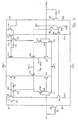
- FIG. 5 illustrates one embodiment of the low bias voltage write driver of the present invention.
- Write driver input W DY is coupled to the input of inverter I2.
- the output of inverter I2 is coupled to the base of NPN transistor Q4.
- the collector of transistor Q4 is coupled to the gate of PMOS FET M23 and to a first terminal of resistor R2.
- the emitter of transistor Q4 is coupled to the resistor R2 is coupled to positive supply PS1.
- the source of FETs M23 and M1 are coupled to positive supply PS1.
- the drain of FET M23 is coupled to the drain of PMOS FET M1, the base of PNP transistor Q6, and the input of Schottky diode D2.
- PMOS FETs M1 and M3, and NPN transistors Q10, Qll and Q13 are part of a current mirror which defines the current that flows through the inductive head across terminals H WX and H wy .
- PMOS FET M23 is a switch which controls the M1 - M3 current source.
- PNP transistor Q6 decreases the turn on time of the M1 - M3 current source.
- Current mirror input IW is coupled to the base of transistor Q13 and the collector of transistor Q10.
- the emitter of transistor Q13 is coupled to the base of transistors Q10 and Q11.
- the emitter of transistor Q10 is coupled to the negative supply through resistor R29.
- the emitter of transistor Qll is coupled to the negative supply through resistor R21.
- the collector of transistor Qll is coupled to the drain of FET M1.
- the output of Schottky diode D2 is coupled to the gates of PMOS FETs M1 and M3, as well as a first terminal of resistor R6.
- the second terminal of resistor R6 is coupled to PS1.
- PMOS FET Mll and NMOS FET M13 form a type of inverter.
- the source of FET Mll is coupled to the emitter of transistor Q6.
- the gates of FETs M11 and M13 are coupled to input W DY .
- the drain of FET Mll is coupled to a first terminal of resistor R11.
- the second terminal of resistor R11 is coupled to the source of FET M13.
- Schottky NPN transistor Q2 forms a lower switch which directs the current through the inductive head across terminals H WX and H wy .
- the base of transistor Q2 is coupled to the source of FET M13.
- the emitter of transistor Q2 is coupled to the negative supply.
- the collector of transistor Q2 is coupled to the drain of PMOS FET M5 and the inductive head across terminals H WX and H wy .
- the source of FET M5 is coupled to the drain of FET M3.
- the gate of FET M5 is coupled to positive supply PS and the collector of transistor Q13.
- the bo dy terminal of FET M5 is coupled to the source of
- Write driver input W DX is coupled to the input inverter I1.
- the output of inverter If is coupled to the base of NPN transistor Q3.
- the collector of transistor Q3 is coupled to the gate of PMOS FET M22 and to positive supply PSI through resistor R1.
- the emitter of Q3 is coupled to the negative supply through resistor R3.
- the sources of FETs M22 and M0 are coupled to PS1.
- the drain of FET M22 is coupled to the drain of PMOS FET M0, the base of PNP transistor Q5, and the input of Schottky diode D1.
- PMOS FETs M0 and M2 and NPN transistors Q10 - Q13 form part of a current mirror which defines the current that flows through the inductive head across terminals H WX and H wy .
- PMOS FET M22 is a switch which controls the M0 - M2 current source.
- PNP transistor Q5 decreases the turn on time of the M0 - M2 current source.
- the base of transistor Q12 is coupled to the bases of transistors Q10 and Qll.
- the emitter of Q12 is coupled to the negative supply through resistor R22.
- the collector of Q12 is coupled to the drain of FET Me.
- the output of Schottky diode D1 is coupled to the gates of PMOS FETs Me and M2, as well as to PSI through resistor R5.
- PMOS FET M10 and NMOS FET M12 form a type of inverter.
- the source of FET M10iS coupled to the emitter of transistor Q5.
- the gates of FETs M10 and M12 are coupled to input W DX .
- the drain of FET M10iS coupled to the source of FET M12 through resistor Rl9.
- the drain of FET M12 is coupled to the negative supply.
- W DX and W DY are CMOS control signals.
- Other embodiments of the present invention can be made using non-CMOS control signals, for example, Emitter Coupled Logic ("ECL”) level control signals.
- Emitter Coupled Logic Emitter Coupled Logic
- Schottky NPN transistor Q1 forms a lower switch which directs the current through the inductive head across terminals H WX and H wy .
- the base of transistor Q1 is coupled to the source of FET M12.
- the emitter of transistor Q1 is coupled to the negative supply.
- the collector of transistor Q1 is coupled to the inductive head across terminals H WX and H wy , and the drain of PMOS FET M4.
- the source of FET M4 is coupled to the drain of FET M2.
- the gate of FET M4 is coupled to the positive supply PS and to the source of FET M10.
- the bo dy terminal of FET M4 is coupled to the source of M4.
- inverter I2 inverts the W DY low signal to turn on transistor Q4.
- Q4 being on lowers the voltage at the gate of PMOS FET M23 turning M23 on. This raises the voltage at the gate of Q6 turning Q6 off and forces current through diode D2, raising the voltage at the gates of PMOS FETs M1 and M3 which turns M1 and M3 off.
- the inverter formed by M10 and M12 inverts the W DX high signal. This turns Schottky NPN transistor Q1 off.
- the inverter formed by Mll and M13 inverts the W DY low signal, which turns Schottky NPN transistor Q2 on.
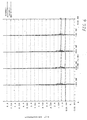
- the head bias voltages during several switching cycles of one embodiment of the present invention is illustrated in Figure 6.
- the solid line in Figure 6 represents the voltage at the H WX side of the write head.
- the dashed line represents the voltage at the H wy side of the write head.
- the transient high voltage swings occur when the current direction through the write head is switched.
- the low stea dy state head bias voltage of the present invention improves the reliability and durability of write heads by reducing the arcing between the head and the recording medium.
- write driver circuits use NPN transistor current sources to drive current through the write head because NPN transistors have a stronger driving ability.
- PMOS FET current sources including M2 - M5, drive current through the write head.
- PMOS FETs are made relatively large so as to provide the high currents required to rapidly switch the direction of current through the head and to induce a sufficient magnetic field to define a bit in the magnetic recording medium.
- the increase in the size of the PMOS FETs increases the gate capacitance of the FETs and thus their turn on time for a given control current.
- POP helper transistors Q5 and Q6 and diodes D1 and D2 increase the switching speed of the FETs.
- Q4 being off raises the voltage at the gate of PMOS FET M23 fuming M23 off.
- Q11 is part of a current mirror which draws current out of the base of PNP transistor Q6 fuming Q6 on.
- Diode D2 isolates the relatively large gate capacitances of M1 and M3 because D2 is reversed biased when the voltage at the base of Q6 is slower than the voltage at the gates of M1 and M3. Isolating the M1 and M3 gate capacitances increases the switching speed of Q6.
- Q6 being on draws current out of the M1 and M3 gates thereby turning M1 and M3 on.
- PNP transistors Q5 and Q6 and diodes D1 and D2 increase the switching speed of the PMOS FET drivers M2 and M3 and compensate for the larger size of these PMOS FETs.
- the present invention may be implemented in a variety of circuit configurations. For example, in one embodiment write driver current sources comprised of M2, M3, M4 and M5 are replaced by PNP transistor current sources. In another embodiment the switches formed by Q1 and Q2 are replaced by NMOS FET switches. Thus a low head bias voltage write driver has been described.
Landscapes
- Engineering & Computer Science (AREA)
- Manufacturing & Machinery (AREA)
- Digital Magnetic Recording (AREA)
Applications Claiming Priority (2)
| Application Number | Priority Date | Filing Date | Title |
|---|---|---|---|
| US725581 | 1991-07-03 | ||
| US08/725,581 US5852526A (en) | 1996-09-25 | 1996-09-25 | Low bias voltage write driver using a low bias voltage to reduce the risk of head arcing |
Publications (2)
| Publication Number | Publication Date |
|---|---|
| EP0833307A2 true EP0833307A2 (de) | 1998-04-01 |
| EP0833307A3 EP0833307A3 (de) | 1999-02-03 |
Family
ID=24915132
Family Applications (1)
| Application Number | Title | Priority Date | Filing Date |
|---|---|---|---|
| EP97116535A Withdrawn EP0833307A3 (de) | 1996-09-25 | 1997-09-23 | Verbesserter Schreibtreiber |
Country Status (5)
| Country | Link |
|---|---|
| US (1) | US5852526A (de) |
| EP (1) | EP0833307A3 (de) |
| JP (1) | JPH10188208A (de) |
| KR (1) | KR19980024898A (de) |
| TW (1) | TW374908B (de) |
Cited By (1)
| Publication number | Priority date | Publication date | Assignee | Title |
|---|---|---|---|---|
| EP1083549A3 (de) * | 1999-09-09 | 2005-05-18 | STMicroelectronics, Inc. | Schaltung und Verfahren zum Schreiben auf einer Speicherplatte |
Families Citing this family (5)
| Publication number | Priority date | Publication date | Assignee | Title |
|---|---|---|---|---|
| US5986832A (en) * | 1996-06-13 | 1999-11-16 | Vtc Inc. | Write driver with Schottky diodes to improve switching rate and reliability |
| JPH10261204A (ja) * | 1997-03-18 | 1998-09-29 | Mitsumi Electric Co Ltd | ヘッドアンプ回路 |
| US6246533B1 (en) * | 1998-07-13 | 2001-06-12 | Agilent Technologies, Inc. | Programmable write driver circuit for writing information to a magnetic storage media |
| JP2000268309A (ja) * | 1999-03-19 | 2000-09-29 | Mitsubishi Electric Corp | 書き込み電流駆動回路 |
| US6278321B1 (en) * | 1999-10-21 | 2001-08-21 | Infineon Technologies Corporation | Method and apparatus for an improved variable gain amplifier |
Family Cites Families (11)
| Publication number | Priority date | Publication date | Assignee | Title |
|---|---|---|---|---|
| JP2531997B2 (ja) * | 1990-03-26 | 1996-09-04 | ティアツク株式会社 | ディジタル記録回路 |
| US5303212A (en) * | 1991-07-11 | 1994-04-12 | Teac Corporation | Low voltage, high current magnetic transducer drive system for digital recording |
| JPH05266405A (ja) * | 1992-03-19 | 1993-10-15 | Fujitsu Ltd | 磁気ヘッドのライト駆動回路 |
| JP2701652B2 (ja) * | 1992-04-08 | 1998-01-21 | 日本電気株式会社 | 磁気ヘッド駆動回路 |
| US5296975A (en) * | 1992-10-09 | 1994-03-22 | International Business Machines Corporation | High-transition-rate, low-supply-voltage write driver circuitry for magnetic inductive write head |
| US5291069A (en) * | 1992-12-15 | 1994-03-01 | International Business Machines Corporation | Bipolar H write driver |
| JPH06325306A (ja) * | 1993-05-11 | 1994-11-25 | Seiko Epson Corp | 磁気ヘッド駆動回路 |
| US5386328A (en) * | 1993-06-18 | 1995-01-31 | Silicon Systems, Inc. | Current mirror based write driver |
| JP3107265B2 (ja) * | 1993-08-06 | 2000-11-06 | キヤノン株式会社 | 磁気ヘッド駆動装置及び磁気記録装置 |
| US5539342A (en) * | 1993-11-09 | 1996-07-23 | International Business Machines Corporation | Low distortion memory write current head drive |
| JPH07270889A (ja) * | 1994-03-30 | 1995-10-20 | Fuji Photo Film Co Ltd | カメラ用磁気記録装置 |
-
1996
- 1996-09-25 US US08/725,581 patent/US5852526A/en not_active Expired - Lifetime
-
1997
- 1997-09-22 JP JP9257130A patent/JPH10188208A/ja active Pending
- 1997-09-23 EP EP97116535A patent/EP0833307A3/de not_active Withdrawn
- 1997-09-24 TW TW086113865A patent/TW374908B/zh not_active IP Right Cessation
- 1997-09-24 KR KR1019970048413A patent/KR19980024898A/ko not_active Ceased
Cited By (1)
| Publication number | Priority date | Publication date | Assignee | Title |
|---|---|---|---|---|
| EP1083549A3 (de) * | 1999-09-09 | 2005-05-18 | STMicroelectronics, Inc. | Schaltung und Verfahren zum Schreiben auf einer Speicherplatte |
Also Published As
| Publication number | Publication date |
|---|---|
| US5852526A (en) | 1998-12-22 |
| TW374908B (en) | 1999-11-21 |
| EP0833307A3 (de) | 1999-02-03 |
| JPH10188208A (ja) | 1998-07-21 |
| KR19980024898A (ko) | 1998-07-06 |
Similar Documents
| Publication | Publication Date | Title |
|---|---|---|
| US5822141A (en) | High speed FET write driver for an inductive head | |
| US5869988A (en) | High speed write driver for inductive heads | |
| US5132852A (en) | Read/write preamplifier with head isolation | |
| US6970316B2 (en) | Write head driver circuit and method for writing to a memory disk | |
| US6456148B2 (en) | Circuit and method for writing to a memory disk | |
| US6429987B1 (en) | High speed inductor current driver with minimum overshoot | |
| US6512645B1 (en) | Circuit and method for writing to a memory disk with a boosted voltage | |
| US6366421B2 (en) | Adjustable writer overshoot for a hard disk drive write head | |
| US5257146A (en) | Magnetic head swing clamp and cross-talk eliminator for read/write preamplifier | |
| US6549353B1 (en) | Overshoot control for a hard disk drive write head | |
| US5852526A (en) | Low bias voltage write driver using a low bias voltage to reduce the risk of head arcing | |
| US6504666B1 (en) | Write head driver circuit and method for writing to a memory disk | |
| US6259305B1 (en) | Method and apparatus to drive the coil of a magnetic write head | |
| US6128146A (en) | Undershoot active damping circuit for write drivers | |
| US6268756B1 (en) | Fast high side switch for hard disk drive preamplifiers | |
| US6400190B1 (en) | Controlled current undershoot circuit | |
| GB2264386A (en) | Self switching head damping | |
| US6512649B1 (en) | Method for differentially writing to a memory disk | |
| KR100288168B1 (ko) | 자기 유도 기록 헤드용 고속 기록 드라이버 | |
| US6580575B1 (en) | Process and temperature resistant active damping circuit for inductive write drivers | |
| US6487030B2 (en) | Write head with switchable impedance and method for operating same | |
| US20030142432A1 (en) | Storage media reading system and semiconductor integrated circuit device | |
| US7113357B2 (en) | Semiconductor device and a disk drive apparatus employing such a semiconductor device | |
| US6867936B2 (en) | Driving circuit for a magnetic head and magnetic recording apparatus | |
| US7382560B2 (en) | Low power servo mode write driver |
Legal Events
| Date | Code | Title | Description |
|---|---|---|---|
| PUAI | Public reference made under article 153(3) epc to a published international application that has entered the european phase |
Free format text: ORIGINAL CODE: 0009012 |
|
| AK | Designated contracting states |
Kind code of ref document: A2 Designated state(s): DE FR GB IT NL |
|
| PUAL | Search report despatched |
Free format text: ORIGINAL CODE: 0009013 |
|
| AK | Designated contracting states |
Kind code of ref document: A3 Designated state(s): AT BE CH DE DK ES FI FR GB GR IE IT LI LU MC NL PT SE |
|
| 17P | Request for examination filed |
Effective date: 19990803 |
|
| AKX | Designation fees paid |
Free format text: DE FR GB IT NL |
|
| 17Q | First examination report despatched |
Effective date: 20020718 |
|
| STAA | Information on the status of an ep patent application or granted ep patent |
Free format text: STATUS: THE APPLICATION IS DEEMED TO BE WITHDRAWN |
|
| 18D | Application deemed to be withdrawn |
Effective date: 20021129 |