EP0835018A1 - Terminal et dispositif de communication - Google Patents
Terminal et dispositif de communication Download PDFInfo
- Publication number
- EP0835018A1 EP0835018A1 EP97116085A EP97116085A EP0835018A1 EP 0835018 A1 EP0835018 A1 EP 0835018A1 EP 97116085 A EP97116085 A EP 97116085A EP 97116085 A EP97116085 A EP 97116085A EP 0835018 A1 EP0835018 A1 EP 0835018A1
- Authority
- EP
- European Patent Office
- Prior art keywords
- connection procedure
- procedure information
- terminal device
- communication terminal
- information
- Prior art date
- Legal status (The legal status is an assumption and is not a legal conclusion. Google has not performed a legal analysis and makes no representation as to the accuracy of the status listed.)
- Withdrawn
Links
Images


Classifications
-
- H—ELECTRICITY
- H04—ELECTRIC COMMUNICATION TECHNIQUE
- H04M—TELEPHONIC COMMUNICATION
- H04M11/00—Telephonic communication systems specially adapted for combination with other electrical systems
- H04M11/08—Telephonic communication systems specially adapted for combination with other electrical systems specially adapted for optional reception of entertainment or informative matter
- H04M11/085—Telephonic communication systems specially adapted for combination with other electrical systems specially adapted for optional reception of entertainment or informative matter using a television receiver, e.g. viewdata system
-
- H—ELECTRICITY
- H04—ELECTRIC COMMUNICATION TECHNIQUE
- H04L—TRANSMISSION OF DIGITAL INFORMATION, e.g. TELEGRAPHIC COMMUNICATION
- H04L67/00—Network arrangements or protocols for supporting network services or applications
- H04L67/01—Protocols
- H04L67/02—Protocols based on web technology, e.g. hypertext transfer protocol [HTTP]
-
- G—PHYSICS
- G06—COMPUTING OR CALCULATING; COUNTING
- G06Q—INFORMATION AND COMMUNICATION TECHNOLOGY [ICT] SPECIALLY ADAPTED FOR ADMINISTRATIVE, COMMERCIAL, FINANCIAL, MANAGERIAL OR SUPERVISORY PURPOSES; SYSTEMS OR METHODS SPECIALLY ADAPTED FOR ADMINISTRATIVE, COMMERCIAL, FINANCIAL, MANAGERIAL OR SUPERVISORY PURPOSES, NOT OTHERWISE PROVIDED FOR
- G06Q50/00—Information and communication technology [ICT] specially adapted for implementation of business processes of specific business sectors, e.g. utilities or tourism
- G06Q50/10—Services
-
- H—ELECTRICITY
- H04—ELECTRIC COMMUNICATION TECHNIQUE
- H04L—TRANSMISSION OF DIGITAL INFORMATION, e.g. TELEGRAPHIC COMMUNICATION
- H04L41/00—Arrangements for maintenance, administration or management of data switching networks, e.g. of packet switching networks
- H04L41/50—Network service management, e.g. ensuring proper service fulfilment according to agreements
- H04L41/508—Network service management, e.g. ensuring proper service fulfilment according to agreements based on type of value added network service under agreement
- H04L41/5096—Network service management, e.g. ensuring proper service fulfilment according to agreements based on type of value added network service under agreement wherein the managed service relates to distributed or central networked applications
-
- H—ELECTRICITY
- H04—ELECTRIC COMMUNICATION TECHNIQUE
- H04L—TRANSMISSION OF DIGITAL INFORMATION, e.g. TELEGRAPHIC COMMUNICATION
- H04L63/00—Network architectures or network communication protocols for network security
- H04L63/04—Network architectures or network communication protocols for network security for providing a confidential data exchange among entities communicating through data packet networks
Definitions
- the present invention relates to a communication terminal device and communication method able to connect to a computer communication network such as the internet or the like.
- log-in procedures In order to connect to a computer network, it is necessary to execute predetermined connection procedures with a provider (Log-in procedures). These log-in procedures involve exchange of predetermined commands with the provider and transmission of a user password and the like so that the procedure execution is time consuming and troublesome.
- the information relating to the connection procedures is prerecorded in a memory of the user's communication terminal device, and when the user wants to communicate with a remote terminal, the connection procedures are automatically executed based on the prerecorded information (automatic logging-in).
- connection procedures information it is necessary for a user to perform a series of operations in order to record the connection procedures information at least the first time and these operations are very troublesome.
- the recording operations for the user who is using many providers are time consuming.
- the recorded connection procedure information needs to be changed at the user side and it is troublesome.
- a first aspect of the present invention provides improvement of a communication terminal device capable of communicating along a computer network. Specifically, it comprises a connection procedure information reception means for receiving from an information source (i.e., host) connection procedure information relating to procedures for connection to the computer network, and a rewritable memory means for memorizing the received connection procedure information.
- the connection procedure information is automatically memorized in the rewritable memory means.
- the communication terminal device may further include a request signal transmission means that transmits to the information source a signal requesting transmission of the connection procedure information.
- the connection procedure information reception means receives the connection procedure information transmitted in response to that request. Accordingly, the connection procedure information is received only when necessary, i.e., only when there is a request from the communication terminal device.
- a second aspect of the present invention provides a unique communication method using a communication terminal device and a host over a computer network.
- the host memorizes the newest connection procedure information relating to the procedures for connection to the computer network.
- the method includes the steps of causing the communication terminal device to request the host transmission of connection procedure information, causing the host to transmit the connection procedure information to the communication terminal device upon the request, causing the communication terminal device to receive this connection procedure information and causing the terminal device to memorize it in a rewritable memory.
- the present invention is also directed to a recording medium for storing various programs to execute the above method.
- One or more computers may execute the steps of the method according to these programs.
- the recording medium may be any suitable device which is able to record computer programs such as a readable semiconductor recording device, a recording medium of a magnetic recording device, a recording medium of a photo-magnetic recording device or the like.
- the recording medium may be a floppy disk, hard disk, optical disk, magneto-optical disk, phase change disk, magnetic tape or the like.
- No password may be included in the connection procedure information transmitted from the host.
- a communication terminal device of the present embodiment transmits image data obtained by scanning of a document as electronic mail and prints out received electronic mail on recording paper as image data.
- the communication terminal device is also provided with a function to communicate with the internet in addition to G3 and G4 facsimile communication functions.
- the internet is used as the computer network in this embodiment. Reception of connection procedure information from a host is performed by a line exchange method.
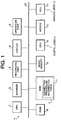
- CPU 1 controls each part of the communication terminal device T via a bus 12 and runs softwares for coding, decoding, image conversion, binary text conversion, mail editing, communication procedures and the like which will be described later.
- a scanner 2 scans an image on a document by a CCD (Charge Coupled Device) and outputs it as bi-level (i.e., white and black) image data.
- a recording part 3 is provided with a printer such as a laser xerographic printer and records on recording paper image data received from a remote G3 of G4 facsimile device or the internet.
- a display 4 comprising a LCD (Liquid Crystal Display) or the like indicates an operating state of the communication terminal device T or image data.
- An operation part 5 is provided with various function keys necessary for operations of the communication terminal device T such as a numeric key pad, speed dial key, one-touch dial key and the like.
- the numeric key pad and one-touch dial key may be used to input characters such as letters of the alphabet.
- ROM (Read Only Memory) 6 stores the programs necessary for operations of the communication terminal device T.
- RAM (Random Access Memory) 7 comprises SRAM (Static Random Access Memory) or flash memory (Flash EEPROM; Flash Electrically Erasable Programmable Read Only Memory) or the like as a rewritable memory means and temporarily memorizes data generated upon execution of the programs.
- RAM 7 also memorizes a user password of the communication terminal device T and a connection procedure information table T1 (see Figure 3: will be described later).
- An image memory 8 comprises DRAM (Dynamic Random Access Memory) or the like and temporarily memorizes the image data which is to be transmitted or the image data received.
- DRAM Dynamic Random Access Memory
- DSU (Digital Service Unit) 9 connects to digital lines L1.
- the data on the digital lines L1 is sent in accordance with a baseband transmission method. Accordingly, the DSU 9 converts the transmission data (or a digital signal) to a voltage change and sends it along the digital lines L1.
- the DSU 9 receives the data from a remote facsimile, it converts the voltage change of the digital lines L1 into a digital signal.
- the DSU 9 is provided with functions that generate and detect each type of facsimile control signal.
- Modem 10 is for carrying out modulation and demodulation of the transmission and reception data and is provided with data modem functions as well as conventional fax modem functions.
- NCU (Network Control Unit) 11 controls line connection to and disconnection from the analog lines L2 and is also provided with functions that transmit a dial pulse corresponding to a third party's fax number and detect an incoming call.
- the means for receiving connection procedure information from the host ( Figure 4) and the means for transmitting a request signal to the host H are constituted by the CPU 1, ROM 6, RAM 7, DSU 9, modem 10 and NCU 11.
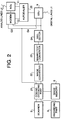
- Figure 2 shows major parts used for processing of data inside the communication terminal device T of the present embodiment. It should be noted that in the same drawing, a coding/decoding part 21, image conversion part 22, binary text conversion part 23, mail editor 24 and auto-dialer 25 are parts having functions which the CPU 1 executes based on the programs memorized in the ROM 6.
- a coding/decoding part 21 codes and decodes the image data by a coding method such as MH (Modified Huffman) method, MR (Modified Read) method, MMR (Modified MR) method or the like.
- MH Modified Huffman
- MR Modified Read
- MMR Modified MR
- the image memory 8 memorizes this G3 format image data.
- An image conversion part 22 converts the G3 format image data at the time of transmission into TIFF (Tag Image File Format) which is a general image format used by computers and at the time of reception converts TIFF into G3 format image data.
- TIFF is a standard format for image files proposed by Aldus, Inc. of America (Currently, taken over by Adobe Systems, Inc.). It does not define the standard data format but uses the properties or attributes of image data as TAG information. Due to this, when using the TIFF format, the format of the data may be recognized by reading the standardized TAG information written in a first couple of hundreds of bytes of the image file.
- TIFF defines various classes: not only a class for bi-level (i.e., white and black) images but also classes for gray scale images as well as full color images.
- Class F which is one of those classes defines G3 format image data. Accordingly, the G3 format image data can be converted to TIFF data by attaching TIFF header information of Class F to the start of the G3 format image data.
- TIFF image data the G3 format image data to which has been added TIFF header information of Class F is called "TIFF image data".
- the binary/text conversion part 23 converts the binary data into text data at times of transmission and converts the text data into binary data at times of reception.
- Text data handled by the internet is defined as a 7-bit code in RFC (Request for Comments) 822, i.e., a document published by IETF (Internet Engineering Task Force).
- the binary text converter part 23 performs conversion of the data using a MIME (Multipurpose Internet Mail Extensions) base 64 or the like.
- MIME Multipurpose Internet Mail Extensions
- MIME is defined by RFC 1521 (which defines the MIME header), RFC 1522 and RFC 1590.
- the mail editor 24 attaches mail header information to the TIFF image data (the TIFF image data has been converted to text data at this point) and edits it to electronic mail format at times of transmission and, at times of reception, removes the mail header information from the data in the electronic mail format and only takes out the TIFF image data which has been converted to text data.
- predetermined header information to electronic mail of the internet is regulated, items Such as "From:” (sender), “To:” (recipient), “Subject:”, “Cc:” (multiple addressees), "Date:” and the like are attached to the beginning of the TIFF image data at times of transmission.
- An autodialer 25 sends the telephone number data of the third party to the DSU 9, modem 10 or NCU 11 which are able to call the telephone number read out from the connection procedure information table T1 in the RAM 7.
- connection procedure information table T1 memorized in the RAM 7 will be described using Figure 3.
- connection procedure information table T1 As shown in Figure 3, information showing a particular provider name, log-in procedure information for this provider (in short, information relating to the procedures for connection to a particular internet via this provider) and telephone number information of the provider are memorized in the connection procedure information table T1. Accordingly, the CPU 1 ( Figure 1) automatically executes log-in procedures based on the data in this connection procedure information table T1. As a result, the communication terminal device T connects to the desired internet via the provider and enables the communication of electronic mail over the internet.
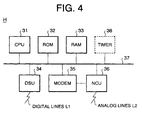
- the host H is provided with a DSU 34, modem 35 and NCU 36 similar to the communication terminal device T and is capable of G3 and G4 facsimile communication.
- CPU 31 not only controls each part of the host H via a bus 37 but also executes the programs and the like for transmission of connection procedure information to the communication terminal device T.
- ROM 32 memorizes the programs necessary for the operations of the host H.
- RAM 33 is comprised of SRAM, a flash memory or the like and temporarily memorizes the data generated during execution of the programs. Furthermore, the newest connection procedure information (log-in procedure information) for a plurality of providers is memorized in the RAM 33. This connection procedure information is always updated with the newest connection procedure information by the operator of the service center (a facility in which the host H is located).
- DSU (Digital Service Unit) 34 is an interface unit for transmission and reception of data to and from digital lines L1.
- Modem 35 is a modulation/demodulation device for transmission and reception of data to and from analog lines L2.
- NCU (Network Control Unit) 36 connects the analog lines L2 with the modem 35. It also converts dialing information from a dialer into a dial pulse.
- the digital lines L1 is a digital circuit such as ISDN (Integrated Service Digital Network).
- the analog lines L2 is an analog telephone circuit such as PSTN (Public Switched Telephone Network).
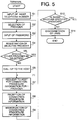
- the telephone number of the host is entered by the user using a key pad or the like of the operation part 5 (S1).
- one provider from among the plurality of providers to which the user is contracted is selected by the user using the key pad or the like of the operation part 5 (S2) and the password is entered (S3).
- the processing proceeds to the next step. If the passwords are not the same, the processing is not advanced to the next step until they coincide with each other.
- S1 to S5 are performed in accordance with instruction screens or similar shown in the display part 4.
- an instruction screen for a recording operation is displayed in the display part 4 by a key operation of the operation part 5.
- the telephone number, provider name and password are entered.
- a message such as "Would you like to choose another provider? YES...1, NO...0" is displayed in the display part 4.
- the processing returns to S2 and if a "0" key is pressed, the processing advances to S6.
- the selection of another provider is performed by returning to S2.
- the telephone number of the host H entered at S1 is dialed (S6).
- a transmission request for connection procedure information for the first selected provider is made to the host H (S7).
- this transmission request is performed using a facsimile control procedure signal for example.
- information indicative of the provider is included in the NSC signal (Non-Standard Facilities Command) and this NSC signal is transmitted to the host from the communication terminal device T as a transmission request signal for connection procedure information.
- an NSS signal (Non-Standard Facilities Set-up) carrying the connection procedure information for the designated provider is transmitted from the host H.
- This NSS signal is also a facsimile control signal.
- connection procedure information When the connection procedure information is received (S8), it is stored in the connection procedure information table T1 of the RAM 7 (S9). In short, the information in a particular area of the connection procedure information table T1 corresponding to the provider designated by the NSC signal is rewritten with the newest connection procedure information. It should be noted that when the provider specified by the NSC signal is a new provider and there is no information relating to that new provider in the connection procedure information table T1, the received connection procedure information as well as the provider name is written into a vacant area of the connection procedure information table T1.
- the user password necessary for execution of log-in procedures between the provider and the communication terminal device T is not included in the connection procedure information from the host H. Accordingly, this password is registered separately by a key operation of the operation part 5 of the device T by the user himself.
- a determination (S10) is performed of whether connection with another provider is desired, in short, whether another provider has been selected at the aforementioned S5 and S2.
- a transmission request for this second provider connection procedure information is made to the host H by returning to S7, and the steps S8 to S10 are repeated.
- no other provider has been specified No at S10
- the lines are disconnected (S11) and the processing is concluded.
- connection procedure information When a line is established (S21) based on a dialing from the communication terminal device T to the host H at S6 of Figure 5, a determination is performed of whether there is a transmission request for connection procedure information based on the NSC signal received from the communication terminal device T (S22). In this particular embodiment, presence or absence of a transmission request is determined by determining whether there is information in the received NSC signal which expresses the provider. When there has been a request for connection procedure information, the connection procedure information corresponding to the provider designated in the received NSC signal is read from the RAM 33 and transmitted to the communication terminal device T (S23). It should be noted that, as explained earlier, no password is included in this connection procedure information.
- the processing is returned to S22 to determine whether there is a further transmission request for another connection procedure information.
- it is determined that there is no further transmission request for connection procedure information.
- a determination is performed of whether a predetermined time period has elapsed or not after establishing a line at S21 or after S23 (S24).
- a predetermined time period has elapsed, the lines are disconnected (S25) and this processing is concluded. If the predetermined time period has not elapsed, the processing returns to S22 to monitor arrival of a next request.
- All or most of the steps shown in Figures 5 and 6 may be executed by one or more computers according various programs. These programs may be stored in a particular recording medium.
- a recording medium may be any suitable device which is able to record computer programs such as a readable semiconductor recording device, a recording medium of a magnetic recording device, a recording medium of a photo-magnetic recording device or the like.
- the recording medium may be a floppy disk, hard disk, optical disk, magneto-optical disk, phase change disk, magnetic tape or the like. If a personal computer coupled with DSU is used as the communication terminal device of the invention, the necessary programs will be fed to the personal computer from the above-mentioned recording medium.
Landscapes
- Engineering & Computer Science (AREA)
- Signal Processing (AREA)
- Business, Economics & Management (AREA)
- Computer Networks & Wireless Communication (AREA)
- Tourism & Hospitality (AREA)
- Computer Security & Cryptography (AREA)
- Marketing (AREA)
- Economics (AREA)
- Strategic Management (AREA)
- Physics & Mathematics (AREA)
- General Business, Economics & Management (AREA)
- General Physics & Mathematics (AREA)
- Human Resources & Organizations (AREA)
- Theoretical Computer Science (AREA)
- General Health & Medical Sciences (AREA)
- Primary Health Care (AREA)
- Health & Medical Sciences (AREA)
- Computer Hardware Design (AREA)
- Computing Systems (AREA)
- General Engineering & Computer Science (AREA)
- Information Transfer Between Computers (AREA)
- Facsimiles In General (AREA)
- Computer And Data Communications (AREA)
- Data Exchanges In Wide-Area Networks (AREA)
- Communication Control (AREA)
Applications Claiming Priority (2)
| Application Number | Priority Date | Filing Date | Title |
|---|---|---|---|
| JP244598/96 | 1996-09-17 | ||
| JP8244598A JPH1091559A (ja) | 1996-09-17 | 1996-09-17 | 通信端末装置及び通信方法 |
Publications (1)
| Publication Number | Publication Date |
|---|---|
| EP0835018A1 true EP0835018A1 (fr) | 1998-04-08 |
Family
ID=17121112
Family Applications (1)
| Application Number | Title | Priority Date | Filing Date |
|---|---|---|---|
| EP97116085A Withdrawn EP0835018A1 (fr) | 1996-09-17 | 1997-09-16 | Terminal et dispositif de communication |
Country Status (4)
| Country | Link |
|---|---|
| EP (1) | EP0835018A1 (fr) |
| JP (1) | JPH1091559A (fr) |
| KR (1) | KR19980024541A (fr) |
| TW (1) | TW396678B (fr) |
Families Citing this family (2)
| Publication number | Priority date | Publication date | Assignee | Title |
|---|---|---|---|---|
| CN100373969C (zh) * | 2004-06-22 | 2008-03-05 | 中兴通讯股份有限公司 | 一种对phs手机锁网和烧号的方法 |
| JP4690975B2 (ja) * | 2005-12-02 | 2011-06-01 | 株式会社東芝 | 遠方監視制御システムと遠方監視制御方法 |
Citations (3)
| Publication number | Priority date | Publication date | Assignee | Title |
|---|---|---|---|---|
| GB2078465A (en) * | 1980-06-13 | 1982-01-06 | Gen Electric Co Ltd | Data retrieval apparatus |
| CH668522A5 (en) * | 1986-07-04 | 1988-12-30 | Siemens Ag Albis | Utilisation of data displayed on video telephone appts. - providing facility for immediate call to displayed subscriber's telephone number or storage for availability on demand |
| FR2677517A1 (fr) * | 1991-06-10 | 1992-12-11 | Sept | Procede d'accueil et de mise en communication automatiques. |
Family Cites Families (4)
| Publication number | Priority date | Publication date | Assignee | Title |
|---|---|---|---|---|
| JPS6272247A (ja) * | 1985-09-25 | 1987-04-02 | Nec Corp | 端末装置自動接続方式 |
| JP3622356B2 (ja) * | 1996-08-29 | 2005-02-23 | 村田機械株式会社 | 通信端末装置 |
| JPH10262083A (ja) * | 1997-03-17 | 1998-09-29 | Toshiba Corp | 通信ネットワークシステム、ならびに同システムにおけるプロトコルの変換方法、及び同方法がプログラムされ記録された記録媒体 |
| TW367674B (en) * | 1997-07-14 | 1999-08-21 | Murata Machinery Ltd | Communication terminal device with electronic mail function and the communication method of electronic mail |
-
1996
- 1996-09-17 JP JP8244598A patent/JPH1091559A/ja active Pending
-
1997
- 1997-08-20 TW TW086111949A patent/TW396678B/zh not_active IP Right Cessation
- 1997-09-11 KR KR1019970046693A patent/KR19980024541A/ko not_active Ceased
- 1997-09-16 EP EP97116085A patent/EP0835018A1/fr not_active Withdrawn
Patent Citations (3)
| Publication number | Priority date | Publication date | Assignee | Title |
|---|---|---|---|---|
| GB2078465A (en) * | 1980-06-13 | 1982-01-06 | Gen Electric Co Ltd | Data retrieval apparatus |
| CH668522A5 (en) * | 1986-07-04 | 1988-12-30 | Siemens Ag Albis | Utilisation of data displayed on video telephone appts. - providing facility for immediate call to displayed subscriber's telephone number or storage for availability on demand |
| FR2677517A1 (fr) * | 1991-06-10 | 1992-12-11 | Sept | Procede d'accueil et de mise en communication automatiques. |
Also Published As
| Publication number | Publication date |
|---|---|
| KR19980024541A (ko) | 1998-07-06 |
| JPH1091559A (ja) | 1998-04-10 |
| TW396678B (en) | 2000-07-01 |
Similar Documents
| Publication | Publication Date | Title |
|---|---|---|
| US6374291B1 (en) | Communication method and apparatus that employs facsimile to electronic mail conversion through a computer network by way of the internet | |
| JP3593849B2 (ja) | 電子メール機能付ファクシミリ装置 | |
| KR100298839B1 (ko) | 통신단말장치 | |
| EP0837592A2 (fr) | Dispositif terminal de communication | |
| JP3166680B2 (ja) | 電子メール機能付通信端末装置 | |
| EP0835018A1 (fr) | Terminal et dispositif de communication | |
| US6714315B1 (en) | Communication system and its control method, and computer readable memory | |
| US7119917B2 (en) | Facsimile server device | |
| US7403312B2 (en) | Communication terminal device | |
| JP3551719B2 (ja) | 電子メール機能付通信端末装置 | |
| JP3298474B2 (ja) | 電子メール機能付通信端末装置 | |
| JP3622356B2 (ja) | 通信端末装置 | |
| JP3586979B2 (ja) | 通信端末装置 | |
| JP3463535B2 (ja) | 電子メール機能付通信端末装置 | |
| JPH10126600A (ja) | 通信端末装置 | |
| JPH1168825A (ja) | 電子メール機能付通信端末装置 | |
| JP3196664B2 (ja) | 通信端末装置 | |
| KR100345642B1 (ko) | 통신방법및통신단말장치 | |
| JPH11205374A (ja) | 電子メール機能付通信端末装置及び記録媒体 | |
| JPH1146278A (ja) | 電子メール機能付通信端末装置及びこの装置によって読み取り可能な記録媒体 | |
| US7502132B2 (en) | Facsimile apparatus | |
| JP3791142B2 (ja) | 電子メール機能付ファクシミリ装置 | |
| JPH10107839A (ja) | 通信端末装置 | |
| JPH1042065A (ja) | 通信端末装置 | |
| JP3591232B2 (ja) | 電子メール機能付通信端末装置 |
Legal Events
| Date | Code | Title | Description |
|---|---|---|---|
| PUAI | Public reference made under article 153(3) epc to a published international application that has entered the european phase |
Free format text: ORIGINAL CODE: 0009012 |
|
| AK | Designated contracting states |
Kind code of ref document: A1 Designated state(s): DE GB |
|
| 17P | Request for examination filed |
Effective date: 19980527 |
|
| AKX | Designation fees paid |
Free format text: DE GB |
|
| RBV | Designated contracting states (corrected) |
Designated state(s): DE GB |
|
| STAA | Information on the status of an ep patent application or granted ep patent |
Free format text: STATUS: THE APPLICATION HAS BEEN WITHDRAWN |
|
| 17Q | First examination report despatched |
Effective date: 20030827 |
|
| 18W | Application withdrawn |
Effective date: 20030826 |