EP0835329B1 - Alliage fritte de densite elevee et procede de spheroidisation pour poudres pre-alliees - Google Patents
Alliage fritte de densite elevee et procede de spheroidisation pour poudres pre-alliees Download PDFInfo
- Publication number
- EP0835329B1 EP0835329B1 EP95923157A EP95923157A EP0835329B1 EP 0835329 B1 EP0835329 B1 EP 0835329B1 EP 95923157 A EP95923157 A EP 95923157A EP 95923157 A EP95923157 A EP 95923157A EP 0835329 B1 EP0835329 B1 EP 0835329B1
- Authority
- EP
- European Patent Office
- Prior art keywords
- article
- temperature
- process according
- sintered
- sintering
- Prior art date
- Legal status (The legal status is an assumption and is not a legal conclusion. Google has not performed a legal analysis and makes no representation as to the accuracy of the status listed.)
- Expired - Lifetime
Links
- 238000000034 method Methods 0.000 title claims abstract description 60
- 239000000843 powder Substances 0.000 title claims abstract description 53
- 229910045601 alloy Inorganic materials 0.000 title description 13
- 239000000956 alloy Substances 0.000 title description 13
- XEEYBQQBJWHFJM-UHFFFAOYSA-N Iron Chemical compound [Fe] XEEYBQQBJWHFJM-UHFFFAOYSA-N 0.000 claims abstract description 39
- OKTJSMMVPCPJKN-UHFFFAOYSA-N Carbon Chemical compound [C] OKTJSMMVPCPJKN-UHFFFAOYSA-N 0.000 claims abstract description 27
- 238000005245 sintering Methods 0.000 claims abstract description 26
- 229910052742 iron Inorganic materials 0.000 claims abstract description 21
- 239000000203 mixture Substances 0.000 claims abstract description 19
- 239000010439 graphite Substances 0.000 claims abstract description 15
- 229910002804 graphite Inorganic materials 0.000 claims abstract description 15
- 239000000314 lubricant Substances 0.000 claims abstract description 12
- 238000003825 pressing Methods 0.000 claims abstract description 11
- 238000002156 mixing Methods 0.000 claims abstract description 7
- 238000005056 compaction Methods 0.000 claims abstract description 5
- 150000001247 metal acetylides Chemical class 0.000 claims description 18
- 238000010438 heat treatment Methods 0.000 claims description 13
- 229910052750 molybdenum Inorganic materials 0.000 claims description 9
- ZOKXTWBITQBERF-UHFFFAOYSA-N Molybdenum Chemical compound [Mo] ZOKXTWBITQBERF-UHFFFAOYSA-N 0.000 claims description 8
- 238000001816 cooling Methods 0.000 claims description 8
- 239000011733 molybdenum Substances 0.000 claims description 8
- IJGRMHOSHXDMSA-UHFFFAOYSA-N Atomic nitrogen Chemical compound N#N IJGRMHOSHXDMSA-UHFFFAOYSA-N 0.000 claims description 6
- 229910052739 hydrogen Inorganic materials 0.000 claims description 6
- 239000001257 hydrogen Substances 0.000 claims description 6
- 238000004519 manufacturing process Methods 0.000 claims description 6
- 238000010791 quenching Methods 0.000 claims description 5
- 230000000171 quenching effect Effects 0.000 claims description 4
- UFHFLCQGNIYNRP-UHFFFAOYSA-N Hydrogen Chemical compound [H][H] UFHFLCQGNIYNRP-UHFFFAOYSA-N 0.000 claims description 3
- 150000002431 hydrogen Chemical class 0.000 claims description 3
- 229910052757 nitrogen Inorganic materials 0.000 claims description 3
- 238000001556 precipitation Methods 0.000 claims description 3
- XOOUIPVCVHRTMJ-UHFFFAOYSA-L zinc stearate Chemical compound [Zn+2].CCCCCCCCCCCCCCCCCC([O-])=O.CCCCCCCCCCCCCCCCCC([O-])=O XOOUIPVCVHRTMJ-UHFFFAOYSA-L 0.000 claims description 2
- 229910052751 metal Inorganic materials 0.000 abstract description 32
- 239000002184 metal Substances 0.000 abstract description 32
- 229910052799 carbon Inorganic materials 0.000 description 15
- 229910000975 Carbon steel Inorganic materials 0.000 description 10
- 239000000047 product Substances 0.000 description 10
- 229910000831 Steel Inorganic materials 0.000 description 9
- 239000010959 steel Substances 0.000 description 9
- 229910000621 Ultra-high-carbon steel Inorganic materials 0.000 description 7
- 229910001566 austenite Inorganic materials 0.000 description 5
- 150000002739 metals Chemical class 0.000 description 5
- 239000002245 particle Substances 0.000 description 5
- 239000007921 spray Substances 0.000 description 5
- 230000015572 biosynthetic process Effects 0.000 description 4
- 239000012535 impurity Substances 0.000 description 4
- 239000000463 material Substances 0.000 description 4
- 229910000859 α-Fe Inorganic materials 0.000 description 4
- 229910000734 martensite Inorganic materials 0.000 description 3
- XKRFYHLGVUSROY-UHFFFAOYSA-N Argon Chemical compound [Ar] XKRFYHLGVUSROY-UHFFFAOYSA-N 0.000 description 2
- 229910001021 Ferroalloy Inorganic materials 0.000 description 2
- 239000000654 additive Substances 0.000 description 2
- 239000000853 adhesive Substances 0.000 description 2
- 238000010586 diagram Methods 0.000 description 2
- 229910052500 inorganic mineral Inorganic materials 0.000 description 2
- 238000002844 melting Methods 0.000 description 2
- 230000008018 melting Effects 0.000 description 2
- 239000011707 mineral Substances 0.000 description 2
- 235000010755 mineral Nutrition 0.000 description 2
- 229910052759 nickel Inorganic materials 0.000 description 2
- 238000004663 powder metallurgy Methods 0.000 description 2
- 239000000126 substance Substances 0.000 description 2
- 238000011282 treatment Methods 0.000 description 2
- 230000001070 adhesive effect Effects 0.000 description 1
- 238000004458 analytical method Methods 0.000 description 1
- 229910052786 argon Inorganic materials 0.000 description 1
- 238000005452 bending Methods 0.000 description 1
- 230000005540 biological transmission Effects 0.000 description 1
- 239000010962 carbon steel Substances 0.000 description 1
- 229910001567 cementite Inorganic materials 0.000 description 1
- 229910052804 chromium Inorganic materials 0.000 description 1
- 230000006835 compression Effects 0.000 description 1
- 238000007906 compression Methods 0.000 description 1
- 229910052802 copper Inorganic materials 0.000 description 1
- 230000007423 decrease Effects 0.000 description 1
- 238000009826 distribution Methods 0.000 description 1
- 238000005516 engineering process Methods 0.000 description 1
- 238000005242 forging Methods 0.000 description 1
- 239000007788 liquid Substances 0.000 description 1
- 238000003754 machining Methods 0.000 description 1
- 229910052748 manganese Inorganic materials 0.000 description 1
- 239000011159 matrix material Substances 0.000 description 1
- 239000013528 metallic particle Substances 0.000 description 1
- 230000007935 neutral effect Effects 0.000 description 1
- 229910052760 oxygen Inorganic materials 0.000 description 1
- 238000010587 phase diagram Methods 0.000 description 1
- 229910052698 phosphorus Inorganic materials 0.000 description 1
- 239000011148 porous material Substances 0.000 description 1
- 239000012255 powdered metal Substances 0.000 description 1
- 239000002244 precipitate Substances 0.000 description 1
- 230000000717 retained effect Effects 0.000 description 1
- 229910052717 sulfur Inorganic materials 0.000 description 1
- 230000000930 thermomechanical effect Effects 0.000 description 1
- 239000011573 trace mineral Substances 0.000 description 1
- 235000013619 trace mineral Nutrition 0.000 description 1
- 230000009466 transformation Effects 0.000 description 1
- 230000007704 transition Effects 0.000 description 1
Images




Classifications
-
- C—CHEMISTRY; METALLURGY
- C22—METALLURGY; FERROUS OR NON-FERROUS ALLOYS; TREATMENT OF ALLOYS OR NON-FERROUS METALS
- C22C—ALLOYS
- C22C33/00—Making ferrous alloys
- C22C33/02—Making ferrous alloys by powder metallurgy
- C22C33/0257—Making ferrous alloys by powder metallurgy characterised by the range of the alloying elements
- C22C33/0264—Making ferrous alloys by powder metallurgy characterised by the range of the alloying elements the maximum content of each alloying element not exceeding 5%
-
- C—CHEMISTRY; METALLURGY
- C21—METALLURGY OF IRON
- C21D—MODIFYING THE PHYSICAL STRUCTURE OF FERROUS METALS; GENERAL DEVICES FOR HEAT TREATMENT OF FERROUS OR NON-FERROUS METALS OR ALLOYS; MAKING METAL MALLEABLE, e.g. BY DECARBURISATION OR TEMPERING
- C21D1/00—General methods or devices for heat treatment, e.g. annealing, hardening, quenching or tempering
- C21D1/26—Methods of annealing
- C21D1/32—Soft annealing, e.g. spheroidising
-
- C—CHEMISTRY; METALLURGY
- C22—METALLURGY; FERROUS OR NON-FERROUS ALLOYS; TREATMENT OF ALLOYS OR NON-FERROUS METALS
- C22C—ALLOYS
- C22C33/00—Making ferrous alloys
- C22C33/02—Making ferrous alloys by powder metallurgy
-
- B—PERFORMING OPERATIONS; TRANSPORTING
- B22—CASTING; POWDER METALLURGY
- B22F—WORKING METALLIC POWDER; MANUFACTURE OF ARTICLES FROM METALLIC POWDER; MAKING METALLIC POWDER; APPARATUS OR DEVICES SPECIALLY ADAPTED FOR METALLIC POWDER
- B22F2998/00—Supplementary information concerning processes or compositions relating to powder metallurgy
Definitions
- This invention relates to a method or process of forming a sintered article of powder metal having a high density and in particular relates to a process of forming a sintered article from powdered metal by use of a pre-alloyed powder as the base material and adding graphite and other additives thereto and then high temperature sintering of the article in a reducing atmosphere to produce sintered parts having a high density.
- this invention relates to a process of forming a sintered article of powder metal having a high density by blending graphite with a pre-alloyed iron based powder containing molybdenum followed by heat treatment to spheroidize the carbides in the microstructure to produce an article with combined high strength and toughness.
- Powder metal technology is well known to the persons skilled in the art and generally comprises the formation of metal powders which are compacted and then subjected to an elevated temperature so as to produce a sintered product.
- United States Patent 2,289,569 relates generally to powder metallurgy and more particularly to a low melting point alloy powder and to the usage of the low melting point alloy powders in the formation of sintered articles.
- the modulus of elasticity and toughness of conventional powder metal articles is limited by density.
- Conventional powder metal processes are limited to approximately 7.12 g/cc by single press, single sinter techniques. At added cost double press, double sintering can be used to increase density.
- United States Patent No. 2,027,763 which relates to a process of making sintered hard metal and consists essentially of steps connected with the process in the production of hard metal.
- United States Patent No. 2,027,763 relates to a process of making sintered hard metal which comprises producing a spray of dry, finely powdered mixture of fusible metals and a readily fusible auxiliary metal under high pressure producing a spray of adhesive agent customary for binding hard metals under high stress, and so directing the sprays that the spray of metallic powder and the spray of adhesive liquid will meet on their way to the molds, or within the latter, whereby the mold will become filled with a compact moist mass of metallic powder and finally completing the hard metallic particle thus formed by sintering.
- United States Patent No. 4,707,332 teaches a process for manufacturing structural parts from intermetallic phases capable of sintering by means of special additives which serve at the same time as sintering assists and increase the ductility of the finished structural product.
- United States Patent No. 4,464,206 relates to a wrought powder metal process for pre-alloyed powder.
- United States Patent No. 4,464,206 teaches a process comprising the steps of communinuting substantially non-compactable pre-alloyed metal powders so as to flatten the particles thereof heating the communinuted particles of metal powder at an elevated temperature, with the particles adhering and forming a mass during heating, crushing the mass of metal powder, compacting the crushed mass of metal powder, sintering the metal powder and hot working the metal powder into a wrought product.
- WO94/05822 discloses the formation of an article by powder metallurgy.
- the article is formed by blending elemental iron, carbon, ferro alloy and lubricant.
- the blend is pressed under a pressure of 25 to 50 tonnes/in 2 in a neutral or reducing atmosphere, and is sintered at a temperature of 1250° to 1350°C.
- the present invention provides a process of manufacturing an article by the powder metallurgical route, comprising blending 0.8 to 2.0 wt % graphite and lubricant with a pre-alloyed iron based powder containing between 0.5 and 3.0 wt % molybdenum, the blend containing no elemental powder, pressing the blended mixture to shape in a single compaction stage, then high temperature sintering the pressed article in a reducing atmosphere to produce a sintered article having a density greater than 7.4 g/cc, rapidly cooling the sintered article from the austenitic phase, and heating the article to near the A1 temperature, to rapidly spheroidize the carbides and minimise their precipitation along the grain boundaries.
- the invention provides an improved process for producing sintered articles having improved dynamic strength characteristics and an accurate method to control same.
- PM articles with high ductility can be produced by spheroidization.
- Further aspects of the invention provide a blend of lubricant, graphite and pre-alloyed iron based powder containing 0.5% to 3.0% molybdenum with substantially no elemental iron, and products made generally in accordance with the method or form the blend of the present invention.
- Ultrahigh carbon steels are carbon steels containing between 0.8% to 2.0% carbon.
- the processes to produce ultra high carbon steels with fine spheroidized carbides are disclosed in United States Patent 3,951,697 as well as in the article by D.R. Lesver, C.K. Syn, A. Goldberg, J. Wadsworth and O.D. Sherby, entitled "The Case for Ultrahigh-Carbon Steels as Structural Materials” appearing in Journal of the Minerals, Metals and Materials Soc., August 1993.
- the invention disclosed herein utilizes high temperature sintering of 1250° to 1350°C and a reducing atmosphere of, for example hydrogen, hydrogen/nitrogen, or in vacuum. Moreover, the reducing atmosphere in combination with the high sintering temperature reduces or cleans off the surface oxides allowing the particles to form good bonds and the compacted article to develop the appropriate strength.
- the lubricant is added in a manner well known to those persons skilled in the art so as to assist in the binding of the powder as well as assisting in the ejecting of the product after pressing.
- An example of lubricant which can be used is Zn stearate.
- the article is formed by pressing the mixture into shape by utilizing the appropriate pressure of, for example, 25 to 50 tonnes per square inch.
- Heat treating stages may be introduced after the sintering stage. Secondary operations such as coining, resizing, machining or the like may be introduced after the sintering stage.
- microstructure of the finished product are improved as they exhibit:
- the percentage of carbon steel lies in the range of up to 0.8% carbon.
- Ultrahigh carbon steels are carbon steels containing between 0.8% to 2% carbon.
- Figure 1 shows the relationship between elongation or ductility versus the carbon content of steels. It is apparent from Figure 1 that the higher the percentage of carbon, the less ductile the steel. Moreover, by reducing the carbon in steels, this also reduces its tensile strength.
- the invention described herein comprises blending graphite and lubricant with a pre-alloyed iron based powder as described herein and illustrated in Figure 6.
- An example of the graphite utilized herein consists of 3203 grade from Asbury but can include other grades of graphite.
- Pre-alloyed powder as used herein consists of a metallic powder composed of two or more elements which are alloyed in the powder manufacturing process, and in which the particles are of the same nominal composition throughout.
- the method described herein may be adapted to produce a high density grade powder metal sintered product having an ultrahigh carbon content with the following composition: Mo 0.5 - 3.0% C in the form of graphite 0.8 to 2.0% Fe and other unavoidable impurities the remainder
- the graphite is blended with the lubricant and the pre-alloyed iron based powder containing molybdenum and is then compacted by conventional pressing methods to a minimum of 6.8 g/cc. Sintering then occurs in a vacuum, or in a vacuum under partial backfill (ie. bleed in argon or nitrogen), or pure hydrogen, or a mixture of H 2 /N 2 at a temperature of 1250°C to 1350°C and in particular 1270°C to 1310°C.
- the vacuum typically occurs at approximately 200 microns.
- the single step compaction typically occurs preferably between 6.8 g/cc to 7.1 g/cc.
- hi-density as sintered articles greater than 7.4 g/cc can be produced in a single compression single sinter stage rather than by a double pressing, double sintering process.
- hi-density sintered articles can be produced having a sintered density of 7.4 g/cc to 7.7 g/cc.
- Such hi-density sintered articles may be used for articles requiring the following characteristics, namely:
- Figure 2 shows the relationship between the density of a sintered article and the modulus. It is apparent from Figure 2 that the higher the density the higher the modulus.
- a high density sintered alloy can be produced via supersolidus sintering.
- an alloy having a sintered density of 7.6 g/cc may be produced by single stage compaction and sintering at 1280°C to 1310°C under vacuum, or in a reducing atmosphere containing H 2 /N 2 .
- the commercially available pre-alloy referred to above consists of .85% molybdenum pre-alloyed with iron and unavoidable impurities.
- the existence of unavoidable impurities is well known to those persons skilled in the art.
- the sintered ultrahigh carbon steel article produced in accordance with the method described herein exhibits a hi-density although the article will tend to be brittle for the reasons described above.
- the brittleness occurs due to the grain boundary carbides 50, which are formed as shown in Figure 3.
- the grain boundary carbides 50 will precipitate during the austenite to ferrite transformation during cooling.
- iron has a ferrite and austenite phase.
- up to 0.02% carbon can be dissolved in ferrite or (alpha) phase, and up to 2.0% in the austenite or (gamma) phase.
- the transition temperature between the ferrite and austenite phase is approximately 727°C as illustrated in Figure 7.
- Spheroidizing is any process of heating and cooling steel that produces a rounded or globular form of carbide.
- Spheroidization is the process of heat treatment that changes embrittling grain boundary carbides and other angular carbides into a rounded or globular form.
- the spheroidization process is time consuming and uneconomical as the carbides transform to a rounded form only very slowly.
- full spheroidization required long soak times at temperature.
- One method to speed the process is to use thermomechanical treatments, which combines mechanical working and heat to cause more rapid spheroidization. This process is not suited to high precision, net shape parts and also has cost disadvantages.
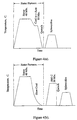
- FIG. 4a is a graph which illustrates this method for spheroidization. The process of figure 4a is also illustrated in Figure 6. The quenching which is illustrated graphically in Figure 4a may occur by oil quenching.
- parts are sintered as described above, in the first stage, but allowed to cool to room temperature as shown in Figure 4b.
- the sintered microstructure will therefore contain the embrittling carbides.
- the second stage is carried out on a separate heat treatment line, whereby parts are austentised at approximately 1000°C to dissolve the carbides, and oil quenched, followed by spheroidization.
- Such sintered parts may be used in the spheroidized condition or further heat treated for very high strength components.
- the ultrahigh carbon steel powder metal may also be conventionally heat treated after spheroidization, partially dissolving the spheroidized carbides, for very high strength and durability, such as:
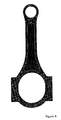
- hi-density sintered alloy connecting rods can be produced in accordance with the hi-density sintered alloy method described herein, as well as the ultra-high carbon steel as described herein.
- automobile connecting rods can be manufactured having the following compositions: Mo 0.6% to 3.0% C 0.8% to 2.0% Fe balance plus unavoidable impurities
- components may show a certain degree of distortion.
- a sintered con-rod may have a side elevational taper from top (narrower) to bottom (wider) and variable shrinkage from part to part.
- Spheroidization as described herein results in sintered parts having high ductility thereby permitting the part to be precision cold coined, achieving good dimensional accuracy.
- Figure 8 illustrates variations in dimension X of Figure 5 in the as spheroidized condition using the QMP AT 4401 composition referred to earlier with 1.5% graphite, as well as the variation after coining.
- Figure 8 shows an approximate variation in the as spheroidized condition of approximately 2.94 to 2.99 inches while the coined variation is approximately 2.975 to 2.98 inches.
Landscapes
- Chemical & Material Sciences (AREA)
- Engineering & Computer Science (AREA)
- Materials Engineering (AREA)
- Mechanical Engineering (AREA)
- Metallurgy (AREA)
- Organic Chemistry (AREA)
- Physics & Mathematics (AREA)
- Thermal Sciences (AREA)
- Crystallography & Structural Chemistry (AREA)
- Powder Metallurgy (AREA)
Claims (10)
- Procédé pour fabriquer un article par la voie de la métallurgie des poudres, comprenant
le mélangeage de 0,8 à 2,0 % de graphite et d'un lubrifiant avec une poudre à base de fer préallié contenant entre 0,5 et 3,0 % en poids de molybdène, le mélange ne contenant pas de fer élémentaire,
la compression du mélange pour mettre en forme en une seule étape de compactage,
puis le frittage à température élevée de l'article compressé dans une atmosphère réductrice pour produire un article fritté ayant une densité supérieure à 7,4 g/cc,
le refroidissement rapide de l'article fritté à partir de la phase austénite,
et le chauffage de l'article à une température proche de la température A1, pour sphéroïdiser rapidement les carbures et minimiser leur précipitation le long des joints de grains. - Procédé selon la revendication 1, dans lequel ladite atmosphère réductrice est l'hydrogène, un mélange hydrogène/azote, le vide, ou un vide avec remplissage partiel.
- Procédé selon la revendication 2, dans lequel ledit frittage est effectué à une température entre 1250°C et 1350°C.
- Procédé selon la revendication 3, dans lequel ledit frittage est effectué à une température entre 1270°C et 1310°C.
- Procédé selon l'une quelconque des revendications précédentes, dans lequel la poudre à base de fer préallié est mélangée avec environ 1,5 % de graphite et un lubrifiant.
- Procédé selon la revendication 5, dans lequel ledit mélange est compressé à une densité d'environ 6,8 g/cc avant le frittage.
- Procédé selon l'une quelconque des revendications précédentes, dans lequel les étapes de refroidissement et de sphéroïdisation comprennent :(a) le refroidissement dudit article fritté dans un four de frittage juste à environ la température ACM ;(b) une trempe rapide dudit article en-dessous de 200°C ;(c) puis l'élévation de la température jusqu'à près de la température A1 pour sphéroïdiser rapidement lesdits carbures.
- Procédé selon l'une quelconque des revendications 1 à 6, dans lequel les étapes de refroidissement et de sphéroïdisation comprennent :(a) le refroidissement dudit article fritté dans un four de frittage ;(b) l'austénitisation dudit article dans une unité de traitement thermique à 1000°C pendant 30 minutes ;(c) une trempe dans l'huile ;(d) puis l'élévation de la température jusqu'à près de la température A1 pour sphéroïdiser rapidement ledit article.
- Procédé selon l'une quelconque des revendications précédentes, dans lequel ledit lubrifiant comprend du stéarate de zinc.
- Procédé selon l'une quelconque des revendications précédentes, dans lequel ladite poudre à base de fer préallié contient essentiellement 0,85% de molybdène.
Applications Claiming Priority (1)
| Application Number | Priority Date | Filing Date | Title |
|---|---|---|---|
| PCT/CA1995/000395 WO1997001651A1 (fr) | 1995-06-29 | 1995-06-29 | Alliage fritte de densite elevee et procede de spheroidisation pour poudres pre-alliees |
Publications (2)
| Publication Number | Publication Date |
|---|---|
| EP0835329A1 EP0835329A1 (fr) | 1998-04-15 |
| EP0835329B1 true EP0835329B1 (fr) | 2003-03-26 |
Family
ID=4173088
Family Applications (1)
| Application Number | Title | Priority Date | Filing Date |
|---|---|---|---|
| EP95923157A Expired - Lifetime EP0835329B1 (fr) | 1995-06-29 | 1995-06-29 | Alliage fritte de densite elevee et procede de spheroidisation pour poudres pre-alliees |
Country Status (7)
| Country | Link |
|---|---|
| EP (1) | EP0835329B1 (fr) |
| JP (1) | JP3634376B2 (fr) |
| AT (1) | ATE235578T1 (fr) |
| AU (1) | AU2783195A (fr) |
| DE (1) | DE69530129T2 (fr) |
| ES (1) | ES2190454T3 (fr) |
| WO (1) | WO1997001651A1 (fr) |
Families Citing this family (6)
| Publication number | Priority date | Publication date | Assignee | Title |
|---|---|---|---|---|
| US5997805A (en) * | 1997-06-19 | 1999-12-07 | Stackpole Limited | High carbon, high density forming |
| US6143240A (en) * | 1997-11-14 | 2000-11-07 | Stackpole Limited | High density forming process with powder blends |
| AT505699B1 (de) * | 2007-09-03 | 2010-10-15 | Miba Sinter Austria Gmbh | Verfahren zur herstellung eines sintergehärteten bauteils |
| CN103084569B (zh) * | 2013-01-04 | 2015-10-07 | 中南大学 | 一种添加剂活化的低合金含量铁基粉末及其制备烧结材料的方法 |
| WO2015023438A1 (fr) | 2013-08-12 | 2015-02-19 | United Technologies Corporation | Sphéroïdisation de poudre par le biais d'un lit fluidisé |
| CN113182523B (zh) * | 2021-04-15 | 2022-12-30 | 博深股份有限公司 | 一种通过高温压烧制备金刚石刀齿的方法 |
Family Cites Families (6)
| Publication number | Priority date | Publication date | Assignee | Title |
|---|---|---|---|---|
| US4018632A (en) * | 1976-03-12 | 1977-04-19 | Chrysler Corporation | Machinable powder metal parts |
| DE3219324A1 (de) * | 1982-05-22 | 1983-11-24 | Kernforschungszentrum Karlsruhe Gmbh, 7500 Karlsruhe | Verfahren zur pulvermetallurgischen herstellung von formteilen hoher festigkeit und haerte aus si-mn- oder si-mn-c-legierten staehlen |
| CA2104605C (fr) * | 1992-09-09 | 2000-05-02 | Peter Jones | Procede de formation d'un alliage de poudres metalliques |
| JP2919073B2 (ja) * | 1992-12-21 | 1999-07-12 | スタックポール リミテッド | 焼結されたままの圧印加工方法 |
| ATE195276T1 (de) * | 1992-12-21 | 2000-08-15 | Stackpole Ltd | Verfahren zur herstellung von lagern |
| CA2182389C (fr) * | 1994-02-07 | 2001-01-30 | Rohith Shivanath | Alliage fritte haute densite |
-
1995
- 1995-06-29 AT AT95923157T patent/ATE235578T1/de not_active IP Right Cessation
- 1995-06-29 AU AU27831/95A patent/AU2783195A/en not_active Abandoned
- 1995-06-29 EP EP95923157A patent/EP0835329B1/fr not_active Expired - Lifetime
- 1995-06-29 JP JP50405697A patent/JP3634376B2/ja not_active Expired - Fee Related
- 1995-06-29 WO PCT/CA1995/000395 patent/WO1997001651A1/fr not_active Ceased
- 1995-06-29 ES ES95923157T patent/ES2190454T3/es not_active Expired - Lifetime
- 1995-06-29 DE DE69530129T patent/DE69530129T2/de not_active Expired - Fee Related
Also Published As
| Publication number | Publication date |
|---|---|
| ES2190454T3 (es) | 2003-08-01 |
| MX9800397A (es) | 1998-05-31 |
| DE69530129D1 (de) | 2003-04-30 |
| AU2783195A (en) | 1997-01-30 |
| EP0835329A1 (fr) | 1998-04-15 |
| WO1997001651A1 (fr) | 1997-01-16 |
| JPH10512625A (ja) | 1998-12-02 |
| DE69530129T2 (de) | 2003-12-04 |
| JP3634376B2 (ja) | 2005-03-30 |
| ATE235578T1 (de) | 2003-04-15 |
Similar Documents
| Publication | Publication Date | Title |
|---|---|---|
| US5516483A (en) | Hi-density sintered alloy | |
| US5641922A (en) | Hi-density sintered alloy and spheroidization method for pre-alloyed powders | |
| US5476632A (en) | Powder metal alloy process | |
| RU2313420C2 (ru) | Предварительно легированный порошок на основе железа, способ изготовления спеченных изделий и изделие | |
| TWI467031B (zh) | 鐵釩粉末合金 | |
| KR101673484B1 (ko) | 저합금강 분말 | |
| US4954171A (en) | Composite alloy steel powder and sintered alloy steel | |
| EP0917593B1 (fr) | Fabrication d'articles de poudre metallique par frittage, spheroidisation et thermoformage | |
| WO1998040180A1 (fr) | Acier et outil trempe constitue dudit acier, fabriques par un procede de metallurgie des poudres et utilisation dudit acier pour des outils | |
| JP2004530794A (ja) | 冷間加工用鋼材 | |
| CN104711485A (zh) | 低合金钢粉 | |
| US4614544A (en) | High strength powder metal parts | |
| US5834640A (en) | Powder metal alloy process | |
| EP0835329B1 (fr) | Alliage fritte de densite elevee et procede de spheroidisation pour poudres pre-alliees | |
| JP3446322B2 (ja) | 粉末冶金用合金鋼粉 | |
| JP3475545B2 (ja) | 粉末冶金用混合鋼粉及びそれを含む焼結用材料 | |
| EP0334968B1 (fr) | Poudre d'acier allie composite et acier allie fritte | |
| US4321091A (en) | Method for producing hot forged material from powder | |
| JP7666359B2 (ja) | 粉末冶金用鉄基混合粉および鉄基焼結体 | |
| CA2225692A1 (fr) | Alliage fritte de densite elevee et procede de spheroidisation pour poudres pre-alliees | |
| JPH04337001A (ja) | 粉末冶金用低合金鋼粉及びその焼結成形体並びに調質成形体 | |
| MXPA98000397A (es) | Aleacion sinterizada de alta densidad y metodo para la formacion de esferas para polvos de pre-aleacion | |
| EP0846782A1 (fr) | Procédé de préparation d'un alliage à base de métal pulvérulent | |
| JPS59162247A (ja) | 鋳鉄粉焼結体 |
Legal Events
| Date | Code | Title | Description |
|---|---|---|---|
| PUAI | Public reference made under article 153(3) epc to a published international application that has entered the european phase |
Free format text: ORIGINAL CODE: 0009012 |
|
| 17P | Request for examination filed |
Effective date: 19980119 |
|
| AK | Designated contracting states |
Kind code of ref document: A1 Designated state(s): AT BE CH DE DK ES FR GB GR IE IT LI LU MC NL PT SE |
|
| 17Q | First examination report despatched |
Effective date: 19980929 |
|
| GRAH | Despatch of communication of intention to grant a patent |
Free format text: ORIGINAL CODE: EPIDOS IGRA |
|
| GRAH | Despatch of communication of intention to grant a patent |
Free format text: ORIGINAL CODE: EPIDOS IGRA |
|
| GRAA | (expected) grant |
Free format text: ORIGINAL CODE: 0009210 |
|
| AK | Designated contracting states |
Designated state(s): AT BE CH DE DK ES FR GB GR IE IT LI LU MC NL PT SE |
|
| PG25 | Lapsed in a contracting state [announced via postgrant information from national office to epo] |
Ref country code: NL Free format text: LAPSE BECAUSE OF FAILURE TO SUBMIT A TRANSLATION OF THE DESCRIPTION OR TO PAY THE FEE WITHIN THE PRESCRIBED TIME-LIMIT Effective date: 20030326 Ref country code: LI Free format text: LAPSE BECAUSE OF FAILURE TO SUBMIT A TRANSLATION OF THE DESCRIPTION OR TO PAY THE FEE WITHIN THE PRESCRIBED TIME-LIMIT Effective date: 20030326 Ref country code: GR Free format text: LAPSE BECAUSE OF FAILURE TO SUBMIT A TRANSLATION OF THE DESCRIPTION OR TO PAY THE FEE WITHIN THE PRESCRIBED TIME-LIMIT Effective date: 20030326 Ref country code: CH Free format text: LAPSE BECAUSE OF FAILURE TO SUBMIT A TRANSLATION OF THE DESCRIPTION OR TO PAY THE FEE WITHIN THE PRESCRIBED TIME-LIMIT Effective date: 20030326 Ref country code: BE Free format text: LAPSE BECAUSE OF FAILURE TO SUBMIT A TRANSLATION OF THE DESCRIPTION OR TO PAY THE FEE WITHIN THE PRESCRIBED TIME-LIMIT Effective date: 20030326 Ref country code: AT Free format text: LAPSE BECAUSE OF FAILURE TO SUBMIT A TRANSLATION OF THE DESCRIPTION OR TO PAY THE FEE WITHIN THE PRESCRIBED TIME-LIMIT Effective date: 20030326 |
|
| REG | Reference to a national code |
Ref country code: GB Ref legal event code: FG4D |
|
| REG | Reference to a national code |
Ref country code: CH Ref legal event code: EP |
|
| REF | Corresponds to: |
Ref document number: 69530129 Country of ref document: DE Date of ref document: 20030430 Kind code of ref document: P |
|
| REG | Reference to a national code |
Ref country code: IE Ref legal event code: FG4D |
|
| PG25 | Lapsed in a contracting state [announced via postgrant information from national office to epo] |
Ref country code: SE Free format text: LAPSE BECAUSE OF FAILURE TO SUBMIT A TRANSLATION OF THE DESCRIPTION OR TO PAY THE FEE WITHIN THE PRESCRIBED TIME-LIMIT Effective date: 20030626 Ref country code: PT Free format text: LAPSE BECAUSE OF FAILURE TO SUBMIT A TRANSLATION OF THE DESCRIPTION OR TO PAY THE FEE WITHIN THE PRESCRIBED TIME-LIMIT Effective date: 20030626 Ref country code: DK Free format text: LAPSE BECAUSE OF FAILURE TO SUBMIT A TRANSLATION OF THE DESCRIPTION OR TO PAY THE FEE WITHIN THE PRESCRIBED TIME-LIMIT Effective date: 20030626 |
|
| PG25 | Lapsed in a contracting state [announced via postgrant information from national office to epo] |
Ref country code: LU Free format text: LAPSE BECAUSE OF NON-PAYMENT OF DUE FEES Effective date: 20030629 |
|
| PG25 | Lapsed in a contracting state [announced via postgrant information from national office to epo] |
Ref country code: MC Free format text: LAPSE BECAUSE OF NON-PAYMENT OF DUE FEES Effective date: 20030630 Ref country code: IE Free format text: LAPSE BECAUSE OF NON-PAYMENT OF DUE FEES Effective date: 20030630 |
|
| REG | Reference to a national code |
Ref country code: ES Ref legal event code: FG2A Ref document number: 2190454 Country of ref document: ES Kind code of ref document: T3 |
|
| NLV1 | Nl: lapsed or annulled due to failure to fulfill the requirements of art. 29p and 29m of the patents act | ||
| REG | Reference to a national code |
Ref country code: CH Ref legal event code: PL |
|
| ET | Fr: translation filed | ||
| PLBE | No opposition filed within time limit |
Free format text: ORIGINAL CODE: 0009261 |
|
| STAA | Information on the status of an ep patent application or granted ep patent |
Free format text: STATUS: NO OPPOSITION FILED WITHIN TIME LIMIT |
|
| 26N | No opposition filed |
Effective date: 20031230 |
|
| REG | Reference to a national code |
Ref country code: IE Ref legal event code: MM4A |
|
| PGFP | Annual fee paid to national office [announced via postgrant information from national office to epo] |
Ref country code: ES Payment date: 20080626 Year of fee payment: 14 |
|
| PGFP | Annual fee paid to national office [announced via postgrant information from national office to epo] |
Ref country code: IT Payment date: 20080626 Year of fee payment: 14 |
|
| PGFP | Annual fee paid to national office [announced via postgrant information from national office to epo] |
Ref country code: DE Payment date: 20080731 Year of fee payment: 14 |
|
| PGFP | Annual fee paid to national office [announced via postgrant information from national office to epo] |
Ref country code: FR Payment date: 20080617 Year of fee payment: 14 |
|
| PGFP | Annual fee paid to national office [announced via postgrant information from national office to epo] |
Ref country code: GB Payment date: 20080627 Year of fee payment: 14 |
|
| GBPC | Gb: european patent ceased through non-payment of renewal fee |
Effective date: 20090629 |
|
| REG | Reference to a national code |
Ref country code: FR Ref legal event code: ST Effective date: 20100226 |
|
| PG25 | Lapsed in a contracting state [announced via postgrant information from national office to epo] |
Ref country code: FR Free format text: LAPSE BECAUSE OF NON-PAYMENT OF DUE FEES Effective date: 20090630 |
|
| PG25 | Lapsed in a contracting state [announced via postgrant information from national office to epo] |
Ref country code: GB Free format text: LAPSE BECAUSE OF NON-PAYMENT OF DUE FEES Effective date: 20090629 |
|
| PG25 | Lapsed in a contracting state [announced via postgrant information from national office to epo] |
Ref country code: DE Free format text: LAPSE BECAUSE OF NON-PAYMENT OF DUE FEES Effective date: 20100101 |
|
| REG | Reference to a national code |
Ref country code: ES Ref legal event code: FD2A Effective date: 20090630 |
|
| PG25 | Lapsed in a contracting state [announced via postgrant information from national office to epo] |
Ref country code: ES Free format text: LAPSE BECAUSE OF NON-PAYMENT OF DUE FEES Effective date: 20090630 |
|
| PG25 | Lapsed in a contracting state [announced via postgrant information from national office to epo] |
Ref country code: IT Free format text: LAPSE BECAUSE OF NON-PAYMENT OF DUE FEES Effective date: 20090629 |