EP0837588A2 - Système de téléconférence - Google Patents
Système de téléconférence Download PDFInfo
- Publication number
- EP0837588A2 EP0837588A2 EP19970117751 EP97117751A EP0837588A2 EP 0837588 A2 EP0837588 A2 EP 0837588A2 EP 19970117751 EP19970117751 EP 19970117751 EP 97117751 A EP97117751 A EP 97117751A EP 0837588 A2 EP0837588 A2 EP 0837588A2
- Authority
- EP
- European Patent Office
- Prior art keywords
- audio
- storage device
- rate
- audio output
- mode
- Prior art date
- Legal status (The legal status is an assumption and is not a legal conclusion. Google has not performed a legal analysis and makes no representation as to the accuracy of the status listed.)
- Withdrawn
Links
- 238000000034 method Methods 0.000 claims abstract description 25
- 230000006835 compression Effects 0.000 claims abstract description 15
- 238000007906 compression Methods 0.000 claims abstract description 15
- 230000005236 sound signal Effects 0.000 claims description 31
- 230000004913 activation Effects 0.000 claims description 12
- 238000004891 communication Methods 0.000 description 6
- 238000010586 diagram Methods 0.000 description 6
- 230000008569 process Effects 0.000 description 4
- 238000012545 processing Methods 0.000 description 4
- 230000005540 biological transmission Effects 0.000 description 3
- 230000003993 interaction Effects 0.000 description 2
- 230000000670 limiting effect Effects 0.000 description 2
- 238000012986 modification Methods 0.000 description 2
- 230000004048 modification Effects 0.000 description 2
- 230000003213 activating effect Effects 0.000 description 1
- 230000004075 alteration Effects 0.000 description 1
- 238000013500 data storage Methods 0.000 description 1
- 230000000694 effects Effects 0.000 description 1
- 238000005516 engineering process Methods 0.000 description 1
- 230000006870 function Effects 0.000 description 1
- 230000002452 interceptive effect Effects 0.000 description 1
- 230000002093 peripheral effect Effects 0.000 description 1
Images



Classifications
-
- H—ELECTRICITY
- H04—ELECTRIC COMMUNICATION TECHNIQUE
- H04M—TELEPHONIC COMMUNICATION
- H04M3/00—Automatic or semi-automatic exchanges
- H04M3/42—Systems providing special services or facilities to subscribers
- H04M3/42221—Conversation recording systems
-
- H—ELECTRICITY
- H04—ELECTRIC COMMUNICATION TECHNIQUE
- H04M—TELEPHONIC COMMUNICATION
- H04M3/00—Automatic or semi-automatic exchanges
- H04M3/42—Systems providing special services or facilities to subscribers
- H04M3/56—Arrangements for connecting several subscribers to a common circuit, i.e. affording conference facilities
-
- H—ELECTRICITY
- H04—ELECTRIC COMMUNICATION TECHNIQUE
- H04M—TELEPHONIC COMMUNICATION
- H04M2203/00—Aspects of automatic or semi-automatic exchanges
- H04M2203/20—Aspects of automatic or semi-automatic exchanges related to features of supplementary services
- H04M2203/2088—Call or conference reconnect, e.g. resulting from isdn terminal portability
Definitions
- the present invention relates to audio data processing, and, in particular, to methods and apparatus for controlling the flow of audio data during teleconferencing.
- Teleconferencing systems that enable multiple users to participate in a conference are well known in the art.
- Current technology allows large numbers of participants to become involved in conference calls.
- the present invention solves the foregoing problems by providing a teleconferencing system and method that allows a user to pause without missing any of the conversation.
- a pause feature may be activated to allow a user to temporarily exit a teleconference.
- the pause feature may be released, allowing the user to rejoin the conference in real time without missing any of the conversation.
- the system includes an audio receiving device that receives audio signals and an audio output device that outputs audio signals.
- a storage device stores the audio signals received by the audio receiving device as audio data.
- a controller controls information flow between the audio receiving device, the output device, and the storage device.
- the controller includes an audio direct device that allows the systems to operate in a first mode in which input audio signals are sent from the audio receiving device to the audio output device. Activation of the pause feature causes the system to operate in a second mode in which the operation of the audio output device is paused and all audio input is sent to the storage device.
- release of the pause feature allows the system to operate in a third mode in which the storage device sends stored audio data to the output device at a first rate and causes the audio input device to send data to the storage device at a second rate.
- the first rate is faster than the second rate so that the storage device can be emptied and the operation of the audio direct device resumed.
- the user is able to temporarily exit the teleconference call.
- the user can hear all conversation that has taken place since the user exited.
- the conversation is played at a rapid rate, thereby enabling the user to resume participation in the teleconference in real time.
- Fig. 1 is a block diagram that shows the basic structure of a telephone communication system for teleconferencing.
- Individual client terminals 100 1 through 100 n are connected with central communications terminal 600 through network 300. Audio data from each of the client communication terminals is transferred to the central communications terminal 600. After processing the received audio data, the central communications terminal 600 sends appropriate audio signals to each of the client communications terminals 600. Processing involves mixing the audio data so that each client terminal receives all audio data.
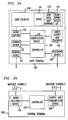
- the pause feature is entirely controlled within the user console 100, as illustrated in Fig. 2(a).
- a pause feature can be activated through the use of the pause activation device 141 of user interface 140. Additional features that may be provided by the user interface 140 include skip back 142 and slow down 143.
- the particular user interface may be any known user interface including, but not limited to, a touch tone interface or a PC based graphic user interface associated with a mouse, keyboard, or touch sensitive screen.
- the graphic user interface could graphically show additional information, such as the current position within speech segments, including the speaker, rate of speech, and the like.
- the interface could include a Web-browser
- User terminal 100 additionally includes an audio capture device 155 for capturing audio from the user and an audio output and playback device 145 for delivering audio output to the user.
- the audio capture device 155 may be any conventional device for capturing sound as digital audio data.
- the audio playback device may also be any conventional device for performing playback of digital audio data.
- An audio receiving device 105 receives audio data from a remote terminal such as central terminal 600.
- the sending device 165 sends audio data to the remote terminal.
- user console 100 comprises compression device 115 (typically, a time-based device, as are known in the art) ) that is operable to compress audio data received by audio receiving device 105.
- the compressed data may be stored in storage device 125.
- Compression device 115 is able to compress the speech by up to a factor of two while remaining intelligible.
- Time based compression algorithms that accelerate the rate of speech without changing its pitch are known in the speech recording art but have not previously been used in conjunction with live interactive speech.
- Storage device 125 is preferably a first-in first-out (FIFO) buffer.
- the buffer has sufficient capacity to store compressed speech during the pause mode initiated by activating pause activation device 141. This type of buffer allows the first bit of data read into memory to be the first bit of data read from memory. The output data of the buffer is faster because it is compressed.
- Controller 120 controls the operation of the pause feature by controlling interaction between the various components of user terminal 100.
- the controller 120 may be implemented as a single special purpose integrated circuit (e.g., ASIC) having a main or central processor section for overall, system level control, and separate circuits dedicated to perform various different specific computations, functions, and other processes under control of the central processor section. It will be appreciated to those skilled in the art that the controller can also be implemented using a plurality of separate dedicated programmable integrated or other electronic circuits or devices.
- the controller can also be implemented using a suitable programmed general purpose computer, e.g., a microprocessor, microcontroller, or other processor device (CPU or MPU) either alone or in conjunction with one or more peripheral data and signal processing devices. In general, any device or assembly of devices capable of implementing the flow chart shown in Figures 4-6 can be used.
- the central terminal as shown in Fig. 2(b) comprises a central audio receiving device 605, a controller 620 for controlling mixing of audio data, and an output device 650 for sending mixed audio data to client terminals 100.
- audio receiving device 105 receives an audio signal a from an outside source such as a the central terminal 600. The signal is then sent directly to output and playback device 145. However, during the pause operation, the controller 120 diverts the received audio signal so that after being received by receiving device 105, the audio signal is sent to compression device 115. The compressed signal is then sent to storage device 125.
- the user When the user again decides to participate in the conversation, the user deactivates the pause activation device 141. Thereafter, data from storage device 125 is directed to the audio output device. The data is output in its compressed form at a faster rate than it is received by receiving device 105. Output is sent to audio output and playback device 145 so that the user may hear the portions of the conference for which he was absent at an accelerated rate.
- audio capture device 155 receives the data from user and sends it as an appropriate signal through sending device 165.
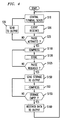
- Fig. 4 illustrates the complete method for implementing the first embodiment of the invention.
- the invention switches modes based on the activation or release of the pause activation device 141.
- the method for operating the apparatus described above involves three distinct modes. All three modes for the first embodiment are illustrated in Fig. 4.
- the first mode or normal operating mode is the straight transmission mode.
- central terminal 600 sends audio signals at S10.
- the client terminal receives these signals.
- the controller determines if the pause feature has been activated. If the feature has not been activated, the process moves to S30.
- the audio signals are transmitted directly to output device and playback device 145.
- the second operating mode occurs upon pause activation. During the second mode it is assumed that the client continues to receive audio data.
- the central terminal 600 sends audio data.
- the client terminal 100 receives audio data. Because the pause feature has been activated as determined at S25, controller 120 in client terminal 100 directs the input audio data to compressor 115 in step S110.
- the compressed audio data is stored in storage device 125. This mode continues until the pause indicator is released as determined at S125.
- the third mode begins when the pause indicator is released at S125. During the third mode it is assumed that the client continues to receive audio data.
- client terminal 100 continues to receive audio data, compress audio data at S130 and store the data at S150 in storage device 125. Simultaneously, at S150, data from the storage device is sent to output and playback device 145.
- S153 it may be desirable to direct the audio into the compressor 115 rather than perform such compression during S110.
- the determination is made whether the storage device is empty. If the storage device is empty, the first mode of operation resumes and received data is sent to output at S160. In other words, the client terminal 100 receives audio data and sends it directly to output device 135 as shown in steps S20 and S30.
- the client terminal 100 continues to receive and compress data and performs steps S130 through S150.
- the teleconferencing system may be controlled at a more central location. This can be accomplished by providing the controller, storage, and compression devices at the teleconferencing bridge.
- the pause feature may be provided as a separate service on a local area network (LAN).
- LAN local area network
- Fig. 3(a) illustrates the user terminal of the second embodiment and Fig. 3(b) illustrates the structure of central terminal 500 of the second embodiment.
- User terminal 200 includes a user interface 240 that is similar to that of the first embodiment.
- a pause activation device 241 on user interface 240 can be activated. Additional features that may be provided at user interface 240 include skip back 242 and slow down 243.
- Audio capture device 255 captures audio from the user and an audio output and playback device 245 delivers audio output to the user.
- An audio receiving device 205 receives audio data from a remote terminal.
- the sending device 265 sends audio data to the remote terminal.
- a controller 220 may control the interaction between the various components.
- the second embodiment differs from the first embodiment in that it is not necessary for the user terminal to have compression or storage devices. These features are incorporated in the central terminal.
- the aforementioned components of the second embodiment may be substantially similar to those described above in relation to the first embodiment.
- Central terminal 500 includes a central audio receiving device 505 for receiving audio data from each of the client terminals 200.
- a controller, 520 selectively mixes the audio data and a central terminal output device and transmitter S545 transmits the mixed audio data back to the client terminals.
- central terminal 500 includes storage device 525 and compression device 515.
- storage device 525 and compression device 515.
- the structure of these devices is substantially similar to that described above in relation to the first embodiment.
- the controller 520 may comprise any of the devices referenced above with respect to the first described embodiment. Likewise, the receiver and transmitter devices may be any of those known in the art.
- the controller 520 of central terminal 500 causes mixing of audio data from all of the client terminals except for the audio data from client terminal 200 1 .
- Central terminal 500 then returns the resulting mixed audio data to client computer 200 1 for playback.
- the client computer 200 1 received mixed audio data corresponding to audio data from all teleconference participants except for its own audio data.
- Central terminal 500 receives not only audio data, but also specific instruction signals from the client terminals.
- the central terminal compresses the mixed audio data for the particular client terminal with compression device 515 and transfers it to storage device 525 (these two steps may be performed in any order).
- the data is continually directed through compression device 515 to storage device 525 until the pause release instruction is received by central terminal 500.
- the data in storage device 525 is directed by the controller 520 directly to transmitting device 545.
- Mixed data continues to be input through the compression device 515 and storage device 525 until the storage device is emptied.
- the storage device is preferably an FIFO buffer.
- the data is retrieved from the device more quickly than it is received by the device. Therefore, at the direction of the controller 520, the storage device 525 eventually empties.
- the controller 520 again directs the mixed audio data directly to the transmission device 545 for return to the selected client terminal.
- the client terminals need not have data storage capabilities such as those described above. However, the client terminals must have the appropriate user interface 240 to create instructions for sending to central terminal 500.
- the necessary features of the client terminal include user interface 240, audio capture device 255, audio output and playback device 245, controller 220, sending device 265, and receiving device 205. These components are substantially similar to those described above and referenced to the first embodiment.
- the user operates the device of the second embodiment in exactly the same manner as in the first embodiment.
- the user's instructions are sent to the central terminal, rather than being processed within the user's own terminal.
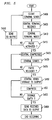
- the first mode is similar to the first mode of the first embodiment of the invention.
- the client terminal sends audio signals at S400.
- the central terminal 500 receives audio data from each client terminal.
- the controller 520 causes the audio data to be mixed at S410.
- the data is mixed so that each user receives data from all other users but does not receive data sent from that user's own terminal.
- the process determines whether pause has been activated. Subsequently, if pause has not been activated, the mixed data is output to the user at S420.
- the second mode begins when the pause feature is activated as determined at S415, and after the data from the client terminals is mixed at central terminal 500 in S410. Thereafter central terminal 500 compresses the data at S425 and stores the data in storage device 525 at S430. These steps continue until it has been determined that pause has been released at S435. Accordingly, no data is sent to the client terminals 100.
- the central terminal 500 Upon release of the pause feature, as determined at S435, the central terminal 500 continues to compress at S440 and store the mixed audio data at S445. At S450, the central terminal sends stored data to the client through output device 545. At S453, it may be desirable to direct the audio into the compressor 115 rather than perform such compression during S425. At S455, the controller determines if the storage device 525 is empty.
- the storage device 525 is empty, the first mode is resumed and the central terminal 500 sends mixed data directly to the client terminals 200. Audio output data is then played back at S450 its original speed as soon as it is received and mixed.
- the central terminal continues to compress and store data and repeats steps S410 through S425 until the storage device is empty.
- Audio data sent at S700 is received at S705 from each client terminal. If at S715, the pause feature has not been activated, the data is mixed at S720 and output at S725.
- the data is compressed at S730 and stored in S735.
- the data is stored at S735 prior to mixing.
- storage space is saved if multiple users activate the pause feature. Rather than saving mixed audio packets for each user, the incoming data from each client terminal is saved only once.
- the second mode of pause activation continues until it is determined at S740 that pause has been released.
- the incoming signals are then compressed at S745 and stored at S750.
- the stored data is mixed at S755 and output upon at S760. This process continues until it is determined that the storage device is empty at S765. When the storage device is empty, the first operating mode is resumed.
- Additional options that may be available in all embodiments of the invention include skip back and slow down modes that may be selected by the user via the user interface. These modes can be implemented with the apparatus described above with the addition of skip back and slow down controls on the user interface.
- the skip back control would allow the user to listen to data already played back.
- the slow down mode would enable slow transmission to the ideal play back device. Both of these modes could be used whether during the live conference or when listening to prerecorded speech.
- the concept of implementing the storage and retrieval system at a central terminal may be incorporated in two ways.
- the central terminal may be a local area network (LAN) terminal in which the teleconferencing time machine feature would be available to the user by subscription.
- the user would select the service via the user interface to forward and would be provided with this service only if the user had previously subscribed.
- LAN local area network
- the central terminal may located at a teleconferencing bridge.
- the user of each station dials a unique telephone number of the conferencing bridge.
- the conferencing bridge is responsive to each incoming call to add that call to the conference.
- the present invention is not limited to the embodiments described above. Various modifications and alterations are possible. Various devices within the system can be combined or modified, so long as the combination of components forms the desired result.
Landscapes
- Engineering & Computer Science (AREA)
- Signal Processing (AREA)
- Multimedia (AREA)
- Telephonic Communication Services (AREA)
- Two-Way Televisions, Distribution Of Moving Picture Or The Like (AREA)
Applications Claiming Priority (2)
| Application Number | Priority Date | Filing Date | Title |
|---|---|---|---|
| US73028096A | 1996-10-15 | 1996-10-15 | |
| US730280 | 1996-10-15 |
Publications (1)
| Publication Number | Publication Date |
|---|---|
| EP0837588A2 true EP0837588A2 (fr) | 1998-04-22 |
Family
ID=24934689
Family Applications (1)
| Application Number | Title | Priority Date | Filing Date |
|---|---|---|---|
| EP19970117751 Withdrawn EP0837588A2 (fr) | 1996-10-15 | 1997-10-14 | Système de téléconférence |
Country Status (3)
| Country | Link |
|---|---|
| EP (1) | EP0837588A2 (fr) |
| JP (1) | JPH10190850A (fr) |
| CA (1) | CA2210832A1 (fr) |
Cited By (5)
| Publication number | Priority date | Publication date | Assignee | Title |
|---|---|---|---|---|
| WO2005125167A1 (fr) * | 2004-06-15 | 2005-12-29 | Lenovo (Beijing) Limited | Systeme d'agence de teleconference |
| US7215954B1 (en) | 1999-03-18 | 2007-05-08 | The Directv Group, Inc. | Resource allocation method for multi-platform communication system |
| EP2192794A1 (fr) * | 2008-11-26 | 2010-06-02 | Oticon A/S | Améliorations dans les algorithmes d'aide auditive |
| WO2012078883A3 (fr) * | 2010-12-08 | 2012-11-01 | Qualcomm Incorporated | Partage de coordonnées entre équipements utilisateur pendant une session de communication de groupe dans système de communication sans fil |
| CN109271206A (zh) * | 2018-08-24 | 2019-01-25 | 晶晨半导体(上海)股份有限公司 | 一种异常现场的内存压缩和保存方法 |
Families Citing this family (2)
| Publication number | Priority date | Publication date | Assignee | Title |
|---|---|---|---|---|
| JP4787071B2 (ja) * | 2006-05-30 | 2011-10-05 | 京セラ株式会社 | サーバ |
| JP4787072B2 (ja) * | 2006-05-30 | 2011-10-05 | 京セラ株式会社 | サーバ |
-
1997
- 1997-07-17 CA CA 2210832 patent/CA2210832A1/fr not_active Abandoned
- 1997-10-14 EP EP19970117751 patent/EP0837588A2/fr not_active Withdrawn
- 1997-10-15 JP JP9280991A patent/JPH10190850A/ja active Pending
Cited By (9)
| Publication number | Priority date | Publication date | Assignee | Title |
|---|---|---|---|---|
| US7215954B1 (en) | 1999-03-18 | 2007-05-08 | The Directv Group, Inc. | Resource allocation method for multi-platform communication system |
| WO2005125167A1 (fr) * | 2004-06-15 | 2005-12-29 | Lenovo (Beijing) Limited | Systeme d'agence de teleconference |
| EP2192794A1 (fr) * | 2008-11-26 | 2010-06-02 | Oticon A/S | Améliorations dans les algorithmes d'aide auditive |
| CN101754081A (zh) * | 2008-11-26 | 2010-06-23 | 奥迪康有限公司 | 助听器算法的改进 |
| US8300861B2 (en) | 2008-11-26 | 2012-10-30 | Oticon A/S | Hearing aid algorithms |
| US8638961B2 (en) | 2008-11-26 | 2014-01-28 | Oticon A/S | Hearing aid algorithms |
| WO2012078883A3 (fr) * | 2010-12-08 | 2012-11-01 | Qualcomm Incorporated | Partage de coordonnées entre équipements utilisateur pendant une session de communication de groupe dans système de communication sans fil |
| EP2953324A1 (fr) * | 2010-12-08 | 2015-12-09 | Qualcomm Incorporated | Partage de coordonnées entre des équipements utilisateur pendant une session de communication de groupe dans un système de communication sans fil |
| CN109271206A (zh) * | 2018-08-24 | 2019-01-25 | 晶晨半导体(上海)股份有限公司 | 一种异常现场的内存压缩和保存方法 |
Also Published As
| Publication number | Publication date |
|---|---|
| CA2210832A1 (fr) | 1998-04-15 |
| JPH10190850A (ja) | 1998-07-21 |
| MX9707860A (es) | 1998-06-28 |
Similar Documents
| Publication | Publication Date | Title |
|---|---|---|
| CA2073893C (fr) | Systeme de teleconference multipoint utilisant des canaux de communication formant un anneau | |
| US5970054A (en) | Multipoint teleconference system employing H. 221 frames | |
| US5434797A (en) | Audio communication system for a computer network | |
| US6163335A (en) | Multiple-mode videoconferencing arrangement | |
| US9838443B2 (en) | Real-time media control for audio and multimedia conferencing services | |
| US20030125064A1 (en) | Method and system for mobile telecommunication | |
| EP2198608A1 (fr) | Commande de directivité audio pour un système de videoconference à commutation multi-écrans | |
| US7425979B2 (en) | Communication system | |
| JPH0662399A (ja) | テレビ電話装置 | |
| JPH06505838A (ja) | デジタル無線電話装置 | |
| EP0837588A2 (fr) | Système de téléconférence | |
| CN114845144B (zh) | 一种投屏方法、辅助投屏装置及存储介质 | |
| JPH08294103A (ja) | 通信端末装置及び通信システム | |
| JP2000236330A (ja) | クライアント・サーバ型デジタル音声会議システムの音声分配方法およびその装置 | |
| MXPA97007860A (es) | Metodo y aparato para pausar y reanudar una señalde habla en vivo | |
| JP3302978B2 (ja) | 電話装置 | |
| JP2588970B2 (ja) | 多地点会議方式 | |
| JPH0267891A (ja) | 画像会議装置 | |
| CN120917730A (zh) | 会议系统、控制装置、控制方法、程序以及记录介质 | |
| JPH10233855A (ja) | 電話システムならびに電話システムの制御方法 | |
| US20050130637A1 (en) | Method for transmitting service data using a discontinuous transmission mode | |
| JPH05111021A (ja) | 画像通信装置 | |
| JPH07298229A (ja) | 通信方法、通信システム及び端末装置 | |
| JP2003259328A (ja) | コンテンツ配信装置、コンテンツ受信装置 | |
| WO1996026609A1 (fr) | Systeme specialise de transmission bidirectionnelle de signaux audio et video |
Legal Events
| Date | Code | Title | Description |
|---|---|---|---|
| PUAI | Public reference made under article 153(3) epc to a published international application that has entered the european phase |
Free format text: ORIGINAL CODE: 0009012 |
|
| AK | Designated contracting states |
Kind code of ref document: A2 Designated state(s): AT BE CH DE DK ES FI FR GB GR IE IT LI LU MC NL PT SE |
|
| AX | Request for extension of the european patent |
Free format text: AL;LT;LV;RO;SI |
|
| STAA | Information on the status of an ep patent application or granted ep patent |
Free format text: STATUS: THE APPLICATION HAS BEEN WITHDRAWN |
|
| 18W | Application withdrawn |
Withdrawal date: 19980819 |