EP0837622A1 - Plasmaerzeuger - Google Patents
Plasmaerzeuger Download PDFInfo
- Publication number
- EP0837622A1 EP0837622A1 EP96116612A EP96116612A EP0837622A1 EP 0837622 A1 EP0837622 A1 EP 0837622A1 EP 96116612 A EP96116612 A EP 96116612A EP 96116612 A EP96116612 A EP 96116612A EP 0837622 A1 EP0837622 A1 EP 0837622A1
- Authority
- EP
- European Patent Office
- Prior art keywords
- plasma generator
- discharging
- dielectric
- plasma
- high voltage
- Prior art date
- Legal status (The legal status is an assumption and is not a legal conclusion. Google has not performed a legal analysis and makes no representation as to the accuracy of the status listed.)
- Ceased
Links
- 239000007789 gas Substances 0.000 claims abstract description 29
- 239000007788 liquid Substances 0.000 claims abstract description 16
- 239000000126 substance Substances 0.000 claims abstract description 15
- 239000007787 solid Substances 0.000 claims abstract description 9
- 238000012545 processing Methods 0.000 claims abstract description 8
- 239000004020 conductor Substances 0.000 claims description 19
- 239000004065 semiconductor Substances 0.000 claims description 18
- 239000003990 capacitor Substances 0.000 claims description 10
- 239000000463 material Substances 0.000 claims description 6
- 239000000203 mixture Substances 0.000 claims description 5
- 230000008878 coupling Effects 0.000 claims description 4
- 238000010168 coupling process Methods 0.000 claims description 4
- 238000005859 coupling reaction Methods 0.000 claims description 4
- 230000010355 oscillation Effects 0.000 claims description 4
- 238000007599 discharging Methods 0.000 claims 12
- 230000001131 transforming effect Effects 0.000 claims 2
- 230000004913 activation Effects 0.000 abstract description 13
- 239000003814 drug Substances 0.000 abstract description 4
- 238000002560 therapeutic procedure Methods 0.000 abstract description 4
- 230000003247 decreasing effect Effects 0.000 abstract description 3
- 238000001994 activation Methods 0.000 abstract description 2
- 230000005495 cold plasma Effects 0.000 abstract description 2
- 238000005516 engineering process Methods 0.000 abstract description 2
- 238000000746 purification Methods 0.000 abstract description 2
- 238000011084 recovery Methods 0.000 abstract description 2
- 208000028659 discharge Diseases 0.000 description 35
- 238000000034 method Methods 0.000 description 20
- 230000008569 process Effects 0.000 description 19
- 238000004804 winding Methods 0.000 description 14
- 238000010586 diagram Methods 0.000 description 13
- 230000006698 induction Effects 0.000 description 12
- 239000002245 particle Substances 0.000 description 11
- 230000006870 function Effects 0.000 description 10
- 229910052751 metal Inorganic materials 0.000 description 10
- 239000002184 metal Substances 0.000 description 10
- 230000005284 excitation Effects 0.000 description 9
- 239000012530 fluid Substances 0.000 description 7
- 239000000443 aerosol Substances 0.000 description 6
- 230000003287 optical effect Effects 0.000 description 5
- 238000012546 transfer Methods 0.000 description 5
- XKRFYHLGVUSROY-UHFFFAOYSA-N Argon Chemical compound [Ar] XKRFYHLGVUSROY-UHFFFAOYSA-N 0.000 description 4
- 239000013078 crystal Substances 0.000 description 4
- 239000011521 glass Substances 0.000 description 4
- 238000006467 substitution reaction Methods 0.000 description 4
- 238000013461 design Methods 0.000 description 3
- 239000006185 dispersion Substances 0.000 description 3
- -1 for instance Substances 0.000 description 3
- 238000010438 heat treatment Methods 0.000 description 3
- 230000001939 inductive effect Effects 0.000 description 3
- 230000007935 neutral effect Effects 0.000 description 3
- 239000010453 quartz Substances 0.000 description 3
- VYPSYNLAJGMNEJ-UHFFFAOYSA-N silicon dioxide Inorganic materials O=[Si]=O VYPSYNLAJGMNEJ-UHFFFAOYSA-N 0.000 description 3
- XLYOFNOQVPJJNP-UHFFFAOYSA-N water Substances O XLYOFNOQVPJJNP-UHFFFAOYSA-N 0.000 description 3
- 229910000859 α-Fe Inorganic materials 0.000 description 3
- 229910000906 Bronze Inorganic materials 0.000 description 2
- 230000005668 Josephson effect Effects 0.000 description 2
- XUIMIQQOPSSXEZ-UHFFFAOYSA-N Silicon Chemical compound [Si] XUIMIQQOPSSXEZ-UHFFFAOYSA-N 0.000 description 2
- 229910052786 argon Inorganic materials 0.000 description 2
- 230000000712 assembly Effects 0.000 description 2
- 238000000429 assembly Methods 0.000 description 2
- 239000010974 bronze Substances 0.000 description 2
- 238000006243 chemical reaction Methods 0.000 description 2
- KUNSUQLRTQLHQQ-UHFFFAOYSA-N copper tin Chemical compound [Cu].[Sn] KUNSUQLRTQLHQQ-UHFFFAOYSA-N 0.000 description 2
- 125000004122 cyclic group Chemical group 0.000 description 2
- 208000037265 diseases, disorders, signs and symptoms Diseases 0.000 description 2
- 230000005672 electromagnetic field Effects 0.000 description 2
- 230000005674 electromagnetic induction Effects 0.000 description 2
- PCHJSUWPFVWCPO-UHFFFAOYSA-N gold Chemical compound [Au] PCHJSUWPFVWCPO-UHFFFAOYSA-N 0.000 description 2
- 239000010931 gold Substances 0.000 description 2
- 229910052737 gold Inorganic materials 0.000 description 2
- 239000001307 helium Substances 0.000 description 2
- 229910052734 helium Inorganic materials 0.000 description 2
- SWQJXJOGLNCZEY-UHFFFAOYSA-N helium atom Chemical compound [He] SWQJXJOGLNCZEY-UHFFFAOYSA-N 0.000 description 2
- 238000004020 luminiscence type Methods 0.000 description 2
- 229910052754 neon Inorganic materials 0.000 description 2
- GKAOGPIIYCISHV-UHFFFAOYSA-N neon atom Chemical compound [Ne] GKAOGPIIYCISHV-UHFFFAOYSA-N 0.000 description 2
- 238000007747 plating Methods 0.000 description 2
- 230000010287 polarization Effects 0.000 description 2
- 239000000843 powder Substances 0.000 description 2
- 239000000523 sample Substances 0.000 description 2
- 229910052710 silicon Inorganic materials 0.000 description 2
- 239000010703 silicon Substances 0.000 description 2
- 230000005418 spin wave Effects 0.000 description 2
- 230000009466 transformation Effects 0.000 description 2
- 230000001052 transient effect Effects 0.000 description 2
- 230000007704 transition Effects 0.000 description 2
- 230000005641 tunneling Effects 0.000 description 2
- 235000012431 wafers Nutrition 0.000 description 2
- OKTJSMMVPCPJKN-UHFFFAOYSA-N Carbon Chemical compound [C] OKTJSMMVPCPJKN-UHFFFAOYSA-N 0.000 description 1
- RYGMFSIKBFXOCR-UHFFFAOYSA-N Copper Chemical compound [Cu] RYGMFSIKBFXOCR-UHFFFAOYSA-N 0.000 description 1
- 239000004593 Epoxy Substances 0.000 description 1
- ZOKXTWBITQBERF-UHFFFAOYSA-N Molybdenum Chemical compound [Mo] ZOKXTWBITQBERF-UHFFFAOYSA-N 0.000 description 1
- 229910000831 Steel Inorganic materials 0.000 description 1
- 239000004809 Teflon Substances 0.000 description 1
- 229920006362 Teflon® Polymers 0.000 description 1
- RTAQQCXQSZGOHL-UHFFFAOYSA-N Titanium Chemical compound [Ti] RTAQQCXQSZGOHL-UHFFFAOYSA-N 0.000 description 1
- QCWXUUIWCKQGHC-UHFFFAOYSA-N Zirconium Chemical compound [Zr] QCWXUUIWCKQGHC-UHFFFAOYSA-N 0.000 description 1
- 238000009825 accumulation Methods 0.000 description 1
- 230000009471 action Effects 0.000 description 1
- 229910045601 alloy Inorganic materials 0.000 description 1
- 239000000956 alloy Substances 0.000 description 1
- 230000015572 biosynthetic process Effects 0.000 description 1
- 239000003054 catalyst Substances 0.000 description 1
- 230000000739 chaotic effect Effects 0.000 description 1
- 239000002131 composite material Substances 0.000 description 1
- 150000001875 compounds Chemical class 0.000 description 1
- 238000010276 construction Methods 0.000 description 1
- 229910052802 copper Inorganic materials 0.000 description 1
- 239000010949 copper Substances 0.000 description 1
- 238000012937 correction Methods 0.000 description 1
- 230000001419 dependent effect Effects 0.000 description 1
- 238000011161 development Methods 0.000 description 1
- 201000010099 disease Diseases 0.000 description 1
- 208000035475 disorder Diseases 0.000 description 1
- 239000000428 dust Substances 0.000 description 1
- 230000000694 effects Effects 0.000 description 1
- 238000010891 electric arc Methods 0.000 description 1
- 230000005684 electric field Effects 0.000 description 1
- 230000002349 favourable effect Effects 0.000 description 1
- 239000007888 film coating Substances 0.000 description 1
- 238000009501 film coating Methods 0.000 description 1
- 229920002313 fluoropolymer Polymers 0.000 description 1
- 229910002804 graphite Inorganic materials 0.000 description 1
- 239000010439 graphite Substances 0.000 description 1
- 239000001257 hydrogen Substances 0.000 description 1
- 229910052739 hydrogen Inorganic materials 0.000 description 1
- 125000004435 hydrogen atom Chemical class [H]* 0.000 description 1
- 230000010354 integration Effects 0.000 description 1
- 230000003993 interaction Effects 0.000 description 1
- 230000004807 localization Effects 0.000 description 1
- 230000007246 mechanism Effects 0.000 description 1
- 150000002739 metals Chemical class 0.000 description 1
- 238000012986 modification Methods 0.000 description 1
- 230000004048 modification Effects 0.000 description 1
- 229910052750 molybdenum Inorganic materials 0.000 description 1
- 239000011733 molybdenum Substances 0.000 description 1
- 229910052758 niobium Inorganic materials 0.000 description 1
- 239000010955 niobium Substances 0.000 description 1
- GUCVJGMIXFAOAE-UHFFFAOYSA-N niobium atom Chemical compound [Nb] GUCVJGMIXFAOAE-UHFFFAOYSA-N 0.000 description 1
- 230000007170 pathology Effects 0.000 description 1
- 238000010248 power generation Methods 0.000 description 1
- 230000000630 rising effect Effects 0.000 description 1
- 238000001228 spectrum Methods 0.000 description 1
- 239000010959 steel Substances 0.000 description 1
- 229910052715 tantalum Inorganic materials 0.000 description 1
- GUVRBAGPIYLISA-UHFFFAOYSA-N tantalum atom Chemical compound [Ta] GUVRBAGPIYLISA-UHFFFAOYSA-N 0.000 description 1
- 230000001225 therapeutic effect Effects 0.000 description 1
- 229910052726 zirconium Inorganic materials 0.000 description 1
Images








Classifications
-
- H—ELECTRICITY
- H01—ELECTRIC ELEMENTS
- H01J—ELECTRIC DISCHARGE TUBES OR DISCHARGE LAMPS
- H01J37/00—Discharge tubes with provision for introducing objects or material to be exposed to the discharge, e.g. for the purpose of examination or processing thereof
- H01J37/32—Gas-filled discharge tubes
- H01J37/32009—Arrangements for generation of plasma specially adapted for examination or treatment of objects, e.g. plasma sources
-
- H—ELECTRICITY
- H01—ELECTRIC ELEMENTS
- H01J—ELECTRIC DISCHARGE TUBES OR DISCHARGE LAMPS
- H01J37/00—Discharge tubes with provision for introducing objects or material to be exposed to the discharge, e.g. for the purpose of examination or processing thereof
- H01J37/32—Gas-filled discharge tubes
- H01J37/32009—Arrangements for generation of plasma specially adapted for examination or treatment of objects, e.g. plasma sources
- H01J37/32018—Glow discharge
- H01J37/32045—Circuits specially adapted for controlling the glow discharge
-
- H—ELECTRICITY
- H05—ELECTRIC TECHNIQUES NOT OTHERWISE PROVIDED FOR
- H05H—PLASMA TECHNIQUE; PRODUCTION OF ACCELERATED ELECTRICALLY-CHARGED PARTICLES OR OF NEUTRONS; PRODUCTION OR ACCELERATION OF NEUTRAL MOLECULAR OR ATOMIC BEAMS
- H05H1/00—Generating plasma; Handling plasma
- H05H1/24—Generating plasma
- H05H1/46—Generating plasma using applied electromagnetic fields, e.g. high frequency or microwave energy
-
- H—ELECTRICITY
- H05—ELECTRIC TECHNIQUES NOT OTHERWISE PROVIDED FOR
- H05H—PLASMA TECHNIQUE; PRODUCTION OF ACCELERATED ELECTRICALLY-CHARGED PARTICLES OR OF NEUTRONS; PRODUCTION OR ACCELERATION OF NEUTRAL MOLECULAR OR ATOMIC BEAMS
- H05H2240/00—Testing
- H05H2240/20—Non-thermal plasma
-
- H—ELECTRICITY
- H05—ELECTRIC TECHNIQUES NOT OTHERWISE PROVIDED FOR
- H05H—PLASMA TECHNIQUE; PRODUCTION OF ACCELERATED ELECTRICALLY-CHARGED PARTICLES OR OF NEUTRONS; PRODUCTION OR ACCELERATION OF NEUTRAL MOLECULAR OR ATOMIC BEAMS
- H05H2277/00—Applications of particle accelerators
- H05H2277/10—Medical devices
Definitions
- the present invention relates to a plasma generator, more specifically, to a plasma generator to apply cold plasma in the fields of medicine, biology, ecological recovery, activation, purification, special processing of gases, liquids and solid substances as well as other areas of technology and science.
- Plasmotrons which can generate plasma under normal atmospheric pressure conditions with temperature up to thousands degrees Celsius are well known in the art.
- the thermal heating of plasma is actived by classical electromagnetic induction, via induction heating of electrically conducting media in alternating electromagnetic field of the inductor.
- the device consists of high voltage AC generator, quartz pipe-shaped case and liquid-cooled inductor, an inductance coil having large numbers of turns.
- a multi-turn inductor of 0.1 m diameter is essentially required, the inductor reactance being raised greatly at 1 MHz and higher frequencies.
- the prior art plasmotron has revealed some drawbacks of large dimensions, poor efficiency and very high plasma temperature, which, in turn, restricted its operational features considerably, especially in medicine, biology and ecological treatment.
- the other types of plasma generator have been used in electric discharge therapy device which comprise electronic oscillator, modulation unit, output resonance transformer and rod-like discharge electrode.
- a plasma beam is induced between the end of the electrode and the biological object.
- the electronic oscillator produces oscillations in 200 kHz through 300 kHz frequency range.
- the modulator which can be constructed in transistors periodically switches on and off the signal of the oscillator at about 3 kHz to 5 kHz rate.
- the modulator provides impact excitation of resonance transformer circuit, which brings about measured output emission in a form of corona discharge between the electrode and the object.
- the device produces favorable therapeutic effect to treat a number of diseases, disorders, pathologies, mainly due to the induced heat in the specified areas of body.
- the device has also revealed shortcomings that the discharge transformation from corona to spark form may be appeared and the conduction currents origination directly in the tissue.
- the classical corona and spark discharge inevitably results in ionization, electric break-through and thermal heating of the air gap between the inducing electrode and the body which is used as the second electrode.
- direct resonance action of the device by virtue of field is shunted as a result of ionization of substantial medium and chaotic heat motion of particles in the discharge area.
- a primary object of the invention is, therefore, to provide a universal plasma generator with decreased mass and dimensions which provides unipolar plasma for plasma therapy and activation of substantial media by virtue of the field.
- a plasma generator of the invention comprises:
- FIG. 1 a structural circuit diagram of the plasma generator of the present invention is shown schematically.
- the plasma generator employs a conventional DC power source (7), which consists of AC voltage reducing transformer (8), bridge rectifier (9) and capacitor filter (10).
- the structure of the primary resonance circuit (13) constituting the electronic oscillator (1) involves non-linear capacitor (17) as well as the input low voltage section (14) of the resonance transformer (4).
- the primary resonance circuit (13) also includes an amplifying (control) element (3), e.g., a transistor.
- the plasma generator is optionally equipped with a drive unit (2) which is connected to the amplifying (control) element (3) and provides cyclic switching on and off of the amplifying (control) element (3) or another special drive mode.
- the drive unit (2) can be made with an electronic integrated circuit or diode-resistor assembly.
- the parametric resonance transformer (4) can be realized as an induction multi-turn coil transformer. In many cases, it makes sense to furnish the resonance transformer (4) with ferrite core (22). Feedback section (23) of the resonance transformer (4) is connected to control input (27) of the amplifying (control) element (3). A junction capacitor (26), correction resistors (28, 29) and diode (30) can be used for optimal operational conditions.
- the high voltage output section (31) of the resonance transformer (4) that is the secondary multilayer winding, is placed directly at the ferrite core (22). This high voltage output section (31) consists of inductive layers (32, 33, 34 and so on), whose number can be 10 to 20.
- the layer capacitance (35, 36, 37) which forms a cell (38) of transfer line in conjunction with the inductive layers.
- the line is combined with the electric circuit of the parametric transformer secondary winding.
- the lead (39) of the secondary winding internal layer is connected to rod-like electrode (6) in plasma head (5) via dividing (coupling) capacitor (41).
- the lead (42) of the secondary winding external layer can be either isolated or connected to the lead (16) of the primary winding (14).
- the primary winding (14) can be winded in one layer atop the secondary winding.
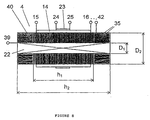
- the feedback winding (23) can be made as one turn placed at the symmetry plane, in the central part of the resonance transformer (4) ( see : Fig. 8).
- the resonance transformer (4) and the dividing high-voltage capacitor (41) can be assembled in dielectric cylinder casing (43) such as fluoroplastic and teflon so on.
- the plasma head (5) can be a kind of dielectric cap (44) with thread or fingered bushing coupling, fastener (46) at the seat (45) to the front end (47) of the casing.
- the electronic oscillations are supplied over the input (48) at the rear end (49) of the casing.
- the discharge rod-like electrode (6) has sharp, pointed emitter (50).
- the electrode (6) can be made, for instance, of bronze and it can have electrically conducting film coating, plating (51), for instance, gold.
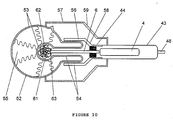
- the plasma head is a kind of double-wall dielectric (glass) bulb (52).
- the space between the walls (55) can be filled with low pressure (for example, 1 to 20 mm Hg, that is 133.3 to 2,667 newton per square meter), normal atmospheric pressure or high pressure gas of a neutral gas, for example, helium, argon, neon, etc.
- the discharge electrode (6) comes to the internal cavity (61) of the bulb, the cavity volume is uniformly, evenly filled with electrically conducting substance (62) such as steel or copper cuts (chips), which has electric contact with the discharge electrode (63).
- the bulb is fixed to the casing (43) by means of dielectric adapters (56, 57, 58, 59).
- the plasma generator of the invention is a non-linear electronic device which generates unipolar (from one electrode) soliton mode discharge.
- the features of the unipolar discharge are dependent on resonance adjustment (amplitude, frequency, phase), on power level and high voltage level and on the type of the plasma head.
- the plasma head like the one depicted in Fig. 9B is optimum for plasma therapy in general and for plasma puncture in particular, because the plasma beam can be generated about 10 mm length and less than 1 mm diameter.
- the plasma head given in Fig. 10 forms three-dimensional (solid) discharges which are close to spherical symmetry of several types. These varying, moving cord-like discharges which diffuse three-dimensional discharges present soliton analogs of corona and spark discharges in linear circuits and devices.
- a non-linear cyclic transient of reactive energy accumulation and conversion is formed in the generalized resonance circuit (in terms of electric circuitry and field).
- the modulating transistor (3) induces free reactive power twice a period of free sine-shaped oscillation of charge (dQ 0 ) and magnetic flow (d ⁇ 0 ) at the moments of the network switching on and off. This free reactive power is emitted and absorbed by the resonance circuit.
- Non-linear features of the parametric resonance circuit are defined by three non-linear components: i.e., non-linear capacitor (17), ferrite core (22) and key-mode component (3) (for instance, transistor).
- the resonance circuit non-linearity and dispersion in terms of field processes are determined not only by the materials of the network components, but by the design of the network.
- the network integrates elements which function as transfer line, forming line and step-up transformer.
- the induction resonance process in this system differs from classical soliton excitation in electronic device.
- Combination, integration of various functions in single device brings about resonance matching of the generating resonance circuit and the load (which is the discharge). This resonance matching appears in stable field and plasma-optical solitons induced by plasma head (5).
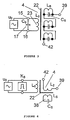
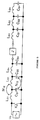
- the schematic diagram of the primary resonance circuit characterized by generalized parameters ⁇ Q 0 , ⁇ 0 , i 0 , u 0 , L 0 , C 0 ⁇ in accordance widh the equations (1) and circuitry design of Fig. 2A can be converted into a set of substitute schematic diagrams.
- This set of substitute schematic diagrams displays the development of the induction process both in time and in the proper space of the generalized resonance circuit. Possible variants of such substitute schematic diagram set are represented in Figs. 3 to 5.
- Figs. 6 and 7 depict some features of the induction process.
- L S and C S denote inductance and capacitance of layers of the resonance transformer secondary winding (31). These layers function as transfer line for the sine-shaped signal (u 0 ) and they function as forming line at the moments of the key component (transistor) driving to conduction and driving to cut-off (the key component is shown in Fig. 5 as K S ). If all the layers have the same number of turns we can roughly consider wherein,
- Figs. 2B and 2C illustrate the mechanism of the spatial reactive currents generation in the circuit given in Fig. 2A.
- the current-against-voltage curve of the key component (transistor) which drives to cut-off at the moment II has the shape of triangle. This triangle bounds an area proportional to the valve reactive power. Given the direction of tracing as shown with arrows in Fig. 2B this power is negative S v ⁇ 0. It means that the Poynting's flow generation takes place in the circuit.
- the key component (3) is driving to conduction this energy is, oppositely, absorbed S v >0.
- a current source i 0 acts in the generalized network.
- Formula (3) demonstrates that this current source i 0 forms the parametric part of the induction process i 0 dL 0 /dt.
- the transient under consideration is described by Mathieu equation which is at definite initial conditions equivalent to non-linear Schrödinger equation. The latter characterizes soliton excitations in the system.
- Fig. 6A shows the current versus voltage characteristic of the double forming line ( see : Fig. 5) which is the generating part of the parametric resonance circuit ( see : Fig. 2).
- Fig. 7 presents one of the variants of soliton waves in the parametric circuit.
- the discharge process starts and completes at the same single electrode.
- the soliton has a core and a tail ("fur-coat"):
- the core is observed as a bright luminescence (thin layer) around the main electrode and it contains more than 90% of all the energy generated by the parametric circuit, where all generated energy is defined by the area within the current-against-voltage curve in Fig. 6A and the soliton tail contains small part of energy and it forms filaments, cords similar to plasma or diffuse luminescence.
- the discharge from the single electrode can be in the form of corona, spark or arc discharge.
- the discharge current J appears as a result of tunneling of the reactive current (or Poynting's flow) through dielectric layer.
- the plasma generator presents a reactive analog of Josephson effect device.
- u 0 corresponds to the potential difference at the Josephson contact.
- the stable form of the soliton reactive current depends on the generalized resonance circuit non-linearity and dispersion which are defined by non-linear materials and geometrical proportions of the transformer ( see : Fig. 8).
- the material was bronze and plating was gold.
- the accommodating (dividing, decoupling) capacitor (41) before the rod-like electrode changes the soliton core localization and the conventional potential difference at the Josephson contact. Thus the requirements of plasmapuncture are met (to reduce the output potential ⁇ 0 ).
- the value of 2-50 pF is practical.
- the power consumption of medical, biological applications of the generator does not exceed 2-40 W.
- the output potential ⁇ 0 0.5-10 kV.
- the carrier resonance frequency f 0 20-200 kHz.
- the rod-like electrode with pointed emitter provides for visible plasma beam formation about 10 mm length, tens or hundreds of micrometer diameter. This is fairly useful, functional for plasma-puncture.
- Any functional part of the invented plasma generator can be combined, either completely or in a certain portion, with another functional part (or other functional parts) in a single unit, component, device (in a number of units, components, devices).
- the discharge electrode made of electrically conducting material can have another, especial form, different from the pointed rod.
- the plasma generator can have the discharge electrode coming to the inner space of hermetically sealed dielectric bulb, envelope, filled with gas and/or liquid and/or solid structure, the pressure and the composition of the gas and other parameters of the contents of the bulb, envelope, being chosen in accordance with the specified requirements on the plasma features.
- the discharge electrode dielectric or semiconductor extensions can be used as well.
- the discharge electrode gas and/or aerosol and/or liquid dynamic extensions can be used; they present gas and/or aerosol and/or liquid stream (jet) produced by special device.
- a compressor, a fan, or a bottled gas, gas cylinder can be used in such device.
- the discharge electrode extension can also present a combination of electric conductor and/or semiconductor and/or dielectric and/or mixed composition parts, components, elements of arbitrary forms and in arbitrary geometrical and electrical configurations, and among those parts, components, elements there can be common, ordinary and/or special, original devices, components, for instance, there can be sealed, hermetic dielectric bulbs, envelopes, either exhausted or filled with some substance or some composition of substances.
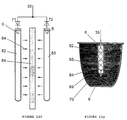
- Plasmon beam (64) similar to the plasmon beam shown in Fig. 9 can also be formed by composite conductor & dielectric (6 & 65) tube electrode assembly presented in Fig. 11A.
- Gas (66), neutral for instance, is coming into dielectric tube (65) and then the gas is being magnetically activated during passage inside parametric resonance transformer (4) to form gas-magnetic focusing lens (67) around the beam (64).
- the metal tube section (6) can be built in dielectric sleeve (68) that functions as an isolator mounting support for high voltage lead (39) of the resonance transformer (4).
- the discharge electrode extension can be formed not only by gas flow (stream) but also by liquid (fluid) and/or aerosol flow generated by special device.
- Fig. 11B displays plasmon head with tube electrode assembly. It can contain a number of dielectric (65) and conductor (metal) (6) elements in line.
- the processing zone (technological space) (69) filled with water system or another liquid, fluid (70) is activated by both beam (64) and flow (67).
- Plasmon unit can also contain two high frequency high voltage semiconductor diodes, (71) and (72), connected to the lead (39) of the resonance transformer (4) as shown in Fig. 11C.
- the processing (technological) chamber (69) is filled with substance (70), it can be gas and/or liquid and/or aerosol and/or powder, dust.
- Conductor electrodes (73) and (74) are placed symmetrically against the resonance transformer (4) axis.
- the ring chamber (69) can be made of molybdenum glass or quartz, it has a spherical expansion (75) in which a filter (76) is built.
- Fig. 11D shows technological chamber with metal electrodes (73) and (74) made as plates of metal which actively absorbs hydrogen, it can be zirconium, titan, niobium, tantalum.
- the discharge currents (64) that pass between the electrodes (73) and (74) can have the form of diffuse discharge which fills all the volume of the medium (70) being activated.
- the walls of the chamber work as catalyst for various reactions in the area of contact with the medium.
- the load currents in the mode of parametric resonance are formed as soliton waves.
- These soliton waves consist of quasi-particles of various types (for instance, of magnons and phonons). Varying the material and the shape of the electrode and electrode extension (metals, alloys, semiconductors, dielectric) one can vary intensity and form of the quasi-particles currents in plasmon unit. These currents are originated as non-force collective excitation of crystal structures at the surface and inside the body of electrode assembly. If excitation of electrons in the crystal body of electrodes (6) dominates, the load currents are produced in the form of plasmons (waves and quasi-particles in the pulse space of metal electrodes).
- Dielectric electrode extensions (69) which work as the processing chambers induce also specific quasi-particle types (at the surface and inside the body), polarons. The polarons are caused by the chosen dielectric polarization.
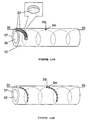
- Figs. 12A, 12B, 12C and 12D show various plasmon-optic units which serve both as converters and as loads for soliton waves. These soliton waves consist of direct and reverse currents of quasi-particles.
- the optic head (unit) in the form of flat spiral tube (77), Fig. 12A, is excited from high voltage lead (39) and conductor cylinder electrode (6).
- the envelope (52) is made of glass.
- the end (78) of the tube is hermetically sealed.
- the internal space (55) is filled with low-pressure gas, it can be neutral, for instance.
- the unit is constructed as a single pole (monopolar) tube with one lead electrode (6) which induces a package of soliton waves-currents into the working volume.
- These soliton waves-currents consist of plasmons and optical phonons which form quantum flow (64) at the surface (52).
- the quantum flow (64) consists of mutually converted photons and optical phonons.
- Plasmon-optical unit can also be assembled from common, general U-shaped gas discharge tubes with luminescent lining (79)( see : Fig. 12B).
- the tubes are connected in series, "snake-like".
- the connections are made by conductor electrodes (80), and an electrode (81) is connected to the end of the assembly.
- the alternating parametric high voltage from the lead (39) is transferred to all the intermediate electrodes (80) and the final electrode (81).
- Optical unit displayed in Fig. 12C generates effectively currents of quasi-particles (excitons and polarons).
- the dielectric (tube) sub-units (82) and (83) can be the flat spiral tubes (Fig. 12A) or the "snake-like" U-tube assemblies (Fig. 12B) or "flat array” assemblies from general rod-shaped gas discharge luminescent tubes.
- Monopolar connection to the parametric resonance lead (39) is implemented by metal electrode (6) and semiconductor diodes (71), (72) (high frequency high voltage diodes).
- processing is placed in the middle of the space between the two polar optical sub-units (82) and (83).
- a cylindrical vacuum tube (bulb) with glass envelope (52) and two metal rod electrodes (6) at the ends can be used for activation of gas and/or liquid (fluid)( see : Fig. 12D).
- a wave current process is developing from the upper electrode (6) in the form of two solid (3-D, spatial) sinusoids. These two sinusoids are growing and then reach the lower electrode (6). After it the two sinusoids begin to rotate about the vertical symmetry axis.
- Emission (64) covers the technological chamber (69) and interacts with the medium (70) to be processed. This emission consists of several types of quasi-particles (plasmons, phonons, magnons).
- the plasmotronic load unit of the generator can be implemented as a system of flat conductor plates (73) and (74) shown in Fig. 13A.
- the object of activation (84) such as dielectric film, wafer, plate, is placed between the conductor plates (73), (74).
- Semiconductor diodes (71) and (72) are connected to the flat electrode (73).
- Capacitor (85) closes the diodes.
- the flow of quasi-particles (64) which transfers the charges, currents in the gape (space) between the plates (73) and (74) can be considered as Josephson current which tunnels through dielectric (the object) in accordance with equations (9)-(11).
- the excessive, extra charge transferred by the quasi-particles (polarons, excitons, etc.) is accumulated and charges the capacitor (85).
- the flow of reactive power can be controlled and the technological process can be adjusted, optimized.
- Fig. 13B shows technological plasmotronic unit for processing of free-flowing bulk materials in order to control their properties, features.
- This unit is also used to control the properties of polycrystal substance in the state of phase transition. For instance, the unit is used to control the process of silicon monocrystal (single crystal) growing by Chokhralsky method.
- the technological chamber (graphite or quartz crucible) (69) with polycrystal substance (silicon) (70) is placed in the center of semi-cylinder electrode structure (73), (74).
- the electrodes (73) and (74) are made of refractory, high-melting-point metal. They also function as heat shields.
- the flow (64) of reactive quasi-particles passes the technological zone between the electrodes and brings about resonance parametric excitation of the processed substance.
- parameters of the substance as heat capacity (specific heat), magnetic susceptibility or dielectric constant (permittivity) can be varied. It is possible to predict, to design and realize various types of phase transition, to derive, obtain various properties, parameters of substance if the dispersion characteristics of the processed substance (load) and the type of non-linearity of the parametric resonance generator are known.
- Metal electrode system can be quadrupolar, as shown in Fig. 13C. Additional pair of electrodes (86), (87) is installed across the first pair (73), (74). The additional electrodes are connected through semiconductor diodes (88) and (89).
- Fig. 14 shows pipe-shaped structure (93) with tablet (button) diodes (92).
- the diodes can be encapsulated, baked, caked, sintered in epoxy compound along helical (helix) line in cylinder layer (97).
- the cylinder hollow (98) serves as the passage of the processed gases and/or aerosols and/or liquids (fluids) and/or free-flowing bulk substances.
Landscapes
- Physics & Mathematics (AREA)
- Engineering & Computer Science (AREA)
- Plasma & Fusion (AREA)
- Chemical & Material Sciences (AREA)
- Analytical Chemistry (AREA)
- Electromagnetism (AREA)
- Spectroscopy & Molecular Physics (AREA)
- Plasma Technology (AREA)
Priority Applications (3)
| Application Number | Priority Date | Filing Date | Title |
|---|---|---|---|
| US08/719,057 US5909086A (en) | 1996-09-24 | 1996-09-24 | Plasma generator for generating unipolar plasma |
| EP00107792A EP1022933A3 (de) | 1996-10-16 | 1996-10-16 | Plasmaerzeuger |
| EP96116612A EP0837622A1 (de) | 1996-09-24 | 1996-10-16 | Plasmaerzeuger |
Applications Claiming Priority (2)
| Application Number | Priority Date | Filing Date | Title |
|---|---|---|---|
| US08/719,057 US5909086A (en) | 1996-09-24 | 1996-09-24 | Plasma generator for generating unipolar plasma |
| EP96116612A EP0837622A1 (de) | 1996-09-24 | 1996-10-16 | Plasmaerzeuger |
Publications (1)
| Publication Number | Publication Date |
|---|---|
| EP0837622A1 true EP0837622A1 (de) | 1998-04-22 |
Family
ID=26142242
Family Applications (1)
| Application Number | Title | Priority Date | Filing Date |
|---|---|---|---|
| EP96116612A Ceased EP0837622A1 (de) | 1996-09-24 | 1996-10-16 | Plasmaerzeuger |
Country Status (2)
| Country | Link |
|---|---|
| US (1) | US5909086A (de) |
| EP (1) | EP0837622A1 (de) |
Cited By (4)
| Publication number | Priority date | Publication date | Assignee | Title |
|---|---|---|---|---|
| US6958063B1 (en) | 1999-04-22 | 2005-10-25 | Soring Gmbh Medizintechnik | Plasma generator for radio frequency surgery |
| EP1148770A3 (de) * | 2000-04-21 | 2008-01-02 | Söring GmbH | Plasmagenerator für die HF-Chirurgie |
| WO2014032747A1 (de) * | 2012-08-31 | 2014-03-06 | NorthCo Ventures GmbH & Co. KG | Vorrichtung und verfahren zur behandlung von biologischem gewebe mit einem niederdruckplasma |
| DE202021002118U1 (de) | 2021-06-10 | 2021-08-02 | Nadezhda Gulko | Ein Gerät, das ein diffuses Niedertemperatur-Nichtgleichgewichtsplasma erzeugt |
Families Citing this family (51)
| Publication number | Priority date | Publication date | Assignee | Title |
|---|---|---|---|---|
| US6236344B1 (en) | 1998-07-02 | 2001-05-22 | The United States Of America, As Represented By The Secretary Of Commerce | AC and DC bipolar voltage source using quantized pulses |
| US7180758B2 (en) * | 1999-07-22 | 2007-02-20 | Mks Instruments, Inc. | Class E amplifier with inductive clamp |
| US6469919B1 (en) | 1999-07-22 | 2002-10-22 | Eni Technology, Inc. | Power supplies having protection circuits |
| KR100766534B1 (ko) * | 2000-09-27 | 2007-10-15 | 마쯔시다덴기산교 가부시키가이샤 | 마그네트론 구동용 전원 |
| US6642526B2 (en) * | 2001-06-25 | 2003-11-04 | Ionfinity Llc | Field ionizing elements and applications thereof |
| US6679236B2 (en) * | 2001-10-12 | 2004-01-20 | Delphi Technologies, Inc. | Ignition system having a high resistivity core |
| WO2003038086A1 (en) * | 2001-10-31 | 2003-05-08 | Ionfinity Llc | Soft ionization device and applications thereof |
| KR100419204B1 (ko) * | 2001-12-24 | 2004-02-21 | 삼성전자주식회사 | 전자렌지 |
| FR2836772B1 (fr) * | 2002-03-04 | 2004-07-09 | Absys | Generateur de gaz pour un systeme de sterilisation |
| US6919688B2 (en) * | 2002-08-21 | 2005-07-19 | Silviu Turcan | Luminescent plasma discharge device, timepiece, having controlled motion of luminous discharge through multiple, independent discharge chambers |
| US7719200B2 (en) * | 2005-03-07 | 2010-05-18 | Old Dominion University | Plasma generator |
| JP4725957B2 (ja) * | 2005-08-01 | 2011-07-13 | セルミ医療器株式会社 | 電圧変換装置 |
| US7459899B2 (en) | 2005-11-21 | 2008-12-02 | Thermo Fisher Scientific Inc. | Inductively-coupled RF power source |
| US7615385B2 (en) | 2006-09-20 | 2009-11-10 | Hypres, Inc | Double-masking technique for increasing fabrication yield in superconducting electronics |
| US9472382B2 (en) | 2007-04-23 | 2016-10-18 | Plasmology4, Inc. | Cold plasma annular array methods and apparatus |
| US9521736B2 (en) | 2007-04-23 | 2016-12-13 | Plasmology4, Inc. | Cold plasma electroporation of medication and associated methods |
| US10039927B2 (en) | 2007-04-23 | 2018-08-07 | Plasmology4, Inc. | Cold plasma treatment devices and associated methods |
| US7633231B2 (en) | 2007-04-23 | 2009-12-15 | Cold Plasma Medical Technologies, Inc. | Harmonic cold plasma device and associated methods |
| US9656095B2 (en) | 2007-04-23 | 2017-05-23 | Plasmology4, Inc. | Harmonic cold plasma devices and associated methods |
| JP2011521735A (ja) | 2008-05-30 | 2011-07-28 | コロラド ステート ユニバーシティ リサーチ ファンデーション | プラズマを発生させるためのシステム、方法、および装置 |
| WO2009146432A1 (en) | 2008-05-30 | 2009-12-03 | Colorado State University Research Foundation | Plasma-based chemical source device and method of use thereof |
| US8994270B2 (en) | 2008-05-30 | 2015-03-31 | Colorado State University Research Foundation | System and methods for plasma application |
| US8083737B2 (en) | 2009-08-26 | 2011-12-27 | Tyco Healthcare Group Lp | Gas-enhanced surgical instrument with mechanism for cylinder puncture |
| JP2011060566A (ja) * | 2009-09-10 | 2011-03-24 | Panasonic Corp | 高周波加熱装置 |
| US8222822B2 (en) | 2009-10-27 | 2012-07-17 | Tyco Healthcare Group Lp | Inductively-coupled plasma device |
| US8795265B2 (en) | 2010-01-28 | 2014-08-05 | Bovie Medical Corporation | Electrosurgical apparatus to generate a dual plasma stream and method thereof |
| EP2552340A4 (de) | 2010-03-31 | 2015-10-14 | Univ Colorado State Res Found | Plasmavorrichtung mit flüssig-gas-schnittstelle |
| JP2013529352A (ja) | 2010-03-31 | 2013-07-18 | コロラド ステート ユニバーシティー リサーチ ファウンデーション | 液体−気体界面プラズマデバイス |
| US8344801B2 (en) | 2010-04-02 | 2013-01-01 | Mks Instruments, Inc. | Variable class characteristic amplifier |
| US9387269B2 (en) | 2011-01-28 | 2016-07-12 | Bovie Medical Corporation | Cold plasma jet hand sanitizer |
| DE102011105713B4 (de) * | 2011-06-23 | 2014-06-05 | Cinogy Gmbh | Elektrodenanordnung für eine dielektrisch behinderte Gasentladung |
| AU2012272572A1 (en) | 2011-06-24 | 2014-02-06 | Jtw, Llc | Advanced nano technology for growing metallic nano-clusters |
| WO2013052261A2 (en) | 2011-09-15 | 2013-04-11 | Cold Plasma Medical Technologies, Inc. | Harmonic cold plasma devices and associated methods |
| CN104641448B (zh) * | 2012-07-27 | 2017-04-05 | 通快许廷格有限公司 | 用于为等离子体处理产生并维持等离子体的装置 |
| DE102012025079B4 (de) * | 2012-08-31 | 2016-09-08 | NorthCo Ventures GmbH & Co. KG | Vorrichtung und Verfahren zur Behandlung von biologischem Gewebe mit einem Niederdruckplasma |
| DE102012025080A1 (de) * | 2012-08-31 | 2014-03-06 | NorthCo Ventures GmbH & Co. KG | Vorrichtung und Verfahren zur Behandlung von biologischem Gewebe mit einem Niederdruckplasma |
| US20150306411A1 (en) * | 2012-08-31 | 2015-10-29 | NorthCo Ventures GmbH & Co. KG | Apparatus and method for treatment of organic human tissue with a low pressure plasma |
| WO2014043512A2 (en) | 2012-09-14 | 2014-03-20 | Cold Plasma Medical Technologies, Inc. | Therapeutic applications of cold plasma |
| MX2012011702A (es) * | 2012-10-08 | 2014-04-24 | Ct De Investigación Y De Estudios Avanzados Del I P N | Dispositivo de rayo plasmatico no termico como fuente de ionizacion espacial para espectrometria de masa ambiental y metodo para su aplicacion. |
| WO2014093513A1 (en) | 2012-12-11 | 2014-06-19 | Cold Plasma Medical Technologies, Inc. | Method and apparatus for cold plasma food contact surface sanitation |
| US9532826B2 (en) | 2013-03-06 | 2017-01-03 | Covidien Lp | System and method for sinus surgery |
| US9555145B2 (en) | 2013-03-13 | 2017-01-31 | Covidien Lp | System and method for biofilm remediation |
| RU2656333C1 (ru) * | 2015-01-12 | 2018-06-05 | Гуанчжоу Цин ГУ Медикал Технолоджи Ко., ЛТД | Плазменный прибор со сменной разрядной трубкой |
| US11166762B2 (en) * | 2016-06-28 | 2021-11-09 | Chiscan Holdings, L.L.C. | Non-thermal plasma generator for detection and treatment of maladies |
| US11432732B2 (en) | 2016-06-28 | 2022-09-06 | Chiscan Holdings, Llc | System and method of measuring millimeter wave of cold atmospheric pressure plasma |
| CN114025664A (zh) | 2019-05-06 | 2022-02-08 | 智像控股有限责任公司 | 使用非热等离子体阵列的推定的能量场分析 |
| CA3185220A1 (en) | 2020-07-24 | 2022-01-27 | Theisen, Olaf | Device for supporting a treatment using pulsed electric fields in order to heal wounds and/or for the inactivation of microorganisms, and method for the inactivation of microorganism |
| CN119816331A (zh) * | 2022-07-18 | 2025-04-11 | 卡普斯医疗有限公司 | 可配置的等离子体生成系统 |
| US11621587B1 (en) | 2022-07-18 | 2023-04-04 | Caps Medical Ltd. | Configurable plasma generating system |
| US12389521B2 (en) | 2022-07-18 | 2025-08-12 | Caps Medical Ltd. | Plasma generating system |
| CN118280499B (zh) * | 2024-06-04 | 2024-08-16 | 中国海洋大学 | 一种耐腐蚀材料的稳定性评估方法 |
Citations (11)
| Publication number | Priority date | Publication date | Assignee | Title |
|---|---|---|---|---|
| US3818277A (en) * | 1973-04-10 | 1974-06-18 | Braun Ag | Start device for battery igniter |
| US4054936A (en) * | 1976-03-16 | 1977-10-18 | Matsushita Electric Industrial Co., Ltd. | Gas ignition device |
| US4099084A (en) * | 1976-01-22 | 1978-07-04 | Heimann Gmbh | Impulse discharge lamp with disc shaped electrodes |
| FR2544951A1 (fr) * | 1983-04-22 | 1984-10-26 | Klein Siegfried | Haut-parleur a effet corona, avec moyens permettant d'obtenir une forte diminution d'ozone, a l'exterieur de celui-ci |
| US4490642A (en) * | 1981-07-24 | 1984-12-25 | Patent-Treuhand-Gesellschaft Fur Elektrische Gluhlampen Mbh | High-pressure sodium discharge lamp |
| SU223198A1 (ru) * | 1966-11-23 | 1989-02-28 | V A Gruzdev | Бeзэлektpoдhaя bыcokoчactothaя гaзopaзpядhaя лamпa |
| US5053933A (en) * | 1989-04-17 | 1991-10-01 | Pavel Imris | Fluorescent lamp |
| JPH03284345A (ja) * | 1990-03-30 | 1991-12-16 | Hitachi Ltd | 真空容器,真空部品等の放電洗浄装置 |
| EP0715334A2 (de) * | 1994-11-30 | 1996-06-05 | Applied Materials, Inc. | Plasmareaktoren zur Behandlung von Halbleiterscheiben |
| JPH08200190A (ja) * | 1995-01-18 | 1996-08-06 | Technova:Kk | 内燃機関点火装置 |
| EP0787465A1 (de) * | 1996-01-31 | 1997-08-06 | Jump Technologies Limited | Kaltes Plasmakoagulierungsvorrichtung |
Family Cites Families (7)
| Publication number | Priority date | Publication date | Assignee | Title |
|---|---|---|---|---|
| US5041760A (en) * | 1973-10-24 | 1991-08-20 | Koloc Paul M | Method and apparatus for generating and utilizing a compound plasma configuration |
| JPS54105342A (en) * | 1978-02-07 | 1979-08-18 | Mitsubishi Electric Corp | Glow-discharge heating device |
| US4370539A (en) * | 1980-10-07 | 1983-01-25 | Npk Za Kontrolno Zavarachni Raboti | Device for the manual start-up of a plasma torch |
| JPH07111918B2 (ja) * | 1987-07-28 | 1995-11-29 | 三菱電機株式会社 | マイクロ波放電光源装置 |
| US5003226A (en) * | 1989-11-16 | 1991-03-26 | Avco Research Laboratories | Plasma cathode |
| US5130003A (en) * | 1990-06-14 | 1992-07-14 | Conrad Richard H | method of powering corona discharge in ozone generators |
| US5549795A (en) * | 1994-08-25 | 1996-08-27 | Hughes Aircraft Company | Corona source for producing corona discharge and fluid waste treatment with corona discharge |
-
1996
- 1996-09-24 US US08/719,057 patent/US5909086A/en not_active Expired - Lifetime
- 1996-10-16 EP EP96116612A patent/EP0837622A1/de not_active Ceased
Patent Citations (11)
| Publication number | Priority date | Publication date | Assignee | Title |
|---|---|---|---|---|
| SU223198A1 (ru) * | 1966-11-23 | 1989-02-28 | V A Gruzdev | Бeзэлektpoдhaя bыcokoчactothaя гaзopaзpядhaя лamпa |
| US3818277A (en) * | 1973-04-10 | 1974-06-18 | Braun Ag | Start device for battery igniter |
| US4099084A (en) * | 1976-01-22 | 1978-07-04 | Heimann Gmbh | Impulse discharge lamp with disc shaped electrodes |
| US4054936A (en) * | 1976-03-16 | 1977-10-18 | Matsushita Electric Industrial Co., Ltd. | Gas ignition device |
| US4490642A (en) * | 1981-07-24 | 1984-12-25 | Patent-Treuhand-Gesellschaft Fur Elektrische Gluhlampen Mbh | High-pressure sodium discharge lamp |
| FR2544951A1 (fr) * | 1983-04-22 | 1984-10-26 | Klein Siegfried | Haut-parleur a effet corona, avec moyens permettant d'obtenir une forte diminution d'ozone, a l'exterieur de celui-ci |
| US5053933A (en) * | 1989-04-17 | 1991-10-01 | Pavel Imris | Fluorescent lamp |
| JPH03284345A (ja) * | 1990-03-30 | 1991-12-16 | Hitachi Ltd | 真空容器,真空部品等の放電洗浄装置 |
| EP0715334A2 (de) * | 1994-11-30 | 1996-06-05 | Applied Materials, Inc. | Plasmareaktoren zur Behandlung von Halbleiterscheiben |
| JPH08200190A (ja) * | 1995-01-18 | 1996-08-06 | Technova:Kk | 内燃機関点火装置 |
| EP0787465A1 (de) * | 1996-01-31 | 1997-08-06 | Jump Technologies Limited | Kaltes Plasmakoagulierungsvorrichtung |
Non-Patent Citations (4)
| Title |
|---|
| DATABASE WPI Section EI Week 8951, Derwent World Patents Index; Class X26, AN 89-376279, XP002027299 * |
| DATABASE WPI Section PQ Week 9641, Derwent World Patents Index; Class Q53, AN 96-409608, XP002027298 * |
| DEMIDOVA T I ET AL: "Gas discharge structure in a UHF field", ZHURNAL PRIKLADNOI MEKHANIKI I TEHKNICHESKOI FIZIKI, JAN.-FEB. 1989, USSR, vol. 30, no. 1, ISSN 0044-4626, pages 3 - 10, XP000645973 * |
| PATENT ABSTRACTS OF JAPAN vol. 016, no. 110 (C - 0920) 18 March 1992 (1992-03-18) * |
Cited By (6)
| Publication number | Priority date | Publication date | Assignee | Title |
|---|---|---|---|---|
| US6958063B1 (en) | 1999-04-22 | 2005-10-25 | Soring Gmbh Medizintechnik | Plasma generator for radio frequency surgery |
| EP1148770A3 (de) * | 2000-04-21 | 2008-01-02 | Söring GmbH | Plasmagenerator für die HF-Chirurgie |
| WO2014032747A1 (de) * | 2012-08-31 | 2014-03-06 | NorthCo Ventures GmbH & Co. KG | Vorrichtung und verfahren zur behandlung von biologischem gewebe mit einem niederdruckplasma |
| CN104736087A (zh) * | 2012-08-31 | 2015-06-24 | 诺斯克投资有限两合公司 | 用于通过低压等离子体处理生物组织的设备和方法 |
| CN104736087B (zh) * | 2012-08-31 | 2018-10-12 | 诺斯克投资有限两合公司 | 用于通过低压等离子体处理生物组织的设备和方法 |
| DE202021002118U1 (de) | 2021-06-10 | 2021-08-02 | Nadezhda Gulko | Ein Gerät, das ein diffuses Niedertemperatur-Nichtgleichgewichtsplasma erzeugt |
Also Published As
| Publication number | Publication date |
|---|---|
| US5909086A (en) | 1999-06-01 |
Similar Documents
| Publication | Publication Date | Title |
|---|---|---|
| US5909086A (en) | Plasma generator for generating unipolar plasma | |
| CN102339717B (zh) | 环形低场活性气体和具有绝缘真空容器的等离子体源 | |
| US7605385B2 (en) | Electro-less discharge extreme ultraviolet light source | |
| US11671033B2 (en) | Cooling module using electrical pulses | |
| US4007430A (en) | Continuous plasma laser | |
| US20250022685A1 (en) | Systems And Methods Of Plasma Generation With Microwaves | |
| EP0787465A1 (de) | Kaltes Plasmakoagulierungsvorrichtung | |
| Hopwood et al. | Fabrication and characterization of a micromachined 5 mm inductively coupled plasma generator | |
| CN111479375A (zh) | 一种表面耦合诱导电离技术及其对应的等离子体与等离子体器件 | |
| RU2561081C2 (ru) | СПОСОБ ВОССТАНОВЛЕНИЯ ЖЕЛЕЗА, ВОССТАНОВЛЕНИЯ КРЕМНИЯ И ВОССТАНОВЛЕНИЯ ДИОКСИДА ТИТАНА ДО МЕТАЛЛИЧЕСКОГО ТИТАНА ПУТЁМ ГЕНЕРАЦИИ ЭЛЕКТРОМАГНИТНЫХ ВЗАИМОДЕЙСТВИЙ ЧАСТИЦ SiO2, КРЕМНИЙСОДЕРЖАЩЕГО ГАЗА, ЧАСТИЦ FeTiО3 И МАГНИТНЫХ ВОЛН | |
| EP1022933A2 (de) | Plasmaerzeuger | |
| Bokhan et al. | Frequency and energy characteristics of a Cu–Ne laser at different durations of the leading edge of the excitation pulse | |
| Thonemann et al. | The role of the self magnetic field in high current gas discharges | |
| EP4149214A1 (de) | Oberflächenkopplungsinduzierte ionisierungstechnologie sowie plasma und plasmavorrichtung dafür | |
| Powell et al. | High intensity electrodeless sources for Raman spectroscopy | |
| Mironer et al. | Radio frequency heating of a dense, moving plasma | |
| US11996790B2 (en) | Producing electrical energy using an etalon | |
| KR20220000641A (ko) | 플라즈마 생성 장치 및 그 제어 방법 | |
| Balslev et al. | The metal-insulator transition in stressed germanium | |
| Slough et al. | Micro-discharge micro-thruster | |
| Bighel et al. | Characteristics of normal ionizing shock waves in helium | |
| Tsui et al. | Plasma impedance and electron density in a pulsed laser channel | |
| US20040012320A1 (en) | Process for structural modification of surfaces by treatment with an atomic or molecular gaseous medium excited to metastable level | |
| HK40088112A (zh) | 使用电脉冲的冷却模块 | |
| JPH06124795A (ja) | プラズマ発生装置 |
Legal Events
| Date | Code | Title | Description |
|---|---|---|---|
| PUAI | Public reference made under article 153(3) epc to a published international application that has entered the european phase |
Free format text: ORIGINAL CODE: 0009012 |
|
| 17P | Request for examination filed |
Effective date: 19961016 |
|
| AK | Designated contracting states |
Kind code of ref document: A1 Designated state(s): BE CH DE FR GB LI NL |
|
| AKX | Designation fees paid |
Free format text: BE CH DE FR GB LI NL |
|
| RBV | Designated contracting states (corrected) |
Designated state(s): BE CH DE FR GB LI NL |
|
| 17Q | First examination report despatched |
Effective date: 19990315 |
|
| STAA | Information on the status of an ep patent application or granted ep patent |
Free format text: STATUS: THE APPLICATION HAS BEEN REFUSED |
|
| 18R | Application refused |
Effective date: 20000525 |