EP0837886B1 - Bimetallzyklische, übergangsmetall enthaltende katalysatorsysteme - Google Patents
Bimetallzyklische, übergangsmetall enthaltende katalysatorsysteme Download PDFInfo
- Publication number
- EP0837886B1 EP0837886B1 EP96919288A EP96919288A EP0837886B1 EP 0837886 B1 EP0837886 B1 EP 0837886B1 EP 96919288 A EP96919288 A EP 96919288A EP 96919288 A EP96919288 A EP 96919288A EP 0837886 B1 EP0837886 B1 EP 0837886B1
- Authority
- EP
- European Patent Office
- Prior art keywords
- group
- substituted
- bimetallocyclic
- compound
- unsubstituted
- Prior art date
- Legal status (The legal status is an assumption and is not a legal conclusion. Google has not performed a legal analysis and makes no representation as to the accuracy of the status listed.)
- Expired - Lifetime
Links
- 239000003054 catalyst Substances 0.000 title claims abstract description 65
- 229910052723 transition metal Inorganic materials 0.000 title claims description 14
- 150000003624 transition metals Chemical class 0.000 title description 9
- 150000001875 compounds Chemical class 0.000 claims abstract description 43
- 229910052751 metal Inorganic materials 0.000 claims abstract description 26
- 239000000178 monomer Substances 0.000 claims abstract description 26
- 238000006116 polymerization reaction Methods 0.000 claims abstract description 23
- 239000002184 metal Substances 0.000 claims abstract description 22
- 150000001923 cyclic compounds Chemical class 0.000 claims abstract description 3
- 239000003446 ligand Substances 0.000 claims description 32
- 150000001450 anions Chemical class 0.000 claims description 23
- 229910052727 yttrium Inorganic materials 0.000 claims description 22
- 238000000034 method Methods 0.000 claims description 21
- 239000000203 mixture Substances 0.000 claims description 17
- 239000012190 activator Substances 0.000 claims description 16
- 150000001336 alkenes Chemical class 0.000 claims description 13
- RTZKZFJDLAIYFH-UHFFFAOYSA-N Diethyl ether Chemical compound CCOCC RTZKZFJDLAIYFH-UHFFFAOYSA-N 0.000 claims description 12
- JRZJOMJEPLMPRA-UHFFFAOYSA-N olefin Natural products CCCCCCCC=C JRZJOMJEPLMPRA-UHFFFAOYSA-N 0.000 claims description 11
- 125000004122 cyclic group Chemical group 0.000 claims description 10
- AQZWEFBJYQSQEH-UHFFFAOYSA-N 2-methyloxaluminane Chemical group C[Al]1CCCCO1 AQZWEFBJYQSQEH-UHFFFAOYSA-N 0.000 claims description 7
- 125000003368 amide group Chemical group 0.000 claims description 7
- 239000002685 polymerization catalyst Substances 0.000 claims description 7
- JLTDJTHDQAWBAV-UHFFFAOYSA-N N,N-dimethylaniline Chemical compound CN(C)C1=CC=CC=C1 JLTDJTHDQAWBAV-UHFFFAOYSA-N 0.000 claims description 6
- 125000004429 atom Chemical group 0.000 claims description 6
- 230000007935 neutral effect Effects 0.000 claims description 5
- PAYRUJLWNCNPSJ-UHFFFAOYSA-N Aniline Chemical compound NC1=CC=CC=C1 PAYRUJLWNCNPSJ-UHFFFAOYSA-N 0.000 claims description 4
- BTBUEUYNUDRHOZ-UHFFFAOYSA-N Borate Chemical compound [O-]B([O-])[O-] BTBUEUYNUDRHOZ-UHFFFAOYSA-N 0.000 claims description 4
- 239000002879 Lewis base Substances 0.000 claims description 4
- WYURNTSHIVDZCO-UHFFFAOYSA-N Tetrahydrofuran Chemical compound C1CCOC1 WYURNTSHIVDZCO-UHFFFAOYSA-N 0.000 claims description 4
- 125000000129 anionic group Chemical group 0.000 claims description 4
- 229910052735 hafnium Inorganic materials 0.000 claims description 4
- 229910052736 halogen Inorganic materials 0.000 claims description 4
- 150000004678 hydrides Chemical class 0.000 claims description 4
- 150000007527 lewis bases Chemical class 0.000 claims description 4
- 229910052758 niobium Inorganic materials 0.000 claims description 4
- 230000000737 periodic effect Effects 0.000 claims description 4
- 229910052715 tantalum Inorganic materials 0.000 claims description 4
- 229910052719 titanium Inorganic materials 0.000 claims description 4
- 229910052726 zirconium Inorganic materials 0.000 claims description 4
- 125000004432 carbon atom Chemical group C* 0.000 claims description 3
- 229910052800 carbon group element Inorganic materials 0.000 claims description 3
- 150000004820 halides Chemical class 0.000 claims description 3
- 150000002367 halogens Chemical class 0.000 claims description 3
- 229910052696 pnictogen Inorganic materials 0.000 claims description 3
- 230000002378 acidificating effect Effects 0.000 claims description 2
- MDFFNEOEWAXZRQ-UHFFFAOYSA-N aminyl Chemical compound [NH2] MDFFNEOEWAXZRQ-UHFFFAOYSA-N 0.000 claims description 2
- 125000004435 hydrogen atom Chemical group [H]* 0.000 claims description 2
- 230000003647 oxidation Effects 0.000 claims description 2
- 238000007254 oxidation reaction Methods 0.000 claims description 2
- 230000000379 polymerizing effect Effects 0.000 claims description 2
- OLRJXMHANKMLTD-UHFFFAOYSA-N silyl Chemical compound [SiH3] OLRJXMHANKMLTD-UHFFFAOYSA-N 0.000 claims description 2
- YLQBMQCUIZJEEH-UHFFFAOYSA-N tetrahydrofuran Natural products C=1C=COC=1 YLQBMQCUIZJEEH-UHFFFAOYSA-N 0.000 claims description 2
- 125000004104 aryloxy group Chemical group 0.000 claims 1
- 125000001181 organosilyl group Chemical group [SiH3]* 0.000 claims 1
- 125000005415 substituted alkoxy group Chemical group 0.000 claims 1
- 150000003623 transition metal compounds Chemical class 0.000 abstract description 15
- -1 Cyclic transition metal compounds Chemical class 0.000 description 36
- YXFVVABEGXRONW-UHFFFAOYSA-N Toluene Chemical compound CC1=CC=CC=C1 YXFVVABEGXRONW-UHFFFAOYSA-N 0.000 description 15
- 125000000217 alkyl group Chemical group 0.000 description 9
- VLKZOEOYAKHREP-UHFFFAOYSA-N n-Hexane Chemical compound CCCCCC VLKZOEOYAKHREP-UHFFFAOYSA-N 0.000 description 9
- 239000002904 solvent Substances 0.000 description 8
- 229920000642 polymer Polymers 0.000 description 7
- 239000002841 Lewis acid Substances 0.000 description 6
- 125000000058 cyclopentadienyl group Chemical group C1(=CC=CC1)* 0.000 description 6
- 230000000694 effects Effects 0.000 description 6
- 150000007517 lewis acids Chemical class 0.000 description 6
- 125000003808 silyl group Chemical group [H][Si]([H])([H])[*] 0.000 description 6
- 230000004913 activation Effects 0.000 description 5
- 230000015572 biosynthetic process Effects 0.000 description 5
- 125000002091 cationic group Chemical group 0.000 description 5
- 229940125904 compound 1 Drugs 0.000 description 5
- 239000003085 diluting agent Substances 0.000 description 5
- ZSWFCLXCOIISFI-UHFFFAOYSA-N endo-cyclopentadiene Natural products C1C=CC=C1 ZSWFCLXCOIISFI-UHFFFAOYSA-N 0.000 description 5
- OEIMLTQPLAGXMX-UHFFFAOYSA-I tantalum(v) chloride Chemical compound Cl[Ta](Cl)(Cl)(Cl)Cl OEIMLTQPLAGXMX-UHFFFAOYSA-I 0.000 description 5
- VYPSYNLAJGMNEJ-UHFFFAOYSA-N Silicium dioxide Chemical compound O=[Si]=O VYPSYNLAJGMNEJ-UHFFFAOYSA-N 0.000 description 4
- 230000003213 activating effect Effects 0.000 description 4
- 238000006243 chemical reaction Methods 0.000 description 4
- 238000009826 distribution Methods 0.000 description 4
- 125000001183 hydrocarbyl group Chemical group 0.000 description 4
- 150000003254 radicals Chemical class 0.000 description 4
- LIKMAJRDDDTEIG-UHFFFAOYSA-N 1-hexene Chemical compound CCCCC=C LIKMAJRDDDTEIG-UHFFFAOYSA-N 0.000 description 3
- UHOVQNZJYSORNB-UHFFFAOYSA-N Benzene Chemical compound C1=CC=CC=C1 UHOVQNZJYSORNB-UHFFFAOYSA-N 0.000 description 3
- VGGSQFUCUMXWEO-UHFFFAOYSA-N Ethene Chemical compound C=C VGGSQFUCUMXWEO-UHFFFAOYSA-N 0.000 description 3
- 239000005977 Ethylene Substances 0.000 description 3
- 229910004537 TaCl5 Inorganic materials 0.000 description 3
- 125000005234 alkyl aluminium group Chemical group 0.000 description 3
- 229910052782 aluminium Inorganic materials 0.000 description 3
- 125000003118 aryl group Chemical group 0.000 description 3
- 230000003197 catalytic effect Effects 0.000 description 3
- 238000011161 development Methods 0.000 description 3
- 230000018109 developmental process Effects 0.000 description 3
- 150000001993 dienes Chemical class 0.000 description 3
- 229930195733 hydrocarbon Natural products 0.000 description 3
- 239000007788 liquid Substances 0.000 description 3
- 150000002736 metal compounds Chemical class 0.000 description 3
- OFBQJSOFQDEBGM-UHFFFAOYSA-N n-pentane Natural products CCCCC OFBQJSOFQDEBGM-UHFFFAOYSA-N 0.000 description 3
- NFHFRUOZVGFOOS-UHFFFAOYSA-N palladium;triphenylphosphane Chemical compound [Pd].C1=CC=CC=C1P(C=1C=CC=CC=1)C1=CC=CC=C1.C1=CC=CC=C1P(C=1C=CC=CC=1)C1=CC=CC=C1.C1=CC=CC=C1P(C=1C=CC=CC=1)C1=CC=CC=C1.C1=CC=CC=C1P(C=1C=CC=CC=1)C1=CC=CC=C1 NFHFRUOZVGFOOS-UHFFFAOYSA-N 0.000 description 3
- 239000012071 phase Substances 0.000 description 3
- 230000037048 polymerization activity Effects 0.000 description 3
- 239000002243 precursor Substances 0.000 description 3
- 241000894007 species Species 0.000 description 3
- 125000001424 substituent group Chemical group 0.000 description 3
- 125000000999 tert-butyl group Chemical group [H]C([H])([H])C(*)(C([H])([H])[H])C([H])([H])[H] 0.000 description 3
- 239000004711 α-olefin Substances 0.000 description 3
- DCTOHCCUXLBQMS-UHFFFAOYSA-N 1-undecene Chemical compound CCCCCCCCCC=C DCTOHCCUXLBQMS-UHFFFAOYSA-N 0.000 description 2
- XKRFYHLGVUSROY-UHFFFAOYSA-N Argon Chemical compound [Ar] XKRFYHLGVUSROY-UHFFFAOYSA-N 0.000 description 2
- IJGRMHOSHXDMSA-UHFFFAOYSA-N Atomic nitrogen Chemical compound N#N IJGRMHOSHXDMSA-UHFFFAOYSA-N 0.000 description 2
- 239000007848 Bronsted acid Substances 0.000 description 2
- KAKZBPTYRLMSJV-UHFFFAOYSA-N Butadiene Chemical compound C=CC=C KAKZBPTYRLMSJV-UHFFFAOYSA-N 0.000 description 2
- SNRUBQQJIBEYMU-UHFFFAOYSA-N Dodecane Natural products CCCCCCCCCCCC SNRUBQQJIBEYMU-UHFFFAOYSA-N 0.000 description 2
- 239000007818 Grignard reagent Substances 0.000 description 2
- IMNFDUFMRHMDMM-UHFFFAOYSA-N N-Heptane Chemical compound CCCCCCC IMNFDUFMRHMDMM-UHFFFAOYSA-N 0.000 description 2
- 239000004698 Polyethylene Substances 0.000 description 2
- 150000004945 aromatic hydrocarbons Chemical class 0.000 description 2
- 239000012298 atmosphere Substances 0.000 description 2
- QVGXLLKOCUKJST-UHFFFAOYSA-N atomic oxygen Chemical compound [O] QVGXLLKOCUKJST-UHFFFAOYSA-N 0.000 description 2
- UORVGPXVDQYIDP-UHFFFAOYSA-N borane Chemical class B UORVGPXVDQYIDP-UHFFFAOYSA-N 0.000 description 2
- 229910000085 borane Inorganic materials 0.000 description 2
- 150000001768 cations Chemical class 0.000 description 2
- 229940125782 compound 2 Drugs 0.000 description 2
- 238000001816 cooling Methods 0.000 description 2
- DMEGYFMYUHOHGS-UHFFFAOYSA-N cycloheptane Chemical compound C1CCCCCC1 DMEGYFMYUHOHGS-UHFFFAOYSA-N 0.000 description 2
- HGCIXCUEYOPUTN-UHFFFAOYSA-N cyclohexene Chemical compound C1CCC=CC1 HGCIXCUEYOPUTN-UHFFFAOYSA-N 0.000 description 2
- LPIQUOYDBNQMRZ-UHFFFAOYSA-N cyclopentene Chemical compound C1CC=CC1 LPIQUOYDBNQMRZ-UHFFFAOYSA-N 0.000 description 2
- 238000001914 filtration Methods 0.000 description 2
- 238000012685 gas phase polymerization Methods 0.000 description 2
- 150000004795 grignard reagents Chemical class 0.000 description 2
- 125000000623 heterocyclic group Chemical group 0.000 description 2
- 150000002430 hydrocarbons Chemical class 0.000 description 2
- 238000010348 incorporation Methods 0.000 description 2
- 238000003780 insertion Methods 0.000 description 2
- 230000037431 insertion Effects 0.000 description 2
- NNPPMTNAJDCUHE-UHFFFAOYSA-N isobutane Chemical compound CC(C)C NNPPMTNAJDCUHE-UHFFFAOYSA-N 0.000 description 2
- 150000002739 metals Chemical class 0.000 description 2
- 125000002496 methyl group Chemical group [H]C([H])([H])* 0.000 description 2
- UAEPNZWRGJTJPN-UHFFFAOYSA-N methylcyclohexane Chemical compound CC1CCCCC1 UAEPNZWRGJTJPN-UHFFFAOYSA-N 0.000 description 2
- ZGEGCLOFRBLKSE-UHFFFAOYSA-N methylene hexane Natural products CCCCCC=C ZGEGCLOFRBLKSE-UHFFFAOYSA-N 0.000 description 2
- 239000010955 niobium Substances 0.000 description 2
- 150000002902 organometallic compounds Chemical class 0.000 description 2
- 239000001301 oxygen Substances 0.000 description 2
- 229910052760 oxygen Inorganic materials 0.000 description 2
- 229920000573 polyethylene Polymers 0.000 description 2
- 229920000098 polyolefin Polymers 0.000 description 2
- 238000002360 preparation method Methods 0.000 description 2
- 150000003839 salts Chemical class 0.000 description 2
- 229920006395 saturated elastomer Polymers 0.000 description 2
- 239000000377 silicon dioxide Substances 0.000 description 2
- 239000002002 slurry Substances 0.000 description 2
- 239000007787 solid Substances 0.000 description 2
- 239000000243 solution Substances 0.000 description 2
- 238000003786 synthesis reaction Methods 0.000 description 2
- 239000010936 titanium Substances 0.000 description 2
- XLYOFNOQVPJJNP-UHFFFAOYSA-N water Substances O XLYOFNOQVPJJNP-UHFFFAOYSA-N 0.000 description 2
- OJOWICOBYCXEKR-KRXBUXKQSA-N (5e)-5-ethylidenebicyclo[2.2.1]hept-2-ene Chemical compound C1C2C(=C/C)/CC1C=C2 OJOWICOBYCXEKR-KRXBUXKQSA-N 0.000 description 1
- CRSBERNSMYQZNG-UHFFFAOYSA-N 1 -dodecene Natural products CCCCCCCCCCC=C CRSBERNSMYQZNG-UHFFFAOYSA-N 0.000 description 1
- PRBHEGAFLDMLAL-UHFFFAOYSA-N 1,5-Hexadiene Natural products CC=CCC=C PRBHEGAFLDMLAL-UHFFFAOYSA-N 0.000 description 1
- KWKAKUADMBZCLK-UHFFFAOYSA-N 1-octene Chemical compound CCCCCCC=C KWKAKUADMBZCLK-UHFFFAOYSA-N 0.000 description 1
- HECLRDQVFMWTQS-RGOKHQFPSA-N 1755-01-7 Chemical compound C1[C@H]2[C@@H]3CC=C[C@@H]3[C@@H]1C=C2 HECLRDQVFMWTQS-RGOKHQFPSA-N 0.000 description 1
- YBYIRNPNPLQARY-UHFFFAOYSA-N 1H-indene Natural products C1=CC=C2CC=CC2=C1 YBYIRNPNPLQARY-UHFFFAOYSA-N 0.000 description 1
- JTXUVHFRSRTSAT-UHFFFAOYSA-N 3,5,5-trimethylhex-1-ene Chemical compound C=CC(C)CC(C)(C)C JTXUVHFRSRTSAT-UHFFFAOYSA-N 0.000 description 1
- LDTAOIUHUHHCMU-UHFFFAOYSA-N 3-methylpent-1-ene Chemical compound CCC(C)C=C LDTAOIUHUHHCMU-UHFFFAOYSA-N 0.000 description 1
- WSSSPWUEQFSQQG-UHFFFAOYSA-N 4-methyl-1-pentene Chemical compound CC(C)CC=C WSSSPWUEQFSQQG-UHFFFAOYSA-N 0.000 description 1
- RMDKEBZUCHXUER-UHFFFAOYSA-N 4-methylbicyclo[2.2.1]hept-2-ene Chemical compound C1CC2C=CC1(C)C2 RMDKEBZUCHXUER-UHFFFAOYSA-N 0.000 description 1
- OKTJSMMVPCPJKN-UHFFFAOYSA-N Carbon Chemical group [C] OKTJSMMVPCPJKN-UHFFFAOYSA-N 0.000 description 1
- 239000004215 Carbon black (E152) Substances 0.000 description 1
- VEXZGXHMUGYJMC-UHFFFAOYSA-M Chloride anion Chemical compound [Cl-] VEXZGXHMUGYJMC-UHFFFAOYSA-M 0.000 description 1
- XDTMQSROBMDMFD-UHFFFAOYSA-N Cyclohexane Chemical compound C1CCCCC1 XDTMQSROBMDMFD-UHFFFAOYSA-N 0.000 description 1
- 229910019804 NbCl5 Inorganic materials 0.000 description 1
- CTQNGGLPUBDAKN-UHFFFAOYSA-N O-Xylene Chemical compound CC1=CC=CC=C1C CTQNGGLPUBDAKN-UHFFFAOYSA-N 0.000 description 1
- 235000010627 Phaseolus vulgaris Nutrition 0.000 description 1
- 244000046052 Phaseolus vulgaris Species 0.000 description 1
- 229910007161 Si(CH3)3 Inorganic materials 0.000 description 1
- RTAQQCXQSZGOHL-UHFFFAOYSA-N Titanium Chemical compound [Ti] RTAQQCXQSZGOHL-UHFFFAOYSA-N 0.000 description 1
- 239000011954 Ziegler–Natta catalyst Substances 0.000 description 1
- QCWXUUIWCKQGHC-UHFFFAOYSA-N Zirconium Chemical compound [Zr] QCWXUUIWCKQGHC-UHFFFAOYSA-N 0.000 description 1
- 150000001335 aliphatic alkanes Chemical class 0.000 description 1
- 125000001931 aliphatic group Chemical group 0.000 description 1
- 125000003545 alkoxy group Chemical group 0.000 description 1
- 230000002152 alkylating effect Effects 0.000 description 1
- 230000029936 alkylation Effects 0.000 description 1
- 238000005804 alkylation reaction Methods 0.000 description 1
- PNEYBMLMFCGWSK-UHFFFAOYSA-N aluminium oxide Inorganic materials [O-2].[O-2].[O-2].[Al+3].[Al+3] PNEYBMLMFCGWSK-UHFFFAOYSA-N 0.000 description 1
- 229910052786 argon Inorganic materials 0.000 description 1
- 150000001491 aromatic compounds Chemical class 0.000 description 1
- 239000002585 base Substances 0.000 description 1
- 125000001797 benzyl group Chemical group [H]C1=C([H])C([H])=C(C([H])=C1[H])C([H])([H])* 0.000 description 1
- 238000012662 bulk polymerization Methods 0.000 description 1
- 239000001273 butane Substances 0.000 description 1
- 229910052799 carbon Inorganic materials 0.000 description 1
- 239000012018 catalyst precursor Substances 0.000 description 1
- 238000006555 catalytic reaction Methods 0.000 description 1
- 239000003153 chemical reaction reagent Substances 0.000 description 1
- 239000003638 chemical reducing agent Substances 0.000 description 1
- 230000000295 complement effect Effects 0.000 description 1
- 229920001577 copolymer Polymers 0.000 description 1
- 238000007334 copolymerization reaction Methods 0.000 description 1
- 239000013078 crystal Substances 0.000 description 1
- CFBGXYDUODCMNS-UHFFFAOYSA-N cyclobutene Chemical compound C1CC=C1 CFBGXYDUODCMNS-UHFFFAOYSA-N 0.000 description 1
- UCIYGNATMHQYCT-OWOJBTEDSA-N cyclodecene Chemical compound C1CCCC\C=C\CCC1 UCIYGNATMHQYCT-OWOJBTEDSA-N 0.000 description 1
- HYPABJGVBDSCIT-UPHRSURJSA-N cyclododecene Chemical compound C1CCCCC\C=C/CCCC1 HYPABJGVBDSCIT-UPHRSURJSA-N 0.000 description 1
- OJOSABWCUVCSTQ-UHFFFAOYSA-N cyclohepta-2,4,6-trienylium Chemical compound C1=CC=C[CH+]=C[CH]1 OJOSABWCUVCSTQ-UHFFFAOYSA-N 0.000 description 1
- ZXIJMRYMVAMXQP-UHFFFAOYSA-N cycloheptene Chemical compound C1CCC=CCC1 ZXIJMRYMVAMXQP-UHFFFAOYSA-N 0.000 description 1
- 125000000113 cyclohexyl group Chemical group [H]C1([H])C([H])([H])C([H])([H])C([H])(*)C([H])([H])C1([H])[H] 0.000 description 1
- BESIOWGPXPAVOS-UPHRSURJSA-N cyclononene Chemical compound C1CCC\C=C/CCC1 BESIOWGPXPAVOS-UPHRSURJSA-N 0.000 description 1
- URYYVOIYTNXXBN-UPHRSURJSA-N cyclooctene Chemical compound C1CCC\C=C/CC1 URYYVOIYTNXXBN-UPHRSURJSA-N 0.000 description 1
- 239000004913 cyclooctene Substances 0.000 description 1
- 230000002950 deficient Effects 0.000 description 1
- 238000009795 derivation Methods 0.000 description 1
- 125000002147 dimethylamino group Chemical group [H]C([H])([H])N(*)C([H])([H])[H] 0.000 description 1
- 125000005982 diphenylmethyl group Chemical group [H]C1=C([H])C([H])=C(C([H])=C1[H])C([H])(*)C1=C([H])C([H])=C([H])C([H])=C1[H] 0.000 description 1
- 238000006073 displacement reaction Methods 0.000 description 1
- 229940069096 dodecene Drugs 0.000 description 1
- 238000001035 drying Methods 0.000 description 1
- 230000008030 elimination Effects 0.000 description 1
- 238000003379 elimination reaction Methods 0.000 description 1
- 125000002534 ethynyl group Chemical class [H]C#C* 0.000 description 1
- 239000012530 fluid Substances 0.000 description 1
- 125000003983 fluorenyl group Chemical group C1(=CC=CC=2C3=CC=CC=C3CC12)* 0.000 description 1
- 239000012634 fragment Substances 0.000 description 1
- WHYHZFHCWGGCOP-UHFFFAOYSA-N germyl Chemical compound [GeH3] WHYHZFHCWGGCOP-UHFFFAOYSA-N 0.000 description 1
- 125000003800 germyl group Chemical group [H][Ge]([H])([H])[*] 0.000 description 1
- VBJZVLUMGGDVMO-UHFFFAOYSA-N hafnium atom Chemical compound [Hf] VBJZVLUMGGDVMO-UHFFFAOYSA-N 0.000 description 1
- 229910052734 helium Inorganic materials 0.000 description 1
- 239000001307 helium Substances 0.000 description 1
- SWQJXJOGLNCZEY-UHFFFAOYSA-N helium atom Chemical compound [He] SWQJXJOGLNCZEY-UHFFFAOYSA-N 0.000 description 1
- GEAWFZNTIFJMHR-UHFFFAOYSA-N hepta-1,6-diene Chemical compound C=CCCCC=C GEAWFZNTIFJMHR-UHFFFAOYSA-N 0.000 description 1
- PYGSKMBEVAICCR-UHFFFAOYSA-N hexa-1,5-diene Chemical compound C=CCCC=C PYGSKMBEVAICCR-UHFFFAOYSA-N 0.000 description 1
- 238000005984 hydrogenation reaction Methods 0.000 description 1
- 125000002887 hydroxy group Chemical group [H]O* 0.000 description 1
- 238000011065 in-situ storage Methods 0.000 description 1
- 125000003454 indenyl group Chemical group C1(C=CC2=CC=CC=C12)* 0.000 description 1
- 238000005342 ion exchange Methods 0.000 description 1
- 150000002500 ions Chemical class 0.000 description 1
- 239000001282 iso-butane Substances 0.000 description 1
- 125000000959 isobutyl group Chemical group [H]C([H])([H])C([H])(C([H])([H])[H])C([H])([H])* 0.000 description 1
- 125000001449 isopropyl group Chemical group [H]C([H])([H])C([H])(*)C([H])([H])[H] 0.000 description 1
- 239000007791 liquid phase Substances 0.000 description 1
- BXBLTKZWYAHPKM-UHFFFAOYSA-M magnesium;methanidyl(trimethyl)silane;chloride Chemical compound [Mg+2].[Cl-].C[Si](C)(C)[CH2-] BXBLTKZWYAHPKM-UHFFFAOYSA-M 0.000 description 1
- 229910001507 metal halide Inorganic materials 0.000 description 1
- 150000005309 metal halides Chemical class 0.000 description 1
- 229910044991 metal oxide Inorganic materials 0.000 description 1
- 150000004706 metal oxides Chemical class 0.000 description 1
- 239000012968 metallocene catalyst Substances 0.000 description 1
- 229910052752 metalloid Inorganic materials 0.000 description 1
- 150000002738 metalloids Chemical class 0.000 description 1
- 238000005649 metathesis reaction Methods 0.000 description 1
- HZVOZRGWRWCICA-UHFFFAOYSA-N methanediyl Chemical compound [CH2] HZVOZRGWRWCICA-UHFFFAOYSA-N 0.000 description 1
- GYNNXHKOJHMOHS-UHFFFAOYSA-N methyl-cycloheptane Natural products CC1CCCCCC1 GYNNXHKOJHMOHS-UHFFFAOYSA-N 0.000 description 1
- 125000000325 methylidene group Chemical group [H]C([H])=* 0.000 description 1
- 238000002156 mixing Methods 0.000 description 1
- IJDNQMDRQITEOD-UHFFFAOYSA-N n-butane Chemical compound CCCC IJDNQMDRQITEOD-UHFFFAOYSA-N 0.000 description 1
- 125000004108 n-butyl group Chemical group [H]C([H])([H])C([H])([H])C([H])([H])C([H])([H])* 0.000 description 1
- AFFLGGQVNFXPEV-UHFFFAOYSA-N n-decene Natural products CCCCCCCCC=C AFFLGGQVNFXPEV-UHFFFAOYSA-N 0.000 description 1
- GUCVJGMIXFAOAE-UHFFFAOYSA-N niobium atom Chemical compound [Nb] GUCVJGMIXFAOAE-UHFFFAOYSA-N 0.000 description 1
- 229910052757 nitrogen Inorganic materials 0.000 description 1
- 239000012299 nitrogen atmosphere Substances 0.000 description 1
- SJYNFBVQFBRSIB-UHFFFAOYSA-N norbornadiene Chemical compound C1=CC2C=CC1C2 SJYNFBVQFBRSIB-UHFFFAOYSA-N 0.000 description 1
- JFNLZVQOOSMTJK-KNVOCYPGSA-N norbornene Chemical compound C1[C@@H]2CC[C@H]1C=C2 JFNLZVQOOSMTJK-KNVOCYPGSA-N 0.000 description 1
- 239000012038 nucleophile Substances 0.000 description 1
- TVMXDCGIABBOFY-UHFFFAOYSA-N octane Chemical compound CCCCCCCC TVMXDCGIABBOFY-UHFFFAOYSA-N 0.000 description 1
- 150000002899 organoaluminium compounds Chemical class 0.000 description 1
- 125000002524 organometallic group Chemical group 0.000 description 1
- 239000007800 oxidant agent Substances 0.000 description 1
- 230000001590 oxidative effect Effects 0.000 description 1
- YHBDIEWMOMLKOO-UHFFFAOYSA-I pentachloroniobium Chemical group Cl[Nb](Cl)(Cl)(Cl)Cl YHBDIEWMOMLKOO-UHFFFAOYSA-I 0.000 description 1
- RGSFGYAAUTVSQA-UHFFFAOYSA-N pentamethylene Natural products C1CCCC1 RGSFGYAAUTVSQA-UHFFFAOYSA-N 0.000 description 1
- 125000005561 phenanthryl group Chemical group 0.000 description 1
- 125000001997 phenyl group Chemical group [H]C1=C([H])C([H])=C(*)C([H])=C1[H] 0.000 description 1
- 239000002798 polar solvent Substances 0.000 description 1
- 125000003367 polycyclic group Chemical group 0.000 description 1
- 150000004291 polyenes Chemical class 0.000 description 1
- 125000001436 propyl group Chemical group [H]C([*])([H])C([H])([H])C([H])([H])[H] 0.000 description 1
- 230000005588 protonation Effects 0.000 description 1
- 239000002516 radical scavenger Substances 0.000 description 1
- 230000009257 reactivity Effects 0.000 description 1
- 125000002914 sec-butyl group Chemical group [H]C([H])([H])C([H])([H])C([H])(*)C([H])([H])[H] 0.000 description 1
- 229910052709 silver Inorganic materials 0.000 description 1
- 239000004332 silver Substances 0.000 description 1
- 230000000087 stabilizing effect Effects 0.000 description 1
- 125000003011 styrenyl group Chemical class [H]\C(*)=C(/[H])C1=C([H])C([H])=C([H])C([H])=C1[H] 0.000 description 1
- 239000000126 substance Substances 0.000 description 1
- 239000000758 substrate Substances 0.000 description 1
- 239000000725 suspension Substances 0.000 description 1
- GUVRBAGPIYLISA-UHFFFAOYSA-N tantalum atom Chemical compound [Ta] GUVRBAGPIYLISA-UHFFFAOYSA-N 0.000 description 1
- 125000001712 tetrahydronaphthyl group Chemical group C1(CCCC2=CC=CC=C12)* 0.000 description 1
- JLTRXTDYQLMHGR-UHFFFAOYSA-N trimethylaluminium Chemical compound C[Al](C)C JLTRXTDYQLMHGR-UHFFFAOYSA-N 0.000 description 1
- OBAJXDYVZBHCGT-UHFFFAOYSA-N tris(pentafluorophenyl)borane Chemical compound FC1=C(F)C(F)=C(F)C(F)=C1B(C=1C(=C(F)C(F)=C(F)C=1F)F)C1=C(F)C(F)=C(F)C(F)=C1F OBAJXDYVZBHCGT-UHFFFAOYSA-N 0.000 description 1
- 125000002221 trityl group Chemical group [H]C1=C([H])C([H])=C([H])C([H])=C1C([*])(C1=C(C(=C(C(=C1[H])[H])[H])[H])[H])C1=C([H])C([H])=C([H])C([H])=C1[H] 0.000 description 1
- OLFPYUPGPBITMH-UHFFFAOYSA-N tritylium Chemical compound C1=CC=CC=C1[C+](C=1C=CC=CC=1)C1=CC=CC=C1 OLFPYUPGPBITMH-UHFFFAOYSA-N 0.000 description 1
- 229910052720 vanadium Inorganic materials 0.000 description 1
- 238000013022 venting Methods 0.000 description 1
- 229920002554 vinyl polymer Polymers 0.000 description 1
- 239000008096 xylene Substances 0.000 description 1
Classifications
-
- C—CHEMISTRY; METALLURGY
- C08—ORGANIC MACROMOLECULAR COMPOUNDS; THEIR PREPARATION OR CHEMICAL WORKING-UP; COMPOSITIONS BASED THEREON
- C08F—MACROMOLECULAR COMPOUNDS OBTAINED BY REACTIONS ONLY INVOLVING CARBON-TO-CARBON UNSATURATED BONDS
- C08F10/00—Homopolymers and copolymers of unsaturated aliphatic hydrocarbons having only one carbon-to-carbon double bond
-
- B—PERFORMING OPERATIONS; TRANSPORTING
- B01—PHYSICAL OR CHEMICAL PROCESSES OR APPARATUS IN GENERAL
- B01J—CHEMICAL OR PHYSICAL PROCESSES, e.g. CATALYSIS OR COLLOID CHEMISTRY; THEIR RELEVANT APPARATUS
- B01J2531/00—Additional information regarding catalytic systems classified in B01J31/00
- B01J2531/02—Compositional aspects of complexes used, e.g. polynuclearity
- B01J2531/0202—Polynuclearity
- B01J2531/0205—Bi- or polynuclear complexes, i.e. comprising two or more metal coordination centres, without metal-metal bonds, e.g. Cp(Lx)Zr-imidazole-Zr(Lx)Cp
-
- B—PERFORMING OPERATIONS; TRANSPORTING
- B01—PHYSICAL OR CHEMICAL PROCESSES OR APPARATUS IN GENERAL
- B01J—CHEMICAL OR PHYSICAL PROCESSES, e.g. CATALYSIS OR COLLOID CHEMISTRY; THEIR RELEVANT APPARATUS
- B01J2531/00—Additional information regarding catalytic systems classified in B01J31/00
- B01J2531/40—Complexes comprising metals of Group IV (IVA or IVB) as the central metal
-
- B—PERFORMING OPERATIONS; TRANSPORTING
- B01—PHYSICAL OR CHEMICAL PROCESSES OR APPARATUS IN GENERAL
- B01J—CHEMICAL OR PHYSICAL PROCESSES, e.g. CATALYSIS OR COLLOID CHEMISTRY; THEIR RELEVANT APPARATUS
- B01J2531/00—Additional information regarding catalytic systems classified in B01J31/00
- B01J2531/50—Complexes comprising metals of Group V (VA or VB) as the central metal
-
- B—PERFORMING OPERATIONS; TRANSPORTING
- B01—PHYSICAL OR CHEMICAL PROCESSES OR APPARATUS IN GENERAL
- B01J—CHEMICAL OR PHYSICAL PROCESSES, e.g. CATALYSIS OR COLLOID CHEMISTRY; THEIR RELEVANT APPARATUS
- B01J2531/00—Additional information regarding catalytic systems classified in B01J31/00
- B01J2531/50—Complexes comprising metals of Group V (VA or VB) as the central metal
- B01J2531/57—Niobium
-
- B—PERFORMING OPERATIONS; TRANSPORTING
- B01—PHYSICAL OR CHEMICAL PROCESSES OR APPARATUS IN GENERAL
- B01J—CHEMICAL OR PHYSICAL PROCESSES, e.g. CATALYSIS OR COLLOID CHEMISTRY; THEIR RELEVANT APPARATUS
- B01J2531/00—Additional information regarding catalytic systems classified in B01J31/00
- B01J2531/50—Complexes comprising metals of Group V (VA or VB) as the central metal
- B01J2531/58—Tantalum
-
- B—PERFORMING OPERATIONS; TRANSPORTING
- B01—PHYSICAL OR CHEMICAL PROCESSES OR APPARATUS IN GENERAL
- B01J—CHEMICAL OR PHYSICAL PROCESSES, e.g. CATALYSIS OR COLLOID CHEMISTRY; THEIR RELEVANT APPARATUS
- B01J31/00—Catalysts comprising hydrides, coordination complexes or organic compounds
- B01J31/02—Catalysts comprising hydrides, coordination complexes or organic compounds containing organic compounds or metal hydrides
- B01J31/12—Catalysts comprising hydrides, coordination complexes or organic compounds containing organic compounds or metal hydrides containing organo-metallic compounds or metal hydrides
- B01J31/14—Catalysts comprising hydrides, coordination complexes or organic compounds containing organic compounds or metal hydrides containing organo-metallic compounds or metal hydrides of aluminium or boron
- B01J31/143—Catalysts comprising hydrides, coordination complexes or organic compounds containing organic compounds or metal hydrides containing organo-metallic compounds or metal hydrides of aluminium or boron of aluminium
-
- B—PERFORMING OPERATIONS; TRANSPORTING
- B01—PHYSICAL OR CHEMICAL PROCESSES OR APPARATUS IN GENERAL
- B01J—CHEMICAL OR PHYSICAL PROCESSES, e.g. CATALYSIS OR COLLOID CHEMISTRY; THEIR RELEVANT APPARATUS
- B01J31/00—Catalysts comprising hydrides, coordination complexes or organic compounds
- B01J31/16—Catalysts comprising hydrides, coordination complexes or organic compounds containing coordination complexes
- B01J31/1608—Catalysts comprising hydrides, coordination complexes or organic compounds containing coordination complexes the ligands containing silicon
-
- B—PERFORMING OPERATIONS; TRANSPORTING
- B01—PHYSICAL OR CHEMICAL PROCESSES OR APPARATUS IN GENERAL
- B01J—CHEMICAL OR PHYSICAL PROCESSES, e.g. CATALYSIS OR COLLOID CHEMISTRY; THEIR RELEVANT APPARATUS
- B01J31/00—Catalysts comprising hydrides, coordination complexes or organic compounds
- B01J31/16—Catalysts comprising hydrides, coordination complexes or organic compounds containing coordination complexes
- B01J31/22—Organic complexes
- B01J31/2265—Carbenes or carbynes, i.e.(image)
-
- C—CHEMISTRY; METALLURGY
- C08—ORGANIC MACROMOLECULAR COMPOUNDS; THEIR PREPARATION OR CHEMICAL WORKING-UP; COMPOSITIONS BASED THEREON
- C08F—MACROMOLECULAR COMPOUNDS OBTAINED BY REACTIONS ONLY INVOLVING CARBON-TO-CARBON UNSATURATED BONDS
- C08F2410/00—Features related to the catalyst preparation, the catalyst use or to the deactivation of the catalyst
- C08F2410/03—Multinuclear procatalyst, i.e. containing two or more metals, being different or not
-
- C—CHEMISTRY; METALLURGY
- C08—ORGANIC MACROMOLECULAR COMPOUNDS; THEIR PREPARATION OR CHEMICAL WORKING-UP; COMPOSITIONS BASED THEREON
- C08F—MACROMOLECULAR COMPOUNDS OBTAINED BY REACTIONS ONLY INVOLVING CARBON-TO-CARBON UNSATURATED BONDS
- C08F4/00—Polymerisation catalysts
- C08F4/42—Metals; Metal hydrides; Metallo-organic compounds; Use thereof as catalyst precursors
- C08F4/44—Metals; Metal hydrides; Metallo-organic compounds; Use thereof as catalyst precursors selected from light metals, zinc, cadmium, mercury, copper, silver, gold, boron, gallium, indium, thallium, rare earths or actinides
- C08F4/60—Metals; Metal hydrides; Metallo-organic compounds; Use thereof as catalyst precursors selected from light metals, zinc, cadmium, mercury, copper, silver, gold, boron, gallium, indium, thallium, rare earths or actinides together with refractory metals, iron group metals, platinum group metals, manganese, rhenium technetium or compounds thereof
- C08F4/619—Component covered by group C08F4/60 containing a transition metal-carbon bond
-
- C—CHEMISTRY; METALLURGY
- C08—ORGANIC MACROMOLECULAR COMPOUNDS; THEIR PREPARATION OR CHEMICAL WORKING-UP; COMPOSITIONS BASED THEREON
- C08F—MACROMOLECULAR COMPOUNDS OBTAINED BY REACTIONS ONLY INVOLVING CARBON-TO-CARBON UNSATURATED BONDS
- C08F4/00—Polymerisation catalysts
- C08F4/42—Metals; Metal hydrides; Metallo-organic compounds; Use thereof as catalyst precursors
- C08F4/44—Metals; Metal hydrides; Metallo-organic compounds; Use thereof as catalyst precursors selected from light metals, zinc, cadmium, mercury, copper, silver, gold, boron, gallium, indium, thallium, rare earths or actinides
- C08F4/60—Metals; Metal hydrides; Metallo-organic compounds; Use thereof as catalyst precursors selected from light metals, zinc, cadmium, mercury, copper, silver, gold, boron, gallium, indium, thallium, rare earths or actinides together with refractory metals, iron group metals, platinum group metals, manganese, rhenium technetium or compounds thereof
- C08F4/619—Component covered by group C08F4/60 containing a transition metal-carbon bond
- C08F4/61908—Component covered by group C08F4/60 containing a transition metal-carbon bond in combination with an ionising compound other than alumoxane, e.g. (C6F5)4B-X+
-
- C—CHEMISTRY; METALLURGY
- C08—ORGANIC MACROMOLECULAR COMPOUNDS; THEIR PREPARATION OR CHEMICAL WORKING-UP; COMPOSITIONS BASED THEREON
- C08F—MACROMOLECULAR COMPOUNDS OBTAINED BY REACTIONS ONLY INVOLVING CARBON-TO-CARBON UNSATURATED BONDS
- C08F4/00—Polymerisation catalysts
- C08F4/42—Metals; Metal hydrides; Metallo-organic compounds; Use thereof as catalyst precursors
- C08F4/44—Metals; Metal hydrides; Metallo-organic compounds; Use thereof as catalyst precursors selected from light metals, zinc, cadmium, mercury, copper, silver, gold, boron, gallium, indium, thallium, rare earths or actinides
- C08F4/60—Metals; Metal hydrides; Metallo-organic compounds; Use thereof as catalyst precursors selected from light metals, zinc, cadmium, mercury, copper, silver, gold, boron, gallium, indium, thallium, rare earths or actinides together with refractory metals, iron group metals, platinum group metals, manganese, rhenium technetium or compounds thereof
- C08F4/619—Component covered by group C08F4/60 containing a transition metal-carbon bond
- C08F4/61912—Component covered by group C08F4/60 containing a transition metal-carbon bond in combination with an organoaluminium compound
Definitions
- This invention relates generally to polymerization catalyst systems comprising an activated bimetallocyclic compound, and to a process for polymerizing ethylenically or acetylenically unsaturated monomers. More specifically, this invention relates to the use of certain bimetallocyclic compounds of Groups 4 and 5 of the Periodic Table of Elements (IUPAC new notation) as polymerization catalysts as defined in the claims.
- transition metal compounds are cocatalyzed by an aluminum alkyl to generate catalysts capable of producing both high and low molecular weight polyolefins.
- the polymers produced in these systems are characterized by a very broad, sometimes multimodal, molecular weight distributions and, in the case of copolymers, uneven comonomer distribution, largely due to the presence of multiple sites capable of active polymerization and variances in the chemical stability and reactivity of those sites.
- This invention relates to stable single site polymerization catalyst systems comprising an activated bimetallocyclic compound and the use of such catalyst systems to polymerize ethylenically or acetylenically unsaturated monomers.
- the catalyst composition of the invention includes bimetallocyclic compounds comprising two independently selected Group 4 or Group 5 metal atoms directly linked through two covalent bridging groups so as to form a cyclic compound having delocalized bonding such that the bimetallocyclic compounds can be activated by cocatalyst compositions into stable, active polymerization catalysts for ethylenically and acetylenically unsaturated monomers.
- the invention also comprises a method of polymerization comprising contacting one or more of ethylenically or acetylenically unsaturated monomers with the invention catalyst systems under polymerization conditions to produce polymers with relatively narrow molecular weight distributions and, optionally, high molecular weights.
- the bimetallocyclic compounds of the invention are characterized by having at least two transition metal atoms in a cyclic structure bound together by delocalized bonding.
- the delocalized bonding provides a stabilized structure wherein the metal atoms can carry a cationic charge without becoming so reactive to arbitrary ligand abstraction that catalyst activity is lost. Additionally, it is significant that due to the electron sharing between the two metal atoms and the bridging structure between them, an essentially single site catalyst is formed. Ligand abstraction for activation thus appears to occur substantially at only one of the two available metal sites (the non-bridging ligand sites), the remaining metal ligand bonds becoming too strongly held for further abstraction.
- a stable cationic charge thus occurs at one of the metal sites, which serves to facilitate olefinic insertion for polymerization, yet can be charge-balanced by an effective cocatalyst component.
- the cyclic ligand structure created by the bridging groups appears to make the catalytically active metal site open to monomers of virtually all molecular sizes both allowing for good activity for ethylene polymerization and high incorporation of higher molecular weight olefinically or acetylenically unsaturated monomers.
- the individual Group 4 and 5 bimetallocyclic compounds of the invention are structurally similar to the biscyclopentadienyl metallocene compounds of the prior art in possessing a tetrahedral metal center.
- the delocalized bonding in the cyclic structure of this invention serves to reduce the number of total electrons per metal atom so as to increase overall electrophilicity.
- the invention's bimetallocyclic compounds are more electron deficient possessing only 10 electrons per metal center compared to 16 electrons in biscyclopentadienyl systems and 14 electrons in the heterocyclic, monocyclopentadienyl transition metal systems.
- the increased electrophilicity relates directly to the ease by which unsaturated monomers are attracted to the site of polymerization activity, and inserted into a growing polymer chain. This is particularly important for the Group 5 metal compounds of the invention since the Group 5 single site catalysts of earlier developments typically have low polymerization activities.
- Exemplary single site polymerization catalyst systems comprise activated bimetallocyclic transition metal compounds of groups 4 or 5 of the Periodic Table of Elements.
- Preferred bimetallocyclic transition metal compounds may be described as group 4 or 5 metal compounds containing covalent bridging groups linking together the metal atoms in a cyclic structure associated by delocalized bonding.
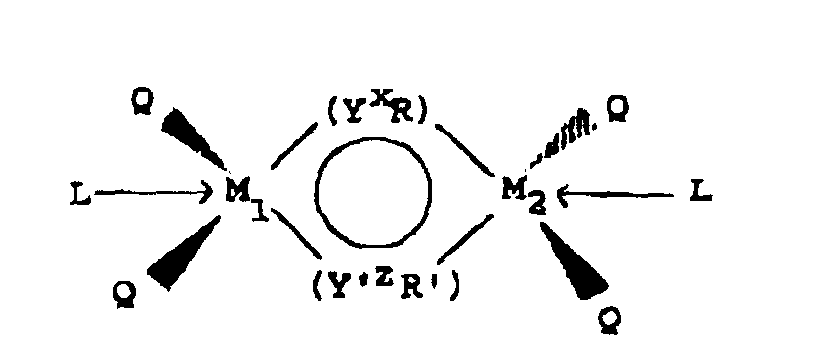
- bridged bimetallocyclic transition metal compounds may be represented by formula I: wherein:
- hydrocarbyl substituents are most preferred and can be any of alkyl, aromatic alkylaromatic, arylaromatic, linear, branched or cyclic, including both fused and pendant ring systems, preferably having from 1 to 30 carbon atoms.
- M 1 and M 2 are the same transition metal element and are bridged by identical groups Y x R n .
- these bridging groups are typically alkylidyne group, CR n and, where R n is defined as above, for example -Si(CH 3 ) 3 , -Si(CH 2 CH 3 ) 3 or -Si(t-C(CH 3 ) 3 ) 3 .
- R and R' groups defined above will include such substituents as the aliphatic groups methyl, propyl, isopropyl, n-butyl, isobutyl, sec-butyl, tert-butyl, cyclohexyl, adamantyl dodecyl, cyclododecyl, and higher alkyls or derivatives thereof ( e.g., benzyl, diphenylmethyl, or triphenylmethyl), the substituted or unsubstituted aromatic substituents such as phenyl, napthyl, phenanthryl, and other polycyclic aromatics and their partially hydrogenated derivatives (e.g., tetrahydronapthyl).
- substituents as the aliphatic groups methyl, propyl, isopropyl, n-butyl, isobutyl, sec-butyl, tert-butyl, cyclohexyl, adamantyl
- the Q groups defined above will include as examples such ligands as the R and R' substituents above and tert-butoxy, phenoxy and its alkyl derivatives, dimethylamido, di- tert -butylamido, diphenylamido, ditrimethylsilylamido; dimethylphosphido, di- tert -butylphosphido, diphenylphosphido, di-trimethylsilyl-phosphido; cyclopentadienyl, indenyl, fluorenyl, and their alkyl and aryl-substituted derivatives; and, bridged cyclopentadienyl Q ligands as previously defined, bridging provided by groups well-known in the metallocene art (e.g., dimethylsilyl, diphenylcarbyl, diethylgermyl, and those consisting of one or more substituted methylene units).
- ligands as the
- the preferred bimetallocyclic compounds of the invention comprise at least one Group 4 or Group 5 metal having adjacent Q ligands which are capable of either abstraction or replacement by an alkyl group.
- the ligand remaining on the cationic metal center must be capable of olefin insertion.
- the remaining Q ligands of the other metal center, whether of Group 4 or 5 will be of sufficient bulk or bonding energy that they cannot be abstracted readily by a strong activating cocatalyst component such as methylalumoxane.
- the activating cocatalysts include, but are not limited to group 13 alkyls, preferably aluminum alkyls; alumoxanes, preferably alkylalumoxanes; and ionizing reagents, preferably Bronsted acid salts, oxidizing metal salts, or covalent neutral compounds containing, or capable of providing, stable, compatible noncoordinating anions.
- Preferred activating cocatalysts include ionizing activator components which may be ion-exchange compounds comprising a cation, which will irreversibly react with at least one ligand, Q, contained in said transition metal compound and a noncoordinating anion which when functioning as a chargebalancing anion in the catalyst system is compatible, defined as not transferring an anionic substituent or fragment thereof to any cationic species formed as the result of the reaction.
- One or more of the cocatalyst activators may be used together so long as a Q ligand is abstracted to produce a transition metal cation which is then charge-balanced by the stable, bulky noncoordinating anion.
- the cocatalyst precursors may comprise as a cation portion of the activator component Bronsted acids such as protons or protonated Lewis bases, or may comprise reducible Lewis acids such as ferricinium, tropylium, triphenylcarbenium, or silver cations.
- the activator may be a neutral Lewis acid capable of abstracting a Q ligand, e.g., tris(pentafluorophenyl)boron, while contributing a counter-balancing noncoordinating anion.
- these activators require the presence of a Q ligand that is readily abstractable, such as hydride, alkyl or silyl groups.
- Anions meeting these criteria such as boranes, polynuclear boranes, carboranes, metallacarboranes, polyoxoanions, and anionic coordination complexes are fully described in the literature above.
- the activator component may also be a Lewis-acid complex which will react with at least one ligand, Q, of the first component, thereby forming an active catalytic species with the ligand from the metal component now bound to the Lewis-acid complex.
- Alumoxanes, and especially methylalumoxane, the product formed from the reaction of trimethylaluminum with substoichiometric quantities of water, are particularly preferred Lewis-acid second components.
- one or more Q ligand may be halogen, alkoxy or other non-alkyl ligand. Alkylation of the transition metal compound occurs and ionization by ligand abstraction is enabled.
- the second compound Upon combination of the bimetallocyclic transition metal compound and the ionizing cocatalyst compounds above, the second compound, or at least a portion thereof, will react with one of the abstractable nonbridging ligands of the first component, thereby generating an ion pair consisting of the Group 4 or 5 bimetallocyclic transition-metal cation and the aforementioned anion, which anion is compatible with and noncoordinating to the Group 4 or 5 transition-metal cation formed from the bimetallocyclic compound.
- the anion must generally be capable of stabilizing the Group 4 or 5 transition-metal cations ability to function as a catalyst and must generally be sufficiently labile to permit displacement by an olefin, diolefin, or acetylenically unsaturated monomer during polymerization.
- bimetallocyclic compounds of the invention are prepared by conventional procedures as reported in the literature (see Background of the Invention).
- bis- ⁇ -(trimethylsilylmethylidyne)tetrakis(trimethylsilylmethyl)ditantalum can be prepared by combining tantalum pentachloride, TaCl 5 , and a Grignard reagent, e.g., trimethylsilylmethylmagnesium chloride, (CH3) 3 SiCH 2 MgCl, in a polar solvent, e.g., diethyl ether, at room temperature.
- the compound is recovered by filtering, stripping, and recrystallizing from a hydrocarbon solvent.
- any Grignard reagent containing the connecting group - CH 2 -MgX when contacted with the group 5 metal halide may serve as an entry into the bimetallocyclic compounds according to the invention.
- the catalyst systems employed in this invention are preferably derived from the combining of the bimetallocyclic transition metal compounds of the invention with the activating cocatalyst.
- convenient preparation of the catalyst system can be accomplished by combining the selected transition metal and activator components, in either order, in an alkane or aromatic hydrocarbon solvent.
- the bimetallocyclic transition metal compounds of the invention may be activated by first alkylating with an organoaluminium compound, such as an alkylalumoxane or alkylaluminium, and combined with an ionizing activator.
- the solvent utilized for activation would be suitable for use as a diluent for the subsequent polymerization, and when this is the case, the activation may be performed in situ in the polymerization reactor.
- the catalyst system may be prepared separately in either concentrated or dilute form and added to the polymerization reactor containing additional diluent as needed.
- Solvent systems which are suitable as solvents for the formation of the catalyst system and as diluents for subsequent polymerizations, include but are not limited to, straight and branched chain hydrocarbons such as isobutane, butane, pentane, hexane, heptane, octane, and the like, cyclic and alicyclic hydrocarbons such as cyclohexane, cycloheptane, methylcyclohexane, and the like, and aromatic and alkyl-substituted aromatic compounds such as benzene, toluene, xylene and the like.
- straight and branched chain hydrocarbons such as isobutane, butane, pentane, hexane, heptane, octane, and the like
- cyclic and alicyclic hydrocarbons such as cyclohexane, cycloheptane, methylcyclohexane,
- Suitable solvents also include olefins which may act as monomers or comonomers such as ethylene, propylene, 1-butene, 1-hexene and the like, as well as bicyclic olefins such as norbornene, and dicyclopentadiene.
- suitable polymerization results are obtained wherein the bimetallocyclic Group 4 or 5 transition metal component is present in the reaction diluent or solvent in a concentration anywhere from 10 -5 to 10 -1 mol./l., and the activator component in a concentration such that the ratio of the activator to the bridged bimetallocyclic transition metal component ranges from a molar value of 1:1 (typical for discrete noncoordinating anion forming cocatalysts) to 20,000:1 (highest typical range for alumoxane cocatalysts).
- Polymerizations may be conducted by combining the activated transition metal compound with polymerizable monomers. This can be done in accordance with conventional olefin polymerization conditions well known in the art.
- the catalyst system is employed in liquid phase, (slurry, solution, suspension or bulk phase or combination thereof), high pressure liquid or supercritical fluid phase, or gas phase polymerizations of olefin monomers. These processes may be employed in singular or in series reactors.
- the liquid processes comprise the steps of contacting an olefin with the catalyst system in a suitable diluent or solvent and allowing said olefin monomer to react with the catalyst system for a time and at a temperature sufficient to produce polyolefin polymer.
- Bulk polymerization is typically done by contacting the catalyst with a slurry of liquid monomer, the catalyst typically being supported on a polymeric support or one of a metal or metalloid oxide, such as silica or silica-alumina.
- the supported catalyst may be prepared in accordance with the knowledge in the art with respect to the use of metallocene catalyst with alumoxane cocatalysts or that addressing the use of metallocenes with noncoordinating anions, for example, the activated catalyst can be supported in accordance with WO 91/0882.
- the methods disclosed in WO 93/11172 or in WO 96/04319, for preparing ionic catalyst systems chemically bound to the support are preferred.
- a neutral Lewis acid ionizing compound is reacted with hydroxyl group-containing metal oxide supports, preferably complexed with a Lewis base, and then reacted with the transition metal compound which is activated by protonation.
- Gas phase polymerization will also typically be conducted with supported versions of the invention catalysts. Additionally, the use of scavenging agents, e.g., alkylaluminum or alkylboron compounds, or alkylalumoxanes, is preferred for enhanced activity in accordance with conventional knowledge, see for example, U.S. patent 5,241,025.
- scavenging agents e.g., alkylaluminum or alkylboron compounds, or alkylalumoxanes
- the catalyst system components may be added to the polymerization vessel separately or after premixing the two components.
- the catalyst system may be used to polymerize olefins at a wide variety of temperatures. Typically this catalyst system may be used at temperatures from -100 °C to 300 °C or more, and at pressures of up to 1500 bar, or more. Preferred temperatures include those between -20 to 280 °C. However during the formation of the catalyst, temperatures from 25 to 100 °C are preferred, with temperatures of 25 to 75 °C being most preferred for catalyst formation.
- a high pressure polymerization utilizing higher temperatures such as that described in U.S. patent 5,408,017 can be effected with the catalysts of this invention as well.
- the catalyst system components, and the catalyst system once formed, should be protected from exposure to oxygen and water. Therefore the reaction necessary to prepare the catalyst system is preferably performed in an atmosphere which is free of oxygen and moisture, preferably, for example in an atmosphere of dry nitrogen, helium, or argon.
- Preferred monomers that may be polymerized using the catalyst system of this invention include essentially any monomers having ethylenic or acetylenic unsaturation, particularly the olefinic and acetylenic monomers.
- Preferred monomers include aliphatic, branched and cyclic olefins and acetylenes.
- Particularly preferred monomers include C 1 to C 100 ⁇ -olefin monomers, preferably linear, branched or cyclic C 1 to C 20 ⁇ -olefin monomers, such as ethylene, propylene, butylene, pentene, hexene, heptene, octene, nonene, decene, undecene, dodecene, cyclobutene, cyclopentene, cyclohexene, cycloheptene, cyclooctene, cyclononene, cyclodecene, cyclododecene, and alkyl-substituted cyclic olefins, substituted and unsubsfituted norbomenes, substituted and unsubstituted vinyl norbornenes, styrenes, alkyl-styrenes, para-alkyl-styrenes, ⁇ -alkyl-styrenes,
- Dienes and other polyenes are also monomers that may be polymerized by the catalyst system described above.
- Preferred dienes include butadiene, dicydopentadiene, ethylidene norbornene, methyl norbornene, norbornadiene, 1,5 hexadiene, 1,6 heptadiene and tert-dodecadiene. It will be readily apparent to those of ordinary skill in the art that the monomers listed above can be homopolymerized, or copolymerized with the other monomers listed.
- a group 5 compound 1) bis- ⁇ -(trimethylsilylmethylidyne)tetrakis(trimethylsilylmethyl) ditantalum, was prepared by mixing tantalum pentachloride, TaCl 5 , (82.53 mmol.), and trimethyisilylmethylmagnesium chloride, (CH 3 ) 3 SiCH 2 MgCl (453.9 mmol.), in 800 mL. diethyl ether at room temperature. The compound was recovered by stripping, filtering, extracting into hexane and then cooling at -20 °C for 12 h.
- Another Group 5 Compound 2) bis- ⁇ -(trimethylsilylmethylidynyl)tetrakis(trimethylsilylmethyl)diniobium, was prepared as above substituting NbCl 5 for TaCl 5 .
- Example 1 The procedure of example 1 was repeated except that dimethylanilinium perfluorotetraphenyl borate was used in place of methylalumoxane.
- Compound 1) (0.100g) and the dimethylanilinium perfluorotetraphenyl borate (0.900g) were slurried together in 2.0 ml toluene and gently warmed until the solids were dissolved and a dark oil phase separated out of the mixture.
- This mixture was transferred to the one liter autoclave batch reactor, which was thereafter charged with 204 psi (1406 kPa)of ethylene. The temperature was maintained at 80 °C.
Landscapes
- Chemical & Material Sciences (AREA)
- Health & Medical Sciences (AREA)
- Chemical Kinetics & Catalysis (AREA)
- Medicinal Chemistry (AREA)
- Polymers & Plastics (AREA)
- Organic Chemistry (AREA)
- Transition And Organic Metals Composition Catalysts For Addition Polymerization (AREA)
- Catalysts (AREA)
- Addition Polymer Or Copolymer, Post-Treatments, Or Chemical Modifications (AREA)
Claims (16)
- Polymerisationskatalysatorzusammensetzung, die bimetallocyclische Verbindung umfaßt, die für olefinpolymerisation aktiviert ist, wobei die bimetallocyclische Verbindung zwei Mitglieder umfaßt, die unabhängig ausgewählt sind aus der Gruppe, die die Gruppe 4 oder Gruppe 5 Metallatome Ti, Zr, Hf, Nb und Ta umfaßt, wobei diese Mitglieder über zwei kovalente Brückenbindungen unter Bildung einer cyclischen Verbindung mit delokalisierter Bindung in der cyclischen Struktur der bimetallocyclischen Verbindung verbunden sind.
- Katalysatorzusammensetzung nach Anspruch 1, die von der bimetallocyclischen Verbindung mit der Formelabgeleitet ist, in der
 M1 und M2 jeweils ein Gruppe 4 oder 5 Metall ausgewählt aus der Gruppe bestehend aus Ti, Zr, Hf, Nb oder Ta in ihrem höchsten Oxidationszustand sind,jedes YxR und Y'zR' unabhängig ein Brückenligand ist, in dem jedes Y und Y' ein Element ausgewählt aus der Gruppe 14, wenn M1 und M2 Gruppe 5 sind, oder Gruppe 15 ist, wenn M1 und M2 Gruppe 4 des Periodensystems der Elemente sind, x und z die Wertigkeiten von Y beziehungsweise Y' sind, so daß, wenn Y oder Y' ein Gruppe 14 Element ist, ihre Wertigkeit als 4 definiert ist, und wenn Y oder Y' ein Gruppe 15 Element ist, ihre wertigkeit als 3 definiert ist,jedes R und R' unabhängig ein Rest ausgewählt aus der Gruppe bestehend aus substituierten oder unsubstituierten Kohlenwasserstoffresten, vorzugsweise C1- bis C30-Kohlenwasserstoffresten ist, die mit beliebigen zusätzlichen C1- bis C30-Kohlenwasserstoffresten substituiert sind, mit der Maßgabe, daß ein oder mehrere der Waseerstoffatome an den zusätzlichen Kohlenwasserstoffresten durch einen Halogenrest, Silylrest, Amidorest, Phosphidorest und Alkoxyrest oder jeden anderen Rest, der eine Lewis-saure oder -basische Funktionalität enthält, ersetzt werden kann,jedes Q unabhängig jeder einwertige anionische Ligand sein kann, vorzugsweise ein Halogenid, Hydrid, substituierte oder unsubstituierte Kohlenwasserstoffreste, substituiertes oder unsubstituiertes Silyl, substituierte oder unsubstituierte Alkoxyreste, substituierte oder unsubstituierte Aryloxyreste, substituierte oder unsubstituierte Amidoreste, substituierte oder unsubstituierte Phosphidoreste, vorzugsweise mit einem bis dreißig Kohlenstoffatomen, ferner mit der Maßgabe, daß zwei Q zusammen einen dianionischen chelatbildenden Liganden bilden können,L eine neutrale Lewisbase ist, von der eine oder mehrere vorhanden sein können oder nicht.
 - Katalysatorzusammensetzung nach Anspruch 2, bei der jeder R und R' unabhängig ein C1- bis C30-Kohlenwasserstoffrest oder substituierter C1- bis C20-Kohlenwasseretoffrest ist.
- Katalysatorzusammensetzung nach Anspruch 2, bei der jedes Q unabhängig ein Halogenid-, Hydrid-, substituierter oder unsubstituierter Kohlenwasserstoffrest, substituierter oder unsubstituierter Alkoxy-, substituierter oder unsubstituierter Aryloxy-, substituierter oder unsubstituierter Amido- oder substituierter oder unsubstituierter Phosphidorest ist.
- Katalysatorzusammensetzung nach Anspruch 2, bei der jedes L unabhängig ausgewählt ist aus Diethylether, Tetrahydrofuran, Dimethylanilin, Anilin und Trialkylphosphin ader Triarylphosphin.
- Katalysatorzusammensetzung nach Anspruch 2, bei der M1 und M2 die gleichen Übergangsmetallelemente sind und durch identische Gruppen YR verbrückt sind.
- Katalysatorzusammensetzung nach Anspruch 6, bei der M1 und M2 ausgewählt sind aus der Gruppe 5 und beide YR-Gruppen verbrückende Alkylidingruppen sind.
- Katalysatorzusammensetzung nach Anspruch 6, bei der M1 und M2 ausgewählt sind aus der Gruppe 4 und beide YR-Gruppen Amido- oder Phosphidogruppen sind.
- Katalysatorsystemzusammensetzung nach Anspruch 1, bei der die bimetallocyclische Verbindung durch Kombinieren mit Alumoxan aktiviert wird.
- Katalysatorzusammensetzung nach Anspruch 1, bei der die bimetallocyclische Verbindung durch Kombinieren mit ionischem Aktivator aktiviert wird, der in der Lage ist, ein verträgliches nicht-koordinierendes Anion zu liefern.
- Katalysatorsystemzusammensetzung nach Anspruch 9, bei der das Alumoxan Methylalumoxan ist.
- Katalysatorzusammensetzung nach Anspruch 10, bei der der ionisierende Aktivator Dimethylaniliniumperfluorotetraphenylborat oder Trisperfluorophenylbor ist.
- Verfahren zum Polymerisieren von ethylenisch oder acetylenisch ungesättigten Monomeren, bei dem die Monomere unter Polymerisationsbedingungen mit einer Katalysatorzusammensetzung gemäß Anspruch 1 kontaktiert werden.
- Verfahren nach Anspruch 13, bei dem die bimetallocyclische Verbindung durch die Formel gemäß Anspruch 2 wiedergegeben wird.
- Verfahren nach Anspruch 14, bei dem die bimetallocyclische Verbindung durch Kombinieren mit Methylalumoxan aktiviert wird.
- Verfahren nach Anspruch 14, bei dem die bimetallocyclische Verbindung durch Kombinieren mit ionischem Aktivator aktiviert wird, der in der Lage ist, ein verträgliches nichtkoordinierendes Anion zu schaffen.
Applications Claiming Priority (3)
| Application Number | Priority Date | Filing Date | Title |
|---|---|---|---|
| US08/473,693 US6143682A (en) | 1995-06-07 | 1995-06-07 | Bimetallocyclic transition metal catalyst systems |
| US473693 | 1995-06-07 | ||
| PCT/US1996/009764 WO1996040805A1 (en) | 1995-06-07 | 1996-06-07 | Bimetallydic transition metal catalyst systems |
Publications (2)
| Publication Number | Publication Date |
|---|---|
| EP0837886A1 EP0837886A1 (de) | 1998-04-29 |
| EP0837886B1 true EP0837886B1 (de) | 1999-08-04 |
Family
ID=23880608
Family Applications (1)
| Application Number | Title | Priority Date | Filing Date |
|---|---|---|---|
| EP96919288A Expired - Lifetime EP0837886B1 (de) | 1995-06-07 | 1996-06-07 | Bimetallzyklische, übergangsmetall enthaltende katalysatorsysteme |
Country Status (7)
| Country | Link |
|---|---|
| US (1) | US6143682A (de) |
| EP (1) | EP0837886B1 (de) |
| JP (1) | JPH11507407A (de) |
| CA (1) | CA2220655A1 (de) |
| DE (1) | DE69603604T2 (de) |
| ES (1) | ES2136414T3 (de) |
| WO (1) | WO1996040805A1 (de) |
Families Citing this family (36)
| Publication number | Priority date | Publication date | Assignee | Title |
|---|---|---|---|---|
| US6143686A (en) * | 1994-08-03 | 2000-11-07 | Exxon Chemical Patents, Inc. | Supported ionic catalyst compositions |
| US6284698B1 (en) * | 1997-09-15 | 2001-09-04 | The Dow Chemical Company | Highly activated bimetallic complexes and polymerization process |
| CN1209404C (zh) * | 1999-09-01 | 2005-07-06 | 埃克森化学专利公司 | 透气膜及其制备方法 |
| US6476164B1 (en) | 1999-10-22 | 2002-11-05 | Exxonmobil Chemical Patents Inc. | Carbenium cationic complexes suitable for polymerization catalysts |
| US6475946B1 (en) | 1999-10-22 | 2002-11-05 | Exxonmobil Chemical Patents Inc. | Olefin polymerization catalysis with aryl substituted carbenium cationic complexes |
| US6822057B2 (en) | 1999-12-09 | 2004-11-23 | Exxon Mobil Chemical Patents Inc. | Olefin polymerization catalysts derived from Group-15 cationic compounds and processes using them |
| US6489480B2 (en) | 1999-12-09 | 2002-12-03 | Exxonmobil Chemical Patents Inc. | Group-15 cationic compounds for olefin polymerization catalysts |
| MXPA02006197A (es) | 1999-12-20 | 2002-12-09 | Exxon Chemical Patents Inc | Procesos para la preparacion de resinas de poliolefinas usando catalizadores ionicos soportados. |
| MXPA02006199A (es) | 1999-12-22 | 2003-10-15 | Exxon Chemical Patents Inc | Composiciones adhesivas a base de polipropileno. |
| US7067603B1 (en) | 1999-12-22 | 2006-06-27 | Exxonmobil Chemical Patents Inc. | Adhesive alpha-olefin inter-polymers |
| US6501000B1 (en) | 2000-04-04 | 2002-12-31 | Exxonmobil Research And Engineering Company | Late transition metal catalyst complexes and oligomers therefrom |
| US6689928B2 (en) | 2000-04-04 | 2004-02-10 | Exxonmobil Research And Engineering Company | Transition metal complexes and oligomers therefrom |
| US6809209B2 (en) | 2000-04-07 | 2004-10-26 | Exxonmobil Chemical Patents Inc. | Nitrogen-containing group-13 anionic compounds for olefin polymerization |
| SG114509A1 (en) * | 2000-11-13 | 2005-09-28 | Sumitomo Chemical Co | Catalyst component and catalyst for addition polymerization, and process for producing addition polymer |
| US6723807B2 (en) | 2000-11-13 | 2004-04-20 | Sumitomo Chemical Company, Limited | Catalyst component and catalyst for addition polymerization, and process for producing addition polymer |
| US6656866B2 (en) * | 2000-12-04 | 2003-12-02 | Univation Technologies, Llc | Catalyst preparation method |
| US7511104B2 (en) | 2001-06-20 | 2009-03-31 | Exxonmobil Chemical Patents Inc. | Polyolefins made by catalyst comprising a noncoordinating anion and articles comprising them |
| SG96700A1 (en) * | 2001-09-27 | 2003-06-16 | Sumitomo Chemical Co | Catalyst component for addition polymerization, process for producing catalyst for addition polymerization and process for producing addition polymer |
| US7319125B2 (en) * | 2002-09-20 | 2008-01-15 | Exxonmobil Chemical Patents Inc. | Supercritical polymerization process and polymers produced therefrom |
| US8008412B2 (en) | 2002-09-20 | 2011-08-30 | Exxonmobil Chemical Patents Inc. | Polymer production at supersolution conditions |
| WO2004046214A2 (en) | 2002-10-15 | 2004-06-03 | Exxonmobil Chemical Patents Inc. | Multiple catalyst system for olefin polymerization and polymers produced therefrom |
| US7144934B2 (en) * | 2002-10-24 | 2006-12-05 | Dow Global Technologies Inc. | Charge dissipation modifiers for olefinic interpolymer compositions |
| GB0411742D0 (en) | 2004-05-26 | 2004-06-30 | Exxonmobil Chem Patents Inc | Transition metal compounds for olefin polymerization and oligomerization |
| KR20070039930A (ko) * | 2004-07-08 | 2007-04-13 | 엑손모빌 케미칼 패턴츠 인코포레이티드 | 초임계 조건에서 중합체의 제조방법 |
| US8242237B2 (en) * | 2006-12-20 | 2012-08-14 | Exxonmobil Chemical Patents Inc. | Phase separator and monomer recycle for supercritical polymerization process |
| US8143352B2 (en) * | 2006-12-20 | 2012-03-27 | Exxonmobil Research And Engineering Company | Process for fluid phase in-line blending of polymers |
| US8080610B2 (en) | 2007-03-06 | 2011-12-20 | Exxonmobil Research And Engineering Company | Monomer recycle process for fluid phase in-line blending of polymers |
| ES2446294T3 (es) | 2007-06-04 | 2014-03-07 | Exxonmobil Chemical Patents Inc. | Polimerización de propileno en un sistema homogéneo en condiciones de superdisolución |
| EP2201042B1 (de) * | 2007-09-13 | 2012-06-27 | ExxonMobil Research and Engineering Company | In-line-mischen von weichmachern mit einem basispolymer |
| US7928162B2 (en) * | 2007-09-13 | 2011-04-19 | Exxonmobil Research And Engineering Company | In-line process for producing plasticized polymers and plasticized polymer blends |
| WO2009082468A1 (en) * | 2007-12-20 | 2009-07-02 | Exxonmobil Research And Engineering Company | Polypropylene ethylene-propylene copolymer blends and in-line process to produce them |
| US7994237B2 (en) * | 2007-12-20 | 2011-08-09 | Exxonmobil Research And Engineering Company | In-line process to produce pellet-stable polyolefins |
| US7910679B2 (en) * | 2007-12-20 | 2011-03-22 | Exxonmobil Research And Engineering Company | Bulk homogeneous polymerization process for ethylene propylene copolymers |
| US8318875B2 (en) | 2008-01-18 | 2012-11-27 | Exxonmobil Chemical Patents Inc. | Super-solution homogeneous propylene polymerization and polypropylenes made therefrom |
| US8058461B2 (en) | 2010-03-01 | 2011-11-15 | Exxonmobil Chemical Patents Inc. | Mono-indenyl transition metal compounds and polymerization therewith |
| WO2018022263A1 (en) | 2016-07-29 | 2018-02-01 | Exxonmobil Chemical Patents Inc. | Polymerization processes using high molecular weight polyhydric quenching agents |
Family Cites Families (22)
| Publication number | Priority date | Publication date | Assignee | Title |
|---|---|---|---|---|
| US2922803A (en) * | 1958-08-27 | 1960-01-26 | Nat Lead Co | Di-cyclopentadienyl di-titanium hexahalide and process of preparation |
| US4727123A (en) * | 1983-04-14 | 1988-02-23 | The Standard Oil Company | Catalysts for the polymerization of conjugated dienes |
| US5324800A (en) * | 1983-06-06 | 1994-06-28 | Exxon Chemical Patents Inc. | Process and catalyst for polyolefin density and molecular weight control |
| US4716205A (en) * | 1985-10-15 | 1987-12-29 | E. I. Du Pont De Nemours And Company | Nickel-catalyzed polymerization of ethylene |
| US5055438A (en) * | 1989-09-13 | 1991-10-08 | Exxon Chemical Patents, Inc. | Olefin polymerization catalysts |
| US5621126A (en) * | 1987-01-30 | 1997-04-15 | Exxon Chemical Patents Inc. | Monocyclopentadienyl metal compounds for ethylene-α-olefin-copolymer production catalysts |
| PL276385A1 (en) * | 1987-01-30 | 1989-07-24 | Exxon Chemical Patents Inc | Method for polymerization of olefines,diolefins and acetylene unsaturated compounds |
| US5198401A (en) * | 1987-01-30 | 1993-03-30 | Exxon Chemical Patents Inc. | Ionic metallocene catalyst compositions |
| US5034549A (en) * | 1989-07-28 | 1991-07-23 | Akzo N.V. | Olefin polymerization catalyst |
| ATE120768T1 (de) * | 1989-10-30 | 1995-04-15 | Fina Technology | Herstellung von metallocenkatalysatoren für olefinpolymerisation. |
| US5387568A (en) * | 1989-10-30 | 1995-02-07 | Fina Technology, Inc. | Preparation of metallocene catalysts for polymerization of olefins |
| RU2118203C1 (ru) * | 1990-06-22 | 1998-08-27 | Экксон Кэмикал Пейтентс Инк. | Каталитическая система для получения полиолефинов и композиция, используемая для полимеризации олефинов |
| WO1992012162A1 (en) * | 1990-12-27 | 1992-07-23 | Exxon Chemical Patents Inc. | An amido transition metal compound and a catalyst system for the production of isotactic polypropylene |
| US5189192A (en) * | 1991-01-16 | 1993-02-23 | The Dow Chemical Company | Process for preparing addition polymerization catalysts via metal center oxidation |
| JP3117231B2 (ja) * | 1991-03-11 | 2000-12-11 | 三井化学株式会社 | 幅広い分子量分布を有するシンジオタクチックポリ−α−オレフィンの製造方法 |
| US5721185A (en) * | 1991-06-24 | 1998-02-24 | The Dow Chemical Company | Homogeneous olefin polymerization catalyst by abstraction with lewis acids |
| US5162466A (en) * | 1991-12-31 | 1992-11-10 | Union Carbide Chemicals & Plastics Technology Corporation | Use of methylene-bridged derivatives of cyclopentadienyl dicarbollide complexes of titanium, zirconium and hafnium as polymerization catalysts |
| ES2137266T3 (es) * | 1992-07-01 | 1999-12-16 | Exxon Chemical Patents Inc | Catalizadores de polimerizacion de olefinas a base de metales de transicion. |
| US5372980A (en) * | 1993-06-03 | 1994-12-13 | Polysar | Bimetallic metallocene alumoxane catalyst system and its use in the preparation of ethylene-alpha olefin and ethylene-alpha olefin-non-conjugated diolefin elastomers |
| EP0664304B1 (de) * | 1993-12-27 | 1999-08-04 | Mitsui Chemicals, Inc. | Katalysator und Verfahren zur Olefinpolymerisation |
| JP3337311B2 (ja) * | 1994-03-11 | 2002-10-21 | 高砂香料工業株式会社 | 新規オキソ−チタン錯体、その製造方法およびその錯体を用いたβ−ヒドロキシケトンまたはα−ヒドロキシカルボン酸エステルの製造方法 |
| US5525678A (en) * | 1994-09-22 | 1996-06-11 | Mobil Oil Corporation | Process for controlling the MWD of a broad/bimodal resin produced in a single reactor |
-
1995
- 1995-06-07 US US08/473,693 patent/US6143682A/en not_active Expired - Fee Related
-
1996
- 1996-06-07 ES ES96919288T patent/ES2136414T3/es not_active Expired - Lifetime
- 1996-06-07 WO PCT/US1996/009764 patent/WO1996040805A1/en not_active Ceased
- 1996-06-07 CA CA002220655A patent/CA2220655A1/en not_active Abandoned
- 1996-06-07 DE DE69603604T patent/DE69603604T2/de not_active Expired - Fee Related
- 1996-06-07 EP EP96919288A patent/EP0837886B1/de not_active Expired - Lifetime
- 1996-06-07 JP JP9501989A patent/JPH11507407A/ja active Pending
Also Published As
| Publication number | Publication date |
|---|---|
| US6143682A (en) | 2000-11-07 |
| DE69603604T2 (de) | 2000-04-27 |
| WO1996040805A1 (en) | 1996-12-19 |
| ES2136414T3 (es) | 1999-11-16 |
| CA2220655A1 (en) | 1996-12-19 |
| EP0837886A1 (de) | 1998-04-29 |
| DE69603604D1 (de) | 1999-09-09 |
| JPH11507407A (ja) | 1999-06-29 |
Similar Documents
| Publication | Publication Date | Title |
|---|---|---|
| EP0837886B1 (de) | Bimetallzyklische, übergangsmetall enthaltende katalysatorsysteme | |
| KR100339461B1 (ko) | 지지된이온촉매조성물 | |
| EP0528041B1 (de) | Uebergangsmetallverbindung und Verfahren zum Polymerisation von Olefin damit | |
| AU651423B2 (en) | Process for preparing addition polymerization catalysts via metal center oxidation | |
| EP1060198B1 (de) | Nicht koordinierende anionen für die polymerisation von olefinen | |
| EP0698618B1 (de) | Additionspolymerisationskatalysator mit oxidativer Aktivität | |
| US5770663A (en) | Metallocene preparation and use | |
| AU665320B1 (en) | Unbridged indenyl-containing metallocenes useful in olefin polymerization | |
| JP3398381B2 (ja) | 遷移金属オレフィン重合触媒 | |
| KR100536961B1 (ko) | 신규한 균질 올레핀 중합 촉매 조성물 | |
| US5519099A (en) | Organometallic catalysts containing hydrotris(pyrazolyl) borate and cyclopentadienyl groups, and processes of employing the same | |
| US6211105B1 (en) | Nitrogen-containing group 13 anionic complexes for olefin polymerization | |
| KR20010071325A (ko) | 지지된 올레핀 폴리머화 촉매 조성물 | |
| EP1373282B1 (de) | Bimetallische katalysatoren zur olefin-polymerisation | |
| WO1996004319A1 (en) | Supported ionic catalyst composition | |
| KR100548105B1 (ko) | α-올레핀계 중합용 촉매용액 | |
| JP2002533484A (ja) | 架橋されたメタロセンポリオレフィン触媒上のハロアリール含有第13族置換基 | |
| US6399532B1 (en) | Polymerization catalyst | |
| US20020002256A1 (en) | Catalyst composition for the polymerization of olefins | |
| JP3572325B2 (ja) | オレフィン重合用触媒およびそれを用いたポリオレフィンの製造方法 | |
| EP0741146A1 (de) | Katalysator für Ethylen-(Co)-Polymerization mit verbesserter Aktivität | |
| US6228959B1 (en) | Single-site catalysts containing homoaromatic ligands | |
| US6908973B2 (en) | Single-site catalysts for olefin polymerization | |
| JPH04366107A (ja) | シンジオタクチックポリプロピレンの製造方法 | |
| JP3427488B2 (ja) | 新規有機遷移金属化合物およびそれを用いたポリオレフィンの製造方法 |
Legal Events
| Date | Code | Title | Description |
|---|---|---|---|
| PUAI | Public reference made under article 153(3) epc to a published international application that has entered the european phase |
Free format text: ORIGINAL CODE: 0009012 |
|
| 17P | Request for examination filed |
Effective date: 19980106 |
|
| AK | Designated contracting states |
Kind code of ref document: A1 Designated state(s): BE DE ES FR GB IT NL |
|
| GRAG | Despatch of communication of intention to grant |
Free format text: ORIGINAL CODE: EPIDOS AGRA |
|
| 17Q | First examination report despatched |
Effective date: 19980901 |
|
| GRAG | Despatch of communication of intention to grant |
Free format text: ORIGINAL CODE: EPIDOS AGRA |
|
| GRAG | Despatch of communication of intention to grant |
Free format text: ORIGINAL CODE: EPIDOS AGRA |
|
| GRAH | Despatch of communication of intention to grant a patent |
Free format text: ORIGINAL CODE: EPIDOS IGRA |
|
| GRAH | Despatch of communication of intention to grant a patent |
Free format text: ORIGINAL CODE: EPIDOS IGRA |
|
| GRAA | (expected) grant |
Free format text: ORIGINAL CODE: 0009210 |
|
| AK | Designated contracting states |
Kind code of ref document: B1 Designated state(s): BE DE ES FR GB IT NL |
|
| REF | Corresponds to: |
Ref document number: 69603604 Country of ref document: DE Date of ref document: 19990909 |
|
| ITF | It: translation for a ep patent filed | ||
| ET | Fr: translation filed | ||
| REG | Reference to a national code |
Ref country code: ES Ref legal event code: FG2A Ref document number: 2136414 Country of ref document: ES Kind code of ref document: T3 |
|
| PLBE | No opposition filed within time limit |
Free format text: ORIGINAL CODE: 0009261 |
|
| STAA | Information on the status of an ep patent application or granted ep patent |
Free format text: STATUS: NO OPPOSITION FILED WITHIN TIME LIMIT |
|
| 26N | No opposition filed | ||
| REG | Reference to a national code |
Ref country code: GB Ref legal event code: IF02 |
|
| PGFP | Annual fee paid to national office [announced via postgrant information from national office to epo] |
Ref country code: GB Payment date: 20060505 Year of fee payment: 11 |
|
| PGFP | Annual fee paid to national office [announced via postgrant information from national office to epo] |
Ref country code: NL Payment date: 20060508 Year of fee payment: 11 |
|
| PGFP | Annual fee paid to national office [announced via postgrant information from national office to epo] |
Ref country code: FR Payment date: 20060605 Year of fee payment: 11 |
|
| PGFP | Annual fee paid to national office [announced via postgrant information from national office to epo] |
Ref country code: ES Payment date: 20060613 Year of fee payment: 11 |
|
| PGFP | Annual fee paid to national office [announced via postgrant information from national office to epo] |
Ref country code: BE Payment date: 20060629 Year of fee payment: 11 |
|
| PGFP | Annual fee paid to national office [announced via postgrant information from national office to epo] |
Ref country code: IT Payment date: 20060630 Year of fee payment: 11 Ref country code: DE Payment date: 20060630 Year of fee payment: 11 |
|
| BERE | Be: lapsed |
Owner name: *EXXON CHEMICAL PATENTS INC. Effective date: 20070630 |
|
| GBPC | Gb: european patent ceased through non-payment of renewal fee |
Effective date: 20070607 |
|
| NLV4 | Nl: lapsed or anulled due to non-payment of the annual fee |
Effective date: 20080101 |
|
| PG25 | Lapsed in a contracting state [announced via postgrant information from national office to epo] |
Ref country code: BE Free format text: LAPSE BECAUSE OF NON-PAYMENT OF DUE FEES Effective date: 20070630 |
|
| REG | Reference to a national code |
Ref country code: FR Ref legal event code: ST Effective date: 20080229 |
|
| PG25 | Lapsed in a contracting state [announced via postgrant information from national office to epo] |
Ref country code: NL Free format text: LAPSE BECAUSE OF NON-PAYMENT OF DUE FEES Effective date: 20080101 Ref country code: DE Free format text: LAPSE BECAUSE OF NON-PAYMENT OF DUE FEES Effective date: 20080101 |
|
| PG25 | Lapsed in a contracting state [announced via postgrant information from national office to epo] |
Ref country code: GB Free format text: LAPSE BECAUSE OF NON-PAYMENT OF DUE FEES Effective date: 20070607 |
|
| REG | Reference to a national code |
Ref country code: ES Ref legal event code: FD2A Effective date: 20070608 |
|
| PG25 | Lapsed in a contracting state [announced via postgrant information from national office to epo] |
Ref country code: FR Free format text: LAPSE BECAUSE OF NON-PAYMENT OF DUE FEES Effective date: 20070702 |
|
| PG25 | Lapsed in a contracting state [announced via postgrant information from national office to epo] |
Ref country code: ES Free format text: LAPSE BECAUSE OF NON-PAYMENT OF DUE FEES Effective date: 20070608 |
|
| PG25 | Lapsed in a contracting state [announced via postgrant information from national office to epo] |
Ref country code: IT Free format text: LAPSE BECAUSE OF NON-PAYMENT OF DUE FEES Effective date: 20070607 |