EP0838480A1 - Verfahren zur Herstellung ketogruppenenthaltender Polyethylenwachse - Google Patents
Verfahren zur Herstellung ketogruppenenthaltender Polyethylenwachse Download PDFInfo
- Publication number
- EP0838480A1 EP0838480A1 EP97117558A EP97117558A EP0838480A1 EP 0838480 A1 EP0838480 A1 EP 0838480A1 EP 97117558 A EP97117558 A EP 97117558A EP 97117558 A EP97117558 A EP 97117558A EP 0838480 A1 EP0838480 A1 EP 0838480A1
- Authority
- EP
- European Patent Office
- Prior art keywords
- polyethylene waxes
- keto groups
- ethylene
- aldehyde
- containing keto
- Prior art date
- Legal status (The legal status is an assumption and is not a legal conclusion. Google has not performed a legal analysis and makes no representation as to the accuracy of the status listed.)
- Granted
Links
- -1 polyethylene Polymers 0.000 title claims abstract description 32
- 239000001993 wax Substances 0.000 title claims abstract description 29
- 239000004698 Polyethylene Substances 0.000 title claims abstract description 25
- 125000000468 ketone group Chemical group 0.000 title claims abstract description 25
- 229920000573 polyethylene Polymers 0.000 title claims abstract description 25
- 238000004519 manufacturing process Methods 0.000 title claims abstract description 11
- VGGSQFUCUMXWEO-UHFFFAOYSA-N Ethene Chemical compound C=C VGGSQFUCUMXWEO-UHFFFAOYSA-N 0.000 claims abstract description 18
- 239000005977 Ethylene Substances 0.000 claims abstract description 18
- 125000002485 formyl group Chemical class [H]C(*)=O 0.000 claims abstract 7
- 238000000034 method Methods 0.000 claims description 14
- 150000003335 secondary amines Chemical class 0.000 claims description 5
- 125000000217 alkyl group Chemical group 0.000 claims description 4
- 125000001997 phenyl group Chemical group [H]C1=C([H])C([H])=C(*)C([H])=C1[H] 0.000 claims description 3
- 238000006268 reductive amination reaction Methods 0.000 claims description 3
- 150000003333 secondary alcohols Chemical class 0.000 claims description 3
- 125000003358 C2-C20 alkenyl group Chemical group 0.000 claims description 2
- 125000003118 aryl group Chemical group 0.000 claims description 2
- 150000001875 compounds Chemical class 0.000 claims description 2
- NBBJYMSMWIIQGU-UHFFFAOYSA-N Propionic aldehyde Chemical compound CCC=O NBBJYMSMWIIQGU-UHFFFAOYSA-N 0.000 description 16
- 150000001299 aldehydes Chemical class 0.000 description 16
- ZTQSAGDEMFDKMZ-UHFFFAOYSA-N butyric aldehyde Natural products CCCC=O ZTQSAGDEMFDKMZ-UHFFFAOYSA-N 0.000 description 10
- 150000002148 esters Chemical class 0.000 description 4
- 238000007306 functionalization reaction Methods 0.000 description 4
- 239000000203 mixture Substances 0.000 description 4
- 238000006116 polymerization reaction Methods 0.000 description 4
- 229920000098 polyolefin Polymers 0.000 description 4
- 239000002253 acid Substances 0.000 description 3
- 150000001298 alcohols Chemical class 0.000 description 3
- 238000006243 chemical reaction Methods 0.000 description 3
- 238000007334 copolymerization reaction Methods 0.000 description 3
- 230000003647 oxidation Effects 0.000 description 3
- 238000007254 oxidation reaction Methods 0.000 description 3
- 239000000047 product Substances 0.000 description 3
- HGBOYTHUEUWSSQ-UHFFFAOYSA-N valeric aldehyde Natural products CCCCC=O HGBOYTHUEUWSSQ-UHFFFAOYSA-N 0.000 description 3
- SGVYKUFIHHTIFL-UHFFFAOYSA-N 2-methylnonane Chemical compound CCCCCCCC(C)C SGVYKUFIHHTIFL-UHFFFAOYSA-N 0.000 description 2
- HGINCPLSRVDWNT-UHFFFAOYSA-N Acrolein Chemical compound C=CC=O HGINCPLSRVDWNT-UHFFFAOYSA-N 0.000 description 2
- 150000007513 acids Chemical class 0.000 description 2
- 150000001336 alkenes Chemical class 0.000 description 2
- JARKCYVAAOWBJS-UHFFFAOYSA-N hexanal Chemical compound CCCCCC=O JARKCYVAAOWBJS-UHFFFAOYSA-N 0.000 description 2
- 235000013873 oxidized polyethylene wax Nutrition 0.000 description 2
- 150000003254 radicals Chemical class 0.000 description 2
- 238000006722 reduction reaction Methods 0.000 description 2
- 239000000126 substance Substances 0.000 description 2
- 125000000999 tert-butyl group Chemical group [H]C([H])([H])C(*)(C([H])([H])[H])C([H])([H])[H] 0.000 description 2
- 125000000391 vinyl group Chemical group [H]C([*])=C([H])[H] 0.000 description 2
- 125000006527 (C1-C5) alkyl group Chemical group 0.000 description 1
- 125000006736 (C6-C20) aryl group Chemical group 0.000 description 1
- CARSMBZECAABMO-UHFFFAOYSA-N 3-chloro-2,6-dimethylbenzoic acid Chemical compound CC1=CC=C(Cl)C(C)=C1C(O)=O CARSMBZECAABMO-UHFFFAOYSA-N 0.000 description 1
- SNRUBQQJIBEYMU-UHFFFAOYSA-N Dodecane Chemical class CCCCCCCCCCCC SNRUBQQJIBEYMU-UHFFFAOYSA-N 0.000 description 1
- SXRSQZLOMIGNAQ-UHFFFAOYSA-N Glutaraldehyde Chemical compound O=CCCCC=O SXRSQZLOMIGNAQ-UHFFFAOYSA-N 0.000 description 1
- 229930194542 Keto Natural products 0.000 description 1
- PCSMJKASWLYICJ-UHFFFAOYSA-N Succinic aldehyde Chemical compound O=CCCC=O PCSMJKASWLYICJ-UHFFFAOYSA-N 0.000 description 1
- IKHGUXGNUITLKF-XPULMUKRSA-N acetaldehyde Chemical compound [14CH]([14CH3])=O IKHGUXGNUITLKF-XPULMUKRSA-N 0.000 description 1
- 238000007259 addition reaction Methods 0.000 description 1
- 125000001204 arachidyl group Chemical class [H]C([*])([H])C([H])([H])C([H])([H])C([H])([H])C([H])([H])C([H])([H])C([H])([H])C([H])([H])C([H])([H])C([H])([H])C([H])([H])C([H])([H])C([H])([H])C([H])([H])C([H])([H])C([H])([H])C([H])([H])C([H])([H])C([H])([H])C([H])([H])[H] 0.000 description 1
- QVGXLLKOCUKJST-UHFFFAOYSA-N atomic oxygen Chemical compound [O] QVGXLLKOCUKJST-UHFFFAOYSA-N 0.000 description 1
- 125000004432 carbon atom Chemical group C* 0.000 description 1
- 150000001735 carboxylic acids Chemical class 0.000 description 1
- KRVSOGSZCMJSLX-UHFFFAOYSA-L chromic acid Substances O[Cr](O)(=O)=O KRVSOGSZCMJSLX-UHFFFAOYSA-L 0.000 description 1
- 239000008199 coating composition Substances 0.000 description 1
- 229920001577 copolymer Polymers 0.000 description 1
- 125000002704 decyl group Chemical class [H]C([H])([H])C([H])([H])C([H])([H])C([H])([H])C([H])([H])C([H])([H])C([H])([H])C([H])([H])C([H])([H])C([H])([H])* 0.000 description 1
- 125000003438 dodecyl group Chemical class [H]C([H])([H])C([H])([H])C([H])([H])C([H])([H])C([H])([H])C([H])([H])C([H])([H])C([H])([H])C([H])([H])C([H])([H])C([H])([H])C([H])([H])* 0.000 description 1
- 238000006735 epoxidation reaction Methods 0.000 description 1
- 125000004185 ester group Chemical group 0.000 description 1
- 125000001495 ethyl group Chemical group [H]C([H])([H])C([H])([H])* 0.000 description 1
- 239000002816 fuel additive Substances 0.000 description 1
- AWJWCTOOIBYHON-UHFFFAOYSA-N furo[3,4-b]pyrazine-5,7-dione Chemical compound C1=CN=C2C(=O)OC(=O)C2=N1 AWJWCTOOIBYHON-UHFFFAOYSA-N 0.000 description 1
- 229960000587 glutaral Drugs 0.000 description 1
- 125000003187 heptyl group Chemical class [H]C([*])([H])C([H])([H])C([H])([H])C([H])([H])C([H])([H])C([H])([H])C([H])([H])[H] 0.000 description 1
- 125000004051 hexyl group Chemical class [H]C([H])([H])C([H])([H])C([H])([H])C([H])([H])C([H])([H])C([H])([H])* 0.000 description 1
- 229910052739 hydrogen Inorganic materials 0.000 description 1
- 239000001257 hydrogen Substances 0.000 description 1
- 125000004435 hydrogen atom Chemical class [H]* 0.000 description 1
- 239000013067 intermediate product Substances 0.000 description 1
- 125000000959 isobutyl group Chemical group [H]C([H])([H])C([H])(C([H])([H])[H])C([H])([H])* 0.000 description 1
- 125000001449 isopropyl group Chemical group [H]C([H])([H])C([H])(*)C([H])([H])[H] 0.000 description 1
- 125000002960 margaryl group Chemical class [H]C([*])([H])C([H])([H])C([H])([H])C([H])([H])C([H])([H])C([H])([H])C([H])([H])C([H])([H])C([H])([H])C([H])([H])C([H])([H])C([H])([H])C([H])([H])C([H])([H])C([H])([H])C([H])([H])C([H])([H])[H] 0.000 description 1
- 239000012528 membrane Substances 0.000 description 1
- 125000002496 methyl group Chemical group [H]C([H])([H])* 0.000 description 1
- 239000000178 monomer Substances 0.000 description 1
- 125000001421 myristyl group Chemical class [H]C([*])([H])C([H])([H])C([H])([H])C([H])([H])C([H])([H])C([H])([H])C([H])([H])C([H])([H])C([H])([H])C([H])([H])C([H])([H])C([H])([H])C([H])([H])C([H])([H])[H] 0.000 description 1
- 125000004108 n-butyl group Chemical group [H]C([H])([H])C([H])([H])C([H])([H])C([H])([H])* 0.000 description 1
- 125000004123 n-propyl group Chemical group [H]C([H])([H])C([H])([H])C([H])([H])* 0.000 description 1
- 125000001624 naphthyl group Chemical group 0.000 description 1
- 125000001196 nonadecyl group Chemical class [H]C([*])([H])C([H])([H])C([H])([H])C([H])([H])C([H])([H])C([H])([H])C([H])([H])C([H])([H])C([H])([H])C([H])([H])C([H])([H])C([H])([H])C([H])([H])C([H])([H])C([H])([H])C([H])([H])C([H])([H])C([H])([H])C([H])([H])[H] 0.000 description 1
- 125000001400 nonyl group Chemical class [H]C([*])([H])C([H])([H])C([H])([H])C([H])([H])C([H])([H])C([H])([H])C([H])([H])C([H])([H])C([H])([H])[H] 0.000 description 1
- 230000000269 nucleophilic effect Effects 0.000 description 1
- 125000002347 octyl group Chemical class [H]C([*])([H])C([H])([H])C([H])([H])C([H])([H])C([H])([H])C([H])([H])C([H])([H])C([H])([H])[H] 0.000 description 1
- JRZJOMJEPLMPRA-UHFFFAOYSA-N olefin Natural products CCCCCCCC=C JRZJOMJEPLMPRA-UHFFFAOYSA-N 0.000 description 1
- 238000006384 oligomerization reaction Methods 0.000 description 1
- 239000007800 oxidant agent Substances 0.000 description 1
- 229910052760 oxygen Inorganic materials 0.000 description 1
- 239000001301 oxygen Substances 0.000 description 1
- 125000000913 palmityl group Chemical class [H]C([*])([H])C([H])([H])C([H])([H])C([H])([H])C([H])([H])C([H])([H])C([H])([H])C([H])([H])C([H])([H])C([H])([H])C([H])([H])C([H])([H])C([H])([H])C([H])([H])C([H])([H])C([H])([H])[H] 0.000 description 1
- 125000002958 pentadecyl group Chemical class [H]C([*])([H])C([H])([H])C([H])([H])C([H])([H])C([H])([H])C([H])([H])C([H])([H])C([H])([H])C([H])([H])C([H])([H])C([H])([H])C([H])([H])C([H])([H])C([H])([H])C([H])([H])[H] 0.000 description 1
- 125000001147 pentyl group Chemical class C(CCCC)* 0.000 description 1
- 150000002978 peroxides Chemical class 0.000 description 1
- 229920000642 polymer Polymers 0.000 description 1
- 238000005086 pumping Methods 0.000 description 1
- 239000011541 reaction mixture Substances 0.000 description 1
- 230000001105 regulatory effect Effects 0.000 description 1
- 125000002914 sec-butyl group Chemical group [H]C([H])([H])C([H])([H])C([H])(*)C([H])([H])[H] 0.000 description 1
- 125000004079 stearyl group Chemical class [H]C([*])([H])C([H])([H])C([H])([H])C([H])([H])C([H])([H])C([H])([H])C([H])([H])C([H])([H])C([H])([H])C([H])([H])C([H])([H])C([H])([H])C([H])([H])C([H])([H])C([H])([H])C([H])([H])C([H])([H])C([H])([H])[H] 0.000 description 1
- 238000006467 substitution reaction Methods 0.000 description 1
- 125000002889 tridecyl group Chemical class [H]C([*])([H])C([H])([H])C([H])([H])C([H])([H])C([H])([H])C([H])([H])C([H])([H])C([H])([H])C([H])([H])C([H])([H])C([H])([H])C([H])([H])C([H])([H])[H] 0.000 description 1
- 125000002948 undecyl group Chemical class [H]C([*])([H])C([H])([H])C([H])([H])C([H])([H])C([H])([H])C([H])([H])C([H])([H])C([H])([H])C([H])([H])C([H])([H])C([H])([H])[H] 0.000 description 1
- 229920001567 vinyl ester resin Polymers 0.000 description 1
Classifications
-
- C—CHEMISTRY; METALLURGY
- C08—ORGANIC MACROMOLECULAR COMPOUNDS; THEIR PREPARATION OR CHEMICAL WORKING-UP; COMPOSITIONS BASED THEREON
- C08F—MACROMOLECULAR COMPOUNDS OBTAINED BY REACTIONS ONLY INVOLVING CARBON-TO-CARBON UNSATURATED BONDS
- C08F210/00—Copolymers of unsaturated aliphatic hydrocarbons having only one carbon-to-carbon double bond
- C08F210/02—Ethene
Definitions
- the present invention relates to a method for Manufacture of polyethylene waxes containing keto groups Telomerization of ethylene with aldehydes at pressures between 1000 and 5000 bar and temperatures between 100 and 280 ° C.
- the present invention furthermore relates to containing keto groups obtainable by the process according to the invention
- Polyethylene waxes, secondary amines and alcohols, which grow from the polyethylene containing keto groups are available as well as the use of those containing keto groups
- Oxidized polyethylene waxes have been known for a long time.
- the production such waxes can be obtained, for example, by copolymerization of ethylene with oxygen-containing monomers such as alkenecarboxylic acids and / or their esters (see e.g. DE-A-1 770 777) or vinyl esters (DE-A-2 102 469), or by oxidation of Paraffins with oxidizing agents such as chromic acid and peroxides (Houben-Weyl, Vol. 7, Part 2b, p. 1287 ff., Georg Thieme Verlag, Stuttgart 1976.
- these synthetic routes always lead to statistical mixtures in which the oxidized carbon atoms different positions in the polyethylene framework can be located.
- Prefabricated polyethylene also come in various Oxidation levels such as keto, aldehyde, acid or ester groups.
- regulator substances are often added to the polymerization mixture.
- Hydrogen for example, but also aldehydes such as propionaldehyde are used as regulating substances.
- DE-A-1 770 777 describes the copolymerization of ethylene with C 3 -C 12 carboxylic acids and C 4 -C 8 alkenes and, if appropriate, additionally esters of alkenecarboxylic acids at pressures from 100 to 4000 bar and temperatures from 110 to 350 ° C , where regulator, for example propionaldehyde in a molar proportion of 0.5 to 6, based on 100 molar parts of ethylene, are added to the polymerization mixture.
- these copolymers containing oxidized groups which are in any case statistically distributed, do not appear to contain any detectable proportion of keto groups from the propionaldehyde; Propionaldehyde appears to only act as a molecular weight regulator in these copolymerizations.
- a process for producing keto groups has become Polyethylene waxes through telomerization of Ethylene with aldehydes at pressures between 500 and 5000 bar and temperatures between 100 and 280 ° C found, which is characterized in that ethylene and aldehyde in Molar ratio 5: 1 to 50: 1 is used.
- new polyethylene waxes containing keto groups found which can be obtained by the process according to the invention are as well as secondary amines and alcohols resulting from these Have polyolefin wax produced as a follow-up product.
- the manufacturing method according to the invention can be general known conditions of high pressure polymerization of ethylene be performed.
- the pressure under which the telomerization takes place is between 500 and 5000 bar, preferably between 1000 and 4000 bar, particularly preferably between 1500 and 3000 bar.
- the reaction temperature can be between 100 and 280 ° C, preferably between 150 and 250 ° C, with Temperatures above 250 ° C generally waxes with lower Degree of functionalization can be obtained.
- telomerization reaction As a reactor to carry out the telomerization reaction all usual pressure reactors can be used, preferably Reaction in continuously operated tubular reactors or continuously operated stirred autoclave.
- About the molar ratio of ethylene and aldehyde can be both the average molecular weight of the polyolefin wax as well as the Influence degree of functionalization. Suitable keto groups Polyolefin waxes are used at molar ratios of ethylene obtained to aldehyde from 5: 1 to 50: 1. This is preferably Molar ratio at 5: 1 to 20: 1, particularly preferably between 5: 1 and 15: 1.
- the properties of the polyethylene waxes according to the invention can also be modified by the choice of the aldehyde.
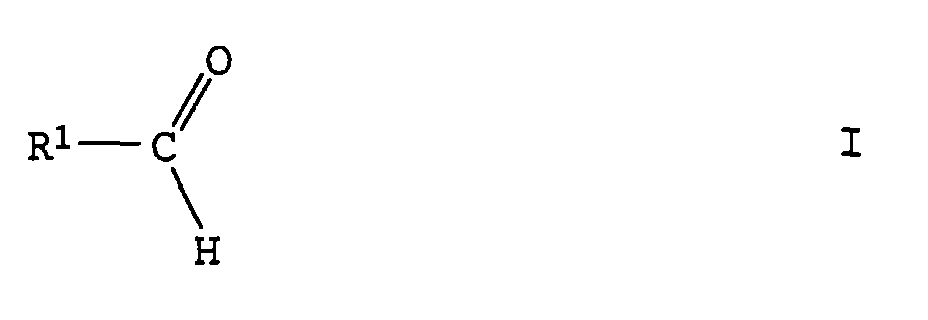
- Particularly suitable aldehydes for use in the telomerization process according to the invention are compounds of the general formula I. in the R 1 C 1 -C 20 alkyl or C 2 -C 20 alkenyl, in which non-adjacent and non-terminal CH 2 groups can also be replaced by -O-CO-, -CO-O- or -CO- can and which can be substituted by phenyl or -CHO, or C 6 -C 20 aryl.
- C 1 -C 20 alkyl radicals are methyl, ethyl, n-propyl, isopropyl, n-butyl, isobutyl, sec-butyl, tert-butyl, and the various branched or unbranched isomers of pentyl, hexyl, heptyl, octyl, Nonyl, decyl, undecyl, dodecyl, tridecyl, tetradecyl, pentadecyl, hexadecyl, heptadecyl, octadecyl, nonadecyl and eicosyl.
- Suitable C 2 -C 20 alkenyl radicals are the corresponding mono- or polyunsaturated radicals, the ethenyl group being less suitable in many cases because of the tendency of acrolein to be statistically integrated into the polyethylene chain.
- Preferred alkenyl radicals are those with a terminal double bond, since the polyethylene waxes resulting from such aldehydes can easily be derivatized further at the end of the molecule, for example by epoxidation with subsequent nucleophilic attack or by addition reactions to the double bond.
- alkyl or alkenyl radicals R 1 can also be substituted by further aldehyde functions.
- dialdehydes such as succinic dialdehyde or glutaric dialdehyde can also be used as aldehydes of the formula I in the production process according to the invention.
- aryl groups R 1 phenyl and naphthyl should be mentioned in particular, it being possible for these aromatic radicals to be substituted by ester or alkyl groups.
- Preferred radicals R 1 are C 1 -C 5 alkyl groups, so that acetaldehyde, propionaldehyde, butyraldehyde, pentanal or hexanal are used as the aldehyde.
- keto group-containing waxes produce secondary alcohols by reduction, which in turn in turn can be converted to different esters. Also the reduction can be carried out by all methods familiar to the person skilled in the art respectively.
- Gaseous ethylene (10 kg / h) was compressed by a membrane compressor in three stages to a pressure of 220 bar.
- the respective aldehyde was pumped into the supercritical ethylene with the aid of a piston pump, then the mixture was further compressed to 1500 bar and pumped continuously into a stirred flow-through autoclave, which was set at a temperature of 220 ° C.
- the autoclave had a volume of 1 l and a length / diameter ratio of 5: 1.
- the oligomerization was carried out by continuously pumping in a solution of 0.2% by weight of tert-butyl peroxipivalate and 0.5% by weight of tert-butyl peroxy-3,5,5-trimethylhexanoate in isodecane (% by weight based on the total weight in each case the solution) started (dosing speed 105 ml / min).
- the average residence time of the reaction mixture in the autoclave was approximately 90 seconds.
Landscapes
- Chemical & Material Sciences (AREA)
- Health & Medical Sciences (AREA)
- Chemical Kinetics & Catalysis (AREA)
- Medicinal Chemistry (AREA)
- Polymers & Plastics (AREA)
- Organic Chemistry (AREA)
- Addition Polymer Or Copolymer, Post-Treatments, Or Chemical Modifications (AREA)
- Organic Low-Molecular-Weight Compounds And Preparation Thereof (AREA)
- Low-Molecular Organic Synthesis Reactions Using Catalysts (AREA)
Abstract
Description
| Beispiel | Aldehyd | Mol-Verhältnis Ethylen/Aldehyd | Mn (g/mol) | Q Mw/Mn | Funktionalisierungsgrad |
| 1 | Propionaldehyd | 10:1 | 460 | 2,0 | 71 % |
| 2 | Propionaldehyd | 8:1 | 250 | 1,9 | 75 % |
| 3 | Propionaldehyd | 5:1 | 220 | 1,9 | 78 % |
| 4 | Undec-ω-enal | 20:1 | 430 | 1,9 | 62 % |
Claims (10)
- Verfahren zur Herstellung ketogruppenenthaltender Polyethylenwachse durch Telomerisation von Ethylen mit Aldehyden bei Drücken zwischen 500 und 5000 bar und Temperaturen zwischen 100 und 280°C, dadurch gekennzeichnet, daß man Ethylen und Aldehyd im Molverhältnis 5:1 bis 50:1 einsetzt.
- Verfahren zur Herstellung ketogruppenenthaltender Polyethylenwachse nach Anspruch 1, dadurch gekennzeichnet, daß man Ethylen und Aldehyd im Molverhältnis 5:1 bis 20:1 einsetzt.
- Verfahren zur Herstellung ketogruppenenthaltender Polyethylenwachse nach Anspruch 1, dadurch gekennzeichnet, daß man Ethylen und Aldehyd im Molverhältnis 5:1 bis 15:1 einsetzt.
- Verfahren zur Herstellung ketogruppenenthaltender Polyethylenwachse nach den Ansprüchen 1 bis 3, dadurch gekennzeichnet, daß man als Aldehyd eine Verbindung der allgemeinen Formel Ieinsetzt, in der R1 C1-C20-Alkyl oder C2-C20-Alkenyl, in welchem nicht benachbarte und nicht endständige CH2-Gruppen auch durch -O-CO-, -CO-O- oder -CO- ersetzt sein können und welches durch Phenyl oder -CHO substituiert sein kann, oder C6-C20-Aryl bedeutet.

- Verfahren zur Herstellung ketogruppenenthaltender Polyethylenwachse nach Anspruch 4, dadurch gekennzeichnet, daß R1 C1-C5-Alkyl bedeutet.
- Ketogruppenenthaltende Polyethylenwachse, erhältlich nach einem Verfahren gemäß den Ansprüchen 1 bis 5.
- Sekundäre Amine, erhältlich durch reduktive Aminierung eines ketogruppenenthaltenden Polyethylenwachses gemäß Anspruch 6.
- Sekundäre Alkohole, erhältlich durch Reduktion von ketogruppenenthaltenden Polyethylenwachsen gemäß Anspruch 6.
- Verwendung ketogruppenenthaltender Polyethylenwachse gemäß Anspruch 6 zur Herstellung von sekundären Aminen.
- Verwendung ketogruppenenthaltender Polyethylenwachse gemäß Anspruch 6 zur Herstellung von sekundären Alkoholen.
Applications Claiming Priority (2)
| Application Number | Priority Date | Filing Date | Title |
|---|---|---|---|
| DE19644269A DE19644269A1 (de) | 1996-10-24 | 1996-10-24 | Verfahren zur Herstellung ketogruppenenthaltender Polyethylenwachse |
| DE19644269 | 1996-10-24 |
Publications (2)
| Publication Number | Publication Date |
|---|---|
| EP0838480A1 true EP0838480A1 (de) | 1998-04-29 |
| EP0838480B1 EP0838480B1 (de) | 2000-05-31 |
Family
ID=7809906
Family Applications (1)
| Application Number | Title | Priority Date | Filing Date |
|---|---|---|---|
| EP97117558A Expired - Lifetime EP0838480B1 (de) | 1996-10-24 | 1997-10-10 | Verfahren zur Herstellung ketogruppenenthaltender Polyethylenwachse |
Country Status (4)
| Country | Link |
|---|---|
| US (1) | US5932684A (de) |
| EP (1) | EP0838480B1 (de) |
| AT (1) | ATE193544T1 (de) |
| DE (2) | DE19644269A1 (de) |
Cited By (1)
| Publication number | Priority date | Publication date | Assignee | Title |
|---|---|---|---|---|
| EP2655444B1 (de) | 2010-12-22 | 2015-03-18 | Basell Polyolefine GmbH | Verfahren zur herstellung von ethylencopolymeren in gegenwart eines freien radikalischen polymerisationsinitiators durch copolymerisation von ethylen, eines bi- oder multifunktionellen comonomers und wahlweise weiteren comonomeren |
Citations (3)
| Publication number | Priority date | Publication date | Assignee | Title |
|---|---|---|---|---|
| US3865881A (en) * | 1972-03-22 | 1975-02-11 | Union Carbide Corp | Preparation of ketones |
| US4698450A (en) * | 1984-01-20 | 1987-10-06 | Exxon Research & Engineering Co. | Polyethylene wax |
| JPH01149828A (ja) * | 1987-12-05 | 1989-06-12 | Mitsubishi Petrochem Co Ltd | ポリアルコールの製造方法 |
Family Cites Families (3)
| Publication number | Priority date | Publication date | Assignee | Title |
|---|---|---|---|---|
| DE177077C (de) * | ||||
| US2683141A (en) * | 1952-02-06 | 1954-07-06 | Allied Chem & Dye Corp | Continuous production of wax from ethylene and normally liquid organic co-reactant compound |
| DE2102469C2 (de) * | 1971-01-20 | 1989-06-29 | Basf Ag, 6700 Ludwigshafen | Verwendung von Äthylencopolymerisaten als Zusatz zu Erdöl und Erdölfraktionen |
-
1996
- 1996-10-24 DE DE19644269A patent/DE19644269A1/de not_active Withdrawn
-
1997
- 1997-10-09 US US08/948,070 patent/US5932684A/en not_active Expired - Fee Related
- 1997-10-10 EP EP97117558A patent/EP0838480B1/de not_active Expired - Lifetime
- 1997-10-10 DE DE59701803T patent/DE59701803D1/de not_active Expired - Lifetime
- 1997-10-10 AT AT97117558T patent/ATE193544T1/de not_active IP Right Cessation
Patent Citations (3)
| Publication number | Priority date | Publication date | Assignee | Title |
|---|---|---|---|---|
| US3865881A (en) * | 1972-03-22 | 1975-02-11 | Union Carbide Corp | Preparation of ketones |
| US4698450A (en) * | 1984-01-20 | 1987-10-06 | Exxon Research & Engineering Co. | Polyethylene wax |
| JPH01149828A (ja) * | 1987-12-05 | 1989-06-12 | Mitsubishi Petrochem Co Ltd | ポリアルコールの製造方法 |
Non-Patent Citations (1)
| Title |
|---|
| PATENT ABSTRACTS OF JAPAN vol. 013, no. 408 (C - 634) 8 September 1989 (1989-09-08) * |
Cited By (2)
| Publication number | Priority date | Publication date | Assignee | Title |
|---|---|---|---|---|
| EP2655444B1 (de) | 2010-12-22 | 2015-03-18 | Basell Polyolefine GmbH | Verfahren zur herstellung von ethylencopolymeren in gegenwart eines freien radikalischen polymerisationsinitiators durch copolymerisation von ethylen, eines bi- oder multifunktionellen comonomers und wahlweise weiteren comonomeren |
| EP2655444B2 (de) † | 2010-12-22 | 2018-11-21 | Basell Polyolefine GmbH | Verfahren zur herstellung von ethylencopolymeren in gegenwart eines freien radikalischen polymerisationsinitiators durch copolymerisation von ethylen, eines bi- oder multifunktionellen comonomers und wahlweise weiteren comonomeren |
Also Published As
| Publication number | Publication date |
|---|---|
| DE59701803D1 (de) | 2000-07-06 |
| US5932684A (en) | 1999-08-03 |
| ATE193544T1 (de) | 2000-06-15 |
| DE19644269A1 (de) | 1998-04-30 |
| EP0838480B1 (de) | 2000-05-31 |
Similar Documents
| Publication | Publication Date | Title |
|---|---|---|
| EP0449092B1 (de) | Verfahren zur Herstellung von Ethylenpolymerisaten bei Drücken oberhalb von 500 bar in einem Rohrreaktor mit Einspritzfinger | |
| EP1029839A1 (de) | Verfahren zur Fraktionierung von Dibuten | |
| DE2359502A1 (de) | Verfahren zur kontinuierlichen herstellung von ungesaettigten polyestern | |
| DE2139630A1 (de) | Verfahren zur herstellung von vorwiegend geradkettigen aldehyden | |
| DE3615562A1 (de) | Verfahren zur herstellung von copolymerisaten des ethylens mit acrylsaeureestern in einem roehrenreaktor bei druecken oberhalb 500 bar | |
| WO1999047482A1 (de) | Rektifikation von (meth)acrylsäure unter zusatz eines tensids | |
| DE967487C (de) | Verfahren zur Herstellung von als Weichmacher geeigneten Mischpolymerisaten | |
| DE2651637A1 (de) | Kontinuierliches verfahren zum polymerisieren von alpha-olefinen zu oligomerengemischen | |
| DE3141507C2 (de) | ||
| EP0573870A1 (de) | Verfahren zur Herstellung von Copolymerisaten des Ethylens mit Acrylsäureestern | |
| EP0838480B1 (de) | Verfahren zur Herstellung ketogruppenenthaltender Polyethylenwachse | |
| EP1355957B1 (de) | Verfahren zur herstellung von polyethylenwachsen im hochdruckverfahren | |
| EP0121755B1 (de) | Verfahren zur Herstellung von Ethylenpolymerisaten bei Drücken oberhalb von 500 bar in einem Zweizonen-Rohrreaktor | |
| DE1243195B (de) | Verfahren zur Herstellung von bestaendigen homogenen wasserhaltigen Loesungen von niedermolekularen Ketonperoxyden | |
| EP0005471B1 (de) | Verfahren zur Herstellung von 3-Hydroxy-2,2,4-trimethylpentylisobutyrat | |
| DE1180131B (de) | Verfahren zur Herstellung von sauerstoffhaltigen Wachsrohstoffen durch Oxydation vonPolyole-finwachsen | |
| DE3434316A1 (de) | Verfahren zur herstellung von ethylencopolymerisaten | |
| DE69104055T2 (de) | Allyl-peroxyketale als kettenübertragungsmittel. | |
| DE1906175B1 (de) | Verfahren zur Aktivierung eines Chromoxyd-Traegerkatalysators | |
| DE69312902T2 (de) | Synthese von Diolen zur Anwendung als Zwischenprodukte von Polymeren, ausgehend von endoständigen Diolefinen | |
| DE102011104437A1 (de) | Isocyanatfreie Polyurethane | |
| EP0121756B1 (de) | Verfahren zur Herstellung von Ethylenpolymerisaten bei Drücken oberhalb von 500 bar in einem Einzonen-Rohrreaktor | |
| DE824051C (de) | Verfahren zur Herstellung von Umwandlungsprodukten aus ungesaettigten organischen Verbindungen und Stickoxydul (NO) | |
| DE977093C (de) | Verfahren zur Herstellung von [3, 4-Dihydro-ª‡-pyran(2)]-aethern und deren Derivaten | |
| EP0635475B1 (de) | Verfahren zur kontinuierlichen Herstellung höhermolekularer Carbonsäuren |
Legal Events
| Date | Code | Title | Description |
|---|---|---|---|
| PUAI | Public reference made under article 153(3) epc to a published international application that has entered the european phase |
Free format text: ORIGINAL CODE: 0009012 |
|
| AK | Designated contracting states |
Kind code of ref document: A1 Designated state(s): AT DE FR GB IT NL |
|
| 17P | Request for examination filed |
Effective date: 19980317 |
|
| RBV | Designated contracting states (corrected) |
Designated state(s): AT DE FR GB IT NL |
|
| 17Q | First examination report despatched |
Effective date: 19981019 |
|
| AKX | Designation fees paid |
Free format text: AT DE FR GB IT NL |
|
| RBV | Designated contracting states (corrected) |
Designated state(s): AT DE FR GB IT NL |
|
| GRAG | Despatch of communication of intention to grant |
Free format text: ORIGINAL CODE: EPIDOS AGRA |
|
| GRAG | Despatch of communication of intention to grant |
Free format text: ORIGINAL CODE: EPIDOS AGRA |
|
| GRAH | Despatch of communication of intention to grant a patent |
Free format text: ORIGINAL CODE: EPIDOS IGRA |
|
| GRAH | Despatch of communication of intention to grant a patent |
Free format text: ORIGINAL CODE: EPIDOS IGRA |
|
| GRAA | (expected) grant |
Free format text: ORIGINAL CODE: 0009210 |
|
| AK | Designated contracting states |
Kind code of ref document: B1 Designated state(s): AT DE FR GB IT NL |
|
| REF | Corresponds to: |
Ref document number: 193544 Country of ref document: AT Date of ref document: 20000615 Kind code of ref document: T |
|
| GBT | Gb: translation of ep patent filed (gb section 77(6)(a)/1977) |
Effective date: 20000612 |
|
| REF | Corresponds to: |
Ref document number: 59701803 Country of ref document: DE Date of ref document: 20000706 |
|
| ITF | It: translation for a ep patent filed | ||
| ET | Fr: translation filed | ||
| PLBE | No opposition filed within time limit |
Free format text: ORIGINAL CODE: 0009261 |
|
| STAA | Information on the status of an ep patent application or granted ep patent |
Free format text: STATUS: NO OPPOSITION FILED WITHIN TIME LIMIT |
|
| 26N | No opposition filed | ||
| REG | Reference to a national code |
Ref country code: GB Ref legal event code: IF02 |
|
| PGFP | Annual fee paid to national office [announced via postgrant information from national office to epo] |
Ref country code: AT Payment date: 20020930 Year of fee payment: 6 |
|
| PG25 | Lapsed in a contracting state [announced via postgrant information from national office to epo] |
Ref country code: AT Free format text: LAPSE BECAUSE OF NON-PAYMENT OF DUE FEES Effective date: 20031010 |
|
| PGFP | Annual fee paid to national office [announced via postgrant information from national office to epo] |
Ref country code: NL Payment date: 20041003 Year of fee payment: 8 |
|
| PGFP | Annual fee paid to national office [announced via postgrant information from national office to epo] |
Ref country code: GB Payment date: 20041006 Year of fee payment: 8 |
|
| PGFP | Annual fee paid to national office [announced via postgrant information from national office to epo] |
Ref country code: DE Payment date: 20041007 Year of fee payment: 8 |
|
| PGFP | Annual fee paid to national office [announced via postgrant information from national office to epo] |
Ref country code: FR Payment date: 20041008 Year of fee payment: 8 |
|
| PG25 | Lapsed in a contracting state [announced via postgrant information from national office to epo] |
Ref country code: IT Free format text: LAPSE BECAUSE OF NON-PAYMENT OF DUE FEES Effective date: 20051010 Ref country code: GB Free format text: LAPSE BECAUSE OF NON-PAYMENT OF DUE FEES Effective date: 20051010 |
|
| PG25 | Lapsed in a contracting state [announced via postgrant information from national office to epo] |
Ref country code: DE Free format text: LAPSE BECAUSE OF THE APPLICANT RENOUNCES Effective date: 20051203 |
|
| PG25 | Lapsed in a contracting state [announced via postgrant information from national office to epo] |
Ref country code: NL Free format text: LAPSE BECAUSE OF NON-PAYMENT OF DUE FEES Effective date: 20060501 |
|
| GBPC | Gb: european patent ceased through non-payment of renewal fee |
Effective date: 20051010 |
|
| PG25 | Lapsed in a contracting state [announced via postgrant information from national office to epo] |
Ref country code: FR Free format text: LAPSE BECAUSE OF NON-PAYMENT OF DUE FEES Effective date: 20060630 |
|
| NLV4 | Nl: lapsed or anulled due to non-payment of the annual fee |
Effective date: 20060501 |
|
| REG | Reference to a national code |
Ref country code: FR Ref legal event code: ST Effective date: 20060630 |