EP0839835B1 - Catalyseurs organométalliques pour la polymérisation et la copolymérisation d'alpha-oléfines - Google Patents
Catalyseurs organométalliques pour la polymérisation et la copolymérisation d'alpha-oléfines Download PDFInfo
- Publication number
- EP0839835B1 EP0839835B1 EP97500186A EP97500186A EP0839835B1 EP 0839835 B1 EP0839835 B1 EP 0839835B1 EP 97500186 A EP97500186 A EP 97500186A EP 97500186 A EP97500186 A EP 97500186A EP 0839835 B1 EP0839835 B1 EP 0839835B1
- Authority
- EP
- European Patent Office
- Prior art keywords
- group
- sup
- catalyst component
- varies
- component according
- Prior art date
- Legal status (The legal status is an assumption and is not a legal conclusion. Google has not performed a legal analysis and makes no representation as to the accuracy of the status listed.)
- Expired - Lifetime
Links
- 239000003054 catalyst Substances 0.000 title claims abstract description 32
- 239000004711 α-olefin Substances 0.000 title claims abstract description 9
- 125000002524 organometallic group Chemical group 0.000 title description 22
- 238000000034 method Methods 0.000 claims abstract description 36
- 150000001875 compounds Chemical class 0.000 claims abstract description 18
- 229910052723 transition metal Inorganic materials 0.000 claims abstract description 17
- 150000003624 transition metals Chemical class 0.000 claims abstract description 17
- 125000002877 alkyl aryl group Chemical group 0.000 claims abstract description 16
- 125000004432 carbon atom Chemical group C* 0.000 claims abstract description 15
- 125000000217 alkyl group Chemical group 0.000 claims abstract description 13
- 239000001257 hydrogen Substances 0.000 claims abstract description 13
- 229910052739 hydrogen Inorganic materials 0.000 claims abstract description 13
- 125000004435 hydrogen atom Chemical class [H]* 0.000 claims abstract description 13
- 125000003710 aryl alkyl group Chemical group 0.000 claims abstract description 11
- 125000000753 cycloalkyl group Chemical group 0.000 claims abstract description 11
- 125000003342 alkenyl group Chemical group 0.000 claims abstract description 7
- 125000005018 aryl alkenyl group Chemical group 0.000 claims abstract description 7
- 125000003118 aryl group Chemical group 0.000 claims abstract description 7
- 239000000460 chlorine Substances 0.000 claims abstract description 6
- 229910052801 chlorine Inorganic materials 0.000 claims abstract description 6
- ZAMOUSCENKQFHK-UHFFFAOYSA-N Chlorine atom Chemical compound [Cl] ZAMOUSCENKQFHK-UHFFFAOYSA-N 0.000 claims abstract description 5
- 229910052751 metal Inorganic materials 0.000 claims abstract description 5
- 239000002184 metal Substances 0.000 claims abstract description 5
- 230000007935 neutral effect Effects 0.000 claims abstract description 5
- 229910052760 oxygen Inorganic materials 0.000 claims abstract description 4
- WKBOTKDWSSQWDR-UHFFFAOYSA-N Bromine atom Chemical compound [Br] WKBOTKDWSSQWDR-UHFFFAOYSA-N 0.000 claims abstract description 3
- 239000002879 Lewis base Substances 0.000 claims abstract description 3
- 229910052768 actinide Inorganic materials 0.000 claims abstract description 3
- 150000001255 actinides Chemical class 0.000 claims abstract description 3
- GDTBXPJZTBHREO-UHFFFAOYSA-N bromine Substances BrBr GDTBXPJZTBHREO-UHFFFAOYSA-N 0.000 claims abstract description 3
- 229910052794 bromium Inorganic materials 0.000 claims abstract description 3
- 150000004820 halides Chemical class 0.000 claims abstract description 3
- PNDPGZBMCMUPRI-UHFFFAOYSA-N iodine Chemical compound II PNDPGZBMCMUPRI-UHFFFAOYSA-N 0.000 claims abstract description 3
- 229910052747 lanthanoid Inorganic materials 0.000 claims abstract description 3
- 150000002602 lanthanoids Chemical class 0.000 claims abstract description 3
- 150000007527 lewis bases Chemical class 0.000 claims abstract description 3
- 230000000737 periodic effect Effects 0.000 claims abstract description 3
- 229910052710 silicon Inorganic materials 0.000 claims abstract description 3
- 229910052717 sulfur Inorganic materials 0.000 claims abstract description 3
- LIKMAJRDDDTEIG-UHFFFAOYSA-N 1-hexene Chemical compound CCCCC=C LIKMAJRDDDTEIG-UHFFFAOYSA-N 0.000 claims description 44
- 238000006116 polymerization reaction Methods 0.000 claims description 30
- VGGSQFUCUMXWEO-UHFFFAOYSA-N Ethene Chemical compound C=C VGGSQFUCUMXWEO-UHFFFAOYSA-N 0.000 claims description 25
- 239000005977 Ethylene Substances 0.000 claims description 25
- -1 tetrahydroindenyl Chemical group 0.000 claims description 18
- 238000006243 chemical reaction Methods 0.000 claims description 17
- VYPSYNLAJGMNEJ-UHFFFAOYSA-N Silicium dioxide Chemical compound O=[Si]=O VYPSYNLAJGMNEJ-UHFFFAOYSA-N 0.000 claims description 16
- 239000011949 solid catalyst Substances 0.000 claims description 16
- 229910052782 aluminium Inorganic materials 0.000 claims description 14
- 125000002887 hydroxy group Chemical group [H]O* 0.000 claims description 14
- 239000004411 aluminium Substances 0.000 claims description 11
- XAGFODPZIPBFFR-UHFFFAOYSA-N aluminium Chemical compound [Al] XAGFODPZIPBFFR-UHFFFAOYSA-N 0.000 claims description 10
- 239000000377 silicon dioxide Substances 0.000 claims description 8
- 125000000058 cyclopentadienyl group Chemical group C1(=CC=CC1)* 0.000 claims description 7
- 230000003197 catalytic effect Effects 0.000 claims description 6
- 229910052736 halogen Inorganic materials 0.000 claims description 6
- 150000002367 halogens Chemical class 0.000 claims description 6
- 239000000203 mixture Substances 0.000 claims description 6
- 239000000725 suspension Substances 0.000 claims description 6
- 125000006736 (C6-C20) aryl group Chemical group 0.000 claims description 5
- ZSWFCLXCOIISFI-UHFFFAOYSA-N endo-cyclopentadiene Natural products C1C=CC=C1 ZSWFCLXCOIISFI-UHFFFAOYSA-N 0.000 claims description 5
- CPOFMOWDMVWCLF-UHFFFAOYSA-N methyl(oxo)alumane Chemical compound C[Al]=O CPOFMOWDMVWCLF-UHFFFAOYSA-N 0.000 claims description 5
- 125000003837 (C1-C20) alkyl group Chemical group 0.000 claims description 4
- VXNZUUAINFGPBY-UHFFFAOYSA-N 1-Butene Chemical compound CCC=C VXNZUUAINFGPBY-UHFFFAOYSA-N 0.000 claims description 4
- GQEZCXVZFLOKMC-UHFFFAOYSA-N 1-hexadecene Chemical compound CCCCCCCCCCCCCCC=C GQEZCXVZFLOKMC-UHFFFAOYSA-N 0.000 claims description 4
- YVSMQHYREUQGRX-UHFFFAOYSA-N 2-ethyloxaluminane Chemical compound CC[Al]1CCCCO1 YVSMQHYREUQGRX-UHFFFAOYSA-N 0.000 claims description 4
- WSSSPWUEQFSQQG-UHFFFAOYSA-N 4-methyl-1-pentene Chemical compound CC(C)CC=C WSSSPWUEQFSQQG-UHFFFAOYSA-N 0.000 claims description 4
- 125000006374 C2-C10 alkenyl group Chemical group 0.000 claims description 4
- PPBRXRYQALVLMV-UHFFFAOYSA-N Styrene Chemical compound C=CC1=CC=CC=C1 PPBRXRYQALVLMV-UHFFFAOYSA-N 0.000 claims description 4
- PNEYBMLMFCGWSK-UHFFFAOYSA-N aluminium oxide Inorganic materials [O-2].[O-2].[O-2].[Al+3].[Al+3] PNEYBMLMFCGWSK-UHFFFAOYSA-N 0.000 claims description 4
- 150000001639 boron compounds Chemical class 0.000 claims description 4
- 125000002496 methyl group Chemical group [H]C([H])([H])* 0.000 claims description 4
- 229920006395 saturated elastomer Polymers 0.000 claims description 4
- 229910052708 sodium Inorganic materials 0.000 claims description 4
- 239000010936 titanium Substances 0.000 claims description 4
- BTBUEUYNUDRHOZ-UHFFFAOYSA-N Borate Chemical compound [O-]B([O-])[O-] BTBUEUYNUDRHOZ-UHFFFAOYSA-N 0.000 claims description 3
- 125000000041 C6-C10 aryl group Chemical group 0.000 claims description 3
- QQONPFPTGQHPMA-UHFFFAOYSA-N Propene Chemical compound CC=C QQONPFPTGQHPMA-UHFFFAOYSA-N 0.000 claims description 3
- 229920001577 copolymer Polymers 0.000 claims description 3
- 239000007789 gas Substances 0.000 claims description 3
- 229910052735 hafnium Inorganic materials 0.000 claims description 3
- 239000000178 monomer Substances 0.000 claims description 3
- 239000002245 particle Substances 0.000 claims description 3
- WCFQIFDACWBNJT-UHFFFAOYSA-N $l^{1}-alumanyloxy(2-methylpropyl)aluminum Chemical compound CC(C)C[Al]O[Al] WCFQIFDACWBNJT-UHFFFAOYSA-N 0.000 claims description 2
- YBYIRNPNPLQARY-UHFFFAOYSA-N 1H-indene Natural products C1=CC=C2CC=CC2=C1 YBYIRNPNPLQARY-UHFFFAOYSA-N 0.000 claims description 2
- RTAQQCXQSZGOHL-UHFFFAOYSA-N Titanium Chemical compound [Ti] RTAQQCXQSZGOHL-UHFFFAOYSA-N 0.000 claims description 2
- QCWXUUIWCKQGHC-UHFFFAOYSA-N Zirconium Chemical compound [Zr] QCWXUUIWCKQGHC-UHFFFAOYSA-N 0.000 claims description 2
- 150000001339 alkali metal compounds Chemical class 0.000 claims description 2
- ILRRQNADMUWWFW-UHFFFAOYSA-K aluminium phosphate Chemical class O1[Al]2OP1(=O)O2 ILRRQNADMUWWFW-UHFFFAOYSA-K 0.000 claims description 2
- 125000003983 fluorenyl group Chemical group C1(=CC=CC=2C3=CC=CC=C3CC12)* 0.000 claims description 2
- 229910052732 germanium Inorganic materials 0.000 claims description 2
- GNPVGFCGXDBREM-UHFFFAOYSA-N germanium atom Chemical group [Ge] GNPVGFCGXDBREM-UHFFFAOYSA-N 0.000 claims description 2
- VBJZVLUMGGDVMO-UHFFFAOYSA-N hafnium atom Chemical compound [Hf] VBJZVLUMGGDVMO-UHFFFAOYSA-N 0.000 claims description 2
- AHAREKHAZNPPMI-UHFFFAOYSA-N hexa-1,3-diene Chemical compound CCC=CC=C AHAREKHAZNPPMI-UHFFFAOYSA-N 0.000 claims description 2
- 125000003454 indenyl group Chemical group C1(C=CC2=CC=CC=C12)* 0.000 claims description 2
- 229910052744 lithium Inorganic materials 0.000 claims description 2
- 125000001570 methylene group Chemical group [H]C([H])([*:1])[*:2] 0.000 claims description 2
- 229920001200 poly(ethylene-vinyl acetate) Polymers 0.000 claims description 2
- 125000003367 polycyclic group Chemical group 0.000 claims description 2
- 229920005862 polyol Polymers 0.000 claims description 2
- 150000003077 polyols Chemical class 0.000 claims description 2
- 239000011148 porous material Substances 0.000 claims description 2
- 229910052700 potassium Inorganic materials 0.000 claims description 2
- 239000010703 silicon Substances 0.000 claims description 2
- 229910052719 titanium Inorganic materials 0.000 claims description 2
- VOITXYVAKOUIBA-UHFFFAOYSA-N triethylaluminium Chemical compound CC[Al](CC)CC VOITXYVAKOUIBA-UHFFFAOYSA-N 0.000 claims description 2
- 229910052726 zirconium Inorganic materials 0.000 claims description 2
- 229920000098 polyolefin Polymers 0.000 claims 6
- 150000002431 hydrogen Chemical class 0.000 claims 5
- KWKAKUADMBZCLK-UHFFFAOYSA-N 1-octene Chemical compound CCCCCCC=C KWKAKUADMBZCLK-UHFFFAOYSA-N 0.000 claims 2
- 150000002899 organoaluminium compounds Chemical class 0.000 claims 2
- UFHFLCQGNIYNRP-UHFFFAOYSA-N Hydrogen Chemical compound [H][H] UFHFLCQGNIYNRP-UHFFFAOYSA-N 0.000 claims 1
- 229920001038 ethylene copolymer Polymers 0.000 claims 1
- TVMXDCGIABBOFY-UHFFFAOYSA-N n-Octanol Natural products CCCCCCCC TVMXDCGIABBOFY-UHFFFAOYSA-N 0.000 claims 1
- MCULRUJILOGHCJ-UHFFFAOYSA-N triisobutylaluminium Chemical compound CC(C)C[Al](CC(C)C)CC(C)C MCULRUJILOGHCJ-UHFFFAOYSA-N 0.000 claims 1
- JLTRXTDYQLMHGR-UHFFFAOYSA-N trimethylaluminium Chemical compound C[Al](C)C JLTRXTDYQLMHGR-UHFFFAOYSA-N 0.000 claims 1
- XUIMIQQOPSSXEZ-UHFFFAOYSA-N Silicon Chemical group [Si] XUIMIQQOPSSXEZ-UHFFFAOYSA-N 0.000 abstract 1
- YXFVVABEGXRONW-UHFFFAOYSA-N Toluene Chemical compound CC1=CC=CC=C1 YXFVVABEGXRONW-UHFFFAOYSA-N 0.000 description 57
- VLKZOEOYAKHREP-UHFFFAOYSA-N n-Hexane Chemical compound CCCCCC VLKZOEOYAKHREP-UHFFFAOYSA-N 0.000 description 21
- 239000002904 solvent Substances 0.000 description 17
- 229920000573 polyethylene Polymers 0.000 description 13
- IMNFDUFMRHMDMM-UHFFFAOYSA-N N-Heptane Chemical compound CCCCCCC IMNFDUFMRHMDMM-UHFFFAOYSA-N 0.000 description 12
- 239000004698 Polyethylene Substances 0.000 description 12
- 229920000642 polymer Polymers 0.000 description 9
- 238000001644 13C nuclear magnetic resonance spectroscopy Methods 0.000 description 7
- 239000007787 solid Substances 0.000 description 7
- IJGRMHOSHXDMSA-UHFFFAOYSA-N Atomic nitrogen Chemical compound N#N IJGRMHOSHXDMSA-UHFFFAOYSA-N 0.000 description 6
- RTZKZFJDLAIYFH-UHFFFAOYSA-N Diethyl ether Chemical compound CCOCC RTZKZFJDLAIYFH-UHFFFAOYSA-N 0.000 description 6
- OKKJLVBELUTLKV-UHFFFAOYSA-N Methanol Chemical compound OC OKKJLVBELUTLKV-UHFFFAOYSA-N 0.000 description 6
- UHOVQNZJYSORNB-MZWXYZOWSA-N benzene-d6 Chemical compound [2H]C1=C([2H])C([2H])=C([2H])C([2H])=C1[2H] UHOVQNZJYSORNB-MZWXYZOWSA-N 0.000 description 6
- 238000009826 distribution Methods 0.000 description 6
- 150000002902 organometallic compounds Chemical class 0.000 description 6
- 238000002360 preparation method Methods 0.000 description 6
- 239000004215 Carbon black (E152) Substances 0.000 description 5
- ZMANZCXQSJIPKH-UHFFFAOYSA-N Triethylamine Chemical compound CCN(CC)CC ZMANZCXQSJIPKH-UHFFFAOYSA-N 0.000 description 5
- 229930195733 hydrocarbon Natural products 0.000 description 5
- 150000002430 hydrocarbons Chemical class 0.000 description 5
- ZWYDDDAMNQQZHD-UHFFFAOYSA-L titanium(ii) chloride Chemical compound [Cl-].[Cl-].[Ti+2] ZWYDDDAMNQQZHD-UHFFFAOYSA-L 0.000 description 5
- 125000001309 chloro group Chemical group Cl* 0.000 description 4
- 238000007334 copolymerization reaction Methods 0.000 description 4
- 239000011521 glass Substances 0.000 description 4
- 238000005160 1H NMR spectroscopy Methods 0.000 description 3
- UHOVQNZJYSORNB-UHFFFAOYSA-N Benzene Chemical compound C1=CC=CC=C1 UHOVQNZJYSORNB-UHFFFAOYSA-N 0.000 description 3
- YKUFSGGUOQDKFT-UHFFFAOYSA-N [1-(dichloromethylsilyl)cyclopenta-2,4-dien-1-yl]-trimethylsilane Chemical compound ClC(Cl)[SiH2]C1([Si](C)(C)C)C=CC=C1 YKUFSGGUOQDKFT-UHFFFAOYSA-N 0.000 description 3
- 238000001354 calcination Methods 0.000 description 3
- 229910052757 nitrogen Inorganic materials 0.000 description 3
- 239000012429 reaction media Substances 0.000 description 3
- 239000011734 sodium Substances 0.000 description 3
- 238000003756 stirring Methods 0.000 description 3
- PAYRUJLWNCNPSJ-UHFFFAOYSA-N Aniline Chemical compound NC1=CC=CC=C1 PAYRUJLWNCNPSJ-UHFFFAOYSA-N 0.000 description 2
- ZOXJGFHDIHLPTG-UHFFFAOYSA-N Boron Chemical compound [B] ZOXJGFHDIHLPTG-UHFFFAOYSA-N 0.000 description 2
- DGAQECJNVWCQMB-PUAWFVPOSA-M Ilexoside XXIX Chemical compound C[C@@H]1CC[C@@]2(CC[C@@]3(C(=CC[C@H]4[C@]3(CC[C@@H]5[C@@]4(CC[C@@H](C5(C)C)OS(=O)(=O)[O-])C)C)[C@@H]2[C@]1(C)O)C)C(=O)O[C@H]6[C@@H]([C@H]([C@@H]([C@H](O6)CO)O)O)O.[Na+] DGAQECJNVWCQMB-PUAWFVPOSA-M 0.000 description 2
- OFBQJSOFQDEBGM-UHFFFAOYSA-N Pentane Chemical compound CCCCC OFBQJSOFQDEBGM-UHFFFAOYSA-N 0.000 description 2
- WYURNTSHIVDZCO-UHFFFAOYSA-N Tetrahydrofuran Chemical compound C1CCOC1 WYURNTSHIVDZCO-UHFFFAOYSA-N 0.000 description 2
- 229910010068 TiCl2 Inorganic materials 0.000 description 2
- KUNZSLJMPCDOGI-UHFFFAOYSA-L [Cl-].[Cl-].[Hf+2] Chemical compound [Cl-].[Cl-].[Hf+2] KUNZSLJMPCDOGI-UHFFFAOYSA-L 0.000 description 2
- 229910052796 boron Inorganic materials 0.000 description 2
- 238000007385 chemical modification Methods 0.000 description 2
- 229960004132 diethyl ether Drugs 0.000 description 2
- 238000001035 drying Methods 0.000 description 2
- 230000004907 flux Effects 0.000 description 2
- 238000005227 gel permeation chromatography Methods 0.000 description 2
- 238000010348 incorporation Methods 0.000 description 2
- 238000009776 industrial production Methods 0.000 description 2
- NNPPMTNAJDCUHE-UHFFFAOYSA-N isobutane Chemical compound CC(C)C NNPPMTNAJDCUHE-UHFFFAOYSA-N 0.000 description 2
- 239000003446 ligand Substances 0.000 description 2
- 239000011541 reaction mixture Substances 0.000 description 2
- YONPGGFAJWQGJC-UHFFFAOYSA-K titanium(iii) chloride Chemical compound Cl[Ti](Cl)Cl YONPGGFAJWQGJC-UHFFFAOYSA-K 0.000 description 2
- RIOQSEWOXXDEQQ-UHFFFAOYSA-N triphenylphosphine Chemical compound C1=CC=CC=C1P(C=1C=CC=CC=1)C1=CC=CC=C1 RIOQSEWOXXDEQQ-UHFFFAOYSA-N 0.000 description 2
- VPGLGRNSAYHXPY-UHFFFAOYSA-L zirconium(2+);dichloride Chemical compound Cl[Zr]Cl VPGLGRNSAYHXPY-UHFFFAOYSA-L 0.000 description 2
- RELMFMZEBKVZJC-UHFFFAOYSA-N 1,2,3-trichlorobenzene Chemical compound ClC1=CC=CC(Cl)=C1Cl RELMFMZEBKVZJC-UHFFFAOYSA-N 0.000 description 1
- ZMZGFLUUZLELNE-UHFFFAOYSA-N 2,3,5-triiodobenzoic acid Chemical compound OC(=O)C1=CC(I)=CC(I)=C1I ZMZGFLUUZLELNE-UHFFFAOYSA-N 0.000 description 1
- ZDXLWTPEFPZMIH-UHFFFAOYSA-K ClC(Cl)[SiH2]C1([Ti](Cl)(Cl)Cl)C=CC=C1 Chemical compound ClC(Cl)[SiH2]C1([Ti](Cl)(Cl)Cl)C=CC=C1 ZDXLWTPEFPZMIH-UHFFFAOYSA-K 0.000 description 1
- XTHFKEDIFFGKHM-UHFFFAOYSA-N Dimethoxyethane Chemical compound COCCOC XTHFKEDIFFGKHM-UHFFFAOYSA-N 0.000 description 1
- JLTDJTHDQAWBAV-UHFFFAOYSA-N N,N-dimethylaniline Chemical compound CN(C)C1=CC=CC=C1 JLTDJTHDQAWBAV-UHFFFAOYSA-N 0.000 description 1
- CTQNGGLPUBDAKN-UHFFFAOYSA-N O-Xylene Chemical compound CC1=CC=CC=C1C CTQNGGLPUBDAKN-UHFFFAOYSA-N 0.000 description 1
- 229910019142 PO4 Inorganic materials 0.000 description 1
- 239000002253 acid Substances 0.000 description 1
- 150000001338 aliphatic hydrocarbons Chemical class 0.000 description 1
- 150000001336 alkenes Chemical class 0.000 description 1
- 125000003545 alkoxy group Chemical group 0.000 description 1
- 150000001412 amines Chemical group 0.000 description 1
- 150000001450 anions Chemical class 0.000 description 1
- 239000003963 antioxidant agent Substances 0.000 description 1
- 230000003078 antioxidant effect Effects 0.000 description 1
- QVGXLLKOCUKJST-UHFFFAOYSA-N atomic oxygen Chemical compound [O] QVGXLLKOCUKJST-UHFFFAOYSA-N 0.000 description 1
- 230000002902 bimodal effect Effects 0.000 description 1
- 150000001638 boron Chemical class 0.000 description 1
- HQABUPZFAYXKJW-UHFFFAOYSA-N butan-1-amine Chemical compound CCCCN HQABUPZFAYXKJW-UHFFFAOYSA-N 0.000 description 1
- 239000006227 byproduct Substances 0.000 description 1
- 150000004649 carbonic acid derivatives Chemical class 0.000 description 1
- 239000013626 chemical specie Substances 0.000 description 1
- 150000001925 cycloalkenes Chemical class 0.000 description 1
- 230000007423 decrease Effects 0.000 description 1
- 150000001993 dienes Chemical class 0.000 description 1
- 230000000694 effects Effects 0.000 description 1
- 230000008030 elimination Effects 0.000 description 1
- 238000003379 elimination reaction Methods 0.000 description 1
- 150000002170 ethers Chemical class 0.000 description 1
- 229940052303 ethers for general anesthesia Drugs 0.000 description 1
- 238000001914 filtration Methods 0.000 description 1
- 125000000524 functional group Chemical group 0.000 description 1
- 125000005842 heteroatom Chemical group 0.000 description 1
- JAGIUTGWNQNUTM-UHFFFAOYSA-N hex-1-ene;oct-1-ene Chemical compound CCCCC=C.CCCCCCC=C JAGIUTGWNQNUTM-UHFFFAOYSA-N 0.000 description 1
- 239000001282 iso-butane Substances 0.000 description 1
- 239000007788 liquid Substances 0.000 description 1
- AOUOEDAWAKONTD-UHFFFAOYSA-N lithium;cyclopenta-2,4-dien-1-yl(trimethyl)silane Chemical compound [Li+].C[Si](C)(C)[C-]1C=CC=C1 AOUOEDAWAKONTD-UHFFFAOYSA-N 0.000 description 1
- ASSTXQFQQJYCIW-UHFFFAOYSA-N lithium;tert-butylazanide Chemical compound [Li+].CC(C)(C)[NH-] ASSTXQFQQJYCIW-UHFFFAOYSA-N 0.000 description 1
- 229920002521 macromolecule Polymers 0.000 description 1
- QUXHCILOWRXCEO-UHFFFAOYSA-M magnesium;butane;chloride Chemical compound [Mg+2].[Cl-].CCC[CH2-] QUXHCILOWRXCEO-UHFFFAOYSA-M 0.000 description 1
- 238000004519 manufacturing process Methods 0.000 description 1
- 239000000463 material Substances 0.000 description 1
- 239000005055 methyl trichlorosilane Substances 0.000 description 1
- JLUFWMXJHAVVNN-UHFFFAOYSA-N methyltrichlorosilane Chemical compound C[Si](Cl)(Cl)Cl JLUFWMXJHAVVNN-UHFFFAOYSA-N 0.000 description 1
- 230000004048 modification Effects 0.000 description 1
- 238000012986 modification Methods 0.000 description 1
- 239000012454 non-polar solvent Substances 0.000 description 1
- 239000001301 oxygen Substances 0.000 description 1
- KSOCVFUBQIXVDC-FMQUCBEESA-N p-azophenyltrimethylammonium Chemical compound C1=CC([N+](C)(C)C)=CC=C1\N=N\C1=CC=C([N+](C)(C)C)C=C1 KSOCVFUBQIXVDC-FMQUCBEESA-N 0.000 description 1
- 235000021317 phosphate Nutrition 0.000 description 1
- 150000003013 phosphoric acid derivatives Chemical class 0.000 description 1
- 239000003880 polar aprotic solvent Substances 0.000 description 1
- 238000012667 polymer degradation Methods 0.000 description 1
- 239000000047 product Substances 0.000 description 1
- 125000004805 propylene group Chemical group [H]C([H])([H])C([H])([*:1])C([H])([H])[*:2] 0.000 description 1
- 238000010992 reflux Methods 0.000 description 1
- 150000004760 silicates Chemical class 0.000 description 1
- 238000001179 sorption measurement Methods 0.000 description 1
- 238000010557 suspension polymerization reaction Methods 0.000 description 1
- 238000001308 synthesis method Methods 0.000 description 1
- 238000010189 synthetic method Methods 0.000 description 1
- XJDNKRIXUMDJCW-UHFFFAOYSA-J titanium tetrachloride Chemical compound Cl[Ti](Cl)(Cl)Cl XJDNKRIXUMDJCW-UHFFFAOYSA-J 0.000 description 1
- 238000004448 titration Methods 0.000 description 1
- 150000003623 transition metal compounds Chemical class 0.000 description 1
- 238000005406 washing Methods 0.000 description 1
- XLYOFNOQVPJJNP-UHFFFAOYSA-N water Substances O XLYOFNOQVPJJNP-UHFFFAOYSA-N 0.000 description 1
- 239000008096 xylene Substances 0.000 description 1
Images
Classifications
-
- B—PERFORMING OPERATIONS; TRANSPORTING
- B01—PHYSICAL OR CHEMICAL PROCESSES OR APPARATUS IN GENERAL
- B01J—CHEMICAL OR PHYSICAL PROCESSES, e.g. CATALYSIS OR COLLOID CHEMISTRY; THEIR RELEVANT APPARATUS
- B01J31/00—Catalysts comprising hydrides, coordination complexes or organic compounds
- B01J31/02—Catalysts comprising hydrides, coordination complexes or organic compounds containing organic compounds or metal hydrides
- B01J31/12—Catalysts comprising hydrides, coordination complexes or organic compounds containing organic compounds or metal hydrides containing organo-metallic compounds or metal hydrides
- B01J31/14—Catalysts comprising hydrides, coordination complexes or organic compounds containing organic compounds or metal hydrides containing organo-metallic compounds or metal hydrides of aluminium or boron
- B01J31/143—Catalysts comprising hydrides, coordination complexes or organic compounds containing organic compounds or metal hydrides containing organo-metallic compounds or metal hydrides of aluminium or boron of aluminium
-
- B—PERFORMING OPERATIONS; TRANSPORTING
- B01—PHYSICAL OR CHEMICAL PROCESSES OR APPARATUS IN GENERAL
- B01J—CHEMICAL OR PHYSICAL PROCESSES, e.g. CATALYSIS OR COLLOID CHEMISTRY; THEIR RELEVANT APPARATUS
- B01J31/00—Catalysts comprising hydrides, coordination complexes or organic compounds
- B01J31/02—Catalysts comprising hydrides, coordination complexes or organic compounds containing organic compounds or metal hydrides
- B01J31/12—Catalysts comprising hydrides, coordination complexes or organic compounds containing organic compounds or metal hydrides containing organo-metallic compounds or metal hydrides
- B01J31/14—Catalysts comprising hydrides, coordination complexes or organic compounds containing organic compounds or metal hydrides containing organo-metallic compounds or metal hydrides of aluminium or boron
- B01J31/146—Catalysts comprising hydrides, coordination complexes or organic compounds containing organic compounds or metal hydrides containing organo-metallic compounds or metal hydrides of aluminium or boron of boron
-
- B—PERFORMING OPERATIONS; TRANSPORTING
- B01—PHYSICAL OR CHEMICAL PROCESSES OR APPARATUS IN GENERAL
- B01J—CHEMICAL OR PHYSICAL PROCESSES, e.g. CATALYSIS OR COLLOID CHEMISTRY; THEIR RELEVANT APPARATUS
- B01J31/00—Catalysts comprising hydrides, coordination complexes or organic compounds
- B01J31/16—Catalysts comprising hydrides, coordination complexes or organic compounds containing coordination complexes
- B01J31/1608—Catalysts comprising hydrides, coordination complexes or organic compounds containing coordination complexes the ligands containing silicon
-
- B—PERFORMING OPERATIONS; TRANSPORTING
- B01—PHYSICAL OR CHEMICAL PROCESSES OR APPARATUS IN GENERAL
- B01J—CHEMICAL OR PHYSICAL PROCESSES, e.g. CATALYSIS OR COLLOID CHEMISTRY; THEIR RELEVANT APPARATUS
- B01J31/00—Catalysts comprising hydrides, coordination complexes or organic compounds
- B01J31/16—Catalysts comprising hydrides, coordination complexes or organic compounds containing coordination complexes
- B01J31/18—Catalysts comprising hydrides, coordination complexes or organic compounds containing coordination complexes containing nitrogen, phosphorus, arsenic or antimony as complexing atoms, e.g. in pyridine ligands, or in resonance therewith, e.g. in isocyanide ligands C=N-R or as complexed central atoms
- B01J31/1805—Catalysts comprising hydrides, coordination complexes or organic compounds containing coordination complexes containing nitrogen, phosphorus, arsenic or antimony as complexing atoms, e.g. in pyridine ligands, or in resonance therewith, e.g. in isocyanide ligands C=N-R or as complexed central atoms the ligands containing nitrogen
-
- B—PERFORMING OPERATIONS; TRANSPORTING
- B01—PHYSICAL OR CHEMICAL PROCESSES OR APPARATUS IN GENERAL
- B01J—CHEMICAL OR PHYSICAL PROCESSES, e.g. CATALYSIS OR COLLOID CHEMISTRY; THEIR RELEVANT APPARATUS
- B01J31/00—Catalysts comprising hydrides, coordination complexes or organic compounds
- B01J31/16—Catalysts comprising hydrides, coordination complexes or organic compounds containing coordination complexes
- B01J31/22—Organic complexes
- B01J31/2282—Unsaturated compounds used as ligands
- B01J31/2295—Cyclic compounds, e.g. cyclopentadienyls
-
- C—CHEMISTRY; METALLURGY
- C07—ORGANIC CHEMISTRY
- C07F—ACYCLIC, CARBOCYCLIC OR HETEROCYCLIC COMPOUNDS CONTAINING ELEMENTS OTHER THAN CARBON, HYDROGEN, HALOGEN, OXYGEN, NITROGEN, SULFUR, SELENIUM OR TELLURIUM
- C07F17/00—Metallocenes
-
- C—CHEMISTRY; METALLURGY
- C08—ORGANIC MACROMOLECULAR COMPOUNDS; THEIR PREPARATION OR CHEMICAL WORKING-UP; COMPOSITIONS BASED THEREON
- C08F—MACROMOLECULAR COMPOUNDS OBTAINED BY REACTIONS ONLY INVOLVING CARBON-TO-CARBON UNSATURATED BONDS
- C08F10/00—Homopolymers and copolymers of unsaturated aliphatic hydrocarbons having only one carbon-to-carbon double bond
-
- C—CHEMISTRY; METALLURGY
- C08—ORGANIC MACROMOLECULAR COMPOUNDS; THEIR PREPARATION OR CHEMICAL WORKING-UP; COMPOSITIONS BASED THEREON
- C08F—MACROMOLECULAR COMPOUNDS OBTAINED BY REACTIONS ONLY INVOLVING CARBON-TO-CARBON UNSATURATED BONDS
- C08F10/00—Homopolymers and copolymers of unsaturated aliphatic hydrocarbons having only one carbon-to-carbon double bond
- C08F10/02—Ethene
-
- B—PERFORMING OPERATIONS; TRANSPORTING
- B01—PHYSICAL OR CHEMICAL PROCESSES OR APPARATUS IN GENERAL
- B01J—CHEMICAL OR PHYSICAL PROCESSES, e.g. CATALYSIS OR COLLOID CHEMISTRY; THEIR RELEVANT APPARATUS
- B01J2531/00—Additional information regarding catalytic systems classified in B01J31/00
- B01J2531/40—Complexes comprising metals of Group IV (IVA or IVB) as the central metal
- B01J2531/46—Titanium
-
- B—PERFORMING OPERATIONS; TRANSPORTING
- B01—PHYSICAL OR CHEMICAL PROCESSES OR APPARATUS IN GENERAL
- B01J—CHEMICAL OR PHYSICAL PROCESSES, e.g. CATALYSIS OR COLLOID CHEMISTRY; THEIR RELEVANT APPARATUS
- B01J2531/00—Additional information regarding catalytic systems classified in B01J31/00
- B01J2531/40—Complexes comprising metals of Group IV (IVA or IVB) as the central metal
- B01J2531/48—Zirconium
-
- B—PERFORMING OPERATIONS; TRANSPORTING
- B01—PHYSICAL OR CHEMICAL PROCESSES OR APPARATUS IN GENERAL
- B01J—CHEMICAL OR PHYSICAL PROCESSES, e.g. CATALYSIS OR COLLOID CHEMISTRY; THEIR RELEVANT APPARATUS
- B01J2531/00—Additional information regarding catalytic systems classified in B01J31/00
- B01J2531/40—Complexes comprising metals of Group IV (IVA or IVB) as the central metal
- B01J2531/49—Hafnium
-
- C—CHEMISTRY; METALLURGY
- C08—ORGANIC MACROMOLECULAR COMPOUNDS; THEIR PREPARATION OR CHEMICAL WORKING-UP; COMPOSITIONS BASED THEREON
- C08F—MACROMOLECULAR COMPOUNDS OBTAINED BY REACTIONS ONLY INVOLVING CARBON-TO-CARBON UNSATURATED BONDS
- C08F110/00—Homopolymers of unsaturated aliphatic hydrocarbons having only one carbon-to-carbon double bond
- C08F110/02—Ethene
-
- C—CHEMISTRY; METALLURGY
- C08—ORGANIC MACROMOLECULAR COMPOUNDS; THEIR PREPARATION OR CHEMICAL WORKING-UP; COMPOSITIONS BASED THEREON
- C08F—MACROMOLECULAR COMPOUNDS OBTAINED BY REACTIONS ONLY INVOLVING CARBON-TO-CARBON UNSATURATED BONDS
- C08F210/00—Copolymers of unsaturated aliphatic hydrocarbons having only one carbon-to-carbon double bond
- C08F210/16—Copolymers of ethene with alpha-alkenes, e.g. EP rubbers
-
- C—CHEMISTRY; METALLURGY
- C08—ORGANIC MACROMOLECULAR COMPOUNDS; THEIR PREPARATION OR CHEMICAL WORKING-UP; COMPOSITIONS BASED THEREON
- C08F—MACROMOLECULAR COMPOUNDS OBTAINED BY REACTIONS ONLY INVOLVING CARBON-TO-CARBON UNSATURATED BONDS
- C08F4/00—Polymerisation catalysts
- C08F4/42—Metals; Metal hydrides; Metallo-organic compounds; Use thereof as catalyst precursors
- C08F4/44—Metals; Metal hydrides; Metallo-organic compounds; Use thereof as catalyst precursors selected from light metals, zinc, cadmium, mercury, copper, silver, gold, boron, gallium, indium, thallium, rare earths or actinides
- C08F4/60—Metals; Metal hydrides; Metallo-organic compounds; Use thereof as catalyst precursors selected from light metals, zinc, cadmium, mercury, copper, silver, gold, boron, gallium, indium, thallium, rare earths or actinides together with refractory metals, iron group metals, platinum group metals, manganese, rhenium technetium or compounds thereof
- C08F4/619—Component covered by group C08F4/60 containing a transition metal-carbon bond
- C08F4/61912—Component covered by group C08F4/60 containing a transition metal-carbon bond in combination with an organoaluminium compound
-
- C—CHEMISTRY; METALLURGY
- C08—ORGANIC MACROMOLECULAR COMPOUNDS; THEIR PREPARATION OR CHEMICAL WORKING-UP; COMPOSITIONS BASED THEREON
- C08F—MACROMOLECULAR COMPOUNDS OBTAINED BY REACTIONS ONLY INVOLVING CARBON-TO-CARBON UNSATURATED BONDS
- C08F4/00—Polymerisation catalysts
- C08F4/42—Metals; Metal hydrides; Metallo-organic compounds; Use thereof as catalyst precursors
- C08F4/44—Metals; Metal hydrides; Metallo-organic compounds; Use thereof as catalyst precursors selected from light metals, zinc, cadmium, mercury, copper, silver, gold, boron, gallium, indium, thallium, rare earths or actinides
- C08F4/60—Metals; Metal hydrides; Metallo-organic compounds; Use thereof as catalyst precursors selected from light metals, zinc, cadmium, mercury, copper, silver, gold, boron, gallium, indium, thallium, rare earths or actinides together with refractory metals, iron group metals, platinum group metals, manganese, rhenium technetium or compounds thereof
- C08F4/619—Component covered by group C08F4/60 containing a transition metal-carbon bond
- C08F4/6192—Component covered by group C08F4/60 containing a transition metal-carbon bond containing at least one cyclopentadienyl ring, condensed or not, e.g. an indenyl or a fluorenyl ring
-
- C—CHEMISTRY; METALLURGY
- C08—ORGANIC MACROMOLECULAR COMPOUNDS; THEIR PREPARATION OR CHEMICAL WORKING-UP; COMPOSITIONS BASED THEREON
- C08F—MACROMOLECULAR COMPOUNDS OBTAINED BY REACTIONS ONLY INVOLVING CARBON-TO-CARBON UNSATURATED BONDS
- C08F4/00—Polymerisation catalysts
- C08F4/42—Metals; Metal hydrides; Metallo-organic compounds; Use thereof as catalyst precursors
- C08F4/44—Metals; Metal hydrides; Metallo-organic compounds; Use thereof as catalyst precursors selected from light metals, zinc, cadmium, mercury, copper, silver, gold, boron, gallium, indium, thallium, rare earths or actinides
- C08F4/60—Metals; Metal hydrides; Metallo-organic compounds; Use thereof as catalyst precursors selected from light metals, zinc, cadmium, mercury, copper, silver, gold, boron, gallium, indium, thallium, rare earths or actinides together with refractory metals, iron group metals, platinum group metals, manganese, rhenium technetium or compounds thereof
- C08F4/62—Refractory metals or compounds thereof
- C08F4/64—Titanium, zirconium, hafnium or compounds thereof
- C08F4/659—Component covered by group C08F4/64 containing a transition metal-carbon bond
- C08F4/65908—Component covered by group C08F4/64 containing a transition metal-carbon bond in combination with an ionising compound other than alumoxane, e.g. (C6F5)4B-X+
-
- C—CHEMISTRY; METALLURGY
- C08—ORGANIC MACROMOLECULAR COMPOUNDS; THEIR PREPARATION OR CHEMICAL WORKING-UP; COMPOSITIONS BASED THEREON
- C08F—MACROMOLECULAR COMPOUNDS OBTAINED BY REACTIONS ONLY INVOLVING CARBON-TO-CARBON UNSATURATED BONDS
- C08F4/00—Polymerisation catalysts
- C08F4/42—Metals; Metal hydrides; Metallo-organic compounds; Use thereof as catalyst precursors
- C08F4/44—Metals; Metal hydrides; Metallo-organic compounds; Use thereof as catalyst precursors selected from light metals, zinc, cadmium, mercury, copper, silver, gold, boron, gallium, indium, thallium, rare earths or actinides
- C08F4/60—Metals; Metal hydrides; Metallo-organic compounds; Use thereof as catalyst precursors selected from light metals, zinc, cadmium, mercury, copper, silver, gold, boron, gallium, indium, thallium, rare earths or actinides together with refractory metals, iron group metals, platinum group metals, manganese, rhenium technetium or compounds thereof
- C08F4/62—Refractory metals or compounds thereof
- C08F4/64—Titanium, zirconium, hafnium or compounds thereof
- C08F4/659—Component covered by group C08F4/64 containing a transition metal-carbon bond
- C08F4/65912—Component covered by group C08F4/64 containing a transition metal-carbon bond in combination with an organoaluminium compound
-
- Y—GENERAL TAGGING OF NEW TECHNOLOGICAL DEVELOPMENTS; GENERAL TAGGING OF CROSS-SECTIONAL TECHNOLOGIES SPANNING OVER SEVERAL SECTIONS OF THE IPC; TECHNICAL SUBJECTS COVERED BY FORMER USPC CROSS-REFERENCE ART COLLECTIONS [XRACs] AND DIGESTS
- Y10—TECHNICAL SUBJECTS COVERED BY FORMER USPC
- Y10S—TECHNICAL SUBJECTS COVERED BY FORMER USPC CROSS-REFERENCE ART COLLECTIONS [XRACs] AND DIGESTS
- Y10S526/00—Synthetic resins or natural rubbers -- part of the class 520 series
- Y10S526/943—Polymerization with metallocene catalysts
Definitions
- the present invention relates to a new class of organometallic catalysts, to the process for preparation thereof and their use for the polymerization and copolymerization of ethylene and alpha-olefins in industrial production plants.
- Some techniques for heterogenizing organometallic complexes on inorganic supports are based on the simple adsorption of the organometallic compound onto the inorganic support [S. Collins Macromolecules 25 , 1780(1992) and JCW Chien J. Polym . Sci ., Part A : Polym . Chem . 29 , 1603 (1991)].
- This process has the disadvantage that the union between the organometallic complex and the inorganic support is not very strong, as there can be loss of the organometallic compound during the polymerization process, causing the fouling of the polymerization reactor.
- an object of the present invention is the production of new organometallic complexes with a reactive halogen in the bridge and their heterogenization on an organic or inorganic support.
- Further object of the present invention is a suitable method for the preparation of said complexes. This synthesis method is more suitable than those already known in the art.
- the present invention relates to homogeneous and heterogeneous organometallic catalytic systems, which can polymerize and copolymerize ethylene and alpha-olefins, in particular they can homopolymerize ethylene and copolymerize ethylene with alpha-olefins.
- the organometallic catalyst of the invention is defined by the general formula (I): wherein:
- organometallic complexes of general formula (I) when D is NR IV and m is equal to 0 can be suitably prepared starting from the substituted monocyclopentadienyl complexes, of formula: by reaction with the alkali metal compound M'NHR IV according to the following scheme:
- R V has the same meaning of R IV and M' is selected from the group comprising Li, Na, K.
- the compound of general formula: can be prepared through the reaction of the transition metal compound of formula MX 4 , or of certain aducts of formula MX 4 ⁇ 2L, with the 1-trialkylsilyl-cyclopentadienes of general formula: where R VI is an alkyl group from 1 to 20 carbon atoms, preferably methyl according the following scheme:
- ligands of general formula can be synthesized from available commercial products.
- reaction temperature is maintained between -100° C and 95° C, preferably between -80° C and 80°C, preferably realizing the operations in nitrogen inert atmosphere.
- polar solvents pentane, hexane and toluene can be used; as polar aprotic solvents ethers such as diethyl ether, tetrahydrofurane or dimethoxyethane can be used.
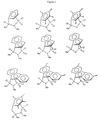
- Non-limiting examples of compounds of general formula (I) according to the present invention are:
- the organometallic catalysts obtained as it has been previously described, can be used in the polymerization and copolymerization of alpha-olefins through the addition of cocatalysts.
- cocatalysts are compounds which can form non-coordinative anions, such as alkylaluminoxanes or boron perfluorinated compounds.
- Representative, but non-limiting, examples are methylaluminoxane, ethylaluminoxane, N,N-dimethylaniliniumtetrakys(pentafluorophenyl)borate, and trispentafluorophenylborane.
- boron derivatives it is preferable to add to the polymerization medium little quantities of aluminium alkyls (TIBA, TEA, TMA).
- organometallic catalysts obtained as it has been previously described, can be heterogenised onto organic or inorganic porous supports containing hydroxyl groups, chemically modified or not.
- the organic supports useful for the present invention are: styrene-divinylbenzene copolymers, polyols, partially hydrolyzed ethylene-vinylacetate copolymers. These supports can be modified in such a way that they contain hydroxyl groups as well known in the art and for example described in EP 633272.
- Non limiting examples of inorganic porous supports containing hydroxyl groups useful for the present invention are oxides, silicates, carbonates, phosphates, clays and mixtures thereof.
- Some inorganic supports preferably used are silica, alumina, silica-alumina, silica-titanates, silica-vanadates, silica-chromates, aluminium phosphates, phosphatized silica and mixtures thereof.
- the surface area varies between 10-1000 m 2 /g, preferably between 150-650 m 2 /g, the pore volume varies between 0.2-4.0 cm 3 /g, preferably 0.6-2.7 cm 3 /g and the average particle size varies between 1-1000 ⁇ m, preferably between 5-100 ⁇ m.
- the water contained in the supports can be eliminated or not before the reaction with the organometallic complex that contains active functional groups.
- inorganic supports when dehydrated supports are used, they are dried through calcination under inert atmosphere in an oven at temperatures that vary between 120°C and 1000°C (typically between 200-800°C).
- the hydroxyl groups present in the support can be determined by titration with n-butyl magnesium chloride or with triethylaluminum.
- the concentration of hydroxyl groups (OH), that depends on the drying temperature, varies between 0.1 and 5 mmol OH/g silica, preferably 0.3 to 3 mmol OH/g silica or between 0.1 and 7 OH groups/nm 2 , preferably between 0.5 and 5 OH groups /nm 2 .
- the support can be stored under inert atmosphere (N 2 or Ar), protecting it from air and humidity.
- inert atmosphere N 2 or Ar
- the supports partially dehydrated or not, can be directly treated with organometallic catalysts, or they can previously be chemically modified through reaction of the hydroxyl groups with compounds of general formula II: wherein:
- d and e take without distinction values between 0 and 10.
- d and e are not at the same time equal to 0.
- Examples of some compounds of general formula II, which can serve to functionalize the catalytic supports with terminal amine or tiol groups are: 3-trimetoxysilylpropanetiol, 3-trimetoxysilylpropylamine, N-phenyl-3-trimetoxysilylpropylamine, N-methyl-3-trimetoxysilylpropylamine.
- the chemical modification of the support is realized through reaction between superficial hydroxyl groups of the supports and the reactive groups (R 1 ) of the compounds of formula II; the molar ratio OH/R 1 is comprised between 0.10 and 6, preferably between 0.2 and 4.
- the reaction is carried out in hydrocarbon solvents (toluene, heptane,), maintaining the temperature of the reaction medium between 25°C and 150°C, preferably working between 50 and 130°C, for 5-36 hours, preferably for 10-30 hours.
- the reaction by-products generally inert, can be easily eliminated by filtration and washing with hydrocarbon solvents.
- organoaluminum compounds such as aluminium alkyl or alkylaluminoxane.
- the alkylaluminoxane is methylaluminoxane, ethylaluminoxane, isobutylaluminoxane.
- the quantity of the used organoaluminum compound can vary from 0.05 to 30 mmol of Al per gram of support; however, this quantity can be smaller or larger, the concentration preferably ranges from 1 to 15 mmol Al/g of support.
- the reaction is completed in 1-24 hours, preferably between 2 and 15 hours, in a temperature range comprised between 15 and 200°C, preferably between 20 and 150°C.
- the solids obtained through this process have aluminium contents between 2 and 20%, preferably between 5 and 15%.
- the anchorage of the organometallic catalyst on the support, chemically modified or not, can be realized through the reaction, under inert atmosphere, of the support with the organometallic catalyst in a hydrocarbon medium (toluene, heptane) from room temperature to reflux temperature of the solvent, for a time comprised between 30 min and 24 h, leaving the formed gas in evolution.
- a hydrocarbon medium toluene, heptane
- the reaction mixture is filtered and washed with a hydrocarbon solvent several times up to the elimination of the acid remnants or the non-supported catalyst. It is dried under vacuum and stored under inert atmosphere, and it is active for long periods of time.
- the quantity of the organometallic complex of general formula I, added to the support, chemically modified or not, can vary between 0.001 and 10 mmol of metal per gram of support, preferably between 0.01 and 7 mmol of metal per gram of support.
- the anchorage of the organometallic catalyst to the support through chemical reaction allows to preserve the organometallic compound structure, producing species which are active in the polymerization of olefins in the presence of aluminium and/or boron cocatalysts.
- the catalytic systems thus prepared are fit for the polymerization of alpha-olefins with 2 to 20 carbon atoms, in particular for the polymerization of ethylene, and for the copolymerization of ethylene with at least one alpha-olefin with 3 to 20 carbon atoms, such as propylene, 1-butene, 4-methyl-1-pentene, 1-hexene 1-octene, 1-hexadecene, with dienes like hexadiene, with cycloalkenes and with styrene or mixtures thereof.
- the polymerization can be realized through a processes in solution, in suspension, in gas phase or in bulk at high pressure and temperature.
- hydrocarbon solvents such as branched or linear aliphatic hydrocarbons (hexane, heptane, isobutane), cyclic hydrocarbons (benzene, toluene, xylene) or a mixture thereof are used as reaction medium.
- the polymerization can be realized between 1 and 4000 atmospheres and temperatures between 60 and 300°C, preferably between 40 and 220°C, and the polymerization time can vary between 20 seconds and 6 hours, according to the process.
- the used concentration of the organometallic catalyst is from 10 -7 to 10 -3 M, preferably form 10 -6 to 10 -4 M.
- the organo aluminum compound (for example an aluminoxane) is used in a concentration from 10 -4 to 10 -1 M, preferably from 10 -3 to 10 -2 M.
- the used Al/M molar ratio ranges from 100 to 10000, preferably between 500 and 1500.
- the molar ratio varies in the range 0.5-10, preferably 0.9-5.
- the molecular weight of the obtained polymers can be controlled by varying the concentrations of catalyst, cocatalyst and monomer in the polymerization medium, the polymerization temperature as well as by the addition of regulators of the molecular weight such as H 2 .
- regulators of the molecular weight such as H 2 .
- the obtained polymers have broad distribution of the molecular weight, including also multimodal distributions.
- the copolymerization reactions can be realized by using the same process as the one used in the homopolymerization processes, but moreover by feeding the reaction medium with the suitable comonomer or comonomers.
- the preferred comonomer/monomer molar ratio is comprised between 0.1/1 and 5/1. In this way, copolymers with controlled content and random distribution of comonomer are obtained.
- Figure 1 shows some non limiting examples of compounds of formula 1.
- the average molecular weights in number, weight and distribution were determined through gel permeation chromatography GPC or SEC.
- the intrinsic viscosities [ ⁇ ] were obtained at 145°C through viscosimetric techniques, using as a solvent trichlorobenzene with 0.05% of antioxidant in order to prevent polymer degradation.
- Ethylene was polymerized in the same way as in example 4, but using 20 ml of a MAO solution in toluene (1.5 M in total aluminium) and 22 mg of the solid catalyst described in example 2. After 15 minutes of polymerization 1.54 g of polyethylene with an Mw of 281,604 and an Mw/Mn of 3.5 was obtained.
- Ethylene and 1-hexene were copolymerized. The same method as example 4 was used, but once the solvent had been added and before the reactor was pressurized, 8 ml of dry and just distilled 1-hexene were injected. 20 ml of a MAO solution in toluene (1.5 M in total aluminium) and 22 mg of the solid catalyst described in example 2 were used. After 15 minutes of polymerization 1 g. of polyethylene with an Mw of 271244 and an Mw/Mn of 3.6 was obtained. The content in 1-hexene determined by 13 C-NMR was 0.5% molar, distributed at random.
- Ethylene and 1-hexene were copolymerized. The same method as example 7 was used, but once the solvent had been added and before the reactor was pressurized, 8 ml of dry and just distilled 1-hexene were injected. After 15 minutes of polymerization 0.7 g of polyethylene with an Mw of 235,486 was obtained. The content in 1-hexene determined by 13 C-NMR was 0.91% molar, distributed at random.
- Ethylene and 1-hexene were copolymerized. The same method as example 7 was used, but once the solvent had been added and before the reactor was pressurized, 16 ml of dry and just distilled 1-hexene were injected. After 15 minutes of polymerization 0.3 g of polyethylene with an Mw of 175641 was obtained. The content in 1-hexene determined by 13 C-NMR was 1.06% molar, distributed at random.
- Ethylene was polymerized in the same way as example 7, but using 20 ml of a MAO solution in toluene (1.5 M in total aluminum) and 65 mg of the solid catalyst described in example 2. After 15 minutes of polymerization 1.59 g of polyethylene with an Mw of 250,268 and an Mw/Mn of 3.0 was obtained.
- Ethylene was polymerized in the same way as example 7, but using 20 ml of a MAO solution in toluene (1.5 in total aluminum) and 73 mg of the solid catalyst described above. After 15 minutes of polymerization 1.70 g of polyethylene with an Mw of 207,722 and an Mw/Mn of 2.9 was obtained.
- Ethylene and 1-hexene were copolymerized. The same method as example 13 was used, but once the solvent had been added and before the reactor was pressurized, 8 ml of dry and just distilled 1-hexene were injected. After 15 minutes of polymerization 1.27 g of polyethylene with an Mw of 239,282 was obtained. The molar content in 1-hexene determined by 13 C-NMR was 0.57% distributed at random.
- Ethylene and 1-hexene were copolymerized. The same method as example 13 was used, but once the solvent had been added and before the reactor was pressurized 4 ml of dry and just distilled 1-hexene were injected. After 15 minutes of polymerization 0.47 g of polyethylene with an Mw of 326,694 was obtained. The molar content in 1-hexene determined by 13 C-NMR was 0.042% distributed at random.
Landscapes
- Chemical & Material Sciences (AREA)
- Organic Chemistry (AREA)
- Chemical Kinetics & Catalysis (AREA)
- Engineering & Computer Science (AREA)
- Materials Engineering (AREA)
- Inorganic Chemistry (AREA)
- Health & Medical Sciences (AREA)
- Medicinal Chemistry (AREA)
- Polymers & Plastics (AREA)
- Transition And Organic Metals Composition Catalysts For Addition Polymerization (AREA)
- Devices And Processes Conducted In The Presence Of Fluids And Solid Particles (AREA)
Claims (26)
- Composant de catalyseur pour la polymérisation d'alphaoléfines de la formule générale (I):dans laquelle:
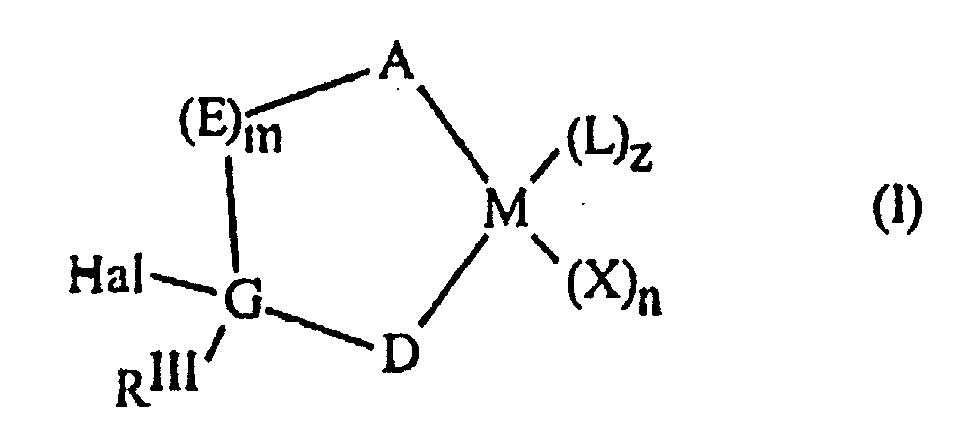 M est un métal de transition des groupes 3, 4-10, des séries des lanthanides ou actinides de la table périodique des éléments;A est un anneau avec des électrons π, qui coordonne directement avec le métal de transition M;L est une base de Lewis neutre;z est un nombre dont la valeur est: 0, 1, 2 ou 3;m est un nombre entier dont la valeur est: 0 ou 1;E se sélectionne entre le groupe composé par: BRII, CRII 2, SiRII 2 ou GeRII 2; chaque RII, pareil ou différent des autres, est de l'hydrogène, de l'halogène, de l'alcoyle, du cyclo-alcoyle, de l'aryle, de l'alkényle, de l'aryle-alcoyle, de l'aryle-alkényle ou de l'alcoyle-aryle avec 1 à 20 atomes de carbone, linéaire ou ramifié, dont l'hydrogène est remplacé de façon optionnelle par des groupes SiRI 3, GeRI 3, ORI, NRI 2, OSiRI 3 ou une quelconque combinaison de ceux-ci, où RI se sélectionne entre le groupe composé par: hydrogène, alcoyle C1-C20, cyclo-alcoyle C3-C20, aryle C6-C20, alkényle C7-C20, aryle-alcoyle C7-C20, aryle-alkényle C7-C20 ou alcoyle-aryle, linéaire ou ramifié; et en outre RII et RIII forment de façon optionnelle un anneau;Hal se sélectionne entre le groupe composé par de l'iode, du brome ou du chlore;RIII a la même signification que RII; G est de la silice ou un atome de germanium;D se sélectionne entre le groupe composé par: O, S, NRIV, PRIV, ORIV, SRIV, NRIV 2, PRIV 2; chaque RIV, pareil ou différent des autres, est de l'hydrogène, de alcoyle, du cyclo-alcoyle, de l'aryle, de l'alkényle, de l'aryle-alcoyle, de l'aryle-alkényle ou de alcoyle-aryle avec 1 à 20 atomes de carbone, linéaire ou ramifié, dont les hydrogènes sont remplacé de façon optionnelle par des groupes SiRI 3, GeRI 3, ORI, NRI 2, OSiRI 3 ou une quelconque combinaison de ceux-ci, où RI est tel qu'il a été défini antérieurement; d'une façon optionnelle il forme un anneau condensé à travers une autre liaison avec RII ou RIII;Chaque groupe X, pareil ou différent des autres, se sélectionne entre le groupe composé par de l'hydrogène, de l'halogénure, de l'alcoyle, du cyclo-alcoyle, de l'aryle, de l'alkényle, de aryle-alcoyle, de l'aryle-alkényle ou de alcoyle-aryle avec 1 à 20 atomes de carbone, linéaire ou ramifié, où les hydrogènes sont remplacés d'une façon optionnelle par des groupes SiRI 3, GeRI 3, ORI, NRI 2, OSiRI 3 ou une quelconque combinaison de ceux-ci, où RI est tel qu'il a été défini antérieurement;n est un nombre dont la valeur est: 0, 1, 2 ou 3; pour remplir les valences qui restent du métal M.
 - Composant de catalyseur selon la revendication 1, caractérisé par le fait que dans la formule générale (I) A est un anneau du type cyclopentadiènyle de formule C5R4, où chaque groupe R, pareil ou différent des autres, se sélectionne entre le groupe composé par: hydrogène, alcoyle C1-C20, cyclo-alcoyle C3-C20, aryle C6-C20, alkényle C7-C20, aryle-alcoyle C7-C20, aryle-alkényle C7-C20 ou alcoyle-aryle, linéaire ou ramifié; les hydrogènes de ces groupes sont remplacés de façon optionnelle par des groupes SiRI 3, GeRI 3, RIO, RI 2N, OSiRI 3 ou une quelconque combinaison de ceux-ci, où RI se sélectionne entre le groupe composé par: hydrogène, alcoyle C1-C20, cyclo-alcoyle C3-C20, aryle C6-C20, alkényle C7-C20, aryle-alcoyle C7-C20, aryle-alkényle C7-C20 ou alcoyle-aryle, linéaire ou ramifié; R se sélectionne également entre le groupe composé par des groupes SiRI 3, GeRI 3, ORI, NRI 2, OSiRI 3 ou une quelconque combinaison de ceux-ci; deux R adjacents étant unis d'une façon optionnelle pour former un anneau de cyclopentadiényle polycyclique saturé ou insaturé tel que indényle, tetrahydroindényle, fluorényle ou octahydrofluorényle, remplacé d'une façon optionnelle par des groupes R.
- Composant de catalyseur selon les revendications 1-2, caractérisé par le fait que dans la formule générale (I), M se sélectionne entre le groupe composé par: zirconium, titane o hafnium.
- Composant de catalyseur selon les revendications 1-3, caractérisé par le fait que Hal est du chlore.
- Composant de catalyseur selon les revendications 1-4, caractérisé par le fait que RIII est du méthyle.
- Composant de catalyseur solide qui peut s'obtenir au moyen du contact d'un composant de catalyseur des revendications 1-5 et d'un support organique ou d'un support inorganique avec des groupes hydroxyle fonctionnels.
- Composant de catalyseur solide selon la revendication 6, caractérisé par le fait que le support se sélectionne entre le groupe composé par: copolymères de styrène-divinyle-benzène, polyols, copolymères d'éthylène-acétate de vinyle partiellement hydrolysés, silice, alumine, silice-alumine, silice-titanates, silice-vanadates, silice-chromates, phosphates d'aluminium, silice phosphaté et mélanges de ceux-ci.
- Composant de catalyseur solide selon les revendications 6-7, caractérisé par le fait que le support organique ou inorganique se modifie au préalable à travers la réaction avec des composés de la formules générale (II) :dans laquelle:
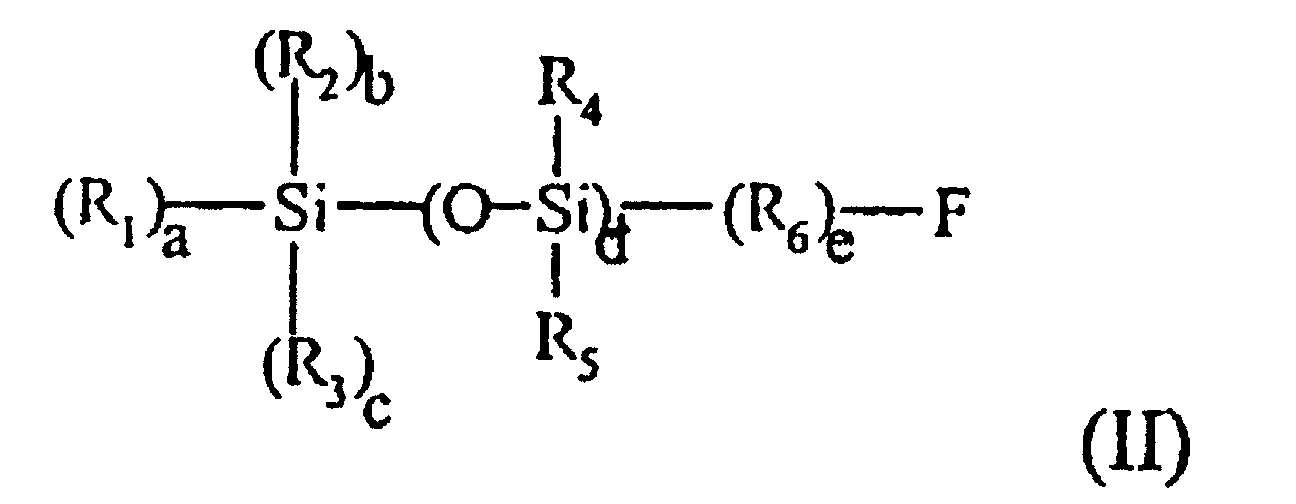 R1 est un groupe réactif avec les groupes hydroxyle du support sélectionné entre le groupe composé par: halogène, alcoxy de formule OR7, R7 étant un alcoyle linéaire ou ramifié, avec 1 à 6 atomes de carbone, un cyclo-alcoyle C5-C7, un aryle C6-C10, un alkényle C2-C10, un aryle-alcoyle C7-C10 ou un alcoyle-aryle C7-C40;R2, R3, R4 y R5, pareils ou différents entre eux, sont des groupes alcoyle, ramifiés ou non, avec 1 à 6 atomes de carbone, cyclo-alcoyle C5-C7, aryle C6-C10, alkényle C2-C10, aryle-alcoyle C7-C10 ou alcoyle-aryle C7-C40;R6 est un groupe propanediyle ou méthylène;F se sélectionne entre le groupe composé par: NH2, NHR7, SH, OH ou PHR7, où R7 a déjà été défini;la somme a + b + c est 3, a étant toujours supérieur à 0;d et e pris de façon indépendante ont des valeurs comprises entre 0 et 10.
 - Composant de catalyseur solide selon la revendication 8, caractérisé par le fait que la relation molaire entre le groupe hydroxyle superficiel du support et les groupes réactifs, R1, est comprise entre 0,10 et 6.
- Composant de catalyseur solide selon la rèvendication 9, caractérisé par le fait que la relation molaire entre le groupe hydroxyle superficiel du support et les groupes réactifs, R1, est comprise entre 0,2 et 4.
- Composant de catalyseur solide selon les revendications 6-7, caractérisé par le fait que le support organique ou inorganique est traité au préalable avec un composé d'organo-aluminium sélectionné entre le groupe composé par: alcoyle aluminium ou alcoyle-aluminoxane.
- Composant de catalyseur solide selon la revendication 11, caractérisé par le fait que le composé d'organo-aluminium se sélectionne entre le groupe composé par triméthyle-aluminium, triéthyle-aluminium, triisobutyle-aluminium, méthyle-aluminoxane, éthyle-aluminoxane ou isobutyle-aluminoxane.
- Composant de catalyseur solide selon les revendications 6-12, caractérisé par le fait que le support a une surface spécifique qui varie entre 100 et 1000 m2/g, le volume de pores varie entre 0,2 et 0,4 cm3/g et la taille moyenne des particules varie entre 1 et 500 µm.
- Composant de catalyseur solide selon les revendications 6-13, caractérisé par le fait que la relation entre les millimasses du métal de transition et les grammes du support est comprise entre 0,001 et 10.
- Composant de catalyseur solide selon la revendication 14, caractérisé par le fait que la relation entre les millimasses du métal de transition et les grammes du support est comprise entre 0,01 et 7.
- Système catalyseur qui comprend:un cocatalyseur sélectionné entre le groupe composé par: alcoyle-aluminoxane, aluminoxane modifié, composés de bore; etun composant de catalyseur selon les revendications 1-5 ou un composant de catalyseur solide selon les revendications 6-15.
- Système catalyseur selon la revendication 16 caractérisé par le fait que le cocatalyseur se sélectionne entre le groupe composé par: méthyle-aluminoxane, éthyle-aluminoxane, N,N-diméthyle-anilinio-tétraquis (pentafluorophényle) borate et trispentafluorophényleborane.
- Procédé pour obtenir des polyoléfines en solution, en suspension ou en phase gazeuse à basses et hautes pressions et températures, ou en masse à hautes pressions et hautes ou basses températures, caractérisé par l'usage des systèmes catalytiques selon les revendications 16-17.
- Procédé pour obtenir des polyoléfines selon la revendication 18, caractérisé par le fait que la température de polymérisation varie entre -60°C et 300°C, la pression varie entre 1 et 4000 atmosphères, la concentration du métal de transition varie entre 10-7 et 10-3 M, le cocatalyseur est un complexe organique en aluminium et la relation molaire de cocatalyseur/métal de transition varie entre 10 et 10000.
- Procédé pour obtenir des polyoléfines selon la revendication 18, caractérisé par le fait que la température de polymérisation varie entre -60°C et 300°C, la pression varie entre 1 et 4000 atmosphères, la concentration molaire de métal de transition varie entre 10-7 et 10-3, le cocatalyseur est un composé en bore et la relation molaire de cocatalyseur/métal de transition varie entre 0,5 et 10.
- Procédé pour obtenir des polyoléfines selon la revendication 20, caractérisé par le fait que la température de polymérisation varie entre 40°C et 220°C, la pression varie entre 1 et 4000 atmosphères, la concentration molaire de métal de transition varie entre 10-6 et 10-4, le cocatalyseur est un composé en bore et la relation molaire de cocatalyseur/métal de transition varie entre 0,9 et 5.
- Procédé pour obtenir des polyoléfines selon la revendication 19, caractérisé par le fait que la température de polymérisation varie entre -40°C et 220°C, la pression varie entre 1 et 4000 atmosphères, la concentration du métal de transition varie entre 10-6 et 10-4 M, le cocatalyseur est un complexe organique en aluminium et la relation molaire de cocatalyseur/métal de transition varie entre 500 et 1500.
- Procédé pour obtenir des polyoléfines selon les revendications 18-22, caractérisé par le fait que le monomère est de l'éthylène.
- Procédé pour obtenir des copolymères d'éthylène selon la revendication 23, caractérisé par le fait que le comonomère se sélectionne entre le groupe composé par : propène, 1-butène, 1-hexène, 1-octène, 1-hexadécène, 4-méthyle-pentène, hexadiène et styrène, ou des mélanges de ceux-ci.
- Procédé pour obtenir un composant de catalyseur selon les revendications 1-5, caractérisé par les étapes suivantes :a) réaction d'un composé de la formule générale :avec un composé d'un métal de transition MX4 ;
 b) réaction du composé obtenuavec le composé de métal alcalin de formule M'NHRIV selon le schéma suivant:
 où
où
RV a la même signification que RIV ; RVI est un groupe alcoyle de 1 à 20 atomes de carbone, et M' se sélectionne entre le groupe composé par Li, K et Na. - Procédé pour obtenir un composant de catalyseur selon la revendication 25, caractérisé par le fait que RVI est du méthyle et Hal est du chlore.
Applications Claiming Priority (2)
| Application Number | Priority Date | Filing Date | Title |
|---|---|---|---|
| ES9602302 | 1996-10-30 | ||
| ES9602302 | 1996-10-30 |
Publications (2)
| Publication Number | Publication Date |
|---|---|
| EP0839835A1 EP0839835A1 (fr) | 1998-05-06 |
| EP0839835B1 true EP0839835B1 (fr) | 2000-02-16 |
Family
ID=8296545
Family Applications (2)
| Application Number | Title | Priority Date | Filing Date |
|---|---|---|---|
| EP97500186A Expired - Lifetime EP0839835B1 (fr) | 1996-10-30 | 1997-10-30 | Catalyseurs organométalliques pour la polymérisation et la copolymérisation d'alpha-oléfines |
| EP97500184A Expired - Lifetime EP0839833B1 (fr) | 1996-10-30 | 1997-10-30 | Systèmes catalytiques pour la polymérisation et la copolymérisation d'alpha-oléfines |
Family Applications After (1)
| Application Number | Title | Priority Date | Filing Date |
|---|---|---|---|
| EP97500184A Expired - Lifetime EP0839833B1 (fr) | 1996-10-30 | 1997-10-30 | Systèmes catalytiques pour la polymérisation et la copolymérisation d'alpha-oléfines |
Country Status (8)
| Country | Link |
|---|---|
| US (1) | US5977392A (fr) |
| EP (2) | EP0839835B1 (fr) |
| JP (3) | JP3352374B2 (fr) |
| AT (3) | ATE256706T1 (fr) |
| DE (2) | DE69726821T2 (fr) |
| ES (2) | ES2142140T3 (fr) |
| NO (3) | NO319295B1 (fr) |
| PT (3) | PT839833E (fr) |
Families Citing this family (11)
| Publication number | Priority date | Publication date | Assignee | Title |
|---|---|---|---|---|
| DE69703728T2 (de) * | 1996-10-31 | 2001-06-28 | Repsol Quimica S.A., Madrid | Katalysatorsysteme für die Polymerisation und Copolymerisation von Alpha-Olefinen |
| EP0856524A1 (fr) * | 1997-02-01 | 1998-08-05 | Repsol Quimica S.A. | Composants catalytiques hétérogènes pour la polymérisation des oléfines, procédé pour leur préparation et leur utilisation |
| US6489261B1 (en) * | 1997-12-01 | 2002-12-03 | Dsm N.V. | Catalyst composition comprising a reduced transition metal complex and a cocatalyst |
| DE69914012T2 (de) | 1998-04-27 | 2004-12-09 | Repsol Quimica S.A. | Katalysatorsysteme für die Polymerisation und Copolymerisation von Alpha-Olefinen |
| DE69916358T2 (de) * | 1998-04-29 | 2005-04-21 | Repsol Quimica Sa | Verfahren und Verwendung von heterogenen Katalysatorbestandteilen für die Olefinpolymerisation |
| EP1392740B1 (fr) * | 2000-09-25 | 2008-08-20 | Basell Polyolefine GmbH | Procede de preparation de polymeres d'ethylene avec un compose de titanium du type bis-amide |
| GB0102440D0 (en) | 2001-01-31 | 2001-03-14 | Borealis Tech Oy | Catalyst |
| JP2003020416A (ja) | 2001-07-06 | 2003-01-24 | Fuji Photo Film Co Ltd | テトラシアノキノジメタン化合物を対アニオンとした特定構造のシアニン色素化合物及び該シアニン色素化合物を含む光情報記録媒体 |
| KR100690345B1 (ko) * | 2004-09-03 | 2007-03-09 | 주식회사 엘지화학 | 담지 메탈로센 촉매, 그 제조방법 및 이를 이용한폴리올레핀의 제조방법 |
| KR101959519B1 (ko) * | 2016-04-12 | 2019-03-18 | (주)디엔에프 | 전이금속 화합물, 이의 제조방법 및 이를 포함하는 전이금속함유 박막증착용 조성물 |
| CN116410223B (zh) * | 2021-12-31 | 2025-12-05 | 中国石油天然气股份有限公司 | 四芳基乙氧基侧链单茂金属化合物、包含其的催化剂体系及应用进行的聚烯烃合成方法 |
Family Cites Families (27)
| Publication number | Priority date | Publication date | Assignee | Title |
|---|---|---|---|---|
| DE1022382B (de) * | 1956-04-12 | 1958-01-09 | Hoechst Ag | Verfahren zur Polymerisation von niederen Olefinen |
| US3440237A (en) * | 1958-05-22 | 1969-04-22 | Monsanto Co | Production of polyethylene with water-modified ziegler catalyst |
| US3184416A (en) * | 1958-05-22 | 1965-05-18 | Monsanto Co | Production of ziegler polymerization catalysts |
| US4172945A (en) * | 1976-01-14 | 1979-10-30 | E. R. Squibb & Sons, Inc. | Precursors of indanpentol derivatives |
| DE3127133A1 (de) * | 1981-07-09 | 1983-01-27 | Hoechst Ag, 6000 Frankfurt | Verfahren zur herstellung von polyolefinen und deren copolymerisaten |
| IL85097A (en) * | 1987-01-30 | 1992-02-16 | Exxon Chemical Patents Inc | Catalysts based on derivatives of a bis(cyclopentadienyl)group ivb metal compound,their preparation and their use in polymerization processes |
| US5055438A (en) * | 1989-09-13 | 1991-10-08 | Exxon Chemical Patents, Inc. | Olefin polymerization catalysts |
| US5064797A (en) * | 1987-04-03 | 1991-11-12 | Phillips Petroleum Company | Process for producing polyolefins and polyolefin catalysts |
| US4939217A (en) * | 1987-04-03 | 1990-07-03 | Phillips Petroleum Company | Process for producing polyolefins and polyolefin catalysts |
| DE3718888A1 (de) * | 1987-06-05 | 1988-12-22 | Hoechst Ag | Verfahren zur herstellung eines 1-olefinpolymers |
| US4912075A (en) * | 1987-12-17 | 1990-03-27 | Exxon Chemical Patents Inc. | Method for preparing a supported metallocene-alumoxane catalyst for gas phase polymerization |
| US4925821A (en) * | 1987-12-17 | 1990-05-15 | Exxon Chemical Patents Inc. | Method for utilizing triethyaluminum to prepare an alumoxane support for an active metallocene catalyst |
| US4937217A (en) * | 1987-12-17 | 1990-06-26 | Exxon Chemical Patents Inc. | Method for utilizing triethylaluminum to prepare an alumoxane support for an active metallocene catalyst |
| US5008228A (en) * | 1988-03-29 | 1991-04-16 | Exxon Chemical Patents Inc. | Method for preparing a silica gel supported metallocene-alumoxane catalyst |
| US4935397A (en) * | 1988-09-28 | 1990-06-19 | Exxon Chemical Patents Inc. | Supported metallocene-alumoxane catalyst for high pressure polymerization of olefins and a method of preparing and using the same |
| NZ235032A (en) * | 1989-08-31 | 1993-04-28 | Dow Chemical Co | Constrained geometry complexes of titanium, zirconium or hafnium comprising a substituted cyclopentadiene ligand; use as olefin polymerisation catalyst component |
| US5057475A (en) * | 1989-09-13 | 1991-10-15 | Exxon Chemical Patents Inc. | Mono-Cp heteroatom containing group IVB transition metal complexes with MAO: supported catalyst for olefin polymerization |
| EP0426637B2 (fr) * | 1989-10-30 | 2001-09-26 | Fina Technology, Inc. | Préparation de catalyseurs métallocènes pour la polymérisation d'oléfines |
| EP1110974B1 (fr) * | 1992-08-05 | 2007-11-28 | ExxonMobil Chemical Patents Inc. | Procédé de préparation d'un activateur sur support |
| DE69312306T2 (de) * | 1992-10-02 | 1997-11-13 | Dow Chemical Co | Aufträger homogener komplexkatalysator für olefinpolymerisation |
| IT1264680B1 (it) * | 1993-07-07 | 1996-10-04 | Spherilene Srl | Catalizzatori supportati per la polimerizzazione delle olefine |
| ES2117829T3 (es) * | 1994-02-17 | 1998-08-16 | Union Carbide Chem Plastic | Composicion de catalizador de metaloceno cargada y secada por pulverizacion, utilizada en la fabricacion de poliolefinas. |
| US5486632A (en) * | 1994-06-28 | 1996-01-23 | The Dow Chemical Company | Group 4 metal diene complexes and addition polymerization catalysts therefrom |
| EP0789718B1 (fr) * | 1994-10-31 | 1998-04-08 | Dsm N.V. | Composition catalytique et procede de polymerisation d'une olefine |
| ES2120868B1 (es) * | 1995-08-03 | 2000-09-16 | Repsol Quimica Sa | Sistema de catalizadores hetereogeneos tipo metalogeno, para procesos de obtencion de poliolefinas. |
| US5688880A (en) * | 1995-12-11 | 1997-11-18 | The Dow Chemical Company | Readily supportable metal complexes |
| US5856258A (en) | 1996-10-15 | 1999-01-05 | Northwestern University | Phenolate constrained geometry polymerization catalyst and method for preparing |
-
1997
- 1997-10-30 EP EP97500186A patent/EP0839835B1/fr not_active Expired - Lifetime
- 1997-10-30 NO NO19975007A patent/NO319295B1/no unknown
- 1997-10-30 AT AT97500184T patent/ATE256706T1/de not_active IP Right Cessation
- 1997-10-30 ES ES97500186T patent/ES2142140T3/es not_active Expired - Lifetime
- 1997-10-30 JP JP33626197A patent/JP3352374B2/ja not_active Expired - Fee Related
- 1997-10-30 NO NO19974998A patent/NO317950B1/no not_active IP Right Cessation
- 1997-10-30 AT AT97500186T patent/ATE189822T1/de not_active IP Right Cessation
- 1997-10-30 DE DE69726821T patent/DE69726821T2/de not_active Expired - Fee Related
- 1997-10-30 PT PT97500184T patent/PT839833E/pt unknown
- 1997-10-30 JP JP33626397A patent/JP3340064B2/ja not_active Expired - Fee Related
- 1997-10-30 ES ES97500184T patent/ES2210479T3/es not_active Expired - Lifetime
- 1997-10-30 JP JP9336262A patent/JPH10182716A/ja active Pending
- 1997-10-30 NO NO19975008A patent/NO316699B1/no unknown
- 1997-10-30 PT PT97500185T patent/PT839834E/pt unknown
- 1997-10-30 DE DE69701306T patent/DE69701306T2/de not_active Expired - Fee Related
- 1997-10-30 US US08/961,349 patent/US5977392A/en not_active Expired - Fee Related
- 1997-10-30 PT PT97500186T patent/PT839835E/pt unknown
- 1997-10-30 EP EP97500184A patent/EP0839833B1/fr not_active Expired - Lifetime
- 1997-10-30 AT AT97500185T patent/ATE202121T1/de not_active IP Right Cessation
Also Published As
| Publication number | Publication date |
|---|---|
| ATE189822T1 (de) | 2000-03-15 |
| EP0839835A1 (fr) | 1998-05-06 |
| EP0839833A3 (fr) | 1998-09-02 |
| PT839833E (pt) | 2004-05-31 |
| NO317950B1 (no) | 2005-01-10 |
| NO975007D0 (no) | 1997-10-30 |
| NO316699B1 (no) | 2004-03-26 |
| DE69701306T2 (de) | 2000-09-14 |
| JPH10226711A (ja) | 1998-08-25 |
| EP0839833A2 (fr) | 1998-05-06 |
| US5977392A (en) | 1999-11-02 |
| NO975007L (no) | 1998-05-04 |
| NO974998L (no) | 1998-05-04 |
| JPH10182716A (ja) | 1998-07-07 |
| NO975008D0 (no) | 1997-10-30 |
| ATE202121T1 (de) | 2001-06-15 |
| NO974998D0 (no) | 1997-10-30 |
| ES2142140T3 (es) | 2000-04-01 |
| ES2210479T3 (es) | 2004-07-01 |
| DE69726821T2 (de) | 2004-10-21 |
| NO975008L (no) | 1998-05-04 |
| ATE256706T1 (de) | 2004-01-15 |
| JPH10226710A (ja) | 1998-08-25 |
| EP0839833B1 (fr) | 2003-12-17 |
| DE69701306D1 (de) | 2000-03-23 |
| JP3352374B2 (ja) | 2002-12-03 |
| JP3340064B2 (ja) | 2002-10-28 |
| PT839834E (pt) | 2001-11-30 |
| PT839835E (pt) | 2000-08-31 |
| DE69726821D1 (de) | 2004-01-29 |
| NO319295B1 (no) | 2005-07-11 |
Similar Documents
| Publication | Publication Date | Title |
|---|---|---|
| AU611384B2 (en) | New supported polymerization catalyst | |
| FI112235B (fi) | Katalyyttikoostumuksia ja menetelmä polyolefiinien valmistamiseksi | |
| JP2775069B2 (ja) | シリカゲル担持メタロセンアルモキサン触媒の製法 | |
| US5359015A (en) | Metallocene catalysts and their production and use | |
| US4935397A (en) | Supported metallocene-alumoxane catalyst for high pressure polymerization of olefins and a method of preparing and using the same | |
| JP4015948B2 (ja) | デュアルサイトのオレフィン重合触媒組成物 | |
| CA1268753A (fr) | Catalyseur de polymerisation sur support | |
| US6136747A (en) | Mixed catalyst composition for the production of olefin polymers | |
| EP0839834B1 (fr) | Systèmes catalytiques pour la (co)polymérisation d'alpha-oléfines | |
| EP0839836B1 (fr) | Systèmes catalytiques pour la polymérisation et la copolymérisation d'alpha-oléfines | |
| US5977392A (en) | Organometallic catalysts for the polymerization and copolymerization of alpha-olefins | |
| US6433111B1 (en) | Method for producing a supported catalyst system | |
| KR100580902B1 (ko) | 중합 방법 | |
| JP2968499B2 (ja) | アンカー鎖によってキャリアと連結したメタロセンを有する触媒系 | |
| JP3394004B2 (ja) | α−オレフィンの重合及び共重合用触媒系 | |
| US20020002256A1 (en) | Catalyst composition for the polymerization of olefins | |
| EP0741146B1 (fr) | Catalyseur pour la (co)-polymérisation d'éthylène ayant une activité améliorée | |
| US6281320B1 (en) | Use of chelatable phenols with metallocene- aluminoxane catalyst systems | |
| WO2005005499A1 (fr) | Procede de polimerisation d'olefines | |
| EP1951764B1 (fr) | Procédé de polymérisation d'oléfines | |
| KR20010014073A (ko) | 기상에서의 올레핀 중합 방법 | |
| JP3588665B2 (ja) | 遷移金属錯体を用いたオレフィン重合触媒およびそれを用いたポリオレフィンの製造法 | |
| KR100209859B1 (ko) | 폴리에틸렌 공중합체의 제조방법 | |
| JPH1180231A (ja) | オレフィン重合用触媒およびそれを用いたポリオレフィンの製造方法 | |
| WO1999021898A1 (fr) | Systeme catalyseur metallocene a base d'halogenure de magnesium |
Legal Events
| Date | Code | Title | Description |
|---|---|---|---|
| PUAI | Public reference made under article 153(3) epc to a published international application that has entered the european phase |
Free format text: ORIGINAL CODE: 0009012 |
|
| AK | Designated contracting states |
Kind code of ref document: A1 Designated state(s): AT BE DE ES FI FR GB IT NL PT |
|
| AX | Request for extension of the european patent |
Free format text: AL;LT;LV;RO;SI |
|
| 17P | Request for examination filed |
Effective date: 19980611 |
|
| AKX | Designation fees paid |
Free format text: AT BE DE ES FI FR GB IT NL PT |
|
| RBV | Designated contracting states (corrected) |
Designated state(s): AT BE DE ES FI FR GB IT NL PT |
|
| GRAG | Despatch of communication of intention to grant |
Free format text: ORIGINAL CODE: EPIDOS AGRA |
|
| 17Q | First examination report despatched |
Effective date: 19990618 |
|
| GRAG | Despatch of communication of intention to grant |
Free format text: ORIGINAL CODE: EPIDOS AGRA |
|
| GRAH | Despatch of communication of intention to grant a patent |
Free format text: ORIGINAL CODE: EPIDOS IGRA |
|
| GRAH | Despatch of communication of intention to grant a patent |
Free format text: ORIGINAL CODE: EPIDOS IGRA |
|
| GRAA | (expected) grant |
Free format text: ORIGINAL CODE: 0009210 |
|
| AK | Designated contracting states |
Kind code of ref document: B1 Designated state(s): AT BE DE ES FI FR GB IT NL PT |
|
| REF | Corresponds to: |
Ref document number: 189822 Country of ref document: AT Date of ref document: 20000315 Kind code of ref document: T |
|
| REF | Corresponds to: |
Ref document number: 69701306 Country of ref document: DE Date of ref document: 20000323 |
|
| REG | Reference to a national code |
Ref country code: ES Ref legal event code: FG2A Ref document number: 2142140 Country of ref document: ES Kind code of ref document: T3 |
|
| ITF | It: translation for a ep patent filed | ||
| ET | Fr: translation filed | ||
| REG | Reference to a national code |
Ref country code: PT Ref legal event code: SC4A Free format text: AVAILABILITY OF NATIONAL TRANSLATION Effective date: 20000516 |
|
| PLBE | No opposition filed within time limit |
Free format text: ORIGINAL CODE: 0009261 |
|
| STAA | Information on the status of an ep patent application or granted ep patent |
Free format text: STATUS: NO OPPOSITION FILED WITHIN TIME LIMIT |
|
| 26N | No opposition filed | ||
| REG | Reference to a national code |
Ref country code: GB Ref legal event code: IF02 |
|
| PGFP | Annual fee paid to national office [announced via postgrant information from national office to epo] |
Ref country code: NL Payment date: 20071023 Year of fee payment: 11 Ref country code: ES Payment date: 20071008 Year of fee payment: 11 Ref country code: DE Payment date: 20071025 Year of fee payment: 11 |
|
| PGFP | Annual fee paid to national office [announced via postgrant information from national office to epo] |
Ref country code: IT Payment date: 20071027 Year of fee payment: 11 Ref country code: FI Payment date: 20071012 Year of fee payment: 11 Ref country code: AT Payment date: 20071011 Year of fee payment: 11 |
|
| PGFP | Annual fee paid to national office [announced via postgrant information from national office to epo] |
Ref country code: BE Payment date: 20071213 Year of fee payment: 11 |
|
| PGFP | Annual fee paid to national office [announced via postgrant information from national office to epo] |
Ref country code: GB Payment date: 20071024 Year of fee payment: 11 Ref country code: FR Payment date: 20071009 Year of fee payment: 11 |
|
| PGFP | Annual fee paid to national office [announced via postgrant information from national office to epo] |
Ref country code: PT Payment date: 20071023 Year of fee payment: 11 |
|
| BERE | Be: lapsed |
Owner name: S.A. *REPSOL QUIMICA Effective date: 20081031 |
|
| REG | Reference to a national code |
Ref country code: PT Ref legal event code: MM4A Free format text: LAPSE DUE TO NON-PAYMENT OF FEES Effective date: 20090430 |
|
| GBPC | Gb: european patent ceased through non-payment of renewal fee |
Effective date: 20081030 |
|
| NLV4 | Nl: lapsed or anulled due to non-payment of the annual fee |
Effective date: 20090501 |
|
| REG | Reference to a national code |
Ref country code: FR Ref legal event code: ST Effective date: 20090630 |
|
| PG25 | Lapsed in a contracting state [announced via postgrant information from national office to epo] |
Ref country code: NL Free format text: LAPSE BECAUSE OF NON-PAYMENT OF DUE FEES Effective date: 20090501 Ref country code: FI Free format text: LAPSE BECAUSE OF NON-PAYMENT OF DUE FEES Effective date: 20081030 |
|
| PG25 | Lapsed in a contracting state [announced via postgrant information from national office to epo] |
Ref country code: PT Free format text: LAPSE BECAUSE OF NON-PAYMENT OF DUE FEES Effective date: 20090430 Ref country code: IT Free format text: LAPSE BECAUSE OF NON-PAYMENT OF DUE FEES Effective date: 20081030 Ref country code: DE Free format text: LAPSE BECAUSE OF NON-PAYMENT OF DUE FEES Effective date: 20090501 Ref country code: AT Free format text: LAPSE BECAUSE OF NON-PAYMENT OF DUE FEES Effective date: 20081030 |
|
| PG25 | Lapsed in a contracting state [announced via postgrant information from national office to epo] |
Ref country code: BE Free format text: LAPSE BECAUSE OF NON-PAYMENT OF DUE FEES Effective date: 20081031 |
|
| PG25 | Lapsed in a contracting state [announced via postgrant information from national office to epo] |
Ref country code: FR Free format text: LAPSE BECAUSE OF NON-PAYMENT OF DUE FEES Effective date: 20081031 |
|
| PG25 | Lapsed in a contracting state [announced via postgrant information from national office to epo] |
Ref country code: GB Free format text: LAPSE BECAUSE OF NON-PAYMENT OF DUE FEES Effective date: 20081030 |
|
| REG | Reference to a national code |
Ref country code: ES Ref legal event code: FD2A Effective date: 20081031 |
|
| PG25 | Lapsed in a contracting state [announced via postgrant information from national office to epo] |
Ref country code: ES Free format text: LAPSE BECAUSE OF NON-PAYMENT OF DUE FEES Effective date: 20081031 |