EP0840323B1 - Statische Halbleiterspeicheranordnung mit Vorausladungsschaltung mit ähnlicher Konfiguration wie Speicherzelle - Google Patents
Statische Halbleiterspeicheranordnung mit Vorausladungsschaltung mit ähnlicher Konfiguration wie Speicherzelle Download PDFInfo
- Publication number
- EP0840323B1 EP0840323B1 EP97118438A EP97118438A EP0840323B1 EP 0840323 B1 EP0840323 B1 EP 0840323B1 EP 97118438 A EP97118438 A EP 97118438A EP 97118438 A EP97118438 A EP 97118438A EP 0840323 B1 EP0840323 B1 EP 0840323B1
- Authority
- EP
- European Patent Office
- Prior art keywords
- precharging
- node
- power supply
- memory cell
- memory cells
- Prior art date
- Legal status (The legal status is an assumption and is not a legal conclusion. Google has not performed a legal analysis and makes no representation as to the accuracy of the status listed.)
- Expired - Lifetime
Links
- 230000003068 static effect Effects 0.000 title claims description 12
- 239000004065 semiconductor Substances 0.000 title claims description 3
- 238000003491 array Methods 0.000 claims 2
- 238000010586 diagram Methods 0.000 description 20
- 230000010354 integration Effects 0.000 description 7
- VYPSYNLAJGMNEJ-UHFFFAOYSA-N Silicium dioxide Chemical compound O=[Si]=O VYPSYNLAJGMNEJ-UHFFFAOYSA-N 0.000 description 6
- 239000012535 impurity Substances 0.000 description 6
- 229910052814 silicon oxide Inorganic materials 0.000 description 6
- 239000000758 substrate Substances 0.000 description 6
- 150000002500 ions Chemical class 0.000 description 5
- 238000009792 diffusion process Methods 0.000 description 4
- 229910052751 metal Inorganic materials 0.000 description 3
- 239000002184 metal Substances 0.000 description 3
- WFKWXMTUELFFGS-UHFFFAOYSA-N tungsten Chemical compound [W] WFKWXMTUELFFGS-UHFFFAOYSA-N 0.000 description 3
- 229910052721 tungsten Inorganic materials 0.000 description 3
- 239000010937 tungsten Substances 0.000 description 3
- 229910052782 aluminium Inorganic materials 0.000 description 2
- XAGFODPZIPBFFR-UHFFFAOYSA-N aluminium Chemical compound [Al] XAGFODPZIPBFFR-UHFFFAOYSA-N 0.000 description 2
- 238000000034 method Methods 0.000 description 2
- 229910021421 monocrystalline silicon Inorganic materials 0.000 description 2
- 230000001590 oxidative effect Effects 0.000 description 2
- XUIMIQQOPSSXEZ-UHFFFAOYSA-N Silicon Chemical compound [Si] XUIMIQQOPSSXEZ-UHFFFAOYSA-N 0.000 description 1
- 230000000295 complement effect Effects 0.000 description 1
- 230000002708 enhancing effect Effects 0.000 description 1
- 230000014759 maintenance of location Effects 0.000 description 1
- 230000003647 oxidation Effects 0.000 description 1
- 238000007254 oxidation reaction Methods 0.000 description 1
- 229910052710 silicon Inorganic materials 0.000 description 1
- 239000010703 silicon Substances 0.000 description 1
Images




Classifications
-
- G—PHYSICS
- G11—INFORMATION STORAGE
- G11C—STATIC STORES
- G11C11/00—Digital stores characterised by the use of particular electric or magnetic storage elements; Storage elements therefor
- G11C11/21—Digital stores characterised by the use of particular electric or magnetic storage elements; Storage elements therefor using electric elements
- G11C11/34—Digital stores characterised by the use of particular electric or magnetic storage elements; Storage elements therefor using electric elements using semiconductor devices
- G11C11/40—Digital stores characterised by the use of particular electric or magnetic storage elements; Storage elements therefor using electric elements using semiconductor devices using transistors
- G11C11/41—Digital stores characterised by the use of particular electric or magnetic storage elements; Storage elements therefor using electric elements using semiconductor devices using transistors forming static cells with positive feedback, i.e. cells not needing refreshing or charge regeneration, e.g. bistable multivibrator or Schmitt trigger
- G11C11/413—Auxiliary circuits, e.g. for addressing, decoding, driving, writing, sensing, timing or power reduction
- G11C11/417—Auxiliary circuits, e.g. for addressing, decoding, driving, writing, sensing, timing or power reduction for memory cells of the field-effect type
- G11C11/419—Read-write [R-W] circuits
-
- G—PHYSICS
- G11—INFORMATION STORAGE
- G11C—STATIC STORES
- G11C7/00—Arrangements for writing information into, or reading information out from, a digital store
- G11C7/12—Bit line control circuits, e.g. drivers, boosters, pull-up circuits, pull-down circuits, precharging circuits, equalising circuits, for bit lines
Definitions
- the present invention relates to a semiconductor device and, more particularly, to a static random access memory (SRAM) device.
- SRAM static random access memory
- a prior art SRAM device includes a plurality of word lines, a plurality of bit line pairs, at least one precharging line, a plurality of static memory cells connected to one of the word lines and one of the bit line pairs, and a plurality of precharging circuits connected to the precharging line and one of the bit line pairs, thus charging the one of the bit line pairs.
- the density of elements in the memory cell area of the static memory cells is much higher than that in the precharging circuits. This degrades the operation characteristics of the device.
- inactive dummy memory cells having the same configuration as the memory cells are inserted between the memory cell area and the precharging circuits. This will be explained later in detail.
- this object is achieved by a memory device as defined by claim 1.
- the precharging circuits also serve as inactive dummy memory cells, such inactive dummy memory cells can be omitted.
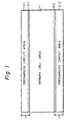
- Fig. 1 which is a layout diagram illustrating a first prior art SRAM device
- reference numeral 1 designates a memory cell area
- 2-1 and 2-2 designate dummy memory cell areas
- 3-1 and 3-2 designate precharging circuit areas.
- the memory cell area 1 includes memory cells C 11 to C n1 each connected to one of word lines WL 1 to WL n and complementary bit lines BL 1 and BL 1 .
- the dummy memory cell area 2-1 (2-2) includes one dummy memory cell DC 11 (DC 21 ) connected to one dummy word line DWL 1 (DWL 2 ) and the bit lines BL 1 and BL 1 .
- the precharging circuit area 3-1 (3-2) includes one precharging circuit PR 11 (PR 21 ) connected to the bit lines BL 1 and BL 1 .
- the precharging circuit PR 1 (PR 2 ) is controlled by a precharging clock signal ⁇ PR . That is the bit lines BL 1 and BL 1 are precharged at V cc after each read or write operation, thus increasing the read or write operation speed.
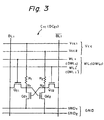
- the memory cell such as C 11 is provided at each intersection between the word line WL 1 and the bit lines BL 1 and BL 1 .
- the memory cell C 11 is constructed by a flip-flop formed by two cross-coupled inverters and two transfer transistors Q t1 and Q t2 between nodes N 1 and N 2 of the flip-flop and the bit lines BL 1 and BL 1 .
- the transfer transistors Q t1 and Q t2 are controlled by the voltage at the word line WL 1 .
- Each of the inverters is formed by a load resistor R 1 (R 2 ) and a drive transistor Q d1 (Q d2 ) between a power supply line denoted by V cc and a ground line denoted by GND.
- the node N 1 is connected to a gate of the drive transistor Q d2 , so that the drive transistor Q d2 is driven by the voltage at the node N 1 .
- the node N 2 is connected to a gate of the drive transistor Q d1 , so that the drive transistor Q d1 is driven by the voltage at the node N 2 .
- the dummy memory cell such as DC 21 has the same configuration as the memory cell C 11 of the memory cell area 1. However, note that the dummy word line DWL 2 is grounded, so that the dummy memory cell DC 2 is completely inactive.
- the precharging circuit such as PR 21 is constructed by a transistor Q PR1 connected between the power supply line V cc and the bit line BL 1 and a transistor Q PR2 connected between the power supply line V cc and the bit line BL 1 .
- the density of elements in the memory cell area 1 is much higher than that in the precharging circuit areas 3-1 and 3-2. This degrades the operation characteristics of the device.
- the inactive dummy memory cells such as DC 11 and DC 21 having the same configuration as the memory cells are inserted between the memory cell area 1 and the precharging circuit areas 3-1 and 3-2.
- the memory cell such as C 11 and the dummy memory cell such as DC 21 are actually symmerical with respect to a center location thereof, so that the memory cells and the dummy memory cells are balanced. As a result, data retention characteristics and soft error resistance characteristics can be improved.
- the circuit diagram of the memory cell C 11 (the dummy memory cell DC 21 ) is actually as illustrated in Fig.
- the power supply line V cc is replaced by two power supply lines V cc1 and V cc2 whose voltages are the same as each other;
- the word line WL 1 (the dummy word line DWL 1 ) is replaced by two word lines WL 1 and WL 1 '(DWL 1 and DWL 1 ') whose voltages are the same as each other;
- the ground line GND is replaced by two ground lines GND 1 and GND 2 whose voltages are the same as each other.
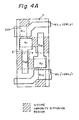
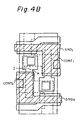
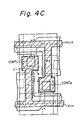
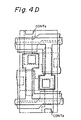
- FIG. 4A An example of the memory cell C 11 (the dummy memory cell DC 21 ) of Fig. 2 is illustrated in Figs. 4A, 4B, 4C and 4D.
- a P-type monocrystalline silicon substrate (not shown) is thermally oxidized to form a field silicon oxide layer F by using a local oxidation of silicon (LOCOS) process.
- LOC local oxidation of silicon
- a gate silicon oxide layer GOX is formed by thermally oxidizing the substrate.
- gate electrodes of the transistors Q t1 , Q t2 , Q d1 , and Q d2 are formed.
- the gate electrodes of the transistors Q t1 and Q t2 also serve as the word lines WL 1 and WL 1 ' (the dummy word lines DWL 1 and DWL 1 '), respectively.
- N-type impurity ions are implanted into the substrate using the gate electrodes as a mask to form N-type impurity diffusion regions as indicated by shaded portions.
- the field silicon oxide layer F, the gate electrodes and the N-type impurity diffusion regions are symmetrical with respect to the center location thereof as indicated by Z.
- a metal (tungsten or the like) layer is formed on an insulating layer (not shown), and is patterned to form the ground lines GND 1 and GND 2 .
- the ground lines GND 1 and GND 2 are connected via contact holes CONT 1 and CONT 2 to sources of the drive transistors Q d1 and Q d2 , respectively.
- ground lines GND 1 , and GND 2 are symmetrical with respect to the center location thereof as indicated by Z.
- a metal (tungsten or the like) layer is formed on an insulating layer (not shown), and a patterned to form the power supply lines V cc1 , and V cc2 .
- the ground lines V cc1 and V cc2 are connected via contact holes CONT 3 and CONT 4 to the nodes N 1 and N 2 , respectively.
- the load resistors R 1 (R 2 ) are formed between the power supply lines V cc1 (V cc2 ) and the contact holes CONT 3 (CONT 4 ).
- the power supply lines V cc1 and V cc2 are symmetrical with respect to the center location thereof as indicated by Z.
- an aluminum layer (not shown) is formed on an insulating layer (not shown) and is patterned to form the bit lines BL 1 and BL 1 (not shown).
- the bit lines BL 1 and BL 1 are connected via contact holes CONT 5 and CONT 6 to the drains of the transfer transistors Q t1 and Q t2 , respectively.
- bit lines BL 1 and BL 1 are symmetrical with respect to the center location thereof as indicated by Z.
- Fig. 5 is a layout diagram illustrating a second prior art SRAM device
- Fig. 6 is a circuit diagram of one column of the device of Fig. 5.
- Figs. 5 and 6 in order to homogenize precharging currents in the device of Fig. 1, three precharging circuit areas 3-1, 3-2 and 3-3 are provided.
- the memory cell area 1 of Fig. 1 is divided into two memory cell areas 1-1 and 1-2. Therefore, dummy memory cell areas 2-1, 2-2, 2-3 and 2-4 are required between the memory cell areas 1-1 and 1-2 and the precharging circuit areas 3-1, 3-2, 3-3 and 3-4.
- the length L 1 of the precharging circuit area 3-1 (3-3) and the dummy memory cell area 2-1 (2-4) is large, for example, about twenty times the longitudinal length of one memory cell, and also, the length L 2 of the precharging circuit 3-2 and the dummy memory areas 2-2 and 2-3 is larger than the length L 1 . Therefore, since 2L 1 + L 2 >2L 1 (first prior art), the integration is further reduced.
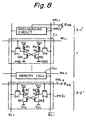
- Fig. 7 is a layout diagram illustrating a first embodiment of the SRAM device according to the present invention
- the dummy memory cell areas 2-1 and 2-2 of Fig. 1 are deleted, and the precharging circuit areas 3-1 and 3-2 are modified to precharging circuit areas 3-1' and 3-2', respectively.
- the precharging circuit area 3-1' (3-2') includes one precharging circuit PR 11 ' (PR 21 ') connected to the bit lines BL 1 and BL 1 .
- the precharging circuit PR 1 ' (PR 2 ') is connected to a precharging line PRL 1 (PRL 2 ) which controlled by a precharging clock signal ⁇ PR .
- the precharging line PRL 1 (PRL 2 ) corresponds to the word line such as WL 1 .
- the precharging circuit such as PR 21 ' has a similar configuration to the memory cell C 11 . That is, the precharging circit such as PR 21 ', is provided at each intersection between the word line WL 1 and the bit lines BL 1 and BL 1 .
- the precharging circuit PR 2 ' is constructed by a cross-coupled balancer and two transfer transistors Q t1 ' and Q t2 ' between nodes N 1 ' and N 2 ' of the balancer and the bit lines BL 1 and BL 1 .
- the transfer transistors Q t1 ' and Q t2 ' are controlled by the voltage at the precharging line PRL 2 .
- Each element of the balancer is formed by a load resistor R 1 ' (R 2 ') and a drive transistor Q d1 ' (Q d2 ') connected to the power supply line V cc .
- the node N 1 ' is connected to a gate of the drive transistor Q d2 ', so that the drive transistor Q d2 ' is driven by the voltage at the node N 1 '.
- the node N 2 ' is connected to a gate of the drive transistor Q d1 ', so that the drive transistor Q d1 ' is driven by the voltage at the node N 2 '.
- the precharging circuit PR 11 ' (PR 21 ') has a similar configuration to the memory cell such as C 11 , the precharging circuit PR 11 ', (PR 21 ') can also serve as the dummy memory cell DC 11 (DC 21 ) of Fig. 2.
- the precharging circuit such as, PR 21 ' is actually symmetrical with respect to a center location thereof, so that the precharging circuit PR 21 ' is balanced.
- the circuit diagram of the precharging circuit PR 21 ' is actually as illustrated in Fig. 9, where the power supply line V cc is replaced by two power supply lines V cc1 and V cc2 whose voltages are the same as each other; the precharging line PRL 2 is replaced by two word lines PRL 2 and PRL 2 ' whose voltages are the same as each other; and the ground line GND is replaced by two ground lines GND 1 and GND 2 whose voltages are the same as each other.
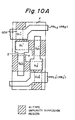
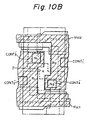
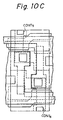
- FIG. 10A, 10B, 10C and 10D An example of the precharging circuit PR 2 ' is illustrated in Figs. 10A, 10B, 10C and 10D.
- a P-type monocrystalline silicon substrate (not shown) is thermally oxidized to form a field silicon oxide layer F by using a LOCOS process. Thereafter, a gate silicon oxide layer GOX is formed by thermally oxidizing the substrate. Then, gate electrodes of the transistors Q t1 ', Q t2 ', Q d1 ' and Q d2 ' are formed. In this case, the gate electrodes of the transistors Q t1 ' and Q t2 ' also serve as the precharging lines PRL 2 and PRL 2 ', respectively. Then, N-type impurity ions are implanted into the substrate using the gate electrodes as a mask to form N-type impurity diffusion regions as indicated by shaded portions.
- the field silicon oxide layer F, the gate electrodes and the N-type impurity diffusion regions are also symmetrical with respect to the center location thereof as indicated by Z.
- a metal (tungsten or the like) layer is formed on an insulating layer (not shown), and is patterned to form the power supply lines V cc1 , and V cc2 .
- the power supply line V cc1 is connected via contact holes CONT 2 ' and CONT 3 ' to a source of the drive transistor Q d2 ' and the node N 1 '.
- the power supply line V cc2 is connected via contact holes CONT 1 ' and CONT 4 ' to a source of the drive transistor Q d1 ' and the node N 2 '.
- the load resistors R 1 (R 2 ) are formed between the power supply lines V cc1 (V cc2 ) and the contact holes CONT 3 ' (CONT 4 ').
- the power supply lines V cc1 and V cc2 are also symmetrical with respect to the center location thereof as indicated by Z.
- an aluminum layer (not shown) is formed on an insulating layer (not shown) and is patterned to form the bit lines BL 1 and BL 1 (not shown).
- the bit lines BL 1 and BL 1 are connected via contact holes CONT 5 and CONT 6 to the drains of the transfer transistors Q t1 ' and Q t2 ', respectively.
- bit lines BL 1 and BL 1 are also symmetrical with respect the center location thereof as indicated by Z.
- the precharging circuit PR 21 ' as illustrated in Figs. 10A, 10B and 10C can be manufactured simultaneously with the memory cell C 11 as illustrated in Figs. 4A, 4B, 4C and 4D.
- ions are implanted into the power supply lines V cc1 and V cc2 only within the precharging circuit areas 3-1' and 3-2', to reduce the resistance values of the load resistors R 1 ' and R 2 ', thus increasing the current supply ability of the precharging circuits to the bit lines such as BL 1 and BL 1 .
- the amount of ions implanted into channel portions of the transistors Q t1 ', Q t2 ', Q d1 ' and Q d2 ' of the precharging circuits is reduced as compared with the amount of ions implanted into channel portions of the transistors Q t1 , Q t2 , Q d1 and Q d2 of the memory cells.
- the threshold voltages of the transistors Q t1' , Q t2' , Q d1' and Q d2' of the precharging circuits are reduced as compared with those of the transistors Q t1 , Q t2 , Q d1 and Q d2 of the memory cells. This also increases the current supply ability of the precharging circuits to the bit lines such as BL 1 and BL 1 .
- the integration can be enhanced.
- the cross-coupled balancer circuit configuration of the precharging circuit such as PR 21 enhances the charging speed of the bit lines BL 1 and BL 1 .
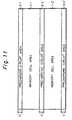
- Fig. 11 is a layout diagram illustrating a second embodiment of the SRAM device according to the present invention
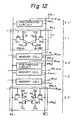
- Fig. 12 is a circuit diagram of one column of the device of Fig. 11.
- Figs. 11 and 12 in order to homogenize precharging currents in the device of Fig. 7, three precharging circuit areas 3-1', 3-2' and 3-3' are provided.
- the memroy cell area 1 of Fig. 7 is divided into two memory cell areas 1-1 and 1-2.
- the dummy memory cell areas 2-1, 2-2, 2-3 and 2-4 of Figs. 5 and 6 are deleted. Since the precharging circuit areas 3-1', 3-2' and 3-3' serve as dummy memory cell areas.
- the length L 1 ' of the precharging circuit area 3-1' (3-2', 3-3') is small, for example, about ten times as the longitudinal length of one memory cell. Therefore, since 3L 1 ' ⁇ 2L 1 + L 2 (second prior art), the integration is enhanced.
- precharging circuits also serve as dummy memory cells, the dummy memory cells can be omitted, thus enhancing the integration.
Landscapes
- Engineering & Computer Science (AREA)
- Microelectronics & Electronic Packaging (AREA)
- Computer Hardware Design (AREA)
- Static Random-Access Memory (AREA)
- Semiconductor Memories (AREA)
Claims (4)
- Statische Halbleiter-Speichervorrichtung, welche Folgendes aufweist:wobei jeder Vorladungs-Schaltkreis eine ähnliche Konfiguration wie eine der statischen Speicherzellen aufweist,eine Vielzahl von Wortleitungen (WL1, WL2,...);eine Vielzahl von Bitleitungspaaren (BL1,
BL 1,...);minestens eine Vorladungs-Leitung (PRL1, PRL2,...);eine Vielzahl von statischen Speicherzellen (C11,...), die an eine der Wortleitungen und an eines der Bitleitungspaare angeschlossen sind; undeine Vielzahl von Vorladungs-Schaltkreisen (PR11',...), die an die Vorladungsleitung und an eines der Bitleitungspaare angeschlossen sind, zum Aufladen dieses einen Bitleitungspaars,
eine erste und eine zweite Stromversorgungsleitung (Vcc, GND),
wobei jede der statischen Speicherzellen Folgendes aufweist:wobei jeder der Vorladungs-Schaltkreise Folgendes aufweist:einen ersten und zweiten Knoten (N1, N2);einen ersten Transfer-Transistor (Qt1), der zwischen einer ersten Bitleitung (BL1) eines der Bitleitungspaare und dem ersten Knoten angeschlossen ist, wobei der erste Transfer-Transistor durch eine Spannung an einer der Wortleitungen gesteuert wird;einen zweiten Transfer-Transistor (Qt2), der zwischen einer zweiten Bitleitung (BL 1) des einen der Bitleitungspaare und dem zweiten Knoten angeschlossen ist, wobei der zweite Transfer-Transistor durch die Spannung an einer der Wortleitungen gesteuert wird;einen ersten Lastwiderstand (R1), der zwischen der ersten Stromversorgungsleitung und dem ersten Knoten angeschlossen ist;einen zweiten Lastwiderstand (R2), der zwischen der ersten Stromversorgungsleitung und dem zweiten Knoten angeschlossen ist;einen ersten Treiber-Transistor (Qd1), der zwischen dem ersten Knoten und der zweiten Stromversorgungsleitung angeschlossen ist; undeinen zweiten Treiber-Transistor (Qd2), der zwischen dem zweiten Knoten und der zweiten Stromversorgungsleitung angeschlossen ist,einen dritten und einen vierten Knoten (N1', N2');einen dritten Transfer-Transistor (Qt1'), der zwischen der ersten Bitleitung und dem dritten Knoten angeschlossen ist, wobei der dritte Transfer-Transistor durch eine Spannung an der Vorladungs-Leitung gesteuert wird;einen vierten Transfer-Transistor (Qt2'), der zwischen der zweiten Bitleitung und dem vierten Knoten angeschlossen ist, wobei der vierte Transfer-Transistor durch die Spannung an der Vorladungs-Leitung gesteuert wird;einen dritten Lastwiderstand (R1'), der zwischen der ersten Stromversorgungsleitung und dem dritten Knoten angeschlossen ist;einen vierten Lastwiderstand (R2'), der zwischen der ersten Stromversorgungsleitung und dem vierten Knoten angeschlossen ist;einen dritten Treiber-Transistor (Qd1'), der zwischen dem dritten Knoten und der ersten Stromversorgungsleitung angeschlossen ist; undeinen vierten Treiber-Transistor (Qd2'), der zwischen dem vierten Knoten und der ersten Stromversorgungsleitung angeschlossen ist. - Vorrichtung nach Anspruch 1, dadurch gekennzeichnet, dass alle statischen Speicherzellen im Hinblick auf ihre Mittelpunkte symmetrisch sind, wobei alle Vorladungs-Schaltkreise im Hinblick auf ihre jeweiligen Mittelpunkte symmetrisch sind.
- Vorrichtung nach Anspruch 1, dadurch gekennzeichnet, dass jeder der Vorladungs-Schaltkreise benachbart zu und in der unmittelbaren Nähe von einem Speicherzellenfeld angeordnet ist, das die statischen Speicherzellen umfasst.
- Vorrichtung nach Anspruch 1, dadurch gekennzeichnet, dass die statischen Speicherzellen in eine Vielzahl von Speicherzellenfelder (1-1, 1-2), gruppiert werden,
wobei die Vorladungs-Schaltkreise zwischen den die Speicherzellenfelder trennenden Lücken angeordnet sind.
Applications Claiming Priority (3)
| Application Number | Priority Date | Filing Date | Title |
|---|---|---|---|
| JP282306/96 | 1996-10-24 | ||
| JP28230696 | 1996-10-24 | ||
| JP8282306A JP2944538B2 (ja) | 1996-10-24 | 1996-10-24 | 半導体記憶回路 |
Publications (3)
| Publication Number | Publication Date |
|---|---|
| EP0840323A2 EP0840323A2 (de) | 1998-05-06 |
| EP0840323A3 EP0840323A3 (de) | 1999-05-06 |
| EP0840323B1 true EP0840323B1 (de) | 2003-05-21 |
Family
ID=17650710
Family Applications (1)
| Application Number | Title | Priority Date | Filing Date |
|---|---|---|---|
| EP97118438A Expired - Lifetime EP0840323B1 (de) | 1996-10-24 | 1997-10-23 | Statische Halbleiterspeicheranordnung mit Vorausladungsschaltung mit ähnlicher Konfiguration wie Speicherzelle |
Country Status (5)
| Country | Link |
|---|---|
| US (1) | US5850364A (de) |
| EP (1) | EP0840323B1 (de) |
| JP (1) | JP2944538B2 (de) |
| KR (1) | KR19980033271A (de) |
| DE (1) | DE69722132T2 (de) |
Families Citing this family (10)
| Publication number | Priority date | Publication date | Assignee | Title |
|---|---|---|---|---|
| EP0920027B1 (de) * | 1997-11-28 | 2004-03-03 | STMicroelectronics S.r.l. | RAM-Speicherzelle mit niedriger Leistungsaufnahme und einer einzigen Bitleitung |
| US7109751B1 (en) | 2004-06-02 | 2006-09-19 | Xilinx, Inc. | Methods of implementing phase shift mask compliant static memory cell circuits |
| US7053652B1 (en) * | 2004-06-02 | 2006-05-30 | Xilinx, Inc. | Static memory cell circuit with single bit line and set/reset write function |
| JP2006079692A (ja) * | 2004-09-08 | 2006-03-23 | Matsushita Electric Ind Co Ltd | 半導体記憶装置 |
| US7394682B2 (en) * | 2006-10-25 | 2008-07-01 | Infineon Technologies Ag | Bit line dummy core-cell and method for producing a bit line dummy core-cell |
| JP2009059735A (ja) | 2007-08-29 | 2009-03-19 | Elpida Memory Inc | 半導体記憶装置 |
| KR101382580B1 (ko) | 2009-02-26 | 2014-04-07 | 삼성전자주식회사 | 반도체 메모리 셀 어레이 및 이를 포함하는 반도체 메모리 장치 |
| US8441850B2 (en) * | 2010-10-08 | 2013-05-14 | Qualcomm Incorporated | Magnetic random access memory (MRAM) layout with uniform pattern |
| JP5789803B2 (ja) * | 2011-12-06 | 2015-10-07 | 株式会社ソシオネクスト | 半導体メモリおよびシステム |
| US11676656B2 (en) * | 2021-02-05 | 2023-06-13 | Arm Limited | Memory architecture with DC biasing |
Family Cites Families (3)
| Publication number | Priority date | Publication date | Assignee | Title |
|---|---|---|---|---|
| US4972377A (en) * | 1989-05-15 | 1990-11-20 | Dallas Semiconductor Corporation | Low-voltage low-power static ram |
| US5570312A (en) * | 1994-03-21 | 1996-10-29 | United Microelectronics Corporation | SRAM cell using word line controlled pull-up NMOS transistors |
| KR0147712B1 (ko) * | 1995-06-30 | 1998-11-02 | 김주용 | 에스램의 저전압 동작용 비트 라인 회로 |
-
1996
- 1996-10-24 JP JP8282306A patent/JP2944538B2/ja not_active Expired - Fee Related
-
1997
- 1997-10-23 DE DE69722132T patent/DE69722132T2/de not_active Expired - Fee Related
- 1997-10-23 EP EP97118438A patent/EP0840323B1/de not_active Expired - Lifetime
- 1997-10-24 KR KR1019970055882A patent/KR19980033271A/ko not_active Ceased
- 1997-10-24 US US08/957,582 patent/US5850364A/en not_active Expired - Lifetime
Also Published As
| Publication number | Publication date |
|---|---|
| JPH10125805A (ja) | 1998-05-15 |
| DE69722132T2 (de) | 2004-04-01 |
| EP0840323A2 (de) | 1998-05-06 |
| US5850364A (en) | 1998-12-15 |
| DE69722132D1 (de) | 2003-06-26 |
| JP2944538B2 (ja) | 1999-09-06 |
| EP0840323A3 (de) | 1999-05-06 |
| KR19980033271A (ko) | 1998-07-25 |
Similar Documents
| Publication | Publication Date | Title |
|---|---|---|
| US6787835B2 (en) | Semiconductor memories | |
| CN103151070B (zh) | 用于FinFET SRAM阵列集成电路的方法和装置 | |
| US6972450B2 (en) | SRAM cell design for soft error rate immunity | |
| US6204538B1 (en) | SRAM cell | |
| US12279419B2 (en) | Semiconductor storage device having rom cells including nanosheet field effect transistors | |
| EP0916159B1 (de) | Statische speicherzelle | |
| JP2011035398A (ja) | デュアルポートsramセルの構造 | |
| KR19990083348A (ko) | 반도체기억장치및그제조방법 | |
| US6801449B2 (en) | Semiconductor memory device | |
| US6295224B1 (en) | Circuit and method of fabricating a memory cell for a static random access memory | |
| US5850364A (en) | Static semiconductor memory device with precharging circuits having similar configuration of memory cells | |
| US6040991A (en) | SRAM memory cell having reduced surface area | |
| JP4674386B2 (ja) | 半導体記憶装置 | |
| JP3551468B2 (ja) | Sramメモリセルの動作方法 | |
| JP2000232168A (ja) | 半導体記憶装置 | |
| JPH06104405A (ja) | スタティック型メモリ | |
| KR100618833B1 (ko) | 비대칭 sram 소자 및 그 제조방법 | |
| US7236408B2 (en) | Electronic circuit having variable biasing | |
| EP0691685B1 (de) | SRAM-Anordnung mit Last-Dünnschichttransistoren | |
| US6242786B1 (en) | SOI Semiconductor device with field shield electrode | |
| KR0179818B1 (ko) | 에스램 | |
| US5946226A (en) | SRAM for SNM measurement | |
| JP2791518B2 (ja) | メモリセル回路 | |
| JP2743672B2 (ja) | 半導体記憶装置 | |
| EP0032608A1 (de) | Statische RAM-Zelle mit Stromversorgung über die Spaltenleiter |
Legal Events
| Date | Code | Title | Description |
|---|---|---|---|
| PUAI | Public reference made under article 153(3) epc to a published international application that has entered the european phase |
Free format text: ORIGINAL CODE: 0009012 |
|
| AK | Designated contracting states |
Kind code of ref document: A2 Designated state(s): DE FR GB |
|
| PUAL | Search report despatched |
Free format text: ORIGINAL CODE: 0009013 |
|
| AK | Designated contracting states |
Kind code of ref document: A3 Designated state(s): AT BE CH DE DK ES FI FR GB GR IE IT LI LU MC NL PT SE |
|
| 17P | Request for examination filed |
Effective date: 19990325 |
|
| AKX | Designation fees paid |
Free format text: DE FR GB |
|
| 17Q | First examination report despatched |
Effective date: 20020208 |
|
| GRAH | Despatch of communication of intention to grant a patent |
Free format text: ORIGINAL CODE: EPIDOS IGRA |
|
| GRAH | Despatch of communication of intention to grant a patent |
Free format text: ORIGINAL CODE: EPIDOS IGRA |
|
| RAP1 | Party data changed (applicant data changed or rights of an application transferred) |
Owner name: NEC ELECTRONICS CORPORATION Owner name: NEC CORPORATION |
|
| GRAA | (expected) grant |
Free format text: ORIGINAL CODE: 0009210 |
|
| AK | Designated contracting states |
Designated state(s): DE FR GB |
|
| REG | Reference to a national code |
Ref country code: GB Ref legal event code: FG4D |
|
| REF | Corresponds to: |
Ref document number: 69722132 Country of ref document: DE Date of ref document: 20030626 Kind code of ref document: P |
|
| ET | Fr: translation filed | ||
| PLBE | No opposition filed within time limit |
Free format text: ORIGINAL CODE: 0009261 |
|
| STAA | Information on the status of an ep patent application or granted ep patent |
Free format text: STATUS: NO OPPOSITION FILED WITHIN TIME LIMIT |
|
| 26N | No opposition filed |
Effective date: 20040224 |
|
| PGFP | Annual fee paid to national office [announced via postgrant information from national office to epo] |
Ref country code: GB Payment date: 20061018 Year of fee payment: 10 |
|
| PGFP | Annual fee paid to national office [announced via postgrant information from national office to epo] |
Ref country code: DE Payment date: 20061019 Year of fee payment: 10 |
|
| REG | Reference to a national code |
Ref country code: GB Ref legal event code: 732E |
|
| REG | Reference to a national code |
Ref country code: FR Ref legal event code: TP |
|
| PGFP | Annual fee paid to national office [announced via postgrant information from national office to epo] |
Ref country code: FR Payment date: 20071009 Year of fee payment: 11 |
|
| GBPC | Gb: european patent ceased through non-payment of renewal fee |
Effective date: 20071023 |
|
| PG25 | Lapsed in a contracting state [announced via postgrant information from national office to epo] |
Ref country code: DE Free format text: LAPSE BECAUSE OF NON-PAYMENT OF DUE FEES Effective date: 20080501 |
|
| PG25 | Lapsed in a contracting state [announced via postgrant information from national office to epo] |
Ref country code: GB Free format text: LAPSE BECAUSE OF NON-PAYMENT OF DUE FEES Effective date: 20071023 |
|
| REG | Reference to a national code |
Ref country code: FR Ref legal event code: ST Effective date: 20090630 |
|
| PG25 | Lapsed in a contracting state [announced via postgrant information from national office to epo] |
Ref country code: FR Free format text: LAPSE BECAUSE OF NON-PAYMENT OF DUE FEES Effective date: 20081031 |