EP0840472A2 - Pfadschutz in einem Telekommunikationsnetzwerk - Google Patents
Pfadschutz in einem Telekommunikationsnetzwerk Download PDFInfo
- Publication number
- EP0840472A2 EP0840472A2 EP97308408A EP97308408A EP0840472A2 EP 0840472 A2 EP0840472 A2 EP 0840472A2 EP 97308408 A EP97308408 A EP 97308408A EP 97308408 A EP97308408 A EP 97308408A EP 0840472 A2 EP0840472 A2 EP 0840472A2
- Authority
- EP
- European Patent Office
- Prior art keywords
- path
- quality
- egress point
- paths
- transmission
- Prior art date
- Legal status (The legal status is an assumption and is not a legal conclusion. Google has not performed a legal analysis and makes no representation as to the accuracy of the status listed.)
- Granted
Links
Images

Classifications
-
- H—ELECTRICITY
- H04—ELECTRIC COMMUNICATION TECHNIQUE
- H04J—MULTIPLEX COMMUNICATION
- H04J3/00—Time-division multiplex systems
- H04J3/02—Details
- H04J3/14—Monitoring arrangements
-
- H—ELECTRICITY
- H04—ELECTRIC COMMUNICATION TECHNIQUE
- H04J—MULTIPLEX COMMUNICATION
- H04J2203/00—Aspects of optical multiplex systems other than those covered by H04J14/05 and H04J14/07
- H04J2203/0001—Provisions for broadband connections in integrated services digital network using frames of the Optical Transport Network [OTN] or using synchronous transfer mode [STM], e.g. SONET, SDH
- H04J2203/0057—Operations, administration and maintenance [OAM]
- H04J2203/006—Fault tolerance and recovery
Definitions
- This invention relates to telecommunications systems or networks, and in particular to an arrangement and method for providing path protection in such networks.
- Telecommunication systems or networks employing synchronous, e.g. SDH or SONET transport techniques are usually provided with path redundancy or path protection of traffic transported across the network to signal processing equipment such as system nodes or cross connects.
- Path protection is a specific requirement of network operators to reduce the risk of outage and thus ensure an uninterrupted high quality service to customers.
- path protection is effected by the provision of two independent paths across the network for the traffic via respective ingress points to a single egress point of the processing equipment.
- One of these paths constitutes the main or normal transmission path, and the other provides a reserve or back-up path in the event of failure of the main path.
- Each of these paths is monitored to determine transmission quality and the equipment then chooses the better of these paths based on the transmission quality measurement.
- the results of these quality measurements are signalled across the equipment to the egress point where the path having the higher transmission quality is selected.
- This technique suffers from the disadvantage that the measurements are most efficiently be completed at the ingress points but the results of these measurements must then be transmitted to the egress point with sufficient rapidity for a decision to be made and a path selected.
- the ITU/Bellcore standards specify a delay no greater than 50ms between the quality measurement and the path selection point regardless of the number of faulty paths. With an increasing number of paths this can be difficult to achieve.
- the object of the invention is to minimise or to overcome this disadvantage.
- a method of path protecting a transmission channel carried on first and second paths over a synchronous network to a signal processing station having ingress points one for each said path and an egress point for output of a processed signal including adapting the channel at each said ingress to the local timing of the processing station, determining during said adaptation a measure of the transmission quality of each said path, embedding an encoded representation of the quality measurement within signals transmitted on the path to the egress point, determining at the egress point from the embedded encoded quality measure which of the first and second paths has the higher transmission quality, and selecting that path for output from the egress point.
- a synchronous transmission equipment for use in a network in which transmission channels are carried each on first and second paths, the transmission equipment having ingress points one for each said path and an egress point for output of a processed signal, wherein the equipment has means for adapting the channel at each said ingress to the local timing of the processing station, means for determining during said adaptation a measure of the transmission quality of each said path, means for embedding an encoded representation of the quality measurement within signals transmitted on the path to the egress point, means for determining at the egress point from the embedded encoded quality measure which of the first and second paths has the higher transmission quality, and means for selecting that path for output from the egress point.
- the technique provides a comparison of the quality of two or more paths at those points in the network where the paths come together by embedding the quality measure in spare capacity in each path. Decisions made on path quality can thus be made on comparisons between inputs which need not be on the same circuit card or even on the same equipment shelf.
- the path quality information is carried on the path embedded in the signal by replacing the pointer'ss' bits, which are used as an indication of what type of administrative unit (AU) and tributary unit (TU) the pointer is associated with, but are not further required within the station or node.
- the replaced bits are decoded to determine which path has the higher quality, that path then being selected.
- the ss pointer bits can then be regenerated before the signal is output from the egress of the station.
- the signal processing station comprises an SDH or SONET cross-connect or multiplexer/demultiplexer.
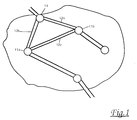
- the synchronous network depicted schematically therein comprises a plurality of nodes generally indicated as 11 interconnected by transmission paths 12, typically comprising optical transmission paths.
- the nodes may comprise e.g. cross-connects and multiplexer/demultiplexers.
- Telecommunications traffic is carried over the network in virtual containers, each incorporating a payload and a path overhead used for supervisory and control purposes.
- These virtual containers are carried within frames, generally referred to as STM frames.
- the synchronous network standards define different combinations of virtual containers which can be used to fill the payload area of an STM frame.
- the process of loading containers, and attaching overheads is repeated at several levels resulting in the "nesting" of smaller virtual containers within larger ones. This process is repeated until the largest size of virtual container (a VC-4 in Europe) is filled, and this is then loaded into the payload of the STM frame.
- the payload area of the STM frame is full, some more control information bytes are added to the frame to form the "section overhead".
- the section overhead bytes are so-called because they remain with the payload for the transmission path between two synchronous multiplexers.
- Their purpose is to provide communication channels for functions such as OA&M (operations, administration and maintenance) facilities, user channels, protection switching, section performance, frame alignment and a number of other functions.
- An SDH or SONET transport signal contains a number of paths, where paths normally contain user data.
- the various standards support the transport of extra data in association with these paths (the path overhead), which permit equipment to measure the quality of the path. e.g.: is it the correct path, have any errors occurred to the path data, etc.
- the equipment can use these quality measures to perform functions such as protection switching, in which the equipment is presented with a choice of (usually) two paths which have arrived via different routes. The equipment then chooses the best path from one of the routes for local termination or forwarding to other equipment.
- Path protection of transmitted traffic in the network of figure 1 is provided by setting up main and standby transmission paths between network nodes
- traffic between nodes 11a and 11b can be carried over the route comprising paths 12a and 12b or over the route comprising the path 12c.
- the signalling quality of the two transmission paths is monitored and, in the event that the quality of the main path falls below that of the reserve path, the reserve path is preferentially selected at the node 11b. This ensures that effective transmission is continued even in the event of complete failure of one or other of the two paths.
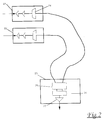
- FIG 2 shows in schematic form the construction of a network node in the network of figure 1.
- the node incorporates first (21) and second (22) ingress line cards for receiving traffic carried across the network on the main and reserve paths respectively, and an egress line card 23 for outputting traffic from the node.
- first (21) and second (22) ingress line cards for receiving traffic carried across the network on the main and reserve paths respectively
- egress line card 23 for outputting traffic from the node.
- the internal signal processing equipment e.g. multiplexing/demultiplexing equipment, disposed between the ingress and egress nodes is not described and only those portions of the node essential to the understanding of the invention are shown.
- a signal When a signal is received by a synchronous transport equipment, the signal is adapted to the timing of that equipment.
- This adaptation function (for example SDH G.783 Multiplex Section Adaptation and Higher Order Path Adaptation) usually known as 'pointer processing' is conveniently performed at equipment entry points which may be circuit cards or input shelves.
- the pointer processing gives rise to basic path quality measures in that total failures are identified which result in the path being declared AIS (the regenerated pointer is set to all 1 s).
- AIS the regenerated pointer is set to all 1 s.
- the incoming optical carrier is detected and demultiplexed to recover the transmission channel.
- the channel is then adapted via adaptation function 24 to the local clock of the node.
- the adaptation function involves location of the payload using the incoming pointer. This also provides a check for basic faults such as path A1S, or loss of the pointer. In addition, because the payload is being located, this is a convenient point at which to check the path overhead for performing a quality measurement.
- the adaptation process uses the pointer to determine the position of the path overhead (POH) within the frame so as to recover the signal label, the path trace and the bit interleaved parity (BIP).
- the signal label and path trace are compared with predetermined values to identify potential errors.
- the BIP is compared with a value computed from a previous frame to identify parity errors. In this way a measure of the path quality is obtained, the fewer the errors the higher the quality of the path.
- the adaptation function generates a new pointer corresponding to the local equipment timing and which points to the located payload. Because this pointer is generated locally, it is known to be either error-free or deliberately set "AIS", i.e. to all ONEs in response to gross incoming errors.
- AIS error-free or deliberately set
- the ss bits become redundant within the node and their position can thus be utilised to carry the path quality information over the path within the node to the point at which the main and reserve paths come together.
- the result of the path quality measurement is encoded on the path overhead in the position previously occupied by the ss bits of the pointer. This path quality information thus travels with the signal by being incorporated within the pointer.
- the signal quality of a path may thus be readily determined at various points within the node. If the signal has been found to fail at any such point, the path can be set 'AIS', i.e. the pointer bits are all set to ONE, so as to overwrite the incorporated quality value bits and give the correct signal
- the path quality bits on the two paths are decoded and compared via comparator 25 which determines which of the paths displays the higher quality. That path is then selected by switch 26 controlled by the comparator 25.
- the path quality bits on that path are then overwritten with regenerated ss bits by circuit 27 before the signal is output from the node, the required values for the regenerated ss bits being known.
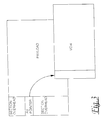
- Figure 3 illustrates a typical STM frame structure containing inter alia a VC-4 virtual container incorporating an AU-4 pointer to the path overhead (POH) of a VC4 virtual container.
- the pointer indicates the beginning of the virtual container within the frame.
- This virtual container may be unstructured or TUG (tributary unit group) structured
- the first byte of the pointer comprises a set of four NDF bits followed by two ss bits and two ID bits. In the event that these pointer bits are all set to ONE, this, as discussed above, indicates a path failure. Where the NDF bits are not all ONEs, this indicates that the path has not been disabled and the replaced values in the ss bit position provide an indication of the measured path quality as shown in Table 1 below.
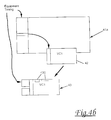
- FIGS. 4a and 4b illustrate the manner in which adaptation or pointer processing generates new pointers corresponding to the local equipment timing. Adaptation may be performed at one or two levels referred to as higher and lower order. Figure 4a illustrates higher order adaptation and figure 4b illustrates lower order adaptation
- an incoming frame 41 is first located in time using the framing pattern to find the start of the frame. This timing location of the frame defines the time position of the pointer which points to the payload. This payload can then be provided with a new path overhaed based on the equipment timing so as to provide an adapted frame 41a.
- the new path overhead incorporates a regenerated pointer which points to the payload whose position has been precisely determined in the section adaptation process. It is this regenerated pointer that incorporates the encoded path quality information in the position normally reserved for the ss bits.
- Figure 4b illustrates lower order adaptation which is employed where lower order paths are being processed.
- the process is similar to ths section adapation process described above, but here the frame timing has already been determined and the path overhead of the higher order frame thus relates to the equipment timing.
- the lower order pointer in the path overhead of the adapted frame 41a is used to identify the position of the required virtual container 42, e.g. a VC1 container. This vitual container is extracted and is provided with suitable overhead information to generate a lower order frame 43.
Landscapes
- Engineering & Computer Science (AREA)
- Computer Networks & Wireless Communication (AREA)
- Signal Processing (AREA)
- Data Exchanges In Wide-Area Networks (AREA)
- Time-Division Multiplex Systems (AREA)
Applications Claiming Priority (2)
| Application Number | Priority Date | Filing Date | Title |
|---|---|---|---|
| US08/739,366 US5822299A (en) | 1996-10-29 | 1996-10-29 | Path protection in a telecommunications network |
| US739366 | 1996-10-29 |
Publications (3)
| Publication Number | Publication Date |
|---|---|
| EP0840472A2 true EP0840472A2 (de) | 1998-05-06 |
| EP0840472A3 EP0840472A3 (de) | 2002-03-20 |
| EP0840472B1 EP0840472B1 (de) | 2005-03-23 |
Family
ID=24971951
Family Applications (1)
| Application Number | Title | Priority Date | Filing Date |
|---|---|---|---|
| EP97308408A Expired - Lifetime EP0840472B1 (de) | 1996-10-29 | 1997-10-22 | Pfadschutz in einem Telekommunikationsnetzwerk |
Country Status (3)
| Country | Link |
|---|---|
| US (1) | US5822299A (de) |
| EP (1) | EP0840472B1 (de) |
| DE (1) | DE69732826T2 (de) |
Cited By (10)
| Publication number | Priority date | Publication date | Assignee | Title |
|---|---|---|---|---|
| EP0977391A3 (de) * | 1998-07-27 | 2001-01-10 | Lucent Technologies Inc. | Steuerungsarchitektur mit Zustandsdaten in mehrschichtlich eingebetteten Signalen |
| EP0907301A3 (de) * | 1997-10-01 | 2001-01-10 | Lucent Technologies Inc. | Steuerungsarchitektur für eine homogene Leitweglenkungsstruktur |
| EP0907302A3 (de) * | 1997-10-01 | 2001-01-17 | Lucent Technologies Inc. | Steuerungsarchitektur mittels eingebetteten Signalinformationen |
| WO2001061909A1 (en) * | 2000-02-16 | 2001-08-23 | Sycamore Networks, Inc. | Method and apparatus for correcting data using a redundant path |
| US6301228B1 (en) | 1998-05-29 | 2001-10-09 | Lucent Technologies, Inc. | Method and apparatus for switching signals using an embedded group signal status |
| WO2002052760A3 (en) * | 2000-12-22 | 2003-07-03 | Turin Networks | Method and apparatus for efficient link redundancy |
| EP1162857A3 (de) * | 2000-06-07 | 2004-03-24 | Fujitsu Limited | Verfahren zur Netzwerkführung, Netzwerkknotenapparat und Mashe-Type Netzwerk |
| US6999468B2 (en) | 2001-06-04 | 2006-02-14 | Turin Networks | Method and apparatus for line and path selection within SONET/SDH based networks |
| WO2008134292A1 (en) | 2007-04-26 | 2008-11-06 | Cisco Technology, Inc. | Multicast fast reroute |
| EP2048816A1 (de) * | 2007-10-12 | 2009-04-15 | Nokia Siemens Networks S.p.A. | Verfahren und System zum Kanaldiversitätsschutz in Kommunikationsnetzen mit verteilter Schaltintelligenz, entsprechendes Netz und Computerprogrammprodukt |
Families Citing this family (14)
| Publication number | Priority date | Publication date | Assignee | Title |
|---|---|---|---|---|
| US6104702A (en) * | 1998-03-06 | 2000-08-15 | Lucent Technologies Inc. | Apparatus and method for extending operation of non-intrusive monitors in SDH |
| JP3293593B2 (ja) * | 1999-06-16 | 2002-06-17 | 日本電気株式会社 | 伝送方式、それに用いる端局及び中継器並びにその伝送方法 |
| US6909741B1 (en) * | 1999-12-22 | 2005-06-21 | Motorola, Inc. | Network quality of service localizer |
| US7016401B1 (en) * | 1999-12-22 | 2006-03-21 | Motorola, Inc | Method and apparatus for automated correlation of digital modulation impairment |
| US7002908B1 (en) * | 2000-02-28 | 2006-02-21 | Telefonaktiebolaget Lm Ericsson (Publ) | Interconnection link redundancy in a modular switch node |
| US6870829B1 (en) * | 2000-03-29 | 2005-03-22 | Nortel Networks Limited | Message signalling in a synchronous transmission apparatus |
| US6766482B1 (en) | 2001-10-31 | 2004-07-20 | Extreme Networks | Ethernet automatic protection switching |
| US7796503B2 (en) * | 2002-09-03 | 2010-09-14 | Fujitsu Limited | Fault tolerant network routing |
| JPWO2004066529A1 (ja) * | 2003-01-20 | 2006-05-18 | 富士通株式会社 | パストレース機能を有する光伝送装置 |
| DE10336397B4 (de) * | 2003-08-06 | 2006-12-14 | Forschungszentrum Jülich GmbH | Vorrichtung zum Speichern digitaler Daten |
| US7602701B1 (en) * | 2003-12-22 | 2009-10-13 | Alcatel Lucent | WideBand cross-connect system and protection method utilizing SONET add/drop multiplexers |
| US7706254B2 (en) * | 2006-11-29 | 2010-04-27 | Fujitsu Limited | Method and system for providing ethernet protection |
| US9178804B2 (en) * | 2010-11-12 | 2015-11-03 | Tellabs Operations, Inc. | Methods and apparatuses for path selection in a packet network |
| US8976790B2 (en) | 2012-08-03 | 2015-03-10 | Honeywell International Inc. | Disjoint data path routing for integrity and availability augmentation |
Family Cites Families (3)
| Publication number | Priority date | Publication date | Assignee | Title |
|---|---|---|---|---|
| JP3420621B2 (ja) * | 1993-11-04 | 2003-06-30 | 富士通株式会社 | 通信網の分散型経路選択制御装置 |
| JP3161911B2 (ja) * | 1994-08-03 | 2001-04-25 | 富士通株式会社 | 回線切替方法及び回線切替装置 |
| JP3333053B2 (ja) * | 1994-09-05 | 2002-10-07 | 富士通株式会社 | ディジタル通信装置 |
-
1996
- 1996-10-29 US US08/739,366 patent/US5822299A/en not_active Expired - Lifetime
-
1997
- 1997-10-22 DE DE69732826T patent/DE69732826T2/de not_active Expired - Lifetime
- 1997-10-22 EP EP97308408A patent/EP0840472B1/de not_active Expired - Lifetime
Cited By (16)
| Publication number | Priority date | Publication date | Assignee | Title |
|---|---|---|---|---|
| EP0907301A3 (de) * | 1997-10-01 | 2001-01-10 | Lucent Technologies Inc. | Steuerungsarchitektur für eine homogene Leitweglenkungsstruktur |
| EP0907302A3 (de) * | 1997-10-01 | 2001-01-17 | Lucent Technologies Inc. | Steuerungsarchitektur mittels eingebetteten Signalinformationen |
| US6301228B1 (en) | 1998-05-29 | 2001-10-09 | Lucent Technologies, Inc. | Method and apparatus for switching signals using an embedded group signal status |
| US6560202B1 (en) | 1998-07-27 | 2003-05-06 | Lucent Technologies Inc. | Control architecture using a multi-layer embedded signal status protocol |
| EP0977391A3 (de) * | 1998-07-27 | 2001-01-10 | Lucent Technologies Inc. | Steuerungsarchitektur mit Zustandsdaten in mehrschichtlich eingebetteten Signalen |
| WO2001061909A1 (en) * | 2000-02-16 | 2001-08-23 | Sycamore Networks, Inc. | Method and apparatus for correcting data using a redundant path |
| EP1162857A3 (de) * | 2000-06-07 | 2004-03-24 | Fujitsu Limited | Verfahren zur Netzwerkführung, Netzwerkknotenapparat und Mashe-Type Netzwerk |
| US7756016B2 (en) | 2000-12-22 | 2010-07-13 | Force IO Networks, Inc. | Method and apparatus for efficient link redundancy |
| WO2002052760A3 (en) * | 2000-12-22 | 2003-07-03 | Turin Networks | Method and apparatus for efficient link redundancy |
| US7050391B1 (en) | 2000-12-22 | 2006-05-23 | Turin Networks | Method and apparatus for efficient link redundancy |
| US6999468B2 (en) | 2001-06-04 | 2006-02-14 | Turin Networks | Method and apparatus for line and path selection within SONET/SDH based networks |
| US7630301B2 (en) | 2001-06-04 | 2009-12-08 | Force10 Networks, Inc. | Method and apparatus for line and path selection within SONET/SDH based networks |
| WO2008134292A1 (en) | 2007-04-26 | 2008-11-06 | Cisco Technology, Inc. | Multicast fast reroute |
| EP2140363A4 (de) * | 2007-04-26 | 2011-11-16 | Cisco Tech Inc | Multcast-schnellumleitung |
| EP2048816A1 (de) * | 2007-10-12 | 2009-04-15 | Nokia Siemens Networks S.p.A. | Verfahren und System zum Kanaldiversitätsschutz in Kommunikationsnetzen mit verteilter Schaltintelligenz, entsprechendes Netz und Computerprogrammprodukt |
| WO2009047015A1 (en) * | 2007-10-12 | 2009-04-16 | Nokia Siemens Networks S.P.A. | Method and system for channel diversity protection in communication networks with distributed switching intelligence, corresponding network and computer program product |
Also Published As
| Publication number | Publication date |
|---|---|
| EP0840472A3 (de) | 2002-03-20 |
| EP0840472B1 (de) | 2005-03-23 |
| DE69732826T2 (de) | 2005-08-11 |
| DE69732826D1 (de) | 2005-04-28 |
| US5822299A (en) | 1998-10-13 |
Similar Documents
| Publication | Publication Date | Title |
|---|---|---|
| US5822299A (en) | Path protection in a telecommunications network | |
| EP0874488B1 (de) | Transparenter Multiplexer/Demultiplexer | |
| EP0874487B1 (de) | Transparente Übertragung in einem Nachrichtenübertragungssystem | |
| US6061328A (en) | Integrated multi-fabric digital cross-connect integrated office links | |
| US6366556B1 (en) | Self-healing networks using virtual rings | |
| CA2387214C (en) | Hitless protection switching | |
| EP0696111B1 (de) | Eine störungsfreie Wegumschaltungsanordnung und Verfahren | |
| US6094737A (en) | Path test signal generator and checker for use in a digital transmission system using a higher order virtual container VC-4-Xc in STM-N frames | |
| EP0654923B1 (de) | Kommunikationssystem bestehend aus miteinander verbundenen, weggeschaltenen Ringübertragungssystemen | |
| EP0964543B1 (de) | Nachrichttenübertragungssystem mit überwachung einer Tandemverbindung | |
| US6839871B2 (en) | Method for transparent multiplexing of SONET/ SDH streams | |
| US7289435B2 (en) | Method and system for manifesting alarms in a telecommunication network | |
| EP1470658A2 (de) | Kommunikationssystem | |
| US7447239B2 (en) | Transmission path monitoring | |
| US20030058789A1 (en) | SDH ring network | |
| US20110103222A1 (en) | Signal transmission method and transmission device | |
| US6901082B1 (en) | Method and apparatus for communicating information | |
| FI98771C (fi) | Menetelmä tiedonsiirtoverkon verkkoelementin toiminnan tutkimiseksi | |
| US6915348B1 (en) | Validation of a connection between arbitrary end-points in a communications network using an augmented SPE | |
| JPH11234345A (ja) | 同期(sdh)および独立同期(pdh)混合タイプのネットワ―ク中の接続を保護するためのアラ―ム信号を伝送する方法および装置 | |
| KR19980054664A (ko) | 전송장치내 직렬 데이타 전송에러 검출장치 | |
| JP2001501423A (ja) | トランスポートループ―およびカード保護を有するリング回路 |
Legal Events
| Date | Code | Title | Description |
|---|---|---|---|
| PUAI | Public reference made under article 153(3) epc to a published international application that has entered the european phase |
Free format text: ORIGINAL CODE: 0009012 |
|
| AK | Designated contracting states |
Kind code of ref document: A2 Designated state(s): AT BE CH DE DK ES FI FR GB GR IE IT LI LU MC NL PT SE Kind code of ref document: A2 Designated state(s): DE FR GB SE |
|
| RAP3 | Party data changed (applicant data changed or rights of an application transferred) |
Owner name: NORTEL NETWORKS CORPORATION |
|
| RAP1 | Party data changed (applicant data changed or rights of an application transferred) |
Owner name: NORTEL NETWORKS LIMITED |
|
| PUAL | Search report despatched |
Free format text: ORIGINAL CODE: 0009013 |
|
| AK | Designated contracting states |
Kind code of ref document: A3 Designated state(s): AT BE CH DE DK ES FI FR GB GR IE IT LI LU MC NL PT SE |
|
| 17P | Request for examination filed |
Effective date: 20020920 |
|
| AKX | Designation fees paid |
Free format text: DE FR GB SE |
|
| RAP1 | Party data changed (applicant data changed or rights of an application transferred) |
Owner name: NORTEL NETWORKS LIMITED |
|
| 17Q | First examination report despatched |
Effective date: 20031030 |
|
| GRAP | Despatch of communication of intention to grant a patent |
Free format text: ORIGINAL CODE: EPIDOSNIGR1 |
|
| GRAS | Grant fee paid |
Free format text: ORIGINAL CODE: EPIDOSNIGR3 |
|
| GRAA | (expected) grant |
Free format text: ORIGINAL CODE: 0009210 |
|
| AK | Designated contracting states |
Kind code of ref document: B1 Designated state(s): DE FR GB SE |
|
| REG | Reference to a national code |
Ref country code: GB Ref legal event code: FG4D |
|
| REG | Reference to a national code |
Ref country code: IE Ref legal event code: FG4D |
|
| REF | Corresponds to: |
Ref document number: 69732826 Country of ref document: DE Date of ref document: 20050428 Kind code of ref document: P |
|
| PLBE | No opposition filed within time limit |
Free format text: ORIGINAL CODE: 0009261 |
|
| STAA | Information on the status of an ep patent application or granted ep patent |
Free format text: STATUS: NO OPPOSITION FILED WITHIN TIME LIMIT |
|
| ET | Fr: translation filed | ||
| 26N | No opposition filed |
Effective date: 20051227 |
|
| PG25 | Lapsed in a contracting state [announced via postgrant information from national office to epo] |
Ref country code: SE Free format text: LAPSE BECAUSE OF FAILURE TO SUBMIT A TRANSLATION OF THE DESCRIPTION OR TO PAY THE FEE WITHIN THE PRESCRIBED TIME-LIMIT Effective date: 20050623 |
|
| REG | Reference to a national code |
Ref country code: GB Ref legal event code: 732E Free format text: REGISTERED BETWEEN 20101230 AND 20110105 |
|
| REG | Reference to a national code |
Ref country code: FR Ref legal event code: TP |
|
| REG | Reference to a national code |
Ref country code: DE Ref legal event code: R082 Ref document number: 69732826 Country of ref document: DE Representative=s name: PATENTANWAELTE WALLACH, KOCH & PARTNER, DE |
|
| REG | Reference to a national code |
Ref country code: DE Ref legal event code: R082 Ref document number: 69732826 Country of ref document: DE Representative=s name: PATENTANWAELTE WALLACH, KOCH, DR. HAIBACH, FEL, DE Effective date: 20120213 Ref country code: DE Ref legal event code: R082 Ref document number: 69732826 Country of ref document: DE Representative=s name: PATENTANWAELTE WALLACH, KOCH & PARTNER, DE Effective date: 20120213 Ref country code: DE Ref legal event code: R081 Ref document number: 69732826 Country of ref document: DE Owner name: CIENA LUXEMBOURG S.A.R.L., LU Free format text: FORMER OWNER: NORTEL NETWORKS LTD., ST. LAURENT, QUEBEC, CA Effective date: 20120213 |
|
| REG | Reference to a national code |
Ref country code: FR Ref legal event code: PLFP Year of fee payment: 19 |
|
| REG | Reference to a national code |
Ref country code: FR Ref legal event code: PLFP Year of fee payment: 20 |
|
| PGFP | Annual fee paid to national office [announced via postgrant information from national office to epo] |
Ref country code: FR Payment date: 20160919 Year of fee payment: 20 |
|
| PGFP | Annual fee paid to national office [announced via postgrant information from national office to epo] |
Ref country code: GB Payment date: 20161019 Year of fee payment: 20 Ref country code: DE Payment date: 20161018 Year of fee payment: 20 |
|
| REG | Reference to a national code |
Ref country code: DE Ref legal event code: R071 Ref document number: 69732826 Country of ref document: DE |
|
| REG | Reference to a national code |
Ref country code: GB Ref legal event code: PE20 Expiry date: 20171021 |
|
| PG25 | Lapsed in a contracting state [announced via postgrant information from national office to epo] |
Ref country code: GB Free format text: LAPSE BECAUSE OF EXPIRATION OF PROTECTION Effective date: 20171021 |