EP0840727B1 - 3-hydroxy-2(1h)-pyridone als chelatbildner - Google Patents
3-hydroxy-2(1h)-pyridone als chelatbildner Download PDFInfo
- Publication number
- EP0840727B1 EP0840727B1 EP95923971A EP95923971A EP0840727B1 EP 0840727 B1 EP0840727 B1 EP 0840727B1 EP 95923971 A EP95923971 A EP 95923971A EP 95923971 A EP95923971 A EP 95923971A EP 0840727 B1 EP0840727 B1 EP 0840727B1
- Authority
- EP
- European Patent Office
- Prior art keywords
- hopo
- hydroxy
- group
- chelating agent
- create
- Prior art date
- Legal status (The legal status is an assumption and is not a legal conclusion. Google has not performed a legal analysis and makes no representation as to the accuracy of the status listed.)
- Expired - Lifetime
Links
- 239000002738 chelating agent Substances 0.000 title claims abstract description 70
- GGOZGYRTNQBSSA-UHFFFAOYSA-N pyridine-2,3-diol Chemical compound OC1=CC=CN=C1O GGOZGYRTNQBSSA-UHFFFAOYSA-N 0.000 title abstract description 14
- 238000000034 method Methods 0.000 claims abstract description 29
- 239000001257 hydrogen Substances 0.000 claims abstract description 17
- 229910052739 hydrogen Inorganic materials 0.000 claims abstract description 17
- 150000001408 amides Chemical group 0.000 claims abstract description 14
- 229910052760 oxygen Inorganic materials 0.000 claims abstract description 8
- 239000003446 ligand Substances 0.000 claims description 78
- -1 hydroxy, carboxy, acrylamido group Chemical group 0.000 claims description 50
- XEEYBQQBJWHFJM-UHFFFAOYSA-N Iron Chemical compound [Fe] XEEYBQQBJWHFJM-UHFFFAOYSA-N 0.000 claims description 47
- 150000001255 actinides Chemical class 0.000 claims description 41
- XLYOFNOQVPJJNP-UHFFFAOYSA-N water Substances O XLYOFNOQVPJJNP-UHFFFAOYSA-N 0.000 claims description 37
- 229910001868 water Inorganic materials 0.000 claims description 37
- 229910052768 actinide Inorganic materials 0.000 claims description 34
- 239000007787 solid Substances 0.000 claims description 25
- 125000001931 aliphatic group Chemical group 0.000 claims description 23
- 238000002360 preparation method Methods 0.000 claims description 23
- 239000000203 mixture Substances 0.000 claims description 22
- 229910052742 iron Inorganic materials 0.000 claims description 17
- 239000002253 acid Substances 0.000 claims description 15
- BWHMMNNQKKPAPP-UHFFFAOYSA-L potassium carbonate Chemical compound [K+].[K+].[O-]C([O-])=O BWHMMNNQKKPAPP-UHFFFAOYSA-L 0.000 claims description 14
- 150000001412 amines Chemical class 0.000 claims description 13
- 125000003118 aryl group Chemical group 0.000 claims description 13
- 238000001914 filtration Methods 0.000 claims description 11
- 239000000706 filtrate Substances 0.000 claims description 10
- 238000009903 catalytic hydrogenation reaction Methods 0.000 claims description 9
- 125000002887 hydroxy group Chemical group [H]O* 0.000 claims description 8
- 150000004820 halides Chemical class 0.000 claims description 7
- 229910000027 potassium carbonate Inorganic materials 0.000 claims description 7
- 239000002904 solvent Substances 0.000 claims description 5
- 230000002194 synthesizing effect Effects 0.000 claims description 5
- 239000003814 drug Substances 0.000 claims description 4
- NGNBDVOYPDDBFK-UHFFFAOYSA-N 2-[2,4-di(pentan-2-yl)phenoxy]acetyl chloride Chemical class CCCC(C)C1=CC=C(OCC(Cl)=O)C(C(C)CCC)=C1 NGNBDVOYPDDBFK-UHFFFAOYSA-N 0.000 claims description 3
- 150000002148 esters Chemical class 0.000 claims description 3
- 239000008194 pharmaceutical composition Substances 0.000 claims description 3
- 238000010438 heat treatment Methods 0.000 claims description 2
- 125000004435 hydrogen atom Chemical class [H]* 0.000 claims 4
- 238000001704 evaporation Methods 0.000 claims 3
- 229910052500 inorganic mineral Inorganic materials 0.000 claims 2
- 239000011707 mineral Substances 0.000 claims 2
- 239000011973 solid acid Substances 0.000 claims 2
- SNUSZUYTMHKCPM-UHFFFAOYSA-N 1-hydroxypyridin-2-one Chemical compound ON1C=CC=CC1=O SNUSZUYTMHKCPM-UHFFFAOYSA-N 0.000 claims 1
- 239000000032 diagnostic agent Substances 0.000 claims 1
- 229940039227 diagnostic agent Drugs 0.000 claims 1
- 239000003085 diluting agent Substances 0.000 claims 1
- 239000003223 protective agent Substances 0.000 claims 1
- 150000001875 compounds Chemical class 0.000 abstract description 69
- GQZXNSPRSGFJLY-UHFFFAOYSA-N hydroxyphosphanone Chemical group OP=O GQZXNSPRSGFJLY-UHFFFAOYSA-N 0.000 abstract description 30
- 239000002243 precursor Substances 0.000 abstract description 21
- 238000002347 injection Methods 0.000 abstract description 11
- 239000007924 injection Substances 0.000 abstract description 11
- 229910052751 metal Inorganic materials 0.000 abstract description 10
- 239000002184 metal Substances 0.000 abstract description 10
- QVGXLLKOCUKJST-UHFFFAOYSA-N atomic oxygen Chemical compound [O] QVGXLLKOCUKJST-UHFFFAOYSA-N 0.000 abstract description 7
- 230000000694 effects Effects 0.000 abstract description 7
- 239000001301 oxygen Substances 0.000 abstract description 7
- 125000003917 carbamoyl group Chemical group [H]N([H])C(*)=O 0.000 abstract description 6
- 125000004356 hydroxy functional group Chemical group O* 0.000 abstract description 6
- 231100000053 low toxicity Toxicity 0.000 abstract description 4
- 238000004519 manufacturing process Methods 0.000 abstract description 2
- 125000004043 oxo group Chemical group O=* 0.000 abstract description 2
- 230000004962 physiological condition Effects 0.000 abstract 1
- OKKJLVBELUTLKV-UHFFFAOYSA-N Methanol Chemical compound OC OKKJLVBELUTLKV-UHFFFAOYSA-N 0.000 description 113
- YMWUJEATGCHHMB-UHFFFAOYSA-N Dichloromethane Chemical compound ClCCl YMWUJEATGCHHMB-UHFFFAOYSA-N 0.000 description 56
- 239000000243 solution Substances 0.000 description 44
- 238000005160 1H NMR spectroscopy Methods 0.000 description 25
- 241000699670 Mus sp. Species 0.000 description 25
- IAZDPXIOMUYVGZ-WFGJKAKNSA-N Dimethyl sulfoxide Chemical compound [2H]C([2H])([2H])S(=O)C([2H])([2H])[2H] IAZDPXIOMUYVGZ-WFGJKAKNSA-N 0.000 description 24
- VYPSYNLAJGMNEJ-UHFFFAOYSA-N Silicium dioxide Chemical compound O=[Si]=O VYPSYNLAJGMNEJ-UHFFFAOYSA-N 0.000 description 20
- VTLYFUHAOXGGBS-UHFFFAOYSA-N Fe3+ Chemical compound [Fe+3] VTLYFUHAOXGGBS-UHFFFAOYSA-N 0.000 description 19
- 230000000052 comparative effect Effects 0.000 description 17
- QOSSAOTZNIDXMA-UHFFFAOYSA-N Dicylcohexylcarbodiimide Chemical compound C1CCCCC1N=C=NC1CCCCC1 QOSSAOTZNIDXMA-UHFFFAOYSA-N 0.000 description 15
- 239000000589 Siderophore Substances 0.000 description 14
- 125000002496 methyl group Chemical group [H]C([H])([H])* 0.000 description 14
- 239000003921 oil Substances 0.000 description 14
- 239000003352 sequestering agent Substances 0.000 description 14
- QTBSBXVTEAMEQO-UHFFFAOYSA-N Acetic acid Chemical compound CC(O)=O QTBSBXVTEAMEQO-UHFFFAOYSA-N 0.000 description 12
- XEKOWRVHYACXOJ-UHFFFAOYSA-N Ethyl acetate Chemical compound CCOC(C)=O XEKOWRVHYACXOJ-UHFFFAOYSA-N 0.000 description 12
- ZMXDDKWLCZADIW-UHFFFAOYSA-N N,N-Dimethylformamide Chemical compound CN(C)C=O ZMXDDKWLCZADIW-UHFFFAOYSA-N 0.000 description 12
- FAPWRFPIFSIZLT-UHFFFAOYSA-M Sodium chloride Chemical compound [Na+].[Cl-] FAPWRFPIFSIZLT-UHFFFAOYSA-M 0.000 description 12
- HEMHJVSKTPXQMS-UHFFFAOYSA-M Sodium hydroxide Chemical compound [OH-].[Na+] HEMHJVSKTPXQMS-UHFFFAOYSA-M 0.000 description 12
- 229910001447 ferric ion Inorganic materials 0.000 description 12
- YCIMNLLNPGFGHC-UHFFFAOYSA-N catechol Chemical class OC1=CC=CC=C1O YCIMNLLNPGFGHC-UHFFFAOYSA-N 0.000 description 11
- 238000001727 in vivo Methods 0.000 description 11
- 239000000047 product Substances 0.000 description 11
- QUKDWRYJPHUXQR-UHFFFAOYSA-N 3-hydroxy-1-methylpyridin-2-one Chemical group CN1C=CC=C(O)C1=O QUKDWRYJPHUXQR-UHFFFAOYSA-N 0.000 description 10
- RTZKZFJDLAIYFH-UHFFFAOYSA-N Diethyl ether Chemical compound CCOCC RTZKZFJDLAIYFH-UHFFFAOYSA-N 0.000 description 10
- HEDRZPFGACZZDS-MICDWDOJSA-N Trichloro(2H)methane Chemical compound [2H]C(Cl)(Cl)Cl HEDRZPFGACZZDS-MICDWDOJSA-N 0.000 description 10
- 239000013078 crystal Substances 0.000 description 10
- 239000000543 intermediate Substances 0.000 description 10
- 239000000178 monomer Substances 0.000 description 10
- XFNJVJPLKCPIBV-UHFFFAOYSA-N trimethylenediamine Chemical compound NCCCN XFNJVJPLKCPIBV-UHFFFAOYSA-N 0.000 description 10
- IAZDPXIOMUYVGZ-UHFFFAOYSA-N Dimethylsulphoxide Chemical compound CS(C)=O IAZDPXIOMUYVGZ-UHFFFAOYSA-N 0.000 description 9
- KWYHDKDOAIKMQN-UHFFFAOYSA-N N,N,N',N'-tetramethylethylenediamine Chemical compound CN(C)CCN(C)C KWYHDKDOAIKMQN-UHFFFAOYSA-N 0.000 description 9
- UBQYURCVBFRUQT-UHFFFAOYSA-N N-benzoyl-Ferrioxamine B Chemical compound CC(=O)N(O)CCCCCNC(=O)CCC(=O)N(O)CCCCCNC(=O)CCC(=O)N(O)CCCCCN UBQYURCVBFRUQT-UHFFFAOYSA-N 0.000 description 9
- 238000006243 chemical reaction Methods 0.000 description 9
- 239000011780 sodium chloride Substances 0.000 description 9
- 238000003756 stirring Methods 0.000 description 9
- IJGRMHOSHXDMSA-UHFFFAOYSA-N Atomic nitrogen Chemical compound N#N IJGRMHOSHXDMSA-UHFFFAOYSA-N 0.000 description 8
- UCISZSYJFXZHKZ-UHFFFAOYSA-O CN(C=CC(C([S+](CCN1)C1=S)=O)=C1OCC2=CC=CC=C2)C1=O Chemical compound CN(C=CC(C([S+](CCN1)C1=S)=O)=C1OCC2=CC=CC=C2)C1=O UCISZSYJFXZHKZ-UHFFFAOYSA-O 0.000 description 8
- VEXZGXHMUGYJMC-UHFFFAOYSA-N Hydrochloric acid Chemical compound Cl VEXZGXHMUGYJMC-UHFFFAOYSA-N 0.000 description 8
- 239000007983 Tris buffer Substances 0.000 description 8
- ILAHWRKJUDSMFH-UHFFFAOYSA-N boron tribromide Chemical compound BrB(Br)Br ILAHWRKJUDSMFH-UHFFFAOYSA-N 0.000 description 8
- 238000010828 elution Methods 0.000 description 8
- 230000029142 excretion Effects 0.000 description 8
- 150000002431 hydrogen Chemical class 0.000 description 8
- 238000000746 purification Methods 0.000 description 8
- 238000000926 separation method Methods 0.000 description 8
- UJBLQXIGCCWUTB-UHFFFAOYSA-N 3-hydroxy-n-[2-[2-[(3-hydroxy-1-methyl-2-oxopyridine-4-carbonyl)amino]ethoxy]ethyl]-1-methyl-2-oxopyridine-4-carboxamide Chemical compound O=C1N(C)C=CC(C(=O)NCCOCCNC(=O)C2=C(C(=O)N(C)C=C2)O)=C1O UJBLQXIGCCWUTB-UHFFFAOYSA-N 0.000 description 7
- XLYOFNOQVPJJNP-ZSJDYOACSA-N heavy water Substances [2H]O[2H] XLYOFNOQVPJJNP-ZSJDYOACSA-N 0.000 description 7
- 239000000377 silicon dioxide Substances 0.000 description 7
- WGJCBBASTRWVJL-UHFFFAOYSA-N 1,3-thiazolidine-2-thione Chemical compound SC1=NCCS1 WGJCBBASTRWVJL-UHFFFAOYSA-N 0.000 description 6
- VHYFNPMBLIVWCW-UHFFFAOYSA-N 4-Dimethylaminopyridine Chemical compound CN(C)C1=CC=NC=C1 VHYFNPMBLIVWCW-UHFFFAOYSA-N 0.000 description 6
- WEVYAHXRMPXWCK-UHFFFAOYSA-N Acetonitrile Chemical compound CC#N WEVYAHXRMPXWCK-UHFFFAOYSA-N 0.000 description 6
- CURLTUGMZLYLDI-UHFFFAOYSA-N Carbon dioxide Chemical compound O=C=O CURLTUGMZLYLDI-UHFFFAOYSA-N 0.000 description 6
- 229960000583 acetic acid Drugs 0.000 description 6
- 238000010511 deprotection reaction Methods 0.000 description 6
- INQOMBQAUSQDDS-UHFFFAOYSA-N iodomethane Chemical compound IC INQOMBQAUSQDDS-UHFFFAOYSA-N 0.000 description 6
- 230000001737 promoting effect Effects 0.000 description 6
- 230000005855 radiation Effects 0.000 description 6
- 238000001953 recrystallisation Methods 0.000 description 6
- 239000000741 silica gel Substances 0.000 description 6
- 229910002027 silica gel Inorganic materials 0.000 description 6
- SMWYXCGOEUIBOQ-UHFFFAOYSA-N 3-hydroxy-1-methyl-2-oxo-n-propylpyridine-4-carboxamide Chemical compound CCCNC(=O)C=1C=CN(C)C(=O)C=1O SMWYXCGOEUIBOQ-UHFFFAOYSA-N 0.000 description 5
- OKJPEAGHQZHRQV-UHFFFAOYSA-N Triiodomethane Natural products IC(I)I OKJPEAGHQZHRQV-UHFFFAOYSA-N 0.000 description 5
- 230000015572 biosynthetic process Effects 0.000 description 5
- 125000003178 carboxy group Chemical group [H]OC(*)=O 0.000 description 5
- 239000003054 catalyst Substances 0.000 description 5
- 210000003608 fece Anatomy 0.000 description 5
- 239000011521 glass Substances 0.000 description 5
- 229910021645 metal ion Inorganic materials 0.000 description 5
- 125000004123 n-propyl group Chemical group [H]C([H])([H])C([H])([H])C([H])([H])* 0.000 description 5
- 229910052757 nitrogen Inorganic materials 0.000 description 5
- 210000004872 soft tissue Anatomy 0.000 description 5
- 238000012360 testing method Methods 0.000 description 5
- 231100000331 toxic Toxicity 0.000 description 5
- 230000002588 toxic effect Effects 0.000 description 5
- 0 CCC(CCC1CCCC1)C1C2C(CC(C3)[C@@]3C(C*)=C*)C(C3)C3C12 Chemical compound CCC(CCC1CCCC1)C1C2C(CC(C3)[C@@]3C(C*)=C*)C(C3)C3C12 0.000 description 4
- KDLHZDBZIXYQEI-UHFFFAOYSA-N Palladium Chemical compound [Pd] KDLHZDBZIXYQEI-UHFFFAOYSA-N 0.000 description 4
- 229910052778 Plutonium Inorganic materials 0.000 description 4
- ATUOYWHBWRKTHZ-UHFFFAOYSA-N Propane Chemical compound CCC ATUOYWHBWRKTHZ-UHFFFAOYSA-N 0.000 description 4
- JUJWROOIHBZHMG-UHFFFAOYSA-N Pyridine Chemical compound C1=CC=NC=C1 JUJWROOIHBZHMG-UHFFFAOYSA-N 0.000 description 4
- RAHZWNYVWXNFOC-UHFFFAOYSA-N Sulphur dioxide Chemical compound O=S=O RAHZWNYVWXNFOC-UHFFFAOYSA-N 0.000 description 4
- 125000001797 benzyl group Chemical group [H]C1=C([H])C([H])=C(C([H])=C1[H])C([H])([H])* 0.000 description 4
- VHRGRCVQAFMJIZ-UHFFFAOYSA-N cadaverine Chemical compound NCCCCCN VHRGRCVQAFMJIZ-UHFFFAOYSA-N 0.000 description 4
- 229910052799 carbon Inorganic materials 0.000 description 4
- 125000005518 carboxamido group Chemical group 0.000 description 4
- 239000003795 chemical substances by application Substances 0.000 description 4
- 238000004440 column chromatography Methods 0.000 description 4
- 239000008139 complexing agent Substances 0.000 description 4
- 238000013461 design Methods 0.000 description 4
- 239000012467 final product Substances 0.000 description 4
- 239000012362 glacial acetic acid Substances 0.000 description 4
- 238000002955 isolation Methods 0.000 description 4
- 238000011031 large-scale manufacturing process Methods 0.000 description 4
- 230000007935 neutral effect Effects 0.000 description 4
- YWAKXRMUMFPDSH-UHFFFAOYSA-N pentene Chemical compound CCCC=C YWAKXRMUMFPDSH-UHFFFAOYSA-N 0.000 description 4
- 239000002244 precipitate Substances 0.000 description 4
- 239000011541 reaction mixture Substances 0.000 description 4
- 238000002390 rotary evaporation Methods 0.000 description 4
- GEHJYWRUCIMESM-UHFFFAOYSA-L sodium sulfite Chemical compound [Na+].[Na+].[O-]S([O-])=O GEHJYWRUCIMESM-UHFFFAOYSA-L 0.000 description 4
- 239000012265 solid product Substances 0.000 description 4
- 238000003860 storage Methods 0.000 description 4
- 239000000126 substance Substances 0.000 description 4
- 210000001519 tissue Anatomy 0.000 description 4
- MBYLVOKEDDQJDY-UHFFFAOYSA-N tris(2-aminoethyl)amine Chemical compound NCCN(CCN)CCN MBYLVOKEDDQJDY-UHFFFAOYSA-N 0.000 description 4
- 150000005206 1,2-dihydroxybenzenes Chemical class 0.000 description 3
- ADFXKUOMJKEIND-UHFFFAOYSA-N 1,3-dicyclohexylurea Chemical compound C1CCCCC1NC(=O)NC1CCCCC1 ADFXKUOMJKEIND-UHFFFAOYSA-N 0.000 description 3
- BCFAIHAFLXDEOT-UHFFFAOYSA-N 1-methyl-2-oxo-3-phenylmethoxypyridine-4-carboxylic acid Chemical compound O=C1N(C)C=CC(C(O)=O)=C1OCC1=CC=CC=C1 BCFAIHAFLXDEOT-UHFFFAOYSA-N 0.000 description 3
- 229910015845 BBr3 Inorganic materials 0.000 description 3
- LFQSCWFLJHTTHZ-UHFFFAOYSA-N Ethanol Chemical compound CCO LFQSCWFLJHTTHZ-UHFFFAOYSA-N 0.000 description 3
- 241001465754 Metazoa Species 0.000 description 3
- NQTADLQHYWFPDB-UHFFFAOYSA-N N-Hydroxysuccinimide Chemical compound ON1C(=O)CCC1=O NQTADLQHYWFPDB-UHFFFAOYSA-N 0.000 description 3
- 239000004809 Teflon Substances 0.000 description 3
- 229920006362 Teflon® Polymers 0.000 description 3
- ZMANZCXQSJIPKH-UHFFFAOYSA-N Triethylamine Chemical compound CCN(CC)CC ZMANZCXQSJIPKH-UHFFFAOYSA-N 0.000 description 3
- 239000001569 carbon dioxide Substances 0.000 description 3
- 229910002092 carbon dioxide Inorganic materials 0.000 description 3
- 150000001768 cations Chemical class 0.000 description 3
- 230000009920 chelation Effects 0.000 description 3
- 239000007979 citrate buffer Substances 0.000 description 3
- 238000002447 crystallographic data Methods 0.000 description 3
- 238000009826 distribution Methods 0.000 description 3
- 239000011363 dried mixture Substances 0.000 description 3
- 238000000605 extraction Methods 0.000 description 3
- 150000002430 hydrocarbons Chemical group 0.000 description 3
- 238000010253 intravenous injection Methods 0.000 description 3
- 150000002500 ions Chemical class 0.000 description 3
- 210000003734 kidney Anatomy 0.000 description 3
- 238000002595 magnetic resonance imaging Methods 0.000 description 3
- 239000000463 material Substances 0.000 description 3
- QMXSDTGNCZVWTB-UHFFFAOYSA-N n',n'-bis(3-aminopropyl)propane-1,3-diamine Chemical compound NCCCN(CCCN)CCCN QMXSDTGNCZVWTB-UHFFFAOYSA-N 0.000 description 3
- VLKZOEOYAKHREP-UHFFFAOYSA-N n-Hexane Chemical compound CCCCCC VLKZOEOYAKHREP-UHFFFAOYSA-N 0.000 description 3
- OFBQJSOFQDEBGM-UHFFFAOYSA-N n-pentane Natural products CCCCC OFBQJSOFQDEBGM-UHFFFAOYSA-N 0.000 description 3
- 229910000478 neptunium(IV) oxide Inorganic materials 0.000 description 3
- 239000000843 powder Substances 0.000 description 3
- 125000006239 protecting group Chemical group 0.000 description 3
- 238000011160 research Methods 0.000 description 3
- 210000002966 serum Anatomy 0.000 description 3
- 238000010257 thawing Methods 0.000 description 3
- PJDRWQSACYJEPF-UHFFFAOYSA-N 1-methyl-2-oxo-3-phenylmethoxy-n-propylpyridine-4-carboxamide Chemical compound C1=CN(C)C(=O)C(OCC=2C=CC=CC=2)=C1C(=O)NCCC PJDRWQSACYJEPF-UHFFFAOYSA-N 0.000 description 2
- AUTKTIRQKUQXTL-UHFFFAOYSA-N 3-hydroxy-1-methyl-2-oxopyridine-4-carboxylic acid Chemical compound CN1C=CC(C(O)=O)=C(O)C1=O AUTKTIRQKUQXTL-UHFFFAOYSA-N 0.000 description 2
- QAXXNCFVWRLTKK-UHFFFAOYSA-N 3-hydroxy-2-oxo-1h-pyridine-4-carboxylic acid Chemical class OC(=O)C=1C=CNC(=O)C=1O QAXXNCFVWRLTKK-UHFFFAOYSA-N 0.000 description 2
- MCSXGCZMEPXKIW-UHFFFAOYSA-N 3-hydroxy-4-[(4-methyl-2-nitrophenyl)diazenyl]-N-(3-nitrophenyl)naphthalene-2-carboxamide Chemical compound Cc1ccc(N=Nc2c(O)c(cc3ccccc23)C(=O)Nc2cccc(c2)[N+]([O-])=O)c(c1)[N+]([O-])=O MCSXGCZMEPXKIW-UHFFFAOYSA-N 0.000 description 2
- XKRFYHLGVUSROY-UHFFFAOYSA-N Argon Chemical compound [Ar] XKRFYHLGVUSROY-UHFFFAOYSA-N 0.000 description 2
- KRKNYBCHXYNGOX-UHFFFAOYSA-K Citrate Chemical compound [O-]C(=O)CC(O)(CC([O-])=O)C([O-])=O KRKNYBCHXYNGOX-UHFFFAOYSA-K 0.000 description 2
- KCXVZYZYPLLWCC-UHFFFAOYSA-N EDTA Chemical class OC(=O)CN(CC(O)=O)CCN(CC(O)=O)CC(O)=O KCXVZYZYPLLWCC-UHFFFAOYSA-N 0.000 description 2
- ZHNUHDYFZUAESO-UHFFFAOYSA-N Formamide Chemical compound NC=O ZHNUHDYFZUAESO-UHFFFAOYSA-N 0.000 description 2
- 206010065973 Iron Overload Diseases 0.000 description 2
- 229910021578 Iron(III) chloride Inorganic materials 0.000 description 2
- 238000002441 X-ray diffraction Methods 0.000 description 2
- 230000002378 acidificating effect Effects 0.000 description 2
- 230000007059 acute toxicity Effects 0.000 description 2
- 231100000403 acute toxicity Toxicity 0.000 description 2
- 125000000217 alkyl group Chemical group 0.000 description 2
- 239000002585 base Substances 0.000 description 2
- KCXMKQUNVWSEMD-UHFFFAOYSA-N benzyl chloride Chemical compound ClCC1=CC=CC=C1 KCXMKQUNVWSEMD-UHFFFAOYSA-N 0.000 description 2
- 229940073608 benzyl chloride Drugs 0.000 description 2
- 125000000051 benzyloxy group Chemical group [H]C1=C([H])C([H])=C(C([H])=C1[H])C([H])([H])O* 0.000 description 2
- 150000001721 carbon Chemical group 0.000 description 2
- 125000004432 carbon atom Chemical group C* 0.000 description 2
- 230000003197 catalytic effect Effects 0.000 description 2
- YCIMNLLNPGFGHC-UHFFFAOYSA-L catecholate(2-) Chemical compound [O-]C1=CC=CC=C1[O-] YCIMNLLNPGFGHC-UHFFFAOYSA-L 0.000 description 2
- 238000010668 complexation reaction Methods 0.000 description 2
- 238000001816 cooling Methods 0.000 description 2
- 238000002425 crystallisation Methods 0.000 description 2
- 230000008025 crystallization Effects 0.000 description 2
- 125000004122 cyclic group Chemical group 0.000 description 2
- 239000012351 deprotecting agent Substances 0.000 description 2
- 238000009792 diffusion process Methods 0.000 description 2
- 238000010790 dilution Methods 0.000 description 2
- 239000012895 dilution Substances 0.000 description 2
- 230000008034 disappearance Effects 0.000 description 2
- 238000004980 dosimetry Methods 0.000 description 2
- 238000001035 drying Methods 0.000 description 2
- 238000005984 hydrogenation reaction Methods 0.000 description 2
- RBTARNINKXHZNM-UHFFFAOYSA-K iron trichloride Chemical compound Cl[Fe](Cl)Cl RBTARNINKXHZNM-UHFFFAOYSA-K 0.000 description 2
- 230000000155 isotopic effect Effects 0.000 description 2
- 210000004185 liver Anatomy 0.000 description 2
- 238000012986 modification Methods 0.000 description 2
- 230000004048 modification Effects 0.000 description 2
- MQRSFFFJDYLJAN-UHFFFAOYSA-N n,n,n',n'-tetrakis(2-aminoethyl)butane-1,4-diamine Chemical compound NCCN(CCN)CCCCN(CCN)CCN MQRSFFFJDYLJAN-UHFFFAOYSA-N 0.000 description 2
- 238000000655 nuclear magnetic resonance spectrum Methods 0.000 description 2
- CTSLXHKWHWQRSH-UHFFFAOYSA-N oxalyl chloride Chemical compound ClC(=O)C(Cl)=O CTSLXHKWHWQRSH-UHFFFAOYSA-N 0.000 description 2
- 125000004430 oxygen atom Chemical group O* 0.000 description 2
- NXJCBFBQEVOTOW-UHFFFAOYSA-L palladium(2+);dihydroxide Chemical compound O[Pd]O NXJCBFBQEVOTOW-UHFFFAOYSA-L 0.000 description 2
- 239000002245 particle Substances 0.000 description 2
- 239000003208 petroleum Substances 0.000 description 2
- OYEHPCDNVJXUIW-UHFFFAOYSA-N plutonium atom Chemical compound [Pu] OYEHPCDNVJXUIW-UHFFFAOYSA-N 0.000 description 2
- 239000001294 propane Substances 0.000 description 2
- WGYKZJWCGVVSQN-UHFFFAOYSA-N propylamine Chemical compound CCCN WGYKZJWCGVVSQN-UHFFFAOYSA-N 0.000 description 2
- KIDHWZJUCRJVML-UHFFFAOYSA-N putrescine Chemical compound NCCCCN KIDHWZJUCRJVML-UHFFFAOYSA-N 0.000 description 2
- UMJSCPRVCHMLSP-UHFFFAOYSA-N pyridine Natural products COC1=CC=CN=C1 UMJSCPRVCHMLSP-UHFFFAOYSA-N 0.000 description 2
- 230000002000 scavenging effect Effects 0.000 description 2
- 235000010265 sodium sulphite Nutrition 0.000 description 2
- 229910001220 stainless steel Inorganic materials 0.000 description 2
- 239000010935 stainless steel Substances 0.000 description 2
- 239000000725 suspension Substances 0.000 description 2
- 238000003786 synthesis reaction Methods 0.000 description 2
- 230000001225 therapeutic effect Effects 0.000 description 2
- FYSNRJHAOHDILO-UHFFFAOYSA-N thionyl chloride Chemical compound ClS(Cl)=O FYSNRJHAOHDILO-UHFFFAOYSA-N 0.000 description 2
- 231100000419 toxicity Toxicity 0.000 description 2
- 230000001988 toxicity Effects 0.000 description 2
- SWGJCIMEBVHMTA-UHFFFAOYSA-K trisodium;6-oxido-4-sulfo-5-[(4-sulfonatonaphthalen-1-yl)diazenyl]naphthalene-2-sulfonate Chemical class [Na+].[Na+].[Na+].C1=CC=C2C(N=NC3=C4C(=CC(=CC4=CC=C3O)S([O-])(=O)=O)S([O-])(=O)=O)=CC=C(S([O-])(=O)=O)C2=C1 SWGJCIMEBVHMTA-UHFFFAOYSA-K 0.000 description 2
- YPLMRTNELCKLLZ-UHFFFAOYSA-N (2,5-dioxopyrrolidin-1-yl) 1-methyl-2-oxo-3-phenylmethoxypyridine-4-carboxylate Chemical compound C=1C=CC=CC=1COC=1C(=O)N(C)C=CC=1C(=O)ON1C(=O)CCC1=O YPLMRTNELCKLLZ-UHFFFAOYSA-N 0.000 description 1
- FJSDGIUVZFHMSH-MTOQALJVSA-N (z)-4-hydroxypent-3-en-2-one;thorium Chemical compound [Th].C\C(O)=C\C(C)=O.C\C(O)=C\C(C)=O.C\C(O)=C\C(C)=O.C\C(O)=C\C(C)=O FJSDGIUVZFHMSH-MTOQALJVSA-N 0.000 description 1
- XGVAEAVGTOZSNS-UHFFFAOYSA-N 1-[(4-methoxyphenoxy)methyl]-4-nitrobenzene Chemical compound C1=CC(OC)=CC=C1OCC1=CC=C([N+]([O-])=O)C=C1 XGVAEAVGTOZSNS-UHFFFAOYSA-N 0.000 description 1
- KUWKQASGHNTJAT-UHFFFAOYSA-N 1-hydroxy-n-[3-[(1-hydroxy-6-oxopyridine-2-carbonyl)-[4-[(1-hydroxy-6-oxopyridine-2-carbonyl)-[3-[(1-hydroxy-6-oxopyridine-2-carbonyl)amino]propyl]amino]butyl]amino]propyl]-6-oxopyridine-2-carboxamide Chemical compound C1=CC(=O)N(O)C(C(=O)NCCCN(CCCCN(CCCNC(=O)C=2N(C(=O)C=CC=2)O)C(=O)C=2N(C(=O)C=CC=2)O)C(=O)C=2N(C(=O)C=CC=2)O)=C1 KUWKQASGHNTJAT-UHFFFAOYSA-N 0.000 description 1
- MMYLEPZDAKFJRP-UHFFFAOYSA-N 1-n,1-n,2-n,2-n-tetrakis(2-aminoethyl)propane-1,2-diamine Chemical compound NCCN(CCN)C(C)CN(CCN)CCN MMYLEPZDAKFJRP-UHFFFAOYSA-N 0.000 description 1
- GUJPWQRAUBETOV-UHFFFAOYSA-N 2,4,6-trimethylbenzene-1,3,5-triamine;trihydrochloride Chemical compound Cl.Cl.Cl.CC1=C(N)C(C)=C(N)C(C)=C1N GUJPWQRAUBETOV-UHFFFAOYSA-N 0.000 description 1
- GXVUZYLYWKWJIM-UHFFFAOYSA-N 2-(2-aminoethoxy)ethanamine Chemical compound NCCOCCN GXVUZYLYWKWJIM-UHFFFAOYSA-N 0.000 description 1
- KTCUXFVANABSPX-UHFFFAOYSA-N 2-(2-aminoethoxy)ethanamine;hydron;dichloride Chemical compound Cl.Cl.NCCOCCN KTCUXFVANABSPX-UHFFFAOYSA-N 0.000 description 1
- 125000000022 2-aminoethyl group Chemical group [H]C([*])([H])C([H])([H])N([H])[H] 0.000 description 1
- NEAQRZUHTPSBBM-UHFFFAOYSA-N 2-hydroxy-3,3-dimethyl-7-nitro-4h-isoquinolin-1-one Chemical class C1=C([N+]([O-])=O)C=C2C(=O)N(O)C(C)(C)CC2=C1 NEAQRZUHTPSBBM-UHFFFAOYSA-N 0.000 description 1
- 125000000954 2-hydroxyethyl group Chemical group [H]C([*])([H])C([H])([H])O[H] 0.000 description 1
- CDVAIHNNWWJFJW-UHFFFAOYSA-N 3,5-diethoxycarbonyl-1,4-dihydrocollidine Chemical compound CCOC(=O)C1=C(C)NC(C)=C(C(=O)OCC)C1C CDVAIHNNWWJFJW-UHFFFAOYSA-N 0.000 description 1
- MARYDOMJDFATPK-UHFFFAOYSA-N 3-hydroxy-1h-pyridine-2-thione Chemical compound OC1=CC=CN=C1S MARYDOMJDFATPK-UHFFFAOYSA-N 0.000 description 1
- 229920000936 Agarose Polymers 0.000 description 1
- 102000009027 Albumins Human genes 0.000 description 1
- 108010088751 Albumins Proteins 0.000 description 1
- 229910052695 Americium Inorganic materials 0.000 description 1
- 241000894006 Bacteria Species 0.000 description 1
- CPELXLSAUQHCOX-UHFFFAOYSA-M Bromide Chemical compound [Br-] CPELXLSAUQHCOX-UHFFFAOYSA-M 0.000 description 1
- QHEKAWNRKWSRDQ-UHFFFAOYSA-N CC(C(N1O)=CC=CC1=O)=O Chemical compound CC(C(N1O)=CC=CC1=O)=O QHEKAWNRKWSRDQ-UHFFFAOYSA-N 0.000 description 1
- CAEFMRJPBQCKGB-UHFFFAOYSA-N CC(c1ccc(C(O)O)c(O)c1O)=O Chemical compound CC(c1ccc(C(O)O)c(O)c1O)=O CAEFMRJPBQCKGB-UHFFFAOYSA-N 0.000 description 1
- HEJLFBLJYFSKCE-UHFFFAOYSA-N CC(c1cccc(O)c1O)=O Chemical compound CC(c1cccc(O)c1O)=O HEJLFBLJYFSKCE-UHFFFAOYSA-N 0.000 description 1
- JKHGWIXQOCPOOC-UHFFFAOYSA-N CCCC=C.NCCN(CCN)CCN(CCN)CCN Chemical compound CCCC=C.NCCN(CCN)CCN(CCN)CCN JKHGWIXQOCPOOC-UHFFFAOYSA-N 0.000 description 1
- OKTJSMMVPCPJKN-UHFFFAOYSA-N Carbon Chemical compound [C] OKTJSMMVPCPJKN-UHFFFAOYSA-N 0.000 description 1
- 102000014914 Carrier Proteins Human genes 0.000 description 1
- 108010078791 Carrier Proteins Proteins 0.000 description 1
- VEXZGXHMUGYJMC-UHFFFAOYSA-M Chloride anion Chemical compound [Cl-] VEXZGXHMUGYJMC-UHFFFAOYSA-M 0.000 description 1
- RPNUMPOLZDHAAY-UHFFFAOYSA-N Diethylenetriamine Chemical class NCCNCCN RPNUMPOLZDHAAY-UHFFFAOYSA-N 0.000 description 1
- SERBHKJMVBATSJ-UHFFFAOYSA-N Enterobactin Natural products OC1=CC=CC(C(=O)NC2C(OCC(C(=O)OCC(C(=O)OC2)NC(=O)C=2C(=C(O)C=CC=2)O)NC(=O)C=2C(=C(O)C=CC=2)O)=O)=C1O SERBHKJMVBATSJ-UHFFFAOYSA-N 0.000 description 1
- 108010061075 Enterobactin Proteins 0.000 description 1
- TZXKOCQBRNJULO-UHFFFAOYSA-N Ferriprox Chemical compound CC1=C(O)C(=O)C=CN1C TZXKOCQBRNJULO-UHFFFAOYSA-N 0.000 description 1
- 229910052688 Gadolinium Inorganic materials 0.000 description 1
- 101000766306 Homo sapiens Serotransferrin Proteins 0.000 description 1
- UFHFLCQGNIYNRP-UHFFFAOYSA-N Hydrogen Chemical compound [H][H] UFHFLCQGNIYNRP-UHFFFAOYSA-N 0.000 description 1
- DGAQECJNVWCQMB-PUAWFVPOSA-M Ilexoside XXIX Chemical compound C[C@@H]1CC[C@@]2(CC[C@@]3(C(=CC[C@H]4[C@]3(CC[C@@H]5[C@@]4(CC[C@@H](C5(C)C)OS(=O)(=O)[O-])C)C)[C@@H]2[C@]1(C)O)C)C(=O)O[C@H]6[C@@H]([C@H]([C@@H]([C@H](O6)CO)O)O)O.[Na+] DGAQECJNVWCQMB-PUAWFVPOSA-M 0.000 description 1
- AFVFQIVMOAPDHO-UHFFFAOYSA-N Methanesulfonic acid Chemical class CS(O)(=O)=O AFVFQIVMOAPDHO-UHFFFAOYSA-N 0.000 description 1
- GRYLNZFGIOXLOG-UHFFFAOYSA-N Nitric acid Chemical compound O[N+]([O-])=O GRYLNZFGIOXLOG-UHFFFAOYSA-N 0.000 description 1
- UIIMBOGNXHQVGW-UHFFFAOYSA-M Sodium bicarbonate Chemical class [Na+].OC([O-])=O UIIMBOGNXHQVGW-UHFFFAOYSA-M 0.000 description 1
- 102000004338 Transferrin Human genes 0.000 description 1
- 108090000901 Transferrin Proteins 0.000 description 1
- 229910052770 Uranium Inorganic materials 0.000 description 1
- XSQUKJJJFZCRTK-UHFFFAOYSA-N Urea Chemical compound NC(N)=O XSQUKJJJFZCRTK-UHFFFAOYSA-N 0.000 description 1
- IDWDEHYPSCTKFU-UHFFFAOYSA-N [3,5-bis(aminomethyl)phenyl]methanamine Chemical compound NCC1=CC(CN)=CC(CN)=C1 IDWDEHYPSCTKFU-UHFFFAOYSA-N 0.000 description 1
- 238000010521 absorption reaction Methods 0.000 description 1
- 238000009825 accumulation Methods 0.000 description 1
- 230000002411 adverse Effects 0.000 description 1
- 150000001338 aliphatic hydrocarbons Chemical class 0.000 description 1
- 229910000288 alkali metal carbonate Inorganic materials 0.000 description 1
- 150000008041 alkali metal carbonates Chemical class 0.000 description 1
- 239000002168 alkylating agent Substances 0.000 description 1
- 229940100198 alkylating agent Drugs 0.000 description 1
- 238000007112 amidation reaction Methods 0.000 description 1
- 125000003368 amide group Chemical group 0.000 description 1
- 238000013459 approach Methods 0.000 description 1
- 239000007864 aqueous solution Substances 0.000 description 1
- 229910052786 argon Inorganic materials 0.000 description 1
- 238000011888 autopsy Methods 0.000 description 1
- HMXXXHQIKVLGFE-UHFFFAOYSA-N benzyl 1-methyl-2-oxo-3-phenylmethoxypyridine-4-carboxylate Chemical compound C=1C=CC=CC=1COC=1C(=O)N(C)C=CC=1C(=O)OCC1=CC=CC=C1 HMXXXHQIKVLGFE-UHFFFAOYSA-N 0.000 description 1
- JHVLLYQQQYIWKX-UHFFFAOYSA-N benzyl 2-bromoacetate Chemical compound BrCC(=O)OCC1=CC=CC=C1 JHVLLYQQQYIWKX-UHFFFAOYSA-N 0.000 description 1
- IQZBCYRIVZVIQO-UHFFFAOYSA-N benzyl 3-hydroxy-1-methyl-2-oxopyridine-4-carboxylate Chemical compound O=C1N(C)C=CC(C(=O)OCC=2C=CC=CC=2)=C1O IQZBCYRIVZVIQO-UHFFFAOYSA-N 0.000 description 1
- 208000005980 beta thalassemia Diseases 0.000 description 1
- 230000003592 biomimetic effect Effects 0.000 description 1
- 210000004369 blood Anatomy 0.000 description 1
- 239000008280 blood Substances 0.000 description 1
- 230000037396 body weight Effects 0.000 description 1
- 210000000988 bone and bone Anatomy 0.000 description 1
- 239000000872 buffer Substances 0.000 description 1
- 239000001273 butane Substances 0.000 description 1
- 239000006227 byproduct Substances 0.000 description 1
- 239000004202 carbamide Substances 0.000 description 1
- 150000007942 carboxylates Chemical group 0.000 description 1
- 150000001732 carboxylic acid derivatives Chemical group 0.000 description 1
- 239000003153 chemical reaction reagent Substances 0.000 description 1
- 230000001419 dependent effect Effects 0.000 description 1
- 230000008021 deposition Effects 0.000 description 1
- 238000003745 diagnosis Methods 0.000 description 1
- BLEBFDYUDVZRFG-UHFFFAOYSA-N dichloromethane;propan-2-ol Chemical compound ClCCl.CC(C)O BLEBFDYUDVZRFG-UHFFFAOYSA-N 0.000 description 1
- 150000005205 dihydroxybenzenes Chemical class 0.000 description 1
- 239000012153 distilled water Substances 0.000 description 1
- 229940079593 drug Drugs 0.000 description 1
- 229920001971 elastomer Polymers 0.000 description 1
- 238000000921 elemental analysis Methods 0.000 description 1
- SERBHKJMVBATSJ-BZSNNMDCSA-N enterobactin Chemical compound OC1=CC=CC(C(=O)N[C@@H]2C(OC[C@@H](C(=O)OC[C@@H](C(=O)OC2)NC(=O)C=2C(=C(O)C=CC=2)O)NC(=O)C=2C(=C(O)C=CC=2)O)=O)=C1O SERBHKJMVBATSJ-BZSNNMDCSA-N 0.000 description 1
- 125000001033 ether group Chemical group 0.000 description 1
- 238000011156 evaluation Methods 0.000 description 1
- 238000002474 experimental method Methods 0.000 description 1
- 239000000284 extract Substances 0.000 description 1
- 239000012530 fluid Substances 0.000 description 1
- 239000003517 fume Substances 0.000 description 1
- UIWYJDYFSGRHKR-UHFFFAOYSA-N gadolinium atom Chemical group [Gd] UIWYJDYFSGRHKR-UHFFFAOYSA-N 0.000 description 1
- 150000002251 gadolinium compounds Chemical class 0.000 description 1
- BNMYHHKLYAXIKP-UHFFFAOYSA-N gadolinium(3+);trinitrate;pentahydrate Chemical compound O.O.O.O.O.[Gd+3].[O-][N+]([O-])=O.[O-][N+]([O-])=O.[O-][N+]([O-])=O BNMYHHKLYAXIKP-UHFFFAOYSA-N 0.000 description 1
- 239000007789 gas Substances 0.000 description 1
- 230000002496 gastric effect Effects 0.000 description 1
- 210000003736 gastrointestinal content Anatomy 0.000 description 1
- 238000003304 gavage Methods 0.000 description 1
- 208000014951 hematologic disease Diseases 0.000 description 1
- NAQMVNRVTILPCV-UHFFFAOYSA-N hexane-1,6-diamine Chemical compound NCCCCCCN NAQMVNRVTILPCV-UHFFFAOYSA-N 0.000 description 1
- XMBWDFGMSWQBCA-UHFFFAOYSA-N hydrogen iodide Chemical compound I XMBWDFGMSWQBCA-UHFFFAOYSA-N 0.000 description 1
- OUUQCZGPVNCOIJ-UHFFFAOYSA-N hydroperoxyl Chemical group O[O] OUUQCZGPVNCOIJ-UHFFFAOYSA-N 0.000 description 1
- 239000005457 ice water Substances 0.000 description 1
- 239000012535 impurity Substances 0.000 description 1
- 231100000405 induce cancer Toxicity 0.000 description 1
- 238000009776 industrial production Methods 0.000 description 1
- 238000002329 infrared spectrum Methods 0.000 description 1
- 238000001802 infusion Methods 0.000 description 1
- 238000013101 initial test Methods 0.000 description 1
- 150000007529 inorganic bases Chemical class 0.000 description 1
- 150000002505 iron Chemical class 0.000 description 1
- 150000002506 iron compounds Chemical class 0.000 description 1
- 229910052747 lanthanoid Inorganic materials 0.000 description 1
- 150000002602 lanthanoids Chemical class 0.000 description 1
- 125000005647 linker group Chemical group 0.000 description 1
- 150000002739 metals Chemical class 0.000 description 1
- 125000000956 methoxy group Chemical group [H]C([H])([H])O* 0.000 description 1
- XELZGAJCZANUQH-UHFFFAOYSA-N methyl 1-acetylthieno[3,2-c]pyrazole-5-carboxylate Chemical compound CC(=O)N1N=CC2=C1C=C(C(=O)OC)S2 XELZGAJCZANUQH-UHFFFAOYSA-N 0.000 description 1
- 125000001570 methylene group Chemical group [H]C([H])([*:1])[*:2] 0.000 description 1
- 244000000010 microbial pathogen Species 0.000 description 1
- 244000005700 microbiome Species 0.000 description 1
- 150000007522 mineralic acids Chemical class 0.000 description 1
- 239000012452 mother liquor Substances 0.000 description 1
- BPFBNAXGHSFGDC-UHFFFAOYSA-N n'-(2-aminoethyl)-n'-[2-[bis(2-aminoethyl)amino]ethyl]ethane-1,2-diamine Chemical compound NCCN(CCN)CCN(CCN)CCN BPFBNAXGHSFGDC-UHFFFAOYSA-N 0.000 description 1
- ZKEGVCJAZHCGTG-UHFFFAOYSA-N n,n,n',n'-tetrakis(2-aminoethyl)propane-1,3-diamine Chemical compound NCCN(CCN)CCCN(CCN)CCN ZKEGVCJAZHCGTG-UHFFFAOYSA-N 0.000 description 1
- ZSTXLRNCUHUSRX-UHFFFAOYSA-N n-[2-[bis[2-[(2,3-dihydroxybenzoyl)amino]ethyl]amino]ethyl]-2,3-dihydroxybenzamide Chemical compound OC1=CC=CC(C(=O)NCCN(CCNC(=O)C=2C(=C(O)C=CC=2)O)CCNC(=O)C=2C(=C(O)C=CC=2)O)=C1O ZSTXLRNCUHUSRX-UHFFFAOYSA-N 0.000 description 1
- IJDNQMDRQITEOD-UHFFFAOYSA-N n-butane Chemical compound CCCC IJDNQMDRQITEOD-UHFFFAOYSA-N 0.000 description 1
- 229910017604 nitric acid Inorganic materials 0.000 description 1
- 125000004433 nitrogen atom Chemical group N* 0.000 description 1
- 231100000252 nontoxic Toxicity 0.000 description 1
- 230000003000 nontoxic effect Effects 0.000 description 1
- 238000009206 nuclear medicine Methods 0.000 description 1
- 238000005025 nuclear technology Methods 0.000 description 1
- 239000003960 organic solvent Substances 0.000 description 1
- 230000003647 oxidation Effects 0.000 description 1
- 238000007254 oxidation reaction Methods 0.000 description 1
- 238000010979 pH adjustment Methods 0.000 description 1
- 239000008177 pharmaceutical agent Substances 0.000 description 1
- 230000000704 physical effect Effects 0.000 description 1
- 231100000572 poisoning Toxicity 0.000 description 1
- 230000000607 poisoning effect Effects 0.000 description 1
- 229920002401 polyacrylamide Polymers 0.000 description 1
- 229920000768 polyamine Polymers 0.000 description 1
- 229920000642 polymer Polymers 0.000 description 1
- 230000003389 potentiating effect Effects 0.000 description 1
- 238000001556 precipitation Methods 0.000 description 1
- 150000003141 primary amines Chemical class 0.000 description 1
- QLNJFJADRCOGBJ-UHFFFAOYSA-N propionamide Chemical compound CCC(N)=O QLNJFJADRCOGBJ-UHFFFAOYSA-N 0.000 description 1
- XNSAINXGIQZQOO-SRVKXCTJSA-N protirelin Chemical compound NC(=O)[C@@H]1CCCN1C(=O)[C@@H](NC(=O)[C@H]1NC(=O)CC1)CC1=CN=CN1 XNSAINXGIQZQOO-SRVKXCTJSA-N 0.000 description 1
- 238000005086 pumping Methods 0.000 description 1
- 230000002285 radioactive effect Effects 0.000 description 1
- 150000003839 salts Chemical class 0.000 description 1
- 239000012047 saturated solution Substances 0.000 description 1
- 238000003345 scintillation counting Methods 0.000 description 1
- 229910052709 silver Inorganic materials 0.000 description 1
- 239000004332 silver Substances 0.000 description 1
- 239000002002 slurry Substances 0.000 description 1
- CDBYLPFSWZWCQE-UHFFFAOYSA-L sodium carbonate Substances [Na+].[Na+].[O-]C([O-])=O CDBYLPFSWZWCQE-UHFFFAOYSA-L 0.000 description 1
- 229910000029 sodium carbonate Inorganic materials 0.000 description 1
- 239000001509 sodium citrate Substances 0.000 description 1
- NLJMYIDDQXHKNR-UHFFFAOYSA-K sodium citrate Chemical compound O.O.[Na+].[Na+].[Na+].[O-]C(=O)CC(O)(CC([O-])=O)C([O-])=O NLJMYIDDQXHKNR-UHFFFAOYSA-K 0.000 description 1
- 241000894007 species Species 0.000 description 1
- 230000003595 spectral effect Effects 0.000 description 1
- 239000012258 stirred mixture Substances 0.000 description 1
- 239000011550 stock solution Substances 0.000 description 1
- 238000007920 subcutaneous administration Methods 0.000 description 1
- 125000001424 substituent group Chemical group 0.000 description 1
- 238000006467 substitution reaction Methods 0.000 description 1
- 229940124597 therapeutic agent Drugs 0.000 description 1
- YMURPAJPLBCAQW-UHFFFAOYSA-N thorium(4+) Chemical compound [Th+4] YMURPAJPLBCAQW-UHFFFAOYSA-N 0.000 description 1
- 239000002341 toxic gas Substances 0.000 description 1
- 231100000820 toxicity test Toxicity 0.000 description 1
- 231100000027 toxicology Toxicity 0.000 description 1
- 239000012581 transferrin Substances 0.000 description 1
- LENZDBCJOHFCAS-UHFFFAOYSA-N tris Chemical compound OCC(N)(CO)CO LENZDBCJOHFCAS-UHFFFAOYSA-N 0.000 description 1
- JFALSRSLKYAFGM-UHFFFAOYSA-N uranium(0) Chemical compound [U] JFALSRSLKYAFGM-UHFFFAOYSA-N 0.000 description 1
- 210000002700 urine Anatomy 0.000 description 1
- 238000005406 washing Methods 0.000 description 1
- 238000012982 x-ray structure analysis Methods 0.000 description 1
Images


Classifications
-
- C—CHEMISTRY; METALLURGY
- C07—ORGANIC CHEMISTRY
- C07D—HETEROCYCLIC COMPOUNDS
- C07D213/00—Heterocyclic compounds containing six-membered rings, not condensed with other rings, with one nitrogen atom as the only ring hetero atom and three or more double bonds between ring members or between ring members and non-ring members
- C07D213/02—Heterocyclic compounds containing six-membered rings, not condensed with other rings, with one nitrogen atom as the only ring hetero atom and three or more double bonds between ring members or between ring members and non-ring members having three double bonds between ring members or between ring members and non-ring members
- C07D213/04—Heterocyclic compounds containing six-membered rings, not condensed with other rings, with one nitrogen atom as the only ring hetero atom and three or more double bonds between ring members or between ring members and non-ring members having three double bonds between ring members or between ring members and non-ring members having no bond between the ring nitrogen atom and a non-ring member or having only hydrogen or carbon atoms directly attached to the ring nitrogen atom
- C07D213/60—Heterocyclic compounds containing six-membered rings, not condensed with other rings, with one nitrogen atom as the only ring hetero atom and three or more double bonds between ring members or between ring members and non-ring members having three double bonds between ring members or between ring members and non-ring members having no bond between the ring nitrogen atom and a non-ring member or having only hydrogen or carbon atoms directly attached to the ring nitrogen atom with hetero atoms or with carbon atoms having three bonds to hetero atoms with at the most one bond to halogen, e.g. ester or nitrile radicals, directly attached to ring carbon atoms
- C07D213/78—Carbon atoms having three bonds to hetero atoms, with at the most one bond to halogen, e.g. ester or nitrile radicals
- C07D213/81—Amides; Imides
-
- A—HUMAN NECESSITIES
- A61—MEDICAL OR VETERINARY SCIENCE; HYGIENE
- A61K—PREPARATIONS FOR MEDICAL, DENTAL OR TOILETRY PURPOSES
- A61K49/00—Preparations for testing in vivo
- A61K49/06—Nuclear magnetic resonance [NMR] contrast preparations; Magnetic resonance imaging [MRI] contrast preparations
-
- C—CHEMISTRY; METALLURGY
- C07—ORGANIC CHEMISTRY
- C07D—HETEROCYCLIC COMPOUNDS
- C07D213/00—Heterocyclic compounds containing six-membered rings, not condensed with other rings, with one nitrogen atom as the only ring hetero atom and three or more double bonds between ring members or between ring members and non-ring members
- C07D213/02—Heterocyclic compounds containing six-membered rings, not condensed with other rings, with one nitrogen atom as the only ring hetero atom and three or more double bonds between ring members or between ring members and non-ring members having three double bonds between ring members or between ring members and non-ring members
- C07D213/89—Heterocyclic compounds containing six-membered rings, not condensed with other rings, with one nitrogen atom as the only ring hetero atom and three or more double bonds between ring members or between ring members and non-ring members having three double bonds between ring members or between ring members and non-ring members with hetero atoms directly attached to the ring nitrogen atom
Definitions
- the present invention relates generally to improved therapeutic metal chelating agents which are highly effective and have low toxicity upon injected and oral administration, and in particular to chelating agents which incorporate within their structures 3-hydroxy-2-pyridinone (3,2-HOPO) moieties with a carbamoyl group substituted on the ring carbon atom ortho to the hydroxyl group of the HOPO ring.
- 3-hydroxy-2-pyridinone (3,2-HOPO) moieties with a carbamoyl group substituted on the ring carbon atom ortho to the hydroxyl group of the HOPO ring.
- the alpha particles emitted by the actinides kill cells and induce cancer in the major storage tissues--lung, bone, liver.
- the only known way to reduce the toxicity of these radioactive metals is to use chelating agents to accelerate their excretion, thereby preventing deposition or re-deposition.
- actinide chelating agents will be octadentate ligands, as opposed to the generally hexadentate or tetradentate siderophores.
- Other uses, such as radionuclide chelation in nuclear medicine applications, for example, are also clearly possible.
- the biomimetic approach of the present invention which designs and synthesizes sequestering agents for ferric ion and actinides, is based on siderophores.
- the metal binding units of siderophores are usually either catechols (dihydroxybenzene analogues; Formula 1A) or hydroxamic acids (Formula 1B):
- DFO desferrioxamine B
- This chelating agent has predominated for over 30 years as the method of choice for treatment of iron overload.
- DFO has low oral activity and a number of adverse effects: including administration via cumbersome subcutaneous infusion, leading to poor patient compliance with the treatment regime, and poor efficacy in removing deposited actinides.
- This hexadentate ligand is composed of three catechoylamide groups attached to a tri-serine lactone backbone.
- Catecholates are much stronger sequestering agents than hydroxamate ligands, such as DFO, and these ligands are faster in removing iron from human transferrin, primarily for kinetic rather than thermodynamic reasons.
- Synthetic analogues of catechol-based siderophores are also known. However, there are a number of difficulties in developing catecholates into effective pharmaceutical agents.
- catecholate siderophores including enterobactin
- enterobactin will be bound by albumin in serum. They also strongly promote the growth of pathogenic microorganisms.
- These factors place severe limitations on the use of catechol-based ligands as therapeutic agents. It is therefore desirable to provide a medicinally useful metal chelating agent having a higher K a , i.e., more acidic, and which therefore binds more effectively at physiological pH, than catechol-based compounds.
- Uninegative ligands i.e., ligands having a single negative charge near neutral pH range, are particularly desirable, in contrast to the correspondingly highly charged ferric and plutonium catechol complexes.
- HOPO hydroxpyridinones
- the HOPO ligands have been shown to be very promising sequestering agents.
- the bidentate 3,4-HOPO ligand, 1,2-dimethyl-3-hydroxy-4-pyridinone, is orally active and has gone through extensive study, including clinical trials.
- Multidentate HOPO derivatives have advantages over simpler bidentate ligands: in particular, low toxicity resulting from a higher binding affinity (pM) at low (clinical level) ligand concentrations.
- the present invention discloses a process to synthesize the desired multidentate 3,2-HOPO ligands in good yield.
- the present invention comprises an effective tetradentate siderophore analogue HOPO ligand in which one or more HOPO rings are linked to a molecular backbone through amide linkage.
- the inventors have previously reported the synthesis of siderophore analogues with linear, multipodal and macrocyclic topologies, and have shown a more effective ligand is one with a greater predisposition toward binding.
- these synthetic strategies, as well as the binding abilities, solubility and lipophilicity of the resulted compounds, are important factors considered.
- the present invention represents a breakthrough in siderophore-like ligands intended for pharmaceutical use.
- the present invention provides novel 3,2-HOPO chelating agents capable of selectively forming stable complexes with certain cations such as Fe 3+ , Gd 3+ , Am 3+ , Pu 4+ , Np 4+ , and U 6+ ions.
- the present invention allows this highly advantageous class of chemicals to be administered orally or by injection.
- These complexing agents are lipophilic enough to display oral activity.
- the present invention provides a method to produce these compounds safely and in good yield.
- the present invention provides unusually good complexing agents with high stability and specificity for iron and actinides.
- the present invention provides chelating agents which are relatively acidic and incorporate monoprotic ligand groups.
- the present invention provides methods of using the novel chelating agents.
- the present invention provides methods of synthesizing the novel chelating agents.
- These new HOPO ligands are generally synthesized by introducing a carboxylate group at the carbon atom ortho to the ligating group of the HOPO ring, then making an amide linkage to a suitable molecular backbone.
- novel chelating agents which include HOPO-based tetradentate ligands.
- novel methods of synthesizing the HOPO-derived chelating agents are provided, as are methods of using the novel compounds.
- the present invention provides novel 3,2-HOPO chelating agents capable of selectively forming stable complexes with certain cations such as Fe 3+ , Gd 3+ , Am 3+ and Pu 4+ , Np 4+ , and U 6+ ions.
- the present invention comprises a compound consisting of 4-(substituted)carbamoyl-3-hydroxy-2-pyridinones having optional substituents on the nitrogen atom, and on one or more of the carbon atoms of the ring. Shown below is the basic ring system in the compounds of the present invention (Formula 2):
- R 1 and R 2 are separately selected from the group consisting of: hydrogen, C 1-4 aliphatic hydrocarbon groups, and C 1-4 aliphatic hydrocarbon groups substituted by a single halide, hydroxy, or carboxy group or an aryl group.
- the HOPO rings are attached to a molecular or polymeric backbone R through amide linkages, where R is selected from multi-linking groups.
- R is selected from multi-linking groups.
- multi-linking groups include:
- each X is the chelating functional unit:
- compounds of Formula 2 Due to the presence of electron-withdrawing substituted carbamoyl group ortho to the hydroxy group of HOPO ring, compounds of Formula 2 have lower pK a s and more preferable coordination properties than corresponding HOPO ligands without the carbamoyl substituents. Their ring systems are also more able to withstand reduction or oxidation than corresponding HOPO ligands without the carbamoyl substituents.
- 3,2-HOPO ligands of this invention have a terminal R 1 group substituted on the HOPO ring nitrogen, which provides certain adjustable lipophilicity to the whole molecule, necessary for the ligand to display oral activity.
- the lipophilic properties of the HOPO substituted compounds in combination with their relatively low pK a s make them effective oral agents, a highly desirable property for therapeutics agents.
- the new 3,2-HOPO compounds display high binding constants for ferric ion, on the order of 10 26 to 10 29 M -3 , and pM values from 19 to 27 for the Fe(III)-tris(HOPO) complexes and are thus effective ligands for iron as well as for certain other ions with similar coordination properties (e.g., the actinide(IV) ions). These ligands are also surprisingly good chelating agents for the lanthanides.
- Monomeric bidentate compounds of the invention include those given by the structure of Formula 9B and 9C.
- Formulae 9B and 9C show the benzyl protected amide form and deprotected amide form respectively.
- R 1 is selected from the group consisting of: hydrogen, C 1-4 aliphatic hydrocarbon groups, and C 1-4 aliphatic hydrocarbon groups substituted by a single halide, hydroxy, or carboxy group or an aryl group. When R 1 is selected from these groups, the molecule is provided with adjustable lipophilicity.
- R' is selected from the group consisting of: hydrogen, C 1-8 aliphatic hydrocarbon groups, and C 1-8 aliphatic hydrocarbon groups substituted by a single carboxy, sulpho, sulphamoyl, N-methyl or N-ethyl sulphamoyl group, or an aryl group.
- the free valency in each case indicates the preferred attachment point of the chelating group to a backbone.
- formula 9C is in the form of a physiologically acceptable salt.
- the pM concept was used to define the concentration of unchelated metal ion at physiological pH (7.4), and at chelator and metal ion concentrations ( ⁇ molar range) which are those expected in the plasma of a chelator-treated patient.
- the more effective chelator has the larger pM value.
- the tetradentate 3,2-HOPO ligands have higher pM values than their bidentate analogues, they have stronger scavenging power for iron and actinides in vivo .
- Tetradentate chelating agents of the present invention which incorporate two 3,2-HOPO structural units, are given by Formula 10. These compounds form stable 2:1 complexes with actinides, and are promising actinide sequestering agents.
- two 3,2-HOPO structural units are linked to an aliphatic hydrocarbon molecular backbone -(CH 2 ) m -, R 1 is as given above for the monomers of Formula 9, and m is an integer from 3 to 8.
- m is five
- the structure is "5-LI-Me-3,2HOPO" (1-Methyl-3-hydroxy-2(1H)-pyridinone structures separated by five methylene groups, somewhat analogous in structure to previously known 5-LICAM, i.e., linear catechoylamide sequestering agents).
- Alternative molecular backbones of special interest are groups corresponding to a hydrocarbon group in which one or more carbon atoms are replaced by an oxygen atom.
- Such backbones are preferably more hydrophilic and the corresponding ligands will have better solubility in water.
- Specific examples of such tetradentate ligands are given by Formula 11, in which R 1 is as given above for the monomers of Formula 9, and m and n are each an integer from 2 to 4, and X is oxygen.
- monomers of Formula 9, and m and n are each an integer from 2 to 4, and X is oxygen.
- hexadentate chelating agents form 1:1 complexes with iron, their stability has first order dependence on the ligand concentration.
- the hexadentate 3,2-HOPO ligands have strong scavenging power for iron at a low concentration of ligand.
- the inventors surprisingly notice that the new tetradentate 3,2-HOPO ligands are not only excellent iron sequestering agents but also excellent actinide sequestering agents in vivo . This is surprising because actinides have coordination numbers greater than eight and therefore would not be expected to bind well to tetradentate chelating agents. This is not the case for tetradentate CAM or 1,2-HOPO sequestering agents, which are toxic and less effective in vivo .
- the new HOPOs are such effective checlators, it is possible that they can be used as MRI diagnosis complexing agents.
- Hexadentate chelating agents which incorporate three 3,2-HOPO structural units with a tripodal amine backbone are given by Formulae 12 and 13.
- R 1 is as given above for the monomers of Formula 9; and in Formula 12, m is an integer from 1 to 3.
- This structure is abbreviated as TREN-Me-3,2-HOPO, similar in structure to previously known triscatechoylamide ligand TRENCAM.
- Octadentate chelating agents which incorporate four 3,2-HOPO structural units are given by Formula 14. This design is based on the siderophore analogues with H shaped tetrapodal topology developed by the inventors, which proved to be predisposed towards metal binding. These chelating agents are especially suitable for binding actinide (IV) ions, because of their preferred high coordination number (eight or greater).
- R 1 is as given above for the monomers of Formula 9, and m and n are each an integer from 1 to 4.
- Comparative chelating agents also include mixed HOPO ligands which in addition to having at least one 3,2-HOPO structural unit, may also have other chelating structural units. Examples of these mixed chelating agents are given by Formula 15-17.
- Formula 15 gives a 3,2-HOPO-substituted analogue of ethylenediamine-N,N,N',N'-tetraacetic acid (EDTA) and
- Formula 16 gives a 3,2-HOPO substituted diethylenetriamine analogue with the Z moiety which is selected from the group consisting of hydrogen, C 1-40 hydrocarbon groups, 2-hydroxyethyl, 2-aminoethyl, and C 1-4 aliphatic hydrocarbon groups substituted by a single carboxy, sulpho, acrylamido or an aryl group:
- Formula 17 gives a 3,2-HOPO substituted analogue of desferrioxamine-B.
- R1 is also as given above for the monomers of Formula 9.
- Comparative chelating agents also include amine compounds which, in addition to having at least one 3,2-HOPO structural unit, are also substituted with 1,2-HOPO analogues and catechol analogues.
- the HOPO substituents could be replaced with the any of the structures given by Formulae 18 to 21, as long as one or more 3,2-HOPO substituents remain present on the chelating structure (where the free valency in each case indicates the preferred attachment point of the chelating group to a backbone).
- chelating agents having polymeric backbones and at least one amine functionality to which a HOPO substituent is bonded through an amide-type linkage.
- suitable polymers include, but are not limited to, poly(styrene-divinylbenzene), agarose, and polyacrylamide.
- the present invention also relates to novel methods of synthesizing the aforementioned chelating agents as outlined below.
- R backbone
- R 1 is selected from the group consisting of: hydrogen, C 1-4 aliphatic hydrocarbon groups, and C 1-4 aliphatic hydrocarbon groups substituted by a single halide, hydroxy, or carboxy group or an aryl group
- R' is selected from the group consisting of: hydrogen, C 1-8 aliphatic hydrocarbon groups, and C 1-8 aliphatic hydrocarbon groups substituted by a single carboxy, sulpho, sulphamoyl, N-methyl or N-ethyl sulphamoyl group, or an aryl group.
- the 4-carboxylic acid derivative (Formula 9A) of 1-alkyl-3-hydroxy-2-pyridinone is prepared from a 1-alkyl-3-hydroxy-2-pyridinone.
- R1 methyl
- the reported procedure is not safe and is neither convenient nor suitable for large scale production.
- the reported procedure is to put 3-hydroxy-2(1H)-pyridinone and iodomethane in a sealed glass tube and heat this mixture to 140°C for two days.
- the size of the sealed glass tube is limited and yields only several grams of product.
- the pressure in the sealed glass tube may cause it to explode, thereby releasing toxic fumes.
- the cooled bomb is opened and the resultant thick dark oil is mixed with sodium sulfite (1:1.5 mol ratio), which is not corrosive and toxic (as is gaseous sulfur dioxide) and dissolved in water.
- the solution is neutralized and then extracted with a suitable solvent.
- the 1-methyl-3-hydroxy-2-pyridinone may then be purified with a flash silica gel plug, which is much safer, convenient and time saving than recrystallization from hot petroleum ether.
- the reported procedure yields approximately 6 grams each batch.
- the present invention can yield approximately 300 grams by using a 1 liter capacity Parr bomb each time.
- a quantity of the 3-hydroxy-2-(1H)-pyridinone is mixed with anhydrous alkali metal carbonate, such as sodium or potassium carbonate, in a preferred mol ratio of 1:3 to 1:5.
- the dried mixture is then put in a Parr bomb and the bomb is then filled with dry carbon dioxide (850 psi) and heated to 170-200°C for 2 days.
- the cooled bomb is opened and the resultant solid is dissolved in water and treated with HCl, the 4-carboxylic acid may then be isolated as free acid form e.g. by filtration recrystallization and dried (see Example 1).
- the 3,2-HOPO ligands shown in Formulae 9C to 17 may be preferably prepared from the reaction of an amine backbone and the active protected intermediates.
- the 1-alkyl-4-carboxy-3-hydroxy-2(1H)-pyridinone (Formula 9A) may conveniently be converted to the protected acid (Formula 23) through the protection of the 3-hydroxy group. Protection can be performed with an ether group, such as a benzyloxy group or a methoxy group. Benzyloxy protection is preferred because it can be easily deprotected by hydrogenation.
- the 3-benzyloxy-1-methyl-4-(2-thioxothiazolidin-1-yl)carbonyl-2(1H)-pyridinone (Formula 24) is a highly preferable intermediate: it is a bright yellow crystalline compound, easy to prepare and purify. Unlike other activated intermediates such as 3-benzyloxy-1-methyl-4-(succinimidyloxy)carbonyl-2(1H)-pyridinone (Formula 25), it is stable and not sensitive to alcohol, water, or even dilute inorganic acid and base. It selectively reacts with primary amines to form amide products. The end of the reaction can be easily monitored by the disappearance of its characteristic yellow color.
- preferred amines are those which correspond to the structures of Formulae 9-11.
- Particularly preferred amines are the polyamines: 1,5-diaminopentane (NH 2 (CH 2 ) 5 NH 2 ), 2,2'-oxybis(ethylamine).
- R backbone
- R 1 is selected from the group consisting of: hydrogen, C 1-4 aliphatic hydrocarbon groups, and C 1-4 aliphatic hydrocarbon groups substituted by a single halide, hydroxy, or carboxy group or an aryl group
- R' is selected from the group consisting of: hydrogen, C 1-8 aliphatic hydrocarbon groups, C 1-8 aliphatic hydrocarbon groups substituted by a single carboxy, sulpho, sulphamoyl, N-methyl or N-ethyl sulphamoyl group, or an aryl group
- W is generally Chloride, Bromide, or Iodide.
- Step 1 The 4-carboxylic acid shown in Formula 9A' is prepared from the commercially available 2,3-dihydroxypyridine (Formula 22 A) as follows. A quantity of the 3-hydroxy-2(1H)-pyridinone is mixed with anhydrous potassium carbonate in a preferred mol ratio of 1:3 to 1:5. The dried mixture is then put in a Parr bomb and the bomb is then filled with dry carbon dioxide (850 psi) and heated to 200° C for 2 days. The cooled bomb is opened and the resultant solid is dissolved in water and treated with HCl, the 4-carboxylic acid is then isolated in a free acid form, for example, by filtrating recrystallizing and drying.
- Form 1 2,3-dihydroxypyridine
- the 3,2-HOPO ligands shown in Formulae 9C to 11 are preferably prepared from the reaction of an amine backbone and the active protected intermediates.
- the 4-carboxy-3-hydroxy-2(1H)-pyridinone (Formula 9A') is conveniently converted to the fully protected ester (Formulae 9E and 9F) through the reaction with an alkylating agent, such as benzyl chloride or methyl iodide, in the presence of a base, such as potassium carbonate.
- an alkylating agent such as benzyl chloride or methyl iodide
- Step 2A Compound 9E is converted into the protected acid (Formula 23A), and reaction of the protected acid with a compound to activate the acid (for example: 2-mercapto-thiazoline or N-Hydroxysuccinimide (NHS)) in the presence of 1,3-dicyclohexylcarbodiimide (DCC) gives the activated intermediates (Formula 24 A or 25A).
- a compound to activate the acid for example: 2-mercapto-thiazoline or N-Hydroxysuccinimide (NHS)
- DCC 1,3-dicyclohexylcarbodiimide
- This is reacted with the amine compound which will provide the "backbone" of the chelating agent at room temperature to give the protected 3,2-HOPO ligands generally as viscous oils. They are purified preferably by extraction and/or column chromatography. The hydroxy protecting groups are then removed by deprotection (for example using BBr 3 as a deprotecting agent) and the
- Step 2B Similarly, compound 9F is converted into the protected acid (Formula 23B), and reaction of the protected acid with a compound to activate the acid (for example: 2-mercapto-thiazoline or N-Hydroxysuccinimide (NHS)), in the presence of 1,3-dicyclohexylcarbodiimide (DCC) gives the activated intermediates (Formulae 24 B or 25B). This is reacted with the backbone amine compound at room temperature to give the protected 3,2-HOPO ligands generally as crystalline solids. They are purified preferably by extraction and/or column chromatography.
- a compound to activate the acid for example: 2-mercapto-thiazoline or N-Hydroxysuccinimide (NHS)
- NHS N-Hydroxysuccinimide
- DCC 1,3-dicyclohexylcarbodiimide
- hydroxy protecting groups are then removed by deprotection (for example using BBr 3 as a deprotecting agent) and the final product may be recrystallized from methanol, ethyl acetate, or water. In this way a series of N-unprotected multidentate 3,2-HOPO ligands can be prepared conveniently.
- the novel 3,2-HOPO compounds are white to pale-yellow in color. They are not hygroscopic in general and are obtained as micro-crystalline or amorphous solids. The monomers melt sharply, but the tetradentate compounds decompose slowly upon heating. The most distinctive feature of their NMR spectra is the presence of two doublets in the aromatic region arising from the HOPO ring protons. The two doublets appear at d 6.4-6.6 and at d 6.6-7.2 ppm.
- metal ions such as Fe 3+ , Gd 3+ , Am 3+ , Pu 4+ , etc.
- Infrared spectra were obtained with a Perkin-Elmer Model 283 spectrophotometer.
- the NMR spectra were obtained using UCB 250 (250 MHz), BVX 300 (300 MHz) and AM 500 (500 MHz) spectrometers.
- Mass spectral data were obtained with an Atlas MS 11; a consolidated 12-110B, or a Kratos MS-50 spectrometer. The data can be tabulated as m/e. Elemental analyses were performed by the microanalytical Laboratory, Department of Chemistry, University of California, Berkeley.
- Tris(3-aminopropyl)amine, 1,3,5-tris(aminomethyl)benzene, N,N,N',N'-tetrakis(2-aminoethyl)-ethylenediamine (PENTEN or H(2,2)-amine) can be prepared by methods described in the literature.
- N,N,N',N'-Tetrakis(2-aminoethyl)-1,3-propylenediamine (H(3,2)-amine), and N,N,N',N'-tetrakis(2-aminoethyl)-1,4-butylenediamine (H(4,2)amine) can be prepared in a manner similar to the preparation of PENTEN.
- Desferrioxamine B can be obtained from Ciba-Geigy.
- Other reagents and items disclosed can be purchased from Aldrich Chemical Co. and used as received.
- Radionuclides used in the animal studies came from a variety of sources. However, they can be purchased commercially.
- the 238 Pu(IV) citrate and 241 Am(III) citrate solutions were prepared for animal injection by 8- to 10-fold dilution with 0.14M NaCl (pH 4) of concentrated stock solutions (0.08M sodium citrate buffer) that had been held in frozen storage at Lawrence Berkeley Laboratory (hereinafter LBL) for several years.
- LBL Lawrence Berkeley Laboratory
- the 237 Np(V) was obtained from J. Bucher of the LBL Actinide Chemistry group as NpO 2 Cl in 0.1 M HCl. It was diluted to the desired radioactivity concentration in 0.14M NaCl and the pH was adjusted to about 4.5 with NaOH just before use.
- the 232 U was obtained from the Isotope Products Laboratory, Burbank, CA, and 234,235 U was obtained as U metal from long-held LBL storage.
- the two U sources were combined and dissolved in 6N HNO 3 , dried, and redissolved in 0.1 N HCl.
- the daughter radioactivities were removed by elution from a Dowex-50X4 column (22 cm length, 0.7 cm diameter, 1.5 mL ⁇ min -1 flow rate) with 3.2N HCl.
- the U fractions previously identified by a trial run with 234,235 U alone) were combined, dried, and redissolved in 0.14M NaCl at pH 5.5.
- 1-methyl-3-hydroxy-2(1H)-pyridinone is a known material; however the previous procedure for preparation is neither safe nor suitable for large scale production. Therefore, the inventors have developed a safe and convenient procedure which can be used for large scale or industrial production after minor modification. The details are described as follows:
- 3-hydroxy-2(1H)-pyridinone (34.44 g, 0.31 mol) and iodomethane (75 g, 0.53 mol) are placed in an 80 mL capped Teflon container (Caution: iodomethane is highly toxic), and put in a stainless steel Parr bomb and heated to 150° C for about 48-60 hours. The cooled bomb is opened and the excess iodomethane decanted. The resultant thick dark oil is mixed with sodium sulfite (64 g, 0.5 mol) and dissolved in 300 mL water to form a pale brown solution. The solution is neutralized to pH 7-8 and filtered to remove any insoluble impurity.
- 1-Methyl-3-hydroxy-2(1H)-pyridinone (1) (6.25 g, 50 mmol) is mixed with anhydrous potassium carbonate (36 g, 0.26 mol).
- the vacuum dried mixture is put in a Parr bomb which is then filled with dry carbon dioxide gas (850 psi) and heated to 175-185° C for 3 days.
- the cooled bomb is opened and the resultant pale yellow solid is dissolved in ice water and acidified with 6N HCl to produce a beige crystalline product (7.42 g, 87.5%), m.p. 243-245° C (dec).
- the reaction mixture is filtered and rotary evaporated to yield a dark oil, which is purified by a silica gel plug as mentioned in 1-methyl-3-hydroxy-2(1H)-pyridinone to give the 3-benzyloxy-4-benzyloxycarbonyl-1-methyl-2(1-H)-pyridinone as a pale yellow, thick oil. It is mixed with methanol (50 mL) and a 6 M NaOH solution (10 mL). The mixture is stirred at room temperature for 4 hours, then evaporated to dryness. The residue is dissolved in water (100 mL), and acidified with 6 M HCl solution to pH 2 to give the title compound (9.3 g 88.7%), as a white crystalline product, m.p.
- This compound is prepared by the procedure of example 4, except 1,4-butanediamine (160 mg, 1.8 mmol) is used instead of 1,3-propanediamine. Separation and purification of the benzyl-protected precursor are performed as described above; the pure precursor is recrystallized from methanol as a white crystalline solid, m.p. 189-190°C. It is deprotected by catalytic hydrogenation as described above. The title compound is recrystallized from methanol to give a beige solid product (462 mg, 68.7%), m.p. 265°C. (dec).
- This compound is prepared by the procedure of example 4, except 1,5-pentanediamine (0.21 g, 2mmol) is used instead of 1,3-propanediamine. Separation and purification of the benzyl-protected precursor are performed as described above, the pure precursor is separated as a pale yellow oil. It is deprotected by catalytic hydrogenation as described above. The deprotected product is recrystallized from methanol to give the title compound (530 mg, 65.7%) as white scale-like micro crystalline product. m.p. 225-6°C (dec).
- This compound is prepared by the procedure of example 4, except 1,6-hexanediamine (220 mg, 1.9 mmol) is used instead of 1,3-propanediamine. Separation and purification of the benzyl-protected precursor are performed as described above, the pure precursor is recrystallized from methanol as a white crystalline solid, m.p. 179-180°C. It is deprotected by catalytic hydrogenation as described above. The title compound is recrystallized from methanol to give a white solid product (530 mg, 73.3%), m.p. 240-1°C. (dec).
- This compound is prepared by the procedure of example 4, except 2,2'-oxybis(ethylamine) dihydrochloride (0.25 g, 1.4 mmol) is used instead of 1,3-propanediamine. Separation and purification of the benzyl-protected precursor are performed as described above, the pure precursor is separated as a pale yellow oil. It is deprotected by catalytic hydrogenation as described above. The title compound is recrystallized from methanol to give a white solid product (510 mg, 89%), m.p. 205°C. (dec). 1 H NMR (300 MHz DMSO- d 6 ): ⁇ 3.327 (t, 4H), 3.404 (s.
- This compound is prepared by the procedure of TREN-Me-3,2-HOPO, except tris(3-aminopropyl)amine (TRPN) (0.16 g, 1.1 mmol) is used instead of TREN. Separation and purification of the benzyl-protected precursor are performed as described in example 9. The title compound (392 mg, 56.6%) is obtained by catalytic hydrogenation deprotection followed by precipitation from methanol/ether mixture and collected by filtration as a pale, greenish-yellow solid, m.p.
- TRPN tris(3-aminopropyl)amine
- This compound is prepared by the procedure of H(2,2)-Me-3,2-HOPO, except N,N,N',N'-tetrakis(2-aminoethyl)-propylenediamine (H(3,2)-amine) (76 mg, 0.25 mmol) is used instead of PENTEN. Separation and purification of the benzyl-protected precursor are performed as described in example 12. The title compound (110 mg, 51.5%) is obtained by catalytic hydrogenation deprotection of the precursor followed by recrystallization from methanol as a greenish pale yellow solid, m.p. 141°C (dec).
- This compound is prepared by the procedure of H(2,2)-Me-3,2-HOPO, except N,N,N',N'-tetrakis (2-aminoethyl)-butylenediamine (H(4,2)-amine) (80 mg, 0.25 mmol) is used instead of PENTEN. Separation and purification of the benzyl-protected precursor are performed as described in example 12. The title compound (125 mg, 58.3%) is obtained by catalytic hydrogenation deprotection followed by recrystallization from methanol as a pale yellow solid, m.p. 124°C (dec).
- the above Fe(III)-Bn-DFO-1-Me-3,2-HOPO Complex (2.56 g, 3.0 mmol) is dissolved in a minimum amount of water and the pH is adjusted to above 13 with a 12 M NaOH solution. The turbid solution is then filtered to remove the brown Fe(HO) 3 precipitate. The slight yellow filtrate is acidified with 6 M HCl, at which point the protected DFO-Me-3,2-HOPO separates as very thick pale yellow oily material. After cooling, the oily product is solidified, it is triturated with the mother liquor and then filtered. The title compound (1.24 g, 51.7%) is obtained after washing with cold water, methanol and drying as a white solid product, m.p. 110-2°C.
- Bn-DFO-Me-3,2-HOPO (0.82 g, 1 mmol) is suspended in methylene chloride (20 mL) in a schlenk flask with a Teflon stopcock. Under a flow of argon, the suspension is cooled to 0°C before boron tribromide (1.9 mL, 20 mmol) is injected. The yellow slurry is stirred at room temperature for 72 hours before pumping off the excess BBr 3 and CH 2 Cl 2 . The remaining pale yellow solid is suspended in cold water. The raw product is collected by filtration, and then dissolved in a 1 M NaOH solution.
- N,N-Bis[(3-benzyloxy-1-methyl-2-oxo-1,2-dihydropyridin-4-yl)carboxamido-ethyl-N-(2-aminoethyl)amine (Bn-TREN-Bis-Me-3,2-HOPO.
- Z CH 2 CH 2 NH 2 )
- Crystals of this compound suitable for x-ray diffraction are prepared by vapor diffusion of ether into its wet DMF solution. Its chemical formula is 2FeC 29 H 30 N 7 O 9 ⁇ 2H 2 O ⁇ C 3 H 7 NO. Its crystal structure is shown in Figure 1 and the crystallographic data and parameters for this compound are shown in Table 1. The structure reveals extensive delocalization and a strong hydrogen bonding between the amide proton and its adjacent HOPO oxygen donor, as shown in Formula 8.
- This complex is very stable in aqueous solution with a formation constant log ⁇ 110 of 20.3 and a pM value for Gd 3+ of 19. This is substantially more stable than any of the Gd 3+ MRI agents in current clinical use.
- Crystals of this compound suitable for x-ray diffraction are prepared by vapor diffusion of ether into its wet DMF solution. Its chemical formula is GdC 29 H 30 N 7 O 9 ⁇ 2H 2 O ⁇ C 3 H 7 NO. Its crystal structure is shown in Figure 2 and the crystallographic data and parameters for this compound are shown in Table 2.
- Solution of the structure indicates that the compound consists of molecules containing one gadolinium (III) ion which coordinates with a hexadentate TREN-Me-3,2-HOPO ligand and two water molecules, so that the square antiprism coordination requirement of the gadolinium atom is satisfied by the oxygen atoms of three bidentate hydroxypyridonate moieties and two water molecules.
- the structure reveals extensive delocalization and a strong hydrogen bonding between the amide proton and its adjacent HOPO oxygen donor, as shown in Formula 8. Because of the large number of coordinated water molecules, this class of compounds is expected to show good nuclear magnetic relaxation properties as need for magnetic resonance imaging.
- the novel chelating agents of the present invention and comparative compounds were tested for their effectiveness in promoting excretion 238 Pu(IV) in nice by injected ligands as follows. Mice, in groups of five, each received an intravenous injection of 1850 Bq 238 Pu(IV) in 0.2 mL of citrate buffer. One hour later, 30 ⁇ mol/kg of ligand was injected intraperitoneally in 0.5 mL of saline. The mice were killed 24 hours after the Pu injection, frozen, and dissected after partial thawing. The 238 Pu in skeleton, soft tissues, and separated excreta was determined by counting the 234 U L x-rays.
- Results of removal of 238 Pu(IV) from mice by injected ligands are summarized in Table 3, which also includes data for CaNa 3 -DTPA and other reference ligands and the Pu-injected controls.
- Table 3 also includes data for CaNa 3 -DTPA and other reference ligands and the Pu-injected controls.
- all 3,2-HOPO chelating agents provide effective Pu removal
- the tetradentate ligands such as 5-LI-O-Me-3,2-HOPO, 5-LI-Me-3,2-HOPO and 4-LI-Me-3,2-HOPO are, surprisingly, as effective or more effective than the hexadentate and octadentate chelating agents.
- the novel chelating agents of the present invention and comparative compounds were tested for their effectiveness in promoting excretion of 238 Pu(IV) by oral administration to mice as follows. Mice in groups of five, each received an intravenous injection of 1850Bq 238 Pu(IV) in 0.2 mL of citrate buffer. Three minutes later, 30 mmol/kg of ligand was given by gavage in 0.5 ml of saline. The mice were killed 24 hours after the 238 Pu(IV) injection, frozen, and dissected after partial thawing. The 238 Pu(IV) in skeleton, soft tissues, and separated excreta was determined by counting the 234 U L x-rays.
- Results of removal of 238 Pu(IV) from mice by orally administered ligands are summarized in Table 4, which also includes data for the reference ligands, and the Pu-injected controls. As illustrated by the data in Table 4, the octadentate and hexadentate chelating agents are superior by oral administration, and the hexadentate ligand TREN-Me-3,2-HOPO is the more effective in both (by oral and injection) cases.
- mice were also tested for effectiveness in promoting excretion of 241 Am(III), 237 Np(V), and 232 U(VI) by injection into mice, as follows: Mice, in groups of five, each received an intravenous injection of (a) 1100 Bq of 241 AM(III) in 0.2 mL of citrate buffer, (b) 150 Bq of 232 UO 2 Cl 2 plus 3.6 mg of 235 UO 2 Cl 2 in 0.2 mL of saline, or (c) 200 Bq of 237 NpO 2 Cl (7.5 mg of 237 NpO 2 Cl) in 0.2 mL of saline.
- TREN-Me-3,2-HOPO Three to five minutes later, 30 mmol/kg of TREN-Me-3,2-HOPO was injected intraperitoneally in 0.5 mL of saline. The mice were killed 24 hours after the actinide injection, frozen, and dissected after partial thawing. The skeleton, soft tissues, and separated excreta were radioanalyzed by counting the 241 Am gamma rays, or the alpha particles emitted by 237 Np or 232 U (and its ingrowing daughters). Removal of those actinides from mice by injected TREN-Me-3,2-HOPO is summarized in Table 5, which also includes data for mice similarly treated with CaNa 3 -DTPA and for actinide-injected controls.
- TREN-Me-3,2-HOPO reduced the body content of all three actinides to a significantly greater degree than CaNa 3 -DTPA.
- the Am content of all tissues was greatly reduced, the Np content of the soft tissues was significantly reduced, and more than one-half of the U burden in the kidneys was removed.
- the structure of Am(III)-TREN-Me-3,2-HOPO is considered to resemble that of the Gd(III) complexes (see example 20).
- Complexation of the fraction of Np(V) that is reduced in vivo to Np(IV) is considered to resemble that of Pu(IV).
- Complexation of U(VI) is considered to take place through binding to UO 2 2+ .
- mice The test of acute toxicity of novel and comparative ligands was carried out as follows. Groups of five mice were each given a single i.p. injection of 100 mmol/kg of ligand and a day for 10 days or given two i.p. injections of 500 mmol/kg in 8 hours. The ligand was dissolved in 0.5 to 1.0 ml of saline at pH 7 to 8. After a period of observation, the mice were killed; selected tissues were removed and fixed for histopathological examination; and unusual findings at autopsy were recorded. Results of the initial test of toxicity of the ligands tested are summarized in Table 6.
- the highly effective ligands such as TREN-Me-3,2-HOPO, 5-LI-Me-3,2-HOPO and 5-LI-O-Me-3,2-HOPO proved to be of low toxicity, even at the relatively high dosage of 2x500 ⁇ mol/kg in 8 hours.
- Initial Evaluation of Acute Toxicity in Mice of Ligands Composed of 1-Me-3,2-HOPO protocol and ligand study length (d) no of mice no. of survivors percent control mean + SD body weight kidney weight plasma urea N I.
Landscapes
- Chemical & Material Sciences (AREA)
- Organic Chemistry (AREA)
- Health & Medical Sciences (AREA)
- Nuclear Medicine, Radiotherapy & Molecular Imaging (AREA)
- Radiology & Medical Imaging (AREA)
- Epidemiology (AREA)
- Life Sciences & Earth Sciences (AREA)
- Animal Behavior & Ethology (AREA)
- General Health & Medical Sciences (AREA)
- Public Health (AREA)
- Veterinary Medicine (AREA)
- Pyridine Compounds (AREA)
- Pharmaceuticals Containing Other Organic And Inorganic Compounds (AREA)
- Detergent Compositions (AREA)
Claims (11)
- Komplexbildner, der ein Element ist, ausgewählt aus der Gruppe, die aus folgendem besteht:und
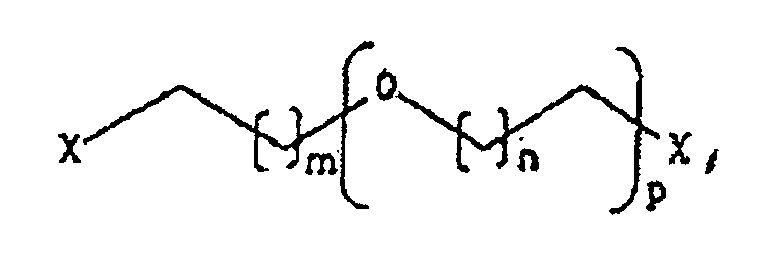 wobei:
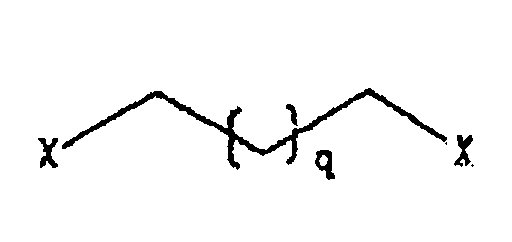 jedes X die funktionelle Komplexbildungseinheitist,
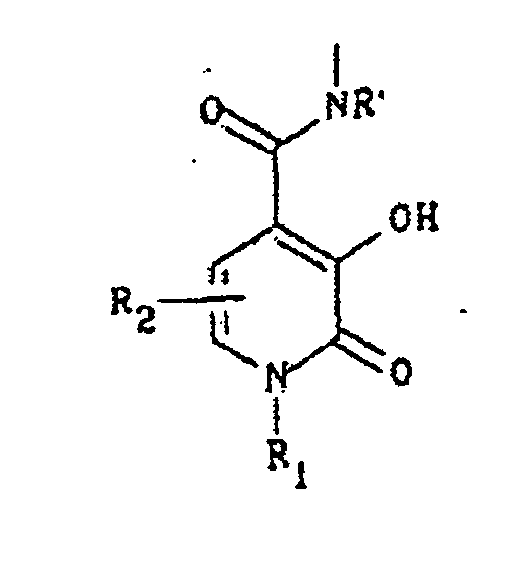 wobei R1 und R2 unabhängig aus der Gruppe ausgewählt sind, die aus Wasserstoff, aliphatischen C1-4 Kohlenwasserstoffgruppen und aliphatischen C1-4 Kohlenwasserstoffgruppen besteht, die durch eine einzige Halogenid-, Hydroxy-, Carboxy-, Acrlyamido-Gruppe oder eine Arylgruppe substituiert sind, undR' ein Element ist, ausgewählt aus der Gruppe, die aus einem Wasserstoffatom, aliphatischen C1-8 Kohlenwasserstoffgruppen, Arylgruppen und aliphatischen C1-8 Kohlenwasserstoffgruppen, die durch Amino-, Carboxy- oder Hydroxygruppen substituiert sind, besteht,m 1 -3 ist,n 1 -3 istp 1 - 3 ist undq 1 - 6 ist.
 - Komplexbildner nach Anspruch 1, bei dem alle funktionellen Komplexbildungseinheiten folgendes sind:
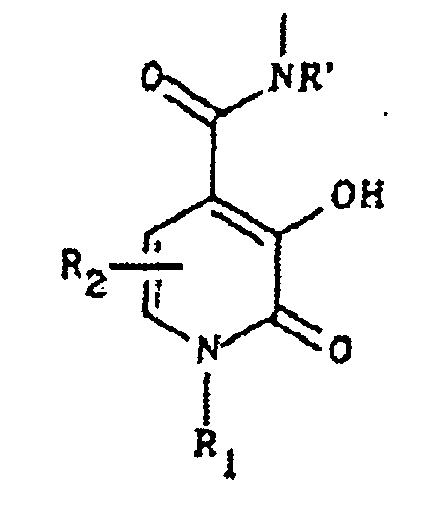
- Komplexbildnerbei dem:
 R1 ein Element ist, ausgewählt aus der Gruppe, die aus Wasserstoff, aliphatischen C1-4 Kohlenwasserstoffgruppen und aliphatischen C1-4 Kohlenwasserstoffgruppen, die durch eine einzige Halogenid-, Hydroxy-, Carboxy- oder Aryl-Gruppe substituiert sind, besteht; und a 2 - 9 ist.
 - Komplexbildnerbei dem:
 R1 ein Element ist, ausgewählt aus der Gruppe, die aus Wasserstoff, aliphatischen C1-4 Kohlenwasserstoffgruppen und aliphatischen C1-4 Kohlenwasserstoffgruppen, substituiert durch eine einzige Halogenid-, Hydroxy-, Carboxy- oder Aryl-Gruppe, besteht; Z ein Element ist, ausgewählt aus der Gruppe, die aus O, NH, N-Alkyl und N-Aryl besteht; a 2 - 4 ist; und b 2 -4 ist.
 - Komplexbildner nach Anspruch 1:

- Komplexbildner nach Anspruch 1:
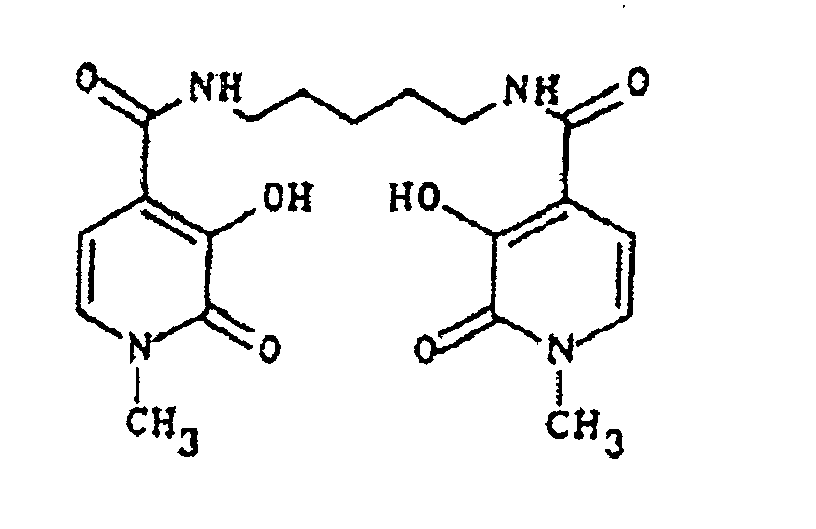
- Pharmazeutische Zusammensetzung, die einen Komplexbildner nach einem der Ansprüche 1 - 6 umfasst.
- Pharmazeutische Zusammensetzung nach Anspruch 7, die weiterhin ein Verdünnungsmittel oder einen Träger umfasst.
- Ein MRI Diagnosemittel, umfassend einen Komplexbildner nach einem der Ansprüche 1 - 6.
- Verfahren zum Synthetisieren eines Komplexbildners nach einem der Ansprüche 1 - 6, das folgende Schritte umfasst:1) Mischen einer Säure der folgenden Formelund wahlweise:
 mit einem Hydroxygruppen-Schutzmittel in einem 1:1:2 Mol-Verhältnis und überschüssigem wasserfreiem Kaliumcarbonat in einem geeigneten Lösungsmittel, zur Erzeugung eines ersten Gemisches;
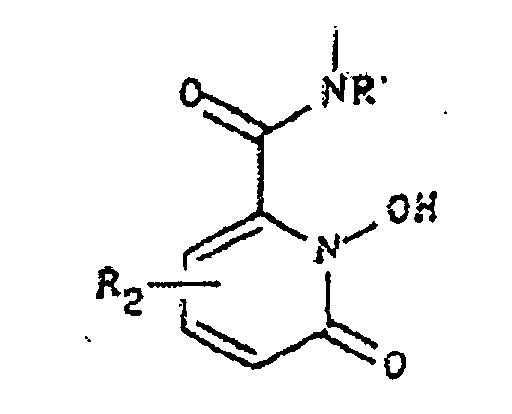 2) Erhitzen des ersten Gemisches auf ungefähr 65 - 80 °C unter N2 bei Dunkelheit für ungefähr 16 Stunden,3) Filtrieren des ersten Gemisches zur Erzeugung eines Filtrats;4) Abdampfen des Filtrats zur Erzeugung eines Öls;5) Mischen des Öls mit einer Lösung einer Mineralbase für ungefähr 4 - 8 Stunden zur Erzeugung eines zweiten Gemisches;6) Eindampfen des zweiten Gemisches bis zur Trockne zur Erzeugung eines Feststoffs;7) Lösen des Feststoffs in Wasser zur Erzeugung einer Lösung;8) Ansäuern der Lösung mit einer Mineralsäure, um eine feste Säure auszufällen;9) Umwandeln der festen Säure zu einem aktivierten Amid, Säurechlorid oder aktivierten Ester;10) Vermischen des aktivierten Amids, Säurechlorids oder aktivierten Esters mit einem geeigneten Amin-Grundgerüst in einem geeigneten Lösungsmittel für ungefähr 4 -8 Stunden zur Erzeugung eines geschützten Roh-Liganden;11) Aufreinigen des geschützten Roh-Liganden zur Erzeugung eines geschützten Liganden;12) Entschützen des geschützten Liganden mit einer geeigneten Säure oder einer katalytischen Hydrierung und Filtrierung zur Erzeugung eines Filtrats;13) Eindampfen des Filtrats zur Erzeugung eines Rückstands;14) Umkristallisieren des Rückstands mit einem geeigneten Lösungsmittel zur Gewinnung eines reinen Hydroxypyridinon-Komplexbildners.
 - Verwendung eines Komplexbildners nach einem der Ansprüche 1 - 6 zur Herstellung eines Medikamentes zur Entfernung von Actiniden und/oder Eisen aus einem Säugeti erkörper.
Applications Claiming Priority (1)
| Application Number | Priority Date | Filing Date | Title |
|---|---|---|---|
| PCT/US1995/007766 WO1997000245A1 (en) | 1995-06-14 | 1995-06-14 | 3-hydroxy-2(1h)-pyridinone chelating agents |
Publications (2)
| Publication Number | Publication Date |
|---|---|
| EP0840727A1 EP0840727A1 (de) | 1998-05-13 |
| EP0840727B1 true EP0840727B1 (de) | 2004-05-06 |
Family
ID=22249334
Family Applications (1)
| Application Number | Title | Priority Date | Filing Date |
|---|---|---|---|
| EP95923971A Expired - Lifetime EP0840727B1 (de) | 1995-06-14 | 1995-06-14 | 3-hydroxy-2(1h)-pyridone als chelatbildner |
Country Status (7)
| Country | Link |
|---|---|
| EP (1) | EP0840727B1 (de) |
| AT (1) | ATE266006T1 (de) |
| AU (1) | AU2865995A (de) |
| DE (1) | DE69533000T2 (de) |
| DK (1) | DK0840727T3 (de) |
| ES (1) | ES2221929T3 (de) |
| WO (1) | WO1997000245A1 (de) |
Families Citing this family (16)
| Publication number | Priority date | Publication date | Assignee | Title |
|---|---|---|---|---|
| AU752812B2 (en) | 1997-11-17 | 2002-10-03 | Research Corporation Technologies, Inc. | Magnetic resonance imaging agents for the detection of physiological agents |
| FI112796B (fi) * | 2000-04-14 | 2004-01-15 | Valtion Teknillinen | Menetelmä oligo-/polymeripihkahappoaimididendrimeerien valmistamiseksi ja niiden käyttö |
| US6846915B2 (en) * | 2001-08-13 | 2005-01-25 | The Regents Of The University Of California | Hydroxypyridonate and hydroxypyrimidinone chelating agents |
| US7504422B2 (en) | 2003-04-02 | 2009-03-17 | Taigen Biotechnology Co. Ltd. | Polyamine compounds |
| WO2004089360A1 (en) | 2003-04-02 | 2004-10-21 | Taigen Biotechnology | Polyamine compounds for treating chemokine receptor mediated diseases |
| DE102004062250A1 (de) * | 2004-12-23 | 2006-07-06 | Schering Ag | Konjugate von Hydroxypyridinonderivat-Metallkomplexen mit Biomolekülen und deren Verwendung zur Herstellung von Mitteln für die NMR-Diagnostik |
| US7501526B2 (en) | 2005-01-20 | 2009-03-10 | Taigen Biotechnology | Synthesis of polyamine compounds |
| CA2659251C (en) | 2006-07-10 | 2016-06-14 | The Regents Of The University Of California | Luminescent 1-hydroxy-2-pyridinone chelates of lanthanides |
| EP2104662A2 (de) | 2007-01-11 | 2009-09-30 | GE Healthcare AS | Chelatbildende mittel |
| WO2009021948A1 (en) * | 2007-08-13 | 2009-02-19 | Ge Healthcare As | Chelators, paramagnetic chelates thereof and their use as contrast agents in magnetic resonance imaging (mri) |
| WO2009021947A1 (en) * | 2007-08-13 | 2009-02-19 | Ge Healthcare As | Chelators, paramagnetic chelates thereof and their use as contrast agents in magnetic resonance imaging (mri) |
| WO2011025790A1 (en) | 2009-08-24 | 2011-03-03 | Lumiphore, Inc. | Macrocyclic hopo chelators |
| GB201002508D0 (en) * | 2010-02-12 | 2010-03-31 | Algeta As | Product |
| GB201019118D0 (en) | 2010-11-11 | 2010-12-29 | King S College | Conjugates and their uses in molecular imaging |
| CN102603964B (zh) * | 2012-01-15 | 2014-03-05 | 浙江工商大学 | 水溶性聚合物铁螯合剂及其制备方法和用途 |
| US11453652B2 (en) | 2013-03-15 | 2022-09-27 | Lumiphore, Inc. | Di-macrocycles |
Family Cites Families (2)
| Publication number | Priority date | Publication date | Assignee | Title |
|---|---|---|---|---|
| GB8325494D0 (en) * | 1983-09-23 | 1983-10-26 | Hider R C | Pharmaceutical compositions |
| US4698431A (en) * | 1985-11-12 | 1987-10-06 | The United States Of America As Represented By The United States Department Of Energy | Hydroxypyridonate chelating agents |
-
1995
- 1995-06-14 AT AT95923971T patent/ATE266006T1/de not_active IP Right Cessation
- 1995-06-14 ES ES95923971T patent/ES2221929T3/es not_active Expired - Lifetime
- 1995-06-14 AU AU28659/95A patent/AU2865995A/en not_active Abandoned
- 1995-06-14 EP EP95923971A patent/EP0840727B1/de not_active Expired - Lifetime
- 1995-06-14 WO PCT/US1995/007766 patent/WO1997000245A1/en not_active Ceased
- 1995-06-14 DK DK95923971T patent/DK0840727T3/da active
- 1995-06-14 DE DE69533000T patent/DE69533000T2/de not_active Expired - Fee Related
Also Published As
| Publication number | Publication date |
|---|---|
| ES2221929T3 (es) | 2005-01-16 |
| AU2865995A (en) | 1997-01-15 |
| DK0840727T3 (da) | 2004-08-16 |
| DE69533000D1 (de) | 2004-06-09 |
| DE69533000T2 (de) | 2005-04-21 |
| ATE266006T1 (de) | 2004-05-15 |
| EP0840727A1 (de) | 1998-05-13 |
| WO1997000245A1 (en) | 1997-01-03 |
Similar Documents
| Publication | Publication Date | Title |
|---|---|---|
| US5892029A (en) | 3-hydroxy-2(1H)-pyridinone chelating agents | |
| RU2073005C1 (ru) | Хелатное соединение металла | |
| EP0138421B1 (de) | Hydroxypyridon-Derivate und sie enthaltende pharmazeutische Zubereitungen | |
| JP2537502B2 (ja) | 1−置換−1,4,7−トリスカルボキシメチル−1,4,7,10−テトラアザシクロドデカンおよび類縁体 | |
| EP0138420B1 (de) | 1-Hydroxypyrid-2-on-Derivate enthaltende pharmazeutische Zubereitungen | |
| US4698431A (en) | Hydroxypyridonate chelating agents | |
| EP0840727A1 (de) | 3-hydroxy-2(1h)-pyridone als chelatbildner | |
| JP2633944B2 (ja) | 錯体化合物の製造方法 | |
| US5104865A (en) | Iron complexes of hydroxypyridones useful for treating iron overload | |
| JP2953670B2 (ja) | 複素環式キレート化剤 | |
| JPH0680636A (ja) | 医薬用組成物に用いる化合物 | |
| NZ229996A (en) | Macrocyclic polyaza compounds containing 5- or 6-membered rings and use in pharmaceutical media for diagnosis or therapy | |
| IE921760A1 (en) | Gallium compounds | |
| US20240228524A1 (en) | Iron(iii) macrocyclic complexes with mixed hyroxyl pendants as mri contrast agents | |
| USRE34313E (en) | Pharmaceutical compositions | |
| CN103601673B (zh) | 3-羟基吡啶-4-酮的氟化衍生物 | |
| Raymond et al. | 3-hydroxy-2 (1H)-pyridinone chelating agents | |
| CN106928132B (zh) | 一种羟基吡啶酮配体及其应用 | |
| RU2060256C1 (ru) | Производные 1,4,10,13-тетраокса-7,16-диазациклооктадекана, обладающие свойством выводить радиоактивные изотопы из живого организма, и фармацевтическая композиция для выведения из организма радиоактивных изотопов | |
| US5440031A (en) | 1,4,10,13-tetraoxa-7,16-diazacyclooctadecane derivatives, pharmaceutical compositions containing them and their use for the removal of toxic metal ions and radioactive isotopes from living organism | |
| CN115340543A (zh) | 正离子型环蕃及其在制备清除光动力治疗残留物的药物制剂中的应用 | |
| EP0335745A1 (de) | Verfahren zur Herstellung von Pyridin-4-onen | |
| CN120424020A (zh) | 一类环形邻苯二酚配体及其制备方法与应用 | |
| Nelson | Aqueous coordination chemistry of aluminum and gallium with 3-hydroxy-4-pyridinone ligands | |
| Waltham | The synthesis and coordination chemistry of 3-hydroxypyridin-4-ones |
Legal Events
| Date | Code | Title | Description |
|---|---|---|---|
| PUAI | Public reference made under article 153(3) epc to a published international application that has entered the european phase |
Free format text: ORIGINAL CODE: 0009012 |
|
| 17P | Request for examination filed |
Effective date: 19980108 |
|
| AK | Designated contracting states |
Kind code of ref document: A1 Designated state(s): AT BE CH DE DK ES FR GB GR IE IT LI LU MC NL PT SE |
|
| AX | Request for extension of the european patent |
Free format text: LT PAYMENT 980108;LV PAYMENT 980108;SI PAYMENT 980108 |
|
| 17Q | First examination report despatched |
Effective date: 19991209 |
|
| GRAP | Despatch of communication of intention to grant a patent |
Free format text: ORIGINAL CODE: EPIDOSNIGR1 |
|
| GRAS | Grant fee paid |
Free format text: ORIGINAL CODE: EPIDOSNIGR3 |
|
| GRAA | (expected) grant |
Free format text: ORIGINAL CODE: 0009210 |
|
| AK | Designated contracting states |
Kind code of ref document: B1 Designated state(s): AT BE CH DE DK ES FR GB GR IE IT LI LU MC NL PT SE |
|
| AX | Request for extension of the european patent |
Extension state: LT LV SI |
|
| REG | Reference to a national code |
Ref country code: GB Ref legal event code: FG4D |
|
| REG | Reference to a national code |
Ref country code: CH Ref legal event code: NV Representative=s name: HEPP, WENGER & RYFFEL AG Ref country code: CH Ref legal event code: EP |
|
| REF | Corresponds to: |
Ref document number: 69533000 Country of ref document: DE Date of ref document: 20040609 Kind code of ref document: P |
|
| PG25 | Lapsed in a contracting state [announced via postgrant information from national office to epo] |
Ref country code: LU Free format text: LAPSE BECAUSE OF NON-PAYMENT OF DUE FEES Effective date: 20040614 |
|
| REG | Reference to a national code |
Ref country code: IE Ref legal event code: FG4D |
|
| REG | Reference to a national code |
Ref country code: SE Ref legal event code: TRGR |
|
| REG | Reference to a national code |
Ref country code: GR Ref legal event code: EP Ref document number: 20040401933 Country of ref document: GR |
|
| REG | Reference to a national code |
Ref country code: DK Ref legal event code: T3 |
|
| REG | Reference to a national code |
Ref country code: PT Ref legal event code: SC4A Free format text: AVAILABILITY OF NATIONAL TRANSLATION Effective date: 20040617 |
|
| LTIE | Lt: invalidation of european patent or patent extension |
Effective date: 20040506 |
|
| ET | Fr: translation filed | ||
| REG | Reference to a national code |
Ref country code: ES Ref legal event code: FG2A Ref document number: 2221929 Country of ref document: ES Kind code of ref document: T3 |
|
| PLBE | No opposition filed within time limit |
Free format text: ORIGINAL CODE: 0009261 |
|
| STAA | Information on the status of an ep patent application or granted ep patent |
Free format text: STATUS: NO OPPOSITION FILED WITHIN TIME LIMIT |
|
| 26N | No opposition filed |
Effective date: 20050208 |
|
| PG25 | Lapsed in a contracting state [announced via postgrant information from national office to epo] |
Ref country code: GB Free format text: LAPSE BECAUSE OF NON-PAYMENT OF DUE FEES Effective date: 20050614 |
|
| GBPC | Gb: european patent ceased through non-payment of renewal fee |
Effective date: 20050614 |
|
| REG | Reference to a national code |
Ref country code: GB Ref legal event code: 728V |
|
| REG | Reference to a national code |
Ref country code: GB Ref legal event code: 728Y |
|
| PGFP | Annual fee paid to national office [announced via postgrant information from national office to epo] |
Ref country code: MC Payment date: 20070521 Year of fee payment: 13 Ref country code: AT Payment date: 20070521 Year of fee payment: 13 |
|
| PGFP | Annual fee paid to national office [announced via postgrant information from national office to epo] |
Ref country code: PT Payment date: 20070522 Year of fee payment: 13 |
|
| PGFP | Annual fee paid to national office [announced via postgrant information from national office to epo] |
Ref country code: NL Payment date: 20070624 Year of fee payment: 13 |
|
| PGFP | Annual fee paid to national office [announced via postgrant information from national office to epo] |
Ref country code: IE Payment date: 20070626 Year of fee payment: 13 Ref country code: ES Payment date: 20070626 Year of fee payment: 13 |
|
| PGFP | Annual fee paid to national office [announced via postgrant information from national office to epo] |
Ref country code: CH Payment date: 20070628 Year of fee payment: 13 |
|
| PGFP | Annual fee paid to national office [announced via postgrant information from national office to epo] |
Ref country code: DK Payment date: 20070629 Year of fee payment: 13 |
|
| PGFP | Annual fee paid to national office [announced via postgrant information from national office to epo] |
Ref country code: DE Payment date: 20070731 Year of fee payment: 13 |
|
| PGFP | Annual fee paid to national office [announced via postgrant information from national office to epo] |
Ref country code: GB Payment date: 20070628 Year of fee payment: 13 |
|
| PGFP | Annual fee paid to national office [announced via postgrant information from national office to epo] |
Ref country code: IT Payment date: 20070626 Year of fee payment: 13 |
|
| PGFP | Annual fee paid to national office [announced via postgrant information from national office to epo] |
Ref country code: SE Payment date: 20070627 Year of fee payment: 13 Ref country code: BE Payment date: 20070716 Year of fee payment: 13 |
|
| PGFP | Annual fee paid to national office [announced via postgrant information from national office to epo] |
Ref country code: FR Payment date: 20070618 Year of fee payment: 13 |
|
| PGFP | Annual fee paid to national office [announced via postgrant information from national office to epo] |
Ref country code: GR Payment date: 20070628 Year of fee payment: 13 |
|
| REG | Reference to a national code |
Ref country code: PT Ref legal event code: MM4A Free format text: LAPSE DUE TO NON-PAYMENT OF FEES Effective date: 20081215 |
|
| BERE | Be: lapsed |
Owner name: THE *REGENTS OF THE UNIVERSITY OF CALIFORNIA Effective date: 20080630 |
|
| PG25 | Lapsed in a contracting state [announced via postgrant information from national office to epo] |
Ref country code: PT Free format text: LAPSE BECAUSE OF NON-PAYMENT OF DUE FEES Effective date: 20081215 Ref country code: MC Free format text: LAPSE BECAUSE OF NON-PAYMENT OF DUE FEES Effective date: 20080630 |
|
| REG | Reference to a national code |
Ref country code: CH Ref legal event code: PL |
|
| REG | Reference to a national code |
Ref country code: DK Ref legal event code: EBP |
|
| EUG | Se: european patent has lapsed | ||
| GBPC | Gb: european patent ceased through non-payment of renewal fee |
Effective date: 20080614 |
|
| NLV4 | Nl: lapsed or anulled due to non-payment of the annual fee |
Effective date: 20090101 |
|
| PG25 | Lapsed in a contracting state [announced via postgrant information from national office to epo] |
Ref country code: BE Free format text: LAPSE BECAUSE OF NON-PAYMENT OF DUE FEES Effective date: 20080630 |
|
| REG | Reference to a national code |
Ref country code: IE Ref legal event code: MM4A |
|
| REG | Reference to a national code |
Ref country code: FR Ref legal event code: ST Effective date: 20090228 |
|
| PG25 | Lapsed in a contracting state [announced via postgrant information from national office to epo] |
Ref country code: IE Free format text: LAPSE BECAUSE OF NON-PAYMENT OF DUE FEES Effective date: 20080616 Ref country code: DE Free format text: LAPSE BECAUSE OF NON-PAYMENT OF DUE FEES Effective date: 20090101 Ref country code: AT Free format text: LAPSE BECAUSE OF NON-PAYMENT OF DUE FEES Effective date: 20080614 |
|
| PG25 | Lapsed in a contracting state [announced via postgrant information from national office to epo] |
Ref country code: NL Free format text: LAPSE BECAUSE OF NON-PAYMENT OF DUE FEES Effective date: 20090101 |
|
| PG25 | Lapsed in a contracting state [announced via postgrant information from national office to epo] |
Ref country code: LI Free format text: LAPSE BECAUSE OF NON-PAYMENT OF DUE FEES Effective date: 20080630 Ref country code: GR Free format text: LAPSE BECAUSE OF NON-PAYMENT OF DUE FEES Effective date: 20090107 Ref country code: GB Free format text: LAPSE BECAUSE OF NON-PAYMENT OF DUE FEES Effective date: 20080614 Ref country code: CH Free format text: LAPSE BECAUSE OF NON-PAYMENT OF DUE FEES Effective date: 20080630 |
|
| REG | Reference to a national code |
Ref country code: ES Ref legal event code: FD2A Effective date: 20080616 |
|
| PG25 | Lapsed in a contracting state [announced via postgrant information from national office to epo] |
Ref country code: IT Free format text: LAPSE BECAUSE OF NON-PAYMENT OF DUE FEES Effective date: 20080614 Ref country code: FR Free format text: LAPSE BECAUSE OF NON-PAYMENT OF DUE FEES Effective date: 20080630 |
|
| PG25 | Lapsed in a contracting state [announced via postgrant information from national office to epo] |
Ref country code: ES Free format text: LAPSE BECAUSE OF NON-PAYMENT OF DUE FEES Effective date: 20080616 |
|
| PG25 | Lapsed in a contracting state [announced via postgrant information from national office to epo] |
Ref country code: DK Free format text: LAPSE BECAUSE OF NON-PAYMENT OF DUE FEES Effective date: 20090106 |
|
| PG25 | Lapsed in a contracting state [announced via postgrant information from national office to epo] |
Ref country code: DK Free format text: LAPSE BECAUSE OF NON-PAYMENT OF DUE FEES Effective date: 20080630 |
|
| PG25 | Lapsed in a contracting state [announced via postgrant information from national office to epo] |
Ref country code: SE Free format text: LAPSE BECAUSE OF NON-PAYMENT OF DUE FEES Effective date: 20080615 |