EP0841368B1 - Préparation de polymères macrocycliques à basse hystérèse - Google Patents
Préparation de polymères macrocycliques à basse hystérèse Download PDFInfo
- Publication number
- EP0841368B1 EP0841368B1 EP97117842A EP97117842A EP0841368B1 EP 0841368 B1 EP0841368 B1 EP 0841368B1 EP 97117842 A EP97117842 A EP 97117842A EP 97117842 A EP97117842 A EP 97117842A EP 0841368 B1 EP0841368 B1 EP 0841368B1
- Authority
- EP
- European Patent Office
- Prior art keywords
- polymers
- mixtures
- polymer
- group
- monomer
- Prior art date
- Legal status (The legal status is an assumption and is not a legal conclusion. Google has not performed a legal analysis and makes no representation as to the accuracy of the status listed.)
- Expired - Lifetime
Links
- 229920000642 polymer Polymers 0.000 title claims description 197
- 230000015572 biosynthetic process Effects 0.000 title description 8
- 238000003786 synthesis reaction Methods 0.000 title description 6
- 238000000034 method Methods 0.000 claims description 68
- 239000003999 initiator Substances 0.000 claims description 64
- 239000000178 monomer Substances 0.000 claims description 56
- 239000003795 chemical substances by application Substances 0.000 claims description 55
- 229910052751 metal Inorganic materials 0.000 claims description 48
- 239000002184 metal Substances 0.000 claims description 48
- 238000006116 polymerization reaction Methods 0.000 claims description 46
- 239000000203 mixture Substances 0.000 claims description 44
- 150000001875 compounds Chemical class 0.000 claims description 42
- 229920001971 elastomer Polymers 0.000 claims description 36
- FYYHWMGAXLPEAU-UHFFFAOYSA-N Magnesium Chemical compound [Mg] FYYHWMGAXLPEAU-UHFFFAOYSA-N 0.000 claims description 24
- 125000004429 atom Chemical group 0.000 claims description 23
- 239000007822 coupling agent Substances 0.000 claims description 23
- -1 cyclic organometallic compound Chemical class 0.000 claims description 23
- PPBRXRYQALVLMV-UHFFFAOYSA-N Styrene Chemical compound C=CC1=CC=CC=C1 PPBRXRYQALVLMV-UHFFFAOYSA-N 0.000 claims description 22
- 238000006243 chemical reaction Methods 0.000 claims description 21
- 229920002554 vinyl polymer Polymers 0.000 claims description 21
- KAKZBPTYRLMSJV-UHFFFAOYSA-N Butadiene Chemical compound C=CC=C KAKZBPTYRLMSJV-UHFFFAOYSA-N 0.000 claims description 20
- VYPSYNLAJGMNEJ-UHFFFAOYSA-N Silicium dioxide Chemical compound O=[Si]=O VYPSYNLAJGMNEJ-UHFFFAOYSA-N 0.000 claims description 20
- 239000000376 reactant Substances 0.000 claims description 20
- 125000000391 vinyl group Chemical group [H]C([*])=C([H])[H] 0.000 claims description 19
- 239000000806 elastomer Substances 0.000 claims description 18
- 150000001993 dienes Chemical class 0.000 claims description 17
- 229910052749 magnesium Inorganic materials 0.000 claims description 17
- RRHGJUQNOFWUDK-UHFFFAOYSA-N Isoprene Chemical compound CC(=C)C=C RRHGJUQNOFWUDK-UHFFFAOYSA-N 0.000 claims description 15
- 239000006229 carbon black Substances 0.000 claims description 15
- 239000011777 magnesium Substances 0.000 claims description 14
- DGPBVJWCIDNDPN-UHFFFAOYSA-N 2-(dimethylamino)benzaldehyde Chemical compound CN(C)C1=CC=CC=C1C=O DGPBVJWCIDNDPN-UHFFFAOYSA-N 0.000 claims description 13
- 239000002904 solvent Substances 0.000 claims description 11
- VVBLNCFGVYUYGU-UHFFFAOYSA-N 4,4'-Bis(dimethylamino)benzophenone Chemical class C1=CC(N(C)C)=CC=C1C(=O)C1=CC=C(N(C)C)C=C1 VVBLNCFGVYUYGU-UHFFFAOYSA-N 0.000 claims description 10
- 238000010539 anionic addition polymerization reaction Methods 0.000 claims description 10
- 125000004432 carbon atom Chemical group C* 0.000 claims description 10
- 239000000945 filler Substances 0.000 claims description 10
- 239000000377 silicon dioxide Substances 0.000 claims description 10
- 125000004209 (C1-C8) alkyl group Chemical group 0.000 claims description 9
- 239000012190 activator Substances 0.000 claims description 9
- 125000006413 ring segment Chemical group 0.000 claims description 7
- CURLTUGMZLYLDI-UHFFFAOYSA-N Carbon dioxide Chemical compound O=C=O CURLTUGMZLYLDI-UHFFFAOYSA-N 0.000 claims description 6
- 239000003607 modifier Substances 0.000 claims description 6
- 150000004040 pyrrolidinones Chemical class 0.000 claims description 6
- HPGGPRDJHPYFRM-UHFFFAOYSA-J tin(iv) chloride Chemical class Cl[Sn](Cl)(Cl)Cl HPGGPRDJHPYFRM-UHFFFAOYSA-J 0.000 claims description 6
- 229910052744 lithium Inorganic materials 0.000 claims description 5
- 239000002798 polar solvent Substances 0.000 claims description 5
- 150000005671 trienes Chemical class 0.000 claims description 5
- VGGSQFUCUMXWEO-UHFFFAOYSA-N Ethene Chemical compound C=C VGGSQFUCUMXWEO-UHFFFAOYSA-N 0.000 claims description 4
- 239000005977 Ethylene Substances 0.000 claims description 4
- DGAQECJNVWCQMB-PUAWFVPOSA-M Ilexoside XXIX Chemical compound C[C@@H]1CC[C@@]2(CC[C@@]3(C(=CC[C@H]4[C@]3(CC[C@@H]5[C@@]4(CC[C@@H](C5(C)C)OS(=O)(=O)[O-])C)C)[C@@H]2[C@]1(C)O)C)C(=O)O[C@H]6[C@@H]([C@H]([C@@H]([C@H](O6)CO)O)O)O.[Na+] DGAQECJNVWCQMB-PUAWFVPOSA-M 0.000 claims description 4
- 229910021627 Tin(IV) chloride Inorganic materials 0.000 claims description 4
- 229910052788 barium Inorganic materials 0.000 claims description 4
- DSAJWYNOEDNPEQ-UHFFFAOYSA-N barium atom Chemical compound [Ba] DSAJWYNOEDNPEQ-UHFFFAOYSA-N 0.000 claims description 4
- 150000002894 organic compounds Chemical class 0.000 claims description 4
- 230000000379 polymerizing effect Effects 0.000 claims description 4
- 229910052708 sodium Inorganic materials 0.000 claims description 4
- 239000011734 sodium Substances 0.000 claims description 4
- 229910052712 strontium Inorganic materials 0.000 claims description 4
- CIOAGBVUUVVLOB-UHFFFAOYSA-N strontium atom Chemical compound [Sr] CIOAGBVUUVVLOB-UHFFFAOYSA-N 0.000 claims description 4
- CYSGHNMQYZDMIA-UHFFFAOYSA-N 1,3-Dimethyl-2-imidazolidinon Chemical class CN1CCN(C)C1=O CYSGHNMQYZDMIA-UHFFFAOYSA-N 0.000 claims description 3
- OYPRJOBELJOOCE-UHFFFAOYSA-N Calcium Chemical compound [Ca] OYPRJOBELJOOCE-UHFFFAOYSA-N 0.000 claims description 3
- WHXSMMKQMYFTQS-UHFFFAOYSA-N Lithium Chemical compound [Li] WHXSMMKQMYFTQS-UHFFFAOYSA-N 0.000 claims description 3
- ZLMJMSJWJFRBEC-UHFFFAOYSA-N Potassium Chemical compound [K] ZLMJMSJWJFRBEC-UHFFFAOYSA-N 0.000 claims description 3
- 229910021626 Tin(II) chloride Inorganic materials 0.000 claims description 3
- HCHKCACWOHOZIP-UHFFFAOYSA-N Zinc Chemical compound [Zn] HCHKCACWOHOZIP-UHFFFAOYSA-N 0.000 claims description 3
- 150000004705 aldimines Chemical class 0.000 claims description 3
- 229910052790 beryllium Inorganic materials 0.000 claims description 3
- ATBAMAFKBVZNFJ-UHFFFAOYSA-N beryllium atom Chemical compound [Be] ATBAMAFKBVZNFJ-UHFFFAOYSA-N 0.000 claims description 3
- 229910052793 cadmium Inorganic materials 0.000 claims description 3
- BDOSMKKIYDKNTQ-UHFFFAOYSA-N cadmium atom Chemical compound [Cd] BDOSMKKIYDKNTQ-UHFFFAOYSA-N 0.000 claims description 3
- 229910052791 calcium Inorganic materials 0.000 claims description 3
- 239000011575 calcium Substances 0.000 claims description 3
- 239000001569 carbon dioxide Substances 0.000 claims description 3
- 229910002092 carbon dioxide Inorganic materials 0.000 claims description 3
- 150000004658 ketimines Chemical class 0.000 claims description 3
- QSHDDOUJBYECFT-UHFFFAOYSA-N mercury Chemical compound [Hg] QSHDDOUJBYECFT-UHFFFAOYSA-N 0.000 claims description 3
- 229910052753 mercury Inorganic materials 0.000 claims description 3
- 239000003505 polymerization initiator Substances 0.000 claims description 3
- 229910052700 potassium Inorganic materials 0.000 claims description 3
- 239000011591 potassium Substances 0.000 claims description 3
- 235000011150 stannous chloride Nutrition 0.000 claims description 3
- AXZWODMDQAVCJE-UHFFFAOYSA-L tin(II) chloride (anhydrous) Chemical compound [Cl-].[Cl-].[Sn+2] AXZWODMDQAVCJE-UHFFFAOYSA-L 0.000 claims description 3
- 229910052725 zinc Inorganic materials 0.000 claims description 3
- 239000011701 zinc Substances 0.000 claims description 3
- OTEKOJQFKOIXMU-UHFFFAOYSA-N 1,4-bis(trichloromethyl)benzene Chemical group ClC(Cl)(Cl)C1=CC=C(C(Cl)(Cl)Cl)C=C1 OTEKOJQFKOIXMU-UHFFFAOYSA-N 0.000 claims description 2
- VXEGSRKPIUDPQT-UHFFFAOYSA-N 4-[4-(4-methoxyphenyl)piperazin-1-yl]aniline Chemical compound C1=CC(OC)=CC=C1N1CCN(C=2C=CC(N)=CC=2)CC1 VXEGSRKPIUDPQT-UHFFFAOYSA-N 0.000 claims description 2
- 125000002947 alkylene group Chemical group 0.000 claims description 2
- BUMGIEFFCMBQDG-UHFFFAOYSA-N dichlorosilicon Chemical compound Cl[Si]Cl BUMGIEFFCMBQDG-UHFFFAOYSA-N 0.000 claims description 2
- 150000005690 diesters Chemical class 0.000 claims description 2
- 150000002148 esters Chemical class 0.000 claims description 2
- 239000005049 silicon tetrachloride Substances 0.000 claims description 2
- 150000005691 triesters Chemical class 0.000 claims description 2
- 229910052792 caesium Inorganic materials 0.000 claims 2
- TVFDJXOCXUVLDH-UHFFFAOYSA-N caesium atom Chemical compound [Cs] TVFDJXOCXUVLDH-UHFFFAOYSA-N 0.000 claims 2
- 229910052701 rubidium Inorganic materials 0.000 claims 2
- IGLNJRXAVVLDKE-UHFFFAOYSA-N rubidium atom Chemical compound [Rb] IGLNJRXAVVLDKE-UHFFFAOYSA-N 0.000 claims 2
- VLKZOEOYAKHREP-UHFFFAOYSA-N n-Hexane Chemical compound CCCCCC VLKZOEOYAKHREP-UHFFFAOYSA-N 0.000 description 30
- 238000005859 coupling reaction Methods 0.000 description 25
- 230000008569 process Effects 0.000 description 25
- KFZMGEQAYNKOFK-UHFFFAOYSA-N Isopropanol Chemical compound CC(C)O KFZMGEQAYNKOFK-UHFFFAOYSA-N 0.000 description 24
- 230000008878 coupling Effects 0.000 description 23
- 238000010168 coupling process Methods 0.000 description 23
- 125000000524 functional group Chemical group 0.000 description 21
- WYURNTSHIVDZCO-UHFFFAOYSA-N Tetrahydrofuran Chemical compound C1CCOC1 WYURNTSHIVDZCO-UHFFFAOYSA-N 0.000 description 20
- 239000005060 rubber Substances 0.000 description 19
- 235000019241 carbon black Nutrition 0.000 description 13
- 238000013329 compounding Methods 0.000 description 12
- 229920001577 copolymer Polymers 0.000 description 11
- 239000004322 Butylated hydroxytoluene Substances 0.000 description 10
- NLZUEZXRPGMBCV-UHFFFAOYSA-N Butylhydroxytoluene Chemical compound CC1=CC(C(C)(C)C)=C(O)C(C(C)(C)C)=C1 NLZUEZXRPGMBCV-UHFFFAOYSA-N 0.000 description 10
- 235000010354 butylated hydroxytoluene Nutrition 0.000 description 10
- 229940095259 butylated hydroxytoluene Drugs 0.000 description 10
- YLQBMQCUIZJEEH-UHFFFAOYSA-N tetrahydrofuran Natural products C=1C=COC=1 YLQBMQCUIZJEEH-UHFFFAOYSA-N 0.000 description 10
- 239000005062 Polybutadiene Substances 0.000 description 9
- 229920002857 polybutadiene Polymers 0.000 description 9
- 125000004122 cyclic group Chemical group 0.000 description 8
- RJGHQTVXGKYATR-UHFFFAOYSA-L dibutyl(dichloro)stannane Chemical compound CCCC[Sn](Cl)(Cl)CCCC RJGHQTVXGKYATR-UHFFFAOYSA-L 0.000 description 8
- 229920003048 styrene butadiene rubber Polymers 0.000 description 8
- UHOVQNZJYSORNB-UHFFFAOYSA-N Benzene Chemical compound C1=CC=CC=C1 UHOVQNZJYSORNB-UHFFFAOYSA-N 0.000 description 6
- 238000010791 quenching Methods 0.000 description 6
- 230000000171 quenching effect Effects 0.000 description 6
- 238000005096 rolling process Methods 0.000 description 6
- XLYOFNOQVPJJNP-UHFFFAOYSA-N water Substances O XLYOFNOQVPJJNP-UHFFFAOYSA-N 0.000 description 6
- GCTFWCDSFPMHHS-UHFFFAOYSA-M Tributyltin chloride Chemical compound CCCC[Sn](Cl)(CCCC)CCCC GCTFWCDSFPMHHS-UHFFFAOYSA-M 0.000 description 5
- 230000015271 coagulation Effects 0.000 description 5
- 238000005345 coagulation Methods 0.000 description 5
- 230000003247 decreasing effect Effects 0.000 description 5
- LIKFHECYJZWXFJ-UHFFFAOYSA-N dimethyldichlorosilane Chemical compound C[Si](C)(Cl)Cl LIKFHECYJZWXFJ-UHFFFAOYSA-N 0.000 description 5
- 238000009472 formulation Methods 0.000 description 5
- 239000000463 material Substances 0.000 description 5
- 238000002360 preparation method Methods 0.000 description 5
- 125000006701 (C1-C7) alkyl group Chemical group 0.000 description 4
- ATJFFYVFTNAWJD-UHFFFAOYSA-N Tin Chemical compound [Sn] ATJFFYVFTNAWJD-UHFFFAOYSA-N 0.000 description 4
- 239000006096 absorbing agent Substances 0.000 description 4
- 125000003545 alkoxy group Chemical group 0.000 description 4
- 125000003118 aryl group Chemical group 0.000 description 4
- UAHWPYUMFXYFJY-UHFFFAOYSA-N beta-myrcene Chemical compound CC(C)=CCCC(=C)C=C UAHWPYUMFXYFJY-UHFFFAOYSA-N 0.000 description 4
- 229920001400 block copolymer Polymers 0.000 description 4
- 230000001747 exhibiting effect Effects 0.000 description 4
- GNOIPBMMFNIUFM-UHFFFAOYSA-N hexamethylphosphoric triamide Chemical compound CN(C)P(=O)(N(C)C)N(C)C GNOIPBMMFNIUFM-UHFFFAOYSA-N 0.000 description 4
- LZWQNOHZMQIFBX-UHFFFAOYSA-N lithium;2-methylpropan-2-olate Chemical compound [Li+].CC(C)(C)[O-] LZWQNOHZMQIFBX-UHFFFAOYSA-N 0.000 description 4
- 150000002739 metals Chemical class 0.000 description 4
- 150000002902 organometallic compounds Chemical class 0.000 description 4
- 229920002959 polymer blend Polymers 0.000 description 4
- 230000035939 shock Effects 0.000 description 4
- 150000003440 styrenes Chemical class 0.000 description 4
- FJEXCGXYOCEARC-UHFFFAOYSA-N CC1=CC[Mg]C1 Chemical compound CC1=CC[Mg]C1 FJEXCGXYOCEARC-UHFFFAOYSA-N 0.000 description 3
- RTZKZFJDLAIYFH-UHFFFAOYSA-N Diethyl ether Chemical compound CCOCC RTZKZFJDLAIYFH-UHFFFAOYSA-N 0.000 description 3
- LFQSCWFLJHTTHZ-UHFFFAOYSA-N Ethanol Chemical compound CCO LFQSCWFLJHTTHZ-UHFFFAOYSA-N 0.000 description 3
- 241001441571 Hiodontidae Species 0.000 description 3
- 239000002174 Styrene-butadiene Substances 0.000 description 3
- XYLMUPLGERFSHI-UHFFFAOYSA-N alpha-Methylstyrene Chemical compound CC(=C)C1=CC=CC=C1 XYLMUPLGERFSHI-UHFFFAOYSA-N 0.000 description 3
- 125000000129 anionic group Chemical group 0.000 description 3
- 239000003963 antioxidant agent Substances 0.000 description 3
- 238000013459 approach Methods 0.000 description 3
- 239000000010 aprotic solvent Substances 0.000 description 3
- MTAZNLWOLGHBHU-UHFFFAOYSA-N butadiene-styrene rubber Chemical compound C=CC=C.C=CC1=CC=CC=C1 MTAZNLWOLGHBHU-UHFFFAOYSA-N 0.000 description 3
- 230000007423 decrease Effects 0.000 description 3
- 229920001519 homopolymer Polymers 0.000 description 3
- 230000003993 interaction Effects 0.000 description 3
- IJGRMHOSHXDMSA-UHFFFAOYSA-N nitrogen Substances N#N IJGRMHOSHXDMSA-UHFFFAOYSA-N 0.000 description 3
- 230000000737 periodic effect Effects 0.000 description 3
- 229930195735 unsaturated hydrocarbon Natural products 0.000 description 3
- UVHXEHGUEKARKZ-UHFFFAOYSA-N 1-ethenylanthracene Chemical compound C1=CC=C2C=C3C(C=C)=CC=CC3=CC2=C1 UVHXEHGUEKARKZ-UHFFFAOYSA-N 0.000 description 2
- IGGDKDTUCAWDAN-UHFFFAOYSA-N 1-vinylnaphthalene Chemical compound C1=CC=C2C(C=C)=CC=CC2=C1 IGGDKDTUCAWDAN-UHFFFAOYSA-N 0.000 description 2
- 0 CCC*(CCC1)[C@@]1C1C[C@](C[C@@]2*C2)C(C)C1 Chemical compound CCC*(CCC1)[C@@]1C1C[C@](C[C@@]2*C2)C(C)C1 0.000 description 2
- XDTMQSROBMDMFD-UHFFFAOYSA-N Cyclohexane Chemical compound C1CCCCC1 XDTMQSROBMDMFD-UHFFFAOYSA-N 0.000 description 2
- LCGLNKUTAGEVQW-UHFFFAOYSA-N Dimethyl ether Chemical compound COC LCGLNKUTAGEVQW-UHFFFAOYSA-N 0.000 description 2
- KWYHDKDOAIKMQN-UHFFFAOYSA-N N,N,N',N'-tetramethylethylenediamine Chemical compound CN(C)CCN(C)C KWYHDKDOAIKMQN-UHFFFAOYSA-N 0.000 description 2
- MZRVEZGGRBJDDB-UHFFFAOYSA-N N-Butyllithium Chemical compound [Li]CCCC MZRVEZGGRBJDDB-UHFFFAOYSA-N 0.000 description 2
- 238000005481 NMR spectroscopy Methods 0.000 description 2
- UFWIBTONFRDIAS-UHFFFAOYSA-N Naphthalene Chemical compound C1=CC=CC2=CC=CC=C21 UFWIBTONFRDIAS-UHFFFAOYSA-N 0.000 description 2
- 229920000459 Nitrile rubber Polymers 0.000 description 2
- 239000004793 Polystyrene Substances 0.000 description 2
- ATUOYWHBWRKTHZ-UHFFFAOYSA-N Propane Chemical compound CCC ATUOYWHBWRKTHZ-UHFFFAOYSA-N 0.000 description 2
- XLOMVQKBTHCTTD-UHFFFAOYSA-N Zinc monoxide Chemical compound [Zn]=O XLOMVQKBTHCTTD-UHFFFAOYSA-N 0.000 description 2
- 230000004913 activation Effects 0.000 description 2
- 150000001335 aliphatic alkanes Chemical class 0.000 description 2
- 150000001350 alkyl halides Chemical class 0.000 description 2
- VYBREYKSZAROCT-UHFFFAOYSA-N alpha-myrcene Natural products CC(=C)CCCC(=C)C=C VYBREYKSZAROCT-UHFFFAOYSA-N 0.000 description 2
- MWPLVEDNUUSJAV-UHFFFAOYSA-N anthracene Chemical compound C1=CC=CC2=CC3=CC=CC=C3C=C21 MWPLVEDNUUSJAV-UHFFFAOYSA-N 0.000 description 2
- 230000003078 antioxidant effect Effects 0.000 description 2
- 238000007334 copolymerization reaction Methods 0.000 description 2
- 229920005565 cyclic polymer Polymers 0.000 description 2
- 238000002036 drum drying Methods 0.000 description 2
- 238000001035 drying Methods 0.000 description 2
- HQQADJVZYDDRJT-UHFFFAOYSA-N ethene;prop-1-ene Chemical group C=C.CC=C HQQADJVZYDDRJT-UHFFFAOYSA-N 0.000 description 2
- 239000005038 ethylene vinyl acetate Substances 0.000 description 2
- 239000000446 fuel Substances 0.000 description 2
- 150000004795 grignard reagents Chemical class 0.000 description 2
- 125000004970 halomethyl group Chemical group 0.000 description 2
- AFRJJFRNGGLMDW-UHFFFAOYSA-N lithium amide Chemical class [Li+].[NH2-] AFRJJFRNGGLMDW-UHFFFAOYSA-N 0.000 description 2
- 238000004519 manufacturing process Methods 0.000 description 2
- 238000002156 mixing Methods 0.000 description 2
- 229910052757 nitrogen Inorganic materials 0.000 description 2
- 229920001200 poly(ethylene-vinyl acetate) Polymers 0.000 description 2
- 229920001195 polyisoprene Polymers 0.000 description 2
- 239000011414 polymer cement Substances 0.000 description 2
- 229920002223 polystyrene Polymers 0.000 description 2
- 229920005604 random copolymer Polymers 0.000 description 2
- 230000009257 reactivity Effects 0.000 description 2
- 238000003756 stirring Methods 0.000 description 2
- 239000011115 styrene butadiene Substances 0.000 description 2
- 229920003051 synthetic elastomer Polymers 0.000 description 2
- 238000012360 testing method Methods 0.000 description 2
- 238000001291 vacuum drying Methods 0.000 description 2
- OGLDWXZKYODSOB-UHFFFAOYSA-N α-phellandrene Chemical compound CC(C)C1CC=C(C)C=C1 OGLDWXZKYODSOB-UHFFFAOYSA-N 0.000 description 2
- FMGGHNGKHRCJLL-UHFFFAOYSA-N 1,2-bis(chloromethyl)benzene Chemical compound ClCC1=CC=CC=C1CCl FMGGHNGKHRCJLL-UHFFFAOYSA-N 0.000 description 1
- GCZOMCDXYFMAGP-UHFFFAOYSA-N 1,8-bis(bromomethyl)naphthalene Chemical compound C1=CC(CBr)=C2C(CBr)=CC=CC2=C1 GCZOMCDXYFMAGP-UHFFFAOYSA-N 0.000 description 1
- ZXHLQRSUVYZJGB-UHFFFAOYSA-N 1-(1-piperidin-1-ylethyl)piperidine Chemical compound C1CCCCN1C(C)N1CCCCC1 ZXHLQRSUVYZJGB-UHFFFAOYSA-N 0.000 description 1
- NFDXQGNDWIPXQL-UHFFFAOYSA-N 1-cyclooctyldiazocane Chemical compound C1CCCCCCC1N1NCCCCCC1 NFDXQGNDWIPXQL-UHFFFAOYSA-N 0.000 description 1
- KGRVJHAUYBGFFP-UHFFFAOYSA-N 2,2'-Methylenebis(4-methyl-6-tert-butylphenol) Chemical compound CC(C)(C)C1=CC(C)=CC(CC=2C(=C(C=C(C)C=2)C(C)(C)C)O)=C1O KGRVJHAUYBGFFP-UHFFFAOYSA-N 0.000 description 1
- FZLHAQMQWDDWFI-UHFFFAOYSA-N 2-[2-(oxolan-2-yl)propan-2-yl]oxolane Chemical compound C1CCOC1C(C)(C)C1CCCO1 FZLHAQMQWDDWFI-UHFFFAOYSA-N 0.000 description 1
- ZCYVEMRRCGMTRW-UHFFFAOYSA-N 7553-56-2 Chemical compound [I] ZCYVEMRRCGMTRW-UHFFFAOYSA-N 0.000 description 1
- NLHHRLWOUZZQLW-UHFFFAOYSA-N Acrylonitrile Chemical compound C=CC#N NLHHRLWOUZZQLW-UHFFFAOYSA-N 0.000 description 1
- 229920002943 EPDM rubber Polymers 0.000 description 1
- 244000043261 Hevea brasiliensis Species 0.000 description 1
- 239000004698 Polyethylene Substances 0.000 description 1
- BLRPTPMANUNPDV-UHFFFAOYSA-N Silane Chemical compound [SiH4] BLRPTPMANUNPDV-UHFFFAOYSA-N 0.000 description 1
- 235000021355 Stearic acid Nutrition 0.000 description 1
- NINIDFKCEFEMDL-UHFFFAOYSA-N Sulfur Chemical compound [S] NINIDFKCEFEMDL-UHFFFAOYSA-N 0.000 description 1
- 239000002253 acid Substances 0.000 description 1
- 230000003213 activating effect Effects 0.000 description 1
- 125000002015 acyclic group Chemical class 0.000 description 1
- 239000000654 additive Substances 0.000 description 1
- 238000013019 agitation Methods 0.000 description 1
- 229910052783 alkali metal Inorganic materials 0.000 description 1
- 150000001340 alkali metals Chemical class 0.000 description 1
- 229910052784 alkaline earth metal Inorganic materials 0.000 description 1
- 150000001336 alkenes Chemical class 0.000 description 1
- OGLDWXZKYODSOB-SNVBAGLBSA-N alpha-phellandrene Natural products CC(C)[C@H]1CC=C(C)C=C1 OGLDWXZKYODSOB-SNVBAGLBSA-N 0.000 description 1
- 125000003277 amino group Chemical group 0.000 description 1
- 238000004458 analytical method Methods 0.000 description 1
- 150000004945 aromatic hydrocarbons Chemical class 0.000 description 1
- 239000012298 atmosphere Substances 0.000 description 1
- QVGXLLKOCUKJST-UHFFFAOYSA-N atomic oxygen Chemical compound [O] QVGXLLKOCUKJST-UHFFFAOYSA-N 0.000 description 1
- WPYMKLBDIGXBTP-UHFFFAOYSA-N benzoic acid Chemical compound OC(=O)C1=CC=CC=C1 WPYMKLBDIGXBTP-UHFFFAOYSA-N 0.000 description 1
- 235000013361 beverage Nutrition 0.000 description 1
- 229920005549 butyl rubber Polymers 0.000 description 1
- 238000004364 calculation method Methods 0.000 description 1
- 230000015556 catabolic process Effects 0.000 description 1
- 238000007385 chemical modification Methods 0.000 description 1
- 239000003153 chemical reaction reagent Substances 0.000 description 1
- 229920006235 chlorinated polyethylene elastomer Polymers 0.000 description 1
- 239000000470 constituent Substances 0.000 description 1
- 238000007796 conventional method Methods 0.000 description 1
- 238000012937 correction Methods 0.000 description 1
- 150000001923 cyclic compounds Chemical class 0.000 description 1
- 238000006731 degradation reaction Methods 0.000 description 1
- 230000001419 dependent effect Effects 0.000 description 1
- 150000001983 dialkylethers Chemical class 0.000 description 1
- 150000004985 diamines Chemical group 0.000 description 1
- 239000012973 diazabicyclooctane Substances 0.000 description 1
- AYOHIQLKSOJJQH-UHFFFAOYSA-N dibutyltin Chemical compound CCCC[Sn]CCCC AYOHIQLKSOJJQH-UHFFFAOYSA-N 0.000 description 1
- 229920003244 diene elastomer Polymers 0.000 description 1
- 239000012971 dimethylpiperazine Substances 0.000 description 1
- JZZIHCLFHIXETF-UHFFFAOYSA-N dimethylsilicon Chemical compound C[Si]C JZZIHCLFHIXETF-UHFFFAOYSA-N 0.000 description 1
- 239000006185 dispersion Substances 0.000 description 1
- 230000000694 effects Effects 0.000 description 1
- 238000000921 elemental analysis Methods 0.000 description 1
- 238000005516 engineering process Methods 0.000 description 1
- 229920005558 epichlorohydrin rubber Polymers 0.000 description 1
- 150000002170 ethers Chemical class 0.000 description 1
- 229920006229 ethylene acrylic elastomer Polymers 0.000 description 1
- 238000002474 experimental method Methods 0.000 description 1
- 229920001973 fluoroelastomer Polymers 0.000 description 1
- 238000005227 gel permeation chromatography Methods 0.000 description 1
- 238000007429 general method Methods 0.000 description 1
- 229910052736 halogen Inorganic materials 0.000 description 1
- 150000002367 halogens Chemical class 0.000 description 1
- 239000008241 heterogeneous mixture Substances 0.000 description 1
- 150000004678 hydrides Chemical class 0.000 description 1
- 150000002430 hydrocarbons Chemical class 0.000 description 1
- 229920002681 hypalon Polymers 0.000 description 1
- 239000012535 impurity Substances 0.000 description 1
- 239000011261 inert gas Substances 0.000 description 1
- 239000004615 ingredient Substances 0.000 description 1
- 238000003780 insertion Methods 0.000 description 1
- 230000037431 insertion Effects 0.000 description 1
- 229910052740 iodine Inorganic materials 0.000 description 1
- 239000011630 iodine Substances 0.000 description 1
- LGAILEFNHXWAJP-BMEPFDOTSA-N macrocycle Chemical group N([C@H]1[C@@H](C)CC)C(=O)C(N=2)=CSC=2CNC(=O)C(=C(O2)C)N=C2[C@H]([C@@H](C)CC)NC(=O)C2=CSC1=N2 LGAILEFNHXWAJP-BMEPFDOTSA-N 0.000 description 1
- 229910012375 magnesium hydride Inorganic materials 0.000 description 1
- QUXHCILOWRXCEO-UHFFFAOYSA-M magnesium;butane;chloride Chemical compound [Mg+2].[Cl-].CCC[CH2-] QUXHCILOWRXCEO-UHFFFAOYSA-M 0.000 description 1
- 229910052987 metal hydride Inorganic materials 0.000 description 1
- 150000004681 metal hydrides Chemical class 0.000 description 1
- 238000012986 modification Methods 0.000 description 1
- 230000004048 modification Effects 0.000 description 1
- 238000000465 moulding Methods 0.000 description 1
- 229920003052 natural elastomer Polymers 0.000 description 1
- 229920001194 natural rubber Polymers 0.000 description 1
- 150000002825 nitriles Chemical class 0.000 description 1
- QIQXTHQIDYTFRH-UHFFFAOYSA-N octadecanoic acid Chemical compound CCCCCCCCCCCCCCCCCC(O)=O QIQXTHQIDYTFRH-UHFFFAOYSA-N 0.000 description 1
- OQCDKBAXFALNLD-UHFFFAOYSA-N octadecanoic acid Natural products CCCCCCCC(C)CCCCCCCCC(O)=O OQCDKBAXFALNLD-UHFFFAOYSA-N 0.000 description 1
- 239000003921 oil Substances 0.000 description 1
- 238000006384 oligomerization reaction Methods 0.000 description 1
- 229910052760 oxygen Inorganic materials 0.000 description 1
- 239000001301 oxygen Substances 0.000 description 1
- 125000001997 phenyl group Chemical group [H]C1=C([H])C([H])=C(*)C([H])=C1[H] 0.000 description 1
- 230000000704 physical effect Effects 0.000 description 1
- 239000004014 plasticizer Substances 0.000 description 1
- 229920001084 poly(chloroprene) Polymers 0.000 description 1
- 229920000573 polyethylene Polymers 0.000 description 1
- 230000001902 propagating effect Effects 0.000 description 1
- 239000001294 propane Substances 0.000 description 1
- QQONPFPTGQHPMA-UHFFFAOYSA-N propylene Natural products CC=C QQONPFPTGQHPMA-UHFFFAOYSA-N 0.000 description 1
- 125000004805 propylene group Chemical group [H]C([H])([H])C([H])([*:1])C([H])([H])[*:2] 0.000 description 1
- 239000003586 protic polar solvent Substances 0.000 description 1
- 238000010926 purge Methods 0.000 description 1
- 239000011541 reaction mixture Substances 0.000 description 1
- 230000009467 reduction Effects 0.000 description 1
- 230000002787 reinforcement Effects 0.000 description 1
- 239000012763 reinforcing filler Substances 0.000 description 1
- 238000010074 rubber mixing Methods 0.000 description 1
- 238000013040 rubber vulcanization Methods 0.000 description 1
- 238000007790 scraping Methods 0.000 description 1
- 229910000077 silane Inorganic materials 0.000 description 1
- 229920002379 silicone rubber Polymers 0.000 description 1
- 239000004945 silicone rubber Substances 0.000 description 1
- 238000001694 spray drying Methods 0.000 description 1
- 229910001220 stainless steel Inorganic materials 0.000 description 1
- 239000010935 stainless steel Substances 0.000 description 1
- 239000008117 stearic acid Substances 0.000 description 1
- 238000003860 storage Methods 0.000 description 1
- 239000000126 substance Substances 0.000 description 1
- 229910052717 sulfur Inorganic materials 0.000 description 1
- 239000011593 sulfur Substances 0.000 description 1
- 238000010301 surface-oxidation reaction Methods 0.000 description 1
- 238000001308 synthesis method Methods 0.000 description 1
- 239000005061 synthetic rubber Substances 0.000 description 1
- 150000003512 tertiary amines Chemical group 0.000 description 1
- BFKJFAAPBSQJPD-UHFFFAOYSA-N tetrafluoroethene Chemical group FC(F)=C(F)F BFKJFAAPBSQJPD-UHFFFAOYSA-N 0.000 description 1
- 125000003718 tetrahydrofuranyl group Chemical group 0.000 description 1
- 238000004448 titration Methods 0.000 description 1
- 238000006276 transfer reaction Methods 0.000 description 1
- IMFACGCPASFAPR-UHFFFAOYSA-N tributylamine Chemical compound CCCCN(CCCC)CCCC IMFACGCPASFAPR-UHFFFAOYSA-N 0.000 description 1
- PIILXFBHQILWPS-UHFFFAOYSA-N tributyltin Chemical group CCCC[Sn](CCCC)CCCC PIILXFBHQILWPS-UHFFFAOYSA-N 0.000 description 1
- 238000002604 ultrasonography Methods 0.000 description 1
- 238000004073 vulcanization Methods 0.000 description 1
- 239000011787 zinc oxide Substances 0.000 description 1
Images


Classifications
-
- C—CHEMISTRY; METALLURGY
- C08—ORGANIC MACROMOLECULAR COMPOUNDS; THEIR PREPARATION OR CHEMICAL WORKING-UP; COMPOSITIONS BASED THEREON
- C08F—MACROMOLECULAR COMPOUNDS OBTAINED BY REACTIONS ONLY INVOLVING CARBON-TO-CARBON UNSATURATED BONDS
- C08F8/00—Chemical modification by after-treatment
-
- C—CHEMISTRY; METALLURGY
- C08—ORGANIC MACROMOLECULAR COMPOUNDS; THEIR PREPARATION OR CHEMICAL WORKING-UP; COMPOSITIONS BASED THEREON
- C08F—MACROMOLECULAR COMPOUNDS OBTAINED BY REACTIONS ONLY INVOLVING CARBON-TO-CARBON UNSATURATED BONDS
- C08F36/00—Homopolymers and copolymers of compounds having one or more unsaturated aliphatic radicals, at least one having two or more carbon-to-carbon double bonds
- C08F36/02—Homopolymers and copolymers of compounds having one or more unsaturated aliphatic radicals, at least one having two or more carbon-to-carbon double bonds the radical having only two carbon-to-carbon double bonds
- C08F36/04—Homopolymers and copolymers of compounds having one or more unsaturated aliphatic radicals, at least one having two or more carbon-to-carbon double bonds the radical having only two carbon-to-carbon double bonds conjugated
-
- C—CHEMISTRY; METALLURGY
- C08—ORGANIC MACROMOLECULAR COMPOUNDS; THEIR PREPARATION OR CHEMICAL WORKING-UP; COMPOSITIONS BASED THEREON
- C08F—MACROMOLECULAR COMPOUNDS OBTAINED BY REACTIONS ONLY INVOLVING CARBON-TO-CARBON UNSATURATED BONDS
- C08F4/00—Polymerisation catalysts
- C08F4/42—Metals; Metal hydrides; Metallo-organic compounds; Use thereof as catalyst precursors
- C08F4/44—Metals; Metal hydrides; Metallo-organic compounds; Use thereof as catalyst precursors selected from light metals, zinc, cadmium, mercury, copper, silver, gold, boron, gallium, indium, thallium, rare earths or actinides
- C08F4/50—Metals; Metal hydrides; Metallo-organic compounds; Use thereof as catalyst precursors selected from light metals, zinc, cadmium, mercury, copper, silver, gold, boron, gallium, indium, thallium, rare earths or actinides selected from alkaline earth metals, zinc, cadmium, mercury, copper or silver
-
- C—CHEMISTRY; METALLURGY
- C08—ORGANIC MACROMOLECULAR COMPOUNDS; THEIR PREPARATION OR CHEMICAL WORKING-UP; COMPOSITIONS BASED THEREON
- C08F—MACROMOLECULAR COMPOUNDS OBTAINED BY REACTIONS ONLY INVOLVING CARBON-TO-CARBON UNSATURATED BONDS
- C08F8/00—Chemical modification by after-treatment
- C08F8/42—Introducing metal atoms or metal-containing groups
-
- C—CHEMISTRY; METALLURGY
- C08—ORGANIC MACROMOLECULAR COMPOUNDS; THEIR PREPARATION OR CHEMICAL WORKING-UP; COMPOSITIONS BASED THEREON
- C08F—MACROMOLECULAR COMPOUNDS OBTAINED BY REACTIONS ONLY INVOLVING CARBON-TO-CARBON UNSATURATED BONDS
- C08F2800/00—Copolymer characterised by the proportions of the comonomers expressed
- C08F2800/20—Copolymer characterised by the proportions of the comonomers expressed as weight or mass percentages
-
- C—CHEMISTRY; METALLURGY
- C08—ORGANIC MACROMOLECULAR COMPOUNDS; THEIR PREPARATION OR CHEMICAL WORKING-UP; COMPOSITIONS BASED THEREON
- C08F—MACROMOLECULAR COMPOUNDS OBTAINED BY REACTIONS ONLY INVOLVING CARBON-TO-CARBON UNSATURATED BONDS
- C08F2810/00—Chemical modification of a polymer
- C08F2810/40—Chemical modification of a polymer taking place solely at one end or both ends of the polymer backbone, i.e. not in the side or lateral chains
-
- Y—GENERAL TAGGING OF NEW TECHNOLOGICAL DEVELOPMENTS; GENERAL TAGGING OF CROSS-SECTIONAL TECHNOLOGIES SPANNING OVER SEVERAL SECTIONS OF THE IPC; TECHNICAL SUBJECTS COVERED BY FORMER USPC CROSS-REFERENCE ART COLLECTIONS [XRACs] AND DIGESTS
- Y10—TECHNICAL SUBJECTS COVERED BY FORMER USPC
- Y10T—TECHNICAL SUBJECTS COVERED BY FORMER US CLASSIFICATION
- Y10T152/00—Resilient tires and wheels
- Y10T152/10—Tires, resilient
- Y10T152/10495—Pneumatic tire or inner tube
Definitions
- the subject invention relates to a practical process of anionic synthesis of stable macrocyclic diene and vinyl aromatic polymers and copolymers using cyclic organometallic polymerization initiators containing metals of Group IIA and IIB of the Periodic System. More particularly, the invention relates to the formation of coupledcoupled/functionalized macrocyclic polymers that may be compounded to produce vulcanizable elastomers exhibiting low hysteresis properties. Such elastomers, when used to form articles, such as tires, shock absorbers, mounts and power belts, will show an increase in rebound, a decrease in rolling resistance and have less heat build-up when mechanical stresses are applied.
- carbon black employed as a reinforcing filler in rubber compounds, should be well dispersed throughout the rubber in order to improve various physical properties.
- This dispersion can be achieved, for example, by endcapping polydienes by reacting a metal terminated polydiene with a capping agent, such as a halogenated nitrile, a heterocyclic aromatic nitrogen-containing compound or a trialkyl tin halide.
- a capping agent such as a halogenated nitrile, a heterocyclic aromatic nitrogen-containing compound or a trialkyl tin halide.
- both ends of the polydiene chains can be capped with polar groups by utilizing functionalized anionic initiators, such as lithium amides.
- lithium amino magnesiate anionic polymerization initiators stable at high polymerization temperatures, have been employed to produce polymers containing a high level of tertiary amine functionality with functional end groups derived from the initiator.
- Such polymers can be compounded to produce vulcanizable elastomers exhibiting reduced hysteresis properties.
- Yamazaki et al. in J. Macromol. Sci. Chem., vol. A9, pp. 551-561, 1975 describe the synthesis of cyclic oligomer and polymer with magnesiacyclohexane as the initiator in HMPA.
- the products were investigated by GPC, IR, NMR, and elemental analysis.
- These macrocyclic and multiblock polymers exhibit desirable properties, such as low viscosities at high molecular weights, and thus provide for enhanced polymer processability during molding, extruding and the forming of films.
- the present invention is concerned with a method of reducing hysteresis by coupling the living ends of the macrocyclic polymers with a functionalizing agent, resulting in macrocyclic polymers that may be compounded to form vulcanizable elastomeric compounds and articles that exhibit reduced hysteresis properties.
- a functionalizing agent is one that interacts with the metal-bound polymer and simultaneously covalently closes the ring and provides a functional group capable of reacting with a filler.
- a vulcanizable elastomeric compound having reduced hysteresis properties is prepared by polymerizing an unsaturated anionically polymerizable monomer in a solvent, preferably an anhydrous, aprotic solvent, in the presence of an initiator comprising a Group IIA and IIB cyclic organometallic compound.
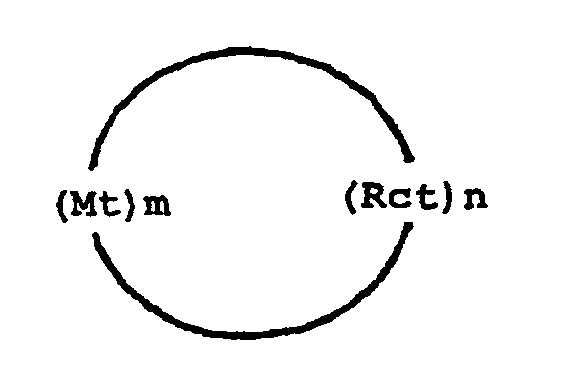
- the initiator comprises a low molecular weight ring-shaped adduct of a divalent metal with a reactant (Rct), or heterogeneous mixture of reactants, and contains one or more metal atoms (Mt) and one or more reactant units (Rct) in the ring structure, according to the formula where m and n represent each independently represent at least one.
- the reactant (Rct) may comprise any reactant that combines chemically with the metal atom to form a ring-shaped initiator, such reactants including, but not limited to, aliphatic olefins, styrene, substituted styrenes, cyclic or acyclic conjugated diolefins, including butadiene, isoprene, myrcene, ⁇ -phellandrene, or aromatic hydrocarbons, such as anthracene and naphthalene.
- reactants including, but not limited to, aliphatic olefins, styrene, substituted styrenes, cyclic or acyclic conjugated diolefins, including butadiene, isoprene, myrcene, ⁇ -phellandrene, or aromatic hydrocarbons, such as anthracene and naphthalene.
- Certain dihalo organic compounds can react via Schlenk-type equilibria to produce cyclic organometallic initiators useful in the invention.
- the metal employed in the initiator is selected from the Group IIA and IIB metals consisting of beryllium, calcium, barium, strontium, magnesium, cadmium, zinc and mercury.
- the metal is magnesium and the initiator comprises a cyclic organomagnesium compound.
- the polymerization reaction is terminated with a coupling or coupling/functionalizing agent to close the ring and form a stable macrocyclic polymer.
- the polymer is then compounded with the addition of a filler, such as silica or carbon black, or mixtures of these, in a compounding formulation to form a vulcanizable elastomeric compound.
- the anionically polymerizable monomers of the invention include, but are not limited to, unsaturated hydrocarbon monomers, such as butadiene, and isoprene, and copolymers thereof with monovinyl aromatics, such as styrene,and alpha methyl styrene or trienes, such as myrcene.
- the polymerization is carried out in the presence of a monomer randomizing agent and/or a vinyl modifier for increasing the vinyl content of the polymer.
- the invention provides a method for preparing a vulcanizable elastomeric compound having reduced hysteresis properties, the vulcanizable elastomeric compound prepared according to the method, and a tire comprising at least one component formed from the vulcanizable elastomeric compound.
- the invention also provides a method for preparing a functionalized polymer having improved hysteresis properties by polymerization of an unsaturated anionically polymerizable monomer, as above, and terminating the polymerization with a functionalizing agent. After quenching, the polymers still retain the functional group on the polymer ring.
- a functionalizing agent also serves to endcap any linear polymers present in the polymer mixture with a functional group. Provision of functional groups on polymers are known to provide for improved interaction with fillers, such as silica and carbon black, to produce vulcanizable elastomers with reduced hysteresis properties.
- the invention provides the functionalized polymer prepared according to the method of the invention, a vulcanizable elastomeric compound comprising the functionalized polymer, and a tire comprising at least one component formed from the vulcanizable elastomeric compound.
- Figure 1 is a representation of a typical Group IIA or IIB metal cyclic organometallic initiator employed for anionic polymerization in the process of the invention to produce macrocyclic polymers.
- Figure 2 is a representation of a typical cyclic organomagnesium initiator that may be employed in an embodiment of the anionic polymerization process of the invention to produce macrocyclic polymers.
- Figure 3 is a schematic representation of the mixture of linear and macrocyclic polymers that may be obtained when prepared by the process of the invention when polymerization is terminated with a coupling/functionalizing agent "X" which adds a functional group "F” to the polymer ring and endcaps linear polymers in the mixture.
- Figure 4 is a graphic illustration that compares the number average molecular weight (M n ) versus the viscous modulus (M") of cured compounds containing coupled, non-functionalized (linear + macrocyclic) and non-coupled, non-functionalized (linear) polybutadiene polymers of Example 1.
- Figure 5 is a graphic illustration that compares the nunber average molecular weight (M n ) versus the viscous modulus (M") of coupled/functionalized (linear + macrocyclic) and non-coupled, non-functionalized (linear) styrene-butadiene polymers of Examples 2 and 3.
- macrocyclic polymers can be produced by anionic polymerization of polar or non-polar monomers by using cyclic organometallic initiators containing metals of Groups IIA and IIB of the Periodic System.
- the present invention provides a method of producing vulcanizable elastomers with reduced hysteresis properties and functionalized macrocyclic polymers with improved hysteresis properties employing these initiators.
- the anionically polymerizable monomers of the present invention preferably comprise unsaturated hydrocarbon monomers, such as ethylene; conjugated alkadienes having from 4 to 40 carbon atoms, preferably C 4 -C 12 alkadienes, including butadiene and isoprene, aryl alkenes having from 8 to 20 carbon atoms, such as styrene and C 1 -C 7 alkyl or alkoxy substituted styrenes; vinyl polynuclear aromatics, such as vinyl anthracene and vinyl naphthalene and their C 1 -C 7 alkyl and alkoxy substituted analogs; C 6 -C 18 trienes; and mixtures of these.
- unsaturated hydrocarbon monomers such as ethylene
- conjugated alkadienes having from 4 to 40 carbon atoms, preferably C 4 -C 12 alkadienes, including butadiene and isoprene, aryl alkenes having from 8 to 20 carbon atoms,
- the polymerization is carried out in the presence of a monomer randomizing agent and/or a vinyl modifier for increasing the vinyl content of the polymer.
- Macrocyclic polymers formed by anionic polymerization of the above described monomers include, but are not limited to, polyethylene, polybutadiene, polyisoprene, polystyrene, poly- ⁇ -methyl styrene, polyvinylanthracene, polyvinylnaphthalene, and mixtures and copolymers of these, such as styrene butadiene rubber (SBR).
- SBR styrene butadiene rubber
- the macrocyclic copolymers formed by the process of the invention may comprise from 99 to 10 percent by weight of monomer A units and from 1 to 90 percent by weight of monomer B units.
- the copolymers may be random copolymers or block copolymers. Random copolymers result from simultaneous copolymerization of the monomers A and B with randomizing agents. Block copolymers, poly( b -B- b -A- b -B), result from the separate polymerization of the monomers forming the A and B polymers.
- the block copolymer, poly( b -styrene- b -butadiene- b -styrene) is referred to as an S-B-S triblock polymer.
- Such block copolymers are the subject of a commonly assigned application filed on the same date as this application, U.S. Patent 5,665,827.
- the Group IIA and IIB metal cyclic organometallic initiators employed in the invention are prepared according to known methods, under anhydrous, anaerobic conditions, by reacting "m” divalent metal, Mt, in the form of elemental metal or a reactive compound, such as a hydride, with "n” reactants, Rct, where m and n each independently represent at least one, according to the formula
- the metal can be in the form of elemental metal, either pure or alloyed with another, nonreactive metal, or in the form of a reactive compound, such as a metal hydride. Typically, pure metal is used.
- the metal may be activated by scraping, ultrasound or the addition of small amounts of activators, such as alkyl halides, metal alkyl halides or halogens, such as iodine.
- the reactant, Rct can be olefinic, such as alkene or alkadiene (e.g ., a C 2 -C 12 alkene or C 4 -C 40 alkadiene), or alkylene, such as styrene or styrene analogs ( e.g ., a C 8 -C 28 aralkene), polynuclear aromatic, or a dihaloorganic compound, such as an alpha, omega dihalo C 4 -C 8 alkane or a di(halomethyl) substituted aromatic, such as 1,2-di(chloromethyl) benzene or 1,8-di(bromomethyl) naphthalene.
- alkene or alkadiene e.g ., a C 2 -C 12 alkene or C 4 -C 40 alkadiene
- alkylene such as styrene or styrene analogs ( e.g ., a
- the initiator ring incorporates at least one metal atom and at least one Rct unit and generally contains at least 3, and usually a total of 5 to 50, ring member atoms.
- the larger number of ring atoms e.g ., greater than 12
- the initiator ring usually has 5 to 8 ring atoms and typically 5 to 7 ring atoms.
- the cyclic organometallic initiator thus synthesized is employed to initiate polymerization, under anhydrous, anaerobic conditions, of at least one unsaturated anionically polymerizable monomer, Mono, to form a macrocyclic polymer, as illustrated below, containing "x" monomers (Mono)x, where each x represents a degree of polymerization of one or more.
- Polymerization of a non-polar unsaturated monomer requires the presence of an activator, as discussed further below.
- the macrocyclic polymers thus produced are highly unstable in air and moisture.
- macrocyclic polymers that are stable in air and moisture and which have low hysteresis properties can be obtained if polymerization is terminated by coupling agents (Cp) that covalently close the ring structure.
- Cp coupling agents
- CpF functionalizing agents
- the reaction with a coupling/functionalizing agent may result in the metal atom remaining in the polymer ring. Alternatively, the metal atom may be removed from the ring by the reaction.
- a coupling/functionalizing agent adds a functional group to the polymer ring and also acts as an "endcapping" agent for the linear polymers by adding a functional group (F) to one or both ends (E) of the linear polymer.
- the coupling/ functionalizing agent may couple together the living ends of adjacent rings, forming macrocyclic polymer rings incorporating a plurality of single rings.
- a coupling/ functionalizing agent may couple together living ends of more than one ring, forming intermolecular coupled polymers.
- intertwining polymer chains or catenanes may be formed.
- a tetra-reactive coupling/functionalizing agent may produce a figure eight double ring.
- the macrocyclic polymers may thus be produced with high concentrations of monomers to result in quantities of macrocyclic polymers suitable for commercial applications, such as the production of vulcanizable elastomeric compounds and rubber articles, such as power belts, shock absorbers, mounts, and tires.
- a typical cyclic organometallic initiator for use in the invention is illustrated in Figure 1 and comprises a divalent metal atom Mt complexed to the carbons ( C ) of one or more reactant units contained in a ring, wherein the metal atom is selected from the group consisting of beryllium, calcium, barium, strontium, magnesium, cadmium, zinc and mercury. While a variety of Group II metals, as disclosed above, can be used to form the cyclic initiators of this invention, magnesium is preferred because of its reactivity and availability. Therefore in the following, for convenience, magnesium will be discussed with the understanding that the other metals disclosed can also be used with it or in its place, without departing from the invention.
- the cyclic organometallic initiators utilized in the invention are prepared by known methods, typically employing Grignard reagents, in the presence of a polar, aprotic solvent under anhydrous, anaerobic conditions.
- Grignard reagents typically employing Grignard reagents, in the presence of a polar, aprotic solvent under anhydrous, anaerobic conditions.
- methods for preparing barium or strontium polystyrene rings in this manner are known.
- the cyclic organometallic initiator comprises a cyclic organomagnesium compound.
- Cyclic low molecular weight adducts containing magnesium may be obtained by reacting activated magnesium metal or magnesium hydride, in the presence of a solvent, such as benzene or tetrahydrofuran (THF), with reactant such as those described above.
- a solvent such as benzene or tetrahydrofuran (THF)
- reactant hydrocarbon compounds and reaction conditions for use in preparing the magnesium-containing adducts used in this invention are disclosed in U.S. patents 3,388,179, 3,354,190 and 3,351,646.
- cyclic organomagnesium or other cyclic organometallic initiators may also be employed to prepare cyclic organomagnesium or other cyclic organometallic initiators.
- certain dihalo organic compounds can function as the reactant, Rct, and will react with magnesium via the Schlenk equilibrium to produce magnesium dihalide and a cyclic organomagnesium product suitable for use as an initiator of the invention.
- Rct reactant
- a cyclic organomagnesium product suitable for use as an initiator of the invention.
- these are the C 4 -C 8 alpha, omega alkanes and di(halomethyl) substituted aromatics described above.
- the resulting adducts may contain one or more (typically one to six) magnesium atoms and from one to 25 reactant units per magnesium atom in the ring structure.
- the rings contain a total of from 3 to 50 ring atoms, including both the metal and reactant unit ring atoms.
- Some known ring structures containing, on average, 25 members have been reported to contain five magnesium atoms; rings containing 27 members, three magnesium atoms; and larger ring structures, one magnesium atom.
- a typical initiator suitable for use in the process of the invention is a magnesium-isoprene adduct, illustrated in Figure 2, containing six isoprene units (a total of 24 ring carbon atoms) and three magnesium atoms in the ring, which results in a total of 27 ring atoms.
- larger or smaller cyclic organometallic compounds, containing more or fewer divalent metal atoms are also suitable as initiators in the process of the invention.
- a macrocyclic polymer is prepared by reacting at least one unsaturated anionically polymerizable monomer with the cyclic organometallic initiator, preferably in the presence of an anhydrous, aprotic solvent.
- activation of a metal atom in the initiator ring results in anionic polymerization of the monomers by addition (or insertion) of a monomer molecule into the initiator ring at the bonds between the metal atom and its two adjacent carbon atoms.
- the metal atom acts as a bridge between the two living "ends" of the growing cyclic polymer ring and, as monomers are continually incorporated into the ring, the terminal carbons of the two living ends of the growing polymer remain in close proximity to each other.
- the amount of initiator used in the polymerization is chosen so as to yield the desired polymer molecular weight. Typically, one part by equivalent of initiator is used to 20 to 20,000 parts by equivalent of monomer, although high ratios, such as 1:30,000, 1:40,000, 1:50,000 or more can be used.
- a coupling/ functionalizing agent is added to the mixture to terminate the reaction and couple together the living ends of the propagating cyclic polymer chain at the carbon-metal moieties, thus producing macrocyclic polymers that are stable in air and moisture and which may also contain functional groups to improve compounding properties.
- the macrocyclic polymers do not exhibit uncoupled chain ends.
- the polymerization process may produce a mixture of polymers including linear polymers having chain ends that may be either functionalized or not functionalized. It was discovered that, when compounded, the mixture of macrocyclic and linear polymers produced by the method of the invention result in products exhibiting improved hysteresis properties.
- the polymers produced by the process of the invention are believed to be a mixture of linear polymers (I) and macrocyclic polymers (II) of varying sizes.
- the resulting ratio of macrocyclic polymers to linear polymers is also variable and dependent on several factors, such as the concentration of monomers, the nature of the activator (see below) and the general reaction conditions, such as temperature and efficiency of the coupling reaction.
- the size and properties of the macrocyclic polymers formed by the process of the invention also vary according to the nature and concentration of the monomers, the ratio of the monomer to the initiator, the polymerization time, as well as the nature and reactivity of the terminating agent, which may be a coupling agent (X) or a couplingcoupling/functionalizing (X-F) agent, as described above.
- the terminating agent which may be a coupling agent (X) or a couplingcoupling/functionalizing (X-F) agent, as described above.
- X coupling agent
- X-F couplingcoupling/functionalizing
- the coupling agent may couple together living ends of more than one ring, resulting in intermolecular (4) coupling.
- intertwining polymer chains (5), or catenanes may be formed.
- Functionalizing coupling agents add a functional group (F) to the ring and also endcap linear polymers present in the mixture, as described above.
- a tetrafunctional coupling agent may produce a figure eight double ring (6).
- the reaction preferably further requires the presence of an activator which forms a complex with and activates the metal atom on the ring.
- the activator may comprise a Group IA metal organic compound which, preferably, is one that does not promote linear polymerization.
- a lithium alkoxide compound which does not promote linear polymerization is preferred over an alkyllithium compound known to promote linear polymerization.
- the activator comprises a Group I metal C 1 -C 12 alkoxide or C 1 -C 12 alkyl thiolate, such as lithium-t-butoxide or sodium amylthiolate.
- alkali metal organic compounds such as lithium amides, and potassium, sodium and lithium phosphides, may also be employed as activators.
- the reaction between organometallic compounds of Group I and Group IIA of the Periodic System are disclosed in U.S. Patent 3,822,219.
- Polar solvents or polar coordinators may also be employed to promote activation of the initiator Group IIA and IIB metal atom.
- suitable polar solvents and/or polar coordinators are described in U.S. Patent Nos. 4,429,091 and 5,272,207.
- the Group IIA and IIB cyclic organometallic initiators may be employed with any anionically-polymerizable monomer to yield polymeric products.
- the initiators are used to polymerize unsaturated hydrocarbon monomers, such as ethylene; conjugated alkadienes having from 4 to 40 carbon atoms, preferably C 4 -C 12 alkadienes, including butadiene, isoprene, and the like; aryl alkenes having from 8 to 20 carbon atoms, such as styrene and C 1 -C 7 alkyl or alkoxy substituted styrenes; vinyl polynuclear aromatics, such as vinyl anthracene and vinyl naphthalene and their C 1 -C 7 alkyl and alkoxy substituted analogs; C 6 -C 18 trienes; and mixtures of these.
- the elastomeric products include include diene homopolymers from monomer A and copolymers thereof with monovinyl aromatic monomers B.
- Exemplary diene homopolymers are those prepared from diolefin monomers having from 4 to 12 carbon atoms.
- Exemplary vinyl aromatic copolymers are those prepared from monomers having from 8 to 20 carbon atoms.
- Preferred elastomers include diene homopolymers, such as polybutadiene and polyisoprene and copolymers, such as styrene butadiene rubber (SBR).
- SBR styrene butadiene rubber
- Copolymers can comprise from 99 to 10 percent by weight of diene units and from 1 to 90 percent by weight of monovinyl aromatic or triene units, totalling 100 percent.
- the polymers and copolymers of the present invention may have 1,2-microstructure contents ranging from 8 to 100 percent, with the preferred polymers or copolymers having 1,2-microstructure contents
- Polymerization is usually conducted in a conventional solvent for anionic polymerizations, such as hexane, cyclohexane and benzene.
- a polar coordinator may optionally be added to the polymerization ingredients. Amounts of the polar coordinator range between 0.1 to 90 or more equivalents per equivalent of metal atom. The amount depends upon the type of polar coordinator that is employed, the amount of vinyl content or randomization desired, the level of co-monomer employed and the temperature of the polymerization reaction, as well as the selected initiator.
- Compounds useful as polar coordinators are organic and include, but are not limited to, tetrahydrofuran, linear and cyclic oligomeric oxolanyl alkanes such as 2-2'-di(tetrahydrofuryl) propane, di-piperidyl ethane, dimethyl ether, diazabicyclooctane, hexamethylphosphoramide, N-N'-dimethylpiperazine, diethyl ether, tributylamine and the like.
- the linear and cyclic oligomeric oxolanyl alkane polar coordinators are described in U.S. Patent No. 4,429,091.
- other polar solvents and coordinators are described in U.S. Patent No.
- polar coordinators include those having an oxygen or nitrogen hetero-atom and a non-bonded pair of electrons.
- examples include dialkyl ethers of mono and oligo alkylene glycols; "crown" ethers; and tertiary diamines, such as tetramethylethylene diamine (TMEDA).
- polymerization is begun by charging a blend of the monomer(s) and solvent to a suitable reaction vessel, followed by the addition of a Group IA metal organic compound or other activating agent and the cyclic organometallic initiator.
- the polymerization reaction is carried out under anhydrous, anaerobic conditions. Often, it is conducted under a dry, inert gas atmosphere.
- the polymerization can be carried out at any convenient temperature, such as -30°C to 200°C. For batch polymerizations, it is preferred to maintain the peak temperature at from 49°C to 149°C, and more preferably from 80°C to 120°C. Polymerization is allowed to continue under agitation for 0.15 to 24 hours.
- the product is terminated by a coupling agent or a coupling agent that is also a functionalizing agent to obtain a macrocyclic polymer.
- termination of the polymerization reaction with a coupling agent serves to couple the living ends of the polymer chains together to form intramolecular or intermolecular polymer rings that are stable in air and moisture.
- the resulting macrocyclic polymers do not exhibit uncoupled chain ends which are known to increase hysteresis.
- the macrocyclic polymers of this invention have molecular weights ranging from 2,000 to 1,000,000 or even 1.5 - 3.0x10 6 . Typically they have molecular weights of 30,000 to 600,000 as measured by conventional gel permeation chromatographic (GPC) techniques.
- Quenching with functionalizing agents couples together the macrocycle chain ends and also provides functional groups. After quenching, the polymers still retain the functional group on the polymer ring.
- the use of a functionalizing agent also serves to endcap any linear polymers present in the polymer mixture with a functional group. Any compounds providing terminal functionality (e.g ., "endcapping") of the linear polymers and that are reactive with the macrocyclic polymer bound carbon-metal moieties can be selected to provide a desired functional group.
- Functionalizing agents are particularly preferred in the process of the invention because the functional group promotes uniform and homogeneous compounding with fillers, such as silica and carbon black.
- the polymerization reaction may be terminated with a protic quenching agent, such as water, steam or an alcohol, such as isopropanol, that does not couple the living ends of the macrocyclic polymer but produces a linear, non-functionalized polymer.
- a protic quenching agent such as water, steam or an alcohol, such as isopropanol
- the terminating agent is added to the reaction vessel, and the vessel is agitated for 0.1 to 4.0 hours. Quenching is usually conducted by stirring the polymer and quenching agent for 0.25 hours to 1.0 hour at temperatures of from 30°C to 120°C to ensure a complete reaction.
- solvent is removed from the polymer by conventional techniques. These include steam or alcohol coagulation, thermal desolventization, or any other suitable method. Additionally, solvent may be removed by drum drying, extruder drying, vacuum drying or the like. Desolventization by drum-drying, coagulation in alcohol, steam or hot water desolventization, extruder drying, vacuum drying, spray drying, and combinations thereof are preferred.
- An antioxidant such as butylated hydroxy toluene (BHT) and/or an antiozonant compound is usually added to the polymer or polymer cement at or before this stage to prevent degradation of the polymer.
- BHT butylated hydroxy toluene
- an antiozonant compound is usually added to the polymer or polymer cement at or before this stage to prevent degradation of the polymer.
- Exemplary coupling agents are ortho-dichloro-xylene (ODX), di (C 1 -C 8 alkyl) silicon dichloride, silicon tetrachloride, di (C 1 -C 8 alkyl) benzoate, esters, diesters, triesters, dihalo organics, hexachloroxylene, and mixtures of these.
- ODX ortho-dichloro-xylene
- di (C 1 -C 8 alkyl) silicon dichloride silicon tetrachloride
- di (C 1 -C 8 alkyl) benzoate esters, diesters, triesters, dihalo organics, hexachloroxylene, and mixtures of these.
- Exemplary functionalizing agents are substituted aldimines, substituted ketimines, 4,4'-bis(dimethylamino)-benzophenone, 1,3-dimethyl-2-imidazolidinone, 1-alkyl substituted pyrrolidinones, 1-aryl substituted pyrrolidinones, dimethylamino benzaldehyde, tin tetrachloride, di(C 1 -C 8 alkyl) tin dichloride, tri(C 1 -C 8 alkyl) tin chloride, carbon dioxide, and mixtures of these.
- Further examples of reactive compounds include the terminators described in U.S. Patent No. 5,066,729 and U.S. Patent No. 5,521,309. The practice of the present invention is not limited solely to these terminators, since other compounds that are reactive with the polymer bound carbon-metal moieties can be selected to provide a desired functional group.
- Termination with ODX (1) results in a macrocyclic polymer containing a benzene ring.
- Termination with dimethylamino benzaldehyde (DMAB) (2) results in a macrocyclic polymer having at least two dimethylaminobenzyl functional groups.
- DMAB termination the metal atom (in this embodiment, magnesium) remains as a ring constituent.
- the polymers according to the present invention have at least 40 percent tin coupling.
- macrocyclic polymers can be produced by the process of the present invention.
- the macrocyclic polymers produced according to the invention exhibit desirable properties, such as lower viscosities at equivalent molecular weights.
- high or low molecular weight macrocyclic polymers may be used during polymer compounding processes and manageable compound viscosities are still obtained.
- the polymers of the present invention contain a functional group attached to the macrocyclic polymer ring and at each end of any linear polymer formed by the process of the invention.
- These functional groups have an affinity for compounding filler materials such as silica or carbon black.
- Such compounding results in products, such as tires, shock absorbers, mounts and power belts and exhibiting reduced hysteresis, which means a product having increased rebound, decreased rolling resistance and lessened heat build-up when subjected to mechanical stress. Decreased rolling resistance is, of course, a useful property for pneumatic tires, both radial as well as bias ply types and thus, the vulcanizable elastomeric compositions of the present invention can be utilized to form treadstocks for such tires.
- the polymers of the invention can be used alone or in combination with other elastomers to prepare an elastomer product such as a tire treadstock, sidewall stock or other tire component stock compound.
- an elastomer product such as a tire treadstock, sidewall stock or other tire component stock compound.
- at least one such component is produced from a vulcanizable elastomer or rubber composition.
- the polymers according to the invention can be blended with any conventionally employed treadstock rubber which includes natural rubber, synthetic rubber and blends thereof.
- Such rubbers are well known to those skilled in the art and include synthetic polyisoprene rubber, styrene/butadiene rubber (SBR), polybutadiene, butyl rubber, Neoprene, ethylene/propylene rubber, ethylene/propylene/diene rubber (EPDM), acrylonitrile/butadiene rubber (NBR), silicone rubber, the fluoroelastomers, ethylene acrylic rubber, ethylene vinyl acetate copolymer (EVA), epichlorohydrin rubbers, chlorinated polyethylene rubbers, chlorosulfonated polyethylene rubbers, hydrogenated nitrile rubber, tetrafluoroethylene/propylene and rubber.
- the amounts can very widely such as between 0-80 percent by weight of the conventional rubber with from 100-20 percent by weight of the invention polymer.
- the polymers can be compounded with all forms of carbon black in amounts ranging from 5 to 80 parts by weight, per 100 parts of rubber (phr), with 35 to 60 phr being preferred.
- the carbon blacks may include any of the commonly available, commercially-produced carbon blacks. Examples of preferred carbon black compounds are described in U.S. Patent 5,521,309. Silica can be used in place of all or part of the carbon black. Preferably, the silica is used in conjunction with a coupling agent, such as silane, by known methods.
- the reinforced rubber compounds can be cured in a conventional manner with known vulcanizing agents at about 0.1 to 10 phr.
- suitable vulcanizing agents one can refer to Kirk-Othmer, Encyclopedia of Chemical Technology , 3rd ed., Wiley Interscience, N.Y. 1982, Vol. 20, pp. 365-468, particularly "Vulcanization Agents and Auxiliary Materials", pp. 390-402. Vulcanizing agents can be used alone or in combination.
- Vulcanizable elastomeric compositions of the invention can be prepared by compounding or mixing the functionalized polymers herein with carbon black and other conventional rubber additives including, for example, fillers, such as silica, plasticizers, antioxidants and curing agents, using standard rubber mixing equipment and procedures.
- fillers such as silica, plasticizers, antioxidants and curing agents
- Such elastomeric compositions when vulcanized using conventional rubber vulcanization conditions, have reduced hysteresis properties and are particularly adapted for use as tread rubbers for tires having reduced rolling resistance.
- a cyclic organomagnesium initiator was prepared. This initiator was than used to polymerize a solution of butadiene monomers or butadiene and styrene monomers. A comparison was made of properties of the resulting polymer or elastomer, when the polymerization was terminated with a protic terminating agent, a coupling agent, or a functionalizing agent.
- initiator and coupling/functionalizing agents are intended to be only examples of initiators and coupling/functionalizing agents that may be used in the process of the invention, and their particular use is not intended to be limiting, as any cyclic organometallic initiator and coupling/functionalizing agents may be utilized by those skilled in the art.
- IMG isoprene-magnesium
- IMG Isoprene-Magnesium Initiator
- the total magnesium concentration was determined by acid titration of the hydrolyzed initiator.
- the activity of the IMG for polymerization was determined by polymerizing 1,3-butadiene in hexane at three concentrations of added IMG in the presence of lithium-t-butoxide. Linear least squares analysis of molecular weight data and correction for impurities allows calculation of the concentration of active IMG.
- Each of the following polymers was prepared in a purged, oxygen-free one gallon stainless steel reactor.
- the monomers and solvents had been dried to approximately 5 parts per million (ppm) of water.
- Two further isopropanol-terminated polymers were prepared in the same manner as the uncoupled polymer described above, except that 3.5 mM IMG and 3.0 mM IMG, respectively, were employed.
- Two further coupled polymers were prepared in the same manner as the coupled polymer described above, except that one of these polymers was prepared with 3.5 mM IMG and coupled with 3.5 mM dimethyl silicon dichloride; whereas the second polymer was prepared with 3.0 mM IMG and coupled with 3.0 mM of dimethyl silicon dichloride.
- the molecular weight of the polybutadiene increased as the amount of IMG decreased.
- Polymers were prepared in a similar manner as those of Example 2, except that 3 mM of the chelating modifier, bis-oxolanyl propane was added to the polymerization mixture to increase the vinyl content of the polymer chains. Polymerization was allowed to proceed for 2.5 hours at 65°C to 95°C. Portions of the resulting viscous polymer solution were terminated with the protic solvent isopropanol, one equivalent of the coupling agent dibutyl tin dichloride, or two equivalents of the functionalizing agent dimethylamino benzaldehyde (DMAB).
- DMAB functionalizing agent dimethylamino benzaldehyde
- the refractive index of each polymer of Example 1 was measured as an indication of vinyl content.
- Each of the polymers of Example 1 was shown to have a vinyl content of approximately 50%.
- the vinyl and styrene content of each polymer of Examples 2 and 3 were measured by proton nuclear magnetic resonance.
- the polymers of Example 2 had a vinyl content of 29% and a styrene content of 18.5% and the polymers of Example 3 had a vinyl content of 56-67% and a styrene content of 20-25%.
- the average molecular weight (M n ) of each polymer of Examples 1, 2 and 3 was determined by gel permeation chromatography. Each of the polymers was then compounded in a standard test formulation shown in Table I and cured for 30 minutes at 160°C. This formulation yields low tan deltas and, therefore, is especially valuable for comparing hysteresis of different polymers, as described below. All of the compound mixes were prepared in a small Brabender mixer. The viscous modulus M" (at 50°C and 1 Hz) of each of the cured stocks was obtained. Compound Mooney values were also determined for the styrene-butadiene copolymers of Examples 2 and 3.
- Tan delta is a measure of the ratio of the loss modulus of the compound to the storage modulus and it has been found that the lower the magnitude of tan delta, the lower is the hysteresis of the compound.
- the viscous moduli of the polymers of Examples 1, 2 and 3 were also determined. The viscous modulus is indicative of hysteresis properties, a lower viscous modulus indicating fewer uncoupled chain ends and, therefore, reduced hysteresis when compounded.
- polymers terminated with isopropanol are linear polymers that do not contain functional end groups.
- Polymers terminated with tributyl tin chloride are linear polymers endcapped with a tributyl tin group.
- Polymers terminated with the coupling/functionalizing agents dibutyl tin dichloride or dimethylamino benzaldehyde are a mixture of functionalized macrocyclic and functionalized linear polymers containing functional dibutyl tin or amino groups, respectively.
- Terminator isopropanol Bu 3 SnCl Bu 2 SnCl2 M n 139,900 134,500 176,600 Compound Mooney 42 64 93 M" @ 50°C 1.832 0.8050 0.7902 Tan Delta @ 50°C 0.208 0.141 0.132
- Terminator isopropanol DMAB Bu 2 SnCl 2 M n 122,800 116,300 193,800 Compound Mooney 35 24 61 M" @ 50°C 2.260 0.606 0.696 Tan Delta @ 50°C 0.245 0.161 0.122
- the macrocyclic polymers prepared with Group IIA and IIB cyclic organometallic initiators, by the method of the invention exhibit reduced hysteresis properties.
- vulcanizable elastomeric compounds containing these polymers exhibit improved hysteresis, which provides lower rolling resistance in tires and improved fuel economy.
- the invention is not limited to the specific reactants, Group IIA and IIB cyclic organometallic initiators and Group IA metal organic compounds disclosed, nor to any particular polar coordinator, solvent or other modifier.
- the examples have been provided merely to demonstrate the practice of the subject invention and do not constitute limitations of the invention.
- Those skilled in the art may readily select other monomers and process conditions, according to the disclosure made herein above.
- any of the variables disclosed herein can readily be determined and controlled without departing from the scope of the invention herein disclosed and described.
- the scope of the invention shall include all modifications and variations that fall within the scope of the attached claims.
Landscapes
- Chemical & Material Sciences (AREA)
- Organic Chemistry (AREA)
- Health & Medical Sciences (AREA)
- Chemical Kinetics & Catalysis (AREA)
- Medicinal Chemistry (AREA)
- Polymers & Plastics (AREA)
- General Chemical & Material Sciences (AREA)
- Engineering & Computer Science (AREA)
- Materials Engineering (AREA)
- Addition Polymer Or Copolymer, Post-Treatments, Or Chemical Modifications (AREA)
- Polymerization Catalysts (AREA)
- Tires In General (AREA)
- Compositions Of Macromolecular Compounds (AREA)
- Other Resins Obtained By Reactions Not Involving Carbon-To-Carbon Unsaturated Bonds (AREA)
Claims (27)
- Procédé pour la préparation d'un composé élastomère vulcanisable présentant des propriétés d'hystérésis réduites, comprenant les étapes consistant :à former une solution d'un ou plusieurs monomères anioniquement polymérisables insaturés dans un solvantà polymériser le monomère en présence d'un initiateur comprenant un composé organométallique cyclique qui comprend un atome de métal divalent (Mt) et un corps réactionnel (Rct) présents dans un noyau, répondant à la formuledans lequel m et n sont chacun indépendamment égaux à au moins un ;
à interrompre la réaction de polymérisation avec un agent de couplage; et
à ajouter une quantité de 5 à 80 parties en poids d'une charge choisie dans le groupe consistant en la silice, le noir de carbone et leurs mélanges, pour former un composé élastomère vulcanisable. - Procédé suivant la revendication 1, dans lequel l'atome de métal est choisi dans le groupe consistant en le béryllium, le calcium, le baryum, le strontium, le magnésium, le cadmium, le zinc et le mercure.
- Procédé suivant la revendication 1, dans lequel le corps réactionnel, Rct, est choisi dans le groupe consistant en des alcènes de C2 à C12, des alkylènes en C8 à C28, des alcadiènes conjugués en C4 à C40, des composés aromatiques polycycliques, des composés dihalogéno-organiques et leurs mélanges, et dans lequel m et n ont chacun indépendamment une valeur de 1 à 6 et le nombre total d'atomes dans le noyau va de 5 à 50 atomes.
- Procédé suivant la revendication 1, dans lequel l'initiateur comprend un composé organique de magnésium cyclique.
- Procédé suivant la revendication 1, dans lequel la réaction est conduite en présence d'un activateur choisi dans le groupe consistant en un composé organique métallique comprenant un métal choisi dans le groupe consistant en le lithium, le sodium, le potassium, le rubidium, le césium et leurs mélanges ; d'un solvant polaire ; d'un coordinateur polaire ; et de leurs mélanges.
- Procédé suivant la revendication 1, dans lequel le monomère anioniquement polymérisable est choisi dans le groupe consistant en l'éthylène, des monomères alcadiène conjugués ayant 4 à 40 atomes de carbone, des monomères arylalcène ayant 8 à 20 atomes de carbone, des monomères aromatiques polycycliques vinyliques, des triènes en C6 à C18, et leurs mélanges.
- Procédé suivant la revendication 1, dans lequel l'atome de métal, Mt, est le magnésium, le corps réactionnel, Rct, est choisi entre le butadiène, l'isoprène, le styrène et leurs mélanges, n a une valeur de 1 à 3, m a une valeur de 1 à 6 et le monomère est choisi dans le groupe consistant en l'éthylène, des alcadiènes conjugués en C4 à C12, des arylalcènes en C8 à C20 et leurs mélanges.
- Procédé suivant la revendication 1, dans lequel le solvant est anhydre et aprotique.
- Procédé suivant la revendication 1, dans lequel la réaction de polymérisation est conduite en présence d'un agent de randomisation des monomères.
- Procédé suivant la revendication 1, dans lequel le monomère comprend un diène et la réaction de polymérisation est conduite en présence d'un agent choisi entre un agent de randomisation des monomères et un modificateur de groupes vinyle pour augmenter la teneur en groupes vinyle de l'élastomère, et leurs mélanges.
- Procédé suivant la revendication 1, dans lequel l'agent de couplage est choisi dans le groupe consistant en des aldimines substituées, des cétimines substituées, la 4,4'-bis(diméthylamino)-benzophénone, la 1,3-diméthyl-2-imidazolidinone, des pyrrolidinones à substituant 1-alkyle, des pyrrolidinones à substituant 1-aryle, le tétrachlorure d'étain, le dichlorure de di(alkyle en C1 à C8)-étain, le dioxyde de carbone, l'ortho-dichloro-xylène, des esters, des diesters, des triesters, des composés dihalogéno-organiques, le diméthylamino-benzaldéhyde, le dichlorure de di(alkyle en C1 à C8)-silicium, le tétrachlorure de silicium, un benzoate d'alkyle en C1 à C8, l'hexachloroxylène et leurs mélanges.
- Procédé suivant la revendication 1, dans lequel l'agent de couplage est également un agent de fonctionnalisation.
- Composé élastomère vulcanisable ayant des propriétés d'hystérésis réduites, préparé par le procédé suivant la revendication 1.
- Bandage pneumatique comprenant au moins un composant formé à partir du composé élastomère vulcanisable suivant la revendication 13.
- Bandage pneumatique suivant la revendication 14, qui présente des propriétés d'hystérésis améliorées.
- Procédé pour la préparation d'un polymère macrocyclique fonctionnalisé ayant des propriétés d'hystérésis améliorées, le polymère étant formé par polymérisation d'au moins un monomère anioniquement polymérisable insaturé en présence d'un initiateur de polymérisation anionique comprenant un composé organométallique cyclique qui comprend un atome de métal divalent (Mt) et un corps réactionnel (Rct) présents dans un noyau, répondant à la formuledans laquelle m et n sont chacun individuellement égaux à au moins un, ledit procédé comprenant la terminaison de la polymérisation avec un agent de fonctionnalisation.

- Procédé suivant la revendication 16, dans lequel l'initiateur comprend un composé d'organomagnésium cyclique.
- Procédé suivant la revendication 16, dans lequel la réaction est conduite en présence d'un activateur choisi dans le groupe consistant en un composé organique métallique comprenant un métal choisi dans le groupe consistant en le lithium, le sodium, le potassium, le rubidium, le césium et leurs mélanges ; d'un solvant polaire ; d'un coordinateur polaire ; et de leurs mélanges.
- Procédé suivant la revendication 16, dans lequel le solvant est un solvant anhydre et aprotique.
- Procédé suivant la revendication 16, dans lequel la réaction de polymérisation est conduite en présence d'un agent de randomisation des monomères.
- Procédé suivant la revendication 16, dans lequel le monomère comprend un diène et la réaction de polymérisation est conduite en présence d'un agent choisi entre un agent de randomisation des monomères et un modificateur de groupes vinyle pour augmenter la teneur en groupes vinyle de l'élastomère, et leurs mélanges.
- Procédé suivant la revendication 16, dans lequel l'agent de fonctionnalisation est choisi entre des aldimines substituées, des cétimines substituées, la 4,4'-bis(diméthylamino)-benzophénone, la 1,3-diméthyl-2-imidazolidinone, des pyrrolidinones à substituant 1-alkyle, des pyrrolidinones à substituant 1-aryle, le diméthylamino-benzaldéhyde, le tétrachlorure d'étain, le dichlorure de di(alkyle en C1 à C8) étain, le chlorure de tri(alkyle en C1 à C8)étain, le dioxyde de carbone et leurs mélanges.
- Polymère fonctionnalisé ayant des propriétés d'hystérésis réduites, préparé par le procédé suivant la revendication 16.
- Polymère fonctionnalisé suivant la revendication 23, qui comprend un mélange de polymères macrocycliques et linéaires à coiffe terminale fonctionnalisés.
- Composé élastomère vulcanisable ayant des propriétés d'hystérésis réduites, comprenant le polymère fonctionnalisé préparé par le procédé suivant la revendication 21 ou 22 et 5 à 80 parties en poids d'une charge pour 100 parties du polymère, dans lequel la charge est choisie dans le groupe consistant en la silice, le noir de carbone et leurs mélanges.
- Bandage pneumatique comprenant au moins un composant formé à partir du composé élastomère vulcanisable suivant la revendication 25.
- Bandage pneumatique suivant la revendication 26, qui présente des propriétés d'hystérésis améliorées.
Applications Claiming Priority (2)
| Application Number | Priority Date | Filing Date | Title |
|---|---|---|---|
| US743779 | 1996-11-07 | ||
| US08/743,779 US5700888A (en) | 1996-11-07 | 1996-11-07 | Synthesis of macrocyclic polymers having low hysteresis compounded properties |
Publications (2)
| Publication Number | Publication Date |
|---|---|
| EP0841368A1 EP0841368A1 (fr) | 1998-05-13 |
| EP0841368B1 true EP0841368B1 (fr) | 2003-03-26 |
Family
ID=24990130
Family Applications (1)
| Application Number | Title | Priority Date | Filing Date |
|---|---|---|---|
| EP97117842A Expired - Lifetime EP0841368B1 (fr) | 1996-11-07 | 1997-10-15 | Préparation de polymères macrocycliques à basse hystérèse |
Country Status (6)
| Country | Link |
|---|---|
| US (2) | US5700888A (fr) |
| EP (1) | EP0841368B1 (fr) |
| JP (1) | JPH10237120A (fr) |
| CA (1) | CA2219715C (fr) |
| DE (1) | DE69720138T2 (fr) |
| ES (1) | ES2195066T3 (fr) |
Families Citing this family (33)
| Publication number | Priority date | Publication date | Assignee | Title |
|---|---|---|---|---|
| US6455651B1 (en) | 1999-04-23 | 2002-09-24 | Kraton Polymers U.S. Llc | Uniform initiation of anionic polymerization using organo-substituted alkali metal initiators |
| US6391981B1 (en) | 1999-04-23 | 2002-05-21 | Kraton Polymers Us Llc | Increased throughput in the manufacture of anionic polymers by reduction in polymer cement viscosity through the addition of metal alkyls |
| US6489403B1 (en) * | 1999-12-14 | 2002-12-03 | The Goodyear Tire & Rubber Company | Process for improved coupling of rubbery polymers |
| US7151143B2 (en) | 2000-01-21 | 2006-12-19 | Cyclics Corporation | Blends containing macrocyclic polyester oligomer and high molecular weight polymer |
| US7256241B2 (en) | 2000-01-21 | 2007-08-14 | Cyclics Corporation | Methods for polymerizing macrocyclic polyester oligomers using catalyst promoters |
| US6420047B2 (en) * | 2000-01-21 | 2002-07-16 | Cyclics Corporation | Macrocyclic polyester oligomers and processes for polymerizing the same |
| US6906147B2 (en) | 2002-03-20 | 2005-06-14 | Cyclics Corporation | Catalytic systems |
| US6369157B1 (en) | 2000-01-21 | 2002-04-09 | Cyclics Corporation | Blend material including macrocyclic polyester oligomers and processes for polymerizing the same |
| US6960626B2 (en) | 2000-01-21 | 2005-11-01 | Cyclics Corporation | Intimate physical mixtures containing macrocyclic polyester oligomer and filler |
| US20020198343A1 (en) * | 2000-03-14 | 2002-12-26 | Willis Carl Lesley | Uniform initiation of anionic polymerization using organo-substituted alkali metal initiators |
| US6451935B1 (en) * | 2000-05-10 | 2002-09-17 | Bridgestone Corporation | Highly functionalized polymers and a process for making the same |
| US7750109B2 (en) | 2000-09-01 | 2010-07-06 | Cyclics Corporation | Use of a residual oligomer recyclate in the production of macrocyclic polyester oligomer |
| AU2001288663A1 (en) | 2000-09-01 | 2002-03-13 | Cyclics Corporation | Methods for converting linear polyesters to macrocyclic oligoester compositions and macrocyclic oligoesters |
| US7767781B2 (en) | 2000-09-01 | 2010-08-03 | Cyclics Corporation | Preparation of low-acid polyalkylene terephthalate and preparation of macrocyclic polyester oligomer therefrom |
| US6436548B1 (en) | 2000-09-12 | 2002-08-20 | Cyclics Corporation | Species modification in macrocyclic polyester oligomers, and compositions prepared thereby |
| US6420048B1 (en) | 2001-06-05 | 2002-07-16 | Cyclics Corporation | High molecular weight copolyesters from macrocyclic oligoesters and cyclic esters |
| US7304123B2 (en) | 2001-06-27 | 2007-12-04 | Cyclics Corporation | Processes for shaping macrocyclic oligoesters |
| JP2005515965A (ja) | 2001-06-27 | 2005-06-02 | サイクリクス コーポレイション | 大環状オリゴエステルの単離、処方、および成形 |
| US6436549B1 (en) | 2001-07-16 | 2002-08-20 | Cyclics Corporation | Block copolymers from macrocyclic oligoesters and dihydroxyl-functionalized polymers |
| US6787632B2 (en) | 2001-10-09 | 2004-09-07 | Cyclics Corporation | Organo-titanate catalysts for preparing pure macrocyclic oligoesters |
| US6596798B1 (en) * | 2001-11-05 | 2003-07-22 | Bridgestone Corporation | Preparation of low hysteresis rubber by reacting a lithium polymer with oxazoline compounds |
| US6831138B2 (en) | 2002-01-07 | 2004-12-14 | Cyclics Corporation | Polymer-containing organo-metal catalysts |
| JP4368303B2 (ja) * | 2002-07-11 | 2009-11-18 | クレイトン・ポリマーズ・リサーチ・ベー・ベー | カップリングしたスチレン性ブロックコポリマーおよびそれを調製する方法 |
| US7723440B2 (en) | 2002-08-30 | 2010-05-25 | Bridgestone Corporation | Functionalized polymers and improved vulcanizates therefrom |
| US6962968B2 (en) | 2002-12-20 | 2005-11-08 | Cyclics Corporation | Purification of macrocyclic oligoesters |
| US7076891B2 (en) * | 2003-11-12 | 2006-07-18 | Nike, Inc. | Flexible fluid-filled bladder for an article of footwear |
| US7517202B2 (en) * | 2005-01-12 | 2009-04-14 | Smith International, Inc. | Multiple elastomer layer progressing cavity stators |
| KR20070103384A (ko) * | 2005-01-14 | 2007-10-23 | 화이어스톤 폴리머스, 엘엘씨 | 블록 공중합체의 응집 억제방법 |
| US7335706B1 (en) | 2007-03-05 | 2008-02-26 | The Goodyear Tire & Rubber Company | Method of making alkoxy functionalized rubbery polymers |
| FR2946048B1 (fr) * | 2009-06-02 | 2012-12-28 | Michelin Soc Tech | Systeme catalytique pour la polymerisation de dienes conjugues,procede de polymerisation et polymere fonctionnel obtenu |
| US9393648B2 (en) | 2010-03-30 | 2016-07-19 | Smith International Inc. | Undercut stator for a positive displacment motor |
| JP2011105946A (ja) * | 2011-01-11 | 2011-06-02 | Sumitomo Rubber Ind Ltd | ポリカテナン構造を有する弾性重合体組成物 |
| US9233364B2 (en) * | 2012-04-25 | 2016-01-12 | University Of Florida Research Foundation, Inc. | Multimetallic assembly, methods of making multimetallic assembly, methods of oxidizing water, methods of O-atom transfer catalysts, and methods of carbon dioxide reduction |
Family Cites Families (22)
| Publication number | Priority date | Publication date | Assignee | Title |
|---|---|---|---|---|
| US3766091A (en) * | 1960-03-31 | 1973-10-16 | Hercules Inc | Modified organomagnesium catalyst compositions |
| US3351646A (en) * | 1965-01-04 | 1967-11-07 | Exxon Research Engineering Co | Magnesium and tin derivatives of styrenes and the preparation thereof |
| US3354190A (en) * | 1965-01-04 | 1967-11-21 | Exxon Research Engineering Co | Magnesium and tin derivatives of fusedring hydrocarbons and the preparation thereof |
| US3388179A (en) * | 1965-01-04 | 1968-06-11 | Exxon Research Engineering Co | Organomagnesium addition compounds, process therefor, and derivatives thereof |
| US3822219A (en) * | 1970-07-23 | 1974-07-02 | Gulf Resources & Chem Corp | Catalyst composition |
| US3726933A (en) * | 1971-01-18 | 1973-04-10 | Gen Tire & Rubber Co | Alkaline earth metal organometallic compounds and method for making the same |
| US4116887A (en) * | 1972-10-03 | 1978-09-26 | Societe Nationale Des Poudres Et Explosifs | Antionic polymerization |
| US4139490A (en) * | 1977-11-07 | 1979-02-13 | The Firestone Tire & Rubber Company | Dehydrocarbyl magnesium and an alkali metal compound catalyst composition for polymerizing conjugated dienes |
| DE2941048A1 (de) * | 1979-10-10 | 1981-04-23 | Schering Ag, 1000 Berlin Und 4619 Bergkamen | Verfahren zur herstellung von organomagnesiumalkoxiden |
| US4401800A (en) * | 1982-06-14 | 1983-08-30 | The Firestone Tire & Rubber Company | Lithium alkoxide diamines as modifiers for polymerization of dienes using lithium-based initiators |
| US4429091A (en) * | 1983-03-09 | 1984-01-31 | The Firestone Tire & Rubber Company | Oligomeric oxolanyl alkanes as modifiers for polymerization of dienes using lithium-based initiators |
| US4520123A (en) * | 1984-07-02 | 1985-05-28 | The Firestone Tire & Rubber Company | Catalyst system and process for polymerizing conjugated dienes |
| US4672097A (en) * | 1986-03-25 | 1987-06-09 | The Firestone Tire & Rubber Company | Process and system for preparing random copolymers having low vinyl contents |
| JPS63297438A (ja) * | 1987-05-28 | 1988-12-05 | Toyo Tire & Rubber Co Ltd | タイヤトレッド用ゴム組成物 |
| US4935471A (en) * | 1987-10-15 | 1990-06-19 | The Goodyear Tire & Rubber Company | Capped polydienes |
| US5066729A (en) * | 1990-04-09 | 1991-11-19 | Bridgestone/Firestone, Inc. | Diene polymers and copolymers terminated by reaction with n-alkyl and n-aryl imines |
| US5268413A (en) * | 1990-04-09 | 1993-12-07 | Bridgestone/Firestone, Inc. | Elastomers and products having reduced hysteresis |
| US5268439A (en) * | 1991-01-02 | 1993-12-07 | Bridgestone/Firestone, Inc. | Tin containing elastomers and products having reduced hysteresis properties |
| US5523371A (en) * | 1991-12-30 | 1996-06-04 | Bridgestone Corporation | Functionalized polymer of improved hysteresis properties prepared using amino-substituted aryllithium polymerization initiators |
| US5272207A (en) * | 1992-01-31 | 1993-12-21 | Bridgestone Corporation | Process for continuously producing cyclicly tapered SBR-type copolymers |
| FR2722505B1 (fr) * | 1994-07-15 | 1996-09-27 | Michelin & Cie | Compositions elastomeres chargees a la silice utilisables pour des enveloppes de pneumatiques |
| US5521309A (en) * | 1994-12-23 | 1996-05-28 | Bridgestone Corporation | Tertiary-amino allyl-or xylyl-lithium initiators and method of preparing same |
-
1996
- 1996-11-07 US US08/743,779 patent/US5700888A/en not_active Expired - Lifetime
-
1997
- 1997-09-29 US US08/939,287 patent/US5936029A/en not_active Expired - Lifetime
- 1997-10-15 ES ES97117842T patent/ES2195066T3/es not_active Expired - Lifetime
- 1997-10-15 EP EP97117842A patent/EP0841368B1/fr not_active Expired - Lifetime
- 1997-10-15 DE DE69720138T patent/DE69720138T2/de not_active Expired - Lifetime
- 1997-10-29 CA CA002219715A patent/CA2219715C/fr not_active Expired - Fee Related
- 1997-10-29 JP JP9311562A patent/JPH10237120A/ja active Pending
Also Published As
| Publication number | Publication date |
|---|---|
| US5936029A (en) | 1999-08-10 |
| DE69720138T2 (de) | 2003-09-11 |
| CA2219715A1 (fr) | 1998-05-07 |
| DE69720138D1 (de) | 2003-04-30 |
| US5700888A (en) | 1997-12-23 |
| JPH10237120A (ja) | 1998-09-08 |
| ES2195066T3 (es) | 2003-12-01 |
| CA2219715C (fr) | 2006-05-23 |
| EP0841368A1 (fr) | 1998-05-13 |
Similar Documents
| Publication | Publication Date | Title |
|---|---|---|
| US5700888A (en) | Synthesis of macrocyclic polymers having low hysteresis compounded properties | |
| US5610227A (en) | Lithium amino magnesiate polymerization initiators and elastomers having reduced hysteresis | |
| CA2058562C (fr) | Etain contenant des elastomeres et produits a proprietes d'hysteresis reduites | |
| JP3735149B2 (ja) | アリル−およびキシリル−アミン含有エラストマーおよび減じられたヒステリシスを有する生成物 | |
| EP0590490B1 (fr) | Amorçeurs de polymérisation anionique solubilisés et produits en résultant | |
| EP0600208B1 (fr) | Amorçeurs de polymérisation anionic solubles et produits obtenus | |
| JP3544691B2 (ja) | 可溶性アニオン重合開始剤及びそれらからの生成物 | |
| EP0451603B1 (fr) | Elastomères et produits à basse hystérésis | |
| US5420219A (en) | Low-hysteresis elastomer compositions using amino-substituted aryllithium polymerization initiators | |
| EP0841347B1 (fr) | Préparation de polymères macrocycliques avec des initiateurs organométalliques de métaux de groupe IIA et IIB | |
| EP0626278B1 (fr) | Amorçeurs de polymérisation anionique solubilisés et produits en résultant | |
| JPH08311135A (ja) | アミノ−置換アリールリチウム重合開始剤を用いた低−ヒステリシスエラストマー組成物 | |
| EP0841356B1 (fr) | Préparation de polymères multiséquencés en utilisant des initiateurs organométalliques des métaux des groupes IIA et IIB | |
| JP2712622B2 (ja) | 共役ジエン系重合体の製造方法 | |
| JPH08311298A (ja) | アミノ−置換アリールリチウム重合開始剤を用いた低−ヒステリシスエラストマー組成物 | |
| JP2712612B2 (ja) | 共役ジエン系重合体の製造方法 | |
| JPH0689178B2 (ja) | カーカス用ゴム組成物 |
Legal Events
| Date | Code | Title | Description |
|---|---|---|---|
| PUAI | Public reference made under article 153(3) epc to a published international application that has entered the european phase |
Free format text: ORIGINAL CODE: 0009012 |
|
| AK | Designated contracting states |
Kind code of ref document: A1 Designated state(s): DE ES FR GB IT |
|
| 17P | Request for examination filed |
Effective date: 19981105 |
|
| AKX | Designation fees paid |
Free format text: DE ES FR GB IT |
|
| RBV | Designated contracting states (corrected) |
Designated state(s): DE ES FR GB IT |
|
| 17Q | First examination report despatched |
Effective date: 20010206 |
|
| GRAH | Despatch of communication of intention to grant a patent |
Free format text: ORIGINAL CODE: EPIDOS IGRA |
|
| GRAA | (expected) grant |
Free format text: ORIGINAL CODE: 0009210 |
|
| AK | Designated contracting states |
Designated state(s): DE ES FR GB IT |
|
| REG | Reference to a national code |
Ref country code: GB Ref legal event code: FG4D |
|
| REF | Corresponds to: |
Ref document number: 69720138 Country of ref document: DE Date of ref document: 20030430 Kind code of ref document: P |
|
| PLBE | No opposition filed within time limit |
Free format text: ORIGINAL CODE: 0009261 |
|
| STAA | Information on the status of an ep patent application or granted ep patent |
Free format text: STATUS: NO OPPOSITION FILED WITHIN TIME LIMIT |
|
| 26N | No opposition filed |
Effective date: 20031230 |
|
| PGFP | Annual fee paid to national office [announced via postgrant information from national office to epo] |
Ref country code: ES Payment date: 20061023 Year of fee payment: 10 |
|
| REG | Reference to a national code |
Ref country code: ES Ref legal event code: FD2A Effective date: 20071016 |
|
| PG25 | Lapsed in a contracting state [announced via postgrant information from national office to epo] |
Ref country code: ES Free format text: LAPSE BECAUSE OF NON-PAYMENT OF DUE FEES Effective date: 20071016 |
|
| PGFP | Annual fee paid to national office [announced via postgrant information from national office to epo] |
Ref country code: GB Payment date: 20101013 Year of fee payment: 14 Ref country code: IT Payment date: 20101018 Year of fee payment: 14 |
|
| PGFP | Annual fee paid to national office [announced via postgrant information from national office to epo] |
Ref country code: DE Payment date: 20121010 Year of fee payment: 16 Ref country code: FR Payment date: 20121018 Year of fee payment: 16 |
|
| GBPC | Gb: european patent ceased through non-payment of renewal fee |
Effective date: 20121015 |
|
| PG25 | Lapsed in a contracting state [announced via postgrant information from national office to epo] |
Ref country code: GB Free format text: LAPSE BECAUSE OF NON-PAYMENT OF DUE FEES Effective date: 20121015 |
|
| PG25 | Lapsed in a contracting state [announced via postgrant information from national office to epo] |
Ref country code: IT Free format text: LAPSE BECAUSE OF NON-PAYMENT OF DUE FEES Effective date: 20121015 |
|
| REG | Reference to a national code |
Ref country code: FR Ref legal event code: ST Effective date: 20140630 |
|
| REG | Reference to a national code |
Ref country code: DE Ref legal event code: R119 Ref document number: 69720138 Country of ref document: DE Effective date: 20140501 |
|
| PG25 | Lapsed in a contracting state [announced via postgrant information from national office to epo] |
Ref country code: FR Free format text: LAPSE BECAUSE OF NON-PAYMENT OF DUE FEES Effective date: 20131031 Ref country code: DE Free format text: LAPSE BECAUSE OF NON-PAYMENT OF DUE FEES Effective date: 20140501 |