EP0841671A2 - Elektronikbauteile mit Kondensatoren - Google Patents
Elektronikbauteile mit Kondensatoren Download PDFInfo
- Publication number
- EP0841671A2 EP0841671A2 EP97308967A EP97308967A EP0841671A2 EP 0841671 A2 EP0841671 A2 EP 0841671A2 EP 97308967 A EP97308967 A EP 97308967A EP 97308967 A EP97308967 A EP 97308967A EP 0841671 A2 EP0841671 A2 EP 0841671A2
- Authority
- EP
- European Patent Office
- Prior art keywords
- layers
- composition
- capacitor
- layer
- ceramic
- Prior art date
- Legal status (The legal status is an assumption and is not a legal conclusion. Google has not performed a legal analysis and makes no representation as to the accuracy of the status listed.)
- Withdrawn
Links
Images




Classifications
-
- H—ELECTRICITY
- H01—ELECTRIC ELEMENTS
- H01G—CAPACITORS; CAPACITORS, RECTIFIERS, DETECTORS, SWITCHING DEVICES, LIGHT-SENSITIVE OR TEMPERATURE-SENSITIVE DEVICES OF THE ELECTROLYTIC TYPE
- H01G4/00—Fixed capacitors; Processes of their manufacture
- H01G4/40—Structural combinations of fixed capacitors with other electric elements, the structure mainly consisting of a capacitor, e.g. RC combinations
-
- H—ELECTRICITY
- H01—ELECTRIC ELEMENTS
- H01G—CAPACITORS; CAPACITORS, RECTIFIERS, DETECTORS, SWITCHING DEVICES, LIGHT-SENSITIVE OR TEMPERATURE-SENSITIVE DEVICES OF THE ELECTROLYTIC TYPE
- H01G4/00—Fixed capacitors; Processes of their manufacture
- H01G4/002—Details
- H01G4/228—Terminals
- H01G4/232—Terminals electrically connecting two or more layers of a stacked or rolled capacitor
-
- H—ELECTRICITY
- H01—ELECTRIC ELEMENTS
- H01G—CAPACITORS; CAPACITORS, RECTIFIERS, DETECTORS, SWITCHING DEVICES, LIGHT-SENSITIVE OR TEMPERATURE-SENSITIVE DEVICES OF THE ELECTROLYTIC TYPE
- H01G4/00—Fixed capacitors; Processes of their manufacture
- H01G4/30—Stacked capacitors
-
- H—ELECTRICITY
- H03—ELECTRONIC CIRCUITRY
- H03H—IMPEDANCE NETWORKS, e.g. RESONANT CIRCUITS; RESONATORS
- H03H7/00—Multiple-port networks comprising only passive electrical elements as network components
- H03H7/01—Frequency selective two-port networks
- H03H7/0115—Frequency selective two-port networks comprising only inductors and capacitors
-
- H—ELECTRICITY
- H03—ELECTRONIC CIRCUITRY
- H03H—IMPEDANCE NETWORKS, e.g. RESONANT CIRCUITS; RESONATORS
- H03H1/00—Constructional details of impedance networks whose electrical mode of operation is not specified or applicable to more than one type of network
- H03H2001/0021—Constructional details
- H03H2001/0085—Multilayer, e.g. LTCC, HTCC, green sheets
Definitions
- the present invention relates to electronic components incorporating capacitors.
- an electronic component comprising a discoidal, multi-layer, multi-composition capacitor, which capacitor is fabricated by stacking and co-firing a plurality of differing ceramic composition layers between a plurality of metallic electrodes to form a ceramic block, the ceramic composition layers having been selected so that the compositions are compatible for co-firing and also so that each layer of a different composition exhibits a respective peak in its permittivity at a different temperature, from that of the other compositions, within a selected temperature range, wherein the number of layers and thickness of layers for each composition is selected such that the total capacitance becomes substantially equal across the complete selected temperature range when the layers are connected in parallel within the ceramic block, and wherein the disc shape of the capacitor is formed from the ceramic block before it is incorporated in the electronic component.
- the layers of several different ceramic compositions, having different temperature dependence of capacitance, are combined in the multi-layer capacitor in such a way as to provide a capacitor with a temperature variation of capacitance within a required specification, but with a much larger capacitance per unit volume that can be achieved with a single ceramic composition.
- This allows capacitors to be manufactured which have either:
- the reduction in size of the capacitor has the advantage that the overall size of the electronic component can be reduced.
- alternate electrodes within the ceramic block are connected to a first and second end termination, respectively.
- the electronic component is a radio frequency interference suppression filter.
- the electronic component comprises two discoidal multi-layer, multi-composition capacitors fashioned from the same block of ceramic.
- This has the advantage that the electronic component can be used a pi-section, surface mount radio frequency interference suppression filter.
- an end termination of one capacitor is connected to an end termination of the other capacitor.
- connection between said end terminations is an inductance link provided by a conducting double spiral on a surface of the block.
- each capacitor is connected between a respective end termination and a central earth terminal.
- a high magnetic permeability layer is provided on the surface of the block. This has the advantage of increasing the inductance of the spiral inductor.
- the high magnetic permeability layer comprises a ferrite.
- the electronic component comprises an array of discoidal multi-layer, multi-component capacitors fashioned from a single block of ceramic.
- the electronic component can constitute a so-called "planar array”, used to act as a radio frequency interference suppression filter on an array of interconnections, such as a multi-way connector.
- planar arrays are limited by the density of interconnections, the capacitance value required and the operating voltage of the connector. That is, for large values of capacitance, a planar array may not be feasible for a particular pin density because the capacitance per unit volume offered by known materials, which fall within the required temperature specification, is insufficient.
- the advantage of the multi-layer, multi-component system is that the electrode area, for any given capacitance, can be reduced with respect to current technology and therefore the pin density can be increased.
- cross-talk between elements on the array can be reduced.
- the high relative permittivity of the multi-layer, multi-composition ceramic between neighbouring electrodes tends to increase the leakage of signals between channels of the array.
- areas of the layers are selectively printed with a dopant before firing the ceramic block.
- the dopant is printed on alternate layers in the spaces not occupied by the electrodes. This has the advantage that the dopant species will diffuse during firing into the selected regions of the ceramic and thereby accomplish the required reduction in the permittivity, without reducing the overall capacitance of individual elements in the array.
- the operating voltage of a planar array is at present limited, as the need to achieve a sufficiently high capacitance can demand that the layer thickness be below that required to prevent voltage breakdown.
- the layer thickness can be increased beyond that normally employed with current technology, so that the working voltage is increased without reducing the capacitance.
- the electronic component is a temperature stable pressure sensor.
- a temperature stable pressure sensor comprising a multi-layer, multi-composition capacitor, which capacitor is fabricated by stacking and co-firing a plurality of differing ceramic composition layers between metallic electrodes to form a ceramic block, the ceramic composition layers having been selected so that the compositions are compatible for co-firing and also so that each layer of a different composition exhibits a respective peak in its permittivity at a different temperature, from that of the other compositions, within a selected temperature range, wherein the number of layers and thickness of layers for each composition is selected such that the total capacitance becomes substantially equal across the complete selected temperature range when the layers are connected in parallel within the ceramic block.
- a temperature stable pressure sensor comprises a discoidal multi-layer, multicomposition capacitor housed inside a body of the sensor, one face of the capacitor being coupled to a pressure plate and the other end being fixed relative to the sensor body, such that pressure applied in use to the pressure plate causes elastic compression of the capacitor, resulting in a measurable variation of the capacitance of the capacitor related to the applied pressure.
- the multi-layer, multi-component structure offers a means of providing a sufficiently temperature independent capacitance, and hence temperature independent pressure sensitivity. Furthermore, the multi-component structure allows the overall size of the capacitor, and hence the pressure sensor to be reduced as described above.
- the capacitor is a discoidal multi-layer, multi-composition capacitor.
- the capacitor is discoidal and is incorporated in a radial or isostatic pressure sensor.
- the capacitor is a single chip multi-layer, multi-composition capacitor.
- the capacitor is a uniaxial or shear mode pressure sensor.
- a multi-layer, multi-composition capacitor fabricated by stacking and co-firing a plurality of different composition layers between metallic electrodes to form a ceramic block, the ceramic composition layers having been selected such that the differing compositions are compatible for co-firing and such that each layer of a different composition exhibits a respective peak in its permittivity at a different temperature from that of the other compositions, within a selected temperature range, wherein the number of layers and thickness of layers for each composition is selected such that the total capacitance becomes substantially equal across the complete selected temperature range when the layers are connected in parallel within the ceramic block.
- the advantage of this structure is that the relative permittivity and hence the capacitance can be increased for a given temperature range. This allows the size of the capacitor to be decreased for any given capacitance, or the capacitance to be increased for any given volume.
- the thickness of the individual layers is equal. This has the advantage that the manufacture of the layers is simplified.
- the thickness of the individual layers vary. This has the advantage that the ceramic can be constructed from layers having fractional layer weightings which allows a larger choice of layer combinations to produce a given capacitor.
- the ceramic composition of the differing layers is based on lead magnesium niobate (PMN).
- PMN lead magnesium niobate
- the ceramic composition is fabricated by selectively doping areas of the layers of PMN.
- the dopant is La 2 0 3 . This has the advantage of reducing the temperature at which the peak in permittivity occurs.
- the dopant is PbTi0 3 . This has the advantage of increasing the temperature at which the peak in permittivity occurs.
- the permittivity of the individual layers can be selectively adjusted to construct a stack/block having the required capacitance for a given temperature range.
- only alternate layers of the stack/block have been selectively doped.
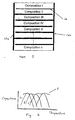
- the ceramic block is constructed from six different compositions as follows:
- the block is constructed from one layer of composition I, zero to three layers of composition II, one to three layers of composition III, zero to three layers of composition IV, zero to three layers of composition V, and three to six layers of composition V1.
- the block is constructed from one to four layers of composition II, one layer of composition IV, zero to three layers of composition V, and three to six layers of composition VI.
- a capacitor of this structure also exhibits an X7R characteristic.
- the so-called X7R specification is expressed as 0.85C(25°C) ⁇ C(T) ⁇ 115C(25°C), - 55°C ⁇ T ⁇ +125°C where in which ⁇ r (T)i and ti are the relative permittivity and thickness of the i th of N layers in the MCMLS capacitor of electrode area A and C (T) is its total capacitance at any temperature, T.
- the capacitor device of Fig. 5 comprises a plurality of ceramic layers (L 1 ,L 2 ,L 3 ,L n ), each of which (or at least some of which) are disposed in a stack together with a plurality of planar inner electrodes 10, alternate ones of which are connected to first and second end terminations 12a, 12b respectively.
- the stack of ceramic layers and electrodes are co-fired to produce a multi-composition, multi-layer monolithic ceramic block structure, referred to hereinafter as a MCMLS.
- the ceramic layers are preferably in the form of tape cast thick film layers of different electro-ceramic compositions.
- the selection criteria used in establishing the composition of the various layers of the parallel structure are the ability for each (different) composition layer to survive and be compatible with its neighbour at the very high temperature involved in co-firing/sintering.
- a particular advantage is gained that the material has relatively low firing temperatures (700° - 1200°C) compared to the firing of conventional materials (typically 1400°C - 1600°C).
- the atmosphere can be either air, inert or reducing. This allows a wider choice of electrodes than normal.
- the electrode material e.g. palladium, has also of course to be compatible with the PMN/PT system. Additionally, it is important that cross contamination between (different) layers does not occur during co-firing because this would degrade the electrical performance of the layer and thus its capacitance. This feature is assisted by the electrode which can itself act as a barrier layer to cross contamination.
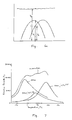
- each different layer has its own particular capacitance/temperature characteristic A,B,C, etc.
- Novel powder processing techniques are employed to produce the chemically differing compositions having substantially the same sintering characteristics to enable co-firing of all the layers to form the device.
- One preferred system is based on lead magnesium niobate (PMN) and lead titanate (PT) materials mixed in varying proportions according to the general formula: 1-x ⁇ Pb(Mg 1 3 Nb 2 3 )O 3 ⁇ + x ⁇ PbTiO 3 ⁇ ⁇ Pb(Mg 1-x 3 Nb 2(1-x) 3 Ti x )O 3 where 1mol% ⁇ x ⁇ 35mol%.
- PMN lead magnesium niobate
- PT lead titanate
- Fig. 12 A particular example based on this formula is illustrated in Fig. 12 wherein three layers have different compositions corresponding to the value X in the formula being 10% and 15%, ie:
- the multilayer structure comprises three layers of equal thickness (typically 100 microns), or multiples of this triplet to achieve the capacitance required.
- Fig. 7 shows the three different curves corresponding to the individual PMN, PMN/10% PT and PMN/15% PZ and also the resulting summation.
- a generic extension is to add varying quantities of lead-zirconate (PZ) to improve the high temperature stability and thus give an even wider operating regime.
- PZ lead-zirconate
- the addition of La 2 0 3 reduces the temperature of the peak of the permittivity of PMN.
- PbTi0 3 increases the temperature at which the peak occurs.
- the number of layers and thickness of the layers for each composition in the multi-layer is adjusted, such that the total capacitance becomes approximately equal across the complete temperature range, and the temperature dependence of total capacitance meets the required criteria.
- MCMLS capacitor are constructed from combinations of layers made from one of the following ceramic compositions.
- Composition II is a ceramic consisting of 94% lead magnesium niobate and 6% lead titanate. However, the ceramic is not a mixture of two lead compounds, but rather a single compound or "solid solution". The above notation is used for convenience and ease of interpretation. Composition II could therefore be expressed as Pb Mg 0.3133 Nb 0.6267 Ti 0.06 0 3
- the inter-electrode thicknesses are equal.
- the relative number of layers of each composition to obtain the X7R temperature characteristic is as follows: Composition Example 1 Example 2 I 1 0 II 0-3 1-4 III 1-3 0 IV 0-3 1 V 0-3 0-3 VI 3-6 3-6
- a ceramic can be constructed having fractional layer weightings. That is, a layer having twice the standard thickness will count as half a layer, a layer with three times the thickness as a third of a layer.
- a large number of structures with different layer counts and thicknesses are possible which exhibit the require X7R temperature coefficient, provided they conform to the limits of the specified layer count ratios.
- lead based relaxor ferroelectric ceramics in some embodiments allows sintering of the structure at temperatures of ⁇ 1000°C thus enabling the use of lower cost base metal electrodes.
- the device may also be fabricated from other dielectric materials, where each layer is chosen for the temperature characteristics desired.
- the disc shape of a discoidal multi-layer, multi-composition ceramic capacitor is formed in that the disc shape is pressed or routed out of a ceramic block constructed as described above.
- Figs. 1 and 2 illustrate a first embodiment of an electronic component incorporating a discoidal multi-layer, multi-component capacitor.
- the electronic component is a radio frequency interference suppression filter 20 with high volumetric efficiency, used to filter high frequencies from a conductor 9.
- the filter 20 is adapted to be provided about a conductor 9 and for this purpose comprises a housing 22 and a discoidal multi-component, multi-layer capacitor 24.
- the end terminal 12b is connected to the housing 22, whilst the end terminal 12a is connected to the conductor 9.
- the housing 22 is isolated from the conductor 9 by a pair of insulators 21a,21b.
- Figs. 10-14 illustrates a further embodiment of an electronic component incorporating multi-layer, multi-component capacitors.
- the electronic component is a Pi-section, surface mount radio frequency interference suppression filter 30.
- the filter 30 comprises two discoidal multi-component, multi-layer capacitors 34a, 34b.
- the capacitors 34a, 34b are fashioned from the same block of ceramic.
- the internal, external and hole electrodes are arranged such that the two end terminations 12b, 12b' are linked by the inductance of a conducting double spiral 36 on the upper surface of the component.
- the capacitor 34b is connected between an earth terminal 12a and end termination 12b, and the capacitor 34a is connected between the earth teminal 12a and the end termination 12b'.
- An equivalent circuit is illustrated in Fig. 14.
- the surface 39 is preferably provided with a high magnetic permeability layer 40, such as a ferrite.
- a high magnetic permeability layer 40 such as a ferrite.
- the ferrite layer 40 is shown as being underneath the conducting spiral 36. However, in other embodiments it may be above the spiral 36 or, most preferably, the conducting spiral is disposed within a thicker layer of ferrite.
- Fig. 3 illustrates a second embodiment of electronic device, in the form of a high density planar capacitance array 40.
- Figs. 3b to 3d illustrate schematically alternate electrode layers in the planar array 40 of Fig. 3.
- Fig. 3b illustrates the earth layers of internal electrode patterns
- Fig. 3c illustrates the signal layers of the internal electrode patterns
- Fig. 3d illustrates the pattern of the dopant print on the top and the bottom of the signal layers.
- the planar capacitance array 40 comprises a plurality of discoidal multi-layer, multi-component capacitors 44a, 44b, 44c ... 44n fashioned from a single block of ceramic and used to act as a radio frequency interference suppression filter (RFI) on an array of interconnections, such as a multi-way connector.
- RFID radio frequency interference suppression filter
- alternate individual layers of the ceramic block are printed with a dopant species, in the space not occupied by the electrodes, before co-firing. This dopant species diffuses during firing into the selected regions of the ceramic to accomplish a reduction in permittivity.
- a multi-layer, multi-composition capacitor is employed in a pressure sensor.
- the shape/geometry of the ceramic block is fashioned to a shape suitable for the type of pressure sensor required.
- a simple chip capacitor may be configured as a uniaxial or shear mode sensor, whilst a discoidal arrangement might be deployed as a radial or isostatic pressure sensor.
- the device of Fig. 8 comprises a discoidal multicomposition multilayer ceramic capacitor 50, housed inside a cylindrical body 52 which is generally electrically conducting but with one face 54 electrical insulating.
- One end of the body consists of a pressure plate 56 which is bonded to one 58 of the flat faces of the capacitor (it is shown slightly separated from this flat face of the capacitor in Fig. 13 for ease of illustration).
- the other face 60 of the capacitor is in physical contact with the other insulating face 54 of the body.
- a "sliding" or flexible joint 62 between the pressure plate 56 and the body 52 ensures that any pressure applied to the pressure plate 56 is transferred to the capacitor 50.
- the elastic compliance of the ceramic capacitor 50 is such that the required movement of the flexible contact 62 is vanishingly small.
- the internal termination 66 of the capacitor is in electrical contact with a pin 64 which passes through the insulating portion 54 of the body, whilst part of the external termination 68 of the capacitor is in contact with the conducting regions of the body 52.
- the majority of the external curved surface of the capacitor is not bonded to the capacitor body so as to allow for compression under pressure on the pressure plate 56.
- the pressure On pressure being applied to the pressure plate 56, the pressure is transmitted to the capacitor 50.
- the capacitance measured between the pin 64 and the conducting portion 52 of the body is dependent upon the applied pressure and so can be used as an electrical measurement of the applied pressure.
- a high pressure sensitivity of capacitance is achieved through the use of the multilayer capacitor employing relaxor dielectrics. Temperature stability of the sensitivity is achieved as in other embodiments, through the use of several different relaxor compositions within the multilayer so that compensation of their temperature dependences is achieved.
- the principle of using a multicomponent multi-layer capacitor, employing relaxor dielectrics can be applied to a wide range of pressure sensing devices, all of which use a combination of relaxors to obtain improved performance in terms of a high pressure sensitivity of capacitance combined with a low temperature dependence of that sensitivity.
- Fig. 9 illustrates the application of the MCMLS concept to a C-section, surface mount filter.
- This device comprises two interleaved electrode stacks 70,72 connected to two separate pairs of terminations 74 on the adjacent sides of the device as shown in this figure.
- the advantages of the MCMLS concept for this device is the high capacitance per unit volume which can be achieved in a high rated voltage component.
Landscapes
- Engineering & Computer Science (AREA)
- Power Engineering (AREA)
- Manufacturing & Machinery (AREA)
- Microelectronics & Electronic Packaging (AREA)
- Fixed Capacitors And Capacitor Manufacturing Machines (AREA)
- Coils Or Transformers For Communication (AREA)
- Ceramic Capacitors (AREA)
- Filters And Equalizers (AREA)
Applications Claiming Priority (2)
| Application Number | Priority Date | Filing Date | Title |
|---|---|---|---|
| GB9623460 | 1996-11-09 | ||
| GBGB9623460.4A GB9623460D0 (en) | 1996-11-09 | 1996-11-09 | Electronic components incorporating capacitors |
Publications (2)
| Publication Number | Publication Date |
|---|---|
| EP0841671A2 true EP0841671A2 (de) | 1998-05-13 |
| EP0841671A3 EP0841671A3 (de) | 2005-08-10 |
Family
ID=10802766
Family Applications (2)
| Application Number | Title | Priority Date | Filing Date |
|---|---|---|---|
| EP97308967A Withdrawn EP0841671A3 (de) | 1996-11-09 | 1997-11-07 | Elektronikbauteile mit Kondensatoren |
| EP97308975A Withdrawn EP0841748A3 (de) | 1996-11-09 | 1997-11-07 | Elektronische Filterbauteile mit Kondensatoren |
Family Applications After (1)
| Application Number | Title | Priority Date | Filing Date |
|---|---|---|---|
| EP97308975A Withdrawn EP0841748A3 (de) | 1996-11-09 | 1997-11-07 | Elektronische Filterbauteile mit Kondensatoren |
Country Status (2)
| Country | Link |
|---|---|
| EP (2) | EP0841671A3 (de) |
| GB (1) | GB9623460D0 (de) |
Cited By (2)
| Publication number | Priority date | Publication date | Assignee | Title |
|---|---|---|---|---|
| WO2003028045A3 (de) * | 2001-09-10 | 2003-12-04 | Epcos Ag | Elektrisches vielschichtbauelement |
| CN101892522A (zh) * | 2010-07-30 | 2010-11-24 | 中国科学院上海硅酸盐研究所 | 利用氧等离子体辅助脉冲激光沉积法制备钛铌镁酸铅薄膜 |
Families Citing this family (4)
| Publication number | Priority date | Publication date | Assignee | Title |
|---|---|---|---|---|
| US9287844B2 (en) | 2011-07-07 | 2016-03-15 | Kemet Electronics Corporation | Surface mountable multi-layer ceramic filter |
| GB2504337A (en) * | 2012-07-26 | 2014-01-29 | Oxley Dev Co Ltd | A surface-mountable unitary in-line noise filter |
| US10925164B2 (en) * | 2016-09-23 | 2021-02-16 | Apple Inc. | Stackable passive component |
| CN111863451B (zh) * | 2020-07-10 | 2021-12-03 | 国网浙江省电力有限公司湖州供电公司 | 一种等电容等极差不等厚度的电容芯体及其设计方法 |
Family Cites Families (9)
| Publication number | Priority date | Publication date | Assignee | Title |
|---|---|---|---|---|
| US4083022A (en) * | 1976-10-12 | 1978-04-04 | Bunker Ramo Corporation | Planar pi multi-filter having a ferrite inductance for pin filters in electrical connectors |
| GB2182033A (en) * | 1985-10-24 | 1987-05-07 | Stc Plc | Dielectric compositions |
| US4746557A (en) * | 1985-12-09 | 1988-05-24 | Murata Manufacturing Co., Ltd. | LC composite component |
| US4873612A (en) * | 1988-08-01 | 1989-10-10 | Rogers Corporation | Temperature stable multilayer capacitor |
| JPH0693589B2 (ja) * | 1989-03-23 | 1994-11-16 | 株式会社村田製作所 | Lcフィルター |
| JPH02271704A (ja) * | 1989-04-12 | 1990-11-06 | Murata Mfg Co Ltd | Lcフィルター |
| GB2243722A (en) * | 1990-05-03 | 1991-11-06 | Oxley Dev Co Ltd | Improvements in multilayer discoidal capacitors |
| JPH0536562A (ja) * | 1991-07-31 | 1993-02-12 | Nippon Steel Corp | セラミツク積層コンデンサ |
| GB9401226D0 (en) * | 1994-01-22 | 1994-03-16 | Oxley Dev Co Ltd | Fabrication of capacitors and electrostrictive devices |
-
1996
- 1996-11-09 GB GBGB9623460.4A patent/GB9623460D0/en active Pending
-
1997
- 1997-11-07 EP EP97308967A patent/EP0841671A3/de not_active Withdrawn
- 1997-11-07 EP EP97308975A patent/EP0841748A3/de not_active Withdrawn
Cited By (3)
| Publication number | Priority date | Publication date | Assignee | Title |
|---|---|---|---|---|
| WO2003028045A3 (de) * | 2001-09-10 | 2003-12-04 | Epcos Ag | Elektrisches vielschichtbauelement |
| CN101892522A (zh) * | 2010-07-30 | 2010-11-24 | 中国科学院上海硅酸盐研究所 | 利用氧等离子体辅助脉冲激光沉积法制备钛铌镁酸铅薄膜 |
| CN101892522B (zh) * | 2010-07-30 | 2013-07-17 | 中国科学院上海硅酸盐研究所 | 利用氧等离子体辅助脉冲激光沉积法制备钛铌镁酸铅薄膜 |
Also Published As
| Publication number | Publication date |
|---|---|
| GB9623460D0 (en) | 1997-01-08 |
| EP0841671A3 (de) | 2005-08-10 |
| EP0841748A2 (de) | 1998-05-13 |
| EP0841748A3 (de) | 2000-04-12 |
Similar Documents
| Publication | Publication Date | Title |
|---|---|---|
| KR101523630B1 (ko) | 적층형 세라믹 전자부품 | |
| US4746557A (en) | LC composite component | |
| US4800459A (en) | Circuit substrate having ceramic multilayer structure containing chip-like electronic components | |
| US6934145B2 (en) | Ceramic multilayer capacitor array | |
| KR100205775B1 (ko) | 복합자기재료, 전자방해필터 | |
| KR100271099B1 (ko) | 유전체 세라믹 조성물 및 이를 이용한 적층 세라믹 커패시터 | |
| US6850404B2 (en) | Component and interference suppression circuit | |
| KR101463125B1 (ko) | 적층형 세라믹 콘덴서 | |
| WO1999018587A3 (en) | Ceramic multilayer capacitor | |
| US7135955B2 (en) | Electrical component with a negative temperature coefficient | |
| KR100320135B1 (ko) | 모놀리식 세라믹 커패시터 | |
| KR100339306B1 (ko) | 적층 세라믹 커패시터 및 그 제조방법 | |
| KR20170110467A (ko) | 적층 세라믹 커패시터 및 그 실장 기판 | |
| US10943741B2 (en) | High capacitance tunable multilayer capacitor and array | |
| US7012501B2 (en) | Electrical multi-layer component | |
| KR100393304B1 (ko) | 적층 세라믹 콘덴서 | |
| US20250047243A1 (en) | System and Method for Mixing Radiofrequency Signals | |
| EP0780350A1 (de) | Piezoelektrische keramische Zusammensetzung | |
| JP3879393B2 (ja) | Lc複合部品 | |
| JP2022016002A (ja) | 電子部品 | |
| US7149073B2 (en) | Electroceramic component | |
| JP2001044059A (ja) | 積層セラミックコンデンサ | |
| KR102899065B1 (ko) | 적층형 커패시터 및 그 실장 기판 | |
| JPH0817675A (ja) | チップ型積層セラミックコンデンサ | |
| KR100232547B1 (ko) | 인덕턴스-커패시턴스복합부품 및 인덕턴스-커패시턴스복합칩부품 |
Legal Events
| Date | Code | Title | Description |
|---|---|---|---|
| PUAI | Public reference made under article 153(3) epc to a published international application that has entered the european phase |
Free format text: ORIGINAL CODE: 0009012 |
|
| AK | Designated contracting states |
Kind code of ref document: A2 Designated state(s): AT BE CH DE DK ES FI FR GB GR IE IT LI LU MC NL PT SE |
|
| AX | Request for extension of the european patent |
Free format text: AL;LT;LV;MK;RO;SI |
|
| PUAL | Search report despatched |
Free format text: ORIGINAL CODE: 0009013 |
|
| AK | Designated contracting states |
Kind code of ref document: A3 Designated state(s): AT BE CH DE DK ES FI FR GB GR IE IT LI LU MC NL PT SE |
|
| AX | Request for extension of the european patent |
Extension state: AL LT LV MK RO SI |
|
| RIC1 | Information provided on ipc code assigned before grant |
Ipc: 7H 01G 4/35 B Ipc: 7H 01G 4/258 A |
|
| AKX | Designation fees paid | ||
| REG | Reference to a national code |
Ref country code: DE Ref legal event code: 8566 |
|
| STAA | Information on the status of an ep patent application or granted ep patent |
Free format text: STATUS: THE APPLICATION IS DEEMED TO BE WITHDRAWN |
|
| 18D | Application deemed to be withdrawn |
Effective date: 20060210 |