EP0841771A1 - Initialisierungsprotokoll für adaptive Datenübertragungsgeschwindigkeiten und Sende-Empfangseinrichtung dafür - Google Patents
Initialisierungsprotokoll für adaptive Datenübertragungsgeschwindigkeiten und Sende-Empfangseinrichtung dafür Download PDFInfo
- Publication number
- EP0841771A1 EP0841771A1 EP96402413A EP96402413A EP0841771A1 EP 0841771 A1 EP0841771 A1 EP 0841771A1 EP 96402413 A EP96402413 A EP 96402413A EP 96402413 A EP96402413 A EP 96402413A EP 0841771 A1 EP0841771 A1 EP 0841771A1
- Authority
- EP
- European Patent Office
- Prior art keywords
- transceiver
- data rate
- message
- proposal
- phase
- Prior art date
- Legal status (The legal status is an assumption and is not a legal conclusion. Google has not performed a legal analysis and makes no representation as to the accuracy of the status listed.)
- Granted
Links
- 230000003044 adaptive effect Effects 0.000 title description 5
- 230000005540 biological transmission Effects 0.000 claims abstract description 27
- 238000004891 communication Methods 0.000 claims abstract description 23
- 238000011144 upstream manufacturing Methods 0.000 claims description 46
- 238000005259 measurement Methods 0.000 claims description 7
- 238000012790 confirmation Methods 0.000 claims description 6
- 230000002457 bidirectional effect Effects 0.000 claims description 3
- 101001045846 Homo sapiens Histone-lysine N-methyltransferase 2A Proteins 0.000 abstract description 28
- 102100022103 Histone-lysine N-methyltransferase 2A Human genes 0.000 abstract 3
- 102100036407 Thioredoxin Human genes 0.000 description 34
- 102100022102 Histone-lysine N-methyltransferase 2B Human genes 0.000 description 22
- 101001045848 Homo sapiens Histone-lysine N-methyltransferase 2B Proteins 0.000 description 22
- 238000000034 method Methods 0.000 description 17
- 239000000969 carrier Substances 0.000 description 10
- 238000012986 modification Methods 0.000 description 3
- 230000004048 modification Effects 0.000 description 3
- RYGMFSIKBFXOCR-UHFFFAOYSA-N Copper Chemical compound [Cu] RYGMFSIKBFXOCR-UHFFFAOYSA-N 0.000 description 1
- 230000006978 adaptation Effects 0.000 description 1
- 238000006243 chemical reaction Methods 0.000 description 1
- 229910052802 copper Inorganic materials 0.000 description 1
- 239000010949 copper Substances 0.000 description 1
- 238000013461 design Methods 0.000 description 1
- 238000010586 diagram Methods 0.000 description 1
- 239000000835 fiber Substances 0.000 description 1
- 230000006870 function Effects 0.000 description 1
- 238000009434 installation Methods 0.000 description 1
- 230000003287 optical effect Effects 0.000 description 1
- 239000013307 optical fiber Substances 0.000 description 1
- 238000012545 processing Methods 0.000 description 1
Images
Classifications
-
- H—ELECTRICITY
- H04—ELECTRIC COMMUNICATION TECHNIQUE
- H04M—TELEPHONIC COMMUNICATION
- H04M11/00—Telephonic communication systems specially adapted for combination with other electrical systems
- H04M11/06—Simultaneous speech and data transmission, e.g. telegraphic transmission over the same conductors
- H04M11/062—Simultaneous speech and data transmission, e.g. telegraphic transmission over the same conductors using different frequency bands for speech and other data
-
- H—ELECTRICITY
- H04—ELECTRIC COMMUNICATION TECHNIQUE
- H04L—TRANSMISSION OF DIGITAL INFORMATION, e.g. TELEGRAPHIC COMMUNICATION
- H04L5/00—Arrangements affording multiple use of the transmission path
- H04L5/14—Two-way operation using the same type of signal, i.e. duplex
- H04L5/1438—Negotiation of transmission parameters prior to communication
- H04L5/1446—Negotiation of transmission parameters prior to communication of transmission speed
-
- H—ELECTRICITY
- H04—ELECTRIC COMMUNICATION TECHNIQUE
- H04L—TRANSMISSION OF DIGITAL INFORMATION, e.g. TELEGRAPHIC COMMUNICATION
- H04L69/00—Network arrangements, protocols or services independent of the application payload and not provided for in the other groups of this subclass
- H04L69/24—Negotiation of communication capabilities
Definitions
- the present invention relates to an initialisation protocol as defined in the non-characterising part of claim 1, and a transceiver adapted to perform this initialisation protocol as defined in the non-characteristic part of claim 8.
- Such an initialisation protocol is already known in the art, e.g. from the communication between two Asymmetric Digital Subscriber Line (ADSL) modems operating in accordance with the specifications of the ANSI (American National Standards Institute, Inc.) Standard on ADSL, the approved version of which has the reference T1E1.413 and titl e " Network and Customer Installation Interfaces, Asymmetric Digital Subscriber Line (ADSL) Metallic Interface ".
- ADSL Asymmetric Digital Subscriber Line
- the part wherein the two communicating ADSL transceivers negotiate the future upstream and downstream data rates is to be considered.
- this part is indicated by " Channel Analysis” and "Exchange”;
- the "Channel Analysis” procedure contains a first phase wherein the first ADSL transceiver, named the central office modem, transmits four optional upstream and downstream data rate values to the second ADSL transceiver, named the remote terminal modem.
- the second ADSL transceiver replies upon receipt of the just mentioned proposal by transmitting four optional upstream data rate values to the central office modem.
- This message contains the bits and gains information for the carriers which will carry the discrete multi tone (DMT) symbols that will constitute the future communication between the ADSL transceivers.
- This bits and gains information can be seen as a confirmation of the selected data rate in the previous phase, since the downstream and upstream data rates for future transmission are completely determined thereby.
- a disadvantage of the above known initialisation protocol is that the final selected and confirmed upstream and downstream data rates can not differ from the four data rate values proposed in the first phase. These proposed data rate values are chosen rather arbitrarily and may all differ significantly from the optimal upstream and downstream data rates which depend on the communication link characteristics.
- the known initialisation protocol does not support adaptive data rates, i.e. data rates which are adapted to the capacity of the communication link between the two transceivers. The only way to adapt data rates is to restart the complete identification and initialisation process.
- An object of the present invention is to provide an initialisation protocol of the above known type, but which overcomes the above described drawback, i.e. which supports adaptation of data rates without restarting, i.e. without executing all previous identification and initialisation steps again.
- the transceivers may announce once more a new data rate proposal if the adapted data rate values included in the second proposal still cannot approximate the optimal data rate satisfactory.
- the data rates proposed in the re-execution of the first phase may be chosen optimally.
- the transceivers when the initialisation protocol contains a second phase wherein the capacity of the communication link, i.e. the highest transmission rate of the link, is measured, the transceivers have a good criterion to decide to announce a new proposal and a good tool to select the adapted proposed data rate values. If none of the first proposed data rate values approximates the highest supportable data rate on its lower side, a transceiver may inform the other transceiver about his wish to formulate a new proposal. This new proposal may include the highest supportable data rate and some lower data rate values which are also acceptable for the transceiver which generates the new data rate proposal. In this way, one re-execution of the first, second and third phase may lead to a final selected data rate, properly adapted to the link capacity. This data rate is confirmed in the fourth phase.
- the re-negotiation not necessarily requires that all steps of the first, second and third phase are re-executed.
- the remote terminal modem replies to the proposal of the central office modem with a proposal for the upstream data rate.
- the second phase wherein the channel is analysed not necessarily has to be re-executed.
- the central office modem of an ADSL system re-formulates a set of four adapted data rate values. One newly proposed data rate value may be sufficient if it is well-chosen.
- an initialisation protocol including such a second phase wherein the link is analysed is already known from the ADSL initialisation protocol.
- the "Channel Analysis" procedure thereof contains the transmission of a so called C-MEDLEY signal (see paragraph 12.6.6 on page 95) and R-MEDLEY signal (see paragraph 11.7.8 on page 98).
- These MEDLEY signals are wideband pseudo-random signals which allow the receiving transceiver to measure the signal noise ratio (SNR) and to determine therefrom the highest data rate that the link can support.
- SNR signal noise ratio
- a remark is that the present invention does not require that the link is analysed before a transceiver announces a new proposal. If one of the transceivers for whatever reason is not satisfied with the proposed data rate values in the first proposal, he may announce a new proposal, even if the link capacity is not yet known to him.
- An additional optional feature of the present invention minimises the transmission of irrelevant information.
- the present invention may be introduced in known initialisation protocols with minor modifications, but with the drawback that some irrelevant information may be transmitted.
- the remote terminal modem transmits a so called R-RATES2 message (see paragraph 12.9.4 on page 103) to the central office modem to communicate the selected one of the four optional downstream data rates.
- the central office modem replies with a C-RATES2 message (see paragraph 12.8.5 on page 100) to communicate to the remote terminal modem the selected upstream and downstream data rates.
- the ADSL initialisation protocol can be easily adapted so that the central office modem announces a new proposal via the C-RATES2 message. This however implies that the previously transmitted R-RATES2 message contained irrelevant information and needlessly occupied bandwidth.
- An additional feature of the present invention is that it is applicable to both unidirectional and bidirectional data rates as defined in claim 5.
- Announcing a new proposal may require that new optional upstream and downstream data rate values are transmitted form the first to the second transceiver.
- a more advanced implementation may allow the transceivers to announce a new proposal for only the downstream or only the upstream direction, so that no superfluous work is done if a satisfactory data rate is negotiated already for one of the two directions.
- a characteristic feature of the present invention is that it may be used to initialise communication between two ADSL transceivers, as defined in claim 6.
- the C-RATES2 message in the third phase may alternatively be used to indicate that none of the optional data rate values is selected, but that a new proposal of four new optional data rates will be formulated.
- An additional feature of the ADSL implementation of the present invention allows to realise the object of supporting adaptive bit rates with minor modifications to the ADSL Standard Specification.
- table 39 on page 100 of the already cited draft ANSI Standard on ADSL lists all bit patterns which may be contained by the C-RATES2 message together with the associated data rate values selected for the upstream and downstream direction. If this list is extended with one additional bit pattern which is sent by the central office modem to the remote terminal modem to announce a new proposal (i.e. a re-execution of phase 1), the object is realised.
- An additional advantageous feature of the transceiver according to the present invention may allow it to indicate that it supports re-negotiation of a data rate without starting up again. This feature is defined in claim 9.
- the transceiver has the capability to indicate to the second transceiver that it is able to announce a new data rate proposal, to produce and to deal with a new set of optional data rate values. If the two communicating transceivers transmit this indication to each other, re-negotiation of a data rate will be possible without re-starting. If one of the two transceivers does not transmit this indication, he is not able to support such a re-negotiation and it will not be possible to deal with a new set of optional data rate values without re-starting the whole identification and initialisation process.
- a communicating unit which communicates with a transceiver which is able to announce a new data rate proposal and to formulate a new data rate proposal may also indicate that it supports re-negotiation as defined in claim 10.
- the communicating unit i.e. a second transceiver or modem
- An indication of the communicating unit that it is capable or not capable to re-negotiate data rates may avoid the system to enter a status wherein the communication between the transceiver and its communicating unit is broken and wherein the identification and initialisation has to be restarted completely.
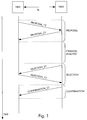
- Fig. 1 two ADSL modems, TRX1 and TRX2, are coupled via a telephone line TL.
- the first ADSL modem TRX1 is the so called central office modem whilst the second ADSL modem TRX2 is the remote terminal modem.
- the two modems TRX1 and TRX2 operate in accordance with the specifications of the ANSI Standard on ADSL to transmit data empacked in discrete multi tone (DMT) symbols in the downstream direction, from the central office modem TRX1 to the remote terminal modem TRX2, and in upstream direction, from the remote terminal modem TRX2 to the central office modem TRX1.
- DMT symbols are carried by a set of 256 equidistant carriers.
- the bits constituting the DMT symbols are thereto spread over the different carriers.
- the two ADSL modems, TRX1 and TRX2 negotiate a downstream bit rate and an upstream bit rate, and decide, based on signal-noise-ratio measurements for each carrier, how much bits will be modulated on each particular carrier and at which power level each particular carrier will be transmitted. This is done in what is usually called the bit allocation procedure.
- both ADSL modems TRX1 and TRX2
- carrier 1 carries 2 bits, modulated thereon via 4 QAM modulation, and is transmitted with a 0,9 dB gain
- carrier 2 carries 5 bits, modulated thereon via 32 QAM modulation, and is transmitted with a 1.2 dB gain
- carrier 3 carries 4 bits, modulated thereon via 16 QAM modulation, and is transmitted with a 1.3 dB gain
- the downstream and upstream data rates are determined when the bit constellation is given.
- the modems TRX1 and TRX2 produce and respond to a specific set of precisely time initialisation signals.
- the time line of these initialisation signals is represented in Fig. 1.
- the complete initialisation procedure is defined in chapter 12 of the earlier mentioned draft version of the ADSL Standard, published in April 1994, from page 83 to page 104.
- the next paragraphs will focus only on the "Channel Analysis” procedure and "Exchange” procedure described in paragraphs 12.6, 12.7, 12.8 and 12.9 from page 92 to 104. More concrete, it will be explained how these procedures can be adapted so that the ADSL modems support adaptive data rates.
- the "Channel Analysis" procedure of the ADSL Standard contains the first phase, PROPOSAL, and second phase, CHANNEL ANALYSIS, of Fig. 1.
- the central office modem TRX1 downstream transmits a message PROPOSE_12 which contains four optional data rate values for the downstream and upstream direction.
- the fields which describe one of the optional data rate values are defined in paragraph 12.6.2 of the draft ADSL Specification on page 92-93. It is noticed that the first message PROPOSE_12 is called the C-RATES1 message in this paragraph.
- the C-RATES1 message is accompanied by a C-MSG1 message, defined in paragraph 12.6.4 on page 93-94. This message is used for vendor identification and defining central office modem functionality but, since it is not relevant in view of the present invention, not further considered here.
- the remote terminal modem TRX2 replies with a PROPOSE_21 message wherein four optional upstream data rate values are proposed to the central office modem TRX1.
- the fields which describe one of the optional upstream data rates are similar to those of the PROPOSE_12 message, and defined in paragraph 12.7.4 on page 96 of the draft ANSI Standard on ADSL. It is noticed that the message PROPOSE_21 is called the R-RATES1 message in this paragraph. Also this message is accompanied by a message R-MSG1 with vendor identification, etc. This accompanying message R-MSG1 is described in paragraph 12.7.6 on page 97 and not considered here.
- the central office modem TRX1 transmits a wideband pseudo-random signal allowing the remote terminal modem TRX2 to estimate the signal-noise-ratio, to determine therefrom the maximum bit allocation for downstream carriers, the maximum downstream data rate and which one of the four optional downstream data rate values proposed by TRX1 in PROPOSE_12 is likely to be used.
- the wideband pseudo-random signal is called C-MEDLEY in the draft ADSL Standard and is defined in paragraph 12.6.6 on page 95.
- the remote terminal modem TRX2 transmits also a wideband pseudo-random signal, called R-MEDLEY in the referenced ADSL Standard, which allows the central office modem TRX1 to estimate the signal-noise-ratio for upstream carriers, to determine therefrom the maximum bit allocation for the upstream carriers, the maximum upstream data rate and which one of the four optional upstream data rate values proposed by TRX2 in PROPOSE_21 is likely to be used.
- R-MEDLEY wideband pseudo-random signal
- the "Exchange" procedure of the ADSL Standard contains the third phase, SELECTION, and fourth phase, CONFIRMATION, of Fig. 1.
- the remote terminal modem TRX2 replies to the PROPOSE_12 message of TRX1 by transmitting to the central office modem TRX1 a message SELECTION_21 containing the selected optional data rate for downstream transmission and the highest data rate that can be supported for downstream transmission based on the signal-noise-ratio measurements for the downstream carriers in the CHANNEL ANALYSIS phase. It is noticed that this SELECTION_21 message is called the R-RATES2 message in the ADSL Standard and is defined in paragraph 12.9.4 on page 103.
- Table 41 on page 103 of this draft Standard lists the predetermined reserved bit patterns which have to be used by the remote terminal modem TRX2 to indicate in R-RATES2 which one of the four optional downstream data rates is selected.
- the central office modem TRX1 replies to the PROPOSE_21 and SELECTION_21 messages by transmitting to the remote terminal TRX2 a message SELECTION_12 containing the selected optional data rates for downstream and upstream transmission.
- the selected optional data rate value is determined based on the signal-noise-ratio measurements for the upstream carriers in the CHANNEL ANALYSIS phase.
- SELECTION_21 For downstream transmission, a copy is made of the information in the SELECTION_21 message produced and transmitted by the remote terminal modem TRX2. It is noticed that the SELECTION_21 message is called the C-RATES2 message in the draft ADSL Standard and is defined in paragraph 12.8.5 on page 100.
- Table 39 on page 100 of this draft Standard lists the predetermined reserved bit patterns which have to be used by the central office modem TRX1 to indicate in C-RATES2 which one of the four optional downstream and four optional upstream data rate values is selected. According to the invention, this list is extended with one additional bit pattern which indicates that no selection is made for the up- and downstream data rates but a new proposal will be formulated by the central office modem TRX1.
- the C-RATES2 message is accompanied by a so called C-B&G message defined in paragraph 12.8.7 on page 101.
- This C-B&G message contains bits and gains information for the upstream carriers : for each upstream carrier, the C-B&G message indicates the number of bits to be modulated thereon by the remote terminal modem TRX2, and the gain or power level that should be used to transmit this carrier.
- the C-RATES2 message contains the bit pattern which indicates that a new data rate proposal will be produced, the C-B&G message obviously contains superfluous information which is needlessly transported.
- PROPOSAL wherein the central office modem TRX1 proposes new upstream and downstream data rate values to the remote terminal modem TRX2.
- the central office modem TRX1 Since the central office modem TRX1 has determined the highest data rate that can be supported for upstream transmission during the CHANNEL ANALYSIS phase and since the central office modem TRX1 is told the highest data rate that can be supported for downstream transmission by the remote terminal modem TRX2 in the SELECTION_21 message, the newly proposed optional upstream and downstream data rate values can be chosen very efficiently. It may thus be expected that the second execution of the PROPOSAL, CHANNEL ANALYSIS and SELECTION phase already results in a selected upstream and downstream data rate value which are well-adapted to the highest upstream and downstream data rates that can be supported on the telephone line TL.
- the central office modem TRX1 may again transmit the predetermined reserved bit pattern which indicates that a new proposal of upstream- and downstream data rates will be produced.
- the phases PROPOSAL, CHANNEL ANALYSIS and SELECTION are thus repetitively executed until a satisfactoring adapted upstream and downstream data rate value are found and communicated to the remote terminal modem TRX2 via the SELECTION_12 message.
- the associated bits and gains information for the upstream carriers which allows to realise the selected upstream data rate value is communicated to the remote terminal modem TRX2 via the C-B&G message related to the selection-12 message.
- the remote terminal modem TRX2 transmits the bits and gains information with respect to the downstream channel to the central office modem TRX1: in the so called R-B&G message defined in paragraph 12.9.8 on page 104 of the draft ADSL Standard, the remote terminal indeed indicates for each downstream carrier the number of bits to be modulated thereon and the gain or power level to be applied when transmitting this downstream carrier.
- the initialisation protocol is terminated herewith.
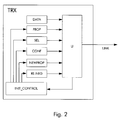
- the transceiver TRX of Fig. 2 includes a line interface LI, means which generate information, i.e. DATA, PROP, SEL, CONF, NEWPROP and RE-NEG, and a controller INIT_CONTROL.
- the information generating means, DATA, PROP, SEL, CONF, NEWPROP and RE-NEG all have outputs coupled to an input of the line interface LI. It is to be remarked that it is not relevant with respect to the invention whether these outputs are coupled to one single input of the line interface LI or to several distinct inputs thereof.
- An output of the line interface LI is coupled to a communication link LINK and another output thereof is connected to an input of the controller INIT_CONTROL.
- the controller INIT_CONTROL has outputs coupled to control terminals of the information generating means PROP, SEL, CONF, NEWPROP and RE-NEG respectively.
- the information generating means which generates messages to be sent during initialisation, i.e. PROP, SEL, CONF, NEWPROP and RE-NEG apply a message to an input of the line interface LI.
- the line interface LI may be seen as a multiplexer or exclusive OR circuit which couples one of its inputs to the communication link LINK. Additional functions like modulation, demodulation, D/A and A/D conversion, data empacking or data depacking, ..., may also be done by the line interface LI.
- the information generating means PROP, SEL, CONF, NEWPROP and RE-NEG may be realised by memory means which contain information to be transmitted in one of the initialisation messages, processing means which (for instance based on signal-noise-ratio measurements or information received from a communicating transceiver), determine new optional data rate values, or a selected optional data rate, and so on. Anyhow, these means do not contain unknown components so that a person skilled in the art, depending on the information that has to be generated, can design these information generating means. Referring to the just described implementation in the field of ADSL, one can suppose that the central office modem TRX1 in Fig. 1 is replaced by the transceiver TRX of Fig. 2.
- the first generating means PROP produces the C-RATES1 message including the four optional upstream and downstream data rate values
- SEL produces the C-RATES2 message in case no new proposal for negotiation is announced therein
- CONF produces the C-B&G message which includes the bits and gains information
- NEWPROP produces the C-RATES2 message in case a new proposal for negotiation is announced therein.
- NEWPROP then generates a C-RATES2 message including for instance the reserved bit pattern 11111111, which is not yet used in table 39 on page 100 of the draft ADSL Standard.
- the information generating means RE-NEG generates the information to indicate to a communicating transceiver that it is capable of re-negotiating a data rate without restarting.
- the controller INIT_CONTROL uses information received from the communicating transceiver via the line interface LI, and information specified in the standard, e.g.
- DATA produces the information that will be transmitted in future at the data rate negotiated during initialisation.
- DATA produces the bitstream which has to be encapsulated in discrete multi tone (DMT) symbols to be transmitted over the link LINK.
- DMT discrete multi tone
- the ability to set the m15 bit is not only important for the transceiver TRX which launches the new proposal but even more important for the communicating transceiver. Indeed, if the communicating transceiver is able to tell the transceiver TRX via the m15 bit that he can support re-negotiating a data rate, the transceiver TRX knows that it makes sense to launch a new proposal. If the communicating transceiver does not support re-negotiating data rates, he will not be able to react correctly to the new proposal of TRX as a result of which the communication between TRX and the communicating modem will be broken after a certain time interval. The complete identification and initialisation process will be restarted then.
- HDSL High Speed Digital Subscriber Line
- SDSL Symmetric Digital Subscriber Line
- VDSL Very High Speed Digital Subscriber Line
- the two transceivers may negotiate a bidirectional data rate (as described above in an ADSL system) or a unidirectional data rate (as in an HFC network for instance wherein data are downstream broadcasted over a point-to-multipoint connection but wherein upstream transmission is done over a point-to-point channel whose data rate may be negotiated during initialisation.
- a bidirectional data rate as described above in an ADSL system
- a unidirectional data rate as in an HFC network for instance wherein data are downstream broadcasted over a point-to-multipoint connection but wherein upstream transmission is done over a point-to-point channel whose data rate may be negotiated during initialisation.
- the criterion to decide to announce a new proposal is no restrictive subject matter in view of the present invention. Indeed, if the channel is analysed as in the ADSL system by signal-noise-ratio measurements, the results thereof provide a good Citroen to decide that the proposed data rate values are not satisfactory and a new proposal may be announced. Nevertheless other criteria, such as the capacity or data rate limitations of one of the transceivers, the service where future transmission will be used for, ...., may indicate that the list of proposed data rate values does not contain well-adapted data rate values so that it is preferable to negotiate data rate values of a new list.
Landscapes
- Engineering & Computer Science (AREA)
- Signal Processing (AREA)
- Computer Networks & Wireless Communication (AREA)
- Quality & Reliability (AREA)
- Communication Control (AREA)
- Telephonic Communication Services (AREA)
- Materials For Medical Uses (AREA)
- External Artificial Organs (AREA)
- Eye Examination Apparatus (AREA)
- Mobile Radio Communication Systems (AREA)
Priority Applications (9)
| Application Number | Priority Date | Filing Date | Title |
|---|---|---|---|
| ES96402413T ES2157413T3 (es) | 1996-11-12 | 1996-11-12 | Procedimiento de inicializacion para tasas de datos adaptativas y transmisor-receptor correspondiente. |
| DE69613376T DE69613376T2 (de) | 1996-11-12 | 1996-11-12 | Initialisierungsprotokoll für adaptive Datenübertragungsgeschwindigkeiten und Sende-Empfangseinrichtung dafür |
| AT96402413T ATE202245T1 (de) | 1996-11-12 | 1996-11-12 | Initialisierungsprotokoll für adaptive datenübertragungsgeschwindigkeiten und sende- empfangseinrichtung dafür |
| EP96402413A EP0841771B1 (de) | 1996-11-12 | 1996-11-12 | Initialisierungsprotokoll für adaptive Datenübertragungsgeschwindigkeiten und Sende-Empfangseinrichtung dafür |
| DE29623893U DE29623893U1 (de) | 1996-11-12 | 1996-11-12 | Initialisierungs-Protokoll für adaptive Datenraten und zugehöriger Transceiver |
| IL12207197A IL122071A (en) | 1996-11-12 | 1997-10-30 | Initialisation protocol |
| AU43692/97A AU720494B2 (en) | 1996-11-12 | 1997-11-03 | Initialisation protocol for data rates |
| US08/967,155 US6215793B1 (en) | 1996-11-12 | 1997-11-10 | Initialization protocol for adaptive data rates, and related transceiver |
| JP31055897A JP3833799B2 (ja) | 1996-11-12 | 1997-11-12 | 適合可能なデータ転送速度のための初期化プロトコルおよびそれに関連したトランシーバ |
Applications Claiming Priority (1)
| Application Number | Priority Date | Filing Date | Title |
|---|---|---|---|
| EP96402413A EP0841771B1 (de) | 1996-11-12 | 1996-11-12 | Initialisierungsprotokoll für adaptive Datenübertragungsgeschwindigkeiten und Sende-Empfangseinrichtung dafür |
Publications (2)
| Publication Number | Publication Date |
|---|---|
| EP0841771A1 true EP0841771A1 (de) | 1998-05-13 |
| EP0841771B1 EP0841771B1 (de) | 2001-06-13 |
Family
ID=8225313
Family Applications (1)
| Application Number | Title | Priority Date | Filing Date |
|---|---|---|---|
| EP96402413A Expired - Lifetime EP0841771B1 (de) | 1996-11-12 | 1996-11-12 | Initialisierungsprotokoll für adaptive Datenübertragungsgeschwindigkeiten und Sende-Empfangseinrichtung dafür |
Country Status (7)
| Country | Link |
|---|---|
| EP (1) | EP0841771B1 (de) |
| JP (1) | JP3833799B2 (de) |
| AT (1) | ATE202245T1 (de) |
| AU (1) | AU720494B2 (de) |
| DE (1) | DE69613376T2 (de) |
| ES (1) | ES2157413T3 (de) |
| IL (1) | IL122071A (de) |
Cited By (8)
| Publication number | Priority date | Publication date | Assignee | Title |
|---|---|---|---|---|
| EP0905948A3 (de) * | 1997-09-25 | 1999-11-24 | Motorola, Inc. | Ratenanpassung für ADSL unter Verwendung einer veränderlichen Anzahl von Unterträgern |
| JP2000013520A (ja) * | 1998-06-19 | 2000-01-14 | Fujitsu Ltd | ディジタル加入者線伝送システム |
| FR2789248A1 (fr) * | 1999-01-29 | 2000-08-04 | Canon Kk | Procede et dispositif d'emission et de reception d'informations, de gestion des transmissions d'informations, stations de base peripherique et reseau les comprenant |
| WO2000052871A1 (en) * | 1999-03-02 | 2000-09-08 | Legerity, Inc. | Transceiver with adjustable coding gain |
| EP1001583A3 (de) * | 1998-11-11 | 2003-08-20 | Alcatel | Verfahren zum dynamisch-adaptiven Einstellen von Übertragungsparametern und zugehörige Komponenten |
| DE19947114B4 (de) * | 1999-09-30 | 2004-10-07 | Siemens Ag | Verfahren zum Übertragen eines hochbitratigen Digitalsignals |
| US7039120B1 (en) | 1998-11-30 | 2006-05-02 | Canon Kabushiki Kaisha | Device and method for the dynamic allocation of frequencies for multicarrier modulation systems |
| EP1041771B1 (de) * | 1999-04-01 | 2009-06-17 | Lucent Technologies Inc. | Verbesserte Datenratensteuerung zur drahtlosen Kommunikation |
Families Citing this family (1)
| Publication number | Priority date | Publication date | Assignee | Title |
|---|---|---|---|---|
| DE102005006890B4 (de) * | 2005-02-15 | 2007-04-26 | Siemens Ag | Verfahren zur Bestimmung einer optimalen Datenübertragungsrate über ein Übertragungsmedium |
Citations (5)
| Publication number | Priority date | Publication date | Assignee | Title |
|---|---|---|---|---|
| EP0375032A1 (de) * | 1988-12-19 | 1990-06-27 | Koninklijke Philips Electronics N.V. | Verfahren zum Herstellen einer Datenverbindung zwischen zwei Terminals sowie für dieses Verfahren geeignetes Terminal |
| US5023869A (en) * | 1989-03-27 | 1991-06-11 | Alberta Telecommunications Research Centre | Method and apparatus for maximizing the transmission capacity of a multi-channel bidirectional communications link |
| US5297186A (en) * | 1991-07-29 | 1994-03-22 | Codex Corporation | Device and method for on-line adaptive selection of baud rate and carrier frequency |
| EP0601260A1 (de) * | 1992-12-10 | 1994-06-15 | International Business Machines Corporation | Vollduplexes Anlaufverfahren für Modems |
| EP0637150A1 (de) * | 1993-07-26 | 1995-02-01 | AT&T Corp. | 1200 Bit pro Sekunde Verminderungsverfahren zur Verwendung in der mobilen Funkkommunikation |
-
1996
- 1996-11-12 ES ES96402413T patent/ES2157413T3/es not_active Expired - Lifetime
- 1996-11-12 DE DE69613376T patent/DE69613376T2/de not_active Expired - Lifetime
- 1996-11-12 AT AT96402413T patent/ATE202245T1/de not_active IP Right Cessation
- 1996-11-12 EP EP96402413A patent/EP0841771B1/de not_active Expired - Lifetime
-
1997
- 1997-10-30 IL IL12207197A patent/IL122071A/en not_active IP Right Cessation
- 1997-11-03 AU AU43692/97A patent/AU720494B2/en not_active Expired
- 1997-11-12 JP JP31055897A patent/JP3833799B2/ja not_active Expired - Lifetime
Patent Citations (5)
| Publication number | Priority date | Publication date | Assignee | Title |
|---|---|---|---|---|
| EP0375032A1 (de) * | 1988-12-19 | 1990-06-27 | Koninklijke Philips Electronics N.V. | Verfahren zum Herstellen einer Datenverbindung zwischen zwei Terminals sowie für dieses Verfahren geeignetes Terminal |
| US5023869A (en) * | 1989-03-27 | 1991-06-11 | Alberta Telecommunications Research Centre | Method and apparatus for maximizing the transmission capacity of a multi-channel bidirectional communications link |
| US5297186A (en) * | 1991-07-29 | 1994-03-22 | Codex Corporation | Device and method for on-line adaptive selection of baud rate and carrier frequency |
| EP0601260A1 (de) * | 1992-12-10 | 1994-06-15 | International Business Machines Corporation | Vollduplexes Anlaufverfahren für Modems |
| EP0637150A1 (de) * | 1993-07-26 | 1995-02-01 | AT&T Corp. | 1200 Bit pro Sekunde Verminderungsverfahren zur Verwendung in der mobilen Funkkommunikation |
Non-Patent Citations (1)
| Title |
|---|
| NETWORK AND CUSTOMER INSTALLATION INTERFACES ASYMMETRIC DIGITAL SUBSCRIBER LINE (ADSL) METALLIC INTERFACE, April 1994 (1994-04-01) |
Cited By (11)
| Publication number | Priority date | Publication date | Assignee | Title |
|---|---|---|---|---|
| EP0905948A3 (de) * | 1997-09-25 | 1999-11-24 | Motorola, Inc. | Ratenanpassung für ADSL unter Verwendung einer veränderlichen Anzahl von Unterträgern |
| US6130882A (en) * | 1997-09-25 | 2000-10-10 | Motorola, Inc. | Method and apparatus for configuring a communication system |
| US6775241B1 (en) | 1997-09-25 | 2004-08-10 | Freescale Semiconductor, Inc. | Method and apparatus for configuring a communication system |
| JP2000013520A (ja) * | 1998-06-19 | 2000-01-14 | Fujitsu Ltd | ディジタル加入者線伝送システム |
| US7072386B1 (en) | 1998-06-19 | 2006-07-04 | Fujitsu Limited | Digital subscriber line communicating system and a transceiver in the system |
| EP1001583A3 (de) * | 1998-11-11 | 2003-08-20 | Alcatel | Verfahren zum dynamisch-adaptiven Einstellen von Übertragungsparametern und zugehörige Komponenten |
| US7039120B1 (en) | 1998-11-30 | 2006-05-02 | Canon Kabushiki Kaisha | Device and method for the dynamic allocation of frequencies for multicarrier modulation systems |
| FR2789248A1 (fr) * | 1999-01-29 | 2000-08-04 | Canon Kk | Procede et dispositif d'emission et de reception d'informations, de gestion des transmissions d'informations, stations de base peripherique et reseau les comprenant |
| WO2000052871A1 (en) * | 1999-03-02 | 2000-09-08 | Legerity, Inc. | Transceiver with adjustable coding gain |
| EP1041771B1 (de) * | 1999-04-01 | 2009-06-17 | Lucent Technologies Inc. | Verbesserte Datenratensteuerung zur drahtlosen Kommunikation |
| DE19947114B4 (de) * | 1999-09-30 | 2004-10-07 | Siemens Ag | Verfahren zum Übertragen eines hochbitratigen Digitalsignals |
Also Published As
| Publication number | Publication date |
|---|---|
| ATE202245T1 (de) | 2001-06-15 |
| EP0841771B1 (de) | 2001-06-13 |
| JPH10262096A (ja) | 1998-09-29 |
| ES2157413T3 (es) | 2001-08-16 |
| AU720494B2 (en) | 2000-06-01 |
| DE69613376D1 (de) | 2001-07-19 |
| IL122071A0 (en) | 1998-03-10 |
| JP3833799B2 (ja) | 2006-10-18 |
| IL122071A (en) | 2002-05-23 |
| AU4369297A (en) | 1998-05-14 |
| DE69613376T2 (de) | 2002-05-02 |
Similar Documents
| Publication | Publication Date | Title |
|---|---|---|
| US6215793B1 (en) | Initialization protocol for adaptive data rates, and related transceiver | |
| AU692628B2 (en) | Signalling techniques and device for high speed data transmission over voiceband channels | |
| JP3897301B2 (ja) | 継ぎ目のないレート適合を使用する高速初期化 | |
| EP0841771B1 (de) | Initialisierungsprotokoll für adaptive Datenübertragungsgeschwindigkeiten und Sende-Empfangseinrichtung dafür | |
| US8208520B2 (en) | Variable state length initialization | |
| JP2001036499A (ja) | 通信帯域設定方法及び通信装置 | |
| AU2002305831A1 (en) | Variable state length initialization | |
| EP1858287B1 (de) | Ein adaptives Aktivierungsverfahren anhand einer multimoden XDSL-Linien-Karte und das dabei verwendete System | |
| JP2005160104A (ja) | 非対称型デジタル加入者回線(adsl)の最適動作モード選択の方法とシステム | |
| KR100842982B1 (ko) | 케이블모뎀의 업스트림 파워레벨 제어방법 | |
| JP2004179848A (ja) | 通信装置および通信方式切換方法 | |
| JP2004040426A (ja) | Adsl端末装置及びそれに用いるadsl起動方法 | |
| KR20000043939A (ko) | 위성통신시스템에서 번호번역 요구방법 | |
| KR20010103952A (ko) | 하나의 케이블을 통해 가입자간 통신하기 위한 통신시스템 및 그 방법 | |
| KR20000044357A (ko) | 디지탈 가입자 선 전송장치의 원격감시방법 | |
| KR20030055567A (ko) | 엑스디에스엘시스템의 핸드쉐이킹 제어방법 | |
| KR20010103954A (ko) | 하나의 케이블을 통해 가입자간 통신하기 위한 통신시스템 및 그 방법 | |
| HK1110458A (en) | Method and system for variable state length initialization for dsl systems |
Legal Events
| Date | Code | Title | Description |
|---|---|---|---|
| PUAI | Public reference made under article 153(3) epc to a published international application that has entered the european phase |
Free format text: ORIGINAL CODE: 0009012 |
|
| AK | Designated contracting states |
Kind code of ref document: A1 Designated state(s): AT BE DE ES FR GB IT SE |
|
| 17P | Request for examination filed |
Effective date: 19981113 |
|
| AKX | Designation fees paid |
Free format text: AT BE DE ES FR GB IT SE |
|
| RBV | Designated contracting states (corrected) |
Designated state(s): AT BE DE ES FR GB IT SE |
|
| RAP3 | Party data changed (applicant data changed or rights of an application transferred) |
Owner name: ALCATEL |
|
| RAP3 | Party data changed (applicant data changed or rights of an application transferred) |
Owner name: ALCATEL |
|
| 17Q | First examination report despatched |
Effective date: 19990701 |
|
| GRAG | Despatch of communication of intention to grant |
Free format text: ORIGINAL CODE: EPIDOS AGRA |
|
| GRAG | Despatch of communication of intention to grant |
Free format text: ORIGINAL CODE: EPIDOS AGRA |
|
| GRAH | Despatch of communication of intention to grant a patent |
Free format text: ORIGINAL CODE: EPIDOS IGRA |
|
| GRAH | Despatch of communication of intention to grant a patent |
Free format text: ORIGINAL CODE: EPIDOS IGRA |
|
| GRAA | (expected) grant |
Free format text: ORIGINAL CODE: 0009210 |
|
| AK | Designated contracting states |
Kind code of ref document: B1 Designated state(s): AT BE DE ES FR GB IT SE |
|
| PG25 | Lapsed in a contracting state [announced via postgrant information from national office to epo] |
Ref country code: BE Free format text: LAPSE BECAUSE OF FAILURE TO SUBMIT A TRANSLATION OF THE DESCRIPTION OR TO PAY THE FEE WITHIN THE PRESCRIBED TIME-LIMIT Effective date: 20010613 Ref country code: AT Free format text: LAPSE BECAUSE OF FAILURE TO SUBMIT A TRANSLATION OF THE DESCRIPTION OR TO PAY THE FEE WITHIN THE PRESCRIBED TIME-LIMIT Effective date: 20010613 |
|
| REF | Corresponds to: |
Ref document number: 202245 Country of ref document: AT Date of ref document: 20010615 Kind code of ref document: T |
|
| ITF | It: translation for a ep patent filed | ||
| ET | Fr: translation filed | ||
| REF | Corresponds to: |
Ref document number: 69613376 Country of ref document: DE Date of ref document: 20010719 |
|
| REG | Reference to a national code |
Ref country code: ES Ref legal event code: FG2A Ref document number: 2157413 Country of ref document: ES Kind code of ref document: T3 |
|
| PG25 | Lapsed in a contracting state [announced via postgrant information from national office to epo] |
Ref country code: SE Free format text: LAPSE BECAUSE OF FAILURE TO SUBMIT A TRANSLATION OF THE DESCRIPTION OR TO PAY THE FEE WITHIN THE PRESCRIBED TIME-LIMIT Effective date: 20010913 |
|
| REG | Reference to a national code |
Ref country code: GB Ref legal event code: IF02 |
|
| PLBE | No opposition filed within time limit |
Free format text: ORIGINAL CODE: 0009261 |
|
| STAA | Information on the status of an ep patent application or granted ep patent |
Free format text: STATUS: NO OPPOSITION FILED WITHIN TIME LIMIT |
|
| 26N | No opposition filed | ||
| REG | Reference to a national code |
Ref country code: FR Ref legal event code: CL |
|
| REG | Reference to a national code |
Ref country code: GB Ref legal event code: 732E Free format text: REGISTERED BETWEEN 20131114 AND 20131120 |
|
| REG | Reference to a national code |
Ref country code: ES Ref legal event code: PC2A Owner name: ALCATEL LUCENT Effective date: 20140127 Ref country code: FR Ref legal event code: CD Owner name: ALCATEL LUCENT Effective date: 20131219 |
|
| REG | Reference to a national code |
Ref country code: FR Ref legal event code: GC Effective date: 20140717 |
|
| REG | Reference to a national code |
Ref country code: FR Ref legal event code: RG Effective date: 20141016 |
|
| REG | Reference to a national code |
Ref country code: FR Ref legal event code: PLFP Year of fee payment: 20 |
|
| PGFP | Annual fee paid to national office [announced via postgrant information from national office to epo] |
Ref country code: DE Payment date: 20151119 Year of fee payment: 20 Ref country code: IT Payment date: 20151125 Year of fee payment: 20 Ref country code: GB Payment date: 20151118 Year of fee payment: 20 |
|
| PGFP | Annual fee paid to national office [announced via postgrant information from national office to epo] |
Ref country code: ES Payment date: 20151111 Year of fee payment: 20 Ref country code: FR Payment date: 20151119 Year of fee payment: 20 |
|
| REG | Reference to a national code |
Ref country code: DE Ref legal event code: R071 Ref document number: 69613376 Country of ref document: DE |
|
| REG | Reference to a national code |
Ref country code: GB Ref legal event code: PE20 Expiry date: 20161111 |
|
| PG25 | Lapsed in a contracting state [announced via postgrant information from national office to epo] |
Ref country code: GB Free format text: LAPSE BECAUSE OF EXPIRATION OF PROTECTION Effective date: 20161111 |
|
| REG | Reference to a national code |
Ref country code: ES Ref legal event code: FD2A Effective date: 20170224 |
|
| PG25 | Lapsed in a contracting state [announced via postgrant information from national office to epo] |
Ref country code: ES Free format text: LAPSE BECAUSE OF EXPIRATION OF PROTECTION Effective date: 20161113 |