EP0843443A2 - Méthode de transport de données de contrÔle et de données provenant d'une source dans un système de communication en anneau - Google Patents
Méthode de transport de données de contrÔle et de données provenant d'une source dans un système de communication en anneau Download PDFInfo
- Publication number
- EP0843443A2 EP0843443A2 EP97117363A EP97117363A EP0843443A2 EP 0843443 A2 EP0843443 A2 EP 0843443A2 EP 97117363 A EP97117363 A EP 97117363A EP 97117363 A EP97117363 A EP 97117363A EP 0843443 A2 EP0843443 A2 EP 0843443A2
- Authority
- EP
- European Patent Office
- Prior art keywords
- data
- bit group
- bit
- area
- transmitted
- Prior art date
- Legal status (The legal status is an assumption and is not a legal conclusion. Google has not performed a legal analysis and makes no representation as to the accuracy of the status listed.)
- Granted
Links
Images

Classifications
-
- H—ELECTRICITY
- H04—ELECTRIC COMMUNICATION TECHNIQUE
- H04L—TRANSMISSION OF DIGITAL INFORMATION, e.g. TELEGRAPHIC COMMUNICATION
- H04L12/00—Data switching networks
- H04L12/28—Data switching networks characterised by path configuration, e.g. LAN [Local Area Networks] or WAN [Wide Area Networks]
- H04L12/42—Loop networks
-
- H—ELECTRICITY
- H04—ELECTRIC COMMUNICATION TECHNIQUE
- H04J—MULTIPLEX COMMUNICATION
- H04J3/00—Time-division multiplex systems
- H04J3/22—Time-division multiplex systems in which the sources have different rates or codes
-
- H—ELECTRICITY
- H04—ELECTRIC COMMUNICATION TECHNIQUE
- H04J—MULTIPLEX COMMUNICATION
- H04J3/00—Time-division multiplex systems
- H04J3/24—Time-division multiplex systems in which the allocation is indicated by an address the different channels being transmitted sequentially
- H04J3/247—ATM or packet multiplexing
Definitions
- the invention relates to a method for the joint transmission of digital source and Control data between data sources and sinks, the participants of a Communication network with a ring structure, the source and control data in one Format are transmitted, which is a clocked sequence of individual bit groups of the same length stipulates that for source and tax data in one continuous data stream synchronous to a clock signal, each certain bit positions are reserved.
- the clock signal is from a single Participant generated. All other participants synchronize to this Clock signal.
- a distinction is to be made between purely package-oriented ones Data transmission methods such as ATM procedure, i.e. asynchronous Transmission method. Furthermore, the invention relates to the use of such Procedure directed.
- Methods of this type are used wherever different types of electrical and electronic devices to exchange information with each other in are sometimes interconnected in a complicated manner by means of data lines. So can for example, in the audio area, the communication between networked Data sources on the one hand, such as CD players, radio receivers and Cassette recorders, and the associated data sinks on the other hand, such as for example amplifier-speaker combinations, by such a method being controlled.
- a device can simultaneously act as a data source and sink be formed, as is the case for example with a cassette recorder.
- the data transmission typical for the mentioned methods in one to one Clock signal synchronous data stream enables easy connection with Data sources and sinks that also send or receive continuously like it for example with many audio and video devices.
- the Today's quality requirements, for example in the audio sector, are generally only met synchronous data transmission can be accomplished with acceptable effort.
- the methods mentioned can also be used to transmit data from originate from a device that provides data in an asynchronous mode, such as for example a fax machine or a CD-ROM drive.
- a device that provides data in an asynchronous mode
- the data supplied in bursts or data bundles with the clock signal synchronize and the synchronized data through a through certain bit positions to transmit formed channel, which is assigned to the recipient of the data. While At the time it is assigned to the receiver, the channel stands for no other data to disposal. Because the allocation and re-approval of channels is relatively much Transmission time is wasted. Through short gaps between individual bursts or data bundles that provide an interim channel release not allow, further transmission capacity is given away.
- fax data or others are proposed format-free, i.e. to transmit uncoded data via so-called transparent channels, provided in the areas reserved for the tax data. These channels are then only available for a specific service, and it there are the same disadvantages as mentioned before. Also the transmission capacity of the permanently reserved transparent channels is limited by the system.
- the object of the invention is a method for data transmission in one Communication network with a ring structure to create a rational transmission enables both continuously and bundled data to be supplied.
- This object is achieved according to the invention in a generic method solved that an arbitrarily large contiguous range of bit positions for the Source data within a bit group can be reserved for data contained in data packets are transmitted, each with a start and a defined length, and those a participant address is assigned.
- the size of the area for the data that is transmitted in data packets can be in Depending on the needs of the respective application. For example needs in a communication system that only works continuously Contains data sources, initially no space provided for data in packets will. For example, the system will have a fax machine or a CD-ROM drive added, this device will have a sufficiently large range of bit positions for the source data available in packages is made available. Be the system If several such sources are added, then generally less than the total of the individual space requirements are reserved, since those with a clear Data packets from a source identified using the subscriber address Gaps between the data packets from another source can be transmitted. This basic advantage of packet-oriented transmission methods is therefore also in the case of the basically synchronous transmission method according to the invention reached.
- a source of data packets writes successive bits of one to be transmitted Data packet preferably in mutually adjacent bit positions for the data reserved that are transmitted in data packets. In doing so, this data is on synchronized the clock of the communication network. Because those transmitted in packets However, data is asynchronous until it enters the network For the sake of simplicity, also referred to as asynchronous data, in contrast to the Source data that is transmitted in a continuous data stream without a defined length and are also referred to as synchronous data.
- the subscriber address starts with of the data packet with the asynchronous data. This enables simple, inexpensive and safe decoding of the address and thus a safe Transmission of the asynchronous data from its source to its sink, which is carried out by the Participant address is determined.
- the reserved bit positions form for the source data that is transmitted in a continuous data stream as well like the bit positions for the asynchronous data each a contiguous Area, the two areas for the synchronous and the asynchronous data adjoin.
- the two areas together preferably take a fixed one Number of bit positions within a bit group.
- the area for synchronous Data can in turn be divided into several sub-bit groups by several Form transmission channels for synchronous data.
- the boundary between the two areas can correspond to the current one Network configuration can be set as described above.
- Invention becomes the boundary between the range for the source data contained in one continuous data stream are transmitted, and the area for the data that is in Data packets are transmitted during operation according to the current required transmission capacities for synchronous or asynchronous data.
- synchronous data is given priority. That means that at Example, an ongoing audio operation is never interrupted when a data-intensive navigation message from an 8-way CD-ROM drive is transmitted, rather it becomes the transmission speed for the asynchronous Data reduced according to the transmission capacity still available.
- the size of the areas or the location of the boundary between the two Areas for synchronous and asynchronous data can be specified in a data field that is formed by certain bit positions in each bit group. From the in Information contained in this data field can be easily the end of each participant determine the synchronous data field and the start of the asynchronous data field.
- 64 bytes become for an entire bit group used.
- 16 consecutive bit groups become one block summarized.
- a data field can be provided as a preamble, in particular to identify the start of the bit group and possibly one Beginning of the block or an assignment between partial bit groups and certain ones Participants.
- control bits within the areas reserved for the control data provided that can be used to transmit control messages, the control bits of several, in particular 16 consecutive Bit groups can be combined to form a control message.
- each bit group within the for the Control data reserved areas of a certain bit position a parity identifier assigned for error detection.
- each bit group within the for the control data reserved areas comprising several, in particular 6 bits Provided data field that a count value corresponding to the position of a subscriber in the ring-shaped communication network. This count enables everyone Participants easily identify their position in the ring, what time-critical Applications is useful.
- the coding of the individual bits is preferably carried out using the known biphase coding.
- the clock signal, encoded in the data signal are transmitted together with this within the network.
- a data packet that contains more bit positions than the area of a bit group that for The data that is transferred in data packets is reserved in the for the Data packets reserved areas of several successive bit groups be transmitted.
- a flag is set that one or more specific Includes bit positions within the areas reserved for the control data.
- everyone Participant who finds this flag in a bit group must not be in the for Write asynchronous data reserved areas of the next bit group.
- everyone Participant, who is currently receiving, recognizes from the set flag that the Transmission has not yet been completed and does not yet give an acknowledgment of receipt.
- each participant copies the Data stream immediately to the next participant.
- the clock generator takes the data to be transferred from each Clock generator incoming bit group and copies them into the following Bit group, so that there is a delay when the ring is completely run through arises that corresponds exactly to the length of time of a bit group. Therefore must for example for control messages bound to block and bit group boundaries precautions are taken to ensure that the control message continues after the Passing the clock generator is recognized as such.
- a suitable procedure for this is known from EP-A-0 725 519.
- the occupancy of the asynchronous area of a bit group with data marked by at the beginning of each a free / busy identifier is provided in the asynchronous area.
- This identifier will set to "busy” by the sender of a data packet while it is sending data, and set back to "Free” after the transmitter has sent the last part of its data Has.
- the bit group is then available to all transmitters for asynchronous data in the network Available.
- An alternative way to prevent an occupied bit group from being permanently in the Circles network consists of a certain subscriber, preferably the clock generator, every data packet that passes it or is sent by itself with one Marking provides.
- the clock generator deletes the data packet or lifts one corresponding busy identifier if it has two data packets with the same Mark recognizes.
- the invention provides a data transmission method for synchronous and for asynchronous Data that is compatible with conventional synchronous systems without Giving away transmission capacity. This can reduce the transmission speed be increased even if the clock frequency cannot be increased further, without generating interference radiation, which in turn suppresses only with considerable effort could be.
- the data transmission method according to the invention is special economically. Admittedly, asynchronous data are fed into the network Buffer needed because of the adaptability of the invention Data transfer formats to the current conditions in the system, however, you get with relatively little buffer storage.
- the method according to the invention is advantageous Use especially with stationary communication systems in the household as well in mobile communication systems in motor vehicles.
- Optical fibers are used, which enable high data transmission speeds.
- Optical fibers are used, which enable high data transmission speeds.
- the case of a communication system in a motor vehicle is also the small one Weight of light guides is particularly advantageous.
- the invention is also for pure electrical ring-shaped communication networks suitable, in which the line sections for example, are coaxial cables.
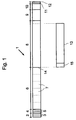
- Bit group 1 also called frame, comprises 64 bytes, i.e. 512 bits. This is an even multiple of the lengths of bit groups in known ones Transmission formats for synchronous data, in particular the SPDIF format or the format known from EP-A-0 725 522, so that because of the simple Convertibility compatibility with these formats is given.
- Bit group 1 contains a preamble 2, which comprises four bit positions 3.
- the Preamble 2 enables a subscriber's PLL circuit to synchronize to one received clock.
- 16 bit groups 1 are combined to form a block, the first preamble 2 of each block contains a special block identifier bit.
- the preamble 2 is followed by a data field 4 which comprises four bit positions 5 and whose function is explained below.
- Area 6 for synchronous data is connected to the data field 4.
- Area 6 can in a known manner in several sub-bit groups 7 of the same length be divided, which are each assigned to a specific participant. The assignment The preamble 2 between the partial bit groups 7 and the respective participants captured.
- An area 8 for asynchronous data is connected to the area 6 for synchronous data on.
- the area 6 for synchronous data and the area 8 for asynchronous data occupy together 60 bytes of bit group 1.
- the total transmission capacity of the network for synchronous and asynchronous source data is formed by these 60 bytes.
- the area 8 for asynchronous data is followed by a 16-bit or 2-byte data field 9 for control bits.
- the control bits of a block i.e. 32 bytes or 192 bits a control message.
- the data field 9 for control bits is followed by a data field 10 consisting of 6 bits consists.
- a clocking subscriber or clock generator writes a "0" in it Data field 10, and the value in data field 10 is used by each subsequent participant in the Ring increased by one, so that each participant out of a maximum of 64 in this case Has immediate knowledge of his position in the ring.
- the data field 10 is followed by a single bit position 11 with which it is indicated whether a Data packet in area 8 for asynchronous data in one following bit group 1 Bit group continues or not.
- Bit position 11 is followed by a bit position 12 for I'arity bit for error detection.
- each bit group 1 is for synchronous or asynchronous source data reserved, and the data fields 2, 4, 9, 10 and the two individual bit positions 11 and 12 are reserved for synchronous control data.
- bit group 1 in favor of a detailed one Representation of individual bit positions is not drawn to scale.
- a data packet 13 that is sent by a packet-oriented subscriber over the network is to be transmitted in such a way in the area 8 for asynchronous Data inserted that there is at the boundary 14 between the area 6 for synchronous data and area 8 for asynchronous data begins, as with dashed lines shown.
- the data packet 13 contains a header area 15, which is the address of a Network connected receiver of the data packet 13 contains. If the sender Participant is a device that issues data packets without addresses is everyone Add an address to data packets. This can easily be done in an interface between the participant and the network.
- the data packet 13 is somewhat shorter than the area 8 for asynchronous data so that it can be transmitted in a single bit group 1.
- the rest of the data packet in the following bit group 1 Bit groups and possibly other bit groups transmit what is through the flag is displayed at bit position 11.
- the transmission of a data packet that is longer than the area 8 for asynchronous data in a bit group is 1, below 2 to 7 explained in more detail.
- a Radio receiver In a ring-shaped communication network in a motor vehicle there are one Radio receiver, a CD player, a mobile phone, an input / output device for voice, a navigation system that includes a GPS receiver and an 8-speed CD-ROM drive as a database for map material, several amplifier-speaker combinations and a screen connected to each other via light guides.
- area 6 becomes synchronous data is automatically reduced to the point where it is just enough Transmission capacity for the audio data and for video data from the navigation system remains on the screen.
- the area 8 for asynchronous data becomes corresponding enlarged, so that a relatively large capacity for data-intensive packets Communication between the navigation system and the CD-ROM drive Available.
- synchronous source data have priority over asynchronous data. That is, if in the meantime on a phone with In synchronous operation a call is received, area 6 for synchronous data is automatically again enlarged accordingly.
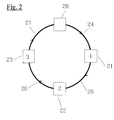
- Fig. 2 shows a ring-shaped network with a subscriber used as a clock generator 20 and three other participants 21, 22 and 23.
- the four participants 20, 21, 22 and 23 are connected to one another in an annular manner via light guide sections 24, 25, 26 and 27.
- the physical direction of data transmission is indicated by arrows on the Light guide sections shown.
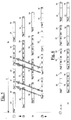
- Fig. 3 is a transmission of asynchronous data from the participant 21 to Participants 23 are shown, the transmission not via the clock generator 20 he follows.
- the clock generator 20 sends bit groups at certain time intervals, wherein in 3 four areas 30, 31, 32 and 33 for asynchronous data of four successive bit groups are shown.
- the clock generator 20 sent area 30 is empty, which with a "free" identifier immediately at the beginning of Area 30 is displayed.
- the participant 21 recognizes that the area 30 is free, and checks its own send status. In the case of a send request, the Participant 21 assigned to area 30 and immediately begins to use area 30 Send address D0 and data D1 and D2.
- Bit 34 corresponds to bit position 11 in the bit group format of FIG. 1, is here but for the sake of clarity immediately after area 30 drawn.
- the set bit 34 signals all other participants that the Data packet in the next bit group or its area for asynchronous data continues. The subsequent participants do not even try in this area to write or not get this area allotted if the allotment of one Headquarters off. Furthermore, the set bit 34 signals the receiver of the Data packet, here the participant 23 that it in the bit group boundary Willingness to receive must remain.
- the subscriber 22 recognizes the occupied area 30, checks the address D0, recognizes that there is no agreement and behaves transparently, only a small one There is a delay.
- the participant 23 recognizes his address D0 in the area 30 and starts with the Reception.
- the clock generator 20 receives the generated by it and now in the area 30 with the Send data from the subscriber 21 occupied bit group with a network size dependent delay.
- the content of the received area 30 is (as well as the remaining content of the bit group in which area 30 is contained) in area 31 for Copies asynchronous data of the next bit group, as with hatched arrows indicated.
- the clock generator 20 has a correspondingly large cache.
- the subscriber 21 then overwrites the data D0, D1 and D2 with subsequent data D3, D4 and D5. Assuming that this is the last part of the data to be sent, the Participant 21 sets bit 34 back to "0" to signal that the range for asynchronous data of the next bit group again to be sent to other participants Available.
- the bit group is then sent to the subscriber 22 without changing the area 21 receiving participant 23 and transmitted from there to the clock generator 20, which the Contents of area 31 in area 32 of the next bit group generated by it copied.
- the subscriber 21 sets the "busy" identifier back to "free”. This prevents this bit group from being forever with Asynchronous data occupied in the system circles when the clock generator 20 as in this Example basically the content of the last received bit group into the next Bit group copied without evaluating their content.
- the transfer of the whole Data packet takes a time t.
- Fig. 4 shows the areas 30, 31, 32 and 33 for asynchronous data in the successive groups of bits, as in the transmission of Fig. 3 from the individual participants can be seen.
- Fig. 5 the case is shown that the transmission link from the transmitter, in this case the participant 23, to the recipient, who in this case is the participant 21, via the Clock generator 20 leads.
- the clock generator 20 again generates a bit stream that does not contains asynchronous data.
- the participants 21 and 22 recognize the free area 30 and check their own broadcasting status. Since neither participant 21 and 22 If there is a send request, then enter the bit group with the area 30 transparently continue.
- the participant 23 would like to send, however, which is why he sets the "busy" identifier and data begins to be sent immediately. Since the amount of data to be transferred is larger than that in number of free bytes contained in an area for asynchronous data of a bit group, he sets bit 34.
- the clock generator 20 receives the generated by it and now in the area 30 with the Send data from the subscriber 21 occupied bit group with a network size dependent delay.
- the content of the received area 30 of received bit group is in the area 31 for as in the example of FIG Copied asynchronous data of the next generated bit group.
- the subscriber 21 recognizes the occupied area 31 delayed by one bit group related to the clock generator 20, recognizes its address D0 and begins with the Reception.
- the participant 23 receives the data sent by him in the area 32 of the next Bit group into which they have been copied by the clock generator 20 and sets them "Occupied" identifier back to "Free".
- the bit group with the free area is also as recognized in the example of Fig. 3 with a delay of one bit group.
- Fig. 6 shows areas 30, 31, 32 and 33 for asynchronous data in the successive groups of bits, as in the transmission of Fig. 5 from the individual participants can be seen.
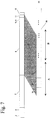
- FIG. 7 shows a data packet 35 which has a free / busy identifier 36, an address 37 and Contains data 38 and this longer than the area 8 for asynchronous data of a bit group which corresponds to bit group 1 of FIG. 1.
- the data packet 35 is divided into pieces A, B, ... decomposes, the maximum length of the length of an area 8 for asynchronous data corresponds, and the individual pieces are inserted into a bit group, such as shown schematically, the bit position 11 in each bit group also being set to "1" is set as long as the data packet 35 is not yet completely in bit groups has been accommodated, and then set to "0".
Landscapes
- Engineering & Computer Science (AREA)
- Computer Networks & Wireless Communication (AREA)
- Signal Processing (AREA)
- Computer Hardware Design (AREA)
- Multimedia (AREA)
- Small-Scale Networks (AREA)
- Data Exchanges In Wide-Area Networks (AREA)
- Synchronisation In Digital Transmission Systems (AREA)
- Communication Control (AREA)
Applications Claiming Priority (2)
| Application Number | Priority Date | Filing Date | Title |
|---|---|---|---|
| DE19642258A DE19642258C1 (de) | 1996-10-11 | 1996-10-11 | Verfahren zur Übertragung von Quell- und Steuerdaten in einem Kommunikationssystem mit Ringstruktur |
| DE19642258 | 1996-10-11 |
Publications (3)
| Publication Number | Publication Date |
|---|---|
| EP0843443A2 true EP0843443A2 (fr) | 1998-05-20 |
| EP0843443A3 EP0843443A3 (fr) | 2003-01-02 |
| EP0843443B1 EP0843443B1 (fr) | 2007-07-11 |
Family
ID=7808652
Family Applications (1)
| Application Number | Title | Priority Date | Filing Date |
|---|---|---|---|
| EP97117363A Expired - Lifetime EP0843443B1 (fr) | 1996-10-11 | 1997-10-08 | Méthode de transport de données de contrôle et de données provenant d'une source dans un système de communication en anneau |
Country Status (5)
| Country | Link |
|---|---|
| US (1) | US5935214A (fr) |
| EP (1) | EP0843443B1 (fr) |
| JP (1) | JP3904688B2 (fr) |
| AT (1) | ATE367030T1 (fr) |
| DE (2) | DE19642258C1 (fr) |
Families Citing this family (12)
| Publication number | Priority date | Publication date | Assignee | Title |
|---|---|---|---|---|
| DE19642265C1 (de) * | 1996-10-11 | 1998-01-29 | Becker Gmbh | Verfahren zum Betreten und Verlassen eines Stromsparbetriebs eines Teilnehmers in einem ringförmigen Kommunikationsnetz |
| DE19742378A1 (de) * | 1997-09-25 | 1999-04-22 | Siemens Ag | Ringspeicher für eine TDMA-Datenübertragungsstation und entsprechende Datenübertragungsstation |
| JPH11234318A (ja) * | 1998-02-10 | 1999-08-27 | Fujitsu Ltd | クロック再生装置 |
| US6108346A (en) * | 1998-08-27 | 2000-08-22 | Xiox Corporation | Combined synchronous and asynchronous message transmission |
| DE19858493A1 (de) * | 1998-12-18 | 2000-06-29 | Xsys Interactive Research Gmbh | Lokales Netzwerk |
| DE19954758A1 (de) * | 1999-11-15 | 2001-05-23 | Becker Gmbh | Verfahren zum Datenaustausch für eine Multimediaanlage sowie Multimediaanlage für ein Fahrzeug |
| DE10011330A1 (de) | 2000-03-10 | 2001-09-20 | Becker Gmbh | Verfahren zur Datenübertragung in einem Kommunikationsnetzwerk mit Ringstruktur |
| US7301960B2 (en) * | 2000-12-15 | 2007-11-27 | Harris Corporation | Apparatus for and method of control and communication of multiple stations in a TDM network |
| EP1271888B1 (fr) | 2001-06-27 | 2005-08-17 | Siemens Aktiengesellschaft | Procédé pour transférer des données de communication fondées sur le protocole Internet |
| US7885279B2 (en) * | 2001-12-18 | 2011-02-08 | Becker Gmbh | Assigning a data channel to multiple data links for simultaneous data transmission via a single data channel |
| DE10308953A1 (de) | 2003-02-28 | 2004-09-09 | Siemens Ag | Kommunikation in einem Datennetz |
| KR100631527B1 (ko) * | 2005-06-23 | 2006-10-09 | 엘지전자 주식회사 | 임베디드 시스템의 운용 소프트웨어 업그레이드 장치와방법 |
Family Cites Families (7)
| Publication number | Priority date | Publication date | Assignee | Title |
|---|---|---|---|---|
| JP2654452B2 (ja) * | 1985-12-18 | 1997-09-17 | アドバンスト・マイクロ・ディバイシズ・インコーポレーテッド | 非同期で異種の可変幅の並列データパターン入力信号を直列データパターン信号に変換するための装置 |
| US4958344A (en) * | 1985-12-18 | 1990-09-18 | Advanced Micro Devices, Inc. | System for transmitting and receiving asynchronous nonhomogeneous variable width parallel data over a synchronous high speed serial transmission media |
| EP0510290B1 (fr) * | 1991-04-22 | 1997-02-05 | International Business Machines Corporation | Insertion et extraction libre de collisions de canaux par commutation circuit dans une structure de transmission par commutation paquet |
| US5361261A (en) * | 1992-11-02 | 1994-11-01 | National Semiconductor Corporation | Frame-based transmission of data |
| US5490168A (en) * | 1994-07-08 | 1996-02-06 | Motorola, Inc. | Method and system for automatic optimization of data throughput using variable packet length and code parameters |
| DE19503213C2 (de) * | 1995-02-02 | 1996-10-17 | Becker Gmbh | Verfahren zur gemeinsamen Übertragung von digitalen Quell- und Steuerdaten zwischen über Datenleitungen verbundenen Datenquellen und -senken |
| DE19503215C1 (de) * | 1995-02-02 | 1996-10-02 | Becker Gmbh | Verfahren zur gemeinsamen Übertragung von digitalen Quell- und Steuerdaten zwischen über Datenleitungen verbundenen Datenquellen und -senken |
-
1996
- 1996-10-11 DE DE19642258A patent/DE19642258C1/de not_active Expired - Lifetime
-
1997
- 1997-10-08 EP EP97117363A patent/EP0843443B1/fr not_active Expired - Lifetime
- 1997-10-08 AT AT97117363T patent/ATE367030T1/de not_active IP Right Cessation
- 1997-10-08 DE DE59712856T patent/DE59712856D1/de not_active Expired - Lifetime
- 1997-10-09 JP JP27631797A patent/JP3904688B2/ja not_active Expired - Lifetime
- 1997-10-14 US US08/949,724 patent/US5935214A/en not_active Expired - Lifetime
Also Published As
| Publication number | Publication date |
|---|---|
| EP0843443B1 (fr) | 2007-07-11 |
| DE59712856D1 (de) | 2007-08-23 |
| US5935214A (en) | 1999-08-10 |
| DE19642258C1 (de) | 1998-03-26 |
| ATE367030T1 (de) | 2007-08-15 |
| JP3904688B2 (ja) | 2007-04-11 |
| JPH10178440A (ja) | 1998-06-30 |
| EP0843443A3 (fr) | 2003-01-02 |
Similar Documents
| Publication | Publication Date | Title |
|---|---|---|
| DE3855925T2 (de) | Nachrichtenübertragung in einem multiplexsystem | |
| DE3688732T2 (de) | Satellitenkommunikationssystem mit wahlfreiem Vielfachzugriff und Zeitschlitzreservierung. | |
| DE3115455C2 (fr) | ||
| DE3705530C2 (fr) | ||
| DE69732274T2 (de) | Flusssteuerungsprotokollsystem und verfahren | |
| DE3786569T2 (de) | Vorrichtung und verfahren zur uebertragung einer ersten und einer zweiten informationsart ueber einen zeitschlitzgesteuerten bus. | |
| DE69013886T2 (de) | Mehrfachzugriffssteuerung für ein Kommunikationssystem mit Reservierungsblockübermittlung. | |
| DE69028266T2 (de) | Paketvermittlungsnetzwerk für unterschiedliche Typen von Paketen | |
| DE19642258C1 (de) | Verfahren zur Übertragung von Quell- und Steuerdaten in einem Kommunikationssystem mit Ringstruktur | |
| DE19856441A1 (de) | Verfahren zur Übertragung von Kurznachrichten | |
| DE69938106T2 (de) | Verfahren zur änderung der bandbreite eines leitungsvermittelten kanals | |
| DE19856440C2 (de) | Übertragungsrahmen und Funkeinheit mit Übertragungsrahmen | |
| EP0924622A2 (fr) | Procédé de transfert d'un flux asynchrone de données sur un bus synchrone et continue ainsi qu'un circuit pour la mise en oeuvre de ce procédé. | |
| DE10231941A1 (de) | Datenpaketstruktur für direkt adressiertes Multicast-Protokoll | |
| DE10231958B4 (de) | Verfahren und System zum Übertragen von Datenpaketen über ein Netzwerk an ausgewählte mehrere Bestimmungsorte, sowie computerlesbares Medium | |
| DE69801728T2 (de) | Gerät und Verfahren zur Teilung eines Signalisierungskanals | |
| EP0725519B1 (fr) | Procédé pour la transmission combinée de signaux numériques de données de source et de contrÔle entre des sources et des récepteurs de données reliés par des lignes de transmission | |
| EP0831663A2 (fr) | Procédé de transmission de données numériques sans fil | |
| DE19503210C1 (de) | Verfahren zur Übertragung von digitalen Daten | |
| DE68903986T2 (de) | Vermittlungssystem fuer leitungs- und/oder paketvermittelte nachrichtenuebertragungen. | |
| EP0332809A2 (fr) | Système de commutation de communication numérique, en particulier un central privé, pour signaux de voix, des données, d'images fixes, de vidéo-téléphone, etc. | |
| DE3788417T2 (de) | Verfahren zur Datenübertragungssteuerung. | |
| EP0836298B1 (fr) | Système de communication | |
| DE3817407C2 (fr) | ||
| DE60304178T2 (de) | Kommunikationssystem zum senden von daten verschiedenen typs und länge über kanäle eines lokal synchronisierten busses |
Legal Events
| Date | Code | Title | Description |
|---|---|---|---|
| PUAI | Public reference made under article 153(3) epc to a published international application that has entered the european phase |
Free format text: ORIGINAL CODE: 0009012 |
|
| AK | Designated contracting states |
Kind code of ref document: A2 Designated state(s): AT BE CH DE DK ES FI FR GB GR IE IT LI LU MC NL PT SE |
|
| AX | Request for extension of the european patent |
Free format text: AL;LT;LV;RO;SI |
|
| PUAL | Search report despatched |
Free format text: ORIGINAL CODE: 0009013 |
|
| AK | Designated contracting states |
Kind code of ref document: A3 Designated state(s): AT BE CH DE DK ES FI FR GB GR IE IT LI LU MC NL PT SE |
|
| AX | Request for extension of the european patent |
Free format text: AL;LT;LV;RO;SI |
|
| RIC1 | Information provided on ipc code assigned before grant |
Free format text: 7H 04L 12/43 A, 7H 04L 29/02 B, 7H 04L 12/64 B, 7H 04L 12/42 B, 7H 04J 3/22 B, 7H 04J 3/24 B |
|
| 17P | Request for examination filed |
Effective date: 20030605 |
|
| AKX | Designation fees paid |
Designated state(s): AT CH DE FR GB IT LI NL |
|
| 17Q | First examination report despatched |
Effective date: 20050111 |
|
| RAP1 | Party data changed (applicant data changed or rights of an application transferred) |
Owner name: SILICON SYSTEMS GMBH MULTIMEDIA ENGINEERING Owner name: HARMAN BECKER AUTOMOTIVE SYSTEMS GMBH |
|
| GRAP | Despatch of communication of intention to grant a patent |
Free format text: ORIGINAL CODE: EPIDOSNIGR1 |
|
| RAP1 | Party data changed (applicant data changed or rights of an application transferred) |
Owner name: SMSC EUROPE GMBH Owner name: HARMAN BECKER AUTOMOTIVE SYSTEMS GMBH |
|
| GRAS | Grant fee paid |
Free format text: ORIGINAL CODE: EPIDOSNIGR3 |
|
| GRAA | (expected) grant |
Free format text: ORIGINAL CODE: 0009210 |
|
| AK | Designated contracting states |
Kind code of ref document: B1 Designated state(s): AT CH DE FR GB IT LI NL |
|
| REG | Reference to a national code |
Ref country code: GB Ref legal event code: FG4D Free format text: NOT ENGLISH |
|
| REG | Reference to a national code |
Ref country code: CH Ref legal event code: EP |
|
| REF | Corresponds to: |
Ref document number: 59712856 Country of ref document: DE Date of ref document: 20070823 Kind code of ref document: P |
|
| GBT | Gb: translation of ep patent filed (gb section 77(6)(a)/1977) |
Effective date: 20071008 |
|
| ET | Fr: translation filed | ||
| PG25 | Lapsed in a contracting state [announced via postgrant information from national office to epo] |
Ref country code: NL Free format text: LAPSE BECAUSE OF FAILURE TO SUBMIT A TRANSLATION OF THE DESCRIPTION OR TO PAY THE FEE WITHIN THE PRESCRIBED TIME-LIMIT Effective date: 20070711 |
|
| NLV1 | Nl: lapsed or annulled due to failure to fulfill the requirements of art. 29p and 29m of the patents act | ||
| PLBE | No opposition filed within time limit |
Free format text: ORIGINAL CODE: 0009261 |
|
| STAA | Information on the status of an ep patent application or granted ep patent |
Free format text: STATUS: NO OPPOSITION FILED WITHIN TIME LIMIT |
|
| 26N | No opposition filed |
Effective date: 20080414 |
|
| REG | Reference to a national code |
Ref country code: CH Ref legal event code: PL |
|
| PG25 | Lapsed in a contracting state [announced via postgrant information from national office to epo] |
Ref country code: LI Free format text: LAPSE BECAUSE OF NON-PAYMENT OF DUE FEES Effective date: 20071031 Ref country code: CH Free format text: LAPSE BECAUSE OF NON-PAYMENT OF DUE FEES Effective date: 20071031 |
|
| PG25 | Lapsed in a contracting state [announced via postgrant information from national office to epo] |
Ref country code: AT Free format text: LAPSE BECAUSE OF NON-PAYMENT OF DUE FEES Effective date: 20071008 |
|
| PGFP | Annual fee paid to national office [announced via postgrant information from national office to epo] |
Ref country code: IT Payment date: 20091023 Year of fee payment: 13 |
|
| PGFP | Annual fee paid to national office [announced via postgrant information from national office to epo] |
Ref country code: FR Payment date: 20101109 Year of fee payment: 14 |
|
| REG | Reference to a national code |
Ref country code: DE Ref legal event code: R082 Ref document number: 59712856 Country of ref document: DE Representative=s name: LOHR, JOESTINGMEIER & PARTNER, DE Effective date: 20110912 Ref country code: DE Ref legal event code: R081 Ref document number: 59712856 Country of ref document: DE Owner name: SMSC EUROPE GMBH, DE Free format text: FORMER OWNERS: HARMAN BECKER AUTOMOTIVE SYSTEMS GMBH, 76307 KARLSBAD, DE; SMSC EUROPE GMBH, 76185 KARLSRUHE, DE Effective date: 20110912 Ref country code: DE Ref legal event code: R081 Ref document number: 59712856 Country of ref document: DE Owner name: SMSC EUROPE GMBH, DE Free format text: FORMER OWNER: HARMAN BECKER AUTOMOTIVE SYSTEM, SMSC EUROPE GMBH, , DE Effective date: 20110912 |
|
| PG25 | Lapsed in a contracting state [announced via postgrant information from national office to epo] |
Ref country code: IT Free format text: LAPSE BECAUSE OF NON-PAYMENT OF DUE FEES Effective date: 20101008 |
|
| REG | Reference to a national code |
Ref country code: FR Ref legal event code: ST Effective date: 20120629 |
|
| PG25 | Lapsed in a contracting state [announced via postgrant information from national office to epo] |
Ref country code: FR Free format text: LAPSE BECAUSE OF NON-PAYMENT OF DUE FEES Effective date: 20111102 |
|
| PGFP | Annual fee paid to national office [announced via postgrant information from national office to epo] |
Ref country code: GB Payment date: 20161027 Year of fee payment: 20 Ref country code: DE Payment date: 20161027 Year of fee payment: 20 |
|
| REG | Reference to a national code |
Ref country code: DE Ref legal event code: R071 Ref document number: 59712856 Country of ref document: DE |
|
| REG | Reference to a national code |
Ref country code: GB Ref legal event code: PE20 Expiry date: 20171007 |
|
| PG25 | Lapsed in a contracting state [announced via postgrant information from national office to epo] |
Ref country code: GB Free format text: LAPSE BECAUSE OF EXPIRATION OF PROTECTION Effective date: 20171007 |