EP0844065B1 - Procédé de fabrication de revêtements pour tuyaux - Google Patents
Procédé de fabrication de revêtements pour tuyaux Download PDFInfo
- Publication number
- EP0844065B1 EP0844065B1 EP97306971A EP97306971A EP0844065B1 EP 0844065 B1 EP0844065 B1 EP 0844065B1 EP 97306971 A EP97306971 A EP 97306971A EP 97306971 A EP97306971 A EP 97306971A EP 0844065 B1 EP0844065 B1 EP 0844065B1
- Authority
- EP
- European Patent Office
- Prior art keywords
- absorbent material
- resin absorbent
- outer layer
- guiding tube
- inner layer
- Prior art date
- Legal status (The legal status is an assumption and is not a legal conclusion. Google has not performed a legal analysis and makes no representation as to the accuracy of the status listed.)
- Expired - Lifetime
Links
- 238000004519 manufacturing process Methods 0.000 title claims description 33
- 239000011347 resin Substances 0.000 claims description 109
- 229920005989 resin Polymers 0.000 claims description 109
- 239000000463 material Substances 0.000 claims description 98
- 239000002250 absorbent Substances 0.000 claims description 96
- 230000002745 absorbent Effects 0.000 claims description 95
- 239000002985 plastic film Substances 0.000 claims description 46
- 229920006255 plastic film Polymers 0.000 claims description 46
- 238000000034 method Methods 0.000 claims description 18
- 229920001187 thermosetting polymer Polymers 0.000 claims description 12
- 239000012530 fluid Substances 0.000 claims description 9
- 238000010438 heat treatment Methods 0.000 claims description 9
- 239000002131 composite material Substances 0.000 claims description 8
- 239000004744 fabric Substances 0.000 claims description 8
- 239000000314 lubricant Substances 0.000 claims description 8
- 239000000835 fiber Substances 0.000 claims description 4
- 238000005304 joining Methods 0.000 claims description 4
- 238000007789 sealing Methods 0.000 claims description 4
- 238000005096 rolling process Methods 0.000 claims description 2
- 230000002093 peripheral effect Effects 0.000 description 11
- 238000009958 sewing Methods 0.000 description 9
- 238000003754 machining Methods 0.000 description 6
- 239000003921 oil Substances 0.000 description 6
- 239000004677 Nylon Substances 0.000 description 3
- 239000000853 adhesive Substances 0.000 description 3
- 230000001070 adhesive effect Effects 0.000 description 3
- 239000011248 coating agent Substances 0.000 description 3
- 238000000576 coating method Methods 0.000 description 3
- 238000003780 insertion Methods 0.000 description 3
- 230000037431 insertion Effects 0.000 description 3
- 229920001778 nylon Polymers 0.000 description 3
- -1 polyethylene Polymers 0.000 description 3
- 239000004698 Polyethylene Substances 0.000 description 2
- 239000007767 bonding agent Substances 0.000 description 2
- 230000002950 deficient Effects 0.000 description 2
- 238000010586 diagram Methods 0.000 description 2
- 230000000694 effects Effects 0.000 description 2
- 239000007788 liquid Substances 0.000 description 2
- 229920000573 polyethylene Polymers 0.000 description 2
- 239000000843 powder Substances 0.000 description 2
- 238000004080 punching Methods 0.000 description 2
- 229920006305 unsaturated polyester Polymers 0.000 description 2
- 238000003466 welding Methods 0.000 description 2
- OKTJSMMVPCPJKN-UHFFFAOYSA-N Carbon Chemical compound [C] OKTJSMMVPCPJKN-UHFFFAOYSA-N 0.000 description 1
- 239000004743 Polypropylene Substances 0.000 description 1
- NIXOWILDQLNWCW-UHFFFAOYSA-N acrylic acid group Chemical group C(C=C)(=O)O NIXOWILDQLNWCW-UHFFFAOYSA-N 0.000 description 1
- 229910052799 carbon Inorganic materials 0.000 description 1
- 239000000919 ceramic Substances 0.000 description 1
- 239000011521 glass Substances 0.000 description 1
- 238000010030 laminating Methods 0.000 description 1
- 238000002844 melting Methods 0.000 description 1
- 230000008018 melting Effects 0.000 description 1
- 239000000203 mixture Substances 0.000 description 1
- 238000012986 modification Methods 0.000 description 1
- 230000004048 modification Effects 0.000 description 1
- 229920000728 polyester Polymers 0.000 description 1
- 229920001155 polypropylene Polymers 0.000 description 1
- 229920000915 polyvinyl chloride Polymers 0.000 description 1
- 239000004800 polyvinyl chloride Substances 0.000 description 1
- 238000009423 ventilation Methods 0.000 description 1
- XLYOFNOQVPJJNP-UHFFFAOYSA-N water Substances O XLYOFNOQVPJJNP-UHFFFAOYSA-N 0.000 description 1
Images





Classifications
-
- F—MECHANICAL ENGINEERING; LIGHTING; HEATING; WEAPONS; BLASTING
- F16—ENGINEERING ELEMENTS AND UNITS; GENERAL MEASURES FOR PRODUCING AND MAINTAINING EFFECTIVE FUNCTIONING OF MACHINES OR INSTALLATIONS; THERMAL INSULATION IN GENERAL
- F16L—PIPES; JOINTS OR FITTINGS FOR PIPES; SUPPORTS FOR PIPES, CABLES OR PROTECTIVE TUBING; MEANS FOR THERMAL INSULATION IN GENERAL
- F16L55/00—Devices or appurtenances for use in, or in connection with, pipes or pipe systems
- F16L55/16—Devices for covering leaks in pipes or hoses, e.g. hose-menders
- F16L55/162—Devices for covering leaks in pipes or hoses, e.g. hose-menders from inside the pipe
- F16L55/165—Devices for covering leaks in pipes or hoses, e.g. hose-menders from inside the pipe a pipe or flexible liner being inserted in the damaged section
- F16L55/1656—Devices for covering leaks in pipes or hoses, e.g. hose-menders from inside the pipe a pipe or flexible liner being inserted in the damaged section materials for flexible liners
-
- B—PERFORMING OPERATIONS; TRANSPORTING
- B29—WORKING OF PLASTICS; WORKING OF SUBSTANCES IN A PLASTIC STATE IN GENERAL
- B29B—PREPARATION OR PRETREATMENT OF THE MATERIAL TO BE SHAPED; MAKING GRANULES OR PREFORMS; RECOVERY OF PLASTICS OR OTHER CONSTITUENTS OF WASTE MATERIAL CONTAINING PLASTICS
- B29B11/00—Making preforms
- B29B11/04—Making preforms by assembling preformed material
-
- B—PERFORMING OPERATIONS; TRANSPORTING
- B29—WORKING OF PLASTICS; WORKING OF SUBSTANCES IN A PLASTIC STATE IN GENERAL
- B29C—SHAPING OR JOINING OF PLASTICS; SHAPING OF MATERIAL IN A PLASTIC STATE, NOT OTHERWISE PROVIDED FOR; AFTER-TREATMENT OF THE SHAPED PRODUCTS, e.g. REPAIRING
- B29C31/00—Handling, e.g. feeding of the material to be shaped, storage of plastics material before moulding; Automation, i.e. automated handling lines in plastics processing plants, e.g. using manipulators or robots
- B29C31/002—Handling tubes, e.g. transferring between shaping stations, loading on mandrels
-
- B—PERFORMING OPERATIONS; TRANSPORTING
- B29—WORKING OF PLASTICS; WORKING OF SUBSTANCES IN A PLASTIC STATE IN GENERAL
- B29C—SHAPING OR JOINING OF PLASTICS; SHAPING OF MATERIAL IN A PLASTIC STATE, NOT OTHERWISE PROVIDED FOR; AFTER-TREATMENT OF THE SHAPED PRODUCTS, e.g. REPAIRING
- B29C63/00—Lining or sheathing, i.e. applying preformed layers or sheathings of plastics; Apparatus therefor
- B29C63/26—Lining or sheathing of internal surfaces
- B29C63/34—Lining or sheathing of internal surfaces using tubular layers or sheathings
-
- B—PERFORMING OPERATIONS; TRANSPORTING
- B29—WORKING OF PLASTICS; WORKING OF SUBSTANCES IN A PLASTIC STATE IN GENERAL
- B29C—SHAPING OR JOINING OF PLASTICS; SHAPING OF MATERIAL IN A PLASTIC STATE, NOT OTHERWISE PROVIDED FOR; AFTER-TREATMENT OF THE SHAPED PRODUCTS, e.g. REPAIRING
- B29C53/00—Shaping by bending, folding, twisting, straightening or flattening; Apparatus therefor
- B29C53/36—Bending and joining, e.g. for making hollow articles
- B29C53/38—Bending and joining, e.g. for making hollow articles by bending sheets or strips at right angles to the longitudinal axis of the article being formed and joining the edges
Definitions
- the present invention relates to a method of manufacturing a pipe liner bag for use in repairing pipelines.
- the pipe lining method utilizes a tubular pipe liner bag made of a resin absorbent material impregnated with a hardenable resin, and having the outer surface covered with a highly air-tight plastic film.
- the tubular pipe liner bag is inserted into a pipe to be repaired by means of a pressurized fluid such that the pipe liner bag is turned inside out as it proceeds deeper in the pipe.
- this manner of insertion shall be called "everting".
- the everted tubular liner When the entire length of the tubular liner bag is everted (i.e., turned inside out) into the pipe, the everted tubular liner is pressed against the inner wall of the pipe by a pressurized fluid, and the tubular flexible liner is hardened as the hardenable resin impregnated in the liner is heated, which is effected by heating the fluid filling the tubular liner bag. It is thus possible to line the inner wall of the defective or old pipe with a rigid liner without digging the ground and disassembling the pipe sections.
- the thickness of the material of the pipe liner bag is adjusted in order to ensure a required strength.
- the adjustment of the thickness is typically made by laminating a plurality of resin absorbent materials to form a multi-layer structure.
- a pipe liner bag is formed of two tubular layers of resin absorbent materials for ensuring a required thickness
- a resin absorbent material made of unwoven fabric is first rolled and both ends are joined to form a first tubular layer of resin absorbent material.
- another strip-like resin absorbent material is surrounded over the first layer of resin absorbent material and both ends are joined to form a second tubular layer of resin absorbent material.
- the outer surface of the two-layer resin absorbent material is coated with a plastic film. In this way, a pipe liner bag having a desired thickness is manufactured.
- the process of coating the outer surface of the resin absorbent material with the plastic film involves the most expertise in the method of manufacturing the multi-layer pipe liner bag.
- this coating is performed on a heavy multi-layer resin absorbent material, there is a problem that the workability is extremely low.
- an operation for modifying a large and heavy pipe liner bag deviated from a machining line is difficult, and the plastic film covering the outer surface of the pipe liner bag is often scratched during treatment of the pipe liner bag.
- the present invention has been made in view of the problems mentioned above, and it is an object of the invention to provide a method which is capable of readily manufacturing a multi-layer pipe liner bag with a good workability.
- a method of manufacturing a pipe liner bag comprising the steps of:
- a pipe liner bag comprising the steps of:
- a pipe liner bag comprising the steps of:
- the guiding tube is inserted inside out into the outer layer by a fluid pressure.
- the guiding tube is composed of a tubular film, a tubular composite film or a composite structure having layered plastic film and unwoven fabric or split fiber.
- the guiding tube is applied with a lubricant.
- the methods described above may further comprise the steps of:
- the tubular outer layer may be manufactured by inserting a resin absorbent material into the plastic film, evacuating the resin absorbent material to bring the plastic film into close contact with the outer surface of the resin absorbent material, and heating the plastic film while maintaining the closely contacted state to weld the plastic film on the outer surface of the resin absorbent material.
- a highly air-tight pressure tube is inserted into the resin absorbent material, the pressure tube is inflated with a fluid pressure to extend the plastic film and the resin absorbent material outwardly in a circular tube shape, and the resin absorbent material is evacuated to bring the plastic film into close contact with the outer surface of the resin absorbent material.
- the outer layer may be manufactured by rolling a strip-like resin absorbent material having a plastic film coated over one surface thereof with the plastic film facing the outside, joining both ends, and hermetically sealing the joined portion.
- the outer layer and the inner layer are separately manufactured, and the manufacturing of each layer can be performed with a good workability.
- the plastic film coated on the outer peripheral surface of the outer layer is prevented from scratches.
- the inner layer is inserted into the outer layer as the inner layer is guided by the guiding tube, so that the inner layer can be smoothly inserted into the outer layer.
- the guiding tube is extracted to readily laminate the outer layer and the inner layer to provide a multi-layer structure.
- the resin absorbent materials of the tubular outer layer and the tubular inner layer are impregnated with thermosetting resin. In this way, a pipe liner bag having a desired thickness can be manufactured with a good workability.
- FIGs. 1 through 3 are cross-sectional views illustrating, in order, the steps of a manufacturing method according to the first embodiment.
- Fig. 4 is a partial perspective view illustrating a pipe liner bag manufactured by the method according to the first embodiment
- Fig. 5 is an enlarged view illustrating in detail an end machined portion of the pipe liner bag.
- a guiding tube 3 is inserted inside out by a fluid pressure such as air pressure or the like, by way of example, into a tubular outer layer 1 composed of a resin absorbent material 1A and a highly air-tight plastic film 1B covering the outer periphery of the resin absorbent material 1A, as illustrated in Fig. 1.
- the guiding tube 3 is composed of a tubular film, a tubular composite film or a composite structure having layered plastic film and unwoven fabric or split fiber.
- the inner and outer surfaces of the guiding tube 3 are smooth, and the outer peripheral surface, before eversion, is applied with a lubricant such as oil, liquid or powder wax.
- a pull rope (or belt) 4 is connected at an end portion of the guiding tube 3.
- the pull rope (or belt) 4 is drawn into the guiding tube 3.
- one end of the pull rope (or belt) 4 is attached to one end of a tubular inner layer 2 comprising another resin absorbent material 2A, as illustrated in Fig. 2.
- the diameter of the resin absorbent material 2A constituting the tubular inner layer 2 is set larger than the diameter of the resin absorbent material 1A constituting the tubular outer layer 1.
- the pull rope 4 is pulled in the direction indicated by arrows (to the right in Fig. 2), with the outer layer 1 and guiding tube 3 fixed at one end thereof, to pull the inner layer 2 into the guiding tube 3.
- the inner peripheral surface of the guiding tube 3 is applied with a lubricant such as oil, the inner layer 2 is smoothly inserted into the guiding tube 3 without resistance.
- the end machining is performed in the following manner.
- one end of the outer layer 1 and one end of the inner layer 2 are fixed using a bolt 6, a nut 7, and washers 8, 9, and end faces of the outer layer 1 and the inner layer 2 are covered with a highly air-tight end cover 11.
- the end cover 11 is integrally formed with an air vent duct 11a which is tied as illustrated, when ventilation is terminated for the outer layer 1 and the inner layer 2, to prevent air from passing into or exiting from the internal space.
- Base members 12 are adhered on both surfaces of the outer layer 1 through which the bolt 6 extends, and a pull rope attaching belt 13 and a hot water attaching belt 14 are fixed by the bolt 6 at end portions of the outer layer 1 and the inner layer 2.
- the bolt 6, the nut 7, and the washers 8, 9, exposed to the outside, are covered with a jacket 15.
- the base members 12 and the jacket 15 are made by coating one surface of unwoven fabric with a plastic film.
- the respective resin absorbent materials constituting the tubular outer layer 1 and the tubular inner layer 2 are impregnated with thermosetting resin such as unsaturated polyester to provide a pipe liner bag 10 having a two-layer structure of the outer layer 1 and the inner layer 2, as illustrated in Fig. 4.
- the outer layer 1 and the inner layer 2 may be manufactured individually.
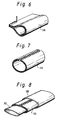
- a method of manufacturing the outer layer 1 will be described below with reference to Figs. 6 through 10.
- Fig. 6 through 9 are explanatory diagrams illustrating various steps of the method of manufacturing the outer layer 1 in order
- Fig. 10 is a cross-sectional view illustrating an evacuated resin absorbent material 1A.
- both edges in the width direction of a resin absorbent material 1A cut into a strip shape are overlapped, and the overlapping edge portions are sewed together (lock sewing) into a tubular shape, as illustrated in Fig. 6.
- the seam is stretched in the circumferential direction to form a resin absorbent material 1A which has both the edges in the width direction abutted to each other, as illustrated in Fig. 7.
- the resin absorbent material 1A is made of high melting point unwoven fabric comprising polyester, acrylic, nylon, glass, carbon, ceramic, and so on, or a mixture thereof.
- the resin absorbent material 1A may be made by joining the abutted edges of the strip resin absorbent material 1A by straight sewing, punching using needles, welding, bonding using a bonding agent, or the like.
- the resin-absorbent material 1A is inserted into a seamless tubular plastic film 1B, and a highly air-tight pressure tube 16 is also inserted into the resin absorbent material 1A.
- the plastic film may be made of polyethylene, polypropylene, nylon, polyvinyl chloride, or the like.
- both ends of the pressure tube 16 are closed to hermetically seal the pressure tube 16. Then, as illustrated in Fig. 9, when compressed air is supplied into the pressure tube 16 from a compressor 17 through an air hose 18, the pressure tube 16 is inflated by the pressure applied by the compressed air to extend the resin absorbent material 1A and the plastic film 1B outwardly in a circular tube shape.
- the resin absorbent material 1A is evacuated using a vacuum pump 19 and a vacuum hose 20, as illustrated in Figs. 9 and 10, such that the plastic film 1B located outside the resin absorbent material 1A is attracted by negative pressure generated within the resin absorbent material 1A to come into close contact with the outer surface of the resin absorbent material 1A.
- the resin absorbent material 1A together with the plastic film 1B and the pressure tube 16 is passed through a cylindrical heating apparatus 21, as illustrated in Fig. 9.
- the tubular assembly 1A, 1B, 16 is pulled by a pull rope 22, while the heating apparatus 21 is being driven, to move the tubular assembly over the entire length thereof through the heating apparatus 21 in the direction indicated by the arrow. Consequently, the plastic film 1B is heated by the heating apparatus 21 and gradually welded on the outer peripheral surface of the resin absorbent material 1A, whereby the outer peripheral surface of the resin absorbent material 1A is covered with the plastic film 1B.
- the heating apparatus 21 may comprise a plurality of linear electric heaters 24 obliquely mounted on the inner wall surface of a cylinder 23 having a diameter sufficiently larger than that of the resin absorbent material 1A.
- the electric heaters 24 When the electric heaters 24 are powered from a power supply 25, the electric heaters 24 generate heat which is applied to the plastic film 1B for heating.
- the outer layer 1 may be manufactured by a method illustrated in Figs. 11 and 12.
- Figs. 11 and 12 are partial perspective views illustrating another method of manufacturing the outer layer 1.
- a strip-like resin absorbent material 1A having a plastic film 1B coated over one surface thereof is rolled with the plastic film 1B facing the outside, and both ends are joined by sewing. Then, an elongate unwoven fabric strip 1a is adhered by a thermal adhesive on the outer periphery of the resin absorbent material 1A along the joined portion to hermetically seal the joined portion. In this way, the outer layer 1 may also be provided.
- a polyethylene or nylon group thermal adhesive may be used as the thermal adhesive of this embodiment.
- the inner layer 2 is manufactured by a method similar to that described with reference to Figs. 6 and 7.
- both edges in the width direction of a resin absorbent material 2A cut into a strip shape are overlapped, and the overlapping edge portions are sewed together (lock sewing) into a tubular shape.
- the seam is stretched in the circumferential direction to form a resin absorbent material 2A which has both the edges in the width direction abutted to each other.
- a specific material for the resin absorbent material 2A may be selected from those used for the resin absorbent material 1A of the outer layer 1.
- the resin absorbent material 2A may be made by joining the abutted edges of the strip resin absorbent material 2A by straight sewing, punching using needles, welding, bonding using a bonding agent, or the like.
- the outer layer 1 and the inner layer 2 can be manufactured individually, the respective manufacturing processes can be carried out with a high workability.
- the plastic film 1B coated over the outer surface of the outer layer 1 will not be scratched.
- the inner layer 2 since the inner layer 2 is inserted into the inside of the outer layer 1 with the guiding tube 3 guiding the inner layer 2, the inner layer 2 can be smoothly inserted into the inside of the outer layer 1.
- the guiding tube 3 is extracted, so that the outer layer 1 and the inner layer 2 are laminated to provide a multi-layer structure.
- the resin absorbent materials 1A, 2A are impregnated with thermosetting resin, thus making it possible to readily manufacture a pipe liner bag 10 having a desired thickness with a high workability.
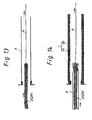
- FIG. 13 through 15 are cross-sectional views illustrating various steps of the manufacturing method according to the second embodiment in order.
- an inner layer 2 composed of a resin absorbent material 2A is pulled using a pull rope (or belt) 4 in the direction indicated by arrows (to the right in Fig. 13) to insert the same into a guiding tube 3.
- the guiding tube 3 is composed of a tubular film, a tubular composite film or a composite structure having layered plastic film and unwoven fabric or split fiber, in a manner similar to the first embodiment.
- the inner and outer surfaces of the guiding tube 3 are smooth, and the outer peripheral surface is applied with a lubricant such as oil, liquid or powder wax. Therefore, the inner layer 2 can be smoothly inserted into the guiding tube 3 without resistance.
- an outer layer 1 composed of a tubular resin absorbent material 1A and a plastic film 1B covering the outer periphery of the resin absorbent material 1A is prepared, and one end thereof is fixed. Then, the inner layer 2 covered with the guiding tube 3 is pulled using the pull rope (or belt) 4 in the direction indicated by arrows (to the right in Fig. 14) to insert the same into the outer layer 1. It should be noted that in this event, since the outer peripheral surface of the guiding tube 3 is also applied with a lubricant such as oil, the insertion of the inner layer 2 covered with the guiding tube 3 into the outer layer 1 can be carried out smoothly.
- the respective resin absorbent materials constituting the tubular outer layer 1 and the tubular inner layer 2 are impregnated with thermosetting resin such as unsaturated polyester to provide a pipe liner bag 10 having a two-layer structure of the outer layer 1 and the inner layer 2, similar to that illustrated in Fig. 4.
- outer layer 1 and the inner layer 2 used in the second embodiment are manufactured in a manner similar to those used in the first embodiment, and the inner layer 2 has a diameter larger than the outer layer 1, as is the case of the first embodiment.
- the second embodiment can also manufacture the outer layer 1 and the inner layer 2 separately, similar effects to those of the first embodiment can be provided.
- the inner layer 2 covered with the guiding tube 3 since the inner layer 2 covered with the guiding tube 3 is inserted into the outer layer 1, the inner layer 2 can be smoothly inserted into the outer layer 1.
- the guiding tube 3 is extracted when the inner layer 2 has been completely inserted, so that the outer layer 1 and the inner layer 2 can be readily laminated to provide a multi-layer structure, thereby making it possible to manufacture a pipe liner bag 10 having a desired thickness with a good workability.
- Fig. 16 is a partial cross-sectional view illustrating a manufacturing method according to the third embodiment of the present invention.
- a guiding tube 3' has been previously inserted inside out into an outer layer 1 by fluid pressure similar to that illustrated in Fig. 1, and an inner layer 2 covered with a guiding tube 3 is pulled using a pull rope (or belt) 4 in the direction indicated by the arrow (to the right in Fig. 16) to insert the same into the guiding tube 3', with one end of the outer layer 1 and one end of the guiding tube 3' being fixed, as illustrated in Fig. 16. Thereafter, the two guiding tubes 3, 3' are extracted with the outer layer 1 and the inner layer 2 being fixed.
- the outer layer and the inner layer are separately manufactured, and the manufacturing of each layer can be performed with a good workability.
- the plastic film coated on the outer peripheral surface of the outer layer is prevented from scratches.
- the inner layer is inserted into the outer layer as the inner layer is guided by the guiding tube, so that the inner layer can be smoothly inserted into the outer layer.
- the guiding tube is extracted to readily laminate the outer layer and the inner layer to provide a multi-layer structure.
- the resin absorbent materials of the tubular outer layer and the tubular inner layer are impregnated with thermosetting resin. In this way, a pipe liner bag having a desired thickness can be manufactured with a good workability.
Landscapes
- Engineering & Computer Science (AREA)
- Mechanical Engineering (AREA)
- General Engineering & Computer Science (AREA)
- Robotics (AREA)
- Manufacturing & Machinery (AREA)
- Lining Or Joining Of Plastics Or The Like (AREA)
- Laminated Bodies (AREA)
- Rigid Pipes And Flexible Pipes (AREA)
Claims (10)
- Procédé de fabrication d'un revêtement en forme de sac d'un tuyau (10), comprenant les étapes ci-dessous :préparation d'une couche tubulaire externe (1) composée de matériau à absorption de résine (1A) et d'un film plastique (1B) appliqué au-dessus de la périphérie externe du matériau à absorption de résine ;insertion d'un tube de guidage (3) dans ladite couche externe (1);insertion d'une couche tubulaire interne (2) composée d'un autre matériau à absorption de résine (2A) dans ledit tube de guidage (3);extraction dudit tube de guidage (3), ladite couche externe (1) et ladite couche interne (2) étant stratifiées ; etimprégnation des matériaux à absorption de résine de ladite couche externe (1) et de ladite couche interne (2) d'une résine thermodurcissable.
- Procédé de fabrication d'un revêtement en forme de sac d'un tuyau (10), comprenant les étapes ci-dessous :insertion d'une couche tubulaire interne (2) composée d'un matériau à absorption de résine (2A) dans un tube de guidage (3);préparation d'une couche tubulaire externe (1) composée d'un autre matériau à absorption de résine (1A) et d'un film plastique (1B) appliqué sur la périphérie externe du matériau à absorption de résine ;insertion de ladite couche interne (2) recouverte du tube de guidage (3) dans ladite couche externe (1);extraction dudit tube de guidage (3), ladite couche externe (1) et ladite couche interne (2) étant stratifiées ; etimprégnation des matériaux à absorption de résine de ladite couche externe (1) et de la couche interne (2) d'une résine thermodurcissable.
- Procédé de fabrication d'un revêtement en forme de sac d'un tuyau (10), comprenant les étapes ci-dessous :préparation d'une couche tubulaire externe (1) composée de matériau à absorption de résine (1A) et d'un film plastique (1B) appliqué sur la périphérie externe du matériau à absorption de résine ;insertion d'un premier tube de guidage (3') dans ladite couche externe (1);insertion d'une couche tubulaire interne (2) composée d'un autre matériau à absorption de résine (2A) dans un deuxième tube de guidage (3);insertion de ladite couche interne (2) recouverte dudit deuxième tube de guidage (3) dans ledit premier tube de guidage (3');extraction desdits premier et deuxième tubes de guidage (3, 3'), ladite couche externe (1) et ladite couche interne (2) étant stratifiées ; etimprégnation desdits matériaux à absorption de résine respectifs (1A, 2A) de ladite couche externe (1) et de ladite couche interne (2) d'une résine thermodurcissable.
- Procédé selon l'une quelconque des revendications 1 à 3, caractérisé en ce que ledit tube de guidage (3) est inséré par retournement dans ladite couche externe (1) par une pression de fluide.
- Procédé selon l'une quelconque des revendications 1 à 4, caractérisé en ce que ledit tube de guidage (3) est composé d'un film tubulaire, d'un film tubulaire composite ou d'une structure composite comportant un film plastique et un non-tissé en couches ou des fibres clivées stratifiés.
- Procédé selon l'une quelconque des revendications 1 à 5, caractérisé en ce que ledit tube de guidage (3) est appliqué avec un lubrifiant.
- Procédé selon l'une quelconque des revendications 1 à 6, caractérisé en ce qu'il comprend en outre l'étape suivante : après l'extraction dudit tube de guidage (3), fixation d'une extrémité de ladite couche externe (1) et d'une extrémité de ladite couche interne (2) par un boulon (6), un écrou (7) et des rondelles (8, 9) ; fermeture étanche de ladite couche externe et de ladite couche interne par une couverture d'extrémité (11); et couverture du boulon, de l'écrou et des rondelles par une gaine (15).
- Procédé selon l'une quelconque des revendications 1 à 7, caractérisé en ce que ladite couche tubulaire externe (1) est produite par insertion d'un matériau à absorption de résine (1A) dans ledit film plastique (1B), mise sous vide dudit matériau à absorption de résine pour mettre ledit film plastique en contact étroit avec la surface externe dudit matériau à absorption de résine et chauffage dudit film plastique tout en maintenant ledit état à contact étroit pour souder ledit film plastique sur la surface externe dudit matériau à absorption de résine.
- Procédé selon la revendication 8, caractérisé en ce qu'un tube de pression hautement étanche à l'air (16) est inséré dans ledit matériau à absorption de résine, ledit tube de pression étant gonflé par une pression de fluide pour étendre ledit film plastique et ledit matériau à absorption de liquide vers l'extérieur en une forme tubulaire circulaire, ledit matériau à absorption de résine étant mis sous vide pour mettre ledit film plastique en contact étroit avec la surface externe dudit matériau à absorption de résine.
- Procédé selon l'une quelconque des revendications 1 à 7, caractérisé en ce que ladite couche externe (1) est produite par laminage d'un matériau à absorption de résine en forme de bande (1A) comportant un film plastique (1B) appliqué au-dessus d'une surface correspondante, le film plastique étant orienté vers l'extérieur, assemblage des deux extrémités et fermeture étanche de la partie assemblée.
Applications Claiming Priority (3)
| Application Number | Priority Date | Filing Date | Title |
|---|---|---|---|
| JP31056296 | 1996-11-21 | ||
| JP310562/96 | 1996-11-21 | ||
| JP8310562A JP2974130B2 (ja) | 1996-11-21 | 1996-11-21 | 管ライニング材の製造方法 |
Publications (3)
| Publication Number | Publication Date |
|---|---|
| EP0844065A2 EP0844065A2 (fr) | 1998-05-27 |
| EP0844065A3 EP0844065A3 (fr) | 2000-05-17 |
| EP0844065B1 true EP0844065B1 (fr) | 2003-04-09 |
Family
ID=18006745
Family Applications (1)
| Application Number | Title | Priority Date | Filing Date |
|---|---|---|---|
| EP97306971A Expired - Lifetime EP0844065B1 (fr) | 1996-11-21 | 1997-09-09 | Procédé de fabrication de revêtements pour tuyaux |
Country Status (9)
| Country | Link |
|---|---|
| US (1) | US6136135A (fr) |
| EP (1) | EP0844065B1 (fr) |
| JP (1) | JP2974130B2 (fr) |
| KR (1) | KR19980041875A (fr) |
| AU (1) | AU724669B2 (fr) |
| CA (1) | CA2221595A1 (fr) |
| DE (1) | DE69720655T2 (fr) |
| DK (1) | DK0844065T3 (fr) |
| TW (1) | TW338742B (fr) |
Cited By (1)
| Publication number | Priority date | Publication date | Assignee | Title |
|---|---|---|---|---|
| EP3174703B1 (fr) | 2014-07-31 | 2020-06-03 | SML Verwaltungs GmbH | Chemise destinée à la rénovation de systèmes de conduites de fluides |
Families Citing this family (10)
| Publication number | Priority date | Publication date | Assignee | Title |
|---|---|---|---|---|
| AU742515B2 (en) * | 1997-06-24 | 2002-01-03 | Lmk Technologies, Llc | Apparatus for repairing a pipeline and method for using same |
| US6481928B1 (en) * | 1997-09-22 | 2002-11-19 | David Doolaege | Flexible hydraulic structure and system for replacing a damaged portion thereof |
| JP3790052B2 (ja) * | 1998-09-25 | 2006-06-28 | 株式会社湘南合成樹脂製作所 | 管ライニング材の製造方法 |
| JP3839605B2 (ja) * | 1998-12-22 | 2006-11-01 | 株式会社湘南合成樹脂製作所 | マンホール用ライニング材 |
| US20050281970A1 (en) * | 2004-06-16 | 2005-12-22 | Lamarca Louis J Ii | Lateral liner substrates |
| JP2010201887A (ja) * | 2009-03-06 | 2010-09-16 | Shonan Plastic Mfg Co Ltd | 管ライニング材 |
| DK2343179T3 (da) * | 2010-01-12 | 2015-02-09 | Twe Group Gmbh | Ultralyds- og lasersvejsning ved rørsanering |
| JP5530880B2 (ja) * | 2010-09-28 | 2014-06-25 | 東海ゴム工業株式会社 | 管体用防音カバーおよびカバー付き管体 |
| DE202014011441U1 (de) | 2013-03-11 | 2020-09-01 | Buergofol GmbH | Einlegeschlauch für die grabenlose Kanalsanierung |
| GB2580957B (en) | 2019-01-31 | 2021-11-03 | W E Rawson Ltd | Improvements relating to pipe liners |
Family Cites Families (10)
| Publication number | Priority date | Publication date | Assignee | Title |
|---|---|---|---|---|
| ATE35647T1 (de) * | 1982-02-05 | 1988-07-15 | Edgealpha Ltd | Auskleidung von rohren oder durchlaessen. |
| JPH0723240Y2 (ja) * | 1988-09-16 | 1995-05-31 | 日本鋼管株式会社 | 管路の内張り工法に使用されるチューブ |
| US5407630A (en) * | 1989-03-21 | 1995-04-18 | Insituform (Netherlands) Bv | Lining of pipelines or passageways |
| CA2000955A1 (fr) * | 1989-08-07 | 1991-02-07 | Lyman R. Lyon | Revetement interieur de tuyaux et methode de mise en place |
| JPH0745182B2 (ja) * | 1990-06-29 | 1995-05-17 | 株式会社ゲット | 管ライニング材の製造方法 |
| JP2554411B2 (ja) * | 1991-05-31 | 1996-11-13 | 株式会社ゲット | 枝管ライニング材及びその製造方法 |
| JPH08426B2 (ja) * | 1993-04-13 | 1996-01-10 | 株式会社湘南合成樹脂製作所 | 管ライニング材とその製造方法及び管路補修工法 |
| AU742515B2 (en) * | 1997-06-24 | 2002-01-03 | Lmk Technologies, Llc | Apparatus for repairing a pipeline and method for using same |
| JP2702086B2 (ja) * | 1995-02-13 | 1998-01-21 | 株式会社湘南合成樹脂製作所 | 管ライニング材の製造方法 |
| JP2837384B2 (ja) * | 1996-03-19 | 1998-12-16 | 株式会社湘南合成樹脂製作所 | 管ライニング工法 |
-
1996
- 1996-11-21 JP JP8310562A patent/JP2974130B2/ja not_active Expired - Fee Related
-
1997
- 1997-09-04 KR KR1019970045835A patent/KR19980041875A/ko not_active Withdrawn
- 1997-09-04 TW TW086112775A patent/TW338742B/zh active
- 1997-09-09 DE DE69720655T patent/DE69720655T2/de not_active Expired - Fee Related
- 1997-09-09 EP EP97306971A patent/EP0844065B1/fr not_active Expired - Lifetime
- 1997-09-09 DK DK97306971T patent/DK0844065T3/da active
- 1997-11-20 US US08/974,835 patent/US6136135A/en not_active Expired - Fee Related
- 1997-11-20 CA CA002221595A patent/CA2221595A1/fr not_active Abandoned
- 1997-11-21 AU AU45345/97A patent/AU724669B2/en not_active Ceased
Cited By (1)
| Publication number | Priority date | Publication date | Assignee | Title |
|---|---|---|---|---|
| EP3174703B1 (fr) | 2014-07-31 | 2020-06-03 | SML Verwaltungs GmbH | Chemise destinée à la rénovation de systèmes de conduites de fluides |
Also Published As
| Publication number | Publication date |
|---|---|
| TW338742B (en) | 1998-08-21 |
| DE69720655T2 (de) | 2003-12-24 |
| JP2974130B2 (ja) | 1999-11-08 |
| AU4534597A (en) | 1998-06-04 |
| DK0844065T3 (da) | 2003-07-14 |
| EP0844065A3 (fr) | 2000-05-17 |
| KR19980041875A (ko) | 1998-08-17 |
| US6136135A (en) | 2000-10-24 |
| AU724669B2 (en) | 2000-09-28 |
| JPH10151672A (ja) | 1998-06-09 |
| CA2221595A1 (fr) | 1998-05-21 |
| DE69720655D1 (de) | 2003-05-15 |
| EP0844065A2 (fr) | 1998-05-27 |
Similar Documents
| Publication | Publication Date | Title |
|---|---|---|
| US6296729B1 (en) | Method of manufacturing pipe liner bag | |
| US6254709B1 (en) | Method of manufacturing a pipe liner bag | |
| EP0978681B1 (fr) | Revêtement pour une conduite de dérivation et procédé de revêtement d'une conduite de dérivation | |
| JPH0745182B2 (ja) | 管ライニング材の製造方法 | |
| CN100520146C (zh) | 具有翻转的外部非渗透层的现场固化内衬及其制造方法 | |
| JP2719312B2 (ja) | 管ライニング材の接合方法 | |
| US5163481A (en) | Tubular liner for softlining pipe rehabilitation | |
| EP0844065B1 (fr) | Procédé de fabrication de revêtements pour tuyaux | |
| US6006787A (en) | Branch pipe liner bag and branch pipe lining method | |
| CN1886618B (zh) | 浸渍和制备现场固化内衬的方法、浸渍设备和浸渍塔 | |
| EP0844076B1 (fr) | Revêtement pour tuyaux et sa méthode de fabrication | |
| JPH11235758A (ja) | 管ライニング材の製造方法及び管ライニング工法 | |
| JP2644437B2 (ja) | 枝管ライニング工法 | |
| JP2678151B2 (ja) | 管ライニング材及びその製造方法 | |
| JP2845798B2 (ja) | 枝管ライニング材及び枝管ライニング工法 | |
| JP2001198980A (ja) | 管ライニング材 | |
| JP3049283B2 (ja) | 管ライニング材の製造方法 | |
| JP2678149B2 (ja) | 枝管ライニング材及び枝管ライニング工法 | |
| JP2737105B2 (ja) | 枝管ライニング材及び枝管ライニング工法 | |
| JPH10323897A (ja) | 管ライニング材の製造方法 | |
| JP2702099B2 (ja) | 枝管用鍔付スタートライナー及び管ライニング工法 | |
| JP2737104B2 (ja) | 管ライニング材の接合方法 | |
| AU4530597A (en) | Pipe liner bag and manufacturing method therefor | |
| JP2001191410A (ja) | 管ライニング材の製造方法 | |
| JPH1080950A (ja) | 管ライニング材の接合構造 |
Legal Events
| Date | Code | Title | Description |
|---|---|---|---|
| PUAI | Public reference made under article 153(3) epc to a published international application that has entered the european phase |
Free format text: ORIGINAL CODE: 0009012 |
|
| AK | Designated contracting states |
Kind code of ref document: A2 Designated state(s): DE DK FR GB |
|
| PUAL | Search report despatched |
Free format text: ORIGINAL CODE: 0009013 |
|
| AK | Designated contracting states |
Kind code of ref document: A3 Designated state(s): AT BE CH DE DK ES FI FR GB GR IE IT LI LU MC NL PT SE |
|
| 17P | Request for examination filed |
Effective date: 20001108 |
|
| AKX | Designation fees paid |
Free format text: DE DK FR GB |
|
| 17Q | First examination report despatched |
Effective date: 20010521 |
|
| GRAH | Despatch of communication of intention to grant a patent |
Free format text: ORIGINAL CODE: EPIDOS IGRA |
|
| GRAH | Despatch of communication of intention to grant a patent |
Free format text: ORIGINAL CODE: EPIDOS IGRA |
|
| GRAA | (expected) grant |
Free format text: ORIGINAL CODE: 0009210 |
|
| AK | Designated contracting states |
Designated state(s): DE DK FR GB |
|
| REG | Reference to a national code |
Ref country code: GB Ref legal event code: FG4D |
|
| REG | Reference to a national code |
Ref country code: DK Ref legal event code: T3 |
|
| PG25 | Lapsed in a contracting state [announced via postgrant information from national office to epo] |
Ref country code: GB Free format text: LAPSE BECAUSE OF NON-PAYMENT OF DUE FEES Effective date: 20030909 |
|
| ET | Fr: translation filed | ||
| PG25 | Lapsed in a contracting state [announced via postgrant information from national office to epo] |
Ref country code: DK Free format text: LAPSE BECAUSE OF NON-PAYMENT OF DUE FEES Effective date: 20030930 |
|
| PLBE | No opposition filed within time limit |
Free format text: ORIGINAL CODE: 0009261 |
|
| STAA | Information on the status of an ep patent application or granted ep patent |
Free format text: STATUS: NO OPPOSITION FILED WITHIN TIME LIMIT |
|
| 26N | No opposition filed |
Effective date: 20040112 |
|
| PG25 | Lapsed in a contracting state [announced via postgrant information from national office to epo] |
Ref country code: DE Free format text: LAPSE BECAUSE OF NON-PAYMENT OF DUE FEES Effective date: 20040401 |
|
| GBPC | Gb: european patent ceased through non-payment of renewal fee |
Effective date: 20030909 |
|
| REG | Reference to a national code |
Ref country code: DK Ref legal event code: EBP |
|
| PG25 | Lapsed in a contracting state [announced via postgrant information from national office to epo] |
Ref country code: FR Free format text: LAPSE BECAUSE OF NON-PAYMENT OF DUE FEES Effective date: 20040528 |
|
| REG | Reference to a national code |
Ref country code: FR Ref legal event code: ST |