EP0844077B1 - Feuille en polymères de cyclooléfines orientée biaxialement, son procédé d'obtention et son utilisation - Google Patents
Feuille en polymères de cyclooléfines orientée biaxialement, son procédé d'obtention et son utilisation Download PDFInfo
- Publication number
- EP0844077B1 EP0844077B1 EP19970119616 EP97119616A EP0844077B1 EP 0844077 B1 EP0844077 B1 EP 0844077B1 EP 19970119616 EP19970119616 EP 19970119616 EP 97119616 A EP97119616 A EP 97119616A EP 0844077 B1 EP0844077 B1 EP 0844077B1
- Authority
- EP
- European Patent Office
- Prior art keywords
- film
- cycloolefin
- weight
- cop
- copolymer
- Prior art date
- Legal status (The legal status is an assumption and is not a legal conclusion. Google has not performed a legal analysis and makes no representation as to the accuracy of the status listed.)
- Expired - Lifetime
Links
- 229920000089 Cyclic olefin copolymer Polymers 0.000 title claims description 72
- 238000004519 manufacturing process Methods 0.000 title description 11
- 239000010408 film Substances 0.000 claims description 106
- -1 monocyclic olefin Chemical class 0.000 claims description 33
- 229920001577 copolymer Polymers 0.000 claims description 21
- 239000000203 mixture Substances 0.000 claims description 19
- 238000000034 method Methods 0.000 claims description 18
- 239000003795 chemical substances by application Substances 0.000 claims description 14
- 229920000642 polymer Polymers 0.000 claims description 13
- VGGSQFUCUMXWEO-UHFFFAOYSA-N Ethene Chemical compound C=C VGGSQFUCUMXWEO-UHFFFAOYSA-N 0.000 claims description 12
- 239000005977 Ethylene Substances 0.000 claims description 12
- 239000000654 additive Substances 0.000 claims description 10
- 230000009477 glass transition Effects 0.000 claims description 10
- 239000003381 stabilizer Substances 0.000 claims description 10
- 239000004215 Carbon black (E152) Substances 0.000 claims description 9
- 239000003990 capacitor Substances 0.000 claims description 9
- 150000001925 cycloalkenes Chemical group 0.000 claims description 8
- NNBZCPXTIHJBJL-UHFFFAOYSA-N decalin Chemical compound C1CCCC2CCCCC21 NNBZCPXTIHJBJL-UHFFFAOYSA-N 0.000 claims description 8
- 125000004435 hydrogen atom Chemical group [H]* 0.000 claims description 8
- JRZJOMJEPLMPRA-UHFFFAOYSA-N olefin Natural products CCCCCCCC=C JRZJOMJEPLMPRA-UHFFFAOYSA-N 0.000 claims description 8
- 150000003254 radicals Chemical class 0.000 claims description 8
- 229920001038 ethylene copolymer Polymers 0.000 claims description 4
- 239000003963 antioxidant agent Substances 0.000 claims description 3
- 230000003472 neutralizing effect Effects 0.000 claims description 3
- PXXNTAGJWPJAGM-UHFFFAOYSA-N vertaline Natural products C1C2C=3C=C(OC)C(OC)=CC=3OC(C=C3)=CC=C3CCC(=O)OC1CC1N2CCCC1 PXXNTAGJWPJAGM-UHFFFAOYSA-N 0.000 claims description 3
- SFFFIHNOEGSAIH-UHFFFAOYSA-N bicyclo[2.2.1]hept-2-ene;ethene Chemical group C=C.C1C2CCC1C=C2 SFFFIHNOEGSAIH-UHFFFAOYSA-N 0.000 claims description 2
- 229910052799 carbon Inorganic materials 0.000 claims description 2
- 125000005915 C6-C14 aryl group Chemical group 0.000 claims 3
- 238000009998 heat setting Methods 0.000 claims 1
- 239000000155 melt Substances 0.000 claims 1
- 239000011104 metalized film Substances 0.000 claims 1
- 239000010410 layer Substances 0.000 description 83
- 239000002585 base Substances 0.000 description 24
- IMBXRZKCLVBLBH-OGYJWPHRSA-N cvp protocol Chemical compound ClCCN(CCCl)P1(=O)NCCCO1.O=C1C=C[C@]2(C)[C@H]3C(=O)C[C@](C)([C@@](CC4)(O)C(=O)CO)[C@@H]4[C@@H]3CCC2=C1.C([C@H](C[C@]1(C(=O)OC)C=2C(=C3C([C@]45[C@H]([C@@]([C@H](OC(C)=O)[C@]6(CC)C=CCN([C@H]56)CC4)(O)C(=O)OC)N3C=O)=CC=2)OC)C[C@@](C2)(O)CC)N2CCC2=C1NC1=CC=CC=C21 IMBXRZKCLVBLBH-OGYJWPHRSA-N 0.000 description 20
- 239000011521 glass Substances 0.000 description 19
- 239000000243 solution Substances 0.000 description 13
- YXFVVABEGXRONW-UHFFFAOYSA-N Toluene Chemical compound CC1=CC=CC=C1 YXFVVABEGXRONW-UHFFFAOYSA-N 0.000 description 12
- 0 CN1C(*2*)C=CC2C(C*)C1 Chemical compound CN1C(*2*)C=CC2C(C*)C1 0.000 description 8
- 239000011888 foil Substances 0.000 description 8
- 239000002245 particle Substances 0.000 description 8
- ISWSIDIOOBJBQZ-UHFFFAOYSA-N phenol group Chemical group C1(=CC=CC=C1)O ISWSIDIOOBJBQZ-UHFFFAOYSA-N 0.000 description 8
- 229910052751 metal Inorganic materials 0.000 description 7
- 239000002184 metal Substances 0.000 description 7
- 238000010438 heat treatment Methods 0.000 description 6
- 239000003054 catalyst Substances 0.000 description 5
- RFFLAFLAYFXFSW-UHFFFAOYSA-N 1,2-dichlorobenzene Chemical compound ClC1=CC=CC=C1Cl RFFLAFLAYFXFSW-UHFFFAOYSA-N 0.000 description 4
- CSCPPACGZOOCGX-UHFFFAOYSA-N Acetone Chemical compound CC(C)=O CSCPPACGZOOCGX-UHFFFAOYSA-N 0.000 description 4
- PXHVJJICTQNCMI-UHFFFAOYSA-N Nickel Chemical compound [Ni] PXHVJJICTQNCMI-UHFFFAOYSA-N 0.000 description 4
- 229910052782 aluminium Inorganic materials 0.000 description 4
- 230000000052 comparative effect Effects 0.000 description 4
- 238000001125 extrusion Methods 0.000 description 4
- 238000001465 metallisation Methods 0.000 description 4
- 229920002959 polymer blend Polymers 0.000 description 4
- 230000003746 surface roughness Effects 0.000 description 4
- 238000004804 winding Methods 0.000 description 4
- 239000004698 Polyethylene Substances 0.000 description 3
- XAGFODPZIPBFFR-UHFFFAOYSA-N aluminium Chemical compound [Al] XAGFODPZIPBFFR-UHFFFAOYSA-N 0.000 description 3
- 238000005227 gel permeation chromatography Methods 0.000 description 3
- 239000008187 granular material Substances 0.000 description 3
- 229930195733 hydrocarbon Natural products 0.000 description 3
- 238000002844 melting Methods 0.000 description 3
- 230000008018 melting Effects 0.000 description 3
- CPOFMOWDMVWCLF-UHFFFAOYSA-N methyl(oxo)alumane Chemical compound C[Al]=O CPOFMOWDMVWCLF-UHFFFAOYSA-N 0.000 description 3
- JFNLZVQOOSMTJK-KNVOCYPGSA-N norbornene Chemical compound C1[C@@H]2CC[C@H]1C=C2 JFNLZVQOOSMTJK-KNVOCYPGSA-N 0.000 description 3
- 229920000573 polyethylene Polymers 0.000 description 3
- 238000002360 preparation method Methods 0.000 description 3
- 238000012545 processing Methods 0.000 description 3
- 238000001644 13C nuclear magnetic resonance spectroscopy Methods 0.000 description 2
- VTYYLEPIZMXCLO-UHFFFAOYSA-L Calcium carbonate Chemical compound [Ca+2].[O-]C([O-])=O VTYYLEPIZMXCLO-UHFFFAOYSA-L 0.000 description 2
- BQCADISMDOOEFD-UHFFFAOYSA-N Silver Chemical compound [Ag] BQCADISMDOOEFD-UHFFFAOYSA-N 0.000 description 2
- 239000003513 alkali Substances 0.000 description 2
- 229910052784 alkaline earth metal Inorganic materials 0.000 description 2
- 150000001342 alkaline earth metals Chemical class 0.000 description 2
- 239000000956 alloy Substances 0.000 description 2
- 229910045601 alloy Inorganic materials 0.000 description 2
- 150000005840 aryl radicals Chemical class 0.000 description 2
- 230000008901 benefit Effects 0.000 description 2
- 230000000903 blocking effect Effects 0.000 description 2
- CJZGTCYPCWQAJB-UHFFFAOYSA-L calcium stearate Chemical compound [Ca+2].CCCCCCCCCCCCCCCCCC([O-])=O.CCCCCCCCCCCCCCCCCC([O-])=O CJZGTCYPCWQAJB-UHFFFAOYSA-L 0.000 description 2
- 125000004432 carbon atom Chemical group C* 0.000 description 2
- 150000001875 compounds Chemical class 0.000 description 2
- 238000005516 engineering process Methods 0.000 description 2
- 229920001519 homopolymer Polymers 0.000 description 2
- PQXKHYXIUOZZFA-UHFFFAOYSA-M lithium fluoride Chemical compound [Li+].[F-] PQXKHYXIUOZZFA-UHFFFAOYSA-M 0.000 description 2
- 238000002156 mixing Methods 0.000 description 2
- 239000000178 monomer Substances 0.000 description 2
- 229910052759 nickel Inorganic materials 0.000 description 2
- 150000002989 phenols Chemical class 0.000 description 2
- 229920000098 polyolefin Polymers 0.000 description 2
- 239000002516 radical scavenger Substances 0.000 description 2
- 229910052709 silver Inorganic materials 0.000 description 2
- 239000004332 silver Substances 0.000 description 2
- 239000002344 surface layer Substances 0.000 description 2
- XBFJAVXCNXDMBH-UHFFFAOYSA-N tetracyclo[6.2.1.1(3,6).0(2,7)]dodec-4-ene Chemical compound C1C(C23)C=CC1C3C1CC2CC1 XBFJAVXCNXDMBH-UHFFFAOYSA-N 0.000 description 2
- 238000007738 vacuum evaporation Methods 0.000 description 2
- XLYOFNOQVPJJNP-UHFFFAOYSA-N water Substances O XLYOFNOQVPJJNP-UHFFFAOYSA-N 0.000 description 2
- HJIAMFHSAAEUKR-UHFFFAOYSA-N (2-hydroxyphenyl)-phenylmethanone Chemical compound OC1=CC=CC=C1C(=O)C1=CC=CC=C1 HJIAMFHSAAEUKR-UHFFFAOYSA-N 0.000 description 1
- 125000006755 (C2-C20) alkyl group Chemical group 0.000 description 1
- OIQXFRANQVWXJF-UHFFFAOYSA-N 2-benzylidene-4,7,7-trimethylbicyclo[2.2.1]heptan-3-one Chemical compound CC1(C)C2CCC1(C)C(=O)C2=CC1=CC=CC=C1 OIQXFRANQVWXJF-UHFFFAOYSA-N 0.000 description 1
- VSAWBBYYMBQKIK-UHFFFAOYSA-N 4-[[3,5-bis[(3,5-ditert-butyl-4-hydroxyphenyl)methyl]-2,4,6-trimethylphenyl]methyl]-2,6-ditert-butylphenol Chemical compound CC1=C(CC=2C=C(C(O)=C(C=2)C(C)(C)C)C(C)(C)C)C(C)=C(CC=2C=C(C(O)=C(C=2)C(C)(C)C)C(C)(C)C)C(C)=C1CC1=CC(C(C)(C)C)=C(O)C(C(C)(C)C)=C1 VSAWBBYYMBQKIK-UHFFFAOYSA-N 0.000 description 1
- ZCILGMFPJBRCNO-UHFFFAOYSA-N 4-phenyl-2H-benzotriazol-5-ol Chemical compound OC1=CC=C2NN=NC2=C1C1=CC=CC=C1 ZCILGMFPJBRCNO-UHFFFAOYSA-N 0.000 description 1
- 229910018072 Al 2 O 3 Inorganic materials 0.000 description 1
- MHAJPDPJQMAIIY-UHFFFAOYSA-N Hydrogen peroxide Chemical compound OO MHAJPDPJQMAIIY-UHFFFAOYSA-N 0.000 description 1
- 239000004594 Masterbatch (MB) Substances 0.000 description 1
- NEAPKZHDYMQZCB-UHFFFAOYSA-N N-[2-[4-[2-(2,3-dihydro-1H-inden-2-ylamino)pyrimidin-5-yl]piperazin-1-yl]ethyl]-2-oxo-3H-1,3-benzoxazole-6-carboxamide Chemical compound C1CN(CCN1CCNC(=O)C2=CC3=C(C=C2)NC(=O)O3)C4=CN=C(N=C4)NC5CC6=CC=CC=C6C5 NEAPKZHDYMQZCB-UHFFFAOYSA-N 0.000 description 1
- 229910019142 PO4 Inorganic materials 0.000 description 1
- 239000004743 Polypropylene Substances 0.000 description 1
- 229910004298 SiO 2 Inorganic materials 0.000 description 1
- NINIDFKCEFEMDL-UHFFFAOYSA-N Sulfur Chemical compound [S] NINIDFKCEFEMDL-UHFFFAOYSA-N 0.000 description 1
- RTAQQCXQSZGOHL-UHFFFAOYSA-N Titanium Chemical compound [Ti] RTAQQCXQSZGOHL-UHFFFAOYSA-N 0.000 description 1
- 239000012963 UV stabilizer Substances 0.000 description 1
- HCHKCACWOHOZIP-UHFFFAOYSA-N Zinc Chemical compound [Zn] HCHKCACWOHOZIP-UHFFFAOYSA-N 0.000 description 1
- UCIKZESDXASJNG-UHFFFAOYSA-L [Cl-].[Cl-].C1=CC=C2C([Zr+2])C=CC2=C1 Chemical compound [Cl-].[Cl-].C1=CC=C2C([Zr+2])C=CC2=C1 UCIKZESDXASJNG-UHFFFAOYSA-L 0.000 description 1
- 239000006096 absorbing agent Substances 0.000 description 1
- 238000010521 absorption reaction Methods 0.000 description 1
- 125000002015 acyclic group Chemical group 0.000 description 1
- 230000000996 additive effect Effects 0.000 description 1
- 125000005275 alkylenearyl group Chemical group 0.000 description 1
- 239000002216 antistatic agent Substances 0.000 description 1
- 150000004982 aromatic amines Chemical class 0.000 description 1
- 230000015572 biosynthetic process Effects 0.000 description 1
- 239000002981 blocking agent Substances 0.000 description 1
- 238000009835 boiling Methods 0.000 description 1
- 229910000019 calcium carbonate Inorganic materials 0.000 description 1
- 239000008116 calcium stearate Substances 0.000 description 1
- 235000013539 calcium stearate Nutrition 0.000 description 1
- 150000004649 carbonic acid derivatives Chemical class 0.000 description 1
- 230000015556 catabolic process Effects 0.000 description 1
- 238000006243 chemical reaction Methods 0.000 description 1
- 150000001851 cinnamic acid derivatives Chemical class 0.000 description 1
- 238000011109 contamination Methods 0.000 description 1
- 238000007796 conventional method Methods 0.000 description 1
- 125000004122 cyclic group Chemical group 0.000 description 1
- 230000007547 defect Effects 0.000 description 1
- 230000002950 deficient Effects 0.000 description 1
- 230000000694 effects Effects 0.000 description 1
- 238000009713 electroplating Methods 0.000 description 1
- PCHJSUWPFVWCPO-UHFFFAOYSA-N gold Chemical compound [Au] PCHJSUWPFVWCPO-UHFFFAOYSA-N 0.000 description 1
- 229910052737 gold Inorganic materials 0.000 description 1
- 239000010931 gold Substances 0.000 description 1
- 238000005469 granulation Methods 0.000 description 1
- 230000003179 granulation Effects 0.000 description 1
- 238000007210 heterogeneous catalysis Methods 0.000 description 1
- 238000007172 homogeneous catalysis Methods 0.000 description 1
- 238000005984 hydrogenation reaction Methods 0.000 description 1
- 238000002955 isolation Methods 0.000 description 1
- 239000004611 light stabiliser Substances 0.000 description 1
- 239000000314 lubricant Substances 0.000 description 1
- 239000000463 material Substances 0.000 description 1
- 239000011159 matrix material Substances 0.000 description 1
- 238000000691 measurement method Methods 0.000 description 1
- 125000003518 norbornenyl group Chemical group C12(C=CC(CC1)C2)* 0.000 description 1
- 150000007524 organic acids Chemical class 0.000 description 1
- 235000005985 organic acids Nutrition 0.000 description 1
- 150000002902 organometallic compounds Chemical class 0.000 description 1
- 229920006280 packaging film Polymers 0.000 description 1
- 239000012785 packaging film Substances 0.000 description 1
- 150000002978 peroxides Chemical class 0.000 description 1
- 235000021317 phosphate Nutrition 0.000 description 1
- AQSJGOWTSHOLKH-UHFFFAOYSA-N phosphite(3-) Chemical class [O-]P([O-])[O-] AQSJGOWTSHOLKH-UHFFFAOYSA-N 0.000 description 1
- 150000003013 phosphoric acid derivatives Chemical class 0.000 description 1
- 229920001155 polypropylene Polymers 0.000 description 1
- 229920001343 polytetrafluoroethylene Polymers 0.000 description 1
- 239000004810 polytetrafluoroethylene Substances 0.000 description 1
- 239000000843 powder Substances 0.000 description 1
- 238000003825 pressing Methods 0.000 description 1
- 125000004805 propylene group Chemical group [H]C([H])([H])C([H])([*:1])C([H])([H])[*:2] 0.000 description 1
- 239000002994 raw material Substances 0.000 description 1
- 238000007151 ring opening polymerisation reaction Methods 0.000 description 1
- 150000003839 salts Chemical class 0.000 description 1
- 229920006395 saturated elastomer Polymers 0.000 description 1
- 150000004760 silicates Chemical class 0.000 description 1
- 239000007787 solid Substances 0.000 description 1
- 238000004544 sputter deposition Methods 0.000 description 1
- 230000000087 stabilizing effect Effects 0.000 description 1
- 238000010561 standard procedure Methods 0.000 description 1
- 238000003756 stirring Methods 0.000 description 1
- 125000000446 sulfanediyl group Chemical group *S* 0.000 description 1
- 229910052717 sulfur Inorganic materials 0.000 description 1
- 239000011593 sulfur Substances 0.000 description 1
- 239000000454 talc Substances 0.000 description 1
- 229910052623 talc Inorganic materials 0.000 description 1
- 238000012360 testing method Methods 0.000 description 1
- 125000000383 tetramethylene group Chemical group [H]C([H])([*:1])C([H])([H])C([H])([H])C([H])([H])[*:2] 0.000 description 1
- 150000003568 thioethers Chemical class 0.000 description 1
- 239000010936 titanium Substances 0.000 description 1
- 229910052719 titanium Inorganic materials 0.000 description 1
- 210000003934 vacuole Anatomy 0.000 description 1
- 150000003682 vanadium compounds Chemical class 0.000 description 1
- 239000003643 water by type Substances 0.000 description 1
- 150000003751 zinc Chemical class 0.000 description 1
- 229910052725 zinc Inorganic materials 0.000 description 1
- 239000011701 zinc Substances 0.000 description 1
Classifications
-
- B—PERFORMING OPERATIONS; TRANSPORTING
- B32—LAYERED PRODUCTS
- B32B—LAYERED PRODUCTS, i.e. PRODUCTS BUILT-UP OF STRATA OF FLAT OR NON-FLAT, e.g. CELLULAR OR HONEYCOMB, FORM
- B32B27/00—Layered products comprising a layer of synthetic resin
- B32B27/32—Layered products comprising a layer of synthetic resin comprising polyolefins
-
- C—CHEMISTRY; METALLURGY
- C08—ORGANIC MACROMOLECULAR COMPOUNDS; THEIR PREPARATION OR CHEMICAL WORKING-UP; COMPOSITIONS BASED THEREON
- C08G—MACROMOLECULAR COMPOUNDS OBTAINED OTHERWISE THAN BY REACTIONS ONLY INVOLVING UNSATURATED CARBON-TO-CARBON BONDS
- C08G61/00—Macromolecular compounds obtained by reactions forming a carbon-to-carbon link in the main chain of the macromolecule
- C08G61/02—Macromolecular compounds containing only carbon atoms in the main chain of the macromolecule, e.g. polyxylylenes
- C08G61/04—Macromolecular compounds containing only carbon atoms in the main chain of the macromolecule, e.g. polyxylylenes only aliphatic carbon atoms
- C08G61/06—Macromolecular compounds containing only carbon atoms in the main chain of the macromolecule, e.g. polyxylylenes only aliphatic carbon atoms prepared by ring-opening of carbocyclic compounds
- C08G61/08—Macromolecular compounds containing only carbon atoms in the main chain of the macromolecule, e.g. polyxylylenes only aliphatic carbon atoms prepared by ring-opening of carbocyclic compounds of carbocyclic compounds containing one or more carbon-to-carbon double bonds in the ring
-
- Y—GENERAL TAGGING OF NEW TECHNOLOGICAL DEVELOPMENTS; GENERAL TAGGING OF CROSS-SECTIONAL TECHNOLOGIES SPANNING OVER SEVERAL SECTIONS OF THE IPC; TECHNICAL SUBJECTS COVERED BY FORMER USPC CROSS-REFERENCE ART COLLECTIONS [XRACs] AND DIGESTS
- Y10—TECHNICAL SUBJECTS COVERED BY FORMER USPC
- Y10T—TECHNICAL SUBJECTS COVERED BY FORMER US CLASSIFICATION
- Y10T428/00—Stock material or miscellaneous articles
- Y10T428/26—Web or sheet containing structurally defined element or component, the element or component having a specified physical dimension
-
- Y—GENERAL TAGGING OF NEW TECHNOLOGICAL DEVELOPMENTS; GENERAL TAGGING OF CROSS-SECTIONAL TECHNOLOGIES SPANNING OVER SEVERAL SECTIONS OF THE IPC; TECHNICAL SUBJECTS COVERED BY FORMER USPC CROSS-REFERENCE ART COLLECTIONS [XRACs] AND DIGESTS
- Y10—TECHNICAL SUBJECTS COVERED BY FORMER USPC
- Y10T—TECHNICAL SUBJECTS COVERED BY FORMER US CLASSIFICATION
- Y10T428/00—Stock material or miscellaneous articles
- Y10T428/26—Web or sheet containing structurally defined element or component, the element or component having a specified physical dimension
- Y10T428/263—Coating layer not in excess of 5 mils thick or equivalent
- Y10T428/264—Up to 3 mils
- Y10T428/265—1 mil or less
-
- Y—GENERAL TAGGING OF NEW TECHNOLOGICAL DEVELOPMENTS; GENERAL TAGGING OF CROSS-SECTIONAL TECHNOLOGIES SPANNING OVER SEVERAL SECTIONS OF THE IPC; TECHNICAL SUBJECTS COVERED BY FORMER USPC CROSS-REFERENCE ART COLLECTIONS [XRACs] AND DIGESTS
- Y10—TECHNICAL SUBJECTS COVERED BY FORMER USPC
- Y10T—TECHNICAL SUBJECTS COVERED BY FORMER US CLASSIFICATION
- Y10T428/00—Stock material or miscellaneous articles
- Y10T428/31504—Composite [nonstructural laminate]
- Y10T428/31855—Of addition polymer from unsaturated monomers
-
- Y—GENERAL TAGGING OF NEW TECHNOLOGICAL DEVELOPMENTS; GENERAL TAGGING OF CROSS-SECTIONAL TECHNOLOGIES SPANNING OVER SEVERAL SECTIONS OF THE IPC; TECHNICAL SUBJECTS COVERED BY FORMER USPC CROSS-REFERENCE ART COLLECTIONS [XRACs] AND DIGESTS
- Y10—TECHNICAL SUBJECTS COVERED BY FORMER USPC
- Y10T—TECHNICAL SUBJECTS COVERED BY FORMER US CLASSIFICATION
- Y10T428/00—Stock material or miscellaneous articles
- Y10T428/31504—Composite [nonstructural laminate]
- Y10T428/31855—Of addition polymer from unsaturated monomers
- Y10T428/31909—Next to second addition polymer from unsaturated monomers
Definitions
- the invention relates to a multilayer film made of cycloolefin polymers with a Base layer and at least one cover layer, the base layer in essentially from cycloolefin polymers COP with a glass transition temperature Tg is built up and the cover layer consists essentially of a mixture Cycloolefinpolymeren is built.
- the invention further relates to a method for the production of the film and its use.
- the film according to the invention is characterized by improved processing behavior and improved electrical properties. It is excellent for use as Capacitor dielectric suitable.
- Cycloolefin polymers are known materials that are characterized by high Heat resistance, high modulus of elasticity, low water absorption and have good dielectric properties.
- the prior art are also Films made from cycloolefin polymers are known.
- DD-A-224 538 describes the production of films from norbornene-ethylene Copolymers by a cast film process.
- EP-A-0 384 694, EP-A-0 610 814, EP-A-0 610 815 and EP-A-0 610 816 Production of cycloolefin polymer films by melt extrusion described. According to this teaching, the mechanical properties are improved by monoaxial or biaxial stretching of the foils.
- DD-241 971 and DD-224 538 state that films made from cycloolefin polymers are distinguished by low dielectric loss factors (tan ⁇ ). It is stated that the tan ⁇ for COC films can be up to 1.2 ⁇ 10 -5 . As is further explained in DD-241 971, low values for tan ⁇ are of interest above all for high-frequency alternating current applications of the films, since electrical losses in the film and heating are then avoided.
- EP-A-0 384 694 describes that cycloolefin polymers form oriented films can be stretched mono- and biaxially. Knowing states that the Polymers before stretching to temperatures above the glass point need to be heated. It is mentioned that the film to avoid Blocking in the processing of additives such. B. added antiblocking agents can be. Electrical properties of cycloolefin polymer films are not mentioned in this document.
- EP-A-0 610 814, EP-A-0 610 815 and EP-A-0 610 816 relate to single or multi-layer films made from cycloolefin copolymers (COC) and their use as a capacitor dielectric. It is described to carry out the mono- or biaxial stretching in a temperature interval from 40 ° C. below to 50 ° C. above the glass point of the COC. It is recommended to incorporate fine inert particles into the film to improve further processability, slip and winding behavior. Examples of inert particles are SiO 2 , Al 2 O 3 , silicates, carbonates, sulfides, polytetrafluoroethylene, talc, lithium fluoride and various salts of organic acids.
- COC cycloolefin copolymers
- the known films made of cycloolefin polymers are related to their Further processability, especially with regard to the slip and winding behavior in need of improvement. They are also excellent electrical Features such as low electrical loss factor and high electrical Breakdown voltage required. These benefits can be achieved by improving the Slip and winding behavior are not affected.
- Capacitor foils are used in the most common areas of application metallized. Unfortunately, the additives mentioned above often cause problems in the metallization of the film surface. The metal layer adheres protruding particles bad and is additionally by removing the Antiblocking agent defective. Poor metal adhesion and defects in the Metal layers are particularly problematic with capacitor foils. It is coming especially to worsen the loss factors and the film is for their intended application can no longer be used.
- the object of the present invention was to achieve the above to avoid described disadvantages of the known films.
- a low slip, good electrical cycloolefin polymer film Properties are made available.
- the film should be easy to process have low friction and do not block.
- the improvement of Slip behavior must not be used as a capacitor film affect. You must therefore in particular a low electrical Have a loss factor.
- the object on which the invention is based is achieved by a film of the type mentioned at the outset, the characteristic features of which are that the mixture of cycloolefin polymers of the top layer contains at least two cycloolefin polymers COP 1 and COP 2 , the glass transition temperatures Tg 1 and Tg 2 of which are at least 5 ° C, where Tg 2 -Tg 1 ⁇ 5 ° C and at the same time the condition Tg 2 -Tg ⁇ 5 ° C is fulfilled.
- the base layer of the film according to the invention is made of cycloolefin polymers or built up from cycloolefin polymer blends.
- the Base layer at least 90-100% by weight of cycloolefin polymer or mixture and if necessary, additionally conventional additives in effective amounts.
- the base layer preferably contains at least 95-99% by weight, in particular 98-99% by weight, cycloolefin polymers or mixture.
- the data in% by weight refer to the weight of the base layer.
- cycloolefin polymers are homopolymers or copolymers which contain polymerized cycloolefin units and optionally acyclic olefins as comonomer.
- Cycloolefin polymers which contain 0.1 to 100% by weight, preferably 10 to 99% by weight, in particular 50 to 95% by weight, based on the total mass of the cycloolefin polymer, of polymerized cycloolefin units are suitable for the present invention.
- Polymers which are composed of cyclic olefins of the formulas I, II, III, IV, V or VI are preferred: wherein R 1 , R 2 , R 3 , R 4 , R 5 , R 6 , R 7 and R 8 are the same or different and represent a hydrogen atom or a C 1 -C 30 hydrocarbon radical or two or more radicals R 1 to R 8 are cyclically linked, the same radicals in the different formulas can have a different meaning.
- C 1 -C 30 hydrocarbon radicals mean, for example, a linear or branched C 1 -C 8 alkyl radical, C 6 -C 18 aryl radical, C 7 -C 20 alkylene aryl radical or a cyclic C 3 -C 20 alkyl radical or acyclic C 2 -C 20 alkyl group.
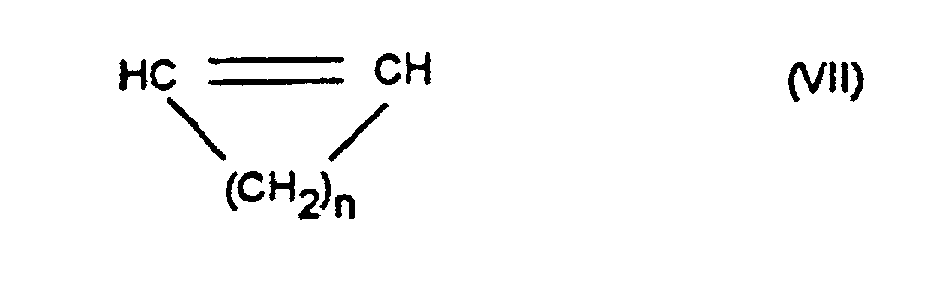
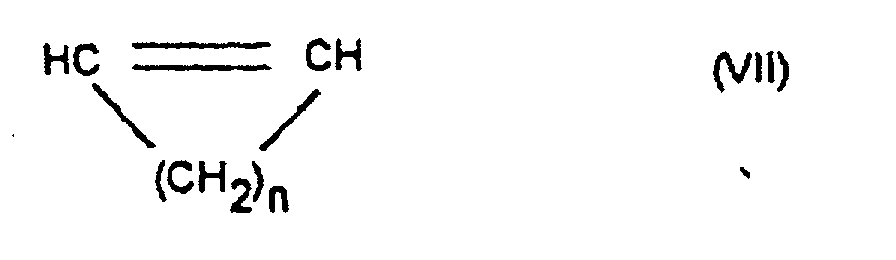
- the cycloolefin polymers can contain 0 to 45% by weight, based on the total mass of the cycloolefin polymer, of polymerized units of at least one monocyclic olefin of the formula VII: where n is a number from 2 to 10,
- the cycloolefin polymers can contain 0 to 99% by weight, based on the total mass of the cycloolefin polymer, of polymerized units of an acyclic olefin of the formula VIII: wherein R 9 , R 10 , R 11 , R 12 are the same or different and represent a hydrogen atom or C 1 -C 10 hydrocarbon radical, for example a C 1 -C 8 alkyl radical or C 6 -C 14 aryl radical.
- cycloolefin polymers which are ring-opening Polymerization of at least one of the monomers of the formulas I to VI and subsequent hydrogenation can be obtained.
- Cycloolefin homopolymers are composed of a monomer of the formulas I-VI.
- cycloolefin copolymers which are preferred at least one cycloolefin of the formulas I to VI and acyclic olefins of the formula VIII included as a comonomer.
- Preferred acyclic olefins are those which have 2 to 20 carbon atoms, especially unbranched acyclic olefins 2 to 10 carbon atoms such as ethylene, propylene and / or butylene.
- the proportion of polymerized units of acyclic olefins of the formula VIII is up to 99% by weight, preferably 5 to 80% by weight, particularly preferably 10 to 60% by weight, based on the total weight of the respective cycloolefin polymer.
- cycloolefin polymers described above are particularly preferred those containing polymerized units of polycyclic olefins Basic norbornene structure, particularly preferably norbornene or tetracyclododecene, contain.
- Cycloolefin copolymers, the polymerized units are also preferred acyclic olefins, especially ethylene.
- are particularly preferred Norbornene / ethylene and tetracyclododecene / ethylene copolymers which have 5 to 80 % By weight, preferably 10 to 60% by weight of ethylene (based on the Weight of the copolymer).
- the cycloolefin polymers described above generally have glass transition temperatures T g between -20 ° C. and 400 ° C., preferably between 50 ° C. and 200 ° C.
- the viscosity number (decalin, 135 ° C, DIN 53728) is generally between 0.1 and 200 ml / g, preferably between 50 and 150 ml / g.
- the cycloolefin polymers are produced by a heterogeneous or homogeneous catalysis with organometallic compounds and is in a variety described by documents. Suitable catalyst systems based on Mixed catalysts made of titanium or vanadium compounds in connection with Aluminum organyls are described in DD 109 224, DD 237 070 and EP-A 0 156 464 described. EP-A-0 283 164, EP-A-0 407 870, EP-A-485 893 and EP-A-0 503 422 describe the preparation of cycloolefin polymers with catalysts based on soluble metallocene complexes. To those in these writings Manufacturing process of cycloolefin polymers described is hereby expressly referred.
- the film according to the invention has at least one, preferably both, top layer (s).
- This cover layer (s) is / are also essentially composed of the cycloolefin polymers described above for the base layer. It is essential to the invention that the cover layer contains at least two different of the cycloolefin polymers COP 1 and COP 2 described above for the base layer, which differ in their glass point.
- the difference between the glass points Tg 1 and Tg 2 is at least 5 ° C., preferably at least 10-150 ° C., in particular 20-100 ° C., where Tg 2 > Tg 1 .
- the higher glass point Tg 2 of the COP 2 is also above the glass point Tg of the cyclololefin polymer of the base layer.
- a difference of at least 5 ° C., preferably at least 10 to 150 ° C., in particular 20 to 100 ° C. is preferred, Tg 2 > Tg.
- the addition of a cycloolefin polymer COP 2 with a raised glass point Tg 2 in the outer cover layer (s) produces a rough surface when the film is stretched.
- the surface roughness of the film can be set precisely and adapted to the respective requirements. This measure makes it possible to dispense with conventional particulate antiblocking agents.
- the film according to the invention is easier to metallize and process better than comparable films with particulate antiblocking agents.
- the COP 2 added does not form any separated particles in the cover layer, but surprisingly nevertheless leads to a roughened film surface.
- the roughened surface of the film according to the invention is distinguished by a particularly uniform, rough surface structure that was not expected.
- the cover layer contains a total of at least 90 to 100% by weight of the cycloolefin polymers COP 2 and COP 1 described above, preferably 95 to 99% by weight, in particular 98 to 99% by weight, in each case based on the weight of the cover layer.
- COP 2 and COP 1 cycloolefin polymers
- the cover layer can additionally contain conventional additives in effective amounts in each case.
- the cover layer generally contains 0.5 to 25% by weight, preferably 2 to 15% by weight, in particular 5 to 10% by weight, based in each case on the weight of the cover layer, of the cycloolefin polymer COP 2 with an increased glass point Tg 2 ,
- the proportion of the cycloolefin polymer COP 1 with the Tg 1 is at most 99.5 to 75% by weight, preferably 98 to 85% by weight, in particular 95 to 90% by weight, in each case based on the weight of the outer layer.
- the top layer mixture of COP 1 and COP 2 can be produced by the customary known processes, for example by mechanical mixing of powder or granules or by extrusion mixing and subsequent granulation.
- the individual layers of the film in addition to the Cycloolefin polymers additionally suitable additives in effective amounts contain.
- all additives that are usually suitable in Polyolefin films such as polyethylene or polypropylene films are used.
- Top layer composition can be dispensed with.
- lubricants and antistatic agents which is common when used as packaging film, should include Capacitor applications are dispensed with because these additives add electrical Deteriorate properties. Therefore stabilizers for capacitor foils are Neutralizers and antioxidants preferred.
- Neutralizing agents are preferably dihydrotalcite, calcium stearate and / or calcium carbonate with an average particle size of at most 0.7 ⁇ m, an absolute particle size of less than 10 ⁇ m and a specific surface area of at least 40 m 2 / g. Generally, the neutralizing agent is added in an amount of 0.02 to 0.1% by weight.
- UV stabilizers absorbers such as Hydroxyphenylbenzotriazole, Hydroxybenzophenone, Formamidin or Benzyliden-Camphor, Quenchers such as cinnamic acid esters or nickel chelates, radical scavengers such as sterically hindered phenols, hydroperoxide decomposers such as nickel or zinc complexes sulfur-containing compounds or light stabilizers of the HALS type as well as their mixtures are used.
- absorbers such as Hydroxyphenylbenzotriazole, Hydroxybenzophenone, Formamidin or Benzyliden-Camphor
- Quenchers such as cinnamic acid esters or nickel chelates
- radical scavengers such as sterically hindered phenols
- hydroperoxide decomposers such as nickel or zinc complexes sulfur-containing compounds or light stabilizers of the HALS type as well as their mixtures are used.
- the usual stabilizing compounds for Ethylene, propylene and other olefin polymers can be used. their The amount added is between 0.05 and 2% by weight.
- phenolic stabilizers alkali / alkaline earth stearates and / or Alkali / alkaline earth metal.
- Phenolic stabilizers are used in an amount of 0.1 to 0.6 wt .-%, in particular 0.15 to 0.4 wt .-%, and with a molecular weight of more than 500 g / mol preferred.
- Pentaerythrityl tetrakis-3- (3,5-di-tert-butyl-4-hydroxyphenyl) propionate or 1,3,5-trimethyl-2,4,6-tris (3,5-di-tertiary-butyl-4-hydroxybenzyl) benzene are particularly advantageous.
- Radical scavengers such as can be added as antioxidants substituted phenols and aromatic amines and / or peroxide decomposers such as Phosphites, phosphates and thio compounds.
- the total thickness of the film according to the invention is generally 2 to 50 ⁇ m, preferably 3 to 30 ⁇ m.
- the base layer is the layer which at least Accounts for 50% of the total film thickness.
- the thickness of the outer cover layer (s) is or are 0.1 to 5 ⁇ m, preferably 0.5 to 3 ⁇ m, in particular 0.5 up to 1 ⁇ m.
- Preferred embodiments have cover layers on both sides, which can be constructed the same or different. Three-layer films with same cover layers, i.e. with a symmetrical structure are preferred.
- the invention further relates to a method for producing the multilayer film according to the invention.
- the production takes place preferably in the usual way known to those skilled in the art by extrusion per se known coextrusion process.
- the optionally added Additives can already be contained in the polymer or in the polymer mixture or added via masterbatch technology.
- the polymer blend for the The top layer is preferably produced in a separate working step. If necessary, the components for the cover layers can also be in the extruder be mixed.
- the one corresponding to the individual layers of the film Melting then takes place together and simultaneously through a flat nozzle (Slot die) coextruded, and the pressed multi-layer film is on drawn off one or more take-off rollers, wherein it cools and itself solidified.
- the take-off roller temperature is in the range from 20 to 180 ° C, preferably between 60 and 130 ° C.
- the film thus obtained is then stretched longitudinally and transversely to the direction of extrusion, which leads to an orientation of the molecular chains.
- the stretching becomes one expediently with the help of two according to the desired Carry out stretching ratio of rolls running at different speeds and that Cross sections with the help of an appropriate tenter frame.
- Thermal fixation usually follows the biaxial stretching (Heat treatment), then the film is wound up.
- Heat treatment Heat treatment
- To increase the surface tension may be after the biaxial Stretching one or both surface (s) of the film according to one of the known Methods are corona or flame treated.
- the temperatures at which the film is stretched in the longitudinal and / or transverse direction are to be adapted to the particular cycloolefin polymer types used, in particular their glass points.
- Both the longitudinal stretching temperature T 1 and the quest stretching temperature T q must depend on the composition of the base layer and also on the Tg 1 of the COP 1 and Tg 2 of the COP 2 of the cover layer.
- Both T 1 and T q must be at least 5 ° C., preferably 10 to 150 ° C. above the Tg of the COP of the base layer and the Tg 1 of the COP 1 of the cover layer.
- heating must take place to such an extent that the polymer mixture of the base layer can be stretched. The stretching temperatures then generally depend on the main component with the highest Tg in the base layer.
- the stretching temperatures T 1 and T q should also be matched to the glass point of the COP 2 used in the top layer.
- the stretching temperatures of the first stretching process (usually T 1 ) should be at least 3 ° C, preferably at least 5 ° C, below the glass point Tg 2 of the COP 2 .
- the T q can be chosen independently of Tg 2 , so that T q can be above or below Tg 2 .
- the stretching temperatures should be above the glass points Tg and Tg 1 of the other cycloolefin polymers.
- the admixture of the cycloolefin polymer COP 2 in the top layer (s) with an increased glass point Tg 2 presumably causes the surface layers to tear open during the stretching process and thus to a roughened surface without the formation of separated particles from COP 2 .
- the surface roughness can be set within wide limits by the type and amount of the cycloolefin polymers used in the top layer (s); This results in good sliding friction values and improved dielectric loss factors compared to the use of conventional antiblocking agents.
- the film according to the invention can be made using conventional techniques known to those skilled in the art Process can be metallized. At least one during metallization Surface layer of foil applied metal layer can be made from any suitable metal. Layers of aluminum, zinc, gold are preferred or silver or from corresponding alloys, aluminum or aluminum-containing alloys are particularly preferred. As suitable Metallization processes are electroplating, sputtering and Vacuum evaporation called, the vacuum evaporation is preferred. The thickness of the metal layer is approximately 20 to 600 nm, preferably 25 to 100 nm.
- the foil is flame or corona before metallization Surface treated.
- the multilayer film according to the invention can also without previous measure to increase the surface energy with a Metal layer can be provided.
- the advantage of this embodiment is there too see that the cycloolefin polymer film not only on one side but also on both sides can be metallized. Leave out of the metallized cycloolefin polymer films produce capacitors using standard methods.
- Example 1 (Production of COP 1 or COP with Tg: 140 ° C)
- a 1.5 dm 3 flask was filled with 1 liter of gasoline fraction (boiling range: 90 to 110 ° C) and 20 ml of toluene methylaluminoxane solution (10.1% by weight methylaluminoxane with a molecular weight of 1300 g / mol after cryoscopic determination) and at 70 ° C stirred for about 30 min to remove any contamination.
- the reactor was filled with 480 cm 3 of an 85 weight percent solution of norbornene in toluene. By pressing ethylene (6 bar G) several times, the solution was saturated with ethylene and then 10 cm 3 of the toluene methylaluminoxane solution were added to the reactor and stirred at 70 ° C.
- a mixture of 16 kg COP 1 and 4 kg COP 2 was extruded in a twin-screw extruder at a melting temperature of 240 ° C. and the solidified melt strand was then granulated. 19.2 kg of colorless, cloudy granules were obtained.
- the examination by DSC showed a glass level at 139 ° C (Tg 1 ) and another, less pronounced glass level at 164 ° C (Tg 2 ).
- Base layer B consisted essentially of COP 1 as described in Example 1 and contained 0.2% by weight of a phenolic stabilizer.
- the two cover layers essentially consisted of 98% by weight of COP 1 from Example 1 and 2% by weight of COP 2 from Example 2 (based on the total weight of the cycloolefin copolymers in the respective cover layer) and 0.2% by weight. % of a phenolic stabilizer (based on the total weight of the top layer).
- the individual layers of the film were at an extruder temperature of 230 ° C and a nozzle temperature of 240 ° C together through a slot die extruded.
- the emerging melt streams were at a temperature of 90 ° C Pull-off roller and then in at temperatures of 150 to 160 ° C. Longitudinal direction (longitudinal stretch ratio: 2.0) and then at temperatures of 170 ° C stretched up to 175 ° C in the transverse direction (transverse stretching ratio: 3.2) and then rolled up.
- the properties measured on the films produced in this way are shown in Table 1 listed.
- the films showed excellent winding behavior without Blocking tendency.
- Base layer B consisted essentially of COP 1 as described in Example 1 and contained 0.2% by weight of a phenolic stabilizer.
- the two top layers essentially also consisted of the COP 1 of Example 1 and 0.2% by weight of a phenolic stabilizer.
- Base and top layers were applied to one as described in Example 5-7 Extruder temperature of 230 ° C and a die temperature of 240 ° C initially extruded a 90 ° C hot roll and then at temperatures of 150 to 160 ° C in the longitudinal direction (longitudinal stretch ratio: 2.0) and then at Temperatures from 170 ° C to 175 ° C in the transverse direction (transverse stretch ratio: 3.2) stretched and then rolled up.
- the films thus produced had properties as listed in Table 1.
- the Films had high friction against each other and therefore could not be Wind up wrinkle-free.
- Base layer B consisted essentially of the COP 1 described in Example 1 and contained 0.2% by weight of a phenolic stabilizer.
- the two outer layers essentially consisted of 99.6% by weight of the COP 1 from Example 1 and 0.4% by weight of Syloblock 44 (based on the total weight of the cycloolefin copolymer COP 1 in the respective outer layer) and 0.2% by weight .-% of a phenolic stabilizer based on the total weight of the top layer.
- Base and top layers were at an extruder temperature of 230 ° C and a nozzle temperature of 240 ° C first on a 90 ° C hot take-off roller extruded and then at temperatures of 150 to 160 ° C in the longitudinal direction (Longitudinal stretch ratio: 2.0) and then at a temperature of 170 ° C to 175 ° C in Cross direction (cross stretch ratio: 3.2) stretched and then rolled up.
- the films thus produced had properties as listed in Table 1.
- a film was produced as described in Comparative Examples 10 and 11. Only the concentration of Sylobloc 44 in the top layer was reduced to 0.15% by weight (based on the total weight of the cycloolefin copolymers (COP 1 and COP 2 ). The film thickness was 6 ⁇ m. The composition of the film and the process conditions corresponded to those VB 10 and 11.
- the films according to the invention are notable for a low coefficient of sliding friction, which is significantly below the values that can be achieved with Sylobloc 44.
- the B 5-B7 show significantly lower loss factors compared to the Sylobloc-containing films. Comparably low loss values can only be achieved according to test examples 8-9 for COC films which are free from antiblocking agents.
- these films are practically unusable due to their strong tendency to block and the high sliding friction values. They cannot be wound up wrinkle-free, they become blocked during unwinding and during all further processing.
- the viscosity number is a measure of the molecular weight.
- the viscosity number is according to DIN 53 728, part 4, measured in 0.1% decahydronaphthalene solution at 135 ° C.
- the glass transition temperatures were calculated according to Dln 53 765 at 20 ° K / min from the 2 heating curve certainly.
- the ethylene content of the COP was determined by 13 C-NMR.
- the molecular weights of the samples were determined by gel permeation chromatography determined with polyethylene as standard. O-dichlorobenzene was used as the conduction agent a temperature of 135 ° C used. It was using a Waters 150-C ALC / GPC a Jerdi column network (500 x 10 mm linear) and an RI-64 as a catalyst used.
- the sliding friction was determined based on DIN 53375 and for the foils outside - measured against the inside of the film.
- the sliding friction number became approx. 14 Determined days after production of the film (at 23 ° C and 50% relative humidity).
- the roughness was according to DIN 4768 with a cut-off of 0.25 mm or 0.08 mm certainly.
- the tensile strength and the elongation at break are determined in accordance with DIN 53455.
- the modulus of elasticity is determined in accordance with DIN 53 457 or ASTM 882.
Landscapes
- Chemical & Material Sciences (AREA)
- Health & Medical Sciences (AREA)
- Chemical Kinetics & Catalysis (AREA)
- Medicinal Chemistry (AREA)
- Polymers & Plastics (AREA)
- Organic Chemistry (AREA)
- Laminated Bodies (AREA)
- Manufacture Of Macromolecular Shaped Articles (AREA)
- Shaping By String And By Release Of Stress In Plastics And The Like (AREA)
Claims (24)
- Feuille à plusieurs couches en polymère de cyclooléfine comprenant une couche de base et au moins une couche de recouvrement, la couche de base étant essentiellement élaborée à partir d'un polymère de cyclooléfine COP présentant une température de transition vitreuse Tg et la couche de recouvrement étant essentiellement élaborée à partir d'un mélange de polymères de cyclooléfine, caractérisée en ce que le mélange de polymères de cyclooléfine contient au moins deux polymères de cyclooléfine COP1 et COP2 dont les températures de transition vitreuse Tg1 et Tg2 diffèrent d'au moins 5°C, avec Tg2-Tg1 ≥ 5°C et la condition Tg2-Tg ≥ 5°C étant simultanément remplie.
- Feuille selon la revendication 1, caractérisée en ce que la couche de base contient au moins 90 à 100% en poids de polymère de cyclooléfine ou de mélange de polymères de cyclooléfine et le cas échéant d'autres additifs usuels supplémentaires.
- Feuille selon l'une ou plusieurs des revendications 1 à 2, caractérisée en ce que le polymère de cyclooléfine de la couche de base contient 0,1 à 100% en poids, de préférence 10 à 99% en poids, à chaque fois par rapport à la masse totale de polymères de cyclooléfine, d'unités polymérisées de cyclooléfine des formules I, II, III, IV, V ou VI


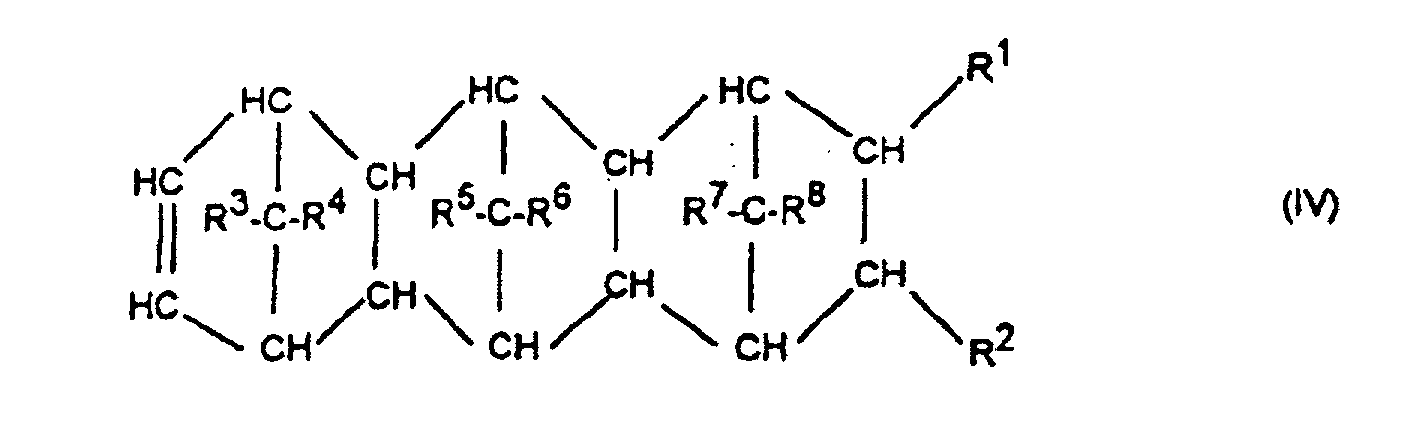
 où R1, R2, R3, R4, R5, R6, R7 et R8 sont identiques
ou différents et signifient un atome d'hydrogène
ou un radical hydrocarboné en C1 à C30 ou deux radicaux R1 à R8 ou plus sont reliés dans un cycle, des radicaux identiques dans les différentes formules pouvant avoir une signification différente. - Feuille selon la revendication 3, caractérisée en ce que le polymère de cyclooléfine de la couche de base est un copolymère de cyclooléfine et contient jusqu'à 45% en poids, par rapport à la masse totale du copolymère de cyclooléfine, d'unités polymérisées d'au moins une oléfine monocyclique de formule VII :où n vaut un nombre de 2 à 10.
- Feuille selon la revendication 3, caractérisée en ce que le polymère de cyclooléfine de la couche de base est un copolymère de cyclooléfine et contient jusqu'à 99% en poids, par rapport à la masse totale du copolymère de cyclooléfine, d'unités polymérisées d'une oléfine acyclique de formule VIII :où R9, R10, R11, R12 sont identiques ou différents et signifient un atome d'hydrogène ou un radical hydrocarboné en C1 à C10, de préférence un radical alkyle en C1 à C8 ou un radical aryle en C6 à C14.

- Feuille selon l'une ou plusieurs des revendications 1 à 5, caractérisée en ce que le polymère de cyclooléfine de la couche de base est un copolymère de norbornène/éthylène ou un copolymère de tétracyclododécène/éthylène avec une teneur en éthylène de 5 à 80% en poids, par rapport au poids du copolymère.
- Feuille selon l'une ou plusieurs des revendications 1 à 6, caractérisée en ce que le polymère de cyclooléfine de la couche de base présente une température de transition vitreuse Tg entre -20°C et 400°C, de préférence entre 50°C et 200°C et un indice de viscosité (Décaline, 135°C, DIN 53728) entre 0,1 et 200 ml/g, de préférence entre 50 et 150 ml/g.
- Feuille selon l'une ou plusieurs des revendications 1 à 7, caractérisée en ce que les températures de transition vitreuse Tg1 et Tg2 des polymères de cyclooléfine COP1 et COP2 diffèrent d'au moins 5 à 150°C, avec Tg1 étant < Tg2.
- Feuille selon l'une ou plusieurs des revendications 1 à 8, caractérisée en ce que la couche de recouvrement contient au moins 90 à 100% en poids de copolymère de cyclooléfine COP1 et COP2, la proportion de COP1 étant de 99,5 à 75% en poids et la proportion de COP2 de 0,5 à 25% en poids, à chaque fois par rapport au poids de la couche de recouvrement.
- Feuille selon l'une ou plusieurs des revendications 1 à 9, caractérisée en ce que le polymère de cyclooléfine COP1 contient 0,1 à 100% en poids, de préférence 10 à 99% en poids, à chaque fois par rapport à la masse totale du polymère de cyclooléfine, d'unités polymérisées de cyclooléfine des formules I, II, III, IV, V ou VI


 où R1, R2, R3, R4, R5, R6, R7 et R8 sont identiques ou différents et signifient un atome d'hydrogène ou un radical hydrocarboné en C1 à C30, ou deux radicaux R1 à R8 ou plus sont reliés dans un cycle, les mêmes radicaux dans les différentes formules pouvant avoir une signification différente.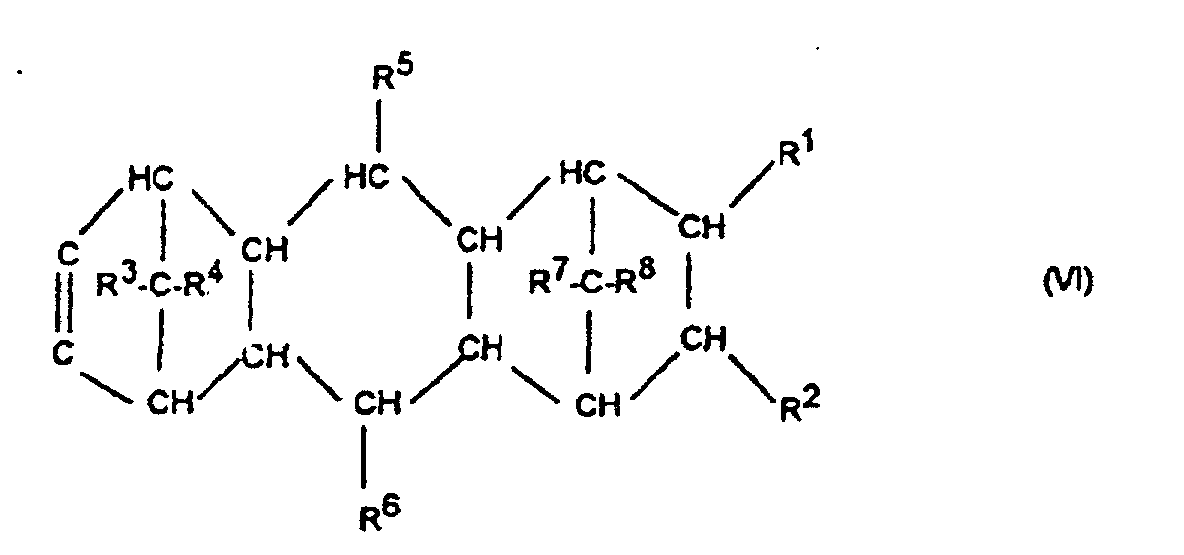
- Feuille selon la revendication 10, caractérisée en ce que le polymère de cyclooléfine COP1 est un copolymère de cyclooléfine et contient jusqu'à 45% en poids, par rapport à la masse totale du copolymère de cyclooléfine, d'unités polymérisées d'au moins une oléfine monocyclique de formule VII :où n vaut un nombre de 2 à 10.
- Feuille selon la revendication 10, caractérisée en ce que le polymère de cyclooléfine COP1 est un copolymère de cyclooléfine et contient jusqu'à 99% en poids, par rapport à la masse totale du copolymère de cyclooléfine, d'unités polymérisées d'une oléfine acyclique de formule VIII :où R9, R10, R11, R12 sont identiques ou différents et signifient un atome d'hydrogène ou un radical hydrocarboné en C1 à C10, de préférence un radical alkyle en C1 à C8 ou un radical aryle en C6 à C14.

- Feuille selon l'une ou plusieurs des revendications 1 à 12, caractérisée en ce que le polymère de cyclooléfine COP2 contient 0,1 à 100% en poids, de préférence 10 à 99% en poids, à chaque fois par rapport à la masse totale du polymère de cyclooléfine, d'unités polymérisées de cyclooléfine des formules I, II, III, IV, V ou VI

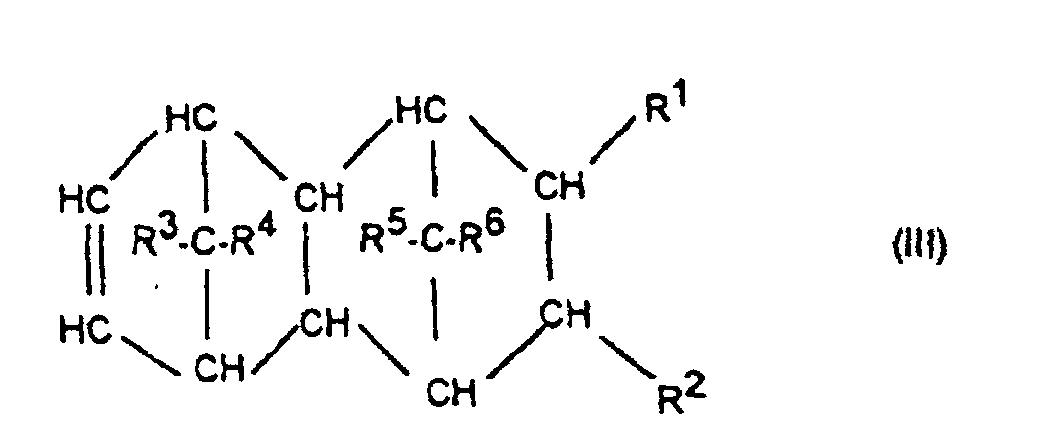

 où R1, R2, R3, R4, R5, R6, R7 et R8 sont identiques ou différents et signifient un atome d'hydrogène ou un radical hydrocarboné en C1 à C30, ou deux radicaux R1 à R8 ou plus sont reliés dans un cycle, les mêmes radicaux dans les différentes formules pouvant avoir une signification différente
- Feuille selon la revendication 13, caractérisée en ce que le polymère de cyclooléfine COP2 est un copolymère de cyclooléfine et contient jusqu'à 45% en poids, par rapport à la masse totale du copolymère de cyclooléfine, d'unités polymérisées d'au moins une oléfine monocyclique de formule VII :où n vaut un nombre de 2 à 10.
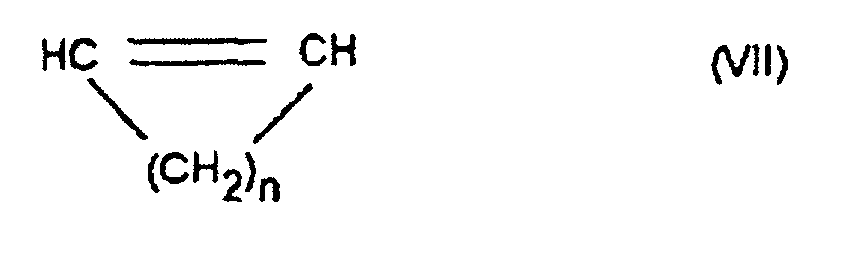
- Feuille selon la revendication 13, caractérisée en ce que le polymère de cyclooléfine COP2 est un copolymère de cyclooléfine et contient jusqu'à 99% en poids, par rapport à la masse totale du copolymère de cyclooléfine, d'unités polymérisées d'une oléfine acyclique de formule VIII :où R9, R10, R11, R12 sont identiques ou différents et signifient un atome d'hydrogène ou un radical hydrocarboné en C1 à C10, de préférence un radical alkyle en C1 à C8 ou un radical aryle en C6 à C14.

- Feuille selon l'une ou plusieurs des revendications 1 à 15, caractérisée en ce que la couche de base et/ou la couche de recouvrement contient des agents de stabilisation, de neutralisation et/ou des anti-oxydants.
- Feuille selon l'une ou plusieurs des revendications 1 à 16, caractérisée en ce que la feuille présente une épaisseur totale de 2 à 50 µm, l'épaisseur de la ou des couches de recouvrement étant de 0,1 à 5 µm.
- Feuille selon l'une ou plusieurs des revendications 1 à 17, caractérisée en ce que la feuille présente sur les deux faces des couches de recouvrement, de préférence des couches de recouvrement identiques.
- Feuille selon l'une ou plusieurs des revendications 1 à 18, caractérisée en ce que la ou les couches de recouvrement ne contiennent pas d'agent anti-adhésif sous forme de particules.
- Procédé pour la préparation de la feuille à plusieurs couches selon la revendication 1, dans lequel les masses fondues correspondant aux différentes couches de la feuille sont coextrudées via une filière plate, la feuille coextrudée est retirée via un cylindre de traction, la feuille est étirée biaxialement avec un rapport d'étirement longitudinal de 1,1:1 à 4:1 et un rapport d'étirement transversal de 2:1 à 5:1, la feuille étirée biaxialement est thermofixée, le cas échéant traitée au corona ou à la flamme et ensuite enroulée.
- Procédé selon la revendication 20, caractérisé en ce que la feuille est orientée à une température d'étirement longitudinal T1 et à une température d'étirement transversal Tq, T1 et Tq étant supérieures d'au moins 5°C à la Tg du polymère de cyclooléfine COP de la couche de base et T1 étant simultanément inférieure d'au moins 3°C à la Tg2 du polymère de cyclooléfine COP2 de la couche de recouvrement.
- Utilisation d'une feuille selon les revendications 1 à 13 pour la préparation d'une feuille métallisée.
- Utilisation d'une feuille selon les revendications 1 à 13 pour la préparation d'une feuille métallisée sur les deux faces.
- Condensateur contenant une feuille selon les revendications 1 à 13, 16 ou 17.
Applications Claiming Priority (2)
| Application Number | Priority Date | Filing Date | Title |
|---|---|---|---|
| DE1996147954 DE19647954A1 (de) | 1996-11-20 | 1996-11-20 | Biaxial orientierte Folie aus cycloolefinischen Polymeren, Verfahren zu deren Herstellung und deren Verwendung |
| DE19647954 | 1996-11-20 |
Publications (3)
| Publication Number | Publication Date |
|---|---|
| EP0844077A2 EP0844077A2 (fr) | 1998-05-27 |
| EP0844077A3 EP0844077A3 (fr) | 2001-03-28 |
| EP0844077B1 true EP0844077B1 (fr) | 2004-06-30 |
Family
ID=7812196
Family Applications (1)
| Application Number | Title | Priority Date | Filing Date |
|---|---|---|---|
| EP19970119616 Expired - Lifetime EP0844077B1 (fr) | 1996-11-20 | 1997-11-10 | Feuille en polymères de cyclooléfines orientée biaxialement, son procédé d'obtention et son utilisation |
Country Status (5)
| Country | Link |
|---|---|
| US (1) | US6017616A (fr) |
| EP (1) | EP0844077B1 (fr) |
| JP (1) | JP3693803B2 (fr) |
| CN (1) | CN1110518C (fr) |
| DE (2) | DE19647954A1 (fr) |
Families Citing this family (30)
| Publication number | Priority date | Publication date | Assignee | Title |
|---|---|---|---|---|
| JP4437232B2 (ja) | 1997-06-13 | 2010-03-24 | ティコナ ゲゼルシャフト ミット ベシュレンクテル ハフツング | エレクトレット |
| DE69829370T2 (de) * | 1997-06-20 | 2006-03-09 | Nippon Zeon Co., Ltd. | Polymerfolie und Schichtkondensator |
| KR100356989B1 (ko) | 1999-04-13 | 2002-10-18 | 주식회사 엘지씨아이 | 투명 도전성필름 일체형 편광판, 편광판 일체형 터치패널 및 터치패널 일체형 평판 디스플레이 |
| DE19917790A1 (de) * | 1999-04-20 | 2000-11-02 | Hoechst Trespaphan Gmbh | Biaxial orientierte Folie für die Herstellung von Keramikkondensatoren |
| DE10026177A1 (de) * | 2000-05-26 | 2001-11-29 | Mitsubishi Polyester Film Gmbh | Weiße, hochglänzende Polyesterfolie enthaltend Cycloolefincopolymer (COC), Verfahren zu ihrer Herstellung und ihre Verwendung |
| ATE334820T1 (de) * | 2000-12-06 | 2006-08-15 | Huhtamaki Deutschland Gmbh & C | Verfahren zum herstellen einer verbundfolie |
| DE10223662A1 (de) * | 2002-05-28 | 2003-12-11 | Mitsubishi Polyester Film Gmbh | Transparente Polyesterfolie mit verbesserter Wasserdampfbarriere, Verfahren zu ihrer Herstellung und ihre Verwendung |
| US7051493B2 (en) * | 2002-08-21 | 2006-05-30 | Cryovac, Inc. | High modulus, temperature-resistant film for form fill and seal packaging |
| DE10238515A1 (de) * | 2002-08-21 | 2004-03-04 | Ticona Gmbh | Polyolefin-Mehrschichtfolie, ein Verfahren zur Herstellung dieser Folie sowie ihre Verwendung |
| DE10238516A1 (de) * | 2002-08-21 | 2004-03-04 | Ticona Gmbh | Polyolefin-Mehrschichtfolie, Verfahren zu ihrer Herstellung und ihre Verwendung |
| US20050186373A1 (en) * | 2004-02-20 | 2005-08-25 | Honeywell International Inc. | Multilayer sheets and films composed of polypropylene and cyclic olefin copolymer |
| US20060078744A1 (en) * | 2004-03-04 | 2006-04-13 | Forhouse Corporation | Substrate having insulating layers to prevent it from warping and the method of making the same |
| US7258930B2 (en) | 2004-04-28 | 2007-08-21 | Cryovac, Inc. | Oxygen scavenging film with cyclic olefin copolymer |
| MX2007004642A (es) * | 2004-10-18 | 2007-06-08 | Topas Advanced Polymers Gmbh | Combinaciones polimericas para producir peliculas con un numero reducido de defectos. |
| US7265183B2 (en) * | 2004-11-01 | 2007-09-04 | Ticona Llc | High clarity, low friction polyethylene compositions for films |
| US20080107899A1 (en) * | 2006-11-07 | 2008-05-08 | Pang-Chia Lu | Metallized multi-layer films, methods of manufacture and articles made therefrom |
| DE102008051399A1 (de) | 2008-10-11 | 2010-04-22 | Topas Advanced Polymers Gmbh | Folien und deren Verwendung |
| US20140147666A1 (en) * | 2010-09-15 | 2014-05-29 | Toray Industries, Inc | Molding film and molding transfer foil |
| CN103608176A (zh) * | 2011-06-30 | 2014-02-26 | 东丽株式会社 | 叠层膜及使用了该叠层膜的成型转印箔 |
| CN103717652B (zh) * | 2011-08-25 | 2016-05-18 | 东丽株式会社 | 成型用膜和使用其的成型转印箔 |
| WO2015004316A1 (fr) | 2013-07-12 | 2015-01-15 | Upm Raflatac Oy | Film multicouche pour une étiquette et procédé permettant de fournir un tel film |
| WO2015004314A1 (fr) | 2013-07-12 | 2015-01-15 | Upm Raflatac Oy | Film multicouche pour étiquette et procédé permettant de fabriquer ce dernier |
| WO2015004310A1 (fr) * | 2013-07-12 | 2015-01-15 | Upm Raflatac Oy | Film d'étiquette thermorétractable, étiquette thermorétractable et procédé pour l'étiquetage d'un article |
| EP3019335B1 (fr) | 2013-07-12 | 2022-06-29 | UPM Raflatac Oy | Film multicouche pour une étiquette et procédé permettant de fabriquer ce dernier |
| CN107430900B (zh) * | 2015-03-26 | 2019-11-01 | 京瓷株式会社 | 介电膜及使用其的膜电容器、连结型电容器、以及逆变器、电动车辆 |
| DE202017006503U1 (de) | 2017-12-19 | 2018-06-26 | Topas Advanced Polymers Gmbh | Mehrschichtfolien enthaltend steife Cycoolefinpolymere und flexible Polymere und deren Verwendung |
| DE102019214769A1 (de) * | 2019-09-26 | 2021-04-01 | Siemens Energy Global GmbH & Co. KG | Leistungskondensator, Verfahren zur Fertigung eines Leistungskondensators und Konverter |
| DE102021128332A1 (de) * | 2021-10-29 | 2023-05-04 | Brückner Maschinenbau GmbH & Co. KG | Biaxial-orientierte Folie enthaltend Cycloolefinpolymere und alpha-Olefinpolymere, Verfahren zu ihrer Herstellung, sowie ihre Verwendung im Kondensator |
| CN114148004A (zh) * | 2022-02-07 | 2022-03-08 | 天津大学 | 一种电容器用聚丙烯薄膜高温介电性能的提升方法 |
| CN121224267B (zh) * | 2025-12-02 | 2026-03-24 | 浙江科普特新材料股份有限公司 | 一种复合膜材料及其制备方法 |
Family Cites Families (14)
| Publication number | Priority date | Publication date | Assignee | Title |
|---|---|---|---|---|
| DE2851557C2 (de) * | 1978-11-29 | 1982-04-01 | Hoechst Ag, 6000 Frankfurt | Biaxial gestreckte Polypropylenverbundfolie zur Verwendung als Elektroisolierfolie |
| DD241971A1 (de) * | 1981-06-15 | 1987-01-07 | Leuna Werke Veb | Polyolefin-dielektrikum fuer kondensatoren |
| DE3855983T2 (de) * | 1987-05-01 | 1998-01-02 | Mitsui Petrochemical Ind | Ungeordnete Cycloolefincopolymer-Zusammensetzungen und deren Anwendung |
| CA2009903A1 (fr) * | 1989-02-14 | 1990-08-14 | Takeshi Shiraki | Compose de resines thermoplastiques |
| DE69213569T2 (de) * | 1991-06-14 | 1997-03-06 | Mitsui Petrochemical Ind | Verbundstoff |
| DE4137427C1 (fr) * | 1991-11-14 | 1993-01-14 | Hoechst Ag, 6230 Frankfurt, De | |
| DE4304310A1 (de) * | 1993-02-12 | 1994-08-18 | Hoechst Ag | Teilkristalline Cycloolefin-Copolymer-Folie |
| DE4304308A1 (de) * | 1993-02-12 | 1994-08-18 | Hoechst Ag | Steife Cycloolefincopolymer-Folie |
| DE4304309A1 (de) * | 1993-02-12 | 1994-08-18 | Hoechst Ag | Biegsame Cycloolefincopolymer-Folie |
| DE4332872C1 (de) * | 1993-09-27 | 1995-04-06 | Zsolt Szabo | Ausschlagwerkzeug für Gelenkprothesen |
| CA2134320C (fr) * | 1993-10-26 | 2001-01-09 | Toshiyuki Hirose | Materiau lamine multicouche polyolefinique et son utilisation |
| US5693414A (en) * | 1994-07-23 | 1997-12-02 | Hoechst Aktiengesellschaft | Heat-sealable or non-heat-sealable, oriented, layered olefin polymer film comprising amorphous polymer particles |
| DE19539093A1 (de) * | 1995-10-20 | 1997-04-24 | Hoechst Ag | Metallisierte Polyolefinfolie |
| CA2221956C (fr) * | 1997-11-21 | 2003-05-20 | Volker Guelck | Dispositif de fixation et methode d'utilisation de ce dernier pour l'installation une mince couche de materiel a une distance ajustable d'un support |
-
1996
- 1996-11-20 DE DE1996147954 patent/DE19647954A1/de not_active Withdrawn
-
1997
- 1997-11-10 DE DE59711747T patent/DE59711747D1/de not_active Expired - Lifetime
- 1997-11-10 EP EP19970119616 patent/EP0844077B1/fr not_active Expired - Lifetime
- 1997-11-19 US US08/972,982 patent/US6017616A/en not_active Expired - Lifetime
- 1997-11-19 JP JP31787397A patent/JP3693803B2/ja not_active Expired - Fee Related
- 1997-11-20 CN CN97120867A patent/CN1110518C/zh not_active Expired - Fee Related
Also Published As
| Publication number | Publication date |
|---|---|
| EP0844077A3 (fr) | 2001-03-28 |
| US6017616A (en) | 2000-01-25 |
| DE19647954A1 (de) | 1998-06-04 |
| DE59711747D1 (de) | 2004-08-05 |
| EP0844077A2 (fr) | 1998-05-27 |
| CN1110518C (zh) | 2003-06-04 |
| JP3693803B2 (ja) | 2005-09-14 |
| JPH10151709A (ja) | 1998-06-09 |
| CN1192455A (zh) | 1998-09-09 |
Similar Documents
| Publication | Publication Date | Title |
|---|---|---|
| EP0844077B1 (fr) | Feuille en polymères de cyclooléfines orientée biaxialement, son procédé d'obtention et son utilisation | |
| EP0610815B1 (fr) | Film copolymère de cyclo-olefine | |
| EP0610816B1 (fr) | Feuille rigide de copolymère cyclo-oléfine | |
| EP3615597A1 (fr) | Film de polyoléfine et son utilisation | |
| EP0608760B1 (fr) | Matériau de copolymère de cyclo-oléfine, procédé pour sa fabrication et articles formés à partir de se matériau | |
| DE102020006588A1 (de) | Kondensator enthaltend biaxial verstreckte Polypropylen-Cycloolefinpolymer-Folie als Dielektrikum und Verwendung dieser Folie | |
| EP1385899B1 (fr) | Film opaque en acides polylactiques | |
| EP0769371B1 (fr) | Film en polyoléfine métallisé | |
| DE19536043A1 (de) | Polyolefinfolie mit Cycloolefinpolymer, Verfahren zu ihrer Herstellung und ihre Verwendung | |
| EP0538746A1 (fr) | Film en polyoléfine multicouche, non scellable, mat, opaque, orienté biaxiallement, procédé pour sa fabrication et son utilisation | |
| EP0622185A1 (fr) | Film en polypropylène multicouche, mat, orienté biaxiallement, procédé pour sa fabrication et son utilisation | |
| EP0622187B1 (fr) | Film en polypropylène multicouche mat, orienté biaxiallement et à rétraction élevée, son procédé de fabrication et son utlisation | |
| EP0318779B1 (fr) | Pellicule multicouche coextrudée, orientée biaxialement | |
| DE69839365T2 (de) | Metallbeschichtete Polyolefinfolien | |
| DE69610334T2 (de) | Mehrschichtige filme auf der basis von lldpe | |
| DE69830127T2 (de) | Dehnbare mehrschichtfolien | |
| DE102021128332A1 (de) | Biaxial-orientierte Folie enthaltend Cycloolefinpolymere und alpha-Olefinpolymere, Verfahren zu ihrer Herstellung, sowie ihre Verwendung im Kondensator | |
| DE60012145T2 (de) | Statistische propylen/alpha-olefin copolymerzusammensetzung | |
| WO2002087877A1 (fr) | Film d'acide polylactique (pla) ayant de bonnes proprietes antistatiques | |
| DE69603258T2 (de) | Dehnbare mehrschichtfolien | |
| DE102008051399A1 (de) | Folien und deren Verwendung | |
| DE69023575T2 (de) | Neue extrudierte Filme und Folien aus Polypropylen. | |
| DE10238515A1 (de) | Polyolefin-Mehrschichtfolie, ein Verfahren zur Herstellung dieser Folie sowie ihre Verwendung | |
| DE3851541T2 (de) | Propylen-äthylen-kopolymer-zusammensetzung und verfahren zur herstellung. | |
| KR100558162B1 (ko) | 사이클로올레핀중합체로부터제조된이축연신필름,이의용도및이의제조방법 |
Legal Events
| Date | Code | Title | Description |
|---|---|---|---|
| PUAI | Public reference made under article 153(3) epc to a published international application that has entered the european phase |
Free format text: ORIGINAL CODE: 0009012 |
|
| AK | Designated contracting states |
Kind code of ref document: A2 Designated state(s): BE DE DK ES FI FR GB IT NL PT SE |
|
| RAP1 | Party data changed (applicant data changed or rights of an application transferred) |
Owner name: TICONA GMBH |
|
| RAP1 | Party data changed (applicant data changed or rights of an application transferred) |
Owner name: MITSUI CHEMICALS, INC. Owner name: TICONA GMBH |
|
| PUAL | Search report despatched |
Free format text: ORIGINAL CODE: 0009013 |
|
| RIC1 | Information provided on ipc code assigned before grant |
Free format text: 7B 32B 27/32 A, 7C 08L 23/02 B, 7H 01G 4/18 B |
|
| AK | Designated contracting states |
Kind code of ref document: A3 Designated state(s): AT BE CH DE DK ES FI FR GB GR IE IT LI LU MC NL PT SE |
|
| 17P | Request for examination filed |
Effective date: 20010928 |
|
| AKX | Designation fees paid |
Free format text: BE DE DK ES FI FR GB IT NL PT SE |
|
| RAP1 | Party data changed (applicant data changed or rights of an application transferred) |
Owner name: MITSUI CHEMICALS, INC. Owner name: TICONA GMBH |
|
| GRAP | Despatch of communication of intention to grant a patent |
Free format text: ORIGINAL CODE: EPIDOSNIGR1 |
|
| GRAS | Grant fee paid |
Free format text: ORIGINAL CODE: EPIDOSNIGR3 |
|
| GRAA | (expected) grant |
Free format text: ORIGINAL CODE: 0009210 |
|
| AK | Designated contracting states |
Kind code of ref document: B1 Designated state(s): BE DE DK ES FI FR GB IT NL PT SE |
|
| PG25 | Lapsed in a contracting state [announced via postgrant information from national office to epo] |
Ref country code: NL Free format text: LAPSE BECAUSE OF FAILURE TO SUBMIT A TRANSLATION OF THE DESCRIPTION OR TO PAY THE FEE WITHIN THE PRESCRIBED TIME-LIMIT Effective date: 20040630 Ref country code: FI Free format text: LAPSE BECAUSE OF FAILURE TO SUBMIT A TRANSLATION OF THE DESCRIPTION OR TO PAY THE FEE WITHIN THE PRESCRIBED TIME-LIMIT Effective date: 20040630 |
|
| REG | Reference to a national code |
Ref country code: GB Ref legal event code: FG4D Free format text: NOT ENGLISH |
|
| REF | Corresponds to: |
Ref document number: 59711747 Country of ref document: DE Date of ref document: 20040805 Kind code of ref document: P |
|
| PG25 | Lapsed in a contracting state [announced via postgrant information from national office to epo] |
Ref country code: SE Free format text: LAPSE BECAUSE OF FAILURE TO SUBMIT A TRANSLATION OF THE DESCRIPTION OR TO PAY THE FEE WITHIN THE PRESCRIBED TIME-LIMIT Effective date: 20040930 Ref country code: DK Free format text: LAPSE BECAUSE OF FAILURE TO SUBMIT A TRANSLATION OF THE DESCRIPTION OR TO PAY THE FEE WITHIN THE PRESCRIBED TIME-LIMIT Effective date: 20040930 |
|
| PG25 | Lapsed in a contracting state [announced via postgrant information from national office to epo] |
Ref country code: ES Free format text: LAPSE BECAUSE OF FAILURE TO SUBMIT A TRANSLATION OF THE DESCRIPTION OR TO PAY THE FEE WITHIN THE PRESCRIBED TIME-LIMIT Effective date: 20041011 |
|
| GBT | Gb: translation of ep patent filed (gb section 77(6)(a)/1977) | ||
| PG25 | Lapsed in a contracting state [announced via postgrant information from national office to epo] |
Ref country code: BE Free format text: LAPSE BECAUSE OF NON-PAYMENT OF DUE FEES Effective date: 20041130 |
|
| RAP2 | Party data changed (patent owner data changed or rights of a patent transferred) |
Owner name: MITSUI CHEMICALS, INC. Owner name: TICONA GMBH |
|
| NLV1 | Nl: lapsed or annulled due to failure to fulfill the requirements of art. 29p and 29m of the patents act | ||
| ET | Fr: translation filed | ||
| PLBE | No opposition filed within time limit |
Free format text: ORIGINAL CODE: 0009261 |
|
| STAA | Information on the status of an ep patent application or granted ep patent |
Free format text: STATUS: NO OPPOSITION FILED WITHIN TIME LIMIT |
|
| BERE | Be: lapsed |
Owner name: MITSUI CHEMICALS, INC. Effective date: 20041130 Owner name: TICONA G.M.B.H. Effective date: 20041130 |
|
| 26N | No opposition filed |
Effective date: 20050331 |
|
| BERE | Be: lapsed |
Owner name: MITSUI CHEMICALS, INC. Effective date: 20041130 Owner name: TICONA G.M.B.H. Effective date: 20041130 |
|
| PG25 | Lapsed in a contracting state [announced via postgrant information from national office to epo] |
Ref country code: PT Free format text: LAPSE BECAUSE OF NON-PAYMENT OF DUE FEES Effective date: 20041130 |
|
| PGFP | Annual fee paid to national office [announced via postgrant information from national office to epo] |
Ref country code: FR Payment date: 20121130 Year of fee payment: 16 Ref country code: DE Payment date: 20121121 Year of fee payment: 16 |
|
| PGFP | Annual fee paid to national office [announced via postgrant information from national office to epo] |
Ref country code: GB Payment date: 20121120 Year of fee payment: 16 Ref country code: IT Payment date: 20121123 Year of fee payment: 16 |
|
| REG | Reference to a national code |
Ref country code: DE Ref legal event code: R119 Ref document number: 59711747 Country of ref document: DE |
|
| GBPC | Gb: european patent ceased through non-payment of renewal fee |
Effective date: 20131110 |
|
| REG | Reference to a national code |
Ref country code: FR Ref legal event code: ST Effective date: 20140731 |
|
| PG25 | Lapsed in a contracting state [announced via postgrant information from national office to epo] |
Ref country code: IT Free format text: LAPSE BECAUSE OF NON-PAYMENT OF DUE FEES Effective date: 20131110 Ref country code: DE Free format text: LAPSE BECAUSE OF NON-PAYMENT OF DUE FEES Effective date: 20140603 |
|
| REG | Reference to a national code |
Ref country code: DE Ref legal event code: R119 Ref document number: 59711747 Country of ref document: DE Effective date: 20140603 |
|
| PG25 | Lapsed in a contracting state [announced via postgrant information from national office to epo] |
Ref country code: FR Free format text: LAPSE BECAUSE OF NON-PAYMENT OF DUE FEES Effective date: 20131202 Ref country code: GB Free format text: LAPSE BECAUSE OF NON-PAYMENT OF DUE FEES Effective date: 20131110 |