EP0610815B1 - Film copolymère de cyclo-olefine - Google Patents
Film copolymère de cyclo-olefine Download PDFInfo
- Publication number
- EP0610815B1 EP0610815B1 EP94101639A EP94101639A EP0610815B1 EP 0610815 B1 EP0610815 B1 EP 0610815B1 EP 94101639 A EP94101639 A EP 94101639A EP 94101639 A EP94101639 A EP 94101639A EP 0610815 B1 EP0610815 B1 EP 0610815B1
- Authority
- EP
- European Patent Office
- Prior art keywords
- film
- cycloolefin copolymer
- films
- microstructure
- cycloolefin
- Prior art date
- Legal status (The legal status is an assumption and is not a legal conclusion. Google has not performed a legal analysis and makes no representation as to the accuracy of the status listed.)
- Expired - Lifetime
Links
- 150000001925 cycloalkenes Chemical class 0.000 title description 4
- 229920000089 Cyclic olefin copolymer Polymers 0.000 title description 2
- 229920001577 copolymer Polymers 0.000 claims description 45
- 238000001460 carbon-13 nuclear magnetic resonance spectrum Methods 0.000 claims description 10
- 230000009477 glass transition Effects 0.000 claims description 10
- 239000012968 metallocene catalyst Substances 0.000 claims description 5
- 239000002245 particle Substances 0.000 claims description 3
- 125000004432 carbon atom Chemical group C* 0.000 claims description 2
- 125000000008 (C1-C10) alkyl group Chemical group 0.000 claims 1
- 125000006374 C2-C10 alkenyl group Chemical group 0.000 claims 1
- UFHFLCQGNIYNRP-UHFFFAOYSA-N Hydrogen Chemical compound [H][H] UFHFLCQGNIYNRP-UHFFFAOYSA-N 0.000 claims 1
- 229910052739 hydrogen Inorganic materials 0.000 claims 1
- 239000001257 hydrogen Substances 0.000 claims 1
- 239000010410 layer Substances 0.000 claims 1
- 239000002356 single layer Substances 0.000 claims 1
- 239000010408 film Substances 0.000 description 76
- 229920000642 polymer Polymers 0.000 description 37
- 238000004519 manufacturing process Methods 0.000 description 20
- -1 isopropylene (cyclopentadienyl) - (1-indenyl) zirconium dichloride Chemical compound 0.000 description 19
- 239000011521 glass Substances 0.000 description 9
- 238000001228 spectrum Methods 0.000 description 9
- 238000000034 method Methods 0.000 description 8
- 239000000203 mixture Substances 0.000 description 8
- VGGSQFUCUMXWEO-UHFFFAOYSA-N Ethene Chemical compound C=C VGGSQFUCUMXWEO-UHFFFAOYSA-N 0.000 description 7
- 239000005977 Ethylene Substances 0.000 description 7
- 238000005452 bending Methods 0.000 description 7
- 229910052791 calcium Inorganic materials 0.000 description 6
- 238000006243 chemical reaction Methods 0.000 description 6
- 239000000178 monomer Substances 0.000 description 6
- 238000006116 polymerization reaction Methods 0.000 description 6
- 239000000243 solution Substances 0.000 description 6
- FJMJPZLXUXRLLD-UHFFFAOYSA-L [Cl-].[Cl-].C1=CC2=CC=CC=C2C1[Zr+2]([SiH](C)C)C1C2=CC=CC=C2C=C1 Chemical compound [Cl-].[Cl-].C1=CC2=CC=CC=C2C1[Zr+2]([SiH](C)C)C1C2=CC=CC=C2C=C1 FJMJPZLXUXRLLD-UHFFFAOYSA-L 0.000 description 5
- 229910052788 barium Inorganic materials 0.000 description 5
- 239000003054 catalyst Substances 0.000 description 5
- PXHVJJICTQNCMI-UHFFFAOYSA-N nickel Substances [Ni] PXHVJJICTQNCMI-UHFFFAOYSA-N 0.000 description 5
- 230000008569 process Effects 0.000 description 5
- 229910052725 zinc Inorganic materials 0.000 description 5
- 239000011701 zinc Substances 0.000 description 5
- SVHPGKHHBXQFLQ-UHFFFAOYSA-L Cl[Zr](Cl)(C1C=CC=C1)(C1c2ccccc2-c2ccccc12)=C(c1ccccc1)c1ccccc1 Chemical compound Cl[Zr](Cl)(C1C=CC=C1)(C1c2ccccc2-c2ccccc12)=C(c1ccccc1)c1ccccc1 SVHPGKHHBXQFLQ-UHFFFAOYSA-L 0.000 description 4
- 239000004698 Polyethylene Substances 0.000 description 4
- PPBRXRYQALVLMV-UHFFFAOYSA-N Styrene Natural products C=CC1=CC=CC=C1 PPBRXRYQALVLMV-UHFFFAOYSA-N 0.000 description 4
- 239000000654 additive Substances 0.000 description 4
- 239000003990 capacitor Substances 0.000 description 4
- 230000000052 comparative effect Effects 0.000 description 4
- 239000011888 foil Substances 0.000 description 4
- 229910052749 magnesium Inorganic materials 0.000 description 4
- 238000005259 measurement Methods 0.000 description 4
- CPOFMOWDMVWCLF-UHFFFAOYSA-N methyl(oxo)alumane Chemical compound C[Al]=O CPOFMOWDMVWCLF-UHFFFAOYSA-N 0.000 description 4
- NLHHRLWOUZZQLW-UHFFFAOYSA-N Acrylonitrile Chemical compound C=CC#N NLHHRLWOUZZQLW-UHFFFAOYSA-N 0.000 description 3
- LFQSCWFLJHTTHZ-UHFFFAOYSA-N Ethanol Chemical compound CCO LFQSCWFLJHTTHZ-UHFFFAOYSA-N 0.000 description 3
- 239000004743 Polypropylene Substances 0.000 description 3
- YXFVVABEGXRONW-UHFFFAOYSA-N Toluene Chemical compound CC1=CC=CC=C1 YXFVVABEGXRONW-UHFFFAOYSA-N 0.000 description 3
- 229910052799 carbon Inorganic materials 0.000 description 3
- 229910052748 manganese Inorganic materials 0.000 description 3
- 229910052759 nickel Inorganic materials 0.000 description 3
- 229920000573 polyethylene Polymers 0.000 description 3
- 150000003254 radicals Chemical class 0.000 description 3
- 229920002554 vinyl polymer Polymers 0.000 description 3
- CSCPPACGZOOCGX-UHFFFAOYSA-N Acetone Chemical compound CC(C)=O CSCPPACGZOOCGX-UHFFFAOYSA-N 0.000 description 2
- IJGRMHOSHXDMSA-UHFFFAOYSA-N Atomic nitrogen Chemical compound N#N IJGRMHOSHXDMSA-UHFFFAOYSA-N 0.000 description 2
- KAKZBPTYRLMSJV-UHFFFAOYSA-N Butadiene Chemical compound C=CC=C KAKZBPTYRLMSJV-UHFFFAOYSA-N 0.000 description 2
- OKTJSMMVPCPJKN-UHFFFAOYSA-N Carbon Chemical compound [C] OKTJSMMVPCPJKN-UHFFFAOYSA-N 0.000 description 2
- RWNKSTSCBHKHTB-UHFFFAOYSA-N Hexachloro-1,3-butadiene Chemical compound ClC(Cl)=C(Cl)C(Cl)=C(Cl)Cl RWNKSTSCBHKHTB-UHFFFAOYSA-N 0.000 description 2
- VEXZGXHMUGYJMC-UHFFFAOYSA-N Hydrochloric acid Chemical compound Cl VEXZGXHMUGYJMC-UHFFFAOYSA-N 0.000 description 2
- KFZMGEQAYNKOFK-UHFFFAOYSA-N Isopropanol Chemical compound CC(C)O KFZMGEQAYNKOFK-UHFFFAOYSA-N 0.000 description 2
- 229920000877 Melamine resin Polymers 0.000 description 2
- 238000005481 NMR spectroscopy Methods 0.000 description 2
- 229930040373 Paraformaldehyde Natural products 0.000 description 2
- 229920003171 Poly (ethylene oxide) Polymers 0.000 description 2
- 229910004298 SiO 2 Inorganic materials 0.000 description 2
- 150000001336 alkenes Chemical class 0.000 description 2
- 239000003963 antioxidant agent Substances 0.000 description 2
- 125000003118 aryl group Chemical group 0.000 description 2
- 150000001875 compounds Chemical class 0.000 description 2
- 125000000753 cycloalkyl group Chemical group 0.000 description 2
- NNBZCPXTIHJBJL-UHFFFAOYSA-N decalin Chemical compound C1CCCC2CCCCC21 NNBZCPXTIHJBJL-UHFFFAOYSA-N 0.000 description 2
- 238000010586 diagram Methods 0.000 description 2
- 238000010348 incorporation Methods 0.000 description 2
- 229910052745 lead Inorganic materials 0.000 description 2
- 229910052744 lithium Inorganic materials 0.000 description 2
- PQXKHYXIUOZZFA-UHFFFAOYSA-M lithium fluoride Chemical compound [Li+].[F-] PQXKHYXIUOZZFA-UHFFFAOYSA-M 0.000 description 2
- 239000000314 lubricant Substances 0.000 description 2
- JFNLZVQOOSMTJK-KNVOCYPGSA-N norbornene Chemical compound C1[C@@H]2CC[C@H]1C=C2 JFNLZVQOOSMTJK-KNVOCYPGSA-N 0.000 description 2
- JRZJOMJEPLMPRA-UHFFFAOYSA-N olefin Natural products CCCCCCCC=C JRZJOMJEPLMPRA-UHFFFAOYSA-N 0.000 description 2
- 238000004806 packaging method and process Methods 0.000 description 2
- 150000002989 phenols Chemical class 0.000 description 2
- 229920003023 plastic Polymers 0.000 description 2
- 239000004033 plastic Substances 0.000 description 2
- 239000011112 polyethylene naphthalate Substances 0.000 description 2
- 229920000098 polyolefin Polymers 0.000 description 2
- 229920006324 polyoxymethylene Polymers 0.000 description 2
- 229920001155 polypropylene Polymers 0.000 description 2
- 229920001343 polytetrafluoroethylene Polymers 0.000 description 2
- 239000004810 polytetrafluoroethylene Substances 0.000 description 2
- 239000002516 radical scavenger Substances 0.000 description 2
- 239000002994 raw material Substances 0.000 description 2
- 150000003839 salts Chemical class 0.000 description 2
- 238000003756 stirring Methods 0.000 description 2
- 238000005496 tempering Methods 0.000 description 2
- XLYOFNOQVPJJNP-UHFFFAOYSA-N water Substances O XLYOFNOQVPJJNP-UHFFFAOYSA-N 0.000 description 2
- 239000001993 wax Substances 0.000 description 2
- 238000004804 winding Methods 0.000 description 2
- HJIAMFHSAAEUKR-UHFFFAOYSA-N (2-hydroxyphenyl)-phenylmethanone Chemical class OC1=CC=CC=C1C(=O)C1=CC=CC=C1 HJIAMFHSAAEUKR-UHFFFAOYSA-N 0.000 description 1
- OIQXFRANQVWXJF-QBFSEMIESA-N (2z)-2-benzylidene-4,7,7-trimethylbicyclo[2.2.1]heptan-3-one Chemical compound CC1(C)C2CCC1(C)C(=O)\C2=C/C1=CC=CC=C1 OIQXFRANQVWXJF-QBFSEMIESA-N 0.000 description 1
- QVLAWKAXOMEXPM-DICFDUPASA-N 1,1,1,2-tetrachloro-2,2-dideuterioethane Chemical compound [2H]C([2H])(Cl)C(Cl)(Cl)Cl QVLAWKAXOMEXPM-DICFDUPASA-N 0.000 description 1
- ZCILGMFPJBRCNO-UHFFFAOYSA-N 4-phenyl-2H-benzotriazol-5-ol Chemical class OC1=CC=C2NN=NC2=C1C1=CC=CC=C1 ZCILGMFPJBRCNO-UHFFFAOYSA-N 0.000 description 1
- 229910018072 Al 2 O 3 Inorganic materials 0.000 description 1
- 0 CCC*C=NCC Chemical compound CCC*C=NCC 0.000 description 1
- PNKUSGQVOMIXLU-UHFFFAOYSA-N Formamidine Chemical compound NC=N PNKUSGQVOMIXLU-UHFFFAOYSA-N 0.000 description 1
- 229940123457 Free radical scavenger Drugs 0.000 description 1
- MHAJPDPJQMAIIY-UHFFFAOYSA-N Hydrogen peroxide Chemical compound OO MHAJPDPJQMAIIY-UHFFFAOYSA-N 0.000 description 1
- JHWNWJKBPDFINM-UHFFFAOYSA-N Laurolactam Chemical compound O=C1CCCCCCCCCCCN1 JHWNWJKBPDFINM-UHFFFAOYSA-N 0.000 description 1
- 229920000571 Nylon 11 Polymers 0.000 description 1
- 229920000299 Nylon 12 Polymers 0.000 description 1
- 229920002292 Nylon 6 Polymers 0.000 description 1
- 229920002302 Nylon 6,6 Polymers 0.000 description 1
- 229910019142 PO4 Inorganic materials 0.000 description 1
- ABLZXFCXXLZCGV-UHFFFAOYSA-N Phosphorous acid Chemical class OP(O)=O ABLZXFCXXLZCGV-UHFFFAOYSA-N 0.000 description 1
- 239000004793 Polystyrene Substances 0.000 description 1
- 239000004372 Polyvinyl alcohol Substances 0.000 description 1
- 229920001328 Polyvinylidene chloride Polymers 0.000 description 1
- NINIDFKCEFEMDL-UHFFFAOYSA-N Sulfur Chemical compound [S] NINIDFKCEFEMDL-UHFFFAOYSA-N 0.000 description 1
- KKEYFWRCBNTPAC-UHFFFAOYSA-N Terephthalic acid Chemical class OC(=O)C1=CC=C(C(O)=O)C=C1 KKEYFWRCBNTPAC-UHFFFAOYSA-N 0.000 description 1
- 239000012963 UV stabilizer Substances 0.000 description 1
- YIMQCDZDWXUDCA-UHFFFAOYSA-N [4-(hydroxymethyl)cyclohexyl]methanol Chemical compound OCC1CCC(CO)CC1 YIMQCDZDWXUDCA-UHFFFAOYSA-N 0.000 description 1
- 239000006096 absorbing agent Substances 0.000 description 1
- 125000000217 alkyl group Chemical group 0.000 description 1
- 125000002947 alkylene group Chemical group 0.000 description 1
- 229910000323 aluminium silicate Inorganic materials 0.000 description 1
- 150000001408 amides Chemical class 0.000 description 1
- 229920006125 amorphous polymer Polymers 0.000 description 1
- 150000004982 aromatic amines Chemical class 0.000 description 1
- 230000004888 barrier function Effects 0.000 description 1
- 230000008901 benefit Effects 0.000 description 1
- WPYMKLBDIGXBTP-UHFFFAOYSA-N benzoic acid Chemical compound OC(=O)C1=CC=CC=C1 WPYMKLBDIGXBTP-UHFFFAOYSA-N 0.000 description 1
- 150000001558 benzoic acid derivatives Chemical class 0.000 description 1
- 229910052793 cadmium Inorganic materials 0.000 description 1
- 238000003490 calendering Methods 0.000 description 1
- 239000006229 carbon black Substances 0.000 description 1
- 150000004649 carbonic acid derivatives Chemical class 0.000 description 1
- 239000001913 cellulose Substances 0.000 description 1
- 229920002678 cellulose Polymers 0.000 description 1
- 229920003086 cellulose ether Polymers 0.000 description 1
- 229920006218 cellulose propionate Polymers 0.000 description 1
- 238000007385 chemical modification Methods 0.000 description 1
- ZCDOYSPFYFSLEW-UHFFFAOYSA-N chromate(2-) Chemical class [O-][Cr]([O-])(=O)=O ZCDOYSPFYFSLEW-UHFFFAOYSA-N 0.000 description 1
- 150000001851 cinnamic acid derivatives Chemical class 0.000 description 1
- 239000002734 clay mineral Substances 0.000 description 1
- 239000011248 coating agent Substances 0.000 description 1
- 238000000576 coating method Methods 0.000 description 1
- 238000010924 continuous production Methods 0.000 description 1
- 238000001816 cooling Methods 0.000 description 1
- 238000004132 cross linking Methods 0.000 description 1
- 125000000392 cycloalkenyl group Chemical group 0.000 description 1
- 230000001419 dependent effect Effects 0.000 description 1
- 238000001514 detection method Methods 0.000 description 1
- IVTQDRJBWSBJQM-UHFFFAOYSA-L dichlorozirconium;indene Chemical compound C1=CC2=CC=CC=C2C1[Zr](Cl)(Cl)C1C2=CC=CC=C2C=C1 IVTQDRJBWSBJQM-UHFFFAOYSA-L 0.000 description 1
- 239000003989 dielectric material Substances 0.000 description 1
- 150000001993 dienes Chemical class 0.000 description 1
- 235000014113 dietary fatty acids Nutrition 0.000 description 1
- GYZLOYUZLJXAJU-UHFFFAOYSA-N diglycidyl ether Chemical compound C1OC1COCC1CO1 GYZLOYUZLJXAJU-UHFFFAOYSA-N 0.000 description 1
- 239000006185 dispersion Substances 0.000 description 1
- 238000010292 electrical insulation Methods 0.000 description 1
- 150000002148 esters Chemical class 0.000 description 1
- 238000001125 extrusion Methods 0.000 description 1
- 239000000194 fatty acid Substances 0.000 description 1
- 229930195729 fatty acid Natural products 0.000 description 1
- 150000004665 fatty acids Chemical class 0.000 description 1
- 229920005570 flexible polymer Polymers 0.000 description 1
- 239000010436 fluorite Substances 0.000 description 1
- 239000007789 gas Substances 0.000 description 1
- 239000010439 graphite Substances 0.000 description 1
- 229910002804 graphite Inorganic materials 0.000 description 1
- 239000012535 impurity Substances 0.000 description 1
- 238000009776 industrial production Methods 0.000 description 1
- 238000001746 injection moulding Methods 0.000 description 1
- 238000009434 installation Methods 0.000 description 1
- 238000011835 investigation Methods 0.000 description 1
- 229910052742 iron Inorganic materials 0.000 description 1
- 239000004611 light stabiliser Substances 0.000 description 1
- VZCYOOQTPOCHFL-UPHRSURJSA-N maleic acid Chemical compound OC(=O)\C=C/C(O)=O VZCYOOQTPOCHFL-UPHRSURJSA-N 0.000 description 1
- 239000000463 material Substances 0.000 description 1
- JDSHMPZPIAZGSV-UHFFFAOYSA-N melamine Chemical compound NC1=NC(N)=NC(N)=N1 JDSHMPZPIAZGSV-UHFFFAOYSA-N 0.000 description 1
- 238000012986 modification Methods 0.000 description 1
- 230000004048 modification Effects 0.000 description 1
- 229910052750 molybdenum Inorganic materials 0.000 description 1
- 230000007935 neutral effect Effects 0.000 description 1
- 229910052757 nitrogen Inorganic materials 0.000 description 1
- QIQXTHQIDYTFRH-UHFFFAOYSA-N octadecanoic acid Chemical compound CCCCCCCCCCCCCCCCCC(O)=O QIQXTHQIDYTFRH-UHFFFAOYSA-N 0.000 description 1
- 230000003287 optical effect Effects 0.000 description 1
- 150000007524 organic acids Chemical class 0.000 description 1
- 235000005985 organic acids Nutrition 0.000 description 1
- 229920000620 organic polymer Polymers 0.000 description 1
- 230000003647 oxidation Effects 0.000 description 1
- 238000007254 oxidation reaction Methods 0.000 description 1
- 150000002978 peroxides Chemical class 0.000 description 1
- 229920001568 phenolic resin Polymers 0.000 description 1
- 235000021317 phosphate Nutrition 0.000 description 1
- AQSJGOWTSHOLKH-UHFFFAOYSA-N phosphite(3-) Chemical class [O-]P([O-])[O-] AQSJGOWTSHOLKH-UHFFFAOYSA-N 0.000 description 1
- 150000003013 phosphoric acid derivatives Chemical class 0.000 description 1
- XNGIFLGASWRNHJ-UHFFFAOYSA-L phthalate(2-) Chemical compound [O-]C(=O)C1=CC=CC=C1C([O-])=O XNGIFLGASWRNHJ-UHFFFAOYSA-L 0.000 description 1
- 229920001084 poly(chloroprene) Polymers 0.000 description 1
- 229920003207 poly(ethylene-2,6-naphthalate) Polymers 0.000 description 1
- 229920002492 poly(sulfone) Polymers 0.000 description 1
- 229920002037 poly(vinyl butyral) polymer Polymers 0.000 description 1
- 229920002401 polyacrylamide Polymers 0.000 description 1
- 229920000058 polyacrylate Polymers 0.000 description 1
- 229920002239 polyacrylonitrile Polymers 0.000 description 1
- 229920001748 polybutylene Polymers 0.000 description 1
- 229920001707 polybutylene terephthalate Polymers 0.000 description 1
- 229920000515 polycarbonate Polymers 0.000 description 1
- 239000004417 polycarbonate Substances 0.000 description 1
- 229920000139 polyethylene terephthalate Polymers 0.000 description 1
- 239000005020 polyethylene terephthalate Substances 0.000 description 1
- 229920000193 polymethacrylate Polymers 0.000 description 1
- 229920000306 polymethylpentene Polymers 0.000 description 1
- 229920006389 polyphenyl polymer Polymers 0.000 description 1
- 229920001296 polysiloxane Polymers 0.000 description 1
- 229920002223 polystyrene Polymers 0.000 description 1
- 229920002635 polyurethane Polymers 0.000 description 1
- 239000004814 polyurethane Substances 0.000 description 1
- 229920002689 polyvinyl acetate Polymers 0.000 description 1
- 239000011118 polyvinyl acetate Substances 0.000 description 1
- 229920002451 polyvinyl alcohol Polymers 0.000 description 1
- 239000004800 polyvinyl chloride Substances 0.000 description 1
- 229920000915 polyvinyl chloride Polymers 0.000 description 1
- 229920002620 polyvinyl fluoride Polymers 0.000 description 1
- 239000005033 polyvinylidene chloride Substances 0.000 description 1
- 239000000843 powder Substances 0.000 description 1
- 238000012545 processing Methods 0.000 description 1
- 102000004169 proteins and genes Human genes 0.000 description 1
- 108090000623 proteins and genes Proteins 0.000 description 1
- 230000035484 reaction time Effects 0.000 description 1
- 229920006300 shrink film Polymers 0.000 description 1
- 150000004760 silicates Chemical class 0.000 description 1
- 239000007787 solid Substances 0.000 description 1
- 239000003381 stabilizer Substances 0.000 description 1
- 229910052712 strontium Inorganic materials 0.000 description 1
- 239000000126 substance Substances 0.000 description 1
- 125000000446 sulfanediyl group Chemical group *S* 0.000 description 1
- 229910052717 sulfur Inorganic materials 0.000 description 1
- 239000011593 sulfur Substances 0.000 description 1
- 150000003467 sulfuric acid derivatives Chemical class 0.000 description 1
- 239000000725 suspension Substances 0.000 description 1
- 239000000454 talc Substances 0.000 description 1
- 229910052623 talc Inorganic materials 0.000 description 1
- 238000009864 tensile test Methods 0.000 description 1
- KKEYFWRCBNTPAC-UHFFFAOYSA-L terephthalate(2-) Chemical compound [O-]C(=O)C1=CC=C(C([O-])=O)C=C1 KKEYFWRCBNTPAC-UHFFFAOYSA-L 0.000 description 1
- 238000010998 test method Methods 0.000 description 1
- 238000012360 testing method Methods 0.000 description 1
- 229920001169 thermoplastic Polymers 0.000 description 1
- 239000004416 thermosoftening plastic Substances 0.000 description 1
- 239000010409 thin film Substances 0.000 description 1
- 150000003568 thioethers Chemical class 0.000 description 1
- 229910052719 titanium Inorganic materials 0.000 description 1
- VZCYOOQTPOCHFL-UHFFFAOYSA-N trans-butenedioic acid Natural products OC(=O)C=CC(O)=O VZCYOOQTPOCHFL-UHFFFAOYSA-N 0.000 description 1
- PXXNTAGJWPJAGM-UHFFFAOYSA-N vertaline Natural products C1C2C=3C=C(OC)C(OC)=CC=3OC(C=C3)=CC=C3CCC(=O)OC1CC1N2CCCC1 PXXNTAGJWPJAGM-UHFFFAOYSA-N 0.000 description 1
- 150000003751 zinc Chemical class 0.000 description 1
- 229910052726 zirconium Inorganic materials 0.000 description 1
Images


Classifications
-
- C—CHEMISTRY; METALLURGY
- C08—ORGANIC MACROMOLECULAR COMPOUNDS; THEIR PREPARATION OR CHEMICAL WORKING-UP; COMPOSITIONS BASED THEREON
- C08J—WORKING-UP; GENERAL PROCESSES OF COMPOUNDING; AFTER-TREATMENT NOT COVERED BY SUBCLASSES C08B, C08C, C08F, C08G or C08H
- C08J5/00—Manufacture of articles or shaped materials containing macromolecular substances
- C08J5/18—Manufacture of films or sheets
-
- B—PERFORMING OPERATIONS; TRANSPORTING
- B29—WORKING OF PLASTICS; WORKING OF SUBSTANCES IN A PLASTIC STATE IN GENERAL
- B29C—SHAPING OR JOINING OF PLASTICS; SHAPING OF MATERIAL IN A PLASTIC STATE, NOT OTHERWISE PROVIDED FOR; AFTER-TREATMENT OF THE SHAPED PRODUCTS, e.g. REPAIRING
- B29C55/00—Shaping by stretching, e.g. drawing through a die; Apparatus therefor
- B29C55/02—Shaping by stretching, e.g. drawing through a die; Apparatus therefor of plates or sheets
- B29C55/04—Shaping by stretching, e.g. drawing through a die; Apparatus therefor of plates or sheets uniaxial, e.g. oblique
-
- B—PERFORMING OPERATIONS; TRANSPORTING
- B29—WORKING OF PLASTICS; WORKING OF SUBSTANCES IN A PLASTIC STATE IN GENERAL
- B29C—SHAPING OR JOINING OF PLASTICS; SHAPING OF MATERIAL IN A PLASTIC STATE, NOT OTHERWISE PROVIDED FOR; AFTER-TREATMENT OF THE SHAPED PRODUCTS, e.g. REPAIRING
- B29C55/00—Shaping by stretching, e.g. drawing through a die; Apparatus therefor
- B29C55/02—Shaping by stretching, e.g. drawing through a die; Apparatus therefor of plates or sheets
- B29C55/10—Shaping by stretching, e.g. drawing through a die; Apparatus therefor of plates or sheets multiaxial
- B29C55/12—Shaping by stretching, e.g. drawing through a die; Apparatus therefor of plates or sheets multiaxial biaxial
-
- C—CHEMISTRY; METALLURGY
- C08—ORGANIC MACROMOLECULAR COMPOUNDS; THEIR PREPARATION OR CHEMICAL WORKING-UP; COMPOSITIONS BASED THEREON
- C08L—COMPOSITIONS OF MACROMOLECULAR COMPOUNDS
- C08L45/00—Compositions of homopolymers or copolymers of compounds having no unsaturated aliphatic radicals in side chain, and having one or more carbon-to-carbon double bonds in a carbocyclic or in a heterocyclic ring system; Compositions of derivatives of such polymers
-
- C—CHEMISTRY; METALLURGY
- C08—ORGANIC MACROMOLECULAR COMPOUNDS; THEIR PREPARATION OR CHEMICAL WORKING-UP; COMPOSITIONS BASED THEREON
- C08J—WORKING-UP; GENERAL PROCESSES OF COMPOUNDING; AFTER-TREATMENT NOT COVERED BY SUBCLASSES C08B, C08C, C08F, C08G or C08H
- C08J2345/00—Characterised by the use of homopolymers or copolymers of compounds having no unsaturated aliphatic radicals in side chain, and having one or more carbon-to-carbon double bonds in a carbocyclic or in a heterocyclic ring system; Derivatives of such polymers
-
- C—CHEMISTRY; METALLURGY
- C08—ORGANIC MACROMOLECULAR COMPOUNDS; THEIR PREPARATION OR CHEMICAL WORKING-UP; COMPOSITIONS BASED THEREON
- C08L—COMPOSITIONS OF MACROMOLECULAR COMPOUNDS
- C08L2314/00—Polymer mixtures characterised by way of preparation
- C08L2314/06—Metallocene or single site catalysts
-
- Y—GENERAL TAGGING OF NEW TECHNOLOGICAL DEVELOPMENTS; GENERAL TAGGING OF CROSS-SECTIONAL TECHNOLOGIES SPANNING OVER SEVERAL SECTIONS OF THE IPC; TECHNICAL SUBJECTS COVERED BY FORMER USPC CROSS-REFERENCE ART COLLECTIONS [XRACs] AND DIGESTS
- Y10—TECHNICAL SUBJECTS COVERED BY FORMER USPC
- Y10S—TECHNICAL SUBJECTS COVERED BY FORMER USPC CROSS-REFERENCE ART COLLECTIONS [XRACs] AND DIGESTS
- Y10S428/00—Stock material or miscellaneous articles
- Y10S428/91—Product with molecular orientation
Definitions
- the invention relates to flexible films made from cycloolefin copolymers Process for producing such films and their use.
- Films made from cycloolefin copolymers are known.
- the DD-A 224 538 and DD-A 241,971 describe cast films made from ethylene-norbornene copolymers.
- EP-A 0 384 694 also describes films made from cyclic copolymers.
- the other cycloolefinic compounds mentioned there are However, raw materials are comparatively expensive and therefore uneconomical.
- cycloolefin copolymers with a special Microstructure with the production of oriented cycloolefin copolymer films allow particularly good flexibility.
- This microstructure is after nuclear magnetic resonance examination tactically regarding the microstructure of the blocks in the Polymer chain.
- the type of tacticity is not known.
- film a bending stress, in particular repeated bending stresses, withstands without breaking.
- Films according to the invention with thicknesses of approximately 100 ⁇ m hold at least 50 times, preferably at least 100 to 200 times, Bending stood.
- the 13 C-NMR spectrum of the cycloolefin copolymer which makes up at least one layer of the film according to the invention, shows, among other differences, a characteristic peak at 42.2 ppm.
- monomers which contain at least two double bonds, ie at least one of the radicals R 6 to R 14 is unsaturated.
- a suitable choice of the polymerization conditions for example a sufficiently long reaction time to achieve a high conversion
- a long chain branching can be brought about - by the incorporation of a side chain via the second double bond of the diene monomer.
- Such polymers are suitable for the production of blown films.
- the polymerization conditions are chosen so that unreacted double bonds remain in the polymer, ie one or more of the radicals R 6 to R 14 are unsaturated, these double bonds can be used for subsequent branching or for crosslinking, for example for fixing the dimension of the film or the deep-drawn part or for chemical modification.
- the content of repeating units of formula (I) in the cycloolefin copolymer is 5-95 mol%, preferably 20-70 mol%.
- the content of repeat units of the formula (II) in the cycloolefin copolymer is 95-5 Mol%, preferably 30-80 mol%.
- the repeating unit of formula (III) is not mandatory and is therefore in one in the polymer Amount of 0-5 mol%, preferably 0-3 mol%.
- the repetition unit Formula (IV) is also not mandatory and is therefore in the polymer in an amount of 0-5 mol%, preferably 0-3 mol% contain.
- the repeating unit of formula (V) is also not mandatory and is consequently in the polymer in an amount of 0-5 Mol%, preferably 0-3 mol% contain. All of the above mol% data refer to the weight of the cycloolefin copolymer used. The Sum of all mol% proportions of the repeating units (I), (II), (III), (IV) and (V) is 100 mol%.
- the molar proportions of structures (I), (II), (III), (IV) and (V) influence the glass transition temperature (T g ) of the cycloolefin copolymers obtained.
- T g glass transition temperature
- copolymers which consist exclusively of the repeating units of the formulas (I) and (II) where (II) is ethylene, a molar fraction of 25% by weight of (I) leads to a T g of approximately 50 ° C .; a molar proportion of 65% by weight of (I) leads to a T g of approx. 200 ° C.
- Other monomer compositions behave similarly, ie higher molar proportions of repeating units of the formula (I) lead to higher glass transition temperatures.
- Glass temperatures of. are used for the flexible films according to the invention 50 ° -250 ° C, in particular 80 ° -200 ° C preferred.
- Some selected bridged metallocene catalyst systems can be used to produce the polymer, as described in DE-A 40 36 264 and EP-A 0 407 870.
- the choice of the catalyst and the polymerization conditions are critical for achieving the microstructure according to the invention.
- Methylaluminoxane / rac -dimethylsilyl-bis- (1-indenyl) zirconium dichloride or methylaluminoxane / isopropylene (cyclopentadienyl) - (1-indenyl) zirconium dichloride systems have proven to be suitable.
- other catalysts are also suitable for the production of the polymers, as long as the microstructure according to the invention is obtained.
- a catalyst which does not lead to the desired microstructure is diphenylmethylene (cyclopentadienyl) - (9-fluorenyl) zirconium dichloride.
- the cycloolefin copolymers are expediently prepared by the process described in DE-A 40 36 264. The best way to do this is to place the cycloolefin and the olefin in a polymerization reactor and to add the dissolved or suspended catalyst system and bring it to the reaction temperature.
- the incorporation ratio of the monomers into the polymer and thus the glass transition temperature of the polymer can be controlled by a suitable choice of the reaction temperature.
- the pressure of the mostly gaseous olefin is expediently kept constant during the polymerization.
- the catalyst is deactivated, for example by adding an alcohol, and separated from the polymer.
- the microstructure according to the invention can be detected either via the temperature profile of the mechanical tan ⁇ or by means of a 13 C-NMR spectrum.
- the temperature profile of the mechanical tan ⁇ (also called the mechanical loss factor) provides information about mechanical relaxation processes, i.e. main softening (glass transitions) and secondary softening.
- the mechanical tan ⁇ can be determined using a number of vibration methods, for example torsional pendulum or alternating load investigations (cf. Ch. Fritzsche, "Torsional Vibration Measurements on Plastics” in Kunststoffe - Plastics, Volume 21, Issue No. 2, (1974) pages 17- 24).
- the measurement of the dielectric loss factor is less instructive for polyolefins for the detection of mechanical relaxations, since they are too polar.
- the vibration test must be carried out on non-oriented samples. If the samples are oriented, they must be isotropized before the examination, ie their orientation must be removed. This isotropization can take place, for example, by tempering for at least 30 minutes at a temperature about 20 ° C. above the T g . As an alternative to tempering film samples, non-oriented injection molding rods can also be produced from the polymer, which serve as measurement samples. If a film sample contains other layers or additives in amounts> 2% by weight, the 13 C-NMR spectra should be measured instead of the mechanical tan ⁇ .
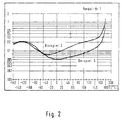
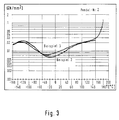
- the temperature profile of the mechanical tan ⁇ of polymers with and without A special microstructure essential to the invention is shown in FIGS. 1, 2 and 3 shown.
- the polymers with the special microstructure have higher ones Values in the range between the glass temperature to below 0 ° C, i.e. the Samples with the special microstructure have in this temperature range improved ductility.
- Characteristic of the polymers with the essential microstructure essential to the invention is that the mechanical tan ⁇ values> 0.015, preferably> 0.018 at a temperature 50 ° C below has the glass temperature. Values of> 0.1 are no longer realistic.
- the films according to the invention have increased flexibility and / or elongation at break. It is known that the flexibility and elongation at break of films can also be increased by orientation. An oriented film not according to the invention can accordingly have a higher flexibility and / or elongation at break than a less oriented film according to the invention. However, when comparing films with the same thickness, the same degree of orientation, the same molar composition and the same T g , the film according to the invention will always have a higher flexibility and elongation at break than a cycloolefin copolymer film not according to the invention.
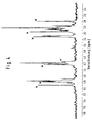
- the microstructure according to the invention causes some characteristic peaks in the 13 C-NMR spectrum.
- Figure 4 shows a typical spectrum of cycloolefin copolymers of norbornene and ethylene with the microstructure according to the invention;
- Fig. 5 shows a comparison of a spectrum of a cycloolefin copolymer without the microstructure according to the invention.
- the spectra have some common peaks and differences, the differences probably being due to a different steric structure of the polymers ("tacticity").
- the special microstructure gives some characteristic peaks:
- the advantage of the present invention is that the microstructure mentioned above for a given degree of orientation gives more flexible films than corresponding films Cycloolefin copolymer films with a different microstructure or no microstructure.
- the film contains fine, inert particles which improve the slip and winding behavior.
- particles which can be contained in amounts of 0-2% are for example: SiO 2 , Al 2 O 3 , silicates with an SiO 2 content of at least 30% by weight, amorphous and crystalline clay minerals, aluminosilicates, oxides of Mg, Zn, Zr and Ti, sulfates of Ca, Mg and Ba, phosphates of Li, Na and Ca (including the monohydrogen salts and dihydrogen salts), benzoates of Li, Na and K, terephthalates of Ca, Ba, Zn and Mn, titanates of Mg, Ca, Ba, Zn, Cd, Pb, Sr, Mn, Fe , Co and Ni, chromates of Ba and Pb, carbon (e.g.
- the film can also contain suitable additives such as e.g. Stabilizers, lubricants or Contain antioxidants.
- suitable additives such as e.g. Stabilizers, lubricants or Contain antioxidants.
- additives are used for polyolefins such as Polyethylene or polypropylene can also be used for the cycloolefin copolymer films suitable.
- UV stabilizers for example Absorbers such as hydroxyphenylbenzotriazoles, hydroxybenzophenones, formamidine or benzylidene camphor, quenchers such as cinnamic acid esters or nickel chelates, Free radical scavengers such as sterically hindered phenols, hydroperoxide decomposers such as nickel or zinc complexes of sulfur-containing compounds or Light stabilizers of the HALS type and their mixtures are used.
- lubricants that can be used are: fatty acids and their esters, amides and salts, silicones or waxes such as PP or PE waxes.
- Radical scavengers such as can be added as antioxidants substituted phenols and aromatic amines and / or peroxide decomposers such as Phosphites, phosphonates and thio compounds.
- the film according to the invention can have one or more layers. At least one layer predominantly exists, i.e. to at least 85 wt .-%, preferred 90-100 wt .-%, from the cycloolefin copolymers described above. A preferred embodiment is the monofilm.
- the main layer according to the invention bears one or two thin polymer cover layers with lower glass temperatures than the main layer, preferably at least 20 ° lower.
- Cycloolefin copolymers are particularly preferred as the top layer, however these cover layers do not have to have the special microstructure.
- the film can be coated to modify the properties.
- the film according to the invention can improve others to improve its properties contain compatible or incompatible polymers. These polymers can form separate layers or mixed with the cycloolefin copolymer be. Examples of such polymers are: polyethylene, polypropylene, polymethylbutene-1, Poly (4-methylpentene-1), polybutene-1 and polystyrene, polyvinyl chloride, Polyvinylidene chloride, polyvinyl fluoride, polytetrafluoroethylene, Polychloroprene, polyacrylate, polymethacrylate, polyacrylamide, polyacrylonitrile, Acrylonitrile / butadiene / styrene copolymers, acrylonitrile / styrene copolymers and Acrylonitrile / styrene / acrylate copolymers, polyvinyl alcohol, polyvinyl acetate, Polyvinyl stearate, polyvinyl benzoate, polyvinyl maleate, poly
- the films can be produced by various methods. to water from solution is possible, but the thermoplastic processing is in the Usually more advantageous. Plate presses work well for trials, however continuous processes such as extrusion or calendering for industrial Manufacturing more economical.
- Extruded films can be formed as a tube or flat film. For Coextrusion is recommended for the production of multilayer films.
- the films are often oriented to further improve the mechanical properties. This is done by stretching.
- the stretching temperatures should expediently be in a temperature interval of 40 C below the glass temperature (T g -40 ° C) to 50 ° C above the glass temperature (T g + 50 ° C).
- the orientation can be uniaxial or biaxial.
- Stretching temperatures above T g are suitable for industrial production because this allows faster production because of the higher achievable stretching speeds.
- the temperature, stretching rate and stretching ratio must be coordinated so that the film does not tear.
- the stretching speed is preferably 1 - 500000% / min.
- the stretching ratios in the longitudinal and transverse directions are 1.1: 1 - 10: 1, preferably 1.5: 1 - 4: 1.
- the area stretch ratio should preferably be 3-20.
- Oriented amorphous films can be used as shrink films.
- Non-oriented or only slightly oriented films can be used for the production of Thermoformed parts are used.
- the surfaces of the foils can be used to achieve e.g. Mediation or Printability or anti-static or non-stick properties can be modified. This modification can be done either by treatment methods such as corona, Flame, plasma or oxidation treatment or done by the Application of a coating from solution or dispersion.
- the glass transition temperature (T g ) was determined as a sudden increase in heat capacity in the DSC diagram.
- the DSC diagrams were recorded with a Perkin-Elmer DSC 7.
- VZ viscosity number
- the number of alternating bends was determined using an alternating bending tester from Frank GmbH on samples 170 mm x 15 mm at 500 alternating bends / min and a load of 150 g. The values given are the average of 5 measurements.
- the mechanical properties of the films were tested on a Zwick tensile testing machine from Zwick on 15 mm wide samples with a clamping length of 100 mm.
- the tensile modulus of elasticity was determined in the stretch range from 0.3 to 0.5% at a stretching speed of 10 mm / min.
- the tensile strength and elongation were determined at 100 mm / min.
- a clean and dry 75 dm 3 polymerization reactor with stirrer was purged with nitrogen and then with ethylene and filled with 25,000 g of norbornene melt at 70 ° C. The reactor was then kept at a temperature of 70 ° C. with stirring and 15 bar of ethylene (excess pressure) were injected.
- toluene methylaluminoxane solution (MAO solution, 10.1% by weight of methylaluminoxane with a molecular weight of 1300 g / mol after cryoscopic determination) were metered into the reactor and the mixture was stirred at 70 ° C. for 15 minutes, wherein the ethylene pressure was kept at 15 bar by metering.
- MAO solution 10.1% by weight of methylaluminoxane with a molecular weight of 1300 g / mol after cryoscopic determination
- 3000 mg of rac -dimethylsilyl-bis- (1-indenyl) zirconium dichloride (metallocene catalyst) were dissolved in 1000 ml of MAO solution (concentration and quality as above) and preactivated by standing for 15 minutes. The mixture was then polymerized for 220 minutes at 70 ° C.
- the filtered polymer was then added to 200 dm 3 of a mixture of 2 parts of 3 normal hydrochloric acid and one part of ethanol and this suspension was stirred for 2 hours.
- the polymer was then filtered off again, washed neutral with water and dried at 80 ° C. and 0.2 bar for 15 hours.
- a product amount of 5100 g was obtained.
- a viscosity number (VZ) of 90 cm 3 / g and a glass transition temperature (T g ) of 147 ° C. were measured on the product.
- Example 2 Polymers were prepared analogously to Example 1, but in Example 2 isopropylene (cyclopentadienyl) - (1-indenyl) zirconium dichloride was used as the metallocene catalyst instead of rac -dimethylsilyl-bis- (1-indenyl) zirconium dichloride.
- rac -Dimethylsilyl-bis- (1-indenyl) zirconium dichloride was used in Example 3 and bis (1-indenyl) zirconium dichloride in Example 4.
- Example 5 Polymers were produced without the special microstructure. Instead of rac -dimethylsilyl-bis- (1-indenyl) zirconium dichloride, diphenylmethylene (cyclopentadienyl) - (9-fluorenyl) zirconium dichloride (example 5) and isopropylene (cyclopentadienyl) - (9-fluorenyl) zirconium dichloride (example 6 ) used as metallocene catalysts.
- Table 2 summarizes the reaction conditions.
- the 13 C-NMR spectrum of the polymer according to Example 5 is shown in Fig. 5. The peaks characteristic of the special microstructure at 28.0, 31.5, 33.1, 41.3, 42.2, 47.7 and 48.8 ppm are missing.
- Example 2 The polymer from Example 1 was pressed in a plate press at 250 ° C. to form a 350 ⁇ m thick film. The film was transparent and colorless and broke when folded once. The mechanical properties of the film were: E-module 2.6 GPa Tensile strength 50 MPa Elongation at break 3%
- the polymer from Example 5 was pressed in a plate press at 250 ° C. to form a 320 ⁇ m thick film.
- the film was transparent and colorless and broke when folded once.
- the mechanical properties of the film were: E-module 2.6 GPa Tensile strength 30 MPa Elongation at break 2%
- the non-oriented film from Example 8 was on a film stretching apparatus (Karo III from Brückner, Siegsdorf) at 180 ° C along and across stretched by a factor of 1.8.
- the mechanical properties of the film were: E-module 3.2 GPa Tensile strength 60 MPa Elongation at break 2% Number of bending cycles 206
- the non-oriented film from Example 8 was first in the film stretching apparatus described in Example 10 at 180 ° C at a stretching rate of about 100% / min. stretched lengthways and crossways by a factor of 1.1. Then it was stretched longitudinally and transversely by a factor of 2.0 at 125 ° C. at a stretching speed of 25% / min.
- the mechanical properties of the film were: E-module 3.2 GPa Tensile strength 89 MPa Elongation at break 26% Number of bending cycles 4000
- Example 12 The non-oriented film from Example 9 was stretched in the longitudinal and transverse directions by various stretching factors in analogy to Example 10 (Examples 12 and 13).
- the mechanical properties were: Example 12 Example 13 Stretch factor (lengthways and crossways; each) 1.8 2.3 E-module 3.6 3.6 GPa Tensile strength 37 47 MPa Elongation at break 2nd 2% Number of bending cycles 50 800
- Example 7 The film from Example 7 was brought to about 180 ° in a vacuum deep-drawing machine C warmed and then to a conical stable mug in a cold Thermoformed mold.
- Example 9 The film from Example 9 was thermoformed analogously to Example 14. At the Setting up the cup tore it at kinks.
Landscapes
- Chemical & Material Sciences (AREA)
- Engineering & Computer Science (AREA)
- Manufacturing & Machinery (AREA)
- Organic Chemistry (AREA)
- Health & Medical Sciences (AREA)
- Chemical Kinetics & Catalysis (AREA)
- Medicinal Chemistry (AREA)
- Polymers & Plastics (AREA)
- Materials Engineering (AREA)
- Mechanical Engineering (AREA)
- Manufacture Of Macromolecular Shaped Articles (AREA)
- Laminated Bodies (AREA)
- Addition Polymer Or Copolymer, Post-Treatments, Or Chemical Modifications (AREA)
- Polarising Elements (AREA)
- Shaping By String And By Release Of Stress In Plastics And The Like (AREA)
Claims (10)
- Feuille à une ou plusieurs couches orientée de manière monoaxiale ou biaxiale, dans laquellle au moins une couche contient un copolymère de cyclooléfine, caractérisée en ce que le copolymère de cyclooléfine possède un facteur de perte mécanique (tan δ) de ≥ 0,015 à 50°C au-dessous de la température de transition vitreuse.
- Feuille suivant la revendication 1 caractérisée en ce que le spectre 13C-RMN du copolymère de cyclooléfine présente un pic à 42,2 ppm.
- Feuille suivant la revendication 1 ou 2, caractérisée en ce que le spectre 13C-RMN du copolymère de cyclooléfine présente des pics à 28,0, 31,5, 33,1, 41,3, 47,7 et 48,8 ppm.
- Feuille suivant l'une ou plusieurs des revendications 1 à 3, caractérisée en ce qu'elle est monocouche.
- Feuille suivant l'une ou plusieurs des revendications 1 à 4, caractérisée en ce qu'elle est orientée de manière biaxiale.
- Feuille suivant l'une ou plusieurs des revendications 1 à 5, caractérisée en ce que le copolymère de cyclooléfine est constitué d'unités répétitives de la formule (I) et (II) et, le cas échéant, (III) et/ou (IV) et/ou (V)
 (III) étant différent de (I), R1 à R5 étant identiques ou différents et signifiant H, aryle en C6-C16, alkyle en C1-C10, alcényle en C2-C10, cycloalkyle en C3-C10 ou cycloalcényle en C3-C10, et R6 à R14 étant identiques ou différents et ayant la signification de R1 à R5 ou les paires de radicaux R6/R7, R8/R9, R10/R11 et/ou R12/R13 étant chaque fois liées les unes aux autres et représentant, conjointement avec les atomes de carbone auxquels elles sont liées, un radical cycloalkyle en C4-C10 ou un radical cycloalcényle en C4-C10, qui de son côté peut être ponté par un radical C(R1, R2), dans lequel R1 et R2 ont les significations données plus haut pour R1 à R5.
- Feuille suivant la revendication 6, caractérisée en ce que R1, R2, R3, R4 et R5 signifient un hydrogène.
- Feuille suivant l'une ou plusieurs des revendications 1 à 6, caractérisée en ce que le copolymère de cyclooléfine est préparé en utilisant un système de catalyseur à métallocène ponté.
- Feuille suivant l'une ou plusieurs des revendications 1 à 8, caractérisée en ce que la température de transition vitreuse du copolymère de cyclooléfine se situe entre 50 et 250°C, de préférence entre 80 et 200°C.
- Feuille suivant l'une ou plusieurs des revendications 1 à 9, caractérisée en ce qu'elle contient 0 à 2% en poids de particules inertes sur base du poids de la feuille.
Applications Claiming Priority (2)
| Application Number | Priority Date | Filing Date | Title |
|---|---|---|---|
| DE4304309A DE4304309A1 (de) | 1993-02-12 | 1993-02-12 | Biegsame Cycloolefincopolymer-Folie |
| DE4304309 | 1993-02-12 |
Publications (3)
| Publication Number | Publication Date |
|---|---|
| EP0610815A2 EP0610815A2 (fr) | 1994-08-17 |
| EP0610815A3 EP0610815A3 (fr) | 1995-10-11 |
| EP0610815B1 true EP0610815B1 (fr) | 1999-12-22 |
Family
ID=6480348
Family Applications (1)
| Application Number | Title | Priority Date | Filing Date |
|---|---|---|---|
| EP94101639A Expired - Lifetime EP0610815B1 (fr) | 1993-02-12 | 1994-02-03 | Film copolymère de cyclo-olefine |
Country Status (10)
| Country | Link |
|---|---|
| US (1) | US5583192A (fr) |
| EP (1) | EP0610815B1 (fr) |
| JP (1) | JPH072953A (fr) |
| KR (1) | KR100287602B1 (fr) |
| CN (1) | CN1052251C (fr) |
| AU (1) | AU673396B2 (fr) |
| CA (1) | CA2115195C (fr) |
| DE (2) | DE4304309A1 (fr) |
| MX (1) | MX9401119A (fr) |
| TW (1) | TW307782B (fr) |
Cited By (1)
| Publication number | Priority date | Publication date | Assignee | Title |
|---|---|---|---|---|
| EP2556957A1 (fr) | 2011-08-11 | 2013-02-13 | Orbita-Film GmbH | Film composite en tant que feuille de protection pour plaies profondes |
Families Citing this family (42)
| Publication number | Priority date | Publication date | Assignee | Title |
|---|---|---|---|---|
| US6964798B2 (en) | 1993-11-16 | 2005-11-15 | Baxter International Inc. | Multi-layered polymer based thin film structure for medical grade products |
| DE4425408A1 (de) | 1994-07-13 | 1996-01-18 | Hoechst Ag | Cycloolefinpolymere |
| DE19539093A1 (de) | 1995-10-20 | 1997-04-24 | Hoechst Ag | Metallisierte Polyolefinfolie |
| DE19647954A1 (de) * | 1996-11-20 | 1998-06-04 | Hoechst Ag | Biaxial orientierte Folie aus cycloolefinischen Polymeren, Verfahren zu deren Herstellung und deren Verwendung |
| DE69829370T2 (de) * | 1997-06-20 | 2006-03-09 | Nippon Zeon Co., Ltd. | Polymerfolie und Schichtkondensator |
| DE19915715A1 (de) | 1999-04-08 | 2000-10-19 | Ticona Gmbh | Mikrostrukturierte Bauteile |
| US6255396B1 (en) | 1999-09-09 | 2001-07-03 | Baxter International Inc. | Cycloolefin blends and method for solvent bonding polyolefins |
| US6590033B2 (en) | 1999-09-09 | 2003-07-08 | Baxter International Inc. | Cycloolefin blends and method for solvent bonding polyolefins |
| US6613187B1 (en) | 1999-09-09 | 2003-09-02 | Baxter International Inc | Solvent bonding method for polyolefin materials |
| US6632318B1 (en) | 1999-09-09 | 2003-10-14 | Baxter International Inc. | Method for solvent bonding polyolefins |
| US6297322B1 (en) | 1999-09-09 | 2001-10-02 | Baxter International Inc. | Cycloolefin blends and method for solvent bonding polyolefins |
| US6497676B1 (en) | 2000-02-10 | 2002-12-24 | Baxter International | Method and apparatus for monitoring and controlling peritoneal dialysis therapy |
| US6372848B1 (en) | 2000-10-10 | 2002-04-16 | Baxter International Inc. | Blend of ethylene and α-olefin copolymers obtained using a metallocene catalyst for fabricating medical films and tubings |
| ATE334820T1 (de) * | 2000-12-06 | 2006-08-15 | Huhtamaki Deutschland Gmbh & C | Verfahren zum herstellen einer verbundfolie |
| US20030125662A1 (en) | 2002-01-03 | 2003-07-03 | Tuan Bui | Method and apparatus for providing medical treatment therapy based on calculated demand |
| US7238164B2 (en) | 2002-07-19 | 2007-07-03 | Baxter International Inc. | Systems, methods and apparatuses for pumping cassette-based therapies |
| AU2003263983B2 (en) * | 2002-08-05 | 2008-05-08 | Cryovac, Inc. | High free shrink, high modulus, low shrink tension film with elastic recovery |
| US20050186373A1 (en) * | 2004-02-20 | 2005-08-25 | Honeywell International Inc. | Multilayer sheets and films composed of polypropylene and cyclic olefin copolymer |
| MXPA06011837A (es) | 2004-04-27 | 2007-01-16 | Baxter Int | Sistema de reactor de tanque agitado. |
| US7258930B2 (en) * | 2004-04-28 | 2007-08-21 | Cryovac, Inc. | Oxygen scavenging film with cyclic olefin copolymer |
| EP1775312A4 (fr) * | 2004-07-09 | 2009-09-30 | Mitsui Chemicals Inc | Résine thermoplastique |
| JP2006083266A (ja) * | 2004-09-15 | 2006-03-30 | Teijin Ltd | 光学用フィルム |
| AT501412A1 (de) | 2004-11-29 | 2006-08-15 | Ebert Folien Ndl Der Haendler | Dreheinschlagfolie sowie deren verwendung als verpackungsfolie |
| JPWO2007043448A1 (ja) * | 2005-10-05 | 2009-04-16 | 帝人化成株式会社 | 溶融押し出しフィルムおよび延伸フィルム |
| US7935401B2 (en) * | 2005-10-27 | 2011-05-03 | Cryovac, Inc. | Shrink sleeve label |
| JP5295566B2 (ja) | 2005-11-24 | 2013-09-18 | トパース・アドヴァンスト・ポリマーズ・ゲーエムベーハー | シクロオレフィン系共重合体 |
| US20070141366A1 (en) * | 2005-12-21 | 2007-06-21 | Janet Rivett | Multilayer film with hot tack property |
| US9163141B2 (en) * | 2006-04-27 | 2015-10-20 | Cryovac, Inc. | Polymeric blend comprising polylactic acid |
| US8206796B2 (en) * | 2006-04-27 | 2012-06-26 | Cryovac, Inc. | Multilayer film comprising polylactic acid |
| US8114491B2 (en) * | 2007-02-15 | 2012-02-14 | Cryovac, Inc. | Shrink sleeve label |
| US8361023B2 (en) | 2007-02-15 | 2013-01-29 | Baxter International Inc. | Dialysis system with efficient battery back-up |
| US7731689B2 (en) | 2007-02-15 | 2010-06-08 | Baxter International Inc. | Dialysis system having inductive heating |
| US7998115B2 (en) | 2007-02-15 | 2011-08-16 | Baxter International Inc. | Dialysis system having optical flowrate detection |
| US8558964B2 (en) | 2007-02-15 | 2013-10-15 | Baxter International Inc. | Dialysis system having display with electromagnetic compliance (“EMC”) seal |
| US8870812B2 (en) | 2007-02-15 | 2014-10-28 | Baxter International Inc. | Dialysis system having video display with ambient light adjustment |
| FI20070155A0 (fi) * | 2007-02-23 | 2007-02-23 | Panphonics Oy | Elektreettilevyrakenne |
| US8986820B2 (en) * | 2007-05-02 | 2015-03-24 | Topas Advanced Polymers, Inc. | Thermoformed articles from sheet incorporating cycloolefin copolymer |
| US8945702B2 (en) | 2007-10-31 | 2015-02-03 | Bemis Company, Inc. | Barrier packaging webs having metallized non-oriented film |
| US11179516B2 (en) | 2017-06-22 | 2021-11-23 | Baxter International Inc. | Systems and methods for incorporating patient pressure into medical fluid delivery |
| CN115260647A (zh) * | 2021-04-30 | 2022-11-01 | 西安交通大学 | 一种聚丙烯-耐高温聚合物共混薄膜及其制备方法和电容器芯子 |
| CN114148004A (zh) * | 2022-02-07 | 2022-03-08 | 天津大学 | 一种电容器用聚丙烯薄膜高温介电性能的提升方法 |
| CN116574391B (zh) * | 2023-04-14 | 2024-06-21 | 湖南映宏新材料股份有限公司 | 一种利用废线路板树脂粉末制作木塑复合材料的方法 |
Family Cites Families (10)
| Publication number | Priority date | Publication date | Assignee | Title |
|---|---|---|---|---|
| DE241971C (fr) * | ||||
| DE224538C (fr) * | ||||
| CA2010320C (fr) * | 1989-02-20 | 2001-04-17 | Yohzoh Yamamoto | Feuille ou pellicule d'un polymere d'olefine cyclique |
| AU634533B2 (en) * | 1989-03-21 | 1993-02-25 | United States of America, as represented by the Secretary, U.S. Department of Commerce, The | Matrix metalloproteinase inhibitor peptides |
| DE3922546A1 (de) * | 1989-07-08 | 1991-01-17 | Hoechst Ag | Verfahren zur herstellung von cycloolefinpolymeren |
| US5371158A (en) * | 1990-07-05 | 1994-12-06 | Hoechst Aktiengesellschaft | Bulk polymerization using specific metallocene catalysts for the preparation of cycloolefin polymers |
| TW227005B (fr) * | 1990-11-14 | 1994-07-21 | Hoechst Ag | |
| DE59209568D1 (de) * | 1991-02-27 | 1999-01-07 | Ticona Gmbh | Verfahren zur Herstellung von Cycloolefin(co)polymeren mit enger Molekulargewichtsverteilung |
| ATE223440T1 (de) * | 1991-03-09 | 2002-09-15 | Basell Polyolefine Gmbh | Metallocen und katalysator |
| TW212809B (fr) * | 1991-09-03 | 1993-09-11 | Hoechst Ag |
-
1993
- 1993-02-12 DE DE4304309A patent/DE4304309A1/de not_active Withdrawn
-
1994
- 1994-02-03 EP EP94101639A patent/EP0610815B1/fr not_active Expired - Lifetime
- 1994-02-03 DE DE59409016T patent/DE59409016D1/de not_active Expired - Lifetime
- 1994-02-08 CN CN94101360A patent/CN1052251C/zh not_active Expired - Fee Related
- 1994-02-08 CA CA002115195A patent/CA2115195C/fr not_active Expired - Fee Related
- 1994-02-10 AU AU55047/94A patent/AU673396B2/en not_active Ceased
- 1994-02-10 JP JP6016408A patent/JPH072953A/ja active Pending
- 1994-02-11 MX MX9401119A patent/MX9401119A/es not_active IP Right Cessation
- 1994-02-12 KR KR1019940002497A patent/KR100287602B1/ko not_active Expired - Fee Related
- 1994-02-14 US US08/195,078 patent/US5583192A/en not_active Expired - Lifetime
- 1994-02-18 TW TW083101323A patent/TW307782B/zh not_active IP Right Cessation
Cited By (2)
| Publication number | Priority date | Publication date | Assignee | Title |
|---|---|---|---|---|
| EP2556957A1 (fr) | 2011-08-11 | 2013-02-13 | Orbita-Film GmbH | Film composite en tant que feuille de protection pour plaies profondes |
| DE102011080831A1 (de) | 2011-08-11 | 2013-02-14 | Orbita-Film Gmbh | Folienverbund als Schutzfolie für Tiefziehanwendungen |
Also Published As
| Publication number | Publication date |
|---|---|
| EP0610815A2 (fr) | 1994-08-17 |
| CA2115195C (fr) | 2004-11-23 |
| JPH072953A (ja) | 1995-01-06 |
| CN1096521A (zh) | 1994-12-21 |
| US5583192A (en) | 1996-12-10 |
| AU673396B2 (en) | 1996-11-07 |
| MX9401119A (es) | 1994-08-31 |
| KR100287602B1 (ko) | 2001-04-16 |
| DE4304309A1 (de) | 1994-08-18 |
| DE59409016D1 (de) | 2000-01-27 |
| EP0610815A3 (fr) | 1995-10-11 |
| AU5504794A (en) | 1994-08-18 |
| CN1052251C (zh) | 2000-05-10 |
| TW307782B (fr) | 1997-06-11 |
| KR940019773A (ko) | 1994-09-15 |
| CA2115195A1 (fr) | 1994-08-13 |
Similar Documents
| Publication | Publication Date | Title |
|---|---|---|
| EP0610815B1 (fr) | Film copolymère de cyclo-olefine | |
| EP0610816B1 (fr) | Feuille rigide de copolymère cyclo-oléfine | |
| EP0610814B1 (fr) | Feuille semi-cristalline de copolymère cyclo-oléfine | |
| EP0844077B1 (fr) | Feuille en polymères de cyclooléfines orientée biaxialement, son procédé d'obtention et son utilisation | |
| EP1268661B1 (fr) | Melange de polymeres contenant un polymere cycloolefinique et un polymere cycloolefinique amorphe | |
| DE102020006588A1 (de) | Kondensator enthaltend biaxial verstreckte Polypropylen-Cycloolefinpolymer-Folie als Dielektrikum und Verwendung dieser Folie | |
| EP0769371B1 (fr) | Film en polyoléfine métallisé | |
| EP0988329B1 (fr) | Electrets | |
| EP0838293A2 (fr) | Feuille mono- ou multicouche | |
| DE60012145T2 (de) | Statistische propylen/alpha-olefin copolymerzusammensetzung | |
| EP0622187A1 (fr) | Film en polypropylène multicouche mat, orienté biaxiallement et à rétraction élevée, son procédé de fabrication et son utlisation | |
| DE102008051399A1 (de) | Folien und deren Verwendung | |
| EP0849074A2 (fr) | Feuilles orientées et scellables comprenant au moins un copolymère cyclooléfinique | |
| DE19916141A1 (de) | Mehrschichtbehälter mit verbesserter Haftung zwischen den Polymerschichten und hervorragenden Barriereeigenschaften | |
| DE19725975A1 (de) | Blisterverpackung | |
| DE19540356A1 (de) | Polymere Schäume | |
| DE19725253A1 (de) | Elektrete | |
| DE19652774A1 (de) | Folien |
Legal Events
| Date | Code | Title | Description |
|---|---|---|---|
| PUAI | Public reference made under article 153(3) epc to a published international application that has entered the european phase |
Free format text: ORIGINAL CODE: 0009012 |
|
| AK | Designated contracting states |
Kind code of ref document: A2 Designated state(s): DE FR GB IT LU NL |
|
| PUAL | Search report despatched |
Free format text: ORIGINAL CODE: 0009013 |
|
| AK | Designated contracting states |
Kind code of ref document: A3 Designated state(s): DE FR GB IT LU NL |
|
| 17P | Request for examination filed |
Effective date: 19960411 |
|
| 17Q | First examination report despatched |
Effective date: 19970915 |
|
| RAP1 | Party data changed (applicant data changed or rights of an application transferred) |
Owner name: TICONA GMBH |
|
| RAP1 | Party data changed (applicant data changed or rights of an application transferred) |
Owner name: TICONA GMBH |
|
| GRAG | Despatch of communication of intention to grant |
Free format text: ORIGINAL CODE: EPIDOS AGRA |
|
| GRAG | Despatch of communication of intention to grant |
Free format text: ORIGINAL CODE: EPIDOS AGRA |
|
| GRAH | Despatch of communication of intention to grant a patent |
Free format text: ORIGINAL CODE: EPIDOS IGRA |
|
| GRAH | Despatch of communication of intention to grant a patent |
Free format text: ORIGINAL CODE: EPIDOS IGRA |
|
| GRAA | (expected) grant |
Free format text: ORIGINAL CODE: 0009210 |
|
| AK | Designated contracting states |
Kind code of ref document: B1 Designated state(s): DE FR GB IT LU NL |
|
| REF | Corresponds to: |
Ref document number: 59409016 Country of ref document: DE Date of ref document: 20000127 |
|
| GBT | Gb: translation of ep patent filed (gb section 77(6)(a)/1977) |
Effective date: 20000121 |
|
| ITF | It: translation for a ep patent filed | ||
| ET | Fr: translation filed | ||
| PLBE | No opposition filed within time limit |
Free format text: ORIGINAL CODE: 0009261 |
|
| STAA | Information on the status of an ep patent application or granted ep patent |
Free format text: STATUS: NO OPPOSITION FILED WITHIN TIME LIMIT |
|
| 26N | No opposition filed | ||
| REG | Reference to a national code |
Ref country code: GB Ref legal event code: IF02 |
|
| PGFP | Annual fee paid to national office [announced via postgrant information from national office to epo] |
Ref country code: DE Payment date: 20110218 Year of fee payment: 18 Ref country code: IT Payment date: 20110221 Year of fee payment: 18 Ref country code: FR Payment date: 20110302 Year of fee payment: 18 Ref country code: LU Payment date: 20110225 Year of fee payment: 18 Ref country code: NL Payment date: 20110216 Year of fee payment: 18 |
|
| PGFP | Annual fee paid to national office [announced via postgrant information from national office to epo] |
Ref country code: GB Payment date: 20110217 Year of fee payment: 18 |
|
| REG | Reference to a national code |
Ref country code: NL Ref legal event code: V1 Effective date: 20120901 |
|
| GBPC | Gb: european patent ceased through non-payment of renewal fee |
Effective date: 20120203 |
|
| REG | Reference to a national code |
Ref country code: FR Ref legal event code: ST Effective date: 20121031 |
|
| PG25 | Lapsed in a contracting state [announced via postgrant information from national office to epo] |
Ref country code: IT Free format text: LAPSE BECAUSE OF NON-PAYMENT OF DUE FEES Effective date: 20120203 |
|
| REG | Reference to a national code |
Ref country code: DE Ref legal event code: R119 Ref document number: 59409016 Country of ref document: DE Effective date: 20120901 |
|
| PG25 | Lapsed in a contracting state [announced via postgrant information from national office to epo] |
Ref country code: FR Free format text: LAPSE BECAUSE OF NON-PAYMENT OF DUE FEES Effective date: 20120229 Ref country code: NL Free format text: LAPSE BECAUSE OF NON-PAYMENT OF DUE FEES Effective date: 20120901 Ref country code: GB Free format text: LAPSE BECAUSE OF NON-PAYMENT OF DUE FEES Effective date: 20120203 |
|
| PG25 | Lapsed in a contracting state [announced via postgrant information from national office to epo] |
Ref country code: DE Free format text: LAPSE BECAUSE OF NON-PAYMENT OF DUE FEES Effective date: 20120901 |
|
| PG25 | Lapsed in a contracting state [announced via postgrant information from national office to epo] |
Ref country code: LU Free format text: LAPSE BECAUSE OF NON-PAYMENT OF DUE FEES Effective date: 20120203 |