EP0844263A2 - Katalysatorgemisch für die ringöffnende Metathesepolymerisation - Google Patents
Katalysatorgemisch für die ringöffnende Metathesepolymerisation Download PDFInfo
- Publication number
- EP0844263A2 EP0844263A2 EP97810831A EP97810831A EP0844263A2 EP 0844263 A2 EP0844263 A2 EP 0844263A2 EP 97810831 A EP97810831 A EP 97810831A EP 97810831 A EP97810831 A EP 97810831A EP 0844263 A2 EP0844263 A2 EP 0844263A2
- Authority
- EP
- European Patent Office
- Prior art keywords
- oder
- alkyl
- alkoxy
- unsubstituted
- substituted
- Prior art date
- Legal status (The legal status is an assumption and is not a legal conclusion. Google has not performed a legal analysis and makes no representation as to the accuracy of the status listed.)
- Granted
Links
Classifications
-
- H—ELECTRICITY
- H01—ELECTRIC ELEMENTS
- H01B—CABLES; CONDUCTORS; INSULATORS; SELECTION OF MATERIALS FOR THEIR CONDUCTIVE, INSULATING OR DIELECTRIC PROPERTIES
- H01B3/00—Insulators or insulating bodies characterised by the insulating materials; Selection of materials for their insulating or dielectric properties
- H01B3/18—Insulators or insulating bodies characterised by the insulating materials; Selection of materials for their insulating or dielectric properties mainly consisting of organic substances
- H01B3/30—Insulators or insulating bodies characterised by the insulating materials; Selection of materials for their insulating or dielectric properties mainly consisting of organic substances plastics; resins; waxes
-
- C—CHEMISTRY; METALLURGY
- C08—ORGANIC MACROMOLECULAR COMPOUNDS; THEIR PREPARATION OR CHEMICAL WORKING-UP; COMPOSITIONS BASED THEREON
- C08G—MACROMOLECULAR COMPOUNDS OBTAINED OTHERWISE THAN BY REACTIONS ONLY INVOLVING UNSATURATED CARBON-TO-CARBON BONDS
- C08G61/00—Macromolecular compounds obtained by reactions forming a carbon-to-carbon link in the main chain of the macromolecule
- C08G61/02—Macromolecular compounds containing only carbon atoms in the main chain of the macromolecule, e.g. polyxylylenes
- C08G61/04—Macromolecular compounds containing only carbon atoms in the main chain of the macromolecule, e.g. polyxylylenes only aliphatic carbon atoms
- C08G61/06—Macromolecular compounds containing only carbon atoms in the main chain of the macromolecule, e.g. polyxylylenes only aliphatic carbon atoms prepared by ring-opening of carbocyclic compounds
- C08G61/08—Macromolecular compounds containing only carbon atoms in the main chain of the macromolecule, e.g. polyxylylenes only aliphatic carbon atoms prepared by ring-opening of carbocyclic compounds of carbocyclic compounds containing one or more carbon-to-carbon double bonds in the ring
Definitions
- the present invention relates to a catalyst composition from a Ruthenium or osmium phosphine complex and an alkyne; containing a mixture Diels-Alder adduct of cyclopentadiene and such a catalyst composition; a Process for the preparation of a metathesis polymer and the use of polymerizable composition as casting resin, impregnating resin or as Wrapping material for electrical or electronic components.
- WO 93/13171 describes air- and water-stable one-component and two-component catalysts based on carbonyl group-containing molybdenum and tungsten compounds as well as ruthenium and osmium compounds with at least one polyene ligand for the thermal and photoactivated ring-opening metathesis polymerization (ROMP) of strained cycloolefins Norbornene and norbornene derivatives.
- 1-alkynes are recommended as co-catalysts for the two-component catalysts.
- WO 96/20235 describes ruthenium and osmium complex compounds as excellent catalysts for the metathesis polymerization of di- and Oligocyclopentadienes described.
- alkyl groups can be straight-chain or branched. The same thing also applies to the or each alkyl part of alkoxy, haloalkyl and further alkyl containing groups. These alkyl groups preferably contain 1 to 12, especially preferably 1 to 8 and particularly preferably 1 to 4 carbon atoms.
- Alkyl includes, for example, methyl, ethyl, isopropyl, n-propyl, n-butyl, isobutyl, sec-butyl, tert-butyl and the various isomeric pentyl, hexyl, heptyl, octyl, nonyl, decyl, Undecyl, dodecyl, tridecyl, tetradecyl, pentadecyl, hexadecyl, heptadecyl, Octadecyl, nonadecyl and eicosyl groups.
- Alkoxy is, for example, methoxy, ethoxy, propyloxy, isopropyloxy, n-butyloxy, isobutyloxy, sec-butyloxy and tert-butyloxy.
- Haloalkyl includes, for example, fluoromethyl, difluoromethyl, trifluoromethyl, chloromethyl, Dichloromethyl, trichloromethyl, 2,2,2-trifluoroethyl, 2-fluoroethyl, 2-chloroethyl, 2,2,2-trichloroethyl and halogenated, especially fluorinated or chlorinated isopropyl, n-propyl, n-butyl, isobutyl, sec-butyl and tert-butyl groups and the various isomeric halogenated pentyl, hexyl, heptyl, octyl, nonyl, decyl, undecyl, dodecyl, Tridecyl, tetradecyl, pentadecyl, hexadecyl, heptadecyl, octadecyl, nonadecyl and Eicosyl groups
- Cycloalkyl is preferably C 5 -C 8 cycloalkyl, especially C 5 or C 6 cycloalkyl. Some examples are cyclopropyl, dimethylcyclopropyl, cyclobutyl, cyclopentyl, methylcyclopentyl, cyclohexyl, cycloheptyl and cyclooctyl.
- Cycloalkoxy groups are, for example, cyclopentyloxy, methylcyclopentyloxy and Cyclohexyloxy.
- Aryl preferably contains 6 to 10 carbon atoms.
- phenyl Trade pentalinyl, indenyl, naphthyl, azulinyl and anthryl.
- Aryloxy groups are, for example, phenyloxy, naphthyloxy and anthryloxy.
- Aralkyl preferably contains 7 to 12 carbon atoms and particularly preferably 7 to 10 carbon atoms. It can be, for example, benzyl, phenethyl, 3-phenylpropyl, ⁇ -methylbenzyl, Act 4-phenylbutyl and ⁇ , ⁇ -dimethylbenzyl.
- aralkyloxy groups are benzyloxy, phenethyloxy, 3-phenylpropyloxy, ⁇ -methylbenzyloxy, 4-phenylbutyloxy and ⁇ , ⁇ -dimethylbenzyloxy.
- component (a) are compounds of the formula I in which R 1 , R 2 and R 3 independently of one another are C 1 -C 6 alkyl, C 1 -C 6 alkoxy, C 4 -C 12 cycloalkyl, C 4 -C 12 cycloalkoxy, C 6 -C 16 aryl or C 6 -C 16 aryloxy.
- R 1 , R 2 and R 3 independently of one another are isopropyl, sec-butyl, phenyl, tolyl, cyclopentyl or cyclohexyl are particularly preferred.
- L in formula I preferably represents unsubstituted or substituted with 1 to 3 C 1 -C 4 alkyl benzene, thiophene, benzonitrile or acetonitrile, nitrogen (N 2 ), an unsubstituted or partially or fully fluorinated C 1 -C 4 alcohol , CO, H 2 O or NH 3 .
- the complex compounds of formula I are known and for example in WO 96/16100 and WO 96/20235.
- Examples of ruthenium and osmium compounds are of the formula I are [Tos means tosylate, Cp stands for cyclopentadienyl and C 6 H 11 is cyclohexyl]: (C 6 H 11 ) 2 HPRu (p-Cymol) Cl 2 , (C 6 H 11 ) 3 PRu (p-Cymol) Cl 2 , (C 6 H 11 ) 3 PRu (p-Cymol) (Tos) 2 , (C 6 H 11 ) 3 PRu (p-Cymol) Br 2 , (C 6 H 11 ) 3 PRu (p-Cymol) ClF, (C 6 H 11 ) 3 PRu (C 6 H 6 ) (Tos) 2 , (C 6 H 11 ) 3 PRu (CH 3 -C 6 H 5 ) (Tos) 2 , (C 6 H 11 ) 3 PRu (C 10 H 8 ) (Tos) 2 , (iC 3 H 7 ) 3 PRu ( p-
- Particularly preferred compounds of the formula I are [(C 6 H 11 ) 3 P] 2 RuCl 2 , [(C 6 H 5 ) 3 P] 3 RuCl 2 , [(C 6 H 5 ) 3 P] 3 (CO) RuH 2 , [(C 6 H 5 ) 3 P] 3 RuClCp, [(C 6 H 11 ) 3 P] 2 (CH 3 OH) Ru (Tos) 2 , [(o-tolyl) 3 P] 3 RuCl 2 , [(CH 3 ) 2 CH] 3 P (p-cymene) RuCl 2 and in particular (C 6 H 11 ) 3 P (p-cymene) RuCl 2 .
- the compounds of formula II are also known and some of them are commercially available. Examples include ethine, phenylethine, 4-tert-butylphenylethine, trimethylsilylethine, Triethylsilylethine, triisopropylsilylethine, ethylethynyl ether, 2-ethynylpyridine, 4-ethynyltoluene, 1-ethynylcyclohexylamine, Propyne, 3-cyclohexyl-1-propyne, 1-bromo-2-propyne, 1-chloro-2-propyne, 1-dimethylamino-2-propyne, 1 -diethylamino-2-propyne, 3-trimethylsilyl-1-propyne, 3-trimethylsilyloxy-1-propyne, Propargyl acrylate, propargyl acetate, dipropargyl ether, Propargyl alde
- compositions according to the invention preferably contain, as component (b), a compound of the formula II in which R 4 is an unsubstituted or substituted by one or more amino groups or halogen atoms, C 1 -C 20 -alkyl-, C 1 -C 20 -alkoxy-, C 4 -C 12 cycloalkyl, C 4 -C 12 cycloalkoxy, C 6 -C 16 aryl, C 6 -C 16 aryloxy or C 7 -C 16 aralkyl group.
- R 4 in the formula II is particularly preferably C 1 -C 12 -alkyl or C 6 -C 10 -aryl.
- Particularly preferred components (b) are 1-heptin, 1-octyne, 1-decyne or Phenylethine.
- the amounts of components (a) and (b) can vary within wide limits in the compositions according to the invention.
- the weight ratio of components (a): (b) is preferably 25: 1 to 1:10, in particular 10: 1 to 1: 2 and very particularly preferably 7: 1 to 2: 1.
- Compositions containing approximately equimolar amounts of components (a) and (b) are particularly suitable. , ie compositions in which the molar ratio of components (a): (b) is 1.1: 1 to 1: 1.1.
- compositions according to the invention are suitable as storage-stable two-component catalysts for the ring-opening metathesis polymerization of cyclopentadiene adducts.
- This new catalyst system enables the polymerization of dicyclopentadiene and other cyclopentadiene adducts in a significantly shorter time, with a high enthalpy of reaction and only a small weight loss being observed.
- the polymers are characterized by a high glass transition temperature and generally by good mechanical properties.
- Particularly suitable components (b) are compounds of the formula II in which R 4 represents a radical containing hydroxyl groups.
- a further subject of the invention therefore forms a composition containing the components (a) and (b) defined above and additionally (c) a Diels-Alder adduct of cyclopentadiene.
- Preferred components (c) are compounds of the formula III wherein R 5 and R 6 independently of one another are hydrogen, C 1 -C 12 alkyl, phenyl, tolyl, cyclohexyl, cyclohexenyl, halogen, cyano, C 1 -C 12 hydroxyalkyl or C 1 -C 12 haloalkyl or R 5 and R 6 together with the carbon atoms to which they are attached form a five- or six-membered ring.
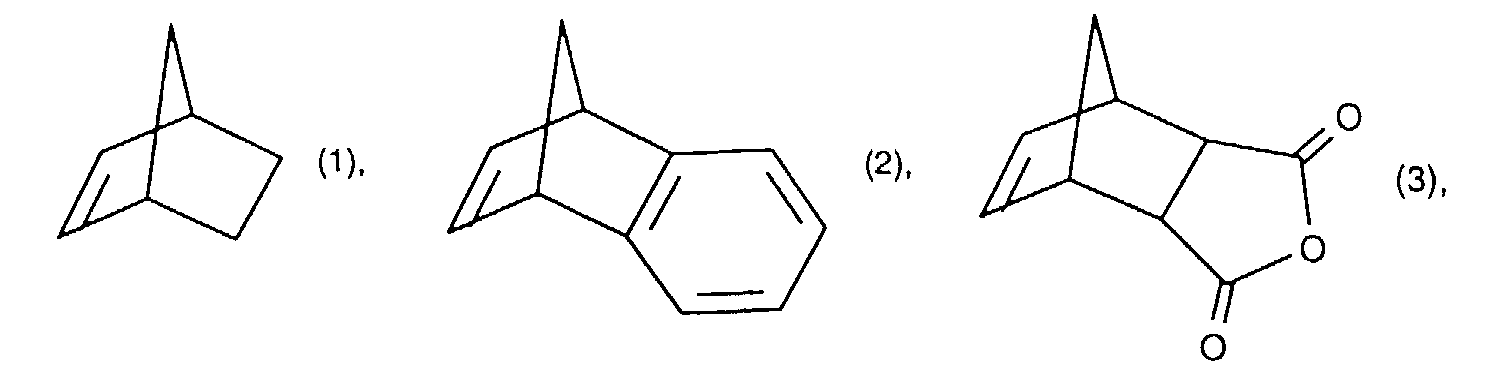
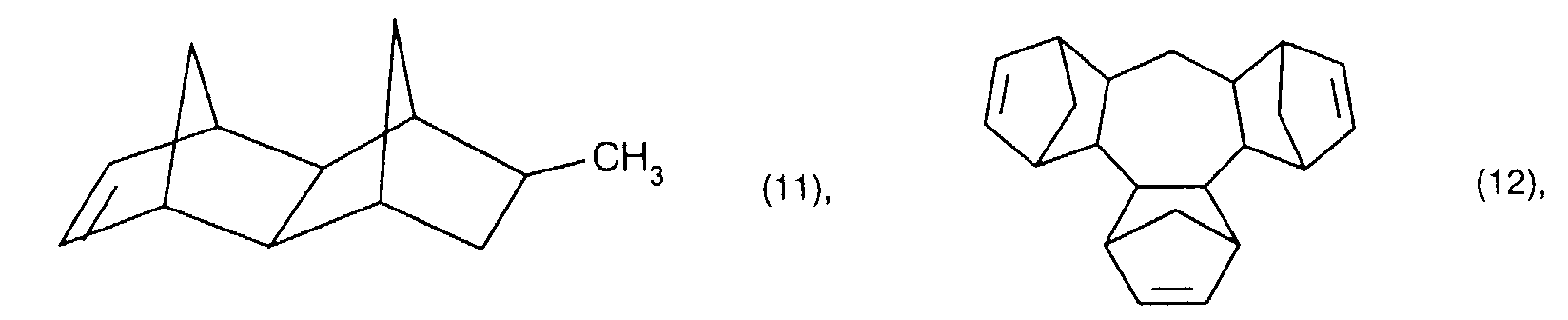
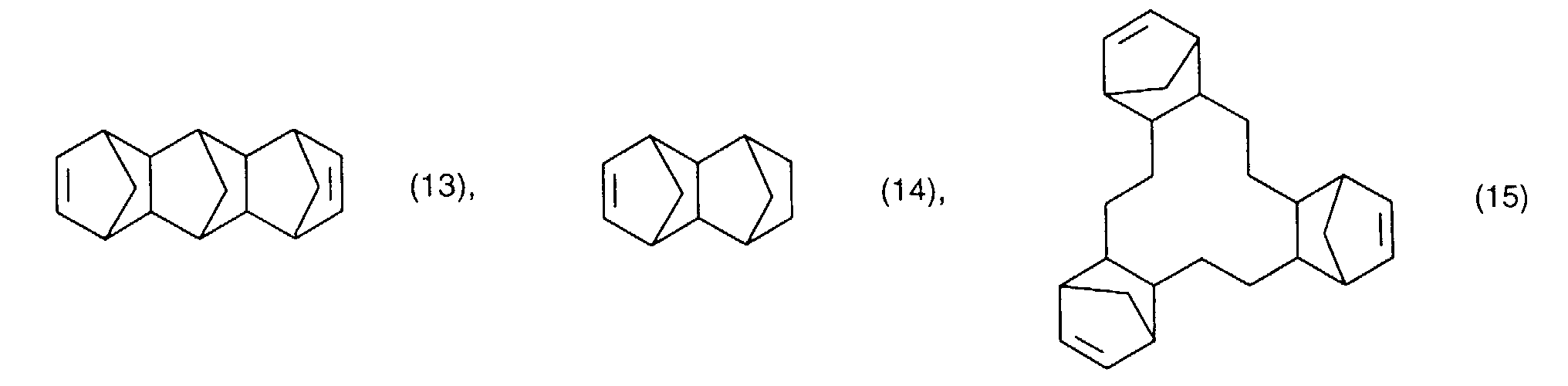
- Suitable Diels-Alder adducts are, for example, the following compounds:
- Preferred Diels-Alder adducts are norbornene (1), norbornadiene (6), Cyclohexenylnorbornene (25), Tetracyclododecen (14), Methyltetracyclododecen (11) and especially dicyclopentadiene (18).
- compositions are preferred, based on the total composition (a) + (b) + (c), 0.001-10.0% by weight, particularly preferably 0.01-5.0% by weight, particularly preferably 0.1 -2.0% by weight of component (a), 0.001-10.0% by weight, particularly preferably 0.005-2.0% by weight, particularly preferably 0.01-1.0% by weight , component (b) and 85.0-99.99% by weight, particularly preferably 90.0-99.9% by weight, particularly preferably 95.0-99.8% by weight, of component ( c).
- the weight ratio of monomer (component c) to catalyst mixture (components a + b) can also vary within wide limits.
- the compositions according to the invention preferably contain, based on the total composition, 85.0-99.99% by weight, in particular 90.0-99.9% by weight, monomer and 0.01-15.0% by weight, in particular 0.1-10.0% by weight, catalyst mixture.
- thermoplastic materials can be adjusted.
- suitable thermoplastics are polystyrene, polynorbornene (e.g. Norsorex® NS from Nippon Zeon), hydrogenated Polynorborn derivatives (e.g. Zeonex® from Nippon Zeon), polycyclooctene (e.g. Vestenamer® from Hüls) and polybutadiene.
- the curable mixtures can contain tougheners, such as, for example, core / shell polymers or the elastomers or graft polymers containing those known to the person skilled in the art as "rubber tougers". Suitable tougheners are described, for example, in EP-A-449 776.
- silanes e.g. from Osi Specialties under the Description Silquest® Silane offered compounds can be added.
- Suitable Silanes are, for example, octyltriethoxysilane, methyltriethoxysilane, vinyltriethoxysilane, Methyltrimethoxysilane, vinyltrimethoxysilane, y-aminopropyltrimethoxysilane and y-glycidyloxypropyltrimethoxysilane.
- inventive Compositions contain other common additives, e.g. Antioxidants, Light stabilizers, plasticizers, dyes, fillers, pigments, thixotropic agents, Defoamers, antistatic agents, lubricants and mold release agents.
- additives e.g. Antioxidants, Light stabilizers, plasticizers, dyes, fillers, pigments, thixotropic agents, Defoamers, antistatic agents, lubricants and mold release agents.
- compositions according to the invention can furthermore contain inert solvents.
- suitable inert solvents are, for example, protic-polar and aprotic solvents, which can be used alone or in mixtures of at least two solvents. Examples are: ethers (dibutyl ether, tetrahydrofuran, dioxane, ethylene glycol monomethyl or dimethyl ether, ethylene glycol monoethyl or diethyl ether, diethylene glycol diethyl ether, triethylene glycol dimethyl ether), halogenated hydrocarbons (methylene chloride, chloroform, 1,2-dichloroethane, 1,1,1-trichloro , 1,2,2-tetrachloroethane), carboxylic acid esters and lactones (ethyl acetate, methyl propionate, ethyl benzoate, 2-methoxyethyl acetate, ⁇ -butyrolactone, ⁇ -valerolactone, pivalolac
- Preferred solvents are aliphatic and aromatic hydrocarbons as well Mixtures of such solvents.
- compositions according to the invention are that in the case of liquid monomers, metathesis polymerization without the use of a Solvent can be carried out.
- composition according to the invention can be prepared directly before the polymerization or can be used as a preformulated mixture.
- the mixture can be stored as a ready-to-use formulation for a long time before the polymerization, which is advantageous for large-scale use. However, storage in the dark is recommended if the catalyst contains photolabile ligands.
- a further subject of the invention is a process for producing a metathesis polymer, characterized in that a composition containing components (a) to (c) is heated to a temperature> 40 ° C.
- the method according to the invention is expedient at a temperature of at least 60 ° C carried out.
- the process according to the invention is carried out at temperatures from 60 to 300 ° C, preferably 60 to 250 ° C, particularly preferably 60 to 200 ° C and particularly preferably 70 to 160 ° C, carried out.
- After polymerization it can be advantageous to mix the mixture at elevated temperatures, for example 80 to 200 ° C., to re-temper.
- component (a) a compound of formula I with photolabile ligands is used, the metathesis polymerization can also be carried out photochemically will.
- the polymerization may involve molding processes, for example Calendering, casting, pressing, injection molding or extrusion processes. With the inventive Processes can be used to produce moldings of all kinds and materials Coatings are made. Shaping and polymerization are advantageous solvent-free reactive systems connected, processing methods such as Example injection molding, extrusion, polymerizations in predetermined forms (if necessary under pressure) can be used.
- the mixtures produced by the process according to the invention can Homopolymers, copolymers with statistical distribution of the structural units, Contain graft polymers, block polymers or cross-linked polymers.
- the polymers can an average molecular weight of 500 to 2,000,000 daltons, preferably 1000 to 1,000,000 daltons (determined by gel permeation chromatography).
- the mixtures produced by the process according to the invention are notable in particular for high thermal stability, high toughness and mechanical strength as well as for excellent electrical properties (low dielectric constant, low loss factor or tan ⁇ value) and are particularly suitable for applications in vacuum casting technology , as casting resins, impregnating resins and in particular as coating material for electrical and electronic components.
- the hardened casting compounds have good mechanical and dielectric properties and a long service life.
- the present invention thus also relates to the use of the composition according to the invention as a casting resin, impregnating resin and as a covering material for electrical or electronic components.
- catalyst A 0.2 g is dissolved in 100 g of liquid dicyclopentadiene (warmed to 40 ° C.). The appropriate amount (see Table 2) of 1-octyne or phenylethine is then added and dissolved by stirring. The mixture is then polymerized (curing cycle: 1 h / 80 ° C, 1 h / 100 ° C, 2 h / 120 ° C), the peak temperature T max occurring during the first curing phase at 80 ° C being measured (in brackets the time in minutes until the peak temperature is reached), which is given in Table 2 together with the glass transition temperature determined by DSC and the conversion measured by TGA.
Landscapes
- Chemical & Material Sciences (AREA)
- Health & Medical Sciences (AREA)
- Chemical Kinetics & Catalysis (AREA)
- Medicinal Chemistry (AREA)
- Polymers & Plastics (AREA)
- Organic Chemistry (AREA)
- Physics & Mathematics (AREA)
- Spectroscopy & Molecular Physics (AREA)
- Polyoxymethylene Polymers And Polymers With Carbon-To-Carbon Bonds (AREA)
- Polyesters Or Polycarbonates (AREA)
- Catalysts (AREA)
Abstract
L einen Neutralliganden bedeutet, Me für Ru oder Os steht, Z1 - und Z2 - je ein einfach geladenes Anion oder Z1 - und Z2 - zusammen ein zweifach geladenes Anion darstellen, x eine Zahl von 1 bis 3 und y eine Zahl von 0 bis 3 darstellen, wobei gilt 2 ≤ x+y ≤ 4; und

eignet sich als lagerstabiler Zweikomponenten-Katalysator für die ringöffnende Metathese-Polymerisation von Cyclopentadien-Addukten und ermöglicht die Polymerisation von Dicyclopentadien und anderen Cyclopentadien-Addukten in kurzer Zeit, wobei eine hohe Reaktionsenthalpie und nur ein geringer Gewichtsverlust zu beobachten ist.
Description
Als Co-Katalysatoren für die Zweikomponenten-Katalysatoren werden u.a. 1-Alkine empfohlen.

(C6H11)2HPRu(p-Cymol)Cl2, (C6H11)3PRu(p-Cymol)Cl2, (C6H11)3PRu(p-Cymol)(Tos)2, (C6H11)3PRu(p-Cymol)Br2, (C6H11)3PRu(p-Cymol)ClF, (C6H11)3PRu(C6H6)(Tos)2, (C6H11)3PRu(CH3-C6H5)(Tos)2, (C6H11)3PRu(C10H8)(Tos)2, (i-C3H7)3PRu(p-Cymol)Cl2, (CH3)3PRu(p-Cymol)Cl2, (C6H11)3PRu(CH3-CN)(C2H5-OH)(Tos)2, (C6H11)3PRu(p-Cymol)(CH3-CN)2(PF6)2, (C6H11)3PRu(p-Cymol)(CH3-CN)2(Tos)2, (n-C4H9)3PRu(p-Cymol)(CH3-CN)2(Tos)2, (C6H11)3PRu(CH3CN)Cl2, (C6H11)3PRu(CH3-CN)2Cl2, (n-C4H9)3PRu(p-Cymol)Cl2, (C6H11)3PRu(p-Cymol)(C2H5OH)2(BF4)2, (C6H11)3PRu(p-Cymol)(C2H5OH)2(PF6)2, (i-C3H7)3POs(p-Cymol)Cl2, (CH3)3POs(p-Cymol)Cl2, (C6H5)3POs(p-Cymol)Cl2, [(C6H11)3P]3Ru(CH3-CN), (C5H9)3PRu(p-Cymol)Cl2, (C6H11)3PRu(p-Cymol)HCl, (C6H11)3PRu[1,2,4,5-(CH3)4C6H2]Cl2, (C6H11)3PRu[1,3,5-(i-C3H7)3C6H3]Cl2, (C6H11)3PRu[(C4H9)-C6H5]Cl2, (C6H11)3POs(p-Cymol)Cl2, (C6H5)3PRu(p-Cymol)HCl, [(C6H11)3P]2Ru(CH3-CN)(Tos)2, RuCl2(p-Cymol)[(C6H11)2PCH2CH2P(C6H11)2], (C6H11)3PRu(p-Cymol)(C2H5OH)(BF4)2, (C6H11)3PRu(C6H6)(C2H5OH)2(Tos)2, (C6H11)3PRu(i-C3H7-C6H5)(Tos)2, (C6H11)3PRu(C6H6)(p-Cymol)Br2, (C6H11)3PRu(Biphenyl)(Tos)2, (C6H11)3PRu(Anthracen)(Tos)2, (2-CH3C6H4)3POs(p-Cymol)Cl2 und (C6H11)3PRu(Chrysen)(Tos)2.
Vorzugsweise beträgt das Gewichtsverhältnis der Komponenten (a) : (b) 25 : 1 bis 1 : 10, insbesondere 10 : 1 bis 1 : 2 und ganz besonders bevorzugt 7 : 1 bis 2 : 1.
Besonders geeignet sind Zusammensetzungen enthaltend etwa äquimolare Mengen der Komponente (a) und (b). , d.h. Zusammensetzungen, worin das molare Verhältnis der Komponenten (a) : (b) 1,1:1 bis 1:1,1 beträgt.
Besonders geeignete Komponenten (b) sind Verbindungen der Formel II, worin R4 einen hydroxylgruppenhaltigen Rest darstellt. Die Verwendung solcher Co-Katalysatoren führt überraschenderweise zu einer sehr gleichmässigen Freisetzung der Reaktionsenthalpie, d.h. es treten keine hohen Spitzentemperaturen während der Polymerisation auf. Durch den Zusatz von hydroxylgruppenhaltigen Acetylenen lässt sich beispielsweise bei der Polymerisation von Dicyclopentadien die Spitzentemperatur von üblicherweise ca. 180 °C auf <100 °C senken, was sich in einer Verbesserung der mechanischen Eigenschaften auswirkt.
(c) ein Diels-Alder-Addukt von Cyclopentadien.








Bevorzugt sind Zusammensetzungen enthaltend, bezogen auf die Gesamtzusammensetzung (a) + (b) + (c), 0,001-10,0 Gew.-%, besonders bevorzugt 0,01-5,0 Gew.-%, insbesondere bevorzugt 0,1-2,0 Gew.-%, der Komponente (a), 0,001-10,0 Gew.-%, besonders bevorzugt 0,005-2,0 Gew.-%, insbesondere bevorzugt 0,01-1,0 Gew.-%, der Komponente (b) und 85,0-99,99 Gew.-%, besonders bevorzugt 90,0-99,9 Gew.-%, insbesondere bevorzugt 95,0-99,8 Gew.-%, der Komponente (c).
Vorzugsweise enthalten die erfindungsgemässen Zusammensetzungen, bezogen auf die Gesamtzusammensetzung, 85,0-99,99 Gew.-%, insbesondere 90,0-99,9 Gew.-%, Monomer und 0,01-15,0 Gew.-%, insbesondere 0,1-10,0 Gew.-%, Katalysatorgemisch.
Geeignete Zähigkeitsvermittler sind beispielsweise in der EP-A-449 776 beschrieben.
Geeignete inerte Lösungsmittel sind zum Beispiel protisch-polare und aprotische Lösungsmittel, die allein oder in Mischungen aus mindestens zwei Lösungsmitteln verwendet werden können. Beispiele sind: Ether (Dibutylether, Tetrahydrofuran, Dioxan, Ethylenglykolmonomethyl- oder -dimethylether, Ethylenglykolmonoethyl- oder -diethylether, Diethylenglykoldiethylether, Triethylenglykoldimethylether), halogenierte Kohlenwasserstoffe (Methylenchlorid, Chloroform, 1,2-Dichlorethan, 1,1,1-Trichlorethan, 1,1,2,2-Tetrachlorethan), Carbonsäureester und Lactone (Essigsäureethylester, Propionsäuremethylester, Benzoesäureethylester, 2-Methoxyethylacetat, γ-Butyrolacton, δ-Valerolacton, Pivalolacton), Carbonsäureamide und Lactame (N,N-Dimethylformamid, N,N-Diethylformamid, N,N-Dimethylacetamid, Tetramethylharnstoff, Hexamethylphosphorsäuretriamid, γ-Butyrolactam, ∈-Caprolactam, N-Methylpyrrolidon, N-Acetylpyrrolidon, N-Methylcaprolactam), Sulfoxide (Dimethylsulfoxid), Sulfone (Dimethylsulfon, Diethylsulfon, Trimethylensulfon, Tetramethylensulfon), tertiäre Amine (N-Methylpiperidin, N-Methylmorpholin), aliphatische und aromatische Kohlenwasserstoffe, wie zum Beispiel Petrolether, Pentan, Hexan, Cyclohexan, Methylcyclohexan, Benzol oder substituierte Benzole (Chlorbenzol, o-Dichlorbenzol, 1,2,4-Trichlorbenzol, Nitrobenzol, Toluol, Xylol) und Nitrile (Acetonitril, Propionitril, Benzonitril, Phenylacetonitril). Bevorzugte Lösungsmittel sind aprotische polare und unpolare Lösungsmittel.
Einen weiteren Erfindungsgegenstand bildet ein Verfahren zur Herstellung eines Metathesepolymerisats, dadurch gekennzeichnet, dass eine Zusammensetzung enthaltend die Komponenten (a) bis (c) auf eine Temperatur >40 °C erwärmt wird.
Die gehärteten Vergussmassen weisen gute mechanische und dielektrische Eigenschaften und eine hohe Lebensdauer aus.
Gegenstand der vorliegenden Erfindung ist somit auch die Verwendung der erfindungsgemässen Zusammensetzung als Giessharz, lmprägnierharz und als Umhüllungsmaterial für elektrische oder elektronische Bauteile.
Als ROMP-Katalysator wird (C6H11)3P(p-Cymol)RuCl2 (Katalysator A) verwendet.
| Komponente (b) | Tg [°C] | -ΔH [J/g] | Gewichtsverlust [%] | Bemerkung |
| ----- | n.b. | 48 | n.b. | halbfeste Masse, starker Geruch nach Dicyclopentadien |
| 2 mg 1 -Octin | 35 | 262 | 11,7 | guter Festkörper |
| 4 mg 1-Octin | n.b. | >300 | n.b. | guter Festkörper |
| 6 mg 1-Octin | 48 | >300 | n.b. | guter Festkörper |
| 8 mg 1-Octin | 53 | >300 | 13,4 | guter Festkörper |
| 10 mg 1-Octin | 57 | >300 | 11,6 | guter Festkörper |
| 15 mg 1-Octin | 60 | >300 | n.b. | guter Festkörper |
| 20 mg 1-Octin | 58 | >300 | 15,0 | guter Festkörper |
| 50 mg 1-Octin | 53 | 288 | 21,6 | guter Festkörper |
| 100 mg 1-Octin | 26 | n.b. | n.b. | weicher Festkörper |
| 9 mg Phenylethin | 127 | 289 | 3,5 | hervorragender Festkörper |
| 13 mg Phenylethin | 125 | 284 | 5,2 | hervorragender Festkörper |
| Komponente (b) | Tmax/°C | Tg/°C | Umsatz/% |
| 52 mg Phenylethin | 170 (40 min) | 115 | 93 |
| 56 mg 1-Octin | 189 (24 min) | 130 | 95 |
Claims (15)
- Zusammensetzung enthaltend(a) eine Verbindung der Formel Iworin R1, R2 und R3 unabhängig voneinander H, C1-C20-Alkyl, C1-C20-Alkoxy, unsubstituiertes oder mit C1-C6-Alkyl, C1-C6-Halogenalkyl oder C1-C6-Alkoxy substituiertes C4-C12-Cycloalkyl oder Cycloalkoxy, oder unsubstituiertes oder mit C1-C6-Alkyl, C1-C6-Halogenalkyl oder C1-C6-Alkoxy substituiertes C6-C16-Aryl oder C6-C16-Aryloxy, oder unsubstituiertes oder mit C1-C6-Alkyl, C1-C6-Halogenalkyl oder C1-C6-Alkoxy substituiertes C7-C16-Aralkyl oder C7-C16-Aralkyloxy darstellen;die Reste R2 und R3 gemeinsam unsubstituiertes oder mit C1-C6-Alkyl, C1-C6-Halogenalkyl oder C1-C6-Alkoxy substituiertes Tetra- oder Pentamethylen, oder Tetra- oder Pentamethylendioxyl bedeuten, oder unsubstituiertes oder mit C1-C6-Alkyl, C1-C6-Halogenalkyl oder C1-C6-Alkoxy substituiertes und mit ein oder zwei 1,2-Phenylenresten kondensiertes Tetra- oder Pentamethylen, oder Tetra- oder Pentamethylendioxyl darstellen, oder unsubstituiertes oder mit C1-C6-Alkyl, C1-C6-Halogenalkyl oder C1-C6-Alkoxy substituiertes und in den 1,2- und 3,4-Stellungen mit 1,2-Phenylen kondensiertes Tetramethylendioxyl darstellen, und R1 die zuvor angebene Bedeutung hat;L einen Neutralliganden bedeutet, Me für Ru oder Os steht, Z1 - und Z2 - je ein einfach geladenes Anion oder Z1 - und Z2 - zusammen ein zweifach geladenes Anion darstellen,x eine Zahl von 1 bis 3 und y eine Zahl von 0 bis 3 darstellen, wobei gilt 2 ≤ x+y ≤ 4; und(b) eine Verbindung der Formel IIworin R4 Wasserstoff oder einen einwertigen organischen Rest mit bis zu 30 C-Atomen bedeutet, welcher ein oder mehrere Silicium-, Phosphor-, Stickstoff-, Sauerstoff- , Schwefel- oder Halogenatome enthalten kann.

- Zusammensetzung nach Anspruch 1, enthaltend als Komponente (a) eine Verbindung der Formel I, worin Me für Ruthenium steht.
- Zusammensetzung nach Anspruch 1, enthaltend als Komponente (a) eine Verbindung der Formel I, worin R1, R2 und R3 unabhängig voneinander für C1-C6-Alkyl, C1-C6-Alkoxy, C4-C12-Cycloalkyl, C4-C12-Cycloalkoxy, C6-C16-Aryl oder C6-C16-Aryloxy stehen.
- Zusammensetzung nach Anspruch 1, enthaltend als Komponente (a) eine Verbindung der Formel I, worin R1, R2 und R3 unabhängig voneinander für Isopropyl, sek.-Butyl, Phenyl, Tolyl, Cyclopentyl oder Cyclohexyl stehen.
- Zusammensetzung nach Anspruch 1, enthaltend als Komponente (a) eine Verbindung der Formel I, worin L für unsubstituiertes oder mit 1 bis 3 C1-C4-Alkyl substituiertes Benzol, Thiophen, Benzonitril, Acetonitril, Stickstoff (N2), einen unsubstituierten oder teilweise oder vollständig fluorierten C1-C4-Alkohol, CO, H2O oder NH3 steht.
- Zusammensetzung nach Anspruch 1, enthaltend als Komponente (a) eine Verbindung der Formel I, worin Z1 - und Z2 - unabhängig voneinander für H-, F-, Cl-, Br-, l- oder unsubstituiertes oder durch eine oder mehrere Hydroxidgruppen, Aminogruppen, Halogenatome, C1-C20-Alkyl-, C1-C20-Alkoxy-, C4-C12-Cycloalkyl-, C4-C12-Cycloalkoxy-, C6-C16-Aryl-, C6-C16-Aryloxy- oder C7-C16-Aralkylgruppen substituiertes Cyclopentadienyl stehen.
- Zusammensetzung nach Anspruch 1, enthaltend als Komponente (b) eine Verbindung der Formel II, worin R4 eine unsubstituierte oder durch eine oder mehrere Aminogruppen oder Halogenatome substituierte C1-C20-Alkyl-, C1-C20-Alkoxy-, C4-C12-Cydoalkyl-, C4-C12-Cycloalkoxy-, C6-C16-Aryl-, C6-C16-Aryloxy- oder C7-C16-Aralkylgruppe darstellt.
- Zusammensetzung nach Anspruch 1, enthaltend als Komponente (b) eine Verbindung der Formel II, worin R4 für C1-C12-Alkyl oder C6-C10-Aryl steht.
- Zusammensetzung nach Anspruch 1, enthaltend als Komponente (b) 1-Heptin, 1-Octin, 1-Decin oder Phenylethin.
- Zusammensetzung nach Anspruch 1, worin das Molverhältnis der Komponenten (a): (b) 25 : 1 bis 1 : 10 beträgt.
- Zusammensetzung nach Anspruch 1, enthaltend zusätzlich
(c) ein Diels-Alder-Addukt von Cyclopentadien. - Zusammensetzung nach Anspruch 11, enthaltend als Komponente (c) Norbornen, Norbornadien, Cyclohexenylnorbornen, Dicyclopentadien, Tetracyclododecen oder Methyltetracyclododecen.
- Zusammensetzung nach Anspruch 11, enthaltend, bezogen auf die Gesamtzusammensetzung, 0,001-10,0 Gew.-% der Komponente (a), 0,001-10,0 Gew.-% der Komponente (b) und 85,0-99,99 Gew.-% der Komponente (c).
- Verfahren zur Herstellung eines Metathesepolymerisats, dadurch gekennzeichnet, dass eine Zusammensetzung nach Anspruch 1 auf eine Temperatur >40 °C erwärmt wird.
- Verwendung der Zusammensetzung nach Anspruch 1 als Giessharz, lmprägnierharz oder als Umhüllungsmaterial für elektrische oder elektronische Bauteile.
Applications Claiming Priority (3)
| Application Number | Priority Date | Filing Date | Title |
|---|---|---|---|
| CH2826/96 | 1996-11-15 | ||
| CH282696 | 1996-11-15 | ||
| CH282696 | 1996-11-15 |
Publications (3)
| Publication Number | Publication Date |
|---|---|
| EP0844263A2 true EP0844263A2 (de) | 1998-05-27 |
| EP0844263A3 EP0844263A3 (de) | 1999-07-07 |
| EP0844263B1 EP0844263B1 (de) | 2003-01-15 |
Family
ID=4242474
Family Applications (2)
| Application Number | Title | Priority Date | Filing Date |
|---|---|---|---|
| EP97810832A Expired - Lifetime EP0844264B1 (de) | 1996-11-15 | 1997-11-06 | Katalysatorgemisch für ringöffnende Metathesepolymerisation |
| EP97810831A Expired - Lifetime EP0844263B1 (de) | 1996-11-15 | 1997-11-06 | Katalysatorgemisch für die ringöffnende Metathesepolymerisation |
Family Applications Before (1)
| Application Number | Title | Priority Date | Filing Date |
|---|---|---|---|
| EP97810832A Expired - Lifetime EP0844264B1 (de) | 1996-11-15 | 1997-11-06 | Katalysatorgemisch für ringöffnende Metathesepolymerisation |
Country Status (5)
| Country | Link |
|---|---|
| US (2) | US6171995B1 (de) |
| EP (2) | EP0844264B1 (de) |
| JP (2) | JPH10147634A (de) |
| CA (2) | CA2221089A1 (de) |
| DE (2) | DE59709143D1 (de) |
Families Citing this family (14)
| Publication number | Priority date | Publication date | Assignee | Title |
|---|---|---|---|---|
| US6175047B1 (en) * | 1997-12-26 | 2001-01-16 | Takasago International Corporation | Ruthenium metathesis catalyst and method for producing olefin reaction product by metathesis reaction using the same |
| WO1999050330A2 (en) * | 1998-03-31 | 1999-10-07 | Ciba Specialty Chemicals Holding Inc. | Ruthenium and osmium carbene carbonyl catalysts |
| US7256241B2 (en) * | 2000-01-21 | 2007-08-14 | Cyclics Corporation | Methods for polymerizing macrocyclic polyester oligomers using catalyst promoters |
| US6906147B2 (en) | 2002-03-20 | 2005-06-14 | Cyclics Corporation | Catalytic systems |
| US7750109B2 (en) | 2000-09-01 | 2010-07-06 | Cyclics Corporation | Use of a residual oligomer recyclate in the production of macrocyclic polyester oligomer |
| WO2002018476A2 (en) * | 2000-09-01 | 2002-03-07 | Cyclics Corporation | Methods for converting linear polyesters to macrocyclic oligoester compositions and macrocyclic oligoesters |
| US7767781B2 (en) | 2000-09-01 | 2010-08-03 | Cyclics Corporation | Preparation of low-acid polyalkylene terephthalate and preparation of macrocyclic polyester oligomer therefrom |
| US7304123B2 (en) * | 2001-06-27 | 2007-12-04 | Cyclics Corporation | Processes for shaping macrocyclic oligoesters |
| JP2005515965A (ja) | 2001-06-27 | 2005-06-02 | サイクリクス コーポレイション | 大環状オリゴエステルの単離、処方、および成形 |
| US20030186035A1 (en) * | 2001-08-30 | 2003-10-02 | Cruce Christopher J. | Infusion of cyclic olefin resins into porous materials |
| US6803339B2 (en) * | 2001-09-14 | 2004-10-12 | Bp Corporation North America Inc. | Latent metallocene catalyst systems for olefin polymerization |
| US6787632B2 (en) * | 2001-10-09 | 2004-09-07 | Cyclics Corporation | Organo-titanate catalysts for preparing pure macrocyclic oligoesters |
| US8906999B2 (en) | 2011-02-17 | 2014-12-09 | Ccp Composites Us Llc | Styrene-free unsaturated polyester |
| US9745493B2 (en) * | 2012-03-29 | 2017-08-29 | Daikin Industries, Ltd. | Surface treatment composition and article obtained using same |
Family Cites Families (21)
| Publication number | Priority date | Publication date | Assignee | Title |
|---|---|---|---|---|
| US3855323A (en) * | 1970-10-14 | 1974-12-17 | Sun Ventures Inc | Olefin isomerization catalysts and process |
| US3962294A (en) * | 1973-08-27 | 1976-06-08 | Sun Ventures, Inc. | Olefin isomerization catalysts and process |
| US3957827A (en) * | 1974-10-17 | 1976-05-18 | Sun Ventures, Inc. | Hydrogenation of carboxylic acid anhydrides to lactones or esters by homogeneous catalysis |
| JPS56140948A (en) * | 1980-04-07 | 1981-11-04 | Teijin Ltd | Fixation of carbon dioxide |
| US5198511A (en) | 1991-12-20 | 1993-03-30 | Minnesota Mining And Manufacturing Company | Polymerizable compositions containing olefin metathesis catalysts and cocatalysts, and methods of use therefor |
| US5312940A (en) * | 1992-04-03 | 1994-05-17 | California Institute Of Technology | Ruthenium and osmium metal carbene complexes for olefin metathesis polymerization |
| US5710298A (en) * | 1992-04-03 | 1998-01-20 | California Institute Of Technology | Method of preparing ruthenium and osmium carbene complexes |
| CN1166176A (zh) * | 1994-11-17 | 1997-11-26 | 希巴特殊化学控股公司 | 热换拉聚合方法和可聚合组合物 |
| KR100396206B1 (ko) * | 1994-12-23 | 2003-12-24 | 시바 스페셜티 케미칼스 홀딩 인크. | 중합성조성물및중합방법 |
| US5559262A (en) * | 1995-01-31 | 1996-09-24 | E. I. Du Pont De Nemours And Company | Process for the preparation of ruthenium complexes and their in situ use as hydrogenation catalysts |
| US5599962A (en) * | 1995-01-31 | 1997-02-04 | E. I. Du Pont De Nemours And Company | Process for the preparation of ruthenium hydrogenation catalysts and products thereof |
| US5728785A (en) * | 1995-07-07 | 1998-03-17 | California Institute Of Technology | Romp polymerization in the presence of peroxide crosslinking agents to form high-density crosslinked polymers |
| US5831108A (en) * | 1995-08-03 | 1998-11-03 | California Institute Of Technology | High metathesis activity ruthenium and osmium metal carbene complexes |
| US5939504A (en) * | 1995-12-07 | 1999-08-17 | Advanced Polymer Technologies | Method for extending the pot life of an olefin metathesis polymerization reaction |
| US6156692A (en) * | 1996-04-30 | 2000-12-05 | Bp Amoco Corporation | Ruthenium-containing catalyst composition for olefin metathesis |
| EP0839821B1 (de) * | 1996-11-01 | 2002-11-20 | Ciba SC Holding AG | Verfahren zur Herstellung von Katalysatoren |
| US5917071A (en) * | 1996-11-15 | 1999-06-29 | California Institute Of Technology | Synthesis of ruthenium or osmium metathesis catalysts |
| DE69818240T2 (de) * | 1997-03-06 | 2004-07-01 | Ciba Speciality Chemicals Holding Inc. | Neue katalysatoren |
| US5998326A (en) * | 1997-05-23 | 1999-12-07 | Ciba Specialty Chemicals Corp. | Two-component catalyst for ROMP |
| US5977393A (en) * | 1997-11-21 | 1999-11-02 | California Institute Of Technology | Schiff base derivatives of ruthenium and osmium olefin metathesis catalysts |
| DE69933904T2 (de) * | 1998-05-08 | 2007-09-06 | Takasago International Corp. | Ruthenium-iodo optisch aktiver Phosphinkomplex |
-
1997
- 1997-11-06 EP EP97810832A patent/EP0844264B1/de not_active Expired - Lifetime
- 1997-11-06 DE DE59709143T patent/DE59709143D1/de not_active Expired - Fee Related
- 1997-11-06 DE DE59709091T patent/DE59709091D1/de not_active Expired - Fee Related
- 1997-11-06 EP EP97810831A patent/EP0844263B1/de not_active Expired - Lifetime
- 1997-11-13 CA CA002221089A patent/CA2221089A1/en not_active Abandoned
- 1997-11-13 CA CA002221008A patent/CA2221008A1/en not_active Abandoned
- 1997-11-13 JP JP9329435A patent/JPH10147634A/ja active Pending
- 1997-11-14 US US08/970,989 patent/US6171995B1/en not_active Expired - Fee Related
- 1997-11-14 US US08/970,990 patent/US6147026A/en not_active Expired - Fee Related
- 1997-11-17 JP JP9332506A patent/JPH10147633A/ja active Pending
Also Published As
| Publication number | Publication date |
|---|---|
| CA2221008A1 (en) | 1998-05-15 |
| EP0844264B1 (de) | 2003-01-08 |
| DE59709143D1 (de) | 2003-02-20 |
| EP0844263B1 (de) | 2003-01-15 |
| EP0844264A3 (de) | 1999-07-07 |
| US6147026A (en) | 2000-11-14 |
| CA2221089A1 (en) | 1998-05-15 |
| JPH10147633A (ja) | 1998-06-02 |
| JPH10147634A (ja) | 1998-06-02 |
| EP0844263A3 (de) | 1999-07-07 |
| EP0844264A2 (de) | 1998-05-27 |
| DE59709091D1 (de) | 2003-02-13 |
| US6171995B1 (en) | 2001-01-09 |
Similar Documents
| Publication | Publication Date | Title |
|---|---|---|
| EP0844263B1 (de) | Katalysatorgemisch für die ringöffnende Metathesepolymerisation | |
| EP0771830B1 (de) | Härtbare Zusammensetzung enthaltend Cycloolefin, Silan und Füllstoff | |
| EP0799266B1 (de) | Polymerisierbare zusammensetzung und polymerisationsverfahren | |
| DE60022322T2 (de) | Polyolefinzusammensetzungen mit verbesserter uv- und oxidationsbeständigkeit und verfahren zu deren herstellung sowie verwendung | |
| EP0794207B1 (de) | Härtbare Zusammensetzung enthaltend ein Diels-Alder-Addukt von Cyclopentadien und einen Füllstoff | |
| EP0807652B1 (de) | Verfahren zur Herstellung von faserverstärkten Verbundstoffen | |
| DE3883936T2 (de) | Zusammensetzungen aus polyungesättigten Kohlenwasserstoff- Polymeren und kompatiblen Antioxydanten. | |
| EP0885911A1 (de) | 2-Komponenten-Katalysator für ROMP | |
| DE1770491C3 (de) | Verfahren zur Herstellung von trans-Polynentenamer | |
| WO1996016100A1 (de) | Thermisches metathesepolymerisationsverfahren und polymerisierbare zusammensetzung | |
| EP0807137A1 (de) | Polymerisierbare zusammensetzung, verfahren zur herstellung vernetzter polymere und vernetzbare polymere | |
| DE19654074A1 (de) | Verfahren zur Herstellung hydrierter ringgeöffneter Metathesepolymeren | |
| EP0889107A2 (de) | Klebstoff aus Basis von Cycloolefin | |
| EP0824125A1 (de) | Umhüllungsmassen auf Basis von Dicyclopentadienderivaten | |
| DE102017130504A1 (de) | Latente Katalysatoren mit Chelatliganden zur Polymerisation von Dicyclopentadien (DCPD) | |
| EP0853099A2 (de) | Thixotropiermittel für gefüllte Cycloolefine | |
| DE1440862B2 (de) | Isolierter elektrischer leiter | |
| EP0799284B1 (de) | Polymerisierbare zusammensetzung mit acetylenen und verfahren zur photopolymerisation von acetylenen | |
| EP0385523A1 (de) | Verfahren zur Herstellung von elektrisch leitenden Polymeren aus 3-Alkylthiophenen und elektrische Gegenstände | |
| EP0973813A1 (de) | Herstellung von homo-, co- oder blockcopolymeren aus cycloolefinischen monomereinheiten | |
| DE1495891C3 (de) | Verfahren zur Herstellung von linearen Polymerisaten und Mischpolymerisaten durch Polymerisation zyklischer Organosiloxane | |
| DE2334606A1 (de) | Polymerisation von norbornenderivaten | |
| EP0886662A1 (de) | Thermoplastische elastomere kohlenmonoxid/olefin-copolymere | |
| DE2535562A1 (de) | Ungesaettigte polyester-kautschuk- copolymerisate und verfahren zu ihrer herstellung | |
| DE2203303C3 (de) | Verbessertes Verfahren zur Herstellung von Polyalkenameren |
Legal Events
| Date | Code | Title | Description |
|---|---|---|---|
| PUAI | Public reference made under article 153(3) epc to a published international application that has entered the european phase |
Free format text: ORIGINAL CODE: 0009012 |
|
| AK | Designated contracting states |
Kind code of ref document: A2 Designated state(s): CH DE ES FR GB IT LI |
|
| 17P | Request for examination filed |
Effective date: 19981104 |
|
| PUAL | Search report despatched |
Free format text: ORIGINAL CODE: 0009013 |
|
| RIC1 | Information provided on ipc code assigned before grant |
Free format text: 6C 08G 61/08 A, 6B 01J 31/24 B |
|
| AK | Designated contracting states |
Kind code of ref document: A3 Designated state(s): AT BE CH DE DK ES FI FR GB GR IE IT LI LU MC NL PT SE |
|
| AKX | Designation fees paid |
Free format text: CH DE ES FR GB IT LI |
|
| 17Q | First examination report despatched |
Effective date: 20011015 |
|
| GRAG | Despatch of communication of intention to grant |
Free format text: ORIGINAL CODE: EPIDOS AGRA |
|
| GRAG | Despatch of communication of intention to grant |
Free format text: ORIGINAL CODE: EPIDOS AGRA |
|
| GRAH | Despatch of communication of intention to grant a patent |
Free format text: ORIGINAL CODE: EPIDOS IGRA |
|
| GRAH | Despatch of communication of intention to grant a patent |
Free format text: ORIGINAL CODE: EPIDOS IGRA |
|
| GRAA | (expected) grant |
Free format text: ORIGINAL CODE: 0009210 |
|
| AK | Designated contracting states |
Kind code of ref document: B1 Designated state(s): CH DE ES FR GB IT LI |
|
| REG | Reference to a national code |
Ref country code: GB Ref legal event code: FG4D Free format text: NOT ENGLISH Ref country code: CH Ref legal event code: EP |
|
| GBT | Gb: translation of ep patent filed (gb section 77(6)(a)/1977) |
Effective date: 20030115 |
|
| REF | Corresponds to: |
Ref document number: 59709143 Country of ref document: DE Date of ref document: 20030220 Kind code of ref document: P |
|
| PG25 | Lapsed in a contracting state [announced via postgrant information from national office to epo] |
Ref country code: ES Free format text: LAPSE BECAUSE OF FAILURE TO SUBMIT A TRANSLATION OF THE DESCRIPTION OR TO PAY THE FEE WITHIN THE PRESCRIBED TIME-LIMIT Effective date: 20030730 |
|
| ET | Fr: translation filed | ||
| PG25 | Lapsed in a contracting state [announced via postgrant information from national office to epo] |
Ref country code: GB Free format text: LAPSE BECAUSE OF NON-PAYMENT OF DUE FEES Effective date: 20031106 |
|
| PLBE | No opposition filed within time limit |
Free format text: ORIGINAL CODE: 0009261 |
|
| STAA | Information on the status of an ep patent application or granted ep patent |
Free format text: STATUS: NO OPPOSITION FILED WITHIN TIME LIMIT |
|
| PG25 | Lapsed in a contracting state [announced via postgrant information from national office to epo] |
Ref country code: LI Free format text: LAPSE BECAUSE OF NON-PAYMENT OF DUE FEES Effective date: 20031130 Ref country code: CH Free format text: LAPSE BECAUSE OF NON-PAYMENT OF DUE FEES Effective date: 20031130 |
|
| 26N | No opposition filed |
Effective date: 20031016 |
|
| PG25 | Lapsed in a contracting state [announced via postgrant information from national office to epo] |
Ref country code: DE Free format text: LAPSE BECAUSE OF NON-PAYMENT OF DUE FEES Effective date: 20040602 |
|
| GBPC | Gb: european patent ceased through non-payment of renewal fee |
Effective date: 20031106 |
|
| REG | Reference to a national code |
Ref country code: CH Ref legal event code: PL |
|
| PG25 | Lapsed in a contracting state [announced via postgrant information from national office to epo] |
Ref country code: FR Free format text: LAPSE BECAUSE OF NON-PAYMENT OF DUE FEES Effective date: 20040730 |
|
| REG | Reference to a national code |
Ref country code: FR Ref legal event code: ST |
|
| PG25 | Lapsed in a contracting state [announced via postgrant information from national office to epo] |
Ref country code: IT Free format text: LAPSE BECAUSE OF NON-PAYMENT OF DUE FEES;WARNING: LAPSES OF ITALIAN PATENTS WITH EFFECTIVE DATE BEFORE 2007 MAY HAVE OCCURRED AT ANY TIME BEFORE 2007. THE CORRECT EFFECTIVE DATE MAY BE DIFFERENT FROM THE ONE RECORDED. Effective date: 20051106 |