EP0844290B1 - Zusammensetzung und Aufschlämmung zum chemisch-mechanischen Polieren von Metallen - Google Patents
Zusammensetzung und Aufschlämmung zum chemisch-mechanischen Polieren von Metallen Download PDFInfo
- Publication number
- EP0844290B1 EP0844290B1 EP97309476A EP97309476A EP0844290B1 EP 0844290 B1 EP0844290 B1 EP 0844290B1 EP 97309476 A EP97309476 A EP 97309476A EP 97309476 A EP97309476 A EP 97309476A EP 0844290 B1 EP0844290 B1 EP 0844290B1
- Authority
- EP
- European Patent Office
- Prior art keywords
- composition
- catalyst
- weight percent
- chemical mechanical
- mechanical polishing
- Prior art date
- Legal status (The legal status is an assumption and is not a legal conclusion. Google has not performed a legal analysis and makes no representation as to the accuracy of the status listed.)
- Expired - Lifetime
Links
Classifications
-
- C—CHEMISTRY; METALLURGY
- C09—DYES; PAINTS; POLISHES; NATURAL RESINS; ADHESIVES; COMPOSITIONS NOT OTHERWISE PROVIDED FOR; APPLICATIONS OF MATERIALS NOT OTHERWISE PROVIDED FOR
- C09K—MATERIALS FOR MISCELLANEOUS APPLICATIONS, NOT PROVIDED FOR ELSEWHERE
- C09K3/00—Materials not provided for elsewhere
- C09K3/14—Anti-slip materials; Abrasives
-
- C—CHEMISTRY; METALLURGY
- C23—COATING METALLIC MATERIAL; COATING MATERIAL WITH METALLIC MATERIAL; CHEMICAL SURFACE TREATMENT; DIFFUSION TREATMENT OF METALLIC MATERIAL; COATING BY VACUUM EVAPORATION, BY SPUTTERING, BY ION IMPLANTATION OR BY CHEMICAL VAPOUR DEPOSITION, IN GENERAL; INHIBITING CORROSION OF METALLIC MATERIAL OR INCRUSTATION IN GENERAL
- C23F—NON-MECHANICAL REMOVAL OF METALLIC MATERIAL FROM SURFACE; INHIBITING CORROSION OF METALLIC MATERIAL OR INCRUSTATION IN GENERAL; MULTI-STEP PROCESSES FOR SURFACE TREATMENT OF METALLIC MATERIAL INVOLVING AT LEAST ONE PROCESS PROVIDED FOR IN CLASS C23 AND AT LEAST ONE PROCESS COVERED BY SUBCLASS C21D OR C22F OR CLASS C25
- C23F3/00—Brightening metals by chemical means
-
- C—CHEMISTRY; METALLURGY
- C09—DYES; PAINTS; POLISHES; NATURAL RESINS; ADHESIVES; COMPOSITIONS NOT OTHERWISE PROVIDED FOR; APPLICATIONS OF MATERIALS NOT OTHERWISE PROVIDED FOR
- C09G—POLISHING COMPOSITIONS; SKI WAXES
- C09G1/00—Polishing compositions
- C09G1/02—Polishing compositions containing abrasives or grinding agents
-
- H—ELECTRICITY
- H10—SEMICONDUCTOR DEVICES; ELECTRIC SOLID-STATE DEVICES NOT OTHERWISE PROVIDED FOR
- H10P—GENERIC PROCESSES OR APPARATUS FOR THE MANUFACTURE OR TREATMENT OF DEVICES COVERED BY CLASS H10
- H10P52/00—Grinding, lapping or polishing of wafers, substrates or parts of devices
- H10P52/40—Chemomechanical polishing [CMP]
- H10P52/403—Chemomechanical polishing [CMP] of conductive or resistive materials
Definitions
- This invention concerns a chemical mechanical polishing composition including at least one oxidizer and a catalyst.
- the chemical mechanical polishing composition is useful alone or in combination with other chemicals and abrasives for polishing metal layers and thin-films associated with semiconductor manufacturing. More particularly this invention concerns a chemical mechanical polishing slurry that is especially adapted for polishing multiple metal layers and thin-films where one of the layers or films is comprised of tungsten and another layer or thin film is comprised of titanium or a titanium containing alloy such as titanium nitride.
- This invention also concerns a chemical mechanical polishing composition including at least one oxidizer, at least one catalyst, and at least one stabilizer.
- this invention relates to a chemical mechanical polishing precursor composition which may be later mixed at the point of use with an oxidizing agent.
- Integrated circuits are made up of millions of active devices formed in or on a silicon substrate.
- the active devices which are initially isolated from one another, are united to form functional circuits and components.
- the devices are interconnected through the use of well-known multilevel interconnections.
- Interconnection structures normally have a first layer of metallization, an interconnection layer, a second level of metallization, and sometimes a third and subsequent levels of metallization.
- Interlevel dielectrics such as doped and undoped silicon dioxide (SiO 2 ), are used to electrically isolate the different levels of metallization in a silicon substrate or well.
- the electrical connections between different interconnection levels are made through the use of metallized vias.
- metal contacts are used to form electrical connections between interconnection levels and devices formed in a well.
- the metal vias and contacts are generally filled with tungsten and generally employ an adhesion layer such as titanium nitride (TiN) and/or titanium to adhere a metal layer such as a tungsten metal layer to SiO 2 .
- an adhesion layer such as titanium nitride (TiN) and/or titanium to adhere a metal layer such as a tungsten metal layer to SiO 2 .
- the adhesion layer acts as a diffusion barrier to prevent tungsten and SiO 2 from reacting.
- metallized vias or contacts are formed by a blanket tungsten deposition followed by a chemical mechanical polish (CMP) step.
- CMP chemical mechanical polish
- via holes are etched through an interlevel dielectric (ILD) to interconnection lines or to a semiconductor substrate.
- a thin adhesion layer such as titanium nitride and/or titanium is generally formed over the ILD and is directed into the etched via hole.
- a tungsten film is blanket deposited over the adhesion layer and into the via. The deposition is continued until the via hole is filled with tungsten.
- CMP chemical mechanical polishing
- the substrate is placed in direct contact with a rotating polishing pad.
- a carrier applies pressure against the backside of the substrate.
- the pad and table are rotated while a downward force is maintained against the substrate back.
- An abrasive and chemically reactive solution commonly referred to as a "slurry" is deposited onto the pad during polishing.
- the slurry initiates the polishing process by chemically reacting with the film being polished.
- the polishing process is facilitated by the rotational movement of the pad relative to the substrate as slurry is provided to the wafer/pad interface. Polishing is continued in this manner until the desired film on the insulator is removed.
- the slurry composition is an important factor in the CMP step.
- the polishing slurry can be tailored to provide effective polishing to metal layers at desired polishing rates while minimizing surface imperfections, defects, corrosion, and erosion.
- the polishing slurry may be used to provide controlled polishing selectivities to other thin-film materials used in current integrated circuit technology such as titanium, titanium nitride and the like.
- CMP polishing slurries typically contain an abrasive material, such as silica or alumina, suspended in an oxidizing, aqueous medium.
- an abrasive material such as silica or alumina
- US Patent No. 5 244 523 to Yu et al. reports a slurry containing alumina, hydrogen peroxide and either potassium or ammonium hydroxide that is useful to remove tungsten at predictable rates with little removal of the underlying insulating layer.
- US Patent No. 5 209 816 to Yu et al. discloses a slurry comprising perchloric acid, hydrogen peroxide and a solid abrasive material in an aqueous medium.
- US Patent No. 5 340 370 to Cadien and Feller discloses a tungsten polishing slurry comprising approximately 0.1M potassium ferricyanide, approximately 5 weight percent silica and potassium acetate. Acetic acid is added to buffer the pH at approximately 3.5.
- non-metallic oxidizers suffer from typically low tungsten polishing rates. Because it is difficult to polish the tungsten at a high rate, the polishing step must be lengthened to remove the last traces of the deposited tungsten layer. Lengthening the polishing step exposes layers, such as SiO 2 , to overpolishing and to undesireable erosion. This erosion makes it more difficult to print high resolution lines during subsequent photolithography steps increasing the number of wafer failures. In addition, lengthened polishing steps reduce the throughput of an IC fabrication plant and increase the cost of the resulting IC.
- US Patent No. 5 225 034 relates to a semiconductor processing method of chemical mechanical polishing a predominately copper containing metal layer.
- the polishing slurry used comprises water, a solid abrasive material and a third component which can be silver nitrate.
- An additional oxidant such as hydrogen peroxide can be included.
- a new CMP slurry is, therefore, required that is both essentially free of potential integrated circuit contaminants and that polishes at high rates.
- a new CMP slurry and composition is needed that remains stable and active long after the compositions and slurry is prepared.
- the present invention is directed to a single chemical mechanical polishing composition that is essentially metal free in that it will generally include less than about 3000 ppm of metals or metal ions. Such a metal free chemical mechanical polishing composition will produce polished substrates with fewer defects that are generally attributed to the presence of metals and metal contaminants in CMP slurries.
- the chemical mechanical polishing composition of this invention is able to polish tungsten, titanium, and titanium nitride layers at high rates.
- This invention is also a chemical mechanical polishing composition that presents fewer disposal problems due to its very low metals content.
- this invention is a state-of-the-art chemical mechanical polishing composition that is able to polish tungsten at very high rates with minimal impurity defects and that can be easily disposed of once used.
- This invention is also a chemical mechanical polishing slurry and composition that has a long shelf life.
- Another aspect of this invention is a chemical mechanical polishing precursor composition that lacks an oxidizing agent and is later combined with an oxidizing agent prior to use to give a useful CMP slurry.
- this invention is directed to methods for using the chemical mechanical polishing composition of this invention in a slurry to polish a plurality of metal layers in an integrated circuit.
- this invention is a chemical mechanical polishing composition
- a chemical mechanical polishing composition comprising an oxidizing agent and at least one catalyst having multiple oxidation states.
- this invention is a chemical mechanical polishing slurry comprising an abrasive, ferric nitrate, and from 1.0 to 10.0 weight percent of an oxidizing agent selected from the group consisting of hydrogen peroxide and monopersulfate.
- an oxidizing agent selected from the group consisting of hydrogen peroxide and monopersulfate.
- the oxidizing agent is hydrogen peroxide
- the slurry includes from 0.01 to 0.05 weight percent ferric nitrate.
- the oxidizing agent is monopersulfate
- the slurry includes from 0.1 to 0.5 weight percent ferric nitrate.
- the invention also includes a chemical mechanical polishing slurry according to any one of Claims 39, 40 or 41.
- this invention is a chemical mechanical composition including at least one oxidizing agent and the product of the mixture of at least one catalyst having multiple oxidation states and at least one stabilizer.
- the composition is most useful in CMP methods for polishing substrates comprising tungsten.
- this invention is a method for polishing a substrate, including at least one metal layer, comprising the steps of preparing CMP slurry by admixing at least one abrasive, at least one oxidizing agent, at least one catalyst having multiple oxidation states and deionized water. Next, the CMP slurry is applied to the substrate, and at least a portion of the metal layer is removed from the substrate by bringing a pad into contact with the substrate.
- the CMP precursor composition described herein may also be utilized.
- this invention is a method for polishing a substrate including a tungsten layer.
- the method is accomplished by preparing a CMP slurry by admixing from 1.0 to 15.0 weight percent silica, from 0.01 to 1.0 weight percent ferric nitrate, from 0.50 to 10.0 weight percent of an oxidizing agent selected from the group consisting of hydrogen peroxide, monopersulfates and mixtures thereof and deionized water.
- an oxidizing agent selected from the group consisting of hydrogen peroxide, monopersulfates and mixtures thereof and deionized water.
- the multiple package system includes a first container comprising at least one oxidizing agent and a second container comprising at least one catalyst having multiple oxidation states.
- the present invention relates to a chemical mechanical polishing composition that comprises at least one oxidizer and at least one catalyst that promotes a chemical reaction between the oxidizer and a substrate metal layer.
- the chemical mechanical polishing composition is used to polish at least one metal layer associated with a substrate selected from the group including silicon substrates, TFT-LCD glass substrates, GaAs substrates, and other substrates associated with integrated circuits, thin films, multiple level semiconductors, and wafers.
- the chemical mechanical polishing slurry of this invention has been found to exhibit excellent polishing performance when used to polish a substrate including one or more layers of tungsten, titanium, and titanium nitride in a single step, multiple metal layer chemical mechanical polishing process.
- the "chemical mechanical composition” refers to the combination comprising of at least one oxidizer and at least one catalyst that may be used in conjunction with an abrasive pad to remove one or more layers of metal from a multiple layer metallization.
- CMP slurry refers to another useful product of this invention that comprises the chemical mechanical composition of this invention and at least one abrasive.
- the CMP slurry is useful for polishing a multiple level metallization which may include but are not limited to semi-conductor thin-films, integrated circuit thin-films, and for polishing any other films, surfaces and substrates where CMP processes are useful.
- One aspect of this invention is a chemical mechanical composition comprising an oxidizing agent and catalyst that is useful in oxidizing metal layers in polishing applications.
- This chemical mechanical composition is useful when incorporated in a chemical mechanical polishing slurry to oxidize a metal layer to its corresponding oxide or ions.
- the combination can be used to oxidize tungsten to tungsten oxide, aluminum to aluminum oxide and copper to copper oxide.
- the oxidizing agent - catalyst combinations disclosed herein are useful when incorporated into a CMP slurry or when used alone in conjunction with an abrasive pad to polish metals and metal based components including tungsten, titanium, titanium nitride, copper, aluminum and various mixtures and combinations thereof.
- the chemical mechanical composition of this invention includes at least one oxidizing agent that has an electrochemical potential greater than the electrochemical potential necessary to oxidize the catalyst.
- an oxidizing agent having a potential of greater than 0.771 volts versus normal hydrogen electrode is necessary when a hexa aqua iron catalyst is oxidized from Fe(II) to Fe(III).
- an aqua copper complex is used, an oxidizing agent having a potential of greater than 0.153 volts versus normal hydrogen electrode is necessary to oxidize Cu(I) to CU(II).
- These potentials are for specific complexes only, and may change, as will the useful oxidizers, upon the addition of additives such as ligands (complexing agents) to the compositions of this invention.
- the oxidizing agent is preferably an inorganic compound, an organic compound and mixtures thereof, most preferably an inorganic or organic per-compound.
- a per-compound as defined by Hawley's Condensed Chemical Dictionary is a compound containing at least one peroxy group (-O-O-) or a compound containing an element in its highest oxidation state.
- Examples of compounds containing an element in its highest oxidation state include but are not limited to periodic acid, periodate salts, perbromic acid, perbromate salts, perchloric acid, perchloric salts, perboric acid, and perborate salts and permanganates.
- Examples of non-per compounds that meet the electrochemical potential requirements include but are not limited to bromates, chlorates, chromates, iodates, iodic acid, and cerium (IV) compounds such as ammonium cerium nitrate.
- the most preferred oxidizing agents are hydrogen peroxide and its adducts, and monopersulfates.
- Monopersulfates are compounds which include the oxidizing SO 5 - group as shown below: where X 1 and X 2 are each individually H 1 , Si(R') 3 , NH 4 , N(R") 4 and alkali earth metals such as Li, Na, K and so forth; where R' is an alkyl group having from 1 to 10 or more carbon atoms and wherein R" is H, an alkyl group, an aryl group or mixtures thereof including, for example, NMe 4 , NBu 4 . NPh 4 , NmeBu 3 , NHEt 3 and so forth.
- One well known and preferred class of monopersulfates are combinations of KHSO 5 , KHSO 4 and K 2 SO 4 . This combination is known as a triple salt.
- the oxidizing agent may be present in the overall chemical mechanical polishing slurry in an amount ranging from 0.5 to 50.0 weight percent. It is preferred that the oxidizer is present in the slurry in an amount ranging from 0.5 to 20.0 weight percent.
- the chemical mechanical polishing slurry preferably includes from 0.5 to 20.0 weight percent monopersulphate.
- the chemical mechanical polishing slurry may include from 1 to 20 weight percent 2KHSO 5 , KHSO 4 , K 2 SO 4 .
- the chemical mechanical composition of this invention includes at least one catalyst.
- the purpose of the catalyst is to transfer electrons from the metal being oxidized to the oxidizer (or analogously to transfer electrochemical current from the oxidizer to the metal).
- the catalyst or catalysts chosen may be metallic, non-metallic or a combination thereof and the catalyst must be able to shuffle electrons efficiently and rapidly between the oxidizer and metal substrate surface.
- the catalyst is chosen from metal compounds that have multiple oxidation states, such as but not limited to Ag, Co, Cr, Cu, Fe, Mo, Mn, Nb, Ni, Os, Pd, Ru, Sn, Ti and V.
- multiple oxidation states refers to an atom and/or compound that has a valence number that is capable of being augmented as the result of a loss of one or more negative charges in the form of electrons.
- Most preferred metal catalysts are compounds of Ag, Cu and Fe and mixtures thereof.
- iron catalysts such as but not limited to inorganic salts of iron, such as iron (II or III) nitrate, iron (II or III) sulfate, iron (II or III) halides, including fluorides, chlorides, bromides and iodides, as well as perchlorates, perbromates and periodates and ferric organic iron (II or III) compounds such as but not limited to acetates, acetylacetonates, citrates, gluconates, oxalates, phthalates, and succinates, and mixtures thereof.
- iron catalysts such as but not limited to inorganic salts of iron, such as iron (II or III) nitrate, iron (II or III) sulfate, iron (II or III) halides, including fluorides, chlorides, bromides and iodides, as well as perchlorates, perbromates and periodates and ferric organic iron (II or III) compounds such as but not limited
- the catalyst may be present in the chemical mechanical polishing composition in an amount ranging from 0.001 to 2.0 weight percent. It is preferred that the catalyst will be present in the chemical mechanical polishing composition in an amount ranging from 0.005 to 0.5 weight percent. It is most preferred that the catalyst will be present in the composition in an amount ranging from 0.01 to 0.05 weight percent. At this preferred catalyst loading level, i.e. , 0.05 weight percent or less, and when a non-metallic oxidizing agent such as hydrogen peroxide, urea hydrogen peroxide or monopersulfate is used, the chemical mechanical polishing composition is essentially metal and "metallic ion free" in comparison to commercially available ferric nitrate based slurries.
- a non-metallic oxidizing agent such as hydrogen peroxide, urea hydrogen peroxide or monopersulfate
- the amount of catalyst in the chemical mechanical composition of this invention may be varied depending upon the oxidizing agent used.
- the catalyst When the preferred oxidizing agent hydrogen peroxide is used in combination with a preferred catalyst such as ferric nitrate, the catalyst will preferably be present in the composition in an amount ranging from 0.005 to 0.20 weight percent (approximately 7 to 280 ppm Fe in solution).
- the preferred oxidizing agent is a triple salt of monopersulfate or monopersulphate and a preferred catalyst such as ferric nitrate is used, the catalyst will preferably be present in the composition in an amount ranging from 0.05 to 1.0 weight percent (approximately 70 to 1400 ppm Fe in solution).
- the ferric nitrate catalyst preferably comprises from 0.01 to 0.5 weight percent ferric nitrate.
- catalyst in the chemical mechanical polishing slurry of this invention are generally reported as a weight percent of the entire compound.
- the use of high molecular weight metal containing compounds that comprise only a small percentage by weight of catalyst is well within the scope of catalysts in this invention.
- the term catalyst when used herein also encompasses compounds wherein the catalytic metal comprises less than 10% by weight of the metal in the composition and wherein the metal catalyst concentration in the CMP slurry is from 2 to 3000 ppm of the overall slurry weight.
- the chemical mechanical composition of this invention may be combined with at least one abrasive to produce a CMP slurry.
- the abrasive is typically a metal oxide abrasive.
- the metal oxide abrasive may be selected from the group including alumina, titania, zirconia, germania, silica, ceria and mixtures thereof.
- the CMP slurry of this invention preferably includes from 1.0 to 20.0 weight percent or more of an abrasive. It is more preferred, however, that the CMP slurry of this invention includes from 3.0 to 7.0 weight percent abrasive.
- the metal oxide abrasive may be produced by any techniques known to those skilled in the art.
- Metal oxide abrasives can be produced using any high temperature process such as sol-gel, hydrothermal, plasma process, or by processes for manufacturing fumed or precipitated metal oxides.
- the metal oxide is a fumed or precipitated abrasive and, more preferably it is a fumed abrasive such as fumed silica or fumed alumina.
- the production of fumed metal oxides is a well-known process which involves the hydrolysis of suitable feedstock vapor (such as aluminum chloride for an alumina abrasive) in a flame of hydrogen and oxygen.
- Molten particles of roughly spherical shapes are formed in the combustion process, the diameters of which are varied through process parameters. These molten spheres of alumina or similar oxide, typically referred to as primary particles, fuse with one another by undergoing collisions at their contact points to form branched, three dimensional chain-like aggregates. The force necessary to break aggregates is considerable and often considered irreversible. During cooling and collecting, the aggregates undergo further collision that may result in some mechanical entanglement to form agglomerates. Agglomerates are thought to be loosely held together by van der Waals forces and can be reversed, i.e. , deagglomerated, by proper dispersion in a suitable media.
- Precipitated abrasives may be manufactured by conventional techniques such as by coagulation of the desired particles from an aqueous medium under the influence of high salt concentrations, acids or other coagulants. The particles are filtered, washed, dried and separated from residues of other reaction products by conventional techniques known to those skilled in the art.
- a preferred metal oxide will have a surface area, as calculated from the method of S. Brunauer, P.H. Emmet, and I. Teller, J. Am. Chemical Society, Volume 60, Page 309 (1938) and commonly referred to as BET, ranging from 5 m 2 /g to 430 m 2 /g and preferably from 30m 2 /g to 170 m 2 /g. Due to stringent purity requirements in the IC industry the preferred metal oxide should be of a high purity. High purity means that the total impurity content, from sources such as raw material impurities and trace processing contaminants, is typically less than 1% and preferably less than 0.01% ( i.e. , 100 ppm).
- the metal oxide abrasive consists of metal oxide aggregates having a size distribution less than about 1.0 micron, a mean aggregate diameter less than about 0.4 micron and a force sufficient to repel and overcome the van der Waals forces between abrasive aggregates themselves.
- Such metal oxide abrasive has been found to be effective in minimizing or avoiding scratching, pit marks, divots and other surface imperfections during polishing.
- the aggregate size distribution in the present invention may be determined utilizing known techniques such as transmission electron microscopy (TEM).
- TEM transmission electron microscopy
- the mean aggregate diameter refers to the average equivalent spherical diameter when using TEM image analysis, i.e. , based on the cross-sectional area of the aggregate.
- force is meant that either the surface potential or the hydration force of the metal oxide particles must be sufficient to repel and overcome the van der Waals attractive forces between the particles.
- the metal oxide abrasive may consist of discrete, individual metal oxide particles having a primary particle diameter less than 0.4 micron (400nm) and a surface area ranging from 10 m 2 /g to 250 m 2 /g.
- the metal oxide abrasive is silica having a surface area of from 120m 2 /g to 200m 2 /g.
- the metal oxide abrasive is incorporated into the aqueous medium of the polishing slurry as a concentrated aqueous dispersion of metal oxides, which concentrated aqueous dispersion of metal oxide abrasives typically ranges from about 3% to about 45% solids, and preferably between 10% and 20% solids.
- the aqueous dispersion of metal oxides may be produced utilizing conventional techniques, such as slowly adding the metal oxide abrasive to an appropriate media, for example, deionized water, to form a colloidal dispersion.
- the dispersion is typically completed by subjecting it to high shear mixing conditions known to those skilled in the art.
- the pH of the slurry may be adjusted away from the isoelectric point to maximize colloidal stability.
- polishing slurry additives may be incorporated alone or in combination into the chemical mechanical polishing slurry of this invention.
- a non-inclusive list is inorganic acids, organic acids, surfactants, alkyl ammonium salts or hydroxides, and dispersing agents.
- An additive which may be useful with this invention is one which stabilizes the oxidizer in the presence of the metal complex. It is well known that hydrogen peroxide is not stable in the presence of many metal ions without the use of stabilizers. For this reason, the CMP composition and slurries of this invention may include a stabilizer. Without the stabilizer, the catalyst and the oxidizing agent may react in a manner that degrades the oxidizing agent rapidly over time. The addition of a stabilizer to compositions of this invention reduces the effectiveness of the catalyst. Therefore the choice of the type and amount of stabilizer added to the composition is important and has a significant impact on CMP performance.
- a stabilizer to the compositions and slurries of this invention is presently understood to create a stabilizer/catalyst complex that inhibits the catalyst from reacting with the oxidizing agent.
- product of the mixture of at least one catalyst having multiple oxidation states and at least one stabilizer refers to an admixture of both ingredients as used in a composition and slurry whether or not the combination of ingredients forms a complex in the end product.
- Useful stabilizers include phosphoric acid, organic acids (e.g. , adipic, citric, malonic, orthophthalic, and EDTA), phosphonate compounds, nitriles and other ligands which bind to the metal and reduce its reactivity toward hydrogen peroxide decomposition and mixture thereof.
- the acid stabilizers may be used in their conjugate form, e.g., the carboxylate can be used instead of the carboxylic acid.
- the term "acid” as it is used to describe useful stabilizers also means the conjugate base of the acid stabilizer.
- adipic acid means adipic acid and its conjugate base.
- Stabilizers can be used alone or in combination and significantly decrease the rate at which oxidizing agents such as hydrogen peroxide decomposes.
- Preferred stabilizers include phosphoric acid, phthalic acid, citric acid, adipic acid, oxalic acid, malonic acid, benzonitrile and mixtures thereof.
- the preferred stabilizers will be added to the compositions and slurries of this invention in an amount ranging from 1 equivalent per catalyst to 3.0 weight percent or more.
- the term "equivalent per catalyst” means one molecule of stabilizer per catalyst ion in the composition. For example 2 equivalents per catalyst means two molecules of stabilizer for each catalyst ion.
- Most preferred stabilizers include from 2 equivalents per catalyst to 15 equivalents per catalyst of malonic acid, from 3 equivalents per catalyst to 3.0 weight percent phthalic acid, and the combination of from 0 equivalents per catalyst to 3 equivalents per catalyst oxalic acid and from 0.2 to 1.0 weight percent adipic acid.
- the chemical mechanical polishing composition of this invention has been found to have a high tungsten (W) polishing rate as well as good polishing rates towards titanium (Ti). In addition, the chemical mechanical polishing composition exhibits desirable low polishing rates towards the dielectric insulating layer.
- composition of this invention may be produced using any techniques known to those skilled in the art.
- the oxidizing agent and catalyst are mixed into the aqueous medium, such as deionized or distilled water, at predetermined concentrations under low shear conditions until such components are completely dissolved in the medium.
- a concentrated dispersion of the metal oxide abrasive, such as fumed silica is added to the medium and diluted to the desired loading level of abrasive in the final CMP slurry.
- the catalyst and additive such as one or more stabilizers, may be added to the slurry by any method that is able to incorporate metal catalytic compounds of this invention in an aqueous solution.
- the stabilizer and catalyst are admixed to form a complex prior to combining the complex with an oxidizing agent such as hydrogen peroxide.
- an oxidizing agent such as hydrogen peroxide.
- This may be accomplished by admixing the stabilizer and a metal oxide abrasive dispersion to give an abrasive/stabilizer dispersion followed by admixing the catalyst with the abrasive/stabilizer dispersion to give a catalyst/stabilizer complex in a metal oxide dispersion.
- the oxidizing agent is then added to the admixture.
- the metal oxide abrasive is alumina
- the stabilizer and catalyst should be admixed to form a complex prior to admixing the complex with the alumina abrasive, otherwise the catalyst may be rendered ineffective.
- compositions of the present invention may be supplied as one package system (at least one oxidizing agent, at least one catalyst, optional abrasive, and optional additives in a stable aqueous medium).
- at least a two package system is used where the first package comprises at least one oxidizing agent, and the second package comprises at least one catalyst.
- Optional components, such as an abrasive and any optional additives may be placed in either the first container, the second container or in a third container.
- the components in the first container or second container may be in dry form while the components in the corresponding container are in the form of an aqueous dispersion.
- the first container may comprise an oxidizer, such as hydrogen peroxide, in liquid form while the second container comprises a catalyst, such a ferric nitrate, in dry form.
- the first container may comprise a dry oxidizing agent while the second container may comprise an aqueous solution of at least one catalyst.
- oxidizer such as hydrogen peroxide
- the second container may comprise an aqueous solution of at least one catalyst.
- Other two-container, and three or more container combinations of the ingredients of the chemical mechanical composition and CMP slurry of this invention are within the knowledge of one of ordinary skill in the art.
- a further aspect of this invention is a CMP precursor composition and/or slurry comprising one or more ingredients selected from the group including catalysts, abrasives, and stabilizers in dry or aqueous form but lacking an oxidizing agent.
- the CMP precursor composition is then combined with at least one oxidizing agent and preferably hydrogen peroxide.
- a preferred CMP precursor composition does not include an oxidizing agent but will include the product of the combination of at least one catalyst having multiple oxidation states and at least one stabilizer with or without one or more abrasives.
- a most preferred CMP precursor composition will not include any oxidizing agent and will include from 3.0 to 7.0 weight percent silica, from 0.01 to 0.05 weight percent ferric nitrate, and 2 equivalents per catalyst to 15 equivalents per catalyst of malonic acid. As stated above, the oxidizing agent is then mixed with the CMP precursor composition at the point of use.
- a single or multi-package (or multi-container) chemical mechanical composition or CMP slurry of this invention may be used with any standard polishing equipment appropriate for use on the desired metal layer of the wafer.
- the multi-package system includes one or more CMP components in aqueous or dry form in two or more containers.
- the multi-package system is used by combining the components from the various containers in the desired amounts to give a CMP slurry comprising at least one oxidizing agent, at least one catalyst, and an optional abrasive in amounts described above.
- composition including an oxidizer and a catalyst is capable of polishing a multiple metal layer comprising tungsten and titanium at high rates while exhibiting an acceptable low polishing rate towards the dielectric layer.
- Polishing slurries were prepared in order to evaluate the performance of the resulting CMP slurries on tungsten wafer CMP. Performance parameters measured included tungsten polishing rates.
- a standard abrasive slurry including 5.0 weight percent colloidal silica and deionized water was used for all runs.
- Various oxidizing agents and catalysts were added to the standard abrasive slurry in order to evaluate the effect of various CMP slurry compositions on tungsten polishing rates.
- polishing slurries were prepared by combining appropriate amounts of SCE fumed silica-based dispersion manufactured by Cabot Corporation and sold under the trademark CAB-O-SPERSE® with the recited amounts of oxidizing agent, catalyst, and, if appropriate, additional additives.
- the CMP slurries were applied to chemically-mechanically polish tungsten blanket wafers having thickness of approximately 8000 ⁇ using a SUBA 500/SUBA IV pad stack manufactured by Rodel, Inc.
- the polishing was performed using a IPEC/WESTECH 472 CMP tool for one minute at a down force of 5 psi, a slurry flow rate of 150 ml/min, a table speed of 60 rpm, and a spindle speed of 65 rpm.
- polishing slurries were prepared according to the method of Example 1 to investigate the effect of the addition of a ferric nitrate catalyst, and/or a hydrogen peroxide oxidizing agent to a CMP slurry on tungsten rates.
- Each slurry included 5.0 wt % fumed silica.
- the concentrations of hydrogen peroxide and ferric nitrate in each slurry are indicated in Table 1.
- the control samples polish tungsten at unacceptably low rates.
- neither hydrogen peroxide alone nor catalytic amounts of ferric nitrate alone achieve significant tungsten rates.
- Slurries 4 and 5 demonstrate that when an oxidizing agent and a catalyst are used in combination, there is a strong synergistic effect that results in tungsten rates on the order of 5000 ⁇ /min and greater.
- the addition of catalytic amounts of ferric nitrate to hydrogen peroxide results in greater than one order of magnitude increase in tungsten rates.
- Example 2 Five polishing slurries were prepared and tested according to the methods set forth in Example 1 in order to investigate the effect of the addition of ferric nitrate catalyst and/or monopersulfate oxidizing agent to a CMP slurry on tungsten chemical mechanical polishing rates.
- the source of monopersulfate used in this Example is Oxone® monopersulfate manufactured by DuPont. Oxone® consists of the triple salt: 2KHSO 5 ⁇ KHSO 4 ⁇ K 2 SO 4 , and is approximately 50% monopersulfate by weight. Each slurry included 5.0 wt % fumed silica. The concentrations of ferric nitrate and monopersulfate in the slurries are set forth in Table 2 below. Slurry Oxone® wt % Ferric nitrate wt % W CMP Rate ⁇ /min 1 0.0 0.0 43 2 0.0 0.2 291 3 10.0 0.0 264 4 20.0 0.0 413 5 10.0 0.2 3396
- control samples polish tungsten at unacceptably low rates.
- Slurry 5 a combination of 5.0 wt. % monopersulfate and 0.2 wt. % ferric nitrate catalyst was able to polish a tungsten layer at a very high rate, once again demonstrating the synergistic effect of combining an electron shuffling catalyst with an oxidizing agent that has an electrochemical potential greater than the potential necessary to oxidize the catalyst.
- tungsten polishing rates vary depending upon both the amount of hydrogen peroxide and the amount of ferric nitrate catalyst in the slurry. Furthermore, the results reported in Table 3 also demonstrate that only a very small amount of catalyst - 0.05 weight percent or less - is very effective in catalyzing tungsten polishing using a CMP slurry comprising hydrogen peroxide.
- Example 2 Nine polishing slurries were prepared and tested according to the methods set forth in Example 1 in order to investigate the effect of varying the amount of ferric nitrate catalyst and/or monopersulfate (Oxone®) oxidizing agent in a CMP slurry on tungsten chemical mechanical polishing rates. Each slurry included 5.0 wt % fumed silica. The concentrations of ferric nitrate and monopersulfate in the slurries are set forth in Table 4 below.
- Example 2 - slurry 3 Example 3 - slurries 3 & 4
- Example 2 - slurry 2 Example 3 - slurry 2
- Example 3 - slurry 2 Example 3 - slurry 2
- polishing slurries were prepared in order to evaluate their performance on patterned device wafers.
- Each wafer consisted of a W/TiN/Ti metallization deposited over a patterned PETEOS layer.
- the initial W layer thickness was 8000 ⁇ , the TIN layer 400 ⁇ , and the Ti layer 250 ⁇ .
- Each wafer was polished until the W/TiN/Ti metallization was cleared from the entire wafer.
- the polishing conditions set forth in Example 1 were used.
- Slurries 1 and 2 contained 5.0 weight percent fumed silica.
- the type and concentrations of the catalyst and oxidizing agent used in each slurry are set forth in Table 6.
- a third commercially available slurry including 3 weight percent alumina abrasive and 5.0 weight percent ferric nitrate was also evaluated.
- This example demonstrates the enhancement of oxidizing agent longevity caused by adding various stabilizers to a chemical mechanical polishing slurry.
- Two chemical mechanical polishing slurries were evaluated.
- the first slurry consisted of 5.0 wt % silica, 0.02 wt % ferric nitrate•(H 2 O) 9 catalyst, 5.0 wt % H 2 O 2 oxidizing agent, the amount of stabilizer set forth in Table 7 below, and deionized water.
- the second slurry consisted of 5.0 wt % silica, 0.036 wt % ferric nitrate•(H 2 O) 9 catalyst, 6 or 8 wt % H 2 O 2 oxidizing agent, the amount of stabilizer set forth in Table 8 below, and deionized water.
- the silica used in both slurries is a fumed silica based dispersion manufactured by Cabot Corporation and sold under the trademark CAB-O-SPERSE®.
- the slurries were prepared and applied to tungsten wafers according to the method of example 1. The slurries were then allowed to age for several days after which a known amount of the aged slurry was sampled and titrated with potassium permanganate to determine the amount of active peroxide remaining. The titration and polishing results are reported in Tables 7 and 8 below. Stabilizcr % hydrogen peroxide remaining after 8 days W Polishing rate ( ⁇ /min) Silica Surface Area (m 2 /g) 1.1 cquiv. phosphonic acid 94 670 90 4.9 equiv. phosphoric acid 93 1600 90 6.0 equiv. phthalic acid 91 2200 90 3-5 equiv.
- the results indicate that the hydrogen peroxide activity was maintained in each slurry that included a stabilizer in comparison to the slurry containing no stabilizer which had no hydrogen peroxide activity after 8 days.
- the polishing results are acceptable and demonstrate that stabilizers effect the catalyst efficiency of the slurry. Therefore, there is a balance between a chemically stable slurry and the high tungsten rates that are promoted by the catalyst/oxidizing agent combinations.
- Tungsten wafers were polished according to the method of Example 1 using a slurry including an alumina abrasive.
- the alumina dispersion used in each slurry was W-A355 manufactured by Cabot Corporation.
- the slurry compositions tested and their polishing results are set forth in Table 9, below.
Landscapes
- Chemical & Material Sciences (AREA)
- Organic Chemistry (AREA)
- Materials Engineering (AREA)
- Engineering & Computer Science (AREA)
- Metallurgy (AREA)
- Mechanical Engineering (AREA)
- General Chemical & Material Sciences (AREA)
- Chemical Kinetics & Catalysis (AREA)
- Mechanical Treatment Of Semiconductor (AREA)
- Finish Polishing, Edge Sharpening, And Grinding By Specific Grinding Devices (AREA)
- Manufacture And Refinement Of Metals (AREA)
- Catalysts (AREA)
- Pharmaceuticals Containing Other Organic And Inorganic Compounds (AREA)
- Acyclic And Carbocyclic Compounds In Medicinal Compositions (AREA)
- ing And Chemical Polishing (AREA)
Claims (48)
- Chemisch-mechanische Polier-Zusammensetzung, welche folgendes aufweist:wenigstens ein Oxidationsmittel; undmindestens einen Katalysator, welcher mehrfache Oxidationszustände aufweist.
- Chemisch-mechanische Polier-Zusammensetzung nach Anspruch 1,
dadurch gekennzeichnet, daß
das Oxidationsmittel ein elektrochemisches Potential aufweist, welches größer ist als das zum Oxidieren des Katalysators notwendige elektrochemische Potential. - Chemisch-mechanische Polier-Zusammensetzung nach einem der Ansprüche 1 bis 2,
dadurch gekennzeichnet, daß
das Oxidationsmittel eine organische Perverbindung, eine anorganische Perverbindung, eine nicht-Perverbindung einschließlich Bromaten, Chloraten, Chromaten, Jodaten, Jodsäure, Cerium (IV)-Verbindungen und Mischungen aus denselben ist. - Chemisch-mechanische Polier-Zusammensetzung nach einem der Ansprüche 1 bis 3,
dadurch gekennzeichnet, daß
das Oxidationsmittel ein Monopersulfat, Persulfat, Peroxid, Perjodat und Mischungen daraus ist. - Chemisch-mechanische Polier-Zusammensetzung nach Anspruch 4,
dadurch gekennzeichnet, daß
das Oxidationsmittel wenigstens ein Monopersulfat aufweist, welches folgende Formel hat:wobei X1, X2 jeweils H, Si(R')3, NH4, N(R'')4 und alkalische Erdenmetalle, wie z.B. Li, Na, K ist, wobei R' eine Alkylgruppe mit 1 bis 10 oder mehr Kohlenstoffatomen ist; und wobei R'' H, eine Alkylgruppe, Arylgruppe oder Mischungen daraus ist.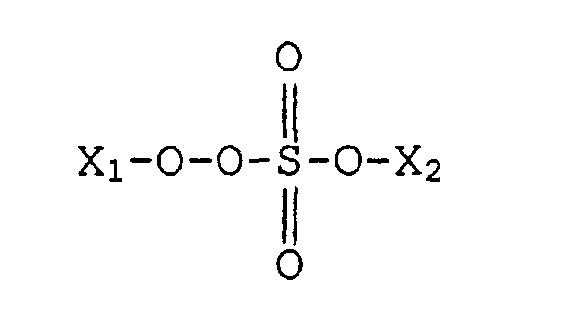
- Chemisch-mechanische Polier-Zusammensetzung nach einem der Ansprüche 4 oder 5,
gekennzeichnet durch
0,5 bis 20 Gewichtsprozent Monopersulfat. - Chemisch-mechanische Polier-Zusammensetzung nach einem der Ansprüche 4 bis 6,
gekennzeichnet durch
1 bis 20 Gewichtsprozent 2KHSO5 - KHSO4 - K2SO4. - Chemisch-mechanische Polier-Vorstufen-Zusammensetzung, welche folgendes aufweist:
das Produkt der Mischung von mindestens einem Katalysator, welcher mehrfache Oxidationszustände aufweist, und wenigstens einem Stabilisator. - Chemisch-mechanische Polier-Zusammensetzung, welche folgendes aufweist:wenigstens ein Oxidationsmittel; unddas Produkt der Mischung von mindestens einem Katalysator, welcher mehrfache Oxidationszustände aufweist, und wenigstens einem Stabilisator.
- Zusammensetzung nach einem der Ansprüche 8 oder 9,
dadurch gekennzeichnet, daß
der Stabilisator eine organische Säure, eine anorganische Säure, ein Nitril und Mischungen daraus ist. - Zusammensetzung nach einem der Ansprüche 8 bis 10,
dadurch gekennzeichnet, daß
der Stabilisator aus der Gruppe gewählt wird, welche aus Phosphorsäure, Phthalsäure, Zitronensäure, Malonsäure, Phosphonsäure, Oxalsäure, Adipinsäure, Benzonitril und Mischungen daraus besteht. - Zusammensetzung nach einem der Ansprüche 8 bis 11,
dadurch gekennzeichnet, daß
der Stabilisator eine Mischung aus von 0 Äquivalenten pro Katalysator bis 3 Äquivalenten pro Katalysator Oxalsäure und von 0,2 bis 1,0 Gewichtsprozent Adipinsäure ist. - Zusammensetzung nach einem der Ansprüche 8 bis 11,
dadurch gekennzeichnet, daß
der Stabilisator von 2 Äquivalenten pro Katalysator bis 15 Äquivalenten pro Katalysator an Malonsäure aufweist. - Zusammensetzung nach einem der Ansprüche 8 bis 11,
dadurch gekennzeichnet, daß
der Stabilisator von drei Äquivalenten pro Katalysator bis zu 3,0 Gewichtsprozent Phthalsäure aufweist. - Zusammensetzung nach einem der Ansprüche 9 bis 14,
dadurch gekennzeichnet, daß
das Oxidationsmittel eine organische Verbindung, anorganische Verbindung und Mischungen daraus ist. - Zusammensetzung nach einem der Ansprüche 1 bis 7 oder 9 bis 15,
dadurch gekennzeichnet, daß
das Oxidationsmittel 0,1 bis 50 Gewichtsprozent Hydrogen-Peroxid aufweist. - Zusammensetzung nach einem der Ansprüche 1 bis 7 oder 9 bis 16,
dadurch gekennzeichnet, daß
das Oxidationmittel 0,5 bis 10 Gewichtsprozent Hydrogen-Peroxid aufweist. - Zusammensetzung nach einem der Ansprüche 1 bis 17,
dadurch gekennzeichnet, daß
der Katalysator ein Metallkatalysator ist. - Zusammensetzung nach Anspruch 18,
dadurch gekennzeichnet, daß
der Katalysator eine Verbindung aus Ag, Co, Cr, Cu, Fe, Mo, Mn, Nb, Ni, Os, Pd, Ru, Sn, Ti, V und Mischungen daraus mit mehrfachen Oxidationszuständen ist. - Zusammensetzung nach Anspruch 19,
dadurch gekennzeichnet, daß
der Metallkatalysator eine Verbindung aus Eisen, Kupfer, Silber und jeder Kombination daraus mit mehreren Oxidationszuständen ist. - Zusammensetzung nach einem der Ansprüche 1 bis 20,
dadurch gekennzeichnet, daß
der Katalysator ein Eisenkatalysator ist, der aus der Gruppe ausgewählt ist, die aus anorganischen Eisenverbindungen und organischen Eisenverbindungen mit mehrfachen Oxidationszuständen besteht. - Zusammensetzung nach einem der Ansprüche 1, 8 oder 9,
dadurch gekennzeichnet, daß
der Katalysator ein Eisennitrat-Katalysator ist. - Zusammensetzung nach Anspruch 22,
dadurch gekennzeichnet, daß
der Eisennitrat-Katalysator zwischen 0,01 bis 0,5 Gewichtsprozent Eisennitrat aufweist. - Zusammensetzung nach einem der Ansprüche 1 bis 22,
gekennzeichnet durch
0,001 bis 2,0 Gewichtsprozent Katalysator. - Zusammensetzung nach einem der Ansprüche 1 bis 22 oder 24,
gekennzeichnet durch
0,005 bis 0,2 Gewichtsprozent Katalysator. - Zusammensetzung nach einem der Ansprüche 1 bis 9,
dadurch gekennzeichnet, daß
das Oxidationsmittel Hydrogenperoxid ist und der Katalysator von 0,005 bis 0,2 Gewichtsprozent eines Eisennitrat-Katalysators ist. - Zusammensetzung nach einem der Ansprüche 1 bis 9,
dadurch gekennzeichnet, daß
das Oxidationsmittel Monopersulfat ist, und daß der Katalysator von 0,05 bis 1,0 Gewichtsprozent eines Eisennitrat-Katalysators ist. - Zusammensetzung nach einem der Ansprüche 1 bis 27,
gekennzeichnet durch
ein Schleifmittel. - Zusammensetzung nach einem der Ansprüche 1 bis 28,
dadurch gekennzeichnet, daß
das Schleifmittel mindestens ein Metalloxid ist. - Zusammensetzung nach einem der Ansprüche 1 bis 29,
dadurch gekennzeichnet, daß
das Metalloxid-Schleifmittel aus der Gruppe ausgewählt ist, die Aluminium, Zeroxid, Germanium, Silizium, Titan, Zirkonium und Mischungen daraus aufweist. - Zusammensetzung nach einem der Ansprüche 1 bis 30,
dadurch gekennzeichnet, daß
das Schleifmittel eine wässrige Dispersion eines Metalloxides ist. - Zusammensetzung nach einem der Ansprüche 1 bis 31,
dadurch gekennzeichnet, daß
das Metalloxid-Schleifmittel aus Metalloxid-Aggregaten besteht, die eine Größenverteilung von wenigstens 1,0 Micron und einen durchschnittlichen Aggregatdurchmesser von weniger als 0,4 Micron aufweisen. - Zusammensetzung nach einem der Ansprüche 1 bis 32,
dadurch gekennzeichnet, daß
das Metalloxid-Schleifmittel aus diskreten, individuellen Metalloxid-Sphären besteht, welche einen primären Partikeldurchmesser von weniger als 0,400 Micron und eine Oberfläche von 10 m2/g bis 250 m2/g aufweist. - Zusammensetzung nach einem der Ansprüche 1 bis 33,
dadurch gekennzeichnet, daß
das Schleifmittel eine Oberfläche von 5 m2/g bis 430 m2/g aufweist. - Zusammensetzung nach einem der Ansprüche 1 bis 34,
dadurch gekennzeichnet, daß
das Schleifmittel eine Oberfläche von 30 m2/g bis 170 m2/g aufweist. - Zusammensetzung nach einem der Ansprüche 1 bis 35,
dadurch gekennzeichnet, daß
das Schleifmittel Niederschlags-Schleifmittel oder geräuchertes Schleifmittel aufweist. - Zusammensetzung nach einem der Ansprüche 1 bis 36,
dadurch gekennzeichnet, daß
das Schleifmittel niedergeschlagenes Silizium, geräuchertes Silizium oder geräuchertes Aluminium aufweist. - Chemische-mechanische Polier-Zusammensetzung nach Anspruch 1, welche folgendes aufweist:ein Schleifmittel;einen Eisennitrat-Katalysator; und1,0 bis 10,0 Gewichtsprozent eines Oxidationsmittels, welches aus der Gruppe ausgewählt ist, die aus Hydrogenperoxid und Monopersulfat besteht, wobei, wenn das Oxidationsmittel Hydrogenperoxid ist, der Schlamm zwischen 0,005 bis 0,20 Gewichtsprozent Eisennitrat-Katalysator aufweist, und wenn das Oxidationsmittel Monopersulfat ist, der Schlamm zwischen 0,05 bis 1,0 Gewichtsprozent Eisennitrat-Katalysator aufweist.
- Chemische-mechanischer Polierschlamm, welcher folgendes aufweist:1,0 bis 15,0 Gewichtsprozent Kieselerde;0,1 bis 0,5 Gewichtsprozent Eisennitrat-Katalysator; und1,0 bis 10,0 Gewichtsprozent Monopersulfat.
- Chemische-mechanischer Polierschlamm, welcher folgendes aufweist:1,0 bis 15,0 Gewichtsprozent Kieselerde;0,01 bis 0,05 Gewichtsprozent Eisennitrat-Katalysator; und1,0 bis 10,0 Gewichtsprozent Hydrogenperoxid.
- Chemische-mechanischer Polierschlamm, welcher folgendes aufweist:3,0 bis 7,0 Gewichtsprozent Kieselerde;0,01 bis 0,05 Gewichtsprozent Eisennitrat-Katalysator; unddas Produkt des Gemisches aus 0,5 bis 10,0 Gewichtsprozent Hydrogenperoxid und zwischen 2 Äquivalenten pro Katalysator bis 15 Äquivalenten pro Katalysator Malonsäure.
- Schlamm nach Anspruch 41,
dadurch gekennzeichnet, daß
die Kieselerde eine Oberfläche von 120 m2/g bis 200 m2/g aufweist. - Chemische-mechanische Polier-Vorstufen-Zusammensetzung, welche eine wässrige Lösung von 3,0 bis 7,0 Gewichtsprozent Kieselerde und das Produkt der Mischung aus 0,01 bis 0,05 Gewichtsprozent Eisennitrat-Katalysator und zwischen 2 Äquivalenten pro Katalysator bis 15 Äquivalenten pro Katalysator Malonsäure aufweist.
- Verfahren zum Polieren einer Oberfläche, welche wenigstens eine Metallschicht aufweist, mit folgenden Verfahrensschritten:(a) Mischen der Zusammensetzungen der Ansprüche 8 oder 43 und deionisiertes Wasser, um eine chemisch-mechanische Polier-Vorstufe zu ergeben;(b) Mischen der chemisch-mechanischen Polier-Vorstufe aus Schritt (a) mit einem Oxidationsmittel, um einen chemisch-mechanischen Polierschlamm zu ergeben;(c) Auftragen des chemisch-mechanischen Polierschlamms auf die Oberfläche; und(d) Entfernen wenigstens eines Bereiches der Metallschicht von der Oberfläche durch in Kontakt bringen eines Pads mit der Oberfläche und Bewegen des Pads relativ zu der Oberfläche.
- Verfahren zum Polieren einer Oberfläche, welche wenigstens eine Metallschicht aufweist, mit folgenden Verfahrensschritten:(a) Mischen der chemisch-mechanischen Polier-Zusammensetzung gemäß einem der Ansprüche 1 bis 7 oder 9 bis 42 und deionisiertem Wasser, um einen chemisch-mechanischen Polierschlamm zu ergeben;(b) Auftragen des chemisch-mechanischen Polierschlamms auf die Oberfläche; und(c) Entfernen wenigstens eines Bereiches der Metallschicht von der Oberfläche durch in Kontakt bringen eines Pads mit der Oberfläche und Bewegen des Pads relativ zu der Oberfläche.
- Verfahren nach einem der Ansprüche 44 bis 45,
dadurch gekennzeichnet, daß
die Oberfläche eine Hartmetall aufweisende Metallschicht aufweist, wobei wenigstens ein Bereich der Hartmetallschicht im Schritt (c) entfernt wird. - Verfahren nach einem der Ansprüche 44 bis 46,
dadurch gekennzeichnet, daß
die Oberfläche des weiteren eine Titan- und/oder Titannitrid-Metallschicht aufweist, wobei wenigstens ein Bereich der Titannitrid-Schicht in Schritt (c) entfernt wird. - Chemisch-mechanisches Polier-Zusammensetzung-Multi-Package-System, welches folgendes aufweist:(a) einen ersten Behälter, der die Zusammensetzung der Ansprüche 8 oder 43 beinhaltet; und(b) einen zweiten Behälter, der das Oxidationsmittel beinhaltet.
Applications Claiming Priority (6)
| Application Number | Priority Date | Filing Date | Title |
|---|---|---|---|
| US753482 | 1996-11-26 | ||
| US08/753,482 US5958288A (en) | 1996-11-26 | 1996-11-26 | Composition and slurry useful for metal CMP |
| US827918 | 1997-04-08 | ||
| US08/827,918 US5980775A (en) | 1996-11-26 | 1997-04-08 | Composition and slurry useful for metal CMP |
| US08/891,468 US6068787A (en) | 1996-11-26 | 1997-07-11 | Composition and slurry useful for metal CMP |
| US891468 | 1997-07-11 |
Publications (2)
| Publication Number | Publication Date |
|---|---|
| EP0844290A1 EP0844290A1 (de) | 1998-05-27 |
| EP0844290B1 true EP0844290B1 (de) | 2002-03-13 |
Family
ID=27419449
Family Applications (1)
| Application Number | Title | Priority Date | Filing Date |
|---|---|---|---|
| EP97309476A Expired - Lifetime EP0844290B1 (de) | 1996-11-26 | 1997-11-25 | Zusammensetzung und Aufschlämmung zum chemisch-mechanischen Polieren von Metallen |
Country Status (13)
| Country | Link |
|---|---|
| US (1) | US6068787A (de) |
| EP (1) | EP0844290B1 (de) |
| JP (1) | JP3822339B2 (de) |
| KR (2) | KR100745447B1 (de) |
| CN (1) | CN1131125C (de) |
| AT (1) | ATE214417T1 (de) |
| AU (1) | AU5464298A (de) |
| DE (1) | DE69710993T2 (de) |
| ES (1) | ES2174192T3 (de) |
| ID (1) | ID23676A (de) |
| IL (1) | IL130138A (de) |
| TW (1) | TW396201B (de) |
| WO (1) | WO1998023408A1 (de) |
Cited By (2)
| Publication number | Priority date | Publication date | Assignee | Title |
|---|---|---|---|---|
| US6930054B2 (en) | 2001-08-09 | 2005-08-16 | Cheil Industries, Inc. | Slurry composition for use in chemical mechanical polishing of metal wiring |
| US6953389B2 (en) | 2001-08-09 | 2005-10-11 | Cheil Industries, Inc. | Metal CMP slurry compositions that favor mechanical removal of oxides with reduced susceptibility to micro-scratching |
Families Citing this family (172)
| Publication number | Priority date | Publication date | Assignee | Title |
|---|---|---|---|---|
| US6083419A (en) * | 1997-07-28 | 2000-07-04 | Cabot Corporation | Polishing composition including an inhibitor of tungsten etching |
| US6592776B1 (en) | 1997-07-28 | 2003-07-15 | Cabot Microelectronics Corporation | Polishing composition for metal CMP |
| US6432828B2 (en) | 1998-03-18 | 2002-08-13 | Cabot Microelectronics Corporation | Chemical mechanical polishing slurry useful for copper substrates |
| US6435947B2 (en) | 1998-05-26 | 2002-08-20 | Cabot Microelectronics Corporation | CMP polishing pad including a solid catalyst |
| US6177026B1 (en) | 1998-05-26 | 2001-01-23 | Cabot Microelectronics Corporation | CMP slurry containing a solid catalyst |
| US6693035B1 (en) * | 1998-10-20 | 2004-02-17 | Rodel Holdings, Inc. | Methods to control film removal rates for improved polishing in metal CMP |
| US6063306A (en) * | 1998-06-26 | 2000-05-16 | Cabot Corporation | Chemical mechanical polishing slurry useful for copper/tantalum substrate |
| EP0969057A1 (de) * | 1998-07-03 | 2000-01-05 | International Business Machines Corporation | Doppelwertige Seltenerdadditive für Polierschlämme |
| CN1126152C (zh) * | 1998-08-31 | 2003-10-29 | 长兴化学工业股份有限公司 | 半导体制程用的化学机械研磨组合物 |
| US6358853B2 (en) * | 1998-09-10 | 2002-03-19 | Intel Corporation | Ceria based slurry for chemical-mechanical polishing |
| US6447693B1 (en) * | 1998-10-21 | 2002-09-10 | W. R. Grace & Co.-Conn. | Slurries of abrasive inorganic oxide particles and method for polishing copper containing surfaces |
| SG99289A1 (en) * | 1998-10-23 | 2003-10-27 | Ibm | Chemical-mechanical planarization of metallurgy |
| JP4366735B2 (ja) * | 1998-11-05 | 2009-11-18 | Jsr株式会社 | 重合体粒子を含有する研磨剤 |
| US6274063B1 (en) * | 1998-11-06 | 2001-08-14 | Hmt Technology Corporation | Metal polishing composition |
| SG73683A1 (en) * | 1998-11-24 | 2000-06-20 | Texas Instruments Inc | Stabilized slurry compositions |
| US6395194B1 (en) * | 1998-12-18 | 2002-05-28 | Intersurface Dynamics Inc. | Chemical mechanical polishing compositions, and process for the CMP removal of iridium thin using same |
| WO2000039844A1 (fr) * | 1998-12-28 | 2000-07-06 | Hitachi Chemical Company, Ltd. | Materiaux pour liquide de polissage de metal, liquide de polissage de metal, procede de preparation et procede de polissage connexes |
| KR100313573B1 (ko) * | 1999-02-19 | 2001-11-07 | 안복현 | 연마용 조성물 |
| US6379577B2 (en) * | 1999-06-10 | 2002-04-30 | International Business Machines Corporation | Hydrogen peroxide and acid etchant for a wet etch process |
| TW486514B (en) | 1999-06-16 | 2002-05-11 | Eternal Chemical Co Ltd | Chemical mechanical abrasive composition for use in semiconductor processing |
| CN1125861C (zh) * | 1999-07-16 | 2003-10-29 | 长兴化学工业股份有限公司 | 半导体加工用化学机械研磨组合物 |
| WO2001019935A1 (en) * | 1999-09-15 | 2001-03-22 | Rodel Holdings, Inc. | Slurry for forming insoluble silicate during chemical-mechanical polishing |
| US6280490B1 (en) * | 1999-09-27 | 2001-08-28 | Fujimi America Inc. | Polishing composition and method for producing a memory hard disk |
| JP4238951B2 (ja) * | 1999-09-28 | 2009-03-18 | 株式会社フジミインコーポレーテッド | 研磨用組成物およびそれを用いたメモリーハードディスクの製造方法 |
| KR100343391B1 (ko) * | 1999-11-18 | 2002-08-01 | 삼성전자 주식회사 | 화학 및 기계적 연마용 비선택성 슬러리 및 그제조방법과, 이를 이용하여 웨이퍼상의 절연층 내에플러그를 형성하는 방법 |
| KR100614567B1 (ko) * | 1999-12-10 | 2006-08-25 | 에포크 머티리얼 컴퍼니, 리미티드 | 반도체 처리에 사용하기 위한 화학-기계적 연마 조성물 |
| JP3805588B2 (ja) | 1999-12-27 | 2006-08-02 | 株式会社日立製作所 | 半導体装置の製造方法 |
| US6841470B2 (en) * | 1999-12-31 | 2005-01-11 | Intel Corporation | Removal of residue from a substrate |
| US6461958B1 (en) | 2000-02-04 | 2002-10-08 | Seagate Technology Llc | Polishing memory disk substrates with reclaim slurry |
| TWI296006B (de) | 2000-02-09 | 2008-04-21 | Jsr Corp | |
| US6332831B1 (en) * | 2000-04-06 | 2001-12-25 | Fujimi America Inc. | Polishing composition and method for producing a memory hard disk |
| US6328774B1 (en) * | 2000-02-23 | 2001-12-11 | Fujimi America Inc. | Polishing composition and method for producing a memory hard disk |
| US6599173B1 (en) * | 2000-06-30 | 2003-07-29 | International Business Machines Corporation | Method to prevent leaving residual metal in CMP process of metal interconnect |
| JP3993369B2 (ja) * | 2000-07-14 | 2007-10-17 | 株式会社東芝 | 半導体装置の製造方法 |
| JP4435391B2 (ja) * | 2000-08-04 | 2010-03-17 | 扶桑化学工業株式会社 | コロイド状シリカスラリー |
| JP2002050595A (ja) | 2000-08-04 | 2002-02-15 | Hitachi Ltd | 研磨方法、配線形成方法及び半導体装置の製造方法 |
| US7153410B2 (en) | 2000-08-30 | 2006-12-26 | Micron Technology, Inc. | Methods and apparatus for electrochemical-mechanical processing of microelectronic workpieces |
| US6551935B1 (en) * | 2000-08-31 | 2003-04-22 | Micron Technology, Inc. | Slurry for use in polishing semiconductor device conductive structures that include copper and tungsten and polishing methods |
| US7192335B2 (en) | 2002-08-29 | 2007-03-20 | Micron Technology, Inc. | Method and apparatus for chemically, mechanically, and/or electrolytically removing material from microelectronic substrates |
| US7153195B2 (en) * | 2000-08-30 | 2006-12-26 | Micron Technology, Inc. | Methods and apparatus for selectively removing conductive material from a microelectronic substrate |
| US7074113B1 (en) * | 2000-08-30 | 2006-07-11 | Micron Technology, Inc. | Methods and apparatus for removing conductive material from a microelectronic substrate |
| US7220166B2 (en) * | 2000-08-30 | 2007-05-22 | Micron Technology, Inc. | Methods and apparatus for electromechanically and/or electrochemically-mechanically removing conductive material from a microelectronic substrate |
| US7160176B2 (en) * | 2000-08-30 | 2007-01-09 | Micron Technology, Inc. | Methods and apparatus for electrically and/or chemically-mechanically removing conductive material from a microelectronic substrate |
| US7112121B2 (en) * | 2000-08-30 | 2006-09-26 | Micron Technology, Inc. | Methods and apparatus for electrical, mechanical and/or chemical removal of conductive material from a microelectronic substrate |
| US7094131B2 (en) | 2000-08-30 | 2006-08-22 | Micron Technology, Inc. | Microelectronic substrate having conductive material with blunt cornered apertures, and associated methods for removing conductive material |
| US7129160B2 (en) * | 2002-08-29 | 2006-10-31 | Micron Technology, Inc. | Method for simultaneously removing multiple conductive materials from microelectronic substrates |
| US7078308B2 (en) * | 2002-08-29 | 2006-07-18 | Micron Technology, Inc. | Method and apparatus for removing adjacent conductive and nonconductive materials of a microelectronic substrate |
| US7134934B2 (en) * | 2000-08-30 | 2006-11-14 | Micron Technology, Inc. | Methods and apparatus for electrically detecting characteristics of a microelectronic substrate and/or polishing medium |
| US6867448B1 (en) | 2000-08-31 | 2005-03-15 | Micron Technology, Inc. | Electro-mechanically polished structure |
| US6541384B1 (en) | 2000-09-08 | 2003-04-01 | Applied Materials, Inc. | Method of initiating cooper CMP process |
| US6623355B2 (en) | 2000-11-07 | 2003-09-23 | Micell Technologies, Inc. | Methods, apparatus and slurries for chemical mechanical planarization |
| KR20020047417A (ko) * | 2000-12-13 | 2002-06-22 | 안복현 | 반도체 소자의 금속층 연마용 슬러리 |
| KR100359216B1 (ko) * | 2000-12-13 | 2002-11-04 | 제일모직주식회사 | 반도체 소자의 금속층 연마용 슬러리 |
| KR20020047418A (ko) * | 2000-12-13 | 2002-06-22 | 안복현 | 반도체 소자의 금속층 연마용 슬러리 |
| CN1255854C (zh) * | 2001-01-16 | 2006-05-10 | 卡伯特微电子公司 | 含有草酸铵的抛光系统及方法 |
| US6383065B1 (en) | 2001-01-22 | 2002-05-07 | Cabot Microelectronics Corporation | Catalytic reactive pad for metal CMP |
| EP1358044B1 (de) * | 2001-02-08 | 2008-12-03 | REM Technologies, Inc. | Chemisch-mechanische bearbeitung und oberflächen endbearbeitung |
| WO2002066400A1 (en) * | 2001-02-20 | 2002-08-29 | Johnsondiversey, Inc. | Surface restoration and maintenance composition and method of restoring a surface |
| JP4231632B2 (ja) | 2001-04-27 | 2009-03-04 | 花王株式会社 | 研磨液組成物 |
| US6589099B2 (en) | 2001-07-09 | 2003-07-08 | Motorola, Inc. | Method for chemical mechanical polishing (CMP) with altering the concentration of oxidizing agent in slurry |
| MY133305A (en) * | 2001-08-21 | 2007-11-30 | Kao Corp | Polishing composition |
| US6812193B2 (en) | 2001-08-31 | 2004-11-02 | International Business Machines Corporation | Slurry for mechanical polishing (CMP) of metals and use thereof |
| US6589100B2 (en) | 2001-09-24 | 2003-07-08 | Cabot Microelectronics Corporation | Rare earth salt/oxidizer-based CMP method |
| US7077880B2 (en) * | 2004-01-16 | 2006-07-18 | Dupont Air Products Nanomaterials Llc | Surface modified colloidal abrasives, including stable bimetallic surface coated silica sols for chemical mechanical planarization |
| KR20030035637A (ko) * | 2001-11-01 | 2003-05-09 | 제일모직주식회사 | 구리배선 연마용 cmp 슬러리 |
| US7029507B2 (en) * | 2001-11-29 | 2006-04-18 | Nanoproducts Corporation | Polishing using multi-metal oxide nanopowders |
| KR100445760B1 (ko) * | 2001-12-28 | 2004-08-25 | 제일모직주식회사 | 금속오염이 적은 금속배선 연마용 슬러리 조성물 |
| US6830503B1 (en) | 2002-01-11 | 2004-12-14 | Cabot Microelectronics Corporation | Catalyst/oxidizer-based CMP system for organic polymer films |
| US20030136759A1 (en) * | 2002-01-18 | 2003-07-24 | Cabot Microelectronics Corp. | Microlens array fabrication using CMP |
| US20030139047A1 (en) * | 2002-01-24 | 2003-07-24 | Thomas Terence M. | Metal polishing slurry having a static etch inhibitor and method of formulation |
| KR20030063763A (ko) * | 2002-01-24 | 2003-07-31 | 한국과학기술연구원 | 텅스텐 씨엠피용 슬러리 |
| US6884729B2 (en) * | 2002-02-11 | 2005-04-26 | Cabot Microelectronics Corporation | Global planarization method |
| US20030162398A1 (en) * | 2002-02-11 | 2003-08-28 | Small Robert J. | Catalytic composition for chemical-mechanical polishing, method of using same, and substrate treated with same |
| US7513920B2 (en) * | 2002-02-11 | 2009-04-07 | Dupont Air Products Nanomaterials Llc | Free radical-forming activator attached to solid and used to enhance CMP formulations |
| EP1489650B1 (de) | 2002-03-04 | 2010-07-14 | Fujimi Incorporated | Polierzusammensetzung und verfahren zur bildung einer verdrahtungsstruktur |
| US6853474B2 (en) * | 2002-04-04 | 2005-02-08 | Cabot Microelectronics Corporation | Process for fabricating optical switches |
| US20040007690A1 (en) * | 2002-07-12 | 2004-01-15 | Cabot Microelectronics Corp. | Methods for polishing fiber optic connectors |
| KR100474537B1 (ko) * | 2002-07-16 | 2005-03-10 | 주식회사 하이닉스반도체 | 산화막용 cmp 슬러리 조성물 및 이를 이용한 반도체소자의 제조 방법 |
| US20040077295A1 (en) * | 2002-08-05 | 2004-04-22 | Hellring Stuart D. | Process for reducing dishing and erosion during chemical mechanical planarization |
| KR100495975B1 (ko) * | 2002-09-25 | 2005-06-16 | 주식회사 동진쎄미켐 | 텅스텐 금속막 연마용 화학-기계적 연마 슬러리 조성물 |
| US20040188379A1 (en) * | 2003-03-28 | 2004-09-30 | Cabot Microelectronics Corporation | Dielectric-in-dielectric damascene process for manufacturing planar waveguides |
| US20040232379A1 (en) * | 2003-05-20 | 2004-11-25 | Ameen Joseph G. | Multi-oxidizer-based slurry for nickel hard disk planarization |
| US20050045852A1 (en) * | 2003-08-29 | 2005-03-03 | Ameen Joseph G. | Particle-free polishing fluid for nickel-based coating planarization |
| US7112122B2 (en) * | 2003-09-17 | 2006-09-26 | Micron Technology, Inc. | Methods and apparatus for removing conductive material from a microelectronic substrate |
| US6929983B2 (en) | 2003-09-30 | 2005-08-16 | Cabot Microelectronics Corporation | Method of forming a current controlling device |
| US20050148289A1 (en) * | 2004-01-06 | 2005-07-07 | Cabot Microelectronics Corp. | Micromachining by chemical mechanical polishing |
| US7153777B2 (en) * | 2004-02-20 | 2006-12-26 | Micron Technology, Inc. | Methods and apparatuses for electrochemical-mechanical polishing |
| JP2005244123A (ja) | 2004-02-27 | 2005-09-08 | Fujimi Inc | 研磨用組成物 |
| US7253111B2 (en) * | 2004-04-21 | 2007-08-07 | Rohm And Haas Electronic Materials Cmp Holding, Inc. | Barrier polishing solution |
| US7247567B2 (en) * | 2004-06-16 | 2007-07-24 | Cabot Microelectronics Corporation | Method of polishing a tungsten-containing substrate |
| KR100850877B1 (ko) * | 2004-06-18 | 2008-08-07 | 주식회사 동진쎄미켐 | 철 함유 콜로이달 실리카를 포함하는 화학 기계적 연마슬러리 조성물 |
| KR101072271B1 (ko) * | 2005-03-14 | 2011-10-11 | 주식회사 동진쎄미켐 | 화학 기계적 연마 슬러리 조성물용 산화제 및 그 제조방법 |
| US7161247B2 (en) * | 2004-07-28 | 2007-01-09 | Cabot Microelectronics Corporation | Polishing composition for noble metals |
| US20060043534A1 (en) * | 2004-08-26 | 2006-03-02 | Kirby Kyle K | Microfeature dies with porous regions, and associated methods and systems |
| US7566391B2 (en) | 2004-09-01 | 2009-07-28 | Micron Technology, Inc. | Methods and systems for removing materials from microfeature workpieces with organic and/or non-aqueous electrolytic media |
| US7524347B2 (en) * | 2004-10-28 | 2009-04-28 | Cabot Microelectronics Corporation | CMP composition comprising surfactant |
| KR100497413B1 (ko) * | 2004-11-26 | 2005-06-23 | 에이스하이텍 주식회사 | 텅스텐-화학적 기계적 연마에 유용한 슬러리 및 그 제조방법 |
| US20060124026A1 (en) * | 2004-12-10 | 2006-06-15 | 3M Innovative Properties Company | Polishing solutions |
| KR100645307B1 (ko) | 2004-12-31 | 2006-11-14 | 제일모직주식회사 | 실리콘 웨이퍼용 경면 연마 슬러리 조성물 |
| CN101180379B (zh) | 2005-03-25 | 2013-07-24 | 气体产品与化学公司 | 用于含有金属离子氧化剂的化学机械抛光组合物中的二羟基烯醇化合物 |
| US20060226402A1 (en) * | 2005-04-08 | 2006-10-12 | Beon-Kyu Kim | Ophthalmic devices comprising photochromic materials having extended PI-conjugated systems |
| CN1854234B (zh) | 2005-04-21 | 2013-03-20 | 安集微电子(上海)有限公司 | 抛光浆料及其用途和使用方法 |
| WO2006120727A1 (ja) * | 2005-05-06 | 2006-11-16 | Asahi Glass Company, Limited | 銅配線研磨用組成物および半導体集積回路表面の研磨方法 |
| KR100641348B1 (ko) | 2005-06-03 | 2006-11-03 | 주식회사 케이씨텍 | Cmp용 슬러리와 이의 제조 방법 및 기판의 연마 방법 |
| US20060278879A1 (en) * | 2005-06-09 | 2006-12-14 | Cabot Microelectronics Corporation | Nanochannel device and method of manufacturing same |
| US7576361B2 (en) * | 2005-08-03 | 2009-08-18 | Aptina Imaging Corporation | Backside silicon wafer design reducing image artifacts from infrared radiation |
| US7435162B2 (en) * | 2005-10-24 | 2008-10-14 | 3M Innovative Properties Company | Polishing fluids and methods for CMP |
| WO2007103578A1 (en) * | 2006-03-09 | 2007-09-13 | Cabot Microelectronics Corporation | Method of polishing a tungsten carbide surface |
| US20080283502A1 (en) * | 2006-05-26 | 2008-11-20 | Kevin Moeggenborg | Compositions, methods and systems for polishing aluminum oxide and aluminum oxynitride substrates |
| US7294576B1 (en) | 2006-06-29 | 2007-11-13 | Cabot Microelectronics Corporation | Tunable selectivity slurries in CMP applications |
| US20080020680A1 (en) * | 2006-07-24 | 2008-01-24 | Cabot Microelectronics Corporation | Rate-enhanced CMP compositions for dielectric films |
| JP2008135453A (ja) | 2006-11-27 | 2008-06-12 | Fujimi Inc | 研磨用組成物及び研磨方法 |
| JP5095228B2 (ja) * | 2007-01-23 | 2012-12-12 | 株式会社フジミインコーポレーテッド | 研磨用組成物 |
| JP2007221170A (ja) * | 2007-05-18 | 2007-08-30 | Hitachi Chem Co Ltd | 金属用研磨液の調製方法 |
| US20090001339A1 (en) * | 2007-06-29 | 2009-01-01 | Tae Young Lee | Chemical Mechanical Polishing Slurry Composition for Polishing Phase-Change Memory Device and Method for Polishing Phase-Change Memory Device Using the Same |
| KR20090002506A (ko) * | 2007-06-29 | 2009-01-09 | 제일모직주식회사 | 상변화 메모리 소자 연마용 cmp 슬러리 조성물 및 이를이용한 연마 방법 |
| CN101302403B (zh) * | 2008-07-03 | 2011-10-19 | 大连理工大学 | 用于大尺寸金刚石晶圆超精密低损伤抛光的抛光液及制备方法 |
| JP2010167551A (ja) * | 2008-12-26 | 2010-08-05 | Nomura Micro Sci Co Ltd | 使用済みスラリーの再生方法 |
| JP5343250B2 (ja) * | 2009-02-19 | 2013-11-13 | 国立大学法人 熊本大学 | 触媒支援型化学加工方法及びそれを用いた加工装置 |
| KR100928456B1 (ko) | 2009-06-01 | 2009-11-25 | 주식회사 동진쎄미켐 | 이온화되지 않는 열활성 나노촉매를 포함하는 화학 기계적 연마 슬러리 조성물 및 이를 이용한 연마방법 |
| WO2011054193A1 (zh) * | 2009-11-06 | 2011-05-12 | Wang Chen | 一种化学机械抛光液 |
| US9028708B2 (en) | 2009-11-30 | 2015-05-12 | Basf Se | Process for removing a bulk material layer from a substrate and a chemical mechanical polishing agent suitable for this process |
| WO2011064734A1 (en) | 2009-11-30 | 2011-06-03 | Basf Se | Process for removing a bulk material layer from a substrate and a chemical mechanical polishing agent suitable for this process |
| CN102093816B (zh) * | 2009-12-11 | 2017-02-22 | 安集微电子(上海)有限公司 | 一种化学机械抛光液 |
| KR101396232B1 (ko) * | 2010-02-05 | 2014-05-19 | 한양대학교 산학협력단 | 상변화 물질 연마용 슬러리 및 이를 이용한 상변화 소자 제조 방법 |
| JP6004943B2 (ja) | 2010-02-24 | 2016-10-12 | ビーエーエスエフ ソシエタス・ヨーロピアBasf Se | 水性研磨剤及びグラフトコポリマー並びにそれらをパターン形成された及び構造化されていない金属表面の研磨プロセスに用いる使用 |
| JP5518523B2 (ja) * | 2010-02-25 | 2014-06-11 | 富士フイルム株式会社 | 化学的機械的研磨液及び研磨方法 |
| WO2012032469A1 (en) | 2010-09-08 | 2012-03-15 | Basf Se | Aqueous polishing composition and process for chemically mechanically polishing substrate materials for electrical, mechanical and optical devices |
| JP2013540850A (ja) | 2010-09-08 | 2013-11-07 | ビーエーエスエフ ソシエタス・ヨーロピア | N−置換ジアゼニウムジオキシド及び/又はn’−ヒドロキシジアゼニウムオキシド塩を含有する水性研磨剤組成物 |
| WO2012032451A1 (en) | 2010-09-08 | 2012-03-15 | Basf Se | Aqueous polishing composition and process for chemically mechanically polishing substrates containing silicon oxide dielectric and polysilicon films |
| WO2012046179A1 (en) | 2010-10-07 | 2012-04-12 | Basf Se | Aqueous polishing composition and process for chemically mechanically polishing substrates having patterned or unpatterned low-k dielectric layers |
| EP2649144A4 (de) | 2010-12-10 | 2014-05-14 | Basf Se | Wässrige polierzusammensetzung und verfahren zum chemisch-mechanischen polieren von substraten mit dielektrischen siliciumoxid- und polysiliciumfilmen |
| WO2012123839A1 (en) | 2011-03-11 | 2012-09-20 | Basf Se | Method for forming through-base wafer vias |
| KR101335946B1 (ko) * | 2011-08-16 | 2013-12-04 | 유비머트리얼즈주식회사 | 텅스텐 연마용 cmp 슬러리 조성물 |
| US9057004B2 (en) * | 2011-09-23 | 2015-06-16 | International Business Machines Corporation | Slurry for chemical-mechanical polishing of metals and use thereof |
| JP5460933B1 (ja) * | 2012-03-30 | 2014-04-02 | ニッタ・ハース株式会社 | 研磨組成物 |
| KR101257336B1 (ko) * | 2012-04-13 | 2013-04-23 | 유비머트리얼즈주식회사 | 연마용 슬러리 및 이를 이용한 기판 연마 방법 |
| US9039914B2 (en) | 2012-05-23 | 2015-05-26 | Cabot Microelectronics Corporation | Polishing composition for nickel-phosphorous-coated memory disks |
| JP6222907B2 (ja) | 2012-09-06 | 2017-11-01 | 株式会社フジミインコーポレーテッド | 研磨用組成物 |
| CN103659576A (zh) * | 2012-09-20 | 2014-03-26 | 苏州赫瑞特电子专用设备科技有限公司 | 一种单面研磨抛光机的研磨抛光盘 |
| KR102200914B1 (ko) * | 2013-08-12 | 2021-01-13 | 주식회사 동진쎄미켐 | 금속막 연마용 화학 기계적 연마 슬러리 조성물 및 금속막의 연마 방법 |
| KR101409889B1 (ko) | 2013-12-27 | 2014-06-19 | 유비머트리얼즈주식회사 | 연마 슬러리 및 이를 이용한 기판 연마 방법 |
| US9962801B2 (en) | 2014-01-07 | 2018-05-08 | Taiwan Semiconductor Manufacturing Company Limited | Systems and methods for performing chemical mechanical planarization |
| JP6285775B2 (ja) * | 2014-03-31 | 2018-02-28 | 日揮触媒化成株式会社 | 研磨用金属担持金属酸化物粒子および研磨剤 |
| EP3161098B1 (de) * | 2014-06-25 | 2022-10-26 | CMC Materials, Inc. | Chemisch-mechanische wolframpolierzusammensetzung |
| CN104131296A (zh) * | 2014-07-01 | 2014-11-05 | 蚌埠天光传感器有限公司 | 一种用于铝件的化学抛光液及其制备方法 |
| CN104513627B (zh) * | 2014-12-22 | 2017-04-05 | 深圳市力合材料有限公司 | 一种集成电路铜cmp组合物及其制备方法 |
| CN104513628A (zh) * | 2014-12-22 | 2015-04-15 | 清华大学 | 一种用于蓝宝石化学机械平坦化的抛光液 |
| US10570313B2 (en) * | 2015-02-12 | 2020-02-25 | Versum Materials Us, Llc | Dishing reducing in tungsten chemical mechanical polishing |
| KR101741707B1 (ko) * | 2015-02-27 | 2017-05-30 | 유비머트리얼즈주식회사 | 연마 슬러리 및 이를 이용한 기판 연마 방법 |
| US9976111B2 (en) * | 2015-05-01 | 2018-05-22 | Versum Materials Us, Llc | TiN hard mask and etch residual removal |
| US9293339B1 (en) * | 2015-09-24 | 2016-03-22 | Rohm And Haas Electronic Materials Cmp Holdings, Inc. | Method of polishing semiconductor substrate |
| KR102543606B1 (ko) | 2015-12-29 | 2023-06-19 | 솔브레인 주식회사 | 텅스텐 연마용 슬러리 조성물 및 이를 이용한 연마방법 |
| US10319605B2 (en) | 2016-05-10 | 2019-06-11 | Jsr Corporation | Semiconductor treatment composition and treatment method |
| JP7028193B2 (ja) | 2017-02-08 | 2022-03-02 | 昭和電工マテリアルズ株式会社 | 研磨液及び研磨方法 |
| KR102626655B1 (ko) * | 2017-02-08 | 2024-01-17 | 제이에스알 가부시끼가이샤 | 반도체 처리용 조성물 및 처리 방법 |
| JP6928675B2 (ja) * | 2017-05-25 | 2021-09-01 | サン−ゴバン セラミックス アンド プラスティクス,インコーポレイティドSaint−Gobain Ceramics And Plastics, Inc. | セラミック材料の化学機械研磨のための酸化流体 |
| KR102422952B1 (ko) * | 2017-06-12 | 2022-07-19 | 삼성전자주식회사 | 금속막 연마용 슬러리 조성물 및 이를 이용하는 반도체 장치의 제조 방법 |
| US20190085205A1 (en) * | 2017-09-15 | 2019-03-21 | Cabot Microelectronics Corporation | NITRIDE INHIBITORS FOR HIGH SELECTIVITY OF TiN-SiN CMP APPLICATIONS |
| US20190352535A1 (en) * | 2018-05-21 | 2019-11-21 | Versum Materials Us, Llc | Chemical Mechanical Polishing Tungsten Buffing Slurries |
| KR102217516B1 (ko) * | 2018-07-02 | 2021-02-18 | 주식회사 동진쎄미켐 | 금속막 연마용 화학 기계적 연마 슬러리 조성물 및 금속막의 연마 방법 |
| US10995238B2 (en) | 2018-07-03 | 2021-05-04 | Rohm And Haas Electronic Materials Cmp Holdings | Neutral to alkaline chemical mechanical polishing compositions and methods for tungsten |
| CN108587478B (zh) * | 2018-07-03 | 2020-09-25 | 中国人民解放军国防科技大学 | 一种改性纳米二氧化硅复合抛光液及其应用 |
| WO2020017894A1 (ko) * | 2018-07-20 | 2020-01-23 | 주식회사 동진쎄미켐 | 화학적 기계적 연마 조성물, 화학적 기계적 연마 슬러리 및 기판의 연마 방법 |
| KR102808137B1 (ko) * | 2018-07-20 | 2025-05-16 | 주식회사 동진쎄미켐 | 화학적 기계적 연마 조성물, 화학적 기계적 연마 슬러리 및 기판의 연마 방법 |
| WO2020245904A1 (ja) | 2019-06-04 | 2020-12-10 | 昭和電工マテリアルズ株式会社 | 研磨液、分散体、研磨液の製造方法及び研磨方法 |
| EP4022002A4 (de) * | 2019-08-30 | 2023-08-23 | Saint-Gobain Ceramics and Plastics, Inc. | Fluidzusammensetzung und verfahren zur durchführung eines materialabtragungsvorgangs |
| CN113004800B (zh) * | 2019-12-20 | 2024-04-12 | 安集微电子(上海)有限公司 | 一种化学机械抛光液 |
| CN113004801B (zh) * | 2019-12-20 | 2024-03-12 | 安集微电子(上海)有限公司 | 一种化学机械抛光液 |
| JP7532962B2 (ja) * | 2020-07-08 | 2024-08-14 | 株式会社レゾナック | Cmp用研磨液、貯蔵液及び研磨方法 |
| KR102531445B1 (ko) * | 2020-10-28 | 2023-05-12 | 주식회사 케이씨텍 | 연마 슬러리 조성물 |
| CN116640516B (zh) * | 2023-05-18 | 2025-07-15 | 万华化学集团电子材料有限公司 | 一种减少eoe现象的钨化学机械抛光液及其应用 |
Family Cites Families (38)
| Publication number | Priority date | Publication date | Assignee | Title |
|---|---|---|---|---|
| US3385682A (en) * | 1965-04-29 | 1968-05-28 | Sprague Electric Co | Method and reagent for surface polishing |
| US3668131A (en) * | 1968-08-09 | 1972-06-06 | Allied Chem | Dissolution of metal with acidified hydrogen peroxide solutions |
| JPS5435125B2 (de) * | 1972-01-28 | 1979-10-31 | ||
| JPS5177404A (de) * | 1974-12-26 | 1976-07-05 | Fuji Photo Film Co Ltd | |
| GB1565349A (en) * | 1975-10-20 | 1980-04-16 | Albright & Wilson | Aluminium polishing compositions |
| JPS61278587A (ja) * | 1985-06-04 | 1986-12-09 | Fujimi Kenmazai Kogyo Kk | 研磨用組成物 |
| US4671851A (en) * | 1985-10-28 | 1987-06-09 | International Business Machines Corporation | Method for removing protuberances at the surface of a semiconductor wafer using a chem-mech polishing technique |
| US4789648A (en) * | 1985-10-28 | 1988-12-06 | International Business Machines Corporation | Method for producing coplanar multi-level metal/insulator films on a substrate and for forming patterned conductive lines simultaneously with stud vias |
| US4944836A (en) * | 1985-10-28 | 1990-07-31 | International Business Machines Corporation | Chem-mech polishing method for producing coplanar metal/insulator films on a substrate |
| GB8701759D0 (en) * | 1987-01-27 | 1987-03-04 | Laporte Industries Ltd | Processing of semi-conductor materials |
| EP0333884B1 (de) * | 1988-03-19 | 1994-06-08 | Deutsche ITT Industries GmbH | CMOS-Parallel-Serien-Multiplizierschaltung sowie deren Multiplizier- und Addierstufen |
| JPH01257563A (ja) * | 1988-04-08 | 1989-10-13 | Showa Denko Kk | アルミニウム磁気ディスク研磨用組成物 |
| US4910155A (en) * | 1988-10-28 | 1990-03-20 | International Business Machines Corporation | Wafer flood polishing |
| US5084071A (en) * | 1989-03-07 | 1992-01-28 | International Business Machines Corporation | Method of chemical-mechanical polishing an electronic component substrate and polishing slurry therefor |
| US4959113C1 (en) * | 1989-07-31 | 2001-03-13 | Rodel Inc | Method and composition for polishing metal surfaces |
| US5137544A (en) * | 1990-04-10 | 1992-08-11 | Rockwell International Corporation | Stress-free chemo-mechanical polishing agent for II-VI compound semiconductor single crystals and method of polishing |
| US5157876A (en) * | 1990-04-10 | 1992-10-27 | Rockwell International Corporation | Stress-free chemo-mechanical polishing agent for II-VI compound semiconductor single crystals and method of polishing |
| US4992135A (en) * | 1990-07-24 | 1991-02-12 | Micron Technology, Inc. | Method of etching back of tungsten layers on semiconductor wafers, and solution therefore |
| JP2689706B2 (ja) * | 1990-08-08 | 1997-12-10 | 上村工業株式会社 | 研磨方法 |
| US5114437A (en) * | 1990-08-28 | 1992-05-19 | Sumitomo Chemical Co., Ltd. | Polishing composition for metallic material |
| US5244534A (en) * | 1992-01-24 | 1993-09-14 | Micron Technology, Inc. | Two-step chemical mechanical polishing process for producing flush and protruding tungsten plugs |
| JPH0781133B2 (ja) * | 1992-05-06 | 1995-08-30 | 株式会社フジミインコーポレーテッド | メモリーハードディスクの研磨用組成物 |
| US5209816A (en) * | 1992-06-04 | 1993-05-11 | Micron Technology, Inc. | Method of chemical mechanical polishing aluminum containing metal layers and slurry for chemical mechanical polishing |
| US5225034A (en) * | 1992-06-04 | 1993-07-06 | Micron Technology, Inc. | Method of chemical mechanical polishing predominantly copper containing metal layers in semiconductor processing |
| JP3149289B2 (ja) * | 1993-03-24 | 2001-03-26 | 三菱製紙株式会社 | 画像形成材料及びそれを使用する画像形成方法 |
| US5575837A (en) * | 1993-04-28 | 1996-11-19 | Fujimi Incorporated | Polishing composition |
| US5391258A (en) * | 1993-05-26 | 1995-02-21 | Rodel, Inc. | Compositions and methods for polishing |
| US5340370A (en) * | 1993-11-03 | 1994-08-23 | Intel Corporation | Slurries for chemical mechanical polishing |
| WO1995024054A1 (en) * | 1994-03-01 | 1995-09-08 | Rodel, Inc. | Improved compositions and methods for polishing |
| JP3397501B2 (ja) * | 1994-07-12 | 2003-04-14 | 株式会社東芝 | 研磨剤および研磨方法 |
| US5527423A (en) * | 1994-10-06 | 1996-06-18 | Cabot Corporation | Chemical mechanical polishing slurry for metal layers |
| EP0749500B1 (de) * | 1994-10-18 | 1998-05-27 | Koninklijke Philips Electronics N.V. | Verfahren und herstellung einer dünnen silizium-oxid-schicht |
| EP0792515A1 (de) * | 1994-11-18 | 1997-09-03 | Advanced Micro Devices, Inc. | Verfahren zum herstellen einer chemisch-mechanischen polieraufschlämmung und die polieraufschlämmung |
| US5860848A (en) * | 1995-06-01 | 1999-01-19 | Rodel, Inc. | Polishing silicon wafers with improved polishing slurries |
| US5645736A (en) * | 1995-12-29 | 1997-07-08 | Symbios Logic Inc. | Method for polishing a wafer |
| US5827781A (en) * | 1996-07-17 | 1998-10-27 | Micron Technology, Inc. | Planarization slurry including a dispersant and method of using same |
| KR19980019046A (ko) * | 1996-08-29 | 1998-06-05 | 고사이 아키오 | 연마용 조성물 및 이의 용도(Abrasive composition and use of the same) |
| US5783489A (en) * | 1996-09-24 | 1998-07-21 | Cabot Corporation | Multi-oxidizer slurry for chemical mechanical polishing |
-
1997
- 1997-07-11 US US08/891,468 patent/US6068787A/en not_active Expired - Lifetime
- 1997-11-21 CN CN97181180A patent/CN1131125C/zh not_active Expired - Lifetime
- 1997-11-21 AU AU54642/98A patent/AU5464298A/en not_active Abandoned
- 1997-11-21 IL IL13013897A patent/IL130138A/xx not_active IP Right Cessation
- 1997-11-21 ID IDW990529D patent/ID23676A/id unknown
- 1997-11-21 WO PCT/US1997/022083 patent/WO1998023408A1/en not_active Ceased
- 1997-11-25 ES ES97309476T patent/ES2174192T3/es not_active Expired - Lifetime
- 1997-11-25 EP EP97309476A patent/EP0844290B1/de not_active Expired - Lifetime
- 1997-11-25 DE DE69710993T patent/DE69710993T2/de not_active Expired - Lifetime
- 1997-11-25 AT AT97309476T patent/ATE214417T1/de not_active IP Right Cessation
- 1997-11-26 JP JP32415397A patent/JP3822339B2/ja not_active Expired - Lifetime
- 1997-11-26 KR KR1019970062978A patent/KR100745447B1/ko not_active Ceased
- 1997-11-26 TW TW086117775A patent/TW396201B/zh active
-
2005
- 2005-03-07 KR KR1020050018499A patent/KR20060087359A/ko not_active Withdrawn
Cited By (3)
| Publication number | Priority date | Publication date | Assignee | Title |
|---|---|---|---|---|
| US6930054B2 (en) | 2001-08-09 | 2005-08-16 | Cheil Industries, Inc. | Slurry composition for use in chemical mechanical polishing of metal wiring |
| US6953389B2 (en) | 2001-08-09 | 2005-10-11 | Cheil Industries, Inc. | Metal CMP slurry compositions that favor mechanical removal of oxides with reduced susceptibility to micro-scratching |
| US7452815B2 (en) | 2001-08-09 | 2008-11-18 | Cheil Industries, Inc. | Methods of forming integrated circuit devices having polished tungsten metal layers therein |
Also Published As
| Publication number | Publication date |
|---|---|
| EP0844290A1 (de) | 1998-05-27 |
| KR19980042755A (ko) | 1998-08-17 |
| KR20060087359A (ko) | 2006-08-02 |
| ES2174192T3 (es) | 2002-11-01 |
| AU5464298A (en) | 1998-06-22 |
| ATE214417T1 (de) | 2002-03-15 |
| DE69710993T2 (de) | 2002-11-28 |
| IL130138A (en) | 2003-03-12 |
| CN1242729A (zh) | 2000-01-26 |
| DE69710993D1 (de) | 2002-04-18 |
| US6068787A (en) | 2000-05-30 |
| CN1131125C (zh) | 2003-12-17 |
| ID23676A (id) | 2000-05-11 |
| JPH10265766A (ja) | 1998-10-06 |
| KR100745447B1 (ko) | 2007-10-16 |
| TW396201B (en) | 2000-07-01 |
| IL130138A0 (en) | 2001-01-28 |
| JP3822339B2 (ja) | 2006-09-20 |
| HK1022661A1 (en) | 2000-08-18 |
| WO1998023408A1 (en) | 1998-06-04 |
Similar Documents
| Publication | Publication Date | Title |
|---|---|---|
| US6068787A (en) | Composition and slurry useful for metal CMP | |
| US5980775A (en) | Composition and slurry useful for metal CMP | |
| EP0896042B1 (de) | Schleifzusammensetzung enthaltend einen Inhibitor für das Ätzen von Wolfram | |
| US6177026B1 (en) | CMP slurry containing a solid catalyst | |
| EP1098948B1 (de) | Suspension zum chemisch-mechanischen polieren von kupfer/tantalsubstraten | |
| US6620037B2 (en) | Chemical mechanical polishing slurry useful for copper substrates | |
| EP1090083B1 (de) | Suspension zum chemisch-mechanischen polieren von kupfer/tantalum-substraten | |
| US6435947B2 (en) | CMP polishing pad including a solid catalyst | |
| US20200024515A1 (en) | Tungsten Chemical Mechanical Polishing For Reduced Oxide Erosion | |
| HK1022661B (en) | A composition and slurry useful for metal cmp |
Legal Events
| Date | Code | Title | Description |
|---|---|---|---|
| PUAI | Public reference made under article 153(3) epc to a published international application that has entered the european phase |
Free format text: ORIGINAL CODE: 0009012 |
|
| AK | Designated contracting states |
Kind code of ref document: A1 Designated state(s): AT BE CH DE DK ES FI FR GB GR IE IT LI LU MC NL PT SE |
|
| AX | Request for extension of the european patent |
Free format text: AL;LT;LV;MK;RO;SI |
|
| 17P | Request for examination filed |
Effective date: 19981123 |
|
| AKX | Designation fees paid |
Free format text: AT BE CH DE DK ES FI FR GB GR IE IT LI LU MC NL PT SE |
|
| RBV | Designated contracting states (corrected) |
Designated state(s): AT BE CH DE DK ES FI FR GB GR IE IT LI LU MC NL PT SE |
|
| 17Q | First examination report despatched |
Effective date: 20000114 |
|
| RAP1 | Party data changed (applicant data changed or rights of an application transferred) |
Owner name: CABOT MICROELECTRONICS CORPORATION |
|
| GRAG | Despatch of communication of intention to grant |
Free format text: ORIGINAL CODE: EPIDOS AGRA |
|
| GRAG | Despatch of communication of intention to grant |
Free format text: ORIGINAL CODE: EPIDOS AGRA |
|
| GRAH | Despatch of communication of intention to grant a patent |
Free format text: ORIGINAL CODE: EPIDOS IGRA |
|
| GRAH | Despatch of communication of intention to grant a patent |
Free format text: ORIGINAL CODE: EPIDOS IGRA |
|
| REG | Reference to a national code |
Ref country code: GB Ref legal event code: IF02 |
|
| GRAA | (expected) grant |
Free format text: ORIGINAL CODE: 0009210 |
|
| AK | Designated contracting states |
Kind code of ref document: B1 Designated state(s): AT BE CH DE DK ES FI FR GB GR IE IT LI LU MC NL PT SE |
|
| PG25 | Lapsed in a contracting state [announced via postgrant information from national office to epo] |
Ref country code: NL Free format text: LAPSE BECAUSE OF FAILURE TO SUBMIT A TRANSLATION OF THE DESCRIPTION OR TO PAY THE FEE WITHIN THE PRESCRIBED TIME-LIMIT Effective date: 20020313 Ref country code: GR Free format text: LAPSE BECAUSE OF FAILURE TO SUBMIT A TRANSLATION OF THE DESCRIPTION OR TO PAY THE FEE WITHIN THE PRESCRIBED TIME-LIMIT Effective date: 20020313 Ref country code: FI Free format text: LAPSE BECAUSE OF FAILURE TO SUBMIT A TRANSLATION OF THE DESCRIPTION OR TO PAY THE FEE WITHIN THE PRESCRIBED TIME-LIMIT Effective date: 20020313 Ref country code: AT Free format text: LAPSE BECAUSE OF FAILURE TO SUBMIT A TRANSLATION OF THE DESCRIPTION OR TO PAY THE FEE WITHIN THE PRESCRIBED TIME-LIMIT Effective date: 20020313 |
|
| REF | Corresponds to: |
Ref document number: 214417 Country of ref document: AT Date of ref document: 20020315 Kind code of ref document: T |
|
| REG | Reference to a national code |
Ref country code: CH Ref legal event code: NV Representative=s name: NOVAPAT INTERNATIONAL S.A. Ref country code: CH Ref legal event code: EP |
|
| REF | Corresponds to: |
Ref document number: 69710993 Country of ref document: DE Date of ref document: 20020418 |
|
| PG25 | Lapsed in a contracting state [announced via postgrant information from national office to epo] |
Ref country code: SE Free format text: LAPSE BECAUSE OF FAILURE TO SUBMIT A TRANSLATION OF THE DESCRIPTION OR TO PAY THE FEE WITHIN THE PRESCRIBED TIME-LIMIT Effective date: 20020613 Ref country code: DK Free format text: LAPSE BECAUSE OF FAILURE TO SUBMIT A TRANSLATION OF THE DESCRIPTION OR TO PAY THE FEE WITHIN THE PRESCRIBED TIME-LIMIT Effective date: 20020613 |
|
| PG25 | Lapsed in a contracting state [announced via postgrant information from national office to epo] |
Ref country code: PT Free format text: LAPSE BECAUSE OF FAILURE TO SUBMIT A TRANSLATION OF THE DESCRIPTION OR TO PAY THE FEE WITHIN THE PRESCRIBED TIME-LIMIT Effective date: 20020614 |
|
| NLV1 | Nl: lapsed or annulled due to failure to fulfill the requirements of art. 29p and 29m of the patents act | ||
| ET | Fr: translation filed | ||
| REG | Reference to a national code |
Ref country code: ES Ref legal event code: FG2A Ref document number: 2174192 Country of ref document: ES Kind code of ref document: T3 |
|
| PG25 | Lapsed in a contracting state [announced via postgrant information from national office to epo] |
Ref country code: LU Free format text: LAPSE BECAUSE OF NON-PAYMENT OF DUE FEES Effective date: 20021125 |
|
| PLBE | No opposition filed within time limit |
Free format text: ORIGINAL CODE: 0009261 |
|
| STAA | Information on the status of an ep patent application or granted ep patent |
Free format text: STATUS: NO OPPOSITION FILED WITHIN TIME LIMIT |
|
| 26N | No opposition filed |
Effective date: 20021216 |
|
| PG25 | Lapsed in a contracting state [announced via postgrant information from national office to epo] |
Ref country code: MC Free format text: LAPSE BECAUSE OF NON-PAYMENT OF DUE FEES Effective date: 20030601 |
|
| PGFP | Annual fee paid to national office [announced via postgrant information from national office to epo] |
Ref country code: CH Payment date: 20141027 Year of fee payment: 18 Ref country code: ES Payment date: 20141105 Year of fee payment: 18 |
|
| REG | Reference to a national code |
Ref country code: FR Ref legal event code: PLFP Year of fee payment: 19 |
|
| REG | Reference to a national code |
Ref country code: CH Ref legal event code: PL |
|
| PG25 | Lapsed in a contracting state [announced via postgrant information from national office to epo] |
Ref country code: LI Free format text: LAPSE BECAUSE OF NON-PAYMENT OF DUE FEES Effective date: 20151130 Ref country code: CH Free format text: LAPSE BECAUSE OF NON-PAYMENT OF DUE FEES Effective date: 20151130 |
|
| REG | Reference to a national code |
Ref country code: FR Ref legal event code: PLFP Year of fee payment: 20 |
|
| REG | Reference to a national code |
Ref country code: ES Ref legal event code: FD2A Effective date: 20161228 |
|
| PGFP | Annual fee paid to national office [announced via postgrant information from national office to epo] |
Ref country code: FR Payment date: 20161017 Year of fee payment: 20 Ref country code: DE Payment date: 20161130 Year of fee payment: 20 Ref country code: IE Payment date: 20161026 Year of fee payment: 20 Ref country code: GB Payment date: 20161026 Year of fee payment: 20 |
|
| PG25 | Lapsed in a contracting state [announced via postgrant information from national office to epo] |
Ref country code: ES Free format text: LAPSE BECAUSE OF NON-PAYMENT OF DUE FEES Effective date: 20151126 |
|
| PGFP | Annual fee paid to national office [announced via postgrant information from national office to epo] |
Ref country code: BE Payment date: 20161114 Year of fee payment: 20 Ref country code: IT Payment date: 20161114 Year of fee payment: 20 |
|
| REG | Reference to a national code |
Ref country code: DE Ref legal event code: R071 Ref document number: 69710993 Country of ref document: DE |
|
| REG | Reference to a national code |
Ref country code: GB Ref legal event code: PE20 Expiry date: 20171124 |
|
| REG | Reference to a national code |
Ref country code: IE Ref legal event code: MK9A |
|
| REG | Reference to a national code |
Ref country code: BE Ref legal event code: MK Effective date: 20171125 |
|
| PG25 | Lapsed in a contracting state [announced via postgrant information from national office to epo] |
Ref country code: GB Free format text: LAPSE BECAUSE OF EXPIRATION OF PROTECTION Effective date: 20171124 Ref country code: IE Free format text: LAPSE BECAUSE OF EXPIRATION OF PROTECTION Effective date: 20171125 |