EP0845008B1 - Resines de polybutadiene fonctionnalisees, prodede de fabrication et utilisation de ces resines - Google Patents
Resines de polybutadiene fonctionnalisees, prodede de fabrication et utilisation de ces resines Download PDFInfo
- Publication number
- EP0845008B1 EP0845008B1 EP96928464A EP96928464A EP0845008B1 EP 0845008 B1 EP0845008 B1 EP 0845008B1 EP 96928464 A EP96928464 A EP 96928464A EP 96928464 A EP96928464 A EP 96928464A EP 0845008 B1 EP0845008 B1 EP 0845008B1
- Authority
- EP
- European Patent Office
- Prior art keywords
- anhydride
- terminated polybutadiene
- fact
- cooh
- anyone
- Prior art date
- Legal status (The legal status is an assumption and is not a legal conclusion. Google has not performed a legal analysis and makes no representation as to the accuracy of the status listed.)
- Expired - Lifetime
Links
- 239000005062 Polybutadiene Substances 0.000 title claims abstract description 39
- 229920002857 polybutadiene Polymers 0.000 title claims abstract description 39
- 229920005989 resin Polymers 0.000 title claims description 29
- 239000011347 resin Substances 0.000 title claims description 29
- 238000000034 method Methods 0.000 title claims description 13
- 125000003178 carboxy group Chemical group [H]OC(*)=O 0.000 claims abstract description 35
- 239000000203 mixture Substances 0.000 claims abstract description 34
- 150000008064 anhydrides Chemical class 0.000 claims abstract description 33
- 229920002121 Hydroxyl-terminated polybutadiene Polymers 0.000 claims abstract description 30
- 150000002118 epoxides Chemical class 0.000 claims abstract description 17
- 239000000178 monomer Substances 0.000 claims abstract description 11
- 238000004519 manufacturing process Methods 0.000 claims abstract description 4
- 238000006243 chemical reaction Methods 0.000 claims description 22
- -1 cyclic anhydride Chemical class 0.000 claims description 17
- 238000000576 coating method Methods 0.000 claims description 12
- 150000007934 α,β-unsaturated carboxylic acids Chemical class 0.000 claims description 12
- 239000002253 acid Substances 0.000 claims description 11
- RIOQSEWOXXDEQQ-UHFFFAOYSA-N triphenylphosphine Chemical compound C1=CC=CC=C1P(C=1C=CC=CC=1)C1=CC=CC=C1 RIOQSEWOXXDEQQ-UHFFFAOYSA-N 0.000 claims description 10
- 150000002978 peroxides Chemical class 0.000 claims description 9
- CNHDIAIOKMXOLK-UHFFFAOYSA-N toluquinol Chemical compound CC1=CC(O)=CC=C1O CNHDIAIOKMXOLK-UHFFFAOYSA-N 0.000 claims description 9
- FALRKNHUBBKYCC-UHFFFAOYSA-N 2-(chloromethyl)pyridine-3-carbonitrile Chemical compound ClCC1=NC=CC=C1C#N FALRKNHUBBKYCC-UHFFFAOYSA-N 0.000 claims description 8
- 239000000047 product Substances 0.000 claims description 8
- 229940014800 succinic anhydride Drugs 0.000 claims description 8
- LGRFSURHDFAFJT-UHFFFAOYSA-N Phthalic anhydride Natural products C1=CC=C2C(=O)OC(=O)C2=C1 LGRFSURHDFAFJT-UHFFFAOYSA-N 0.000 claims description 7
- 125000002947 alkylene group Chemical group 0.000 claims description 7
- 125000000732 arylene group Chemical group 0.000 claims description 7
- JHIWVOJDXOSYLW-UHFFFAOYSA-N butyl 2,2-difluorocyclopropane-1-carboxylate Chemical compound CCCCOC(=O)C1CC1(F)F JHIWVOJDXOSYLW-UHFFFAOYSA-N 0.000 claims description 7
- 125000002993 cycloalkylene group Chemical group 0.000 claims description 7
- GYZLOYUZLJXAJU-UHFFFAOYSA-N diglycidyl ether Chemical compound C1OC1COCC1CO1 GYZLOYUZLJXAJU-UHFFFAOYSA-N 0.000 claims description 7
- IISBACLAFKSPIT-UHFFFAOYSA-N bisphenol A Chemical compound C=1C=C(O)C=CC=1C(C)(C)C1=CC=C(O)C=C1 IISBACLAFKSPIT-UHFFFAOYSA-N 0.000 claims description 6
- 239000003054 catalyst Substances 0.000 claims description 6
- VOZRXNHHFUQHIL-UHFFFAOYSA-N glycidyl methacrylate Chemical compound CC(=C)C(=O)OCC1CO1 VOZRXNHHFUQHIL-UHFFFAOYSA-N 0.000 claims description 6
- 239000003999 initiator Substances 0.000 claims description 6
- 239000000376 reactant Substances 0.000 claims description 6
- 239000000654 additive Substances 0.000 claims description 5
- 229910052751 metal Inorganic materials 0.000 claims description 5
- 239000002184 metal Substances 0.000 claims description 5
- 239000000049 pigment Substances 0.000 claims description 5
- QIGBRXMKCJKVMJ-UHFFFAOYSA-N Hydroquinone Chemical compound OC1=CC=C(O)C=C1 QIGBRXMKCJKVMJ-UHFFFAOYSA-N 0.000 claims description 4
- 239000007795 chemical reaction product Substances 0.000 claims description 4
- 150000003254 radicals Chemical class 0.000 claims description 4
- 239000002904 solvent Substances 0.000 claims description 4
- YJTKZCDBKVTVBY-UHFFFAOYSA-N 1,3-Diphenylbenzene Chemical group C1=CC=CC=C1C1=CC=CC(C=2C=CC=CC=2)=C1 YJTKZCDBKVTVBY-UHFFFAOYSA-N 0.000 claims description 3
- SMZOUWXMTYCWNB-UHFFFAOYSA-N 2-(2-methoxy-5-methylphenyl)ethanamine Chemical compound COC1=CC=C(C)C=C1CCN SMZOUWXMTYCWNB-UHFFFAOYSA-N 0.000 claims description 3
- MHAJPDPJQMAIIY-UHFFFAOYSA-N Hydrogen peroxide Chemical compound OO MHAJPDPJQMAIIY-UHFFFAOYSA-N 0.000 claims description 3
- CERQOIWHTDAKMF-UHFFFAOYSA-N Methacrylic acid Chemical compound CC(=C)C(O)=O CERQOIWHTDAKMF-UHFFFAOYSA-N 0.000 claims description 3
- 239000000853 adhesive Substances 0.000 claims description 3
- 230000001070 adhesive effect Effects 0.000 claims description 3
- 229940106691 bisphenol a Drugs 0.000 claims description 3
- 239000000975 dye Substances 0.000 claims description 3
- 239000000945 filler Substances 0.000 claims description 3
- 239000003112 inhibitor Substances 0.000 claims description 3
- 150000007524 organic acids Chemical class 0.000 claims description 3
- RPQRDASANLAFCM-UHFFFAOYSA-N oxiran-2-ylmethyl prop-2-enoate Chemical group C=CC(=O)OCC1CO1 RPQRDASANLAFCM-UHFFFAOYSA-N 0.000 claims description 3
- 150000003839 salts Chemical class 0.000 claims description 3
- 239000000565 sealant Substances 0.000 claims description 3
- SRPWOOOHEPICQU-UHFFFAOYSA-N trimellitic anhydride Chemical compound OC(=O)C1=CC=C2C(=O)OC(=O)C2=C1 SRPWOOOHEPICQU-UHFFFAOYSA-N 0.000 claims description 3
- MUTGBJKUEZFXGO-OLQVQODUSA-N (3as,7ar)-3a,4,5,6,7,7a-hexahydro-2-benzofuran-1,3-dione Chemical compound C1CCC[C@@H]2C(=O)OC(=O)[C@@H]21 MUTGBJKUEZFXGO-OLQVQODUSA-N 0.000 claims description 2
- VLDPXPPHXDGHEW-UHFFFAOYSA-N 1-chloro-2-dichlorophosphoryloxybenzene Chemical compound ClC1=CC=CC=C1OP(Cl)(Cl)=O VLDPXPPHXDGHEW-UHFFFAOYSA-N 0.000 claims description 2
- WJFKNYWRSNBZNX-UHFFFAOYSA-N 10H-phenothiazine Chemical compound C1=CC=C2NC3=CC=CC=C3SC2=C1 WJFKNYWRSNBZNX-UHFFFAOYSA-N 0.000 claims description 2
- VQVIHDPBMFABCQ-UHFFFAOYSA-N 5-(1,3-dioxo-2-benzofuran-5-carbonyl)-2-benzofuran-1,3-dione Chemical compound C1=C2C(=O)OC(=O)C2=CC(C(C=2C=C3C(=O)OC(=O)C3=CC=2)=O)=C1 VQVIHDPBMFABCQ-UHFFFAOYSA-N 0.000 claims description 2
- MWSKJDNQKGCKPA-UHFFFAOYSA-N 6-methyl-3a,4,5,7a-tetrahydro-2-benzofuran-1,3-dione Chemical compound C1CC(C)=CC2C(=O)OC(=O)C12 MWSKJDNQKGCKPA-UHFFFAOYSA-N 0.000 claims description 2
- CERQOIWHTDAKMF-UHFFFAOYSA-M Methacrylate Chemical compound CC(=C)C([O-])=O CERQOIWHTDAKMF-UHFFFAOYSA-M 0.000 claims description 2
- BGNXCDMCOKJUMV-UHFFFAOYSA-N Tert-Butylhydroquinone Chemical compound CC(C)(C)C1=CC(O)=CC=C1O BGNXCDMCOKJUMV-UHFFFAOYSA-N 0.000 claims description 2
- GTDPSWPPOUPBNX-UHFFFAOYSA-N ac1mqpva Chemical compound CC12C(=O)OC(=O)C1(C)C1(C)C2(C)C(=O)OC1=O GTDPSWPPOUPBNX-UHFFFAOYSA-N 0.000 claims description 2
- 150000003926 acrylamides Chemical class 0.000 claims description 2
- NIXOWILDQLNWCW-UHFFFAOYSA-N acrylic acid group Chemical group C(C=C)(=O)O NIXOWILDQLNWCW-UHFFFAOYSA-N 0.000 claims description 2
- 239000003963 antioxidant agent Substances 0.000 claims description 2
- 150000001845 chromium compounds Chemical class 0.000 claims description 2
- 125000004122 cyclic group Chemical group 0.000 claims description 2
- STZIXLPVKZUAMV-UHFFFAOYSA-N cyclopentane-1,1,2,2-tetracarboxylic acid Chemical compound OC(=O)C1(C(O)=O)CCCC1(C(O)=O)C(O)=O STZIXLPVKZUAMV-UHFFFAOYSA-N 0.000 claims description 2
- 238000010894 electron beam technology Methods 0.000 claims description 2
- FLBJFXNAEMSXGL-UHFFFAOYSA-N het anhydride Chemical compound O=C1OC(=O)C2C1C1(Cl)C(Cl)=C(Cl)C2(Cl)C1(Cl)Cl FLBJFXNAEMSXGL-UHFFFAOYSA-N 0.000 claims description 2
- NWVVVBRKAWDGAB-UHFFFAOYSA-N hydroquinone methyl ether Natural products COC1=CC=C(O)C=C1 NWVVVBRKAWDGAB-UHFFFAOYSA-N 0.000 claims description 2
- FPYJFEHAWHCUMM-UHFFFAOYSA-N maleic anhydride Chemical compound O=C1OC(=O)C=C1 FPYJFEHAWHCUMM-UHFFFAOYSA-N 0.000 claims description 2
- 125000005395 methacrylic acid group Chemical group 0.000 claims description 2
- SNVLJLYUUXKWOJ-UHFFFAOYSA-N methylidenecarbene Chemical compound C=[C] SNVLJLYUUXKWOJ-UHFFFAOYSA-N 0.000 claims description 2
- 229920003986 novolac Polymers 0.000 claims description 2
- 229950000688 phenothiazine Drugs 0.000 claims description 2
- 229920005862 polyol Polymers 0.000 claims description 2
- 150000003242 quaternary ammonium salts Chemical class 0.000 claims description 2
- 229920006395 saturated elastomer Polymers 0.000 claims description 2
- 239000003381 stabilizer Substances 0.000 claims description 2
- AUHHYELHRWCWEZ-UHFFFAOYSA-N tetrachlorophthalic anhydride Chemical compound ClC1=C(Cl)C(Cl)=C2C(=O)OC(=O)C2=C1Cl AUHHYELHRWCWEZ-UHFFFAOYSA-N 0.000 claims description 2
- 125000000391 vinyl group Chemical group [H]C([*])=C([H])[H] 0.000 claims description 2
- 229920002554 vinyl polymer Polymers 0.000 claims description 2
- 230000000996 additive effect Effects 0.000 claims 1
- 150000002148 esters Chemical class 0.000 abstract description 3
- ZWEHNKRNPOVVGH-UHFFFAOYSA-N 2-Butanone Chemical compound CCC(C)=O ZWEHNKRNPOVVGH-UHFFFAOYSA-N 0.000 description 9
- 239000007788 liquid Substances 0.000 description 8
- 239000011248 coating agent Substances 0.000 description 5
- 239000008199 coating composition Substances 0.000 description 5
- 239000012299 nitrogen atmosphere Substances 0.000 description 5
- IJGRMHOSHXDMSA-UHFFFAOYSA-N Atomic nitrogen Chemical compound N#N IJGRMHOSHXDMSA-UHFFFAOYSA-N 0.000 description 4
- JGBAASVQPMTVHO-UHFFFAOYSA-N 2,5-dihydroperoxy-2,5-dimethylhexane Chemical compound OOC(C)(C)CCC(C)(C)OO JGBAASVQPMTVHO-UHFFFAOYSA-N 0.000 description 3
- FRIBMENBGGCKPD-UHFFFAOYSA-N 3-(2,3-dimethoxyphenyl)prop-2-enal Chemical compound COC1=CC=CC(C=CC=O)=C1OC FRIBMENBGGCKPD-UHFFFAOYSA-N 0.000 description 3
- FIHBHSQYSYVZQE-UHFFFAOYSA-N 6-prop-2-enoyloxyhexyl prop-2-enoate Chemical compound C=CC(=O)OCCCCCCOC(=O)C=C FIHBHSQYSYVZQE-UHFFFAOYSA-N 0.000 description 3
- 239000004593 Epoxy Substances 0.000 description 3
- CTQNGGLPUBDAKN-UHFFFAOYSA-N O-Xylene Chemical compound CC1=CC=CC=C1C CTQNGGLPUBDAKN-UHFFFAOYSA-N 0.000 description 3
- 239000012298 atmosphere Substances 0.000 description 3
- MIAJZAAHRXPODB-UHFFFAOYSA-N cobalt potassium Chemical group [K].[Co] MIAJZAAHRXPODB-UHFFFAOYSA-N 0.000 description 3
- 238000001723 curing Methods 0.000 description 3
- 239000007789 gas Substances 0.000 description 3
- 239000011521 glass Substances 0.000 description 3
- 229920000642 polymer Polymers 0.000 description 3
- 238000002360 preparation method Methods 0.000 description 3
- 238000005809 transesterification reaction Methods 0.000 description 3
- 239000008096 xylene Substances 0.000 description 3
- XMLYCEVDHLAQEL-UHFFFAOYSA-N 2-hydroxy-2-methyl-1-phenylpropan-1-one Chemical compound CC(C)(O)C(=O)C1=CC=CC=C1 XMLYCEVDHLAQEL-UHFFFAOYSA-N 0.000 description 2
- XEEYBQQBJWHFJM-UHFFFAOYSA-N Iron Chemical compound [Fe] XEEYBQQBJWHFJM-UHFFFAOYSA-N 0.000 description 2
- XYFCBTPGUUZFHI-UHFFFAOYSA-N Phosphine Chemical compound P XYFCBTPGUUZFHI-UHFFFAOYSA-N 0.000 description 2
- 125000004450 alkenylene group Chemical group 0.000 description 2
- 239000010960 cold rolled steel Substances 0.000 description 2
- LSXWFXONGKSEMY-UHFFFAOYSA-N di-tert-butyl peroxide Chemical compound CC(C)(C)OOC(C)(C)C LSXWFXONGKSEMY-UHFFFAOYSA-N 0.000 description 2
- 230000032050 esterification Effects 0.000 description 2
- 238000005886 esterification reaction Methods 0.000 description 2
- 210000004905 finger nail Anatomy 0.000 description 2
- 230000003301 hydrolyzing effect Effects 0.000 description 2
- 239000012948 isocyanate Substances 0.000 description 2
- 150000002513 isocyanates Chemical class 0.000 description 2
- CHJJGSNFBQVOTG-UHFFFAOYSA-N methylguanidine Chemical compound CNC(N)=N CHJJGSNFBQVOTG-UHFFFAOYSA-N 0.000 description 2
- 229910052757 nitrogen Inorganic materials 0.000 description 2
- 235000005985 organic acids Nutrition 0.000 description 2
- 239000000758 substrate Substances 0.000 description 2
- 231100000331 toxic Toxicity 0.000 description 2
- 230000002588 toxic effect Effects 0.000 description 2
- HVYVMSPIJIWUNA-UHFFFAOYSA-N triphenylstibine Chemical compound C1=CC=CC=C1[Sb](C=1C=CC=CC=1)C1=CC=CC=C1 HVYVMSPIJIWUNA-UHFFFAOYSA-N 0.000 description 2
- PIZHFBODNLEQBL-UHFFFAOYSA-N 2,2-diethoxy-1-phenylethanone Chemical compound CCOC(OCC)C(=O)C1=CC=CC=C1 PIZHFBODNLEQBL-UHFFFAOYSA-N 0.000 description 1
- KWVGIHKZDCUPEU-UHFFFAOYSA-N 2,2-dimethoxy-2-phenylacetophenone Chemical compound C=1C=CC=CC=1C(OC)(OC)C(=O)C1=CC=CC=C1 KWVGIHKZDCUPEU-UHFFFAOYSA-N 0.000 description 1
- XMNIXWIUMCBBBL-UHFFFAOYSA-N 2-(2-phenylpropan-2-ylperoxy)propan-2-ylbenzene Chemical compound C=1C=CC=CC=1C(C)(C)OOC(C)(C)C1=CC=CC=C1 XMNIXWIUMCBBBL-UHFFFAOYSA-N 0.000 description 1
- ZCDADJXRUCOCJE-UHFFFAOYSA-N 2-chlorothioxanthen-9-one Chemical compound C1=CC=C2C(=O)C3=CC(Cl)=CC=C3SC2=C1 ZCDADJXRUCOCJE-UHFFFAOYSA-N 0.000 description 1
- WFUGQJXVXHBTEM-UHFFFAOYSA-N 2-hydroperoxy-2-(2-hydroperoxybutan-2-ylperoxy)butane Chemical compound CCC(C)(OO)OOC(C)(CC)OO WFUGQJXVXHBTEM-UHFFFAOYSA-N 0.000 description 1
- WVRHNZGZWMKMNE-UHFFFAOYSA-N 2-hydroxy-1-[2-(2-methylpropyl)phenyl]-2-phenylethanone Chemical compound CC(C)CC1=CC=CC=C1C(=O)C(O)C1=CC=CC=C1 WVRHNZGZWMKMNE-UHFFFAOYSA-N 0.000 description 1
- RZVINYQDSSQUKO-UHFFFAOYSA-N 2-phenoxyethyl prop-2-enoate Chemical compound C=CC(=O)OCCOC1=CC=CC=C1 RZVINYQDSSQUKO-UHFFFAOYSA-N 0.000 description 1
- SAPGBCWOQLHKKZ-UHFFFAOYSA-N 6-(2-methylprop-2-enoyloxy)hexyl 2-methylprop-2-enoate Chemical compound CC(=C)C(=O)OCCCCCCOC(=O)C(C)=C SAPGBCWOQLHKKZ-UHFFFAOYSA-N 0.000 description 1
- QTBSBXVTEAMEQO-UHFFFAOYSA-M Acetate Chemical compound CC([O-])=O QTBSBXVTEAMEQO-UHFFFAOYSA-M 0.000 description 1
- NIXOWILDQLNWCW-UHFFFAOYSA-M Acrylate Chemical compound [O-]C(=O)C=C NIXOWILDQLNWCW-UHFFFAOYSA-M 0.000 description 1
- 239000004342 Benzoyl peroxide Substances 0.000 description 1
- OMPJBNCRMGITSC-UHFFFAOYSA-N Benzoylperoxide Chemical compound C=1C=CC=CC=1C(=O)OOC(=O)C1=CC=CC=C1 OMPJBNCRMGITSC-UHFFFAOYSA-N 0.000 description 1
- 229910052684 Cerium Inorganic materials 0.000 description 1
- RYGMFSIKBFXOCR-UHFFFAOYSA-N Copper Chemical compound [Cu] RYGMFSIKBFXOCR-UHFFFAOYSA-N 0.000 description 1
- 229910019142 PO4 Inorganic materials 0.000 description 1
- GWEVSGVZZGPLCZ-UHFFFAOYSA-N Titan oxide Chemical compound O=[Ti]=O GWEVSGVZZGPLCZ-UHFFFAOYSA-N 0.000 description 1
- HCHKCACWOHOZIP-UHFFFAOYSA-N Zinc Chemical compound [Zn] HCHKCACWOHOZIP-UHFFFAOYSA-N 0.000 description 1
- QCWXUUIWCKQGHC-UHFFFAOYSA-N Zirconium Chemical compound [Zr] QCWXUUIWCKQGHC-UHFFFAOYSA-N 0.000 description 1
- 238000010521 absorption reaction Methods 0.000 description 1
- 150000001252 acrylic acid derivatives Chemical class 0.000 description 1
- 238000013019 agitation Methods 0.000 description 1
- 150000001412 amines Chemical class 0.000 description 1
- RWCCWEUUXYIKHB-UHFFFAOYSA-N benzophenone Chemical compound C=1C=CC=CC=1C(=O)C1=CC=CC=C1 RWCCWEUUXYIKHB-UHFFFAOYSA-N 0.000 description 1
- 239000012965 benzophenone Substances 0.000 description 1
- 235000019400 benzoyl peroxide Nutrition 0.000 description 1
- KXHPPCXNWTUNSB-UHFFFAOYSA-M benzyl(trimethyl)azanium;chloride Chemical compound [Cl-].C[N+](C)(C)CC1=CC=CC=C1 KXHPPCXNWTUNSB-UHFFFAOYSA-M 0.000 description 1
- ZNAAXKXXDQLJIX-UHFFFAOYSA-N bis(2-cyclohexyl-3-hydroxyphenyl)methanone Chemical compound C1CCCCC1C=1C(O)=CC=CC=1C(=O)C1=CC=CC(O)=C1C1CCCCC1 ZNAAXKXXDQLJIX-UHFFFAOYSA-N 0.000 description 1
- GWXLDORMOJMVQZ-UHFFFAOYSA-N cerium Chemical compound [Ce] GWXLDORMOJMVQZ-UHFFFAOYSA-N 0.000 description 1
- 239000003795 chemical substances by application Substances 0.000 description 1
- 150000001805 chlorine compounds Chemical class 0.000 description 1
- 229910017052 cobalt Inorganic materials 0.000 description 1
- 239000010941 cobalt Substances 0.000 description 1
- GUTLYIVDDKVIGB-UHFFFAOYSA-N cobalt atom Chemical compound [Co] GUTLYIVDDKVIGB-UHFFFAOYSA-N 0.000 description 1
- 229910052802 copper Inorganic materials 0.000 description 1
- 239000010949 copper Substances 0.000 description 1
- 230000007547 defect Effects 0.000 description 1
- 230000032798 delamination Effects 0.000 description 1
- 125000006159 dianhydride group Chemical group 0.000 description 1
- VFHVQBAGLAREND-UHFFFAOYSA-N diphenylphosphoryl-(2,4,6-trimethylphenyl)methanone Chemical compound CC1=CC(C)=CC(C)=C1C(=O)P(=O)(C=1C=CC=CC=1)C1=CC=CC=C1 VFHVQBAGLAREND-UHFFFAOYSA-N 0.000 description 1
- 238000007598 dipping method Methods 0.000 description 1
- 238000001227 electron beam curing Methods 0.000 description 1
- 230000007613 environmental effect Effects 0.000 description 1
- RTZKZFJDLAIYFH-UHFFFAOYSA-N ether Substances CCOCC RTZKZFJDLAIYFH-UHFFFAOYSA-N 0.000 description 1
- 125000003055 glycidyl group Chemical group C(C1CO1)* 0.000 description 1
- 238000000227 grinding Methods 0.000 description 1
- GRKJHYSEVIVDBO-UHFFFAOYSA-N hydrogen peroxide;pentane Chemical compound OO.CCCCC GRKJHYSEVIVDBO-UHFFFAOYSA-N 0.000 description 1
- 229910052742 iron Inorganic materials 0.000 description 1
- WPBNNNQJVZRUHP-UHFFFAOYSA-L manganese(2+);methyl n-[[2-(methoxycarbonylcarbamothioylamino)phenyl]carbamothioyl]carbamate;n-[2-(sulfidocarbothioylamino)ethyl]carbamodithioate Chemical compound [Mn+2].[S-]C(=S)NCCNC([S-])=S.COC(=O)NC(=S)NC1=CC=CC=C1NC(=S)NC(=O)OC WPBNNNQJVZRUHP-UHFFFAOYSA-L 0.000 description 1
- 239000000463 material Substances 0.000 description 1
- QSHDDOUJBYECFT-UHFFFAOYSA-N mercury Chemical compound [Hg] QSHDDOUJBYECFT-UHFFFAOYSA-N 0.000 description 1
- 150000002734 metacrylic acid derivatives Chemical class 0.000 description 1
- 238000002156 mixing Methods 0.000 description 1
- HMZGPNHSPWNGEP-UHFFFAOYSA-N octadecyl 2-methylprop-2-enoate Chemical compound CCCCCCCCCCCCCCCCCCOC(=O)C(C)=C HMZGPNHSPWNGEP-UHFFFAOYSA-N 0.000 description 1
- 125000005474 octanoate group Chemical group 0.000 description 1
- 239000003973 paint Substances 0.000 description 1
- 230000035699 permeability Effects 0.000 description 1
- NBIIXXVUZAFLBC-UHFFFAOYSA-K phosphate Chemical compound [O-]P([O-])([O-])=O NBIIXXVUZAFLBC-UHFFFAOYSA-K 0.000 description 1
- 239000010452 phosphate Substances 0.000 description 1
- 229910000073 phosphorus hydride Inorganic materials 0.000 description 1
- 229920001228 polyisocyanate Polymers 0.000 description 1
- 239000005056 polyisocyanate Substances 0.000 description 1
- 239000002244 precipitate Substances 0.000 description 1
- 230000005855 radiation Effects 0.000 description 1
- 239000011541 reaction mixture Substances 0.000 description 1
- 238000007761 roller coating Methods 0.000 description 1
- 239000007787 solid Substances 0.000 description 1
- 238000005507 spraying Methods 0.000 description 1
- 238000003860 storage Methods 0.000 description 1
- 239000000126 substance Substances 0.000 description 1
- CIHOLLKRGTVIJN-UHFFFAOYSA-N tert‐butyl hydroperoxide Chemical compound CC(C)(C)OO CIHOLLKRGTVIJN-UHFFFAOYSA-N 0.000 description 1
- 239000010891 toxic waste Substances 0.000 description 1
- KEROTHRUZYBWCY-UHFFFAOYSA-N tridecyl 2-methylprop-2-enoate Chemical compound CCCCCCCCCCCCCOC(=O)C(C)=C KEROTHRUZYBWCY-UHFFFAOYSA-N 0.000 description 1
- XOALFFJGWSCQEO-UHFFFAOYSA-N tridecyl prop-2-enoate Chemical compound CCCCCCCCCCCCCOC(=O)C=C XOALFFJGWSCQEO-UHFFFAOYSA-N 0.000 description 1
- 229910052720 vanadium Inorganic materials 0.000 description 1
- LEONUFNNVUYDNQ-UHFFFAOYSA-N vanadium atom Chemical compound [V] LEONUFNNVUYDNQ-UHFFFAOYSA-N 0.000 description 1
- XLYOFNOQVPJJNP-UHFFFAOYSA-N water Substances O XLYOFNOQVPJJNP-UHFFFAOYSA-N 0.000 description 1
- 229910052725 zinc Inorganic materials 0.000 description 1
- 239000011701 zinc Substances 0.000 description 1
- 229910052726 zirconium Inorganic materials 0.000 description 1
Classifications
-
- C—CHEMISTRY; METALLURGY
- C08—ORGANIC MACROMOLECULAR COMPOUNDS; THEIR PREPARATION OR CHEMICAL WORKING-UP; COMPOSITIONS BASED THEREON
- C08F—MACROMOLECULAR COMPOUNDS OBTAINED BY REACTIONS ONLY INVOLVING CARBON-TO-CARBON UNSATURATED BONDS
- C08F290/00—Macromolecular compounds obtained by polymerising monomers on to polymers modified by introduction of aliphatic unsaturated end or side groups
- C08F290/02—Macromolecular compounds obtained by polymerising monomers on to polymers modified by introduction of aliphatic unsaturated end or side groups on to polymers modified by introduction of unsaturated end groups
- C08F290/04—Polymers provided for in subclasses C08C or C08F
- C08F290/048—Polymers of monomers having two or more carbon-to-carbon double bonds as defined in group C08F36/00
-
- C—CHEMISTRY; METALLURGY
- C08—ORGANIC MACROMOLECULAR COMPOUNDS; THEIR PREPARATION OR CHEMICAL WORKING-UP; COMPOSITIONS BASED THEREON
- C08C—TREATMENT OR CHEMICAL MODIFICATION OF RUBBERS
- C08C19/00—Chemical modification of rubber
- C08C19/30—Addition of a reagent which reacts with a hetero atom or a group containing hetero atoms of the macromolecule
- C08C19/34—Addition of a reagent which reacts with a hetero atom or a group containing hetero atoms of the macromolecule reacting with oxygen or oxygen-containing groups
-
- C—CHEMISTRY; METALLURGY
- C08—ORGANIC MACROMOLECULAR COMPOUNDS; THEIR PREPARATION OR CHEMICAL WORKING-UP; COMPOSITIONS BASED THEREON
- C08C—TREATMENT OR CHEMICAL MODIFICATION OF RUBBERS
- C08C19/00—Chemical modification of rubber
- C08C19/30—Addition of a reagent which reacts with a hetero atom or a group containing hetero atoms of the macromolecule
- C08C19/34—Addition of a reagent which reacts with a hetero atom or a group containing hetero atoms of the macromolecule reacting with oxygen or oxygen-containing groups
- C08C19/38—Addition of a reagent which reacts with a hetero atom or a group containing hetero atoms of the macromolecule reacting with oxygen or oxygen-containing groups with hydroxy radicals
-
- C—CHEMISTRY; METALLURGY
- C08—ORGANIC MACROMOLECULAR COMPOUNDS; THEIR PREPARATION OR CHEMICAL WORKING-UP; COMPOSITIONS BASED THEREON
- C08F—MACROMOLECULAR COMPOUNDS OBTAINED BY REACTIONS ONLY INVOLVING CARBON-TO-CARBON UNSATURATED BONDS
- C08F279/00—Macromolecular compounds obtained by polymerising monomers on to polymers of monomers having two or more carbon-to-carbon double bonds as defined in group C08F36/00
- C08F279/02—Macromolecular compounds obtained by polymerising monomers on to polymers of monomers having two or more carbon-to-carbon double bonds as defined in group C08F36/00 on to polymers of conjugated dienes
Definitions
- the present invention relates to polybutadiene resins functionalized by R-COO- terminal functions which are derived from an ⁇ , ⁇ -unsaturated carboxylic acid and to a method for making same.
- the present invention is also directed to curable and cured compositions comprising such functionalized polybutadiene resins.
- Resins prepared with hydroxy-terminated polybutadiene possess unique and desirable properties. These properties include low water absorption, low moisture permeability, high hydrolytic stability, high solvent and chemical resistance, excellent low temperature flexibility and good bonding to a variety of substrates. These properties are particularly useful for materials used as coatings, adhesives, caulk, and sealants.
- hydroxy-terminated polybutadiene A number of polymers employing hydroxy-terminated polybutadiene are known (e.g. EP-A-0 261 890 and EP-A-0 533 459).
- hydroxy-terminated polybutadiene can be reacted rapidly with polyisocyanates to yield tough, elastomeric polymers which have good hydrolytic stability.
- isocyanates are extremely toxic there are serious environmental and safety concerns associated with the manufacture of such polymers.
- hydroxy-terminated polybutadiene can be esterified either directly with acid or acid chlorides or by transesterification with various esters. Both direct esterification and transesterification, however, are complex and relatively high temperature processes which often lead to instability and generate large toxic waste streams.
- the present invention is based on the discovery that hydroxy terminated polybutadiene can be esterified by reaction with an anhydride to form a derivative which can then be reacted with an epoxide.
- Said epoxide may be a monoepoxide bearing a R-COO- group or a diepoxide capable of reacting with RCOOH.
- the residual anhydride or -COOH terminal functions can react with a monoepoxide bearing a RCOO- group.
- the present invention is directed to a polybutadiene resin functionalized by R-COO- type terminal functions which are derived from an ⁇ , ⁇ unsaturated carboxylic acid R-COOH, said resin consisting of the product of the reaction of a -COOH or anhydride-terminated polybutadiene derivative with at least one epoxide, said epoxide being a monoepoxide in such a case it bears a R-COO-type function as defined above, or a diepoxide in such a case the reaction has been conducted with a stoichiometric excess of diepoxide or of -COOH or anhydride-terminated polybutadiene, and as the case may be, the residual epoxide functions having partly or totally reacted with an ⁇ , ⁇ unsaturated carboxylic acid or the residual -COOH or anhydride functions having partly or totally reacted with a monoepoxide having a R-COO- type function as defined above ; the -
- the -COOH or anhydride-terminated polybutadiene derivative is the product of the reaction of an hydroxy-terminated polybutadiene derivative with phthalic anhydride or succinic anhydride.
- the hydroxy-terminated polybutadiene can be any such hydroxy-terminated polybutadiene described in United States Patent N° 3,652,520 beginning at column 3, line 64. As described in United States Patent N° 3,652,520, the hydroxy-terminated polybutadiene has the general formula :
- a preferred hydroxy-terminated polybutadiene is POLYbd 45HTTM available from Elf Atochem Co.
- the resin according to a preferred embodiment of the present invention can contain at least one structure having the following general formula : wherein :
- the RCOO- functionality of the resin according to the present invention is generally from 2 to 6.
- the present invention relates also to a method for producing the resin as defined above, said method being characterized by :
- the first step in a method of the present invention is to prepare a carboxyl-terminated polybutadiene derivative.
- the carboxyl-terminated polybutadiene derivative is prepared by reacting hydroxy-terminated polybutadiene with an anhydride having the general formula: wherein R 1 is arylene, cycloalkylene, alkylene or alkenylene. R 1 may bear an acid group (trimellitic anhydride). Dianhydrides can also be used.
- Exemplary anhydrides having the above mentioned general formula include, without limitation, phthalic anhydride, succinic anhydride, trimellitic anhydride, hexahydrophthalic anhydride, chlorinated anhydrides such as chlorendic anhydride and tetrachlorophthalic anhydride, methyltetrahydrophthalic anhydride, pyromellitic dianhydride, benzophenonetetracarboxylic dianhydride, and cyclopentanetetracarboxylic dianhydride.
- Preferred are those anhydrides, such as phthalic anhydride and succinic anhydride, which are highly soluble in hydroxy-terminated polybutadiene at relatively low temperatures, i.e . 120°C and below. Use of such anhydrides allows for the use of lower temperature equipment and, therefore, makes processing easier and less expensive. Mixtures of these anhydrides may also be used.
- the amount of the anhydride used is approximately 2-15 wt. percent and is most preferably approximately 5-10 wt. percent, with respect to the total reactant charge.
- the amount of the hydroxy-terminated polybutadiene used is preferably 50-90 wt. percent and is most preferably approximately 70-80 wt. percent, with respect to the total reactant charge.
- This reaction can be performed in a standard reaction flask in an inert atmosphere, such as a nitrogen atmosphere, at approximately 100°C-160°C, and preferably 100°C-120°C, for approximately 1-4 hours.
- an inert atmosphere such as a nitrogen atmosphere
- the lower the temperature of the reaction the lower the viscosity of the product.
- An amine catalyst such as methylguanidine, can be used to increase the reaction rate. However, such catalysts may retard curing and are, therefore, not preferred.
- the carboxyl-terminated polybutadiene derivative is then reacted with a monoepoxide such as a glycidyl acrylate ester.
- a monoepoxide such as a glycidyl acrylate ester.
- exemplary glycidyl acrylate esters include, without limitation, glycidyl acrylate and glycidyl methacrylate (GMA).
- the amount of the monoepoxide which is used in this case is preferably approximately 4-20 wt. percent and most preferably approximately 6-12 wt. percent, with respect to the total reactant charge.
- the carboxyl-terminated polybutadiene derivative may be reacted with a diepoxide.
- diepoxides include, without limitation, all the well-known diepoxides such as diglycidyl ether of bisphenol-A, glycidyl ethers of novolac resins, glycidyl ethers of aliphatic polyols and cycloaliphatic epoxides. Where a diepoxide is used a stoichiometric excess of either the diepoxide or the carboxyl (or anhydride)-terminated polybutadiene is used.
- the carboxyl-terminated polybutadiene derivative is reacted with a stoichiometric excess of a diepoxide, the residual epoxide groups are then reacted with at least one ⁇ , ⁇ unsaturated carboxylic acid, such as acrylic or methacrylic acid.
- the carboxyl (or anhydride)-terminated polybutadiene derivative is reacted with a diepoxide, the residual carboxy or anhydride groups are then reacted with at least one monoepoxide such as glycidyl acrylate ester.
- the amount of the diepoxide which is used is preferably approximately 1-10 wt. percent and most preferably approximately 1-5 wt. percent, with respect to the total reactant charge.
- catalysts such as triphenyl stibene (approximately 0-2 wt. percent, preferably 0.5-1.0 wt. percent), triphenyl phosphine (approximately 0-1 wt. percent, preferably 0.2-0.5 wt. percent), and inhibitors, such as toluhydroquinone (approximately 100-1000 ppm, preferably 400-800 ppm), may be added to the reaction mixture.
- the ratio of stibene to phosphine is approximately 3:1.
- Alternative inhibitors include, without limitation, methyl hydroquinone, hydroquinone, t-butyl hydroquinone, and phenothiazine.
- Alternative catalysts include, without limitation, quaternary ammonium salts, such as benzyltrimethylammonium chloride (approximately 0-2%, preferably 0.2-0.8%), and chromium compounds, such as Cr +3 acetate (approximately 0-1%, preferably 0.2-0.6%). Such catalysts may be present in amounts from about 0% to 2% by weight and, preferably, from about 0.2 to 0.8% by weight. All the percentages are given with respect to the total reactant charge.
- This reaction can be performed in a standard reaction flask under an air atmosphere at approximately 70-130°C, preferably at 90-110°C.
- a preferred embodiment of the present invention comprises the following reactions : wherein POLYbd, R 1 and R' 1 are as defined above.
- the derivative yield of reaction (I) is reacted with a stoichiometric excess of a diepoxide.
- the residual diepoxide groups are then reacted with an ⁇ , ⁇ unsaturated carboxylic acid, such as acrylic or methacrylic acid.
- a stoichiometric excess of the derivative yield of reaction (I) is reacted with a diepoxide.
- the residual carboxyl groups are then reacted with glycidyl (meth)acrylate.
- the present invention is also directed to a curable composition
- a curable composition comprising :
- a composition according to the invention which is thermally curable or which is curable at room temperature, contains generally at least one curing free radical initiator of the peroxide or hydroperoxide type, and possibly at least one drier.
- Thermally curable compositions in accordance with the present invention may comprise :
- the copolymerizable ethylenically unsaturated monomer may be mono or polyfunctional acrylic and methacrylic monomers, mono- or polyfunctional acrylamides, and mono- or polyfunctional vinyl monomers.
- Acrylates and methacrylates such as 1,6 hexanedioldiacrylate, 1,6 hexanedioldimethacrylate, stearyl methacrylate, tridecylacrylate, tridecylmethacrylate, and phenoxyethylacrylate are preferred.
- the drier may be salts of metal valence 2 or more of saturated and unsaturated organic acids.
- Suitable metal components of the metal salts include, without limitation, cobalt, manganese, cerium, lead, vanadium, iron, copper, zirconium, and zinc.
- Suitable organic acids include, without limitation, linoleates, napthenates, octoates, and neodeconates.
- a preferred drier is cobalt-potassium complex drier (available as NUOCURE CKTM from Hüls, Inc.).
- the free radical initiator can be any free radical initiator suitable for curing the monomer, including, without limitation, cumene hydroperoxide, 2,5-dimethylhexane 2,5-dihydroperoxide, t-butyl hydroperoxide, dicumylperoxide, benzoyl peroxide, di-t-butyl peroxide, methylethylketone peroxide, t-butyl peroxide, p-methane hydroperoxide, pentanehydroperoxide. Most preferred are cumene hydroperoxide and 2,5-dimethylhexane 2,5-dihydroperoxide (available as LUPERSOLTM 2,5 2,5, supplied by Pennwalt Corp.).
- compositions according to the present invention may also be prepared for use in ultraviolet and electron beam curing systems.
- a photoinitiator is substituted for the peroxide or hydroperoxide free radical initiator.
- Suitable photoinitiators include, without limitation, isobutyl benzoin ether, 2,2 dimethoxy-2-phenyl acetophenone, hydroxy cyclohexyl phenyl ketone, diethoxyacetophenone, 2-hydroxy-2-methyl-1-phenyl propane-1-one, benzophenone, 2-chlorothioxanthone, 2,4,6 trimethylbenzoyldiphenyl phosphine oxide.
- no photoinitiator is necessary.
- compositions according to the present invention may also comprise solvents, oligomers, flow control additives, thixotropes, pigments, dyes, fillers, antioxidants, dispersing aids, stabilizers and others additives that may be desirable depending on the end use of the composition.
- compositions according to the present invention may be prepared for application in any conventional manner. Notably, it is important to avoid mixing the peroxide and the drier simultaneously.
- the compositions may be utilized in a variety of settings such as coatings, adhesives, sealants, caulks, electrical coatings, and the like.
- the compositions of the present invention may be applied to the substrate by any conventional means such as dipping, spraying, roller coating or the like.
- the resulting product was a dark amber colored liquid having a viscosity of 3625 mPa.s (3625 cps) at 60°C, and acid value of 7.9 and an epoxy equivalent weight of 11,500.
- the resulting resin was an amber colored liquid with an acid value of 2.7, viscosity of 7500 mPa.s (7500 cps) at 60°C and an epoxy equivalent weight of 20,100.
- a peroxide curable coating composition was prepared by combining 80 grams of the resin prepared in Example 1, 0.4 grams 10% cobalt-potassium complex drier (NUOCURE CKTM, supplied by Hüls Inc.), 20 grams 1,6 hexanedioldiacrylate, 1.5 grams cumene hydroperoxide and 10 grams xylene.
- NUOCURE CKTM cobalt-potassium complex drier
- the coating composition was applied by means of a 76.2 ⁇ m (3 mil) draw down bar to a glass plate.
- the coated plate was placed in an oven held at 88°C for 10 min.
- the cured film had a surface free of tack and could not be marred by rubbing the back of a fingernail across it.
- the film was unaffected by 100 double rubs with a rag soaked with methyl ethyl ketone.
- a 76.2 ⁇ m (3 mil) draw down of the same coating composition was applied to a glass plate and allowed to stand at room temperature for 16 hours.
- the resulting film was tack free, mar resistant, and softened after 60 rubs with methyl ethyl ketone.
- a white pigmented paint was prepared by combining a pigment grind paste including of 8.0 grams of the resin prepared in Example 2, 8.0 grams xylene, 32.9 grams rutile titanium dioxide, 0.33 grams ANTITERRA 207TM (antisetting agent, supplied by Byk Chemie), and 0.73 grams DISPERBYK 165TM (pigment grinding aid, supplied by Byk Chemie) with 25 grams of the resin prepared in Example 2, 0.7 grams 2,5-dimethylhexane 2,5-dihydroperoxide (LUPERSOL 2,5 2,5TM, supplied by Pennwalt Corp.) and 0.2 grams Cobalt-Potassium Complex (NUOCURE CKTM, supplied by Hüls Inc.).
- a pigment grind paste including of 8.0 grams of the resin prepared in Example 2, 8.0 grams xylene, 32.9 grams rutile titanium dioxide, 0.33 grams ANTITERRA 207TM (antisetting agent, supplied by Byk Chemie), and 0.73 grams DISPERBYK 165TM (pigment grinding aid,
- the peroxide curable coating composition was drawn down onto a cold rolled steel panel with a 38.1 ⁇ m (1.5 mil) film applicator.
- the coated panel was placed in an oven held at 70°C for 30 minutes.
- the cured film was non-tacky, mar resistant and possessed gloss of 78 and 86, on 20° and 60° Gardner Gloss Meters, respectively.
- the resulting polybd methacrylate was an amber colored liquid having a viscosity of 3750 mPa.s (3750 cps) at 60°C, an acid value of 3.6, and an epoxy equivalent weight of 16,460. After 4 days dark storage in a glass container at 60°C the viscosity was 3875 mPa.s (3875 cps) at 60°C.
- a UV curable coating was prepared by combining 40 grams of the resin prepared in Example 5, 10 grams of 1,6 hexanedioldiacrylate (SR 238TM supplied by Sartomer Co., Inc.) and .2 grams of 2-hydroxy-2-methyl-1-phenyl propane-1one (DAROCURE 1173TM supplied by Ciba-Geigy Corp.).
- the UV coating composition was applied to a phosphate treated cold rolled steel panel by means of a 76.2 ⁇ m (3 mil) draw down bar and exposed to UV radiation from a 200 watt per inch mercury vapor lamp. After 2 passes under the lamp at a speed of 30.48 meters (100 feet) per minute the coating was free of surface tack and after 3 passes it could not be marred by rubbing the back of a fingernail across the surface. The coating softened slightly after doubly rubbing 100 times wih a rag soaked in methyl ethyl ketone.
- the above UV cured coating was placed in a Cleveland Humidity cabinet set at 39°C. After 30 days exposure to this environment no softening, pitting, delamination, panel rusting, or other defects were observed.
Landscapes
- Chemical & Material Sciences (AREA)
- Health & Medical Sciences (AREA)
- Chemical Kinetics & Catalysis (AREA)
- Medicinal Chemistry (AREA)
- Polymers & Plastics (AREA)
- Organic Chemistry (AREA)
- General Chemical & Material Sciences (AREA)
- Macromonomer-Based Addition Polymer (AREA)
- Addition Polymer Or Copolymer, Post-Treatments, Or Chemical Modifications (AREA)
- Epoxy Resins (AREA)
- Transition And Organic Metals Composition Catalysts For Addition Polymerization (AREA)
- Epoxy Compounds (AREA)
Claims (21)
- Résine de polybutadiène fonctionnalisée par des fonctions terminales de type R-COO- qui sont dérivées d'un acide carboxylique α,β-insaturé R-COOH, ladite résine étant constituée du produit de la réaction d'un dérivé polybutadiène à terminaison -COOH ou anhydride avec au moins un époxyde, ledit époxyde étant un monoépoxyde, auquel cas il porte une fonction de type R-COO- telle que définie ci-dessus, ou un diépoxyde, auquel cas la réaction a été réalisée avec un excès stoechiométrique de diépoxyde ou de polybutadiène à terminaison -COOH ou anhydride, et, le cas échéant, les fonctions époxyde résiduelles ayant partiellement ou totalement réagi avec un acide carboxylique α,β-insaturé ou bien les fonctions -COOH ou anhydride résiduelles ayant partiellement ou totalement réagi avec un monoépoxyde ayant une fonction de type R-COO- telle que définie ci-dessus ; le polybutadiène à terminaison -COOH ou anhydride étant le produit de la réaction entre un polybutadiène à terminaison hydroxy et au moins un anhydride cyclique de formule générale :dans laquelle R1 est choisi parmi les groupes arylène, cycloalkylène et alkylène, avec la possibilité pour R1 de porter un groupe -COOH ou un autre groupe anhydride.
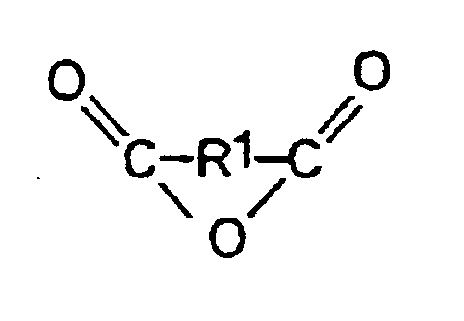
- Résine selon la revendication 1, caractérisée par le fait que le dérivé polybutadiène à terminaison -COOH ou anhydride est le produit de la réaction d'un polybutadiène à terminaison hydroxy avec l'anhydride phtalique ou l'anhydride succinique.
- Résine selon la revendication 1 ou 2, caractérisée par le fait que le dérivé polybutadiène à terminaison hydroxy comprend environ 20% d'insaturation en cis et environ 60% d'insaturation en trans.
- Résine selon l'une quelconque des revendications 1 à 3, caractérisée par le fait qu'elle contient au moins une structure de formule générale suivante :dans laquelle :
 PBd représente la chaíne principale polybutadiène dérivée d'un polybutadiène à terminaison hydroxy ;chacun des radicaux R1 et R'1, lesquels peuvent être identiques ou différents, représente indépendamment un résidu arylène, cycloalkylène ou alkylène d'un monoanhydride cyclique (m ou m' = 1), avec la possibilité pour R1 et R'1 de porter un groupe acide (m ou m' = 2) ou un autre groupe anhydride (m ou m' = 3) ;n vaut 0 ou 1 et, dans ce dernier cas, chacun des radicaux R2 et R'2, lesquels peuvent être identiques ou différents, représente indépendamment un résidu diépoxyde ;R et R', qui peuvent être identiques ou différents, sont choisis parmi les radicaux CH2=C(Y)-, avec Y = H ou CH3.
 - Résine selon l'une quelconque des revendications 1 à 4, caractérisée par le fait qu'elle possède une fonctionnalité RCOO- de 2 à 6.
- Résine selon l'une quelconque des revendications 1 à 5, caractérisée par le fait que la quantité d'anhydride utilisée est d'environ 2-15% en poids, la quantité de polybutadiène à terminaison hydroxy utilisée est de 50-90 pour cent en poids, la quantité de monoépoxyde utilisée pour la réaction avec ledit dérivé polybutadiène à terminaison -COOH ou anhydride est d'environ 4-20 pour cent en poids, et la quantité de diépoxyde utilisée est d'environ 1-10 pour cent en poids, toutes ces quantités étant rapportées à la charge totale de réactif.
- Procédé de production de la résine telle que définie dans l'une quelconque des revendications 1 à 6,
caractérisé par le fait que :dans une première étape, on fait réagir un dérivé polybutadiène à terminaison hydroxy avec au moins un anhydride cyclique de formule générale :dans laquelle R1 est choisi parmi les groupes arylène, cycloalkylène et alkylène, avec la possibilité pour R1 de porter un groupe -COOH ou un autre groupe anhydride,
pour obtenir un dérivé polybutadiène à terminaison -COOH ou anhydride ; ou on se procure un tel dérivé polybutadiène à terminaison -COOH ou anhydride ; etdans une deuxième étape, faire réagir ledit dérivé polybutadiène à terminaison -COOH ou anhydride avec un monoépoxyde portant une fonction de type R-COO-, dérivé d'un acide carboxylique α,β-insaturé R-COOH pour obtenir un dérivé polybutadiène à terminaison R-COO- ou avec une quantité supérieure ou inférieure à la stoechiométrie d'au moins un diépoxyde, pour former des groupes résiduels terminaux époxyde ou des groupes résiduels terminaux -COOH ou anhydride, respectivement, les groupes résiduels terminaux époxyde étant ensuite mis à réagir partiellement ou totalement avec au moins un acide carboxylique α,β-insaturé, et les groupes résiduels terminaux -COOH ou anhydride étant ensuite mis à réagir partiellement ou totalement avec au moins un monoépoxyde du type défini ci-dessus. - Procédé selon la revendication 7, caractérisé par le fait que l'anhydride cyclique est choisi parmi l'anhydride phtalique, l'anhydride succinique, l'anhydride trimellitique, l'anhydride hexahydrophtalique, les anhydrides chlorés tels que l'anhydride chlorendique et l'anhydride tétrachlorophtalique, l'anhydride méthyltétrahydrophtalique, le dianhydride pyromellitique, le dianhydride benzophénonetétracarboxylique et le dianhydride cyclopentanetétracarboxylique.
- Procédé selon la revendication 7, caractérisé par le fait que l'anhydride se solubilise dans un dérivé polybutadiène à terminaison hydroxy à moins d'environ 120°C et est par exemple, l'anhydride phtalique ou l'anhydride succinique.
- Procédé selon l'une quelconque des revendications 7 à 9, caractérisé par le fait que la première étape est réalisée à une température de 100°C à 160°C, de préférence de 100°C à 120°C.
- Procédé selon l'une quelconque des revendications 7 à 10, caractérisé par le fait que le monoépoxyde est l'acrylate ou le méthacrylate de glycidyle, et le diépoxyde est choisi parmi un éther diglycidylique de bisphénol A, un éther glycidylique d'une résine novolaque, un éther glycidylique d'un polyol aliphatique ou un époxyde cycloaliphatique.
- Procédé selon l'une quelconque des revendications 7 à 11, caractérisé par le fait que l'acide carboxylique α,β-insaturé est l'acide acrylique ou méthacrylique.
- Procédé selon l'une quelconque des revendications 7 à 12, caractérisé par le fait que la deuxième étape est réalisée à une température de 70°C à 130°C, de préférence de 90°C à 110°C, éventuellement en présence d'un catalyseur tel que le triphénylstilbène et la triphénylphosphine, les sels d'ammonium quaternaire et les composés du chrome, et éventuellement en présence d'un inhibiteur, tel que la toluylhydroquinone, la méthylhydroquinone, l'hydroquinone, la t-butylhydroquinone et la phénothiazine.
- Composition durcissable comprenant :(A) au moins une résine de polybutadiène telle que définie dans l'une quelconque des revendications 1 à 6 ou préparée par un procédé tel que défini dans l'une quelconque des revendications 7 à 13, y compris le produit de la réaction entre le méthacrylate de glycidyle et le produit de réaction d'un polybutadiène à terminaison hydroxy et l'anhydride maléique ; et(B) éventuellement au moins un monomère à insaturation éthylénique copolymérisable.
- Composition selon la revendication 14, caractérisée par le fait que, pour 100 parties en poids de (A) + (B), (A) représente 30-100 parties en poids et (B) représente 0-70 parties en poids.
- Composition selon la revendication 14 ou 15, caractérisée par le fait que les monomères (B) sont choisis parmi les monomères acryliques ou méthacryliques monofonctionnels ou polyfonctionnels, les (méth)acrylamides monofonctionnels. ou polyfonctionnels et les monomères vinyliques monofonctionnels ou polyfonctionnels.
- Composition selon l'une quelconque des revendications 14 à 16, qui peut être durcie à la chaleur ou qui peut être durcie à la température ambiante, caractérisée par le fait qu'elle contient au moins un initiateur de durcissement radicalaire de type peroxyde ou hydroperoxyde.
- Composition selon la revendication 17, caractérisée par le fait qu'elle contient au moins un siccatif, tel qu'un sel d'un métal de valence 2 ou plus d'un acide organique saturé ou insaturé.
- Composition selon l'une quelconque des revendications 14 à 18, qui peut être durcie par des ultraviolets ou par un faisceau d'électrons, caractérisée par le fait qu'elle contient au moins un photo-initiateur dans le premier cas et pas de photo-initiateur dans le second cas.
- Composition selon l'une quelconque des revendications 14 à 19, caractérisée par le fait qu'elle contient aussi au moins un additif habituel choisi parmi les solvants, les oligomères, les additifs de régulation de l'écoulement, les thixotropes, les pigments, les colorants, les charges, les antioxydants, les auxiliaires de dispersion et les stabilisants.
- Revêtements, adhésifs, produits d'étanchéité, produits de calfatage, revêtements électriques, obtenus par durcissement de la composition telle que définie dans l'une quelconque des revendications 14 à 20.
Applications Claiming Priority (3)
| Application Number | Priority Date | Filing Date | Title |
|---|---|---|---|
| US516144 | 1995-08-17 | ||
| US08/516,144 US5587433A (en) | 1995-08-17 | 1995-08-17 | Esters of hydroxy terminated polybutadiene compositions and methods for making same |
| PCT/EP1996/003593 WO1997007140A1 (fr) | 1995-08-17 | 1996-08-14 | Resines de polybutadiene fonctionnalisees, prodede de fabrication et utilisation de ces resines |
Publications (2)
| Publication Number | Publication Date |
|---|---|
| EP0845008A1 EP0845008A1 (fr) | 1998-06-03 |
| EP0845008B1 true EP0845008B1 (fr) | 2001-07-04 |
Family
ID=24054314
Family Applications (1)
| Application Number | Title | Priority Date | Filing Date |
|---|---|---|---|
| EP96928464A Expired - Lifetime EP0845008B1 (fr) | 1995-08-17 | 1996-08-14 | Resines de polybutadiene fonctionnalisees, prodede de fabrication et utilisation de ces resines |
Country Status (8)
| Country | Link |
|---|---|
| US (1) | US5587433A (fr) |
| EP (1) | EP0845008B1 (fr) |
| JP (1) | JP2000505120A (fr) |
| AT (1) | ATE202788T1 (fr) |
| CA (1) | CA2229225A1 (fr) |
| DE (1) | DE69613704T2 (fr) |
| ES (1) | ES2161371T3 (fr) |
| WO (1) | WO1997007140A1 (fr) |
Families Citing this family (45)
| Publication number | Priority date | Publication date | Assignee | Title |
|---|---|---|---|---|
| US5641834A (en) * | 1995-12-11 | 1997-06-24 | Lord Corporation | Modified polyalkadiene-containing compositions |
| JP2000502136A (ja) * | 1995-12-11 | 2000-02-22 | ロード コーポレーション | 改質ポリアルカジェン含有組成物 |
| US5710235A (en) * | 1995-12-11 | 1998-01-20 | Lord Corporation | Olefinic and urethane-terminated ester polyalkadiene |
| US5859134A (en) * | 1997-03-18 | 1999-01-12 | Polyfibron Technologies, Inc. | Polymers which are dispersible in aqueous solvents and photocurable elements comprising same |
| US6570001B1 (en) * | 1997-06-20 | 2003-05-27 | Institut Pasteur | Polynucleotides and their use for detecting resistance to streptogramin A or to streptogramin B and related compounds |
| US7157507B2 (en) | 1999-04-14 | 2007-01-02 | Allied Photochemical, Inc. | Ultraviolet curable silver composition and related method |
| CN1175058C (zh) | 1999-10-06 | 2004-11-10 | 紫外线专门公司 | 用于生产电发光涂料的紫外可固化的组合物 |
| US6767577B1 (en) | 1999-10-06 | 2004-07-27 | Allied Photochemical, Inc. | Uv curable compositions for producing electroluminescent coatings |
| US6500877B1 (en) | 1999-11-05 | 2002-12-31 | Krohn Industries, Inc. | UV curable paint compositions and method of making and applying same |
| US6509389B1 (en) | 1999-11-05 | 2003-01-21 | Uv Specialties, Inc. | UV curable compositions for producing mar resistant coatings and method for depositing same |
| WO2001040386A2 (fr) | 1999-12-06 | 2001-06-07 | Krohn Industries, Inc. | Compositions reticulables sous l'effet des uv pour la production de peintures multicouches |
| US6805917B1 (en) | 1999-12-06 | 2004-10-19 | Roy C. Krohn | UV curable compositions for producing decorative metallic coatings |
| MXPA02005257A (es) | 1999-12-06 | 2003-09-22 | Slidekote Inc | Composiciones curables por uv. |
| CA2396978C (fr) | 2000-01-13 | 2009-04-07 | Uv Specialties, Inc. | Compositions conductibles transparentes qui peut secher aux u.v. |
| WO2001051568A1 (fr) | 2000-01-13 | 2001-07-19 | Uv Specialties, Inc. | Compositions ferromagnetiques durcissables aux uv |
| US6706821B1 (en) * | 2000-07-18 | 2004-03-16 | Fmc Corporation | Michael addition products of amine terminated polyolefins and polyfunctional acrylates |
| US7323499B2 (en) | 2000-09-06 | 2008-01-29 | Allied Photochemical, Inc. | UV curable silver chloride compositions for producing silver coatings |
| AU2001293252A1 (en) | 2000-09-06 | 2002-03-22 | Allied Photochemical, Inc. | Uv curable silver chloride compositions for producing silver coatings |
| US20040077773A1 (en) * | 2002-07-12 | 2004-04-22 | Tavares Manuel J | Low viscosity, flexible, hydrolytically stable potting compounds |
| US20040229990A1 (en) * | 2003-05-16 | 2004-11-18 | Lord Corporation | Acrylic structural adhesive having improved T-peel strength |
| US6946628B2 (en) | 2003-09-09 | 2005-09-20 | Klai Enterprises, Inc. | Heating elements deposited on a substrate and related method |
| CA2538268C (fr) | 2003-09-10 | 2013-01-08 | Sartomer Technology Co., Inc. | Composition de polybutadiene (meth)acrylate et procede |
| US9623631B2 (en) * | 2005-06-22 | 2017-04-18 | Henkel IP & Holding GmbH | Radiation-curable laminating adhesives |
| US20100151242A1 (en) * | 2008-12-10 | 2010-06-17 | E.I. Du Pont De Nemours And Company | Impregnating compositions |
| CN102300950A (zh) | 2009-02-02 | 2011-12-28 | 洛德公司 | 含有马来酰亚胺封端的聚酰亚胺的结构粘合剂 |
| BRPI0924015A2 (pt) | 2009-04-21 | 2016-01-26 | Dow Global Technologies Llc | composição de agente de cura, composição curável e produto termofixo |
| US9145334B2 (en) * | 2011-09-22 | 2015-09-29 | Fina Technology, Inc. | Isocyanate-free insulated glass sealant and insulated glass units using the same |
| US20130084459A1 (en) | 2011-09-30 | 2013-04-04 | 3M Innovative Properties Company | Low peel adhesive |
| US8865315B2 (en) * | 2011-12-20 | 2014-10-21 | Huntsman International Llc | Self healing coating system for use with fuel tanks |
| KR20160132903A (ko) | 2014-03-10 | 2016-11-21 | 쓰리엠 이노베이티브 프로퍼티즈 캄파니 | 티올-치환된 실리콘을 포함하는 복합 나노입자 |
| US9896607B2 (en) | 2014-03-19 | 2018-02-20 | Lord Corporation | Amine co-accelerator for acrylic adhesives |
| US9574132B2 (en) | 2014-04-02 | 2017-02-21 | 3M Innovative Properties Company | Composite nanoparticles including a thioether ligand |
| JP2018529832A (ja) | 2015-09-15 | 2018-10-11 | スリーエム イノベイティブ プロパティズ カンパニー | 添加剤安定化複合ナノ粒子 |
| CN108026444B (zh) | 2015-09-15 | 2020-08-04 | 3M创新有限公司 | 添加剂稳定的复合纳米粒子 |
| EP3377591A1 (fr) | 2015-11-18 | 2018-09-26 | 3M Innovative Properties Company | Fluide porteur de stabilisation copolymère pour nanoparticules |
| WO2017142782A1 (fr) | 2016-02-17 | 2017-08-24 | 3M Innovative Properties Company | Points quantiques à copolymères fluorés stabilisants |
| KR20180128956A (ko) | 2016-04-01 | 2018-12-04 | 쓰리엠 이노베이티브 프로퍼티즈 컴파니 | 플루오로케미칼 안정화제를 갖는 양자점 |
| KR20190009763A (ko) | 2016-05-20 | 2019-01-29 | 쓰리엠 이노베이티브 프로퍼티즈 컴파니 | 혼합 아민 및 티올 리간드를 갖는 양자점 |
| US11345849B2 (en) | 2016-07-20 | 2022-05-31 | 3M Innovative Properties Company | Stabilizing styrenic polymer for quantum dots |
| CN109476987A (zh) | 2016-07-20 | 2019-03-15 | 3M创新有限公司 | 用于量子点的稳定苯乙烯系聚合物 |
| US10544241B2 (en) | 2016-09-15 | 2020-01-28 | Fina Technology, Inc. | Farnesene-based macromonomers and methods of making and using the same |
| WO2018167645A1 (fr) | 2017-03-14 | 2018-09-20 | 3M Innovative Properties Company | Nanoparticules composites stabilisées par des additifs |
| JP6481736B1 (ja) * | 2017-10-25 | 2019-03-13 | 横浜ゴム株式会社 | ゴム組成物、変性ジエン系重合体及び変性ジエン系重合体の製造方法 |
| US20210301183A1 (en) | 2020-03-24 | 2021-09-30 | Illinois Tool Works Inc. | Low surface energy accelerated bonding adhesive formulation and process for the use thereof |
| CN114369295B (zh) * | 2021-12-09 | 2022-08-26 | 中国科学院兰州化学物理研究所 | 一种改性丁腈橡胶水润滑复合材料及其制备方法 |
Family Cites Families (6)
| Publication number | Priority date | Publication date | Assignee | Title |
|---|---|---|---|---|
| US3652520A (en) * | 1968-03-22 | 1972-03-28 | Atlantic Richfield Co | Polymers of polymerizable polydiene ethylenically unsaturated esters |
| GB1264561A (fr) * | 1969-05-09 | 1972-02-23 | ||
| US4857434A (en) * | 1986-09-23 | 1989-08-15 | W. R. Grace & Co. | Radiation curable liquid (meth) acrylated polymeric hydrocarbon maleate prepolymers and formulations containing same |
| US5462835A (en) * | 1991-09-16 | 1995-10-31 | P T Sub Inc. | Photocurable composition, flexible, photosensitive articles made therefrom, and methods of improving solvent resistance and flexibility of those articles |
| JPH05112710A (ja) * | 1991-10-23 | 1993-05-07 | Mitsubishi Gas Chem Co Inc | ポリカーボネート樹脂組成物 |
| US5362819A (en) * | 1992-01-30 | 1994-11-08 | Gencorp Inc. | Polyester-flexible polymer block copolymers and mixtures thereof |
-
1995
- 1995-08-17 US US08/516,144 patent/US5587433A/en not_active Expired - Lifetime
-
1996
- 1996-08-14 ES ES96928464T patent/ES2161371T3/es not_active Expired - Lifetime
- 1996-08-14 DE DE69613704T patent/DE69613704T2/de not_active Expired - Lifetime
- 1996-08-14 JP JP9508943A patent/JP2000505120A/ja active Pending
- 1996-08-14 WO PCT/EP1996/003593 patent/WO1997007140A1/fr not_active Ceased
- 1996-08-14 EP EP96928464A patent/EP0845008B1/fr not_active Expired - Lifetime
- 1996-08-14 CA CA002229225A patent/CA2229225A1/fr not_active Abandoned
- 1996-08-14 AT AT96928464T patent/ATE202788T1/de active
Also Published As
| Publication number | Publication date |
|---|---|
| DE69613704T2 (de) | 2002-07-04 |
| WO1997007140A1 (fr) | 1997-02-27 |
| CA2229225A1 (fr) | 1997-02-27 |
| EP0845008A1 (fr) | 1998-06-03 |
| ATE202788T1 (de) | 2001-07-15 |
| US5587433A (en) | 1996-12-24 |
| DE69613704D1 (de) | 2001-08-09 |
| ES2161371T3 (es) | 2001-12-01 |
| JP2000505120A (ja) | 2000-04-25 |
Similar Documents
| Publication | Publication Date | Title |
|---|---|---|
| EP0845008B1 (fr) | Resines de polybutadiene fonctionnalisees, prodede de fabrication et utilisation de ces resines | |
| US3882187A (en) | Radiation curable epoxy ester-saturated alkyd compositions | |
| EP1189994B1 (fr) | Composes solubles dans l'huile et contenant des metaux, compositions et procedes associes | |
| US4250007A (en) | Photocurable acrylic phosphate esters of epoxidized polybutadiene | |
| US4330643A (en) | Process for production of acryloyloxy- or methacryloyloxy-terminated polyesters | |
| JP4565293B2 (ja) | 硬化性イミド樹脂の製造方法及びその組成物 | |
| US20050261458A1 (en) | Polycarboxylic acid resin, polycarboxylic acid resin composition, and cured article obtained therefrom | |
| US4411955A (en) | Reactive hardenable binder mixture, process for preparing hardened products and use of the mixture for the preparation of coatings | |
| JPH0151487B2 (fr) | ||
| US3968181A (en) | Modified acrylate resin | |
| JPH06172445A (ja) | アクリル基またはメトアクリル基を有するエポキシ樹脂 | |
| JPS6335609A (ja) | エチレン性不飽和基を有する硬化性樹脂組成物の製造法 | |
| JPS6029753B2 (ja) | 紫外線硬化性樹脂組成物 | |
| US3812063A (en) | Polyester prepolymer useful for coating and a method of preparing the same | |
| EP0977792A1 (fr) | Resines epoxydes contenant de l'azote pour applications comme revetements photodurcissables | |
| JPH0569816B2 (fr) | ||
| JP3436788B2 (ja) | 樹脂組成物、レジストインキ組成物及びこれらの硬化物 | |
| JPS5952649B2 (ja) | 光硬化性組成物 | |
| JP2001064376A (ja) | マレエート基を含むポリエステルの製造方法、樹脂組成物の製造方法及びマレエート基を含むポリエステルの異性化方法 | |
| JPH0714993B2 (ja) | 電子部品用表面コーテイング剤 | |
| JPH08277319A (ja) | ラジカル重合性不飽和基含有エポキシ樹脂 | |
| JPH0217566B2 (fr) | ||
| JPS58191773A (ja) | 活性エネルギ−線硬化性インキ組成物 | |
| WO1999001494A1 (fr) | Procede de production d'esters de resines epoxydes et compositions de resines photosensibles a base de tels esters | |
| JPH0124168B2 (fr) |
Legal Events
| Date | Code | Title | Description |
|---|---|---|---|
| PUAI | Public reference made under article 153(3) epc to a published international application that has entered the european phase |
Free format text: ORIGINAL CODE: 0009012 |
|
| 17P | Request for examination filed |
Effective date: 19980219 |
|
| AK | Designated contracting states |
Kind code of ref document: A1 Designated state(s): AT BE CH DE DK ES FI FR GB GR IE IT LI LU MC NL PT SE |
|
| 17Q | First examination report despatched |
Effective date: 19980831 |
|
| GRAG | Despatch of communication of intention to grant |
Free format text: ORIGINAL CODE: EPIDOS AGRA |
|
| GRAG | Despatch of communication of intention to grant |
Free format text: ORIGINAL CODE: EPIDOS AGRA |
|
| GRAH | Despatch of communication of intention to grant a patent |
Free format text: ORIGINAL CODE: EPIDOS IGRA |
|
| GRAH | Despatch of communication of intention to grant a patent |
Free format text: ORIGINAL CODE: EPIDOS IGRA |
|
| GRAA | (expected) grant |
Free format text: ORIGINAL CODE: 0009210 |
|
| AK | Designated contracting states |
Kind code of ref document: B1 Designated state(s): AT BE CH DE DK ES FI FR GB GR IE IT LI LU MC NL PT SE |
|
| PG25 | Lapsed in a contracting state [announced via postgrant information from national office to epo] |
Ref country code: LI Free format text: LAPSE BECAUSE OF FAILURE TO SUBMIT A TRANSLATION OF THE DESCRIPTION OR TO PAY THE FEE WITHIN THE PRESCRIBED TIME-LIMIT Effective date: 20010704 Ref country code: IT Free format text: LAPSE BECAUSE OF FAILURE TO SUBMIT A TRANSLATION OF THE DESCRIPTION OR TO PAY THE FEE WITHIN THE PRESCRIBED TIME-LIMIT;WARNING: LAPSES OF ITALIAN PATENTS WITH EFFECTIVE DATE BEFORE 2007 MAY HAVE OCCURRED AT ANY TIME BEFORE 2007. THE CORRECT EFFECTIVE DATE MAY BE DIFFERENT FROM THE ONE RECORDED. Effective date: 20010704 Ref country code: FI Free format text: LAPSE BECAUSE OF FAILURE TO SUBMIT A TRANSLATION OF THE DESCRIPTION OR TO PAY THE FEE WITHIN THE PRESCRIBED TIME-LIMIT Effective date: 20010704 Ref country code: CH Free format text: LAPSE BECAUSE OF FAILURE TO SUBMIT A TRANSLATION OF THE DESCRIPTION OR TO PAY THE FEE WITHIN THE PRESCRIBED TIME-LIMIT Effective date: 20010704 Ref country code: BE Free format text: LAPSE BECAUSE OF FAILURE TO SUBMIT A TRANSLATION OF THE DESCRIPTION OR TO PAY THE FEE WITHIN THE PRESCRIBED TIME-LIMIT Effective date: 20010704 Ref country code: AT Free format text: LAPSE BECAUSE OF FAILURE TO SUBMIT A TRANSLATION OF THE DESCRIPTION OR TO PAY THE FEE WITHIN THE PRESCRIBED TIME-LIMIT Effective date: 20010704 |
|
| REF | Corresponds to: |
Ref document number: 202788 Country of ref document: AT Date of ref document: 20010715 Kind code of ref document: T |
|
| REG | Reference to a national code |
Ref country code: CH Ref legal event code: EP |
|
| REG | Reference to a national code |
Ref country code: IE Ref legal event code: FG4D |
|
| REF | Corresponds to: |
Ref document number: 69613704 Country of ref document: DE Date of ref document: 20010809 |
|
| PG25 | Lapsed in a contracting state [announced via postgrant information from national office to epo] |
Ref country code: LU Free format text: LAPSE BECAUSE OF NON-PAYMENT OF DUE FEES Effective date: 20010814 Ref country code: IE Free format text: LAPSE BECAUSE OF NON-PAYMENT OF DUE FEES Effective date: 20010814 |
|
| PG25 | Lapsed in a contracting state [announced via postgrant information from national office to epo] |
Ref country code: SE Free format text: LAPSE BECAUSE OF FAILURE TO SUBMIT A TRANSLATION OF THE DESCRIPTION OR TO PAY THE FEE WITHIN THE PRESCRIBED TIME-LIMIT Effective date: 20011004 Ref country code: PT Free format text: LAPSE BECAUSE OF FAILURE TO SUBMIT A TRANSLATION OF THE DESCRIPTION OR TO PAY THE FEE WITHIN THE PRESCRIBED TIME-LIMIT Effective date: 20011004 Ref country code: DK Free format text: LAPSE BECAUSE OF FAILURE TO SUBMIT A TRANSLATION OF THE DESCRIPTION OR TO PAY THE FEE WITHIN THE PRESCRIBED TIME-LIMIT Effective date: 20011004 |
|
| PG25 | Lapsed in a contracting state [announced via postgrant information from national office to epo] |
Ref country code: GR Free format text: LAPSE BECAUSE OF FAILURE TO SUBMIT A TRANSLATION OF THE DESCRIPTION OR TO PAY THE FEE WITHIN THE PRESCRIBED TIME-LIMIT Effective date: 20011005 |
|
| ET | Fr: translation filed | ||
| REG | Reference to a national code |
Ref country code: ES Ref legal event code: FG2A Ref document number: 2161371 Country of ref document: ES Kind code of ref document: T3 |
|
| REG | Reference to a national code |
Ref country code: GB Ref legal event code: IF02 |
|
| REG | Reference to a national code |
Ref country code: CH Ref legal event code: PL |
|
| PG25 | Lapsed in a contracting state [announced via postgrant information from national office to epo] |
Ref country code: MC Free format text: LAPSE BECAUSE OF NON-PAYMENT OF DUE FEES Effective date: 20020301 |
|
| PLBE | No opposition filed within time limit |
Free format text: ORIGINAL CODE: 0009261 |
|
| STAA | Information on the status of an ep patent application or granted ep patent |
Free format text: STATUS: NO OPPOSITION FILED WITHIN TIME LIMIT |
|
| REG | Reference to a national code |
Ref country code: IE Ref legal event code: MM4A |
|
| 26N | No opposition filed | ||
| REG | Reference to a national code |
Ref country code: NL Ref legal event code: SD Effective date: 20101111 |
|
| REG | Reference to a national code |
Ref country code: GB Ref legal event code: 732E Free format text: REGISTERED BETWEEN 20101209 AND 20101215 |
|
| REG | Reference to a national code |
Ref country code: DE Ref legal event code: R081 Ref document number: 69613704 Country of ref document: DE Owner name: CRAY VALLEY TECHNOLOGY USA, LLC, WILMINGTON, US Free format text: FORMER OWNER: SARTOMER CO. INC., EXTON, PA., US Effective date: 20110216 |
|
| REG | Reference to a national code |
Ref country code: FR Ref legal event code: TP |
|
| REG | Reference to a national code |
Ref country code: FR Ref legal event code: PLFP Year of fee payment: 20 |
|
| PGFP | Annual fee paid to national office [announced via postgrant information from national office to epo] |
Ref country code: NL Payment date: 20150826 Year of fee payment: 20 |
|
| PGFP | Annual fee paid to national office [announced via postgrant information from national office to epo] |
Ref country code: ES Payment date: 20150826 Year of fee payment: 20 Ref country code: GB Payment date: 20150827 Year of fee payment: 20 Ref country code: DE Payment date: 20150827 Year of fee payment: 20 |
|
| PGFP | Annual fee paid to national office [announced via postgrant information from national office to epo] |
Ref country code: FR Payment date: 20150817 Year of fee payment: 20 |
|
| REG | Reference to a national code |
Ref country code: DE Ref legal event code: R071 Ref document number: 69613704 Country of ref document: DE |
|
| REG | Reference to a national code |
Ref country code: NL Ref legal event code: MK Effective date: 20160813 |
|
| REG | Reference to a national code |
Ref country code: GB Ref legal event code: PE20 Expiry date: 20160813 |
|
| PG25 | Lapsed in a contracting state [announced via postgrant information from national office to epo] |
Ref country code: GB Free format text: LAPSE BECAUSE OF EXPIRATION OF PROTECTION Effective date: 20160813 |
|
| REG | Reference to a national code |
Ref country code: ES Ref legal event code: FD2A Effective date: 20161125 |
|
| PG25 | Lapsed in a contracting state [announced via postgrant information from national office to epo] |
Ref country code: ES Free format text: LAPSE BECAUSE OF EXPIRATION OF PROTECTION Effective date: 20160815 |