EP0845351A2 - Film de polyester stratifié orienté biaxialement - Google Patents
Film de polyester stratifié orienté biaxialement Download PDFInfo
- Publication number
- EP0845351A2 EP0845351A2 EP97308963A EP97308963A EP0845351A2 EP 0845351 A2 EP0845351 A2 EP 0845351A2 EP 97308963 A EP97308963 A EP 97308963A EP 97308963 A EP97308963 A EP 97308963A EP 0845351 A2 EP0845351 A2 EP 0845351A2
- Authority
- EP
- European Patent Office
- Prior art keywords
- layer
- biaxially oriented
- polyester film
- film
- fine particles
- Prior art date
- Legal status (The legal status is an assumption and is not a legal conclusion. Google has not performed a legal analysis and makes no representation as to the accuracy of the status listed.)
- Granted
Links
- 229920006267 polyester film Polymers 0.000 title claims abstract description 32
- 239000002245 particle Substances 0.000 claims abstract description 55
- 239000010419 fine particle Substances 0.000 claims abstract description 38
- 229920000728 polyester Polymers 0.000 claims abstract description 32
- 125000003118 aryl group Chemical group 0.000 claims abstract description 24
- 229910052751 metal Inorganic materials 0.000 claims abstract description 13
- 239000002184 metal Substances 0.000 claims abstract description 13
- 239000000126 substance Substances 0.000 claims description 4
- 238000009826 distribution Methods 0.000 claims description 2
- 239000010410 layer Substances 0.000 description 78
- LYCAIKOWRPUZTN-UHFFFAOYSA-N Ethylene glycol Chemical compound OCCO LYCAIKOWRPUZTN-UHFFFAOYSA-N 0.000 description 28
- 239000002253 acid Substances 0.000 description 14
- 238000000034 method Methods 0.000 description 12
- -1 alicyclic diols Chemical class 0.000 description 11
- 239000005001 laminate film Substances 0.000 description 11
- 238000005259 measurement Methods 0.000 description 9
- KKEYFWRCBNTPAC-UHFFFAOYSA-N Terephthalic acid Chemical compound OC(=O)C1=CC=C(C(O)=O)C=C1 KKEYFWRCBNTPAC-UHFFFAOYSA-N 0.000 description 8
- WGCNASOHLSPBMP-UHFFFAOYSA-N hydroxyacetaldehyde Natural products OCC=O WGCNASOHLSPBMP-UHFFFAOYSA-N 0.000 description 8
- OFOBLEOULBTSOW-UHFFFAOYSA-N Malonic acid Chemical compound OC(=O)CC(O)=O OFOBLEOULBTSOW-UHFFFAOYSA-N 0.000 description 6
- 239000011248 coating agent Substances 0.000 description 6
- 238000000576 coating method Methods 0.000 description 6
- XEEYBQQBJWHFJM-UHFFFAOYSA-N Iron Chemical compound [Fe] XEEYBQQBJWHFJM-UHFFFAOYSA-N 0.000 description 5
- 150000002500 ions Chemical group 0.000 description 5
- 235000019592 roughness Nutrition 0.000 description 5
- 239000002344 surface layer Substances 0.000 description 5
- 230000003746 surface roughness Effects 0.000 description 5
- GWEVSGVZZGPLCZ-UHFFFAOYSA-N Titan oxide Chemical compound O=[Ti]=O GWEVSGVZZGPLCZ-UHFFFAOYSA-N 0.000 description 4
- 239000011230 binding agent Substances 0.000 description 4
- 239000000203 mixture Substances 0.000 description 4
- 229920000139 polyethylene terephthalate Polymers 0.000 description 4
- 239000005020 polyethylene terephthalate Substances 0.000 description 4
- ZWEHNKRNPOVVGH-UHFFFAOYSA-N 2-Butanone Chemical compound CCC(C)=O ZWEHNKRNPOVVGH-UHFFFAOYSA-N 0.000 description 3
- YXFVVABEGXRONW-UHFFFAOYSA-N Toluene Chemical compound CC1=CC=CC=C1 YXFVVABEGXRONW-UHFFFAOYSA-N 0.000 description 3
- 229920002433 Vinyl chloride-vinyl acetate copolymer Polymers 0.000 description 3
- 125000001931 aliphatic group Chemical group 0.000 description 3
- 238000006243 chemical reaction Methods 0.000 description 3
- 238000001816 cooling Methods 0.000 description 3
- 239000006185 dispersion Substances 0.000 description 3
- 238000004519 manufacturing process Methods 0.000 description 3
- 238000002844 melting Methods 0.000 description 3
- 230000008018 melting Effects 0.000 description 3
- RXOHFPCZGPKIRD-UHFFFAOYSA-N naphthalene-2,6-dicarboxylic acid Chemical compound C1=C(C(O)=O)C=CC2=CC(C(=O)O)=CC=C21 RXOHFPCZGPKIRD-UHFFFAOYSA-N 0.000 description 3
- 239000000843 powder Substances 0.000 description 3
- MYRTYDVEIRVNKP-UHFFFAOYSA-N 1,2-Divinylbenzene Chemical compound C=CC1=CC=CC=C1C=C MYRTYDVEIRVNKP-UHFFFAOYSA-N 0.000 description 2
- ISPYQTSUDJAMAB-UHFFFAOYSA-N 2-chlorophenol Chemical compound OC1=CC=CC=C1Cl ISPYQTSUDJAMAB-UHFFFAOYSA-N 0.000 description 2
- VTYYLEPIZMXCLO-UHFFFAOYSA-L Calcium carbonate Chemical compound [Ca+2].[O-]C([O-])=O VTYYLEPIZMXCLO-UHFFFAOYSA-L 0.000 description 2
- QIGBRXMKCJKVMJ-UHFFFAOYSA-N Hydroquinone Chemical compound OC1=CC=C(O)C=C1 QIGBRXMKCJKVMJ-UHFFFAOYSA-N 0.000 description 2
- UQSXHKLRYXJYBZ-UHFFFAOYSA-N Iron oxide Chemical compound [Fe]=O UQSXHKLRYXJYBZ-UHFFFAOYSA-N 0.000 description 2
- WGLPBDUCMAPZCE-UHFFFAOYSA-N Trioxochromium Chemical compound O=[Cr](=O)=O WGLPBDUCMAPZCE-UHFFFAOYSA-N 0.000 description 2
- BZHJMEDXRYGGRV-UHFFFAOYSA-N Vinyl chloride Chemical compound ClC=C BZHJMEDXRYGGRV-UHFFFAOYSA-N 0.000 description 2
- WNLRTRBMVRJNCN-UHFFFAOYSA-N adipic acid Chemical compound OC(=O)CCCCC(O)=O WNLRTRBMVRJNCN-UHFFFAOYSA-N 0.000 description 2
- 238000004458 analytical method Methods 0.000 description 2
- ADCOVFLJGNWWNZ-UHFFFAOYSA-N antimony trioxide Chemical compound O=[Sb]O[Sb]=O ADCOVFLJGNWWNZ-UHFFFAOYSA-N 0.000 description 2
- IISBACLAFKSPIT-UHFFFAOYSA-N bisphenol A Chemical compound C=1C=C(O)C=CC=1C(C)(C)C1=CC=C(O)C=C1 IISBACLAFKSPIT-UHFFFAOYSA-N 0.000 description 2
- WERYXYBDKMZEQL-UHFFFAOYSA-N butane-1,4-diol Chemical compound OCCCCO WERYXYBDKMZEQL-UHFFFAOYSA-N 0.000 description 2
- 239000003795 chemical substances by application Substances 0.000 description 2
- 229910000423 chromium oxide Inorganic materials 0.000 description 2
- 229920001577 copolymer Polymers 0.000 description 2
- JHIVVAPYMSGYDF-UHFFFAOYSA-N cyclohexanone Chemical compound O=C1CCCCC1 JHIVVAPYMSGYDF-UHFFFAOYSA-N 0.000 description 2
- 230000007547 defect Effects 0.000 description 2
- 230000000593 degrading effect Effects 0.000 description 2
- 230000002542 deteriorative effect Effects 0.000 description 2
- GYUVMLBYMPKZAZ-UHFFFAOYSA-N dimethyl naphthalene-2,6-dicarboxylate Chemical compound C1=C(C(=O)OC)C=CC2=CC(C(=O)OC)=CC=C21 GYUVMLBYMPKZAZ-UHFFFAOYSA-N 0.000 description 2
- WOZVHXUHUFLZGK-UHFFFAOYSA-N dimethyl terephthalate Chemical compound COC(=O)C1=CC=C(C(=O)OC)C=C1 WOZVHXUHUFLZGK-UHFFFAOYSA-N 0.000 description 2
- 229910052742 iron Inorganic materials 0.000 description 2
- QQVIHTHCMHWDBS-UHFFFAOYSA-N isophthalic acid Chemical compound OC(=O)C1=CC=CC(C(O)=O)=C1 QQVIHTHCMHWDBS-UHFFFAOYSA-N 0.000 description 2
- 239000006247 magnetic powder Substances 0.000 description 2
- 229910052757 nitrogen Inorganic materials 0.000 description 2
- 239000008188 pellet Substances 0.000 description 2
- 229920006324 polyoxymethylene Polymers 0.000 description 2
- YPFDHNVEDLHUCE-UHFFFAOYSA-N propane-1,3-diol Chemical compound OCCCO YPFDHNVEDLHUCE-UHFFFAOYSA-N 0.000 description 2
- CXMXRPHRNRROMY-UHFFFAOYSA-N sebacic acid Chemical compound OC(=O)CCCCCCCCC(O)=O CXMXRPHRNRROMY-UHFFFAOYSA-N 0.000 description 2
- 239000007787 solid Substances 0.000 description 2
- 229910001220 stainless steel Inorganic materials 0.000 description 2
- 239000010935 stainless steel Substances 0.000 description 2
- OGIDPMRJRNCKJF-UHFFFAOYSA-N titanium oxide Inorganic materials [Ti]=O OGIDPMRJRNCKJF-UHFFFAOYSA-N 0.000 description 2
- ARCGXLSVLAOJQL-UHFFFAOYSA-N trimellitic acid Chemical compound OC(=O)C1=CC=C(C(O)=O)C(C(O)=O)=C1 ARCGXLSVLAOJQL-UHFFFAOYSA-N 0.000 description 2
- PUPZLCDOIYMWBV-UHFFFAOYSA-N (+/-)-1,3-Butanediol Chemical compound CC(O)CCO PUPZLCDOIYMWBV-UHFFFAOYSA-N 0.000 description 1
- PXGZQGDTEZPERC-UHFFFAOYSA-N 1,4-cyclohexanedicarboxylic acid Chemical compound OC(=O)C1CCC(C(O)=O)CC1 PXGZQGDTEZPERC-UHFFFAOYSA-N 0.000 description 1
- BXJGUBZTZWCMEX-UHFFFAOYSA-N 2,3-dimethylbenzene-1,4-diol Chemical compound CC1=C(C)C(O)=CC=C1O BXJGUBZTZWCMEX-UHFFFAOYSA-N 0.000 description 1
- BXGYYDRIMBPOMN-UHFFFAOYSA-N 2-(hydroxymethoxy)ethoxymethanol Chemical compound OCOCCOCO BXGYYDRIMBPOMN-UHFFFAOYSA-N 0.000 description 1
- FJKROLUGYXJWQN-UHFFFAOYSA-N 4-hydroxybenzoic acid Chemical compound OC(=O)C1=CC=C(O)C=C1 FJKROLUGYXJWQN-UHFFFAOYSA-N 0.000 description 1
- OKTJSMMVPCPJKN-UHFFFAOYSA-N Carbon Chemical compound [C] OKTJSMMVPCPJKN-UHFFFAOYSA-N 0.000 description 1
- ALQSHHUCVQOPAS-UHFFFAOYSA-N Pentane-1,5-diol Chemical compound OCCCCCO ALQSHHUCVQOPAS-UHFFFAOYSA-N 0.000 description 1
- OAICVXFJPJFONN-UHFFFAOYSA-N Phosphorus Chemical compound [P] OAICVXFJPJFONN-UHFFFAOYSA-N 0.000 description 1
- 239000002202 Polyethylene glycol Substances 0.000 description 1
- VYPSYNLAJGMNEJ-UHFFFAOYSA-N Silicium dioxide Chemical compound O=[Si]=O VYPSYNLAJGMNEJ-UHFFFAOYSA-N 0.000 description 1
- 238000005299 abrasion Methods 0.000 description 1
- 230000001133 acceleration Effects 0.000 description 1
- 235000011037 adipic acid Nutrition 0.000 description 1
- 239000001361 adipic acid Substances 0.000 description 1
- 125000002723 alicyclic group Chemical group 0.000 description 1
- PNEYBMLMFCGWSK-UHFFFAOYSA-N aluminium oxide Inorganic materials [O-2].[O-2].[O-2].[Al+3].[Al+3] PNEYBMLMFCGWSK-UHFFFAOYSA-N 0.000 description 1
- FNGGVJIEWDRLFV-UHFFFAOYSA-N anthracene-1,2-dicarboxylic acid Chemical compound C1=CC=CC2=CC3=C(C(O)=O)C(C(=O)O)=CC=C3C=C21 FNGGVJIEWDRLFV-UHFFFAOYSA-N 0.000 description 1
- 229910000019 calcium carbonate Inorganic materials 0.000 description 1
- 229910052799 carbon Inorganic materials 0.000 description 1
- 125000004432 carbon atom Chemical group C* 0.000 description 1
- 239000006229 carbon black Substances 0.000 description 1
- 239000003054 catalyst Substances 0.000 description 1
- 238000005119 centrifugation Methods 0.000 description 1
- 239000011247 coating layer Substances 0.000 description 1
- 230000000052 comparative effect Effects 0.000 description 1
- 150000001875 compounds Chemical class 0.000 description 1
- FOTKYAAJKYLFFN-UHFFFAOYSA-N decane-1,10-diol Chemical compound OCCCCCCCCCCO FOTKYAAJKYLFFN-UHFFFAOYSA-N 0.000 description 1
- 150000002148 esters Chemical group 0.000 description 1
- 238000001125 extrusion Methods 0.000 description 1
- 125000000524 functional group Chemical group 0.000 description 1
- 230000009477 glass transition Effects 0.000 description 1
- 150000002334 glycols Chemical class 0.000 description 1
- 238000009998 heat setting Methods 0.000 description 1
- 238000010438 heat treatment Methods 0.000 description 1
- XXMIOPMDWAUFGU-UHFFFAOYSA-N hexane-1,6-diol Chemical compound OCCCCCCO XXMIOPMDWAUFGU-UHFFFAOYSA-N 0.000 description 1
- 239000012948 isocyanate Substances 0.000 description 1
- 238000010030 laminating Methods 0.000 description 1
- 238000003475 lamination Methods 0.000 description 1
- 239000000314 lubricant Substances 0.000 description 1
- 239000002932 luster Substances 0.000 description 1
- 229940071125 manganese acetate Drugs 0.000 description 1
- UOGMEBQRZBEZQT-UHFFFAOYSA-L manganese(2+);diacetate Chemical compound [Mn+2].CC([O-])=O.CC([O-])=O UOGMEBQRZBEZQT-UHFFFAOYSA-L 0.000 description 1
- 238000000465 moulding Methods 0.000 description 1
- 229920000620 organic polymer Polymers 0.000 description 1
- AJCDFVKYMIUXCR-UHFFFAOYSA-N oxobarium;oxo(oxoferriooxy)iron Chemical compound [Ba]=O.O=[Fe]O[Fe]=O.O=[Fe]O[Fe]=O.O=[Fe]O[Fe]=O.O=[Fe]O[Fe]=O.O=[Fe]O[Fe]=O.O=[Fe]O[Fe]=O AJCDFVKYMIUXCR-UHFFFAOYSA-N 0.000 description 1
- WXZMFSXDPGVJKK-UHFFFAOYSA-N pentaerythritol Chemical compound OCC(CO)(CO)CO WXZMFSXDPGVJKK-UHFFFAOYSA-N 0.000 description 1
- 229910052698 phosphorus Inorganic materials 0.000 description 1
- 239000011574 phosphorus Substances 0.000 description 1
- 230000000704 physical effect Effects 0.000 description 1
- 229920001515 polyalkylene glycol Polymers 0.000 description 1
- 229920001223 polyethylene glycol Polymers 0.000 description 1
- 239000002685 polymerization catalyst Substances 0.000 description 1
- 229920001451 polypropylene glycol Polymers 0.000 description 1
- GHMLBKRAJCXXBS-UHFFFAOYSA-N resorcinol Chemical compound OC1=CC=CC(O)=C1 GHMLBKRAJCXXBS-UHFFFAOYSA-N 0.000 description 1
- 229960001755 resorcinol Drugs 0.000 description 1
- 229920002050 silicone resin Polymers 0.000 description 1
- 239000002904 solvent Substances 0.000 description 1
- 239000003381 stabilizer Substances 0.000 description 1
- 238000005211 surface analysis Methods 0.000 description 1
- 229920002803 thermoplastic polyurethane Polymers 0.000 description 1
- 239000004408 titanium dioxide Substances 0.000 description 1
Images
Classifications
-
- B—PERFORMING OPERATIONS; TRANSPORTING
- B32—LAYERED PRODUCTS
- B32B—LAYERED PRODUCTS, i.e. PRODUCTS BUILT-UP OF STRATA OF FLAT OR NON-FLAT, e.g. CELLULAR OR HONEYCOMB, FORM
- B32B27/00—Layered products comprising a layer of synthetic resin
- B32B27/36—Layered products comprising a layer of synthetic resin comprising polyesters
-
- C—CHEMISTRY; METALLURGY
- C08—ORGANIC MACROMOLECULAR COMPOUNDS; THEIR PREPARATION OR CHEMICAL WORKING-UP; COMPOSITIONS BASED THEREON
- C08J—WORKING-UP; GENERAL PROCESSES OF COMPOUNDING; AFTER-TREATMENT NOT COVERED BY SUBCLASSES C08B, C08C, C08F, C08G or C08H
- C08J5/00—Manufacture of articles or shaped materials containing macromolecular substances
- C08J5/18—Manufacture of films or sheets
-
- G—PHYSICS
- G11—INFORMATION STORAGE
- G11B—INFORMATION STORAGE BASED ON RELATIVE MOVEMENT BETWEEN RECORD CARRIER AND TRANSDUCER
- G11B5/00—Recording by magnetisation or demagnetisation of a record carrier; Reproducing by magnetic means; Record carriers therefor
- G11B5/62—Record carriers characterised by the selection of the material
- G11B5/73—Base layers, i.e. all non-magnetic layers lying under a lowermost magnetic recording layer, e.g. including any non-magnetic layer in between a first magnetic recording layer and either an underlying substrate or a soft magnetic underlayer
- G11B5/733—Base layers, i.e. all non-magnetic layers lying under a lowermost magnetic recording layer, e.g. including any non-magnetic layer in between a first magnetic recording layer and either an underlying substrate or a soft magnetic underlayer characterised by the addition of non-magnetic particles
-
- G—PHYSICS
- G11—INFORMATION STORAGE
- G11B—INFORMATION STORAGE BASED ON RELATIVE MOVEMENT BETWEEN RECORD CARRIER AND TRANSDUCER
- G11B5/00—Recording by magnetisation or demagnetisation of a record carrier; Reproducing by magnetic means; Record carriers therefor
- G11B5/62—Record carriers characterised by the selection of the material
- G11B5/73—Base layers, i.e. all non-magnetic layers lying under a lowermost magnetic recording layer, e.g. including any non-magnetic layer in between a first magnetic recording layer and either an underlying substrate or a soft magnetic underlayer
- G11B5/739—Magnetic recording media substrates
- G11B5/73923—Organic polymer substrates
- G11B5/73927—Polyester substrates, e.g. polyethylene terephthalate
- G11B5/73931—Two or more layers, at least one layer being polyester
-
- G—PHYSICS
- G11—INFORMATION STORAGE
- G11B—INFORMATION STORAGE BASED ON RELATIVE MOVEMENT BETWEEN RECORD CARRIER AND TRANSDUCER
- G11B5/00—Recording by magnetisation or demagnetisation of a record carrier; Reproducing by magnetic means; Record carriers therefor
- G11B5/62—Record carriers characterised by the selection of the material
- G11B5/73—Base layers, i.e. all non-magnetic layers lying under a lowermost magnetic recording layer, e.g. including any non-magnetic layer in between a first magnetic recording layer and either an underlying substrate or a soft magnetic underlayer
- G11B5/739—Magnetic recording media substrates
- G11B5/73923—Organic polymer substrates
- G11B5/73927—Polyester substrates, e.g. polyethylene terephthalate
- G11B5/73935—Polyester substrates, e.g. polyethylene terephthalate characterised by roughness or surface features, e.g. by added particles
-
- Y—GENERAL TAGGING OF NEW TECHNOLOGICAL DEVELOPMENTS; GENERAL TAGGING OF CROSS-SECTIONAL TECHNOLOGIES SPANNING OVER SEVERAL SECTIONS OF THE IPC; TECHNICAL SUBJECTS COVERED BY FORMER USPC CROSS-REFERENCE ART COLLECTIONS [XRACs] AND DIGESTS
- Y10—TECHNICAL SUBJECTS COVERED BY FORMER USPC
- Y10S—TECHNICAL SUBJECTS COVERED BY FORMER USPC CROSS-REFERENCE ART COLLECTIONS [XRACs] AND DIGESTS
- Y10S428/00—Stock material or miscellaneous articles
- Y10S428/90—Magnetic feature
-
- Y—GENERAL TAGGING OF NEW TECHNOLOGICAL DEVELOPMENTS; GENERAL TAGGING OF CROSS-SECTIONAL TECHNOLOGIES SPANNING OVER SEVERAL SECTIONS OF THE IPC; TECHNICAL SUBJECTS COVERED BY FORMER USPC CROSS-REFERENCE ART COLLECTIONS [XRACs] AND DIGESTS
- Y10—TECHNICAL SUBJECTS COVERED BY FORMER USPC
- Y10S—TECHNICAL SUBJECTS COVERED BY FORMER USPC CROSS-REFERENCE ART COLLECTIONS [XRACs] AND DIGESTS
- Y10S428/00—Stock material or miscellaneous articles
- Y10S428/91—Product with molecular orientation
-
- Y—GENERAL TAGGING OF NEW TECHNOLOGICAL DEVELOPMENTS; GENERAL TAGGING OF CROSS-SECTIONAL TECHNOLOGIES SPANNING OVER SEVERAL SECTIONS OF THE IPC; TECHNICAL SUBJECTS COVERED BY FORMER USPC CROSS-REFERENCE ART COLLECTIONS [XRACs] AND DIGESTS
- Y10—TECHNICAL SUBJECTS COVERED BY FORMER USPC
- Y10T—TECHNICAL SUBJECTS COVERED BY FORMER US CLASSIFICATION
- Y10T428/00—Stock material or miscellaneous articles
- Y10T428/24—Structurally defined web or sheet [e.g., overall dimension, etc.]
- Y10T428/24355—Continuous and nonuniform or irregular surface on layer or component [e.g., roofing, etc.]
-
- Y—GENERAL TAGGING OF NEW TECHNOLOGICAL DEVELOPMENTS; GENERAL TAGGING OF CROSS-SECTIONAL TECHNOLOGIES SPANNING OVER SEVERAL SECTIONS OF THE IPC; TECHNICAL SUBJECTS COVERED BY FORMER USPC CROSS-REFERENCE ART COLLECTIONS [XRACs] AND DIGESTS
- Y10—TECHNICAL SUBJECTS COVERED BY FORMER USPC
- Y10T—TECHNICAL SUBJECTS COVERED BY FORMER US CLASSIFICATION
- Y10T428/00—Stock material or miscellaneous articles
- Y10T428/24—Structurally defined web or sheet [e.g., overall dimension, etc.]
- Y10T428/24942—Structurally defined web or sheet [e.g., overall dimension, etc.] including components having same physical characteristic in differing degree
- Y10T428/2495—Thickness [relative or absolute]
-
- Y—GENERAL TAGGING OF NEW TECHNOLOGICAL DEVELOPMENTS; GENERAL TAGGING OF CROSS-SECTIONAL TECHNOLOGIES SPANNING OVER SEVERAL SECTIONS OF THE IPC; TECHNICAL SUBJECTS COVERED BY FORMER USPC CROSS-REFERENCE ART COLLECTIONS [XRACs] AND DIGESTS
- Y10—TECHNICAL SUBJECTS COVERED BY FORMER USPC
- Y10T—TECHNICAL SUBJECTS COVERED BY FORMER US CLASSIFICATION
- Y10T428/00—Stock material or miscellaneous articles
- Y10T428/25—Web or sheet containing structurally defined element or component and including a second component containing structurally defined particles
-
- Y—GENERAL TAGGING OF NEW TECHNOLOGICAL DEVELOPMENTS; GENERAL TAGGING OF CROSS-SECTIONAL TECHNOLOGIES SPANNING OVER SEVERAL SECTIONS OF THE IPC; TECHNICAL SUBJECTS COVERED BY FORMER USPC CROSS-REFERENCE ART COLLECTIONS [XRACs] AND DIGESTS
- Y10—TECHNICAL SUBJECTS COVERED BY FORMER USPC
- Y10T—TECHNICAL SUBJECTS COVERED BY FORMER US CLASSIFICATION
- Y10T428/00—Stock material or miscellaneous articles
- Y10T428/26—Web or sheet containing structurally defined element or component, the element or component having a specified physical dimension
-
- Y—GENERAL TAGGING OF NEW TECHNOLOGICAL DEVELOPMENTS; GENERAL TAGGING OF CROSS-SECTIONAL TECHNOLOGIES SPANNING OVER SEVERAL SECTIONS OF THE IPC; TECHNICAL SUBJECTS COVERED BY FORMER USPC CROSS-REFERENCE ART COLLECTIONS [XRACs] AND DIGESTS
- Y10—TECHNICAL SUBJECTS COVERED BY FORMER USPC
- Y10T—TECHNICAL SUBJECTS COVERED BY FORMER US CLASSIFICATION
- Y10T428/00—Stock material or miscellaneous articles
- Y10T428/26—Web or sheet containing structurally defined element or component, the element or component having a specified physical dimension
- Y10T428/266—Web or sheet containing structurally defined element or component, the element or component having a specified physical dimension of base or substrate
-
- Y—GENERAL TAGGING OF NEW TECHNOLOGICAL DEVELOPMENTS; GENERAL TAGGING OF CROSS-SECTIONAL TECHNOLOGIES SPANNING OVER SEVERAL SECTIONS OF THE IPC; TECHNICAL SUBJECTS COVERED BY FORMER USPC CROSS-REFERENCE ART COLLECTIONS [XRACs] AND DIGESTS
- Y10—TECHNICAL SUBJECTS COVERED BY FORMER USPC
- Y10T—TECHNICAL SUBJECTS COVERED BY FORMER US CLASSIFICATION
- Y10T428/00—Stock material or miscellaneous articles
- Y10T428/29—Coated or structually defined flake, particle, cell, strand, strand portion, rod, filament, macroscopic fiber or mass thereof
- Y10T428/2982—Particulate matter [e.g., sphere, flake, etc.]
-
- Y—GENERAL TAGGING OF NEW TECHNOLOGICAL DEVELOPMENTS; GENERAL TAGGING OF CROSS-SECTIONAL TECHNOLOGIES SPANNING OVER SEVERAL SECTIONS OF THE IPC; TECHNICAL SUBJECTS COVERED BY FORMER USPC CROSS-REFERENCE ART COLLECTIONS [XRACs] AND DIGESTS
- Y10—TECHNICAL SUBJECTS COVERED BY FORMER USPC
- Y10T—TECHNICAL SUBJECTS COVERED BY FORMER US CLASSIFICATION
- Y10T428/00—Stock material or miscellaneous articles
- Y10T428/31504—Composite [nonstructural laminate]
- Y10T428/31786—Of polyester [e.g., alkyd, etc.]
Definitions
- This invention relates to a biaxially oriented laminate polyester film. More specifically, it relates to a biaxially oriented laminate polyester film useful for a magnetic tape, particularly a digital recording magnetic tape, having stable running properties and excellent magnetic output characteristics.
- JP-A 2-77431 discloses a biaxially oriented laminate polyester film having a specific relationship between the thickness of a polyester layer and the particle diameter of fine particles contained in the polyester layer.
- the magnetic tape runs through a complicated running system at the time of recording or reproduction in most of its systems. If the running properties of the magnetic tape are not balanced at a contact portion of the surface of a magnetic layer or back coated layer, such a defect as a track deviation or the like occurs. For example, in a DLT (digital linear tape), when the running properties of the tape are not balanced at a contact portion of the surface of a magnetic layer or back coated layer, a defect called "LTM (lateral tape motion)" occurs.
- DLT digital linear tape
- the aromatic polyester of the first layer forming the film of the present invention comprises an aromatic dicarboxylic acid as a main acid component preferably in an amount of 80 mol% or more and an aliphatic glycol as a main glycol component preferably in an amount of 80 mol% or more.
- This polyester is substantially linear and has film-forming properties, especially film-forming properties by melt molding.
- aromatic dicarboxylic acid examples include terephthalic acid, 2,6-naphthalenedicarboxylic acid, isophthalic acid, diphenoxyethanedicarboxylic acid, diphenyldicarboxylic acid, diphenyletherdicarboxylic acid, diphenylsulfonedicarboxylic acid, diphenylketonedicarboxylic acid, anthracenedicarboxylic acid and the like.
- Illustrative examples of the aliphatic glycol include polymethylene glycols having 2 to 10 carbon atoms such as ethylene glycol, trimethylene glycol, tetramethylene glycol, pentamethylene glycol, hexamethylene glycol, decamethylene glycol and the like; and alicyclic diols such as 1,4-dicyclohexane dimethanol.
- polyesters comprising terephthalic acid and/or 2,6-naphthalenedicarboyxlic acid as a main acid component(s) and a polymethylene glycol as a main glycol component are preferred, and polyethylene terephthalate, polyethylene-2,6-naphthalate and a copolymer comprising terephthalic acid and/or 2,6-naphthalenedicarboxylic acid in a proportion of 80 mol% or more of the whole dicarboxylic acid component and ethylene glycol in a proportion of 80 mol% or more of the whole glycol component are particularly preferred.
- 20 mol% or less of the whole acid component can be any of the above-described aromatic dicarboxylic acids other than terephthalic acid and/or 2,6-naphthalenedicarboxylic acid; an aliphatic dicarboxylic acid such as adipic acid or sebacic acid; an alicyclic dicarboxylic acid such as cyclohexane-1,4-dicarboxylic acid; or the like.
- 20 Mol% or less of the whole glycol component can be any of the above-described glycols other than ethylene glycol; an aromatic diol such as hydroquinone, resorcin or 2,2-bis(4-hydroxyphenyl)propane; an aliphatic diol having an aromatic ring such as 1,4-dihydroxydimethylbenzene; a polyalkylene glycol (polyoxyalkylene glycol) such as polyethylene glycol, polypropylene glycol or polytetramethylene glycol; or the like.
- an aromatic diol such as hydroquinone, resorcin or 2,2-bis(4-hydroxyphenyl)propane
- an aliphatic diol having an aromatic ring such as 1,4-dihydroxydimethylbenzene
- a polyalkylene glycol polyoxyalkylene glycol
- polyethylene glycol polypropylene glycol or polytetramethylene glycol
- the above aromatic polyester includes those copolymerized with or bonded to a component derived from oxycarboxylic acid such as an aromatic hydroxy acid exemplified by hydroxybenzoic acid or aliphatic hydroxy acid exemplified ⁇ -hydroxycaproic acid in a proportion of 20 mol% or less based on the total amount of dicarboxylic acid components and oxycarboxylic acid components.
- oxycarboxylic acid such as an aromatic hydroxy acid exemplified by hydroxybenzoic acid or aliphatic hydroxy acid exemplified ⁇ -hydroxycaproic acid in a proportion of 20 mol% or less based on the total amount of dicarboxylic acid components and oxycarboxylic acid components.
- the aromatic polyester includes also those copolymerized with a polycarboxylic acid having three or more functional groups or a polyhydroxy compound such as trimellitic acid or pentaerythritol in such an amount that it is substantially linear, for example, in an amount of 2 mol% or less of the whole acid component.
- the aromatic polyester is known per se and can be produced by a method known per se.
- the above aromatic polyester preferably has an intrinsic viscosity, measured at 35°C in an o-chlorophenol solution, of 0.4 to 0.9 dl/g, more preferably 0.5 to 0.7 dl/g, particularly preferably 0.55 to 0.65 dl/g.
- the aromatic polyester contains inert fine particles having an average particle diameter of 1.0 pm or less in an amount of 0.01 to 2 % by weight.
- the inert fine particles can consist of at least one kind of fine particles.
- the inert fine particles consist of two or more different fine particles, they can be formed from a plurality of different chemical sources or a single chemical source having a plurality of peaks in a particle size distribution.
- the content of the inert fine particles is less than 0.01 % by weight, a film having desired friction properties cannot be obtained and the wind-up properties of the resulting film deteriorate.
- the content is more than 2 % by weight, a film having desired friction properties cannot be obtained and the surface of the resulting film is extremely roughened, thereby degrading abrasion resistance and output characteristics disadvantageously.
- the preferred content of the inert fine particles is 0.5 to 1 % by weight.
- the inert fine particles consist of two or more different fine particles
- at least one kind of fine particles are particles having a particle diameter ratio (major diameter/minor diameter) of 1.0 to 1.3 and in particular, are of spherical shape, because output characteristics are further improved advantageously.
- the inert fine particles preferably have a relative standard deviation of 0.6 or less, more preferably 0.5 or less. In this case, output characteristics are further improved.
- Illustrative examples of the inert fine particles having the above preferred particle characteristics include substantially spherical silica particles, crosslinked divinylbenzene particles, crosslinked silicone resin particles and the like.
- Other particles such as calcium carbonate, alumina and titanium dioxide particles may be also used as the inert fine particles in the present invention.
- the ratio (t/d) is less than 5, the particles will be easy to fall off and the resulting film will be liable to be abraded. On the other hand, if the ratio is more than 30, the surface opposite to the first layer of the second layer will be undulated by the particles contained in the first layer, thereby deteriorating the output characteristics of a magnetic tape formed therefrom.
- the ratio (t/d) is preferably 11 to 25.
- the thickness of the first layer is preferably in the range of 0.5 to 3 ⁇ m, more preferably 0.6 to 2.5 ⁇ m.
- the aromatic polyester of the second layer may contain or may not contain inert fine particles.
- it When it contains inert fine particles, it preferably contains inert fine particles having an average particle diameter of 0.005 to 1 ⁇ m in an amount of 0.001 to 0.3 % by weight.
- the aromatic polyester contains the inert fine particles as described above, a film formed therefrom has a better friction coefficient and is rolled in a better shape.
- Preferred examples of the inert fine particles are the same as those listed for the inert fine particles contained in the first layer.
- the inert fine particles contained in the first layer and those contained in the second layer may be the same or different in kind and size.
- the average particle diameter of the inert fine particles is more preferably 0.05 to 0.6 pm and the content thereof is more preferably 0.005 to 0.2 % by weight, particularly preferably 0.005 to 0.1 % by weight.
- the relationship required for the first layer between the average particle diameter of the inert fine particles contained in the layer and the thickness of the layer is not necessary.
- the film thickness of the second layer is preferably in the range of 1.0 to 7.5 ⁇ m.
- the exposed surfaces of the first and second layers of the film of the present invention have the following dynamic friction coefficients against a metal and the following relationship.
- dynamic friction coefficient ( ⁇ k 1 ) of first layer 0.15 to 0.50
- dynamic friction coefficient ( ⁇ k 2 ) of second layer 0.24 to 0.60
- ⁇ k 2 / ⁇ k 1 1.2 to 4.0
- ⁇ k 1 is preferably in the range of 0.25 to 0.48 and ⁇ k 2 is preferably in the range of 0.30 to 0.50.
- the film of the present invention has a thickness of 2 to 8 ⁇ m, preferably 2 to 7 ⁇ m.
- the biaxially oriented laminate polyester film of the present invention has a center plane average surface roughness WRa 2 of the second layer of 0.1 to 7 nm and a center plane average surface roughness WRa 1 of the first layer of 4 to 10 nm.
- the center plane average surface roughness WRa is measured under such conditions as a measurement magnification of 40X and a measurement area of 242 ⁇ m x 239 ⁇ m (0.058 mm 2 ) using a non-contact 3-D roughness meter (TOPO-3D) of WYKO Co., Ltd.
- the biaxially oriented laminate polyester film of the present invention is produced and traded in a form of long size.
- the biaxially oriented laminate polyester film has a Young's modulus of 400 kg/mm 2 to 2,000 kg/mm 2 in each of the longitudinal (machine) direction (MD) and the transverse direction (TD). If this Young's modulus is less than 400 kg/mm 2 , the contact pressure between a magnetic tape and a magnetic head will be insufficient, thereby deteriorating the electromagnetic conversion characteristics of the film disadvantageously. If the Young's modulus is more than 2,000 kg/mm 2 , the film-forming properties of the film will deteriorate disadvantageously. Particularly preferably, the Young's modulus in MD is 400 to 900 kg/mm 2 and the Young's modulus in TD is 550 to 1,500 kg/mm 2 .
- the film of the present invention having a Young's modulus within above ranges and having either the Young's modulus in a longitudinal direction being the same or larger than the Young's modulus in a transverse direction or the Young's modulus in a transverse direction being larger than the Young's modulus in a longitudinal direction can be provided according to required characteristics.
- the biaxially oriented laminate polyester film of the present invention can be produced by a conventionally known method or a method accumulated by the industry.
- the film can be obtained by first producing an unstretched laminate film and then biaxially orienting the film.
- the unstretched laminate film can be produced by a heretofore accumulated method for producing a laminate film.
- a method for laminating together a first layer and a second layer forming the opposite surface thereof in a state where polyesters are molten or solidified by cooling can be used.
- the laminate film can be produced by such a method as coextrusion, extrusion lamination or the like.
- the laminate film produced by the above method can be formed into a biaxially oriented film in accordance with a heretofore accumulated method for producing a biaxially oriented film.
- an unstretched laminate film is obtained by melting and coextruding a polyester at a temperature between a melting point (Tm:°C) and (Tm + 70)°C.
- the unstretched laminate film is stretched in a uniaxial direction (longitudinal or transverse direction) by 2.5 times or more, preferably 3 times or more at a temperature between (Tg - 10) and (Tg + 70)°C (Tg: glass transition temperature of a polyester) and then stretched in a direction perpendicular to the above direction by 2.5 times or more, preferably 3 times or more at a temperature between Tg and (Tg + 70)°C.
- the biaxially oriented film may be further stretched in a longitudinal and/or transverse direction(s).
- the total stretch ratio is preferably 9 times or more, more preferably 12 to 35 times, particularly preferably 15 to 25 times, in terms of area stretch ratio.
- the biaxially oriented film can be heat-set at a temperature between (Tg + 70) and (Tm - 10)°C, for example, at a temperature of 180 to 250°C.
- the heat-setting time is preferably 1 to 60 seconds.
- the biaxially oriented laminate polyester film of the present invention having a back coated layer formed on the exposed surface of the first layer and a magnetic layer formed on the exposed surface of the second layer is advantageously used when a magnetic tape is formed therefrom.
- the biaxially oriented laminate polyester film of the present invention is preferably used as a base film for a magnetic tape, particularly a base film for a digital recording magnetic tape, owing to the above characteristics.
- a magnetic tape comprising the biaxially oriented laminate polyester film of the present invention and a magnetic layer formed on the second layer of the film.
- the magnetic tape of the present invention is produced by uniformly dispersing needle-like fine magnetic powders of iron or essentially composed of iron into an organic binder such as vinyl chloride or vinyl chloride-vinyl acetate copolymer, coating the resulting dispersion onto the exposed surface of the second layer so as to have a magnetic layer thickness of 2 ⁇ m or less, preferably 0.1 to 1.0 ⁇ m, in terms of a solid content, to form a magnetic layer, and further forming a back coated layer on the exposed surface of the first layer by a known method.
- an organic binder such as vinyl chloride or vinyl chloride-vinyl acetate copolymer
- This method provides a high-density recording metal-coated magnetic tape having excellent output characteristics at a short-wavelength range, electromagnetic conversion characteristics such as S/N and C/N and a small error rate and almost free of a drop-out.
- a non-magnetic layer containing titanium oxide fine particles or the like can be dispersed in the same organic binder as that for the magnetic layer and coated, as an underlying layer for the metal powder-containing magnetic layer, on the exposed surface of the second layer.
- This metal coated magnetic tape is extremely useful for 8 mm video, Hi8, ⁇ -cam SP and W-VHS for analog signal recording and digital video cassette recorders (DVC), 8 mm data recorder, DDSIV data recorder, digital ⁇ -cam, D2, D3, SX for digital signal recording.
- the magnetic tape of the present invention can also be produced by uniformly dispersing needle-like magnetic fine powders such as iron oxide or chromium oxide or sheet-like magnetic fine powders such as barium ferrite into an organic binder such as vinyl chloride or vinyl chloride-vinyl acetate copolymer, coating the resulting dispersion onto the exposed surface of the second layer so as to have a magnetic layer thickness of 2 ⁇ m or less, preferably 0.1 to 1.0 ⁇ m, in terms of a solid content, to form a magnetic layer and further forming a back coating layer on the exposed surface of the first layer by a known method.
- needle-like magnetic fine powders such as iron oxide or chromium oxide or sheet-like magnetic fine powders such as barium ferrite into an organic binder such as vinyl chloride or vinyl chloride-vinyl acetate copolymer
- This method provides a high-density recording oxide-coated magnetic tape having excellent output characteristics at a short-wavelength range, electromagnetic conversion characteristics such as S/N and C/N, a small error rate and almost free of a drop-out.
- a non-magnetic layer may be formed on the exposed surface of the second layer as required as an underlying layer for the oxide magnetic powder-containing magnetic layer by dispersing titanium oxide fine particles into the same organic binder as that of the magnetic layer and coating the resulting dispersion.
- This oxide-coated magnetic tape is useful as a high-density oxide magnetic recording medium for QIC, DLT for data streamers for digital signal recording.
- Recording on the magnetic tape of the present invention is advantageously carried out on linear tracks.
- a polyester is removed from the exposed surface of a film by a plasma low-temperature incineration device (for example, PR-3 model manufactured by Yamato Kagaku Co., Ltd) to expose particles.
- a plasma low-temperature incineration device for example, PR-3 model manufactured by Yamato Kagaku Co., Ltd
- Such treatment conditions that the polyester is incinerated but particles are not damaged are selected.
- the particles are observed through an SEM (scanning electron microscope), an image (graduation of shade of light produced by the particles) of the particles is linked to an image analyzer, and the following numerical processing is carried out with 5,000 or more particles observed at different sites to obtain a number average particle diameter (d) as an average particle diameter.
- d ⁇ di/n wherein di is a circle equivalent diameter ( ⁇ m) of a particle and n is a number of particles.
- Sample particles are dissolved in a solvent which dissolves a polyester but not particles, the particles are separated from the solution by centrifugation, and the ratio (wt%) of the particles to the total weight is taken as the content of particles.
- WRa is calculated from the following equation based on surface analysis using software built in the roughness meter and an output value from the meter is used.
- Z jk is a height on a 2-D roughness chart at a j-th position and a k-th position in each of a measurement direction (242 ⁇ m) and a direction (239 ⁇ m) perpendicular to the measurement direction when these directions are divided into M divisions and N divisions, respectively.
- the concentration ratio (M + /C + ) of an element derived from the highest-concentration particle out of particles contained in a portion of up to a depth of 3,000 nm from the surface of the film to the carbon element of the polyester is taken as a particle concentration and analysis in a thickness direction up to a depth of 3,000 nm from the surface is carried out.
- the particle concentration is low in the surface layer because it is an interface but grows as the distance from the surface increases.
- a depth at which the particle concentration becomes half the maximum value (this depth is larger than a depth at which the particle concentration is maximum value) is obtained and taken as a surface layer thickness.
- the conditions are as follows.
- the same depth profile as described above may be measured by XPS (X-ray photoelectron spectrograph), IR (infrared spectrograph) or the like while the film is etched from the surface to obtain the thickness of the surface layer.
- the thickness of the surface layer can be obtained by observing the profile of the layer by an electron microscope to recognize the interface of the layer from changes in particle concentration and contrast.
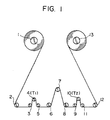
- reference numeral 1 is a supply reel, 2 a tension controller, 3, 5, 6, 8 and 11 free rollers, 4 a tensiometer (input), 7 a fixing bar made of stainless steel SUS304 (outer diameter: 5 mm ⁇ , surface roughness Ra: 20 nm), 10 a tensiometer (output), 12 a guide roller and 13 a take-up reel.
- the S/N ratio of a magnetic tape for video is measured, and difference between the measured value and the S/N ratio (standard) of the tape of Example 4 shown in Table 1 is obtained.
- the VTR used is EDV-6000 of Sony Corp.
- the magnetic tape is prepared by the following method.
- composition shown below is placed in a ball mill, kneaded for 16 hours and dispersed, and then, 5 parts by weight of an isocyanate compound (Desmodule L of Bayer AG.) is added to the composition. The resulting mixture is sheared and dispersed at a high speed for 1 hour to obtain a magnetic coating.
- an isocyanate compound (Desmodule L of Bayer AG.)
- composition of magnetic coating needle-like Fe particles 100 parts by weight vinyl chloride-vinyl acetate copolymer (Eslec 7A of Sekisui Chemical Co., Ltd) 15 parts by weight thermoplastic polyurethane resin 5 parts by weight chromium oxide 5 parts by weight carbon black 5 parts by weight lecitin 2 parts by weight aliphatic ester 1 part by weight toluene 50 parts by weight methyl ethyl ketone 50 parts by weight cyclohexanone 50 parts by weight
- This magnetic coating is applied to one side (second layer) of the biaxially oriented polyester film so as to have a thickness of 2 ⁇ m, oriented in a DC magnetic field of 2,500 Gauss and dried by heating at 100°C, and the resulting film is supercalendered (linear pressure of 300 kg/cm, temperature of 80°C) and rolled up. This roll is left in an oven heated at 55°C for 3 days and cut into a 1/2-inch wide piece to obtain a magnetic tape.
- Dimethyl-2,6-naphthalenedicarboxylate and ethylene glycol were mixed with manganese acetate as an ester exchange catalyst, antimony trioxide as a polymerization catalyst, phosphorus acid as a stabilizer and particles shown in Table 1 as a lubricant (inert fine particles) and polymerized by a commonly used method to obtain polyethylene-2,6-naphthalenedicarboxylate (PEN) for the first and second layers having an intrinsic viscosity (in orthochlorophenol, at 35°C) of 0.61.
- PEN polyethylene-2,6-naphthalenedicarboxylate
- the pellets of the polyethylene-2,6-naphthalenedicarboxylate were dried at 170°C for 6 hours, supplied to the hoppers of two extruders, molten at a melting temperature of 280 to 300°C and formed into a laminate having the first layer with the second layer thereon using a multi-manifold coextrusion die.
- the laminate was extruded onto a rotary cooling drum having a surface finishing degree of about 0.3S and a surface temperature of 60°C to obtain an unstretched laminate film having a thickness of 120 pm.
- the thus obtained unstretched laminate film was preheated at 120°C, further heated between low-speed and high-speed rolls from 15 mm above by an IR heater having a surface temperature of 900°C to be stretched to 4.0 times, quenched, supplied to a stenter, and stretched to 5.0 times in a transverse direction at 145°C.
- the thus obtained biaxially oriented film was heat-set with hot air heated at 210°C for 4 seconds to obtain a biaxially oriented laminate polyester film having a thickness of 6.0 pm.
- the films of Examples 1 and 2 had a Young's modulus in a longitudinal direction of 600 kg/mm 2 and a Young's modulus in a transverse direction of 900 kg/mm 2 . Other characteristics of the films are shown in Table 2.
- PET Polyethylene terephthalate
- the thus obtained unstretched laminate film was preheated at 78°C, further heated between low-speed and high-speed rolls from 15 mm above by an IR heater having a surface temperature of 850°C to be stretched to 2.3 times, quenched, supplied to a stenter, and stretched to 3.6 times in a transverse direction at 110°C. Subsequently, the film was preheated at 110°C, heated between low-speed and high-speed rolls to be stretched to 2.0 times in a longitudinal direction, supplied to a stenter, and stretched to 1.5 times in a transverse direction at 90°C.
- the thus obtained biaxially oriented film was heat set with hot air heated at 220°C for 4 seconds to obtain a biaxially oriented laminate polyester film.
- This film had a Young's modulus in a longitudinal direction of 600 kg/mm 2 and a Young's modulus in a transverse direction of 600 kg/mm 2 .
- Other characteristics of the film are shown in Table 2.
- the thickness of each layer was adjusted by changing the discharge amounts of the two extruders.
- films of the present invention have excellent output characteristics.
- polyester film which improves the running stability of a magnetic tape and output characteristics thereof.
- This polyester film is useful as a base film for a magnetic recording medium, particularly for a magnetic tape such as a 1/2-inch video tape, 8 mm video tape, data cartridge tape or digital video tape.
Landscapes
- Chemical & Material Sciences (AREA)
- Engineering & Computer Science (AREA)
- Manufacturing & Machinery (AREA)
- Materials Engineering (AREA)
- Health & Medical Sciences (AREA)
- Chemical Kinetics & Catalysis (AREA)
- Medicinal Chemistry (AREA)
- Polymers & Plastics (AREA)
- Organic Chemistry (AREA)
- Laminated Bodies (AREA)
- Magnetic Record Carriers (AREA)
- Shaping By String And By Release Of Stress In Plastics And The Like (AREA)
Applications Claiming Priority (3)
| Application Number | Priority Date | Filing Date | Title |
|---|---|---|---|
| JP30292096 | 1996-11-14 | ||
| JP302920/96 | 1996-11-14 | ||
| JP30292096A JPH10138432A (ja) | 1996-11-14 | 1996-11-14 | 磁気テープ用二軸配向積層ポリエステルフィルム |
Publications (3)
| Publication Number | Publication Date |
|---|---|
| EP0845351A2 true EP0845351A2 (fr) | 1998-06-03 |
| EP0845351A3 EP0845351A3 (fr) | 1999-03-10 |
| EP0845351B1 EP0845351B1 (fr) | 2003-03-19 |
Family
ID=17914719
Family Applications (1)
| Application Number | Title | Priority Date | Filing Date |
|---|---|---|---|
| EP19970308963 Expired - Lifetime EP0845351B1 (fr) | 1996-11-14 | 1997-11-07 | Film de polyester stratifié orienté biaxialement |
Country Status (6)
| Country | Link |
|---|---|
| US (1) | US6068909A (fr) |
| EP (1) | EP0845351B1 (fr) |
| JP (1) | JPH10138432A (fr) |
| KR (1) | KR100407850B1 (fr) |
| DE (1) | DE69719921T2 (fr) |
| TW (1) | TW458886B (fr) |
Cited By (3)
| Publication number | Priority date | Publication date | Assignee | Title |
|---|---|---|---|---|
| EP1033244A3 (fr) * | 1999-03-04 | 2001-01-31 | Teijin Limited | Film stratifié en polyester étiré biaxialement |
| US6465075B2 (en) | 1999-03-04 | 2002-10-15 | Teijin Limited | Biaxially oriented laminate polyester film |
| EP1273438A4 (fr) * | 2000-12-05 | 2004-11-24 | Teijin Ltd | Film polyester a couches oriente bi-axialement et support d'enregistrement magnetique |
Families Citing this family (8)
| Publication number | Priority date | Publication date | Assignee | Title |
|---|---|---|---|---|
| DE69818036T2 (de) * | 1997-12-11 | 2004-07-15 | Teijin Ltd. | Biaxial orientierter polyesterfilm für magnetische aufzeichnungsmedien |
| US6375889B1 (en) * | 1998-04-17 | 2002-04-23 | Polymer Group, Inc. | Method of making machine direction stretchable nonwoven fabrics having a high degree of recovery upon elongation |
| JP2002150545A (ja) * | 2000-09-25 | 2002-05-24 | Imation Corp | 張力下の磁気テープの熱処理 |
| DE10231595A1 (de) * | 2002-07-12 | 2004-01-22 | Mitsubishi Polyester Film Gmbh | Mehrschichtige, transparente, siegelfähige, biaxial orientierte Polyesterfolie, Verfahren zu ihrer Herstellung und ihre Verwendung |
| DE10231594A1 (de) * | 2002-07-12 | 2004-01-22 | Mitsubishi Polyester Film Gmbh | Mehrschichtige, metallisierte oder keramisch beschichtete, siegelfähige, biaxial orientierte Polyesterfolie, Verfahren zu ihrer Herstellung und ihre Verwendung |
| US7833545B2 (en) * | 2003-04-29 | 2010-11-16 | The General Hospital Corporation | Methods and devices for the sustained release of multiple drugs |
| KR100611821B1 (ko) * | 2004-09-10 | 2006-08-11 | 에스케이씨 주식회사 | 마찰계수가 조절된 폴리에스터 적층 필름 |
| WO2017221701A1 (fr) * | 2016-06-24 | 2017-12-28 | 東レ株式会社 | Film de résine thermoplastique à orientation biaxiale |
Family Cites Families (5)
| Publication number | Priority date | Publication date | Assignee | Title |
|---|---|---|---|---|
| EP0679508B1 (fr) * | 1988-06-08 | 1999-12-29 | Toray Industries, Inc. | Film multicouche orienté biaxialement |
| JPH0780282B2 (ja) * | 1988-06-08 | 1995-08-30 | 東レ株式会社 | 二軸配向熱可塑性樹脂フィルム |
| US5336079A (en) * | 1991-03-06 | 1994-08-09 | Toray Industries, Inc. | Biaxially oriented laminated film comprising particles in a specific ratio of particle density |
| DE69321291T3 (de) * | 1992-05-27 | 2004-11-18 | Teijin Ltd. | Biaxial orientiertes Polyesterfilmlaminat |
| DE69330327T2 (de) * | 1992-09-29 | 2002-05-02 | Mitsubishi Polyester Film Corp., Tokio/Tokyo | Biaxial ausgerichteter Polyesterfilm für magnetisches Aufzeichnungsmedium |
-
1996
- 1996-11-14 JP JP30292096A patent/JPH10138432A/ja active Pending
-
1997
- 1997-11-04 US US08/963,618 patent/US6068909A/en not_active Expired - Lifetime
- 1997-11-04 TW TW86116388A patent/TW458886B/zh not_active IP Right Cessation
- 1997-11-07 EP EP19970308963 patent/EP0845351B1/fr not_active Expired - Lifetime
- 1997-11-07 DE DE1997619921 patent/DE69719921T2/de not_active Expired - Lifetime
- 1997-11-13 KR KR1019970059861A patent/KR100407850B1/ko not_active Expired - Fee Related
Cited By (5)
| Publication number | Priority date | Publication date | Assignee | Title |
|---|---|---|---|---|
| EP1033244A3 (fr) * | 1999-03-04 | 2001-01-31 | Teijin Limited | Film stratifié en polyester étiré biaxialement |
| US6319589B1 (en) | 1999-03-04 | 2001-11-20 | Teijin Limited | Biaxially oriented laminate polyester film |
| US6465075B2 (en) | 1999-03-04 | 2002-10-15 | Teijin Limited | Biaxially oriented laminate polyester film |
| EP1273438A4 (fr) * | 2000-12-05 | 2004-11-24 | Teijin Ltd | Film polyester a couches oriente bi-axialement et support d'enregistrement magnetique |
| KR100769507B1 (ko) * | 2000-12-05 | 2007-10-23 | 데이진 가부시키가이샤 | 이축배향적층 폴리에스테르 필름 및 자기기록매체 |
Also Published As
| Publication number | Publication date |
|---|---|
| TW458886B (en) | 2001-10-11 |
| DE69719921T2 (de) | 2004-01-15 |
| EP0845351A3 (fr) | 1999-03-10 |
| DE69719921D1 (de) | 2003-04-24 |
| KR19980042399A (ko) | 1998-08-17 |
| EP0845351B1 (fr) | 2003-03-19 |
| US6068909A (en) | 2000-05-30 |
| KR100407850B1 (ko) | 2004-06-30 |
| JPH10138432A (ja) | 1998-05-26 |
Similar Documents
| Publication | Publication Date | Title |
|---|---|---|
| EP1047048B1 (fr) | Film polyester stratifie a orientation biaxiale pour support d'enregistrement magnetique | |
| US6190753B1 (en) | Biaxially oriented polyester film for magnetic recording media | |
| EP1273438B1 (fr) | Film polyester a couches oriente bi-axialement et support d'enregistrement magnetique | |
| EP0845351B1 (fr) | Film de polyester stratifié orienté biaxialement | |
| EP0787579B1 (fr) | Film multicouche orienté biaxialement | |
| EP0995593B1 (fr) | Film stratifie de polyester oriente biaxialement | |
| EP0893249B1 (fr) | Film de polyester stratifié orienté biaxialement | |
| JP3359813B2 (ja) | 積層二軸配向ポリエステルフィルム | |
| EP0786765B1 (fr) | Film de polyester stratifié orienté biaxialement | |
| JP3920008B2 (ja) | 積層二軸配向ポリエステルフィルム | |
| EP1190848B1 (fr) | Film polyester multicouche a orientation biaxiale | |
| JP3923176B2 (ja) | 積層二軸配向ポリエステルフィルム | |
| JP3923187B2 (ja) | 積層二軸配向ポリエステルフイルム | |
| EP0811653B1 (fr) | Film de polyester à orientation biaxiale | |
| JP3584127B2 (ja) | 磁気記録テープ | |
| JPH09314760A (ja) | 積層フィルム | |
| JP3229192B2 (ja) | 積層フイルム | |
| JP4169389B2 (ja) | 積層ポリエステルフィルム | |
| JP3976711B2 (ja) | 磁気テープ用二軸配向積層ポリエステルフィルム | |
| JP3306292B2 (ja) | 二軸配向積層ポリエステルフイルム | |
| JPH10315415A (ja) | 積層二軸配向ポリエステルフィルム | |
| JP2000043213A (ja) | 積層二軸配向ポリエステルフイルム | |
| JPH09314781A (ja) | 積層二軸配向ポリエステルフイルム | |
| JPH11291429A (ja) | 複合ポリエステルフィルム | |
| JPH11309820A (ja) | 積層フィルム |
Legal Events
| Date | Code | Title | Description |
|---|---|---|---|
| PUAI | Public reference made under article 153(3) epc to a published international application that has entered the european phase |
Free format text: ORIGINAL CODE: 0009012 |
|
| AK | Designated contracting states |
Kind code of ref document: A2 Designated state(s): DE FR GB |
|
| AX | Request for extension of the european patent |
Free format text: AL;LT;LV;MK;RO;SI |
|
| PUAL | Search report despatched |
Free format text: ORIGINAL CODE: 0009013 |
|
| AK | Designated contracting states |
Kind code of ref document: A3 Designated state(s): AT BE CH DE DK ES FI FR GB GR IE IT LI LU MC NL PT SE |
|
| AX | Request for extension of the european patent |
Free format text: AL;LT;LV;MK;RO;SI |
|
| 17P | Request for examination filed |
Effective date: 19990712 |
|
| AKX | Designation fees paid |
Free format text: DE FR GB |
|
| GRAG | Despatch of communication of intention to grant |
Free format text: ORIGINAL CODE: EPIDOS AGRA |
|
| 17Q | First examination report despatched |
Effective date: 20020508 |
|
| GRAG | Despatch of communication of intention to grant |
Free format text: ORIGINAL CODE: EPIDOS AGRA |
|
| GRAH | Despatch of communication of intention to grant a patent |
Free format text: ORIGINAL CODE: EPIDOS IGRA |
|
| GRAH | Despatch of communication of intention to grant a patent |
Free format text: ORIGINAL CODE: EPIDOS IGRA |
|
| GRAA | (expected) grant |
Free format text: ORIGINAL CODE: 0009210 |
|
| AK | Designated contracting states |
Designated state(s): DE FR GB |
|
| REG | Reference to a national code |
Ref country code: GB Ref legal event code: FG4D |
|
| RIC1 | Information provided on ipc code assigned before grant |
Ipc: 7C 08K 3/00 B Ipc: 7G 11B 5/73 B Ipc: 7B 32B 27/36 A |
|
| REF | Corresponds to: |
Ref document number: 69719921 Country of ref document: DE Date of ref document: 20030424 Kind code of ref document: P |
|
| ET | Fr: translation filed | ||
| PLBE | No opposition filed within time limit |
Free format text: ORIGINAL CODE: 0009261 |
|
| STAA | Information on the status of an ep patent application or granted ep patent |
Free format text: STATUS: NO OPPOSITION FILED WITHIN TIME LIMIT |
|
| 26N | No opposition filed |
Effective date: 20031222 |
|
| PGFP | Annual fee paid to national office [announced via postgrant information from national office to epo] |
Ref country code: GB Payment date: 20131115 Year of fee payment: 17 Ref country code: FR Payment date: 20131121 Year of fee payment: 17 Ref country code: DE Payment date: 20131118 Year of fee payment: 17 |
|
| REG | Reference to a national code |
Ref country code: DE Ref legal event code: R119 Ref document number: 69719921 Country of ref document: DE |
|
| GBPC | Gb: european patent ceased through non-payment of renewal fee |
Effective date: 20141107 |
|
| REG | Reference to a national code |
Ref country code: FR Ref legal event code: ST Effective date: 20150731 |
|
| PG25 | Lapsed in a contracting state [announced via postgrant information from national office to epo] |
Ref country code: DE Free format text: LAPSE BECAUSE OF NON-PAYMENT OF DUE FEES Effective date: 20150602 Ref country code: GB Free format text: LAPSE BECAUSE OF NON-PAYMENT OF DUE FEES Effective date: 20141107 |
|
| PG25 | Lapsed in a contracting state [announced via postgrant information from national office to epo] |
Ref country code: FR Free format text: LAPSE BECAUSE OF NON-PAYMENT OF DUE FEES Effective date: 20141201 |