EP0845476A2 - Synthetische katalytische Oligonukleotide - Google Patents
Synthetische katalytische Oligonukleotide Download PDFInfo
- Publication number
- EP0845476A2 EP0845476A2 EP97121976A EP97121976A EP0845476A2 EP 0845476 A2 EP0845476 A2 EP 0845476A2 EP 97121976 A EP97121976 A EP 97121976A EP 97121976 A EP97121976 A EP 97121976A EP 0845476 A2 EP0845476 A2 EP 0845476A2
- Authority
- EP
- European Patent Office
- Prior art keywords
- oligonucleotide structure
- structure according
- und
- oligonucleotide
- nucleotides
- Prior art date
- Legal status (The legal status is an assumption and is not a legal conclusion. Google has not performed a legal analysis and makes no representation as to the accuracy of the status listed.)
- Granted
Links
Classifications
-
- C—CHEMISTRY; METALLURGY
- C12—BIOCHEMISTRY; BEER; SPIRITS; WINE; VINEGAR; MICROBIOLOGY; ENZYMOLOGY; MUTATION OR GENETIC ENGINEERING
- C12N—MICROORGANISMS OR ENZYMES; COMPOSITIONS THEREOF; PROPAGATING, PRESERVING, OR MAINTAINING MICROORGANISMS; MUTATION OR GENETIC ENGINEERING; CULTURE MEDIA
- C12N15/00—Mutation or genetic engineering; DNA or RNA concerning genetic engineering, vectors, e.g. plasmids, or their isolation, preparation or purification; Use of hosts therefor
- C12N15/09—Recombinant DNA-technology
- C12N15/11—DNA or RNA fragments; Modified forms thereof; Non-coding nucleic acids having a biological activity
- C12N15/113—Non-coding nucleic acids modulating the expression of genes, e.g. antisense oligonucleotides; Antisense DNA or RNA; Triplex- forming oligonucleotides; Catalytic nucleic acids, e.g. ribozymes; Nucleic acids used in co-suppression or gene silencing
-
- A—HUMAN NECESSITIES
- A61—MEDICAL OR VETERINARY SCIENCE; HYGIENE
- A61P—SPECIFIC THERAPEUTIC ACTIVITY OF CHEMICAL COMPOUNDS OR MEDICINAL PREPARATIONS
- A61P31/00—Antiinfectives, i.e. antibiotics, antiseptics, chemotherapeutics
- A61P31/12—Antivirals
-
- A—HUMAN NECESSITIES
- A61—MEDICAL OR VETERINARY SCIENCE; HYGIENE
- A61P—SPECIFIC THERAPEUTIC ACTIVITY OF CHEMICAL COMPOUNDS OR MEDICINAL PREPARATIONS
- A61P43/00—Drugs for specific purposes, not provided for in groups A61P1/00-A61P41/00
-
- C—CHEMISTRY; METALLURGY
- C07—ORGANIC CHEMISTRY
- C07H—SUGARS; DERIVATIVES THEREOF; NUCLEOSIDES; NUCLEOTIDES; NUCLEIC ACIDS
- C07H21/00—Compounds containing two or more mononucleotide units having separate phosphate or polyphosphate groups linked by saccharide radicals of nucleoside groups, e.g. nucleic acids
-
- C—CHEMISTRY; METALLURGY
- C12—BIOCHEMISTRY; BEER; SPIRITS; WINE; VINEGAR; MICROBIOLOGY; ENZYMOLOGY; MUTATION OR GENETIC ENGINEERING
- C12N—MICROORGANISMS OR ENZYMES; COMPOSITIONS THEREOF; PROPAGATING, PRESERVING, OR MAINTAINING MICROORGANISMS; MUTATION OR GENETIC ENGINEERING; CULTURE MEDIA
- C12N2310/00—Structure or type of the nucleic acid
- C12N2310/10—Type of nucleic acid
- C12N2310/12—Type of nucleic acid catalytic nucleic acids, e.g. ribozymes
- C12N2310/121—Hammerhead
-
- C—CHEMISTRY; METALLURGY
- C12—BIOCHEMISTRY; BEER; SPIRITS; WINE; VINEGAR; MICROBIOLOGY; ENZYMOLOGY; MUTATION OR GENETIC ENGINEERING
- C12N—MICROORGANISMS OR ENZYMES; COMPOSITIONS THEREOF; PROPAGATING, PRESERVING, OR MAINTAINING MICROORGANISMS; MUTATION OR GENETIC ENGINEERING; CULTURE MEDIA
- C12N2310/00—Structure or type of the nucleic acid
- C12N2310/30—Chemical structure
- C12N2310/31—Chemical structure of the backbone
- C12N2310/315—Phosphorothioates
-
- C—CHEMISTRY; METALLURGY
- C12—BIOCHEMISTRY; BEER; SPIRITS; WINE; VINEGAR; MICROBIOLOGY; ENZYMOLOGY; MUTATION OR GENETIC ENGINEERING
- C12N—MICROORGANISMS OR ENZYMES; COMPOSITIONS THEREOF; PROPAGATING, PRESERVING, OR MAINTAINING MICROORGANISMS; MUTATION OR GENETIC ENGINEERING; CULTURE MEDIA
- C12N2310/00—Structure or type of the nucleic acid
- C12N2310/30—Chemical structure
- C12N2310/32—Chemical structure of the sugar
- C12N2310/321—2'-O-R Modification
-
- C—CHEMISTRY; METALLURGY
- C12—BIOCHEMISTRY; BEER; SPIRITS; WINE; VINEGAR; MICROBIOLOGY; ENZYMOLOGY; MUTATION OR GENETIC ENGINEERING
- C12N—MICROORGANISMS OR ENZYMES; COMPOSITIONS THEREOF; PROPAGATING, PRESERVING, OR MAINTAINING MICROORGANISMS; MUTATION OR GENETIC ENGINEERING; CULTURE MEDIA
- C12N2310/00—Structure or type of the nucleic acid
- C12N2310/30—Chemical structure
- C12N2310/33—Chemical structure of the base
Definitions
- the present invention relates to synthetic catalytic Oligonucleotide structures used to cleave a nucleic acid target sequence are suitable and modified nucleotides contain.
- the invention further relates to a method for Cleavage of a nucleic acid target sequence using synthetic catalytic modified oligonucleotide structures.
- RNA mediated catalysis After discovery of RNA mediated catalysis various attempts to inactivate specific RNA molecules in vitro and in vivo.
- hammerhead _Ribozyme can be used to develop a multi-purpose enzyme which is used to identify and split a given specific RNA is capable of at least in vitro (Haseloff and Gerlach (1988)).
- Many interesting uses for such ribozymes are based on their ability to be specific RNA efficiently within a given mixture recognize and split.
- the possible uses for RNA enzymes range from the development of RNA restriction enzymes until the specific inactivation of genes in the cell.
- a special biomedical interest is based on the The fact that many diseases including many types of tumors correlate with the expression of specific genes.
- RNA enzymes possibly such an agent could be given the viral expression selectively blocked by cleavage of the viral RNA molecules can be.
- RNA molecules instead of an RNA molecule, a new type of nucleic acid used on artificial nucleotides based on a 2'-alkoxy substituent.
- Such molecules are significantly more stable than native RNA molecules because they are neither by RNAsen still be split by DNAsen and also fewer interactions with RNA or DNA binding proteins (Iribarren et al., Proc.Natl.Acad.Sci. USA 87 (1990), 7747-7751).
- Such molecules promise a larger one Effectiveness in the cellular environment as appropriate native RNA molecules.
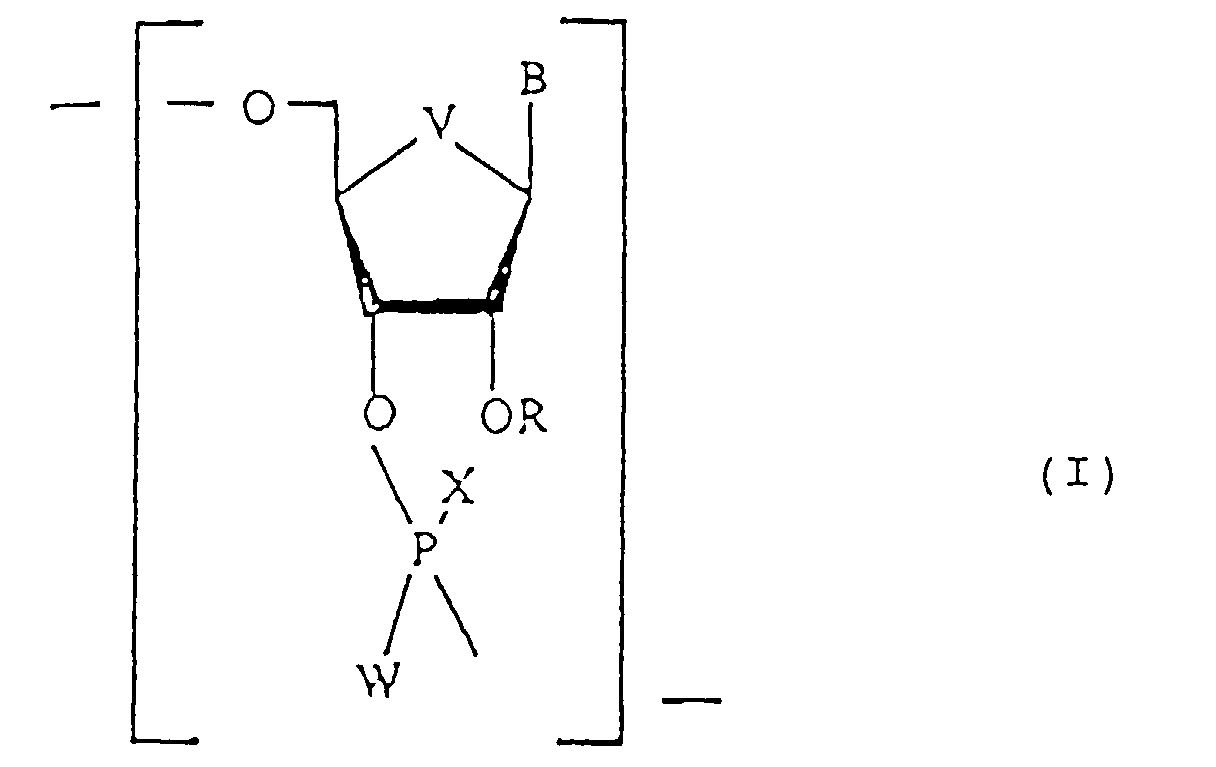
- B can be any purine or pyrimidine nucleoside base represent.
- suitable purine nucleoside bases are such as adenin-9-yl, guanin-9-yl, hypoxanthine-9-yl and 2-aminoadenin-9-yl.
- pyrimidine nucleoside bases are, for example Cytosin-1-yl, uracil-1-yl, uracil-5-yl and thymin-1-yl.
- V is independently a 0 or a CH 2 group, preferably an O group, for each nucleotide.
- X and W can be identical or different in a nucleotide and independently of one another denote O, S, NH 2 , alkyl or alkoxy groups having 1 to 10, preferably 1 to 4, carbon atoms.
- X and W are particularly preferably each O groups (in which case one O atom would be bound to a phosphor via a double bond and the other would be bound via a single bond and would have a negative charge).
- R is hydrogen or a straight-chain or branched, optionally with halogen (fluorine, chlorine, bromine, iodine), cyano-, Isocyano, nitro, amino, carboxyl, hydroxyl or / and Mercapto groups substituted alkyl, alkenyl or alkynyl groups with 1 to 10 carbon atoms. That of hydrogen various radicals R preferably contain 1 to 6 carbon atoms. Examples of preferred radicals R are methyl, Ethyl, propyl, allyl, dimethylallyl, butyl or cyanomethyl radicals. R is particularly preferably an alkenyl radical with 1 up to 4 carbon atoms, e.g. an allyl residue.
- a catalytic oligonucleotide structure according to the invention is characterized in that at least one of the nucleotides the radical R in formula (I) is different from hydrogen is. It is preferred if the oligonucleotide structure contains the smallest possible number of nucleotides, in where R is hydrogen. Such oligonucleotides have a high resistance to nucleases and show less interaction with nucleic acid binding proteins. On the other hand, the residue R be different from hydrogen, otherwise the oligonucleotide no longer has any catalytic activity. Especially within the catalytically active center of the invention Oligonucleotides exist single nucleotides, in which the radical R represents a hydrogen atom.
- the catalytically active center of the oligonucleotide structure according to the invention preferably has a hammer head or Hairpin structure.
- RNA hairpin structures are described, for example, in the work by Tritz and Hampel (Biochemistry 28 (1989), 4929) and Hampel et al., Nucleic Acids Res. 18 (1990), 299-304.
- Such a hairpin structure contains 4 helices, 2 of which are formed between the substrate and the catalytic RNA.
- the following is an example of a catalytic center in the form of an RNA hairpin structure derived from the Tobacco Ringspot virus:
- the active center of a catalytic RNA can also be a have a so-called hammerhead structure (Hotchins et al., Nucleic Acids Res. 14 (1986), 3627; Kiese and Symons in: Viroids and viroid-like pathogens, J.S. Semancik, editor (CRC-Press, Bocaratan, Florida (1987) pp. 1-47).
- the catalytic Center of the hammerhead structure contains 3 trunks and can by adjacent sequence regions of the RNA or else are formed by regions that have many nucleotides are separated from each other.
- the area N 1 to N 14 contains the catalytic center of the oligonucleotide structure (II).
- the nucleotides labeled (N) x and (N) y are located outside the active center and contain regions that are responsible for hybridization with a specific nucleic acid target sequence.
- the length of these areas is such that x ⁇ 1 and y ⁇ 2.
- X and y are preferably 20 20, larger values for x or / and y bring no specific advantages, but make the synthesis of the oligonucleotide more difficult.
- the oligonucleotide structure II can either be a coherent molecule or consist of two different molecules, ie N 'and N "are either together a single nucleotide sequence or two different nucleotide sequences.
- the nucleotide sequences N' and N" at least partially contain mutually complementary regions that enable stable base pairing between the two nucleotide sequences.
- stable base pairing is understood to mean that the oligonucleotide structure is present as a double-stranded strand under physiological conditions at room temperature and preferably at temperatures up to 40 ° C.
- the oligonucleotide structure according to the invention is characterized in that in at least one, preferably in several, of the nucleotides N 2 , N 3 , N 5 , N 6 , N 7 , N 9 , N 10 , N 12 , N 13 and N 14, the residue R is different from hydrogen in formula (I).
- the radicals R in formula (I) are preferably hydrogen.
- nucleoside base in N 1 is adenin-1-yl or 2-aminoadenin-9-yl and in the case of the nucleotides N 4 , N 8 and N 11 in each case guanin-1-yl (or hypoxanthine-9-yl) .
- a particularly preferred object of the present invention is an oligonucleotide structure with the general structural formula (III): wherein N, x and y are as defined in claim 3, M represents a chemical bond or a nucleotide sequence (N) a , where a ⁇ 1, m and n are the same or different and, if appropriate, one or more additional nucleotides according to N 7 or / and N 9 can be inserted.
- the radicals R in formula (III) in the nucleotides N 1 , N 4 , N 8 , N 10 , N 11 and N 12 are preferably hydrogen.
- the radicals R in formula (III) in all nucleotides except N 1 , N 4 , N 8 , N 10 , N 11 and N 12 are preferably different from hydrogen.
- one or more of the radicals R butyl in the oligonucleotide structures according to the invention in order to improve the uptake of the catalytic structures by the cell.
- R butyl
- N 1 , N 4 , N 8 , N 10, N 11 and N 12 R H
- N 5 and N 6 R butyl
- oligonucleotide structures according to the invention can at their free 3 'end or at their free 3 'ends 3'-deoxyribonucleotides or / and 3'-O-alkyl ribonucleotides are located. That way it will Oligonucleotide according to the invention before 3'-exonuclease degradation protected.
- the oligonucleotides according to the invention can also be used for Stabilization of their spatial configuration nucleotides contain whose nucleoside bases by a crosslinking agent are modified.
- a cross-linking agent is psoralen or a psoralen derivative.
- double-stranded oligonucleotide structures be modified by covalent cross-linking.
- the production of nucleotides with a cross-linking agent are modified, is disclosed in detail in DE-A 39 28 900.
- the oligonucleotide structure according to the invention can also be used a prosthetic group linked to the admission in the cell or / and the specific cellular localization to improve the oligonucleotide structure.
- prosthetic groups are polyamino acids (e.g. polylysine), Lipids, hormones or peptides. Linking this prosthetic groups usually take place via free 5'- or 3 'ends of the oligonucleotide structure according to the invention, this linking either directly or through a linker can be done.
- linkers are at the terminal 5'-phosphate diesters present with amino or phosphate function or with mercaptoalkoxy groups.
- the oligonucleotide structures according to the invention are synthesized in a manner known per se from monomer units.
- Such monomer units usually have the general formula (V) wherein V, B and R are as defined in formula (I) and D and E are reactive groups capable of forming 3'- to 5'-internucleotide bonds.
- groups are known to the person skilled in the art and are described, for example, in B. Sproat et al., Nucleic Acids Res. 18 (1990), 41-49 and in summary in EL Winnacker, Gene und Klone, VCH-Verlagsgesellschaft mbH, Weinheim (Germany) (1985) , especially pages 44-49 and in Froehler and Matteucci, Tetrahedron Let. (1986), pp. 469-472.
- the reactive mononucleotides of the formula (V) can be used to produce the oligonucleotide structures according to the invention in a known manner, in particular on a solid
- Another object of the present invention is a Method for cleaving a nucleic acid target sequence under Use of a synthetic catalytic oligonucleotide structure according to the present invention.
- This nucleic acid target sequence can either be part of the synthetic catalytic oligonucleotide structure itself, or it this nucleic acid target sequence can be one of the synthetic catalytic oligonucleotide structure various Act molecule.
- the nucleotide Y in the nucleic acid target sequence preferably represents a guanosine residue and Z preferably denotes adenosine or cytidine.
- the target nucleic acid sequence can be any oligonucleotide or polynucleotide, provided that Z is an unmodified ribonucleotide.
- the rest of the target sequence can be, for example, DNA, 2'-O-alkyl-RNA or a mixed structure.
- the target nucleic acid sequence is preferably an RNA.
- the cleavage specificity of the oligonucleotide according to the invention for a specific nucleic acid target sequence can be achieved by changing the sequence of the hybridization arms of the catalytic component (N 0 (N) X or (N) YN 14 ) so that they are complementary to the sequences which flank the cleavage site of the desired target sequence.
- the method according to the invention can be carried out both within a living cell and in vitro.
- the cleavage is preferably carried out in the presence of a divalent cation, in particular Mg 2+ and at a pH of about 7 to 9, particularly preferably about 8.
- Another object of the present invention is Use of an oligonucleotide structure according to the invention for catalytic cleavage of a nucleic acid target sequence, wherein the nucleic acid target sequence is either part of the catalytic Is oligonucleotide structure or a different one Represents molecule.
- the invention further relates to a medicament which is used as an active ingredient an oligonucleotide structure according to the invention, if appropriate together with usual pharmaceutical carriers, Contains auxiliaries, fillers and / or diluents.
- the invention also relates to a method of manufacturing a medicament for antiviral therapy in humans, animals and plants, an active ingredient according to the invention Oligonucleotide structure used.
- An example of one antiviral therapy would be combating AIDS the oligonucleotides according to the invention (see e.g. Sarver et al., Science 247 (1990), 1222-1225).
- Another object of the present invention is also a diagnostic reagent that is part of an inventive Contains oligonucleotide structure and a method for the preparation of such a diagnostic reagent.
- This diagnostic reagent according to the invention can, for example can be used for a genetic patterning procedure.
- the oligonucleotides were made according to the ⁇ -cyanoethyl phosphoramidite method on using controlled pore glass a modified DNA synthesis cycle on an applied Biosystems synthesizer composed. Instead of Tetrazole was 5- (4-nitrophenyl) -1H-tetrazole as an activator used for the condensation step, the reaction time for the condensation was increased to 12 minutes (cf. Nucleic Acids Res. 18 (1990), 41-49 and 5141-5151).
- the deblocking and cleaning was carried out by first treating a support to which a completely blocked oligonucleotide was bound with a solution of 25% strength aqueous ammonia in a sealed sterile vessel for 10 hours at 60 ° C. The cooled solution was then evaporated to dryness in a sterile vessel in vacuo.
- the crude oligonucleotide product which still contains a 5'-terminal 5'-O-dimethoxytrithyl protective group and some 2'-O-Fpmp protective groups, was then subjected to reverse phase HPLC on a ⁇ -Bondapak C 18 column using a Acetonitrile gradients in aqueous 0.1 mol / l triethylammonium acetate pH 7.0 as eluent.
- the product peak was collected and the solvent removed in vacuo.
- the residue was resuspended in 1 ml of 10% glycerol in water and the solution was centrifuged for 10 minutes.
- the supernatant was placed on a G15 Sephadex column (30 ml) which was eluted with sterile distilled water. The empty volume of the column (about 9 ml) was discarded and a 3 ml fraction was collected which contained the partially blocked oligonucleotide. Then, sterile aqueous hydrochloric acid (270 ⁇ l, 0.1 mol / l) was added, whereby a pH in the range of 2 to 2.5 was obtained. The solution was kept at 20-25 ° C for 20 hours to remove the acid labile DMTr and Fpmp protecting groups. The solution was then centrifuged at 2000 rpm for 10 minutes.
- the supernatant was neutralized by adding 2 mol / l Tris acetate (75 ul, pH 7.9).
- the pure fully unblocked oligonucleotide was recovered from the aqueous solution using repeated 1-butanol extractions as described by Cathala and Brunel (Nucleic Acids Res. 18 (1990), 201).
- the oligonucleotide pellet was dried and dissolved in 100 ⁇ l Tris buffer (10 mmol / l, pH 7.5, 1 mmol / l EDTA).
- SEQ ID NO.1 A 17 nucleotide long, chemically synthesized oligoribonucleotide based on the EDB exon of human fibronectin mRNA was used as the target sequence.
- the sequence (SEQ ID NO.1) was as follows:
- the ribozyme used to cleave this sequence had the nucleotide sequence shown below (SEQ ID NO.2):
- E0 This sequence is called E0.
- the underlined areas denote the nucleotides N 14 to N 6 or N 5 to N 0 according to formula (III). Furthermore, the following analogues of E0 (with an identical base composition) were synthesized:
- the test for determining the cleavage activity was carried out in a reaction volume of 10 ⁇ l, the substrate RNA (10 nmol / l to 1 ⁇ mol / l), Tris 50 mmol / l pH 7.5, MgCl 2 20 mmol / l and 0.01 contained up to 10 pmol ribozyme.
- the reaction mixture was incubated at 50 ° C for 60 minutes.
- the cleavage products were separated by polyacrylamide gel electrophoresis in the presence of 7 mol / l urea.
- the reaction kinetics were determined by measuring the amount of 32 P-radioactive labeled substrate with a cleavage period of 1.5, 10 and 15 minutes at 50 ° C.
- the substrate concentrations were as follows: 25, 50, 100, 250 nmol / l; the ribozyme concentration was between 4 nmol / l and 20 nmol / l.
- the samples were preheated and the reaction started by adding ribozyme. After the predetermined reaction time, the reaction was stopped by adding 2 volumes of 20 mmol / l EDTA.
- the products were separated by polyacrylamide-urea gel electrophoresis and analyzed quantitatively with the Molecular Dynamics Phosphor Imager.
- Table 1 shows the relative activity and the RNase sensitivity of the catalytic oligonucleotides E0, E1, E2, E3, E4, E5, E6 and E7 listed above.
- Catalytic structure Relative activity RNase A sensitivity E0 1 1 E1 0.2 0.01 E2 ⁇ 0.05 stable E3 0.1 0.001 E4 about 0.2 0.01 E5 about 0.2 0.01 E6 about 0.2 0.01 E7 about 0.2 0.01
Landscapes
- Health & Medical Sciences (AREA)
- Life Sciences & Earth Sciences (AREA)
- Chemical & Material Sciences (AREA)
- Engineering & Computer Science (AREA)
- Organic Chemistry (AREA)
- Genetics & Genomics (AREA)
- Molecular Biology (AREA)
- Biomedical Technology (AREA)
- Biochemistry (AREA)
- Biotechnology (AREA)
- General Health & Medical Sciences (AREA)
- Bioinformatics & Cheminformatics (AREA)
- General Engineering & Computer Science (AREA)
- Wood Science & Technology (AREA)
- Zoology (AREA)
- Medicinal Chemistry (AREA)
- Biophysics (AREA)
- Public Health (AREA)
- Animal Behavior & Ethology (AREA)
- Pharmacology & Pharmacy (AREA)
- Nuclear Medicine, Radiotherapy & Molecular Imaging (AREA)
- General Chemical & Material Sciences (AREA)
- Chemical Kinetics & Catalysis (AREA)
- Physics & Mathematics (AREA)
- Veterinary Medicine (AREA)
- Microbiology (AREA)
- Plant Pathology (AREA)
- Oncology (AREA)
- Communicable Diseases (AREA)
- Virology (AREA)
- Saccharide Compounds (AREA)
- Pharmaceuticals Containing Other Organic And Inorganic Compounds (AREA)
- Enzymes And Modification Thereof (AREA)
- Medicinal Preparation (AREA)
- Medicines That Contain Protein Lipid Enzymes And Other Medicines (AREA)
Abstract
Description


M eine chemische Bindung darstellt oder eine Nukleotidsequenz (N)a bedeutet, wobei a ≥ 1 ist, m und n gleich oder verschieden sind und gegebenenfalls ein oder mehrere zusätzliche Nukleotide nach N7 oder/und N9 insertiert werden können.


- SEQ ID NO.1:
- die Nukleotidsequenz einer Substrat-RNA und
- SEQ ID NO.2:
- die Nukleotidsequenz einer katalytisch aktiven Ribozym-RNA


| Katalytische Struktur | Relative Aktivität | RNase A Sensitifität |
| E0 | 1 | 1 |
| E1 | 0,2 | 0,01 |
| E2 | < 0,05 | stabil |
| E3 | 0,1 | 0,001 |
| E4 | ca. 0,2 | 0,01 |
| E5 | ca. 0,2 | 0,01 |
| E6 | ca. 0,2 | 0,01 |
| E7 | ca. 0,2 | 0,01 |

Claims (21)
- Synthetische katalytische Oligonukleotidstruktur, die zur Spaltung einer Nukleinsäure-Zielsequenz geeignet ist und Nukleotide mit der allgemeinen Strukturformel (I) enthält:worin B eine Nukleosidbase darstellt, die insbesondere aus der Gruppe, bestehend aus Adenin-9-yl (A), Cytosin-1-yl (C), Guanin-9-yl (G), Uracil-1-yl (U), Uracil-5-yl (ψ), Hypoxanthin-9-yl (I), Thymin-1-yl (T) und 2-Aminoadenin-9-yl ausgewählt ist,
 dadurch gekennzeichnet, daß bei mindestens einem der Nukleotide der Rest R in Formel (I) von Wasserstoff verschieden istV bei jedem Nukleotid unabhängig eine O- oder eine CH2-Gruppe ist,X und W jeweils in einem Nukleotid gleich oder verschieden sein können und unabhängig voneinander O-, S-, NH2-, Alkyl- oder Alkoxygruppen mit 1 bis 10, vorzugsweise mit 1 bis 4 Kohlenstoffatomen sind,R Wasserstoff oder eine geradkettige oder verzweigte, gegebenenfalls mit Halogen-, Cyano-, Isocyano-, Nitro-, Amino-, Carboxyl-, Hydroxyl- oder/und Mercaptogruppen substituierte Alkyl-, Alkenyl- oder Alkinylgruppe mit 1 bis 10 Kohlenstoffatomen ist,
- Oligonukleotidstruktur nach Anspruch 1,
dadurch gekennzeichnet, daß ihr katalytisch aktives Zentrum eine Hammerkopf- oder Haarnadelstruktur aufweist. - Oligonukleotidstruktur nach Anspruch 1 oder 2,
dadurch gekennzeichnet, daß innerhalb des katalytisch aktiven Zentrums Nukleotide existieren, in denen R Wasserstoff ist. - Oligonukleotidstruktur nach einem der vorhergehenden Ansprüche,
dadurch gekennzeichnet, daß die Reste V, W und X in Formel (I) O-Gruppen sind. - Oligonukleotidsturktur nach einem der vorhergehenden Ansprüche,
dadurch gekennzeichnet, daß die von Wasserstoff verschiedenen Reste R in Formel (I) 1 bis 6 Kohlenstoffatome enthalten. - Oligonukleotidstruktur nach Anspruch 7,
dadurch gekennzeichnet, daß die von Wasserstoff verschiedenen Reste R in Formel (I) aus der Gruppe, bestehend aus Methyl-, Ethyl-, Propyl-, Allyl-, Dimethylallyl-, Butyl- oder Cyanomethylresten ausgewählt sind. - Oligonukleotidstruktur nach einem der vorhergehenden Ansprüche,
dadurch gekennzeichnet, daß sich an den freien 3'-Enden der Oligonukleotidstruktur 3'-Deoxyribonukleotide oder/und 3' -O-Alkylribonukleotide befinden. - Oligonukleotidstruktur nach einem der vorhergehenden Ansprüche,
dadurch gekennzeichnet, daß sie weiterhin zur Stabilisierung ihrer räumlichen Konfiguration Nukleotide enthält, deren Nukleosidbasen durch ein Quervernetzungsmittel modifiziert sind. - Oligonukleotidstruktur nach Anspruch 8,
dadurch gekennzeichnet, daß das Quervernetzungsmittel Psoralen oder ein Psoralenderivat ist. - Oligonukleotidstruktur nach einem der vorhergehenden Ansprüche,
dadurch gekennzeichnet, daß sie mit einer prostethischen Gruppe, ausgewählt aus Polyaminosäuren, Lipiden, Hormonen oder Peptiden verknüpft ist, um die Aufnahme in der Zelle oder/und die spezifische zelluläre Lokalisierung der Oligonukleotidstruktur zu verbessern. - Verfahren zur Spaltung einer Nukleinsäure-Zielsequenz unter Verwendung einer synthetischen katalytischen Oligonukleotidstruktur nach einem der Ansprüche 1 bis 10.
- Verfahren nach Anspruch 11,
dadurch gekennzeichnet, daß die Nukleinsäure-Zielsequenz ein von der synthetischenkatalytischen Oligonukleotidstruktur verschiedenes Molekül ist. - Verfahren nach einem der Ansprüche 11 bis 12,
dadurch gekennzeichnet, daß die Nukleinsäure-Zielsequenz eine Ribonukleinsäure ist. - Verfahren nach einem der Ansprüche 11 bis 13,
dadurch gekennzeichnet, daß man die Spaltung in Gegenwart eines divalenten Kations, insbesondere Mg2+ durchführt. - Verfahren nach einem der Ansprüche 11 bis 14,
dadurch gekennzeichnet, daß man die Spaltung bei einem pH-Wert von etwa 7 bis 9 durchführt. - Verwendung einer Oligonukleotidstruktur nach einem der Ansprüche 1 bis 10 zur katalytischen Spaltung einer Nukleinsäure-Zielsequenz.
- Arzneimittel,
dadurch gekennzeichnet, daß es als Wirkstoff eine Oligonukleotidstruktur nach einem der Ansprüche 1 bis 10, gegebenenfalls zusammen mit üblichen pharmazeutischen Träger-, Hilfs-, Füll- oder/und Verdünnungsmitteln enthält. - Verfahren zur Herstellung eines Arzneimittels für die antivirale Therapie in Menschen, Tieren und Pflanzen,
dadurch gekennzeichnet, daß man als Wirkstoff eine Oligonukleotidstruktur nach einem der Ansprüche 1 bis 10 verwendet. - Verfahren nach Anspruch 18 zur Herstellung eines Arzneimittels gegen AIDS.
- Diagnostisches Reagenz,
dadurch gekennzeichnet, daß es als Bestandteil eine Oligonukleotidstruktur nach einem der Ansprüche 1 bis 10 enthält. - Verfahren zur Herstellung eines diagnostischen Reagenz für eine genetische Musterungsprozedur,
dadurch gekennzeichnet, daß es als Bestandteil eine Oligonukleotidstruktur nach einem der Ansprüche 1 bis 10 enthält.
Priority Applications (1)
| Application Number | Priority Date | Filing Date | Title |
|---|---|---|---|
| EP00117112A EP1061085A3 (de) | 1991-06-20 | 1992-06-17 | Synthetische katalytische Oligonukleotide |
Applications Claiming Priority (5)
| Application Number | Priority Date | Filing Date | Title |
|---|---|---|---|
| DE4120406 | 1991-06-20 | ||
| DE4120406 | 1991-06-20 | ||
| DE4216134A DE4216134A1 (de) | 1991-06-20 | 1992-05-15 | Synthetische katalytische oligonukleotidstrukturen |
| DE4216134 | 1992-05-15 | ||
| EP92110298A EP0519463B1 (de) | 1991-06-20 | 1992-06-17 | Synthetische katalytische Oligonukleotide |
Related Parent Applications (1)
| Application Number | Title | Priority Date | Filing Date |
|---|---|---|---|
| EP92110298A Division EP0519463B1 (de) | 1991-06-20 | 1992-06-17 | Synthetische katalytische Oligonukleotide |
Related Child Applications (1)
| Application Number | Title | Priority Date | Filing Date |
|---|---|---|---|
| EP00117112A Division EP1061085A3 (de) | 1991-06-20 | 1992-06-17 | Synthetische katalytische Oligonukleotide |
Publications (3)
| Publication Number | Publication Date |
|---|---|
| EP0845476A2 true EP0845476A2 (de) | 1998-06-03 |
| EP0845476A3 EP0845476A3 (de) | 1998-06-10 |
| EP0845476B1 EP0845476B1 (de) | 2001-03-14 |
Family
ID=25904724
Family Applications (3)
| Application Number | Title | Priority Date | Filing Date |
|---|---|---|---|
| EP92110298A Expired - Lifetime EP0519463B1 (de) | 1991-06-20 | 1992-06-17 | Synthetische katalytische Oligonukleotide |
| EP97121976A Expired - Lifetime EP0845476B1 (de) | 1991-06-20 | 1992-06-17 | Synthetische katalytische Oligonukleotide |
| EP00117112A Withdrawn EP1061085A3 (de) | 1991-06-20 | 1992-06-17 | Synthetische katalytische Oligonukleotide |
Family Applications Before (1)
| Application Number | Title | Priority Date | Filing Date |
|---|---|---|---|
| EP92110298A Expired - Lifetime EP0519463B1 (de) | 1991-06-20 | 1992-06-17 | Synthetische katalytische Oligonukleotide |
Family Applications After (1)
| Application Number | Title | Priority Date | Filing Date |
|---|---|---|---|
| EP00117112A Withdrawn EP1061085A3 (de) | 1991-06-20 | 1992-06-17 | Synthetische katalytische Oligonukleotide |
Country Status (10)
| Country | Link |
|---|---|
| US (1) | US5334711A (de) |
| EP (3) | EP0519463B1 (de) |
| JP (3) | JP3512818B2 (de) |
| AT (2) | ATE172468T1 (de) |
| AU (1) | AU658634B2 (de) |
| CA (1) | CA2071446C (de) |
| DE (3) | DE4216134A1 (de) |
| DK (2) | DK0519463T3 (de) |
| ES (2) | ES2155959T3 (de) |
| PT (1) | PT845476E (de) |
Families Citing this family (422)
| Publication number | Priority date | Publication date | Assignee | Title |
|---|---|---|---|---|
| US7101993B1 (en) | 1990-01-11 | 2006-09-05 | Isis Pharmaceuticals, Inc. | Oligonucleotides containing 2′-O-modified purines |
| US5914396A (en) * | 1990-01-11 | 1999-06-22 | Isis Pharmaceuticals, Inc. | 2'-O-modified nucleosides and phosphoramidites |
| US6041910A (en) * | 1997-09-22 | 2000-03-28 | Jervis B. Webb Company | Baggage pusher device and system |
| AU649074B2 (en) * | 1990-10-12 | 1994-05-12 | Max-Planck-Gesellschaft Zur Forderung Der Wissenschaften E.V. | Modified ribozymes |
| US5359052A (en) * | 1991-08-05 | 1994-10-25 | Polish Academy Of Sciences | Chalcophospholanes useful in the synthesis of oligonucleoside phosphorothioates, phosphorodithioates and related selenates |
| US5646267A (en) * | 1991-08-05 | 1997-07-08 | Polish Academy Of Sciences | Method of making oligonucleotides and oligonucleotide analogs using phospholanes and enantiomerically resolved phospholane analogues |
| US7119184B2 (en) | 1991-08-12 | 2006-10-10 | Isis Pharmaceuticals, Inc. | Oligonucleotides having A-DNA form and B-DNA form conformational geometry |
| US6369209B1 (en) | 1999-05-03 | 2002-04-09 | Isis Pharmaceuticals, Inc. | Oligonucleotides having A-DNA form and B-DNA form conformational geometry |
| US5652094A (en) * | 1992-01-31 | 1997-07-29 | University Of Montreal | Nucleozymes |
| US6204027B1 (en) * | 1992-02-26 | 2001-03-20 | University Of Massachusetts Worcester | Ribozymes having 2′-O substituted nucleotides in the flanking sequences |
| US20030125270A1 (en) * | 2000-12-18 | 2003-07-03 | Lawrence Blatt | Enzymatic nucleic acid treatment of diseases or conditions related to hepatitis C virus infection |
| US20040054156A1 (en) * | 1992-05-14 | 2004-03-18 | Kenneth Draper | Method and reagent for inhibiting hepatitis B viral replication |
| US20040127446A1 (en) * | 1992-05-14 | 2004-07-01 | Lawrence Blatt | Oligonucleotide mediated inhibition of hepatitis B virus and hepatitis C virus replication |
| US20030206887A1 (en) * | 1992-05-14 | 2003-11-06 | David Morrissey | RNA interference mediated inhibition of hepatitis B virus (HBV) using short interfering nucleic acid (siNA) |
| US5646042A (en) * | 1992-08-26 | 1997-07-08 | Ribozyme Pharmaceuticals, Inc. | C-myb targeted ribozymes |
| US5891684A (en) * | 1992-10-15 | 1999-04-06 | Ribozyme Pharmaceuticals, Inc. | Base-modified enzymatic nucleic acid |
| US5612215A (en) * | 1992-12-07 | 1997-03-18 | Ribozyme Pharmaceuticals, Inc. | Stromelysin targeted ribozymes |
| US5837542A (en) * | 1992-12-07 | 1998-11-17 | Ribozyme Pharmaceuticals, Inc. | Intercellular adhesion molecule-1 (ICAM-1) ribozymes |
| US5811300A (en) * | 1992-12-07 | 1998-09-22 | Ribozyme Pharmaceuticals, Inc. | TNF-α ribozymes |
| US5616488A (en) * | 1992-12-07 | 1997-04-01 | Ribozyme Pharmaceuticals, Inc. | IL-5 targeted ribozymes |
| US6323185B1 (en) * | 1993-04-23 | 2001-11-27 | The United States Of America As Represented By The Department Of Health And Human Services | Anti-viral guanosine-rich oligonucleotides and method of treating HIV |
| US5567604A (en) * | 1993-04-23 | 1996-10-22 | Aronex Pharmaceuticals, Inc. | Anti-viral guanosine-rich oligonucleotides |
| US6288042B1 (en) | 1993-04-23 | 2001-09-11 | Aronex Pharmaceuticals, Inc. | Anti-viral guanosine-rich tetrad forming oligonucleotides |
| US5955591A (en) * | 1993-05-12 | 1999-09-21 | Imbach; Jean-Louis | Phosphotriester oligonucleotides, amidites and method of preparation |
| FR2705099B1 (fr) * | 1993-05-12 | 1995-08-04 | Centre Nat Rech Scient | Oligonucléotides phosphorothioates triesters et procédé de préparation. |
| US5817635A (en) * | 1993-08-09 | 1998-10-06 | Max-Planck-Gesellschaft Zur Forderung Der Wissenschaften E.V. | Modified ribozymes |
| EP1253199A1 (de) | 1993-09-02 | 2002-10-30 | Ribozyme Pharmaceuticals, Inc. | Enzymatische Nukleinsaüre die abasische Gruppen enthalten |
| ATE174600T1 (de) * | 1993-10-27 | 1999-01-15 | Ribozyme Pharm Inc | 2'-amido-und 2'-peptido-modifizierte oligonukleotide |
| AU687479B2 (en) | 1993-11-08 | 1998-02-26 | Ribozyme Pharmaceuticals, Inc. | Base-modified enzymatic nucleic acid |
| US5639647A (en) | 1994-03-29 | 1997-06-17 | Ribozyme Pharmaceuticals, Inc. | 2'-deoxy-2'alkylnucleotide containing nucleic acid |
| US5631359A (en) * | 1994-10-11 | 1997-05-20 | Ribozyme Pharmaceuticals, Inc. | Hairpin ribozymes |
| US5869248A (en) * | 1994-03-07 | 1999-02-09 | Yale University | Targeted cleavage of RNA using ribonuclease P targeting and cleavage sequences |
| US5627053A (en) * | 1994-03-29 | 1997-05-06 | Ribozyme Pharmaceuticals, Inc. | 2'deoxy-2'-alkylnucleotide containing nucleic acid |
| US6639061B1 (en) * | 1999-07-07 | 2003-10-28 | Isis Pharmaceuticals, Inc. | C3′-methylene hydrogen phosphonate oligomers and related compounds |
| US6103890A (en) * | 1994-05-18 | 2000-08-15 | Ribozyme Pharmaceuticals, Inc. | Enzymatic nucleic acids that cleave C-fos |
| US5998193A (en) * | 1994-06-24 | 1999-12-07 | Gene Shears Pty., Ltd. | Ribozymes with optimized hybridizing arms, stems, and loops, tRNA embedded ribozymes and compositions thereof |
| US5599706A (en) * | 1994-09-23 | 1997-02-04 | Stinchcomb; Dan T. | Ribozymes targeted to apo(a) mRNA |
| CA2207593A1 (en) * | 1994-12-13 | 1996-06-20 | John Gustofson | Method and reagent for treatment of arthritic conditions, induction of graft tolerance and reversal of immune responses |
| US5716824A (en) | 1995-04-20 | 1998-02-10 | Ribozyme Pharmaceuticals, Inc. | 2'-O-alkylthioalkyl and 2-C-alkylthioalkyl-containing enzymatic nucleic acids (ribozymes) |
| US5672501A (en) * | 1994-12-23 | 1997-09-30 | Ribozyme Pharmaceuticals, Inc. | Base-modified enzymatic nucleic acid |
| US5705388A (en) * | 1994-12-23 | 1998-01-06 | Ribozyme Pharmaceuticals, Inc. | CETP Ribozymes |
| US5663064A (en) * | 1995-01-13 | 1997-09-02 | University Of Vermont | Ribozymes with RNA protein binding site |
| US6057153A (en) * | 1995-01-13 | 2000-05-02 | Yale University | Stabilized external guide sequences |
| US5683873A (en) * | 1995-01-13 | 1997-11-04 | Innovir Laboratories, Inc. | EGS-mediated inactivation of target RNA |
| US5910408A (en) * | 1995-06-07 | 1999-06-08 | The General Hospital Corporation | Catalytic DNA having ligase activity |
| US5877021A (en) * | 1995-07-07 | 1999-03-02 | Ribozyme Pharmaceuticals, Inc. | B7-1 targeted ribozymes |
| CA2227867A1 (en) * | 1995-07-19 | 1997-02-06 | Michael E. Hogan | Anti-viral guanosine-rich oligonucleotides |
| US20040220128A1 (en) * | 1995-10-26 | 2004-11-04 | Sirna Therapeutics, Inc. | Nucleic acid based modulation of female reproductive diseases and conditions |
| US20040142895A1 (en) * | 1995-10-26 | 2004-07-22 | Sirna Therapeutics, Inc. | Nucleic acid-based modulation of gene expression in the vascular endothelial growth factor pathway |
| US20040102389A1 (en) * | 1995-10-26 | 2004-05-27 | Ribozyme Pharmaceuticals, Inc. | Nucleic acid-mediated treatment of diseases or conditions related to levels of vascular endothelial growth factor receptor (VEGF-R) |
| US7034009B2 (en) * | 1995-10-26 | 2006-04-25 | Sirna Therapeutics, Inc. | Enzymatic nucleic acid-mediated treatment of ocular diseases or conditions related to levels of vascular endothelial growth factor receptor (VEGF-R) |
| US6346398B1 (en) | 1995-10-26 | 2002-02-12 | Ribozyme Pharmaceuticals, Inc. | Method and reagent for the treatment of diseases or conditions related to levels of vascular endothelial growth factor receptor |
| US5998203A (en) * | 1996-04-16 | 1999-12-07 | Ribozyme Pharmaceuticals, Inc. | Enzymatic nucleic acids containing 5'-and/or 3'-cap structures |
| DK0882061T3 (da) | 1996-02-14 | 2004-09-27 | Isis Pharmaceuticals Inc | Sukkermodificerede gapped oligonukleotider |
| US6238917B1 (en) * | 1996-04-02 | 2001-05-29 | Commonwealth Scientific Industrial Research Organizaion | Asymmetric hammerhead ribozymes |
| US6610478B1 (en) | 1996-08-16 | 2003-08-26 | Yale University | Phenotypic conversion of cells mediated by external guide sequences |
| US5807743A (en) * | 1996-12-03 | 1998-09-15 | Ribozyme Pharmaceuticals, Inc. | Interleukin-2 receptor gamma-chain ribozymes |
| PT948538E (pt) * | 1996-12-13 | 2008-08-05 | Novartis Vaccines & Diagnostic | Análise e separação de proteínas do factor de crescimento derivado de plaquetas |
| US6248878B1 (en) | 1996-12-24 | 2001-06-19 | Ribozyme Pharmaceuticals, Inc. | Nucleoside analogs |
| US6057156A (en) | 1997-01-31 | 2000-05-02 | Robozyme Pharmaceuticals, Inc. | Enzymatic nucleic acid treatment of diseases or conditions related to levels of epidermal growth factor receptors |
| US20030186909A1 (en) * | 1997-01-27 | 2003-10-02 | Ribozyme Pharmaceuticals, Inc. | Nucleic acid treatment of diseases or conditions related to levels of epidermal growth factor receptors |
| CA2279488A1 (en) * | 1997-02-04 | 1998-08-06 | Aronex Pharmaceuticals, Inc. | Anti-viral guanosine-rich tetrad forming oligonucleotides |
| US6159951A (en) * | 1997-02-13 | 2000-12-12 | Ribozyme Pharmaceuticals Inc. | 2'-O-amino-containing nucleoside analogs and polynucleotides |
| US6251666B1 (en) | 1997-03-31 | 2001-06-26 | Ribozyme Pharmaceuticals, Inc. | Nucleic acid catalysts comprising L-nucleotide analogs |
| US6548657B1 (en) | 1997-06-09 | 2003-04-15 | Ribozyme Pharmaceuticals, Inc. | Method for screening nucleic acid catalysts |
| US6280936B1 (en) | 1997-06-09 | 2001-08-28 | Ribozyme Pharmaceuticals, Inc. | Method for screening nucleic acid catalysts |
| US6300483B1 (en) * | 1997-06-19 | 2001-10-09 | Ribozyme Pharmaceuticals, Inc. | Compositions inducing cleavage of RNA motifs |
| US6183959B1 (en) | 1997-07-03 | 2001-02-06 | Ribozyme Pharmaceuticals, Inc. | Method for target site selection and discovery |
| US6316612B1 (en) | 1997-08-22 | 2001-11-13 | Ribozyme Pharmaceuticals, Inc. | Xylofuranosly-containing nucleoside phosphoramidites and polynucleotides |
| US6656731B1 (en) | 1997-09-22 | 2003-12-02 | Max Planck Gesellschaft Zur Forderung Der Wissenschaften E.V. | Nucleic acid catalysts with endonuclease activity |
| CA2304813A1 (en) * | 1997-09-22 | 1999-04-08 | Fritz Eckstein | Nucleic acid catalysts with endonuclease activity |
| US6054576A (en) * | 1997-10-02 | 2000-04-25 | Ribozyme Pharmaceuticals, Inc. | Deprotection of RNA |
| US6617438B1 (en) | 1997-11-05 | 2003-09-09 | Sirna Therapeutics, Inc. | Oligoribonucleotides with enzymatic activity |
| US6482932B1 (en) | 1997-11-05 | 2002-11-19 | Ribozyme Pharmaceuticals, Incorporated | Nucleoside triphosphates and their incorporation into oligonucleotides |
| US6013447A (en) * | 1997-11-21 | 2000-01-11 | Innovir Laboratories, Inc. | Random intracellular method for obtaining optimally active nucleic acid molecules |
| US20020147143A1 (en) | 1998-03-18 | 2002-10-10 | Corixa Corporation | Compositions and methods for the therapy and diagnosis of lung cancer |
| US6248525B1 (en) | 1998-03-30 | 2001-06-19 | Yale University | Method for identifying essential or functional genes |
| CA2326823A1 (en) | 1998-04-20 | 1999-10-28 | Ribozyme Pharmaceuticals, Inc. | Nucleic acid molecules with novel chemical compositions capable of modulating gene expression |
| US6995259B1 (en) * | 1998-10-23 | 2006-02-07 | Sirna Therapeutics, Inc. | Method for the chemical synthesis of oligonucleotides |
| JP2002542805A (ja) * | 1999-04-30 | 2002-12-17 | ユニバーシティ オブ フロリダ | アデノ随伴ウイルス送達リボザイム組成物および使用方法 |
| AR025996A1 (es) * | 1999-10-07 | 2002-12-26 | Valigen Us Inc | Plantas no transgenicas resistentes a los herbicidas. |
| US6831171B2 (en) * | 2000-02-08 | 2004-12-14 | Yale University | Nucleic acid catalysts with endonuclease activity |
| CA2398282A1 (en) * | 2000-02-11 | 2001-08-16 | Ribozyme Pharmaceuticals, Inc. | Method and reagent for the modulation and diagnosis of cd20 and nogo gene expression |
| US7491805B2 (en) * | 2001-05-18 | 2009-02-17 | Sirna Therapeutics, Inc. | Conjugates and compositions for cellular delivery |
| US20050032733A1 (en) * | 2001-05-18 | 2005-02-10 | Sirna Therapeutics, Inc. | RNA interference mediated inhibition of gene expression using chemically modified short interfering nucleic acid (SiNA) |
| US7833992B2 (en) * | 2001-05-18 | 2010-11-16 | Merck Sharpe & Dohme | Conjugates and compositions for cellular delivery |
| US20080039414A1 (en) * | 2002-02-20 | 2008-02-14 | Sima Therapeutics, Inc. | RNA interference mediated inhibition of gene expression using chemically modified short interfering nucleic acid (siNA) |
| US8273866B2 (en) * | 2002-02-20 | 2012-09-25 | Merck Sharp & Dohme Corp. | RNA interference mediated inhibition of gene expression using chemically modified short interfering nucleic acid (SINA) |
| US8202979B2 (en) * | 2002-02-20 | 2012-06-19 | Sirna Therapeutics, Inc. | RNA interference mediated inhibition of gene expression using chemically modified short interfering nucleic acid |
| US20050233329A1 (en) * | 2002-02-20 | 2005-10-20 | Sirna Therapeutics, Inc. | Inhibition of gene expression using duplex forming oligonucleotides |
| US20040002068A1 (en) | 2000-03-01 | 2004-01-01 | Corixa Corporation | Compositions and methods for the detection, diagnosis and therapy of hematological malignancies |
| US20050239061A1 (en) * | 2000-03-01 | 2005-10-27 | Marshall William S | Identification and use of effectors and allosteric molecules for the alteration of gene expression |
| US20040023292A1 (en) * | 2001-10-19 | 2004-02-05 | Mcswiggen James | Method and reagent for the detection of proteins and peptides |
| US20030065155A1 (en) * | 2000-03-06 | 2003-04-03 | Nassim Usman | Nucleic acid sensor molecules |
| US20040009510A1 (en) * | 2000-03-06 | 2004-01-15 | Scott Seiwert | Allosteric nucleic acid sensor molecules |
| US20020102694A1 (en) * | 2000-03-31 | 2002-08-01 | Ronald Breaker | Nucleozymes with endonuclease activity |
| EP1319069B1 (de) | 2000-06-28 | 2008-05-21 | Corixa Corporation | Zusammensetzungen und verfahren für therapie und diagnose von lungenkrebs |
| US6686157B2 (en) | 2000-06-30 | 2004-02-03 | Molecular Staging Inc. | Signal amplification with lollipop probes |
| US8568766B2 (en) | 2000-08-24 | 2013-10-29 | Gattadahalli M. Anantharamaiah | Peptides and peptide mimetics to treat pathologies associated with eye disease |
| US20080032942A1 (en) * | 2000-08-30 | 2008-02-07 | Mcswiggen James | RNA interference mediated treatment of Alzheimer's disease using short interfering nucleic acid (siNA) |
| US20050209179A1 (en) * | 2000-08-30 | 2005-09-22 | Sirna Therapeutics, Inc. | RNA interference mediated treatment of Alzheimer's disease using short interfering nucleic acid (siNA) |
| US20030190635A1 (en) * | 2002-02-20 | 2003-10-09 | Mcswiggen James A. | RNA interference mediated treatment of Alzheimer's disease using short interfering RNA |
| JP5305553B2 (ja) | 2000-10-12 | 2013-10-02 | ユニバーシティー オブ ロチェスター | 癌細胞の増殖を阻害する組成物 |
| WO2002061133A2 (en) * | 2000-11-09 | 2002-08-08 | Yale University | Nucleic acid detection using structured probes |
| CA2442092A1 (en) * | 2001-03-26 | 2002-10-17 | Ribozyme Pharmaceuticals, Inc. | Oligonucleotide mediated inhibition of hepatitis b virus and hepatitis c virus replication |
| EP1386004A4 (de) * | 2001-04-05 | 2005-02-16 | Ribozyme Pharm Inc | Modulation der mit der entzündungsausbreitung und dem neuritenauswuchs assoziierten genexpression unter verwendung von technologien auf nukleinsäurebasis |
| CA2446788A1 (en) | 2001-05-09 | 2002-11-14 | Corixa Corporation | Compositions and methods for the therapy and diagnosis of prostate cancer |
| US20050143333A1 (en) * | 2001-05-18 | 2005-06-30 | Sirna Therapeutics, Inc. | RNA interference mediated inhibition of interleukin and interleukin receptor gene expression using short interfering nucleic acid (SINA) |
| EP3231445A1 (de) | 2001-05-18 | 2017-10-18 | Sirna Therapeutics, Inc. | Konjugate und zusammensetzungen zur zellulären verabreichung |
| US20040209831A1 (en) * | 2002-02-20 | 2004-10-21 | Mcswiggen James | RNA interference mediated inhibition of hepatitis C virus (HCV) gene expression using short interfering nucleic acid (siNA) |
| US20050182007A1 (en) * | 2001-05-18 | 2005-08-18 | Sirna Therapeutics, Inc. | RNA interference mediated inhibition of interleukin and interleukin receptor gene expression using short interfering nucleic acid (SINA) |
| US20050137155A1 (en) * | 2001-05-18 | 2005-06-23 | Sirna Therapeutics, Inc. | RNA interference mediated treatment of Parkinson disease using short interfering nucleic acid (siNA) |
| US20040198682A1 (en) * | 2001-11-30 | 2004-10-07 | Mcswiggen James | RNA interference mediated inhibition of placental growth factor gene expression using short interfering nucleic acid (siNA) |
| US20050164224A1 (en) * | 2001-05-18 | 2005-07-28 | Sirna Therapeutics, Inc. | RNA interference mediated inhibition of cyclin D1 gene expression using short interfering nucleic acid (siNA) |
| US20050119212A1 (en) * | 2001-05-18 | 2005-06-02 | Sirna Therapeutics, Inc. | RNA interference mediated inhibition of FAS and FASL gene expression using short interfering nucleic acid (siNA) |
| US20050159380A1 (en) * | 2001-05-18 | 2005-07-21 | Sirna Therapeutics, Inc. | RNA interference mediated inhibition of angiopoietin gene expression using short interfering nucleic acid (siNA) |
| US20050282188A1 (en) * | 2001-05-18 | 2005-12-22 | Sirna Therapeutics, Inc. | RNA interference mediated inhibition of gene expression using short interfering nucleic acid (siNA) |
| US20080188430A1 (en) * | 2001-05-18 | 2008-08-07 | Sirna Therapeutics, Inc. | RNA interference mediated inhibition of hypoxia inducible factor 1 (HIF1) gene expression using short interfering nucleic acid (siNA) |
| US20050124567A1 (en) * | 2001-05-18 | 2005-06-09 | Sirna Therapeutics, Inc. | RNA interference mediated inhibition of TRPM7 gene expression using short interfering nucleic acid (siNA) |
| US20080161256A1 (en) * | 2001-05-18 | 2008-07-03 | Sirna Therapeutics, Inc. | RNA interference mediated inhibition of gene expression using short interfering nucleic acid (siNA) |
| US20050203040A1 (en) * | 2001-05-18 | 2005-09-15 | Sirna Therapeutics, Inc. | RNA interference mediated inhibition of vascular cell adhesion molecule (VCAM) gene expression using short interfering nucleic acid (siNA) |
| US20050288242A1 (en) * | 2001-05-18 | 2005-12-29 | Sirna Therapeutics, Inc. | RNA interference mediated inhibition of RAS gene expression using short interfering nucleic acid (siNA) |
| US20050014172A1 (en) * | 2002-02-20 | 2005-01-20 | Ivan Richards | RNA interference mediated inhibition of muscarinic cholinergic receptor gene expression using short interfering nucleic acid (siNA) |
| US20050187174A1 (en) * | 2001-05-18 | 2005-08-25 | Sirna Therapeutics, Inc. | RNA interference mediated inhibition of intercellular adhesion molecule (ICAM) gene expression using short interfering nucleic acid (siNA) |
| US20050124568A1 (en) * | 2001-05-18 | 2005-06-09 | Sirna Therapeutics, Inc. | RNA interference mediated inhibition of acetyl-CoA-carboxylase gene expression using short interfering nucleic acid (siNA) |
| US20040019001A1 (en) * | 2002-02-20 | 2004-01-29 | Mcswiggen James A. | RNA interference mediated inhibition of protein typrosine phosphatase-1B (PTP-1B) gene expression using short interfering RNA |
| US20050136436A1 (en) * | 2001-05-18 | 2005-06-23 | Sirna Therapeutics, Inc. | RNA interference mediated inhibition of G72 and D-amino acid oxidase (DAAO) gene expression using short interfering nucleic acid (siNA) |
| US20060211642A1 (en) * | 2001-05-18 | 2006-09-21 | Sirna Therapeutics, Inc. | RNA inteference mediated inhibition of hepatitis C virus (HVC) gene expression using short interfering nucleic acid (siNA) |
| US20070042983A1 (en) * | 2001-05-18 | 2007-02-22 | Sirna Therapeutics, Inc. | RNA interference mediated inhibition of gene expression using short interfering nucleic acid (siNA) |
| US20050267058A1 (en) * | 2001-05-18 | 2005-12-01 | Sirna Therapeutics, Inc. | RNA interference mediated inhibition of placental growth factor gene expression using short interfering nucleic acid (sINA) |
| US20050153914A1 (en) * | 2001-05-18 | 2005-07-14 | Sirna Therapeutics, Inc. | RNA interference mediated inhibition of MDR P-glycoprotein gene expression using short interfering nucleic acid (siNA) |
| US20050209180A1 (en) * | 2001-05-18 | 2005-09-22 | Sirna Therapeutics, Inc. | RNA interference mediated inhibition of hepatitis C virus (HCV) expression using short interfering nucleic acid (siNA) |
| US20030170891A1 (en) * | 2001-06-06 | 2003-09-11 | Mcswiggen James A. | RNA interference mediated inhibition of epidermal growth factor receptor gene expression using short interfering nucleic acid (siNA) |
| US7517864B2 (en) * | 2001-05-18 | 2009-04-14 | Sirna Therapeutics, Inc. | RNA interference mediated inhibition of vascular endothelial growth factor and vascular endothelial growth factor receptor gene expression using short interfering nucleic acid (siNA) |
| US20050124566A1 (en) * | 2001-05-18 | 2005-06-09 | Sirna Therapeutics, Inc. | RNA interference mediated inhibition of myostatin gene expression using short interfering nucleic acid (siNA) |
| US20050159376A1 (en) * | 2002-02-20 | 2005-07-21 | Slrna Therapeutics, Inc. | RNA interference mediated inhibition 5-alpha reductase and androgen receptor gene expression using short interfering nucleic acid (siNA) |
| US20050176666A1 (en) * | 2001-05-18 | 2005-08-11 | Sirna Therapeutics, Inc. | RNA interference mediated inhibition of GPRA and AAA1 gene expression using short interfering nucleic acid (siNA) |
| US20050196765A1 (en) * | 2001-05-18 | 2005-09-08 | Sirna Therapeutics, Inc. | RNA interference mediated inhibition of checkpoint Kinase-1 (CHK-1) gene expression using short interfering nucleic acid (siNA) |
| US20050159382A1 (en) * | 2001-05-18 | 2005-07-21 | Sirna Therapeutics, Inc. | RNA interference mediated inhibition of polycomb group protein EZH2 gene expression using short interfering nucleic acid (siNA) |
| US20050159379A1 (en) * | 2001-05-18 | 2005-07-21 | Sirna Therapeutics, Inc | RNA interference mediated inhibition of gastric inhibitory polypeptide (GIP) and gastric inhibitory polypeptide receptor (GIPR) gene expression using short interfering nucleic acid (siNA) |
| US20050233997A1 (en) * | 2001-05-18 | 2005-10-20 | Sirna Therapeutics, Inc. | RNA interference mediated inhibition of matrix metalloproteinase 13 (MMP13) gene expression using short interfering nucleic acid (siNA) |
| US20050054598A1 (en) * | 2002-02-20 | 2005-03-10 | Sirna Therapeutics, Inc. | RNA interference mediated inhibition hairless (HR) gene expression using short interfering nucleic acid (siNA) |
| US20050191638A1 (en) * | 2002-02-20 | 2005-09-01 | Sirna Therapeutics, Inc. | RNA interference mediated treatment of polyglutamine (polyQ) repeat expansion diseases using short interfering nucleic acid (siNA) |
| US20050182006A1 (en) * | 2001-05-18 | 2005-08-18 | Sirna Therapeutics, Inc | RNA interference mediated inhibition of protein kinase C alpha (PKC-alpha) gene expression using short interfering nucleic acid (siNA) |
| US20050233344A1 (en) * | 2001-05-18 | 2005-10-20 | Sirna Therapeutics, Inc. | RNA interference mediated inhibition of platelet derived growth factor (PDGF) and platelet derived growth factor receptor (PDGFR) gene expression using short interfering nucleic acid (siNA) |
| US20060142225A1 (en) * | 2001-05-18 | 2006-06-29 | Sirna Therapeutics, Inc. | RNA interference mediated inhibition of cyclin dependent kinase-2 (CDK2) gene expression using short interfering nucleic acid (siNA) |
| US20050164967A1 (en) * | 2001-05-18 | 2005-07-28 | Sirna Therapeutics, Inc. | RNA interference mediated inhibition of platelet-derived endothelial cell growth factor (ECGF1) gene expression using short interfering nucleic acid (siNA) |
| US9994853B2 (en) | 2001-05-18 | 2018-06-12 | Sirna Therapeutics, Inc. | Chemically modified multifunctional short interfering nucleic acid molecules that mediate RNA interference |
| US20060241075A1 (en) * | 2001-05-18 | 2006-10-26 | Sirna Therapeutics, Inc. | RNA interference mediated inhibition of desmoglein gene expression using short interfering nucleic acid (siNA) |
| US20050182009A1 (en) * | 2001-05-18 | 2005-08-18 | Sirna Therapeutics, Inc. | RNA interference mediated inhibition of NF-Kappa B / REL-A gene expression using short interfering nucleic acid (siNA) |
| US20050079610A1 (en) * | 2001-05-18 | 2005-04-14 | Sirna Therapeutics, Inc. | RNA interference mediated inhibition of Fos gene expression using short interfering nucleic acid (siNA) |
| US20040006035A1 (en) * | 2001-05-29 | 2004-01-08 | Dennis Macejak | Nucleic acid mediated disruption of HIV fusogenic peptide interactions |
| US20050080031A1 (en) * | 2001-05-18 | 2005-04-14 | Sirna Therapeutics, Inc. | Nucleic acid treatment of diseases or conditions related to levels of Ras, HER2 and HIV |
| US20050176664A1 (en) * | 2001-05-18 | 2005-08-11 | Sirna Therapeutics, Inc. | RNA interference mediated inhibition of cholinergic muscarinic receptor (CHRM3) gene expression using short interfering nucleic acid (siNA) |
| US20050176665A1 (en) * | 2001-05-18 | 2005-08-11 | Sirna Therapeutics, Inc. | RNA interference mediated inhibition of hairless (HR) gene expression using short interfering nucleic acid (siNA) |
| US20050196767A1 (en) * | 2001-05-18 | 2005-09-08 | Sirna Therapeutics, Inc. | RNA interference mediated inhibition of GRB2 associated binding protein (GAB2) gene expression using short interfering nucleic acis (siNA) |
| US20060019913A1 (en) * | 2001-05-18 | 2006-01-26 | Sirna Therapeutics, Inc. | RNA interference mediated inhibtion of protein tyrosine phosphatase-1B (PTP-1B) gene expression using short interfering nucleic acid (siNA) |
| US20050119211A1 (en) * | 2001-05-18 | 2005-06-02 | Sirna Therapeutics, Inc. | RNA mediated inhibition connexin gene expression using short interfering nucleic acid (siNA) |
| US7109165B2 (en) * | 2001-05-18 | 2006-09-19 | Sirna Therapeutics, Inc. | Conjugates and compositions for cellular delivery |
| US20050227935A1 (en) * | 2001-05-18 | 2005-10-13 | Sirna Therapeutics, Inc. | RNA interference mediated inhibition of TNF and TNF receptor gene expression using short interfering nucleic acid (siNA) |
| US20050054596A1 (en) * | 2001-11-30 | 2005-03-10 | Mcswiggen James | RNA interference mediated inhibition of vascular endothelial growth factor and vascular endothelial growth factor receptor gene expression using short interfering nucleic acid (siNA) |
| US20050256068A1 (en) * | 2001-05-18 | 2005-11-17 | Sirna Therapeutics, Inc. | RNA interference mediated inhibition of stearoyl-CoA desaturase (SCD) gene expression using short interfering nucleic acid (siNA) |
| US20050148530A1 (en) * | 2002-02-20 | 2005-07-07 | Sirna Therapeutics, Inc. | RNA interference mediated inhibition of vascular endothelial growth factor and vascular endothelial growth factor receptor gene expression using short interfering nucleic acid (siNA) |
| US20050222066A1 (en) * | 2001-05-18 | 2005-10-06 | Sirna Therapeutics, Inc. | RNA interference mediated inhibition of vascular endothelial growth factor and vascular endothelial growth factor receptor gene expression using short interfering nucleic acid (siNA) |
| WO2002097114A2 (en) * | 2001-05-29 | 2002-12-05 | Sirna Therapeutics, Inc. | Nucleic acid treatment of diseases or conditions related to levels of ras, her2 and hiv |
| US20030175950A1 (en) * | 2001-05-29 | 2003-09-18 | Mcswiggen James A. | RNA interference mediated inhibition of HIV gene expression using short interfering RNA |
| US20060142226A1 (en) * | 2001-05-18 | 2006-06-29 | Sirna Therapeutics, Inc. | RNA interference mediated inhibition of cholesteryl ester transfer protein (CETP) gene expression using short interfering nucleic acid (siNA) |
| US20050164968A1 (en) * | 2001-05-18 | 2005-07-28 | Sirna Therapeutics, Inc. | RNA interference mediated inhibition of ADAM33 gene expression using short interfering nucleic acid (siNA) |
| US20070270579A1 (en) * | 2001-05-18 | 2007-11-22 | Sirna Therapeutics, Inc. | RNA interference mediated inhibition of gene expression using short interfering nucleic acid (siNA) |
| US20050287128A1 (en) * | 2001-05-18 | 2005-12-29 | Sirna Therapeutics, Inc. | RNA interference mediated inhibition of TGF-beta and TGF-beta receptor gene expression using short interfering nucleic acid (siNA) |
| US20040219671A1 (en) * | 2002-02-20 | 2004-11-04 | Sirna Therapeutics, Inc. | RNA interference mediated treatment of parkinson disease using short interfering nucleic acid (siNA) |
| US20050130181A1 (en) * | 2001-05-18 | 2005-06-16 | Sirna Therapeutics, Inc. | RNA interference mediated inhibition of wingless gene expression using short interfering nucleic acid (siNA) |
| US20050153915A1 (en) * | 2001-05-18 | 2005-07-14 | Sirna Therapeutics, Inc. | RNA interference mediated inhibition of early growth response gene expression using short interfering nucleic acid (siNA) |
| US20050164966A1 (en) * | 2001-05-18 | 2005-07-28 | Sirna Therapeutics, Inc. | RNA interference mediated inhibition of type 1 insulin-like growth factor receptor gene expression using short interfering nucleic acid (siNA) |
| US20030140362A1 (en) * | 2001-06-08 | 2003-07-24 | Dennis Macejak | In vivo models for screening inhibitors of hepatitis B virus |
| US7205399B1 (en) | 2001-07-06 | 2007-04-17 | Sirna Therapeutics, Inc. | Methods and reagents for oligonucleotide synthesis |
| WO2003008628A2 (en) * | 2001-07-20 | 2003-01-30 | Ribozyme Pharmacuticals, Inc. | Enzymatic nucleic acid peptide conjugates |
| US20030084473A1 (en) * | 2001-08-09 | 2003-05-01 | Valigen | Non-transgenic herbicide resistant plants |
| US20070203333A1 (en) * | 2001-11-30 | 2007-08-30 | Mcswiggen James | RNA interference mediated inhibition of vascular endothelial growth factor and vascular endothelial growth factor receptor gene expression using short interfering nucleic acid (siNA) |
| US20050075304A1 (en) * | 2001-11-30 | 2005-04-07 | Mcswiggen James | RNA interference mediated inhibition of vascular endothelial growth factor and vascular endothelial growth factor receptor gene expression using short interfering nucleic acid (siNA) |
| US20040138163A1 (en) * | 2002-05-29 | 2004-07-15 | Mcswiggen James | RNA interference mediated inhibition of vascular edothelial growth factor and vascular edothelial growth factor receptor gene expression using short interfering nucleic acid (siNA) |
| AU2002357240A1 (en) * | 2001-12-14 | 2003-06-30 | Yale University | Nucleic acid diagnostic reagents and methods for detecting nucleic acids, polynucleotides and oligonucleotides |
| EP1581119B1 (de) | 2001-12-17 | 2013-01-30 | Corixa Corporation | Zusammensetzungen und verfahren zur behandlung und diagnose von entzündlicher darmerkrankung |
| EP1572168B1 (de) | 2002-02-06 | 2010-05-26 | Vicor Technologies, Inc. | Anti-infarkt-moleküle |
| EP1432724A4 (de) | 2002-02-20 | 2006-02-01 | Sirna Therapeutics Inc | Durch rna-interferenz vermittelte inhibierung von map-kinase-genen |
| WO2003106476A1 (en) * | 2002-02-20 | 2003-12-24 | Sirna Therapeutics, Inc | Nucleic acid mediated inhibition of enterococcus infection and cytolysin toxin activity |
| US20050096284A1 (en) * | 2002-02-20 | 2005-05-05 | Sirna Therapeutics, Inc. | RNA interference mediated treatment of polyglutamine (polyQ) repeat expansion diseases using short interfering nucleic acid (siNA) |
| US20050222064A1 (en) * | 2002-02-20 | 2005-10-06 | Sirna Therapeutics, Inc. | Polycationic compositions for cellular delivery of polynucleotides |
| US9657294B2 (en) | 2002-02-20 | 2017-05-23 | Sirna Therapeutics, Inc. | RNA interference mediated inhibition of gene expression using chemically modified short interfering nucleic acid (siNA) |
| US9181551B2 (en) | 2002-02-20 | 2015-11-10 | Sirna Therapeutics, Inc. | RNA interference mediated inhibition of gene expression using chemically modified short interfering nucleic acid (siNA) |
| US20050137153A1 (en) * | 2002-02-20 | 2005-06-23 | Sirna Therapeutics, Inc. | RNA interference mediated inhibition of alpha-1 antitrypsin (AAT) gene expression using short interfering nucleic acid (siNA) |
| EP1534729A2 (de) * | 2002-02-26 | 2005-06-01 | University of Utah Research Foundation | Mit bluthochdruck und virusknospung assoziierte nedd4l-varianten |
| US20030195164A1 (en) * | 2002-04-16 | 2003-10-16 | Veli-Matti Kahari | Novel ribozyme and its use |
| US20040018520A1 (en) * | 2002-04-22 | 2004-01-29 | James Thompson | Trans-splicing enzymatic nucleic acid mediated biopharmaceutical and protein |
| US20030224435A1 (en) * | 2002-05-16 | 2003-12-04 | Scott Seiwert | Detection of abused substances and their metabolites using nucleic acid sensor molecules |
| US6989442B2 (en) * | 2002-07-12 | 2006-01-24 | Sirna Therapeutics, Inc. | Deprotection and purification of oligonucleotides and their derivatives |
| US7655790B2 (en) | 2002-07-12 | 2010-02-02 | Sirna Therapeutics, Inc. | Deprotection and purification of oligonucleotides and their derivatives |
| US20050287648A1 (en) | 2002-08-05 | 2005-12-29 | University Of Rochester | Protein Transducing Domain/Deaminase Chimeric Proteins, Related Compounds, and Uses Thereof |
| US7923547B2 (en) | 2002-09-05 | 2011-04-12 | Sirna Therapeutics, Inc. | RNA interference mediated inhibition of gene expression using chemically modified short interfering nucleic acid (siNA) |
| EP1581648A2 (de) * | 2002-09-09 | 2005-10-05 | Nura, Inc. | G-protein-gekoppelte rezeptoren und deren verwendung |
| US20080260744A1 (en) * | 2002-09-09 | 2008-10-23 | Omeros Corporation | G protein coupled receptors and uses thereof |
| CA2499770A1 (en) * | 2002-09-20 | 2004-04-01 | Yale University | Riboswitches, methods for their use, and compositions for use with riboswitches. |
| US9233120B2 (en) | 2002-11-15 | 2016-01-12 | Jyant Technologies | Anti-CCL25 and anti-CCR9 antibodies for the prevention and treatment of cancer and cancer cell migration |
| US8658377B2 (en) | 2002-11-15 | 2014-02-25 | Morehouse School Of Medicine | Detecting cancer with anti-CCL25 and anti-CCR9 antibodies |
| US8512701B2 (en) | 2002-11-15 | 2013-08-20 | Morehouse School Of Medicine | Anti-CXCL13 and anti-CXCR5 antibodies for the prevention and treatment of cancer and cancer cell migration |
| US20030232400A1 (en) * | 2002-12-20 | 2003-12-18 | Susan Radka | Methods of screening subjects for expression of soluble receptors of vascular endothelial growth factor (VEGF) for use in managing treatment and determining prognostic outcome |
| US9487823B2 (en) | 2002-12-20 | 2016-11-08 | Qiagen Gmbh | Nucleic acid amplification |
| US20040231231A1 (en) * | 2002-12-20 | 2004-11-25 | Cataldo Dominic A. | Use of colloidal clays for sustained release of active ingredients |
| US8043834B2 (en) | 2003-03-31 | 2011-10-25 | Qiagen Gmbh | Universal reagents for rolling circle amplification and methods of use |
| AU2004231740A1 (en) * | 2003-04-17 | 2004-11-04 | The Trustees Of Columbia University In The City Ofnew York | Desmoglein 4 is a novel gene involved in hair growth |
| EP3222294A1 (de) | 2003-04-30 | 2017-09-27 | Sirna Therapeutics, Inc. | Konjugate und zusammensetzungen zur zellulären verabreichung |
| US20050287668A1 (en) * | 2003-11-04 | 2005-12-29 | Cell Therapeutics, Inc. (Cti) | RNA interference compositions and screening methods for the identification of novel genes and biological pathways |
| WO2005078848A2 (en) * | 2004-02-11 | 2005-08-25 | University Of Tennessee Research Foundation | Inhibition of tumor growth and invasion by anti-matrix metalloproteinase dnazymes |
| ES2423060T3 (es) | 2004-03-12 | 2013-09-17 | Alnylam Pharmaceuticals, Inc. | Agentes iRNA que tienen como diana al VEGF |
| CA2564616C (en) * | 2004-04-20 | 2016-08-30 | Nastech Pharmaceutical Company Inc. | Methods and compositions for enhancing delivery of double-stranded rna or a double-stranded hybrid nucleic acid to regulate gene expression in mammalian cells |
| CA2557532A1 (en) * | 2004-04-23 | 2005-11-10 | Angela M. Christiano | Inhibition of hairless protein mrna |
| US20060040882A1 (en) * | 2004-05-04 | 2006-02-23 | Lishan Chen | Compostions and methods for enhancing delivery of nucleic acids into cells and for modifying expression of target genes in cells |
| US10508277B2 (en) | 2004-05-24 | 2019-12-17 | Sirna Therapeutics, Inc. | Chemically modified multifunctional short interfering nucleic acid molecules that mediate RNA interference |
| WO2006020684A2 (en) | 2004-08-10 | 2006-02-23 | Institute For Multiple Myeloma And Bone Cancer Research | Methods of regulating differentiation and treating of multiple myeloma |
| BRPI0606791A2 (pt) | 2005-02-02 | 2010-02-09 | The Uab Research Foundation | métodos de reverter ou prevenir a resistência de uma célula a um agonista do receptor da morte, de triar uma célula quanto a um biomarcador da resistência a um agonista do receptor da morte, de monitorar a resistência a um agonista do receptor da morte em um indivìduo, de induzir seletivamente a apoptose em uma célula alvo expressando um receptor da morte, de tratar de um indivìduo com cáncer, de tratar de um indivìduo com uma doença inflamatória ou autoimune, de bloquear a ligação da proteìna contendo card a um receptor da morte em uma célula, de bloquear a associação de um iap com o receptor da morte e de triar um modulador de uma proteìna contendo card, composição, ácido nucleico isolado, vetor, célula, e, polipeptìdeo isolado |
| EP2551282A3 (de) | 2005-03-23 | 2013-02-13 | Genmab A/S | Antikörper gegen CD38 zur Behandling von multiplem Myelom |
| US7476733B2 (en) | 2005-03-25 | 2009-01-13 | The United States Of America As Represented By The Department Of Health And Human Services | Development of a real-time PCR assay for detection of pneumococcal DNA and diagnosis of pneumococccal disease |
| PL1866414T3 (pl) | 2005-03-31 | 2012-10-31 | Calando Pharmaceuticals Inc | Inhibitory podjednostki 2 reduktazy rybonukleotydowej i ich zastosowania |
| EP1863908B1 (de) | 2005-04-01 | 2010-11-17 | Qiagen GmbH | Reverse transkription und amplifikation von rna bei simultaner degradierung von dna |
| US20060234973A1 (en) * | 2005-04-14 | 2006-10-19 | Kevin Fitzgerald | Transcription factor RNA interference reagents and methods of use thereof |
| WO2007000768A2 (en) * | 2005-06-28 | 2007-01-04 | Yeda Research And Development Co. Ltd. At The Weizmann Institute Of Science | Gliomedin, fragments thereof and methods of using same |
| ATE522626T1 (de) | 2005-06-28 | 2011-09-15 | Medtronic Inc | Verfahren und nukleotid-sequenzen, die bevorzugt die expression eines mutierten huntingtin-genes unterdrücken |
| US20090176725A1 (en) * | 2005-08-17 | 2009-07-09 | Sirna Therapeutics Inc. | Chemically modified short interfering nucleic acid molecules that mediate rna interference |
| EP1762627A1 (de) | 2005-09-09 | 2007-03-14 | Qiagen GmbH | Verfahren zur Aktivierung einer Nukleinsäure für eine Polymerase-Reaktion |
| AU2006302245A1 (en) * | 2005-10-06 | 2007-04-19 | Emthrax, Llc | Methods and compositions relating to anthrax spore glycoproteins as vaccines |
| EP2395076A1 (de) | 2005-10-14 | 2011-12-14 | MUSC Foundation For Research Development | Targeting von PAX2 zur Induktion der DEFB1-vermittelten Tumorimmunität und Krebstherapie |
| US8080534B2 (en) | 2005-10-14 | 2011-12-20 | Phigenix, Inc | Targeting PAX2 for the treatment of breast cancer |
| JP2009524411A (ja) * | 2005-12-21 | 2009-07-02 | イェール ユニバーシティー | リボスイッチの調節に関連した方法および組成物 |
| FI20055712A0 (fi) * | 2005-12-29 | 2005-12-29 | Wallac Oy | Makrosykliset oligonukleotiidien leimausreagenssit ja niistä johdetut konjugaatit |
| ES2531882T3 (es) | 2006-01-12 | 2015-03-20 | Cibus Europe B.V. | EPSPS mutantes |
| EP2526968A3 (de) | 2006-01-27 | 2013-05-22 | Biogen Idec MA Inc. | Nogo-Rezeptorantagonisten |
| JP5704741B2 (ja) * | 2006-03-31 | 2015-04-22 | アルナイラム ファーマシューティカルズ, インコーポレイテッドAlnylam Pharmaceuticals, Inc. | Eg5遺伝子発現の抑制のための組成物および方法 |
| US8524454B2 (en) | 2006-04-07 | 2013-09-03 | The Research Foundation Of State University Of New York | Transcobalamin receptor polypeptides, nucleic acids, and modulators thereof, and related methods of use in modulating cell growth and treating cancer and cobalamin deficiency |
| US8158782B2 (en) * | 2006-05-05 | 2012-04-17 | Wallac Oy | Biomolecule labeling reactants based on azacycloalkanes and conjugates derived thereof |
| US8598333B2 (en) * | 2006-05-26 | 2013-12-03 | Alnylam Pharmaceuticals, Inc. | SiRNA silencing of genes expressed in cancer |
| UA107442C2 (uk) * | 2006-06-28 | 2015-01-12 | Nucelis Inc | Суміш жирних кислот та її застосування |
| WO2009085033A1 (en) * | 2007-12-27 | 2009-07-09 | Cibus Llc | Alkylester fatty acid blends and uses therefor |
| EP2061799A4 (de) * | 2006-09-11 | 2010-12-22 | Univ Yale | Verfahren und zusammensetzungen zur verwendung von lysin-riboswitches |
| EP2066812A4 (de) | 2006-09-21 | 2010-04-28 | Univ Rochester | Zusammensetzungen und verfahren in zusammenhang mit proteinverschiebungstherapie für myotone dystrophie |
| AU2007310982A1 (en) * | 2006-10-18 | 2008-04-24 | Marina Biotech, Inc. | Nicked or gapped nucleic acid molecules and uses thereof |
| WO2008052774A2 (en) | 2006-10-31 | 2008-05-08 | Noxxon Pharma Ag | Methods for detection of a single- or double-stranded nucleic acid molecule |
| WO2008136852A2 (en) | 2006-11-01 | 2008-11-13 | University Of Rochester | Methods and compositions related to the structure and function of apobec3g |
| JP2010512327A (ja) | 2006-12-11 | 2010-04-22 | ユニヴァーシティー オブ ユタ リサーチ ファウンデーション | 病的血管形成および脈管透過性の処置用の組成物および方法 |
| US20080286866A1 (en) * | 2007-03-02 | 2008-11-20 | Nastech Pharmaceutical Company Inc. | Nucleic acid compounds for inhibiting vegf gene expression and uses thereof |
| WO2008109381A2 (en) * | 2007-03-02 | 2008-09-12 | Mdrna, Inc. | Nucleic acid compounds for inhibiting hif1a gene expression and uses thereof |
| US20100105134A1 (en) * | 2007-03-02 | 2010-04-29 | Mdrna, Inc. | Nucleic acid compounds for inhibiting gene expression and uses thereof |
| JP2010519907A (ja) * | 2007-03-02 | 2010-06-10 | エムディーアールエヌエー,インコーポレイテッド | Vegfファミリー遺伝子の発現を抑制するための核酸化合物およびその使用 |
| WO2008109518A1 (en) * | 2007-03-02 | 2008-09-12 | Mdrna, Inc. | Nucleic acid compounds for inhibiting wnt gene expression and uses thereof |
| CA2679387A1 (en) * | 2007-03-02 | 2008-09-12 | Mdrna, Inc. | Nucleic acid compounds for inhibiting akt gene expression and uses thereof |
| EP2126082A1 (de) * | 2007-03-02 | 2009-12-02 | MDRNA, Inc. | Nukleinsäureverbindungen zur hemmung der bcl2-genexpression und ihre verwendung |
| WO2008109361A1 (en) * | 2007-03-02 | 2008-09-12 | Mdrna, Inc, | Nucleic acid compounds for inhibiting erbb family gene expression and uses thereof |
| US20100055782A1 (en) * | 2007-03-02 | 2010-03-04 | Mdrna, Inc. | Nucleic acid compounds for inhibiting myc gene expression and uses thereof |
| US20080299659A1 (en) * | 2007-03-02 | 2008-12-04 | Nastech Pharmaceutical Company Inc. | Nucleic acid compounds for inhibiting apob gene expression and uses thereof |
| DK2623605T3 (en) | 2007-04-09 | 2019-03-25 | Univ Florida | RAAV VECTOR COMPOSITIONS WITH TYROSIN MODIFIED CAPSIDE PROTEINS AND PROCEDURES FOR USE THEREOF |
| CN101686939B (zh) * | 2007-04-17 | 2013-03-27 | 巴克斯特国际公司 | 用于肺部投送的核酸微粒 |
| EP3434259A1 (de) | 2007-05-04 | 2019-01-30 | Marina Biotech, Inc. | Aminosäurelipide und verwendungen davon |
| WO2008142693A2 (en) * | 2007-05-22 | 2008-11-27 | Yeda Research And Development Co. Ltd. | Regulation of myelination by nectin-like (necl) molecules |
| EP2426219A1 (de) * | 2007-05-29 | 2012-03-07 | Yale University | Riboswitches sowie Verfahren und Zusammensetzungen zur Verwendung von und mit Riboswitches |
| CN101688251A (zh) * | 2007-05-29 | 2010-03-31 | 耶鲁大学 | 与控制可变剪接和rna加工的核糖开关有关的方法和组合物 |
| AU2008296487A1 (en) | 2007-08-28 | 2009-03-12 | The Uab Research Foundation | Synthetic apolipoprotein E mimicking polypeptides and methods of use |
| JP2010538005A (ja) | 2007-08-28 | 2010-12-09 | ユーエービー リサーチ ファウンデーション | 合成アポリポ蛋白質e模倣ポリペプチドおよび使用方法 |
| WO2009033027A2 (en) * | 2007-09-05 | 2009-03-12 | Medtronic, Inc. | Suppression of scn9a gene expression and/or function for the treatment of pain |
| BR122018070228B1 (pt) * | 2007-10-05 | 2023-01-10 | Cibus Europe B.V. | Método para produção de planta brassica resistente à herbicida |
| WO2010070380A2 (en) * | 2007-12-03 | 2010-06-24 | The Government Of The United States Of America, As Represented By The Secretary, Department Of Health Of Human Services, National Institutes Of Health | Doc1 compositions and methods for treating cancer |
| EP2229186A2 (de) | 2007-12-04 | 2010-09-22 | Alnylam Pharmaceuticals Inc. | Kohlenhydrat-konjugate als mittel zur abgabe von oligonukleotiden |
| EP3100718B1 (de) | 2008-01-02 | 2019-11-27 | Arbutus Biopharma Corporation | Verbesserte zusammensetzungen und verfahren zur freisetzung von nukleinsäuren |
| WO2009106999A2 (en) * | 2008-02-28 | 2009-09-03 | Deutsches Krebsforschungszentrum, Stiftung Des Öffentlichen Rechts | Hollow nanoparticles and uses thereof |
| CN105267233B (zh) * | 2008-03-05 | 2019-07-26 | 阿尔尼拉姆医药品有限公司 | 用于抑制Eg5和VEGF基因表达的组合物和方法 |
| US20090233993A1 (en) * | 2008-03-06 | 2009-09-17 | Burnham Institute For Medical Research | Compositions and methods for inhibiting gsk3 activity and uses thereof |
| JP2011516065A (ja) | 2008-04-04 | 2011-05-26 | カランド ファーマシューティカルズ, インコーポレイテッド | Epas1阻害剤の組成物および使用 |
| EP2279254B1 (de) | 2008-04-15 | 2017-07-05 | Protiva Biotherapeutics Inc. | Neue lipidformulierungen zur nukleinsäurezuführung |
| US20110262395A1 (en) | 2008-05-08 | 2011-10-27 | University Of Utah Research Foundation | Sensory receptors for chronic fatigue and pain and uses thereof |
| KR20170010072A (ko) * | 2008-05-23 | 2017-01-25 | 누셀리스 인크. | 효모를 사용한 스쿠알렌 생산 |
| US20110212021A1 (en) | 2008-05-30 | 2011-09-01 | Slack Frank J | Targeted oligonucleotide compositions for modifying gene expression |
| US20100015708A1 (en) * | 2008-06-18 | 2010-01-21 | Mdrna, Inc. | Ribonucleic acids with non-standard bases and uses thereof |
| EP2323679A4 (de) | 2008-07-25 | 2012-08-22 | Univ Colorado | Clip-hemmer und verfahren zur modulierung der immunfunktion |
| EP2341924A4 (de) | 2008-10-02 | 2013-01-23 | David Gladstone Inst | Verfahren zur behandlung von hepatitis-c-virusinfektionen |
| AU2009303345B2 (en) | 2008-10-09 | 2015-08-20 | Arbutus Biopharma Corporation | Improved amino lipids and methods for the delivery of nucleic acids |
| CN104382853A (zh) | 2008-10-16 | 2015-03-04 | 玛瑞纳生物技术有限公司 | 基因沉默治疗剂的脂质体有效递送方法和组合物 |
| ES2732504T3 (es) | 2008-10-29 | 2019-11-22 | Circular Commitment Company | Procedimientos y agentes para el diagnóstico y tratamiento del carcinoma hepatocelular |
| EP3699172A3 (de) | 2008-11-10 | 2020-11-18 | Arbutus Biopharma Corporation | Neuartige lipide und zusammensetzungen zur verabreichung von therapeutika |
| US20120070443A1 (en) | 2008-12-02 | 2012-03-22 | University Of Utah Research Foundation | Pde1 as a target therapeutic in heart disease |
| EP2391343B1 (de) | 2009-01-29 | 2017-03-01 | Arbutus Biopharma Corporation | Verbesserte lipidformulierung zur verabreichung von nukleinsaueren |
| US20100215660A1 (en) | 2009-02-23 | 2010-08-26 | Sarwar Hashmi | Kruppel-like factors and fat regulation |
| CA2758189C (en) | 2009-04-10 | 2020-12-29 | Association Institut De Myologie | Tricyclo-dna antisense oligonucleotides, compositions, and methods for the treatment of disease |
| CN107252489A (zh) | 2009-04-13 | 2017-10-17 | 法国健康和医学研究院 | Hpv颗粒及其用途 |
| CA3042927C (en) | 2009-05-05 | 2022-05-17 | Arbutus Biopharma Corporation | Lipid compositions for the delivery of therapeutic agents |
| CA2760706C (en) | 2009-05-05 | 2019-08-06 | Alnylam Pharmaceuticals, Inc. | Methods of delivering oligonucleotides to immune cells |
| KR20220038506A (ko) | 2009-06-10 | 2022-03-28 | 알닐람 파마슈티칼스 인코포레이티드 | 향상된 지질 조성물 |
| ES2613498T3 (es) | 2009-07-01 | 2017-05-24 | Protiva Biotherapeutics Inc. | Nuevas formulaciones de lípidos para el suministro de agentes terapéuticos a tumores sólidos |
| WO2011031974A1 (en) | 2009-09-10 | 2011-03-17 | Southern Research Institute | Acridine analogs in the treatment of gliomas |
| WO2011039646A2 (en) | 2009-09-30 | 2011-04-07 | Inserm (Institut National De La Sante Et De La Recherche Medicale) | Papilloma virus -like particles for targeted gene delivery |
| US8450090B2 (en) | 2009-10-06 | 2013-05-28 | The Regents Of The University Of Colorado, A Body Corporate | Compositions and methods for promoting fatty acid production in plants |
| HUE034245T2 (en) | 2009-11-23 | 2018-02-28 | Nucelis Llc | Methods and preparations for the preparation of squalene using yeast |
| CA3044884A1 (en) | 2009-12-07 | 2011-06-16 | Arbutus Biopharma Corporation | Compositions for nucleic acid delivery |
| US20130017223A1 (en) | 2009-12-18 | 2013-01-17 | The University Of British Columbia | Methods and compositions for delivery of nucleic acids |
| MX2012009318A (es) | 2010-02-10 | 2012-09-07 | Novartis Ag | Metodos y compuestos para el crecimiento muscular. |
| ES2647390T3 (es) * | 2010-02-11 | 2017-12-21 | Nanostring Technologies, Inc | Composiciones y métodos para la detección preferencial de ARN pequeños mediante hibridación con puente y ligación |
| US20110207789A1 (en) | 2010-02-19 | 2011-08-25 | Ye Fang | Methods related to casein kinase ii (ck2) inhibitors and the use of purinosome-disrupting ck2 inhibitors for anti-cancer therapy agents |
| EP2550361B1 (de) | 2010-03-25 | 2017-02-08 | The J. David Gladstone Institutes | Zusammensetzungen und verfahren zur behandlung neurologischer störungen |
| WO2011120023A1 (en) | 2010-03-26 | 2011-09-29 | Marina Biotech, Inc. | Nucleic acid compounds for inhibiting survivin gene expression uses thereof |
| WO2011133584A2 (en) | 2010-04-19 | 2011-10-27 | Marina Biotech, Inc. | Nucleic acid compounds for inhibiting hras gene expression and uses thereof |
| HUE041571T2 (hu) | 2010-04-23 | 2019-05-28 | Univ Florida | RAAV-guanilát-cikláz-készítmények és ejárások 1-es típusú Leber-féle veleszületett vakság (LCA1) kezelésére |
| US20130190383A1 (en) | 2010-04-26 | 2013-07-25 | Marina Biotech, Inc. | Nucleic acid compounds with conformationally restricted monomers and uses thereof |
| WO2011139842A2 (en) | 2010-04-28 | 2011-11-10 | Marina Biotech, Inc. | Nucleic acid compounds for inhibiting fgfr3 gene expression and uses thereof |
| US10064885B2 (en) | 2010-07-09 | 2018-09-04 | Massachusetts Institute Of Technology | Metabolic gene, enzyme, and flux targets for cancer therapy |
| WO2012016184A2 (en) | 2010-07-30 | 2012-02-02 | Alnylam Pharmaceuticals, Inc. | Methods and compositions for delivery of active agents |
| WO2012016188A2 (en) | 2010-07-30 | 2012-02-02 | Alnylam Pharmaceuticals, Inc. | Methods and compositions for delivery of active agents |
| US20120122223A1 (en) | 2010-08-03 | 2012-05-17 | Cibus Us Llc | Mutated protoporphyrinogen ix oxidase (ppx) genes |
| UA112969C2 (uk) | 2010-08-03 | 2016-11-25 | Сібас Юс Ллс | Рослина, стійка до одного або більше ррх-інгібуючих гербіцидів, яка містить мутантний ген протопорфіриноген ix оксидази (ррх) |
| JP6106085B2 (ja) | 2010-08-24 | 2017-03-29 | サーナ・セラピューティクス・インコーポレイテッドSirna Therapeutics,Inc. | 内部非核酸スペーサーを含む一本鎖RNAi剤 |
| WO2012044992A2 (en) | 2010-09-30 | 2012-04-05 | Agency For Science, Technology And Research (A*Star) | Methods and reagents for detection and treatment of esophageal metaplasia |
| WO2012058210A1 (en) | 2010-10-29 | 2012-05-03 | Merck Sharp & Dohme Corp. | RNA INTERFERENCE MEDIATED INHIBITION OF GENE EXPRESSION USING SHORT INTERFERING NUCLEIC ACIDS (siNA) |
| US9999673B2 (en) | 2011-01-11 | 2018-06-19 | Alnylam Pharmaceuticals, Inc. | PEGylated lipids and their use for drug delivery |
| WO2013066438A2 (en) | 2011-07-22 | 2013-05-10 | President And Fellows Of Harvard College | Evaluation and improvement of nuclease cleavage specificity |
| EP2753631A1 (de) | 2011-09-07 | 2014-07-16 | Marina Biotech, Inc. | Synthese und verwendung von nukleinsäureverbindungen mit konformationseingeschränkten monomeren |
| JP6250543B2 (ja) | 2011-09-27 | 2017-12-20 | アルニラム・ファーマシューティカルズ・インコーポレーテッド | ジ脂肪族置換peg化脂質 |
| PE20141562A1 (es) | 2011-10-14 | 2014-11-12 | Genentech Inc | Anticuerpos anti-htra1 y metodos de uso |
| JP2015502365A (ja) | 2011-12-12 | 2015-01-22 | オンコイミューニン,インコーポレイティド | オリゴヌクレオチドのイン−ビボ送達 |
| EP2797948B1 (de) | 2011-12-27 | 2019-02-20 | The J. David Gladstone Institutes | Zusammensetzungen zur verwendung in der regulierung des glukosemetabolismus |
| WO2013119877A1 (en) | 2012-02-07 | 2013-08-15 | Aura Biosciences, Inc. | Virion-derived nanospheres for selective delivery of therapeutic and diagnostic agents to cancer cells |
| US9352042B2 (en) | 2012-02-24 | 2016-05-31 | Protiva Biotherapeutics, Inc. | Trialkyl cationic lipids and methods of use thereof |
| KR101520383B1 (ko) | 2012-08-02 | 2015-05-15 | 에이비온 주식회사 | Hpv 감염과 관련된 암의 치료용 조성물 |
| CN105358696A (zh) | 2013-03-14 | 2016-02-24 | 希博斯美国有限公司 | 突变的丙二烯氧合酶2(aos2)基因 |
| IL290273B2 (en) | 2013-03-15 | 2024-03-01 | Cibus Us Llc | Methods and compositions for increasing efficiency of increased efficiency of targeted gene modification using oligonucleotide-mediated gene repair |
| US12331303B2 (en) | 2013-03-15 | 2025-06-17 | Cibus Us Llc | Methods and compositions for increasing efficiency of targeted gene modification using oligonucleotide-mediated gene repair |
| US9957515B2 (en) | 2013-03-15 | 2018-05-01 | Cibus Us Llc | Methods and compositions for targeted gene modification |
| AU2014233465A1 (en) | 2013-03-15 | 2015-09-03 | Cibus Europe B.V. | Targeted gene modification using oligonucleotide-mediated gene repair |
| WO2014165814A1 (en) | 2013-04-04 | 2014-10-09 | Georgia State University Research Foundation, Inc. | Rna microchip detection using nanoparticle-assisted signal amplification |
| WO2015006740A2 (en) | 2013-07-11 | 2015-01-15 | Alnylam Pharmaceuticals, Inc. | Oligonucleotide-ligand conjugates and process for their preparation |
| US9163284B2 (en) | 2013-08-09 | 2015-10-20 | President And Fellows Of Harvard College | Methods for identifying a target site of a Cas9 nuclease |
| US9322037B2 (en) | 2013-09-06 | 2016-04-26 | President And Fellows Of Harvard College | Cas9-FokI fusion proteins and uses thereof |
| US9340799B2 (en) | 2013-09-06 | 2016-05-17 | President And Fellows Of Harvard College | MRNA-sensing switchable gRNAs |
| WO2015042325A1 (en) | 2013-09-18 | 2015-03-26 | Aura Biosciences, Inc. | Virus-like particle conjugates for diagnosis and treatment of tumors |
| WO2015074010A2 (en) | 2013-11-18 | 2015-05-21 | Beth Israel Deaconess Medical Center, Inc. | Compositions and methods for cardiac regeneration |
| US20150166984A1 (en) | 2013-12-12 | 2015-06-18 | President And Fellows Of Harvard College | Methods for correcting alpha-antitrypsin point mutations |
| CA3208184A1 (en) | 2014-03-14 | 2015-09-17 | Cibus Us Llc | Methods and compositions for increasing efficiency of targeted gene modification using oligonucleotide-mediated gene repair |
| AU2015298571B2 (en) | 2014-07-30 | 2020-09-03 | President And Fellows Of Harvard College | Cas9 proteins including ligand-dependent inteins |
| JP7081923B2 (ja) | 2014-07-31 | 2022-06-07 | ユーエイビー リサーチ ファンデーション | アポe模倣ペプチド及び血漿コレステロールを取り除くためのより高い効果 |
| WO2016061131A1 (en) | 2014-10-14 | 2016-04-21 | The J. David Gladstone Institutes | Compositions and methods for reactivating latent immunodeficiency virus |
| US10723794B2 (en) | 2015-03-18 | 2020-07-28 | University Of South Carolina | Anti-CcL8 antibodies and uses thereof |
| EP3331536A4 (de) | 2015-08-03 | 2019-03-27 | The Regents of The University of California | Zusammensetzungen und verfahren zur modulierung der abhd2-aktivität |
| WO2017070632A2 (en) | 2015-10-23 | 2017-04-27 | President And Fellows Of Harvard College | Nucleobase editors and uses thereof |
| KR20180095511A (ko) | 2015-10-30 | 2018-08-27 | 더 유나이티드 스테이츠 오브 어메리카, 애즈 리프리젠티드 바이 더 세크러테리, 디파트먼트 오브 헬쓰 앤드 휴먼 서비씨즈 | 표적화된 암 요법 |
| BR112018007703A2 (pt) | 2015-10-30 | 2018-11-06 | Genentech Inc | anticorpos, ácido nucleico isolado, métodos de produção de um anticorpo e de tratamento de um distúrbio, composição farmacêutica, terapia de combinação e uso do anticorpo |
| CN109072248A (zh) | 2016-02-09 | 2018-12-21 | 希博斯美国有限公司 | 采用寡核苷酸介导的基因修复提高靶向基因修饰的效率的方法和组合物 |
| WO2017173297A1 (en) | 2016-04-01 | 2017-10-05 | Avidity Biosciences Llc | Beta-catenin nucleic acids and uses thereof |
| KR102775461B1 (ko) | 2016-04-01 | 2025-02-28 | 어비디티 바이오사이언시스 인크. | 핵산-폴리펩타이드 조성물 및 이의 용도 |
| US10876121B2 (en) | 2016-04-01 | 2020-12-29 | Avidity Biosciences, Inc. | EGFR nucleic acids and uses thereof |
| MA45471A (fr) | 2016-04-01 | 2019-02-06 | Avidity Biosciences Llc | Acides nucléiques de phosphatidylinositol-3-kinase et leurs utilisations |
| US10858656B2 (en) | 2016-04-01 | 2020-12-08 | Avidity Biosciences, Inc. | KRAS nucleic acids and uses thereof |
| MA45468A (fr) | 2016-04-01 | 2019-02-06 | Avidity Biosciences Llc | Acides nucléiques myc et utilisations |
| EP3463388B1 (de) | 2016-05-24 | 2024-09-11 | Emory University | Partikel mit rna-spaltenden nukleobasenpolymeren und verwendungen zur behandlung von entzündlichen erkrankungen |
| WO2018027078A1 (en) | 2016-08-03 | 2018-02-08 | President And Fellows Of Harard College | Adenosine nucleobase editors and uses thereof |
| EP3496736A4 (de) | 2016-08-03 | 2020-05-13 | H. Lee Moffitt Cancer Center And Research Institute, Inc. | Gegen tlr9 gerichtete therapeutika |
| AU2017308889B2 (en) | 2016-08-09 | 2023-11-09 | President And Fellows Of Harvard College | Programmable Cas9-recombinase fusion proteins and uses thereof |
| WO2018039438A1 (en) | 2016-08-24 | 2018-03-01 | President And Fellows Of Harvard College | Incorporation of unnatural amino acids into proteins using base editing |
| KR20240007715A (ko) | 2016-10-14 | 2024-01-16 | 프레지던트 앤드 펠로우즈 오브 하바드 칼리지 | 핵염기 에디터의 aav 전달 |
| WO2018119359A1 (en) | 2016-12-23 | 2018-06-28 | President And Fellows Of Harvard College | Editing of ccr5 receptor gene to protect against hiv infection |
| KR20240172236A (ko) | 2017-01-06 | 2024-12-09 | 어비디티 바이오사이언시스 인크. | 핵산-폴리펩티드 조성물 및 엑손 스키핑을 유도하는 방법 |
| KR20190123328A (ko) | 2017-03-09 | 2019-10-31 | 프레지던트 앤드 펠로우즈 오브 하바드 칼리지 | 암 백신 |
| WO2018165504A1 (en) | 2017-03-09 | 2018-09-13 | President And Fellows Of Harvard College | Suppression of pain by gene editing |
| CN110914310A (zh) | 2017-03-10 | 2020-03-24 | 哈佛大学的校长及成员们 | 胞嘧啶至鸟嘌呤碱基编辑器 |
| AU2018251788B2 (en) | 2017-04-12 | 2025-04-10 | Aura Biosciences, Inc. | Targeted combination therapy |
| GB201711809D0 (en) | 2017-07-21 | 2017-09-06 | Governors Of The Univ Of Alberta | Antisense oligonucleotide |
| EP3658573A1 (de) | 2017-07-28 | 2020-06-03 | President and Fellows of Harvard College | Verfahren und zusammensetzungen zur entwicklung von basiseditoren unter verwendung von phagenunterstützter kontinuierlicher entwicklung (pace) |
| EP3676376B1 (de) | 2017-08-30 | 2025-01-15 | President and Fellows of Harvard College | Hocheffiziente baseneditoren mit gam |
| WO2019051355A1 (en) | 2017-09-08 | 2019-03-14 | Ohio State Innovation Foundation | NEW MICROARN INHIBITOR THERAPY FOR SYSTEMIC LUPUS ERYTHEMATOSUS |
| SG11202002517RA (en) | 2017-09-22 | 2020-04-29 | Avidity Biosciences Inc | Nucleic acid-polypeptide compositions and methods of inducing exon skipping |
| CA3082251A1 (en) | 2017-10-16 | 2019-04-25 | The Broad Institute, Inc. | Uses of adenosine base editors |
| CN118638787A (zh) | 2017-12-06 | 2024-09-13 | 艾维迪提生物科学公司 | 治疗肌萎缩和强直性肌营养不良的组合物和方法 |
| US12406749B2 (en) | 2017-12-15 | 2025-09-02 | The Broad Institute, Inc. | Systems and methods for predicting repair outcomes in genetic engineering |
| UA128937C2 (uk) | 2018-01-09 | 2024-12-04 | Сайбас Юес Ллс | Рослина brassica napus, що має знижену сприйнятливість до розстріскування плодів до збирання урожаю, та спосіб її одержання |
| US12090142B2 (en) | 2018-02-22 | 2024-09-17 | Board Of Regents, The University Of Texas System | Combination therapy for the treatment of cancer |
| EA202092382A1 (ru) | 2018-04-04 | 2021-02-02 | САЙБАС ЮЭс ЛЛС | Гены fad2 и мутации |
| WO2019226953A1 (en) | 2018-05-23 | 2019-11-28 | The Broad Institute, Inc. | Base editors and uses thereof |
| EP3820495A4 (de) | 2018-07-09 | 2022-07-20 | The Broad Institute Inc. | Rna-programmierbare epigenetische rna-modifikatoren und deren verwendungen |
| WO2020092453A1 (en) | 2018-10-29 | 2020-05-07 | The Broad Institute, Inc. | Nucleobase editors comprising geocas9 and uses thereof |
| IL312067B2 (en) | 2018-12-21 | 2025-08-01 | Avidity Biosciences Inc | Anti-transferrin receptor antibodies and uses thereof |
| US12351837B2 (en) | 2019-01-23 | 2025-07-08 | The Broad Institute, Inc. | Supernegatively charged proteins and uses thereof |
| WO2020191241A1 (en) | 2019-03-19 | 2020-09-24 | The Broad Institute, Inc. | Methods and compositions for editing nucleotide sequences |
| WO2020214842A1 (en) | 2019-04-17 | 2020-10-22 | The Broad Institute, Inc. | Adenine base editors with reduced off-target effects |
| WO2020219820A1 (en) | 2019-04-25 | 2020-10-29 | Avidity Biosciences, Inc. | Nucleic acid compositions and methods of multi-exon skipping |
| GB2600859B (en) | 2019-08-14 | 2024-04-03 | Acuitas Therapeutics Inc | Improved lipid nanoparticles for delivery of nucleic acids |
| US12435330B2 (en) | 2019-10-10 | 2025-10-07 | The Broad Institute, Inc. | Methods and compositions for prime editing RNA |
| EP4058032A4 (de) | 2019-12-19 | 2024-01-10 | Entrada Therapeutics, Inc. | Zusammensetzungen zur verabreichung von antisense-verbindungen |
| JP7709981B2 (ja) | 2020-03-17 | 2025-07-17 | ジェネヴァント サイエンシズ ゲーエムベーハー | 肝星細胞への治療薬の脂質ナノ粒子送達のためのカチオン性脂質 |
| TW202144572A (zh) | 2020-03-19 | 2021-12-01 | 美商亞維代堤生物科學公司 | 治療臉肩胛肱骨肌肉失養症之組合物及方法 |
| KR102927945B1 (ko) | 2020-03-27 | 2026-02-23 | 어비디티 바이오사이언시스 인크. | 근이영양증의 치료용 조성물 및 방법 |
| CA3177481A1 (en) | 2020-05-08 | 2021-11-11 | David R. Liu | Methods and compositions for simultaneous editing of both strands of a target double-stranded nucleotide sequence |
| WO2022097157A2 (en) | 2020-11-09 | 2022-05-12 | 1E Therapeutics, Ltd. | Catalytic sequence based methods of treating or preventing bacterial infections |
| JP7880877B2 (ja) | 2020-12-18 | 2026-06-26 | イェダ リサーチ アンド ディベロップメント カンパニー リミテッド | Chd2ハプロ不全の処置における使用のための組成物及びその同定方法 |
| AU2021403156A1 (en) | 2020-12-18 | 2023-07-13 | Genevant Sciences Gmbh | Peg lipids and lipid nanoparticles |
| AU2021416356B2 (en) | 2020-12-28 | 2026-02-26 | 1E Therapeutics, Ltd. | P21 mrna targeting dnazymes |
| EP4267741A2 (de) | 2020-12-28 | 2023-11-01 | 1E Therapeutics, Ltd. | P21-mrna-zielbereiche zum silencing |
| KR20240009393A (ko) | 2021-03-31 | 2024-01-22 | 엔트라다 테라퓨틱스, 인크. | 사이클릭 세포 침투 펩티드 |
| IL308353A (en) | 2021-05-10 | 2024-01-01 | Entrada Therapeutics Inc | Compositions and methods for modulating tissue distribution of intracellular therapies |
| US20250051393A1 (en) | 2021-05-10 | 2025-02-13 | Entrada Therapeutics, Inc. | Compositions and methods for modulating interferon regulatory factor-5 (irf-5) activity |
| JP2024518476A (ja) | 2021-05-10 | 2024-05-01 | エントラーダ セラピューティクス,インコーポレイティド | mRNAスプライシングを調節するための組成物及び方法 |
| AU2022298774A1 (en) | 2021-06-23 | 2023-12-14 | Entrada Therapeutics, Inc. | Antisense compounds and methods for targeting cug repeats |
| CA3227661A1 (en) | 2021-08-05 | 2023-02-09 | Weimin Wang | 1'-alkyl modified ribose derivatives and methods of use |
| EP4401792A4 (de) | 2021-09-16 | 2025-12-03 | Avidity Biosciences Inc | Zusammensetzungen und verfahren zur behandlung von fazioskapulohumeraler muskeldystrophie |
| US12492245B2 (en) | 2021-09-21 | 2025-12-09 | University Of South Carolina | Anti-CCL8 antibodies and treatment of lung injury by CCL8 inhibition |
| CA3233113A1 (en) | 2021-09-22 | 2023-03-30 | Sanegene Bio Usa Inc. | 2'-alkyl or 3'-alkyl modified ribose derivatives for use in the in-vivo delivery of oligonucleotides |
| US20230227480A1 (en) | 2021-10-05 | 2023-07-20 | Sanegene Bio Usa Inc. | Polyhydroxylated cyclopentane derivatives and methods of use |
| WO2023144792A1 (en) | 2022-01-31 | 2023-08-03 | Genevant Sciences Gmbh | Poly(alkyloxazoline)-lipid conjugates and lipid particles containing same |
| KR20240146674A (ko) | 2022-01-31 | 2024-10-08 | 제네반트 사이언시즈 게엠베하 | 지질 나노입자를 위한 이온화 가능한 양이온성 지질 |
| IL314850A (en) | 2022-02-22 | 2024-10-01 | Sanegene Bio Usa Inc | Ribonucleotide derivatives substituted at the 5' position in the carboxyl group and methods of use |
| US12071621B2 (en) | 2022-04-05 | 2024-08-27 | Avidity Biosciences, Inc. | Anti-transferrin receptor antibody-PMO conjugates for inducing DMD exon 44 skipping |
| IL317824A (en) | 2022-07-11 | 2025-02-01 | Sanegene Bio Usa Inc | Ribose derivatives modified at the '2' position and methods of use |
| EP4705312A1 (de) | 2023-05-03 | 2026-03-11 | Sanegene Bio USA Inc. | Lipidbasierte konjugate für systemisches, zentrales nervensystem, peripheres nervensystem und okulare freisetzung |
| US12491257B2 (en) | 2023-06-27 | 2025-12-09 | Avidity Biosciences, Inc. | Compositions and methods of using PRKAG2-targeting antibody-oligonucleotide conjugates |
| AU2024308906A1 (en) | 2023-06-30 | 2026-02-05 | Atrium Therapeutics, Inc. | Compositions and methods of using pln-targeting antibody-oligonucleotide conjugates |
| AU2024301344A1 (en) | 2023-07-24 | 2026-01-29 | Sanegene Bio Usa Inc. | Lipid-based enhancement agent for rna delivery and therapy |
| WO2025052278A1 (en) | 2023-09-05 | 2025-03-13 | Genevant Sciences Gmbh | Pyrrolidine based cationic lipids for lipid nanoparticle delivery of therapeutics to hepatic stellate cells |
| WO2025076006A2 (en) | 2023-10-02 | 2025-04-10 | Avidity Biosciences, Inc. | Antibody-oligonucleotide conjugate compositions and methods of inducing dmd exon 45 skipping |
| WO2025133951A1 (en) | 2023-12-21 | 2025-06-26 | Genevant Sciences Gmbh | Ionizable lipids suitable for lipid nanoparticles |
Family Cites Families (5)
| Publication number | Priority date | Publication date | Assignee | Title |
|---|---|---|---|---|
| US4469863A (en) * | 1980-11-12 | 1984-09-04 | Ts O Paul O P | Nonionic nucleic acid alkyl and aryl phosphonates and processes for manufacture and use thereof |
| CA1340323C (en) * | 1988-09-20 | 1999-01-19 | Arnold E. Hampel | Rna catalyst for cleaving specific rna sequences |
| DE3928900A1 (de) | 1989-08-31 | 1991-03-07 | Europ Lab Molekularbiolog | Neue nucleotidderivate, ihre herstellung und ihre verwendung |
| US5215899A (en) * | 1989-11-09 | 1993-06-01 | Miles Inc. | Nucleic acid amplification employing ligatable hairpin probe and transcription |
| NO904633L (no) * | 1989-11-09 | 1991-05-10 | Molecular Diagnostics Inc | Amplifikasjon av nukleinsyrer ved transkriberbar haarnaalsprobe. |
-
1992
- 1992-05-15 DE DE4216134A patent/DE4216134A1/de not_active Ceased
- 1992-06-15 AU AU18249/92A patent/AU658634B2/en not_active Ceased
- 1992-06-17 DK DK92110298T patent/DK0519463T3/da active
- 1992-06-17 ES ES97121976T patent/ES2155959T3/es not_active Expired - Lifetime
- 1992-06-17 EP EP92110298A patent/EP0519463B1/de not_active Expired - Lifetime
- 1992-06-17 CA CA002071446A patent/CA2071446C/en not_active Expired - Fee Related
- 1992-06-17 EP EP97121976A patent/EP0845476B1/de not_active Expired - Lifetime
- 1992-06-17 AT AT92110298T patent/ATE172468T1/de not_active IP Right Cessation
- 1992-06-17 DE DE59209531T patent/DE59209531D1/de not_active Expired - Fee Related
- 1992-06-17 DE DE59209895T patent/DE59209895D1/de not_active Expired - Fee Related
- 1992-06-17 DK DK97121976T patent/DK0845476T3/da active
- 1992-06-17 PT PT97121976T patent/PT845476E/pt unknown
- 1992-06-17 EP EP00117112A patent/EP1061085A3/de not_active Withdrawn
- 1992-06-17 ES ES92110298T patent/ES2124712T3/es not_active Expired - Lifetime
- 1992-06-17 AT AT97121976T patent/ATE199725T1/de not_active IP Right Cessation
- 1992-06-19 JP JP16056492A patent/JP3512818B2/ja not_active Expired - Fee Related
- 1992-06-22 US US07/901,708 patent/US5334711A/en not_active Expired - Fee Related
-
2000
- 2000-07-31 JP JP2000231727A patent/JP2001069972A/ja active Pending
-
2003
- 2003-11-19 JP JP2003389904A patent/JP4027305B2/ja not_active Expired - Fee Related
Also Published As
| Publication number | Publication date |
|---|---|
| JP4027305B2 (ja) | 2007-12-26 |
| DE4216134A1 (de) | 1992-12-24 |
| US5334711A (en) | 1994-08-02 |
| EP0845476B1 (de) | 2001-03-14 |
| EP1061085A3 (de) | 2003-08-13 |
| CA2071446A1 (en) | 1992-12-21 |
| DK0845476T3 (da) | 2001-06-25 |
| EP0845476A3 (de) | 1998-06-10 |
| CA2071446C (en) | 1999-09-14 |
| DE59209895D1 (de) | 2001-04-19 |
| EP1061085A2 (de) | 2000-12-20 |
| EP0519463A1 (de) | 1992-12-23 |
| JP2004123754A (ja) | 2004-04-22 |
| ES2124712T3 (es) | 1999-02-16 |
| AU1824992A (en) | 1992-12-24 |
| ES2155959T3 (es) | 2001-06-01 |
| PT845476E (pt) | 2001-07-31 |
| JPH06128284A (ja) | 1994-05-10 |
| DK0519463T3 (da) | 1999-06-28 |
| AU658634B2 (en) | 1995-04-27 |
| EP0519463B1 (de) | 1998-10-21 |
| ATE172468T1 (de) | 1998-11-15 |
| JP2001069972A (ja) | 2001-03-21 |
| DE59209531D1 (de) | 1998-11-26 |
| ATE199725T1 (de) | 2001-03-15 |
| JP3512818B2 (ja) | 2004-03-31 |
Similar Documents
| Publication | Publication Date | Title |
|---|---|---|
| EP0845476B1 (de) | Synthetische katalytische Oligonukleotide | |
| DE69619132T2 (de) | Chimäre oligomere mit einer rns-spaltungsaktivität | |
| DE69415343T2 (de) | 2'-amido-und 2'-peptido-modifizierte oligonukleotide | |
| DE69331946T2 (de) | Nukleozyme | |
| EP1214945B1 (de) | Verfahren und Medikament zur Hemmung der Expression eines vorgegebenen Gens | |
| DE69127903T2 (de) | Neue mit polyamin konjugierte oligonukleotide | |
| DE69331524T2 (de) | Verfahren zum spezifischen schneiden von rna-strängen | |
| DE69729292T2 (de) | Kurze externe führungssequenzen | |
| DE69303712T2 (de) | Gezielte spaltung von rna mittels eukaryontischer rnase p und externe führungssequenz | |
| DE69432315T2 (de) | ANTISENSE NUKLEINSÄUREN ZUR VORBEUGUNG UND BEHANDLUNG VON BESCHWERDEN IN WELCHEN DIE EXPRIMIERUNG VON C-erbB-2 EINE ROLLE SPIELT | |
| DE69126311T2 (de) | Therapeutische zusammensetzungen auf der basis von ribozymen | |
| DE69431669T2 (de) | Enzymatische nukleiksaüre die nicht-nukleotide enthaltet | |
| EP0593901B2 (de) | Oligoribonucleotid- und Ribozym-Analoga mit terminalen 3'-3'-bzw.5'-5'-Verknüpfungen | |
| DE69736840T2 (de) | Synthese von nukleosiden und polynukleotiden | |
| DE69613336T2 (de) | Chimere ribozym-snRNA Moleküle mit katalytischen Aktivität nuklearer RNAs | |
| DE19935303A1 (de) | Oligonukleotide zur Inhibierung der Expression von humanem eg5 | |
| EP1204430B1 (de) | Konjugate und verfahren zu deren herstellung sowie deren verwendung zum transport von molekülen über biologische membranen | |
| EP1282639B1 (de) | Peptidnukleinsaure-derivate mit negativer ladung, mittel und verfahren zu ihrer herstellung | |
| EP1414961B1 (de) | Neue oligoribonucleotid-derivate zur gezielten hemmung der genexpression | |
| DE60117572T2 (de) | Inhibitoren der Reversen Transkriptase von HIV aus tRNA | |
| EP1060246A2 (de) | Verfahren zur selektion von ribozymen, die ribonucleinsäuren in trans an 2' -oh-gruppen kovalent modifizieren können | |
| DE602004006599T2 (de) | Verbindungen zur Hydrolyse von Ribonukleinsäuren (RNS) | |
| EP0980379B1 (de) | Chimäre oligonucleotide und ihre verwendung | |
| EP1242621A2 (de) | Primer, insbesondere für primer-abhängige nukleinsäure-syntheseprozesse und nukleinsäure-amplifikationsverfahren | |
| DE19542404A1 (de) | Chimäre Oligomere mit RNA-Spaltungsaktivität |
Legal Events
| Date | Code | Title | Description |
|---|---|---|---|
| PUAI | Public reference made under article 153(3) epc to a published international application that has entered the european phase |
Free format text: ORIGINAL CODE: 0009012 |
|
| PUAL | Search report despatched |
Free format text: ORIGINAL CODE: 0009013 |
|
| 17P | Request for examination filed |
Effective date: 19971212 |
|
| AC | Divisional application: reference to earlier application |
Ref document number: 519463 Country of ref document: EP |
|
| AK | Designated contracting states |
Kind code of ref document: A2 Designated state(s): AT BE CH DE DK ES FR GB IT LI LU MC NL PT SE |
|
| AK | Designated contracting states |
Kind code of ref document: A3 Designated state(s): AT BE CH DE DK ES FR GB IT LI LU MC NL PT SE |
|
| 17Q | First examination report despatched |
Effective date: 19990204 |
|
| GRAG | Despatch of communication of intention to grant |
Free format text: ORIGINAL CODE: EPIDOS AGRA |
|
| 17Q | First examination report despatched |
Effective date: 19990204 |
|
| GRAG | Despatch of communication of intention to grant |
Free format text: ORIGINAL CODE: EPIDOS AGRA |
|
| GRAH | Despatch of communication of intention to grant a patent |
Free format text: ORIGINAL CODE: EPIDOS IGRA |
|
| GRAH | Despatch of communication of intention to grant a patent |
Free format text: ORIGINAL CODE: EPIDOS IGRA |
|
| GRAA | (expected) grant |
Free format text: ORIGINAL CODE: 0009210 |
|
| AC | Divisional application: reference to earlier application |
Ref document number: 519463 Country of ref document: EP |
|
| AK | Designated contracting states |
Kind code of ref document: B1 Designated state(s): AT BE CH DE DK ES FR GB IT LI LU MC NL PT SE |
|
| REF | Corresponds to: |
Ref document number: 199725 Country of ref document: AT Date of ref document: 20010315 Kind code of ref document: T |
|
| REG | Reference to a national code |
Ref country code: CH Ref legal event code: EP |
|
| REF | Corresponds to: |
Ref document number: 59209895 Country of ref document: DE Date of ref document: 20010419 |
|
| REG | Reference to a national code |
Ref country code: CH Ref legal event code: NV Representative=s name: PATENTANWAELTE SCHAAD, BALASS, MENZL & PARTNER AG |
|
| ITF | It: translation for a ep patent filed | ||
| REG | Reference to a national code |
Ref country code: ES Ref legal event code: FG2A Ref document number: 2155959 Country of ref document: ES Kind code of ref document: T3 |
|
| GBT | Gb: translation of ep patent filed (gb section 77(6)(a)/1977) |
Effective date: 20010525 |
|
| REG | Reference to a national code |
Ref country code: DK Ref legal event code: T3 |
|
| ET | Fr: translation filed | ||
| REG | Reference to a national code |
Ref country code: PT Ref legal event code: SC4A Free format text: AVAILABILITY OF NATIONAL TRANSLATION Effective date: 20010420 |
|
| REG | Reference to a national code |
Ref country code: GB Ref legal event code: IF02 |
|
| PLBE | No opposition filed within time limit |
Free format text: ORIGINAL CODE: 0009261 |
|
| STAA | Information on the status of an ep patent application or granted ep patent |
Free format text: STATUS: NO OPPOSITION FILED WITHIN TIME LIMIT |
|
| 26N | No opposition filed | ||
| PGFP | Annual fee paid to national office [announced via postgrant information from national office to epo] |
Ref country code: AT Payment date: 20030603 Year of fee payment: 12 |
|
| PGFP | Annual fee paid to national office [announced via postgrant information from national office to epo] |
Ref country code: MC Payment date: 20030611 Year of fee payment: 12 |
|
| PGFP | Annual fee paid to national office [announced via postgrant information from national office to epo] |
Ref country code: PT Payment date: 20030616 Year of fee payment: 12 |
|
| PGFP | Annual fee paid to national office [announced via postgrant information from national office to epo] |
Ref country code: SE Payment date: 20030619 Year of fee payment: 12 Ref country code: NL Payment date: 20030619 Year of fee payment: 12 |
|
| PGFP | Annual fee paid to national office [announced via postgrant information from national office to epo] |
Ref country code: DK Payment date: 20030623 Year of fee payment: 12 Ref country code: CH Payment date: 20030623 Year of fee payment: 12 |
|
| PGFP | Annual fee paid to national office [announced via postgrant information from national office to epo] |
Ref country code: LU Payment date: 20030703 Year of fee payment: 12 |
|
| PGFP | Annual fee paid to national office [announced via postgrant information from national office to epo] |
Ref country code: BE Payment date: 20030724 Year of fee payment: 12 |
|
| PG25 | Lapsed in a contracting state [announced via postgrant information from national office to epo] |
Ref country code: LU Free format text: LAPSE BECAUSE OF NON-PAYMENT OF DUE FEES Effective date: 20040617 Ref country code: AT Free format text: LAPSE BECAUSE OF NON-PAYMENT OF DUE FEES Effective date: 20040617 |
|
| PG25 | Lapsed in a contracting state [announced via postgrant information from national office to epo] |
Ref country code: SE Free format text: LAPSE BECAUSE OF NON-PAYMENT OF DUE FEES Effective date: 20040618 |
|
| PG25 | Lapsed in a contracting state [announced via postgrant information from national office to epo] |
Ref country code: MC Free format text: LAPSE BECAUSE OF NON-PAYMENT OF DUE FEES Effective date: 20040630 Ref country code: LI Free format text: LAPSE BECAUSE OF NON-PAYMENT OF DUE FEES Effective date: 20040630 Ref country code: DK Free format text: LAPSE BECAUSE OF NON-PAYMENT OF DUE FEES Effective date: 20040630 Ref country code: CH Free format text: LAPSE BECAUSE OF NON-PAYMENT OF DUE FEES Effective date: 20040630 Ref country code: BE Free format text: LAPSE BECAUSE OF NON-PAYMENT OF DUE FEES Effective date: 20040630 |
|
| PG25 | Lapsed in a contracting state [announced via postgrant information from national office to epo] |
Ref country code: PT Free format text: LAPSE BECAUSE OF NON-PAYMENT OF DUE FEES Effective date: 20041217 |
|
| BERE | Be: lapsed |
Owner name: EUROPAISCHES LABORATORIUM FUR MOLEKULARBIOLOGIE *E Effective date: 20040630 |
|
| PG25 | Lapsed in a contracting state [announced via postgrant information from national office to epo] |
Ref country code: NL Free format text: LAPSE BECAUSE OF NON-PAYMENT OF DUE FEES Effective date: 20050101 |
|
| REG | Reference to a national code |
Ref country code: DK Ref legal event code: EBP |
|
| EUG | Se: european patent has lapsed | ||
| EUG | Se: european patent has lapsed | ||
| REG | Reference to a national code |
Ref country code: CH Ref legal event code: PL |
|
| REG | Reference to a national code |
Ref country code: PT Ref legal event code: MM4A Free format text: LAPSE DUE TO NON-PAYMENT OF FEES Effective date: 20041217 |
|
| NLV4 | Nl: lapsed or anulled due to non-payment of the annual fee |
Effective date: 20050101 |
|
| PGFP | Annual fee paid to national office [announced via postgrant information from national office to epo] |
Ref country code: GB Payment date: 20050608 Year of fee payment: 14 |
|
| PGFP | Annual fee paid to national office [announced via postgrant information from national office to epo] |
Ref country code: FR Payment date: 20050617 Year of fee payment: 14 |
|
| PGFP | Annual fee paid to national office [announced via postgrant information from national office to epo] |
Ref country code: ES Payment date: 20050708 Year of fee payment: 14 |
|
| PGFP | Annual fee paid to national office [announced via postgrant information from national office to epo] |
Ref country code: DE Payment date: 20050801 Year of fee payment: 14 |
|
| PG25 | Lapsed in a contracting state [announced via postgrant information from national office to epo] |
Ref country code: GB Free format text: LAPSE BECAUSE OF NON-PAYMENT OF DUE FEES Effective date: 20060617 |
|
| PG25 | Lapsed in a contracting state [announced via postgrant information from national office to epo] |
Ref country code: ES Free format text: LAPSE BECAUSE OF NON-PAYMENT OF DUE FEES Effective date: 20060619 |
|
| PGFP | Annual fee paid to national office [announced via postgrant information from national office to epo] |
Ref country code: IT Payment date: 20060630 Year of fee payment: 15 |
|
| PG25 | Lapsed in a contracting state [announced via postgrant information from national office to epo] |
Ref country code: DE Free format text: LAPSE BECAUSE OF NON-PAYMENT OF DUE FEES Effective date: 20070103 |
|
| GBPC | Gb: european patent ceased through non-payment of renewal fee |
Effective date: 20060617 |
|
| REG | Reference to a national code |
Ref country code: FR Ref legal event code: ST Effective date: 20070228 |
|
| REG | Reference to a national code |
Ref country code: ES Ref legal event code: FD2A Effective date: 20060619 |
|
| PG25 | Lapsed in a contracting state [announced via postgrant information from national office to epo] |
Ref country code: FR Free format text: LAPSE BECAUSE OF NON-PAYMENT OF DUE FEES Effective date: 20060630 |
|
| PG25 | Lapsed in a contracting state [announced via postgrant information from national office to epo] |
Ref country code: IT Free format text: LAPSE BECAUSE OF NON-PAYMENT OF DUE FEES Effective date: 20070617 |