EP0845712A1 - Composition de pigment pour toner liquide, procede de fabrication de cette composition et procede de fabrication d'un toner liquide - Google Patents
Composition de pigment pour toner liquide, procede de fabrication de cette composition et procede de fabrication d'un toner liquide Download PDFInfo
- Publication number
- EP0845712A1 EP0845712A1 EP97928448A EP97928448A EP0845712A1 EP 0845712 A1 EP0845712 A1 EP 0845712A1 EP 97928448 A EP97928448 A EP 97928448A EP 97928448 A EP97928448 A EP 97928448A EP 0845712 A1 EP0845712 A1 EP 0845712A1
- Authority
- EP
- European Patent Office
- Prior art keywords
- resin
- pigment
- carbon black
- liquid toner
- aqueous solvent
- Prior art date
- Legal status (The legal status is an assumption and is not a legal conclusion. Google has not performed a legal analysis and makes no representation as to the accuracy of the status listed.)
- Granted
Links
- 239000000049 pigment Substances 0.000 title claims abstract description 160
- 239000007788 liquid Substances 0.000 title claims abstract description 124
- 239000000203 mixture Substances 0.000 title claims abstract description 113
- 238000004519 manufacturing process Methods 0.000 title description 40
- 229920005989 resin Polymers 0.000 claims abstract description 143
- 239000011347 resin Substances 0.000 claims abstract description 143
- 239000006229 carbon black Substances 0.000 claims abstract description 128
- 239000002245 particle Substances 0.000 claims abstract description 104
- 239000003125 aqueous solvent Substances 0.000 claims abstract description 59
- QVGXLLKOCUKJST-UHFFFAOYSA-N atomic oxygen Chemical compound [O] QVGXLLKOCUKJST-UHFFFAOYSA-N 0.000 claims abstract description 21
- 239000001301 oxygen Substances 0.000 claims abstract description 21
- 229910052760 oxygen Inorganic materials 0.000 claims abstract description 21
- 229920005547 polycyclic aromatic hydrocarbon Polymers 0.000 claims abstract description 16
- 238000004898 kneading Methods 0.000 claims abstract description 15
- 238000010298 pulverizing process Methods 0.000 claims abstract description 14
- MVPPADPHJFYWMZ-UHFFFAOYSA-N chlorobenzene Chemical compound ClC1=CC=CC=C1 MVPPADPHJFYWMZ-UHFFFAOYSA-N 0.000 claims abstract description 5
- 239000000284 extract Substances 0.000 claims abstract description 5
- 238000000034 method Methods 0.000 claims description 82
- 230000008569 process Effects 0.000 claims description 33
- 239000003795 chemical substances by application Substances 0.000 claims description 16
- 239000002270 dispersing agent Substances 0.000 claims description 11
- 239000011362 coarse particle Substances 0.000 claims description 9
- 239000007787 solid Substances 0.000 claims description 7
- 230000001747 exhibiting effect Effects 0.000 abstract description 7
- 235000019241 carbon black Nutrition 0.000 description 115
- 239000006185 dispersion Substances 0.000 description 24
- XLYOFNOQVPJJNP-UHFFFAOYSA-N water Substances O XLYOFNOQVPJJNP-UHFFFAOYSA-N 0.000 description 24
- 239000002904 solvent Substances 0.000 description 23
- YXFVVABEGXRONW-UHFFFAOYSA-N Toluene Chemical compound CC1=CC=CC=C1 YXFVVABEGXRONW-UHFFFAOYSA-N 0.000 description 21
- 239000003921 oil Substances 0.000 description 20
- 230000001276 controlling effect Effects 0.000 description 18
- DOIRQSBPFJWKBE-UHFFFAOYSA-N dibutyl phthalate Chemical compound CCCCOC(=O)C1=CC=CC=C1C(=O)OCCCC DOIRQSBPFJWKBE-UHFFFAOYSA-N 0.000 description 16
- 238000011156 evaluation Methods 0.000 description 15
- IJGRMHOSHXDMSA-UHFFFAOYSA-N Atomic nitrogen Chemical compound N#N IJGRMHOSHXDMSA-UHFFFAOYSA-N 0.000 description 12
- 238000009826 distribution Methods 0.000 description 10
- POULHZVOKOAJMA-UHFFFAOYSA-N dodecanoic acid Chemical compound CCCCCCCCCCCC(O)=O POULHZVOKOAJMA-UHFFFAOYSA-N 0.000 description 10
- 238000007639 printing Methods 0.000 description 10
- 239000002002 slurry Substances 0.000 description 10
- 238000010521 absorption reaction Methods 0.000 description 9
- 239000000654 additive Substances 0.000 description 9
- 239000000126 substance Substances 0.000 description 9
- 230000000052 comparative effect Effects 0.000 description 7
- 125000000524 functional group Chemical group 0.000 description 7
- 239000007789 gas Substances 0.000 description 7
- 239000012046 mixed solvent Substances 0.000 description 7
- ZWEHNKRNPOVVGH-UHFFFAOYSA-N 2-Butanone Chemical compound CCC(C)=O ZWEHNKRNPOVVGH-UHFFFAOYSA-N 0.000 description 6
- UHOVQNZJYSORNB-UHFFFAOYSA-N Benzene Chemical compound C1=CC=CC=C1 UHOVQNZJYSORNB-UHFFFAOYSA-N 0.000 description 6
- CURLTUGMZLYLDI-UHFFFAOYSA-N Carbon dioxide Chemical compound O=C=O CURLTUGMZLYLDI-UHFFFAOYSA-N 0.000 description 6
- VGGSQFUCUMXWEO-UHFFFAOYSA-N Ethene Chemical compound C=C VGGSQFUCUMXWEO-UHFFFAOYSA-N 0.000 description 6
- 239000005977 Ethylene Substances 0.000 description 6
- PPBRXRYQALVLMV-UHFFFAOYSA-N Styrene Chemical compound C=CC1=CC=CC=C1 PPBRXRYQALVLMV-UHFFFAOYSA-N 0.000 description 6
- -1 blue black HF Substances 0.000 description 6
- 238000000151 deposition Methods 0.000 description 6
- 229910052757 nitrogen Inorganic materials 0.000 description 6
- 239000008188 pellet Substances 0.000 description 6
- 239000000243 solution Substances 0.000 description 6
- 230000000996 additive effect Effects 0.000 description 5
- 229920001577 copolymer Polymers 0.000 description 5
- 230000003247 decreasing effect Effects 0.000 description 5
- 230000008021 deposition Effects 0.000 description 5
- 239000012535 impurity Substances 0.000 description 5
- XEEYBQQBJWHFJM-UHFFFAOYSA-N iron Substances [Fe] XEEYBQQBJWHFJM-UHFFFAOYSA-N 0.000 description 5
- 239000000725 suspension Substances 0.000 description 5
- RTZKZFJDLAIYFH-UHFFFAOYSA-N Diethyl ether Chemical compound CCOCC RTZKZFJDLAIYFH-UHFFFAOYSA-N 0.000 description 4
- LFQSCWFLJHTTHZ-UHFFFAOYSA-N Ethanol Chemical compound CCO LFQSCWFLJHTTHZ-UHFFFAOYSA-N 0.000 description 4
- 229910002092 carbon dioxide Inorganic materials 0.000 description 4
- 238000004040 coloring Methods 0.000 description 4
- 239000000975 dye Substances 0.000 description 4
- 239000010419 fine particle Substances 0.000 description 4
- 238000002156 mixing Methods 0.000 description 4
- WWZKQHOCKIZLMA-UHFFFAOYSA-N octanoic acid Chemical compound CCCCCCCC(O)=O WWZKQHOCKIZLMA-UHFFFAOYSA-N 0.000 description 4
- 239000002994 raw material Substances 0.000 description 4
- 238000003756 stirring Methods 0.000 description 4
- 238000011282 treatment Methods 0.000 description 4
- NIXOWILDQLNWCW-UHFFFAOYSA-M Acrylate Chemical compound [O-]C(=O)C=C NIXOWILDQLNWCW-UHFFFAOYSA-M 0.000 description 3
- HSFWRNGVRCDJHI-UHFFFAOYSA-N alpha-acetylene Natural products C#C HSFWRNGVRCDJHI-UHFFFAOYSA-N 0.000 description 3
- 239000012298 atmosphere Substances 0.000 description 3
- 239000000987 azo dye Substances 0.000 description 3
- 229910052791 calcium Inorganic materials 0.000 description 3
- 239000011575 calcium Substances 0.000 description 3
- 125000003178 carboxy group Chemical group [H]OC(*)=O 0.000 description 3
- 229910052804 chromium Inorganic materials 0.000 description 3
- 239000011651 chromium Substances 0.000 description 3
- 125000002534 ethynyl group Chemical group [H]C#C* 0.000 description 3
- 238000001914 filtration Methods 0.000 description 3
- 229910052742 iron Inorganic materials 0.000 description 3
- 229910052751 metal Inorganic materials 0.000 description 3
- 239000002184 metal Substances 0.000 description 3
- MWUXSHHQAYIFBG-UHFFFAOYSA-N nitrogen oxide Inorganic materials O=[N] MWUXSHHQAYIFBG-UHFFFAOYSA-N 0.000 description 3
- 230000009467 reduction Effects 0.000 description 3
- 238000000926 separation method Methods 0.000 description 3
- 239000004094 surface-active agent Substances 0.000 description 3
- 229920005992 thermoplastic resin Polymers 0.000 description 3
- 238000012546 transfer Methods 0.000 description 3
- 238000005406 washing Methods 0.000 description 3
- NWUYHJFMYQTDRP-UHFFFAOYSA-N 1,2-bis(ethenyl)benzene;1-ethenyl-2-ethylbenzene;styrene Chemical compound C=CC1=CC=CC=C1.CCC1=CC=CC=C1C=C.C=CC1=CC=CC=C1C=C NWUYHJFMYQTDRP-UHFFFAOYSA-N 0.000 description 2
- CSCPPACGZOOCGX-UHFFFAOYSA-N Acetone Chemical compound CC(C)=O CSCPPACGZOOCGX-UHFFFAOYSA-N 0.000 description 2
- HEDRZPFGACZZDS-UHFFFAOYSA-N Chloroform Chemical compound ClC(Cl)Cl HEDRZPFGACZZDS-UHFFFAOYSA-N 0.000 description 2
- VYZAMTAEIAYCRO-UHFFFAOYSA-N Chromium Chemical compound [Cr] VYZAMTAEIAYCRO-UHFFFAOYSA-N 0.000 description 2
- IAYPIBMASNFSPL-UHFFFAOYSA-N Ethylene oxide Chemical compound C1CO1 IAYPIBMASNFSPL-UHFFFAOYSA-N 0.000 description 2
- MHAJPDPJQMAIIY-UHFFFAOYSA-N Hydrogen peroxide Chemical compound OO MHAJPDPJQMAIIY-UHFFFAOYSA-N 0.000 description 2
- UFWIBTONFRDIAS-UHFFFAOYSA-N Naphthalene Chemical compound C1=CC=CC2=CC=CC=C21 UFWIBTONFRDIAS-UHFFFAOYSA-N 0.000 description 2
- PXHVJJICTQNCMI-UHFFFAOYSA-N Nickel Chemical compound [Ni] PXHVJJICTQNCMI-UHFFFAOYSA-N 0.000 description 2
- 229910019142 PO4 Inorganic materials 0.000 description 2
- WYURNTSHIVDZCO-UHFFFAOYSA-N Tetrahydrofuran Chemical compound C1CCOC1 WYURNTSHIVDZCO-UHFFFAOYSA-N 0.000 description 2
- 235000010724 Wisteria floribunda Nutrition 0.000 description 2
- 150000001242 acetic acid derivatives Chemical class 0.000 description 2
- 239000002253 acid Substances 0.000 description 2
- 150000001338 aliphatic hydrocarbons Chemical class 0.000 description 2
- 150000001336 alkenes Chemical class 0.000 description 2
- 125000000217 alkyl group Chemical group 0.000 description 2
- ZCGHEBMEQXMRQL-UHFFFAOYSA-N benzyl 2-carbamoylpyrrolidine-1-carboxylate Chemical compound NC(=O)C1CCCN1C(=O)OCC1=CC=CC=C1 ZCGHEBMEQXMRQL-UHFFFAOYSA-N 0.000 description 2
- 125000002915 carbonyl group Chemical group [*:2]C([*:1])=O 0.000 description 2
- 230000008859 change Effects 0.000 description 2
- WDECIBYCCFPHNR-UHFFFAOYSA-N chrysene Chemical compound C1=CC=CC2=CC=C3C4=CC=CC=C4C=CC3=C21 WDECIBYCCFPHNR-UHFFFAOYSA-N 0.000 description 2
- 229910017052 cobalt Inorganic materials 0.000 description 2
- 239000010941 cobalt Substances 0.000 description 2
- GUTLYIVDDKVIGB-UHFFFAOYSA-N cobalt atom Chemical compound [Co] GUTLYIVDDKVIGB-UHFFFAOYSA-N 0.000 description 2
- 239000000571 coke Substances 0.000 description 2
- 239000000567 combustion gas Substances 0.000 description 2
- 238000001816 cooling Methods 0.000 description 2
- XCJYREBRNVKWGJ-UHFFFAOYSA-N copper(II) phthalocyanine Chemical compound [Cu+2].C12=CC=CC=C2C(N=C2[N-]C(C3=CC=CC=C32)=N2)=NC1=NC([C]1C=CC=CC1=1)=NC=1N=C1[C]3C=CC=CC3=C2[N-]1 XCJYREBRNVKWGJ-UHFFFAOYSA-N 0.000 description 2
- JHIVVAPYMSGYDF-UHFFFAOYSA-N cyclohexanone Chemical compound O=C1CCCCC1 JHIVVAPYMSGYDF-UHFFFAOYSA-N 0.000 description 2
- 230000006866 deterioration Effects 0.000 description 2
- 238000004090 dissolution Methods 0.000 description 2
- 230000000694 effects Effects 0.000 description 2
- 229920001971 elastomer Polymers 0.000 description 2
- 229940035423 ethyl ether Drugs 0.000 description 2
- 238000010438 heat treatment Methods 0.000 description 2
- 125000002887 hydroxy group Chemical group [H]O* 0.000 description 2
- 239000003456 ion exchange resin Substances 0.000 description 2
- 229920003303 ion-exchange polymer Polymers 0.000 description 2
- 238000004811 liquid chromatography Methods 0.000 description 2
- 238000005259 measurement Methods 0.000 description 2
- 150000002739 metals Chemical class 0.000 description 2
- 229920003145 methacrylic acid copolymer Polymers 0.000 description 2
- 239000011259 mixed solution Substances 0.000 description 2
- 238000007645 offset printing Methods 0.000 description 2
- JRZJOMJEPLMPRA-UHFFFAOYSA-N olefin Natural products CCCCCCCC=C JRZJOMJEPLMPRA-UHFFFAOYSA-N 0.000 description 2
- 230000003287 optical effect Effects 0.000 description 2
- 230000010355 oscillation Effects 0.000 description 2
- 235000021317 phosphate Nutrition 0.000 description 2
- 150000003013 phosphoric acid derivatives Chemical class 0.000 description 2
- 229920006324 polyoxymethylene Polymers 0.000 description 2
- BBEAQIROQSPTKN-UHFFFAOYSA-N pyrene Chemical compound C1=CC=C2C=CC3=CC=CC4=CC=C1C2=C43 BBEAQIROQSPTKN-UHFFFAOYSA-N 0.000 description 2
- 238000010992 reflux Methods 0.000 description 2
- 239000005060 rubber Substances 0.000 description 2
- 239000004576 sand Substances 0.000 description 2
- 239000011734 sodium Substances 0.000 description 2
- 239000007921 spray Substances 0.000 description 2
- 229910052717 sulfur Inorganic materials 0.000 description 2
- 239000010409 thin film Substances 0.000 description 2
- 230000004304 visual acuity Effects 0.000 description 2
- 239000003799 water insoluble solvent Substances 0.000 description 2
- 239000003021 water soluble solvent Substances 0.000 description 2
- DHKHKXVYLBGOIT-UHFFFAOYSA-N 1,1-Diethoxyethane Chemical compound CCOC(C)OCC DHKHKXVYLBGOIT-UHFFFAOYSA-N 0.000 description 1
- OSNILPMOSNGHLC-UHFFFAOYSA-N 1-[4-methoxy-3-(piperidin-1-ylmethyl)phenyl]ethanone Chemical compound COC1=CC=C(C(C)=O)C=C1CN1CCCCC1 OSNILPMOSNGHLC-UHFFFAOYSA-N 0.000 description 1
- IIZPXYDJLKNOIY-JXPKJXOSSA-N 1-palmitoyl-2-arachidonoyl-sn-glycero-3-phosphocholine Chemical compound CCCCCCCCCCCCCCCC(=O)OC[C@H](COP([O-])(=O)OCC[N+](C)(C)C)OC(=O)CCC\C=C/C\C=C/C\C=C/C\C=C/CCCCC IIZPXYDJLKNOIY-JXPKJXOSSA-N 0.000 description 1
- SMZOUWXMTYCWNB-UHFFFAOYSA-N 2-(2-methoxy-5-methylphenyl)ethanamine Chemical compound COC1=CC=C(C)C=C1CCN SMZOUWXMTYCWNB-UHFFFAOYSA-N 0.000 description 1
- OEPOKWHJYJXUGD-UHFFFAOYSA-N 2-(3-phenylmethoxyphenyl)-1,3-thiazole-4-carbaldehyde Chemical compound O=CC1=CSC(C=2C=C(OCC=3C=CC=CC=3)C=CC=2)=N1 OEPOKWHJYJXUGD-UHFFFAOYSA-N 0.000 description 1
- NIXOWILDQLNWCW-UHFFFAOYSA-N 2-Propenoic acid Natural products OC(=O)C=C NIXOWILDQLNWCW-UHFFFAOYSA-N 0.000 description 1
- MFYSUUPKMDJYPF-UHFFFAOYSA-N 2-[(4-methyl-2-nitrophenyl)diazenyl]-3-oxo-n-phenylbutanamide Chemical compound C=1C=CC=CC=1NC(=O)C(C(=O)C)N=NC1=CC=C(C)C=C1[N+]([O-])=O MFYSUUPKMDJYPF-UHFFFAOYSA-N 0.000 description 1
- CFWRDBDJAOHXSH-SECBINFHSA-N 2-azaniumylethyl [(2r)-2,3-diacetyloxypropyl] phosphate Chemical compound CC(=O)OC[C@@H](OC(C)=O)COP(O)(=O)OCCN CFWRDBDJAOHXSH-SECBINFHSA-N 0.000 description 1
- NKFIBMOQAPEKNZ-UHFFFAOYSA-N 5-amino-1h-indole-2-carboxylic acid Chemical compound NC1=CC=C2NC(C(O)=O)=CC2=C1 NKFIBMOQAPEKNZ-UHFFFAOYSA-N 0.000 description 1
- 229920002126 Acrylic acid copolymer Polymers 0.000 description 1
- 238000004438 BET method Methods 0.000 description 1
- FMMWHPNWAFZXNH-UHFFFAOYSA-N Benz[a]pyrene Chemical compound C1=C2C3=CC=CC=C3C=C(C=C3)C2=C2C3=CC=CC2=C1 FMMWHPNWAFZXNH-UHFFFAOYSA-N 0.000 description 1
- OYPRJOBELJOOCE-UHFFFAOYSA-N Calcium Chemical compound [Ca] OYPRJOBELJOOCE-UHFFFAOYSA-N 0.000 description 1
- MHZGKXUYDGKKIU-UHFFFAOYSA-N Decylamine Chemical compound CCCCCCCCCCN MHZGKXUYDGKKIU-UHFFFAOYSA-N 0.000 description 1
- LCGLNKUTAGEVQW-UHFFFAOYSA-N Dimethyl ether Chemical compound COC LCGLNKUTAGEVQW-UHFFFAOYSA-N 0.000 description 1
- YCKRFDGAMUMZLT-UHFFFAOYSA-N Fluorine atom Chemical compound [F] YCKRFDGAMUMZLT-UHFFFAOYSA-N 0.000 description 1
- FYYHWMGAXLPEAU-UHFFFAOYSA-N Magnesium Chemical compound [Mg] FYYHWMGAXLPEAU-UHFFFAOYSA-N 0.000 description 1
- PWHULOQIROXLJO-UHFFFAOYSA-N Manganese Chemical compound [Mn] PWHULOQIROXLJO-UHFFFAOYSA-N 0.000 description 1
- CERQOIWHTDAKMF-UHFFFAOYSA-M Methacrylate Chemical compound CC(=C)C([O-])=O CERQOIWHTDAKMF-UHFFFAOYSA-M 0.000 description 1
- CERQOIWHTDAKMF-UHFFFAOYSA-N Methacrylic acid Chemical compound CC(=C)C(O)=O CERQOIWHTDAKMF-UHFFFAOYSA-N 0.000 description 1
- GRYLNZFGIOXLOG-UHFFFAOYSA-N Nitric acid Chemical compound O[N+]([O-])=O GRYLNZFGIOXLOG-UHFFFAOYSA-N 0.000 description 1
- CTQNGGLPUBDAKN-UHFFFAOYSA-N O-Xylene Chemical compound CC1=CC=CC=C1C CTQNGGLPUBDAKN-UHFFFAOYSA-N 0.000 description 1
- CBENFWSGALASAD-UHFFFAOYSA-N Ozone Chemical compound [O-][O+]=O CBENFWSGALASAD-UHFFFAOYSA-N 0.000 description 1
- 229930182556 Polyacetal Natural products 0.000 description 1
- 239000004743 Polypropylene Substances 0.000 description 1
- 241000872198 Serjania polyphylla Species 0.000 description 1
- XTXRWKRVRITETP-UHFFFAOYSA-N Vinyl acetate Chemical compound CC(=O)OC=C XTXRWKRVRITETP-UHFFFAOYSA-N 0.000 description 1
- BZHJMEDXRYGGRV-UHFFFAOYSA-N Vinyl chloride Chemical compound ClC=C BZHJMEDXRYGGRV-UHFFFAOYSA-N 0.000 description 1
- HCHKCACWOHOZIP-UHFFFAOYSA-N Zinc Chemical compound [Zn] HCHKCACWOHOZIP-UHFFFAOYSA-N 0.000 description 1
- QCWXUUIWCKQGHC-UHFFFAOYSA-N Zirconium Chemical compound [Zr] QCWXUUIWCKQGHC-UHFFFAOYSA-N 0.000 description 1
- WLKAMFOFXYCYDK-UHFFFAOYSA-N [5-amino-4-[[3-[(2-amino-4-azaniumyl-5-methylphenyl)diazenyl]-4-methylphenyl]diazenyl]-2-methylphenyl]azanium;dichloride Chemical compound [Cl-].[Cl-].CC1=CC=C(N=NC=2C(=CC([NH3+])=C(C)C=2)N)C=C1N=NC1=CC(C)=C([NH3+])C=C1N WLKAMFOFXYCYDK-UHFFFAOYSA-N 0.000 description 1
- OAJHWYJGCSAOTQ-UHFFFAOYSA-N [Zr].CCCCCCCCO.CCCCCCCCO.CCCCCCCCO.CCCCCCCCO Chemical compound [Zr].CCCCCCCCO.CCCCCCCCO.CCCCCCCCO.CCCCCCCCO OAJHWYJGCSAOTQ-UHFFFAOYSA-N 0.000 description 1
- 239000011354 acetal resin Substances 0.000 description 1
- 230000002411 adverse Effects 0.000 description 1
- 239000003513 alkali Substances 0.000 description 1
- 229910052783 alkali metal Inorganic materials 0.000 description 1
- 150000001340 alkali metals Chemical class 0.000 description 1
- 229910052784 alkaline earth metal Inorganic materials 0.000 description 1
- 150000004996 alkyl benzenes Chemical class 0.000 description 1
- 150000001412 amines Chemical class 0.000 description 1
- 239000003945 anionic surfactant Substances 0.000 description 1
- 150000004945 aromatic hydrocarbons Chemical class 0.000 description 1
- BBCDCWSBHCIZJI-UHFFFAOYSA-L barium(2+);2-dodecylbenzenesulfonate Chemical compound [Ba+2].CCCCCCCCCCCCC1=CC=CC=C1S([O-])(=O)=O.CCCCCCCCCCCCC1=CC=CC=C1S([O-])(=O)=O BBCDCWSBHCIZJI-UHFFFAOYSA-L 0.000 description 1
- 230000015572 biosynthetic process Effects 0.000 description 1
- 239000011449 brick Substances 0.000 description 1
- OOCMUZJPDXYRFD-UHFFFAOYSA-L calcium;2-dodecylbenzenesulfonate Chemical compound [Ca+2].CCCCCCCCCCCCC1=CC=CC=C1S([O-])(=O)=O.CCCCCCCCCCCCC1=CC=CC=C1S([O-])(=O)=O OOCMUZJPDXYRFD-UHFFFAOYSA-L 0.000 description 1
- YBGHFLPNIGPGHX-UHFFFAOYSA-N calcium;octan-1-olate Chemical compound [Ca+2].CCCCCCCC[O-].CCCCCCCC[O-] YBGHFLPNIGPGHX-UHFFFAOYSA-N 0.000 description 1
- 239000001569 carbon dioxide Substances 0.000 description 1
- 235000011089 carbon dioxide Nutrition 0.000 description 1
- PZTQVMXMKVTIRC-UHFFFAOYSA-L chembl2028348 Chemical compound [Ca+2].[O-]S(=O)(=O)C1=CC(C)=CC=C1N=NC1=C(O)C(C([O-])=O)=CC2=CC=CC=C12 PZTQVMXMKVTIRC-UHFFFAOYSA-L 0.000 description 1
- 238000006243 chemical reaction Methods 0.000 description 1
- 239000011248 coating agent Substances 0.000 description 1
- 238000000576 coating method Methods 0.000 description 1
- 239000012141 concentrate Substances 0.000 description 1
- 239000002826 coolant Substances 0.000 description 1
- 238000011161 development Methods 0.000 description 1
- GVGUFUZHNYFZLC-UHFFFAOYSA-N dodecyl benzenesulfonate;sodium Chemical compound [Na].CCCCCCCCCCCCOS(=O)(=O)C1=CC=CC=C1 GVGUFUZHNYFZLC-UHFFFAOYSA-N 0.000 description 1
- 238000003912 environmental pollution Methods 0.000 description 1
- 125000004185 ester group Chemical group 0.000 description 1
- QHZOMAXECYYXGP-UHFFFAOYSA-N ethene;prop-2-enoic acid Chemical compound C=C.OC(=O)C=C QHZOMAXECYYXGP-UHFFFAOYSA-N 0.000 description 1
- 150000002170 ethers Chemical class 0.000 description 1
- 239000003925 fat Substances 0.000 description 1
- GVEPBJHOBDJJJI-UHFFFAOYSA-N fluoranthrene Natural products C1=CC(C2=CC=CC=C22)=C3C2=CC=CC3=C1 GVEPBJHOBDJJJI-UHFFFAOYSA-N 0.000 description 1
- RMBPEFMHABBEKP-UHFFFAOYSA-N fluorene Chemical compound C1=CC=C2C3=C[CH]C=CC3=CC2=C1 RMBPEFMHABBEKP-UHFFFAOYSA-N 0.000 description 1
- 239000011737 fluorine Substances 0.000 description 1
- 229910052731 fluorine Inorganic materials 0.000 description 1
- 238000007710 freezing Methods 0.000 description 1
- 230000008014 freezing Effects 0.000 description 1
- 238000004817 gas chromatography Methods 0.000 description 1
- 239000011521 glass Substances 0.000 description 1
- 238000005469 granulation Methods 0.000 description 1
- 230000003179 granulation Effects 0.000 description 1
- 238000003384 imaging method Methods 0.000 description 1
- 150000002500 ions Chemical class 0.000 description 1
- GIWKOZXJDKMGQC-UHFFFAOYSA-L lead(2+);naphthalene-2-carboxylate Chemical compound [Pb+2].C1=CC=CC2=CC(C(=O)[O-])=CC=C21.C1=CC=CC2=CC(C(=O)[O-])=CC=C21 GIWKOZXJDKMGQC-UHFFFAOYSA-L 0.000 description 1
- 239000000787 lecithin Substances 0.000 description 1
- 229940067606 lecithin Drugs 0.000 description 1
- 235000010445 lecithin Nutrition 0.000 description 1
- 235000010187 litholrubine BK Nutrition 0.000 description 1
- 229910052749 magnesium Inorganic materials 0.000 description 1
- 239000011777 magnesium Substances 0.000 description 1
- OFUAIAKLWWIPTC-UHFFFAOYSA-L magnesium;naphthalene-2-carboxylate Chemical compound [Mg+2].C1=CC=CC2=CC(C(=O)[O-])=CC=C21.C1=CC=CC2=CC(C(=O)[O-])=CC=C21 OFUAIAKLWWIPTC-UHFFFAOYSA-L 0.000 description 1
- HPBJPFJVNDHMEG-UHFFFAOYSA-L magnesium;octanoate Chemical compound [Mg+2].CCCCCCCC([O-])=O.CCCCCCCC([O-])=O HPBJPFJVNDHMEG-UHFFFAOYSA-L 0.000 description 1
- 238000012423 maintenance Methods 0.000 description 1
- FDZZZRQASAIRJF-UHFFFAOYSA-M malachite green Chemical compound [Cl-].C1=CC(N(C)C)=CC=C1C(C=1C=CC=CC=1)=C1C=CC(=[N+](C)C)C=C1 FDZZZRQASAIRJF-UHFFFAOYSA-M 0.000 description 1
- 229940107698 malachite green Drugs 0.000 description 1
- 229910052748 manganese Inorganic materials 0.000 description 1
- 239000011572 manganese Substances 0.000 description 1
- SGGOJYZMTYGPCH-UHFFFAOYSA-L manganese(2+);naphthalene-2-carboxylate Chemical compound [Mn+2].C1=CC=CC2=CC(C(=O)[O-])=CC=C21.C1=CC=CC2=CC(C(=O)[O-])=CC=C21 SGGOJYZMTYGPCH-UHFFFAOYSA-L 0.000 description 1
- SGLXWMAOOWXVAM-UHFFFAOYSA-L manganese(2+);octanoate Chemical compound [Mn+2].CCCCCCCC([O-])=O.CCCCCCCC([O-])=O SGLXWMAOOWXVAM-UHFFFAOYSA-L 0.000 description 1
- 239000000463 material Substances 0.000 description 1
- GEMHFKXPOCTAIP-UHFFFAOYSA-N n,n-dimethyl-n'-phenylcarbamimidoyl chloride Chemical compound CN(C)C(Cl)=NC1=CC=CC=C1 GEMHFKXPOCTAIP-UHFFFAOYSA-N 0.000 description 1
- UIEKYBOPAVTZKW-UHFFFAOYSA-L naphthalene-2-carboxylate;nickel(2+) Chemical compound [Ni+2].C1=CC=CC2=CC(C(=O)[O-])=CC=C21.C1=CC=CC2=CC(C(=O)[O-])=CC=C21 UIEKYBOPAVTZKW-UHFFFAOYSA-L 0.000 description 1
- 229910052759 nickel Inorganic materials 0.000 description 1
- 229910017604 nitric acid Inorganic materials 0.000 description 1
- LYGJENNIWJXYER-UHFFFAOYSA-N nitromethane Chemical compound C[N+]([O-])=O LYGJENNIWJXYER-UHFFFAOYSA-N 0.000 description 1
- 239000002736 nonionic surfactant Substances 0.000 description 1
- NIHNNTQXNPWCJQ-UHFFFAOYSA-N o-biphenylenemethane Natural products C1=CC=C2CC3=CC=CC=C3C2=C1 NIHNNTQXNPWCJQ-UHFFFAOYSA-N 0.000 description 1
- 230000003647 oxidation Effects 0.000 description 1
- 238000007254 oxidation reaction Methods 0.000 description 1
- 235000012736 patent blue V Nutrition 0.000 description 1
- 238000005191 phase separation Methods 0.000 description 1
- 150000003904 phospholipids Chemical class 0.000 description 1
- IEQIEDJGQAUEQZ-UHFFFAOYSA-N phthalocyanine Chemical compound N1C(N=C2C3=CC=CC=C3C(N=C3C4=CC=CC=C4C(=N4)N3)=N2)=C(C=CC=C2)C2=C1N=C1C2=CC=CC=C2C4=N1 IEQIEDJGQAUEQZ-UHFFFAOYSA-N 0.000 description 1
- 229920002647 polyamide Polymers 0.000 description 1
- 229920001225 polyester resin Polymers 0.000 description 1
- 239000004645 polyester resin Substances 0.000 description 1
- 229920013716 polyethylene resin Polymers 0.000 description 1
- 238000006116 polymerization reaction Methods 0.000 description 1
- 229920001155 polypropylene Polymers 0.000 description 1
- 239000002243 precursor Substances 0.000 description 1
- 238000010791 quenching Methods 0.000 description 1
- 230000000171 quenching effect Effects 0.000 description 1
- 239000001008 quinone-imine dye Substances 0.000 description 1
- 230000035484 reaction time Effects 0.000 description 1
- 230000008439 repair process Effects 0.000 description 1
- 239000011369 resultant mixture Substances 0.000 description 1
- PYWVYCXTNDRMGF-UHFFFAOYSA-N rhodamine B Chemical compound [Cl-].C=12C=CC(=[N+](CC)CC)C=C2OC2=CC(N(CC)CC)=CC=C2C=1C1=CC=CC=C1C(O)=O PYWVYCXTNDRMGF-UHFFFAOYSA-N 0.000 description 1
- 150000003839 salts Chemical class 0.000 description 1
- 229920006395 saturated elastomer Polymers 0.000 description 1
- 239000000344 soap Substances 0.000 description 1
- 229940080264 sodium dodecylbenzenesulfonate Drugs 0.000 description 1
- WSFQLUVWDKCYSW-UHFFFAOYSA-M sodium;2-hydroxy-3-morpholin-4-ylpropane-1-sulfonate Chemical compound [Na+].[O-]S(=O)(=O)CC(O)CN1CCOCC1 WSFQLUVWDKCYSW-UHFFFAOYSA-M 0.000 description 1
- 229910001220 stainless steel Inorganic materials 0.000 description 1
- 239000010935 stainless steel Substances 0.000 description 1
- 150000005846 sugar alcohols Polymers 0.000 description 1
- YLQBMQCUIZJEEH-UHFFFAOYSA-N tetrahydrofuran Natural products C=1C=COC=1 YLQBMQCUIZJEEH-UHFFFAOYSA-N 0.000 description 1
- 238000005979 thermal decomposition reaction Methods 0.000 description 1
- 229920002554 vinyl polymer Polymers 0.000 description 1
- 239000003643 water by type Substances 0.000 description 1
- 239000008096 xylene Substances 0.000 description 1
- 239000011701 zinc Substances 0.000 description 1
- 229910052725 zinc Inorganic materials 0.000 description 1
- CHJMFFKHPHCQIJ-UHFFFAOYSA-L zinc;octanoate Chemical compound [Zn+2].CCCCCCCC([O-])=O.CCCCCCCC([O-])=O CHJMFFKHPHCQIJ-UHFFFAOYSA-L 0.000 description 1
- 229910052726 zirconium Inorganic materials 0.000 description 1
Images


Classifications
-
- G—PHYSICS
- G03—PHOTOGRAPHY; CINEMATOGRAPHY; ANALOGOUS TECHNIQUES USING WAVES OTHER THAN OPTICAL WAVES; ELECTROGRAPHY; HOLOGRAPHY
- G03G—ELECTROGRAPHY; ELECTROPHOTOGRAPHY; MAGNETOGRAPHY
- G03G9/00—Developers
- G03G9/08—Developers with toner particles
- G03G9/12—Developers with toner particles in liquid developer mixtures
- G03G9/125—Developers with toner particles in liquid developer mixtures characterised by the liquid
-
- G—PHYSICS
- G03—PHOTOGRAPHY; CINEMATOGRAPHY; ANALOGOUS TECHNIQUES USING WAVES OTHER THAN OPTICAL WAVES; ELECTROGRAPHY; HOLOGRAPHY
- G03G—ELECTROGRAPHY; ELECTROPHOTOGRAPHY; MAGNETOGRAPHY
- G03G9/00—Developers
- G03G9/08—Developers with toner particles
- G03G9/12—Developers with toner particles in liquid developer mixtures
- G03G9/122—Developers with toner particles in liquid developer mixtures characterised by the colouring agents
Definitions
- the present invention relates to a pigment composition for liquid toner, a process for producing the pigment composition and a process for producing the liquid toner.
- the printing speed of a wet-type electrophotographic printing system is inferior to that of a commercially available offset printing press, but in general, is far superior to that of a dry-type copying machine.
- the wet-type electrophotographic printing system can provide a print having an image quality as high as that of a photograph (resolution: 800 DIP or more) at a reduced printing cost without replacement of printing plates.
- the development of images is conducted by using a so-called liquid toner.
- This liquid toner primarily is comprises an electrically insulating liquid and pigment fine particles dispersed therein. More specifically, the liquid toner comprises an electrically insulating carrier liquid (having an electrical resistance of 10 9 to 10 15 ⁇ /cm), coloring particles dispersed in the carrier liquid, a resin soluble in the electrically insulating liquid, a charge controlling agent for charging the coloring particles to positive or negative potential, and various additives.
- the pigment fine particles there have been used carbon black and various non-black pigments.
- the above-mentioned resin has been used for the purpose of dispersing or fixing the coloring particles.
- grits comprising mainly metals or the like and having a particle diameter of not less than 44 ⁇ m
- the commercially available carbon blacks have contained at least 50 ppm of such grits.
- the above-mentioned grits result from cake particles produced in an oven simultaneously with the production of carbon black, or chips or spalls of brick, and from a heat exchanger.
- liquid toners has the low zeta ( ⁇ ) potential, there have been caused insufficient print density or non-uniformity in dot configuration. For this reason, it is one of important problems how to solve it.
- liquid toners contain insufficiently dispersed masses produced mainly in a dispersion step of the pigment, or impurities or foreign substances incorporated mainly in the toner production step
- various problems including not only deterioration in resolving power, image density or image properties, e.g., occurrence of fogs, but also damage to a surface of the photosensitive member. Therefore, it is also one of important problems how to completely prevent these coarse particles from being incorporated in the liquid toner.
- the liquid toners have advantages such as excellent resolving power because of small toner particle diameters, they are deteriorated in fixing property. Besides, when the high concentration toner liquid is used for a long period of time while being replenished, there has been caused such a disadvantage that the image quality is considerably deteriorated due to the change in concentration of the resin dissolved in the electrically insulating liquid.
- a liquid toner prepared by dispersing pigment and resin particles comprising a pigment and a resin substantially insoluble in an electrically insulating liquid at normal temperature, in the electrically insulating liquid.
- a phase separation method of separating the particles from an organic solution by using the temperature difference therebetween, in addition to a polymerization method.
- various additive particles including coloring materials such as pigments tend to be coagulated upon deposition of the resin.
- toner properties and image quality are apt to be deteriorated due to insufficient dispersion of the additive particles in the resin particles.
- One of the production processes according to the present invention is a process for producing a pigment composition for a liquid toner containing a pigment and a resin.
- the process comprises kneading the pigment and the resin together, freeze-pulverizing, and then dissolving or dispersing in a non-aqueous solvent.
- this production process is referred to as "production process A”.
- pigments there may be used various pigments generally known as those for ink and toner. That is, as black pigments, there may be exemplified various carbon blacks. Specific examples of the carbon blacks may include all of commercially available carbon blacks for rubbers, for color-printing or for impartment of an electrical conductivity, which may be produced by a furnace method, a contact method, an acetylene method or the like.
- HCF hydrogen fluorescence Activated Carbon Black
- MCF molecular weight distribution
- RCF fluorescence Activated Carbon Black
- the preferred carbon blacks have an average particle diameter of 10 to 100 nm, a DBP (dibutyl phthalate) oil absorption of 40 to 300 ml/100 g, a specific surface area of 20 to 1,000 m 2 /g and a pH of 2.0 to 10.0.
- the especially preferred carbon blacks have an average particle diameter of 20 to 50 nm, a DBP oil absorption of 50 to 150 ml/100 g, a specific surface area of 50 to 150 m 2 /g and a pH of 2.0 to 6.0.
- non-black pigments there may be exemplified phthalocyanine blue, phthalocyanine green, sky blue, rhodamine lake, malachite green lake, Hansa yellow, benzidine yellow, brilliant carmine 6B or the like.
- the above-mentioned pigments can be used in combination with dyes.
- these dyes may include oil-soluble azo dyes such as oil black or oil red, basic azo dyes such as Bismarck brown, acid azo dyes such as blue black HF, quinoneimine dyes such as nigrosine, or the like.
- dyes which are called processed pigments produced by coating surfaces of the above-mentioned pigments with a resin can be used.
- thermoplastic resins are preferred.
- these thermoplastic resins may include a vinyl chloride resin, a vinylidene chloride resin, a vinyl acetate resin, a polyvinyl acetal resin, styrene-based resins, methacrylic acid-based resins, a polyethylene resin, a polyprppylene resin, fluorine-based resins, polyamide-based resins, polyacetal resins, saturated polyester resins, or the like.
- the preferred thermoplastic resins are olefin-based resins containing a carboxyl group or an ester group.
- these olefin-based resins may include an ethylene/vinyl acetate copolymer, partially saponified products of the ethylene/vinyl acetate copolymer, ethylene/acrylic acid or methacrylic acid copolymers, ethylene/acrylate or methacrylate copolymers, acrylate or methacrylate resins, styrene/acrylic acid or methacrylic acid copolymers, styrene/acrylate or methacrylate copolymers, or the like.
- These resins can be used in the form of a mixture of any two or more thereof.
- the above-mentioned pigment composition for a liquid toner can further contain a charge controlling agent and/or a dispersant.
- the charge controlling agents there may be exemplified various charge controlling agents conventionally used for controlling the charge of developers.
- the charge controlling agents may include nigrosine-based dyes, metallic soaps such as manganese naphthenate, calcium naphthenate, zirconium naphthenate, cobalt naphthenate, iron naphthenate, lead naphthenate, nickel naphthenate, chromium naphthenate, zinc naphthenate, magnesium naphthenate, manganese octylate, calcium octylate, zirconium octylate, iron octylate, lead octylate, cobalt octylate, chromium octylate, zinc octylate, magnesium octylate, manganese dodecylate, calcium dodecylate, zirconium dodecylate, iron dodecylate, lead dodecylate, cobalt
- the charge controlling agent may be added in a minimum amount sufficient to exhibit a charge controlling effect.
- the charge controlling agent may be added in an amount of usually 0.5 to 50 % by weight, preferably 1 to 30 % by weight based on the solid content in the liquid toner.
- dispersants surfactants to which ethylene oxide as a hydrophilic group is added, are preferred.
- dispersants there may be exemplified phosphates of higher alcohol-ethylene oxide adducts which are classified into phosphates in anionic surfactants.
- nonionic surfactants there may be exemplified higher alcohol-ethylene oxide adducts, alkyl phenol-ethylene oxide adducts, fatty acid-ethylene oxide adducts, polyhydric alcohol fatty ester-ethylene oxide adducts, higher alkyl amine-ethylene oxide adducts, fatty amide-ethylene oxide adducts, ethylene oxide adducts of fats and oils, polypropylene glycol-ethylene oxide adducts or the like.
- These dispersants can be used singly or in the form of a mixture of any two or more thereof.
- the amount of the dispersant added is usually in the range of 0.5 to 80 % by weight, preferably 1 to 50 % by weight based on the solid content in the liquid toner.
- the above-mentioned pigment and resin are first kneaded together. It is preferred that before the kneading, the resin is previously pulverized to prevent coarse particles from being incorporated therein.
- a suitable method of kneading the resin and the pigment together there may be exemplified a method comprising adding the charge controlling agent and/or the dispersant to a mixture of the resin and the pigment, treating the mixture in a mixer, and then treating the mixture in a kneader.
- the mixers there may be exemplified a Henschel mixer, a cooler mixer, a Naughter mixer, a drum mixer, a tumbler or the like.
- kneaders there may be exemplified a Banbury mixer, a co-kneader, a twin roll mill, a three roll mill, a single screw extruder, a twin screw extruder or the like.
- the resin may be contained in an amount of 50 to 99.9 % by weight, and the pigment may be contained in an amount of 50 to 0.1 % by weight.
- the obtained kneaded mixture is freeze-pulverized.
- the mixture is freeze-pulverized by a crusher into particles having a particle diameter of usually not more than 1,000 ⁇ m, preferably not more than 500 ⁇ m.
- the crushers there may be exemplified "Jet Mill” or Jet-O'Mizer manufactured by SEISHIN ENTERPRISE CO., LTD., "Counter Jet Mill” manufactured by HOSOKAWA MICRON CO., LTD., "Super Hammer Mill” manufactured by MEIJI KIKAI CO., LTD., or the like.
- the purpose of the pulverization is to crush and comminute hard granular resin produced upon the kneading or undispersed masses of the pigment, and to pulverize a whole part of the kneaded mixture into fine particles to facilitate the dissolution and dispersion thereof in the non-aqueous solvent.
- the reason why the kneaded mixture is freeze-pulverized is such that since the kneaded mixture becomes hard and brittle by freezing, the pulverization efficiency can be increased and the particle diameter of the resultant particles is considerably decreased.
- the particles are classified by a classifier to obtain particles having a desired particle diameter and remove coarse particles therefrom.
- a classifier to obtain particles having a desired particle diameter and remove coarse particles therefrom.
- Such a classifying operation is preferred because the efficiencies of dissolution and dispersion to be conducted in the next step can be further increased.
- the classifiers there may be exemplified "Micron Separator” manufactured by HOSOKAWA MICRON CO., LTD., “Turbo Classifier” manufactured by NISSHIN ENGINEERING CO., LTD., “Micron Classifier” manufactured by SEISHIN ENTERPRISE CO., LTD., or the like.
- the above kneaded and pulverized mixture is dissolved and dispersed in the non-aqueous solvent.
- the non-aqueous solvents may include linear or branched aliphatic hydrocarbons, halogenated aliphatic hydrocarbons, aromatic hydrocarbons, aliphatic alcohols, ethers or the like.
- the preferred non-aqueous solvents in which the resin cannot be dissolved may include "ISOPER G”, “ISOPER H”, “ISOPER K”, “ISOPER L”, “ISOPER M” and “ISOPER V”, all of which are produced by EXXON OIL CO., "SHELLSOL 71" produced by SHELL OIL COMPANY, "IP1620”, “IP2028” and “IP2835”, all of which are produced by IDEMITSU PETROCHEMICAL CO., LTD., or the like.
- the mixing weight ratio between the non-aqueous solvent and the kneaded and pulverized mixture upon dispersing is such that the non-aqueous solvent is used in an amount of usually 3 to 8 parts by weight, preferably 4 to 7 parts by weight based on one part by weight of the kneaded and pulverized mixture.
- the dispersing treatment is carried out in order to dissolve the resin in the non-aqueous solvent and reduce a viscosity of the resultant dispersion.
- Such dispersing treatment is preferably conducted by adding the kneaded and pulverized mixture as fine particles to the solvent heated to 60 to 80°C and then lightly stirring to completely dissolve the resin in the solvent.
- the dispersing apparatuses there can be preferably used a ball mill, a pebble mill, an attritor, a sand grinder (including both vertical and horizontal types) or the like.
- a ball mill a pebble mill, an attritor, a sand grinder (including both vertical and horizontal types) or the like.
- the sand grinders which are commercially available with tradenames "DAINOMILL” and "COBRAMILL".
- the temperature of the solution upon the dispersing varies depending upon kinds of resins or solvents used, but is preferably in the range of about 60 to about 80°C.
- the dispersing treatment may be preferably conducted until it is determined by tracing the dispersing condition of the dispersion every hour by using a fineness-of-grind gauge or a microscope, that substantially no coagulated masses having a size of usually not less than 5 ⁇ m, preferably not less than 3 ⁇ m, are present in the dispersion.
- the pigment resin particles are deposited by an ordinary method to obtain the aimed liquid toner.
- This production process comprises separating and removing coarse particles having a maximum length of not less than 5 ⁇ m from the pigment composition for a liquid toner contains a pigment and a resin which are dissolved and dispersed in a non-aqueous solvent capable of dissolving the resin, and has a solid content of not less than 5 % by weight at the temperature at which the resin can be substantially completely dissolved in the non-aqueous solvent, or higher.
- the same pigments, the same resins and the same non-aqueous solvents as described above may be used.
- the same charge controlling agents and the same dispersants may also be used in the process.
- the pigment composition containing the pigment and the resin dissolved and dispersed in the non-aqueous solvent capable of dissolving the resin may be prepared, for example, by the following methods.
- the method (i) is entirely the same as the above-mentioned production process A.
- the resin is dissolved in the solvent, and then the resultant resin solution is added to the water dispersion slurry containing the pigment.
- the solvents there can be used any of water-soluble or water-insoluble solvents as far as the resin can be dissolved therein.
- the water-soluble solvents may include acetates, acetone, cyclohexanone, nitromethane, methylethylketone, ethylether, methylether or the like.
- the water-insoluble solvents may include toluene, xylene, benzene, chloroform or the like.
- the water dispersion slurry containing the pigment may be in the form of a homogeneous suspension prepared by adding the pigment to water and stirring the mixture.
- the content of the pigment in the slurry is preferably in the range of 0.1 to 10 % by weight.
- the mixture can be separated into two phases, i.e., a resin phase and a water phase.
- the content of the pigment in the slurry is in the range of usually 100 to 800 parts by weight, preferably 200 to 600 parts by weight based on 100 parts by weight of the resin.
- the pigment is first present mainly in the water phase. However, when the stirring operation is further continued, the pigment is transferred into the resin phase. After the pigment is transferred into the resin phase, water or both water and the solvent are removed from the mixture system, thereby obtaining a composition containing the pigment and the resin.
- the thus obtained composition containing the pigment and the resin is dissolved and dispersed in the non-aqueous solvent.
- the amount of the non-aqueous solvent used is so adjusted that the solid content in the resultant dispersion is not less than 5 % by weight.
- the temperature used for the separation and removal operations is varied depending upon kinds of the resins and the non-aqueous solvents used, but usually in the range of about 40°C to about 100°C.
- apparatuses used for the separation and removal there can be used, for example, "KORO-FILTER” (manufactured by TOHBU SEISAKUSHO CO., LTD.), "AIR-FINEX” (manufactured by FUJI POWDAL CO., LTD.), “ULTRASONIC FILTER” (manufactured by MITSUBISHI CHEMICAL CORPORATION) or the like.
- KRO-FILTER manufactured by TOHBU SEISAKUSHO CO., LTD.
- AIR-FINEX manufactured by FUJI POWDAL CO., LTD.
- ULTRASONIC FILTER manufactured by MITSUBISHI CHEMICAL CORPORATION
- the non-aqueous solvent is added to the thus obtained dispersion, if necessary, to adjust the pigment concentration thereof to a preferred value, and then the pigment and resin particles are deposited by an ordinary method to obtain the aimed liquid toner.
- the pigment composition for a toner according to the present invention comprises carbon black, a resin and a non-aqueous solvent, the carbon black and the resin being dissolved and dispersed in the non-aqueous solvent.
- the same charge controlling agents and the same dispersants as described above can also be used, if necessary.
- One of the pigment compositions according to the present invention comprises carbon black containing grits (impurities having a particle diameter of not less than 44 ⁇ m) in an amount of not more than 10 ppm and ash in an amount of not more than 0.1 % by weight, used as the carbon black for the pigment composition.
- carbon black containing grits impurities having a particle diameter of not less than 44 ⁇ m
- ash in an amount of not more than 0.1 % by weight
- Such carbon black having a grit content of not more than 10 ppm, preferably not more than 5 ppm, can be obtained by uniformly suspending carbon black particles having an average particle diameter of 10 to 100 nm, a DBP oil absorption of 40 to 300 ml/100 g, a specific surface area of 20 to 1,000 m 2 /g and a pH of 2 to 10 in water to form a slurry having a viscosity of 1 to 100 poises and treating the slurry by a wet vibrating sieve (see Japanese Patent Application Laid-Open (KOKAI) No. 56-11963) or a ultrasonic classifier (see Japanese Patent Application Laid-Open (KOKAI) No. 61-89262) to remove impurities having a particle diameter of not less than 44 ⁇ m therefrom.
- a wet vibrating sieve see Japanese Patent Application Laid-Open (KOKAI) No. 56-11963
- a ultrasonic classifier see Japanese Patent Application Laid-Open (
- carbon blacks there may be exemplified such carbon blacks obtained by subjecting carbon black particles having an average particle diameter of 20 to 50 nm, a DBP oil absorption of 50 to 150 ml/100 g, a specific surface area of 50 to 150 m 2 /g and a pH of 2.0 to 6.0 to the same treatments as described above to adjust the girt content thereof to not more than 10 ppm, preferably not more than 5 ppm.
- the grit content may be measured by a residue-on-sieve method "A" according to JIS K6221 (1970). Specifically, carbon black is slowly supplied into a 350-mesh sieve, and then water is fed into the sieve through a nozzle to wash carbon black. The washing is continued until the water passing through the sieve becomes transparent. The carbon black residue remaining on the sieve is dried at 105°C for one hour, and then cooled. Thereafter, the weight of the residue is measured, and the amount of residue on the sieve (grit content) is calculated from the following formula. Incidentally, the measurement of the grit content is carried out by using 500 to 1,000 g of carbon black.
- Grit Content Residue on sieve (g)/Weight of carbon black (g)
- the carbon black used for the above-mentioned pigment composition has not only a grit content of not more than 10 ppm but also an ash content of not more than 0.1 % by weight.
- the ash has a composition containing alkali metals, alkali earth metals, salts and oxides of these metals or the like. Accordingly, when the carbon black having an ash content of more than 0.1 % by weight is used, the electrical conductivity of the liquid toner is increased, thereby forming non-uniform and unstable electrostatic images on the surface of photosensitive member. As a result, it becomes impossible to obtain images having a high toner density.
- alkali ion substances contained in the ash are absorbed by the toner particles, so that the charge controlling agent is inhibited from being absorbed by the toner particles, thereby causing the zeta ( ⁇ ) potential to be decreased.
- edges between printing area and non-printing area become unclear and loose, resulting in not only deterioration in resolution or definition of images but also formation of so-called "drowsy images”.
- the reduction in ash content can be achieved by appropriately selecting raw oils used upon the production of carbon black, spray water used upon quenching, additives or the like. Also, the reduction in ash content can be achieved by washing carbon black yielded from the production furnace with water or acid. Further, the reduction in ash content can be achieved by the combination of the above-mentioned selection of the raw materials upon the production of carbon black, the spray water, the additives or the like, and the above-mentioned water- or acid-washing.
- the ash content in carbon black is expressed in terms of such an amount of the residue generated when carbon black is calcined in air at 750°C for 4 to 6 hours.
- the pigment composition such carbon black that a value calculated by dividing a total amount of oxygen obtained from a composition of volatile components generated therefrom at 1,500°C by a specific surface area thereof, lies in the range of 0.20 to 0.40 mg/m 2 , is used as the carbon black for the pigment composition.
- a pigment composition for a liquid toner which is capable of exhibiting good imaging properties with a sufficient print density.
- oxygen-containing functional groups such as a hydroxyl group, a carbonyl group or a carboxyl group.
- the electrical resistance of the mixture can be considerably varied depending upon amounts of the oxygen-containing functional groups contained.
- the amounts of the oxygen-containing functional groups may be measured by determining the composition of the volatile components. Specifically, the amount of the hydroxyl group or the carbonyl group can be determined by that of CO, and the amount of the carboxyl group can be determined by that of CO 2 . The total amount of oxygen contained is a value calculated from the amounts of CO and CO 2 .
- composition of the volatile components can be obtained in the following manner.
- a predetermined amount of dry carbon black is put into a heat-resistant sample tube whose inner pressure is then reduced up to 10 -2 mmHg. Thereafter, the sample tube is placed in an electric furnace heated to 1,500°C, and volatile components are isolated from the carbon black for 30 minutes. All of the volatile components isolated are received in a tank and mixed together. Thereafter, the composition and amounts of the gases are measured by gas chromatography to calculate the ratio (weight ratio) of CO 2 to CO and the ratio of the total amount of oxygen to the specific surface area.
- the specific surface area is measured by a BET method.
- the amount of nitrogen absorbed by the carbon black is measured by a low-temperature nitrogen absorption method. Then, the specific surface area is calculated according to the BET equation by a multi-point method.
- total amount of oxygen obtained from the composition of the volatile components generated at 1,500°C is divided by the specific surface area to calculate a total amount of oxygen per unit specific surface area.
- the attribute "total amount of oxygen per unit specific surface area" is prescribed for the following reasons.
- the ratio of the total amount of oxygen to the specific surface area of carbon black is less than 0.20 (mg/m 2 )
- the carbon black exhibits deteriorated compatibility with the solvent used in the next dispersing step.
- a liquid toner having a good dispersing condition cannot be obtained, and further the specific resistance of the liquid toner tends to become lowered due to the low specific resistance of the carbon black itself.
- the ratio of the total amount of oxygen to the specific surface area of carbon black is more than 0.40 (mg/m 2 )
- almost all the surface thereof is covered with the oxygen-containing functional groups, so that the compatibility thereof with the resin is deteriorated, and the resultant composition contains a large amount of undispersed carbon black masses.
- the liquid toner is deteriorated in print density.
- the method for the production of carbon black is not particularly restricted, and any methods such as an oil furnace method, a gas furnace method or an acetylene thermal decomposition method may be used.
- Carbon black whose ratio of the total amount of oxygen to the specific surface area is large can be obtained not only by an air oxidation method in which carbon black yielded from a production furnace is contacted and reacted with air in an elevated temperature atmosphere, but also by a method in which the carbon black is reacted with nitrogen oxides, ozone, hydrogen peroxide, nitric acid or the like at ordinary temperature.
- the pigment composition comprises such carbon black that when extracted with monochlorobenzene, the content of polynuclear aromatic hydrocarbons in the extract is not more than 30 ppm, used as the carbon black for the pigment composition.
- the above-mentioned polynuclear aromatic hydrocarbons may generally include precursor substances produced during the reaction for the production of carbon black.
- the main substances there may be exemplified naphthalene, fluorene, fluoranthine, pyrene, chrysene, benzopyrene or the like.
- the total amount of these substances contained is regarded as the amount of the polynuclear aromatic hydrocarbon (PAH).
- PAH polynuclear aromatic hydrocarbon
- the PAH contained in carbon black is preferably not more than 10 ppm.
- a variety of polynuclear aromatic hydrocarbons are oily substances.
- carbon black having a PAH of more than 30 ppm is mixed and kneaded with a resin in a high temperature atmosphere, the PAH components are oozed out on a surface of the carbon black, so that a skin layer is formed between the carbon black and the resin, thereby the dispersing condition being deteriorated because of causing such a composition containing a large amount of coagulated masses.
- a part of the coagulated masses still remains in the liquid.
- the aimed dispersion. especially a liquid toner having a fine and uniform particle diameter cannot be obtained.
- carbon black is disadvantageously scattered around. Accordingly, in many cases, the scattered carbon black is attached to cloths or bodies of operators, or inhaled or sucked by the operators.
- liquid toner in the form of dry particles is deposited onto surfaces of a photosensitive member and various rollers thereof, thereby causing a risk that the toner in the form of particles is inhaled or sucked by operators for repair and maintenance.
- the carbon black containing a large amount of PAH components is not preferable as a raw material for liquid toner.
- Carbon black containing less amount of the PAH components can be obtained by taking measures such as increase in temperature inside the production furnace or lengthening of the reaction time.
- the above-mentioned pigment compositions according to the present invention can be produced by the production process described hereinbefore.
- the production process is a process for producing a liquid toner in which toner particles comprising primarily a pigment and a resin is dispersed in a carrier liquid.
- the production process comprises using such a pigment composition as formed by kneading the pigment and the resin together, freeze-pulverizing the kneaded mixture and then dissolving and dispersing the obtained particles in a non-aqueous solvent; and dispersing the toner particles comprising primarily the pigment and the resin in the carrier liquid to prepare a liquid toner.
- the resin is dissolved in the non-aqueous solvent (if necessary, under a heating condition). In this state, when the solubility of the resin in the solvent is decreased, the resin is deposited from the solvent.
- the decrease in solubility of the resin can be achieved, for example, by using any one or more of the following methods.
- the pigment concentration can be adjusted to a preferred value by adding such a non-aqueous solvent which shows a temperature dependency with respect to its dissolving property relative to the resin and whose solubility parameter (SP value) is adjusted in order to optionally control a particle diameter of deposited pigment and resin particles.
- SP value solubility parameter
- the particle diameter of the pigment and resin particles deposited in the subsequent deposition step can become smaller and the particle diameter distribution thereof can become sharper.
- the above-mentioned ⁇ SP value is usually not more than 0.5, preferably not more than 0.3.
- the solvent used can be appropriately selected from the above-mentioned non-aqueous solvents.
- the solvent may be made of a single kind of solvent or a in the form of a mixed solvent.
- other additives such as a charge controlling agent or a dispersant can be added to the composition.
- the solubility to the resin is decreased in such a manner as described above, whereby the pigment and resin particles (toner particles) having small particle diameters and sharp particle diameter distribution and exhibiting a good dispersibility of the pigment can be obtained without operations such as pulverization or classification of the toner particles.
- the pigment composition according to the present invention it becomes possible to prevent the pigment in the pigment and resin particles from being coagulated together. That is, in the pigment composition according to the present invention, the pigment and the resin are kneaded together to completely cover a surface of the pigment with the resin. For this reason, in the resin solution before deposition of the pigment and resin particles, the surface of the pigment has a strong affinity with resin molecules in the solvent, thereby obtaining the effect of preventing the pigment particles from being coagulated upon deposition of the resin.
- the next process for dissolving and dispersing the kneaded pigment and resin particles in the non-aqueous solvent can be conducted with a high efficiency, and the pigment particles can be effectively prevented from being coagulated again.
- the affinity between the solvent and the resin can be varied.
- the affinity between the resin and the solvent becomes stronger and the dispersibility of the resin-coated pigment particles is further improved as the difference in SP value therebetween ( ⁇ SP value) is decreased, the pigment and resin particles having small particle diameters and sharp particle diameter distribution and exhibiting a good dispersibility of the pigment in the particles can be deposited.
- the resultant mixture was kneaded by a twin screw extruder ("TEM-35B" manufactured by TOSHIBA KIKAI CO., LTD.) whose maximum temperature was set to 150°C. Thereafter, the kneaded mixture was cut into pieces having a diameter of about 1 to about 2 mm by a strand cutter, thereby obtaining kneaded pellets.
- TEM-35B twin screw extruder
- the above-obtained pellets were immersed in liquid nitrogen and sufficiently cooled. Then, the pellets were pulverized by a jet mill ("STJ-200" manufactured by SEISHIN ENTERPRISE CO., LTD.). The obtained pulverized product was dried in a vacuum dryer whose temperature was set to 70°C, for 10 hours. The average particle diameter of the thus obtained pulverized product was 120 ⁇ m.
- a part of the resultant dispersion was applied onto a glass plate to form a thin film thereon, and the thin film of the dispersion was observed with respect to a dispersing condition thereof by an optical microscope (magnification: x 400). As a result, it was confirmed that the dispersion contained no coagulated masses having diameters of not less than 1 ⁇ m.
- the mixed solvent of the dispersion containing the deposited pigment and resin particles was replaced with "ISOPER G", and zirconium naphthenate as a charge controlling agent was added to the dispersion to obtain a positively charged liquid toner.
- the results of evaluations for the toner are shown in Table 1.
- the particle diameter distribution of the toner is shown in Fig. 1.
- Example 2 The same procedure as defined in Example 1 was conducted except that phthalocyanine blue (produced by DAINICHI SEIKA CO., LTD.) was used instead of carbon black, and the addition of nigrosine was omitted, thereby producing a positively charged liquid toner.
- phthalocyanine blue produced by DAINICHI SEIKA CO., LTD.
- nigrosine was omitted, thereby producing a positively charged liquid toner.
- Table 1 The particle diameter distribution of the toner is shown in Fig. 2.
- Example 2 The same procedure as defined in Example 1 was conducted except that the freeze-pulverization of the pellets obtained by kneading by a twin screw kneader was omitted, thereby producing a positively charged liquid toner.
- the results of evaluations for the toner are shown in Table 1.
- the particle diameter distribution of the toner is shown in Fig. 3.
- Example 1 The same procedure as defined in Example 1 was conducted except that the pellets (having an average particle diameter of 1.5 mm) obtained by kneading by a twin screw kneader was cooled with liquid nitrogen and then pulverized by "SAMPLE MILL TYPE KII" manufactured by FUJI POWDAL CO., LTD., thereby producing a positively charged liquid toner.
- the particle diameters of the pulverized product were within the range of 0.1 to 0.9 mm.
- the results of evaluations for the toner are shown in Table 1.
- Example 1 Example 2 Comp.
- Example 2 Dispersing condition of dispersion (visually observed by a microscope (x 400)) Excellent Excellent Bad Not good Particle diameter of toner (median diameter) ( ⁇ m) 2.12 2.55 3.94 3.23 Zeta (x) potential (mV) +80 +77 +78 +78 Image density (D) 2.1 1.6 1.7 1.8 Configuration of dots (visually observed) Sharp Sharp slightly blurred at edges slightly blurred at edges Total evaluation of image quality (visually observed) Excellent Excellent Not good Not good Not good
- Example 2 The same procedure as defined in Example 1 was conducted except that the liquid dissolving the pulverized pellets were dispersed by "DAINOMILL", and then filtered by an ultrasonic filtering apparatus to remove undispersed masses or undissolved substances therefrom, thereby producing a positively charged liquid toner.
- the filtering was conducted under the below-mentioned conditions.
- the results of the evaluations for the positively charged liquid toner are shown in Table 2.
- Example 3 Dispersing condition of dispersion (visually observed by a microscope (x 400)) Excellent Particle diameter of toner (median diameter) ( ⁇ m) 2.08 Zeta (x) potential (mV) +81 Image density (D) 2.2 Configuration of dots (visually observed) Sharp non-uniformity of image density 2.1 ⁇ 0.01 Total evaluation of image quality (visually observed) Excellent
- Example 2 The same procedure as defined in Example 1 was conducted except that the carbon black obtained by the below-mentioned method was used, thereby producing a positively charged liquid toner.
- the method used for the production of the carbon black was identical to ordinary oil furnace method.
- ethylene bottom oil containing less amounts of Na, Ca and S was used as a raw oil, and coke oven gas was used as a combustion gas.
- pure water treated with an ion exchange resin was used as a reaction-terminating water.
- the obtained carbon black was added to pure water, and forcibly stirred by a suspending-type T.K. homomixer (manufactured by TOKUSHU KIKA-KOGYO CO., LTD.) to prepare a homogeneous suspension containing 1 to 2 % by weight of carbon black.
- the suspension was treated with a vibrating sieve to which a 500-mesh metal net having a diameter of 50 cm was attached. Successively, a predetermined amount of toluene was added to the filtered suspension, and then the mixture was stirred to transfer the carbon black to the toluene phase and simultaneously conduct the granulation thereof. Thereafter, the carbon black was filtered and separated from water, and heated to a temperature of 100 to 200°C to remove toluene and water from the carbon black, followed by measurements of the grit content, the ash content, the DBP oil absorption, the specific surface area or the like. The properties of the thus obtained carbon black (A1) are shown in Table 3. The results of the evaluations for the obtained positively charged liquid toner are shown in Table 4.
- Example 3 The same procedure as defined in Example 1 was conducted except that each of carbon blacks having grades shown in Table 3 was used, thereby producing a positively charged liquid toner.
- the results of evaluations for the toner are shown in Table 4.
- Properties of carbon black A1 A2 B1 B2 Average particle diameter (nm) 29 25 29 25 DBP oil absorption (l/100g) 65 58 66 60 Specific surface area (m 2 /g) 105 135 107 137 Grit content (ppm) 1 0 89 67 Ash content (% by weight) 0.03 0.05 0.15 0.67
- Example 4 Example 5 Comp.
- Example 3 Comp.
- Example 4 Kind of carbon black A1 A2 B1 B2 Zeta (x) potential (mV) +85 +90 +53 +40 Conductivity of liquid (s/cm) 7.2 x 10 -12 6.5 x 10 -12 1.3 x 10 -11 1.5 x 10 -11 Particle diameter of toner (median diameter) ( ⁇ m) 2.14 1.98 2.32 2.10 Print density (D) 2.0 2.2 1.7 1.8 Configuration of dots Sharp Sharp Blurred at edges Blurred at edges Stains (D) after printing on 100,000 sheets (A4) Not more than 0.01 Not more than 0.01 0.35 0.28 Drowsy images None None Occurred Occurred Total evaluation Excellent Excellent Bad Bad Bad
- Example 2 The same procedure as defined in Example 1 was conducted except that each of carbon blacks having grades shown in Table 5 (A3 to A5 and B3 to B4) was used, thereby producing a positively charged liquid toner.
- the results of evaluations for the toners are shown in Table 6.
- the method used for the production of the carbon black was identical to ordinary oil furnace method.
- ethylene bottom oil containing less amounts of Na, Ca and S was used as a raw oil, and coke oven gas was used as a combustion gas. Further, pure water treated with an ion exchange resin was used as a reaction-terminating water. 500 g of the obtained carbon black was charged into a cylindrical kiln having an inner diameter of 50 cm and a length of 100 cm.
- a mixed gas composed of air and NO 2 gas (concentration of NO 2 : 12,000 ppm) was passed through the kiln, thereby treating carbon black A3 for 16 hours, carbon black A4 for 12 hours, carbon black A5 for 19 hours, carbon black B3 for 8 hours and carbon black B4 for 24 hours, with the mixed gas.
- these carbon blacks treated were charged into separate external heating type kilns and heat-treated therein at 200°C for 30 minutes while feeding air through the respective kilns. After completely cooling, the carbon blacks were taken out of the respective kilns to obtain samples to be evaluated.
- Example 5 Comp.
- Example 6 Kind of carbon black B3 B4 Toner particle diameter ( ⁇ m) 2.41 5.49 Zeta (x) potential (mV) +67 +100 Liquid specific resistance (W-cm) 5.9 x 10 10 1.4 x 10 11 Viscosity (cp) 480 275 Print Density (D) 1.8 1.6 Reproducibility of gradation (visually observed) Bad Not good Total evaluation Bad Bad
- Example 7 Comp.
- Example 7 Comp.
- Example 8 Kind of carbon black A6 A7 B5 B6 Dispersibility of pigment ⁇ o ⁇ ⁇ ⁇ Toner particle diameter (median diameter) ( ⁇ m) 2.12 1.95 2.25 2.24 Print Density (D) 2.2 2.0 1.7 1.6 Configuration of dots (visually observed) Sharp Sharp Slightly blurred at edges Slightly blurred at edges Total evaluation Excellent Good Not good Not good
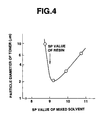
- Example 1 The same procedure as defined in Example 1 was conducted except that the composition of the mixed solvent received in a container equipped with a stirrer, a thermometer and a reflux condenser was changed as indicated in Table 9 below to deposit pigment and resin particles, thereby producing a liquid toner, The particle diameters of the thus produced liquid toners are shown in Table 9. Further, the relationship between the SP values of the mixed solvents used and the particle diameters of the obtained toners are shown in Fig. 4. (Incidentally, the results of Example 1 are also shown in Table 9 and Fig.
Landscapes
- Physics & Mathematics (AREA)
- General Physics & Mathematics (AREA)
- Liquid Developers In Electrophotography (AREA)
- Developing Agents For Electrophotography (AREA)
Applications Claiming Priority (19)
| Application Number | Priority Date | Filing Date | Title |
|---|---|---|---|
| JP8159612A JPH1010798A (ja) | 1996-06-20 | 1996-06-20 | 液体トナー用顔料組成物の製造方法 |
| JP159615/96 | 1996-06-20 | ||
| JP15961096 | 1996-06-20 | ||
| JP15961596A JP3525626B2 (ja) | 1996-06-20 | 1996-06-20 | 液体トナー用顔料組成物 |
| JP8159610A JPH1010797A (ja) | 1996-06-20 | 1996-06-20 | 液体トナー用顔料組成物の製法 |
| JP15961796 | 1996-06-20 | ||
| JP15961296 | 1996-06-20 | ||
| JP15961596 | 1996-06-20 | ||
| JP15961796A JP3525627B2 (ja) | 1996-06-20 | 1996-06-20 | 液体トナー用顔料組成物 |
| JP159617/96 | 1996-06-20 | ||
| JP15961696 | 1996-06-20 | ||
| JP159616/96 | 1996-06-20 | ||
| JP15961696A JP3567621B2 (ja) | 1996-06-20 | 1996-06-20 | 液体トナー用顔料組成物 |
| JP159612/96 | 1996-06-20 | ||
| JP159610/96 | 1996-06-20 | ||
| JP16161396 | 1996-06-21 | ||
| JP161613/96 | 1996-06-21 | ||
| JP8161613A JPH1010796A (ja) | 1996-06-21 | 1996-06-21 | 液体トナーの製造方法 |
| PCT/JP1997/002114 WO1997049007A1 (fr) | 1996-06-20 | 1997-06-19 | Composition de pigment pour toner liquide, procede de fabrication de cette composition et procede de fabrication d'un toner liquide |
Publications (3)
| Publication Number | Publication Date |
|---|---|
| EP0845712A1 true EP0845712A1 (fr) | 1998-06-03 |
| EP0845712A4 EP0845712A4 (fr) | 1999-08-11 |
| EP0845712B1 EP0845712B1 (fr) | 2004-12-08 |
Family
ID=27553228
Family Applications (1)
| Application Number | Title | Priority Date | Filing Date |
|---|---|---|---|
| EP97928448A Expired - Lifetime EP0845712B1 (fr) | 1996-06-20 | 1997-06-19 | Composition de pigment pour toner liquide |
Country Status (4)
| Country | Link |
|---|---|
| US (1) | US6087434A (fr) |
| EP (1) | EP0845712B1 (fr) |
| DE (1) | DE69731873T2 (fr) |
| WO (1) | WO1997049007A1 (fr) |
Cited By (3)
| Publication number | Priority date | Publication date | Assignee | Title |
|---|---|---|---|---|
| EP1008915A4 (fr) * | 1997-08-29 | 2000-08-23 | Nippon Zeon Co | Toner pour le developpement d'images electrostatiques et procede de production de ce toner |
| EP2302004A1 (fr) * | 2009-09-28 | 2011-03-30 | Evonik Carbon Black GmbH | Suie, son procédé de fabrication et d'utilisation |
| EP2336228A1 (fr) * | 2009-11-26 | 2011-06-22 | Evonik Carbon Black GmbH | Mélange de caoutchouc |
Families Citing this family (8)
| Publication number | Priority date | Publication date | Assignee | Title |
|---|---|---|---|---|
| US7226966B2 (en) * | 2001-08-03 | 2007-06-05 | Nanogram Corporation | Structures incorporating polymer-inorganic particle blends |
| DE19854819A1 (de) * | 1998-11-27 | 2000-05-31 | Degussa | Hohler Artikel mit antistatischen Eigenschaften |
| US7148285B2 (en) | 2001-05-11 | 2006-12-12 | Cabot Corporation | Coated carbon black pellets and methods of making same |
| DE10340884A1 (de) * | 2003-09-04 | 2005-03-31 | Riebel, Ulrich, Prof. Dr.-Ing. | Verfahren zur Herstellung von Ruß oder anderen Flammenaerosolen und Vorrichtung zur Durchführung des Verfahrens |
| US7505720B2 (en) * | 2005-12-28 | 2009-03-17 | Konica Minolta Business Technologies, Inc. | Developing roller and developing method thereof |
| US20120097903A1 (en) * | 2008-12-19 | 2012-04-26 | Vorbeck Materials Corp. | Inks and coatings containing multi-chain lipids |
| US20120308925A1 (en) * | 2011-05-30 | 2012-12-06 | Xerox Corporation | Hyperpigmented black low melt toner |
| WO2017174123A1 (fr) * | 2016-04-06 | 2017-10-12 | Hp Indigo B.V. | Encre électrophotographique comprenant un directeur de charge |
Family Cites Families (9)
| Publication number | Priority date | Publication date | Assignee | Title |
|---|---|---|---|---|
| US3988478A (en) * | 1974-02-22 | 1976-10-26 | Cities Service Company | Carbon black |
| US3959008A (en) * | 1974-06-24 | 1976-05-25 | Cities Service Company | Carbon black |
| DE3118907A1 (de) * | 1981-05-13 | 1982-12-02 | Degussa Ag, 6000 Frankfurt | Verfahren zur entfernung von extrahierbaren bestandteilen aus russen |
| JPS6450061A (en) * | 1987-08-21 | 1989-02-27 | Morimura Baadeishie Kk | Production of liquid developer for electrostatic photography |
| JPH0619220A (ja) * | 1992-07-06 | 1994-01-28 | Dainippon Printing Co Ltd | 湿式トナー及びその製造方法 |
| US5382621A (en) * | 1993-01-21 | 1995-01-17 | Cabot Corporation | Skim compounds incorporating low ash carbon blacks |
| JPH06289657A (ja) * | 1993-03-31 | 1994-10-18 | Mitsubishi Kasei Corp | 静電荷像現像用トナーの製造方法 |
| JP3457375B2 (ja) * | 1994-02-25 | 2003-10-14 | ヒューレット−パッカード・インデイゴ・ビー・ブイ | 静電荷像現像用液体現像剤の製造方法 |
| DE69611984T2 (de) * | 1996-01-19 | 2001-06-13 | Denki Kagaku Kogyo K.K., Tokio/Tokyo | Acetylenruss, seine Herstellung und seine Verwendung |
-
1997
- 1997-06-19 US US09/011,982 patent/US6087434A/en not_active Expired - Fee Related
- 1997-06-19 WO PCT/JP1997/002114 patent/WO1997049007A1/fr not_active Ceased
- 1997-06-19 EP EP97928448A patent/EP0845712B1/fr not_active Expired - Lifetime
- 1997-06-19 DE DE69731873T patent/DE69731873T2/de not_active Expired - Fee Related
Cited By (6)
| Publication number | Priority date | Publication date | Assignee | Title |
|---|---|---|---|---|
| EP1008915A4 (fr) * | 1997-08-29 | 2000-08-23 | Nippon Zeon Co | Toner pour le developpement d'images electrostatiques et procede de production de ce toner |
| US6440628B1 (en) | 1997-08-29 | 2002-08-27 | Nippon Zeon Co., Ltd. | Tones for development of electrostatic image and production process thereof |
| EP2302004A1 (fr) * | 2009-09-28 | 2011-03-30 | Evonik Carbon Black GmbH | Suie, son procédé de fabrication et d'utilisation |
| US8420044B2 (en) | 2009-09-28 | 2013-04-16 | Evonik Carbon Black Gmbh | Carbon black, a process for preparation thereof and use thereof |
| EP2336228A1 (fr) * | 2009-11-26 | 2011-06-22 | Evonik Carbon Black GmbH | Mélange de caoutchouc |
| US8124682B2 (en) | 2009-11-26 | 2012-02-28 | Evonik Carbon Black Gmbh | Rubber mixture |
Also Published As
| Publication number | Publication date |
|---|---|
| DE69731873D1 (de) | 2005-01-13 |
| WO1997049007A1 (fr) | 1997-12-24 |
| EP0845712B1 (fr) | 2004-12-08 |
| EP0845712A4 (fr) | 1999-08-11 |
| DE69731873T2 (de) | 2005-11-24 |
| US6087434A (en) | 2000-07-11 |
Similar Documents
| Publication | Publication Date | Title |
|---|---|---|
| DE102019122587B4 (de) | Toner und Bilderzeugungsverfahren | |
| CN101430513B (zh) | 调色剂和图像形成方法 | |
| DE69926685T2 (de) | Toner und Bildherstellungsverfahren | |
| US6087434A (en) | Pigment composition for liquid toner | |
| JP3906580B2 (ja) | 金属石鹸微粒子及びその製造方法とその用途 | |
| JP3450658B2 (ja) | 静電荷潜像現像用磁性トナー、装置ユニット及び画像形成方法 | |
| JP2014029511A (ja) | トナー | |
| DE69517229T2 (de) | Toner für die Entwicklung elektrostatischer Bilder | |
| US6160142A (en) | Metallic soap fine particles, process for producing same and use of same | |
| DE69932388T2 (de) | Gelber Toner, Herstellungsverfahren und Bilderzeugungsverfahren | |
| US6020103A (en) | Liquid developer, method of producing the liquid developer and image formation using the same | |
| US20090246681A1 (en) | Method for Producing Positive Charging Toner | |
| DE102005045131B4 (de) | Verfahren zur Herstellung von Toner, der Toner und ein Fixierverfahren | |
| JP3525626B2 (ja) | 液体トナー用顔料組成物 | |
| JP7630981B2 (ja) | トナー | |
| JP4311053B2 (ja) | 静電潜像現像用乾式トナー、現像剤及び画像形成方法 | |
| JP3567621B2 (ja) | 液体トナー用顔料組成物 | |
| JPH1010797A (ja) | 液体トナー用顔料組成物の製法 | |
| JP3742146B2 (ja) | 液体トナー用顔料組成物の製法 | |
| JP3763608B2 (ja) | 液体トナー用顔料組成物の製造法 | |
| JP3647282B2 (ja) | マゼンタトナー | |
| JPH1010794A (ja) | 液体トナーの製造法 | |
| JP3525627B2 (ja) | 液体トナー用顔料組成物 | |
| JP2010072362A (ja) | 黒色トナー、黒色トナーの製造方法および画像形成方法 | |
| JP3229647B2 (ja) | 湿式トナー及びその製造方法 |
Legal Events
| Date | Code | Title | Description |
|---|---|---|---|
| PUAI | Public reference made under article 153(3) epc to a published international application that has entered the european phase |
Free format text: ORIGINAL CODE: 0009012 |
|
| AK | Designated contracting states |
Kind code of ref document: A1 Designated state(s): BE DE FR GB IT NL |
|
| 17P | Request for examination filed |
Effective date: 19980603 |
|
| A4 | Supplementary search report drawn up and despatched |
Effective date: 19990625 |
|
| AK | Designated contracting states |
Kind code of ref document: A4 Designated state(s): BE DE FR GB IT NL |
|
| 17Q | First examination report despatched |
Effective date: 20031104 |
|
| RTI1 | Title (correction) |
Free format text: PIGMENT COMPOSITION FOR LIQUID TONER |
|
| GRAP | Despatch of communication of intention to grant a patent |
Free format text: ORIGINAL CODE: EPIDOSNIGR1 |
|
| RTI1 | Title (correction) |
Free format text: PIGMENT COMPOSITION FOR LIQUID TONER |
|
| RIN1 | Information on inventor provided before grant (corrected) |
Inventor name: MAKINO, KATSUAKI C/O MITSUBISHI HEAVY IND., LTD., Inventor name: KUNO, HIROAKI C/O MITSUBISHI HEAVY IND., LTD., Inventor name: SUDA, YASUHARU,C/O MITSUBISHI HEAVY IND., LTD. Inventor name: MATSUGI, AKIHIRO,C/O MITSUBISHI CHEMICAL CORP. Inventor name: HISASHI, HIDEYUKI,C/O MITSUBISHI CHEMICAL CORP., |
|
| RAP1 | Party data changed (applicant data changed or rights of an application transferred) |
Owner name: MITSUBISHI HEAVY INDUSTRIES, LTD. Owner name: MITSUBISHI CHEMICAL CORPORATION |
|
| GRAS | Grant fee paid |
Free format text: ORIGINAL CODE: EPIDOSNIGR3 |
|
| GRAA | (expected) grant |
Free format text: ORIGINAL CODE: 0009210 |
|
| AK | Designated contracting states |
Kind code of ref document: B1 Designated state(s): BE DE FR GB IT NL |
|
| PG25 | Lapsed in a contracting state [announced via postgrant information from national office to epo] |
Ref country code: NL Free format text: LAPSE BECAUSE OF FAILURE TO SUBMIT A TRANSLATION OF THE DESCRIPTION OR TO PAY THE FEE WITHIN THE PRESCRIBED TIME-LIMIT Effective date: 20041208 |
|
| REG | Reference to a national code |
Ref country code: GB Ref legal event code: FG4D |
|
| RAP2 | Party data changed (patent owner data changed or rights of a patent transferred) |
Owner name: MITSUBISHI HEAVY INDUSTRIES, LTD. Owner name: MITSUBISHI CHEMICAL CORPORATION |
|
| REF | Corresponds to: |
Ref document number: 69731873 Country of ref document: DE Date of ref document: 20050113 Kind code of ref document: P |
|
| NLT2 | Nl: modifications (of names), taken from the european patent patent bulletin |
Owner name: MITSUBISHI CHEMICAL CORPORATION EN MITSUBISHI HEAV |
|
| NLV1 | Nl: lapsed or annulled due to failure to fulfill the requirements of art. 29p and 29m of the patents act | ||
| PGFP | Annual fee paid to national office [announced via postgrant information from national office to epo] |
Ref country code: GB Payment date: 20050615 Year of fee payment: 9 |
|
| PGFP | Annual fee paid to national office [announced via postgrant information from national office to epo] |
Ref country code: DE Payment date: 20050629 Year of fee payment: 9 |
|
| ET | Fr: translation filed | ||
| PLBE | No opposition filed within time limit |
Free format text: ORIGINAL CODE: 0009261 |
|
| STAA | Information on the status of an ep patent application or granted ep patent |
Free format text: STATUS: NO OPPOSITION FILED WITHIN TIME LIMIT |
|
| 26N | No opposition filed |
Effective date: 20050909 |
|
| PG25 | Lapsed in a contracting state [announced via postgrant information from national office to epo] |
Ref country code: GB Free format text: LAPSE BECAUSE OF NON-PAYMENT OF DUE FEES Effective date: 20060619 |
|
| PG25 | Lapsed in a contracting state [announced via postgrant information from national office to epo] |
Ref country code: DE Free format text: LAPSE BECAUSE OF NON-PAYMENT OF DUE FEES Effective date: 20070103 |
|
| GBPC | Gb: european patent ceased through non-payment of renewal fee |
Effective date: 20060619 |
|
| PGFP | Annual fee paid to national office [announced via postgrant information from national office to epo] |
Ref country code: FR Payment date: 20120604 Year of fee payment: 16 Ref country code: BE Payment date: 20120531 Year of fee payment: 16 |
|
| PGFP | Annual fee paid to national office [announced via postgrant information from national office to epo] |
Ref country code: IT Payment date: 20120604 Year of fee payment: 16 |
|
| BERE | Be: lapsed |
Owner name: *MITSUBISHI CHEMICAL CORP. Effective date: 20130630 Owner name: *MITSUBISHI HEAVY INDUSTRIES LTD Effective date: 20130630 |
|
| REG | Reference to a national code |
Ref country code: FR Ref legal event code: ST Effective date: 20140228 |
|
| PG25 | Lapsed in a contracting state [announced via postgrant information from national office to epo] |
Ref country code: BE Free format text: LAPSE BECAUSE OF NON-PAYMENT OF DUE FEES Effective date: 20130630 |
|
| PG25 | Lapsed in a contracting state [announced via postgrant information from national office to epo] |
Ref country code: FR Free format text: LAPSE BECAUSE OF NON-PAYMENT OF DUE FEES Effective date: 20130701 Ref country code: IT Free format text: LAPSE BECAUSE OF NON-PAYMENT OF DUE FEES Effective date: 20130619 |