EP0845907A2 - System und Methode zur Bearbeitung von Multimedia-Datenströmen in gemeinsamer Ringarchitektur-Multimedia-Subsystemclustern - Google Patents
System und Methode zur Bearbeitung von Multimedia-Datenströmen in gemeinsamer Ringarchitektur-Multimedia-Subsystemclustern Download PDFInfo
- Publication number
- EP0845907A2 EP0845907A2 EP97480075A EP97480075A EP0845907A2 EP 0845907 A2 EP0845907 A2 EP 0845907A2 EP 97480075 A EP97480075 A EP 97480075A EP 97480075 A EP97480075 A EP 97480075A EP 0845907 A2 EP0845907 A2 EP 0845907A2
- Authority
- EP
- European Patent Office
- Prior art keywords
- servers
- loop
- clusters
- cluster
- interconnected
- Prior art date
- Legal status (The legal status is an assumption and is not a legal conclusion. Google has not performed a legal analysis and makes no representation as to the accuracy of the status listed.)
- Granted
Links
Images



Classifications
-
- H—ELECTRICITY
- H04—ELECTRIC COMMUNICATION TECHNIQUE
- H04N—PICTORIAL COMMUNICATION, e.g. TELEVISION
- H04N7/00—Television systems
- H04N7/16—Analogue secrecy systems; Analogue subscription systems
- H04N7/173—Analogue secrecy systems; Analogue subscription systems with two-way working, e.g. subscriber sending a programme selection signal
- H04N7/17309—Transmission or handling of upstream communications
- H04N7/17336—Handling of requests in head-ends
Definitions
- This invention relates to computerized systems for serving audio and video data and, more particularly, to such systems having improved data storage and handling.
- An example of an application of such systems is information kiosks in shopping malls, museums, etc., but perhaps an application more representative of the myriad technical problems which arise in delivery of such a system is in the case of video-on-demand systems.
- Such systems are called upon to deliver simultaneously to thousands of customers their individualized selection of movie titles to view on an almost instantaneous demand basis, wherein the movie titles may be selected by a customer from a list numbering in the thousands.
- Multimedia data is notoriously extremely dense. For example, storage of a single full length movie may require 5 gigabytes, and playback of a video stream of the title typically may be at a 20 megabyte per second rate.
- a video-on-demand service might be expected to service thousands of customers, each with the ability to select their own "customized" uninterruptable 20 megabyte per second video stream simultaneously selected from a video database comprising perhaps 10 14 bytes (e.g., 100 gigabytes per title times 1,000 titles).
- a video database comprising perhaps 10 14 bytes (e.g., 100 gigabytes per title times 1,000 titles).
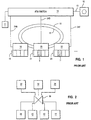
- Fig. 1 is a simplified illustration of one conventional implementation of a video server system.
- a plurality of servers 18, 20, 22 are provided which may take the form of RAID controllers well known in the art such as RAID 4 or 5 controllers which offer data loss protection.
- Each such controller may control a corresponding dedicated number of disk drives on the order of perhaps 30 or 40 per controller organized in raid arrays.
- controllers 18, 20, 22 would control their respective plurality of disk arrays 19, 21, and 23, respectively, each array containing digitized video data such as titles T shown in Fig. 1, typically on 4 disk drivers with an additional drive for parity.
- each of the controllers 18-22 Interconnecting each of the controllers 18-22 is a fiber channel arbitrated loop 10 and a redundant loop 12 (the data loss protection afforded by the raid controllers and the redundant loop are present due to the need in such systems for high availability).
- Each of the respective controllers 18-22 delivers on respective line 24A, 24B, 24C, streaming video from their respective disk arrays 19, 21, 23, respectively, such as an ATM streaming video in MPEG 2 format well known in the art, such streaming video being delivered to an appropriate ATM switch 14 also well known in the art.
- Interconnected to the switch 14 is a cable network 13 serving a plurality of video/audio controllers or computers or televisions 16 for example, only one of which is shown for simplicity.
- the controller 20 will deliver the video stream from one of the corresponding dedicated drives 21 on which the title resides through the controller 20, onto the line 24B, through the ATM switch 14, out cable connection 13 to be viewed by the customer on the monitor 16.
- the system may work very well.
- the title T may be in great demand and thus saturate the bus, inasmuch as a given raid controller such as controller 20 may only handle a finite number of such streams. In such an eventuality, the fiber channel loop 10-12 comes into play.
- the title T may be transferred over the loop 10-12, statically by an operator, e.g., not on demand, to a next disk controller 22 and replicated as T' in one of the corresponding disk drives 23 associated with controller 22. In this manner, an additional complement of video streams of the title may be provided by the controller 22 on line 24C, deriving from the replication of title T on controller 22's disk drive as the redundant title T'.
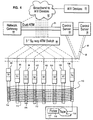
- the system of Fig. 1 provides a crossbar switch 6 or other type interconnecting switch interposed between a plurality of disk controllers 30, 32, 34, and various disk arrays, 38, 40, 42, 44, which have stored therein the video data.
- the system of Fig. 2 enables any controller 30, 32, 34, to access a title on any of the disk arrays 38, 40, 42, 44, by means of the crossbar switches 36.
- the cost per stream in a system such that of Fig. 2 becomes prohibitive. This is a direct result of the excessive cost of such high interconnect and redundancy crossbar switches 36, considering the fact that given the large number of datastreams, a correspondingly large number of the expensive crossbar switches 36 are required.
- a cluster of clusters of multimedia A/V server subsystems is provided.
- Each cluster in turn is comprised of a plurality of A/V servers, a shared loop architecture plurality of data storage devices interconnected to the A/V servers whereby any storage device is substantially equally accessible by any of the servers in the cluster; and a highly available control server subsystem interconnected to the A/V servers and the data storage devices for controlling the A/V servers and the data storage devices.
- Each of the clusters is interconnected to a high speed switch for delivery of datastreams from the cluster to the end user.
- One of the control server subsystems also serves as a master control server assigning a request for a datastream to one of the clusters.
- Fig. 1 is a functional block diagram of an audio/video server system of the prior art, employing fiber channel arbitrated loops interconnecting disk controllers.
- Fig. 2 is a functional block diagram of yet another audio/video server system of the prior art employing crossbar switches for selectively interconnecting a given controller to a desired storage device.
- Fig. 3 is a functional block diagram of one implementation an audio/video server system of the invention employing a shared storage loop.
- Fig. 4 is a more detailed functional diagram of the system of Fig. 3.
- Fig. 5 is a flow diagram illustrating the operation of the systems of Figs. 3 and 4 of the invention.
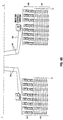
- Fig. 6 is a drawing of a 5 cluster system in accordance with the invention, each cluster containing 16 video service nodes and 352 4.6 disk drives interconnected so as to be shared by all 16 nodes of the cluster.
- Fig. 3 depicted therein is one implementation of an audio/video server system of the invention.
- an appropriate switch such as an ATM switch 50 is provided interposed between a plurality of display terminals such as television sets 54 and a plurality of servers or controllers 56, 58, 60.
- Each controller is interconnected to the switch 50 by its respective data stream line 62, 64, 66.
- a plurality of disk drive arrays 70, 72, 74, 76, are provided wherein titles such as T are digitally stored therein.
- Figs. 1 and 3 a closer comparison of Figs. 1 and 3 reveals a fundamental distinction. It will be noted that the fiber channel arbitrated loop 10-12 of Fig. 1 is dispensed with which interconnected the controllers 18-22. In contrast, in the system of the invention depicted in Fig. 3, a serial storage architecture (SSA) or fiber channel arbitrated loop (FC-AL) 68 is provided interposed between the controllers 56-60 and the disk arrays 70-76.
- SSA serial storage architecture
- FC-AL fiber channel arbitrated loop
- this video stream may essentially be provided by any of the controllers 56-60 from the same disk 72 on which the title T resides.
- the demand may therefore be serviced by the stream from disk 72 being delivered across loop 68 to controller 56, through line 62, switch 50, cable connection 51, to display device 54.
- the path could be from disk 72 through loop 68, controller 58, line 64, switch 50, cable connection 51 to display 54.
- the demand could be serviced along the path from disk 72 through loop 68, controller 60, line 66, switch 50, cable connection 51, to display device 54.
- the bandwidth of a given disk drive 70-76 typically may exceed the datastream handling ability of a given controller 56-60.
- the bandwidth of the drive 72 may be able to deliver 60 or more datastreams of the title T, whereas a given controller 56, for example, may only be able to handle 30 datastreams.
- this control loop 52 may be provided by an Ethernet loop well known in the art rather than necessitating a high speed fiber channel loop as in the case of the system of Fig. 1.
- the relatively slower loop connection 52 such as that provided by an Ethernet, may be adequate because unlike the case of Fig. 1, a great deal of video data is not being placed upon the loop 52 (since essentially it is only performing the function of control and coordinating the various processors 56-60).
- the loop 52 need not be as high a performance loop as that of arbitrated loop 10-12 in the case of the system of Fig. 1.
- the disks 70-76 are shared by all of the processors 56-60 in a cluster. Moreover, only as many drives 70-76 are required to hold titles as are required or limited by the bandwidth of the particular disk drive (e.g., the number of video streams that a given disk can handle). This is in recognition of the fact that modern day processors 56-60 may saturate quickly in terms of the number of video streams they may handle whereas a given disk drive 70-76 may nevertheless have remaining bandwidth left over to service another such processor with the identical video stream (e.g., the same title T). Also, in the system of Fig. 3, because any given controller can essentially access a title T with similar overhead via the SSA or FC-AL loop 68, the demands to balance the titles over the disk arrays are not as demanding as in the case of the system of Fig. 1.
- Figs. 1-3 only three servers or controllers were shown.
- the invention is not intended to be so limited.
- one or a cluster of essentially any desired number of audio/video server computers 94-108 may be provided which access a pool of disks via shared loops shown generally as reference numeral 110 looped in accordance with serial storage architecture (SSA) or fiber channel arbitrated loop (FC-AL) standards.
- SSA serial storage architecture
- FC-AL fiber channel arbitrated loop
- 1 to 32 computing nodes may be provided by the computers 94, 108, comprised of a corresponding 1 to 8 CPUs, with 3 x ATM 155 megabyte adapters, 2 x SSA adapters or 4 x FC-AL loop adapters.
- An isochronous (e.g., guaranteed bandwidth) connection (implemented in the system of Fig. 4 as an ATM switch and network, 88) is provided between the servers 94-108 and a set of audio/video devices 83 delivered by a broadband channel 82.
- analog output may be selected and provided in a conventional manner.
- audio/video (A/V) devices 83 may include, but are not limited to televisions, television control adapters (set top boxes) personal computers, and information kiosks. For generality, users of such A/V devices 83 may be referred to herein as viewers regardless of whether they are listening, viewing, or both.
- a plurality of disk drives 112 are provided in the loops 110 represented in the figure as small ovals.
- a set of loop adapters 114 are provided represented as black rectangles in Fig. 4 which connect each computer 94-108 to each loop of the disk communications loop 110.
- these would be SSA or FC-AL adapters dependent upon which loop architecture for the loop 110 is adopted.
- Stored media titles are preferably divided into thousands of data blocks, each in the implementation herein described of a size at least 256K bytes.
- individual data blocks are not stored on a single disk 112, but rather are placed in a balanced fashion across many or even all of the available disk drives 112 on the shared loops 110. This permits any stored title to be played simultaneously by a large number of A/V devices 83 without overloading any single drive 112 or server 94-108.
- the content on the drives 112 has been described as video or movie data, the invention is not intended to be so limited.
- any multimedia, audio, video, or audio/video titles or clips may be stored on the shared disk drives 112 and in any of a number of digital standard formats including, but not limited to MPEG 1, MPEG 2, and motion JPEG. Connection from any of these titles to any such A/V device 83 may thus be made from any of the servers 94-108 through the isochronous connection 88-82.
- a pair of redundant, fault-tolerant control servers in a computing cluster 84-86 are further included for, as but one function, controlling the servers 94-108.
- control commands may also be set essentially by any type of computer or input mechanism capable of communicating title selection and play control commands to the servers 94-108.
- Either the control server 84-86 or the A/V servers 94-108 may perform the additional function of balancing the computer load among the servers as previously noted.
- a program executing in the control servers 84-86 also performs the additional function of determining whether new media selection requests can be played without pauses, gaps, or excessive loss of quality of service (QOS) to the viewer. If they cannot be so played, the control servers will delay the request.
- the programs associated with the control server could reside on one or more of the A/V servers 94-108.
- One or more archive servers 108 preferably may be interconnected to a robotic media archiving system 117 comprised of a magnetic tape or CD ROM media 118 and a picker 116 for selecting and playing back tapes or CD ROMs in the subsystem 117 in response to commands from the archive server 108.
- the archive server 108 will provide the function of loading new titles onto the disks 112 of the loops of the shared loop 110. Two more clusters may be connected to the archive server 108 if desired.
- FIG. 5 The operation of the preferred sequence of events of the system of Fig. 1 may be more clearly understood now with reference to the flow diagram of Fig. 5.
- This flow diagram may be implemented in program code executing on the control servers 84-86 or A/V servers 94-108 and cause execution of the following steps.
- the control routine is entered at 120, whereupon the typical sequence of events in order to play a media title transpires as follows.
- a request to play a media title, 122 is made by an A/V device 83 (Fig. 4) or a viewer via a Network Gateway 80 (Fig. 4) or any other data entry device, such request being delivered to the control server 84-86 from the Network Gateway 80 along communication path 81.
- the control server(s) 84-86 will then determine if the requested title is available, step 124 of Fig. 5, on any set of the shared loop disks 112 of Fig. 4. If not, the flow exits to the right of decision block 124, whereupon the control server issues a request to the archive server 108 along the control message path 90 of Fig. 4 to load the title onto free disk space in the loops 110. If the title is already available on a loop, the flow exits to the left of decision box 124. It will be noted that the archive server 108 can double as a hot standby to A/V servers 94-106 if necessary.
- control server 84-86 selects an A/V server 94-108 to play the request, 128, balancing the workload across all of the A/V servers. Because the A/V servers are connected to all of the disks 112 via the shared loop architecture of loops 110, any A/V server may be selected by the control server at any time to effect such playing, thereby making load balancing easier.
- the control server 84-86 issues a play request, 130, to the selected A/V server 94-108 utilizing the control message path 90 (or redundant control path backup 92).
- the control message path 90 is preferably redundant, although implementations may vary (e.g., Ethernet, FDDI, or Token-Ring paths would be equally acceptable).
- the particular A/V server selected at step 128 thereafter completes a connection, 132, to the requesting A/V device 83 via the isochronous network 88, if such a connection has not already been established previously.
- This selected A/V server will then locate the first two blocks of media data (e.g., the title data) on the shared loop disk drives 112, and will pre-fetch them both into the selected server's memory, shown at step 134.
- this A/V server will output the first block of the media data via an I/O adapter (e.g., an ATM adapter in the server, although not necessarily an ATM adapter) which is connected to the requesting A/V device 83.
- I/O adapter e.g., an ATM adapter in the server, although not necessarily an ATM adapter
- a check may be made of the integrity of the ensuing data transfer, 138.
- the selected A/V server, control server 84-86, and communications adapter in the server jointly may make checks to ensure that the media data flows to the selected A/V device 83 without gaps, pauses, or the introduction of unacceptable excessive noise or jitter.
- the selected A/V server will pre-fetch successive title data blocks into its memory, 140, prior to their being required by the A/V device 83.
- the access pattern is preferably essentially random across multiple disks 112 and within each such disk.
- each disk 112 is connected to each A/V server 94-108 via one or more shared communication loops shown collectively at reference numeral 110 of Fig. 4, such loops being implemented via SSA or FC-AL architecture and standards.
- Each media selection or title because of the foregoing design, may be directly accessible by every A/V server 94-108 in the cluster or clusters of server computers due to this shared disk loop architecture.
- Media titles may be randomly dispersed across many such disks 112, thereby facilitating individual titles being played by many simultaneous viewers.
- the archive server 108 may load new titles directly onto the shared loop disks 112 without adding additional workload to any of the active A/V servers 95-106, thereby enhancing the chances of a high quality playback.
- the archive server 108 may be advantageous to provide not one shared loop cluster as shown in Fig. 4, but rather three independent A/V shared-loop clusters which may be interconnected, thereby reducing archive device, robot, and media costs per upload.
- the archive server 108 itself can assume the workload of a failed A/V node in the cluster, thereby acting as a hot standby for up to three interconnected clusters.
- the programs executing in the control servers 84-86 desirably may also support multiple control and data path interconnected clusters (e.g., clusters of clusters) for load leveling and scaling to a larger number of A/V playbacks.
- clusters of clusters For example, cost performance studies have shown that disk sharing by 8-16 A/V servers may amortize shared disk cost enough so that additional costs per stream are dominated by non-shared system cost. Accordingly, currently there may be little economy in scaling clusters beyond 16 nodes.
- clusters of such shared loop clusters 110 may be scaled to support nominally up to 25,000 streams if desired, assuming suitable switching devices for the play streams. Up to three such clusters can thereby share expensive archive server and media costs, thereby further reducing the cost per upload.
- the archive server 108 may load new titles directly onto the shared-loop disks 112 without adding substantial workload to any of the active A/V servers 94-106, thereby enhancing the probability of high quality playback which is highly desirable in commercial video-on-demand settings. Because all nodes are connected to all disks and titles may be spread across many or even all disk drives, suddenly popular, e.g., "hot" titles may not cause transient system overload on any single server or disk drive.
- replication of data across multiple loops, plus attachment of each A/V server 94-108 to each of such loops results in the fact that disk or loop failure will have low impact on system play performance.
- storage cost is a dominant factor in overall cost per played title for many A/V applications.
- the invention contemplates collection by the control servers of view frequency per title data. This data may then be used to optimize shared-loop bandwidth and reduce data replication significantly.
- dynamic balancing of media title requests across disks 112 is not required unless frequency of play optimization is desired and utilized.
- a multimedia datastream providing system may be required which can readily support a larger number of datastreams than that of the system previously depicted.
- Such a system with a scaled up capability is shown in the functional block diagram of Fig. 6.
- a cluster of clusters of the multimedia system previously described are shown, for convenience graphically disposed about a high speed ATM switch 186. Taking one of the clusters shown in the upper left hand corner of Fig. 6 approximately in the "ten o'clock" position, this cluster will be recognized as being substantially similar to the previously described cluster of A/V servers. Moreover, it will be noted that this cluster will essentially be replicated as shown in the figure many time over.
- the first cluster discussed will include a control server subsystem 150 (typically comprised of the previously described two control servers for high availability reasons); a plurality of A/V servers 162, and a shared loop architecture data storage subsystem 174.
- the A/V servers 162 and control server subsystem 150 are interconnected to the ATM switch 186 through the interconnections 188.
- This first cluster it will be observed is interconnected essentially similarly to the previously described cluster in the sense that the plurality of A/V servers 162 (16 in total in the embodiment shown in Fig. 6) will be interconnected to the shared loop architecture data system 174 so that any of the 16 A/V servers 162 may have substantially equal access to any of the disks on the shared loop architecture system 174.
- a control server subsystem 152 is provided, with a plurality of A/V servers 164, and a plurality of disk drives arranged in the shared loop architecture shown at reference numeral 176, such components being in communication with the ATM switch 186 through interconnections 190.
- each following cluster will, in like manner, include, respectively, a control server subsystem 154, 156, 158 and 160.
- Each cluster will also include a corresponding plurality of A/V servers 166, 168, 170, 172, respectively.
- Each such cluster will further include its corresponding plurality of disk drives arranged in the familiar shared loop architecture, shown at reference numerals 178, 180, 182, 184.
- the components of each cluster will be in communication through the ATM switches 186 through their respective interconnections, 192, 194, 196, 198.
- one of the control server subsystems desirably will also provide the function of a master control server, such as the control server subsystem 156.
- the purpose of the master control subsystem is as follows. When a request for a datastream load 182 is transferred along line 184 to the ATM switch 186 and thence to the master control server subsystem 156 along connection 186, this master control server will serve the purpose of then assigning this request for a datastream to a particular one of the multiple clusters in Fig. 6. Accordingly this assignment will be transmitted from the master control server 156 along line 186 through the ATM switch 186 to the appropriate cluster so as to balance the load.
- the ATM switch 186 may take the form of an OC12 switch well known in the art which has a capacity of four times an OC3 switch shown in the previous figures so as to handle the increased throughput of the 16 nodes/cluster and multiple clusters of Fig. 6.
Landscapes
- Engineering & Computer Science (AREA)
- Multimedia (AREA)
- Signal Processing (AREA)
- Two-Way Televisions, Distribution Of Moving Picture Or The Like (AREA)
- Computer And Data Communications (AREA)
- Small-Scale Networks (AREA)
- Information Retrieval, Db Structures And Fs Structures Therefor (AREA)
- Data Exchanges In Wide-Area Networks (AREA)
- Multi Processors (AREA)
Applications Claiming Priority (2)
| Application Number | Priority Date | Filing Date | Title |
|---|---|---|---|
| US08/755,874 US5892913A (en) | 1996-12-02 | 1996-12-02 | System and method for datastreams employing shared loop architecture multimedia subsystem clusters |
| US755874 | 1996-12-02 |
Publications (3)
| Publication Number | Publication Date |
|---|---|
| EP0845907A2 true EP0845907A2 (de) | 1998-06-03 |
| EP0845907A3 EP0845907A3 (de) | 2003-07-02 |
| EP0845907B1 EP0845907B1 (de) | 2007-07-11 |
Family
ID=25041032
Family Applications (1)
| Application Number | Title | Priority Date | Filing Date |
|---|---|---|---|
| EP97480075A Expired - Lifetime EP0845907B1 (de) | 1996-12-02 | 1997-10-31 | System und Methode zur Bearbeitung von Multimedia-Datenströmen in gemeinsamer Ringarchitektur-Multimedia-Subsystemclustern |
Country Status (9)
| Country | Link |
|---|---|
| US (1) | US5892913A (de) |
| EP (1) | EP0845907B1 (de) |
| JP (1) | JP3905962B2 (de) |
| CN (1) | CN1138218C (de) |
| CA (1) | CA2222390C (de) |
| DE (1) | DE69737904T2 (de) |
| ES (1) | ES2287947T3 (de) |
| SG (1) | SG55405A1 (de) |
| TW (1) | TW369631B (de) |
Families Citing this family (48)
| Publication number | Priority date | Publication date | Assignee | Title |
|---|---|---|---|---|
| JP3271916B2 (ja) * | 1996-12-06 | 2002-04-08 | 株式会社エクシング | 音・動画再生システム |
| US6185203B1 (en) | 1997-02-18 | 2001-02-06 | Vixel Corporation | Fibre channel switching fabric |
| US6118776A (en) * | 1997-02-18 | 2000-09-12 | Vixel Corporation | Methods and apparatus for fiber channel interconnection of private loop devices |
| US6654933B1 (en) | 1999-09-21 | 2003-11-25 | Kasenna, Inc. | System and method for media stream indexing |
| US6381674B2 (en) * | 1997-09-30 | 2002-04-30 | Lsi Logic Corporation | Method and apparatus for providing centralized intelligent cache between multiple data controlling elements |
| US6279032B1 (en) | 1997-11-03 | 2001-08-21 | Microsoft Corporation | Method and system for quorum resource arbitration in a server cluster |
| US6311217B1 (en) * | 1998-06-04 | 2001-10-30 | Compaq Computer Corporation | Method and apparatus for improved cluster administration |
| US6138187A (en) * | 1998-08-21 | 2000-10-24 | International Business Machines Corporation | Method and system for increasing spatial reuse in a serial storage architecture subsystem |
| US6829610B1 (en) * | 1999-03-11 | 2004-12-07 | Microsoft Corporation | Scalable storage system supporting multi-level query resolution |
| US6401120B1 (en) * | 1999-03-26 | 2002-06-04 | Microsoft Corporation | Method and system for consistent cluster operational data in a server cluster using a quorum of replicas |
| US6453426B1 (en) | 1999-03-26 | 2002-09-17 | Microsoft Corporation | Separately storing core boot data and cluster configuration data in a server cluster |
| US7774469B2 (en) | 1999-03-26 | 2010-08-10 | Massa Michael T | Consistent cluster operational data in a server cluster using a quorum of replicas |
| US6289376B1 (en) * | 1999-03-31 | 2001-09-11 | Diva Systems Corp. | Tightly-coupled disk-to-CPU storage server |
| US6721794B2 (en) * | 1999-04-01 | 2004-04-13 | Diva Systems Corp. | Method of data management for efficiently storing and retrieving data to respond to user access requests |
| US6233607B1 (en) * | 1999-04-01 | 2001-05-15 | Diva Systems Corp. | Modular storage server architecture with dynamic data management |
| US7487531B1 (en) * | 1999-12-10 | 2009-02-03 | Sedna Patent Services, Llc | Method and apparatus of load sharing and improving fault tolerance in an interactive video distribution system |
| WO2001042940A1 (en) * | 1999-12-10 | 2001-06-14 | Diva Systems Corporation | Method and apparatus of load sharing and improving fault tolerance in an interactive video distribution system |
| US6662219B1 (en) | 1999-12-15 | 2003-12-09 | Microsoft Corporation | System for determining at subgroup of nodes relative weight to represent cluster by obtaining exclusive possession of quorum resource |
| US6757291B1 (en) | 2000-02-10 | 2004-06-29 | Simpletech, Inc. | System for bypassing a server to achieve higher throughput between data network and data storage system |
| US6622163B1 (en) * | 2000-03-09 | 2003-09-16 | Dell Products L.P. | System and method for managing storage resources in a clustered computing environment |
| US7318107B1 (en) * | 2000-06-30 | 2008-01-08 | Intel Corporation | System and method for automatic stream fail-over |
| US7310678B2 (en) * | 2000-07-28 | 2007-12-18 | Kasenna, Inc. | System, server, and method for variable bit rate multimedia streaming |
| US7277956B2 (en) | 2000-07-28 | 2007-10-02 | Kasenna, Inc. | System and method for improved utilization of bandwidth in a computer system serving multiple users |
| US7191244B2 (en) * | 2001-01-19 | 2007-03-13 | Streamworks Technologies, Inc. | System and method for routing media |
| US8554940B2 (en) | 2001-01-19 | 2013-10-08 | Single Touch Interactive, Inc. | System and method for routing media |
| US20040025186A1 (en) * | 2001-01-19 | 2004-02-05 | Jennings Charles A. | System and method for managing media |
| US7054949B2 (en) | 2001-01-19 | 2006-05-30 | World Streaming Network, Inc. | System and method for streaming media |
| US20030018978A1 (en) * | 2001-03-02 | 2003-01-23 | Singal Sanjay S. | Transfer file format and system and method for distributing media content |
| WO2002071191A2 (en) * | 2001-03-02 | 2002-09-12 | Kasenna, Inc. | Metadata enabled push-pull model for efficient low-latency video-content distribution over a network |
| US7277952B2 (en) * | 2001-09-28 | 2007-10-02 | Microsoft Corporation | Distributed system resource protection via arbitration and ownership |
| US7155438B2 (en) * | 2002-05-01 | 2006-12-26 | Bea Systems, Inc. | High availability for event forwarding |
| US7526519B2 (en) * | 2002-05-01 | 2009-04-28 | Bea Systems, Inc. | High availability application view deployment |
| US7222148B2 (en) * | 2002-05-02 | 2007-05-22 | Bea Systems, Inc. | System and method for providing highly available processing of asynchronous service requests |
| KR20040001415A (ko) * | 2002-06-28 | 2004-01-07 | 대우전자주식회사 | 에이브이 출력 제어 장치 |
| US7403993B2 (en) * | 2002-07-24 | 2008-07-22 | Kasenna, Inc. | System and method for highly-scalable real-time and time-based data delivery using server clusters |
| JP2004070860A (ja) * | 2002-08-09 | 2004-03-04 | Hitachi Ltd | ストリームコンテンツ配送システムおよびプロキシサーバ |
| US7379959B2 (en) | 2002-09-07 | 2008-05-27 | Appistry, Inc. | Processing information using a hive of computing engines including request handlers and process handlers |
| US20040199650A1 (en) * | 2002-11-14 | 2004-10-07 | Howe John E. | System and methods for accelerating data delivery |
| US7613768B2 (en) * | 2003-05-19 | 2009-11-03 | Hewlett-Packard Development Company, L.P. | Method and system for managing a streaming media service |
| US7689685B2 (en) * | 2003-09-26 | 2010-03-30 | International Business Machines Corporation | Autonomic monitoring for web high availability |
| US20050262245A1 (en) * | 2004-04-19 | 2005-11-24 | Satish Menon | Scalable cluster-based architecture for streaming media |
| US11468128B1 (en) * | 2006-10-20 | 2022-10-11 | Richard Paiz | Search engine optimizer |
| GB2418268A (en) * | 2004-09-15 | 2006-03-22 | Ibm | Method for monitoring software components using native device instructions |
| US7793329B2 (en) * | 2006-02-06 | 2010-09-07 | Kasenna, Inc. | Method and system for reducing switching delays between digital video feeds using multicast slotted transmission technique |
| US11048765B1 (en) | 2008-06-25 | 2021-06-29 | Richard Paiz | Search engine optimizer |
| US11741090B1 (en) | 2013-02-26 | 2023-08-29 | Richard Paiz | Site rank codex search patterns |
| US11809506B1 (en) | 2013-02-26 | 2023-11-07 | Richard Paiz | Multivariant analyzing replicating intelligent ambience evolving system |
| EP4104158A4 (de) | 2020-04-21 | 2023-08-09 | Zeku, Inc. | Skalierbare architektur auf datenebene für drahtlose kommunikation |
Family Cites Families (13)
| Publication number | Priority date | Publication date | Assignee | Title |
|---|---|---|---|---|
| US4924303A (en) * | 1988-09-06 | 1990-05-08 | Kenneth Dunlop | Method and apparatus for providing interactive retrieval of TV still frame images and audio segments |
| US5765011A (en) * | 1990-11-13 | 1998-06-09 | International Business Machines Corporation | Parallel processing system having a synchronous SIMD processing with processing elements emulating SIMD operation using individual instruction streams |
| US5412416A (en) * | 1992-08-07 | 1995-05-02 | Nbl Communications, Inc. | Video media distribution network apparatus and method |
| US5440336A (en) * | 1993-07-23 | 1995-08-08 | Electronic Data Systems Corporation | System and method for storing and forwarding audio and/or visual information on demand |
| US5495283A (en) * | 1993-09-13 | 1996-02-27 | Albrit Technologies Ltd. | Cable television video messaging system and headend facility incorporating same |
| US5390138A (en) * | 1993-09-13 | 1995-02-14 | Taligent, Inc. | Object-oriented audio system |
| US5388264A (en) * | 1993-09-13 | 1995-02-07 | Taligent, Inc. | Object oriented framework system for routing, editing, and synchronizing MIDI multimedia information using graphically represented connection object |
| US5387927A (en) * | 1993-09-17 | 1995-02-07 | Mpr Teltech Ltd. | Method and apparatus for broadband transmission from a central office to a number of subscribers |
| US5481542A (en) * | 1993-11-10 | 1996-01-02 | Scientific-Atlanta, Inc. | Interactive information services control system |
| DE69521374T2 (de) * | 1994-08-24 | 2001-10-11 | Hyundai Electronics America, Milpitas | Videoserver und diesen verwendendes System |
| US5450411A (en) * | 1994-09-02 | 1995-09-12 | At&T Global Information Solutions Company | Network interface for multiplexing and demultiplexing isochronous and bursty data streams in ATM networks |
| WO1996010315A1 (en) * | 1994-09-26 | 1996-04-04 | Micropolis Corporation | Video server using memory pipe segments |
| US5737747A (en) * | 1995-10-27 | 1998-04-07 | Emc Corporation | Prefetching to service multiple video streams from an integrated cached disk array |
-
1996
- 1996-12-02 US US08/755,874 patent/US5892913A/en not_active Expired - Lifetime
-
1997
- 1997-10-28 TW TW086115984A patent/TW369631B/zh not_active IP Right Cessation
- 1997-10-30 CN CNB971212406A patent/CN1138218C/zh not_active Expired - Lifetime
- 1997-10-31 EP EP97480075A patent/EP0845907B1/de not_active Expired - Lifetime
- 1997-10-31 DE DE69737904T patent/DE69737904T2/de not_active Expired - Lifetime
- 1997-10-31 ES ES97480075T patent/ES2287947T3/es not_active Expired - Lifetime
- 1997-11-01 SG SG1997003939A patent/SG55405A1/en unknown
- 1997-11-21 JP JP32097297A patent/JP3905962B2/ja not_active Expired - Fee Related
- 1997-11-27 CA CA002222390A patent/CA2222390C/en not_active Expired - Lifetime
Also Published As
| Publication number | Publication date |
|---|---|
| CA2222390C (en) | 2002-02-05 |
| DE69737904T2 (de) | 2008-03-13 |
| JP3905962B2 (ja) | 2007-04-18 |
| JPH10228454A (ja) | 1998-08-25 |
| US5892913A (en) | 1999-04-06 |
| DE69737904D1 (de) | 2007-08-23 |
| CN1184287A (zh) | 1998-06-10 |
| CN1138218C (zh) | 2004-02-11 |
| TW369631B (en) | 1999-09-11 |
| ES2287947T3 (es) | 2007-12-16 |
| EP0845907A3 (de) | 2003-07-02 |
| EP0845907B1 (de) | 2007-07-11 |
| SG55405A1 (en) | 1998-12-21 |
| CA2222390A1 (en) | 1998-06-02 |
Similar Documents
| Publication | Publication Date | Title |
|---|---|---|
| US5892913A (en) | System and method for datastreams employing shared loop architecture multimedia subsystem clusters | |
| JP3195231B2 (ja) | マルチノード・ビデオ・サーバ・システム | |
| US9432460B2 (en) | Computer system and process for transferring multiple high bandwidth streams of data between multiple storage units and multiple applications in a scalable and reliable manner | |
| US5675743A (en) | Multi-media server | |
| US6128467A (en) | Crosspoint switched multimedia system | |
| US5854887A (en) | System for the management of multiple time-critical data streams | |
| US20030154246A1 (en) | Server for storing files | |
| JPH11504746A (ja) | 複数のパリティ・グループを持つ多重ディスク・ドライブ配列 | |
| EP0845906A2 (de) | Geteiltes Ring Audio/Videoserversystem | |
| Jadav et al. | Designing and implementing high-performance media-on-demand servers | |
| US6425130B2 (en) | Video network server for distributing sound and video image information to a plurality of terminals | |
| KR100253626B1 (ko) | 공유 루프 구조의 멀티미디어 서브시스템 클러스터를사용하여 멀티미디어 데이터스트림을 처리하기 위한 방법 및 시스템 | |
| KR100259331B1 (ko) | 공유 루프 오디오/비디오 서버 시스템 | |
| Jadav et al. | Design issues in high performance media-on-demand servers | |
| US7421726B1 (en) | Method of seamlessly replacing disc-based video streams with memory-based video streams in a video-on-demand system | |
| CN1189034A (zh) | 共享环路音频/视频服务器系统 | |
| JPH10283295A (ja) | データ転送システム、及びそのデータ転送方法 | |
| Aref et al. | An inexpensive, scalable, and open-architecture media server | |
| EP0577362A2 (de) | Erweiterte Architektur für die Speicherung und Verteilung von Bildern | |
| JP2000148711A (ja) | 動画像サーバシステム | |
| Jadav | Design and implementation of a high-performance continuous media-on-demand server | |
| Guittenit et al. | Design and evaluation of ring-based video servers |
Legal Events
| Date | Code | Title | Description |
|---|---|---|---|
| PUAI | Public reference made under article 153(3) epc to a published international application that has entered the european phase |
Free format text: ORIGINAL CODE: 0009012 |
|
| AK | Designated contracting states |
Kind code of ref document: A2 Designated state(s): AT BE CH DE DK ES FI FR GB GR IE IT LI LU MC NL PT SE |
|
| AX | Request for extension of the european patent |
Free format text: AL;LT;LV;RO;SI |
|
| PUAL | Search report despatched |
Free format text: ORIGINAL CODE: 0009013 |
|
| RIC1 | Information provided on ipc code assigned before grant |
Ipc: 7G 11B 20/18 B Ipc: 7G 06F 11/10 B Ipc: 7G 06F 3/06 B Ipc: 7H 04N 5/00 B Ipc: 7H 04N 7/173 A |
|
| AK | Designated contracting states |
Designated state(s): AT BE CH DE DK ES FI FR GB GR IE IT LI LU MC NL PT SE |
|
| AX | Request for extension of the european patent |
Extension state: AL LT LV RO SI |
|
| 17P | Request for examination filed |
Effective date: 20031209 |
|
| AKX | Designation fees paid |
Designated state(s): BE CH DE ES FR GB IT LI NL SE |
|
| 17Q | First examination report despatched |
Effective date: 20050228 |
|
| GRAP | Despatch of communication of intention to grant a patent |
Free format text: ORIGINAL CODE: EPIDOSNIGR1 |
|
| GRAS | Grant fee paid |
Free format text: ORIGINAL CODE: EPIDOSNIGR3 |
|
| GRAA | (expected) grant |
Free format text: ORIGINAL CODE: 0009210 |
|
| AK | Designated contracting states |
Kind code of ref document: B1 Designated state(s): BE CH DE ES FR GB IT LI NL SE |
|
| REG | Reference to a national code |
Ref country code: GB Ref legal event code: FG4D |
|
| REG | Reference to a national code |
Ref country code: CH Ref legal event code: EP |
|
| REF | Corresponds to: |
Ref document number: 69737904 Country of ref document: DE Date of ref document: 20070823 Kind code of ref document: P |
|
| REG | Reference to a national code |
Ref country code: SE Ref legal event code: TRGR |
|
| ET | Fr: translation filed | ||
| REG | Reference to a national code |
Ref country code: CH Ref legal event code: PL Ref country code: CH Ref legal event code: AEN Free format text: DAS PATENT IST AUF GRUND DES WEITERBEHANDLUNGSANTRAGS VOM 12.11.2007 REAKTIVIERT WORDEN. |
|
| REG | Reference to a national code |
Ref country code: ES Ref legal event code: FG2A Ref document number: 2287947 Country of ref document: ES Kind code of ref document: T3 |
|
| PG25 | Lapsed in a contracting state [announced via postgrant information from national office to epo] |
Ref country code: LI Free format text: LAPSE BECAUSE OF FAILURE TO SUBMIT A TRANSLATION OF THE DESCRIPTION OR TO PAY THE FEE WITHIN THE PRESCRIBED TIME-LIMIT Effective date: 20070711 |
|
| PGRI | Patent reinstated in contracting state [announced from national office to epo] |
Ref country code: CH Effective date: 20071112 |
|
| PG25 | Lapsed in a contracting state [announced via postgrant information from national office to epo] |
Ref country code: BE Free format text: LAPSE BECAUSE OF FAILURE TO SUBMIT A TRANSLATION OF THE DESCRIPTION OR TO PAY THE FEE WITHIN THE PRESCRIBED TIME-LIMIT Effective date: 20070711 |
|
| PGRI | Patent reinstated in contracting state [announced from national office to epo] |
Ref country code: CH Effective date: 20071112 |
|
| PLBE | No opposition filed within time limit |
Free format text: ORIGINAL CODE: 0009261 |
|
| STAA | Information on the status of an ep patent application or granted ep patent |
Free format text: STATUS: NO OPPOSITION FILED WITHIN TIME LIMIT |
|
| 26N | No opposition filed |
Effective date: 20080414 |
|
| REG | Reference to a national code |
Ref country code: CH Ref legal event code: PL |
|
| PG25 | Lapsed in a contracting state [announced via postgrant information from national office to epo] |
Ref country code: LI Free format text: LAPSE BECAUSE OF NON-PAYMENT OF DUE FEES Effective date: 20071031 |
|
| PGRI | Patent reinstated in contracting state [announced from national office to epo] |
Ref country code: CH Effective date: 20071112 |
|
| REG | Reference to a national code |
Ref country code: GB Ref legal event code: 746 Effective date: 20080925 |
|
| PGFP | Annual fee paid to national office [announced via postgrant information from national office to epo] |
Ref country code: SE Payment date: 20091026 Year of fee payment: 13 |
|
| PGFP | Annual fee paid to national office [announced via postgrant information from national office to epo] |
Ref country code: NL Payment date: 20091030 Year of fee payment: 13 |
|
| PGFP | Annual fee paid to national office [announced via postgrant information from national office to epo] |
Ref country code: IT Payment date: 20091028 Year of fee payment: 13 |
|
| REG | Reference to a national code |
Ref country code: NL Ref legal event code: V1 Effective date: 20110501 |
|
| REG | Reference to a national code |
Ref country code: SE Ref legal event code: EUG |
|
| PG25 | Lapsed in a contracting state [announced via postgrant information from national office to epo] |
Ref country code: NL Free format text: LAPSE BECAUSE OF NON-PAYMENT OF DUE FEES Effective date: 20110501 |
|
| PG25 | Lapsed in a contracting state [announced via postgrant information from national office to epo] |
Ref country code: SE Free format text: LAPSE BECAUSE OF NON-PAYMENT OF DUE FEES Effective date: 20101101 |
|
| PG25 | Lapsed in a contracting state [announced via postgrant information from national office to epo] |
Ref country code: IT Free format text: LAPSE BECAUSE OF NON-PAYMENT OF DUE FEES Effective date: 20101031 |
|
| PGFP | Annual fee paid to national office [announced via postgrant information from national office to epo] |
Ref country code: ES Payment date: 20141023 Year of fee payment: 18 |
|
| REG | Reference to a national code |
Ref country code: FR Ref legal event code: PLFP Year of fee payment: 19 |
|
| REG | Reference to a national code |
Ref country code: FR Ref legal event code: PLFP Year of fee payment: 20 |
|
| REG | Reference to a national code |
Ref country code: ES Ref legal event code: FD2A Effective date: 20161128 |
|
| PGFP | Annual fee paid to national office [announced via postgrant information from national office to epo] |
Ref country code: DE Payment date: 20161025 Year of fee payment: 20 Ref country code: FR Payment date: 20161019 Year of fee payment: 20 Ref country code: GB Payment date: 20161025 Year of fee payment: 20 |
|
| PG25 | Lapsed in a contracting state [announced via postgrant information from national office to epo] |
Ref country code: ES Free format text: LAPSE BECAUSE OF NON-PAYMENT OF DUE FEES Effective date: 20151101 |
|
| REG | Reference to a national code |
Ref country code: DE Ref legal event code: R071 Ref document number: 69737904 Country of ref document: DE |
|
| REG | Reference to a national code |
Ref country code: GB Ref legal event code: PE20 Expiry date: 20171030 |
|
| PG25 | Lapsed in a contracting state [announced via postgrant information from national office to epo] |
Ref country code: GB Free format text: LAPSE BECAUSE OF EXPIRATION OF PROTECTION Effective date: 20171030 |