EP0846133B1 - (meth)acrylat polymere verfahren zu deren herstellung und deren verwendung als pigmentdispergiermittel - Google Patents
(meth)acrylat polymere verfahren zu deren herstellung und deren verwendung als pigmentdispergiermittel Download PDFInfo
- Publication number
- EP0846133B1 EP0846133B1 EP96929361A EP96929361A EP0846133B1 EP 0846133 B1 EP0846133 B1 EP 0846133B1 EP 96929361 A EP96929361 A EP 96929361A EP 96929361 A EP96929361 A EP 96929361A EP 0846133 B1 EP0846133 B1 EP 0846133B1
- Authority
- EP
- European Patent Office
- Prior art keywords
- meth
- copolymer
- weight
- acrylic
- carbon atoms
- Prior art date
- Legal status (The legal status is an assumption and is not a legal conclusion. Google has not performed a legal analysis and makes no representation as to the accuracy of the status listed.)
- Expired - Lifetime
Links
- 239000000049 pigment Substances 0.000 title claims description 33
- 239000002270 dispersing agent Substances 0.000 title claims description 14
- 238000000034 method Methods 0.000 title claims description 13
- 229920000058 polyacrylate Polymers 0.000 title description 4
- 229920001577 copolymer Polymers 0.000 claims abstract description 49
- 229920006243 acrylic copolymer Polymers 0.000 claims abstract description 29
- -1 alkyl radicals Chemical class 0.000 claims abstract description 19
- 125000004432 carbon atom Chemical group C* 0.000 claims abstract description 14
- 238000006386 neutralization reaction Methods 0.000 claims abstract description 13
- 125000004435 hydrogen atom Chemical class [H]* 0.000 claims abstract description 12
- 150000001768 cations Chemical class 0.000 claims abstract description 7
- 150000005840 aryl radicals Chemical class 0.000 claims abstract description 6
- 125000000753 cycloalkyl group Chemical group 0.000 claims abstract description 6
- 239000001257 hydrogen Substances 0.000 claims abstract description 6
- 229910052739 hydrogen Inorganic materials 0.000 claims abstract description 6
- 125000003178 carboxy group Chemical group [H]OC(*)=O 0.000 claims abstract description 4
- WCYWZMWISLQXQU-UHFFFAOYSA-N methyl Chemical compound [CH3] WCYWZMWISLQXQU-UHFFFAOYSA-N 0.000 claims abstract description 4
- 239000000178 monomer Substances 0.000 claims description 13
- 150000003254 radicals Chemical class 0.000 claims description 11
- 238000007334 copolymerization reaction Methods 0.000 claims description 10
- 150000001408 amides Chemical group 0.000 claims description 8
- 239000003999 initiator Substances 0.000 claims description 7
- 238000004519 manufacturing process Methods 0.000 claims description 7
- 239000000203 mixture Substances 0.000 claims description 7
- CERQOIWHTDAKMF-UHFFFAOYSA-N Methacrylic acid Chemical compound CC(=C)C(O)=O CERQOIWHTDAKMF-UHFFFAOYSA-N 0.000 claims description 6
- 239000012736 aqueous medium Substances 0.000 claims description 6
- 239000003960 organic solvent Substances 0.000 claims description 5
- 239000002904 solvent Substances 0.000 claims description 5
- 238000009835 boiling Methods 0.000 claims description 4
- QGZKDVFQNNGYKY-UHFFFAOYSA-O Ammonium Chemical compound [NH4+] QGZKDVFQNNGYKY-UHFFFAOYSA-O 0.000 claims description 3
- 238000000354 decomposition reaction Methods 0.000 claims description 3
- 229910052783 alkali metal Inorganic materials 0.000 claims description 2
- 150000003926 acrylamides Chemical class 0.000 claims 2
- 150000003751 zinc Chemical class 0.000 claims 1
- 125000003368 amide group Chemical group 0.000 abstract 2
- 239000006185 dispersion Substances 0.000 description 33
- XLYOFNOQVPJJNP-UHFFFAOYSA-N water Substances O XLYOFNOQVPJJNP-UHFFFAOYSA-N 0.000 description 18
- 239000000243 solution Substances 0.000 description 16
- 230000015572 biosynthetic process Effects 0.000 description 12
- 239000006229 carbon black Substances 0.000 description 10
- 238000003786 synthesis reaction Methods 0.000 description 10
- NIXOWILDQLNWCW-UHFFFAOYSA-N 2-Propenoic acid Natural products OC(=O)C=C NIXOWILDQLNWCW-UHFFFAOYSA-N 0.000 description 9
- OKKJLVBELUTLKV-UHFFFAOYSA-N Methanol Chemical compound OC OKKJLVBELUTLKV-UHFFFAOYSA-N 0.000 description 9
- GWEVSGVZZGPLCZ-UHFFFAOYSA-N Titan oxide Chemical compound O=[Ti]=O GWEVSGVZZGPLCZ-UHFFFAOYSA-N 0.000 description 9
- 238000005259 measurement Methods 0.000 description 9
- DGAQECJNVWCQMB-PUAWFVPOSA-M Ilexoside XXIX Chemical compound C[C@@H]1CC[C@@]2(CC[C@@]3(C(=CC[C@H]4[C@]3(CC[C@@H]5[C@@]4(CC[C@@H](C5(C)C)OS(=O)(=O)[O-])C)C)[C@@H]2[C@]1(C)O)C)C(=O)O[C@H]6[C@@H]([C@H]([C@@H]([C@H](O6)CO)O)O)O.[Na+] DGAQECJNVWCQMB-PUAWFVPOSA-M 0.000 description 8
- 125000000217 alkyl group Chemical group 0.000 description 8
- 150000001412 amines Chemical class 0.000 description 8
- 229910052708 sodium Inorganic materials 0.000 description 8
- 239000011734 sodium Substances 0.000 description 8
- 238000006243 chemical reaction Methods 0.000 description 7
- HRPVXLWXLXDGHG-UHFFFAOYSA-N Acrylamide Chemical compound NC(=O)C=C HRPVXLWXLXDGHG-UHFFFAOYSA-N 0.000 description 6
- XEKOWRVHYACXOJ-UHFFFAOYSA-N Ethyl acetate Chemical compound CCOC(C)=O XEKOWRVHYACXOJ-UHFFFAOYSA-N 0.000 description 6
- KFZMGEQAYNKOFK-UHFFFAOYSA-N Isopropanol Chemical compound CC(C)O KFZMGEQAYNKOFK-UHFFFAOYSA-N 0.000 description 6
- 125000004429 atom Chemical group 0.000 description 6
- 230000002209 hydrophobic effect Effects 0.000 description 6
- SECXISVLQFMRJM-UHFFFAOYSA-N N-Methylpyrrolidone Chemical compound CN1CCCC1=O SECXISVLQFMRJM-UHFFFAOYSA-N 0.000 description 5
- 239000008346 aqueous phase Substances 0.000 description 5
- 239000003973 paint Substances 0.000 description 5
- 229920001495 poly(sodium acrylate) polymer Polymers 0.000 description 5
- 229920000642 polymer Polymers 0.000 description 5
- 239000002244 precipitate Substances 0.000 description 5
- NNMHYFLPFNGQFZ-UHFFFAOYSA-M sodium polyacrylate Chemical compound [Na+].[O-]C(=O)C=C NNMHYFLPFNGQFZ-UHFFFAOYSA-M 0.000 description 5
- ADFXKUOMJKEIND-UHFFFAOYSA-N 1,3-dicyclohexylurea Chemical compound C1CCCCC1NC(=O)NC1CCCCC1 ADFXKUOMJKEIND-UHFFFAOYSA-N 0.000 description 4
- 229940048053 acrylate Drugs 0.000 description 4
- XCJYREBRNVKWGJ-UHFFFAOYSA-N copper(II) phthalocyanine Chemical compound [Cu+2].C12=CC=CC=C2C(N=C2[N-]C(C3=CC=CC=C32)=N2)=NC1=NC([C]1C=CC=CC1=1)=NC=1N=C1[C]3C=CC=CC3=C2[N-]1 XCJYREBRNVKWGJ-UHFFFAOYSA-N 0.000 description 4
- JRBPAEWTRLWTQC-UHFFFAOYSA-N dodecylamine Chemical compound CCCCCCCCCCCCN JRBPAEWTRLWTQC-UHFFFAOYSA-N 0.000 description 4
- 229910052500 inorganic mineral Inorganic materials 0.000 description 4
- 239000002609 medium Substances 0.000 description 4
- 239000011707 mineral Substances 0.000 description 4
- 235000010755 mineral Nutrition 0.000 description 4
- 239000004408 titanium dioxide Substances 0.000 description 4
- NIXOWILDQLNWCW-UHFFFAOYSA-M Acrylate Chemical compound [O-]C(=O)C=C NIXOWILDQLNWCW-UHFFFAOYSA-M 0.000 description 3
- QOSSAOTZNIDXMA-UHFFFAOYSA-N Dicylcohexylcarbodiimide Chemical compound C1CCCCC1N=C=NC1CCCCC1 QOSSAOTZNIDXMA-UHFFFAOYSA-N 0.000 description 3
- ZMXDDKWLCZADIW-UHFFFAOYSA-N N,N-Dimethylformamide Chemical compound CN(C)C=O ZMXDDKWLCZADIW-UHFFFAOYSA-N 0.000 description 3
- 241000209504 Poaceae Species 0.000 description 3
- 229920002845 Poly(methacrylic acid) Polymers 0.000 description 3
- ZLMJMSJWJFRBEC-UHFFFAOYSA-N Potassium Chemical compound [K] ZLMJMSJWJFRBEC-UHFFFAOYSA-N 0.000 description 3
- 229920000180 alkyd Polymers 0.000 description 3
- 125000000484 butyl group Chemical group [H]C([*])([H])C([H])([H])C([H])([H])C([H])([H])[H] 0.000 description 3
- 230000000052 comparative effect Effects 0.000 description 3
- 229910052700 potassium Inorganic materials 0.000 description 3
- 239000011591 potassium Substances 0.000 description 3
- 238000004611 spectroscopical analysis Methods 0.000 description 3
- 238000001308 synthesis method Methods 0.000 description 3
- 239000002562 thickening agent Substances 0.000 description 3
- PQUXFUBNSYCQAL-UHFFFAOYSA-N 1-(2,3-difluorophenyl)ethanone Chemical compound CC(=O)C1=CC=CC(F)=C1F PQUXFUBNSYCQAL-UHFFFAOYSA-N 0.000 description 2
- SMZOUWXMTYCWNB-UHFFFAOYSA-N 2-(2-methoxy-5-methylphenyl)ethanamine Chemical compound COC1=CC=C(C)C=C1CCN SMZOUWXMTYCWNB-UHFFFAOYSA-N 0.000 description 2
- JWAZRIHNYRIHIV-UHFFFAOYSA-N 2-naphthol Chemical compound C1=CC=CC2=CC(O)=CC=C21 JWAZRIHNYRIHIV-UHFFFAOYSA-N 0.000 description 2
- QGZKDVFQNNGYKY-UHFFFAOYSA-N Ammonia Chemical compound N QGZKDVFQNNGYKY-UHFFFAOYSA-N 0.000 description 2
- 239000004342 Benzoyl peroxide Substances 0.000 description 2
- OMPJBNCRMGITSC-UHFFFAOYSA-N Benzoylperoxide Chemical compound C=1C=CC=CC=1C(=O)OOC(=O)C1=CC=CC=C1 OMPJBNCRMGITSC-UHFFFAOYSA-N 0.000 description 2
- OKTJSMMVPCPJKN-UHFFFAOYSA-N Carbon Chemical compound [C] OKTJSMMVPCPJKN-UHFFFAOYSA-N 0.000 description 2
- LYCAIKOWRPUZTN-UHFFFAOYSA-N Ethylene glycol Chemical compound OCCO LYCAIKOWRPUZTN-UHFFFAOYSA-N 0.000 description 2
- VEXZGXHMUGYJMC-UHFFFAOYSA-N Hydrochloric acid Chemical compound Cl VEXZGXHMUGYJMC-UHFFFAOYSA-N 0.000 description 2
- 238000005481 NMR spectroscopy Methods 0.000 description 2
- 229920003171 Poly (ethylene oxide) Polymers 0.000 description 2
- KWYUFKZDYYNOTN-UHFFFAOYSA-M Potassium hydroxide Chemical compound [OH-].[K+] KWYUFKZDYYNOTN-UHFFFAOYSA-M 0.000 description 2
- VYPSYNLAJGMNEJ-UHFFFAOYSA-N Silicium dioxide Chemical compound O=[Si]=O VYPSYNLAJGMNEJ-UHFFFAOYSA-N 0.000 description 2
- CDBYLPFSWZWCQE-UHFFFAOYSA-L Sodium Carbonate Chemical compound [Na+].[Na+].[O-]C([O-])=O CDBYLPFSWZWCQE-UHFFFAOYSA-L 0.000 description 2
- WQDUMFSSJAZKTM-UHFFFAOYSA-N Sodium methoxide Chemical compound [Na+].[O-]C WQDUMFSSJAZKTM-UHFFFAOYSA-N 0.000 description 2
- 229920002125 Sokalan® Polymers 0.000 description 2
- WYURNTSHIVDZCO-UHFFFAOYSA-N Tetrahydrofuran Chemical compound C1CCOC1 WYURNTSHIVDZCO-UHFFFAOYSA-N 0.000 description 2
- 239000002253 acid Substances 0.000 description 2
- 230000001476 alcoholic effect Effects 0.000 description 2
- 229910001854 alkali hydroxide Inorganic materials 0.000 description 2
- 150000008044 alkali metal hydroxides Chemical class 0.000 description 2
- 150000004703 alkoxides Chemical class 0.000 description 2
- 239000007864 aqueous solution Substances 0.000 description 2
- 125000003118 aryl group Chemical group 0.000 description 2
- 239000002585 base Substances 0.000 description 2
- 235000019400 benzoyl peroxide Nutrition 0.000 description 2
- 239000000839 emulsion Substances 0.000 description 2
- 238000002270 exclusion chromatography Methods 0.000 description 2
- 238000001914 filtration Methods 0.000 description 2
- 239000000976 ink Substances 0.000 description 2
- IIPYXGDZVMZOAP-UHFFFAOYSA-N lithium nitrate Chemical compound [Li+].[O-][N+]([O-])=O IIPYXGDZVMZOAP-UHFFFAOYSA-N 0.000 description 2
- 238000012986 modification Methods 0.000 description 2
- 230000004048 modification Effects 0.000 description 2
- HOZLHJIPBBRFGM-UHFFFAOYSA-N n-dodecyl-2-methylprop-2-enamide Chemical compound CCCCCCCCCCCCNC(=O)C(C)=C HOZLHJIPBBRFGM-UHFFFAOYSA-N 0.000 description 2
- 239000002245 particle Substances 0.000 description 2
- 239000012071 phase Substances 0.000 description 2
- 239000004033 plastic Substances 0.000 description 2
- 229920003023 plastic Polymers 0.000 description 2
- 239000004584 polyacrylic acid Substances 0.000 description 2
- 229940072033 potash Drugs 0.000 description 2
- BWHMMNNQKKPAPP-UHFFFAOYSA-L potassium carbonate Substances [K+].[K+].[O-]C([O-])=O BWHMMNNQKKPAPP-UHFFFAOYSA-L 0.000 description 2
- 235000015320 potassium carbonate Nutrition 0.000 description 2
- 239000000047 product Substances 0.000 description 2
- 150000003335 secondary amines Chemical class 0.000 description 2
- 229940047670 sodium acrylate Drugs 0.000 description 2
- 238000003756 stirring Methods 0.000 description 2
- 239000004094 surface-active agent Substances 0.000 description 2
- 229920001897 terpolymer Polymers 0.000 description 2
- NALFRYPTRXKZPN-UHFFFAOYSA-N 1,1-bis(tert-butylperoxy)-3,3,5-trimethylcyclohexane Chemical compound CC1CC(C)(C)CC(OOC(C)(C)C)(OOC(C)(C)C)C1 NALFRYPTRXKZPN-UHFFFAOYSA-N 0.000 description 1
- XMKLTEGSALONPH-UHFFFAOYSA-N 1,2,4,5-tetrazinane-3,6-dione Chemical compound O=C1NNC(=O)NN1 XMKLTEGSALONPH-UHFFFAOYSA-N 0.000 description 1
- PAOHAQSLJSMLAT-UHFFFAOYSA-N 1-butylperoxybutane Chemical group CCCCOOCCCC PAOHAQSLJSMLAT-UHFFFAOYSA-N 0.000 description 1
- QNLVSEVOEORLBH-UHFFFAOYSA-N 2,5-bis(2-ethylhexylperoxy)-2,5-dimethylhexane Chemical compound CCCCC(CC)COOC(C)(C)CCC(C)(C)OOCC(CC)CCCC QNLVSEVOEORLBH-UHFFFAOYSA-N 0.000 description 1
- XMNIXWIUMCBBBL-UHFFFAOYSA-N 2-(2-phenylpropan-2-ylperoxy)propan-2-ylbenzene Chemical group C=1C=CC=CC=1C(C)(C)OOC(C)(C)C1=CC=CC=C1 XMNIXWIUMCBBBL-UHFFFAOYSA-N 0.000 description 1
- WFUGQJXVXHBTEM-UHFFFAOYSA-N 2-hydroperoxy-2-(2-hydroperoxybutan-2-ylperoxy)butane Chemical compound CCC(C)(OO)OOC(C)(CC)OO WFUGQJXVXHBTEM-UHFFFAOYSA-N 0.000 description 1
- VAPQAGMSICPBKJ-UHFFFAOYSA-N 2-nitroacridine Chemical compound C1=CC=CC2=CC3=CC([N+](=O)[O-])=CC=C3N=C21 VAPQAGMSICPBKJ-UHFFFAOYSA-N 0.000 description 1
- CGLVZFOCZLHKOH-UHFFFAOYSA-N 8,18-dichloro-5,15-diethyl-5,15-dihydrodiindolo(3,2-b:3',2'-m)triphenodioxazine Chemical compound CCN1C2=CC=CC=C2C2=C1C=C1OC3=C(Cl)C4=NC(C=C5C6=CC=CC=C6N(C5=C5)CC)=C5OC4=C(Cl)C3=NC1=C2 CGLVZFOCZLHKOH-UHFFFAOYSA-N 0.000 description 1
- 229920000178 Acrylic resin Polymers 0.000 description 1
- 239000004925 Acrylic resin Substances 0.000 description 1
- LFQSCWFLJHTTHZ-UHFFFAOYSA-N Ethanol Chemical compound CCO LFQSCWFLJHTTHZ-UHFFFAOYSA-N 0.000 description 1
- UFHFLCQGNIYNRP-UHFFFAOYSA-N Hydrogen Chemical compound [H][H] UFHFLCQGNIYNRP-UHFFFAOYSA-N 0.000 description 1
- 229920005732 JONCRYL® 678 Polymers 0.000 description 1
- WHXSMMKQMYFTQS-UHFFFAOYSA-N Lithium Chemical compound [Li] WHXSMMKQMYFTQS-UHFFFAOYSA-N 0.000 description 1
- 229910002651 NO3 Inorganic materials 0.000 description 1
- NHNBFGGVMKEFGY-UHFFFAOYSA-N Nitrate Chemical compound [O-][N+]([O-])=O NHNBFGGVMKEFGY-UHFFFAOYSA-N 0.000 description 1
- REYJJPSVUYRZGE-UHFFFAOYSA-N Octadecylamine Chemical compound CCCCCCCCCCCCCCCCCCN REYJJPSVUYRZGE-UHFFFAOYSA-N 0.000 description 1
- 239000004793 Polystyrene Substances 0.000 description 1
- FAPWRFPIFSIZLT-UHFFFAOYSA-M Sodium chloride Chemical compound [Na+].[Cl-] FAPWRFPIFSIZLT-UHFFFAOYSA-M 0.000 description 1
- RTAQQCXQSZGOHL-UHFFFAOYSA-N Titanium Chemical compound [Ti] RTAQQCXQSZGOHL-UHFFFAOYSA-N 0.000 description 1
- BZHJMEDXRYGGRV-UHFFFAOYSA-N Vinyl chloride Chemical compound ClC=C BZHJMEDXRYGGRV-UHFFFAOYSA-N 0.000 description 1
- HCHKCACWOHOZIP-UHFFFAOYSA-N Zinc Chemical compound [Zn] HCHKCACWOHOZIP-UHFFFAOYSA-N 0.000 description 1
- YRKCREAYFQTBPV-UHFFFAOYSA-N acetylacetone Natural products CC(=O)CC(C)=O YRKCREAYFQTBPV-UHFFFAOYSA-N 0.000 description 1
- 229920006397 acrylic thermoplastic Polymers 0.000 description 1
- 239000003513 alkali Substances 0.000 description 1
- 150000001340 alkali metals Chemical class 0.000 description 1
- 125000005250 alkyl acrylate group Chemical group 0.000 description 1
- 229910021529 ammonia Inorganic materials 0.000 description 1
- 239000013011 aqueous formulation Substances 0.000 description 1
- 239000011230 binding agent Substances 0.000 description 1
- 239000001273 butane Substances 0.000 description 1
- 150000001718 carbodiimides Chemical class 0.000 description 1
- 229910052799 carbon Inorganic materials 0.000 description 1
- 239000003795 chemical substances by application Substances 0.000 description 1
- 239000008199 coating composition Substances 0.000 description 1
- 238000000576 coating method Methods 0.000 description 1
- 239000003086 colorant Substances 0.000 description 1
- 238000004040 coloring Methods 0.000 description 1
- 150000001875 compounds Chemical class 0.000 description 1
- 238000001816 cooling Methods 0.000 description 1
- 125000004122 cyclic group Chemical group 0.000 description 1
- 150000008049 diazo compounds Chemical class 0.000 description 1
- 238000005516 engineering process Methods 0.000 description 1
- 239000003822 epoxy resin Substances 0.000 description 1
- 150000002148 esters Chemical class 0.000 description 1
- 239000013020 final formulation Substances 0.000 description 1
- 238000005227 gel permeation chromatography Methods 0.000 description 1
- 239000010439 graphite Substances 0.000 description 1
- 229910002804 graphite Inorganic materials 0.000 description 1
- 125000001165 hydrophobic group Chemical group 0.000 description 1
- WGCNASOHLSPBMP-UHFFFAOYSA-N hydroxyacetaldehyde Natural products OCC=O WGCNASOHLSPBMP-UHFFFAOYSA-N 0.000 description 1
- 239000004615 ingredient Substances 0.000 description 1
- 238000005342 ion exchange Methods 0.000 description 1
- UQSXHKLRYXJYBZ-UHFFFAOYSA-N iron oxide Inorganic materials [Fe]=O UQSXHKLRYXJYBZ-UHFFFAOYSA-N 0.000 description 1
- 235000013980 iron oxide Nutrition 0.000 description 1
- VBMVTYDPPZVILR-UHFFFAOYSA-N iron(2+);oxygen(2-) Chemical class [O-2].[Fe+2] VBMVTYDPPZVILR-UHFFFAOYSA-N 0.000 description 1
- JJWLVOIRVHMVIS-UHFFFAOYSA-N isopropylamine Chemical compound CC(C)N JJWLVOIRVHMVIS-UHFFFAOYSA-N 0.000 description 1
- PBOSTUDLECTMNL-UHFFFAOYSA-N lauryl acrylate Chemical compound CCCCCCCCCCCCOC(=O)C=C PBOSTUDLECTMNL-UHFFFAOYSA-N 0.000 description 1
- 229910052744 lithium Inorganic materials 0.000 description 1
- FPYJFEHAWHCUMM-UHFFFAOYSA-N maleic anhydride Chemical compound O=C1OC(=O)C=C1 FPYJFEHAWHCUMM-UHFFFAOYSA-N 0.000 description 1
- FQPSGWSUVKBHSU-UHFFFAOYSA-N methacrylamide Chemical class CC(=C)C(N)=O FQPSGWSUVKBHSU-UHFFFAOYSA-N 0.000 description 1
- IJDNQMDRQITEOD-UHFFFAOYSA-N n-butane Chemical compound CCCC IJDNQMDRQITEOD-UHFFFAOYSA-N 0.000 description 1
- MJCJUDJQDGGKOX-UHFFFAOYSA-N n-dodecyldodecan-1-amine Chemical compound CCCCCCCCCCCCNCCCCCCCCCCCC MJCJUDJQDGGKOX-UHFFFAOYSA-N 0.000 description 1
- XQPVIMDDIXCFFS-UHFFFAOYSA-N n-dodecylprop-2-enamide Chemical compound CCCCCCCCCCCCNC(=O)C=C XQPVIMDDIXCFFS-UHFFFAOYSA-N 0.000 description 1
- OFBQJSOFQDEBGM-UHFFFAOYSA-N n-pentane Natural products CCCCC OFBQJSOFQDEBGM-UHFFFAOYSA-N 0.000 description 1
- 150000001451 organic peroxides Chemical class 0.000 description 1
- 125000005634 peroxydicarbonate group Chemical group 0.000 description 1
- IEQIEDJGQAUEQZ-UHFFFAOYSA-N phthalocyanine Chemical compound N1C(N=C2C3=CC=CC=C3C(N=C3C4=CC=CC=C4C(=N4)N3)=N2)=C(C=CC=C2)C2=C1N=C1C2=CC=CC=C2C4=N1 IEQIEDJGQAUEQZ-UHFFFAOYSA-N 0.000 description 1
- 229920003229 poly(methyl methacrylate) Polymers 0.000 description 1
- 229920000647 polyepoxide Polymers 0.000 description 1
- 229920002223 polystyrene Polymers 0.000 description 1
- 150000003141 primary amines Chemical class 0.000 description 1
- 125000002924 primary amino group Chemical group [H]N([H])* 0.000 description 1
- 239000011541 reaction mixture Substances 0.000 description 1
- 238000010992 reflux Methods 0.000 description 1
- 239000003507 refrigerant Substances 0.000 description 1
- 229920005989 resin Polymers 0.000 description 1
- 239000011347 resin Substances 0.000 description 1
- 238000000518 rheometry Methods 0.000 description 1
- 238000009666 routine test Methods 0.000 description 1
- 150000003839 salts Chemical class 0.000 description 1
- 238000007127 saponification reaction Methods 0.000 description 1
- 229920006395 saturated elastomer Polymers 0.000 description 1
- 239000000377 silicon dioxide Substances 0.000 description 1
- 239000011780 sodium chloride Substances 0.000 description 1
- 230000002194 synthesizing effect Effects 0.000 description 1
- 238000010189 synthetic method Methods 0.000 description 1
- GJBRNHKUVLOCEB-UHFFFAOYSA-N tert-butyl benzenecarboperoxoate Chemical compound CC(C)(C)OOC(=O)C1=CC=CC=C1 GJBRNHKUVLOCEB-UHFFFAOYSA-N 0.000 description 1
- ISXSCDLOGDJUNJ-UHFFFAOYSA-N tert-butyl prop-2-enoate Chemical compound CC(C)(C)OC(=O)C=C ISXSCDLOGDJUNJ-UHFFFAOYSA-N 0.000 description 1
- CIHOLLKRGTVIJN-UHFFFAOYSA-N tert‐butyl hydroperoxide Chemical compound CC(C)(C)OO CIHOLLKRGTVIJN-UHFFFAOYSA-N 0.000 description 1
- YLQBMQCUIZJEEH-UHFFFAOYSA-N tetrahydrofuran Natural products C=1C=COC=1 YLQBMQCUIZJEEH-UHFFFAOYSA-N 0.000 description 1
- 229920002803 thermoplastic polyurethane Polymers 0.000 description 1
- 230000008719 thickening Effects 0.000 description 1
- 239000010936 titanium Substances 0.000 description 1
- 229910052719 titanium Inorganic materials 0.000 description 1
- 238000012546 transfer Methods 0.000 description 1
- 238000006276 transfer reaction Methods 0.000 description 1
- 239000007762 w/o emulsion Substances 0.000 description 1
- 239000011701 zinc Substances 0.000 description 1
- 229910052725 zinc Inorganic materials 0.000 description 1
- 239000004711 α-olefin Substances 0.000 description 1
Classifications
-
- C—CHEMISTRY; METALLURGY
- C08—ORGANIC MACROMOLECULAR COMPOUNDS; THEIR PREPARATION OR CHEMICAL WORKING-UP; COMPOSITIONS BASED THEREON
- C08F—MACROMOLECULAR COMPOUNDS OBTAINED BY REACTIONS ONLY INVOLVING CARBON-TO-CARBON UNSATURATED BONDS
- C08F220/00—Copolymers of compounds having one or more unsaturated aliphatic radicals, each having only one carbon-to-carbon double bond, and only one being terminated by only one carboxyl radical or a salt, anhydride ester, amide, imide or nitrile thereof
- C08F220/02—Monocarboxylic acids having less than ten carbon atoms; Derivatives thereof
- C08F220/52—Amides or imides
- C08F220/54—Amides, e.g. N,N-dimethylacrylamide or N-isopropylacrylamide
-
- C—CHEMISTRY; METALLURGY
- C08—ORGANIC MACROMOLECULAR COMPOUNDS; THEIR PREPARATION OR CHEMICAL WORKING-UP; COMPOSITIONS BASED THEREON
- C08F—MACROMOLECULAR COMPOUNDS OBTAINED BY REACTIONS ONLY INVOLVING CARBON-TO-CARBON UNSATURATED BONDS
- C08F220/00—Copolymers of compounds having one or more unsaturated aliphatic radicals, each having only one carbon-to-carbon double bond, and only one being terminated by only one carboxyl radical or a salt, anhydride ester, amide, imide or nitrile thereof
- C08F220/02—Monocarboxylic acids having less than ten carbon atoms; Derivatives thereof
- C08F220/04—Acids; Metal salts or ammonium salts thereof
Definitions
- Patent EP-B-107,403 describes a stable aqueous dispersion comprising an emulsion of copolymer, insoluble in water, obtained from 10 to 70% by weight of (meth) acrylic acid, from 0.5 to 25% in weight of N-dodecylacrylamide and preferably at least 30% by weight of C 1 -C 4 alkyl (meth) acrylate. After neutralization with an alkali hydroxide or a volatile amine, this emulsion copolymer becomes highly viscous and capable of thickening various aqueous media, such as aqueous paints, pigment dispersions, etc.
- US-A-4,524,175 describes a stable water-in-oil emulsion comprising a discontinuous aqueous phase containing an associative hydrophobic copolymer obtained from 40 to 99.9% in moles of acrylamide, from 0 to 50% in moles of acrylic acid and 0.1 to 10 mol% of C 8 -C 12 alkyl (meth) acrylate, said copolymer having a molecular weight of 800,000 to 2,500,000.
- US-A-4,432,881 describes the use, in a water-soluble thickening agent, of an acid copolymer (meth) acrylic and a water-insoluble monomer having a hydrophobic group of at least 8 atoms of carbon such as an ethylenically unsaturated N-alkylamide.
- this copolymer is associated with a nonionic water-dispersible surfactant in a ratio of weight of the surfactant copolymer between 0.5 and 20.
- Patent FR-A-2,693,202 describes, as thickening agents for aqueous saline solutions, water-soluble amphiphilic copolymers of sodium or potassium acrylate and of N-monoalkylacrylamide (the alkyl group being C 8 -C 16 ), the total number of monomer units being between 500 and 20,000 and the N-monoalkylacrylamide units present in an amount of 0.5 to 20 mol% being distributed in a non-statistical manner along the chains, that is to say rather say block type.
- European patent application EP-A-0 494 022 describes a copolymer originating from the copolymerization of a mixture of monomers comprising at least 30% by weight of at least one acid ethylenically unsaturated carboxylic organic; at least 30% by weight of at least one N-alkyl acrylamide, the alkyl group contains from 8 to 30 carbon atoms in the alkyl chain; and from 0 to 40% of at least one monomer hydrophilic unsaturated, as well as a corresponding copolymer of which the carboxylic groups are totally or partially salified.
- a first aim of the present invention to define (meth) acrylic copolymers which are easy to produce industrially and which can be directly used as pigment dispersants.
- a second object of the present invention is to provide aqueous dispersions of pigments, in particular hydrophobic pigments, which have (in common shear gradients, ie from 1 to 500 s -1 ) low viscosities, for example of approximately 0.01 to 5 Pa.s, even at low utilization rates of the (meth) acrylic copolymer.
- the monovalent cation M + is preferably mainly a cation of an alkali metal such as sodium or potassium, the ammonium ion, a quaternized ammonium ion or else a zinc complex. It can also be, preferably in the minority, the proton. Mixtures of monovalent cations as defined above also fall within the scope of the present invention.
- a first method of estimating the average molar mass in weight consists in esterifying the (meth) acrylic copolymer then subjecting the esterified copolymer sample to the gel permeation chromatography in the tetrahydrofuran, using a polystyrene sample for calibration.
- a second method of estimating the weight average molar mass consists of the use of steric exclusion chromatography in aqueous phase in using an aqueous nitrate solution as the mobile phase lithium, using a grafted silica column and using as standard polymers for example sodium polyacrylates or polyoxyethylenes.
- a second object of the present invention relates to the manufacture of the (meth) acrylic copolymers described above, for which two methods are proposed.
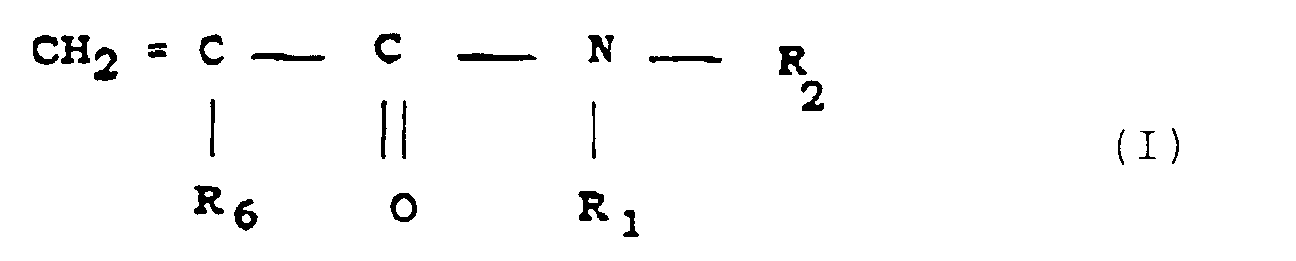
- a first method of synthesis consists in the direct copolymerization, by radical route of a mixture of monomers comprising: an (meth) acrylic acid, an N-substituted derivative of (meth) acrylamide of formula in which R 1 , R 2 and R 6 have the meanings indicated above and, where appropriate, an N- substituted derivative of (meth) acrylamide of formula in which R 3 , R 4 and R 7 have the meanings indicated above, the copolymerization being carried out in at least one organic solvent capable of allowing a transfer reaction sufficient for the average molar mass by weight of the copolymer not to exceed 30,000 and in the presence of at least one initiator of free radicals, at a temperature at most equal to the boiling point of the solvent and at least equal to the decomposition temperature of the initiator and for a period of 0.5 to 12 hours, sufficient to convert all of the mono
- the copolymerization temperature is most often between 40 ° C and 100 ° C.
- Neutralization can be carried out by means of a concentrated base such as ammonia, soda, potash or preferably alkaline alkoxides (sodium or potassium alcoholates), the latter being able to be used in alcoholic solution.
- a concentrated base such as ammonia, soda, potash or preferably alkaline alkoxides (sodium or potassium alcoholates), the latter being able to be used in alcoholic solution.
- this first method of synthesis given that the duration of copolymerization is adjusted to obtain a total conversion, use is made for 1 mole of mixture of monomers ⁇ 1 mole of the N-substituted derivative of formula (I) and, where appropriate where appropriate, ⁇ 2 mole of the N-substituted derivative of formula (II) for 1- ( ⁇ 1 + ⁇ 2 ) mole of (meth) acrylic acid.
- a person skilled in the art knows how to choose, by a few routine tests, the duration of copolymerization suitable for total conversion of the monomers as a function of the other variable parameters which are the initiator of free radicals, the nature of the radicals R 1 , R 2 and R 6 and, where appropriate, the nature of the radicals R 3 , R 4 and R 7 and finally the values of ⁇ 1 and ⁇ 2 .
- a light alcohol such as isopropanol or a saturated ester such as ethyl acetate is preferably used as the organic solvent.
- free radical initiators mention may be made, inter alia, of diazo compounds, organic peroxides, peroxydicarbonates and peroxyesters such as benzoyl peroxide, tertiary butyl hydroperoxide, tertiary butyl peroxide, dicumyl peroxide, 2,2 bis (ter-butylperoxy) butane, peracetal, 1,1-bis (t-butylperoxy) 3,3,5-trimethylcyclohexane, tertiary butyl perbenzoate, tertiary butyl peroxyoctoate, ter-butyl peroxy isopropylcarbonate, tertiary butyl perisononanoate, tertiary butyl permaleate, cyclic peracetal, 2,5-dimethyl-2,5-bis (2-ethylhexylperoxy) hexane, methyl ethyl ketone peroxide, tertioamy
- the free radical initiator will be chosen so that its decomposition temperature does not exceed the boiling temperature of the organic solvent under the pressure considered.
- the copolymerization can be carried out in the presence of at least one transfer agent in a proportion of up to 1% by weight relative to the monomers.
- the radicals R 5 , R 6 and R 7 can be chosen completely independently of one another and it is possible, for example, to combine in the copolymer units derived from a cation acrylate monovalent with units originating from N-substituted derivatives of methacrylamides or conversely to combine in the copolymer units derived from a monovalent cation methacrylate with units originating from N-substituted derivatives of acrylides.
- a second method for synthesizing the acrylic copolymers described above consists in reacting a poly (meth) acrylic acid, of average molar mass by weight such that it does not exceed 30,000 after reaction, in a solvent for said poly (meth) acrylic acid and a primary or secondary amine of formula R 1 R 2 NH and if appropriate a second primary or secondary amine of formula R 3 R 4 NH in the presence of a carbodiimide such as dicyclohexylcarbodiimide.
- This method produces quantitatively, after saponification of the product of this reaction, the acrylic copolymer described above as well as a diurea such as dicyclohexylurea. This being in the medium in the form of precipitate is easily removed from the organic solution by filtration.
- the reaction is carried out at a temperature not exceeding the boiling point of the chosen solvent, preferably between 20 and 80 ° C.
- the reaction is preferably carried out for a period of 30 minutes to 12 hours and the subsequent neutralization is preferably carried out using a concentrated base, for example an alcoholic solution of alkali alkoxide such as sodium methoxylate or ethoxylate. or potassium or a concentrated aqueous solution of an alkali hydroxide such as soda or potash.
- R 5 , R 6 and R 7 are necessarily identical and are either the hydrogen atom (modification of polyacrylic acid) or the methyl radical (modification of polymethacrylic acid).
- organic solvents suitable for this second method of synthesis mention may be made of N-methylpyrrolidone, dimethylformamide.
- the reaction carried out according to this method being quantitative, preferably use ⁇ 1 mole of amine R 1 R 2 NH and if necessary ⁇ 2 mole of amine R 3 R 4 NH for each mole of poly (meth ) acrylic engaged.
- the first or the second synthesis method will be chosen depending on the one hand on the commercial availability of the N-substituted derivative of formula (I) and on the other hand on the need possible to differentiate R 5 , R 6 and R 7 .
- a third object of the present invention concerns the use of (meth) acrylic copolymers described above as dispersants of various pigments and more particularly as pigment dispersants hydrophobic like carbon black.
- Other pigments to which the copolymers according to the invention can be usefully applied as dispersants include on the one hand mineral pigments such as titanium dioxide and yellow and red iron oxides and secondly pigments organic such as copper phthalocyanine blue, ⁇ -naphthol red, azo acetaryl yellow, dioxazine violet and phthalocyanine green.
- the (meth) acrylic copolymer is added to a predominantly aqueous medium containing said pigment.
- aqueous medium a dispersion of the organic or mineral pigment, hydrophobic or not, in water or in a mixture, the majority by weight of water, of water and at least one water-miscible compound such as a glycol.
- concentration of pigment in this dispersion can be very variable depending on the nature of the pigment and reach up to 70% by weight for a mineral pigment such as dioxide titanium. Usual concentrations for carbon black and copper phthalocyanine blue vary from 10% to 50% in weight.
- the copolymer (meth) acrylic according to the invention is used in proportion more or less important.
- (meth) acrylic copolymers according to the invention find particular use appreciated in all areas where employment is involved of an aqueous pigment paste and in particular in inks, paints and coatings and manufacture of colored plastics when the manufacturing process includes an aqueous phase step.
- the use of (meth) acrylic copolymers according to the invention as pigment dispersants is more particularly advantageous in the case of paints in aqueous phase, as well as solvent-based paints especially those using a polymeric binder long oil, medium oil or oil alkyd resin short, an alkyd resin modified by a urethane resin, an epoxy resin or an acrylic resin, a copolymer vinyl chloride or a water-soluble alkyd resin.
- the copolymers (meth) acrylics according to the invention provide advantages sensitive compared to other dispersing polymers already known, especially in terms of rheological behavior, dispersing power, coloring force, stability on long life and compatibility with the pigment and with the other ingredients of the final formulation to which the aqueous pigment paste is integrated, whether it is an ink, paint or coating formulation or still plastic.
- the dispersions pigments prepared from copolymers according to the invention is very viscous at room temperature even with a low dispersant level.
- aqueous solution provided by the company COATEX of one mole of a mass sodium polyacrylate weight average molar equal to 4,000 is passed on an ion exchange column whose resin has been acidified beforehand with hydrochloric acid and rinsed to remove all traces of salt. The recovered fractions are concentrated and then lyophilized. Polyacrylic acid thus obtained is dissolved in 500 ml of N-methyl pyrrolidone. A solution of 0.05 mole of fatty amine (dodecylamine) is added dropwise at temperature 60 ° C. The temperature is then brought to 80 ° C.
- a dispersion is prepared comprising, by weight, 67% water, 30% carbon black and 3% of the acrylic copolymer of Example 1.
- the rheology of this dispersion is studied using a Carrimed rheometer of CS type In particular, the viscosity ⁇ , expressed in Pa.s, of the dispersion at different shear gradients ⁇ (expressed in s -1 ) is measured. The results of these measurements are shown in Table I below.
- a dispersion comprising, by weight, 58% water, 40% carbon black and 2% of the copolymer acrylic of example 4. The results of the viscosity on this dispersion are indicated in the Table I below.
- a dispersion comprising, by weight, 59% water, 40% phthalocyanine blue sold under the name LANGDOCYAL PO 361 by the company LANGUEDOCIENNE OF MICRON-COLORS and 1% of the copolymer acrylic of example 7.
- the results of the viscosity on this dispersion are indicated in the Table II below.
- a dispersion comprising, by weight, 55.8% water, 40% phthalocyanine blue (reference PO 361) and 4.2% of a dispersant marketed by the company AKZO under the reference DAPRAL GE 202.
- the results of viscosity measurements on this dispersion are indicated in Table II below. It is important to note that when, in equal proportion (40%) of pigment, we lower the proportion of dispersant up to 1% by increasing correlatively the proportion of water up to 59%, then the viscosity of the dispersion is increased to such an extent that it is no longer measurable.
- a dispersion comprising, by weight, 29.37% water, 70% titanium dioxide sold under the designation TR 80 by the company TIOXIDE and 0.63% of the acrylic copolymer of example 7.
- TR 80 by the company TIOXIDE
- a dispersion is prepared comprising, by weight, 28.9% of water, 70% of titanium dioxide (reference TR 80) and 1.1% of the dispersant DAPRAL GE 202 already mentioned.
- the results of the viscosity measurements on this dispersion are indicated in Table II below. It is important to note that when, in equal proportion (70%) of pigment, the proportion of dispersant is lowered to 0.63% by correspondingly increasing the proportion of water to 29.37%, then the viscosity dispersion is increased to such an extent that it is no longer measurable.
- a dispersion comprising. in weight. 68.5% water. 30% carbon black and 1.5% of the acrylic copolymer of example 12. The results of viscosity measurements on this dispersion are indicated in table I.
- Example 7 The synthesis of Example 7 is repeated until the filtration of the reaction mixture to remove the dicyclohexylurea precipitate. We then add drop to drop at a temperature of 0 ° C a solution of 0.20 mole of isopropylamine in 200 ml of N-methyl pyrrolidone. We then pour a solution of 0.22 mole of dicyclohexylcarbodiimide in 150 ml of N-methyl pyrrolidone then the medium is stirred for 1 hour at temperature of 0 ° C. The precipitate of dicyclohexylurea is then eliminated then the polymer formed is neutralized and purified as in Example 1. The yield of this synthesis is equal to 30%.
- a dispersion comprising. in weight. 69.5% water. 30% carbon black and 0.5% of the acrylic terpolymer of example 14. The results of the viscosity measurements on this dispersion are indicated in table I.
- a dispersion comprising, by weight, 69.75% water, 30% carbon black and 0.25% of the copolymer of Example 16. The results of the measurements of viscosity of this dispersion are indicated in the table I.
Landscapes
- Chemical & Material Sciences (AREA)
- Health & Medical Sciences (AREA)
- Chemical Kinetics & Catalysis (AREA)
- Medicinal Chemistry (AREA)
- Polymers & Plastics (AREA)
- Organic Chemistry (AREA)
- Pigments, Carbon Blacks, Or Wood Stains (AREA)
- Emulsifying, Dispersing, Foam-Producing Or Wetting Agents (AREA)
- Addition Polymer Or Copolymer, Post-Treatments, Or Chemical Modifications (AREA)
- Polymerisation Methods In General (AREA)
- Macromonomer-Based Addition Polymer (AREA)
Claims (10)
- (Meth)acrylcopolymere der allgemeinen Formelworin:
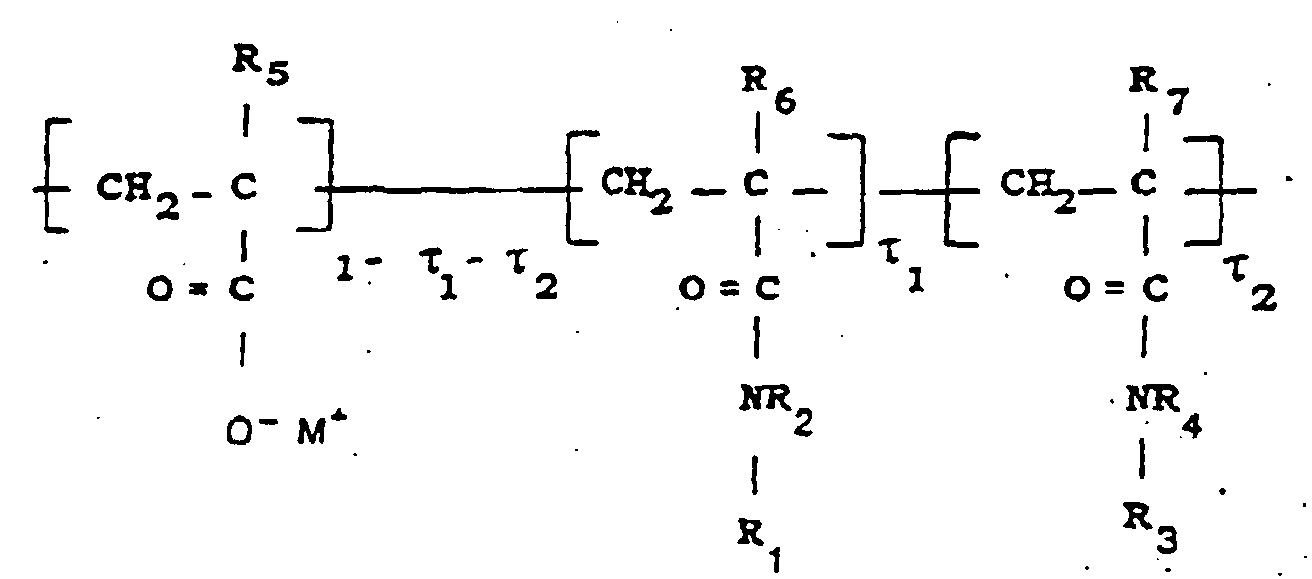 dadurch gekennzeichnet, daß die gewichtsmittlere Molmasse 30.000 nicht überschreitet und daß τ1 zwischen 0,01 und 0,30 liegt.M+ einwertige, durch Neutralisation der -COOH-Gruppen entstandene Kationen bedeuten, wobei diese Neutralisation auch nur teilweise stattgefunden haben kann;R1 und R2 ausgewählt sind aus: Wasserstoff, linearen oder verzweigten langkettigen Alkyl- oder Cycloalkylresten mit 8 bis 30 Kohlenstoffatomen und Arylresten mit 8 bis 22 Kohlenstoffatomen, unter der Bedingung, daß mindestens einer der Reste R1 und R2 nicht Wasserstoff bedeutet;R3 und R4 unabhängig voneinander ausgewählt sind aus: Wasserstoffatom, kurzkettigen Alkyl- oder Cycloalkylresten mit 1 bis 7 Kohlenstoffatomen und Arylresten mit 6 bis 7 Kohlenstoffatomen;R5, R6 und R7 jeweils unabhängig voneinander ausgewählt sind aus: Wasserstoffatom und Methylrest;τ1 das Molverhältnis von langkettigen Amideinheiten im Copolymer; undτ2 das Molverhältnis von im Copolymer gegebenenfalls vorliegenden kurzkettigen Amideinheiten bedeuten;
 - (Meth)acrylcopolymere nach Anspruch 1, dadurch gekennzeichnet, daß sie eine gewichtsmittlere Molmasse von mindestens 2000 aufweisen.
- (Meth)acrylcopolymere nach Anspruch 1 oder 2, dadurch gekennzeichnet, daß sie ein Molverhältnis τ1 zwischen 0,02 und 0,12 aufweisen.
- (Meth)acrylcopolymere nach einem der Ansprüche 1 bis 3, dadurch gekennzeichnet, daß sie ein Molverhältnis τ2 von 0 bis 0,4 aufweisen.
- (Meth)acrylcopolymere nach einem der Ansprüche 1 bis 4, dadurch gekennzeichnet, daß sie Amideinheiten aufweisen, in denen mindestens einer der Reste R1 und R2 einen linearen oder verzweigten Alkylrest mit 10 bis 18 Kohlenstoffatomen bedeutet.
- (Meth)acrylcopolymere nach einem der Ansprüche 1 bis 5, dadurch gekennzeichnet, daß das einwertige Kation M+ ausgewählt ist aus Alkalikationen, dem Ammoniumion, quaternisierten Ammoniumionen und Zinkkomplexen.
- Verfahren zur Herstellung von (Meth)acrylcopolymeren nach einem der Ansprüche 1 bis 6 durch direkte Copolymerisation auf radikalischem Weg einer Monomermischung aus (Meth)acrylsäure, einem N-substituierten Derivat des (Meth)acrylamids der Formelund gegebenenfalls einem N-substituierten Derivat des (Meth)acrylamids der Formel
 wobei die Copolymerisation in einem organischen Lösungsmittel und in Gegenwart mindestens eines Radikalbildners bei einer Temperatur zwischen der Zersetzungstemperatur des Radikalbildners und der Siedetemperatur des Lösungsmittels über einen Zeitraum von 0,5 bis 12 Stunden mit anschließender Neutralisation des gebildeten Copolymers erfolgt.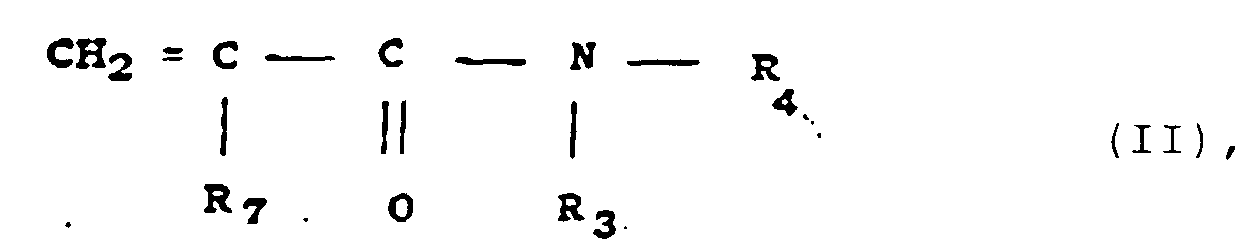
- Herstellungsverfahren nach Anspruch 7, dadurch gekennzeichnet, daß man pro Mol Monomergemisch τ1 mol des N-substituierten Derivats der Formel (I) und gegebenenfalls τ2 mol des N-substituierten Derivats der Formel (II) pro 1-(τ1 + τ2) mol (Meth)acrylsäure einsetzt.
- Verwendung eines (Meth)acrylcopolymers nach einem der Ansprüche 1 bis 6 oder hergestellt nach einem Verfahren nach Anspruch 7 oder 8 als Pigmentdispergiermittel, wobei das (Meth)acrylcopolymer zu einem das Pigment enthaltenden, weitgehend wäßrigen Medium gegeben wird.
- Verwendung nach Anspruch 9, dadurch gekennzeichnet, daß das (Meth)acrylcopolymer bei Vorliegen eines anorganischen Pigments in einem Anteil von 1 bis 10 Gew.-%, bezogen auf das Pigmentgewicht, bei Vorliegen eines organischen Pigments jedoch von 1 bis 30 Gew.-%, bezogen auf das Pigmentgewicht, eingesetzt wird.
Applications Claiming Priority (3)
| Application Number | Priority Date | Filing Date | Title |
|---|---|---|---|
| FR9510042 | 1995-08-24 | ||
| FR9510042A FR2738010B1 (fr) | 1995-08-24 | 1995-08-24 | Polymeres (meth)acryliques, leur procede de fabrication et leur utilisation comme dispersant de pigment |
| PCT/FR1996/001309 WO1997008217A1 (fr) | 1995-08-24 | 1996-08-22 | Polymeres (meth)acryliques, leur procede de fabrication et leur utilisation comme dispersant de pigment |
Publications (2)
| Publication Number | Publication Date |
|---|---|
| EP0846133A1 EP0846133A1 (de) | 1998-06-10 |
| EP0846133B1 true EP0846133B1 (de) | 1999-06-30 |
Family
ID=9482058
Family Applications (1)
| Application Number | Title | Priority Date | Filing Date |
|---|---|---|---|
| EP96929361A Expired - Lifetime EP0846133B1 (de) | 1995-08-24 | 1996-08-22 | (meth)acrylat polymere verfahren zu deren herstellung und deren verwendung als pigmentdispergiermittel |
Country Status (13)
| Country | Link |
|---|---|
| US (1) | US6040386A (de) |
| EP (1) | EP0846133B1 (de) |
| JP (1) | JP2000506551A (de) |
| AT (1) | ATE181740T1 (de) |
| CA (1) | CA2229983A1 (de) |
| DE (1) | DE69603084T2 (de) |
| DK (1) | DK0846133T3 (de) |
| ES (1) | ES2135915T3 (de) |
| FR (1) | FR2738010B1 (de) |
| GR (1) | GR3031319T3 (de) |
| MY (1) | MY132480A (de) |
| TW (1) | TW425422B (de) |
| WO (1) | WO1997008217A1 (de) |
Families Citing this family (5)
| Publication number | Priority date | Publication date | Assignee | Title |
|---|---|---|---|---|
| CA2339118C (en) | 1998-08-14 | 2010-10-19 | Mbt Holding Ag | Cementitious dry cast mixture |
| DK1044175T3 (da) | 1998-08-14 | 2003-03-17 | Mbt Holding Ag | Cementblandinger med højt pozzolanindhold |
| DE10206994A1 (de) * | 2001-11-12 | 2003-05-22 | Ercros Deutschland Gmbh | Kunststoffdispersion und Verfahren zu ihrer Herstellung |
| ES2688532T3 (es) | 2013-01-18 | 2018-11-05 | Basf Se | Composiciones de recubrimiento a base de dispersión acrílica |
| JP7685135B2 (ja) * | 2018-12-03 | 2025-05-29 | セントレ ナシオナル デ ラ ルシェルシェ シエンティフィーク | アンフィポール |
Family Cites Families (10)
| Publication number | Priority date | Publication date | Assignee | Title |
|---|---|---|---|---|
| US4432881A (en) * | 1981-02-06 | 1984-02-21 | The Dow Chemical Company | Water-dispersible hydrophobic thickening agent |
| US4423199A (en) * | 1982-09-30 | 1983-12-27 | Rohm And Haas Company | Acrylamide containing emulsion copolymers for thickening purposes |
| US4524175A (en) * | 1984-04-16 | 1985-06-18 | The Dow Chemical Company | Water-in-oil emulsions of hydrophobe association polymers |
| US5367039A (en) * | 1988-07-06 | 1994-11-22 | Nippon Paint Company, Ltd. | Production of colored vinyl polymer particles by polymerizing a vinyl polymerizable monomer with a polymerizable dye |
| US4921903A (en) * | 1988-10-11 | 1990-05-01 | Nalco Chemical Company | Process for preparing high molecular weight hydrophobic acrylamide polymers |
| US5015708A (en) * | 1989-06-26 | 1991-05-14 | Gaf Chemicals Corporation | Precipitation polymerization of terpolymers of a vinyl lactam, a polymerizable carboxylic acid and a hydrophobic monomer in an aliphatic hydrocarbon solvent |
| FR2671088B1 (fr) * | 1990-12-27 | 1994-04-15 | Oreal | Nouveaux copolymeres a base de n-alkyl acrylamide, leur preparation et leur utilisation comme agents epaississants, notamment dans des compositions de shampooing. |
| FR2693202B1 (fr) * | 1992-07-06 | 1994-12-30 | Hoechst France | Polymères amphiphiles hydrosolubles, leur procédé de préparation et leur application comme épaississant. |
| US5973025A (en) * | 1994-04-12 | 1999-10-26 | Sri International | Aqueous ink compositions containing a binder of a neutralized acidic resin |
| US5863527A (en) * | 1996-09-04 | 1999-01-26 | The Proctor & Gamble Company | Personal care compositions |
-
1995
- 1995-08-24 FR FR9510042A patent/FR2738010B1/fr not_active Expired - Fee Related
-
1996
- 1996-08-22 JP JP9509912A patent/JP2000506551A/ja active Pending
- 1996-08-22 AT AT96929361T patent/ATE181740T1/de not_active IP Right Cessation
- 1996-08-22 DE DE69603084T patent/DE69603084T2/de not_active Expired - Fee Related
- 1996-08-22 US US09/011,742 patent/US6040386A/en not_active Expired - Fee Related
- 1996-08-22 ES ES96929361T patent/ES2135915T3/es not_active Expired - Lifetime
- 1996-08-22 EP EP96929361A patent/EP0846133B1/de not_active Expired - Lifetime
- 1996-08-22 WO PCT/FR1996/001309 patent/WO1997008217A1/fr not_active Ceased
- 1996-08-22 MY MYPI96003445A patent/MY132480A/en unknown
- 1996-08-22 CA CA002229983A patent/CA2229983A1/fr not_active Abandoned
- 1996-08-22 DK DK96929361T patent/DK0846133T3/da active
- 1996-08-24 TW TW085110338A patent/TW425422B/zh not_active IP Right Cessation
-
1999
- 1999-09-23 GR GR990402419T patent/GR3031319T3/el unknown
Also Published As
| Publication number | Publication date |
|---|---|
| DE69603084T2 (de) | 2000-01-27 |
| JP2000506551A (ja) | 2000-05-30 |
| CA2229983A1 (fr) | 1997-03-06 |
| ATE181740T1 (de) | 1999-07-15 |
| FR2738010A1 (fr) | 1997-02-28 |
| TW425422B (en) | 2001-03-11 |
| ES2135915T3 (es) | 1999-11-01 |
| FR2738010B1 (fr) | 1997-10-31 |
| EP0846133A1 (de) | 1998-06-10 |
| US6040386A (en) | 2000-03-21 |
| DE69603084D1 (de) | 1999-08-05 |
| WO1997008217A1 (fr) | 1997-03-06 |
| MY132480A (en) | 2007-10-31 |
| GR3031319T3 (en) | 1999-12-31 |
| DK0846133T3 (da) | 2000-01-31 |
Similar Documents
| Publication | Publication Date | Title |
|---|---|---|
| EP0783531B1 (de) | Durch aminosäuren oder deren derivate funktionalisierte polymere, verfahren zu ihrer herstellung, ihre verwendung als tenside, insbesondere in kosmetika und als nagellack | |
| CA2382853C (fr) | Composition aqueuse gelifiee comportant un copolymere a blocs comprenant au moins un bloc hydrosoluble et un bloc hydrophobe | |
| US4764554A (en) | Thickeners for emulsion paints | |
| EP0826751B1 (de) | Wässrige Dispersionen enthaltend Pfropfcopolymere als Dispergiermittel | |
| EP1397403B1 (de) | Blockcopolymer-tenside durch eine kontrollierte radikalpolymerisation hergestellt | |
| EP2285850B1 (de) | Verfahren zur herstellung einer polymerpartikeldispersion in einem wässrigen medium | |
| EP0877765B1 (de) | Pfropfcopolymere, verfahren zu deren herstellung, zusammensetzungen die sie enthalten und ihre verwendung zur herstellung von wässrigen und/oder organischen pigmentdispersionen | |
| EP1688445B1 (de) | Latex mit modifizierter Oberflächenchemie und redispergierbare Pulver, ihre Herstellung und Anwendungen | |
| FR2767327A1 (fr) | Nouveaux polymeres associatifs et leur procede de preparation par emulsion inverse | |
| CA2422372A1 (fr) | Latex a proprietes de surface modifiees par l'ajout d'un copolymere hydrosoluble a caractere amphiphile | |
| EP0846133B1 (de) | (meth)acrylat polymere verfahren zu deren herstellung und deren verwendung als pigmentdispergiermittel | |
| FR2758825A1 (fr) | Dispersion aqueuses a base de polymeres hydrosolubles | |
| FR2739625A1 (fr) | Copolymeres hydrosolubles associatifs triblocs | |
| EP0869136A1 (de) | Assoziative Polymere und Verfahren zu deren Herstellung in umgekehrte Mikroemulsion | |
| EP0652269A1 (de) | Latexharz für Beschichtungszusammensetzung | |
| JPS6092360A (ja) | 水性顔料分散液 | |
| EP1989257A1 (de) | Verwendung partikelförmiger polymere oder copolymere als tenside zur latexstabilisierung | |
| JP4191302B2 (ja) | アニオン性水分散性被覆組成物の製造方法及び該組成物を使用した塗料用トップコート | |
| EP2326673A1 (de) | Copolymere mit zusammensetzungsgradient und starrer matrix, die in wasser und in organischen lösungsmitteln löslich und/oder dispergierbar sind | |
| FR2868070A1 (fr) | Composes monomeriques possedant des proprietes optiques, polymeres les comprenant et utilisation | |
| FR2867471A1 (fr) | Composes monomeriques possedant des proprietes optiques, polymeres les comprenant et utilisation | |
| FR2816314A1 (fr) | Composition de resines (meth) acryliques en milieu solvant organique, leur procede de fabrication, et leur utilisation comme liants des peintures marines antisalissures | |
| WO2010076461A1 (fr) | Copolymeres a gradient de composition a matrice souple solubles et/ou dispersibles dans l'eau et dans des solvants organiques | |
| FR2867779A1 (fr) | Composes monomeriques possedant des proprietes optiques, polymeres les comprenant et utilisation |
Legal Events
| Date | Code | Title | Description |
|---|---|---|---|
| PUAI | Public reference made under article 153(3) epc to a published international application that has entered the european phase |
Free format text: ORIGINAL CODE: 0009012 |
|
| 17P | Request for examination filed |
Effective date: 19980303 |
|
| AK | Designated contracting states |
Kind code of ref document: A1 Designated state(s): AT BE CH DE DK ES FI FR GB GR IE IT LI LU MC NL PT SE |
|
| GRAG | Despatch of communication of intention to grant |
Free format text: ORIGINAL CODE: EPIDOS AGRA |
|
| 17Q | First examination report despatched |
Effective date: 19981014 |
|
| GRAG | Despatch of communication of intention to grant |
Free format text: ORIGINAL CODE: EPIDOS AGRA |
|
| GRAH | Despatch of communication of intention to grant a patent |
Free format text: ORIGINAL CODE: EPIDOS IGRA |
|
| GRAH | Despatch of communication of intention to grant a patent |
Free format text: ORIGINAL CODE: EPIDOS IGRA |
|
| GRAA | (expected) grant |
Free format text: ORIGINAL CODE: 0009210 |
|
| AK | Designated contracting states |
Kind code of ref document: B1 Designated state(s): AT BE CH DE DK ES FI FR GB GR IE IT LI LU MC NL PT SE |
|
| REF | Corresponds to: |
Ref document number: 181740 Country of ref document: AT Date of ref document: 19990715 Kind code of ref document: T |
|
| REG | Reference to a national code |
Ref country code: CH Ref legal event code: EP |
|
| REF | Corresponds to: |
Ref document number: 69603084 Country of ref document: DE Date of ref document: 19990805 |
|
| PG25 | Lapsed in a contracting state [announced via postgrant information from national office to epo] |
Ref country code: LU Free format text: LAPSE BECAUSE OF NON-PAYMENT OF DUE FEES Effective date: 19990822 |
|
| REG | Reference to a national code |
Ref country code: IE Ref legal event code: FG4D Free format text: FRENCH |
|
| GBT | Gb: translation of ep patent filed (gb section 77(6)(a)/1977) |
Effective date: 19990831 |
|
| ITF | It: translation for a ep patent filed | ||
| REG | Reference to a national code |
Ref country code: CH Ref legal event code: NV Representative=s name: BUECHEL & PARTNER AG PATENTBUERO |
|
| REG | Reference to a national code |
Ref country code: ES Ref legal event code: FG2A Ref document number: 2135915 Country of ref document: ES Kind code of ref document: T3 |
|
| REG | Reference to a national code |
Ref country code: PT Ref legal event code: SC4A Free format text: AVAILABILITY OF NATIONAL TRANSLATION Effective date: 19990922 |
|
| REG | Reference to a national code |
Ref country code: DK Ref legal event code: T3 |
|
| PG25 | Lapsed in a contracting state [announced via postgrant information from national office to epo] |
Ref country code: MC Free format text: LAPSE BECAUSE OF NON-PAYMENT OF DUE FEES Effective date: 20000229 |
|
| PLBE | No opposition filed within time limit |
Free format text: ORIGINAL CODE: 0009261 |
|
| STAA | Information on the status of an ep patent application or granted ep patent |
Free format text: STATUS: NO OPPOSITION FILED WITHIN TIME LIMIT |
|
| 26N | No opposition filed | ||
| PGFP | Annual fee paid to national office [announced via postgrant information from national office to epo] |
Ref country code: IE Payment date: 20000823 Year of fee payment: 5 Ref country code: GR Payment date: 20000823 Year of fee payment: 5 |
|
| PGFP | Annual fee paid to national office [announced via postgrant information from national office to epo] |
Ref country code: CH Payment date: 20000828 Year of fee payment: 5 |
|
| PGFP | Annual fee paid to national office [announced via postgrant information from national office to epo] |
Ref country code: BE Payment date: 20001024 Year of fee payment: 5 |
|
| PGFP | Annual fee paid to national office [announced via postgrant information from national office to epo] |
Ref country code: PT Payment date: 20010803 Year of fee payment: 6 |
|
| PGFP | Annual fee paid to national office [announced via postgrant information from national office to epo] |
Ref country code: FI Payment date: 20010814 Year of fee payment: 6 |
|
| PG25 | Lapsed in a contracting state [announced via postgrant information from national office to epo] |
Ref country code: IE Free format text: LAPSE BECAUSE OF NON-PAYMENT OF DUE FEES Effective date: 20010822 |
|
| PG25 | Lapsed in a contracting state [announced via postgrant information from national office to epo] |
Ref country code: LI Free format text: LAPSE BECAUSE OF NON-PAYMENT OF DUE FEES Effective date: 20010831 Ref country code: CH Free format text: LAPSE BECAUSE OF NON-PAYMENT OF DUE FEES Effective date: 20010831 Ref country code: BE Free format text: LAPSE BECAUSE OF NON-PAYMENT OF DUE FEES Effective date: 20010831 |
|
| REG | Reference to a national code |
Ref country code: GB Ref legal event code: IF02 |
|
| PG25 | Lapsed in a contracting state [announced via postgrant information from national office to epo] |
Ref country code: GR Free format text: LAPSE BECAUSE OF NON-PAYMENT OF DUE FEES Effective date: 20020209 |
|
| BERE | Be: lapsed |
Owner name: S.A. CRAY VALLEY Effective date: 20010831 |
|
| REG | Reference to a national code |
Ref country code: CH Ref legal event code: PL |
|
| REG | Reference to a national code |
Ref country code: IE Ref legal event code: MM4A |
|
| PGFP | Annual fee paid to national office [announced via postgrant information from national office to epo] |
Ref country code: FR Payment date: 20020722 Year of fee payment: 7 |
|
| PGFP | Annual fee paid to national office [announced via postgrant information from national office to epo] |
Ref country code: SE Payment date: 20020806 Year of fee payment: 7 |
|
| PGFP | Annual fee paid to national office [announced via postgrant information from national office to epo] |
Ref country code: AT Payment date: 20020813 Year of fee payment: 7 |
|
| PGFP | Annual fee paid to national office [announced via postgrant information from national office to epo] |
Ref country code: DK Payment date: 20020814 Year of fee payment: 7 |
|
| PGFP | Annual fee paid to national office [announced via postgrant information from national office to epo] |
Ref country code: GB Payment date: 20020821 Year of fee payment: 7 |
|
| PG25 | Lapsed in a contracting state [announced via postgrant information from national office to epo] |
Ref country code: FI Free format text: LAPSE BECAUSE OF NON-PAYMENT OF DUE FEES Effective date: 20020822 |
|
| PGFP | Annual fee paid to national office [announced via postgrant information from national office to epo] |
Ref country code: ES Payment date: 20020826 Year of fee payment: 7 |
|
| PGFP | Annual fee paid to national office [announced via postgrant information from national office to epo] |
Ref country code: NL Payment date: 20020829 Year of fee payment: 7 Ref country code: DE Payment date: 20020829 Year of fee payment: 7 |
|
| PG25 | Lapsed in a contracting state [announced via postgrant information from national office to epo] |
Ref country code: PT Free format text: LAPSE BECAUSE OF NON-PAYMENT OF DUE FEES Effective date: 20030228 |
|
| PG25 | Lapsed in a contracting state [announced via postgrant information from national office to epo] |
Ref country code: GB Free format text: LAPSE BECAUSE OF NON-PAYMENT OF DUE FEES Effective date: 20030822 Ref country code: AT Free format text: LAPSE BECAUSE OF NON-PAYMENT OF DUE FEES Effective date: 20030822 |
|
| PG25 | Lapsed in a contracting state [announced via postgrant information from national office to epo] |
Ref country code: SE Free format text: LAPSE BECAUSE OF NON-PAYMENT OF DUE FEES Effective date: 20030823 Ref country code: ES Free format text: LAPSE BECAUSE OF NON-PAYMENT OF DUE FEES Effective date: 20030823 |
|
| PG25 | Lapsed in a contracting state [announced via postgrant information from national office to epo] |
Ref country code: DK Free format text: LAPSE BECAUSE OF NON-PAYMENT OF DUE FEES Effective date: 20030901 |
|
| PG25 | Lapsed in a contracting state [announced via postgrant information from national office to epo] |
Ref country code: NL Free format text: LAPSE BECAUSE OF NON-PAYMENT OF DUE FEES Effective date: 20040301 |
|
| PG25 | Lapsed in a contracting state [announced via postgrant information from national office to epo] |
Ref country code: DE Free format text: LAPSE BECAUSE OF NON-PAYMENT OF DUE FEES Effective date: 20040302 |
|
| EUG | Se: european patent has lapsed | ||
| REG | Reference to a national code |
Ref country code: DK Ref legal event code: EBP |
|
| GBPC | Gb: european patent ceased through non-payment of renewal fee | ||
| PG25 | Lapsed in a contracting state [announced via postgrant information from national office to epo] |
Ref country code: FR Free format text: LAPSE BECAUSE OF NON-PAYMENT OF DUE FEES Effective date: 20040430 |
|
| NLV4 | Nl: lapsed or anulled due to non-payment of the annual fee |
Effective date: 20040301 |
|
| REG | Reference to a national code |
Ref country code: FR Ref legal event code: ST |
|
| REG | Reference to a national code |
Ref country code: ES Ref legal event code: FD2A Effective date: 20030823 |
|
| PG25 | Lapsed in a contracting state [announced via postgrant information from national office to epo] |
Ref country code: IT Free format text: LAPSE BECAUSE OF NON-PAYMENT OF DUE FEES Effective date: 20050822 |