EP0846608A2 - Soupape de commande pour direction assistée avec réduction de bruit. - Google Patents
Soupape de commande pour direction assistée avec réduction de bruit. Download PDFInfo
- Publication number
- EP0846608A2 EP0846608A2 EP19970121650 EP97121650A EP0846608A2 EP 0846608 A2 EP0846608 A2 EP 0846608A2 EP 19970121650 EP19970121650 EP 19970121650 EP 97121650 A EP97121650 A EP 97121650A EP 0846608 A2 EP0846608 A2 EP 0846608A2
- Authority
- EP
- European Patent Office
- Prior art keywords
- orifices
- constricting
- valve
- pair
- axis
- Prior art date
- Legal status (The legal status is an assumption and is not a legal conclusion. Google has not performed a legal analysis and makes no representation as to the accuracy of the status listed.)
- Granted
Links
Images



Classifications
-
- B—PERFORMING OPERATIONS; TRANSPORTING
- B62—LAND VEHICLES FOR TRAVELLING OTHERWISE THAN ON RAILS
- B62D—MOTOR VEHICLES; TRAILERS
- B62D5/00—Power-assisted or power-driven steering
- B62D5/06—Power-assisted or power-driven steering fluid, i.e. using a pressurised fluid for most or all the force required for steering a vehicle
- B62D5/08—Power-assisted or power-driven steering fluid, i.e. using a pressurised fluid for most or all the force required for steering a vehicle characterised by type of steering valve used
- B62D5/083—Rotary valves
- B62D5/0837—Rotary valves characterised by the shape of the control edges, e.g. to reduce noise
-
- Y—GENERAL TAGGING OF NEW TECHNOLOGICAL DEVELOPMENTS; GENERAL TAGGING OF CROSS-SECTIONAL TECHNOLOGIES SPANNING OVER SEVERAL SECTIONS OF THE IPC; TECHNICAL SUBJECTS COVERED BY FORMER USPC CROSS-REFERENCE ART COLLECTIONS [XRACs] AND DIGESTS
- Y10—TECHNICAL SUBJECTS COVERED BY FORMER USPC
- Y10T—TECHNICAL SUBJECTS COVERED BY FORMER US CLASSIFICATION
- Y10T137/00—Fluid handling
- Y10T137/8593—Systems
- Y10T137/86493—Multi-way valve unit
- Y10T137/86574—Supply and exhaust
- Y10T137/86638—Rotary valve
- Y10T137/86646—Plug type
- Y10T137/86654—For plural lines
Definitions
- the present invention relates to a hydraulic fluid control valve for a power steering gear.
- a known hydraulic fluid control valve for a power steering gear includes a valve core rotatable within a valve sleeve.
- the core and the sleeve control the pressure of hydraulic fluid flowing through the valve between a pump, a reservoir, and a pair of opposed fluid chambers in a hydraulic motor.
- the hydraulic fluid pressures in the opposed fluid chambers are equal.
- a plurality of lands and grooves on the core and the sleeve cooperate to increase the hydraulic fluid pressure in one of the opposed fluid chambers, and thereby to provide hydraulic power steering assist in the steering gear.
- the lands and grooves in the core and the sleeve define orifices through which the hydraulic fluid flows through the valve. Changing pressure differentials at these orifices tends to generate noise in the steering gear. It is desirable to minimize this noise.
- a hydraulic fluid control valve comprises first and second valve members which are rotatable relative to each other about an axis.
- the valve members comprise means for defining a plurality of hydraulic fluid flow orifices which are spaced apart circumferentially about the axis.
- the orifices are variable in size such that an orifice enlarges when a pair of adjacent orifices constrict upon relative rotation of the valve members from neutral positions.
- the pair of constricting orifices initially constrict at unequal rates, and subsequently constrict at equal rates until they reach fully constricted conditions.
- a valve constructed in accordance with the present invention generates a relatively low level of noise as hydraulic fluid flows through the orifices. Noise is maintained at a relatively low level by causing certain orifices to constrict at varying rates in accordance with the present invention.
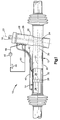
- a hydraulic power steering gear 10 comprising a preferred embodiment of the present invention is shown in Fig. 1.
- the steering gear 10 is a hydraulically-assisted rack and pinion steering gear including a housing 12, an elongate steering rack 14, and an input shaft 16.
- the steering gear 10 further includes a hydraulic fluid control valve 18 which is contained in the housing 12.
- the rack 14 extends longitudinally through a lower portion 20 of the housing 12 along a horizontal axis 21, and is supported for movement relative to the housing 12 along the axis 21.
- the opposite ends (not shown) of the rack 14 are connected to steering linkages which, in turn, connect the steering gear 10 to a pair of steerable vehicle wheels.
- the input shaft 16 projects outward from an upper portion 22 of the housing 12 along another axis 23, and is rotatable about the axis 23 in response to rotation of the vehicle steering wheel.
- the steering gear 10 operates to move the rack 14 along the axis 21 in response to rotation of the input shaft about the axis 23.
- the steering gear thus actuates the steering linkages to steer the vehicle wheels in response to rotation of the steering wheel.
- the steering gear 10 includes a pinion gear 24 and a piston 26.
- the pinion gear 24 is connected with the input shaft 16 by a torsion bar 28, and is supported for rotation about the axis 23 in meshing engagement with a row of rack teeth 30 on the rack 14.
- a tubular section 32 of the lower housing portion 20 functions as a power cylinder.
- the piston 26 is fixed to the rack 14 within the power cylinder 32.
- a pair of variable volume hydraulic fluid chambers 34 and 36 are located in the power cylinder 32 on opposite sides of the piston 26.
- the valve 18 communicates with the first chamber 34 in the power cylinder 32 through a first two-way conduit 40.
- the valve 18 further communicates with the second chamber 36 in the power cylinder 32 through a second two-way conduit 42.
- the valve 18 receives hydraulic fluid from a reservoir 44 and a pump 46 through an inlet conduit 48.
- the pump 46 could be a flow-varying pump, and could be driven by an electric motor or by the vehicle engine.
- An outlet conduit 50 exhausts hydraulic fluid from the valve 18 to the reservoir 44.
- the valve 18 operates in response to rotation of the input shaft 16 with the vehicle steering wheel.
- the input shaft 16 rotates with the steering wheel in a first direction about the axis 23, it rotates slightly relative to the pinion gear 24.
- the torsion bar 28 flexes to permit such rotation of the input shaft 16 relative to the pinion gear 24.
- the valve 18 responds to the resulting rotational displacement by opening hydraulic fluid flow paths that extend through the valve 18 from the inlet conduit 48 to the first two-way flow conduit 40.
- the valve 18 simultaneously opens hydraulic fluid flow paths that extend through the valve 18 from the second two-way flow conduit 42 to the outlet conduit 50.
- valve 18 communicates the pump 46 with the first chamber 34 in the power cylinder 32 to pressurize the first chamber 34, and simultaneously communicates the second chamber 36 in the power cylinder 32 with the reservoir 44 to exhaust the second chamber 36.
- a resulting flow of hydraulic fluid from the pump 46, and a resulting hydraulic fluid pressure differential acting across the piston 26, cause the piston 26 and the rack 14 to move to the right, as viewed in Fig. 1, along the axis 21. This causes the steering linkage to steer the vehicle wheels in a first direction.
- the pinion gear 24 rotates in meshing engagement with the rack teeth 30.
- the pinion gear 24 thus rotates about the axis 23 relative to the input shaft 16 in a follow-up manner so as to cancel the rotational displacement between the pinion gear 24 and the input shaft 16.
- the valve 18 responds by closing the previously opened hydraulic fluid flow paths. This equalizes the hydraulic fluid pressures acting on the piston 26 in the two chambers 34 and 36 in the power cylinder 32, and causes the piston 26 and the rack 14 to stop moving along the axis 21.
- the input shaft 16 is rotated with the steering wheel in an opposite direction about the axis 23, and is again rotated slightly relative to the pinion gear 24 upon flexing of the torsion bar 28.
- the valve 18 responds by pressurizing the second chamber 36 and by simultaneously exhausting the first chamber 34.
- the piston 26 and the rack 14 then move axially to the left, as viewed in Fig. 1.
- a resulting follow-up rotation of the pinion gear 24 relative to the input shaft 16 causes the valve 18 again to equalize the hydraulic fluid pressures in the two chambers 34 and 36 in the power cylinder 32.
- the steering gear 10 thus steers the vehicle wheels in directions and amounts corresponding to the directions and the amounts of rotation of the steering wheel and the input shaft 16.
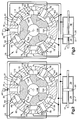
- the valve 18 includes a valve core 60 and a valve sleeve 62. Both the core 60 and the sleeve 62 have generally cylindrical shapes centered on the axis 23.
- the core 60 is defined by a section of the input shaft 16 (Fig. 1).
- the sleeve 62 is connected with an upper end portion of the pinion gear 24 (Fig. 1). Accordingly, the core 60 and the sleeve 62 rotate relative to each other when the input shaft 16 and the pinion gear 24 rotate relative to each other.
- the core 60 and the sleeve 62 then vary the hydraulic fluid flow paths extending through the valve 18 so that certain flow paths become relatively unrestricted and certain flow paths become relatively restricted. Pressurized flows of hydraulic fluid are thereby directed through the valve 18 between the pump 46 and the chambers 34 and 36 in the power cylinder 32, as described above with reference to Fig. 1.
- the sleeve 62 has a radially inner periphery 64 extending circumferentially around the core 60.
- the inner periphery 64 of the sleeve 62 has an undulating contour defined by a plurality of circumferentially spaced lands and grooves.
- the sleeve 62 has six lands 71, 72, 73, 74, 75 and 76 which are equally spaced from each other circumferentially about the axis 23.
- the sleeve 62 further has six grooves 81, 82, 83, 84, 85 and 86, each of which is located circumferentially between a pair of adjacent lands.
- Three inlet ports 78 extend radially inward through the sleeve 62 at the locations of the first land 71, the third land 73, and the fifth land 75. As shown schematically in Fig. 2, the inlet ports 78 receive hydraulic fluid from the pump 46.
- the grooves 81-86 on the sleeve 62 communicate with the fluid chambers 34 and 36 in the power cylinder 32.
- the first, third and fifth grooves 81, 83 and 85 communicate with the chamber 36 on the right side of the piston 26, as viewed in Fig. 2.
- the second, fourth and sixth grooves 82, 84 and 86 communicate with the other chamber 34 on the left side of the piston 26.
- the core 60 also has an undulating contour defined by a plurality of lands and grooves. These include six lands 91-96 and six grooves 101-106.
- the lands 91-96 on the core 60 are located radially opposite the grooves 81-86 on the sleeve 62.
- the grooves 101-106 on the core 60 are located radially opposite the lands 71-76 on the sleeve 62. Accordingly, the adjacent corners of the lands 71-76 and 91-96 define orifices 110 between the grooves 81-86 and 101-106.
- Three of the grooves 102, 104 and 106 on the core 60 communicate with the reservoir 44 (Fig. 1) through corresponding branches of a return port system 108 within the core 60.
- a small portion of the hydraulic fluid flow extending from the inlet ports 78 to the return port system 108 is thus diverted to the right chamber 36 through the grooves 81, 83 and 85.
- An equal flow of hydraulic fluid is simultaneously exhausted from the left chamber 34 to the other grooves 82, 84 and 86.
- the piston 26 and the rack 14 then move to the left, as viewed in Fig. 3. This causes the steering linkages to turn the steerable vehicle wheels to the right.
- the changing hydraulic fluid pressures within the valve 18 can generate noise.
- noise can be generated by the changing pressure drops across the orifices 110.
- the lands 91-96 on the core 60 are shaped to reduce noise generated by the changing pressure drops across the orifices 110.
- one of the orifices 110 that enlarges is differentiated from two of the orifices 110 that constrict upon rotation of the core 60 from the neutral position of Fig. 2 to the shifted position of Fig. 3.
- one of the enlarging orifices 110 is designated by the reference number 110a in Fig. 4.
- An adjacent pair of constricting orifices 110 are designated by the reference numbers 110b and 110c.
- Those constricting orifices 110b and 110c are located in parallel between the inlet ports 78 and the return port system 108.
- the corresponding lands 91 and 92 on the core 60 are shaped so that the pair of constricting orifices 110b and 110c initially constrict at unequal rates, and subsequently constrict at equal rates until reaching fully constricted conditions, when the core 60 is rotated from the neutral position of Fig. 2 to the shifted position of Fig. 3. This reduces the amount of noise that is generated by the changing pressure drops across those constricting orifices 110b and 110c.
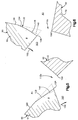
- the first constricting orifice 110b of Fig. 4 is shown in enlarged detail in Fig. 5, with the core 60 and the sleeve 62 being shown in the neutral positions.
- the orifice 110b is a gap between the first land 91 on the core 60 and the second land 72 on the sleeve 62.
- the first land 91 on the core 60 has a cylindrical surface 120.
- the cylindrical surface 120 has a circular radial contour centered on the axis 23 (Figs. 2-4).
- the first land 91 on the core 60 further has a planar edge surface or facet 122.
- the facet 122 is inclined radially inward from the cylindrical surface 120, and extends from the cylindrical surface 120 to the corner 124 of the land 91 beside the adjacent groove 102.
- the contour of the land 91 is thus tapered radially inward from the cylindrical surface 120 to the corner 124.
- the second constricting orifice 110c of Fig. 4 is shown in enlarged detail in Fig. 6, also with the core 60 and the sleeve 62 being shown in the neutral positions.
- the orifice 110c is a gap between the second land 92 on the core 60 and the third land 73 on the sleeve 62.
- the second land 92 on the core 60 also has a cylindrical surface 130 with a circular radial contour centered on the axis 23.
- the second land 92 further has an edge surface 132 with two discreet planar facets 134 and 136 which are inclined radially inward from the cylindrical surface 130, and which extend successively from the cylindrical surface 130 to the corner 138 of the land 92 beside the adjacent groove 103.
- the second facet 136 is inclined and extends radially inward from the first facet 134.
- the second land 92 thus has a tapered contour beside the orifice 110c which differs from the tapered contour of the first land 91 beside the orifice 110b. This is indicated in Fig.
- Fig. 6 by a dashed line 140 which shows the edge surface 122 of the first land 91 superimposed on the edge surface 132 of the second land 92.
- Fig. 5 similarly has a dashed line 142 showing the edge surface 132 of the second land 92 superimposed on the edge surface 122 of the first land 91.
- the angle of radially inwardly inclination and the radially inward spacing of the facet 134 are the same as the angle of radially inward inclination and the radially inward spacing of the facet 122.
- the orifices 110b and 110c simultaneously begin to constrict as the first and second lands 91 and 92 on the core 60 begin to move relative to the sleeve 62 in the directions indicated by the arrows 150 and 152 shown in Figs. 5 and 6. This occurs when the core 60 is rotated from the neutral position of Fig. 2 toward the shifted position of Fig. 3. During an initial amount of such rotation, the corners 124 and 138 of the lands 91 and 92 move downward, as viewed in Figs. 5 and 6, toward and past the opposed corners 154 and 156 on the sleeve 62, respectively.
- the orifice 110b of Fig. 5 constricts faster than the orifice 110c of Fig. 6 during this initial amount of rotation of the core 60.
- the edge surfaces 122 and 132 of the lands 91 and 92 move past the corners 154 and 156 on the sleeve 62.
- the orifice 110c closes faster than the orifice 110b. This is because the second facet 136 at the orifice 110c is inclined and spaced radially inward more than the facet 122 at the orifice 110b.
- the first facet 134 of the edge surface 132 moves past the corner 156 on the sleeve 62, and the remaining portion of the facet 122 simultaneously moves past the corresponding corner 154. Since the facets 122 and 134 have the same angle of radially inward inclination, and are equally spaced radially inward from the concentric cylindrical surfaces 120 and 130, the orifices 110b and 110c constrict at equal rates during this amount of rotation of the core 60. The amount of noise generated in the valve 18 is greatly reduced by varying the rates at which the orifices 110b and 110c constrict in this manner.
- Fig. 7 is a graph showing the varying rates at which the orifices 110 can constrict in accordance with the present invention.
- the angle of rotation of the core 60 from the neutral position is measured in degrees on the horizontal axis of Fig. 7.
- the sizes (widths) of the gaps defined by the orifices 110 are measured in millimeters on the vertical axis of Fig. 7.
- One of the lines plotted on Fig. 7 represents measurements taken at an orifice like the orifice 110b of Fig. 5.
- the other line plotted on Fig. 7 represents measurements taken at an orifice like the orifice 110c of Fig. 6.
- the orifice 110b is thus shown to constrict faster than the orifice 110c during the initial amount of rotation of the core 60 when the corners 124 and 138 of the lands 91 and 92 are moving toward the opposed corners 154 and 156 of the sleeve 62.
- This preferably comprises approximately 1° of rotation of the core 60 from the neutral position.
- the orifice 110c constricts faster than the orifice 110b during the next successive amount of rotation of the core 60. This results from the relatively greater inclination and radially inward spacing of the facet 136 on the second land 92, as described above, and preferably continues throughout approximately 1.2° of continued rotation of the core 60 in the same direction.
- the orifices 110b and 110c subsequently close at equal rates as a result of the equal inclination of the facets 134 and 122. This preferably continues throughout approximately 0.9 degrees more of continued rotation of the core 60 in the same direction.
- the contour of the first land 91 adjacent to the corner 124 is designated by the letter A.
- the contour of the second land 92 adjacent the corner 138 is similarly designated by the letter B.
- Fig. 8 shows the preferred locations where those contours are repeated about the circumference of the core 60.
- each of the lands 91-96 on the core 60 has the contour designated A at one side of the land, and has the contour designated B at the circumferentially opposite side of the land.
- Fig. 9 shows a superimposed pair of edge surfaces 170 and 172 that can be used as alternatives for the edge surfaces 122 and 132 of Figs. 5 and 6.
- the edge surfaces 170 and 172 of Fig. 9 are inclined radially inward from a cylindrical surface 174 which is centered on the axis of rotation (not shown).
- Both of the edge surfaces 170 and 172 have initially constricting portions for causing corresponding orifices to constrict at unequal rates, and further have subsequently constricting portions for causing the orifices subsequently to constrict at equal rates until reaching fully constricted conditions, in accordance with the present invention.
- the edge surface 170 includes a first planar facet 176 extending from a corner at the edge of an adjacent groove 177.
- the first planar facet 176 functions as an initially constricting portion of the edge surface 170 in accordance with the present invention.
- the edge surface 170 further includes a second planar facet 178 which functions as a subsequently constricting portion of the edge surface 170.
- the other edge surface 172 shown in Fig. 9 has a first and second planar facets 180 and 182 which function successively as an initially constricting portions of the edge surface 172, and further has a third planar facet 184 which functions as a subsequently constricting portion.
- the first facet 182 of the edge surface 172 is spaced radially inward relative to the first facet 176 of the edge surface 170, but has the same angle of radially inward inclination.
- the third facet 184 of the edge surface 172 has the same radially inward spacing and angle of inclination as the second facet 178 of the edge surface 170.
- facets 176 and 180 of Fig. 9 are parallel along the length of the facet 180, they cause corresponding orifices to constrict at equal rates when they act together. This is indicated in Fig. 10 by the parallel curve sections extending from approximately 1° to approximately 1.4°.
- Fig. 11 also shows a superimposed pair of edge surfaces 190 and 192 that can be used as alternatives for the edge surfaces 122 and 132 of Figs. 5 and 6. Both of the edge surfaces 190 and 192 of Fig. 11 are inclined radially inward from a cylindrical outer surface 194 which is centered on the axis of rotation (not shown).
- the edge surface 190 includes a first planar facet 196 extending from a corner at the edge of an adjacent groove 197, and further includes a second planar facet 198 extending oppositely from the cylindrical surface 194 toward the groove 197.
- a cylindrical intermediate portion 200 of the edge surface 190 extends in an arc between the two facets 196 and 198.
- the facets 196 and 198 are tangential to the intermediate surface portion 200.
- the first facet 196 and the intermediate portion 200 function successively as initially constricting portions of the edge surface 190 in accordance with the present invention.
- the second planar facet 198 functions as a subsequently constricting portion of the edge surface 190.
- the other edge surface 192 shown in Fig. 11 has a first planar facet 202, a cylindrical intermediate portion 204, and a second planar facet 206.
- the facets 202 and 206 are tangential to the intermediate surface portion 204.
- the first facet 202 and the intermediate surface portion 204 are inclined and spaced radially inward from the cylindrical surface 194 more than the corresponding portions 196 and 200 of the other edge surface 190, and function successively as initially constricting portions of the edge surface 192 in accordance with the present invention.
- the second facet 206 of the edge surface 192 has the same size, angle of inclination, and radially inward spacing as the second facet 198 of the other edge surface 190, and likewise functions as a subsequently constricting portion of the edge surface 192 in accordance with the present invention.
- the invention relates to an apparatus comprising: valve members rotatable relative to each other about an axis; said valve members comprising means for defining hydraulic fluid flow orifices which are spaced apart circumferentially about said axis.
Landscapes
- Engineering & Computer Science (AREA)
- Chemical & Material Sciences (AREA)
- Combustion & Propulsion (AREA)
- Transportation (AREA)
- Mechanical Engineering (AREA)
- Power Steering Mechanism (AREA)
- Details Of Valves (AREA)
Applications Claiming Priority (2)
| Application Number | Priority Date | Filing Date | Title |
|---|---|---|---|
| US762597 | 1996-12-09 | ||
| US08/762,597 US5799693A (en) | 1996-12-09 | 1996-12-09 | Power steering control valve with noise reduction |
Publications (3)
| Publication Number | Publication Date |
|---|---|
| EP0846608A2 true EP0846608A2 (fr) | 1998-06-10 |
| EP0846608A3 EP0846608A3 (fr) | 1998-11-18 |
| EP0846608B1 EP0846608B1 (fr) | 2002-02-27 |
Family
ID=25065530
Family Applications (1)
| Application Number | Title | Priority Date | Filing Date |
|---|---|---|---|
| EP19970121650 Expired - Lifetime EP0846608B1 (fr) | 1996-12-09 | 1997-12-09 | Soupape de commande pour direction assistée avec réduction de bruit. |
Country Status (5)
| Country | Link |
|---|---|
| US (1) | US5799693A (fr) |
| EP (1) | EP0846608B1 (fr) |
| JP (1) | JP2960041B2 (fr) |
| AU (1) | AU698302B2 (fr) |
| DE (1) | DE69710691T2 (fr) |
Families Citing this family (5)
| Publication number | Priority date | Publication date | Assignee | Title |
|---|---|---|---|---|
| JP2000159130A (ja) * | 1998-11-30 | 2000-06-13 | Koyo Seiko Co Ltd | 油圧制御弁及びこれを用いた動力舵取装置 |
| US6240961B1 (en) * | 2000-03-09 | 2001-06-05 | Trw Inc. | Hydraulic power steering control valve |
| US6499507B1 (en) * | 2000-09-12 | 2002-12-31 | Ford Global Technologies, Inc. | Rotary valve |
| JP2005524568A (ja) * | 2002-05-03 | 2005-08-18 | ティアールダブリュ オートモーティブ ユー.エス.リミテッド ライアビリティ カンパニー | パワーステアリング制御弁 |
| US7025754B2 (en) * | 2002-07-01 | 2006-04-11 | Ventaira Pharmaceuticals, Inc. | Drug containment system |
Family Cites Families (15)
| Publication number | Priority date | Publication date | Assignee | Title |
|---|---|---|---|---|
| GB1344829A (en) * | 1970-05-18 | 1974-01-23 | Alford Alder Engs Ltd | Servo valves |
| GB2042442B (en) * | 1979-01-26 | 1983-02-02 | Bishop A | Power steering valve |
| ES502483A0 (es) * | 1981-05-26 | 1982-04-01 | Bendiberica Sa | Perfeccionamientos en distribuidores hidraulicos rotativos |
| JPS5958278A (ja) * | 1982-09-28 | 1984-04-03 | Toyoda Mach Works Ltd | ロ−タリバルブ |
| JPS6015265A (ja) * | 1983-07-04 | 1985-01-25 | Toyoda Mach Works Ltd | サ−ボバルブ |
| US4860635A (en) * | 1986-05-12 | 1989-08-29 | Nissan Motor Co., Ltd. | Steering control valve for variable power assist steering system |
| JP2529679B2 (ja) * | 1987-01-30 | 1996-08-28 | 日産自動車株式会社 | パワ−ステアリングの油圧制御装置 |
| US5244012A (en) * | 1990-08-23 | 1993-09-14 | Koyo Seiko Co., Ltd. | Hydraulic pressure control valve |
| JP2523170Y2 (ja) * | 1990-08-23 | 1997-01-22 | 光洋精工株式会社 | 油圧制御弁 |
| JP2719861B2 (ja) * | 1991-12-13 | 1998-02-25 | 自動車機器株式会社 | 流体制御弁装置 |
| AU659917B2 (en) * | 1992-01-16 | 1995-06-01 | A.E. Bishop & Associates Pty Limited | Rotary valve for hydraulic power steering with reduced noise and linear boost characteristic |
| JP3345148B2 (ja) * | 1993-02-26 | 2002-11-18 | 光洋精工株式会社 | 油圧パワーステアリング装置 |
| US5417244A (en) * | 1994-02-07 | 1995-05-23 | Trw Inc. | Valve with noise reducing two stage pressure drop |
| US5562124A (en) * | 1995-02-21 | 1996-10-08 | Trw Inc. | Steering control valve with different size flow gaps for noise suppression |
| US5582207A (en) * | 1995-03-14 | 1996-12-10 | Trw Inc. | Steering control valve with flow gaps which change relative size for noise suppression |
-
1996
- 1996-12-09 US US08/762,597 patent/US5799693A/en not_active Expired - Fee Related
-
1997
- 1997-12-08 JP JP33726697A patent/JP2960041B2/ja not_active Expired - Fee Related
- 1997-12-08 AU AU46912/97A patent/AU698302B2/en not_active Ceased
- 1997-12-09 DE DE69710691T patent/DE69710691T2/de not_active Expired - Fee Related
- 1997-12-09 EP EP19970121650 patent/EP0846608B1/fr not_active Expired - Lifetime
Non-Patent Citations (1)
| Title |
|---|
| None |
Also Published As
| Publication number | Publication date |
|---|---|
| JP2960041B2 (ja) | 1999-10-06 |
| US5799693A (en) | 1998-09-01 |
| EP0846608A3 (fr) | 1998-11-18 |
| AU698302B2 (en) | 1998-10-29 |
| JPH10175557A (ja) | 1998-06-30 |
| AU4691297A (en) | 1998-06-11 |
| EP0846608B1 (fr) | 2002-02-27 |
| DE69710691D1 (de) | 2002-04-04 |
| DE69710691T2 (de) | 2002-10-24 |
Similar Documents
| Publication | Publication Date | Title |
|---|---|---|
| EP0732254B1 (fr) | Soupape de commande pour direction avec dimensions d'ouverture variant relativement pour une suppression du bruit | |
| US7231940B2 (en) | Control valve for a hydraulic power steering system | |
| EP0846609B1 (fr) | Soupape de commande pour direction assistée avec contre-pression. | |
| EP0949137B1 (fr) | Soupape de commande pour direction assistée avec contre-pression | |
| US5799693A (en) | Power steering control valve with noise reduction | |
| US4558720A (en) | Closed-center controller for use with unequal area cylinder | |
| US5975137A (en) | Power steering control valve | |
| US6240961B1 (en) | Hydraulic power steering control valve | |
| US7025091B2 (en) | Power steering control valve | |
| EP0728654B1 (fr) | Soupape de direction assistée à orifices de surfaces différentes, pour la suppression des bruits | |
| EP0930217A2 (fr) | Mécanisme de centrage pour une soupape de commande de direction assistée | |
| EP0854074B1 (fr) | Soupape de commande de direction assistée avec réduction de bruit | |
| JPH03266774A (ja) | 油圧制御弁 | |
| JP3313787B2 (ja) | パワーステアリング装置 | |
| JP3541520B2 (ja) | 動力舵取装置 | |
| JPS6246766A (ja) | 自動車のステアリング装置 | |
| JPH01119473A (ja) | 油圧制御弁 |
Legal Events
| Date | Code | Title | Description |
|---|---|---|---|
| PUAI | Public reference made under article 153(3) epc to a published international application that has entered the european phase |
Free format text: ORIGINAL CODE: 0009012 |
|
| AK | Designated contracting states |
Kind code of ref document: A2 Designated state(s): DE ES FR GB IT |
|
| AX | Request for extension of the european patent |
Free format text: AL;LT;LV;MK;RO;SI |
|
| PUAL | Search report despatched |
Free format text: ORIGINAL CODE: 0009013 |
|
| AK | Designated contracting states |
Kind code of ref document: A3 Designated state(s): AT BE CH DE DK ES FI FR GB GR IE IT LI LU MC NL PT SE |
|
| AX | Request for extension of the european patent |
Free format text: AL;LT;LV;MK;RO;SI |
|
| 17P | Request for examination filed |
Effective date: 19990518 |
|
| AKX | Designation fees paid |
Free format text: DE ES FR GB IT |
|
| 17Q | First examination report despatched |
Effective date: 20000411 |
|
| GRAG | Despatch of communication of intention to grant |
Free format text: ORIGINAL CODE: EPIDOS AGRA |
|
| GRAG | Despatch of communication of intention to grant |
Free format text: ORIGINAL CODE: EPIDOS AGRA |
|
| GRAH | Despatch of communication of intention to grant a patent |
Free format text: ORIGINAL CODE: EPIDOS IGRA |
|
| GRAH | Despatch of communication of intention to grant a patent |
Free format text: ORIGINAL CODE: EPIDOS IGRA |
|
| REG | Reference to a national code |
Ref country code: GB Ref legal event code: IF02 |
|
| GRAA | (expected) grant |
Free format text: ORIGINAL CODE: 0009210 |
|
| AK | Designated contracting states |
Kind code of ref document: B1 Designated state(s): DE ES FR GB IT |
|
| PG25 | Lapsed in a contracting state [announced via postgrant information from national office to epo] |
Ref country code: IT Free format text: LAPSE BECAUSE OF FAILURE TO SUBMIT A TRANSLATION OF THE DESCRIPTION OR TO PAY THE FEE WITHIN THE PRESCRIBED TIME-LIMIT;WARNING: LAPSES OF ITALIAN PATENTS WITH EFFECTIVE DATE BEFORE 2007 MAY HAVE OCCURRED AT ANY TIME BEFORE 2007. THE CORRECT EFFECTIVE DATE MAY BE DIFFERENT FROM THE ONE RECORDED. Effective date: 20020227 Ref country code: FR Free format text: LAPSE BECAUSE OF FAILURE TO SUBMIT A TRANSLATION OF THE DESCRIPTION OR TO PAY THE FEE WITHIN THE PRESCRIBED TIME-LIMIT Effective date: 20020227 |
|
| REF | Corresponds to: |
Ref document number: 69710691 Country of ref document: DE Date of ref document: 20020404 |
|
| PG25 | Lapsed in a contracting state [announced via postgrant information from national office to epo] |
Ref country code: ES Free format text: LAPSE BECAUSE OF FAILURE TO SUBMIT A TRANSLATION OF THE DESCRIPTION OR TO PAY THE FEE WITHIN THE PRESCRIBED TIME-LIMIT Effective date: 20020829 |
|
| EN | Fr: translation not filed | ||
| PG25 | Lapsed in a contracting state [announced via postgrant information from national office to epo] |
Ref country code: GB Free format text: LAPSE BECAUSE OF NON-PAYMENT OF DUE FEES Effective date: 20021209 |
|
| PLBE | No opposition filed within time limit |
Free format text: ORIGINAL CODE: 0009261 |
|
| STAA | Information on the status of an ep patent application or granted ep patent |
Free format text: STATUS: NO OPPOSITION FILED WITHIN TIME LIMIT |
|
| 26N | No opposition filed |
Effective date: 20021128 |
|
| GBPC | Gb: european patent ceased through non-payment of renewal fee | ||
| PGFP | Annual fee paid to national office [announced via postgrant information from national office to epo] |
Ref country code: DE Payment date: 20081230 Year of fee payment: 12 |
|
| PG25 | Lapsed in a contracting state [announced via postgrant information from national office to epo] |
Ref country code: DE Free format text: LAPSE BECAUSE OF NON-PAYMENT OF DUE FEES Effective date: 20100701 |