EP0847408B1 - Procede de production de polypropylene modifie par dienes - Google Patents
Procede de production de polypropylene modifie par dienes Download PDFInfo
- Publication number
- EP0847408B1 EP0847408B1 EP96929875A EP96929875A EP0847408B1 EP 0847408 B1 EP0847408 B1 EP 0847408B1 EP 96929875 A EP96929875 A EP 96929875A EP 96929875 A EP96929875 A EP 96929875A EP 0847408 B1 EP0847408 B1 EP 0847408B1
- Authority
- EP
- European Patent Office
- Prior art keywords
- group
- diene
- different
- methyl
- zrcl
- Prior art date
- Legal status (The legal status is an assumption and is not a legal conclusion. Google has not performed a legal analysis and makes no representation as to the accuracy of the status listed.)
- Expired - Lifetime
Links
- 229920001155 polypropylene Polymers 0.000 title claims description 24
- 125000004805 propylene group Chemical group [H]C([H])([H])C([H])([*:1])C([H])([H])[*:2] 0.000 title claims description 20
- 238000004519 manufacturing process Methods 0.000 title claims description 6
- 150000001993 dienes Chemical class 0.000 claims abstract description 37
- 238000000034 method Methods 0.000 claims abstract description 24
- XWJBRBSPAODJER-UHFFFAOYSA-N 1,7-octadiene Chemical compound C=CCCCCC=C XWJBRBSPAODJER-UHFFFAOYSA-N 0.000 claims description 25
- 238000006116 polymerization reaction Methods 0.000 claims description 20
- XMRSTLBCBDIKFI-UHFFFAOYSA-N tetradeca-1,13-diene Chemical compound C=CCCCCCCCCCCC=C XMRSTLBCBDIKFI-UHFFFAOYSA-N 0.000 claims description 19
- QQONPFPTGQHPMA-UHFFFAOYSA-N propylene Natural products CC=C QQONPFPTGQHPMA-UHFFFAOYSA-N 0.000 claims description 17
- 238000006243 chemical reaction Methods 0.000 claims description 13
- 125000005843 halogen group Chemical group 0.000 claims description 12
- 125000000008 (C1-C10) alkyl group Chemical group 0.000 claims description 10
- 125000000041 C6-C10 aryl group Chemical group 0.000 claims description 9
- 125000002877 alkyl aryl group Chemical group 0.000 claims description 9
- 125000005018 aryl alkenyl group Chemical group 0.000 claims description 9
- 125000004435 hydrogen atom Chemical group [H]* 0.000 claims description 9
- 125000003710 aryl alkyl group Chemical group 0.000 claims description 8
- 125000004122 cyclic group Chemical group 0.000 claims description 8
- 125000006374 C2-C10 alkenyl group Chemical group 0.000 claims description 7
- 125000003118 aryl group Chemical group 0.000 claims description 7
- NLDGJRWPPOSWLC-UHFFFAOYSA-N deca-1,9-diene Chemical compound C=CCCCCCCC=C NLDGJRWPPOSWLC-UHFFFAOYSA-N 0.000 claims description 7
- 229910052735 hafnium Inorganic materials 0.000 claims description 7
- 239000012968 metallocene catalyst Substances 0.000 claims description 7
- RTAQQCXQSZGOHL-UHFFFAOYSA-N Titanium Chemical compound [Ti] RTAQQCXQSZGOHL-UHFFFAOYSA-N 0.000 claims description 6
- 229910052719 titanium Inorganic materials 0.000 claims description 6
- 239000010936 titanium Substances 0.000 claims description 6
- 229910052726 zirconium Inorganic materials 0.000 claims description 6
- QCWXUUIWCKQGHC-UHFFFAOYSA-N Zirconium Chemical compound [Zr] QCWXUUIWCKQGHC-UHFFFAOYSA-N 0.000 claims description 5
- 125000004429 atom Chemical group 0.000 claims description 5
- VBJZVLUMGGDVMO-UHFFFAOYSA-N hafnium atom Chemical compound [Hf] VBJZVLUMGGDVMO-UHFFFAOYSA-N 0.000 claims description 5
- 229910052710 silicon Inorganic materials 0.000 claims description 5
- 239000010703 silicon Substances 0.000 claims description 5
- 125000000027 (C1-C10) alkoxy group Chemical group 0.000 claims description 4
- 125000006656 (C2-C4) alkenyl group Chemical group 0.000 claims description 4
- 125000004104 aryloxy group Chemical group 0.000 claims description 4
- 229910052732 germanium Inorganic materials 0.000 claims description 4
- GNPVGFCGXDBREM-UHFFFAOYSA-N germanium atom Chemical compound [Ge] GNPVGFCGXDBREM-UHFFFAOYSA-N 0.000 claims description 4
- 125000003837 (C1-C20) alkyl group Chemical group 0.000 claims description 3
- 125000003860 C1-C20 alkoxy group Chemical group 0.000 claims description 3
- 125000003358 C2-C20 alkenyl group Chemical group 0.000 claims description 3
- VYZAMTAEIAYCRO-UHFFFAOYSA-N Chromium Chemical compound [Cr] VYZAMTAEIAYCRO-UHFFFAOYSA-N 0.000 claims description 3
- ZOKXTWBITQBERF-UHFFFAOYSA-N Molybdenum Chemical compound [Mo] ZOKXTWBITQBERF-UHFFFAOYSA-N 0.000 claims description 3
- XUIMIQQOPSSXEZ-UHFFFAOYSA-N Silicon Chemical compound [Si] XUIMIQQOPSSXEZ-UHFFFAOYSA-N 0.000 claims description 3
- ATJFFYVFTNAWJD-UHFFFAOYSA-N Tin Chemical compound [Sn] ATJFFYVFTNAWJD-UHFFFAOYSA-N 0.000 claims description 3
- 229910052804 chromium Inorganic materials 0.000 claims description 3
- 239000011651 chromium Substances 0.000 claims description 3
- 125000004407 fluoroaryl group Chemical group 0.000 claims description 3
- 229910052750 molybdenum Inorganic materials 0.000 claims description 3
- 239000011733 molybdenum Substances 0.000 claims description 3
- 229910052758 niobium Inorganic materials 0.000 claims description 3
- 239000010955 niobium Substances 0.000 claims description 3
- GUCVJGMIXFAOAE-UHFFFAOYSA-N niobium atom Chemical compound [Nb] GUCVJGMIXFAOAE-UHFFFAOYSA-N 0.000 claims description 3
- 229910052715 tantalum Inorganic materials 0.000 claims description 3
- GUVRBAGPIYLISA-UHFFFAOYSA-N tantalum atom Chemical compound [Ta] GUVRBAGPIYLISA-UHFFFAOYSA-N 0.000 claims description 3
- 229910052718 tin Inorganic materials 0.000 claims description 3
- WFKWXMTUELFFGS-UHFFFAOYSA-N tungsten Chemical compound [W] WFKWXMTUELFFGS-UHFFFAOYSA-N 0.000 claims description 3
- 229910052721 tungsten Inorganic materials 0.000 claims description 3
- 239000010937 tungsten Substances 0.000 claims description 3
- 229910052720 vanadium Inorganic materials 0.000 claims description 3
- LEONUFNNVUYDNQ-UHFFFAOYSA-N vanadium atom Chemical compound [V] LEONUFNNVUYDNQ-UHFFFAOYSA-N 0.000 claims 1
- 229920000642 polymer Polymers 0.000 abstract description 56
- 125000004432 carbon atom Chemical group C* 0.000 abstract description 2
- 229910007928 ZrCl2 Inorganic materials 0.000 description 41
- YXFVVABEGXRONW-UHFFFAOYSA-N Toluene Chemical compound CC1=CC=CC=C1 YXFVVABEGXRONW-UHFFFAOYSA-N 0.000 description 24
- 150000001450 anions Chemical class 0.000 description 16
- -1 polypropylenes Polymers 0.000 description 16
- 239000003054 catalyst Substances 0.000 description 15
- 229920001519 homopolymer Polymers 0.000 description 12
- 150000001875 compounds Chemical class 0.000 description 11
- 239000004743 Polypropylene Substances 0.000 description 10
- 238000009826 distribution Methods 0.000 description 10
- 239000000155 melt Substances 0.000 description 10
- 150000001768 cations Chemical class 0.000 description 9
- 125000001997 phenyl group Chemical group [H]C1=C([H])C([H])=C(*)C([H])=C1[H] 0.000 description 9
- 230000008569 process Effects 0.000 description 8
- 239000000243 solution Substances 0.000 description 8
- UFHFLCQGNIYNRP-UHFFFAOYSA-N Hydrogen Chemical compound [H][H] UFHFLCQGNIYNRP-UHFFFAOYSA-N 0.000 description 7
- 239000001257 hydrogen Substances 0.000 description 7
- 229910052739 hydrogen Inorganic materials 0.000 description 7
- 230000007935 neutral effect Effects 0.000 description 7
- 239000000047 product Substances 0.000 description 7
- VOITXYVAKOUIBA-UHFFFAOYSA-N triethylaluminium Chemical compound CC[Al](CC)CC VOITXYVAKOUIBA-UHFFFAOYSA-N 0.000 description 7
- OKKJLVBELUTLKV-UHFFFAOYSA-N Methanol Chemical compound OC OKKJLVBELUTLKV-UHFFFAOYSA-N 0.000 description 6
- IMNFDUFMRHMDMM-UHFFFAOYSA-N N-Heptane Chemical compound CCCCCCC IMNFDUFMRHMDMM-UHFFFAOYSA-N 0.000 description 6
- 229910052801 chlorine Inorganic materials 0.000 description 6
- 150000003254 radicals Chemical class 0.000 description 6
- 239000012190 activator Substances 0.000 description 5
- 239000000460 chlorine Substances 0.000 description 5
- 239000000499 gel Substances 0.000 description 5
- 229920005629 polypropylene homopolymer Polymers 0.000 description 5
- 239000002904 solvent Substances 0.000 description 5
- ZAMOUSCENKQFHK-UHFFFAOYSA-N Chlorine atom Chemical compound [Cl] ZAMOUSCENKQFHK-UHFFFAOYSA-N 0.000 description 4
- 239000011954 Ziegler–Natta catalyst Substances 0.000 description 4
- 229920001577 copolymer Polymers 0.000 description 4
- 229910052751 metal Inorganic materials 0.000 description 4
- 239000002184 metal Substances 0.000 description 4
- 239000002243 precursor Substances 0.000 description 4
- 238000002360 preparation method Methods 0.000 description 4
- 229920001384 propylene homopolymer Polymers 0.000 description 4
- AQZWEFBJYQSQEH-UHFFFAOYSA-N 2-methyloxaluminane Chemical compound C[Al]1CCCCO1 AQZWEFBJYQSQEH-UHFFFAOYSA-N 0.000 description 3
- ZOXJGFHDIHLPTG-UHFFFAOYSA-N Boron Chemical compound [B] ZOXJGFHDIHLPTG-UHFFFAOYSA-N 0.000 description 3
- 239000002841 Lewis acid Substances 0.000 description 3
- 125000000217 alkyl group Chemical group 0.000 description 3
- 229910052796 boron Inorganic materials 0.000 description 3
- 239000003085 diluting agent Substances 0.000 description 3
- 229910052731 fluorine Inorganic materials 0.000 description 3
- 239000011737 fluorine Substances 0.000 description 3
- 150000002367 halogens Chemical class 0.000 description 3
- 150000007517 lewis acids Chemical class 0.000 description 3
- 239000003446 ligand Substances 0.000 description 3
- 239000000178 monomer Substances 0.000 description 3
- VLKZOEOYAKHREP-UHFFFAOYSA-N n-Hexane Chemical compound CCCCCC VLKZOEOYAKHREP-UHFFFAOYSA-N 0.000 description 3
- 238000012360 testing method Methods 0.000 description 3
- 150000003623 transition metal compounds Chemical class 0.000 description 3
- VPGLGRNSAYHXPY-UHFFFAOYSA-L zirconium(2+);dichloride Chemical compound Cl[Zr]Cl VPGLGRNSAYHXPY-UHFFFAOYSA-L 0.000 description 3
- 125000006273 (C1-C3) alkyl group Chemical group 0.000 description 2
- WKBOTKDWSSQWDR-UHFFFAOYSA-N Bromine atom Chemical group [Br] WKBOTKDWSSQWDR-UHFFFAOYSA-N 0.000 description 2
- YCKRFDGAMUMZLT-UHFFFAOYSA-N Fluorine atom Chemical compound [F] YCKRFDGAMUMZLT-UHFFFAOYSA-N 0.000 description 2
- OFBQJSOFQDEBGM-UHFFFAOYSA-N Pentane Chemical compound CCCCC OFBQJSOFQDEBGM-UHFFFAOYSA-N 0.000 description 2
- VYPSYNLAJGMNEJ-UHFFFAOYSA-N Silicium dioxide Chemical compound O=[Si]=O VYPSYNLAJGMNEJ-UHFFFAOYSA-N 0.000 description 2
- 150000001336 alkenes Chemical class 0.000 description 2
- 230000015572 biosynthetic process Effects 0.000 description 2
- 238000000071 blow moulding Methods 0.000 description 2
- 230000008859 change Effects 0.000 description 2
- 230000000052 comparative effect Effects 0.000 description 2
- 230000006835 compression Effects 0.000 description 2
- 238000007906 compression Methods 0.000 description 2
- 238000001125 extrusion Methods 0.000 description 2
- 239000007789 gas Substances 0.000 description 2
- 229910052736 halogen Inorganic materials 0.000 description 2
- 125000002887 hydroxy group Chemical group [H]O* 0.000 description 2
- 230000006872 improvement Effects 0.000 description 2
- 238000010348 incorporation Methods 0.000 description 2
- 239000000203 mixture Substances 0.000 description 2
- 238000012986 modification Methods 0.000 description 2
- 230000004048 modification Effects 0.000 description 2
- VJHGSLHHMIELQD-UHFFFAOYSA-N nona-1,8-diene Chemical compound C=CCCCCCC=C VJHGSLHHMIELQD-UHFFFAOYSA-N 0.000 description 2
- JRZJOMJEPLMPRA-UHFFFAOYSA-N olefin Natural products CCCCCCCC=C JRZJOMJEPLMPRA-UHFFFAOYSA-N 0.000 description 2
- 230000000704 physical effect Effects 0.000 description 2
- 239000002002 slurry Substances 0.000 description 2
- 230000008961 swelling Effects 0.000 description 2
- 238000003856 thermoforming Methods 0.000 description 2
- 229910052723 transition metal Inorganic materials 0.000 description 2
- 150000003624 transition metals Chemical class 0.000 description 2
- MCULRUJILOGHCJ-UHFFFAOYSA-N triisobutylaluminium Chemical compound CC(C)C[Al](CC(C)C)CC(C)C MCULRUJILOGHCJ-UHFFFAOYSA-N 0.000 description 2
- JLTRXTDYQLMHGR-UHFFFAOYSA-N trimethylaluminium Chemical compound C[Al](C)C JLTRXTDYQLMHGR-UHFFFAOYSA-N 0.000 description 2
- GPPXJZIENCGNKB-UHFFFAOYSA-N vanadium Chemical compound [V]#[V] GPPXJZIENCGNKB-UHFFFAOYSA-N 0.000 description 2
- QMBQEXOLIRBNPN-UHFFFAOYSA-L zirconocene dichloride Chemical compound [Cl-].[Cl-].[Zr+4].C=1C=C[CH-]C=1.C=1C=C[CH-]C=1 QMBQEXOLIRBNPN-UHFFFAOYSA-L 0.000 description 2
- 125000006274 (C1-C3)alkoxy group Chemical group 0.000 description 1
- 125000004178 (C1-C4) alkyl group Chemical group 0.000 description 1
- 125000006736 (C6-C20) aryl group Chemical group 0.000 description 1
- VOSLXTGMYNYCPW-UHFFFAOYSA-N 1,10-Undecadiene Chemical compound C=CCCCCCCCC=C VOSLXTGMYNYCPW-UHFFFAOYSA-N 0.000 description 1
- YBYIRNPNPLQARY-UHFFFAOYSA-N 1H-indene Natural products C1=CC=C2CC=CC2=C1 YBYIRNPNPLQARY-UHFFFAOYSA-N 0.000 description 1
- ZCYVEMRRCGMTRW-UHFFFAOYSA-N 7553-56-2 Chemical group [I] ZCYVEMRRCGMTRW-UHFFFAOYSA-N 0.000 description 1
- PNZJHMTVFFXLAX-UHFFFAOYSA-N C1=CC2=CC=CC=C2C1[Hf]([SiH](C)C)C1C2=CC=CC=C2C=C1 Chemical compound C1=CC2=CC=CC=C2C1[Hf]([SiH](C)C)C1C2=CC=CC=C2C=C1 PNZJHMTVFFXLAX-UHFFFAOYSA-N 0.000 description 1
- 239000004215 Carbon black (E152) Substances 0.000 description 1
- KZBUYRJDOAKODT-UHFFFAOYSA-N Chlorine Chemical compound ClCl KZBUYRJDOAKODT-UHFFFAOYSA-N 0.000 description 1
- VGGSQFUCUMXWEO-UHFFFAOYSA-N Ethene Chemical compound C=C VGGSQFUCUMXWEO-UHFFFAOYSA-N 0.000 description 1
- 239000005977 Ethylene Substances 0.000 description 1
- PXGOKWXKJXAPGV-UHFFFAOYSA-N Fluorine Chemical compound FF PXGOKWXKJXAPGV-UHFFFAOYSA-N 0.000 description 1
- 239000002879 Lewis base Substances 0.000 description 1
- WHXSMMKQMYFTQS-UHFFFAOYSA-N Lithium Chemical compound [Li] WHXSMMKQMYFTQS-UHFFFAOYSA-N 0.000 description 1
- FYYHWMGAXLPEAU-UHFFFAOYSA-N Magnesium Chemical compound [Mg] FYYHWMGAXLPEAU-UHFFFAOYSA-N 0.000 description 1
- CTQNGGLPUBDAKN-UHFFFAOYSA-N O-Xylene Chemical compound CC1=CC=CC=C1C CTQNGGLPUBDAKN-UHFFFAOYSA-N 0.000 description 1
- 239000004698 Polyethylene Substances 0.000 description 1
- 238000000944 Soxhlet extraction Methods 0.000 description 1
- 230000003213 activating effect Effects 0.000 description 1
- 238000012644 addition polymerization Methods 0.000 description 1
- 239000000654 additive Substances 0.000 description 1
- 125000005234 alkyl aluminium group Chemical group 0.000 description 1
- 238000005804 alkylation reaction Methods 0.000 description 1
- AZDRQVAHHNSJOQ-UHFFFAOYSA-N alumane Chemical class [AlH3] AZDRQVAHHNSJOQ-UHFFFAOYSA-N 0.000 description 1
- 150000001449 anionic compounds Chemical class 0.000 description 1
- 238000013459 approach Methods 0.000 description 1
- QVGXLLKOCUKJST-UHFFFAOYSA-N atomic oxygen Chemical compound [O] QVGXLLKOCUKJST-UHFFFAOYSA-N 0.000 description 1
- 238000009835 boiling Methods 0.000 description 1
- GDTBXPJZTBHREO-UHFFFAOYSA-N bromine Substances BrBr GDTBXPJZTBHREO-UHFFFAOYSA-N 0.000 description 1
- 229910052794 bromium Inorganic materials 0.000 description 1
- 238000012662 bulk polymerization Methods 0.000 description 1
- 239000006227 byproduct Substances 0.000 description 1
- 229910052799 carbon Inorganic materials 0.000 description 1
- 125000002091 cationic group Chemical group 0.000 description 1
- 239000001913 cellulose Substances 0.000 description 1
- 229920002678 cellulose Polymers 0.000 description 1
- 239000012986 chain transfer agent Substances 0.000 description 1
- 238000003889 chemical engineering Methods 0.000 description 1
- 125000001309 chloro group Chemical group Cl* 0.000 description 1
- 238000012718 coordination polymerization Methods 0.000 description 1
- 238000007334 copolymerization reaction Methods 0.000 description 1
- 238000004132 cross linking Methods 0.000 description 1
- SJJCABYOVIHNPZ-UHFFFAOYSA-N cyclohexyl-dimethoxy-methylsilane Chemical compound CO[Si](C)(OC)C1CCCCC1 SJJCABYOVIHNPZ-UHFFFAOYSA-N 0.000 description 1
- 238000000354 decomposition reaction Methods 0.000 description 1
- 230000007812 deficiency Effects 0.000 description 1
- 230000005595 deprotonation Effects 0.000 description 1
- 238000010537 deprotonation reaction Methods 0.000 description 1
- CQYBWJYIKCZXCN-UHFFFAOYSA-N diethylaluminum Chemical compound CC[Al]CC CQYBWJYIKCZXCN-UHFFFAOYSA-N 0.000 description 1
- JLTDJTHDQAWBAV-UHFFFAOYSA-O dimethyl(phenyl)azanium Chemical compound C[NH+](C)C1=CC=CC=C1 JLTDJTHDQAWBAV-UHFFFAOYSA-O 0.000 description 1
- 238000006073 displacement reaction Methods 0.000 description 1
- IYPLTVKTLDQUGG-UHFFFAOYSA-N dodeca-1,11-diene Chemical compound C=CCCCCCCCCC=C IYPLTVKTLDQUGG-UHFFFAOYSA-N 0.000 description 1
- 238000000605 extraction Methods 0.000 description 1
- 238000007765 extrusion coating Methods 0.000 description 1
- 125000003709 fluoroalkyl group Chemical group 0.000 description 1
- 239000006261 foam material Substances 0.000 description 1
- 239000012634 fragment Substances 0.000 description 1
- 238000010528 free radical solution polymerization reaction Methods 0.000 description 1
- 238000007306 functionalization reaction Methods 0.000 description 1
- 150000004795 grignard reagents Chemical class 0.000 description 1
- JEJVUMPKJVMOEZ-UHFFFAOYSA-N hexadeca-1,15-diene Chemical compound C=CCCCCCCCCCCCCC=C JEJVUMPKJVMOEZ-UHFFFAOYSA-N 0.000 description 1
- 150000004678 hydrides Chemical group 0.000 description 1
- 229930195733 hydrocarbon Natural products 0.000 description 1
- 150000002430 hydrocarbons Chemical class 0.000 description 1
- 238000011065 in-situ storage Methods 0.000 description 1
- 229910052809 inorganic oxide Inorganic materials 0.000 description 1
- 150000008040 ionic compounds Chemical class 0.000 description 1
- 150000002500 ions Chemical class 0.000 description 1
- 150000007527 lewis bases Chemical class 0.000 description 1
- 229910052744 lithium Inorganic materials 0.000 description 1
- 229920001684 low density polyethylene Polymers 0.000 description 1
- 239000004702 low-density polyethylene Substances 0.000 description 1
- 239000011777 magnesium Substances 0.000 description 1
- 229910052749 magnesium Inorganic materials 0.000 description 1
- 238000006263 metalation reaction Methods 0.000 description 1
- 125000002496 methyl group Chemical group [H]C([H])([H])* 0.000 description 1
- 239000002480 mineral oil Substances 0.000 description 1
- 235000010446 mineral oil Nutrition 0.000 description 1
- 229910052757 nitrogen Inorganic materials 0.000 description 1
- CLNYHERYALISIR-UHFFFAOYSA-N nona-1,3-diene Chemical compound CCCCCC=CC=C CLNYHERYALISIR-UHFFFAOYSA-N 0.000 description 1
- SJYNFBVQFBRSIB-UHFFFAOYSA-N norbornadiene Chemical compound C1=CC2C=CC1C2 SJYNFBVQFBRSIB-UHFFFAOYSA-N 0.000 description 1
- GUYLTGCUWGGXHD-UHFFFAOYSA-N octadeca-1,17-diene Chemical compound C=CCCCCCCCCCCCCCCC=C GUYLTGCUWGGXHD-UHFFFAOYSA-N 0.000 description 1
- OXUCOTSGWGNWGC-UHFFFAOYSA-N octane Chemical compound CCCCCCC[CH2-] OXUCOTSGWGNWGC-UHFFFAOYSA-N 0.000 description 1
- 150000002902 organometallic compounds Chemical class 0.000 description 1
- 125000002524 organometallic group Chemical group 0.000 description 1
- 230000003647 oxidation Effects 0.000 description 1
- 238000007254 oxidation reaction Methods 0.000 description 1
- 230000001590 oxidative effect Effects 0.000 description 1
- 239000001301 oxygen Substances 0.000 description 1
- 229910052760 oxygen Inorganic materials 0.000 description 1
- NFHFRUOZVGFOOS-UHFFFAOYSA-N palladium;triphenylphosphane Chemical compound [Pd].C1=CC=CC=C1P(C=1C=CC=CC=1)C1=CC=CC=C1.C1=CC=CC=C1P(C=1C=CC=CC=1)C1=CC=CC=C1.C1=CC=CC=C1P(C=1C=CC=CC=1)C1=CC=CC=C1.C1=CC=CC=C1P(C=1C=CC=CC=1)C1=CC=CC=C1 NFHFRUOZVGFOOS-UHFFFAOYSA-N 0.000 description 1
- 230000000737 periodic effect Effects 0.000 description 1
- 150000002978 peroxides Chemical class 0.000 description 1
- 229920000573 polyethylene Polymers 0.000 description 1
- 229920005606 polypropylene copolymer Polymers 0.000 description 1
- XOJVVFBFDXDTEG-UHFFFAOYSA-N pristane Chemical compound CC(C)CCCC(C)CCCC(C)CCCC(C)C XOJVVFBFDXDTEG-UHFFFAOYSA-N 0.000 description 1
- 238000012545 processing Methods 0.000 description 1
- 239000002516 radical scavenger Substances 0.000 description 1
- 230000000717 retained effect Effects 0.000 description 1
- 238000000926 separation method Methods 0.000 description 1
- 239000000377 silicon dioxide Substances 0.000 description 1
- 239000007787 solid Substances 0.000 description 1
- 238000001179 sorption measurement Methods 0.000 description 1
- 238000003860 storage Methods 0.000 description 1
- 125000001424 substituent group Chemical group 0.000 description 1
- 238000012956 testing procedure Methods 0.000 description 1
- 238000012546 transfer Methods 0.000 description 1
- IMFACGCPASFAPR-UHFFFAOYSA-N tributylamine Chemical compound CCCCN(CCCC)CCCC IMFACGCPASFAPR-UHFFFAOYSA-N 0.000 description 1
- OBAJXDYVZBHCGT-UHFFFAOYSA-N tris(pentafluorophenyl)borane Chemical compound FC1=C(F)C(F)=C(F)C(F)=C1B(C=1C(=C(F)C(F)=C(F)C=1F)F)C1=C(F)C(F)=C(F)C(F)=C1F OBAJXDYVZBHCGT-UHFFFAOYSA-N 0.000 description 1
- 239000008096 xylene Substances 0.000 description 1
Images



Classifications
-
- C—CHEMISTRY; METALLURGY
- C08—ORGANIC MACROMOLECULAR COMPOUNDS; THEIR PREPARATION OR CHEMICAL WORKING-UP; COMPOSITIONS BASED THEREON
- C08F—MACROMOLECULAR COMPOUNDS OBTAINED BY REACTIONS ONLY INVOLVING CARBON-TO-CARBON UNSATURATED BONDS
- C08F210/00—Copolymers of unsaturated aliphatic hydrocarbons having only one carbon-to-carbon double bond
- C08F210/04—Monomers containing three or four carbon atoms
- C08F210/06—Propene
-
- C—CHEMISTRY; METALLURGY
- C08—ORGANIC MACROMOLECULAR COMPOUNDS; THEIR PREPARATION OR CHEMICAL WORKING-UP; COMPOSITIONS BASED THEREON
- C08F—MACROMOLECULAR COMPOUNDS OBTAINED BY REACTIONS ONLY INVOLVING CARBON-TO-CARBON UNSATURATED BONDS
- C08F236/00—Copolymers of compounds having one or more unsaturated aliphatic radicals, at least one having two or more carbon-to-carbon double bonds
- C08F236/02—Copolymers of compounds having one or more unsaturated aliphatic radicals, at least one having two or more carbon-to-carbon double bonds the radical having only two carbon-to-carbon double bonds
- C08F236/04—Copolymers of compounds having one or more unsaturated aliphatic radicals, at least one having two or more carbon-to-carbon double bonds the radical having only two carbon-to-carbon double bonds conjugated
- C08F236/045—Copolymers of compounds having one or more unsaturated aliphatic radicals, at least one having two or more carbon-to-carbon double bonds the radical having only two carbon-to-carbon double bonds conjugated conjugated hydrocarbons other than butadiene or isoprene
-
- C—CHEMISTRY; METALLURGY
- C08—ORGANIC MACROMOLECULAR COMPOUNDS; THEIR PREPARATION OR CHEMICAL WORKING-UP; COMPOSITIONS BASED THEREON
- C08F—MACROMOLECULAR COMPOUNDS OBTAINED BY REACTIONS ONLY INVOLVING CARBON-TO-CARBON UNSATURATED BONDS
- C08F4/00—Polymerisation catalysts
- C08F4/42—Metals; Metal hydrides; Metallo-organic compounds; Use thereof as catalyst precursors
- C08F4/44—Metals; Metal hydrides; Metallo-organic compounds; Use thereof as catalyst precursors selected from light metals, zinc, cadmium, mercury, copper, silver, gold, boron, gallium, indium, thallium, rare earths or actinides
- C08F4/60—Metals; Metal hydrides; Metallo-organic compounds; Use thereof as catalyst precursors selected from light metals, zinc, cadmium, mercury, copper, silver, gold, boron, gallium, indium, thallium, rare earths or actinides together with refractory metals, iron group metals, platinum group metals, manganese, rhenium technetium or compounds thereof
- C08F4/62—Refractory metals or compounds thereof
- C08F4/639—Component covered by group C08F4/62 containing a transition metal-carbon bond
- C08F4/6392—Component covered by group C08F4/62 containing a transition metal-carbon bond containing at least one cyclopentadienyl ring, condensed or not, e.g. an indenyl or a fluorenyl ring
- C08F4/63922—Component covered by group C08F4/62 containing a transition metal-carbon bond containing at least one cyclopentadienyl ring, condensed or not, e.g. an indenyl or a fluorenyl ring containing at least two cyclopentadienyl rings, fused or not
- C08F4/63927—Component covered by group C08F4/62 containing a transition metal-carbon bond containing at least one cyclopentadienyl ring, condensed or not, e.g. an indenyl or a fluorenyl ring containing at least two cyclopentadienyl rings, fused or not two cyclopentadienyl rings being mutually bridged
-
- C—CHEMISTRY; METALLURGY
- C08—ORGANIC MACROMOLECULAR COMPOUNDS; THEIR PREPARATION OR CHEMICAL WORKING-UP; COMPOSITIONS BASED THEREON
- C08F—MACROMOLECULAR COMPOUNDS OBTAINED BY REACTIONS ONLY INVOLVING CARBON-TO-CARBON UNSATURATED BONDS
- C08F8/00—Chemical modification by after-treatment
- C08F8/50—Partial depolymerisation
-
- C—CHEMISTRY; METALLURGY
- C08—ORGANIC MACROMOLECULAR COMPOUNDS; THEIR PREPARATION OR CHEMICAL WORKING-UP; COMPOSITIONS BASED THEREON
- C08J—WORKING-UP; GENERAL PROCESSES OF COMPOUNDING; AFTER-TREATMENT NOT COVERED BY SUBCLASSES C08B, C08C, C08F, C08G or C08H
- C08J5/00—Manufacture of articles or shaped materials containing macromolecular substances
- C08J5/18—Manufacture of films or sheets
-
- C—CHEMISTRY; METALLURGY
- C08—ORGANIC MACROMOLECULAR COMPOUNDS; THEIR PREPARATION OR CHEMICAL WORKING-UP; COMPOSITIONS BASED THEREON
- C08J—WORKING-UP; GENERAL PROCESSES OF COMPOUNDING; AFTER-TREATMENT NOT COVERED BY SUBCLASSES C08B, C08C, C08F, C08G or C08H
- C08J7/00—Chemical treatment or coating of shaped articles made of macromolecular substances
- C08J7/12—Chemical modification
- C08J7/123—Treatment by wave energy or particle radiation
-
- C—CHEMISTRY; METALLURGY
- C08—ORGANIC MACROMOLECULAR COMPOUNDS; THEIR PREPARATION OR CHEMICAL WORKING-UP; COMPOSITIONS BASED THEREON
- C08F—MACROMOLECULAR COMPOUNDS OBTAINED BY REACTIONS ONLY INVOLVING CARBON-TO-CARBON UNSATURATED BONDS
- C08F4/00—Polymerisation catalysts
- C08F4/42—Metals; Metal hydrides; Metallo-organic compounds; Use thereof as catalyst precursors
- C08F4/44—Metals; Metal hydrides; Metallo-organic compounds; Use thereof as catalyst precursors selected from light metals, zinc, cadmium, mercury, copper, silver, gold, boron, gallium, indium, thallium, rare earths or actinides
- C08F4/60—Metals; Metal hydrides; Metallo-organic compounds; Use thereof as catalyst precursors selected from light metals, zinc, cadmium, mercury, copper, silver, gold, boron, gallium, indium, thallium, rare earths or actinides together with refractory metals, iron group metals, platinum group metals, manganese, rhenium technetium or compounds thereof
- C08F4/62—Refractory metals or compounds thereof
- C08F4/64—Titanium, zirconium, hafnium or compounds thereof
- C08F4/659—Component covered by group C08F4/64 containing a transition metal-carbon bond
- C08F4/65908—Component covered by group C08F4/64 containing a transition metal-carbon bond in combination with an ionising compound other than alumoxane, e.g. (C6F5)4B-X+
-
- C—CHEMISTRY; METALLURGY
- C08—ORGANIC MACROMOLECULAR COMPOUNDS; THEIR PREPARATION OR CHEMICAL WORKING-UP; COMPOSITIONS BASED THEREON
- C08F—MACROMOLECULAR COMPOUNDS OBTAINED BY REACTIONS ONLY INVOLVING CARBON-TO-CARBON UNSATURATED BONDS
- C08F4/00—Polymerisation catalysts
- C08F4/42—Metals; Metal hydrides; Metallo-organic compounds; Use thereof as catalyst precursors
- C08F4/44—Metals; Metal hydrides; Metallo-organic compounds; Use thereof as catalyst precursors selected from light metals, zinc, cadmium, mercury, copper, silver, gold, boron, gallium, indium, thallium, rare earths or actinides
- C08F4/60—Metals; Metal hydrides; Metallo-organic compounds; Use thereof as catalyst precursors selected from light metals, zinc, cadmium, mercury, copper, silver, gold, boron, gallium, indium, thallium, rare earths or actinides together with refractory metals, iron group metals, platinum group metals, manganese, rhenium technetium or compounds thereof
- C08F4/62—Refractory metals or compounds thereof
- C08F4/64—Titanium, zirconium, hafnium or compounds thereof
- C08F4/659—Component covered by group C08F4/64 containing a transition metal-carbon bond
- C08F4/65912—Component covered by group C08F4/64 containing a transition metal-carbon bond in combination with an organoaluminium compound
-
- C—CHEMISTRY; METALLURGY
- C08—ORGANIC MACROMOLECULAR COMPOUNDS; THEIR PREPARATION OR CHEMICAL WORKING-UP; COMPOSITIONS BASED THEREON
- C08F—MACROMOLECULAR COMPOUNDS OBTAINED BY REACTIONS ONLY INVOLVING CARBON-TO-CARBON UNSATURATED BONDS
- C08F4/00—Polymerisation catalysts
- C08F4/42—Metals; Metal hydrides; Metallo-organic compounds; Use thereof as catalyst precursors
- C08F4/44—Metals; Metal hydrides; Metallo-organic compounds; Use thereof as catalyst precursors selected from light metals, zinc, cadmium, mercury, copper, silver, gold, boron, gallium, indium, thallium, rare earths or actinides
- C08F4/60—Metals; Metal hydrides; Metallo-organic compounds; Use thereof as catalyst precursors selected from light metals, zinc, cadmium, mercury, copper, silver, gold, boron, gallium, indium, thallium, rare earths or actinides together with refractory metals, iron group metals, platinum group metals, manganese, rhenium technetium or compounds thereof
- C08F4/62—Refractory metals or compounds thereof
- C08F4/64—Titanium, zirconium, hafnium or compounds thereof
- C08F4/659—Component covered by group C08F4/64 containing a transition metal-carbon bond
- C08F4/6592—Component covered by group C08F4/64 containing a transition metal-carbon bond containing at least one cyclopentadienyl ring, condensed or not, e.g. an indenyl or a fluorenyl ring
- C08F4/65922—Component covered by group C08F4/64 containing a transition metal-carbon bond containing at least one cyclopentadienyl ring, condensed or not, e.g. an indenyl or a fluorenyl ring containing at least two cyclopentadienyl rings, fused or not
- C08F4/65927—Component covered by group C08F4/64 containing a transition metal-carbon bond containing at least one cyclopentadienyl ring, condensed or not, e.g. an indenyl or a fluorenyl ring containing at least two cyclopentadienyl rings, fused or not two cyclopentadienyl rings being mutually bridged
-
- C—CHEMISTRY; METALLURGY
- C08—ORGANIC MACROMOLECULAR COMPOUNDS; THEIR PREPARATION OR CHEMICAL WORKING-UP; COMPOSITIONS BASED THEREON
- C08J—WORKING-UP; GENERAL PROCESSES OF COMPOUNDING; AFTER-TREATMENT NOT COVERED BY SUBCLASSES C08B, C08C, C08F, C08G or C08H
- C08J2323/00—Characterised by the use of homopolymers or copolymers of unsaturated aliphatic hydrocarbons having only one carbon-to-carbon double bond; Derivatives of such polymers
- C08J2323/02—Characterised by the use of homopolymers or copolymers of unsaturated aliphatic hydrocarbons having only one carbon-to-carbon double bond; Derivatives of such polymers not modified by chemical after treatment
- C08J2323/10—Homopolymers or copolymers of propene
- C08J2323/12—Polypropene
Definitions
- This invention relates to a method for producing diene modified polymers, particularly diene modified polypropylenes, which are produced using metallocene catalyst systems.
- the polymers so produced exhibit enhanced melt strength and shear thinning behavior and have a broad molecular weight distribution as compared to homopolymers and Ziegler Natta catalyzed copolymers.
- Polypropylene and related polymers arc known to have low melt strength, This is a significant deficiency in key application areas such as thermoforming and blow molding.
- Polyethylene on the other hand is used extensively in blown film applications requiring good melt strength.
- the limitations in the melt strength of polypropylenes show up as excess sag in sheet extrusion, rapid thinning of walls in parts thermoformed in the melt phase, low draw-down ratios in extrusion coating, poor bubble formation in extrusion foam materials, and relative weakness in large-part blow molding.
- EP 190 889 A2 discloses high energy irradiation of polypropylene to create what is believed to be polypropylene having substantial free-end long branches of propylene units.
- EP 384 43 1 discloses the use of peroxide decomposition of polypropylene in the substantial absence of oxygen to obtain a similar product.
- This invention relates to methods for producing diene-modified polymers, particularly diene-modified propylene polymers. More specifically, the invention relates to a methods for producing diene-modified polymers, said method comprising combining in a reaction zone under suitable reaction conditions, propylene, a diene, and a metallocene catalyst system according to claim 1.
- a method for producing diene-modified isotactic propylene polymer comprising combining in a reaction zone under suitable polymerization conditions propylene, one or more ⁇ - ⁇ -dienes or norbomadiene, and a metallocene catalyst system comprising a metallocene represented by the formula: wherein M is selected from the group consisting of titanium, zirconium, hafnium, vanadium, niobium, tantalum, chromium, molybdenum and tungsten; R 1 and R 2 are identical or different, are one of n hydrogen atom, a C 1 -C 10 alkyl group, a C 1 -C 10 alkoxy group, a C 6 -C 10 aryl group, a C 6 -C 10 aryloxy group, a C 2 -C 10 alkenyl group, a C 2 -C 4 alkenyl group, a C 7 -C 40 arylalkyl group
- Propylene is copolymerized with one or more dienes using a metallocene catalyst system.
- the dienes may be linear, cyclic, and/or multicyclic including conjugated linear dienes and fused and non-fused cyclic dienes.
- the dienes are preferably ⁇ - ⁇ -dienes and/or are selected from the group consisting of 1,7-octadiene, 1,9-decadiene, 1,13-tetradecadiene, 1,8-nonadiene, 1,10-undecadiene, 1,11-dodecadiene, 1,15-hexadecadiene, 1,17-octadecadiene and norbomadiene.
- the dienes are selected from the group consisting of 1,7-octadiene, 1,9-decadiene, 1,13-tetradecadiene, and norbomadiene. Most preferably, the dienes are selected from the group consisting of 1,9,-decadiene, and 1,13-tetradecadiene.
- the metallocenes are those that are stereorigid and comprise a Group 4, 5, or 6 transition metal bis-indenyl metallocene components having the following general structure: wherein M is a metal of Group 4, 5, or 6 of the Periodic Table, for example titanium, , zirconium, hafnium, vanadium, niobium, tantalum, chromium, molybdenum and tungsten, preferably, zirconium, hafnium and titanium, most preferably zirconium and hafnium; R 1 and R 2 are identical or different, are one of a hydrogen atom, a C 1 -C 10 alkyl group, preferably a C 1 -C 3 alkyl group, a C 1 -C 10 alkoxy group, preferably a C 1 -C 3 alkoxy group, a C 6 -C 10 aryl group, preferably a C 6 -C 8 aryl group, a C 6 -C 10 aryloxy group, preferably
- Halogen is fluorine, chlorine, bromine or iodine atoms, preferably fluorine or chlorine.
- Particularly preferred metallocenes are compounds of the structures: wherein:
- the chiral metallocenes may be used as a racemate for the preparation of highly isotactic polypropylene copolymers. It is also possible to use the pure R or S form. An optically active polymer can be prepared with these pure stereoisomeric forms. Preferably the meso form of the metallocene is removed to ensure the center (i.e., the metal atom) provides stereoregular polymerization. Separation of the stereoisomers can be accomplished by known literature techniques. For special products it is also possible to use rac/meso mixtures.
- the metallocenes are prepared by a multi-step process involving repeated deprotonations/metallations of the aromatic ligands and introduction of the bridge and the central atom by their halogen derivatives.
- the following reaction scheme illustrates this generic approach:
- cocatalyst and “activator” are used herein interchangeably and are defined to be any compound or component which can activate a bulky ligand transition metal compound or a metallocene, as defined above.
- Alumoxane may be used as an activator.
- methods for preparing alumoxane are described in U.S. Patent No.
- ionizing activators neutral or ionic, or compounds such as tri(n-butyl)ammonium tetrakis(pentaflurophenyl)boron, which ionize the neutral metallocene compound.
- ionizing compounds may contain an active proton, or some other cation associated with but not coordinated or only loosely coordinated to the remaining ion of the ionizing compound.
- Combinations of activators are also contemplated by the invention, for example, alumoxane and ionizing activators in combinations, see for example, WO 94/07928.
- ionic catalysts for coordination polymerization comprised of metallocene cations activated by non-coordinating anions appear in the early work in EP-A-0 277 003, EP-A-0 277 004 and US patent 5,198,401 and WO-A-92/00333 (incorporated herein by reference). These teach a preferred method of preparation wherein metallocenes (bisCp and monoCp) are protonated by an anion precursor such that an alkyl/hydride group is abstracted from a transition metal to make it both cationic and charge-balanced by the non-coordinating anion.
- noncoordinating anion means an anion which either does not coordinate to said cation or which is only weakly coordinated to said cation thereby remaining sufficiently labile to be displaced by a neutral Lewis base.
- “Compatible” noncoordinating anions are those which are not degraded to neutrality when the initially formed complex decomposes. Further, the anion will not transfer an anionic substituent or fragment to the cation so as to cause it to form a neutral four coordinate metallocene compound and a neutral by-product from the anion.
- Noncoordinating anions useful in accordance with this invention are those which are compatible, stabilize the metallocene cation in the sense of balancing its ionic charge in a +1 state, yet retain sufficient lability to permit displacement by an ethylenically or acetylenically unsaturated monomer during polymerization.
- ionizing ionic compounds not containing an active proton but capable of producing the both the active metallocene cation and an noncoordinating anion is also known. See, EP-A-0 426 637 and EP-A- 0 573 403 (incorporated herein by reference).
- An additional method of making the ionic catalysts uses ionizing anion pre-cursors which are initially neutral Lewis acids but form the cation and anion upon ionizing reaction with the metallocene compounds, for example the use of tris(pentafluorophenyl) boron. See EP-A-0 520 732 (incorporated herein by reference).
- Ionic catalysts for addition polymerization can also be prepared by oxidation of the metal centers of transition metal compounds by anion pre-cursors containing metallic oxidizing groups along with the anion groups, see EP-A-0 495 375 (incorporated herein by reference).
- metal ligands include halogen moieties (for example, bis-cyclopentadienyl zirconium dichloride) which are not capable of ionizing abstraction under standard conditions, they can be converted via known alkylation reactions with organometallic compounds such as lithium or aluminum hydrides or alkyls, alkylalumoxanes, Grignard reagents, etc. See EP-A-0 500 944 and EP-A1-0 570 982 (incorporated herein by reference) for in situ processes describing the reaction of alkyl aluminum compounds with dihalo-substituted metallocene compounds prior to or with the addition of activating anionic compounds.
- organometallic compounds such as lithium or aluminum hydrides or alkyls, alkylalumoxanes, Grignard reagents, etc.
- the methods generally comprise either physical adsorption on traditional polymeric or inorganic supports that have been largely dehydrated and dehydroxylated, or using neutral anion precursors that are sufficiently strong Lewis acids to activate retained hydroxy groups in silica containing inorganic oxide supports such that the Lewis acid becomes covalently bound and the hydrogen of the hydroxy group is available to protonate the metallocene compounds.
- the polymerization method of this invention can be a solution, slurry or bulk phase process. Further, gas phase processes can be used as long as a support, if used, is chosen that will not significantly interfere with the polymerization of the pendant unsaturation site.
- a solution process toluene, heptane, octane, pentane and hexane are suitable solvents, however any hydrocarbon or solvent will work in the practice of this invention.
- the catalyst system may be introduced into the reaction zone as independent components in a solvent or diluent or as the combined product in a solvent or a diluent.
- the monomers, in bulk or in solvent or diluent can be introduced into the reaction zone as a separate feed, or may be combined with one or the other of the catalyst system components.
- the catalyst components can be suspended or dissolved in the monomers themselves and thereafter fed into the reaction zone.
- the various reactors operate in standard conditions for solution, slurry, bulk or gas phase reactors known to those of ordinary skill in the art.
- a transition metal compound such as bis-cyclopentadienyl zirconium dichloride combined with methylalumoxane may be suspended in toluene and a quantity of propylene with ⁇ , ⁇ -diene(s) is suspended in a second quantity of toluene, then the two toluene compositions are charged into a reactor and allowed to react for 1 minute to 10 hours at a temperature of 0 to 250 °C and at a pressure of 1 to 15 psi (7 to 104 MPa) to produce a diene modified polymer.
- Process conditions may affect the level of comonomer concentration and the ability to obtain a gel-free product.
- Solution polymerization conditions as opposed to bulk polymerization, appear to enhance the production of gel-free product.
- a two stage polymerization process may be used in order to increase melt flow rate and broaden molecular weight distribution. This process involves a first stage wherein high molecular weight (greater than 200,000 weight average molecular weight) diene modified polymer is produced without hydrogen and a second stage wherein hydrogen is introduced into the reactor to produce a lower molecular weight fraction.
- concentration of hydrogen used in the second stage will depend upon the type of polymer made and the melt flow rate desired.
- Seavengers and other additives may be used in the polymerization process of this invention.
- Seavengers include such compounds as triethylaluminum (TEAL), trimethylaluminum (TMAL), tri-isobutylaluminum (TIBAL), tri-n-hexylaluminim (TNHAL), and diethyl aluminum chlorido (DEAC).
- the diene modified polymers produced by the invention may contain anywhere from .00003 to 5,00 mole percent ⁇ -diene, preferably from 0.00005 to 1 mole percent ⁇ - ⁇ -diene, even more preferably from 0.0005 to 0.5 mole percent ⁇ - ⁇ -diene, oven more preferably from 0.0005 to 0.2 mole percent ⁇ - ⁇ -diene, and most preferably from 0.005 to 0.15 mole % ⁇ - ⁇ -diene.
- the molecular weight of the diene-modified polymer should be in the range of from 50,000 to 700,000, preferably from 100,000 to 600,000, even more preferably from 300,000 to 550,000 weight average molecular weight. (Unless otherwise specified, all references to molecular weight are weight average molecular weight.)
- the melt flow rate of the polymer is in the range of from about .03 dg/min to about 100 dg/min, more preferably from about .05 dg/min to about 50 dg/min.
- a chain transfer agent such as hydrogen to control the melt flow rate and/or molecular weight of the final polymer product.
- a chain transfer agent such as hydrogen
- the catalyst system selected tends to produce polymer having a molecular weight that is above about 800,000, then the use of hydrogen to control molecular weight will facilitate diene incorporation such that a gel-free product may be obtained.
- essentially gel-free means that, (1) using the rheological test, considering the cross-over of G' (storage modulus) and G" (loss modulus) in the test frequency range, if the G' is always above G" the polymer is assumed to be in an elastic network structure containing gels; or (2) during the MFR test, the polymer does not remain powdery (melts) or when the polymer extrudate comes out of the capillary, the polymer does not exhibit extensive swelling; or (3) during the preparation of compression molded films, no gels are visible.
- G' storage modulus
- G" loss modulus
- Metallocene catalyzed homopolymer typically has a molecular weight distribution (Mw/Mn) of from about 2.1 to about 2.5.
- the diene modified polymer of this invention may have a molecular weight distribution of from about 2.1 to about 30, preferably from about 2.1 to about 20, even more preferably from about 2.1 to about 15.
- Zeigler-Natta catalyzed ethylene/diene or propylene/diene copolymers typically have a molecular weight distribution in the range of from 4.0 to 7.5 compared to Zeigler-Natta catalyzed homopolymer which typically has a molecular weight distribution of from 2.5 to 5.0.
- the diene-modified polymers of this invention One of the most significant properties of the diene-modified polymers of this invention is their complex viscosity vs. frequency and shear thinning behavior.
- the ⁇ - ⁇ -diene modified polymers show enhanced shear thinning, i. e., a much sharper decrease in viscosity as frequency is increased as compared to homopolymer produced using either a metallocene catalyst system or a Zeigler-Natta catalyst.
- the ⁇ - ⁇ -diene modified polymers of this invention have superior processing characteristics.
- the magnitude of viscosity at low shear rate such as 0.1rad/s is an indication of melt strength. Higher viscosity at low shear rate indicates higher melt strength.
- the diene modified polymers of the present invention exhibit a viscosity that is significantly higher at low shear rate or frequency as compared to homopolymer. Thus, the diene modified polymers of the present invention are not only easier to process but have higher melt strength as compared to a propylene homopolymer.
- 1,13-tetradecadiene (TDD), 1,9-decadiene, 1,7-octadiene (OD) and norbomadiene were used to modify propylene in a series of polymerization reactions using different amounts of diene. Two different catalyst systems were used. In the first series of polymerizations, propylene was modified with 1,13-tetradecadiene, 1,9-decadiene, 1,7-octadiene and norbomadiene using the metallocene dimethysilylbis(indenyl)hafnium dimethyl ionically activated with (N, N-dimethylanilinium perfluorotetraphenyl boron).
- propylene was modified with 1,13 tetradecadiene and 1,7-octadiene using the metallocene di-tetrahydropyrrolesilanediyl (bis-2-methylindenyl)zirconium dichloride [(C 4 H 8 N) 2 Si(2-methylindenyl)ZrCl 2 ] activated with methylalumoxane.
- the physical properties of the diene modified polymers were characterized and are discussed below.
- MFR Melt flow rate
- MFD molecular weight distribution
- Di-tetrahydropyrrolesilanediyl (bis-2-methylindenyl)zirconium dichloride is prepared by the method disclosed in EP-A-0 739 361.
- Percent gel formation is determined by the Soxhlet extraction technique which generally is as follows. Approximately 0.5 gm of sample is placed in a dry cellulose microthimble. The thimble is stapled carefully so that the sample does not escape during the extraction. The weight of the thimble loaded with the sample is recorded (x) and the thimble is placed in a soxlet extractor where it is immersed in hot xylene at near boiling temperature for 48 hours. The thimble is then removed and dried thoroughly under vacuum until it reaches constant weight (y). The percent gel is equal to y/x ⁇ 100%.
- the polymerizations were carried out as follows. A 1-liter autoclave reactor was charged with 0.5 ml 1 molar triethyl aluminum (TEAL) as a scavenger, followed by 1,13-tetradecadiene in 2 ml of toluene, 300 ml of toluene, and 150 ml of propylene. The temperature of the reactor was equilibrated at the desired temperature and 3 mg of dimethylsilanyl bis(indenyl) hafnium di-methyl and 5 mg of (N, N-dimethylanalynium perflurotetraphenyl boron) dissolved together in toluene (1 ml) was injected into the reactor.
- TEAL triethyl aluminum
- the polymerization was allowed to run for 30 minutes then the reactor was vented to stop the reaction.
- the recovered solid polymer was precipitated into methanol, filtered and dried.
- the data and conditions for the polymerization runs are shown in Table 1.
- the physical properties of the resulting diene modified polymers are shown in Table 2.
- Polymerizations were carried out as follows. A 2-liter autoclave reactor was charged with 0.5 ml of 1 molar triethyl aluminum (TEAL), followed by the comonomer indicated in Table 3 in 1 ml of toluene, and 500 ml propylene. The temperature of the reactor was equillibrated at 50°C and was charged with 0.0045 mmol/l of di-tetrahydropyrrolesilanediyl (bis-2-methylindenyl)zirconium dichloride and 0.0129 mol/l of MAO. The polymerization was continued for 10 min. after which the reactor was vented to terminate the reaction.
- TEAL triethyl aluminum
- Propylene was copolymerized with varying amounts of 1,13-tetradecadiene using the Zeigler Natta catalyst system TOHO-THC-131-2, a magnesium supported Ziegler Natta catalyst commercially available from Toho Titanium Company, Limited (Japan). Polymerizations were carried out as follows. A typical polymerization consisted of adding to a 2 liter zipperclave reactor, 1000 ml. of propylene, a premixed solution containing 2 ml. of 1M triethylaluminum in heptane and 2 ml. of 0.1 M methylcyclohexyldimethoxysilane in heptane, the indicated amount of 1,13-tetradecadiene and 70 mmol.
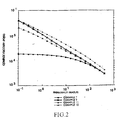
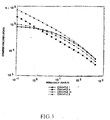
- Figures 1-7 The relationship between viscosity and frequency for some of the diene modified polymers are shown in Figures 1-7.
- Figure one illustrates this feature of the diene modified propylene of Examples 5 and 6 as compared to Example 1 which is the non-modified homopolypropylene.
- the melt viscosity for the inventive polymer at the frequency of 0.1 rad/s is significantly higher in comparison to Example 1.
- invention Examples 5 and 6 have enhanced shear thinning behavior as compared to homopolypropylene.
- Figure 2 demonstrates the relationship between viscosity and frequency for the diene modified polymers of Examples 9, 10, and 11 as compared to the homopolypropylene of Example 7.
- the viscosity at a frequency of 0.1 rad/s for Example 7 (non-diene modified) is significantly lower than Example 1 (shown in Figure 1). This is due to the higher MFR of Example 7 as compared to Example 1 (8.47 dg/min as compared to 1.76 dg/min).
- the diene modified polymers of Examples 9,10 and 11 show a significantly better melt viscosity in comparison to Example 7. More importantly, the shear thinning behavior of the diene modified polymers is much better in comparison to the homopolymer of Example 7.
- Figure 3 demonstrates the relationship bewteen viscosity and frequency for the diene modified polymers of Examples 5 and 6 as compared to a commercially available polypropylene (Example 16) which has a MFR of 2.1 dg/min and is used commercially for thermoforming applications requiring high melt strenghth.
- the diene modified polymers of Examples 5 and 6 show a significantly higher melt viscosity at a frequency of .1 rad/s and more importantly, superior shear thinning behavior.
- Figure 4 demonstrates the relationship betwen viscosity and frequency for the diene modified polymers of Examples 13, 14, and 15 as compared to the homopolymer of Example 1.
- Figure 5 demonstrates the relationship betwen viscosity and frequency for the diene modified polymers of Example 14 and 5 as compared to the homopolymer of Example 1.
- the polymer modified with 1,13-tetradecadiene (Example 5) has much improved shear thinning characteristics and melt strength.
- the polymer modified with 1,7-octadiene (Example 14) shows slight improvement.
- Figure 6 demonstrates the relationship betwen viscosity and frequency for the diene modified polymers of comparative examples 24-29 which were prepared usng the Zeigler Natta catalyst TOHO-THC-131-2 (obtained from Toho Titanium Company, Limited. It is evident from this figure that shear thinning behavior is not improved.
- Figure 7 shows the relationship between viscosity and frequency for the diene modified polymers of Examples 18 (modified with 1,7-octadiene) and 21 (modified with (1,13-tetradecadiene) as compared to control Example 17 (homopolymer).
- the diene modified polymers of Examples 18 and 21 have improved shear thinning behavior and melt strength.
Landscapes
- Chemical & Material Sciences (AREA)
- Chemical Kinetics & Catalysis (AREA)
- Medicinal Chemistry (AREA)
- Polymers & Plastics (AREA)
- Organic Chemistry (AREA)
- Health & Medical Sciences (AREA)
- Engineering & Computer Science (AREA)
- Manufacturing & Machinery (AREA)
- General Chemical & Material Sciences (AREA)
- Materials Engineering (AREA)
- Crystallography & Structural Chemistry (AREA)
- Transition And Organic Metals Composition Catalysts For Addition Polymerization (AREA)
- Addition Polymer Or Copolymer, Post-Treatments, Or Chemical Modifications (AREA)
Abstract
Claims (2)
- Procédé pour la production d'un polymère de propylène isotactique à modification diénique, ledit procédé comprenant l'association dans une zone réactionnelle, dans des conditions de polymérisation convenables, de propylène, d'un ou plusieurs α-ω-diènes ou de norbornadiène et d'un système de catalyseur à base de métallocène comprenant un métallocène représenté par la formule :dans laquelle M est choisi dans le groupe consistant en titane, zirconium, hafnium, vanadium, niobium, tantale, chrome, molybdène et tungstène ;

R1 et R2 sont identiques ou différents et sont choisis entre un atome d'hydrogène, un groupe alkyle en C1 à C10, un groupe alkoxy en C1 à C10, un groupe aryle en C6 à C10, un groupe aryloxy en C6 à C10, un groupe alcényle en C2 à C10, un groupe alcényle en C2 à C4, un groupe arylalkyle en C7 à C40, un groupe alkylaryle en C7 à C40, un groupe arylalcényle en C8 à C40 et un atome d'halogène ;
R3 et R4 représentent des atomes d'hydrogène ;
R5 et R6 sont identiques ou différents et sont choisis entre un atome d'halogène, un groupe alkyle en C1 à C10 qui peut être halogéné, un groupe aryle en C6 à C10 qui peut être halogéné, un groupe alcényle en C2 à C10, un groupe arylalkyle en C7 à C40, un groupe alkylaryle en C7 à C40, un groupe arylacényle en C8 à C40, un radical -NR2 15, -SR15, -OR15, -OSiR3 15 ou -PR2 15, dans lequel R15 est choisi entre un atome d'halogène, un groupe alkyle en C1 à C10 et un groupe aryle en C6 à C10 ;
R7 représente un groupe =BR11, =AlR11, -Ge-, -Sn-, -O-, -S-, =SO, =SO2, =NR11, =CO, PR11 ou =P(O)R11 ;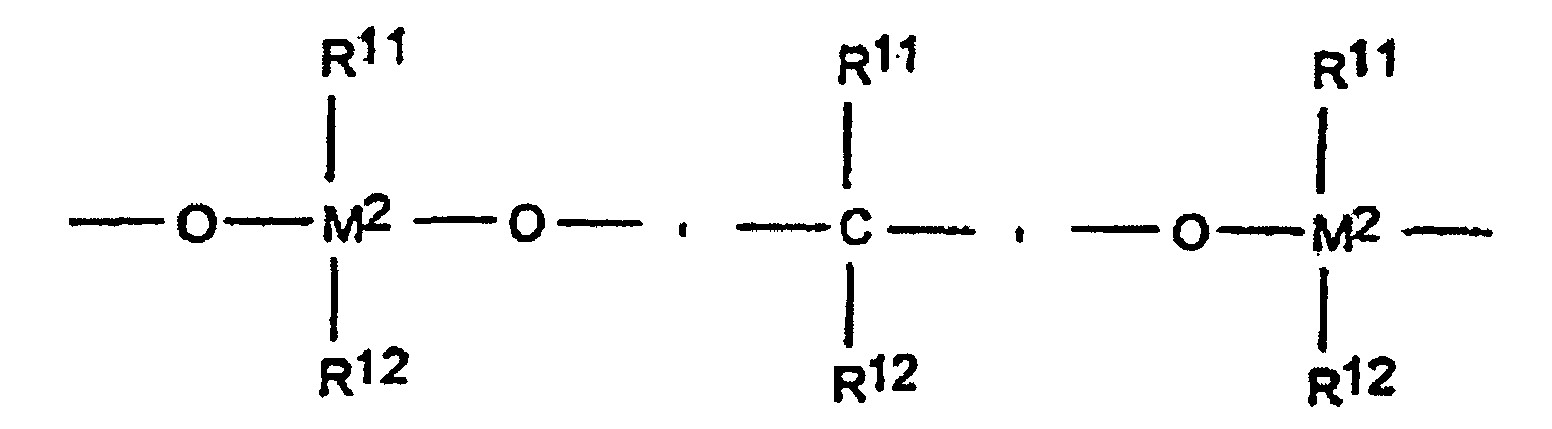
dans lequel :R11, R12 et R13 sont identiques ou différents et représentent un atome d'hydrogène, un atome d'halogène, un groupe alkyle en C1 à C20, un groupe fluoralkyle en C1 à C20, un groupe aryle en C6 à C30, un groupe fluoroaryle en C6 à C30, un groupe alkoxy en C1 à C20, un groupe alcényle en C2 à C20, un groupe arylalkyle en C7 à C40, un groupe arylalcényle en C8 à C40, un groupe alkylaryle en C7 à C40, ou bien R11 et R12, ou R11 et R13, conjointement avec les atomes les reliant, peuvent former des systèmes cycliques ;M2 représente le silicium, le germanium ou l'étain,R8 et R9 sont identiques ou différents et répondent aux définitions indiquées pour R11;m et n sont identiques ou différents et sont égaux à 0, 1 ou 2, la somme m plus n étant égale à 0, 1 ou 2 ; etles radicaux R10 sont identiques ou différents et répondent aux définitions indiquées pour R11, R12 et R13 et deux radicaux R10 adjacents peuvent être joints l'un à l'autre pour former un système cyclique. - Procédé suivant la revendication 1, dans lequel le diène est choisi dans le groupe consistant en 1,13-tétradécadiène, 1,9-décadiène et 1,7-octadiène.
Priority Applications (1)
| Application Number | Priority Date | Filing Date | Title |
|---|---|---|---|
| EP99105738A EP0942017A3 (fr) | 1995-08-28 | 1996-08-27 | Procédé de production de polypropylène modifié par diènes |
Applications Claiming Priority (3)
| Application Number | Priority Date | Filing Date | Title |
|---|---|---|---|
| US520010 | 1990-05-07 | ||
| US08/520,010 US5670595A (en) | 1995-08-28 | 1995-08-28 | Diene modified polymers |
| PCT/US1996/014119 WO1997008216A1 (fr) | 1995-08-28 | 1996-08-27 | Procede de production de polypropylene modifie par dienes |
Related Child Applications (1)
| Application Number | Title | Priority Date | Filing Date |
|---|---|---|---|
| EP99105738A Division EP0942017A3 (fr) | 1995-08-28 | 1996-08-27 | Procédé de production de polypropylène modifié par diènes |
Publications (2)
| Publication Number | Publication Date |
|---|---|
| EP0847408A1 EP0847408A1 (fr) | 1998-06-17 |
| EP0847408B1 true EP0847408B1 (fr) | 2005-10-19 |
Family
ID=24070815
Family Applications (2)
| Application Number | Title | Priority Date | Filing Date |
|---|---|---|---|
| EP96929875A Expired - Lifetime EP0847408B1 (fr) | 1995-08-28 | 1996-08-27 | Procede de production de polypropylene modifie par dienes |
| EP99105738A Ceased EP0942017A3 (fr) | 1995-08-28 | 1996-08-27 | Procédé de production de polypropylène modifié par diènes |
Family Applications After (1)
| Application Number | Title | Priority Date | Filing Date |
|---|---|---|---|
| EP99105738A Ceased EP0942017A3 (fr) | 1995-08-28 | 1996-08-27 | Procédé de production de polypropylène modifié par diènes |
Country Status (11)
| Country | Link |
|---|---|
| US (1) | US5670595A (fr) |
| EP (2) | EP0847408B1 (fr) |
| JP (1) | JPH11511499A (fr) |
| KR (1) | KR100461290B1 (fr) |
| CN (1) | CN1098288C (fr) |
| CA (1) | CA2226947A1 (fr) |
| DE (1) | DE69635306D1 (fr) |
| EA (1) | EA199800241A1 (fr) |
| ES (1) | ES2251727T3 (fr) |
| PL (1) | PL325286A1 (fr) |
| WO (1) | WO1997008216A1 (fr) |
Families Citing this family (83)
| Publication number | Priority date | Publication date | Assignee | Title |
|---|---|---|---|---|
| US5993922A (en) * | 1996-03-29 | 1999-11-30 | Cryovac, Inc. | Compositions and methods for selectively crosslinking films and improved film articles resulting therefrom |
| DE19622272A1 (de) * | 1996-06-03 | 1997-12-04 | Basf Ag | Copolymere von Alk-1-enen und a,beta-Dienen mit erhöhtem Viskositätsindex |
| US6025407A (en) * | 1997-10-30 | 2000-02-15 | Occidental Chemical Corporation | Photo-polymerization of vinyl chloride using metallocene catalysts |
| JP2002512276A (ja) * | 1998-04-21 | 2002-04-23 | バーゼル、ポリプロピレン、ゲゼルシャフト、ミット、ベシュレンクテル、ハフツング | 特定のメタロセンを使用するポリプロピレンの製造方法 |
| EP1109843B1 (fr) * | 1998-07-25 | 2004-09-01 | BP Chemicals Limited | Copolymeres d'alpha-olefine/diene |
| AU1241600A (en) * | 1998-11-02 | 2000-05-22 | Dupont Dow Elastomers L.L.C. | Shear thinning ethylene/alpha-olefin interpolymers and their preparation |
| US6294631B1 (en) * | 1998-12-15 | 2001-09-25 | Exxonmobil Chemical Patents Inc. | Hyperbranched polymers by coordination polymerization |
| US6329454B1 (en) | 1999-12-08 | 2001-12-11 | The Dow Chemical Company | Filled propylene polymer composition |
| US6809168B2 (en) * | 1999-12-10 | 2004-10-26 | Exxonmobil Chemical Patents Inc. | Articles formed from propylene diene copolymers |
| US6977287B2 (en) * | 1999-12-10 | 2005-12-20 | Exxonmobil Chemical Patents Inc. | Propylene diene copolymers |
| JP2003516440A (ja) * | 1999-12-10 | 2003-05-13 | エクソンモービル・ケミカル・パテンツ・インク | プロピレンジエン共重合ポリマー |
| US6509431B1 (en) * | 2000-01-18 | 2003-01-21 | Exxonmobil Oil Corporation | Terpolymers |
| JP2001316510A (ja) | 2000-02-29 | 2001-11-16 | Chisso Corp | 発泡用のポリプロピレン系樹脂組成物、該組成物を用いた発泡体、同発泡体の製造方法および同発泡体を用いた発泡成形体 |
| US7122498B2 (en) * | 2000-06-30 | 2006-10-17 | Exxonmobil Chemical Patents Inc. | Metallocenes and catalyst compositions derived therefrom |
| EP1170307A1 (fr) * | 2000-07-05 | 2002-01-09 | ATOFINA Research | Moulage de polyoléfines ayant de meilleures propriétés |
| EP1170305A1 (fr) * | 2000-07-05 | 2002-01-09 | ATOFINA Research | Production de polyoléfines ayant de meilleures propriétés |
| US7282541B2 (en) * | 2000-10-30 | 2007-10-16 | Exxonmobil Chemical Patents Inc. | Functionalized polypropylene-based polymers |
| ATE474006T1 (de) * | 2000-10-30 | 2010-07-15 | Exxonmobil Chem Patents Inc | Pfropfmodifizierte polymere auf basis neuer propylen-ethylen-copolymere |
| KR20040054596A (ko) * | 2000-12-20 | 2004-06-25 | 엑손모빌 케미칼 패턴츠 인코포레이티드 | 분지된 중합체 조성물을 제조하기 위한 올레핀 중합 방법 |
| US6433090B1 (en) | 2001-01-26 | 2002-08-13 | Advanced Elastomer Systems, L.P. | Thermoplastic elastomers having improved set foams made therefrom |
| JP2002226520A (ja) * | 2001-02-05 | 2002-08-14 | Grand Polymer Co Ltd | プロピレン・α,ω−ジエンランダム共重合体およびその製造方法 |
| US20040092677A1 (en) * | 2001-05-11 | 2004-05-13 | The Procter & Gamble Company | Synthetic material comprising a network polymer |
| EP1256594A1 (fr) * | 2001-05-11 | 2002-11-13 | The Procter & Gamble Company | Matière synthétique comprenant un polymère réticulé |
| JP2003055407A (ja) * | 2001-08-17 | 2003-02-26 | Chisso Corp | プロピレン系重合体 |
| US8008412B2 (en) | 2002-09-20 | 2011-08-30 | Exxonmobil Chemical Patents Inc. | Polymer production at supersolution conditions |
| WO2004037871A1 (fr) * | 2002-10-24 | 2004-05-06 | Exxonmobil Chemical Patents Inc. | Polypropylene cristallin ramifie |
| US7439312B2 (en) * | 2002-10-24 | 2008-10-21 | Exxonmobil Chemical Patents Inc. | Branched crystalline polypropylene |
| US7339018B2 (en) * | 2002-12-05 | 2008-03-04 | Exxonmobil Chemical Patents Inc. | Diene-modified propylene copolymers |
| AU2003287683A1 (en) * | 2002-12-05 | 2004-06-30 | Exxonmobil Chemical Patents Inc. | High temperature bulk polymerization of branched crystalline polypropylene |
| US6790911B2 (en) * | 2002-12-26 | 2004-09-14 | Advanvced Elastomer Systems, L.P. | Thermoplastic elastomers having improved adhesive proterties |
| US6780936B1 (en) * | 2003-02-11 | 2004-08-24 | Exxonmobil Chemical Patents Inc. | Diene-modified propylene polymer nucleating agents |
| US7511105B2 (en) * | 2004-07-01 | 2009-03-31 | The Penn State Research Foundation | One-pot process and reagents for preparing long chain branched polymers |
| US20090198031A1 (en) * | 2004-07-01 | 2009-08-06 | The Penn State Research Foundation | One-pot process and reagents for preparing long chain branched polymers |
| US7951872B2 (en) * | 2005-06-22 | 2011-05-31 | Exxonmobil Chemical Patents Inc. | Heterogeneous polymer blend with continuous elastomeric phase and process of making the same |
| US8288480B2 (en) | 2005-06-22 | 2012-10-16 | Exxonmobil Chemical Patents Inc. | In-reactor polymer blends |
| US9745461B2 (en) | 2005-06-22 | 2017-08-29 | Exxonmobil Chemical Patents Inc. | Vulcanized polymer blends |
| US20060293462A1 (en) * | 2005-06-22 | 2006-12-28 | Sunny Jacob | Heterogeneous polymer blend and process of making the same |
| US7928164B2 (en) * | 2005-06-22 | 2011-04-19 | Exxonmobil Chemical Patents Inc. | Homogeneous polymer blend and process of making the same |
| US9644092B2 (en) | 2005-06-22 | 2017-05-09 | Exxonmobil Chemical Patents Inc. | Heterogeneous in-situ polymer blend |
| EA013421B1 (ru) * | 2006-03-24 | 2010-04-30 | Сауди Бейсик Индастриз Корпорейшн | Композиция экструзионного покрытия |
| US8143352B2 (en) * | 2006-12-20 | 2012-03-27 | Exxonmobil Research And Engineering Company | Process for fluid phase in-line blending of polymers |
| US8242237B2 (en) | 2006-12-20 | 2012-08-14 | Exxonmobil Chemical Patents Inc. | Phase separator and monomer recycle for supercritical polymerization process |
| US8080610B2 (en) | 2007-03-06 | 2011-12-20 | Exxonmobil Research And Engineering Company | Monomer recycle process for fluid phase in-line blending of polymers |
| JP2010529253A (ja) | 2007-06-04 | 2010-08-26 | エクソンモービル・ケミカル・パテンツ・インク | 非常に均一なプロピレンの溶液重合法 |
| CN101855249B (zh) * | 2007-09-13 | 2013-02-13 | 埃克森美孚研究工程公司 | 在线生产增塑聚合物和增塑聚合物共混物的方法 |
| EP2201042B1 (fr) * | 2007-09-13 | 2012-06-27 | ExxonMobil Research and Engineering Company | Melange en ligne de plastifiants avec un polymere de base |
| US8138269B2 (en) * | 2007-12-20 | 2012-03-20 | Exxonmobil Research And Engineering Company | Polypropylene ethylene-propylene copolymer blends and in-line process to produce them |
| CN101945942B (zh) | 2007-12-20 | 2012-08-08 | 埃克森美孚研究工程公司 | 生产粒料稳定的聚烯烃的在线方法 |
| US7910679B2 (en) * | 2007-12-20 | 2011-03-22 | Exxonmobil Research And Engineering Company | Bulk homogeneous polymerization process for ethylene propylene copolymers |
| US8318875B2 (en) | 2008-01-18 | 2012-11-27 | Exxonmobil Chemical Patents Inc. | Super-solution homogeneous propylene polymerization and polypropylenes made therefrom |
| US8802797B2 (en) | 2008-06-20 | 2014-08-12 | Exxonmobil Chemical Patents Inc. | Vinyl-terminated macromonomer oligomerization |
| US8399725B2 (en) * | 2008-06-20 | 2013-03-19 | Exxonmobil Chemical Patents Inc. | Functionalized high vinyl terminated propylene based oligomers |
| US8372930B2 (en) | 2008-06-20 | 2013-02-12 | Exxonmobil Chemical Patents Inc. | High vinyl terminated propylene based oligomers |
| US8283419B2 (en) * | 2008-06-20 | 2012-10-09 | Exxonmobil Chemical Patents Inc. | Olefin functionalization by metathesis reaction |
| US8283428B2 (en) | 2008-06-20 | 2012-10-09 | Exxonmobil Chemical Patents Inc. | Polymacromonomer and process for production thereof |
| JP5422274B2 (ja) * | 2008-07-18 | 2014-02-19 | 電気化学工業株式会社 | オレフィン−芳香族ポリエン共重合体の製造方法 |
| US9458310B2 (en) | 2009-10-16 | 2016-10-04 | Exxonmobil Chemical Patents Inc. | Modified polyethylene film compositions |
| CN102268124A (zh) * | 2010-06-07 | 2011-12-07 | 中国科学院化学研究所 | 一种长链支化聚丙烯及其制备方法 |
| EP2520425B1 (fr) * | 2011-05-02 | 2017-11-08 | Borealis AG | Polypropylène pour mousse et mousse de polypropylène |
| US9321911B2 (en) | 2011-09-23 | 2016-04-26 | Exxonmobil Chemical Patents Inc. | Modified polyethylene compositions for cast film |
| WO2013043796A2 (fr) * | 2011-09-23 | 2013-03-28 | Exxonmobil Chemical Patents Inc. | Compositions de polyéthylène modifiées |
| US9340664B2 (en) | 2011-09-23 | 2016-05-17 | Exxonmobil Chemical Patents Inc. | Modified polyethylene compositions for blown film |
| US20160272798A1 (en) | 2011-09-23 | 2016-09-22 | Exxonmobil Chemical Patents Inc. | Modified Polyethylene Compositions with Enhanced Melt Strength |
| US8629217B2 (en) | 2011-11-22 | 2014-01-14 | Exxonmobil Chemical Patents Inc. | Modified polyethylene blown film compositions having excellent bubble stability |
| US10836853B2 (en) | 2012-09-20 | 2020-11-17 | Exxonmobil Chemical Patents Inc. | Crack-resistant polyethylene compositions |
| US10822479B2 (en) | 2012-09-20 | 2020-11-03 | Exxonmobil Chemical Patents Inc. | Foamed polyethylene compositions |
| WO2014088827A1 (fr) | 2012-12-05 | 2014-06-12 | Exxonmobil Chemical Patents Inc. | Compositions de film soufflé en polyéthylène modifié par polyéthylène haute densité présentant une excellente stabilité de bulle |
| WO2015159869A1 (fr) * | 2014-04-17 | 2015-10-22 | 株式会社カネカ | Feuille de résine à base de polypropylène et objet formé |
| CN103980402B (zh) * | 2014-04-30 | 2015-12-09 | 中国科学院化学研究所 | 一种可用于3d打印的交联聚丙烯树脂及其制备方法和应用 |
| US10125247B2 (en) | 2014-05-29 | 2018-11-13 | Exxonmobil Chemical Patents Inc. | Polyethylene compositions |
| WO2015183577A1 (fr) | 2014-05-29 | 2015-12-03 | Exxonmobil Chemical Patents Inc. | Additifs de diène cyclique dans des films de polyéthylène et équilibre d'orientation de film amélioré dans la production correspondante |
| US10077344B2 (en) | 2014-05-29 | 2018-09-18 | Exxonmobil Chemical Patents Inc. | Polyethylene films and production of such films |
| KR101810317B1 (ko) * | 2016-04-06 | 2017-12-19 | 롯데케미칼 주식회사 | 용융 장력이 우수한 폴리프로필렌 수지 |
| KR101853447B1 (ko) | 2016-09-29 | 2018-04-30 | 롯데케미칼 주식회사 | 고용융장력 폴리프로필렌 수지를 포함하는 전선용 절연체 조성물 |
| WO2018182943A1 (fr) | 2017-03-29 | 2018-10-04 | Exxonmobil Chemical Patents Inc. | Compositions de polyéthylène |
| WO2018222310A1 (fr) | 2017-05-30 | 2018-12-06 | Exxonmobil Chemical Patents Inc. | Polypropylène à haute résistance à l'état fondu présentant une rigidité et une transparence élevées |
| CN110785442B (zh) | 2017-05-30 | 2022-05-13 | 埃克森美孚化学专利公司 | 具有高劲度和透明度的高熔体强度聚丙烯 |
| KR102682379B1 (ko) * | 2017-11-09 | 2024-07-05 | 롯데케미칼 주식회사 | 고용융장력 폴리프로필렌 수지 제조방법 |
| US11041035B2 (en) | 2018-03-08 | 2021-06-22 | Exxonmobil Chemical Patents Inc. | Process to produce long-chain branched polyolefins using dienes |
| WO2019173605A1 (fr) | 2018-03-08 | 2019-09-12 | Exxonmobil Chemical Patents Inc. | Copolymères d'éthylène-propylène ramifiés à utiliser en tant que modificateurs de viscosité à économie de carburant améliorée |
| WO2019173129A1 (fr) * | 2018-03-08 | 2019-09-12 | Exxonmobil Chemical Patents Inc. | Procédé amélioré de production de polyoléfines ramifiées à longue chaîne à l'aide de diènes |
| WO2022029212A1 (fr) * | 2020-08-06 | 2022-02-10 | Total Research & Technology Feluy | Procédé de préparation de polymères de propylène ayant des ramifications à longue chaîne |
| WO2022238520A1 (fr) | 2021-05-12 | 2022-11-17 | Borealis Ag | Polypropylène à haute résistance à l'état fondu |
Family Cites Families (20)
| Publication number | Priority date | Publication date | Assignee | Title |
|---|---|---|---|---|
| US3351621A (en) * | 1964-02-06 | 1967-11-07 | Chevron Res | Copolymerization with alpha, omega-dienes |
| CA980498A (en) * | 1971-04-16 | 1975-12-23 | Du Pont Of Canada Limited | Ethylene polymers with long chain branching |
| US4551503A (en) * | 1977-12-19 | 1985-11-05 | The Goodyear Tire & Rubber Company | Preparation of interpolymers of alpha-olefins and nonconjugated alpha, omega-dienes |
| DE3021273A1 (de) * | 1979-06-12 | 1981-01-08 | Mitsubishi Petrochemical Co | Ungesaettigte mischpolymerisate |
| IN166935B (fr) * | 1985-01-31 | 1990-08-11 | Himont Inc | |
| EP0190889B2 (fr) * | 1985-01-31 | 2000-07-05 | Montell North America Inc. | Polypropylène à branchement de longue chaíne libre, son procédé de fabrication et son application |
| US4626467A (en) * | 1985-12-16 | 1986-12-02 | Hercules Incorporated | Branched polyolefin as a quench control agent for spin melt compositions |
| JPH0816125B2 (ja) * | 1987-09-29 | 1996-02-21 | 東燃料株式会社 | ジオレフィン共重合体及びその製造方法 |
| US5047446A (en) * | 1988-07-22 | 1991-09-10 | Himont Incorporated | Thermal treatment of irradiated propylene polymer material |
| US5047485A (en) * | 1989-02-21 | 1991-09-10 | Himont Incorporated | Process for making a propylene polymer with free-end long chain branching and use thereof |
| WO1991015523A1 (fr) * | 1990-04-09 | 1991-10-17 | Mitsui Toatsu Chemicals, Incorporated | Copolymere de propylene |
| AU7875791A (en) * | 1990-05-07 | 1991-11-27 | Exxon Chemical Patents Inc. | Unsaturated alpha-olefin copolymers and method for preparation thereof |
| US5272236A (en) * | 1991-10-15 | 1993-12-21 | The Dow Chemical Company | Elastic substantially linear olefin polymers |
| US5243001A (en) * | 1990-11-12 | 1993-09-07 | Hoechst Aktiengesellschaft | Process for the preparation of a high molecular weight olefin polymer |
| JP3193066B2 (ja) * | 1991-05-02 | 2001-07-30 | 三菱化学株式会社 | プロピレンランダム共重合体の製造法 |
| US5391789A (en) * | 1991-08-08 | 1995-02-21 | Hoechst Aktiengesellschaft | Bridged, chiral metallocenes, processes for their preparation and their use as catalysts |
| US5296433A (en) * | 1992-04-14 | 1994-03-22 | Minnesota Mining And Manufacturing Company | Tris(pentafluorophenyl)borane complexes and catalysts derived therefrom |
| IT1260497B (it) * | 1992-05-29 | 1996-04-09 | Himont Inc | Polimeri cristallini del propilene aventi migliorata processabilita' allo stato e processo per la loro preparazione |
| WO1994010216A1 (fr) * | 1992-10-28 | 1994-05-11 | Idemitsu Kosan Co., Ltd. | Copolymeres d'olefines et procede pour leur production |
| US5552489A (en) * | 1994-07-22 | 1996-09-03 | Exxon Chemical Patents Inc. | Tackifiers and a process to obtain tackifiers |
-
1995
- 1995-08-28 US US08/520,010 patent/US5670595A/en not_active Expired - Lifetime
-
1996
- 1996-08-27 ES ES96929875T patent/ES2251727T3/es not_active Expired - Lifetime
- 1996-08-27 PL PL96325286A patent/PL325286A1/xx unknown
- 1996-08-27 CN CN96196608A patent/CN1098288C/zh not_active Expired - Fee Related
- 1996-08-27 WO PCT/US1996/014119 patent/WO1997008216A1/fr not_active Ceased
- 1996-08-27 DE DE69635306T patent/DE69635306D1/de not_active Expired - Lifetime
- 1996-08-27 JP JP9510639A patent/JPH11511499A/ja active Pending
- 1996-08-27 CA CA002226947A patent/CA2226947A1/fr not_active Abandoned
- 1996-08-27 EP EP96929875A patent/EP0847408B1/fr not_active Expired - Lifetime
- 1996-08-27 EP EP99105738A patent/EP0942017A3/fr not_active Ceased
- 1996-08-27 EA EA199800241A patent/EA199800241A1/ru unknown
- 1996-08-27 KR KR10-1998-0701251A patent/KR100461290B1/ko not_active Expired - Fee Related
Also Published As
| Publication number | Publication date |
|---|---|
| EP0942017A3 (fr) | 1999-10-06 |
| ES2251727T3 (es) | 2006-05-01 |
| EP0942017A2 (fr) | 1999-09-15 |
| US5670595A (en) | 1997-09-23 |
| DE69635306D1 (de) | 2006-03-02 |
| EP0847408A1 (fr) | 1998-06-17 |
| PL325286A1 (en) | 1998-07-20 |
| WO1997008216A1 (fr) | 1997-03-06 |
| EA199800241A1 (ru) | 1999-02-25 |
| KR100461290B1 (ko) | 2005-06-17 |
| KR19990044019A (ko) | 1999-06-25 |
| CN1194654A (zh) | 1998-09-30 |
| CA2226947A1 (fr) | 1997-03-06 |
| JPH11511499A (ja) | 1999-10-05 |
| CN1098288C (zh) | 2003-01-08 |
Similar Documents
| Publication | Publication Date | Title |
|---|---|---|
| US5670595A (en) | Diene modified polymers | |
| WO1997008216A9 (fr) | Procede de production de polypropylene modifie par dienes | |
| US6225432B1 (en) | Branched polypropylene compositions | |
| US6660809B1 (en) | Propylene polymers incorporating polyethylene macromers | |
| US6342574B1 (en) | Propylene polymers incorporating macromers | |
| EP0923618B1 (fr) | Polypropylenes ameliores pour films orientes | |
| US6114479A (en) | Polymerization catalyst systems, their production and use | |
| US20040171782A1 (en) | Polypropylene polymers | |
| US5346925A (en) | Method for producing α-olefin polymers | |
| EP1078009B1 (fr) | Homopolymeres de propylene et leur procede de fabrication | |
| WO1996011961A1 (fr) | Production et utilisation de systemes catalyseurs de polymerisation | |
| EP1361232B1 (fr) | Polymères de propylène contenant des macromonomères | |
| US7205363B2 (en) | Polymerization processes using antistatic agents | |
| US20030088022A1 (en) | Polypropylene compositions methods of making the same | |
| JP3202370B2 (ja) | プロピレンブロック共重合体の製造法 | |
| MXPA00005703A (es) | Polimeros de propileno que incorporan macromeros |
Legal Events
| Date | Code | Title | Description |
|---|---|---|---|
| PUAI | Public reference made under article 153(3) epc to a published international application that has entered the european phase |
Free format text: ORIGINAL CODE: 0009012 |
|
| 17P | Request for examination filed |
Effective date: 19980320 |
|
| AK | Designated contracting states |
Kind code of ref document: A1 Designated state(s): BE CH DE ES FR GB IT LI NL |
|
| 17Q | First examination report despatched |
Effective date: 19980702 |
|
| RAP1 | Party data changed (applicant data changed or rights of an application transferred) |
Owner name: EXXONMOBIL CHEMICAL PATENTS INC. |
|
| GRAP | Despatch of communication of intention to grant a patent |
Free format text: ORIGINAL CODE: EPIDOSNIGR1 |
|
| GRAS | Grant fee paid |
Free format text: ORIGINAL CODE: EPIDOSNIGR3 |
|
| GRAA | (expected) grant |
Free format text: ORIGINAL CODE: 0009210 |
|
| AK | Designated contracting states |
Kind code of ref document: B1 Designated state(s): BE CH DE ES FR GB IT LI NL |
|
| PG25 | Lapsed in a contracting state [announced via postgrant information from national office to epo] |
Ref country code: LI Free format text: LAPSE BECAUSE OF FAILURE TO SUBMIT A TRANSLATION OF THE DESCRIPTION OR TO PAY THE FEE WITHIN THE PRESCRIBED TIME-LIMIT Effective date: 20051019 Ref country code: IT Free format text: LAPSE BECAUSE OF FAILURE TO SUBMIT A TRANSLATION OF THE DESCRIPTION OR TO PAY THE FEE WITHIN THE PRESCRIBED TIME-LIMIT;WARNING: LAPSES OF ITALIAN PATENTS WITH EFFECTIVE DATE BEFORE 2007 MAY HAVE OCCURRED AT ANY TIME BEFORE 2007. THE CORRECT EFFECTIVE DATE MAY BE DIFFERENT FROM THE ONE RECORDED. Effective date: 20051019 Ref country code: CH Free format text: LAPSE BECAUSE OF FAILURE TO SUBMIT A TRANSLATION OF THE DESCRIPTION OR TO PAY THE FEE WITHIN THE PRESCRIBED TIME-LIMIT Effective date: 20051019 |
|
| REG | Reference to a national code |
Ref country code: GB Ref legal event code: FG4D |
|
| REG | Reference to a national code |
Ref country code: CH Ref legal event code: EP |
|
| PG25 | Lapsed in a contracting state [announced via postgrant information from national office to epo] |
Ref country code: DE Free format text: LAPSE BECAUSE OF FAILURE TO SUBMIT A TRANSLATION OF THE DESCRIPTION OR TO PAY THE FEE WITHIN THE PRESCRIBED TIME-LIMIT Effective date: 20060120 |
|
| REF | Corresponds to: |
Ref document number: 69635306 Country of ref document: DE Date of ref document: 20060302 Kind code of ref document: P |
|
| REG | Reference to a national code |
Ref country code: CH Ref legal event code: PL |
|
| REG | Reference to a national code |
Ref country code: ES Ref legal event code: FG2A Ref document number: 2251727 Country of ref document: ES Kind code of ref document: T3 |
|
| PLBE | No opposition filed within time limit |
Free format text: ORIGINAL CODE: 0009261 |
|
| STAA | Information on the status of an ep patent application or granted ep patent |
Free format text: STATUS: NO OPPOSITION FILED WITHIN TIME LIMIT |
|
| 26N | No opposition filed |
Effective date: 20060720 |
|
| EN | Fr: translation not filed | ||
| PG25 | Lapsed in a contracting state [announced via postgrant information from national office to epo] |
Ref country code: FR Free format text: LAPSE BECAUSE OF FAILURE TO SUBMIT A TRANSLATION OF THE DESCRIPTION OR TO PAY THE FEE WITHIN THE PRESCRIBED TIME-LIMIT Effective date: 20061208 |
|
| GBPC | Gb: european patent ceased through non-payment of renewal fee |
Effective date: 20060827 |
|
| PG25 | Lapsed in a contracting state [announced via postgrant information from national office to epo] |
Ref country code: GB Free format text: LAPSE BECAUSE OF NON-PAYMENT OF DUE FEES Effective date: 20060827 |
|
| PGFP | Annual fee paid to national office [announced via postgrant information from national office to epo] |
Ref country code: NL Payment date: 20080715 Year of fee payment: 13 |
|
| PG25 | Lapsed in a contracting state [announced via postgrant information from national office to epo] |
Ref country code: FR Free format text: LAPSE BECAUSE OF FAILURE TO SUBMIT A TRANSLATION OF THE DESCRIPTION OR TO PAY THE FEE WITHIN THE PRESCRIBED TIME-LIMIT Effective date: 20051019 |
|
| PGFP | Annual fee paid to national office [announced via postgrant information from national office to epo] |
Ref country code: BE Payment date: 20080828 Year of fee payment: 13 |
|
| BERE | Be: lapsed |
Owner name: *EXXONMOBIL CHEMICAL PATENTS INC. Effective date: 20090831 |
|
| REG | Reference to a national code |
Ref country code: NL Ref legal event code: V1 Effective date: 20100301 |
|
| PG25 | Lapsed in a contracting state [announced via postgrant information from national office to epo] |
Ref country code: BE Free format text: LAPSE BECAUSE OF NON-PAYMENT OF DUE FEES Effective date: 20090831 |
|
| PG25 | Lapsed in a contracting state [announced via postgrant information from national office to epo] |
Ref country code: NL Free format text: LAPSE BECAUSE OF NON-PAYMENT OF DUE FEES Effective date: 20100301 |
|
| PGFP | Annual fee paid to national office [announced via postgrant information from national office to epo] |
Ref country code: ES Payment date: 20130806 Year of fee payment: 18 |
|
| REG | Reference to a national code |
Ref country code: ES Ref legal event code: FD2A Effective date: 20150925 |
|
| PG25 | Lapsed in a contracting state [announced via postgrant information from national office to epo] |
Ref country code: ES Free format text: LAPSE BECAUSE OF NON-PAYMENT OF DUE FEES Effective date: 20140828 |