EP0849006A2 - Verfahren und Vorrichtung zum Sortieren von wiederverwertbaren Materialien - Google Patents
Verfahren und Vorrichtung zum Sortieren von wiederverwertbaren Materialien Download PDFInfo
- Publication number
- EP0849006A2 EP0849006A2 EP97310105A EP97310105A EP0849006A2 EP 0849006 A2 EP0849006 A2 EP 0849006A2 EP 97310105 A EP97310105 A EP 97310105A EP 97310105 A EP97310105 A EP 97310105A EP 0849006 A2 EP0849006 A2 EP 0849006A2
- Authority
- EP
- European Patent Office
- Prior art keywords
- disc
- discs
- primary
- screen
- frame
- Prior art date
- Legal status (The legal status is an assumption and is not a legal conclusion. Google has not performed a legal analysis and makes no representation as to the accuracy of the status listed.)
- Granted
Links
- 239000000463 material Substances 0.000 title claims abstract description 81
- 238000000034 method Methods 0.000 title claims description 6
- 238000000926 separation method Methods 0.000 claims abstract description 16
- 125000006850 spacer group Chemical group 0.000 claims description 21
- 229910000831 Steel Inorganic materials 0.000 claims description 4
- 239000010959 steel Substances 0.000 claims description 4
- 239000004033 plastic Substances 0.000 claims description 3
- 150000001875 compounds Chemical class 0.000 abstract description 30
- 239000002023 wood Substances 0.000 description 20
- 239000000123 paper Substances 0.000 description 16
- 238000012216 screening Methods 0.000 description 15
- 239000000470 constituent Substances 0.000 description 7
- 230000008901 benefit Effects 0.000 description 6
- 239000002245 particle Substances 0.000 description 6
- 230000009471 action Effects 0.000 description 5
- 239000011111 cardboard Substances 0.000 description 5
- 239000010899 old newspaper Substances 0.000 description 5
- 230000001965 increasing effect Effects 0.000 description 4
- 230000000694 effects Effects 0.000 description 3
- 239000002184 metal Substances 0.000 description 3
- 239000010893 paper waste Substances 0.000 description 3
- 230000008569 process Effects 0.000 description 3
- 230000009286 beneficial effect Effects 0.000 description 2
- 230000007423 decrease Effects 0.000 description 2
- 230000001939 inductive effect Effects 0.000 description 2
- 238000004519 manufacturing process Methods 0.000 description 2
- 230000007246 mechanism Effects 0.000 description 2
- 230000035939 shock Effects 0.000 description 2
- 239000002028 Biomass Substances 0.000 description 1
- CWYNVVGOOAEACU-UHFFFAOYSA-N Fe2+ Chemical compound [Fe+2] CWYNVVGOOAEACU-UHFFFAOYSA-N 0.000 description 1
- 239000012615 aggregate Substances 0.000 description 1
- 238000013019 agitation Methods 0.000 description 1
- 239000010426 asphalt Substances 0.000 description 1
- 230000000712 assembly Effects 0.000 description 1
- 238000000429 assembly Methods 0.000 description 1
- 239000000919 ceramic Substances 0.000 description 1
- 230000000295 complement effect Effects 0.000 description 1
- 239000004567 concrete Substances 0.000 description 1
- 230000003247 decreasing effect Effects 0.000 description 1
- 230000007613 environmental effect Effects 0.000 description 1
- 239000012634 fragment Substances 0.000 description 1
- 239000011521 glass Substances 0.000 description 1
- 230000005484 gravity Effects 0.000 description 1
- 238000005007 materials handling Methods 0.000 description 1
- 239000007769 metal material Substances 0.000 description 1
- 238000012986 modification Methods 0.000 description 1
- 230000004048 modification Effects 0.000 description 1
- 230000002028 premature Effects 0.000 description 1
- 238000004513 sizing Methods 0.000 description 1
- 239000002689 soil Substances 0.000 description 1
- 238000003466 welding Methods 0.000 description 1
Images





Classifications
-
- B—PERFORMING OPERATIONS; TRANSPORTING
- B07—SEPARATING SOLIDS FROM SOLIDS; SORTING
- B07B—SEPARATING SOLIDS FROM SOLIDS BY SIEVING, SCREENING, SIFTING OR BY USING GAS CURRENTS; SEPARATING BY OTHER DRY METHODS APPLICABLE TO BULK MATERIAL, e.g. LOOSE ARTICLES FIT TO BE HANDLED LIKE BULK MATERIAL
- B07B1/00—Sieving, screening, sifting, or sorting solid materials using networks, gratings, grids, or the like
- B07B1/12—Apparatus having only parallel elements
- B07B1/14—Roller screens
- B07B1/15—Roller screens using corrugated, grooved or ribbed rollers
-
- B—PERFORMING OPERATIONS; TRANSPORTING
- B07—SEPARATING SOLIDS FROM SOLIDS; SORTING
- B07B—SEPARATING SOLIDS FROM SOLIDS BY SIEVING, SCREENING, SIFTING OR BY USING GAS CURRENTS; SEPARATING BY OTHER DRY METHODS APPLICABLE TO BULK MATERIAL, e.g. LOOSE ARTICLES FIT TO BE HANDLED LIKE BULK MATERIAL
- B07B1/00—Sieving, screening, sifting, or sorting solid materials using networks, gratings, grids, or the like
- B07B1/46—Constructional details of screens in general; Cleaning or heating of screens
- B07B1/4609—Constructional details of screens in general; Cleaning or heating of screens constructional details of screening surfaces or meshes
- B07B1/4636—Regulation of screen apertures
Definitions
- This invention relates to an apparatus and method for separating various materials, and in particular, to improvements in a disc screen.
- Disc or roll screens are frequently used as part of a multi-stage materials separating system.
- Disc screens are used in the materials handling industry for screening large flows of materials to remove certain items of desired dimensions.
- disc screens are particularly suitable for classifying what is normally considered debris or residual materials. This debris may consist of various constituents, such as soil, aggregate, asphalt, concrete, wood, biomass, ferrous and nonferrous metal, plastic, ceramic, paper, cardboard, or other products or materials recognized as debris throughout consumer, commercial and industrial markets.
- the function of the disc screen is to separate the materials fed into it by size. The size classification may be adjusted to meet virtually any specific application.
- Disc screens generally having a screening bed having a series of rotating spaced parallel shafts each of which has a longitudinal series of concentric screen discs separated by spacers which interdigitate with the screen discs of the adjacent shafts.
- the relationship of the discs and spacers on one shaft to the discs and spacers on each adjacent shaft form an opening generally known in the industry as the interfacial opening or "IFO".
- the IFOs permit only material of acceptable size to pass downwardly through the rotating disc bed.
- the acceptable sized material which drops through the IFO is commonly referred to in the industry as Accepts or Unders.
- the discs are all driven to rotate in a common direction from the infeed end of the screen bed to the outfeed or discharge end of the bed.
- materials which are larger than the IFO referred to in the industry as Overs, will be advanced on the bed to the outfeed end of the bed and rejected.
- a disc for a material separation screen comprising a primary disc having a first outside perimeter shaped to maintain a substantially constant spacing with a first adjacent disc during rotation; a secondary disc having a second outside perimeter smaller than the first outside perimeter and shaped to maintain a substantially constant spacing with a second adjacent disc during rotation.
- the use of a compound disc can eliminate secondary slots formed between discs on adjacent shafts in a material separation screen.
- the compound disc comprises a primary disc joined to an associated secondary disc.
- the primary disc and the secondary disc each have the same shape but the secondary disc has a smaller outside perimeter than the primary disc.
- the secondary disc may also be wider than the primary disc.
- the primary disc and associated secondary disc are formed from a unitary piece of rubber.
- the compound discs are interleaved with oppositely aligned compound discs on adjacent shafts.
- the large primary disc is positioned on a shaft to align with a smaller secondary disc on an adjacent shaft.
- the alternating arrangement between the large discs and small discs eliminate secondary slots that normally exist in disc screens.
- the rubber discs provide additional gripping for flat materials such as paper while inducing oversized materials, such as plastic bottles, to roll off a bottom end of the screen.
- the compound disc separates materials more effectively than current disc screens while also reducing jamming.
- a disc screen apparatus 10 comprising a frame 12 supporting a screening bed 14 having a series of co-rotating spaced parallel shafts 16 of rectangular perimeter and similar length and each of which has a longitudinal series of screen discs 18.
- the shafts 16 are driven clockwise in unison in the same direction by suitable drive means 20.
- Material such as debris to be screened is delivered to the infeed end 22 of the screen bed 14 by means of a chute (not shown) as indicated by directional arrows.
- the constituents of acceptable size (Accepts) drop through the IFOs defined by the discs 18 and are received in a hopper 24. Debris constituents which are too large to pass through the IFOs (Overs) are advanced to and discharged, as indicated by directional arrows, from the rejects end 26 of the screening bed 14.
- the discs 18 have perimeters shaped so that space D SP remains constant during rotation.
- the perimeter of discs 18 is defined by three sides having substantially the same degree of curvature.
- the perimeter of discs 18 is defined by drawing an equilateral triangle which has vertices A, B, and C. And thereafter drawing three arcs: (1) between vertices B and C using vertex A as the center point of the arc; (2) between vertices C and A using vertex B as the center point for the arc; and (3) between vertices A and B using vertex C as the center point of the arc.
- This uniquely shaped disc perimeter provides several advantages. First, although space D SP changes location during the rotation of discs 18 as shown in FIGs. 3-3c, the distance between the discs remains constant. In conventional disc screens which have toothed discs which interdigitate, the distance between a disc and its adjacent shaft varies, depending upon the position of the disc during its rotation. This interdigitation action tends to pinch materials between the disc and its adjacent shaft, resulting in frequent jamming.
- Another advantage resulting from the uniquely shaped perimeter is that as the discs 18 rotate, they move the debris in an up and down fashion which creates a sifting effect and facilitates classification. This phenomenon produces a disc screen which is very efficient in classifying materials.
- FIG. 4 illustrates a four-sided disc 18.
- the perimeter of the four-sided disc 18a is defined by having four sides having substantially the same degree of curvature.
- the perimeter of disc 18a is defined by (1) determining the desired center distance L between adjacent shafts and then determining the desired clearance or gap D sp between adjacent coplanar discs; (2) drawing a square having corners A, B, C, and D and side length S.
- Arcs are then drawn between corners A and B, B and C, C and D, and D and A.
- the present invention can employ a five-sided disc 18b as illustrated in FIG. 5.
- the perimeter of the five-sided disc 18b is defined by having five sides having substantially the same degree of curvature.
- the perimeter of disc 18b is defined by drawing a regular pentagon having vertices A, B, C, D, and E.
- Discs 18a and 18b are very beneficial in classifying materials which are more fragile or delicate. As the number of sides of the discs are increased, from 3 to 4 or 5 for example, the amplitude of rotation decreases. This effect is quite dramatic when employing larger diameter discs. Higher amplitudes of the sifting action are more likely to damage delicate or fragile materials. On the other hand, fewer sides increases the amplitude and enhances the sifting action of the screen.
- the discs 18 can be held in place by spacers 30.
- the spacers 30 comprise central apertures to receive the hubs 28 therethrough.
- the spacers 30 are of substantially uniform size and are placed between the discs 18 to achieve substantially uniform IFOs.
- spacers 30 has numerous advantages.
- the size of the IFOs can be easily adjusted by employing spacers 30 of various lengths and widths corresponding to the desired sized opening without replacing the shafts or having to manufacture new discs.
- the distance between adjacent discs 18 can be changed by employing spacers 30 of different lengths.
- the distance between adjacent shafts can be changed by employing spacers 30 of different radial widths.
- the shafts 16 can be adjusted to also vary the size of the IFOs.
- manufacturing costs are greatly reduced as compared to mounting of the discs directly on the shaft.
- damaged discs can be easily replaced.
- the discs 18 are mounted by sets concentrically and in axially extending relation on hubs 28 complementary to and adapted for slidable concentric engagement with the perimeter of the shafts 16.
- the discs 18 comprise central apertures to receive the hubs 28 therethrough.
- the discs 18 are attached in substantially accurately spaced relation to one another axially along the hubs 28 in any suitable manner, as for example by welding.
- the discs 18 may range from about 4 inches major diameter to about 24 inches major diameter. Again, depending on the size, character and quantity of the debris, the number of discs per shaft range from about 5 to about 60.
- a disc screen 110 comprising a frame 112 supporting a screening bed 114 having a first stage of co-rotating spaced parallel shafts 116 of similar length and each of which has a longitudinal series of screen discs 118 and having a second stage of co-rotating spaced parallel shafts 116a of similar length and each of which has a longitudinal series of screen discs 118a.
- the shafts 116 and 116a are driven clockwise as hereafter described in the same direction by suitable drive means 120.
- Material such as debris to be screened is delivered to the infeed end 122 of the screen bed 114 by means of a chute (not shown) as indicated by directional arrows.
- the small fraction material comprises particles having a diameter of less than about 4 inches and the intermediate fraction material comprises particles having a diameter of less than about 8 inches.
- the small faction material particles have a diameter of less than 3 inches and the intermediate fraction material particles have a diameter of less than 6 inches.
- the small fraction particles have diameters of less than 2 inches and the intermediate fraction particles have diameters of less than 4 inches.
- debris traveling horizontally through the first stage travels at a velocity ranging from about 50 to 200 feet per minute (FPM) and the debris traveling horizontally through the second stage at a velocity from about 50 to 250 FPM.
- FPM feet per minute
- the first stage debris travels at a velocity of about 75 to 150 FPM, most preferably from about 120 FPM; and the second stage debris travels at a velocity ranging from about 100 to 200 FPM, most preferably from about 146 FPM.
- first stage and second stage discs rotate in cooperation with one another.
- (RPM) 1 4/3 (RPM) 2 . That is, the four-sided second stage discs are rotated at 3/4 the rotation speed of the three-sided first stage disc to maintain proper spacing.
- discs 118 and 118a have perimeters shaped so that space D SP remains constant during rotation.
- the perimeter of discs 118 is defined by three sides having substantially the same degree of curvature and defined as shown in FIGS. 2-3c.
- the perimeter of discs 118a is defined by four sides having substantially the same degree of curvature and defined as shown in FIG. 4.
- Multi-stage disc screens have several advantages. First, additional stages allows the user to classify material into multiple factions of increasing size. In addition, multiple stage classifying using a screen results in more efficient separation. Because the velocity of the second stage is greater than the first stage discs, the material speeds up and tends to spread out when passing from the first stage to the second stage of the bed. This in turn accelerates the separation process and results in more efficient screening.
- additional stages are added to the apparatus to provide further classifying of the debris to be screened.
- a three stage screen is employed where the first stage comprises three sided discs, the second stage comprises four-sided discs, and third stage comprises five-sided discs.
- (RPM) 2 3/4(RPM) 1
- (RPM) 3 3/5(RPM) 1 .
- Classifying debris with this embodiment of the invention would produce four fractions of debris having graduated sized diameters.
- a multistage screen 129 includes discs 136 similar to discs 18 previously shown in FIG. 1.
- the screen 129 comprises a receiving section 130 that inclines upward at an angle of approximately 20 degrees.
- Receiving section 130 is supported by a pillar 131.
- a roll over section 132 is attached to the rear end of receiving section 130 and provides a slight downwardly sloping radius that extends over the front end of a discharge section 134.
- the discharge section 134 also inclines at an angle of approximately 20 degrees and is supported by a pillar 133.
- Sections 130, 132, and 134 each include a series of co-rotating parallel shafts 135 that contain a longitudinal series of screen discs 136.
- the shafts 135 contained in sections 130 and 132 are driven in unison in the same clockwise direction by drive means 138.
- the shafts 135 in section 134 are driven by a separately controllable drive means 140.
- the discs 136 on the first three rows 142 of shafts 135 in receiving section 130 overlap in an interdigitized manner.
- discs 136 on adjacent shafts extend between longitudinally adjacent discs on common shafts.
- the discs on the first three rows 144 of shafts 135 in discharge section 134 overlap in the same manner as the discs on rows 142.
- the discs on subsequent rows after rows 142 and 144 are aligned in the same longitudinal positions on each shaft 135.
- Discs 136 on adjacent shafts 135 in the same longitudinal positions have outside perimeters that are spaced apart a distance D sp of between 3/8 to 1/2 inches.
- the small distance between the discs on adjacent shafts form secondary slots 146.
- the discs 136 are all aligned and rotated in phase to maintain the same relative angular positions during rotation as previously shown in FIGS. 3A-3C.
- the distance D SP between discs remains constant as the shafts 135 rotate the discs 136 in a clockwise direction.
- the constant distance of the secondary slots 146 allow precise control over the size of debris that falls down through screen 129.
- the unique tri-arch shaped perimeter of the discs 136 move debris longitudinally along the screen 129 while at the same time moving the debris vertically up and down. The up and down motion of the debris while moving up the screen at an angle creates a sifting effect that facilitates classification as described below.
- common office size waste paper includes pieces of old corrugated cardboard (OCC) 152-156 and pieces of 8 1/2 inch x 11 inch paper 158.
- OCC old corrugated cardboard
- the OWP is carried by a conveyer (not shown) and dumped through a chute (not shown) onto receiving section 130.
- Much of the paper 158 falls between the discs 136 and onto a conveyer or large bin (not shown) below screen 129.
- the overlapping discs on rows 142 (FIG. 8) prevent the OCC 152-156 from falling through receiving section 130.
- the OCC 152-156 after being dropped onto screen 129 lies flat on top of the discs 136. Because the OCC 152-156 now lies in a parallel alignment with the upwardly angled direction of receiving section 130, the OCC is not in danger of falling between adjacent rows of discs. Thus, the discs 136 on adjacent shafts can be aligned in the same lateral positions forming the secondary slots 146 shown in FIG. 8.
- the OCC 152-156 is dropped or "flipped over" onto discharge section 134.
- Paper 158 which would normally not be separated during the disc agitation process performed by receiving section 130 is more likely to be dislodged by dropping the OCC vertically downward or flipping the OCC over.
- simply sending the OCC 152-156 over the top of receiving section 130 would launch the OCC in a horizontal direction onto discharge section 134. This horizontal launching direction is less likely to dislodge paper 158 still residing on the OCC. Launching also increases the possibility that the OCC will not land on discharge section 134.
- Roll over section 132 contains rows of discs that orient the OCC 152-156 in a sight downwardly sloping direction (OCC 154).
- OCC 154 a sight downwardly sloping direction
- the OCC will either drop down onto section 134 in a vertical direction or will flip over, top side down, as shown by OCC 156.
- paper 158 on top of OCC 156 is more likely to become dislodged and fall through discharge section 134.
- the first three rows 144 in discharge section 134 have overlapping discs that prevent OCC from passing through the discs 136. Referring back to FIG.
- the shafts in receiving section 130 and roll over section 132 are rotated by drive means 138 and the shafts 135 in discharge section 134 are separately rotated by dive means 140.
- the shafts in discharge section 134 are rotated at a faster speed than the shafts in sections 130 and 132.
- OCC 152-156 dropped onto discharge section 134 will not keep paper 158 from falling through screen 129.
- FIG. 12 shows the OCC 156 being moved quickly up discharge section 134 out from under the rear end of roll over section 132.
- OCC 156 is sufficiently distanced out from under roll over section 132 before OCC 154 is dropped onto discharge section 134.
- paper 158 falling from OCC 154 will not land on OCC 156 allowing free passage through discharge section 134.
- FIG. 13 shows the separated OCC 156 being dropped onto a pile 162 of OCC at the end of discharge section 134.
- the multistage screen 129 provides four separation stages as follows:
- a secondary slot D sp extends laterally across the screen.
- the slot D sp is formed by the space that exists between discs 18 on adjacent shafts.
- the secondary slot D sp allows unintentional accepts for some types of large thin material, such as cardboard.
- the large materials pass through the screen into a hopper 24 (FIG. 1) along with smaller material.
- the large materials must then be separated by hand from the rest of the accepts that fall into hopper 24.
- the secondary slot D sp reduces screening efficiency in disc based screening systems.
- a compound disc 170 is used to eliminate the secondary slot D sp that extends between discs on adjacent shafts.
- the compound disc 170 includes a primary disc 172 having three arched sides 174 that form an outside perimeter substantially the same shape as disc 18 in FIG. 3.
- a secondary disc 176 extends from a side face of the primary disk 172.
- the secondary disc 176 has three arched sides 178 that form an outside perimeter substantially the same shape as disc 18 in FIG. 3.
- the outside perimeter of the secondary disc 176 is smaller than the outside perimeter of the primary disc 172 and is approximately twice as wide as the width of the primary disc 172.
- the compound disk 170 is made from a unitary piece of rubber or can be made from two pieces of steel, one taking the shape of the primary disc and one taking the shape of the secondary disc. The rubber material grips onto certain types and shapes of materials providing a more effective screening process as described below.
- a portion of a screen 180 includes a first shaft 182 and a second shaft 184 mounted to a frame (not shown) in a substantially parallel relationship.
- a first set of primary discs 172 and associated secondary discs 176 are mounted on the first shaft 182 and separated by spacers 30.
- a second set of primary discs 172 are mounted on the second shaft 184 and are aligned laterally on shaft 184 with secondary discs 176 on the first shaft 182.
- a second set of secondary discs 176 are mounted on the second shaft 184 and align laterally with primary discs 172 on the first shaft 182.
- the primary discs 172 on the first shaft 182 and the secondary discs 176 on the second shaft 184 maintain a substantially constant spacing during rotation.
- the secondary discs 176 on the first shaft 182 and the primary discs 172 on the second shaft 184 also maintain a substantially constant perimeter spacing during rotation. Thus, jamming that typically occurs with toothed discs is substantially reduced.
- the alternating alignment of the primary discs 172 with the secondary discs 176 both laterally across each shaft and longitudinally between adjacent shafts eliminate the rectangularly shaped secondary slots D sp that normally extends laterally across the entire width of the screen 180. Since large thin materials, such as cardboard, can no longer unintentionally pass through the disc screen via the secondary slot D sp , oversized materials are more accurately separated and deposited in the correct location with other oversized materials.
- the compound disc 170 is shown as having a triangular profile with three arched sides. However, the compound discs can have any number of arched sides such as shown by the four sided discs in FIG. 4 and the five sided discs in FIG. 5.
- the primary disc 172 and the associated secondary disc 176 are formed from the same piece of rubber. However, the primary discs and associated secondary discs can also be formed from separate pieces of rubber. If a rubber material is not required for screening materials, the primary and secondary discs may be formed from either a unitary piece of metal of from two separate pieces of metal.
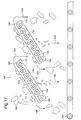
- FIG. 16 is an alternative embodiment of the invention.
- the primary discs 172 and secondary discs 176 are separate pieces formed from either rubber or from a metal material.
- the primary discs 172 are mounted laterally across the shaft 182 between secondary discs 176 and separated by spacers 30.
- the primary discs 172 are mounted laterally across shaft 184 in alignment with primary discs on shaft 182.
- the secondary discs on shaft 184 are aligned with primary discs 172 on shaft 182.
- the different sizes and alignment of the discs on the adjacent shafts 182 and 184 create a stair-step shaped spacing between the discs on the two adjacent shafts.
- Different spacing between the primary discs 172 and secondary discs 176, as well as the size and shapes of the primary and secondary discs can be varied according to the types of materials being separated. For example, for separation of larger sized materials, the configuration in FIG. 15 is used. For separation of smaller sized material, the configuration in FIG. 16 is used.
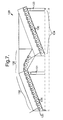
- FIG. 17 shows a two stage screen 182 that uses the compound disk 170 shown in FIGS. 14a-14c.
- a first frame section 184 is angled at an upward incline from a bottom end 186 to a top end 188.
- a second frame section 190 is angled at an upward incline adjacent to the first frame section 184 and includes a bottom end 192 and a top end 194.
- Multiple shafts 16 are attached on both the first frame section 184 and the second frame section 190.
- Multiple primary discs 172 and associated smaller secondary discs 178 are aligned in rows on each one of the shafts 16 as previously shown in either FIG. 15 or FIG. 16.
- Each one of the primary discs 172 on the shafts 16 are aligned longitudinally on screen 182 with a secondary disc 178 on adjacent shafts 16.
- Materials 195 are categorized as either oversized (large) items or sized (small) items.
- the unsorted materials 195 are dropped onto the bottom end of screen section 184. Due to gravity, some of the oversized materials drop or roll off the bottom end of screen section 184 onto a conveyer or bin 208, as shown by arrow 196.
- certain large round items, such as jugs and cartons are more likely to roll off the bottom end 186 of screen section 184 than smaller flat materials.
- the rubber compound discs 170 grip the smaller sized materials preventing them from sliding off the bottom end of screen section 184. While in rotation, the rubber compound discs 170 help transport the smaller size materials up the screen while inducing additional oversized materials to roll back off the bottom end 186 of screen section 184.
- the remaining materials 195 are agitated up and down by the arched shape discs while being transported up the angled screen section 184.
- the vibration in conjunction with the spacing between the discs (FIGS. 15 and 16) shifts the smaller sized materials through the screen, as shown by arrow 198, onto a conveyer or bin.
- the stair-step spacing created by the large primary discs 172 and small secondary discs 176, prevent oversize materials from falling through the screen section 184.
- the materials 195 reaching the top end 188 of screen section 184 are dropped onto the bottom end 192 of the second screen section 190, as represented by arrow 200. Some of the oversized materials roll off the bottom end 192 of screen section 190 into the collection conveyer 208 as represented by arrow 202. The remaining material 195 is vibrated up and down by the compound discs 170 while being transported up screen section 190. Remaining smaller sized materials are sifted through the screen section 190 as represented by arrow 204. The remaining oversized material is transported over the top end 194 of screen section 190 and dropped into an oversized material bin or conveyer 208.
- the rubber compound discs 170 in one embodiment allows only paper material to be conveyed up the surface of the screen 182 at a specific angle of incline.
- the angle of the screen is set between 25° and 45° from horizontal to achieve the proper separation of newspaper from containers.
- the system described above allows less than 1 % of containers or glass fragments to remain commingled with paper products, such as newspaper, after reaching the top end 194 of screen section 190.
- the rubber compound discs in combination with the dual-stage screen assembly provide more effective material separation than current disc screen systems and single stage material separation systems.
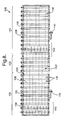
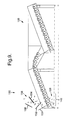
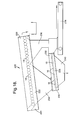
- FIGS. 18 and 19 show a two stage screen 220 utilizing the primary and secondary disc arrangement shown in FIG. 16.
- a first frame section 222 is angled at an upward incline from a bottom end 224 to a top end 226.
- a second frame section 228 is angled at an upward incline and positioned beneath the first frame section 222.
- Second frame section 228 includes a bottom end 230 and a top end 232.
- Multiple shafts 16 are attached on both the first frame section 222 and the second frame section 228.
- Multiple primary discs 172 and secondary discs 176 are alternately mounted on each of multiple shafts 16 as shown in FIG. 19.
- Multiple primary discs 172 and secondary discs 176 are aligned in rows on each one of the shafts 16.
- Each one of the primary discs 172 is aligned longitudinally on first screen 222 with a secondary disc 176 on an adjacent shaft 16. Likewise, each one of the primary discs 172 are aligned longitudinally on second screen section 228 with a secondary disc 176 on an adjacent shaft 16.
- the two stage screen 220 shown in FIG. 18 operates particularly well for separating wood or pulp products when used in conjunction with discs 18b shown in FIG. 5.
- the average size of the wood or pulp chips found in a lot determines the lot's commercial value.
- the size variation of the chips also affect the lot's commercial value.
- accuracy and repeatability in sizing chips is very important.
- the first inclined screen section 222 receives the wood or pulp material to be separated at bottom end 224.
- the upward movement of screen section 222 and the vibration of the screen bed as shafts 16 are rotated at an appropriate speed promotes the separation of oversized wood chips from proper sized and very small chips.
- the proper and very small wood chips pass through about the first two thirds of first screen section 222 and are delivered to bottom end 230 of second screen section 228 through chute 234.
- first screen section 222 By the time the material moves up to about the upper third of second screen section 222, the very small wood chips have been separated from the oversized and proper sized chips through the vibration action of shafts 16 in combination with the upward movement of first 'screen section 222 and delivered to second screen section 228.
- the material sifted through the upper third or so of first screen section 222 comprises primarily oversized chips and proper sized ships.
- the upper third or so of first screen section 222 further separates the proper sized chips only from oversized chips, passes the proper sized chips through the first screen section 222, and delivers the proper sized chips to chute 236 which, in turn, delivers the proper sized chips directly to conveyor belt 238 for further processing.
- the second screen section 228 receives the separated chips from first screen section 222 through chute 234 as shown in FIG. 18. Second screen section 228 separates the proper sized chips from the very small chips. The very small chips are delivered to a container (now shown) through chute 240. The proper sized chips are delivered to conveyor belt 238.
- the speed at which the shafts 16 are rotated varies depending on a variety of factors including environmental conditions, the type and quality of the infeed chip material, and type and quality of the desired outfeed chip material. If shafts 16 are rotated at a faster speed, more rejects or unders are produced. Conversely, if the shafts 16 are rotated at a slower speed, less rejects or unders are produced.
- the primary discs 172 and secondary discs 176 are of substantially equal width. Also, each of primary discs 172 have a larger outer diameter than each of secondary discs 176. The relative diameter and width of primary discs 172 and secondary discs 176 and length and width of spacers 30 vary depending on the size of the material sifted through the screen.
- an IFO spacing 250 is created by varying the outside diameter and width of spacers 30.
- the area of secondary slots 252 are varied by varying the outside diameter and thickness of both the primary discs 172 and secondary discs 176.
- the IFO's 250 are made smaller by increasing the diameter and reducing the width of spacers 30.
- the IFO's are reduced by reducing the diameter of the primary and secondary discs and then moving the shafts 16 closer together.
- the two stage screen 220 in one embodiment uses five sided discs 18b referenced in FIGS. 5 and 16.
- the five sided discs have several advantages when used in combination with the primary and secondary disc configuration shown in FIG. 19.
- First, using five sided disc 18b is very beneficial for separating fragile wood or pulp chips from oversized and very, small chips without damaging the proper sized wood chips. Higher amplitudes of the sifting action are more likely to damage delicate or fragile materials like wood or pulp chips. As the number of sides increases, from 3 to 5, for example, the amplitude of rotation decreases.
- five sided discs 18b tend to minimize damage to wood or pulp chips as they pass through first screen section 222 and second screen section 228.
- a continuous secondary slot D SP is eliminated by aligning a primary disc 172 mounted on shaft 182 with a secondary disc 176 mounted on an adjacent shaft 184. Eliminating the continuous secondary slot D SP results in fewer screen jams since an oversized wood chip cannot wedge itself between discs. Most importantly, by using alternately mounted primary discs 172 with secondary discs 176 the percentage of IFO area in a given screen increases dramatically over compound discs 170 shown in FIG. 15. This is because compound disc 170 comprises a secondary disc 176 extending outwardly from a face of primary disc 172, the secondary disc 176 being wider than the associated primary disc 172.
- secondary disc 176 is wider than primary disc 172 in compound disc 170, the amount of open space available from an IFO is reduced for a given length of shaft.
- the number of IFOs equals 6.
- the number of IFOs increases to between 8 and 9.
- a smaller screen can process the same tonnage of wood or pulp material using the screen arrangement shown in FIGS. 18 and 19 consequently decreasing processing costs.
- the primary and secondary discs 172 and 176 used to form compound disc 170 are of the same width, the number of IFOs would still be less than the compound disc arrangement of FIG. 19.
Landscapes
- Combined Means For Separation Of Solids (AREA)
- Separation, Recovery Or Treatment Of Waste Materials Containing Plastics (AREA)
- Processing And Handling Of Plastics And Other Materials For Molding In General (AREA)
Applications Claiming Priority (2)
| Application Number | Priority Date | Filing Date | Title |
|---|---|---|---|
| US769506 | 1996-12-18 | ||
| US08/769,506 US5960964A (en) | 1996-05-24 | 1996-12-18 | Method and apparatus for sorting recycled material |
Publications (3)
| Publication Number | Publication Date |
|---|---|
| EP0849006A2 true EP0849006A2 (de) | 1998-06-24 |
| EP0849006A3 EP0849006A3 (de) | 1999-11-17 |
| EP0849006B1 EP0849006B1 (de) | 2003-04-23 |
Family
ID=25085652
Family Applications (1)
| Application Number | Title | Priority Date | Filing Date |
|---|---|---|---|
| EP97310105A Expired - Lifetime EP0849006B1 (de) | 1996-12-18 | 1997-12-15 | Verfahren und Vorrichtung zum Sortieren von wiederverwertbaren Materialien |
Country Status (7)
| Country | Link |
|---|---|
| US (3) | US5960964A (de) |
| EP (1) | EP0849006B1 (de) |
| CA (1) | CA2224918C (de) |
| DE (1) | DE69721199T2 (de) |
| ES (1) | ES2196268T3 (de) |
| NO (1) | NO975933L (de) |
| PL (1) | PL187323B1 (de) |
Cited By (3)
| Publication number | Priority date | Publication date | Assignee | Title |
|---|---|---|---|---|
| WO2000045966A1 (en) * | 1999-02-08 | 2000-08-10 | Cp Manufacturing, Inc. | Disc screen apparatus with removable discs |
| WO2001021512A3 (de) * | 1999-09-20 | 2001-10-11 | Hubertus Exner | Sortieranordnung für partikel unterschiedlicher grössenausdehnung |
| US6702104B2 (en) | 2000-04-18 | 2004-03-09 | Machinefabriek Bollegraaf Appingedam B.V. | Conveyor for conveying bulk material |
Families Citing this family (57)
| Publication number | Priority date | Publication date | Assignee | Title |
|---|---|---|---|---|
| US5960964A (en) * | 1996-05-24 | 1999-10-05 | Bulk Handling, Inc. | Method and apparatus for sorting recycled material |
| US6374998B1 (en) | 1999-04-29 | 2002-04-23 | Advanced Sorting Technologies Llc | “Acceleration conveyor” |
| US6369882B1 (en) | 1999-04-29 | 2002-04-09 | Advanced Sorting Technologies Llc | System and method for sensing white paper |
| US7019822B1 (en) * | 1999-04-29 | 2006-03-28 | Mss, Inc. | Multi-grade object sorting system and method |
| ITUD20010022A1 (it) * | 2001-02-09 | 2002-08-09 | Pal Srl | Apparecchiatura e metodo per la separazione di elementi o materiali eventi differenti dimensioni |
| DE60219355T2 (de) * | 2001-10-02 | 2007-12-13 | Emerging Acquisitions, LLC, O'Fallon | Sieb |
| US8857621B2 (en) * | 2001-10-02 | 2014-10-14 | Emerging Acquisitions, Llc | De-inking screen with air knife |
| DE10230606B4 (de) * | 2002-07-08 | 2016-09-08 | Dieffenbacher GmbH Maschinen- und Anlagenbau | Vorrichtung zur Längsorientierung von länglichen Holzspänen |
| DE20309857U1 (de) * | 2003-06-25 | 2004-11-04 | Doppstadt Calbe Gmbh | Trommelsiebmaschine |
| DE10338645B4 (de) * | 2003-08-22 | 2007-04-12 | Jan Kuclo | Scheibensieb oder-separator |
| ITMI20041008A1 (it) * | 2004-05-20 | 2004-08-20 | Globus Srl | Macchina per la classificazione vagliatura e separazione di masse disomogenee di materiali |
| CA2476194C (en) * | 2004-07-30 | 2010-06-22 | Suncor Energy Inc. | Sizing roller screen ore processing apparatus |
| US7261209B2 (en) * | 2004-12-31 | 2007-08-28 | Bulk Handling Systems, Inc. | Multi-disc module and method of application |
| US20060226054A1 (en) * | 2005-03-31 | 2006-10-12 | Bishop Harry R Jr | Disc screen assembly |
| US8393561B2 (en) * | 2005-11-09 | 2013-03-12 | Suncor Energy Inc. | Method and apparatus for creating a slurry |
| EP2001609A4 (de) * | 2006-04-04 | 2011-12-07 | 6511660 Canada Inc | System und verfahren zum identifizieren und sortieren von material |
| CA2642699C (en) * | 2006-04-04 | 2014-01-07 | 6358357 Canada Inc. | Apparatus and method for sorting material |
| US7584856B2 (en) * | 2006-11-03 | 2009-09-08 | Emerging Acquisitions, Llc | Air separation of recyclable material |
| US7942273B2 (en) * | 2008-10-07 | 2011-05-17 | Emerging Acquisitions, Llc | Cross flow air separation system |
| US8307987B2 (en) * | 2006-11-03 | 2012-11-13 | Emerging Acquisitions, Llc | Electrostatic material separator |
| US7661537B1 (en) * | 2006-11-14 | 2010-02-16 | Sewell Rodney H | Multi-finger clamshell disc |
| US7445122B2 (en) * | 2006-11-22 | 2008-11-04 | Albert Ben Currey | Mechanical bucket |
| US8360249B1 (en) * | 2006-11-22 | 2013-01-29 | Albert Ben Currey | Crusher and mechanical bucket for use therewith |
| US7549544B1 (en) | 2006-11-22 | 2009-06-23 | Albert Ben Currey | Agitator and mechanical bucket for use therewith |
| US8117278B2 (en) * | 2007-02-05 | 2012-02-14 | Oracle International Corporation | Orchestration of components to realize a content or service delivery suite |
| US7578396B1 (en) * | 2007-10-16 | 2009-08-25 | Hustler Conveyor Company | Disc screen apparatus |
| US8618432B2 (en) * | 2007-12-18 | 2013-12-31 | Emerging Acquisitions, Llc | Separation system for recyclable material |
| CA2640514A1 (en) | 2008-09-18 | 2010-03-18 | Kyle Alan Bruggencate | Method and apparatus for processing an ore feed |
| DE102008048947A1 (de) * | 2008-09-28 | 2010-04-01 | Dieffenbacher Gmbh + Co. Kg | Vorrichtung und Verfahren zum Aussortieren von Fremdkörpern, insbesondere Leimklumpen, und eine Anlage zur Herstellung von Holzwerkstoffplatten mit einer solchen Vorrichtung |
| EP2362814B1 (de) * | 2008-10-30 | 2013-05-08 | Globus S.R.L. | Sichter auf nockenbasis für die behandlung von heterogenen materialmassen |
| CA2700962C (en) * | 2009-04-20 | 2013-12-17 | Jjg Ip Holdings, Llc | Method and apparatus for classification of recycled material |
| US8336714B2 (en) | 2009-05-14 | 2012-12-25 | Emerging Acquistions, LLC | Heating system for material processing screen |
| US20110068051A1 (en) * | 2009-05-22 | 2011-03-24 | 6358357 Canada Inc. | Ballistic separator |
| US8424684B2 (en) * | 2009-11-11 | 2013-04-23 | Emerging Acquisitions, LLC. | Multi-diameter disc assembly for material processing screen |
| ITTO20100696A1 (it) * | 2010-08-13 | 2012-02-14 | Monchiero & C S N C | Macchina agricola perfezionata di raccolta, particolarmente per frutta secca |
| WO2013003857A2 (en) | 2011-06-30 | 2013-01-03 | Mark Gerlinger Lyman | Biomass bale processing system with automatic binding remover |
| US20130168297A1 (en) * | 2011-09-14 | 2013-07-04 | Mark G. Lyman | Screening system for biomass processing system |
| US8991616B2 (en) | 2012-11-21 | 2015-03-31 | Emerging Acquisitions, Llc | Material sorting discs with variable interfacial opening |
| ES2648171T3 (es) * | 2013-01-23 | 2017-12-28 | Bollegraaf Patents And Brands B.V. | Criba de clasificación para clasificar material y cuerpo de rotor para una criba de clasificación como tal |
| US20140263770A1 (en) * | 2013-03-14 | 2014-09-18 | Summit Equipment, Inc. | Apparatus and Method for Separating Paper from Mixed Recyclable Materials |
| CN104624507B (zh) * | 2013-11-08 | 2016-06-08 | 烟台大丰轴瓦有限责任公司 | 一种轴瓦分拣装置 |
| ES2629391T3 (es) * | 2015-02-19 | 2017-08-09 | C.M.A. S.N.C. Di Minnicucci Tommaso Giuseppe & C. | Mesa de selección para separar los frutos de cuerpos extraños |
| US20160318071A1 (en) * | 2015-04-28 | 2016-11-03 | Cp Manufacturing, Inc. | Helical Disc For Use In A Disc Screen |
| US10307793B2 (en) | 2016-04-22 | 2019-06-04 | Emerging Acquisitions, Llc | Reusable material handling disc for recovery and separation of recyclable materials |
| US10111385B2 (en) | 2016-06-24 | 2018-10-30 | Jackrabbit | Nut harvester with separating disks |
| US10137573B2 (en) | 2016-08-10 | 2018-11-27 | Cp Manufacturing, Inc. | Cleaning robot for recycling equipment |
| RU172040U1 (ru) * | 2016-10-04 | 2017-06-27 | Научно-производственная корпорация "Механобр-техника" (Акционерное общество) | Сепаратор для твердых коммунальных отходов |
| RU181437U1 (ru) * | 2017-08-07 | 2018-07-13 | Научно-производственная корпорация "Механобр-техника" (Акционерное общество) | Сепаратор для твердых коммунальных отходов |
| US10758940B1 (en) | 2018-03-01 | 2020-09-01 | Christopher J. Young | Mobile sieving apparatus and method for harvesting cannabis pollen and trichomes |
| EP3768441A1 (de) | 2018-03-23 | 2021-01-27 | LANXESS Solutions US Inc. | Sortierscheibe und verfahren zur verbesserung ihrer haltbarkeit |
| RU2686345C1 (ru) * | 2018-04-23 | 2019-04-25 | ООО "Экомашгрупп" | Дисковый модуль вала сепаратора (варианты) |
| RU2687666C1 (ru) * | 2018-06-06 | 2019-05-15 | Закрытое акционерное общество "Дробмаш" | Валковый грохот |
| RU186832U1 (ru) * | 2018-06-19 | 2019-02-05 | Федеральное государственное бюджетное образовательное учреждение высшего образования "Тверской государственный технический университет" | Ротационный сепаратор |
| US10406560B1 (en) * | 2018-10-01 | 2019-09-10 | Cp Manufacturing, Inc. | Disc for use in disc screen |
| US11432463B2 (en) | 2019-02-08 | 2022-09-06 | Jackrabbit, Inc. | Nut harvester with a removable assembly and a method of replacing a removable assembly of a nut harvester |
| FI130767B1 (fi) | 2019-06-20 | 2024-03-06 | Tana Oy | Valukappale ja akselikokoonpano seulapöytää varten |
| CA3271501A1 (en) * | 2024-04-23 | 2025-11-29 | Industries Machinex Inc. | Screw system for mechanical separation of matter |
Family Cites Families (50)
| Publication number | Priority date | Publication date | Assignee | Title |
|---|---|---|---|---|
| DE592126C (de) * | 1934-02-01 | Maschb Act Ges | Scheibenrost fuer Feinabsiebung | |
| DE618154C (de) * | 1935-09-03 | Buckau R Wolf Akt Ges Maschf | Walzenrost | |
| US530262A (en) * | 1894-12-04 | distl | ||
| US800690A (en) * | 1900-11-19 | 1905-10-03 | American Cereal Company | Grain-separating machine. |
| US785508A (en) * | 1904-11-07 | 1905-03-21 | Samuel Jasper Mason | Grain-separating device. |
| US1941147A (en) * | 1931-06-19 | 1933-12-26 | Krupp Ag Grusonwerk | Classifying apparatus |
| DE609919C (de) * | 1932-01-01 | 1935-02-28 | Fried Krupp Grusonwerk Akt Ges | Scheibenwalzenklassierrost |
| DE607459C (de) * | 1932-01-03 | 1934-12-28 | Westfalia Dinnendahl Groeppel | Rollenrost |
| DE658699C (de) * | 1932-04-12 | 1938-04-09 | Buckau R Wolf Akt Ges Maschf | Scheibenwalzenrost zum Feinabsieben von Schuettgut |
| DE600232C (de) * | 1932-07-01 | 1934-07-20 | Buckau R Wolf Akt Ges Maschf | Scheibenwalzenrost zum Absieben von Schuettgut |
| DE640551C (de) * | 1932-10-19 | 1937-01-07 | Buckau R Wolf Akt Ges Maschf | Scheibenwalzenrost |
| DE657918C (de) * | 1935-03-10 | 1938-03-17 | Maschb Akt Ges | Scheibenwalzenrost zum Grobklassieren |
| US2124856A (en) * | 1935-03-18 | 1938-07-26 | Krupp Ag Grusonwerk | Disk roller classifying grate for coal |
| US2350332A (en) * | 1941-07-26 | 1944-06-06 | Sr Ellis Albaugh | Device for separating worms and larvae from nut meats |
| US2370539A (en) * | 1943-06-21 | 1945-02-27 | Hodecker Fred | Grader or sizer |
| US2417921A (en) * | 1944-02-04 | 1947-03-25 | Fmc Corp | Flexibly suspended ball means for advancing articles over transverse assorting rollers |
| US2588309A (en) * | 1950-07-29 | 1952-03-04 | Abner J Troyer | Sizing roll construction for potato graders |
| US2743813A (en) * | 1951-04-25 | 1956-05-01 | Lester E Erickson | Materials separating means |
| DE1031220B (de) * | 1957-01-08 | 1958-05-29 | Overhoff & Altmayer App Und Ma | Vorrichtung zum Austragen von Holzspaenen u. dgl. aus einem Bunker |
| FR1176640A (fr) * | 1957-06-11 | 1959-04-14 | Elfa App Vertriebs Gmbh | Grille à rouleaux destinée au nettoyage de produits agricoles, de préférence de betteraves sucrières, pour les débarrasser de la terre et d'autres souillures |
| US3367494A (en) * | 1965-07-22 | 1968-02-06 | Soren E. Peterson | Small potato eliminator structure |
| US3870627A (en) * | 1972-11-27 | 1975-03-11 | John W Herkes | Mechanical screening device for machine-harvested sugar cane |
| US4452694A (en) * | 1977-03-16 | 1984-06-05 | Black Clawson, Inc. | Apparatus for selective sorting of material chips |
| US4301930A (en) * | 1979-09-24 | 1981-11-24 | Radar Companies, Inc. | Disk screen, modular disk assembly and method |
| US4538734A (en) * | 1983-07-14 | 1985-09-03 | Beloit Corporation | Disk screen apparatus, disk assemblies and method |
| US4760925A (en) * | 1984-03-01 | 1988-08-02 | Maschinenfabrik Bezner Gmbh & Co. Kg | Refuse sorting apparatus |
| US4653648A (en) * | 1985-04-17 | 1987-03-31 | Beloit Corporation | Disk screen or like shaft assemblies and method of making the same |
| SU1406093A1 (ru) * | 1986-08-06 | 1988-06-30 | Научно-Исследовательский Институт Картофельного Хозяйства Агропрома Рсфср | Загрузочное устройство |
| SU1428237A2 (ru) * | 1987-03-02 | 1988-10-07 | Калининский политехнический институт | Ротационный сепаратор |
| US4795036A (en) * | 1987-06-15 | 1989-01-03 | Williams Patent Crusher And Pulverizer Company | Rotary disc screen conveyor apparatus |
| US4871073A (en) * | 1987-10-02 | 1989-10-03 | National Ecology, Inc. | Disc screen separator device |
| US5051172A (en) * | 1988-01-05 | 1991-09-24 | Gilmore Larry J | Disc screen for material separation |
| US4836388A (en) * | 1988-04-27 | 1989-06-06 | Beloit Corporation | Apparatus for separating material by length |
| US4901864A (en) * | 1988-08-16 | 1990-02-20 | International Paper Company | Grooved spacer for disc screen wood chip sorter |
| US5024335A (en) * | 1988-11-30 | 1991-06-18 | Lundell Vernon J | Automatic sorter |
| US5060806A (en) * | 1989-02-06 | 1991-10-29 | Cal Recovery Systems, Incorporated | Variable-aperture screen |
| DE3926451C1 (en) * | 1989-08-10 | 1991-03-21 | Aulmann & Beckschulte Maschinenfabrik Gmbh & Co Kg, 5275 Bergneustadt, De | Roll grizzly for sizing minerals - has sizing openings kept clear during screening using lifters to eject lumps jamming in holes |
| US5163564A (en) * | 1991-03-18 | 1992-11-17 | Beloit Technologies, Inc. | Disc screen with controlled interfacial openings |
| FI90019C (fi) * | 1991-12-10 | 1993-12-27 | Sunds Defibrator Rauma Woodhan | Saollningsfoerfarande och -anordning |
| US5361909A (en) * | 1993-03-31 | 1994-11-08 | Gemmer Bradley K | Waste aggregate mass density separator |
| US5480034A (en) * | 1993-06-22 | 1996-01-02 | Kabushiki Kaisha Miike Tekkosho | Screening machine |
| DE9309872U1 (de) * | 1993-07-02 | 1993-08-26 | Hülsmann, Werner, 49082 Osnabrück | Vorrichtung zum Sieben von Abfällen |
| US5450966A (en) * | 1993-08-26 | 1995-09-19 | Bulk Handling Systems, Inc. | Multi-stage disc screen for classifying material by size |
| US5484247A (en) * | 1994-05-16 | 1996-01-16 | Bulk Handling Systems, Inc. | Bag breaker |
| US5799801A (en) * | 1994-06-22 | 1998-09-01 | Bulk Handling System, Inc. | Method and apparatus for separating paper from cardboard |
| US5558234A (en) * | 1994-07-22 | 1996-09-24 | Mobley; John E. | Product size grading system |
| US5485925A (en) * | 1994-09-21 | 1996-01-23 | Bulk Handling Systems, Inc. | System and method for separating recycled debris |
| US5647473A (en) * | 1995-02-10 | 1997-07-15 | Bulk Handling Systems, Inc. | Method and apparatus for aligning and spacing articles on a conveyor belt |
| US5960964A (en) * | 1996-05-24 | 1999-10-05 | Bulk Handling, Inc. | Method and apparatus for sorting recycled material |
| GB9706737D0 (en) * | 1997-04-03 | 1997-05-21 | Trp Scotland Limited | Agricultural separating device and agricultural separator |
-
1996
- 1996-12-18 US US08/769,506 patent/US5960964A/en not_active Expired - Lifetime
-
1997
- 1997-12-15 CA CA002224918A patent/CA2224918C/en not_active Expired - Lifetime
- 1997-12-15 EP EP97310105A patent/EP0849006B1/de not_active Expired - Lifetime
- 1997-12-15 DE DE69721199T patent/DE69721199T2/de not_active Expired - Lifetime
- 1997-12-15 ES ES97310105T patent/ES2196268T3/es not_active Expired - Lifetime
- 1997-12-17 NO NO975933A patent/NO975933L/no unknown
- 1997-12-18 PL PL97323851A patent/PL187323B1/pl unknown
-
1999
- 1999-05-03 US US09/304,618 patent/US6149018A/en not_active Expired - Lifetime
-
2000
- 2000-07-20 US US09/620,017 patent/US6371305B1/en not_active Expired - Lifetime
Cited By (4)
| Publication number | Priority date | Publication date | Assignee | Title |
|---|---|---|---|---|
| WO2000045966A1 (en) * | 1999-02-08 | 2000-08-10 | Cp Manufacturing, Inc. | Disc screen apparatus with removable discs |
| US6250478B1 (en) | 1999-02-08 | 2001-06-26 | C P Manufacturing Inc. | Stepped disc screens of unequal inclination angles for conveying and grading recycling materials |
| WO2001021512A3 (de) * | 1999-09-20 | 2001-10-11 | Hubertus Exner | Sortieranordnung für partikel unterschiedlicher grössenausdehnung |
| US6702104B2 (en) | 2000-04-18 | 2004-03-09 | Machinefabriek Bollegraaf Appingedam B.V. | Conveyor for conveying bulk material |
Also Published As
| Publication number | Publication date |
|---|---|
| NO975933L (no) | 1998-06-19 |
| DE69721199D1 (de) | 2003-05-28 |
| US5960964A (en) | 1999-10-05 |
| NO975933D0 (no) | 1997-12-17 |
| ES2196268T3 (es) | 2003-12-16 |
| PL187323B1 (pl) | 2004-06-30 |
| US6149018A (en) | 2000-11-21 |
| DE69721199T2 (de) | 2003-10-23 |
| PL323851A1 (en) | 1998-06-22 |
| CA2224918C (en) | 2001-08-07 |
| CA2224918A1 (en) | 1998-06-18 |
| EP0849006B1 (de) | 2003-04-23 |
| US6371305B1 (en) | 2002-04-16 |
| EP0849006A3 (de) | 1999-11-17 |
Similar Documents
| Publication | Publication Date | Title |
|---|---|---|
| CA2224918C (en) | Dual diameter disc debris roll screen | |
| US5799801A (en) | Method and apparatus for separating paper from cardboard | |
| US6460706B1 (en) | Disc screen apparatus with air manifold | |
| US5450966A (en) | Multi-stage disc screen for classifying material by size | |
| US5626239A (en) | Separating machine | |
| US7810646B2 (en) | Air separation of recyclable material | |
| JP5748951B2 (ja) | 揺動選別機 | |
| EP0028639B1 (de) | Verfahren zum trennen von material ungleicher art | |
| US9283594B2 (en) | Material sorting discs with variable interfacial opening | |
| US6758342B1 (en) | Cereal grain sorting system and roll sorting machine | |
| US7004332B2 (en) | Articulating disc screen apparatus for recyclable materials | |
| KR20020048412A (ko) | 상이한 크기의 조각을 위한 분류장치 | |
| AU610920B2 (en) | Split flow "v" screen | |
| US5377848A (en) | Roller screen for screening bulk material, especially wood chips | |
| JP2580488B2 (ja) | 選別機 | |
| JP3508279B2 (ja) | 円筒状物と非円筒状物との選別装置 | |
| AU8421398A (en) | Sorting apparatus | |
| JP4004887B2 (ja) | 形状の異なる主ディスクおよび補助ディスクを有する複径ディスク | |
| JPH089025B2 (ja) | 廃棄物分別装置 | |
| GB2055308A (en) | Material grading apparatus | |
| JPH08276157A (ja) | 円筒状物と非円筒状物との選別装置 | |
| CA1178248A (en) | A-circular interdigitating dynamic disk-type screen with forward flow enhancement | |
| JPH08290121A (ja) | 円筒状物と非円筒状物との選別装置 | |
| JPH07124522A (ja) | ガラスびんのサイズ別自動選別装置 | |
| JPH08323291A (ja) | ガラスビン分級装置 |
Legal Events
| Date | Code | Title | Description |
|---|---|---|---|
| PUAI | Public reference made under article 153(3) epc to a published international application that has entered the european phase |
Free format text: ORIGINAL CODE: 0009012 |
|
| AK | Designated contracting states |
Kind code of ref document: A2 Designated state(s): BE DE ES FI FR GB NL SE |
|
| AX | Request for extension of the european patent |
Free format text: AL;LT;LV;MK;RO;SI |
|
| PUAL | Search report despatched |
Free format text: ORIGINAL CODE: 0009013 |
|
| AK | Designated contracting states |
Kind code of ref document: A3 Designated state(s): AT BE CH DE DK ES FI FR GB GR IE IT LI LU MC NL PT SE |
|
| AX | Request for extension of the european patent |
Free format text: AL;LT;LV;MK;RO;SI |
|
| 17P | Request for examination filed |
Effective date: 20000407 |
|
| AKX | Designation fees paid |
Free format text: BE DE ES FI FR GB NL SE |
|
| 17Q | First examination report despatched |
Effective date: 20010615 |
|
| GRAG | Despatch of communication of intention to grant |
Free format text: ORIGINAL CODE: EPIDOS AGRA |
|
| GRAG | Despatch of communication of intention to grant |
Free format text: ORIGINAL CODE: EPIDOS AGRA |
|
| GRAH | Despatch of communication of intention to grant a patent |
Free format text: ORIGINAL CODE: EPIDOS IGRA |
|
| GRAH | Despatch of communication of intention to grant a patent |
Free format text: ORIGINAL CODE: EPIDOS IGRA |
|
| GRAA | (expected) grant |
Free format text: ORIGINAL CODE: 0009210 |
|
| AK | Designated contracting states |
Designated state(s): BE DE ES FI FR GB NL SE |
|
| REG | Reference to a national code |
Ref country code: GB Ref legal event code: FG4D |
|
| REG | Reference to a national code |
Ref country code: SE Ref legal event code: TRGR |
|
| REF | Corresponds to: |
Ref document number: 69721199 Country of ref document: DE Date of ref document: 20030528 Kind code of ref document: P |
|
| REG | Reference to a national code |
Ref country code: ES Ref legal event code: FG2A Ref document number: 2196268 Country of ref document: ES Kind code of ref document: T3 |
|
| ET | Fr: translation filed | ||
| PLBE | No opposition filed within time limit |
Free format text: ORIGINAL CODE: 0009261 |
|
| STAA | Information on the status of an ep patent application or granted ep patent |
Free format text: STATUS: NO OPPOSITION FILED WITHIN TIME LIMIT |
|
| 26N | No opposition filed |
Effective date: 20040126 |
|
| REG | Reference to a national code |
Ref country code: FR Ref legal event code: PLFP Year of fee payment: 19 |
|
| REG | Reference to a national code |
Ref country code: FR Ref legal event code: PLFP Year of fee payment: 20 |
|
| PGFP | Annual fee paid to national office [announced via postgrant information from national office to epo] |
Ref country code: GB Payment date: 20161214 Year of fee payment: 20 Ref country code: FI Payment date: 20161212 Year of fee payment: 20 Ref country code: NL Payment date: 20161212 Year of fee payment: 20 Ref country code: FR Payment date: 20161111 Year of fee payment: 20 Ref country code: DE Payment date: 20161206 Year of fee payment: 20 |
|
| PGFP | Annual fee paid to national office [announced via postgrant information from national office to epo] |
Ref country code: SE Payment date: 20161213 Year of fee payment: 20 Ref country code: ES Payment date: 20161111 Year of fee payment: 20 Ref country code: BE Payment date: 20161024 Year of fee payment: 20 |
|
| REG | Reference to a national code |
Ref country code: DE Ref legal event code: R071 Ref document number: 69721199 Country of ref document: DE |
|
| REG | Reference to a national code |
Ref country code: NL Ref legal event code: MK Effective date: 20171214 |
|
| REG | Reference to a national code |
Ref country code: GB Ref legal event code: PE20 Expiry date: 20171214 |
|
| REG | Reference to a national code |
Ref country code: SE Ref legal event code: EUG |
|
| REG | Reference to a national code |
Ref country code: BE Ref legal event code: MK Effective date: 20171215 |
|
| PG25 | Lapsed in a contracting state [announced via postgrant information from national office to epo] |
Ref country code: GB Free format text: LAPSE BECAUSE OF EXPIRATION OF PROTECTION Effective date: 20171214 |
|
| REG | Reference to a national code |
Ref country code: ES Ref legal event code: FD2A Effective date: 20180508 |
|
| PG25 | Lapsed in a contracting state [announced via postgrant information from national office to epo] |
Ref country code: ES Free format text: LAPSE BECAUSE OF EXPIRATION OF PROTECTION Effective date: 20171216 |