EP0849007A2 - Procédé et dispositif pour le prélèvement de substances - Google Patents
Procédé et dispositif pour le prélèvement de substances Download PDFInfo
- Publication number
- EP0849007A2 EP0849007A2 EP19970121927 EP97121927A EP0849007A2 EP 0849007 A2 EP0849007 A2 EP 0849007A2 EP 19970121927 EP19970121927 EP 19970121927 EP 97121927 A EP97121927 A EP 97121927A EP 0849007 A2 EP0849007 A2 EP 0849007A2
- Authority
- EP
- European Patent Office
- Prior art keywords
- buoyancy
- opening
- liquid
- removal
- solids
- Prior art date
- Legal status (The legal status is an assumption and is not a legal conclusion. Google has not performed a legal analysis and makes no representation as to the accuracy of the status listed.)
- Withdrawn
Links
- 238000000034 method Methods 0.000 title claims abstract description 10
- 239000007788 liquid Substances 0.000 claims abstract description 57
- 239000007787 solid Substances 0.000 claims abstract description 37
- 239000013049 sediment Substances 0.000 claims description 25
- 238000007667 floating Methods 0.000 claims description 16
- 239000012530 fluid Substances 0.000 claims description 4
- 238000003780 insertion Methods 0.000 claims description 4
- 230000037431 insertion Effects 0.000 claims description 4
- 238000002347 injection Methods 0.000 claims description 3
- 239000007924 injection Substances 0.000 claims description 3
- 238000005096 rolling process Methods 0.000 claims description 3
- 238000004140 cleaning Methods 0.000 description 12
- 230000003068 static effect Effects 0.000 description 5
- 239000007789 gas Substances 0.000 description 4
- 238000005086 pumping Methods 0.000 description 4
- 238000005070 sampling Methods 0.000 description 4
- 238000003801 milling Methods 0.000 description 3
- 230000002285 radioactive effect Effects 0.000 description 3
- 238000005452 bending Methods 0.000 description 2
- 238000010276 construction Methods 0.000 description 2
- 238000007689 inspection Methods 0.000 description 2
- 239000000463 material Substances 0.000 description 2
- 239000000203 mixture Substances 0.000 description 2
- 125000006850 spacer group Chemical group 0.000 description 2
- 239000000725 suspension Substances 0.000 description 2
- 230000009182 swimming Effects 0.000 description 2
- 229910000831 Steel Inorganic materials 0.000 description 1
- 238000010521 absorption reaction Methods 0.000 description 1
- 238000005202 decontamination Methods 0.000 description 1
- 230000003588 decontaminative effect Effects 0.000 description 1
- 238000010586 diagram Methods 0.000 description 1
- 238000006073 displacement reaction Methods 0.000 description 1
- 230000009189 diving Effects 0.000 description 1
- 239000006260 foam Substances 0.000 description 1
- 238000010297 mechanical methods and process Methods 0.000 description 1
- 230000005226 mechanical processes and functions Effects 0.000 description 1
- 230000003287 optical effect Effects 0.000 description 1
- 239000002245 particle Substances 0.000 description 1
- 235000011837 pasties Nutrition 0.000 description 1
- 230000002093 peripheral effect Effects 0.000 description 1
- 238000012958 reprocessing Methods 0.000 description 1
- 238000000926 separation method Methods 0.000 description 1
- 239000002689 soil Substances 0.000 description 1
- 239000008247 solid mixture Substances 0.000 description 1
- 239000007921 spray Substances 0.000 description 1
- 239000010959 steel Substances 0.000 description 1
- 239000003351 stiffener Substances 0.000 description 1
- 238000003756 stirring Methods 0.000 description 1
- 239000000126 substance Substances 0.000 description 1
- 239000002352 surface water Substances 0.000 description 1
- 231100000331 toxic Toxicity 0.000 description 1
- 230000002588 toxic effect Effects 0.000 description 1
- 238000009423 ventilation Methods 0.000 description 1
- 239000002699 waste material Substances 0.000 description 1
Images




Classifications
-
- F—MECHANICAL ENGINEERING; LIGHTING; HEATING; WEAPONS; BLASTING
- F04—POSITIVE - DISPLACEMENT MACHINES FOR LIQUIDS; PUMPS FOR LIQUIDS OR ELASTIC FLUIDS
- F04D—NON-POSITIVE-DISPLACEMENT PUMPS
- F04D13/00—Pumping installations or systems
- F04D13/02—Units comprising pumps and their driving means
- F04D13/06—Units comprising pumps and their driving means the pump being electrically driven
- F04D13/066—Floating-units
-
- B—PERFORMING OPERATIONS; TRANSPORTING
- B08—CLEANING
- B08B—CLEANING IN GENERAL; PREVENTION OF FOULING IN GENERAL
- B08B9/00—Cleaning hollow articles by methods or apparatus specially adapted thereto
- B08B9/08—Cleaning containers, e.g. tanks
-
- F—MECHANICAL ENGINEERING; LIGHTING; HEATING; WEAPONS; BLASTING
- F04—POSITIVE - DISPLACEMENT MACHINES FOR LIQUIDS; PUMPS FOR LIQUIDS OR ELASTIC FLUIDS
- F04D—NON-POSITIVE-DISPLACEMENT PUMPS
- F04D13/00—Pumping installations or systems
- F04D13/02—Units comprising pumps and their driving means
- F04D13/06—Units comprising pumps and their driving means the pump being electrically driven
- F04D13/08—Units comprising pumps and their driving means the pump being electrically driven for submerged use
- F04D13/086—Units comprising pumps and their driving means the pump being electrically driven for submerged use the pump and drive motor are both submerged
-
- F—MECHANICAL ENGINEERING; LIGHTING; HEATING; WEAPONS; BLASTING
- F04—POSITIVE - DISPLACEMENT MACHINES FOR LIQUIDS; PUMPS FOR LIQUIDS OR ELASTIC FLUIDS
- F04D—NON-POSITIVE-DISPLACEMENT PUMPS
- F04D29/00—Details, component parts, or accessories
- F04D29/60—Mounting; Assembling; Disassembling
- F04D29/605—Mounting; Assembling; Disassembling specially adapted for liquid pumps
- F04D29/606—Mounting in cavities
- F04D29/607—Mounting in cavities means for positioning from outside
-
- F—MECHANICAL ENGINEERING; LIGHTING; HEATING; WEAPONS; BLASTING
- F04—POSITIVE - DISPLACEMENT MACHINES FOR LIQUIDS; PUMPS FOR LIQUIDS OR ELASTIC FLUIDS
- F04D—NON-POSITIVE-DISPLACEMENT PUMPS
- F04D7/00—Pumps adapted for handling specific fluids, e.g. by selection of specific materials for pumps or pump parts
- F04D7/02—Pumps adapted for handling specific fluids, e.g. by selection of specific materials for pumps or pump parts of centrifugal type
- F04D7/04—Pumps adapted for handling specific fluids, e.g. by selection of specific materials for pumps or pump parts of centrifugal type the fluids being viscous or non-homogenous
- F04D7/045—Pumps adapted for handling specific fluids, e.g. by selection of specific materials for pumps or pump parts of centrifugal type the fluids being viscous or non-homogenous with means for comminuting, mixing stirring or otherwise treating
Definitions
- the invention relates to a device for removing liquid and / or Solids such as sediment deposits from a receptacle accessible via an opening, in particular tank, comprising a connected via a line led through the opening Conveying unit such as a pump, especially a submersible pump and a buoyancy device is introduced through the opening,
- DE 85 02 696 U1 is a device for cleaning the interior of tank rooms known, wherein a tank opening is provided with a flange, which as a pivot bearing part is designed to a spray head into the tank interior via a pivotable holder introduce.
- a corresponding construction is in its boom length in relation to the limited moments to be recorded.
- Containers or the like In the case of a device for cleaning radioactive contaminated areas of storage tanks, Containers or the like is proposed according to DE 32 30 520 A1 that from one Manifold dispenser nozzles dispensing cleaning liquid to a floor surface act upon.
- the manifold itself is based on a hollow mouthpiece that is in turn connected to a suction line.
- EP 0 638 371 A1 proposes that from a pivoting boom, the cleaning devices at the ends have to be cleaned over the inner walls of the container. Due to construction the maximum radius of the tank is determined by the tank height.
- a cleaning device arranged movably, from the self into the interior of the Tanks extending and pivoting arranged cleaning arms.
- DE 38 22 515 C2 proposes Pumping liquid in surge mode, which causes gushing currents which cause the containers to be cleaned.
- DE 31 51 529 C1 provides that a suction device is arranged movable along the bottom of the container.
- a container can be moved by means of a swiveling suction device be sucked empty.
- the tank has sufficient stability has in order to be able to remove cleaning equipment to the required extent.
- the interior of the tank must be accessible via a sufficiently large opening to allow the To bring cleaning facilities.
- US 5,253,812 shows a device of the type mentioned at the outset. It is a tower is arranged above an opening in a cover of a tank, from which a rope is lowered into the tank, at the end of which there is a delivery unit or a shredder for solids is located. The rope is inside the one in the tank Liquid surrounded by a tube, the circumferential side of which has buoyancy elements are inside the liquid. To the device over the bottom of the tank To be able to move, an uncontrolled forward and backward movement takes place using a propeller.
- GB 1 337 191 discloses a device for cleaning tanks and swimming pools remove.
- a pump starts from a floating body, which in turn also Suction lines are connected, which are within the tank or swimming pool liquid extend.
- the object of the present invention is an apparatus and a method of the type mentioned in the introduction so that even with small openings or Recordings like containers, the static of which is essentially due to the absorption of liquid and / or solids is designed, the contents can be emptied to the extent necessary is, and it should also be ensured that sediments that are due to the prevailing Pressure and large storage periods can be highly compressed to the extent necessary can be removed.
- the object is achieved in that the on the Liquid floating depending on the distance between the opening and one Removal location in its effective length changeable buoyancy device with a holder for the line or the conveyor unit and the buoyancy device by one in the area the opening extending axis is connected to pivotable rotating device, wherein the buoyancy device has a buoyancy necessary for carrying the unit.
- the buoyancy device preferably consists of strings that can be lined up outside the receptacle Floats and cushions, which in turn are parallel to the surface of the liquid extending axis pivotable to each other and perpendicular to the axis in the are connected to each other substantially torsionally rigid. It can from the opening to An introductory aid with several degrees of freedom, such as Slide or gutter can be provided for the buoyancy device.
- the buoyancy device consists of spaced apart Buoyancy bodies consist of rod-shaped brackets running parallel to one another such as struts or sections of such are connected, which in turn are parallel to the liquid surface torsionally rigid or essentially torsionally rigid are.
- the buoyancy device can also consist of inflatable devices that run parallel to one another There are hoses that are connected to each other via brackets.
- a buoyancy body or a section of the buoyancy device is preferably bell-shaped trained with a bottom-facing receptacle for the conveyor unit. Also there is the possibility of the conveyor unit of a preferably conical envelope for the peripheral shielding of the removal site.
- the device can be one of the buoyancy device have lowering or lifting removal device that the conveyor unit and Includes air injecting solids such as lances and / or air injectors.
- the removal device can preferably be of a conical shape towards the receiving location towards the bell-shaped shield extending, creating a easy suction of the whirled up solids can take place.
- the buoyancy device itself comprises guide elements such as rollers for the removal device or conveying or supply lines leading the conveying unit.
- the removal device itself can comprise a support structure with a base frame, which is designed to be supported on a solid surface.
- a compacted solid sediment layer with a special loosening lance by means of stored compressed air released by an air injector in pulses be loosened up.
- the air flow and the expansion energy of the relaxed air will used to break the solid particle bonds, creating gaps which, after the air bubbles have risen, fill up again with liquid.
- the sediment is affected by the air and the subsequent inflow the fluid fluidizes and is easier with a conveyor such as e.g. Submersible pump removable.
- the air injector with loosening lance can be due to its own weight on the compacted sediment layer to be put on, then to the necessary extent in a pulsed manner To apply compressed air.
- the suction unit can be used for improved suction Side nozzles are provided, whereby a conveying takes place in a certain direction. This means that additional sediment can be whirled up.
- the removal device is automatically lowered by the Sediment layer without the need for additional control devices.
- the teaching according to the invention offers in particular in the case of samples to be sampled or removed radioactive or toxic media has the advantage that the entire device, i.e. Buoyancy body, Aggregates etc. can be accommodated completely outside the recording can, so that decontamination is possible in a simple manner.
- buoyancy bodies wear after reaching a working position e.g. Flood or drain from the Submerge media causing buoyancy, so that a height adjustment device for the Removal device can be omitted.
- the diving depth can be varied by adding ballast. This is not just a placement on a solid layer of soil, but also a floating state conceivable.
- buoyancy body together with the media supply and disposal lines be firmly connected to each other so that a device can be realized that a roll up all elements. A putting together or taking apart is in this Case no longer required.
- the buoyancy bodies can have a shape or geometry such that a desired bending stiffness is given via a positive connection.
- the stiffening to achieve the bending stiffness can be mechanical, hydromechanical, pneumatic, electrical devices also via an in the axis of the buoyancy body steel cable.
- Solid bodies made of foam or hollow bodies come in as material for the buoyancy bodies Question e.g. are filled with gases, liquids or solids, but a required density difference to the medium to be removed must be given.
- the media-carrying supply and disposal lines themselves can be above, below, be guided laterally or within the buoyancy body.
- the buoyancy body can essentially made of a flexible element with chambered sections which are interconnected and may have stiffeners.
- This flexible element can be on one or several drums are wound up.
- the elements themselves can be buoyant by e.g. Draining gas or liquid can be varied. This allows the Removal or other tasks provided aggregates also under the surface sink. It is mentioned that there is a state of suspension or sinking to the ground possible. With suitable devices, a removal device can be in the lowest position e.g. Solve or pump out solids and move them using a feed unit will.
- the buoyancy body can also consist of a hose-in-hose system, the front part like a balloon can be inflated to provide the necessary buoyancy achieve.
- the hose itself is relatively rigid when turned to the side, being pressurized the rigidity of the entire structure can be influenced.
- buoyancy bodies are then attached at certain intervals.
- a suitable hose is used as a carrier for the buoyancy body.
- the buoyancy bodies themselves need not be connected to one another. Indeed can increase the rigidity of the buoyancy body by means of suitable elements be connected to each other.
- the section of the buoyancy device holding the removal device may be provided with a rolling element, such as a roller, which can be deposited on the floor, in order to to make it easy to drive along.
- the object is achieved in that the floating on the liquid depending on the distance between the opening and a sampling point in it effective length variable buoyancy device with a holder for the line or the conveyor unit and the buoyancy device around one in the area of the opening extending axis pivotable rotating device is connected, the buoyancy device has a necessary buoyancy for carrying the unit.
- the solids are preferably resuspended by air injection will.
- the air can be introduced into the solids in pulses. But there are as well as other devices such as Liquid jet possible.
- the teaching of the invention has the advantage that the device for Aspiration of the liquid and the solids to an additional static load on the Do not hold the holder like the tank itself, as it will be removed by the float itself he follows. Regardless of the size of the opening, it is ensured that each area of the Recording is available. For this, e.g. Buoyancy bodies strung together outside the intake and then inserted into the receptacle through the opening, by suitable means Measures achieved a torsional stiffness parallel to the liquid surface becomes. This ensures that the buoyancy device to the required extent can be moved along the surface to any desired location. The pivoting of the buoyancy device can via a rotating and toothed ring surrounding the opening take place so that the entire cross-sectional area of the receptacle, ie a container like Tanks can be painted over.
- buoyancy device Preferably at the foremost buoyancy body or at the front end of the buoyancy device can then desired units such as pumps, agitators or air injection devices such as lances for whirling up and suctioning off the resuspended sediments or Liquid are arranged.
- a line with a suction opening is also conceivable can be connected to a conveyor unit outside the recording.
- the removal facility itself can be surrounded by a bell-shaped envelope to resuspend To be able to deliver solids specifically to the delivery unit such as submersible pumps.
- the sediments are compacted due to storage time and / or pressure, can be cut open using mechanical tools (pressure lances or milling) and swirling up the sediment or the solids in such a way that suction is possible.
- Solids and liquids have the properties in a certain time in a liquid column like sedimenting containers, if not a constant pumping or stirring he follows.
- the sedimented solids are very compact and can only be mechanically a milling machine or e.g. Remove again in layers with high-pressure liquid jets and into the one above Suspend liquid. In some cases, this involves considerable expenditure on equipment necessary, which makes it necessary to have an appropriate container over a relatively large To make the opening accessible.
- the container walls must be made very stable to withstand the required static loads. An afterthought Extending a corresponding opening is fundamentally not possible, otherwise the Static of the container is unduly weakened. All of these disadvantages are overcome by solved the invention.
- a container 10 is shown in principle, which e.g. a diameter of 25 m and can have a height of 10 m.
- a mixture such as radioactive mixture of sedimented solids 12 and liquids 14 are located. In there are no removal or resuspension devices in the container 10 itself.
- the container 10 is accessed via an opening 16 in the form of a manhole, without enlargement possible for static reasons. So the space is limited extremely restricted.
- a buoyancy device 18 can be introduced via the opening 16, which consists of Floatable bodies 20, 22 can be assembled outside the container 10 is.
- a threading or insertion aid extending to the liquid surface 24 30 in the form of e.g. a gutter or slide.
- the opening 16 is surrounded by a slewing ring 32, one of which Holder for the buoyancy device 18 goes out, so that according to the arrow / - or 2 any arbitrary point on the surface 24 of the liquid 14 is paintable.
- the buoyancy bodies 20, 22 parallel to Surface 24 are torsionally rigid, but are articulated perpendicularly to it in order to To allow insertion through the opening 16 to the liquid surface 24.
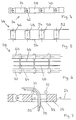
- FIGS. 4 to 6 Examples of corresponding buoyancy bodies can be found in FIGS. 4 to 6.
- the Fig. 4 shows a buoyancy device 34 which consists of air cushions 36, 38 40, which are connected to one another via joints 42.
- the predetermined by the joints 42 Axes run with the buoyancy device floating on the liquid surface 24 34 parallel to the former. This makes the required torsional rigidity the float 36, 38, 40 given to the surface 24 without mobility of the Floats 36, 38, 40 with each other to affect the axis 42.
- the floating bodies 36, 38, 40 can be rectangular bodies or pipe sections act that are filled with gas or suitable materials whose density is less than that the liquid is.
- FIG. 5 shows a buoyancy device 44 which is spaced apart from one another cuboid or tubular buoyancy bodies 46, 48, 50, 52, which are on the end face rod-shaped elements 54, 56 are connected. This results in a high section modulus against twisting so that the liquid surface 24 to the required extent can be painted over very precisely.
- a buoyancy device 58 consists of two parallel to each other and with a fluid such as gas fillable hoses 60, 62, which over Spacers and spacers 64 and rod members running parallel to the tubes 60, 62 66, 68 are connected to be torsionally or torsionally rigid or substantially torsionally or torsionally stiff about the surface 24 of the liquid 14 will.
- the filling of the hoses 60, 62 essentially only takes place when when they are placed in the container 10.
- the removal device 28 is in principle removed from the foremost float 26 drained.
- the floating body 26 an opening 76 delimited by rollers 70, 72, via the supply and suction line 78, 80 are guided to the one provided with the reference number 28 in principle Guide the removal device.
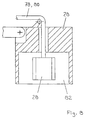
- the first floating body 26 can be one of the others Floating bodies with different geometry and e.g. a cuboid or cylindrical shape with a have bottom-side opening 82 which serves as a receptacle for the removal device 28 is trained.
- the dimensions of the buoyancy body 28 must match those of the opening 16 be adapted, i.e. the cross section must be smaller than that of the opening 16.
- the removal device 28 has, according to FIGS. 9 and 10, a support frame or frame 84 with a base frame 86 which can be placed on the sediment layer 12.
- a pump such as a submersible pump 88 and concentric these surrounding air injectors 90, 92, 94 with possibly emanating from them Air lances 98, 100, 102 are arranged around the sediment layer 12 to the required extent break up and the resuspended solids together with liquid via the submersible pump 88 suction.
- the removal device can 28 have a bell-shaped envelope 104 which surrounds the support structure 84. The diameter in the bottom area can be larger than that of the opening 16. In this case, the envelope 104 must be able to be raised along the supply line 78, 80, so that folding can take place to the extent necessary.
- Compressed air is injected into the air injectors 90, 92, 94 and air lances 98, 100, 102 Sediment layer 12 introduced in pulses to the required extent.
- the airflow and the Expansion energy of the air is used to break up the sediment layer and Creating gaps after the air bubbles come to the surface of the liquid 24 have risen, fill up with liquid again.
- the sediment 12 becomes accordingly fluidized by the action of air and the subsequent inflow of liquid, so that pumping can be carried out in a simple manner by means of the submersible pump 88. Reinforced these measures can be taken through the air lances 98, 100, 102.
- the extreme positions are the buoyancy device Take 18, shown in dashed lines.
- the extreme extension is with the Reference numeral 104 and the shortest marked with, reference numeral 106. This However, there is an asymmetrical course only if the opening 12 is not in the center located in the top of the container.
- the feeder aligned along a line 108 that the corresponds to longest extension 104.
- additional auxiliary structures are not required, depending on the position of the foremost float 26 bring more floats.
- FIG. 3 shows a section of a container 10 with a container arranged above it nuclear facility 110 comprising a shielded room 112, above which Supply and disposal facilities for the lines 78, 80 are provided.
- a Conveyor such as an endless belt 114 can float 116 after assembly fed to the container 10 via the insertion direction 30 or via this be removed.
- a lock 118 represents the connection to the outside.
- an operating and glove box 120 to be present to the extent necessary Float 116 to assemble or detach from each other.
- the room can e.g. be shielded, preferably there is a ventilation separation or at least one desired air flow
- the teaching of the invention is essentially characterized in that by means of the float floating to the liquid 14 reaches any location of the tank 10 can be used to suction liquid / solid mixture.
- an assembly of buoyancy bodies can be carried out by means of the Sliding and rotating device 32 can be pivoted over the entire cross-sectional area are.
- the floating bodies 20, 22 to be connected to one another are about an axis articulated.
- a necessary torsional stiffness is perpendicular to this given to be able to perform the desired rotary movement.
- Using a measuring device can the exact position of the float, especially the foremost Float 26, from which the removal device 28 is based, are determined.
- the Removal device 28 can also be used to hold various supply and disposal devices be trained.
- the corresponding float 26 must be the Ensure the necessary buoyancy.
- Resuspending and removal can be carried out to the required extent via the removal device 28 then pumping out the suspension.
- Other facilities such as nozzle sticks
- Surface cleaning or inspection of the inner wall of the container 10 or optical and electronic inspection systems can also be attached.
- Coagulated products can use other mechanical processes such as milling for reprocessing are used. Cavities with pasty or solid substances can also be targeted be approached. It is only necessary that there is sufficient liquid coverage the sediment layer or the necessary buoyancy is available.
- the displacement resistance of the buoyancy device 18 should also be low. Possibly liquid can be added to the container 10 to provide the required buoyancy ensure.
- FIG. 11 there is a buoyancy device that can be rolled off a drum 122 in a container 10 124, which consist of sections which can be arranged in a row, or a structure can have, as can be seen in FIGS. 12 to 14.
- the Buoyancy device 124 has a removal device 126, which at the front end 128 of the Buoyancy device 124 is arranged. This area 128 is at the bottom of the Tanks 10 or the sediment deposits 130 can be lowered, as the solid representation clarifies.
- the removal device 126 On the bottom side, the removal device 126 has a drive or rolling elements 132 in order to be able to be moved in a simple manner.
- the removal device 126 floating on the liquid surface 24 to move to the place where sampling or sampling is on the ground should be done. Starting from this location, the removal device 126 is lowered without that there are lifting devices or the like for conveying units, air lances and others Equipment is required to aspirate liquid and solids to the desired extent can.
- buoyancy device 124 removes from a preferred embodiment of a buoyancy device 124 remove.
- This consists of an inner hose 134, in which media such as supply and / or suction lines 136 run.
- the tube 134 is made up of several buoyancy bodies 138 surrounded, depending on the required buoyancy, the buoyancy body 138 spaced apart along the tube 134 can be plugged.
- the hose 134 may extend over or nearly its entire length of be surrounded by an outer tube 140, which consists of chambers connected via openings 142 144, 146 exists.
- the hose 140 not only performs the function of the Buoyancy body, but also protection for the inner tube 134 in which the Supply and other lines 136 are embedded.
- the corresponding buoyancy devices shown in FIGS. 12 to 14 can be opened 11 to be taken from the drum 122 are wound up without a separate Assembling or assembling is required.
- the teaching according to the invention also for indexing and sampling e.g. of surface waters with high risk potential for humans like waste lakes, hot springs, Currents or the like can be used. It is used for other pools and caverns also possible.
Landscapes
- Engineering & Computer Science (AREA)
- Mechanical Engineering (AREA)
- General Engineering & Computer Science (AREA)
- Cleaning In General (AREA)
Applications Claiming Priority (2)
| Application Number | Priority Date | Filing Date | Title |
|---|---|---|---|
| DE1996152358 DE19652358A1 (de) | 1996-12-17 | 1996-12-17 | Verfahren und Vorrichtung zur Entnahme von Medien |
| DE19652358 | 1996-12-17 |
Publications (1)
| Publication Number | Publication Date |
|---|---|
| EP0849007A2 true EP0849007A2 (fr) | 1998-06-24 |
Family
ID=7814911
Family Applications (1)
| Application Number | Title | Priority Date | Filing Date |
|---|---|---|---|
| EP19970121927 Withdrawn EP0849007A2 (fr) | 1996-12-17 | 1997-12-12 | Procédé et dispositif pour le prélèvement de substances |
Country Status (2)
| Country | Link |
|---|---|
| EP (1) | EP0849007A2 (fr) |
| DE (1) | DE19652358A1 (fr) |
Cited By (4)
| Publication number | Priority date | Publication date | Assignee | Title |
|---|---|---|---|---|
| DE102004013304A1 (de) * | 2004-02-27 | 2005-09-15 | Rwe Nukem Gmbh | Anordnung und Verfahren zum Entfernen von Ablagerungen aus einem Tank |
| CZ302150B6 (cs) * | 2004-02-27 | 2010-11-18 | Nukem Technologies Gmbh | Zarízení a zpusob odstranování usazenin z nádrže |
| CN118183072A (zh) * | 2022-12-12 | 2024-06-14 | 华能(天津)煤气化发电有限公司 | 一种常压储罐用的倒液装置 |
| WO2025032329A1 (fr) * | 2023-08-07 | 2025-02-13 | Harries Philip James | Appareil et procédé de nettoyage de réservoirs de stockage |
Families Citing this family (1)
| Publication number | Priority date | Publication date | Assignee | Title |
|---|---|---|---|---|
| DE10131419B4 (de) * | 2001-06-29 | 2004-12-02 | Lobbe Tankschutz Gmbh | Vorrichtung und Verfahren zum Reinigen von Tanks zur Lagerung von Rohöl |
Family Cites Families (2)
| Publication number | Priority date | Publication date | Assignee | Title |
|---|---|---|---|---|
| GB1337191A (en) * | 1971-01-21 | 1973-11-14 | Accatino S | Devices for cleaning tanks or swimming pools |
| US5253812A (en) * | 1992-10-16 | 1993-10-19 | Wesley Staples | Tank cleaning method and apparatus |
-
1996
- 1996-12-17 DE DE1996152358 patent/DE19652358A1/de not_active Withdrawn
-
1997
- 1997-12-12 EP EP19970121927 patent/EP0849007A2/fr not_active Withdrawn
Cited By (5)
| Publication number | Priority date | Publication date | Assignee | Title |
|---|---|---|---|---|
| DE102004013304A1 (de) * | 2004-02-27 | 2005-09-15 | Rwe Nukem Gmbh | Anordnung und Verfahren zum Entfernen von Ablagerungen aus einem Tank |
| CZ302150B6 (cs) * | 2004-02-27 | 2010-11-18 | Nukem Technologies Gmbh | Zarízení a zpusob odstranování usazenin z nádrže |
| DE102004013304B4 (de) * | 2004-02-27 | 2014-10-30 | Nukem Technologies Gmbh | Anordnung und Verfahren zum Entfernen von Ablagerungen aus einem Tank |
| CN118183072A (zh) * | 2022-12-12 | 2024-06-14 | 华能(天津)煤气化发电有限公司 | 一种常压储罐用的倒液装置 |
| WO2025032329A1 (fr) * | 2023-08-07 | 2025-02-13 | Harries Philip James | Appareil et procédé de nettoyage de réservoirs de stockage |
Also Published As
| Publication number | Publication date |
|---|---|
| DE19652358A1 (de) | 1998-06-18 |
Similar Documents
| Publication | Publication Date | Title |
|---|---|---|
| DE2850119A1 (de) | Verfahren und vorrichtung zum anheben eines belueftungsaggregats fuer fluessigkeiten | |
| DE3700187A1 (de) | Fluessigabfallentsorgung | |
| DE10131419B4 (de) | Vorrichtung und Verfahren zum Reinigen von Tanks zur Lagerung von Rohöl | |
| DE19627161B4 (de) | Verfahren zum Abräumen von Schwimmstoffen und Räumvorrichtung | |
| DE10237431B4 (de) | Verfahren und Reinigungsfahrzeug zur Innenreinigung eines Tanks | |
| DE19652358A1 (de) | Verfahren und Vorrichtung zur Entnahme von Medien | |
| EP0819198A1 (fr) | Ecumeuse flottante | |
| WO2009043570A1 (fr) | Support d'engin submersible et dispositif pour travailler ou examiner le fond d'un lit | |
| DE69738052T2 (de) | Verfahren zum reinigen eines ölspeichertanks und gerät zur verwirklichung des verfahrens | |
| DE69602740T2 (de) | Systeme zum entfernen von flüssigkeiten aus tanks | |
| EP1220805B1 (fr) | Systeme et procede pour prelever des produits en vrac | |
| DE4221086C2 (de) | Vorrichtung zum Beseitigen von Material unterhalb des Spiegels eines Mediums | |
| DE4103473C1 (en) | Cleaner for contaminated ground - has tubular reaction chamber with soiled feed hopper at top | |
| DE9300023U1 (de) | Reaktor zur Reingiung kontaminierter Feststoffe | |
| DE19617613A1 (de) | Reinigungsvorrichtung für einen Behälter für radioaktiven Abfall | |
| DE19948938A1 (de) | Vorrichtung zum Einfüllen von Beton aus einem Betonkübel in eine Schalung | |
| DE3147288C2 (fr) | ||
| DE102018007743B4 (de) | Vorrichtung und Verfahren zur Reduzierung der Gewässerverschmutzung durch havarierte Oel- und/oder Gasbohrungen | |
| DE202015103194U1 (de) | Reingungsvorrichtung für einen Schachteinsatz | |
| DE202018102991U1 (de) | Tiefenverstellbares Entnahmesystem zur Entnahme von Wasser aus Wasserreservoiren | |
| DE202005011349U1 (de) | In einem Tank verfahrbares Fahrzeug | |
| DE3729653A1 (de) | Verfahren zum vorsorglichen oder nachtraeglichen schutz des um eine deponie anstehenden erdreichs gegen aus der deponie austretende schadfluessigkeit | |
| DE20000037U1 (de) | Vorrichtung zum Einfüllen von Beton aus einem Betonkübel in eine Schalung | |
| EP1394117B1 (fr) | Dispositif pour la decontamination des eaux souterraines et procédé pour l'installation d'un tel dispositif | |
| DE29911860U1 (de) | Vorrichtung zum Einfüllen von Beton aus einem Betonkübel in eine Schalung |
Legal Events
| Date | Code | Title | Description |
|---|---|---|---|
| PUAI | Public reference made under article 153(3) epc to a published international application that has entered the european phase |
Free format text: ORIGINAL CODE: 0009012 |
|
| AK | Designated contracting states |
Kind code of ref document: A2 Designated state(s): AT BE CH DE DK ES FI FR GB GR IE IT LI LU MC NL PT SE |
|
| AX | Request for extension of the european patent |
Free format text: AL;LT;LV;MK;RO;SI |
|
| STAA | Information on the status of an ep patent application or granted ep patent |
Free format text: STATUS: THE APPLICATION HAS BEEN WITHDRAWN |
|
| 18W | Application withdrawn |
Withdrawal date: 19990810 |