EP0849636B1 - Composition photosensible à base de polymères contenant un polyamide photosensible et élément photosensible de type négatif - Google Patents
Composition photosensible à base de polymères contenant un polyamide photosensible et élément photosensible de type négatif Download PDFInfo
- Publication number
- EP0849636B1 EP0849636B1 EP97203847A EP97203847A EP0849636B1 EP 0849636 B1 EP0849636 B1 EP 0849636B1 EP 97203847 A EP97203847 A EP 97203847A EP 97203847 A EP97203847 A EP 97203847A EP 0849636 B1 EP0849636 B1 EP 0849636B1
- Authority
- EP
- European Patent Office
- Prior art keywords
- photosensitive
- resin
- composition
- monomer
- carbon atoms
- Prior art date
- Legal status (The legal status is an assumption and is not a legal conclusion. Google has not performed a legal analysis and makes no representation as to the accuracy of the status listed.)
- Expired - Lifetime
Links
- 239000000203 mixture Substances 0.000 title claims description 54
- 229920000642 polymer Polymers 0.000 title claims description 20
- 239000004952 Polyamide Substances 0.000 title description 3
- 229920002647 polyamide Polymers 0.000 title description 3
- 229920005989 resin Polymers 0.000 claims description 29
- 239000011347 resin Substances 0.000 claims description 29
- 125000004432 carbon atom Chemical group C* 0.000 claims description 21
- -1 perfluoro Chemical group 0.000 claims description 21
- 239000000178 monomer Substances 0.000 claims description 18
- 238000000576 coating method Methods 0.000 claims description 14
- 125000003118 aryl group Chemical group 0.000 claims description 13
- 239000011248 coating agent Substances 0.000 claims description 12
- 229920000728 polyester Polymers 0.000 claims description 12
- 229910052782 aluminium Inorganic materials 0.000 claims description 10
- XAGFODPZIPBFFR-UHFFFAOYSA-N aluminium Chemical compound [Al] XAGFODPZIPBFFR-UHFFFAOYSA-N 0.000 claims description 10
- ZYGHJZDHTFUPRJ-UHFFFAOYSA-N coumarin Chemical compound C1=CC=C2OC(=O)C=CC2=C1 ZYGHJZDHTFUPRJ-UHFFFAOYSA-N 0.000 claims description 10
- 125000001931 aliphatic group Chemical group 0.000 claims description 8
- 235000001671 coumarin Nutrition 0.000 claims description 7
- 229920001225 polyester resin Polymers 0.000 claims description 6
- 239000004645 polyester resin Substances 0.000 claims description 6
- 229930195733 hydrocarbon Natural products 0.000 claims description 5
- 150000002430 hydrocarbons Chemical class 0.000 claims description 5
- 229910052739 hydrogen Inorganic materials 0.000 claims description 5
- 239000001257 hydrogen Substances 0.000 claims description 5
- 125000004043 oxo group Chemical group O=* 0.000 claims description 5
- 239000004215 Carbon black (E152) Substances 0.000 claims description 4
- UFHFLCQGNIYNRP-UHFFFAOYSA-N Hydrogen Chemical compound [H][H] UFHFLCQGNIYNRP-UHFFFAOYSA-N 0.000 claims description 3
- 238000010521 absorption reaction Methods 0.000 claims description 3
- 125000000732 arylene group Chemical group 0.000 claims description 3
- 229960000956 coumarin Drugs 0.000 claims description 3
- 230000001681 protective effect Effects 0.000 claims description 3
- JYEUMXHLPRZUAT-UHFFFAOYSA-N 1,2,3-triazine Chemical group C1=CN=NN=C1 JYEUMXHLPRZUAT-UHFFFAOYSA-N 0.000 claims description 2
- NIXOWILDQLNWCW-UHFFFAOYSA-M Acrylate Chemical compound [O-]C(=O)C=C NIXOWILDQLNWCW-UHFFFAOYSA-M 0.000 claims 1
- 150000001875 compounds Chemical class 0.000 description 18
- 239000010410 layer Substances 0.000 description 17
- 239000002904 solvent Substances 0.000 description 11
- 239000000463 material Substances 0.000 description 10
- 239000000126 substance Substances 0.000 description 10
- YXFVVABEGXRONW-UHFFFAOYSA-N Toluene Chemical compound CC1=CC=CC=C1 YXFVVABEGXRONW-UHFFFAOYSA-N 0.000 description 9
- 150000003254 radicals Chemical class 0.000 description 8
- 239000000243 solution Substances 0.000 description 8
- 238000009472 formulation Methods 0.000 description 7
- ARXJGSRGQADJSQ-UHFFFAOYSA-N 1-methoxypropan-2-ol Chemical compound COCC(C)O ARXJGSRGQADJSQ-UHFFFAOYSA-N 0.000 description 6
- YEJRWHAVMIAJKC-UHFFFAOYSA-N 4-Butyrolactone Chemical compound O=C1CCCO1 YEJRWHAVMIAJKC-UHFFFAOYSA-N 0.000 description 6
- WYURNTSHIVDZCO-UHFFFAOYSA-N Tetrahydrofuran Chemical compound C1CCOC1 WYURNTSHIVDZCO-UHFFFAOYSA-N 0.000 description 6
- 230000005855 radiation Effects 0.000 description 6
- XLYOFNOQVPJJNP-UHFFFAOYSA-N water Substances O XLYOFNOQVPJJNP-UHFFFAOYSA-N 0.000 description 6
- 238000000034 method Methods 0.000 description 5
- 229920001721 polyimide Polymers 0.000 description 5
- ZWEHNKRNPOVVGH-UHFFFAOYSA-N 2-Butanone Chemical compound CCC(C)=O ZWEHNKRNPOVVGH-UHFFFAOYSA-N 0.000 description 4
- 239000004642 Polyimide Substances 0.000 description 4
- HVVWZTWDBSEWIH-UHFFFAOYSA-N [2-(hydroxymethyl)-3-prop-2-enoyloxy-2-(prop-2-enoyloxymethyl)propyl] prop-2-enoate Chemical compound C=CC(=O)OCC(CO)(COC(=O)C=C)COC(=O)C=C HVVWZTWDBSEWIH-UHFFFAOYSA-N 0.000 description 4
- 239000002253 acid Substances 0.000 description 4
- 150000001252 acrylic acid derivatives Chemical class 0.000 description 4
- 125000000217 alkyl group Chemical group 0.000 description 4
- 150000004775 coumarins Chemical class 0.000 description 4
- JHIVVAPYMSGYDF-UHFFFAOYSA-N cyclohexanone Chemical compound O=C1CCCCC1 JHIVVAPYMSGYDF-UHFFFAOYSA-N 0.000 description 4
- 239000000975 dye Substances 0.000 description 4
- 125000005843 halogen group Chemical group 0.000 description 4
- 125000004435 hydrogen atom Chemical group [H]* 0.000 description 4
- 125000002496 methyl group Chemical group [H]C([H])([H])* 0.000 description 4
- 239000000758 substrate Substances 0.000 description 4
- 239000004094 surface-active agent Substances 0.000 description 4
- 150000003918 triazines Chemical class 0.000 description 4
- WVDDGKGOMKODPV-UHFFFAOYSA-N Benzyl alcohol Chemical compound OCC1=CC=CC=C1 WVDDGKGOMKODPV-UHFFFAOYSA-N 0.000 description 3
- OKTJSMMVPCPJKN-UHFFFAOYSA-N Carbon Chemical compound [C] OKTJSMMVPCPJKN-UHFFFAOYSA-N 0.000 description 3
- KFZMGEQAYNKOFK-UHFFFAOYSA-N Isopropanol Chemical compound CC(C)O KFZMGEQAYNKOFK-UHFFFAOYSA-N 0.000 description 3
- ZJCCRDAZUWHFQH-UHFFFAOYSA-N Trimethylolpropane Chemical compound CCC(CO)(CO)CO ZJCCRDAZUWHFQH-UHFFFAOYSA-N 0.000 description 3
- 125000003545 alkoxy group Chemical group 0.000 description 3
- ISAOCJYIOMOJEB-UHFFFAOYSA-N benzoin Chemical compound C=1C=CC=CC=1C(O)C(=O)C1=CC=CC=C1 ISAOCJYIOMOJEB-UHFFFAOYSA-N 0.000 description 3
- 229930188620 butyrolactone Natural products 0.000 description 3
- 229910052799 carbon Inorganic materials 0.000 description 3
- 238000004132 cross linking Methods 0.000 description 3
- 125000000753 cycloalkyl group Chemical group 0.000 description 3
- 238000004519 manufacturing process Methods 0.000 description 3
- 229910052751 metal Inorganic materials 0.000 description 3
- 239000002184 metal Substances 0.000 description 3
- 125000000843 phenylene group Chemical group C1(=C(C=CC=C1)*)* 0.000 description 3
- 239000003504 photosensitizing agent Substances 0.000 description 3
- 229920006009 resin backbone Polymers 0.000 description 3
- 239000002356 single layer Substances 0.000 description 3
- YLQBMQCUIZJEEH-UHFFFAOYSA-N tetrahydrofuran Natural products C=1C=COC=1 YLQBMQCUIZJEEH-UHFFFAOYSA-N 0.000 description 3
- TXXHDPDFNKHHGW-UHFFFAOYSA-N (2E,4E)-2,4-hexadienedioic acid Natural products OC(=O)C=CC=CC(O)=O TXXHDPDFNKHHGW-UHFFFAOYSA-N 0.000 description 2
- QPFMBZIOSGYJDE-UHFFFAOYSA-N 1,1,2,2-tetrachloroethane Chemical compound ClC(Cl)C(Cl)Cl QPFMBZIOSGYJDE-UHFFFAOYSA-N 0.000 description 2
- INQDDHNZXOAFFD-UHFFFAOYSA-N 2-[2-(2-prop-2-enoyloxyethoxy)ethoxy]ethyl prop-2-enoate Chemical compound C=CC(=O)OCCOCCOCCOC(=O)C=C INQDDHNZXOAFFD-UHFFFAOYSA-N 0.000 description 2
- XLLIQLLCWZCATF-UHFFFAOYSA-N 2-methoxyethyl acetate Chemical compound COCCOC(C)=O XLLIQLLCWZCATF-UHFFFAOYSA-N 0.000 description 2
- CSCPPACGZOOCGX-UHFFFAOYSA-N Acetone Chemical compound CC(C)=O CSCPPACGZOOCGX-UHFFFAOYSA-N 0.000 description 2
- HEDRZPFGACZZDS-UHFFFAOYSA-N Chloroform Chemical compound ClC(Cl)Cl HEDRZPFGACZZDS-UHFFFAOYSA-N 0.000 description 2
- BAPJBEWLBFYGME-UHFFFAOYSA-N Methyl acrylate Chemical compound COC(=O)C=C BAPJBEWLBFYGME-UHFFFAOYSA-N 0.000 description 2
- LRHPLDYGYMQRHN-UHFFFAOYSA-N N-Butanol Chemical compound CCCCO LRHPLDYGYMQRHN-UHFFFAOYSA-N 0.000 description 2
- 239000002202 Polyethylene glycol Substances 0.000 description 2
- 244000028419 Styrax benzoin Species 0.000 description 2
- 235000000126 Styrax benzoin Nutrition 0.000 description 2
- 235000008411 Sumatra benzointree Nutrition 0.000 description 2
- HCHKCACWOHOZIP-UHFFFAOYSA-N Zinc Chemical compound [Zn] HCHKCACWOHOZIP-UHFFFAOYSA-N 0.000 description 2
- NIXOWILDQLNWCW-UHFFFAOYSA-N acrylic acid group Chemical group C(C=C)(=O)O NIXOWILDQLNWCW-UHFFFAOYSA-N 0.000 description 2
- QVGXLLKOCUKJST-UHFFFAOYSA-N atomic oxygen Chemical compound [O] QVGXLLKOCUKJST-UHFFFAOYSA-N 0.000 description 2
- WPYMKLBDIGXBTP-UHFFFAOYSA-N benzoic acid Chemical compound OC(=O)C1=CC=CC=C1 WPYMKLBDIGXBTP-UHFFFAOYSA-N 0.000 description 2
- 229960002130 benzoin Drugs 0.000 description 2
- 239000003795 chemical substances by application Substances 0.000 description 2
- MVPPADPHJFYWMZ-UHFFFAOYSA-N chlorobenzene Chemical compound ClC1=CC=CC=C1 MVPPADPHJFYWMZ-UHFFFAOYSA-N 0.000 description 2
- TXXHDPDFNKHHGW-CCAGOZQPSA-N cis,cis-muconic acid Chemical compound OC(=O)\C=C/C=C\C(O)=O TXXHDPDFNKHHGW-CCAGOZQPSA-N 0.000 description 2
- 150000002148 esters Chemical class 0.000 description 2
- 239000004744 fabric Substances 0.000 description 2
- 239000011521 glass Substances 0.000 description 2
- 235000019382 gum benzoic Nutrition 0.000 description 2
- 125000000623 heterocyclic group Chemical group 0.000 description 2
- 125000004356 hydroxy functional group Chemical group O* 0.000 description 2
- 150000002739 metals Chemical class 0.000 description 2
- 238000002156 mixing Methods 0.000 description 2
- 125000001820 oxy group Chemical group [*:1]O[*:2] 0.000 description 2
- 125000006353 oxyethylene group Chemical group 0.000 description 2
- 229910052760 oxygen Inorganic materials 0.000 description 2
- 239000001301 oxygen Substances 0.000 description 2
- 229920002120 photoresistant polymer Polymers 0.000 description 2
- 239000000049 pigment Substances 0.000 description 2
- BASFCYQUMIYNBI-UHFFFAOYSA-N platinum Chemical compound [Pt] BASFCYQUMIYNBI-UHFFFAOYSA-N 0.000 description 2
- 229920005575 poly(amic acid) Polymers 0.000 description 2
- 229920006122 polyamide resin Polymers 0.000 description 2
- 229920001223 polyethylene glycol Polymers 0.000 description 2
- 239000002243 precursor Substances 0.000 description 2
- 238000002360 preparation method Methods 0.000 description 2
- 125000005551 pyridylene group Chemical group 0.000 description 2
- 230000000717 retained effect Effects 0.000 description 2
- 239000003381 stabilizer Substances 0.000 description 2
- 229910052725 zinc Inorganic materials 0.000 description 2
- 239000011701 zinc Substances 0.000 description 2
- TXXHDPDFNKHHGW-WZNPJAPVSA-N (2E,4Z)-2,4-hexadienedioic acid Natural products OC(=O)C=C\C=C\C(O)=O TXXHDPDFNKHHGW-WZNPJAPVSA-N 0.000 description 1
- ACDCZGWPKSKPDG-VNKDHWASSA-N (2e,4e)-2,3-dimethylhexa-2,4-dienedioic acid Chemical compound OC(=O)C(\C)=C(/C)\C=C\C(O)=O ACDCZGWPKSKPDG-VNKDHWASSA-N 0.000 description 1
- JMMVHMOAIMOMOF-UHFFFAOYSA-N (4-prop-2-enoyloxyphenyl) prop-2-enoate Chemical compound C=CC(=O)OC1=CC=C(OC(=O)C=C)C=C1 JMMVHMOAIMOMOF-UHFFFAOYSA-N 0.000 description 1
- AAFXQFIGKBLKMC-KQQUZDAGSA-N (e)-3-[4-[(e)-2-carboxyethenyl]phenyl]prop-2-enoic acid Chemical group OC(=O)\C=C\C1=CC=C(\C=C\C(O)=O)C=C1 AAFXQFIGKBLKMC-KQQUZDAGSA-N 0.000 description 1
- UOCLXMDMGBRAIB-UHFFFAOYSA-N 1,1,1-trichloroethane Chemical compound CC(Cl)(Cl)Cl UOCLXMDMGBRAIB-UHFFFAOYSA-N 0.000 description 1
- SCYULBFZEHDVBN-UHFFFAOYSA-N 1,1-Dichloroethane Chemical compound CC(Cl)Cl SCYULBFZEHDVBN-UHFFFAOYSA-N 0.000 description 1
- YXIWHUQXZSMYRE-UHFFFAOYSA-N 1,3-benzothiazole-2-thiol Chemical class C1=CC=C2SC(S)=NC2=C1 YXIWHUQXZSMYRE-UHFFFAOYSA-N 0.000 description 1
- RYHBNJHYFVUHQT-UHFFFAOYSA-N 1,4-Dioxane Chemical compound C1COCCO1 RYHBNJHYFVUHQT-UHFFFAOYSA-N 0.000 description 1
- CCZNFGBAORROPB-UHFFFAOYSA-N 2,4,6-tris(dibromomethyl)-1,3,5-triazine Chemical compound BrC(Br)C1=NC(C(Br)Br)=NC(C(Br)Br)=N1 CCZNFGBAORROPB-UHFFFAOYSA-N 0.000 description 1
- URJAUSYMVIZTHC-UHFFFAOYSA-N 2,4,6-tris(tribromomethyl)-1,3,5-triazine Chemical compound BrC(Br)(Br)C1=NC(C(Br)(Br)Br)=NC(C(Br)(Br)Br)=N1 URJAUSYMVIZTHC-UHFFFAOYSA-N 0.000 description 1
- DXUMYHZTYVPBEZ-UHFFFAOYSA-N 2,4,6-tris(trichloromethyl)-1,3,5-triazine Chemical compound ClC(Cl)(Cl)C1=NC(C(Cl)(Cl)Cl)=NC(C(Cl)(Cl)Cl)=N1 DXUMYHZTYVPBEZ-UHFFFAOYSA-N 0.000 description 1
- GUKYYIQMUCVKHI-UHFFFAOYSA-N 2-(2,4-dichlorophenyl)-4,6-bis(trichloromethyl)-1,3,5-triazine Chemical compound ClC1=CC(Cl)=CC=C1C1=NC(C(Cl)(Cl)Cl)=NC(C(Cl)(Cl)Cl)=N1 GUKYYIQMUCVKHI-UHFFFAOYSA-N 0.000 description 1
- DQMOHZLFVGYNAN-UHFFFAOYSA-N 2-(2-phenylethenyl)-4,6-bis(trichloromethyl)-1,3,5-triazine Chemical compound ClC(Cl)(Cl)C1=NC(C(Cl)(Cl)Cl)=NC(C=CC=2C=CC=CC=2)=N1 DQMOHZLFVGYNAN-UHFFFAOYSA-N 0.000 description 1
- JAHNSTQSQJOJLO-UHFFFAOYSA-N 2-(3-fluorophenyl)-1h-imidazole Chemical compound FC1=CC=CC(C=2NC=CN=2)=C1 JAHNSTQSQJOJLO-UHFFFAOYSA-N 0.000 description 1
- OEPOKWHJYJXUGD-UHFFFAOYSA-N 2-(3-phenylmethoxyphenyl)-1,3-thiazole-4-carbaldehyde Chemical compound O=CC1=CSC(C=2C=C(OCC=3C=CC=CC=3)C=CC=2)=N1 OEPOKWHJYJXUGD-UHFFFAOYSA-N 0.000 description 1
- WJKHYAJKIXYSHS-UHFFFAOYSA-N 2-(4-chlorophenyl)-4,6-bis(trichloromethyl)-1,3,5-triazine Chemical compound C1=CC(Cl)=CC=C1C1=NC(C(Cl)(Cl)Cl)=NC(C(Cl)(Cl)Cl)=N1 WJKHYAJKIXYSHS-UHFFFAOYSA-N 0.000 description 1
- QRHHZFRCJDAUNA-UHFFFAOYSA-N 2-(4-methoxyphenyl)-4,6-bis(trichloromethyl)-1,3,5-triazine Chemical compound C1=CC(OC)=CC=C1C1=NC(C(Cl)(Cl)Cl)=NC(C(Cl)(Cl)Cl)=N1 QRHHZFRCJDAUNA-UHFFFAOYSA-N 0.000 description 1
- MPNIGZBDAMWHSX-UHFFFAOYSA-N 2-(4-methylphenyl)-4,6-bis(trichloromethyl)-1,3,5-triazine Chemical compound C1=CC(C)=CC=C1C1=NC(C(Cl)(Cl)Cl)=NC(C(Cl)(Cl)Cl)=N1 MPNIGZBDAMWHSX-UHFFFAOYSA-N 0.000 description 1
- XNWFRZJHXBZDAG-UHFFFAOYSA-N 2-METHOXYETHANOL Chemical compound COCCO XNWFRZJHXBZDAG-UHFFFAOYSA-N 0.000 description 1
- BLPUXJIIRIWMSQ-QPJJXVBHSA-N 2-[(e)-3-phenylprop-2-enylidene]propanedioic acid Chemical compound OC(=O)C(C(O)=O)=C\C=C\C1=CC=CC=C1 BLPUXJIIRIWMSQ-QPJJXVBHSA-N 0.000 description 1
- MCNPOZMLKGDJGP-UHFFFAOYSA-N 2-[2-(4-methoxyphenyl)ethenyl]-4,6-bis(trichloromethyl)-1,3,5-triazine Chemical compound C1=CC(OC)=CC=C1C=CC1=NC(C(Cl)(Cl)Cl)=NC(C(Cl)(Cl)Cl)=N1 MCNPOZMLKGDJGP-UHFFFAOYSA-N 0.000 description 1
- JENKIIWNWASCFW-UHFFFAOYSA-N 2-[2-(4-methylphenyl)ethenyl]-4,6-bis(trichloromethyl)-1,3,5-triazine Chemical compound C1=CC(C)=CC=C1C=CC1=NC(C(Cl)(Cl)Cl)=NC(C(Cl)(Cl)Cl)=N1 JENKIIWNWASCFW-UHFFFAOYSA-N 0.000 description 1
- WPRWWXUEGMTZQP-UHFFFAOYSA-N 2-[3-(2-nitrophenyl)prop-2-enylidene]propanedioic acid Chemical compound OC(=O)C(C(O)=O)=CC=CC1=CC=CC=C1[N+]([O-])=O WPRWWXUEGMTZQP-UHFFFAOYSA-N 0.000 description 1
- NHIAQXYBZPJUOI-UHFFFAOYSA-N 2-[3-(furan-2-yl)prop-2-enylidene]propanedioic acid Chemical compound OC(=O)C(C(O)=O)=CC=CC1=CC=CO1 NHIAQXYBZPJUOI-UHFFFAOYSA-N 0.000 description 1
- LBTDHCQNAQRHCE-UHFFFAOYSA-N 2-[4-(2-hydroxyethoxy)cyclohexyl]oxyethanol Chemical compound OCCOC1CCC(OCCO)CC1 LBTDHCQNAQRHCE-UHFFFAOYSA-N 0.000 description 1
- SKHJNYCDXYHLBP-UHFFFAOYSA-N 2-but-2-enylidenepropanedioic acid Chemical compound CC=CC=C(C(O)=O)C(O)=O SKHJNYCDXYHLBP-UHFFFAOYSA-N 0.000 description 1
- FLFWJIBUZQARMD-UHFFFAOYSA-N 2-mercapto-1,3-benzoxazole Chemical class C1=CC=C2OC(S)=NC2=C1 FLFWJIBUZQARMD-UHFFFAOYSA-N 0.000 description 1
- URPRWILECKGGKP-UHFFFAOYSA-N 2-methoxy-4-methyl-6-(trichloromethyl)-1,3,5-triazine Chemical compound COC1=NC(C)=NC(C(Cl)(Cl)Cl)=N1 URPRWILECKGGKP-UHFFFAOYSA-N 0.000 description 1
- GOTIJEQQGSMAIN-UHFFFAOYSA-N 2-methyl-4,6-bis(tribromomethyl)-1,3,5-triazine Chemical compound CC1=NC(C(Br)(Br)Br)=NC(C(Br)(Br)Br)=N1 GOTIJEQQGSMAIN-UHFFFAOYSA-N 0.000 description 1
- LETDRANQSOEVCX-UHFFFAOYSA-N 2-methyl-4,6-bis(trichloromethyl)-1,3,5-triazine Chemical compound CC1=NC(C(Cl)(Cl)Cl)=NC(C(Cl)(Cl)Cl)=N1 LETDRANQSOEVCX-UHFFFAOYSA-N 0.000 description 1
- PWHRSISNZCATDZ-UHFFFAOYSA-N 2-nonyl-4,6-bis(trichloromethyl)-1,3,5-triazine Chemical compound CCCCCCCCCC1=NC(C(Cl)(Cl)Cl)=NC(C(Cl)(Cl)Cl)=N1 PWHRSISNZCATDZ-UHFFFAOYSA-N 0.000 description 1
- HAZQZUFYRLFOLC-UHFFFAOYSA-N 2-phenyl-4,6-bis(trichloromethyl)-1,3,5-triazine Chemical compound ClC(Cl)(Cl)C1=NC(C(Cl)(Cl)Cl)=NC(C=2C=CC=CC=2)=N1 HAZQZUFYRLFOLC-UHFFFAOYSA-N 0.000 description 1
- YFHKLSPMRRWLKI-UHFFFAOYSA-N 2-tert-butyl-4-(3-tert-butyl-4-hydroxy-5-methylphenyl)sulfanyl-6-methylphenol Chemical compound CC(C)(C)C1=C(O)C(C)=CC(SC=2C=C(C(O)=C(C)C=2)C(C)(C)C)=C1 YFHKLSPMRRWLKI-UHFFFAOYSA-N 0.000 description 1
- HTWRFCRQSLVESJ-UHFFFAOYSA-N 3-(2-methylprop-2-enoyloxy)propyl 2-methylprop-2-enoate Chemical compound CC(=C)C(=O)OCCCOC(=O)C(C)=C HTWRFCRQSLVESJ-UHFFFAOYSA-N 0.000 description 1
- BZNPASMOLPVEGS-UHFFFAOYSA-N 4,5-bis(diethylamino)-4h-chromene-2,3-dione Chemical compound C1=CC(N(CC)CC)=C2C(N(CC)CC)C(=O)C(=O)OC2=C1 BZNPASMOLPVEGS-UHFFFAOYSA-N 0.000 description 1
- VLDNVZORIFZCEC-UHFFFAOYSA-N 4-(4-methoxynaphthalen-1-yl)-5,6-bis(trichloromethyl)triazine Chemical compound C12=CC=CC=C2C(OC)=CC=C1C1=NN=NC(C(Cl)(Cl)Cl)=C1C(Cl)(Cl)Cl VLDNVZORIFZCEC-UHFFFAOYSA-N 0.000 description 1
- VBNIYPOGDJUMEM-UHFFFAOYSA-N 4-[2-(4-methoxyphenyl)ethenyl]-6-(trichloromethyl)-1,3,5-triazin-2-amine Chemical compound C1=CC(OC)=CC=C1C=CC1=NC(N)=NC(C(Cl)(Cl)Cl)=N1 VBNIYPOGDJUMEM-UHFFFAOYSA-N 0.000 description 1
- AEAYCTGEHOJKBI-UHFFFAOYSA-N 4-methyl-6-(tribromomethyl)-1,3,5-triazin-2-amine Chemical compound CC1=NC(N)=NC(C(Br)(Br)Br)=N1 AEAYCTGEHOJKBI-UHFFFAOYSA-N 0.000 description 1
- VZKNBNPDGNAKDS-UHFFFAOYSA-N 4-naphthalen-1-yl-5,6-bis(trichloromethyl)triazine Chemical group ClC(Cl)(Cl)C1=NN=NC(C=2C3=CC=CC=C3C=CC=2)=C1C(Cl)(Cl)Cl VZKNBNPDGNAKDS-UHFFFAOYSA-N 0.000 description 1
- 125000002373 5 membered heterocyclic group Chemical group 0.000 description 1
- 125000004070 6 membered heterocyclic group Chemical group 0.000 description 1
- NLHHRLWOUZZQLW-UHFFFAOYSA-N Acrylonitrile Chemical compound C=CC#N NLHHRLWOUZZQLW-UHFFFAOYSA-N 0.000 description 1
- 239000005711 Benzoic acid Substances 0.000 description 1
- 229920002134 Carboxymethyl cellulose Polymers 0.000 description 1
- SBLOWDPNVCEPOU-UHFFFAOYSA-N Cc1c([Na])c(C)c(C(O)=O)c(c1C(O)=O)S(O)(=O)=O Chemical compound Cc1c([Na])c(C)c(C(O)=O)c(c1C(O)=O)S(O)(=O)=O SBLOWDPNVCEPOU-UHFFFAOYSA-N 0.000 description 1
- RYGMFSIKBFXOCR-UHFFFAOYSA-N Copper Chemical compound [Cu] RYGMFSIKBFXOCR-UHFFFAOYSA-N 0.000 description 1
- 229910000599 Cr alloy Inorganic materials 0.000 description 1
- LFQSCWFLJHTTHZ-UHFFFAOYSA-N Ethanol Chemical compound CCO LFQSCWFLJHTTHZ-UHFFFAOYSA-N 0.000 description 1
- 239000004606 Fillers/Extenders Substances 0.000 description 1
- 108010010803 Gelatin Proteins 0.000 description 1
- VVQNEPGJFQJSBK-UHFFFAOYSA-N Methyl methacrylate Chemical compound COC(=O)C(C)=C VVQNEPGJFQJSBK-UHFFFAOYSA-N 0.000 description 1
- ZMXDDKWLCZADIW-UHFFFAOYSA-N N,N-Dimethylformamide Chemical compound CN(C)C=O ZMXDDKWLCZADIW-UHFFFAOYSA-N 0.000 description 1
- 239000000020 Nitrocellulose Substances 0.000 description 1
- CTQNGGLPUBDAKN-UHFFFAOYSA-N O-Xylene Chemical compound CC1=CC=CC=C1C CTQNGGLPUBDAKN-UHFFFAOYSA-N 0.000 description 1
- 206010034972 Photosensitivity reaction Diseases 0.000 description 1
- 239000004698 Polyethylene Substances 0.000 description 1
- 239000004743 Polypropylene Substances 0.000 description 1
- BQCADISMDOOEFD-UHFFFAOYSA-N Silver Chemical compound [Ag] BQCADISMDOOEFD-UHFFFAOYSA-N 0.000 description 1
- 229910000831 Steel Inorganic materials 0.000 description 1
- NINIDFKCEFEMDL-UHFFFAOYSA-N Sulfur Chemical compound [S] NINIDFKCEFEMDL-UHFFFAOYSA-N 0.000 description 1
- DAKWPKUUDNSNPN-UHFFFAOYSA-N Trimethylolpropane triacrylate Chemical compound C=CC(=O)OCC(CC)(COC(=O)C=C)COC(=O)C=C DAKWPKUUDNSNPN-UHFFFAOYSA-N 0.000 description 1
- OKKRPWIIYQTPQF-UHFFFAOYSA-N Trimethylolpropane trimethacrylate Chemical compound CC(=C)C(=O)OCC(CC)(COC(=O)C(C)=C)COC(=O)C(C)=C OKKRPWIIYQTPQF-UHFFFAOYSA-N 0.000 description 1
- FJWGYAHXMCUOOM-QHOUIDNNSA-N [(2s,3r,4s,5r,6r)-2-[(2r,3r,4s,5r,6s)-4,5-dinitrooxy-2-(nitrooxymethyl)-6-[(2r,3r,4s,5r,6s)-4,5,6-trinitrooxy-2-(nitrooxymethyl)oxan-3-yl]oxyoxan-3-yl]oxy-3,5-dinitrooxy-6-(nitrooxymethyl)oxan-4-yl] nitrate Chemical compound O([C@@H]1O[C@@H]([C@H]([C@H](O[N+]([O-])=O)[C@H]1O[N+]([O-])=O)O[C@H]1[C@@H]([C@@H](O[N+]([O-])=O)[C@H](O[N+]([O-])=O)[C@@H](CO[N+]([O-])=O)O1)O[N+]([O-])=O)CO[N+](=O)[O-])[C@@H]1[C@@H](CO[N+]([O-])=O)O[C@@H](O[N+]([O-])=O)[C@H](O[N+]([O-])=O)[C@H]1O[N+]([O-])=O FJWGYAHXMCUOOM-QHOUIDNNSA-N 0.000 description 1
- 150000008065 acid anhydrides Chemical class 0.000 description 1
- 150000001298 alcohols Chemical class 0.000 description 1
- 125000002947 alkylene group Chemical group 0.000 description 1
- 125000001118 alkylidene group Chemical group 0.000 description 1
- 239000003963 antioxidant agent Substances 0.000 description 1
- 239000007864 aqueous solution Substances 0.000 description 1
- 150000008365 aromatic ketones Chemical class 0.000 description 1
- 125000003710 aryl alkyl group Chemical group 0.000 description 1
- 125000004104 aryloxy group Chemical group 0.000 description 1
- 125000004429 atom Chemical group 0.000 description 1
- 235000010233 benzoic acid Nutrition 0.000 description 1
- 235000019445 benzyl alcohol Nutrition 0.000 description 1
- NIDNOXCRFUCAKQ-UHFFFAOYSA-N bicyclo[2.2.1]hept-5-ene-2,3-dicarboxylic acid Chemical compound C1C2C=CC1C(C(=O)O)C2C(O)=O NIDNOXCRFUCAKQ-UHFFFAOYSA-N 0.000 description 1
- 239000011230 binding agent Substances 0.000 description 1
- 239000003990 capacitor Substances 0.000 description 1
- 125000002837 carbocyclic group Chemical group 0.000 description 1
- 125000003178 carboxy group Chemical group [H]OC(*)=O 0.000 description 1
- 239000001768 carboxy methyl cellulose Substances 0.000 description 1
- 235000010948 carboxy methyl cellulose Nutrition 0.000 description 1
- 239000008112 carboxymethyl-cellulose Substances 0.000 description 1
- 229920002678 cellulose Polymers 0.000 description 1
- 150000008280 chlorinated hydrocarbons Chemical class 0.000 description 1
- 239000000788 chromium alloy Substances 0.000 description 1
- TXXHDPDFNKHHGW-HSFFGMMNSA-N cis,trans-muconic acid Chemical compound OC(=O)\C=C\C=C/C(O)=O TXXHDPDFNKHHGW-HSFFGMMNSA-N 0.000 description 1
- 239000008199 coating composition Substances 0.000 description 1
- 238000009833 condensation Methods 0.000 description 1
- 230000005494 condensation Effects 0.000 description 1
- 238000006482 condensation reaction Methods 0.000 description 1
- 229920001577 copolymer Polymers 0.000 description 1
- 229910052802 copper Inorganic materials 0.000 description 1
- 239000010949 copper Substances 0.000 description 1
- 239000006184 cosolvent Substances 0.000 description 1
- 239000013078 crystal Substances 0.000 description 1
- ILUAAIDVFMVTAU-UHFFFAOYSA-N cyclohex-4-ene-1,2-dicarboxylic acid Chemical compound OC(=O)C1CC=CCC1C(O)=O ILUAAIDVFMVTAU-UHFFFAOYSA-N 0.000 description 1
- MJZUVTBSHJXHRG-UHFFFAOYSA-N cyclohexa-1,3-diene-1,3-dicarboxylic acid Chemical compound OC(=O)C1=CC(C(O)=O)=CCC1 MJZUVTBSHJXHRG-UHFFFAOYSA-N 0.000 description 1
- BQYOGZXCESFTRX-UHFFFAOYSA-N cyclohexa-1,3-diene-1,4-dicarboxylic acid Chemical compound OC(=O)C1=CC=C(C(O)=O)CC1 BQYOGZXCESFTRX-UHFFFAOYSA-N 0.000 description 1
- ACPRBIUWOJNRAM-UHFFFAOYSA-N cyclohexa-1,5-diene-1,4-dicarboxylic acid Chemical compound OC(=O)C1CC=C(C(O)=O)C=C1 ACPRBIUWOJNRAM-UHFFFAOYSA-N 0.000 description 1
- 125000004956 cyclohexylene group Chemical group 0.000 description 1
- 125000004386 diacrylate group Chemical group 0.000 description 1
- 150000001991 dicarboxylic acids Chemical class 0.000 description 1
- 238000003618 dip coating Methods 0.000 description 1
- 238000007606 doctor blade method Methods 0.000 description 1
- 238000001035 drying Methods 0.000 description 1
- 239000008151 electrolyte solution Substances 0.000 description 1
- 150000002170 ethers Chemical class 0.000 description 1
- QYGWZBFQWUBYAT-WGDLNXRISA-N ethyl (e)-3-[4-[(e)-3-ethoxy-3-oxoprop-1-enyl]phenyl]prop-2-enoate Chemical compound CCOC(=O)\C=C\C1=CC=C(\C=C\C(=O)OCC)C=C1 QYGWZBFQWUBYAT-WGDLNXRISA-N 0.000 description 1
- STVZJERGLQHEKB-UHFFFAOYSA-N ethylene glycol dimethacrylate Chemical compound CC(=C)C(=O)OCCOC(=O)C(C)=C STVZJERGLQHEKB-UHFFFAOYSA-N 0.000 description 1
- 238000007765 extrusion coating Methods 0.000 description 1
- 239000000835 fiber Substances 0.000 description 1
- 125000001153 fluoro group Chemical group F* 0.000 description 1
- 239000011888 foil Substances 0.000 description 1
- 229920000159 gelatin Polymers 0.000 description 1
- 239000008273 gelatin Substances 0.000 description 1
- 235000019322 gelatine Nutrition 0.000 description 1
- 235000011852 gelatine desserts Nutrition 0.000 description 1
- PCHJSUWPFVWCPO-UHFFFAOYSA-N gold Chemical compound [Au] PCHJSUWPFVWCPO-UHFFFAOYSA-N 0.000 description 1
- 229910052737 gold Inorganic materials 0.000 description 1
- 239000010931 gold Substances 0.000 description 1
- 150000002366 halogen compounds Chemical class 0.000 description 1
- 125000005842 heteroatom Chemical group 0.000 description 1
- 239000011229 interlayer Substances 0.000 description 1
- 150000002576 ketones Chemical class 0.000 description 1
- AUHZEENZYGFFBQ-UHFFFAOYSA-N mesitylene Substances CC1=CC(C)=CC(C)=C1 AUHZEENZYGFFBQ-UHFFFAOYSA-N 0.000 description 1
- 125000001827 mesitylenyl group Chemical group [H]C1=C(C(*)=C(C([H])=C1C([H])([H])[H])C([H])([H])[H])C([H])([H])[H] 0.000 description 1
- 150000002734 metacrylic acid derivatives Chemical class 0.000 description 1
- LVHBHZANLOWSRM-UHFFFAOYSA-N methylenebutanedioic acid Natural products OC(=O)CC(=C)C(O)=O LVHBHZANLOWSRM-UHFFFAOYSA-N 0.000 description 1
- 125000004957 naphthylene group Chemical group 0.000 description 1
- 230000007935 neutral effect Effects 0.000 description 1
- 125000000449 nitro group Chemical group [O-][N+](*)=O 0.000 description 1
- 229920001220 nitrocellulos Polymers 0.000 description 1
- 125000004433 nitrogen atom Chemical group N* 0.000 description 1
- 239000003960 organic solvent Substances 0.000 description 1
- 230000001590 oxidative effect Effects 0.000 description 1
- 125000005740 oxycarbonyl group Chemical group [*:1]OC([*:2])=O 0.000 description 1
- 230000036211 photosensitivity Effects 0.000 description 1
- 239000004014 plasticizer Substances 0.000 description 1
- 229910052697 platinum Inorganic materials 0.000 description 1
- 229920001603 poly (alkyl acrylates) Polymers 0.000 description 1
- 229920002401 polyacrylamide Polymers 0.000 description 1
- 229920000573 polyethylene Polymers 0.000 description 1
- 239000009719 polyimide resin Substances 0.000 description 1
- 229920001155 polypropylene Polymers 0.000 description 1
- 238000012805 post-processing Methods 0.000 description 1
- 238000007761 roller coating Methods 0.000 description 1
- 239000004065 semiconductor Substances 0.000 description 1
- 229910052709 silver Inorganic materials 0.000 description 1
- 239000004332 silver Substances 0.000 description 1
- 238000002791 soaking Methods 0.000 description 1
- JXPYSXDNGXSFNV-UHFFFAOYSA-N sodium;bis[(3-methoxycarbonylphenyl)sulfonyl]azanide Chemical compound [Na+].COC(=O)C1=CC=CC(S(=O)(=O)[N-]S(=O)(=O)C=2C=C(C=CC=2)C(=O)OC)=C1 JXPYSXDNGXSFNV-UHFFFAOYSA-N 0.000 description 1
- 238000004528 spin coating Methods 0.000 description 1
- 238000005507 spraying Methods 0.000 description 1
- 239000010959 steel Substances 0.000 description 1
- 229910052717 sulfur Inorganic materials 0.000 description 1
- 239000011593 sulfur Substances 0.000 description 1
- 125000004434 sulfur atom Chemical group 0.000 description 1
- 229920003002 synthetic resin Polymers 0.000 description 1
- 239000000057 synthetic resin Substances 0.000 description 1
- TXXHDPDFNKHHGW-ZPUQHVIOSA-N trans,trans-muconic acid Chemical compound OC(=O)\C=C\C=C\C(O)=O TXXHDPDFNKHHGW-ZPUQHVIOSA-N 0.000 description 1
- 125000003866 trichloromethyl group Chemical group ClC(Cl)(Cl)* 0.000 description 1
- 125000002023 trifluoromethyl group Chemical group FC(F)(F)* 0.000 description 1
- 125000004953 trihalomethyl group Chemical group 0.000 description 1
- 229940096522 trimethylolpropane triacrylate Drugs 0.000 description 1
- 239000002966 varnish Substances 0.000 description 1
- 229920002554 vinyl polymer Polymers 0.000 description 1
- 239000008096 xylene Substances 0.000 description 1
Classifications
-
- G—PHYSICS
- G03—PHOTOGRAPHY; CINEMATOGRAPHY; ANALOGOUS TECHNIQUES USING WAVES OTHER THAN OPTICAL WAVES; ELECTROGRAPHY; HOLOGRAPHY
- G03F—PHOTOMECHANICAL PRODUCTION OF TEXTURED OR PATTERNED SURFACES, e.g. FOR PRINTING, FOR PROCESSING OF SEMICONDUCTOR DEVICES; MATERIALS THEREFOR; ORIGINALS THEREFOR; APPARATUS SPECIALLY ADAPTED THEREFOR
- G03F7/00—Photomechanical, e.g. photolithographic, production of textured or patterned surfaces, e.g. printing surfaces; Materials therefor, e.g. comprising photoresists; Apparatus specially adapted therefor
- G03F7/004—Photosensitive materials
- G03F7/027—Non-macromolecular photopolymerisable compounds having carbon-to-carbon double bonds, e.g. ethylenic compounds
- G03F7/032—Non-macromolecular photopolymerisable compounds having carbon-to-carbon double bonds, e.g. ethylenic compounds with binders
- G03F7/037—Non-macromolecular photopolymerisable compounds having carbon-to-carbon double bonds, e.g. ethylenic compounds with binders the binders being polyamides or polyimides
Definitions
- This invention relates to a photosensitive composition containing a mixture of photocrosslinkable polymers and a polymerizable monomer. Such compositions are useful in the production of photosensitive elements such as lithographic printing plates.
- lithographic printing is-based upon the immiscibility of oil and water, wherein the oily material or ink is preferentially retained by the image area and the water or fountain solution is preferentially retained by the non-image areas.
- oily material or ink is preferentially retained by the image area and the water or fountain solution is preferentially retained by the non-image areas.
- the background or non-image areas retain the water and repel the ink, while the image areas accept the ink and repel the water.
- the ink on the image areas is then transferred to the surface of a material in which the image is to be reproduced, such as paper or cloth.
- Negative-working lithographic printing plates are prepared from negative-working radiation-sensitive compositions that are formed from polymers that crosslink in radiation-exposed areas. A developing solution is used to remove the unexposed areas of the plates to thereby form a negative image.
- the most widely used type of negative-working lithographic printing plates comprises a layer of a radiation-sensitive composition applied to an aluminum substrate and commonly includes a subbing layer or interlayer to control the bonding of the radiation-sensitive layer to the substrate.
- the aluminum substrate is typically provided with an anodized coating formed by anodically oxidizing the aluminum in an aqueous electrolyte solution.
- a very common commercially useful photocrosslinkable polymer in lithographic printing plates is a polyester prepared from diethyl p -phenylenediacrylate and 1,4-bis( ⁇ -hydroxyethoxy)-cyclohexane.
- Polyesters in addition to Polymer A that are especially useful in the preparation of lithographic printing plates are those which incorporate ionic moieties derived from monomers such as dimethyl-3,3'-[(sodioimino)disulfonyl]dibenzoate and dimethyl-5-sodiosulfoisophthalate. Polyesters of this type are well known.
- a preferred polyester of this type, known in the art as "Polymer B" is poly[1,4-cyclohexylene-bis(oxyethylene)- p -phenylenediacrylate]-co-3,3'[(sodioimino)disulfonyl]dibenzoate.
- Polymer C Another preferred polyester of this type is known in the art as "Polymer C” and is defined as poly[1,4-cyclohexylene-bis(oxyethylene)- p -phenylenediacrylate]-co-3,3'-[(sodioimino)disulfonyl]dibenzoate-co-3-hydroxyisophthalate.
- photocrosslinkable polymers are known for use in lithographic printing plates including the polyimide precursors described in US-A-4,416,973. Such compositions are known for durability, chemical resistance, adhesion to metals and high mechanical strength when photocrosslinked.
- Well-known sensitizers including coumarins and halogenated triazines, as described for example in US-A-4,505,793, can also be used in photocrosslinkable compositions.
- EP-A-0 453 237 a film forming, photosensitive, heat-resistant composition comprising a varnish of a polyimide precursor having no photosensitivity in itself.
- the present invention overcomes the problems noted above with a photosensitive composition characterized as comprising:
- This invention also provides a photosensitive element comprising a support and having thereon a photosensitive image-forming layer formed from the photosensitive composition described above.
- the photocrosslinkable compositions of this invention have a number of advantages. They contain compatible polymers and polymerizable monomers, and can be readily coated to provide single layer negative-working radiation sensitive elements such as photoresists and lithographic plates.
- the compositions are easily processed after exposure to remove nonimaged areas with many conventional aqueous developers.
- the compositions exhibit high chemical resistance after thermal crosslinking. This attribute is largely due to the inclusion of the polyamide resin a) described herein (also known as a polyamic acid ester). This resin is not only photochemically curable, but also thermally curable to form the corresponding polyimide, a process known as imidization.
- the polyimide resin is highly durable and resistant to chemicals.
- the photosensitive elements of the present invention are capable of generally high run length, and thus the user has an option of using them for any desired run length.
- Conventional post-exposure will provide additional crosslinking density in the imaged layer, but the present invention extends run length even further by using the heat-curable polyamide resin a) to form the polyimide.
- the photosensitive composition of this invention has four essential components, the first being a resin (identified herein as "resin a") containing ethylenically unsaturated photocrosslinkable groups, and having any one of the structures I, II or III: wherein X is -NH-.
- resin a a resin containing ethylenically unsaturated photocrosslinkable groups, and having any one of the structures I, II or III: wherein X is -NH-.
- R 1 is a divalent substituted or unsubstituted aromatic carbocyclic or heterocyclic group (such as arylene including naphthylene or phenylene, or pyrimidylene), a divalent non-aromatic cycloaliphatic group (such as those having 5 to 15 carbon, sulfur, oxygen or nitrogen atoms, including cycloalkyl groups of 5 to 15 carbon atoms, and heterocyclic groups having 5 to 15 carbon and heteroatoms in the ring, including cyclohexylene, pyridinylene and pyridylene) or a divalent substituted or unsubstituted aliphatic group having at least 2 carbon atoms and including substituted or unsubstituted aromatic and non-aromatic groups that can also be connected with one or more oxy, amino, thio, carbonyl, oxycarbonyl, carbonyloxy, sulfonyl, sulfonyloxy or oxysulfonyl (such as al
- at least one of R 2 and R 3 (and more preferably, both) is an organic radical containing a photopolymerizable olefinic double bond that allows for crosslinking.
- the organic radical can include from 2 to 12 carbon, oxygen and sulfur atoms in the radical backbone, and can be substituted with various groups (such as hydroxy) that would be readily apparent to one skilled in the art.
- Other useful organic radicals are described in US-A-4,416,973.
- R 4 and R 5 are independently a hydrocarbon having 1 to 8 carbon atoms (such as substituted or unsubstituted alkyl, cycloalkyl and aryl groups, each of which can be substituted with one or more hydrocarbon groups), perfluoro, or a perhalofluoro aliphatic group having 1 to 8 carbon atoms, or together, R 4 and R 5 form an oxo group. Preferably, R 4 and R 5 together form an oxo group.
- Perfluoro and perhalofluoro aliphatic groups designate groups that contain no hydrogen atoms, and wherein the all-hydrogen atoms are substituted with fluoro or other halo atoms.
- a preferred perhalofluoro aliphatic group is trifluoromethyl, but others would be readily apparent to one skilled in the art.
- n is a positive integer corresponding to the number of units in the polymer and is sufficiently large to provide resin a) with a number average molecular weight of at least 1500.
- n is sufficiently large to provide a number average molecular weight of from 1500 to 35,000, and more preferably, it is sufficiently large to provide a number average molecular weight of from 2500 to 25,000.
- a second essential component of the composition of this invention is one or more ethylenically unsaturated photopolymerizable monomers.
- Particularly useful monomers are photosensitive acrylates including mono- and polyfunctional acrylates (including methacrylates).
- the polyfunctional acrylates are most preferred and include, but are not limited to, such compounds as trimethylol propane trimethacrylate, trimethylol propane triacrylate, trimethylol propane ethoxylated triacrylate, trimethylol propane polyethoxylated trimethacrylate, trimethylol propane polyethoxylated triacrylate, pentaerythritol triacrylate, polyethylene glycol diacrylate, triethylene glycol diacrylate, polyethylene glycol dimethacrylate, polymethylene diacrylate, polyethylene dimethacrylate, trimethylene glycol dimethacrylate, and mixtures thereof. Most preferred is pentaerythritol triacrylate. These materials are commercially available from a number of sources.
- a photocrosslinkable polyester resin (or mixture thereof) is the third essential component of the composition of this invention.
- photosensitive groups can be incorporated into the resin backbone, or be groups pendant to the resin backbone.
- the photosensitive groups are an integral part of the resin backbone.
- the compounds also have aromatic groups.
- polyester resins can be prepared from one or more compounds represented by the following structures V-IX: wherein R 6 is one or more substituted or unsubstituted alkyl groups having 1 to 6 carbon atoms, substituted or unsubstituted aryl having 6 to 12 carbon atoms, substituted or unsubstituted aralkyl having 7 to 20 carbon atoms, substituted or unsubstituted alkoxy having 1 to 6 carbon atoms, nitro, amino, acrylic, carboxyl, or halo, and is chosen to provide at least one condensation site.
- R 7 is hydroxy, substituted or unsubstituted alkoxy having 1 to 6 carbon atoms, halo or oxy if the compound is an acid anhydride.
- a preferred compound of structure V is p-phenylene diacrylic acid or a functional equivalent thereof. These and other useful compounds are described in US-A-3,030,208, US-A-3,622,320 and US-A-3,702,765. Structure VI: wherein R 7 is as defined above, and R 8 is substituted or unsubstituted alkylidene having 1 to 4 carbon atoms, substituted or unsubstituted aralkylidene having 7 to 16 carbon atoms or a 5- or 6-membered heterocyclic ring.
- Particularly useful compounds of structure VI include, but are not limited to, cinnamylidenemalonic acid, 2-butenylidenemalonic acid, 3-pentenylidenemalonic acid, o-nitrocinnamylidenemalonic acid, naphthylallylidenemalonic acid, 2-furfurylideneethylidenemalonic acid and functional equivalents thereof. These and other useful compounds are described in US-A-3,674,745. Structure VII: wherein R 7 is as defined above, and R 9 is hydrogen or methyl.
- Particularly useful compounds of structure VII are trans, trans -muconic acid, cis, trans -muconic acid, cis, cis -muconic acid, ⁇ , ⁇ '- cis , trans -dimethylmuconic acid, ⁇ , ⁇ '- cis , cis -dimethylmuconic acid and functional equivalents thereof.
- Structure VIII wherein R 7 is as defined above, and Z represents the atoms necessary to form an unsaturated bridged or unbridged, substituted or unsubstituted carbocyclic nucleus of 6 or 7 carbon atoms.
- Particularly useful compounds of structure VIII include, but are not limited to, 4-cyclohexene-1,2-dicarboxylic acid, 5-norbornene-2,3-dicarboxylic acid, hexachloro-5[2:2:1]-bicycloheptene-2,3-dicarboxylic acid and functional equivalents thereof. These and other useful compounds are described in Canadian Patent 824,096. Structure IX: wherein R 7 is as defined above, and R 10 is hydrogen, substituted or unsubstituted alkyl having 1 to 12 carbon atoms, substituted or unsubstituted cycloalkyl having 5 to 12 carbon atoms or substituted or unsubstituted aryl having 6 to 12 carbon atoms.
- R 10 can be substituted with any group that does not interfere with the condensation reaction, such as halo, nitro, aryl, alkoxy, aryloxy and others readily apparent to those skilled in the art.
- Particularly useful compounds include, but are not limited to, 1,3-cyclohexadiene-1,4-dicarboxylic acid, 1,3-cyclohexadiene-1,3-dicarboxylic acid, 1,5-cyclohexadiene-1,4-dicarboxylic acid and functional equivalents thereof. These and other useful compounds are described, for example, in Belgian Patent 754,892.
- Preferred photocrosslinkable polyesters for use in this invention are the p -phenylene diacrylate polyesters.
- Photoinitiators useful in the practice of this invention include, but are not limited to, aromatic biimidazoles, aromatic ketones, benzoin, benzoin ethers, mercaptobenzothiazoles, mercaptobenzoxazoles, and active halogen compounds, as described for example in US-A-4,416,973 and US-A-4,505,793.
- Particularly useful photoinitiators include 'the halogenated triazines that are substituted with at least one trihalomethyl group. Such compounds are described in more detail in the noted Tamoto and others patent. Representative compounds include, but are not limited to, 2-phenyl-4,6-bis(trichloromethyl)-s-triazine, 2-(p-chlorophenyl)-4,6-bis(trichloromethyl)-s-triazine, 2-(p-tolyl)-4,6-bis(trichloromethyl)-s-triazine, 2-(p-methoxyphenyl)-4,6-bis(trichloromethyl)-s-triazine, 2-(2',4'-dichlorophenyl)-4,6-bis(trichloromethyl)-s-triazine, 2,4,6-tris(trichloromethyl)-s-triazine, 2-methyl-4,6-bis(trichloromethyl)-s-triazine, 2-
- a most preferred halogenated triazine photoinitiator is bis(trichloromethyl)-1-naphthyltriazine or its 4-methoxy derivative.
- resin a) comprises from 15 to 65%
- the polymerizable monomer comprises from 15 to 50%
- the photocrosslinkable polyester comprises from 15 to 65%
- the photoinitiator comprises from 0.5 to 15%, all based on dry coating weight.
- Preferable amounts include from 30 to 50% of resin a), from 25 to 50% of the polymerizable monomer, from 30 to 50% of the photocrosslinkable polyester, and from 2 to 12% of the photoinitiator, based on dry coating weight.
- the weight ratio of the total (that is, the sum of weights) of resin a) and resin c) to the monomer b) in the composition is at least 1.5:1, and preferably, at least 2.25:1. Generally, a useful weight ratio range is from 1.5:1 to 5:1, with a range of from 2.25:1 to 4:1 being preferred.
- a photosensitizer is included in the composition of this invention, especially when the photoinitiator is a halogenated triazine.
- Particularly useful photosensitizers include coumarins that have an absorption maximum of from 250 to 550 nm. Representative useful coumarins are described in the Tamoto and others patent noted above as 3-keto-substituted coumarins. A particularly useful coumarin is t -n-propoxy ketocoumarin.
- the amount of the sensitizer is from 0.5 to 15% (based on total dry weight), and in particular, the weight ratio of photoinitiator to sensitizer is from 10:1 to 1:1.
- compositions of this invention can also include one or more surfactants, stabilizers, dyes or pigments, plasticizers, binders, anti-scumming agents, antioxidants, extenders, and other addenda commonly employed in such compositions, especially when they are used to prepare photoresists and lithographic printing plates.
- addenda can be included in conventional amounts.
- the photosensitive compositions of this invention can be prepared by dissolving or dispersing the components in one or more suitable solvents that are commonly employed in the art to prepare polymer dopes.
- the solvents are chosen to be substantially unreactive toward the polymers and monomer within the time period contemplated for maintaining the solvent(s) and polymers in association, and are chosen to be compatible with the substrate employed for coating.
- exemplary preferred solvents include alcohols (such as butanol, benzyl alcohol and 1-methoxy-2-propanol), ketones (such as acetone, 2-butanone and cyclohexanone), butyrolactone, ethers (such as tetrahydrofuran and dioxane), 2-methoxyethyl acetate, N,N'-dimethylformamide, chlorinated hydrocarbons (such as chloroform, trichloroethane, dichloroethane, tetrachloroethane and chlorobenzene), hydrocarbons (such as toluene, xylene and mesitylene).
- a preferred mixture includes toluene, tetrahydrofuran, 1-methoxy-2-propanol and butyrolactone.
- the photosensitive elements of this invention include electrical or electronic devices such as semiconductors, capacitors and printed circuits, and lithographic printing plates. Preferred elements are negative-working lithographic printing plates.
- the photosensitive elements comprise a support having thereon a layer containing the photosensitive composition of this invention.
- Such elements can be prepared by forming coatings with the compositions and removing solvent(s) by drying at ambient or elevated temperatures. Any one of a variety of conventional coating techniques can be employed, such as extrusion coating, doctor-blade coating, spray coating, dip coating, whirl coating, spin coating, roller coating and other procedures known in the art.
- Suitable supports can be chosen from a wide variety of materials that do not directly chemically react with the coating compositions.
- Such supports include, but are not limited to, fiber based materials (such as paper, polyethylene-coated papers, polypropylene-coated papers, parchment and cloth), metal sheets and foils (such as aluminum, steel, silver, zinc, copper, gold and platinum), glass and glass coated metals (such as chromium alloys), synthetic resins and polymeric materials [such as poly(alkyl acrylates), poly(alkyl methacrylates), polyesters, poly(vinyl acetals), polyamides, cellulose nitrate, cellulose esters and the like].
- Preferred support materials include zinc, anodized aluminum, grained aluminum, and aluminum that has been both anodized and grained, as described in US-A-4,647,346 and US-A-4,865,951.
- the support can be preliminarily treated or coated before application of the photosensitive coating of this invention.
- subbing layers can be used if desired, including copolymers of vinylidene chloride and acrylic monomers (such as acrylonitrile, methyl acrylate and methyl methacrylate) and unsaturated dicarboxylic acids (such as itaconic acid and benzoic acid), carboxymethyl cellulose, gelatin, polyacrylamide and similar materials.
- the optimum coating thickness of the photosensitive layer will depend upon such factors as the particular application to which the element will be put, and the nature of the various components in the layer. Typical coating thicknesses can be from 0.05 to 10 m ⁇ or greater, with thicknesses of from 0.1 to 2.5 m ⁇ being preferred. A protective overcoat prepared from conventional polymeric materials can be used, if desired.
- a lithographic printing plate comprises an anodized aluminum support and has thereon a photosensitive image-forming layer and a protective overcoat layer, the photosensitive image-forming layer comprising:
- Exposed printing plates can be developed by flushing, soaking, swabbing or otherwise treating the crosslinked photosensitive layer with a developing solution which selectively removes (that is, solubilizes) the unexposed areas of the layer.
- the developer is preferably an aqueous solution having a pH near neutral.
- the developing solution includes a combination of water and an alcohol that is water-miscible, or is rendered water-miscible with a co-solvent or surfactant.
- Various useful solvents are known in the art.
- the developing solutions can also contain various addenda, such as surfactants, dyes and/or pigments, anti-scumming agents as are well known in the art.
- lithographic printing plates are typically subjected to desensitizing etches or finishing solutions.
- a photosensitive composition of this invention was prepared by mixing the following components in a solvent-based formulation (weight % of wet formulation):
- Example 1 The composition of Example 1 was coated on an electrochemically grained and anodized aluminum support that had been treated with polyvinylphosphonic acid. The resulting photosensitive layer was dried to provide a photosensitive layer having a thickness of 1.5 ⁇ m.
- the printing plate (Plate 1) was imagewise exposed at 40 units through a commercial vacuum exposing frame (OLEC). The plate was then machine processed in a commercially available KODAK N-85 Processor at a rate of 0.9 m/min using KODAK Production Series Negative Developer. The plate was also finished using KODAK Aqua Image Plate Finisher, to provide a high density blue image with excellent resolution and sharpness.
- a second plate (Plate 2) was processed as described above, but then floodwise exposed at 160 units (post-processing exposure).
- a third plate (Plate 3) was processed as described above, then treated with KODAK Production Series Prebake Solution, and baked at 250 °C for 3 minutes.
- a second photosensitive composition of this invention was prepared by mixing the following components in a solvent-based formulation (weight % of wet formulation): Pentaerythritol triacrylate (Nippon Kayaku) 2.01% Polyamic acid ester*(noted above) (DuPont KG-10602) 2.41% Bis(diethylamino) ketocoumarin photosensitizer (Eastman Kodak Company) 0.87% Photosensitive polyester** (noted above) (Eastman Kodak Company) 1.88% Bis(trichloromethyl)-4-methoxy-1-naphthyl triazine (Eastman Kodak Co.) 0.44% 3- t -Butyl-4-hydroxy-5-methylphenyl sulfide stabilizer (Aldrich Chemicals) 0.012% Victoria Blue (Charkit) 0.075% Crystal Violet (Charkit) 0.075% FC-430 surfactant (3M) 0.08% BYK 307 coating aid (BYK) 0.12% Butyrolactone 12.97% Tetrahydro
- Example 3 The composition of Example 3 was applied to a support to form a printing plate (Plate 1) that was imagewise exposed and processed as described in Example 2. Plates 2 and 3 were also further processed as described in Example 2. All three plates were then subjected to the accelerated wear tests as described above, and it was found that the plates gave similar results.
- Each plate was also tested for chemical resistance by rubbing it for 2 minutes with various photochemicals, such as Rubber Rejuvinator, Prisco Omni, Rossos plate cleaner, and the organic solvents, isopropyl alcohol, 2-methoxy ethanol, methyl ethyl ketone and cyclohexanone. Plate 1 was resistant to many press chemicals, Plate 2 was resistant to most press chemicals, and Plate 3 was resistant to all press chemicals.
- photochemicals such as Rubber Rejuvinator, Prisco Omni, Rossos plate cleaner, and the organic solvents, isopropyl alcohol, 2-methoxy ethanol, methyl ethyl ketone and cyclohexanone.
- Plate 1 was resistant to many press chemicals
- Plate 2 was resistant to most press chemicals
- Plate 3 was resistant to all press chemicals.
Landscapes
- Physics & Mathematics (AREA)
- Spectroscopy & Molecular Physics (AREA)
- General Physics & Mathematics (AREA)
- Photosensitive Polymer And Photoresist Processing (AREA)
- Materials For Photolithography (AREA)
Claims (10)
- Composition photosensible, caractérisée en ce qu'elle comprend:le rapport en poids du total des résines a) et c) au monomère b) étant au moins 1,5:1,a) une résine, comprenant des groupes photoréticulables éthyleniquement insaturés,b) un monomère photopolymérisable éthyleniquement insaturé,c) une résine de polyester photoréticulable, etd) un photoinitiateur,
la résine a) ayant une des structures I, II ou III: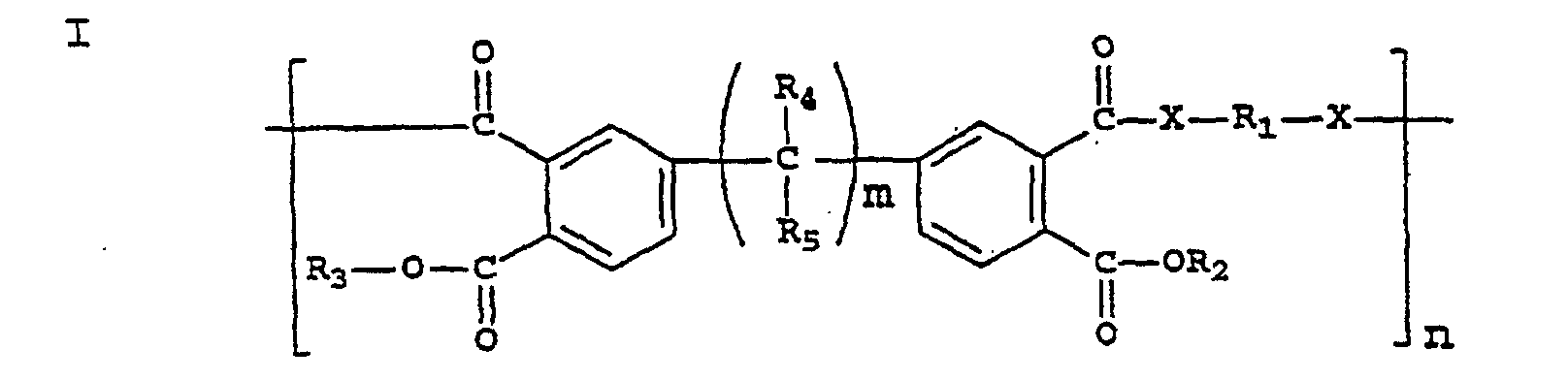
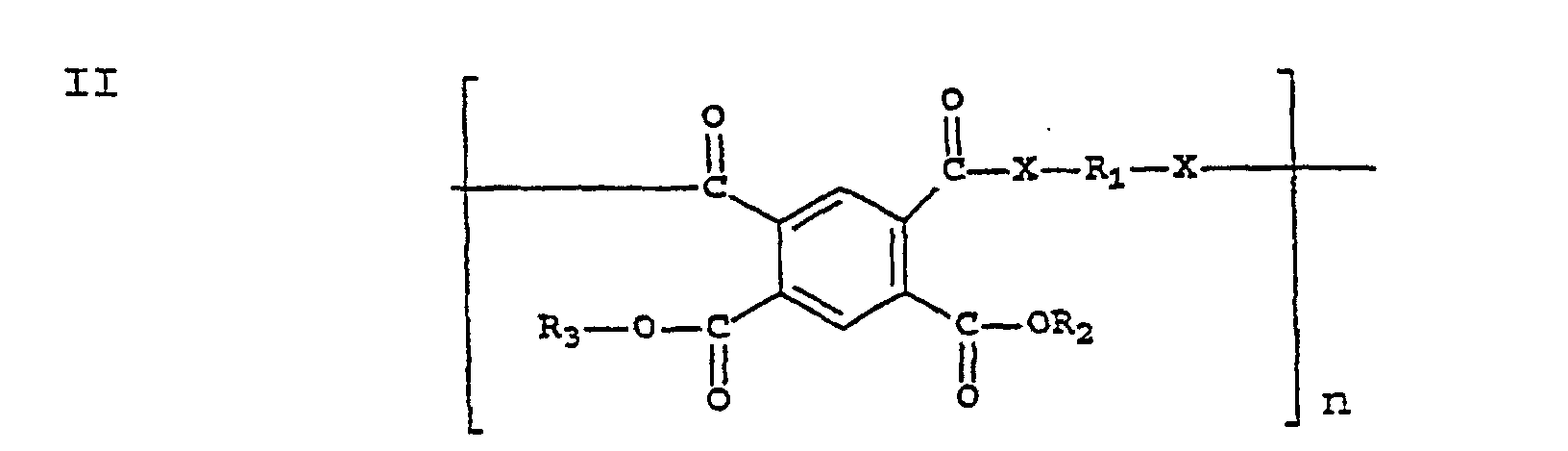
 X étant-NH-,R1 étant un reste divalent aromatique, cycloaliphatique ou aliphatique avec au moins 2 atomes de carbone,R2 et R3 étant indépendamment de l'hydrogène ou un reste organique, comprenant une liaison double oléfinique photopolymérisable, pourvu qu'au moins un des restes R2 et R3 soit un reste organique,R4 et R5 étant indépendamment un reste hydrocarbure ayant 1 à 8 atomes de carbone, un reste aliphatique perfluoré ou perhalofluoré ayant 1 à 8 atomes de carbone, ou R4 et R5 ensemble formant un groupe oxo,m étant 0 ou 1, etn étant un nombre entier positif correspondant au nombre d'unités dans le polymère et étant suffisamment large pour fournir la résine a) avec un nombre moyen du poids molaire d'au moins 1.500.
 - Composition selon la revendication 1, R1 étant un groupe arylène ou arylènoxyarylène, R2 et R3 étant tous les deux des restes organiques comprenant une double liaison oléfinique photopolymérisable, R4 et R5 étant tous les deux des restes perfluorés ou forment ensemble un groupe oxo, et n étant un nombre entier positif étant suffisamment large pour fournir la résine a) avec un nombre moyen du poids molaire de 1.500 à 35.000.
- Composition selon l'une quelconque des revendications 1 et 2, le monomère étant un acrylate polyfonctionnel photosensitive.
- Composition selon l'une quelconque des revendications 1 à 3, le polyester ayant des groupes aromatiques et un groupe -CH=CH-CO- photosensible ou un groupe équivalent.
- Composition selon l'une quelconque des revendications 1 à 4, le photoinitiateur étant une triazine halogéné.
- Composition selon l'une quelconque des revendications 1 à 5, le rapport en poids du total des résines a) et c) au monomère b) étant au moins 2,25:1.
- Composition selon l'une quelconque des revendications 1 à 6, comprenant en outre un co-photoinitiateur coumarin ayant un maximum d'absorption de 250 à 550 nm.
- Composition selon l'une quelconque des revendications 1 à 7, la résine a) étant présent en un montant de 15 à 65%, le monomère photopolymérisable étant présent en un montant de 15 à 50%, la résine polyester photoréticulable étant présent en un montant de 15 à 65%, et le photoinitiateur étant présent en un montant de 0,5 à 15%, basé sur le poids de la couche sec.
- Un élément photosensitive comprenant un support et ayant sur ledit support une couche formant une image photosensitive, ladite couche formant l'image photosensitive étant formé à partir de la composition selon l'une quelconque des revendications 1 à 8.
- La planche d'impression lithographique selon la revendication 9, ledit support étant un support d'aluminium traité ou non-traité, et la planche comprenant en outre une couche supérieure protectrice.
Applications Claiming Priority (2)
| Application Number | Priority Date | Filing Date | Title |
|---|---|---|---|
| US770749 | 1996-12-19 | ||
| US08/770,749 US5879858A (en) | 1996-12-19 | 1996-12-19 | Photosensitive polymer composition containing photosensitive polyamide and negative working photosensitive element |
Publications (2)
| Publication Number | Publication Date |
|---|---|
| EP0849636A1 EP0849636A1 (fr) | 1998-06-24 |
| EP0849636B1 true EP0849636B1 (fr) | 2002-04-10 |
Family
ID=25089566
Family Applications (1)
| Application Number | Title | Priority Date | Filing Date |
|---|---|---|---|
| EP97203847A Expired - Lifetime EP0849636B1 (fr) | 1996-12-19 | 1997-12-08 | Composition photosensible à base de polymères contenant un polyamide photosensible et élément photosensible de type négatif |
Country Status (3)
| Country | Link |
|---|---|
| US (1) | US5879858A (fr) |
| EP (1) | EP0849636B1 (fr) |
| DE (1) | DE69711827T2 (fr) |
Families Citing this family (2)
| Publication number | Priority date | Publication date | Assignee | Title |
|---|---|---|---|---|
| US5925498A (en) * | 1997-06-16 | 1999-07-20 | Kodak Polychrome Graphics Llc | Photosensitive polymer composition and element containing photosensitive polyamide and mixture of acrylates |
| RU2190870C2 (ru) * | 2000-06-15 | 2002-10-10 | Российский химико-технологический университет им. Д.И.Менделеева | Сухой пленочный фоторезист |
Family Cites Families (21)
| Publication number | Priority date | Publication date | Assignee | Title |
|---|---|---|---|---|
| US2732301A (en) * | 1952-10-15 | 1956-01-24 | Chxcxch | |
| DE1119510B (de) * | 1956-03-14 | 1961-12-14 | Bayer Ag | Verfahren zur Herstellung unloeslicher, vernetzter hochmolekularer Polyester |
| US3622320A (en) * | 1968-02-29 | 1971-11-23 | Mona Armstrong Allen | Thermographic processes and elements utilizing photocrosslinkable polyesters |
| US3702765A (en) * | 1970-10-13 | 1972-11-14 | Eastman Kodak Co | Alkali-soluble light sensitive polymers and compositions and processes for using such polymers |
| US3987037A (en) * | 1971-09-03 | 1976-10-19 | Minnesota Mining And Manufacturing Company | Chromophore-substituted vinyl-halomethyl-s-triazines |
| US3929489A (en) * | 1973-09-14 | 1975-12-30 | Eastman Kodak Co | Lithographic plates having radiation sensitive elements developable with aqueous alcohol |
| US4062686A (en) * | 1976-04-21 | 1977-12-13 | Eastman Kodak Company | Sensitizers for photocrosslinkable polymers |
| JPS5928328B2 (ja) * | 1977-11-29 | 1984-07-12 | 富士写真フイルム株式会社 | 光重合性組成物 |
| JPS6053300B2 (ja) * | 1978-08-29 | 1985-11-25 | 富士写真フイルム株式会社 | 感光性樹脂組成物 |
| US4414312A (en) * | 1980-09-03 | 1983-11-08 | E. I. Du Pont De Nemours & Co. | Photopolymerizable polyamide ester resin compositions containing an oxygen scavenger |
| DE3048502A1 (de) * | 1980-12-22 | 1982-07-22 | Hoechst Ag, 6000 Frankfurt | Durch strahlung polymerisierbares gemisch und daraus hergestelltes strahlungsempfindliches aufzeichnungsmaterial |
| JPS5815503A (ja) * | 1981-07-20 | 1983-01-28 | Fuji Photo Film Co Ltd | 光重合性組成物 |
| CA1195039A (fr) * | 1982-01-04 | 1985-10-08 | David L. Goff | Composition pour precurseur a base de polyimide photosensible, derive d'un diaryle fluore |
| US4416973A (en) * | 1982-01-04 | 1983-11-22 | E. I. Du Pont De Nemours & Co. | Radiation-sensitive polyimide precursor composition derived from a diaryl fluoro compound |
| US4454220A (en) * | 1982-01-04 | 1984-06-12 | E. I. Du Pont De Nemours And Company | Electrical device containing a radiation-sensitive polyimide precursor composition derived from a diaryl fluoro compound |
| JPS5989303A (ja) * | 1982-11-12 | 1984-05-23 | Fuji Photo Film Co Ltd | 光重合性組成物 |
| DE3421511A1 (de) * | 1984-06-08 | 1985-12-12 | Hoechst Ag, 6230 Frankfurt | Polymerisierbare, perfluoralkylgruppen aufweisende verbindungen, sie enthaltende reproduktionsschichten und deren verwendung fuer den wasserlosen offsetdruck |
| JP2980359B2 (ja) * | 1990-04-16 | 1999-11-22 | 富士通株式会社 | 感光性耐熱樹脂組成物とそれを用いたパターン形成方法 |
| US5045432A (en) * | 1990-07-17 | 1991-09-03 | Eastman Kodak Company | Radiation-sensitive composition containing both a poly(N-acylalkyleneimine) and an unsaturated polyester and use thereof in lithographic printing plates |
| US5061600A (en) * | 1990-07-17 | 1991-10-29 | Eastman Kodak Company | Radiation-sensitive composition containing both a vinyl pyrrolidone polymer and an unsaturated polyester and use thereof in lithographic printing plates |
| US5141842A (en) * | 1991-03-27 | 1992-08-25 | Eastman Kodak Company | Radiation-sensitive compositions comprising a photocrosslinkable polymer, a leuco dye, a photooxidant and a heteroaromatic amine n-oxide |
-
1996
- 1996-12-19 US US08/770,749 patent/US5879858A/en not_active Expired - Fee Related
-
1997
- 1997-12-08 EP EP97203847A patent/EP0849636B1/fr not_active Expired - Lifetime
- 1997-12-08 DE DE69711827T patent/DE69711827T2/de not_active Expired - Fee Related
Also Published As
| Publication number | Publication date |
|---|---|
| EP0849636A1 (fr) | 1998-06-24 |
| US5879858A (en) | 1999-03-09 |
| DE69711827T2 (de) | 2002-11-21 |
| DE69711827D1 (de) | 2002-05-16 |
Similar Documents
| Publication | Publication Date | Title |
|---|---|---|
| US4780393A (en) | Photopolymerizable composition and photopolymerizable recording material containing same | |
| US4985470A (en) | Photopolymerizable compositions | |
| US5114832A (en) | Photopolymerizable mixture and recording material prepared therefrom, having a photoinitiating set of compounds which give increased absorption below 450 nm | |
| US4598036A (en) | Print-out compositions | |
| US3765898A (en) | Photopolymerizable copying composition and copying material produced therewith | |
| US5229253A (en) | Photopolymerizable mixture and recording material produced therefrom | |
| US5821032A (en) | Photosensitive polymer composition and negative working photosensitive element containing three photocrosslinkable polymers | |
| JPS63287942A (ja) | 感光性組成物 | |
| JPH07120042B2 (ja) | 感光性組成物 | |
| JPH10333321A (ja) | 印刷現像感光性平版印刷版及びその製版方法 | |
| DE3931525B4 (de) | Lichtempfindliche Zusammensetzung | |
| US4657942A (en) | Photopolymerizable composition | |
| CA2080364A1 (fr) | Resines photosensibles positives et leur utilisation dans les films a developpement sec | |
| JP2702120B2 (ja) | 光重合可能な混合物、該混合物を含有する感光性記録素子および該感光性記録素子を用いて平版印刷版を製造する方法 | |
| AU611721B2 (en) | Improved composition | |
| US4254209A (en) | Dry planographic plate with light sensitive silicone composition | |
| US4946761A (en) | Image-forming layer | |
| US5057398A (en) | Photopolymerizable composition and photopolymerizable recording material containing same | |
| EP0778292A2 (fr) | Méthode pour préparer des acétals polyvinyliques modifiés par des anhydrides utilisables dans des compositions photosensibles | |
| US4661434A (en) | Photopolymerizable composition containing a novel combination of photopolymerizable initiators | |
| US5925498A (en) | Photosensitive polymer composition and element containing photosensitive polyamide and mixture of acrylates | |
| EP0849636B1 (fr) | Composition photosensible à base de polymères contenant un polyamide photosensible et élément photosensible de type négatif | |
| JPS5933893B2 (ja) | 協力作用を有する光開始剤系を含む感光性複写組成物 | |
| US5962189A (en) | Photosensitive composition containing photosensitive polyamide and thiazoline photoinitiator and negative working photosensitive element | |
| DE3907820A1 (de) | Lichtempfindliche zusammensetzung |
Legal Events
| Date | Code | Title | Description |
|---|---|---|---|
| PUAI | Public reference made under article 153(3) epc to a published international application that has entered the european phase |
Free format text: ORIGINAL CODE: 0009012 |
|
| AK | Designated contracting states |
Kind code of ref document: A1 Designated state(s): BE DE GB |
|
| AX | Request for extension of the european patent |
Free format text: AL;LT;LV;MK;RO;SI |
|
| 17P | Request for examination filed |
Effective date: 19981202 |
|
| RAP1 | Party data changed (applicant data changed or rights of an application transferred) |
Owner name: KODAK POLYCHROME GRAPHICS LLC |
|
| AKX | Designation fees paid |
Free format text: BE DE GB |
|
| RBV | Designated contracting states (corrected) |
Designated state(s): BE DE GB |
|
| 17Q | First examination report despatched |
Effective date: 19990506 |
|
| GRAG | Despatch of communication of intention to grant |
Free format text: ORIGINAL CODE: EPIDOS AGRA |
|
| RAP1 | Party data changed (applicant data changed or rights of an application transferred) |
Owner name: KODAK POLYCHROME GRAPHICS COMPANY LTD. |
|
| GRAG | Despatch of communication of intention to grant |
Free format text: ORIGINAL CODE: EPIDOS AGRA |
|
| GRAH | Despatch of communication of intention to grant a patent |
Free format text: ORIGINAL CODE: EPIDOS IGRA |
|
| GRAH | Despatch of communication of intention to grant a patent |
Free format text: ORIGINAL CODE: EPIDOS IGRA |
|
| REG | Reference to a national code |
Ref country code: GB Ref legal event code: IF02 |
|
| GRAA | (expected) grant |
Free format text: ORIGINAL CODE: 0009210 |
|
| AK | Designated contracting states |
Kind code of ref document: B1 Designated state(s): BE DE GB |
|
| PG25 | Lapsed in a contracting state [announced via postgrant information from national office to epo] |
Ref country code: BE Free format text: LAPSE BECAUSE OF FAILURE TO SUBMIT A TRANSLATION OF THE DESCRIPTION OR TO PAY THE FEE WITHIN THE PRESCRIBED TIME-LIMIT Effective date: 20020410 |
|
| REF | Corresponds to: |
Ref document number: 69711827 Country of ref document: DE Date of ref document: 20020516 |
|
| PGFP | Annual fee paid to national office [announced via postgrant information from national office to epo] |
Ref country code: GB Payment date: 20021204 Year of fee payment: 6 |
|
| PGFP | Annual fee paid to national office [announced via postgrant information from national office to epo] |
Ref country code: DE Payment date: 20021212 Year of fee payment: 6 |
|
| PLBE | No opposition filed within time limit |
Free format text: ORIGINAL CODE: 0009261 |
|
| STAA | Information on the status of an ep patent application or granted ep patent |
Free format text: STATUS: NO OPPOSITION FILED WITHIN TIME LIMIT |
|
| 26N | No opposition filed |
Effective date: 20030113 |
|
| PG25 | Lapsed in a contracting state [announced via postgrant information from national office to epo] |
Ref country code: GB Free format text: LAPSE BECAUSE OF NON-PAYMENT OF DUE FEES Effective date: 20031208 |
|
| PG25 | Lapsed in a contracting state [announced via postgrant information from national office to epo] |
Ref country code: DE Free format text: LAPSE BECAUSE OF NON-PAYMENT OF DUE FEES Effective date: 20040701 |
|
| GBPC | Gb: european patent ceased through non-payment of renewal fee |
Effective date: 20031208 |