EP0849810A2 - Herstellungsverfahren für photovoltaische Bauelemente - Google Patents
Herstellungsverfahren für photovoltaische Bauelemente Download PDFInfo
- Publication number
- EP0849810A2 EP0849810A2 EP97122283A EP97122283A EP0849810A2 EP 0849810 A2 EP0849810 A2 EP 0849810A2 EP 97122283 A EP97122283 A EP 97122283A EP 97122283 A EP97122283 A EP 97122283A EP 0849810 A2 EP0849810 A2 EP 0849810A2
- Authority
- EP
- European Patent Office
- Prior art keywords
- substrate
- reflective layer
- layer
- gas
- semiconductor layer
- Prior art date
- Legal status (The legal status is an assumption and is not a legal conclusion. Google has not performed a legal analysis and makes no representation as to the accuracy of the status listed.)
- Withdrawn
Links
Images
Classifications
-
- H—ELECTRICITY
- H10—SEMICONDUCTOR DEVICES; ELECTRIC SOLID-STATE DEVICES NOT OTHERWISE PROVIDED FOR
- H10F—INORGANIC SEMICONDUCTOR DEVICES SENSITIVE TO INFRARED RADIATION, LIGHT, ELECTROMAGNETIC RADIATION OF SHORTER WAVELENGTH OR CORPUSCULAR RADIATION
- H10F71/00—Manufacture or treatment of devices covered by this subclass
- H10F71/137—Batch treatment of the devices
-
- C—CHEMISTRY; METALLURGY
- C23—COATING METALLIC MATERIAL; COATING MATERIAL WITH METALLIC MATERIAL; CHEMICAL SURFACE TREATMENT; DIFFUSION TREATMENT OF METALLIC MATERIAL; COATING BY VACUUM EVAPORATION, BY SPUTTERING, BY ION IMPLANTATION OR BY CHEMICAL VAPOUR DEPOSITION, IN GENERAL; INHIBITING CORROSION OF METALLIC MATERIAL OR INCRUSTATION IN GENERAL
- C23C—COATING METALLIC MATERIAL; COATING MATERIAL WITH METALLIC MATERIAL; SURFACE TREATMENT OF METALLIC MATERIAL BY DIFFUSION INTO THE SURFACE, BY CHEMICAL CONVERSION OR SUBSTITUTION; COATING BY VACUUM EVAPORATION, BY SPUTTERING, BY ION IMPLANTATION OR BY CHEMICAL VAPOUR DEPOSITION, IN GENERAL
- C23C14/00—Coating by vacuum evaporation, by sputtering or by ion implantation of the coating forming material
- C23C14/22—Coating by vacuum evaporation, by sputtering or by ion implantation of the coating forming material characterised by the process of coating
- C23C14/34—Sputtering
-
- H—ELECTRICITY
- H10—SEMICONDUCTOR DEVICES; ELECTRIC SOLID-STATE DEVICES NOT OTHERWISE PROVIDED FOR
- H10F—INORGANIC SEMICONDUCTOR DEVICES SENSITIVE TO INFRARED RADIATION, LIGHT, ELECTROMAGNETIC RADIATION OF SHORTER WAVELENGTH OR CORPUSCULAR RADIATION
- H10F19/00—Integrated devices, or assemblies of multiple devices, comprising at least one photovoltaic cell covered by group H10F10/00, e.g. photovoltaic modules
- H10F19/80—Encapsulations or containers for integrated devices, or assemblies of multiple devices, having photovoltaic cells
-
- H—ELECTRICITY
- H10—SEMICONDUCTOR DEVICES; ELECTRIC SOLID-STATE DEVICES NOT OTHERWISE PROVIDED FOR
- H10F—INORGANIC SEMICONDUCTOR DEVICES SENSITIVE TO INFRARED RADIATION, LIGHT, ELECTROMAGNETIC RADIATION OF SHORTER WAVELENGTH OR CORPUSCULAR RADIATION
- H10F77/00—Constructional details of devices covered by this subclass
- H10F77/20—Electrodes
- H10F77/244—Electrodes made of transparent conductive layers, e.g. transparent conductive oxide [TCO] layers
-
- H—ELECTRICITY
- H10—SEMICONDUCTOR DEVICES; ELECTRIC SOLID-STATE DEVICES NOT OTHERWISE PROVIDED FOR
- H10F—INORGANIC SEMICONDUCTOR DEVICES SENSITIVE TO INFRARED RADIATION, LIGHT, ELECTROMAGNETIC RADIATION OF SHORTER WAVELENGTH OR CORPUSCULAR RADIATION
- H10F77/00—Constructional details of devices covered by this subclass
- H10F77/20—Electrodes
- H10F77/244—Electrodes made of transparent conductive layers, e.g. transparent conductive oxide [TCO] layers
- H10F77/251—Electrodes made of transparent conductive layers, e.g. transparent conductive oxide [TCO] layers comprising zinc oxide [ZnO]
-
- H—ELECTRICITY
- H10—SEMICONDUCTOR DEVICES; ELECTRIC SOLID-STATE DEVICES NOT OTHERWISE PROVIDED FOR
- H10F—INORGANIC SEMICONDUCTOR DEVICES SENSITIVE TO INFRARED RADIATION, LIGHT, ELECTROMAGNETIC RADIATION OF SHORTER WAVELENGTH OR CORPUSCULAR RADIATION
- H10F77/00—Constructional details of devices covered by this subclass
- H10F77/40—Optical elements or arrangements
- H10F77/42—Optical elements or arrangements directly associated or integrated with photovoltaic cells, e.g. light-reflecting means or light-concentrating means
- H10F77/48—Back surface reflectors [BSR]
-
- Y—GENERAL TAGGING OF NEW TECHNOLOGICAL DEVELOPMENTS; GENERAL TAGGING OF CROSS-SECTIONAL TECHNOLOGIES SPANNING OVER SEVERAL SECTIONS OF THE IPC; TECHNICAL SUBJECTS COVERED BY FORMER USPC CROSS-REFERENCE ART COLLECTIONS [XRACs] AND DIGESTS
- Y02—TECHNOLOGIES OR APPLICATIONS FOR MITIGATION OR ADAPTATION AGAINST CLIMATE CHANGE
- Y02E—REDUCTION OF GREENHOUSE GAS [GHG] EMISSIONS, RELATED TO ENERGY GENERATION, TRANSMISSION OR DISTRIBUTION
- Y02E10/00—Energy generation through renewable energy sources
- Y02E10/50—Photovoltaic [PV] energy
- Y02E10/52—PV systems with concentrators
-
- Y—GENERAL TAGGING OF NEW TECHNOLOGICAL DEVELOPMENTS; GENERAL TAGGING OF CROSS-SECTIONAL TECHNOLOGIES SPANNING OVER SEVERAL SECTIONS OF THE IPC; TECHNICAL SUBJECTS COVERED BY FORMER USPC CROSS-REFERENCE ART COLLECTIONS [XRACs] AND DIGESTS
- Y02—TECHNOLOGIES OR APPLICATIONS FOR MITIGATION OR ADAPTATION AGAINST CLIMATE CHANGE
- Y02P—CLIMATE CHANGE MITIGATION TECHNOLOGIES IN THE PRODUCTION OR PROCESSING OF GOODS
- Y02P70/00—Climate change mitigation technologies in the production process for final industrial or consumer products
- Y02P70/50—Manufacturing or production processes characterised by the final manufactured product
Definitions
- the present invention relates to a method for producing a photovoltaic element with high conversion efficiency of energy from light to electricity, based on effective utilization of incident light.
- a semiconductor layer of a photovoltaic element For a semiconductor layer of a photovoltaic element, research and development has extensively been carried out on materials including so-called thin film semiconductors using crystal-based semiconductors of monocrystalline or polycrystalline silicon with high conversion efficiency, amorphous silicon (hereinafter referred to as a-Si) available at low prices, and compound semiconductors such as CdS ⁇ CuInSe 2 .
- a-Si amorphous silicon
- This technology for effectively utilizing the incident light involves techniques as to a transparent electrode for allowing more light to reach the semiconductor layer by preventing reflection on an incident surface of light, a light scattering layer for scattering the incident light to increase optical path lengths in the semiconductor layer, a reflective layer for reflecting light not absorbed by the semiconductor layer, again into the semiconductor layer to utilize the reflected light, and so on.
- U.S. Patent Nos. 4,419,533 and 4,532,372 disclose the technology for effectively utilizing the incident light by providing the surface of reflective layer with the texture structure and scattering the light thereby. They also disclose the technology for forming a transparent, conductive layer on the reflective layer to prevent a short circuit due to defects of the semiconductor layer.
- the above mentioned prior art discloses that aluminum, gold, silver, and copper can be used for the reflective layer.
- gold and silver are expensive and silver and copper are electrically ionized under presence of even a little water, posing a problem of the short circuit occurring through the semiconductor layer.
- Japanese Patent Application Laid-Open No. 62-211377 discloses a method for forming the aluminum film by carrying out sputtering while supplying oxygen gas and controlling the flow rate of the oxygen gas with monitoring the amount thereof by a quadrupole mass spectrometer and describes that the grain sizes of aluminum can be controlled by the method.
- Japanese Patent Application Laid-Open No. 2-297737 discloses a method for forming an aluminum film by sputtering wherein the sputter gas is kept under the pressure of not less than 10 mTorr, thereby preventing corrosion or a deformation defect thereof.
- Japanese Patent Application Laid-Open No. 5-171434 discloses a method for forming an aluminum film having no projections in such a way that sputtering is carried out with residual air remaining in a vacuum vessel.
- Japanese Patent Application Laid-Open No. 6-116723 discloses a method for obtaining a smooth aluminum film by repetitively carrying out a step of forming an aluminum film by sputtering and a step of exposing this aluminum film to a mixed gas of nitrogen and oxygen.
- Japanese Patent Application Laid-Open No. 7-224379 discloses a method of forming an aluminum film by sputtering while introducing oxygen, hydrogen, or water, in addition to an inert gas.
- the above mentioned prior art disclosing the methods for forming an aluminum film discloses nothing about reflectivity of light, particularly, when used for the reflective layer of a photovoltaic element and also discloses nothing about the influence on an aluminum film when a transparent, conductive layer of zinc oxide or the like, and a semiconductor layer are stacked on the aluminum film. Further, the above mentioned prior art describes nothing about change in quality of a formed aluminum film during a continuous film forming method for a long period of time.
- the conversion efficiency of photovoltaic elements is expected to be increased remarkably by combination of a transparent electrode, a light scattering layer, and a reflective layer, whereby reduction of price of obtained electric energy is expected. In practice, however, it is often the case that the expected effect is not achieved, and the reduction of price of obtained electric energy is not satisfactory yet. In addition, achievement of long-term reliability throughout 10 years to 20 years, as well as the high conversion efficiency, is not satisfactory yet, so that the photovoltaic elements are not in widespread use for a system power yet.
- the inventor has also found that the phenomenon of short circuit of the semiconductor layer can be prevented by sufficiently shutting the water out with provision of a protective film of a vitreous material or the like and that it is difficult to produce an inexpensive, lightweight, and flexible photovoltaic element by this method.
- the inventor has intensively and extensively studied a method for producing a reflective layer by use of aluminum, which is inexpensive and stable and has good reflectivity, or a material mainly containing aluminum from various aspects.
- the inventor has however found that the stacking of the aluminum layer with the transparent, conductive layer or the semiconductor layer may pose a problem of decrease of reflectivity, when compared with the structure of the single aluminum layer.
- the inventor has also found that, especially when a method for continuously producing the photovoltaic element on a long substrate unwound from a substrate roll is employed as an inexpensive production method, there is a problem that the reflectivity is lowered with the elapse of time during production for a long period. It has been clarified that this is caused as follows: crystallization of the aluminum film proceeds because of energy upon deposition of the transparent, conductive layer or the semiconductor layer above the reflective layer, grain boundaries develop therewith, and the grain boundaries absorb the light to lower the reflectivity, thereby decreasing the quantity of light that can be converted to electricity in the semiconductor layer.
- the inventor has also found the following mechanism for the problem that the reflectivity of the formed deposit film gradually decreases from start to end of formation in the continuous production method for a long term; that is, a residual gas remaining in the vacuum system and containing water as the main component decreases with the passage of time; grain boundaries develop with increase in speed of crystallization of the aluminum film; and the grain boundaries absorb the light to lower the reflectivity, thereby decreasing the quantity of light that can be converted to electricity in the semiconductor layer.
- An object of the present invention is to provide a method for producing a photovoltaic element having a reflective layer with high reflectivity and with high reliability and thereby having high photoelectric conversion efficiency, and especially to provide a production method free of change in the reflection characteristics of the deposit film even in continuous production on a long substrate for a long period.
- a method for producing a photovoltaic element according to the present invention is a method for producing a photovoltaic element having a reflective layer and a semiconductor layer on a long substrate, comprising the steps of supplying an inert gas, hydrogen atoms, and oxygen atoms into a vacuum vessel housing the long substrate and effecting sputtering by use of a target comprising aluminum, thereby forming the reflective layer on the long substrate.
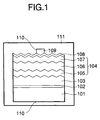
- Fig. 1 shows an example of cross section of a photovoltaic element produced according to the present invention.
- the reference numeral 101 designates a substrate, 102 a reflective layer, 103 a transparent, conductive layer, 104 a semiconductor layer comprised of an n-type Si layer 105, an i-type Si layer 106, and a p-type Si layer 107, 108 a transparent electrode, 109 a collector electrode, 110 output terminals, and 111 a protective resin.
- the conductive substrate 101 is set in a vacuum vessel, and the vacuum vessel is evacuated to the pressure of not more than 10 -4 Torr.
- An inert gas such as argon gas, hydrogen atoms, and oxygen atoms are supplied into the vacuum vessel by use of mass flow controllers.
- the hydrogen atoms and oxygen atoms are supplied by hydrogen gas and oxygen gas, respectively, or by water vapor.
- a plasma is induced while maintaining the pressure inside the vacuum vessel at several mTorr, and a reflective layer 102 consisting of aluminum or mainly containing aluminum is deposited on the substrate.
- preferred flow rate ratios of inert gas to water vapor are 100:(2 to 10).
- Preferred flow rate ratios of inert gas, hydrogen gas, and oxygen gas are 100:(2 to 10):(1 to 5).
- the amount of water vapor or the amounts of oxygen and hydrogen in the deposition chamber are monitored and the amounts of introduced gas are controlled so as to keep the amount of water vapor or the amounts of oxygen and hydrogen always constant.
- the transparent, conductive layer 103 of zinc oxide or the like having a surface with several-hundred-nm unevenness is continuously formed on the reflective layer.
- the semiconductor layer 104 is produced on the conductive layer, using another vacuum system.
- the reference numeral 105 denotes an n-type Si layer, 106 an i-type Si layer, and 107 a p-type Si layer.
- the semiconductor layer 104 is thin, the whole of the semiconductor layer often exhibits the same texture structure as the transparent, conductive layer 103, as shown in Fig. 1.
- the numeral 108 represents a reflection preventing layer also serving as a transparent electrode in the surface.
- a comb-shaped collector electrode 109 is provided on the reflection preventing layer and the output is led to the outside by output terminals 110.
- the element may further be sealed with a transparent resin 111.
- the photovoltaic element produced according to the above procedures development of crystal grains is suppressed in the reflective layer 102 consisting of aluminum or mainly containing aluminum, so that the reflection of light is as good as that with a single layer film; the light is thus effectively absorbed in the semiconductor layer, thus increasing the photoelectric conversion efficiency. Further, even in continuous production for a long period, no change is seen in the characteristics with the reliability being also high.
- the substrate 101 of the present invention there is used a substrate long enough to be applied to the so-called roll-to-roll method or the step feed method.
- a metal sheet, a resin film on which a conductive layer is formed, or the like may be used.
- stainless steel sheet, galvanized sheet iron, aluminum sheet, and so on are suitably applicable because of their relatively low price.
- the surface of the substrate may be polished, but, for example when the substrate has a well-finished surface like a stainless steel sheet processed by bright annealing, it can be used as it is, after only cleaning with water and blow drying.
- the material for the reflective layer is aluminum or mainly contains aluminum, and the reflective layer is produced by sputtering.
- the reflective layer 102 also serves as one electrode of the semiconductor layer 104.
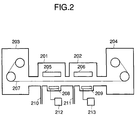
- the long substrate 207 rolled is set in a feed chamber 203 and is stretched to a winding chamber 204. After the whole apparatus is evacuated to a predetermined vacuum degree by a vacuum pump not illustrated and a predetermined temperature is attained by use of a heater 205, the long substrate 207 is allowed to move at a constant carrying speed with the speed being monitored by an encoder not illustrated.
- An aluminum film is formed by sputtering in a deposition chamber 201.
- Hydrogen atoms and oxygen atoms, together with an inert gas are supplied through a gas inlet pipe 210.
- the inert gas there may be used argon (Ar), helium (He), neon (Ne) or the like with argon being preferred.
- the supply sources of hydrogen and oxygen atoms water vapor, or combination of hydrogen gas and oxygen gas, may be used.
- power of dc or ac is supplied from a power supply 212 to induce the plasma, thereby forming the aluminum film.
- a zinc oxide layer can also be deposited in a deposition chamber 202.
- a gas gate or a gate valve may be disposed between the deposition chambers 201, 202, the feed chamber 203, and the winding chamber 204 to separate them from each other.
- the transparent, conductive layer 103 having the finely uneven surface can also be formed by a forming method such as sputtering, electrodeposition, or the like.
- the conductive layer needs to have a certain resistance for controlling the current flowing through defects of the semiconductor film.
- a material for the conductive layer is selected, for example, from zinc oxide, titanium oxide, indium oxide, and tin oxide, or substances mainly containing them. Among them, zinc oxide or a substance containing it is suitably applicable.
- This transparent, conductive layer 103 may be omitted according to circumstances. It is also possible to produce the conductive layer continuously in the same vacuum unit 201 as the reflective layer 102 was produced, using the apparatus as shown in Fig. 2.
- a CVD apparatus utilizing RF power, VHF power, microwave power or the like can be used for formation of the semiconductor layer 104.
- SiH 4 , SiF 4 , PH 3 , and H 2 as material gases and the power supplied, an n-type a-Si layer 105 can be formed on the transparent, conductive layer 103.
- an i-type a-Si layer 106 can be formed on the n-type a-Si layer 105.
- a p-type ⁇ c-Si layer 107 can be formed on the i-type a-Si layer 106, thus making the nip semiconductor layer 104.
- This semiconductor layer 104 is not limited to only amorphous and microcrystalline semiconductors, but it is generally made of non-monocrystalline semiconductors.
- the semiconductor layer may be of either the nip structure or the pin structure, and a plurality of semiconductor layers may also be formed.
- the transparent electrode 108 also serves as an electrode on the opposite side to the substrate 101 through the semiconductor layer 104 and desirably has a certain degree of low resistance.
- the raw material for the transparent electrode is selected, for example, from indium oxide, tin oxide, titanium oxide, zinc oxide, and mixtures thereof.
- the transparent electrode can be made by vacuum vapor deposition by use of resistance heating or electron beam, or sputtering, and the like, using the above mentioned raw material.
- the thickness of the transparent electrode is desirably to be approximately equal to one fourth of the wavelength of the light desired to be mainly prevented from being reflected.
- a collector electrode of a grid pattern may be provided on the transparent electrode 108 in place of the comb-shaped collector electrode 109.
- the material for the collector electrode 109 include metals such as Ti, Cr, Mo, W, Al, Ag, Ni, Cu, or Sn, or conductive pastes including the silver paste.
- the conductive pastes are normally those in which fine powder of silver, gold, copper, nickel, or carbon is dispersed in a binder polymer.
- the binder polymer include polyester, epoxy, acrylic, alkyd, polyvinyl acetate, rubber, urethane, and phenol resins.
- the method for forming the collector electrode 109 is selected from sputtering with a mask pattern, resistor heating, CVD method, a method for evaporating a metal film over the entire surface and removing unnecessary portions by etching, a method for directly forming the grid electrode pattern by photo-CVD, a method for forming a mask of a negative pattern to the grid electrode pattern and effecting plating thereon, a method of printing a conductive paste, a method for fixing a metal wire with a conductive paste, and so on.
- the output terminals 110 are attached to the substrate 101 and to the collector electrode 109 for extracting the electromotive force.
- One output terminal is attached to the substrate 101 by a method for bonding a metal body of copper tab or the like thereto by spot welding or soldering, while the other output terminal is bonded to the collector electrode 109 by a method for electrically connecting a metal body thereto by the conductive paste or by soldering.
- the protective resin 111 is made of a resin film for coating the surface, and a filler (adhesive) resin.
- the resin film are fluororesins, polyethylene terephthalate, nylons, polycarbonate, polyethylene, polypropylene, polyvinyl chloride, acrylic resins, and so on.
- the filler (adhesive) resin can be selected, for example, from resins such as EVA, EEA, acrylic resins, polyamide resins, polychloroprene rubber, butyl rubber, nitrile rubber, phenol resins, melamine resins, epoxy resins, or silicone.
- a glass sheet may be used in place of the coating film.
- a reinforcing member of a metal or the like may be provided on the back face.
- the reflective layer 102 and the transparent, conductive layer 103 were made using the vacuum apparatus of the roll-to-roll type shown in Fig. 2.
- the whole apparatus was evacuated to the vacuum of not more than 10 -4 Torr by the vacuum pump not illustrated and thereafter conveyance of the stainless steel of the roll substrate 207 was started at a constant convey speed of 100 mm/min by a servo motor for winding while monitoring the speed by the encoder not illustrated.
- the pressure inside the vacuum vessel 201 as a deposition chamber was kept at 3 mTorr, and, using the target 208 of aluminum of 250 mm ⁇ 250 mm ⁇ 6 mm thick and the purity of 99.99 %, the reflective layer 102 was deposited in the average thickness of 100 nm while supplying the power of 200 W from the DC power supply 212.
- the substrate 207 was heated to the temperature of 200 °C by the heater 206, argon was introduced at 50 sccm through the gas inlet pipe 211, the pressure inside the vacuum vessel 202 as a deposition chamber was kept at 3 mTorr, and, using the target 209 of zinc oxide of 250 mm ⁇ 250 mm ⁇ 6 mm thick and the purity of 99.99 %, the transparent, conductive layer 103 was deposited in the average thickness of 1000 nm while supplying the power of 4000 W from the DC power supply 213.
- photovoltaic elements were produced in the manner as described above.
- the characteristics of the photovoltaic elements were evaluated under irradiation with light of AM 1.5 (100 mW/cm 2 ). All the three photovoltaic elements showed excellent conversion efficiencies; that is, photoelectric conversion efficiencies of 9.6 ⁇ 1 %.
- the three samples were subjected to an environmental test for 500 hours in an environmental test box kept at the temperature of 95 °C and at the humidity of 95 %.
- the change of conversion efficiency was only 0.1 % decrease, so that there was no problem at all.
- Example 2 By following the procedure of Example 1, except that water vapor was introduced at 3 sccm, together with argon gas at 50 sccm, through the gas supply pipe 210 into the vacuum vessel 201 instead of the supply of hydrogen gas and oxygen gas, the reflective layer and the transparent, conductive layer were produced.
- the substrate thus produced was taken out and predetermined portions were cut out in the size of 5 cm ⁇ 5 cm.
- the reflectivities of the samples were measured by a spectrophotometer. All the reflectivities at portions of 5 m, 30 m, and 55 m from the start of production were 68 % at the center of vibration due to interference of 800 nm.
- the subsequent layers including the semiconductor layer were made in the same manner as in Example 1, thereby forming photovoltaic elements.
- the characteristics of the photovoltaic elements were evaluated under irradiation with light of AM 1.5 (100 mW/cm 2 ). All the three photovoltaic elements showed excellent conversion efficiencies; that is, photoelectric conversion efficiencies of 9.5 ⁇ 1 %.
- the three samples were subjected to the environmental test for 500 hours in the environmental test box kept at the temperature of 95 °C and at the humidity of 95 %.
- the change of conversion efficiency was only 0.1 % decrease, so that there was no problem at all.
- the reflective layer 102 and the transparent, conductive layer 103 were produced in the same manner as in Example 1 except that in formation of the reflective layer 102, evacuation was continued for over 2 hours down to the vacuum of not more than 5 ⁇ 10 -6 Torr and sputtering was carried out in the presence of only argon gas.
- the substrate thus produced was taken out and predetermined portions were cut out in the size of 5 cm ⁇ 5 cm.
- the reflectivities of the samples were measured by a spectrophotometer.
- the reflectivities of the samples at 5 m, 30 m, and 55 m from the start of production were 67 %, 64 %, and 61 %, respectively, at the center of vibration due to interference of 800 nm.
- the subsequent layers including the semiconductor layer were made in the same manner as in Example 1, thereby forming photovoltaic elements.
- the characteristics of the photovoltaic elements were evaluated under irradiation with light of AM 1.5 (100 mW/cm 2 ).
- the photovoltaic elements showed the photoelectric conversion efficiencies of 9.4 %, 9.3 % and 9.1 %, respectively.
- the reason of the low reflectivities and the low conversion efficiencies is presumably that the light was absorbed by the grain boundaries of the aluminum film.
- the reflective layer 102 and the transparent, conductive layer 103 were produced in the same manner as in Example 1 except that argon was introduced at the flow rate of 50 sccm and oxygen gas at 2 sccm through the gas inlet pipe 210 without supplying hydrogen gas.
- the substrate thus produced was taken out and predetermined portions were cut out in the size of 5 cm ⁇ 5 cm.
- the reflectivities of the samples were measured by a spectrophotometer.
- the reflectivities of the samples at 5 m, 30 m, and 55 m from the start of production were each 69 % at the center of vibration due to interference of 800 nm.
- the subsequent layers including the semiconductor layer were made in the same manner as in Example 1, thereby forming photovoltaic elements.
- the characteristics of the photovoltaic elements were evaluated under irradiation with light of AM 1.5 (100 mW/cm 2 ).
- the photovoltaic elements showed the photoelectric conversion efficiencies of 7.2 %, 6.9 % and 6.5 %, respectively.
- the photovoltaic elements showed the low conversion efficiencies, though the reflectivities thereof were as high as those in Example 1.
- the photovoltaic element obtained by the production method of the present invention has the reflective layer with high reflectivity and it can effectively utilize the incident light. Therefore, absorption of light in the semiconductor layer increases, which achieves the high conversion efficiency. It is thus expected that the photovoltaic elements can be utilized in smaller areas.
- the present invention permits continuous production for a long period without decrease of conversion efficiency, so that the present invention contributes to widespread use for a system power, of inexpensive and highly reliable photovoltaic elements.
- the present invention is to provide a method for producing a photovoltaic element having a reflective layer with high reflectivity and with high reliability and thus showing high photoelectric conversion efficiency, and especially to provide a production method causing no change in the reflection characteristics of a deposit film, even in continuous production on a long substrate for a long period.
- the production method of a photovoltaic element of the present invention is a method for producing a photovoltaic element having a reflective layer and a semiconductor layer on a long substrate, comprising the steps of supplying an inert gas, hydrogen atoms, and oxygen atoms into a vacuum vessel housing the substrate and effecting sputtering by use of a target comprising aluminum, thereby forming the reflective layer on the substrate.
Landscapes
- Chemical & Material Sciences (AREA)
- Chemical Kinetics & Catalysis (AREA)
- Engineering & Computer Science (AREA)
- Materials Engineering (AREA)
- Mechanical Engineering (AREA)
- Metallurgy (AREA)
- Organic Chemistry (AREA)
- Photovoltaic Devices (AREA)
- Physical Vapour Deposition (AREA)
Applications Claiming Priority (2)
| Application Number | Priority Date | Filing Date | Title |
|---|---|---|---|
| JP337935/96 | 1996-12-18 | ||
| JP8337935A JPH10178193A (ja) | 1996-12-18 | 1996-12-18 | 光起電力素子の製造方法 |
Publications (2)
| Publication Number | Publication Date |
|---|---|
| EP0849810A2 true EP0849810A2 (de) | 1998-06-24 |
| EP0849810A3 EP0849810A3 (de) | 1998-09-09 |
Family
ID=18313391
Family Applications (1)
| Application Number | Title | Priority Date | Filing Date |
|---|---|---|---|
| EP97122283A Withdrawn EP0849810A3 (de) | 1996-12-18 | 1997-12-17 | Herstellungsverfahren für photovoltaische Bauelemente |
Country Status (5)
| Country | Link |
|---|---|
| US (1) | US6132569A (de) |
| EP (1) | EP0849810A3 (de) |
| JP (1) | JPH10178193A (de) |
| KR (1) | KR100343241B1 (de) |
| AU (1) | AU731331B2 (de) |
Families Citing this family (20)
| Publication number | Priority date | Publication date | Assignee | Title |
|---|---|---|---|---|
| US6222271B1 (en) | 1997-07-15 | 2001-04-24 | Micron Technology, Inc. | Method of using hydrogen gas in sputter deposition of aluminum-containing films and aluminum-containing films derived therefrom |
| US5969423A (en) * | 1997-07-15 | 1999-10-19 | Micron Technology, Inc. | Aluminum-containing films derived from using hydrogen and oxygen gas in sputter deposition |
| JPH11264071A (ja) * | 1998-03-18 | 1999-09-28 | Matsushita Electron Corp | 薄膜の形成方法 |
| EP1108804A3 (de) | 1999-11-29 | 2004-03-10 | Canon Kabushiki Kaisha | Verfahren und Vorrichtung zur Herstellung einer Zinkoxidschicht und Verfahren und Vorrichtung zur Herstellung einer Photovoltaische Vorrichtung |
| JP2002080998A (ja) | 2000-07-03 | 2002-03-22 | Canon Inc | 酸化亜鉛膜の製造装置、および酸化亜鉛膜の製造方法 |
| JP4783500B2 (ja) * | 2000-12-25 | 2011-09-28 | 株式会社カネカ | 封止前準備用シートセット装置、封止前準備用出力取出し線セット装置、及び自動封止前準備装置 |
| US6878973B2 (en) * | 2001-08-23 | 2005-04-12 | Lumileds Lighting U.S., Llc | Reduction of contamination of light emitting devices |
| JP2004165394A (ja) * | 2002-11-13 | 2004-06-10 | Canon Inc | 積層型光起電力素子 |
| JP4086629B2 (ja) * | 2002-11-13 | 2008-05-14 | キヤノン株式会社 | 光起電力素子 |
| JP2009164644A (ja) * | 2003-04-14 | 2009-07-23 | Fuji Electric Systems Co Ltd | 導電性光反射膜、薄膜太陽電池用基板およびそれを適用した薄膜太陽電池 |
| US20090114262A1 (en) * | 2006-08-18 | 2009-05-07 | Adriani Paul M | Methods and Devices for Large-Scale Solar Installations |
| WO2009041330A1 (ja) * | 2007-09-26 | 2009-04-02 | Sharp Kabushiki Kaisha | 太陽電池、集光型太陽光発電モジュール、集光型太陽光発電ユニット、および太陽電池製造方法 |
| US20090101201A1 (en) * | 2007-10-22 | 2009-04-23 | White John M | Nip-nip thin-film photovoltaic structure |
| TW200945612A (en) * | 2007-12-28 | 2009-11-01 | Ulvac Inc | Solar battery and method for manufacturing the same |
| KR20100009249A (ko) * | 2008-07-18 | 2010-01-27 | 삼성전자주식회사 | 태양 전지 및 그 제조 방법 |
| KR20110014913A (ko) * | 2009-08-06 | 2011-02-14 | 삼성전자주식회사 | 태양 전지 모듈 및 그 제조 방법 |
| KR101239852B1 (ko) * | 2012-05-10 | 2013-03-06 | 학교법인 포항공과대학교 | GaN계 화합물 반도체 발광 소자 |
| DE102012214401A1 (de) * | 2012-08-13 | 2014-02-13 | Tesa Se | Verfahren zur Herstellung eines Solarmoduls |
| KR20140071058A (ko) * | 2012-12-03 | 2014-06-11 | 코닝정밀소재 주식회사 | 롤투롤 스퍼터링 장치 |
| CN105322433B (zh) * | 2014-05-28 | 2020-02-04 | 深圳光峰科技股份有限公司 | 波长转换装置及其相关发光装置 |
Family Cites Families (9)
| Publication number | Priority date | Publication date | Assignee | Title |
|---|---|---|---|---|
| US4419533A (en) * | 1982-03-03 | 1983-12-06 | Energy Conversion Devices, Inc. | Photovoltaic device having incident radiation directing means for total internal reflection |
| US4532372A (en) * | 1983-12-23 | 1985-07-30 | Energy Conversion Devices, Inc. | Barrier layer for photovoltaic devices |
| JPS61147870A (ja) * | 1984-12-20 | 1986-07-05 | Anelva Corp | スパツタAl膜形成方法 |
| JP2515977B2 (ja) * | 1986-03-11 | 1996-07-10 | アネルバ株式会社 | スパツタ装置 |
| JP2574025B2 (ja) * | 1989-01-11 | 1997-01-22 | 東京電力 株式会社 | 光偏光回路素子の製造方法 |
| JPH02297737A (ja) * | 1989-05-12 | 1990-12-10 | Fuji Photo Film Co Ltd | 光記録媒体 |
| JPH07150346A (ja) * | 1993-11-29 | 1995-06-13 | Seiko Instr Inc | 薄膜の堆積方法 |
| JPH07224379A (ja) * | 1994-02-14 | 1995-08-22 | Ulvac Japan Ltd | スパッタ方法およびそのスパッタ装置 |
| JP3651932B2 (ja) * | 1994-08-24 | 2005-05-25 | キヤノン株式会社 | 光起電力素子用裏面反射層及びその形成方法並びに光起電力素子及びその製造方法 |
-
1996
- 1996-12-18 JP JP8337935A patent/JPH10178193A/ja active Pending
-
1997
- 1997-12-08 US US08/986,634 patent/US6132569A/en not_active Expired - Lifetime
- 1997-12-17 AU AU48433/97A patent/AU731331B2/en not_active Ceased
- 1997-12-17 KR KR1019970069921A patent/KR100343241B1/ko not_active Expired - Fee Related
- 1997-12-17 EP EP97122283A patent/EP0849810A3/de not_active Withdrawn
Also Published As
| Publication number | Publication date |
|---|---|
| KR100343241B1 (ko) | 2002-08-22 |
| KR19980064244A (ko) | 1998-10-07 |
| AU4843397A (en) | 1998-06-25 |
| AU731331B2 (en) | 2001-03-29 |
| JPH10178193A (ja) | 1998-06-30 |
| EP0849810A3 (de) | 1998-09-09 |
| US6132569A (en) | 2000-10-17 |
Similar Documents
| Publication | Publication Date | Title |
|---|---|---|
| US6132569A (en) | Method for producing photovoltaic element | |
| US5486238A (en) | Photovoltaic device | |
| US5977477A (en) | Photovoltaic device | |
| JP2974485B2 (ja) | 光起電力素子の製造法 | |
| US6072117A (en) | Photovoltaic device provided with an opaque substrate having a specific irregular surface structure | |
| US6133061A (en) | Method of forming thin zinc oxide film, and method of producing semiconductor element substrate and photovoltaic element using thin zinc oxide film | |
| EP0831536B1 (de) | Photoelektrischer Wandler | |
| US5668050A (en) | Solar cell manufacturing method | |
| JPH07297421A (ja) | 薄膜半導体太陽電池の製造方法 | |
| JP2000219512A (ja) | 酸化亜鉛薄膜の製造方法、それを用いた光起電力素子の製造方法、及び光起電力素子 | |
| JPH09135037A (ja) | 光起電力素子 | |
| JP2962897B2 (ja) | 光起電力素子 | |
| JP3402637B2 (ja) | 太陽電池の製造方法、その製造装置及び長尺シート基板の製造方法 | |
| JPH10178195A (ja) | 光起電力素子 | |
| JP3112339B2 (ja) | 太陽電池モジュール | |
| JP3162261B2 (ja) | 太陽電池の製造方法及び製造装置 | |
| JP2846508B2 (ja) | 光起電力素子 | |
| JP3072832B2 (ja) | 光電変換体 | |
| JPH09186351A (ja) | 光起電力素子及びその製造方法 | |
| JP3293391B2 (ja) | 太陽電池モジュール | |
| JP2006269607A (ja) | 光起電力素子の製造方法 | |
| JP2713847B2 (ja) | 薄膜太陽電池 | |
| JP3337918B2 (ja) | 光起電力素子の製造方法 | |
| JP3142682B2 (ja) | 太陽電池製造方法及び製造装置 | |
| JP2952121B2 (ja) | 光起電力素子 |
Legal Events
| Date | Code | Title | Description |
|---|---|---|---|
| PUAI | Public reference made under article 153(3) epc to a published international application that has entered the european phase |
Free format text: ORIGINAL CODE: 0009012 |
|
| AK | Designated contracting states |
Kind code of ref document: A2 Designated state(s): DE FR GB |
|
| AX | Request for extension of the european patent |
Free format text: AL;LT;LV;MK;RO;SI |
|
| PUAL | Search report despatched |
Free format text: ORIGINAL CODE: 0009013 |
|
| AK | Designated contracting states |
Kind code of ref document: A3 Designated state(s): AT BE CH DE DK ES FI FR GB GR IE IT LI LU MC NL PT SE |
|
| AX | Request for extension of the european patent |
Free format text: AL;LT;LV;MK;RO;SI |
|
| 17P | Request for examination filed |
Effective date: 19990126 |
|
| AKX | Designation fees paid |
Free format text: DE FR GB |
|
| RBV | Designated contracting states (corrected) |
Designated state(s): DE FR GB |
|
| STAA | Information on the status of an ep patent application or granted ep patent |
Free format text: STATUS: THE APPLICATION HAS BEEN WITHDRAWN |
|
| 18W | Application withdrawn |
Effective date: 20060829 |