EP0850701A1 - Verfahren und Anlage zur Herstellung von Stabstahl mit durch Schmiedewalzen verfeinertem und/oder verdichtetem Gefüge - Google Patents
Verfahren und Anlage zur Herstellung von Stabstahl mit durch Schmiedewalzen verfeinertem und/oder verdichtetem Gefüge Download PDFInfo
- Publication number
- EP0850701A1 EP0850701A1 EP97122109A EP97122109A EP0850701A1 EP 0850701 A1 EP0850701 A1 EP 0850701A1 EP 97122109 A EP97122109 A EP 97122109A EP 97122109 A EP97122109 A EP 97122109A EP 0850701 A1 EP0850701 A1 EP 0850701A1
- Authority
- EP
- European Patent Office
- Prior art keywords
- rolling
- stand
- forging
- roll stand
- roll
- Prior art date
- Legal status (The legal status is an assumption and is not a legal conclusion. Google has not performed a legal analysis and makes no representation as to the accuracy of the status listed.)
- Granted
Links
- 238000000034 method Methods 0.000 title claims abstract description 36
- 238000009434 installation Methods 0.000 title abstract 3
- 238000010080 roll forging Methods 0.000 title 1
- 238000005096 rolling process Methods 0.000 claims abstract description 53
- 238000005242 forging Methods 0.000 claims abstract description 40
- 229910000831 Steel Inorganic materials 0.000 claims abstract description 26
- 239000010959 steel Substances 0.000 claims abstract description 26
- 230000008569 process Effects 0.000 claims abstract description 10
- 238000009499 grossing Methods 0.000 claims abstract description 8
- 238000004519 manufacturing process Methods 0.000 claims description 13
- 239000000047 product Substances 0.000 claims description 10
- 230000006835 compression Effects 0.000 claims description 7
- 238000007906 compression Methods 0.000 claims description 7
- 238000010438 heat treatment Methods 0.000 claims description 7
- 239000007858 starting material Substances 0.000 claims description 5
- 238000005056 compaction Methods 0.000 claims description 4
- 239000007795 chemical reaction product Substances 0.000 claims description 2
- 230000006698 induction Effects 0.000 claims description 2
- 230000009467 reduction Effects 0.000 claims description 2
- 238000005496 tempering Methods 0.000 claims description 2
- 230000007704 transition Effects 0.000 claims description 2
- 238000005266 casting Methods 0.000 claims 1
- 238000003303 reheating Methods 0.000 claims 1
- 239000000463 material Substances 0.000 abstract description 9
- 230000001939 inductive effect Effects 0.000 abstract description 2
- 238000004513 sizing Methods 0.000 abstract 1
- 230000009466 transformation Effects 0.000 abstract 1
- 230000008901 benefit Effects 0.000 description 6
- 238000009749 continuous casting Methods 0.000 description 4
- 239000003795 chemical substances by application Substances 0.000 description 3
- 238000001000 micrograph Methods 0.000 description 3
- 206010011416 Croup infectious Diseases 0.000 description 2
- 230000000052 comparative effect Effects 0.000 description 2
- 230000006872 improvement Effects 0.000 description 2
- 238000007711 solidification Methods 0.000 description 2
- 230000008023 solidification Effects 0.000 description 2
- XEEYBQQBJWHFJM-UHFFFAOYSA-N Iron Chemical compound [Fe] XEEYBQQBJWHFJM-UHFFFAOYSA-N 0.000 description 1
- 239000013078 crystal Substances 0.000 description 1
- 230000001419 dependent effect Effects 0.000 description 1
- 230000000694 effects Effects 0.000 description 1
- 238000011835 investigation Methods 0.000 description 1
- 238000004898 kneading Methods 0.000 description 1
- 230000035515 penetration Effects 0.000 description 1
- 238000002360 preparation method Methods 0.000 description 1
- 238000003825 pressing Methods 0.000 description 1
- 239000002994 raw material Substances 0.000 description 1
- 210000002023 somite Anatomy 0.000 description 1
- 238000011144 upstream manufacturing Methods 0.000 description 1
Images

Classifications
-
- B—PERFORMING OPERATIONS; TRANSPORTING
- B21—MECHANICAL METAL-WORKING WITHOUT ESSENTIALLY REMOVING MATERIAL; PUNCHING METAL
- B21B—ROLLING OF METAL
- B21B1/00—Metal-rolling methods or mills for making semi-finished products of solid or profiled cross-section; Sequence of operations in milling trains; Layout of rolling-mill plant, e.g. grouping of stands; Succession of passes or of sectional pass alternations
- B21B1/46—Metal-rolling methods or mills for making semi-finished products of solid or profiled cross-section; Sequence of operations in milling trains; Layout of rolling-mill plant, e.g. grouping of stands; Succession of passes or of sectional pass alternations for rolling metal immediately subsequent to continuous casting
- B21B1/466—Metal-rolling methods or mills for making semi-finished products of solid or profiled cross-section; Sequence of operations in milling trains; Layout of rolling-mill plant, e.g. grouping of stands; Succession of passes or of sectional pass alternations for rolling metal immediately subsequent to continuous casting in a non-continuous process, i.e. the cast being cut before rolling
-
- B—PERFORMING OPERATIONS; TRANSPORTING
- B21—MECHANICAL METAL-WORKING WITHOUT ESSENTIALLY REMOVING MATERIAL; PUNCHING METAL
- B21B—ROLLING OF METAL
- B21B1/00—Metal-rolling methods or mills for making semi-finished products of solid or profiled cross-section; Sequence of operations in milling trains; Layout of rolling-mill plant, e.g. grouping of stands; Succession of passes or of sectional pass alternations
- B21B1/02—Metal-rolling methods or mills for making semi-finished products of solid or profiled cross-section; Sequence of operations in milling trains; Layout of rolling-mill plant, e.g. grouping of stands; Succession of passes or of sectional pass alternations for rolling heavy work, e.g. ingots, slabs, blooms, or billets, in which the cross-sectional form is unimportant ; Rolling combined with forging or pressing
- B21B1/026—Rolling
-
- B—PERFORMING OPERATIONS; TRANSPORTING
- B21—MECHANICAL METAL-WORKING WITHOUT ESSENTIALLY REMOVING MATERIAL; PUNCHING METAL
- B21B—ROLLING OF METAL
- B21B1/00—Metal-rolling methods or mills for making semi-finished products of solid or profiled cross-section; Sequence of operations in milling trains; Layout of rolling-mill plant, e.g. grouping of stands; Succession of passes or of sectional pass alternations
- B21B1/02—Metal-rolling methods or mills for making semi-finished products of solid or profiled cross-section; Sequence of operations in milling trains; Layout of rolling-mill plant, e.g. grouping of stands; Succession of passes or of sectional pass alternations for rolling heavy work, e.g. ingots, slabs, blooms, or billets, in which the cross-sectional form is unimportant ; Rolling combined with forging or pressing
- B21B1/04—Metal-rolling methods or mills for making semi-finished products of solid or profiled cross-section; Sequence of operations in milling trains; Layout of rolling-mill plant, e.g. grouping of stands; Succession of passes or of sectional pass alternations for rolling heavy work, e.g. ingots, slabs, blooms, or billets, in which the cross-sectional form is unimportant ; Rolling combined with forging or pressing in a continuous process
-
- B—PERFORMING OPERATIONS; TRANSPORTING
- B21—MECHANICAL METAL-WORKING WITHOUT ESSENTIALLY REMOVING MATERIAL; PUNCHING METAL
- B21B—ROLLING OF METAL
- B21B13/00—Metal-rolling stands, i.e. an assembly composed of a stand frame, rolls, and accessories
- B21B13/22—Metal-rolling stands, i.e. an assembly composed of a stand frame, rolls, and accessories for rolling metal immediately subsequent to continuous casting, i.e. in-line rolling of steel
-
- Y—GENERAL TAGGING OF NEW TECHNOLOGICAL DEVELOPMENTS; GENERAL TAGGING OF CROSS-SECTIONAL TECHNOLOGIES SPANNING OVER SEVERAL SECTIONS OF THE IPC; TECHNICAL SUBJECTS COVERED BY FORMER USPC CROSS-REFERENCE ART COLLECTIONS [XRACs] AND DIGESTS
- Y10—TECHNICAL SUBJECTS COVERED BY FORMER USPC
- Y10T—TECHNICAL SUBJECTS COVERED BY FORMER US CLASSIFICATION
- Y10T29/00—Metal working
- Y10T29/49—Method of mechanical manufacture
- Y10T29/4998—Combined manufacture including applying or shaping of fluent material
- Y10T29/49988—Metal casting
- Y10T29/49991—Combined with rolling
Definitions
- the invention relates to a method for producing bar steel with a refined and / or compacted structure.
- the invention relates also a rolling mill system to carry out the process.
- the invention is based, a method and a task Specify plant with which the production of a core-compressed Product with significantly higher productivity compared to forging and consequently greatly reduced costs overall the benefits of rolling in quality improvement of Steel through forging to an overall economic and technical success unite.
- the problem is solved with a manufacturing method of steel bars with a refined and / or compacted structure, that as the starting material, continuous cast products of forgeable Steel quality with an almost square cross-section and beveled Corner areas are used and this in forging heat above the transition temperature through continuous, swirl-free Forming alternately in at least one two-roll stand and / or at least one four-roll stand in comparison low elongation a multi-stage forming process with comparative very high rolling forces to a core compacted Roll product to be subjected.
- An embodiment of the method according to the invention provides that forming (forging rolling) by rolling down corner areas the billet in at least one four-roll stand with such high rolling force that the resulting and, for example, in the micrograph recognizable compression-compressive stresses effective into the core zone are.
- an embodiment of the method provides that the billet after solidification of the cast strand, temperature compensation and heating pre-calibrated to an intended forging roll temperature while doing so the flanks of the billets are deformed concavely.
- the hereby resulting cross-sectional shape of the billet guarantees that that the compression pressures create compressive stresses right into the core and a relatively even structure across the entire cross-section produce.
- An advantageous embodiment of the invention provides that the Pre-calibrated billets preferably in a combination of a horizontal roll stand and vertical mill stand smoothed and immediate then inserted into and into the four-roll stands be deformed by forging rolls.
- the invention also makes it possible to achieve what is to be achieved Degree of microstructure deformation of the rolling stock immediately following stitches in a sequence of Two-roll stands and four-roll stands are made.
- the Determining whether a wire with sufficient microstructure compaction up to The core zone has been reached through a number of attempts on rolled specimens, especially after they have cooled Determine micrographs and with the experience gained reproduce safely.
- Embodiment of the invention may be advantageous, according to the An increase in the rolling temperature on the inlet side of a stand Temperature preferably by induction heating.
- At least one four-roll stand can be used for forging rolls can be used with four driven rollers. With appropriate however, requirements for other rolling parameters can also suffice that for forging rolling at least one four-roll stand with two driven rollers is used, for example. With two driven Horizontal rollers and two non-driven vertical rollers.
- the billets, at least on the first stitch, for rolling down the corner areas in a two-roll stand or in one Four-roll stand can be brought into a diagonal position below 45 °.
- the advantage here is that a maximum amount of deformation work realized with a relatively small elongation of the rolled product becomes.
- This advantage can be further enhanced be used so that the sticks are turned 45 ° for each subsequent stitch will.
- the smoothing stitch in the two-roll horizontal stand or in the two-roll vertical stand is about 10%, whereas that Forging rolls in the four-roll stand with a pass reduction of 30 - 60% is done.
- the method according to the invention sees with great advantage before that continuous casting billets in the roughing train of a rolling mill to steel bars with and / or refined by forging rolls processed compacted structure and that the hot rolled bar steel immediately afterwards in an intermediate or finishing line of the Rolling mill system for a calibrated or profiled end product is finished rolling.
- Figure 1 shows the cross section of a as a starting material for manufacturing of steel bars with and refined by forging rolls compacted structure of continuously cast billet 20. It has one approximately square cross section with the vertical plane y-y and the horizontal plane x-x. At an angle of 45 ° between them Layers shows the cross-sectional shape of strongly sloping corner areas and initially even flanks 22.
- a temperature compensation for example, in a conventional manner Equalization furnace (not shown) and the strand with a pair of scissors 11 cut into individual billets.
- the Sticks pre-calibrated, smoothed and their flanks 22 accordingly the representation in Fig.
- FIG. 2 the Stick 20 rotated by 45 ° and, for example, in a first stitch another sequence of steps between a pair of horizontal rollers 4 Rolling down the corner regions 21 in a first compression step subjected.
- the resulting compression zones in the structure are indicated by the reference number 30 in FIG.
- This illustration also clearly shows the concave shape 23 of the prepared for the billet cross sections.
- Figure 2 shows the preparation of the next forming stitch in a universal scaffold 5, 7 of FIG Vertical rolls 14.
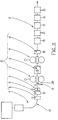
- FIG. 3 shows an example of a family tree Carrying out the process suitable rolling mill system.
- she owns an upstream system unit 1 in the form of a continuous casting system for the production of continuous cast and for forging rolling thermally prepared billet 20 made from the endless cast strand 10 can be cut to length with scissors 11.
- the facility also shows in a preparatory part a roughing stand 2 for pre-calibration and then for smoothing a duo-horizontal frame 3 with subordinate Vertical smoothing scaffold 4.
- Essential elements for that Forging rolls are the following two universal stands 5 and 7 preferably with smooth cylindrical rollers, between which there are a device 6 for preferably inductively heating the billets 20 is located. This can be followed by a duo frame 8 for smoothing be.
- FIG. 3 further shows, there is one in the system of the Vorstrasse 15 Finishing line 9, not specifically identified, with, for example, five finishing stands subordinate.
- the core is compacted into these by forging rolls Steel bars introduced hot and rolled in a heat.
Landscapes
- Engineering & Computer Science (AREA)
- Mechanical Engineering (AREA)
- Metal Rolling (AREA)
- Forging (AREA)
- Reduction Rolling/Reduction Stand/Operation Of Reduction Machine (AREA)
- Heat Treatment Of Steel (AREA)
Abstract
Description
- zumindest einen zweigerüstigen Block zum Vorkalibrieren von Stranggusslangprodukten, wie gegossene Knüppel,
- wenigstens ein Duo-Horizontal- oder Duo-Vertikal-Gerüst zum Glätten der zu verformenden Knüppeloberfläche,
- wenigstens ein Vierwalzengerüst mit Mitteln zum Führen und Wenden der Knüppel,
- Mittel zum bevorzugt induktiven Zwischenerwärmen der Knüppel.
- Figur 1
- im Querschnitt einen als Ausgangsmaterial vorgesehenen Stranggussknüppel;
- Figur 2
- im Querschnitt den Knüppel um 45° gedreht zwischen einem Paar Horizontalwalzen;
- Figur 3
- einen Stammbaum einer Walzwerksanlage zum Durchführen des erfindungsgemäßen Verfahrens.
Claims (18)
- Verfahren zur Herstellung von Stabstahl mit verfeinertem und/oder verdichtetem Gefüge,
dadurch gekennzeichnet,
daß als Ausgangsmaterial Stranggusslangprodukte (20) von schmiedbarer Stahlqualität mit annährend quadratischem Querschnitt und abgeschrägten Eckenbereichen (21) eingesetzt werden und diese bei Schmiedehitze oberhalb der Umwandlungstemperatur durch kontinuierliches, drallfreies Umformen abwechselnd in mindestens einem Zweiwalzengerüst (2,3) und/oder mindestens einem Vierwalzengerüst (5, 7) bei vergleichsweise geringer Längung des Walzproduktes einem mehrstufigen Umformungsprozess mit vergleichweise sehr hohen Walzkräften zu einem kernverdichteten Walzprodukt unterzogen werden. - Verfahren nach Anspruch 1,
dadurch gekennzeichnet,
dass das Umformen (Schmiedewalzen) durch Niederwalzen von Eckbereichen (21) der Knüppel (20) in wenigstens einem Vierwalzengerüst (5, 7) mit so hoher Walzkraft erfolgt, dass die dabei entstehenden und bspw. im Schliffbild erkennbaren Verdichtungs-Druckspannungen (30) bis in die Kernzone wirksam sind. - Verfahren nach Anspruch 1 oder 2,
dadurch gekennzeichnet,
dass es bei einem Walzgut mit maximal 480 cm2 entsprechend bspw. einem quadratischen Querschnitt von ca. 22 cm Kantenlänge und bei einem unlegierten bzw. schwach legierten Vergütungsstahl mit einem C-Gehalt von 0,1 bis 0,3% durchgeführt wird. - Verfahren nach einem oder mehreren der Ansprüche 1 bis 3,
dadurch gekennzeichnet,
dass die Knüppel (20) nach Erstarrung des Gussstranges (10), Temperaturausgleich und Erwärmen auf eine vorgesehene Schmiedewalztemperatur vorkalibriert und dabei die Knüppelflanken (21) konkav verformt (23) werden. - Verfahren nach einem oder mehreren der Ansprüche 1 bis 4,
dadurch gekennzeichnet,
daß die vorkalibrierten Knüppel (20) bevorzugt in einer Kombination aus Horizontalwalzgerüst (13) und/oder Vertikalwalzgerüst (4) geglättet und unmittelbar anschließend in das bzw. die Vierwalzengerüste (5, 7) eingeführt und darin durch Schmiedewalzen verformt werden. - Verfahren nach einem oder mehreren der Ansprüche 1 bis 5,
dadurch gekennzeichnet,
dass nach Maßgabe des zu erreichenden Grades der Gefügeverdichtung Umformungen des Walzgutes durch einander unmittelbar folgende Stiche in jeweils einer Folge von Zweiwalzengerüsten und Vierwalzengerüsten (3, 4, 5, 7, 8) vorgenommen werden. - Verfahren nach einem oder mehreren der Ansprüche 1 bis 6,
dadurch gekennzeichnet,
dass eine nach Maßgabe der Walzguttemperatur an der Einlaufseite eines Gerüstes (7) erforderliche Anhebung der Walztemperatur bevorzugt durch Mittel (6) zur Induktionserwärmung vorgenommen wird. - Verfahren nach einem oder mehreren der Ansprüche 1 bis 7,
dadurch gekennzeichnet,
dass das Schmiedewalzen unter Verwendung von vergleichsweise sehr biegesteifen Walzgerüsten (5, 7) mit bevorzugt zylindrischen Walzen (4, 14) von vergleichsweise geringem Durchmesser durchgeführt wird. - Verfahren nach einem der mehreren der Ansprüche 1 bis 8,
dadurch gekennzeichnet,
dass für das Schmiedewalzen wenigstens ein Vierwalzengerüst (5, 7) mit vier angetriebenen Walzen (4, 14) verwendet wird. - Verfahren nach einem oder mehreren der Ansprüche 1 bis 9,
dadurch gekennzeichnet,
dass für das Schmiedewalzen wenigstens ein Vierwalzengerüst (5, 7) mit zwei angetriebenen Walzen (4 bzw. 14) verwendet wird, bspw. mit zwei angetriebenen Horizontalwalzen und zwei nicht angetriebenen Vertikalwalzen. - Verfahren nach einem oder mehreren der Ansprüche 1 bis 10,
dadurch gekennzeichnet,
dass die Knüppel (20) zumindest beim ersten Stich für das Niederwalzen der Eckbereich (21) in einem Zweiwalzengerüst (3, 4) oder Vierwalzengerüst (5, 7) in eine Diagonalstellung unter 45° gebracht werden. - Verfahren nach einem oder mehreren der Ansprüche 1 bis 11,
dadurch gekennzeichnet,
dass die Knüppel (20) für jeden Folgestich um 45° gedreht werden. - Verfahren nach einem oder mehreren der Ansprüche 1 bis 12, insbesondere nach Anspruch 5
dadurch gekennzeichnet,
dass der Glättstich in den Zweiwalzen-Horizontalgerüst bzw in dem Zweiwalzen-Vertikalgerüst etwa 10% beträgt und dass das Schmiedewalzen in dem Vierwalzengerüst mit einer Stichabnahme von 30% bis 60% erfolgt. - Verfahren nach einem oder mehreren der Ansprüche 1 bis 13,
dadurch gekennzeichnet,
dass Strangussknüppel (20) in der Vorstraße (15) einer Walzwerksanlage zu Stabstahl mit durch Schmiedewalzen verfeinertem und/oder verdichtetem Gefüge (30) verarbeitet wird und dass der walzwarme Stabstahl unmittelbar anschließend in einer Zwischen- oder Fertigstraße (9) der Walzwerksanlage zu einem kalibrierten bzw. profilierten Endprodukt fertiggewalzt wird. - Walzwerksanlage mit einem Anlagenteil zur Herstellung von Stabstahl mit verfeinertem und/oder verdichtetem Gefüge (30), insbesondere zur Durchführung des Verfahrens nach der Erfindung gemäß den Ansprüchen 1 bis 14,
dadurch gekennzeichnet,
dass der Anlagenteil zur Herstellung von schmiedegewalztem Stabstahl eine Vorstraße (15) ist, welche die folgenden oder zumindest einige der folgenden Umformmittel aufweist:zumindest einen zweigerüstigen Block (2) zum Vorkalibrieren von Stranggusslangprodukten wie gegossene Knüppel,wenigstens ein Duo-Horizontalgerüst (4) oder ein Duo-Vertikal-Gerüst (3)zum Glätten der zu verformenden Knüppeloberfläche, und/oderwenigstens ein Vierwalzengerüst (5, 7) mit Mitteln zum Führen und Wenden der Knüppel (20),Mittel (6) zum bevorzugt induktiven Zwischenerwärmen der Knüppel (20). - Walzwerksanlage nach Anspruch 15,
dadurch gekennzeichnet,
dass der Vorstraße (15) eine Zwischen- oder Fertigstraße (9) unmittelbar nachgeordnet ist. - Walzwerksanlage nach Anspruch 15 oder 16,
dadurch gekennzeichnet,
dass der Vorstraße (15) eine Gießanlage für die Produktion stranggegossener und für das Schmiedewalzen thermisch vorbereiteter Langprodukte wie bspw. Knüppel vorgeordnet ist. - Walzwerksanlage nach Anspruch 16 oder 17,
dadurch gekennzeichnet,
dass das Zweiwalzengerüst (3, 4) ein übliches Duo-Horizontalgerüst bzw. Duo-Vertikalgerüst und das Vierwalzengerüst ein Universalgerüst ist, jeweils mit glatten Walzen ausgerüstet.
Applications Claiming Priority (2)
| Application Number | Priority Date | Filing Date | Title |
|---|---|---|---|
| DE19654063A DE19654063A1 (de) | 1996-12-23 | 1996-12-23 | Verfahren und Anlage zur Herstellung von Stabstahl mit durch Schmiedewalzen verfeinertem und/oder verdichtetem Gefüge |
| DE19654063 | 1996-12-23 |
Publications (2)
| Publication Number | Publication Date |
|---|---|
| EP0850701A1 true EP0850701A1 (de) | 1998-07-01 |
| EP0850701B1 EP0850701B1 (de) | 2001-11-28 |
Family
ID=7816045
Family Applications (1)
| Application Number | Title | Priority Date | Filing Date |
|---|---|---|---|
| EP97122109A Expired - Lifetime EP0850701B1 (de) | 1996-12-23 | 1997-12-16 | Verfahren und Anlage zur Herstellung von Stabstahl mit durch Schmiedewalzen verfeinertem und/oder verdichtetem Gefüge |
Country Status (5)
| Country | Link |
|---|---|
| US (1) | US5983481A (de) |
| EP (1) | EP0850701B1 (de) |
| JP (1) | JPH10211501A (de) |
| AT (1) | ATE209536T1 (de) |
| DE (2) | DE19654063A1 (de) |
Families Citing this family (5)
| Publication number | Priority date | Publication date | Assignee | Title |
|---|---|---|---|---|
| IT1400913B1 (it) * | 2010-06-24 | 2013-07-02 | Danieli Off Mecc | Procedimento e impianto di colata e laminazione per realizzare prodotti laminati metallici lunghi |
| WO2016027208A1 (en) | 2014-08-18 | 2016-02-25 | Bharat Forge Limited | A method of forging complex parts from continuous cast billets |
| KR102348556B1 (ko) | 2018-11-27 | 2022-01-06 | 주식회사 포스코 | 롤 포징 장치 |
| IT202000020434A1 (it) | 2020-08-26 | 2022-02-26 | Danieli Off Mecc | Processo e apparato per produrre prodotti siderurgici, in particolare di tipo merchant, in particolare in modalita’ endless |
| CN113231463A (zh) * | 2021-06-24 | 2021-08-10 | 西安盛日机电科技有限公司 | 无孔型技术轧制高速棒材的工艺方法 |
Citations (7)
| Publication number | Priority date | Publication date | Assignee | Title |
|---|---|---|---|---|
| US2066314A (en) * | 1935-02-21 | 1937-01-05 | Bartscherer Franz | Process of improving the structure of steel products |
| JPS5581004A (en) * | 1978-12-12 | 1980-06-18 | Nippon Steel Corp | Forming roll |
| EP0342403A2 (de) * | 1988-05-18 | 1989-11-23 | Sms Schloemann-Siemag Aktiengesellschaft | Kalibrierung für die Walzen von Walzgerüsten mit drei oder mehr Walzen |
| SU1623805A1 (ru) * | 1989-03-15 | 1991-01-30 | Производственное объединение "Уралмаш" | Способ прокатки заготовок |
| JPH04327301A (ja) * | 1991-04-30 | 1992-11-16 | Nkk Corp | ビレットの圧延方法 |
| JPH05337510A (ja) * | 1992-06-10 | 1993-12-21 | Daido Steel Co Ltd | 圧延方法 |
| JPH08174001A (ja) * | 1994-12-24 | 1996-07-09 | Sumitomo Heavy Ind Ltd | インライン型鋼材生産設備 |
Family Cites Families (1)
| Publication number | Priority date | Publication date | Assignee | Title |
|---|---|---|---|---|
| DE2014878B2 (de) * | 1970-04-01 | 1975-04-10 | Wsesojusnij Nautschno-Issledowatelskij I Projektno-Konstruktorskij Institut Metallurgitscheskowo Maschinostrojenija Moskau | Verfahren zum Walzen von gegossenem Metallgut mit gerader Zahl von Begrenzungsflächen |
-
1996
- 1996-12-23 DE DE19654063A patent/DE19654063A1/de not_active Withdrawn
-
1997
- 1997-12-16 EP EP97122109A patent/EP0850701B1/de not_active Expired - Lifetime
- 1997-12-16 AT AT97122109T patent/ATE209536T1/de not_active IP Right Cessation
- 1997-12-16 DE DE59705539T patent/DE59705539D1/de not_active Expired - Fee Related
- 1997-12-19 JP JP9351139A patent/JPH10211501A/ja active Pending
- 1997-12-23 US US08/996,847 patent/US5983481A/en not_active Expired - Fee Related
Patent Citations (7)
| Publication number | Priority date | Publication date | Assignee | Title |
|---|---|---|---|---|
| US2066314A (en) * | 1935-02-21 | 1937-01-05 | Bartscherer Franz | Process of improving the structure of steel products |
| JPS5581004A (en) * | 1978-12-12 | 1980-06-18 | Nippon Steel Corp | Forming roll |
| EP0342403A2 (de) * | 1988-05-18 | 1989-11-23 | Sms Schloemann-Siemag Aktiengesellschaft | Kalibrierung für die Walzen von Walzgerüsten mit drei oder mehr Walzen |
| SU1623805A1 (ru) * | 1989-03-15 | 1991-01-30 | Производственное объединение "Уралмаш" | Способ прокатки заготовок |
| JPH04327301A (ja) * | 1991-04-30 | 1992-11-16 | Nkk Corp | ビレットの圧延方法 |
| JPH05337510A (ja) * | 1992-06-10 | 1993-12-21 | Daido Steel Co Ltd | 圧延方法 |
| JPH08174001A (ja) * | 1994-12-24 | 1996-07-09 | Sumitomo Heavy Ind Ltd | インライン型鋼材生産設備 |
Non-Patent Citations (5)
| Title |
|---|
| DATABASE WPI Section Ch Week 9201, Derwent World Patents Index; Class M21, AN 92-005268, XP002057900 * |
| PATENT ABSTRACTS OF JAPAN vol. 004, no. 123 (M - 029) 30 August 1980 (1980-08-30) * |
| PATENT ABSTRACTS OF JAPAN vol. 017, no. 164 (M - 1390) 30 March 1993 (1993-03-30) * |
| PATENT ABSTRACTS OF JAPAN vol. 018, no. 168 (M - 1580) 22 March 1994 (1994-03-22) * |
| PATENT ABSTRACTS OF JAPAN vol. 096, no. 011 29 November 1996 (1996-11-29) * |
Also Published As
| Publication number | Publication date |
|---|---|
| ATE209536T1 (de) | 2001-12-15 |
| US5983481A (en) | 1999-11-16 |
| EP0850701B1 (de) | 2001-11-28 |
| JPH10211501A (ja) | 1998-08-11 |
| DE59705539D1 (de) | 2002-01-10 |
| DE19654063A1 (de) | 1998-06-25 |
Similar Documents
| Publication | Publication Date | Title |
|---|---|---|
| EP0256409B2 (de) | Verfahren zur Herstellung von Formstahl | |
| DE2714485C2 (de) | Verfahren zum Warmwalzen von Doppel-T-Trägern aus rechteckigem Flachmaterial | |
| DE69202088T2 (de) | Vorrichtung und Verfahren zur Herstellung von warmgewalztem Stahl. | |
| DE69710159T2 (de) | Verfahren und einrichtung zum herstellen nahtloser stahlrohre | |
| DE69211869T2 (de) | Verfahren zum Walzen von Stahlprofilen | |
| EP0666122A1 (de) | Verfahren und Anlage zur Herstellung von warmgewalztem Stahlband aus stranggegossenem Vormaterial | |
| DD280978A5 (de) | Verfahren zur herstellung von rohren, staeben, baendern aus nichteisenmetallen | |
| EP0265757B1 (de) | Verfahren und Anordnung zum Walzen von stranggegossenen Profilen | |
| EP1414597A1 (de) | Vorrichtung und arbeitsverfahren zum automatischen wechseln der arbeits-, stütz- und zwischenwalzen eines ein- oder mehrgerüstigen bandwalzwerkes | |
| DD154106A5 (de) | Verfahren und vorrichtung zum stranggiessen und anschliessenden warmwalzen eines kupferstranges | |
| EP0850701B1 (de) | Verfahren und Anlage zur Herstellung von Stabstahl mit durch Schmiedewalzen verfeinertem und/oder verdichtetem Gefüge | |
| DE2114346A1 (de) | Verfahren und Vorrichtung zum Vorwalzen von Brammen bezueglich ihrer Breite | |
| DE3839151A1 (de) | Verfahren zum herstellen von warmgewalztem stahlband aus einem bandfoermig stranggegossenem vormaterial | |
| DE3239655A1 (de) | Vorprofile, ihre herstellungsverfahren und auf das universal-walzen von schienen anwendbare weiterentwicklungen | |
| DE2757071A1 (de) | Verfahren zum walzen von knueppeln | |
| EP0535767B1 (de) | Walzstrasse zum Walzen von Trägerprofilen | |
| DE2514783A1 (de) | Verfahren und vorrichtung zum walzen von metall | |
| EP0734792A2 (de) | Universalgerüstgruppe und VErfahren zum Walzen von stranggegossenen Vorprofilen | |
| EP0449004A2 (de) | Verfahren und Anlage zur Herstellung von warmgewalztem Stahlband, insbesondere für Edelstähle aus bandförmig stranggegossenem Vormaterial | |
| DE2529405A1 (de) | Verfahren zum profilwalzen | |
| EP0560115A1 (de) | Verfahren und Walzwerk zum Präzisionswalzen von Draht bzw. von Walzgut mit Rundquerschnitt | |
| EP0845310A1 (de) | Drahtkühlung | |
| EP0272520A2 (de) | Verfahren und Reversierstrasse zum Walzen, insbesondere von Spundbohlen | |
| DE69211492T2 (de) | Verfahren zur Herstellung von Stahlbrammen mit quadratischem Querschnitt und danach hergestellte Brammen | |
| DE69623208T2 (de) | Verfahren und vorrichtung zum warmwalzen von h-stahlträgern |
Legal Events
| Date | Code | Title | Description |
|---|---|---|---|
| PUAI | Public reference made under article 153(3) epc to a published international application that has entered the european phase |
Free format text: ORIGINAL CODE: 0009012 |
|
| 17P | Request for examination filed |
Effective date: 19980114 |
|
| AK | Designated contracting states |
Kind code of ref document: A1 Designated state(s): AT DE FR GB IT SE |
|
| AX | Request for extension of the european patent |
Free format text: AL;LT;LV;MK;RO;SI |
|
| AKX | Designation fees paid |
Free format text: AT DE FR GB IT SE |
|
| RBV | Designated contracting states (corrected) |
Designated state(s): AT DE FR GB IT SE |
|
| RAP1 | Party data changed (applicant data changed or rights of an application transferred) |
Owner name: SMS DEMAG AG |
|
| 17Q | First examination report despatched |
Effective date: 20000630 |
|
| GRAG | Despatch of communication of intention to grant |
Free format text: ORIGINAL CODE: EPIDOS AGRA |
|
| GRAG | Despatch of communication of intention to grant |
Free format text: ORIGINAL CODE: EPIDOS AGRA |
|
| GRAH | Despatch of communication of intention to grant a patent |
Free format text: ORIGINAL CODE: EPIDOS IGRA |
|
| GRAH | Despatch of communication of intention to grant a patent |
Free format text: ORIGINAL CODE: EPIDOS IGRA |
|
| GRAA | (expected) grant |
Free format text: ORIGINAL CODE: 0009210 |
|
| AK | Designated contracting states |
Kind code of ref document: B1 Designated state(s): AT DE FR GB IT SE |
|
| REF | Corresponds to: |
Ref document number: 209536 Country of ref document: AT Date of ref document: 20011215 Kind code of ref document: T |
|
| PGFP | Annual fee paid to national office [announced via postgrant information from national office to epo] |
Ref country code: FR Payment date: 20011218 Year of fee payment: 5 |
|
| REG | Reference to a national code |
Ref country code: GB Ref legal event code: IF02 |
|
| REF | Corresponds to: |
Ref document number: 59705539 Country of ref document: DE Date of ref document: 20020110 |
|
| ET | Fr: translation filed | ||
| GBT | Gb: translation of ep patent filed (gb section 77(6)(a)/1977) |
Effective date: 20020306 |
|
| PLBE | No opposition filed within time limit |
Free format text: ORIGINAL CODE: 0009261 |
|
| STAA | Information on the status of an ep patent application or granted ep patent |
Free format text: STATUS: NO OPPOSITION FILED WITHIN TIME LIMIT |
|
| 26N | No opposition filed | ||
| PG25 | Lapsed in a contracting state [announced via postgrant information from national office to epo] |
Ref country code: FR Free format text: LAPSE BECAUSE OF NON-PAYMENT OF DUE FEES Effective date: 20030901 |
|
| REG | Reference to a national code |
Ref country code: FR Ref legal event code: ST |
|
| PGFP | Annual fee paid to national office [announced via postgrant information from national office to epo] |
Ref country code: GB Payment date: 20031126 Year of fee payment: 7 |
|
| PGFP | Annual fee paid to national office [announced via postgrant information from national office to epo] |
Ref country code: AT Payment date: 20031201 Year of fee payment: 7 |
|
| PGFP | Annual fee paid to national office [announced via postgrant information from national office to epo] |
Ref country code: SE Payment date: 20031202 Year of fee payment: 7 |
|
| PGFP | Annual fee paid to national office [announced via postgrant information from national office to epo] |
Ref country code: DE Payment date: 20031205 Year of fee payment: 7 |
|
| PG25 | Lapsed in a contracting state [announced via postgrant information from national office to epo] |
Ref country code: GB Free format text: LAPSE BECAUSE OF NON-PAYMENT OF DUE FEES Effective date: 20041216 Ref country code: AT Free format text: LAPSE BECAUSE OF NON-PAYMENT OF DUE FEES Effective date: 20041216 |
|
| PG25 | Lapsed in a contracting state [announced via postgrant information from national office to epo] |
Ref country code: SE Free format text: LAPSE BECAUSE OF NON-PAYMENT OF DUE FEES Effective date: 20041217 |
|
| PG25 | Lapsed in a contracting state [announced via postgrant information from national office to epo] |
Ref country code: DE Free format text: LAPSE BECAUSE OF NON-PAYMENT OF DUE FEES Effective date: 20050701 |
|
| EUG | Se: european patent has lapsed | ||
| GBPC | Gb: european patent ceased through non-payment of renewal fee |
Effective date: 20041216 |
|
| PG25 | Lapsed in a contracting state [announced via postgrant information from national office to epo] |
Ref country code: IT Free format text: LAPSE BECAUSE OF NON-PAYMENT OF DUE FEES Effective date: 20051216 |