EP0850945B1 - Diphosphine chirale, intermédiaires pour sa préparation, complexes de ladite diphosphine avec des métaux de transition et catalyseur d'hydrogénation asymétrique - Google Patents
Diphosphine chirale, intermédiaires pour sa préparation, complexes de ladite diphosphine avec des métaux de transition et catalyseur d'hydrogénation asymétrique Download PDFInfo
- Publication number
- EP0850945B1 EP0850945B1 EP97403152A EP97403152A EP0850945B1 EP 0850945 B1 EP0850945 B1 EP 0850945B1 EP 97403152 A EP97403152 A EP 97403152A EP 97403152 A EP97403152 A EP 97403152A EP 0850945 B1 EP0850945 B1 EP 0850945B1
- Authority
- EP
- European Patent Office
- Prior art keywords
- group
- compound
- formula
- transition metal
- bis
- Prior art date
- Legal status (The legal status is an assumption and is not a legal conclusion. Google has not performed a legal analysis and makes no representation as to the accuracy of the status listed.)
- Expired - Lifetime
Links
- -1 diphosphine compound Chemical class 0.000 title claims description 28
- 229910052723 transition metal Inorganic materials 0.000 title claims description 27
- 150000003624 transition metals Chemical class 0.000 title claims description 27
- VURFVHCLMJOLKN-UHFFFAOYSA-N Diphosphine Natural products PP VURFVHCLMJOLKN-UHFFFAOYSA-N 0.000 title claims description 21
- 238000009876 asymmetric hydrogenation reaction Methods 0.000 title claims description 12
- 239000003054 catalyst Substances 0.000 title claims description 12
- 239000003446 ligand Substances 0.000 title claims description 10
- 150000001875 compounds Chemical class 0.000 claims description 53
- KDLHZDBZIXYQEI-UHFFFAOYSA-N Palladium Chemical compound [Pd] KDLHZDBZIXYQEI-UHFFFAOYSA-N 0.000 claims description 30
- 239000010948 rhodium Substances 0.000 claims description 28
- UHOVQNZJYSORNB-UHFFFAOYSA-N Benzene Chemical compound C1=CC=CC=C1 UHOVQNZJYSORNB-UHFFFAOYSA-N 0.000 claims description 21
- PXHVJJICTQNCMI-UHFFFAOYSA-N Nickel Chemical compound [Ni] PXHVJJICTQNCMI-UHFFFAOYSA-N 0.000 claims description 21
- 239000002904 solvent Substances 0.000 claims description 19
- HFPZCAJZSCWRBC-UHFFFAOYSA-N p-cymene Chemical compound CC(C)C1=CC=C(C)C=C1 HFPZCAJZSCWRBC-UHFFFAOYSA-N 0.000 claims description 17
- 125000001997 phenyl group Chemical group [H]C1=C([H])C([H])=C(*)C([H])=C1[H] 0.000 claims description 14
- 229910052740 iodine Inorganic materials 0.000 claims description 13
- 229910052801 chlorine Inorganic materials 0.000 claims description 12
- 229910001914 chlorine tetroxide Inorganic materials 0.000 claims description 12
- VLTRZXGMWDSKGL-UHFFFAOYSA-M perchlorate Chemical compound [O-]Cl(=O)(=O)=O VLTRZXGMWDSKGL-UHFFFAOYSA-M 0.000 claims description 12
- 229910052703 rhodium Inorganic materials 0.000 claims description 12
- MHOVAHRLVXNVSD-UHFFFAOYSA-N rhodium atom Chemical compound [Rh] MHOVAHRLVXNVSD-UHFFFAOYSA-N 0.000 claims description 12
- 229910052741 iridium Inorganic materials 0.000 claims description 11
- 238000000034 method Methods 0.000 claims description 11
- 229910052763 palladium Inorganic materials 0.000 claims description 11
- ZMANZCXQSJIPKH-UHFFFAOYSA-N Triethylamine Chemical compound CCN(CC)CC ZMANZCXQSJIPKH-UHFFFAOYSA-N 0.000 claims description 10
- 229910052794 bromium Inorganic materials 0.000 claims description 10
- GKOZUEZYRPOHIO-UHFFFAOYSA-N iridium atom Chemical compound [Ir] GKOZUEZYRPOHIO-UHFFFAOYSA-N 0.000 claims description 10
- 229910052759 nickel Inorganic materials 0.000 claims description 10
- 229910052707 ruthenium Inorganic materials 0.000 claims description 9
- KJTLSVCANCCWHF-UHFFFAOYSA-N Ruthenium Chemical compound [Ru] KJTLSVCANCCWHF-UHFFFAOYSA-N 0.000 claims description 8
- 239000012327 Ruthenium complex Substances 0.000 claims description 8
- 229910052739 hydrogen Inorganic materials 0.000 claims description 8
- 239000001257 hydrogen Substances 0.000 claims description 8
- 125000004178 (C1-C4) alkyl group Chemical group 0.000 claims description 7
- 125000000753 cycloalkyl group Chemical group 0.000 claims description 7
- 125000001072 heteroaryl group Chemical group 0.000 claims description 7
- 125000004435 hydrogen atom Chemical group [H]* 0.000 claims description 7
- XYFCBTPGUUZFHI-UHFFFAOYSA-N Phosphine Natural products P XYFCBTPGUUZFHI-UHFFFAOYSA-N 0.000 claims description 6
- 229910052717 sulfur Inorganic materials 0.000 claims description 6
- 125000000229 (C1-C4)alkoxy group Chemical group 0.000 claims description 5
- UFHFLCQGNIYNRP-UHFFFAOYSA-N Hydrogen Chemical compound [H][H] UFHFLCQGNIYNRP-UHFFFAOYSA-N 0.000 claims description 5
- 125000005843 halogen group Chemical group 0.000 claims description 5
- 125000002496 methyl group Chemical group [H]C([H])([H])* 0.000 claims description 5
- 229910000073 phosphorus hydride Inorganic materials 0.000 claims description 5
- 239000004912 1,5-cyclooctadiene Substances 0.000 claims description 4
- VYXHVRARDIDEHS-UHFFFAOYSA-N 1,5-cyclooctadiene Chemical compound C1CC=CCCC=C1 VYXHVRARDIDEHS-UHFFFAOYSA-N 0.000 claims description 3
- 125000002777 acetyl group Chemical group [H]C([H])([H])C(*)=O 0.000 claims description 3
- SJYNFBVQFBRSIB-UHFFFAOYSA-N norbornadiene Chemical compound C1=CC2C=CC1C2 SJYNFBVQFBRSIB-UHFFFAOYSA-N 0.000 claims description 3
- NAWXUBYGYWOOIX-SFHVURJKSA-N (2s)-2-[[4-[2-(2,4-diaminoquinazolin-6-yl)ethyl]benzoyl]amino]-4-methylidenepentanedioic acid Chemical compound C1=CC2=NC(N)=NC(N)=C2C=C1CCC1=CC=C(C(=O)N[C@@H](CC(=C)C(O)=O)C(O)=O)C=C1 NAWXUBYGYWOOIX-SFHVURJKSA-N 0.000 claims description 2
- 125000001301 ethoxy group Chemical group [H]C([H])([H])C([H])([H])O* 0.000 claims description 2
- 125000001495 ethyl group Chemical group [H]C([H])([H])C([H])([H])* 0.000 claims description 2
- 229910052736 halogen Inorganic materials 0.000 claims description 2
- 150000002367 halogens Chemical class 0.000 claims description 2
- 150000002431 hydrogen Chemical group 0.000 claims description 2
- 125000003253 isopropoxy group Chemical group [H]C([H])([H])C([H])(O*)C([H])([H])[H] 0.000 claims description 2
- 125000001449 isopropyl group Chemical group [H]C([H])([H])C([H])(*)C([H])([H])[H] 0.000 claims description 2
- 125000000956 methoxy group Chemical group [H]C([H])([H])O* 0.000 claims description 2
- 125000004108 n-butyl group Chemical group [H]C([H])([H])C([H])([H])C([H])([H])C([H])([H])* 0.000 claims description 2
- 125000004123 n-propyl group Chemical group [H]C([H])([H])C([H])([H])C([H])([H])* 0.000 claims description 2
- 125000000999 tert-butyl group Chemical group [H]C([H])([H])C(*)(C([H])([H])[H])C([H])([H])[H] 0.000 claims description 2
- 229910052727 yttrium Inorganic materials 0.000 claims description 2
- XEKOWRVHYACXOJ-UHFFFAOYSA-N Ethyl acetate Chemical compound CCOC(C)=O XEKOWRVHYACXOJ-UHFFFAOYSA-N 0.000 description 36
- HEDRZPFGACZZDS-MICDWDOJSA-N Trichloro(2H)methane Chemical compound [2H]C(Cl)(Cl)Cl HEDRZPFGACZZDS-MICDWDOJSA-N 0.000 description 34
- WYURNTSHIVDZCO-UHFFFAOYSA-N Tetrahydrofuran Chemical compound C1CCOC1 WYURNTSHIVDZCO-UHFFFAOYSA-N 0.000 description 32
- 238000003756 stirring Methods 0.000 description 28
- YMWUJEATGCHHMB-UHFFFAOYSA-N Dichloromethane Chemical compound ClCCl YMWUJEATGCHHMB-UHFFFAOYSA-N 0.000 description 21
- YXFVVABEGXRONW-UHFFFAOYSA-N Toluene Chemical compound CC1=CC=CC=C1 YXFVVABEGXRONW-UHFFFAOYSA-N 0.000 description 21
- VLKZOEOYAKHREP-UHFFFAOYSA-N n-Hexane Chemical compound CCCCCC VLKZOEOYAKHREP-UHFFFAOYSA-N 0.000 description 18
- 238000006243 chemical reaction Methods 0.000 description 16
- HEDRZPFGACZZDS-UHFFFAOYSA-N Chloroform Chemical compound ClC(Cl)Cl HEDRZPFGACZZDS-UHFFFAOYSA-N 0.000 description 14
- VEXZGXHMUGYJMC-UHFFFAOYSA-N Hydrochloric acid Chemical compound Cl VEXZGXHMUGYJMC-UHFFFAOYSA-N 0.000 description 12
- HEMHJVSKTPXQMS-UHFFFAOYSA-M Sodium hydroxide Chemical compound [OH-].[Na+] HEMHJVSKTPXQMS-UHFFFAOYSA-M 0.000 description 12
- 239000000203 mixture Substances 0.000 description 12
- LFQSCWFLJHTTHZ-UHFFFAOYSA-N Ethanol Chemical compound CCO LFQSCWFLJHTTHZ-UHFFFAOYSA-N 0.000 description 11
- FAPWRFPIFSIZLT-UHFFFAOYSA-M Sodium chloride Chemical class [Na+].[Cl-] FAPWRFPIFSIZLT-UHFFFAOYSA-M 0.000 description 11
- 238000005160 1H NMR spectroscopy Methods 0.000 description 10
- 238000004679 31P NMR spectroscopy Methods 0.000 description 10
- IJGRMHOSHXDMSA-UHFFFAOYSA-N nitrogen Substances N#N IJGRMHOSHXDMSA-UHFFFAOYSA-N 0.000 description 10
- OKKJLVBELUTLKV-UHFFFAOYSA-N Methanol Chemical compound OC OKKJLVBELUTLKV-UHFFFAOYSA-N 0.000 description 9
- ZMXDDKWLCZADIW-UHFFFAOYSA-N N,N-Dimethylformamide Chemical compound CN(C)C=O ZMXDDKWLCZADIW-UHFFFAOYSA-N 0.000 description 9
- RZZDRSHFIVOQAF-UHFFFAOYSA-N [4-(5-diphenylphosphanyl-1,3-benzodioxol-4-yl)-1,3-benzodioxol-5-yl]-diphenylphosphane Chemical compound C=12OCOC2=CC=C(P(C=2C=CC=CC=2)C=2C=CC=CC=2)C=1C1=C2OCOC2=CC=C1P(C=1C=CC=CC=1)C1=CC=CC=C1 RZZDRSHFIVOQAF-UHFFFAOYSA-N 0.000 description 9
- 238000003786 synthesis reaction Methods 0.000 description 9
- 230000015572 biosynthetic process Effects 0.000 description 8
- AUONHKJOIZSQGR-UHFFFAOYSA-N oxophosphane Chemical compound P=O AUONHKJOIZSQGR-UHFFFAOYSA-N 0.000 description 8
- XLYOFNOQVPJJNP-UHFFFAOYSA-N water Substances O XLYOFNOQVPJJNP-UHFFFAOYSA-N 0.000 description 8
- 238000001816 cooling Methods 0.000 description 7
- NLXLAEXVIDQMFP-UHFFFAOYSA-N Ammonia chloride Chemical class [NH4+].[Cl-] NLXLAEXVIDQMFP-UHFFFAOYSA-N 0.000 description 6
- CSNNHWWHGAXBCP-UHFFFAOYSA-L Magnesium sulfate Chemical compound [Mg+2].[O-][S+2]([O-])([O-])[O-] CSNNHWWHGAXBCP-UHFFFAOYSA-L 0.000 description 6
- 238000004128 high performance liquid chromatography Methods 0.000 description 6
- ZCSHNCUQKCANBX-UHFFFAOYSA-N lithium diisopropylamide Chemical compound [Li+].CC(C)[N-]C(C)C ZCSHNCUQKCANBX-UHFFFAOYSA-N 0.000 description 6
- 229910052757 nitrogen Inorganic materials 0.000 description 6
- 230000003287 optical effect Effects 0.000 description 6
- 238000010898 silica gel chromatography Methods 0.000 description 6
- 239000007787 solid Substances 0.000 description 6
- FBOYMIDCHINJKC-UHFFFAOYSA-N 5-bromo-1,3-benzodioxole Chemical compound BrC1=CC=C2OCOC2=C1 FBOYMIDCHINJKC-UHFFFAOYSA-N 0.000 description 5
- KFZMGEQAYNKOFK-UHFFFAOYSA-N Isopropanol Chemical compound CC(C)O KFZMGEQAYNKOFK-UHFFFAOYSA-N 0.000 description 5
- MUALRAIOVNYAIW-UHFFFAOYSA-N binap Chemical group C1=CC=CC=C1P(C=1C(=C2C=CC=CC2=CC=1)C=1C2=CC=CC=C2C=CC=1P(C=1C=CC=CC=1)C=1C=CC=CC=1)C1=CC=CC=C1 MUALRAIOVNYAIW-UHFFFAOYSA-N 0.000 description 5
- ZUOUZKKEUPVFJK-UHFFFAOYSA-N diphenyl Chemical group C1=CC=CC=C1C1=CC=CC=C1 ZUOUZKKEUPVFJK-UHFFFAOYSA-N 0.000 description 5
- 238000010438 heat treatment Methods 0.000 description 5
- 239000011541 reaction mixture Substances 0.000 description 5
- YFPJFKYCVYXDJK-UHFFFAOYSA-N Diphenylphosphine oxide Chemical compound C=1C=CC=CC=1[P+](=O)C1=CC=CC=C1 YFPJFKYCVYXDJK-UHFFFAOYSA-N 0.000 description 4
- 235000010290 biphenyl Nutrition 0.000 description 4
- 239000004305 biphenyl Substances 0.000 description 4
- 239000003480 eluent Substances 0.000 description 4
- 239000010410 layer Substances 0.000 description 4
- 239000011777 magnesium Substances 0.000 description 4
- 239000012044 organic layer Substances 0.000 description 4
- 238000002360 preparation method Methods 0.000 description 4
- VZGDMQKNWNREIO-UHFFFAOYSA-N tetrachloromethane Chemical compound ClC(Cl)(Cl)Cl VZGDMQKNWNREIO-UHFFFAOYSA-N 0.000 description 4
- YLQBMQCUIZJEEH-UHFFFAOYSA-N tetrahydrofuran Natural products C=1C=COC=1 YLQBMQCUIZJEEH-UHFFFAOYSA-N 0.000 description 4
- 238000001291 vacuum drying Methods 0.000 description 4
- YONLFQNRGZXBBF-ZIAGYGMSSA-N (2r,3r)-2,3-dibenzoyloxybutanedioic acid Chemical compound O([C@@H](C(=O)O)[C@@H](OC(=O)C=1C=CC=CC=1)C(O)=O)C(=O)C1=CC=CC=C1 YONLFQNRGZXBBF-ZIAGYGMSSA-N 0.000 description 3
- BTZNHPDWCLTVDH-UHFFFAOYSA-N 5-diphenylphosphoryl-1,3-benzodioxole Chemical compound C=1C=CC=CC=1P(C=1C=C2OCOC2=CC=1)(=O)C1=CC=CC=C1 BTZNHPDWCLTVDH-UHFFFAOYSA-N 0.000 description 3
- ZCYVEMRRCGMTRW-UHFFFAOYSA-N 7553-56-2 Chemical compound [I] ZCYVEMRRCGMTRW-UHFFFAOYSA-N 0.000 description 3
- RYGMFSIKBFXOCR-UHFFFAOYSA-N Copper Chemical compound [Cu] RYGMFSIKBFXOCR-UHFFFAOYSA-N 0.000 description 3
- FYYHWMGAXLPEAU-UHFFFAOYSA-N Magnesium Chemical compound [Mg] FYYHWMGAXLPEAU-UHFFFAOYSA-N 0.000 description 3
- QPQGTZMAQRXCJW-UHFFFAOYSA-N [chloro(phenyl)phosphoryl]benzene Chemical compound C=1C=CC=CC=1P(=O)(Cl)C1=CC=CC=C1 QPQGTZMAQRXCJW-UHFFFAOYSA-N 0.000 description 3
- 125000000217 alkyl group Chemical group 0.000 description 3
- 125000006267 biphenyl group Chemical group 0.000 description 3
- LMXRTXPFJNGAAX-UHFFFAOYSA-N bis(3,5-dimethylphenyl)-oxophosphanium Chemical compound CC1=CC(C)=CC([P+](=O)C=2C=C(C)C=C(C)C=2)=C1 LMXRTXPFJNGAAX-UHFFFAOYSA-N 0.000 description 3
- 230000003197 catalytic effect Effects 0.000 description 3
- 229910052802 copper Inorganic materials 0.000 description 3
- 239000010949 copper Substances 0.000 description 3
- 239000013078 crystal Substances 0.000 description 3
- GPAYUJZHTULNBE-UHFFFAOYSA-N diphenylphosphine Chemical compound C=1C=CC=CC=1PC1=CC=CC=C1 GPAYUJZHTULNBE-UHFFFAOYSA-N 0.000 description 3
- XLSMFKSTNGKWQX-UHFFFAOYSA-N hydroxyacetone Chemical compound CC(=O)CO XLSMFKSTNGKWQX-UHFFFAOYSA-N 0.000 description 3
- 239000011630 iodine Substances 0.000 description 3
- 229910052749 magnesium Inorganic materials 0.000 description 3
- 239000012046 mixed solvent Substances 0.000 description 3
- 125000002524 organometallic group Chemical group 0.000 description 3
- 239000000843 powder Substances 0.000 description 3
- 239000011780 sodium chloride Substances 0.000 description 3
- 125000001424 substituent group Chemical group 0.000 description 3
- ZDHXKXAHOVTTAH-UHFFFAOYSA-N trichlorosilane Chemical compound Cl[SiH](Cl)Cl ZDHXKXAHOVTTAH-UHFFFAOYSA-N 0.000 description 3
- 239000005052 trichlorosilane Substances 0.000 description 3
- JLTDJTHDQAWBAV-UHFFFAOYSA-N N,N-dimethylaniline Chemical compound CN(C)C1=CC=CC=C1 JLTDJTHDQAWBAV-UHFFFAOYSA-N 0.000 description 2
- 229910021586 Nickel(II) chloride Inorganic materials 0.000 description 2
- VYPSYNLAJGMNEJ-UHFFFAOYSA-N Silicium dioxide Chemical compound O=[Si]=O VYPSYNLAJGMNEJ-UHFFFAOYSA-N 0.000 description 2
- PMZURENOXWZQFD-UHFFFAOYSA-L Sodium Sulfate Chemical compound [Na+].[Na+].[O-]S([O-])(=O)=O PMZURENOXWZQFD-UHFFFAOYSA-L 0.000 description 2
- UIIMBOGNXHQVGW-UHFFFAOYSA-M Sodium bicarbonate Chemical class [Na+].OC([O-])=O UIIMBOGNXHQVGW-UHFFFAOYSA-M 0.000 description 2
- 235000019270 ammonium chloride Nutrition 0.000 description 2
- 239000007795 chemical reaction product Substances 0.000 description 2
- 238000007796 conventional method Methods 0.000 description 2
- 238000001035 drying Methods 0.000 description 2
- 238000002451 electron ionisation mass spectrometry Methods 0.000 description 2
- 238000001914 filtration Methods 0.000 description 2
- XMBWDFGMSWQBCA-UHFFFAOYSA-N hydrogen iodide Chemical compound I XMBWDFGMSWQBCA-UHFFFAOYSA-N 0.000 description 2
- 238000006317 isomerization reaction Methods 0.000 description 2
- 238000004949 mass spectrometry Methods 0.000 description 2
- QMMRZOWCJAIUJA-UHFFFAOYSA-L nickel dichloride Chemical compound Cl[Ni]Cl QMMRZOWCJAIUJA-UHFFFAOYSA-L 0.000 description 2
- QJGQUHMNIGDVPM-UHFFFAOYSA-N nitrogen group Chemical group [N] QJGQUHMNIGDVPM-UHFFFAOYSA-N 0.000 description 2
- 150000003003 phosphines Chemical class 0.000 description 2
- 238000010992 reflux Methods 0.000 description 2
- 150000003303 ruthenium Chemical class 0.000 description 2
- 239000000126 substance Substances 0.000 description 2
- VYXHVRARDIDEHS-QGTKBVGQSA-N (1z,5z)-cycloocta-1,5-diene Chemical compound C\1C\C=C/CC\C=C/1 VYXHVRARDIDEHS-QGTKBVGQSA-N 0.000 description 1
- ZZGBVIZFVUGNJX-UHFFFAOYSA-N 1,3-benzodioxol-5-yl(diphenyl)phosphane Chemical compound C1=C2OCOC2=CC=C1P(C=1C=CC=CC=1)C1=CC=CC=C1 ZZGBVIZFVUGNJX-UHFFFAOYSA-N 0.000 description 1
- QDWOIMWUGPSJMU-UHFFFAOYSA-N 1-chloro-4-(4-chlorophenyl)phosphonoylbenzene Chemical compound C1=CC(Cl)=CC=C1P(=O)C1=CC=C(Cl)C=C1 QDWOIMWUGPSJMU-UHFFFAOYSA-N 0.000 description 1
- AKHPZCUBCXFMPZ-UHFFFAOYSA-N 1-tert-butyl-4-(4-tert-butylphenyl)phosphonoylbenzene Chemical compound C1=CC(C(C)(C)C)=CC=C1P(=O)C1=CC=C(C(C)(C)C)C=C1 AKHPZCUBCXFMPZ-UHFFFAOYSA-N 0.000 description 1
- 125000002941 2-furyl group Chemical group O1C([*])=C([H])C([H])=C1[H] 0.000 description 1
- JSYUCISYJIGHOR-UHFFFAOYSA-N 2-methoxy-5-(4-methoxy-3,5-dimethylphenyl)phosphonoyl-1,3-dimethylbenzene Chemical compound C1=C(C)C(OC)=C(C)C=C1P(=O)C1=CC(C)=C(OC)C(C)=C1 JSYUCISYJIGHOR-UHFFFAOYSA-N 0.000 description 1
- PAORVUMOXXAMPL-UHFFFAOYSA-N 3,3,3-trifluoro-2-methoxy-2-phenylpropanoyl chloride Chemical compound COC(C(Cl)=O)(C(F)(F)F)C1=CC=CC=C1 PAORVUMOXXAMPL-UHFFFAOYSA-N 0.000 description 1
- 125000003682 3-furyl group Chemical group O1C([H])=C([*])C([H])=C1[H] 0.000 description 1
- HBAQYPYDRFILMT-UHFFFAOYSA-N 8-[3-(1-cyclopropylpyrazol-4-yl)-1H-pyrazolo[4,3-d]pyrimidin-5-yl]-3-methyl-3,8-diazabicyclo[3.2.1]octan-2-one Chemical class C1(CC1)N1N=CC(=C1)C1=NNC2=C1N=C(N=C2)N1C2C(N(CC1CC2)C)=O HBAQYPYDRFILMT-UHFFFAOYSA-N 0.000 description 1
- WEVYAHXRMPXWCK-UHFFFAOYSA-N Acetonitrile Chemical compound CC#N WEVYAHXRMPXWCK-UHFFFAOYSA-N 0.000 description 1
- 0 C*(c1cc(*)c(*)c(*)c1)Pc1ccc(*CO2)c2c1-c(c1c(cc2)OCO1)c2P*(C=C)c1cc(*)c(*)c(*)c1 Chemical compound C*(c1cc(*)c(*)c(*)c1)Pc1ccc(*CO2)c2c1-c(c1c(cc2)OCO1)c2P*(C=C)c1cc(*)c(*)c(*)c1 0.000 description 1
- HVDRQGAYNYKSCS-UHFFFAOYSA-N CC(C)(C)C1=CC(C(C)(C)C)=CC(P(=O)C=2C=C(C=C(C=2)C(C)(C)C)C(C)(C)C)=C1 Chemical compound CC(C)(C)C1=CC(C(C)(C)C)=CC(P(=O)C=2C=C(C=C(C=2)C(C)(C)C)C(C)(C)C)=C1 HVDRQGAYNYKSCS-UHFFFAOYSA-N 0.000 description 1
- VEXZGXHMUGYJMC-UHFFFAOYSA-M Chloride anion Chemical compound [Cl-] VEXZGXHMUGYJMC-UHFFFAOYSA-M 0.000 description 1
- ZAFNJMIOTHYJRJ-UHFFFAOYSA-N Diisopropyl ether Chemical compound CC(C)OC(C)C ZAFNJMIOTHYJRJ-UHFFFAOYSA-N 0.000 description 1
- 239000007818 Grignard reagent Substances 0.000 description 1
- 238000005481 NMR spectroscopy Methods 0.000 description 1
- 229910021585 Nickel(II) bromide Inorganic materials 0.000 description 1
- 229910021588 Nickel(II) iodide Inorganic materials 0.000 description 1
- 229910002666 PdCl2 Inorganic materials 0.000 description 1
- WCROMOMALMIICY-UHFFFAOYSA-N [1-(2-phosphanylnaphthalen-1-yl)naphthalen-2-yl]phosphane Chemical group C1=CC=C2C(C3=C4C=CC=CC4=CC=C3P)=C(P)C=CC2=C1 WCROMOMALMIICY-UHFFFAOYSA-N 0.000 description 1
- IOPQYDKQISFMJI-UHFFFAOYSA-N [1-[2-bis(4-methylphenyl)phosphanylnaphthalen-1-yl]naphthalen-2-yl]-bis(4-methylphenyl)phosphane Chemical group C1=CC(C)=CC=C1P(C=1C(=C2C=CC=CC2=CC=1)C=1C2=CC=CC=C2C=CC=1P(C=1C=CC(C)=CC=1)C=1C=CC(C)=CC=1)C1=CC=C(C)C=C1 IOPQYDKQISFMJI-UHFFFAOYSA-N 0.000 description 1
- ZNORAFJUESSLTM-UHFFFAOYSA-N [4-[5-bis(3,5-ditert-butyl-4-methoxyphenyl)phosphanyl-1,3-benzodioxol-4-yl]-1,3-benzodioxol-5-yl]-bis(3,5-ditert-butyl-4-methoxyphenyl)phosphane Chemical compound C1=C(C(C)(C)C)C(OC)=C(C(C)(C)C)C=C1P(C=1C(=C2OCOC2=CC=1)C=1C(=CC=C2OCOC2=1)P(C=1C=C(C(OC)=C(C=1)C(C)(C)C)C(C)(C)C)C=1C=C(C(OC)=C(C=1)C(C)(C)C)C(C)(C)C)C1=CC(C(C)(C)C)=C(OC)C(C(C)(C)C)=C1 ZNORAFJUESSLTM-UHFFFAOYSA-N 0.000 description 1
- 125000003277 amino group Chemical group 0.000 description 1
- 125000003118 aryl group Chemical group 0.000 description 1
- 238000011914 asymmetric synthesis Methods 0.000 description 1
- LYEAXXYVUWFZST-UHFFFAOYSA-N bis(3,5-ditert-butyl-4-methoxyphenyl)-oxophosphanium Chemical compound C1=C(C(C)(C)C)C(OC)=C(C(C)(C)C)C=C1[P+](=O)C1=CC(C(C)(C)C)=C(OC)C(C(C)(C)C)=C1 LYEAXXYVUWFZST-UHFFFAOYSA-N 0.000 description 1
- AZEBUSRDBBMQGF-UHFFFAOYSA-N bis(3,5-ditert-butyl-4-methoxyphenyl)phosphane Chemical compound C1=C(C(C)(C)C)C(OC)=C(C(C)(C)C)C=C1PC1=CC(C(C)(C)C)=C(OC)C(C(C)(C)C)=C1 AZEBUSRDBBMQGF-UHFFFAOYSA-N 0.000 description 1
- ICFJFBGAFIUVKS-UHFFFAOYSA-N bis(3,5-ditert-butylphenyl)phosphane Chemical compound CC(C)(C)C1=CC(C(C)(C)C)=CC(PC=2C=C(C=C(C=2)C(C)(C)C)C(C)(C)C)=C1 ICFJFBGAFIUVKS-UHFFFAOYSA-N 0.000 description 1
- JOVHNTIMXPAYOU-UHFFFAOYSA-N bis(4-chlorophenyl)phosphane Chemical compound C1=CC(Cl)=CC=C1PC1=CC=C(Cl)C=C1 JOVHNTIMXPAYOU-UHFFFAOYSA-N 0.000 description 1
- VNKFDSUAELUAQZ-UHFFFAOYSA-N bis(4-methoxy-3,5-dimethylphenyl)phosphane Chemical compound C1=C(C)C(OC)=C(C)C=C1PC1=CC(C)=C(OC)C(C)=C1 VNKFDSUAELUAQZ-UHFFFAOYSA-N 0.000 description 1
- RREGWFNURZJKNB-UHFFFAOYSA-N bis(4-methoxyphenyl)-oxophosphanium Chemical compound C1=CC(OC)=CC=C1[P+](=O)C1=CC=C(OC)C=C1 RREGWFNURZJKNB-UHFFFAOYSA-N 0.000 description 1
- FWKICRREDMVWRF-UHFFFAOYSA-N bis(4-methoxyphenyl)phosphane Chemical compound C1=CC(OC)=CC=C1PC1=CC=C(OC)C=C1 FWKICRREDMVWRF-UHFFFAOYSA-N 0.000 description 1
- ZHIPXAFNKGZMSC-UHFFFAOYSA-N bis(4-methylphenyl)-oxophosphanium Chemical compound C1=CC(C)=CC=C1[P+](=O)C1=CC=C(C)C=C1 ZHIPXAFNKGZMSC-UHFFFAOYSA-N 0.000 description 1
- RRSCGNXXNRAXJC-UHFFFAOYSA-N bis(4-methylphenyl)phosphane Chemical compound C1=CC(C)=CC=C1PC1=CC=C(C)C=C1 RRSCGNXXNRAXJC-UHFFFAOYSA-N 0.000 description 1
- OQECHGHHTSIGDR-UHFFFAOYSA-N bis(4-tert-butylphenyl)phosphane Chemical compound C1=CC(C(C)(C)C)=CC=C1PC1=CC=C(C(C)(C)C)C=C1 OQECHGHHTSIGDR-UHFFFAOYSA-N 0.000 description 1
- 125000004432 carbon atom Chemical group C* 0.000 description 1
- 238000006555 catalytic reaction Methods 0.000 description 1
- 238000000262 chemical ionisation mass spectrometry Methods 0.000 description 1
- 125000000582 cycloheptyl group Chemical group [H]C1([H])C([H])([H])C([H])([H])C([H])([H])C([H])(*)C([H])([H])C1([H])[H] 0.000 description 1
- 125000000113 cyclohexyl group Chemical group [H]C1([H])C([H])([H])C([H])([H])C([H])(*)C([H])([H])C1([H])[H] 0.000 description 1
- LMZHXYGJIFEDSC-UHFFFAOYSA-N cyclohexylphosphonoylcyclohexane Chemical compound C1CCCCC1P(=O)C1CCCCC1 LMZHXYGJIFEDSC-UHFFFAOYSA-N 0.000 description 1
- 125000001511 cyclopentyl group Chemical group [H]C1([H])C([H])([H])C([H])([H])C([H])(*)C1([H])[H] 0.000 description 1
- 229930007927 cymene Natural products 0.000 description 1
- HDULBKVLSJEMGN-UHFFFAOYSA-N dicyclohexylphosphane Chemical compound C1CCCCC1PC1CCCCC1 HDULBKVLSJEMGN-UHFFFAOYSA-N 0.000 description 1
- 230000002708 enhancing effect Effects 0.000 description 1
- 150000002148 esters Chemical class 0.000 description 1
- 238000004817 gas chromatography Methods 0.000 description 1
- 239000003292 glue Substances 0.000 description 1
- 150000004795 grignard reagents Chemical class 0.000 description 1
- 238000006459 hydrosilylation reaction Methods 0.000 description 1
- 238000004811 liquid chromatography Methods 0.000 description 1
- 238000004519 manufacturing process Methods 0.000 description 1
- 238000002844 melting Methods 0.000 description 1
- 230000008018 melting Effects 0.000 description 1
- 239000012452 mother liquor Substances 0.000 description 1
- IPLJNQFXJUCRNH-UHFFFAOYSA-L nickel(2+);dibromide Chemical compound [Ni+2].[Br-].[Br-] IPLJNQFXJUCRNH-UHFFFAOYSA-L 0.000 description 1
- BFSQJYRFLQUZKX-UHFFFAOYSA-L nickel(ii) iodide Chemical compound I[Ni]I BFSQJYRFLQUZKX-UHFFFAOYSA-L 0.000 description 1
- PENAXHPKEVTBLF-UHFFFAOYSA-L palladium(2+);prop-1-ene;dichloride Chemical compound [Pd+]Cl.[Pd+]Cl.[CH2-]C=C.[CH2-]C=C PENAXHPKEVTBLF-UHFFFAOYSA-L 0.000 description 1
- PIBWKRNGBLPSSY-UHFFFAOYSA-L palladium(II) chloride Chemical compound Cl[Pd]Cl PIBWKRNGBLPSSY-UHFFFAOYSA-L 0.000 description 1
- 230000000704 physical effect Effects 0.000 description 1
- 230000003389 potentiating effect Effects 0.000 description 1
- 239000000047 product Substances 0.000 description 1
- 238000000746 purification Methods 0.000 description 1
- 238000001953 recrystallisation Methods 0.000 description 1
- 150000003284 rhodium compounds Chemical class 0.000 description 1
- 238000000926 separation method Methods 0.000 description 1
- 239000000758 substrate Substances 0.000 description 1
Classifications
-
- B—PERFORMING OPERATIONS; TRANSPORTING
- B01—PHYSICAL OR CHEMICAL PROCESSES OR APPARATUS IN GENERAL
- B01J—CHEMICAL OR PHYSICAL PROCESSES, e.g. CATALYSIS OR COLLOID CHEMISTRY; THEIR RELEVANT APPARATUS
- B01J31/00—Catalysts comprising hydrides, coordination complexes or organic compounds
- B01J31/16—Catalysts comprising hydrides, coordination complexes or organic compounds containing coordination complexes
- B01J31/24—Phosphines, i.e. phosphorus bonded to only carbon atoms, or to both carbon and hydrogen atoms, including e.g. sp2-hybridised phosphorus compounds such as phosphabenzene, phosphole or anionic phospholide ligands
- B01J31/2404—Cyclic ligands, including e.g. non-condensed polycyclic ligands, the phosphine-P atom being a ring member or a substituent on the ring
- B01J31/2442—Cyclic ligands, including e.g. non-condensed polycyclic ligands, the phosphine-P atom being a ring member or a substituent on the ring comprising condensed ring systems
- B01J31/2447—Cyclic ligands, including e.g. non-condensed polycyclic ligands, the phosphine-P atom being a ring member or a substituent on the ring comprising condensed ring systems and phosphine-P atoms as substituents on a ring of the condensed system or on a further attached ring
- B01J31/2452—Cyclic ligands, including e.g. non-condensed polycyclic ligands, the phosphine-P atom being a ring member or a substituent on the ring comprising condensed ring systems and phosphine-P atoms as substituents on a ring of the condensed system or on a further attached ring with more than one complexing phosphine-P atom
- B01J31/2457—Cyclic ligands, including e.g. non-condensed polycyclic ligands, the phosphine-P atom being a ring member or a substituent on the ring comprising condensed ring systems and phosphine-P atoms as substituents on a ring of the condensed system or on a further attached ring with more than one complexing phosphine-P atom comprising aliphatic or saturated rings, e.g. Xantphos
-
- C—CHEMISTRY; METALLURGY
- C07—ORGANIC CHEMISTRY
- C07B—GENERAL METHODS OF ORGANIC CHEMISTRY; APPARATUS THEREFOR
- C07B53/00—Asymmetric syntheses
-
- C—CHEMISTRY; METALLURGY
- C07—ORGANIC CHEMISTRY
- C07F—ACYCLIC, CARBOCYCLIC OR HETEROCYCLIC COMPOUNDS CONTAINING ELEMENTS OTHER THAN CARBON, HYDROGEN, HALOGEN, OXYGEN, NITROGEN, SULFUR, SELENIUM OR TELLURIUM
- C07F15/00—Compounds containing elements of Groups 8, 9, 10 or 18 of the Periodic Table
- C07F15/0006—Compounds containing elements of Groups 8, 9, 10 or 18 of the Periodic Table compounds of the platinum group
- C07F15/0046—Ruthenium compounds
- C07F15/0053—Ruthenium compounds without a metal-carbon linkage
-
- C—CHEMISTRY; METALLURGY
- C07—ORGANIC CHEMISTRY
- C07F—ACYCLIC, CARBOCYCLIC OR HETEROCYCLIC COMPOUNDS CONTAINING ELEMENTS OTHER THAN CARBON, HYDROGEN, HALOGEN, OXYGEN, NITROGEN, SULFUR, SELENIUM OR TELLURIUM
- C07F15/00—Compounds containing elements of Groups 8, 9, 10 or 18 of the Periodic Table
- C07F15/0006—Compounds containing elements of Groups 8, 9, 10 or 18 of the Periodic Table compounds of the platinum group
- C07F15/0073—Rhodium compounds
- C07F15/008—Rhodium compounds without a metal-carbon linkage
-
- C—CHEMISTRY; METALLURGY
- C07—ORGANIC CHEMISTRY
- C07F—ACYCLIC, CARBOCYCLIC OR HETEROCYCLIC COMPOUNDS CONTAINING ELEMENTS OTHER THAN CARBON, HYDROGEN, HALOGEN, OXYGEN, NITROGEN, SULFUR, SELENIUM OR TELLURIUM
- C07F15/00—Compounds containing elements of Groups 8, 9, 10 or 18 of the Periodic Table
- C07F15/04—Nickel compounds
- C07F15/045—Nickel compounds without a metal-carbon linkage
-
- C—CHEMISTRY; METALLURGY
- C07—ORGANIC CHEMISTRY
- C07F—ACYCLIC, CARBOCYCLIC OR HETEROCYCLIC COMPOUNDS CONTAINING ELEMENTS OTHER THAN CARBON, HYDROGEN, HALOGEN, OXYGEN, NITROGEN, SULFUR, SELENIUM OR TELLURIUM
- C07F9/00—Compounds containing elements of Groups 5 or 15 of the Periodic Table
- C07F9/02—Phosphorus compounds
- C07F9/547—Heterocyclic compounds, e.g. containing phosphorus as a ring hetero atom
- C07F9/655—Heterocyclic compounds, e.g. containing phosphorus as a ring hetero atom having oxygen atoms, with or without sulfur, selenium, or tellurium atoms, as the only ring hetero atoms
- C07F9/65515—Heterocyclic compounds, e.g. containing phosphorus as a ring hetero atom having oxygen atoms, with or without sulfur, selenium, or tellurium atoms, as the only ring hetero atoms the oxygen atom being part of a five-membered ring
- C07F9/65517—Heterocyclic compounds, e.g. containing phosphorus as a ring hetero atom having oxygen atoms, with or without sulfur, selenium, or tellurium atoms, as the only ring hetero atoms the oxygen atom being part of a five-membered ring condensed with carbocyclic rings or carbocyclic ring systems
-
- B—PERFORMING OPERATIONS; TRANSPORTING
- B01—PHYSICAL OR CHEMICAL PROCESSES OR APPARATUS IN GENERAL
- B01J—CHEMICAL OR PHYSICAL PROCESSES, e.g. CATALYSIS OR COLLOID CHEMISTRY; THEIR RELEVANT APPARATUS
- B01J2231/00—Catalytic reactions performed with catalysts classified in B01J31/00
- B01J2231/60—Reduction reactions, e.g. hydrogenation
- B01J2231/64—Reductions in general of organic substrates, e.g. hydride reductions or hydrogenations
- B01J2231/641—Hydrogenation of organic substrates, i.e. H2 or H-transfer hydrogenations, e.g. Fischer-Tropsch processes
- B01J2231/643—Hydrogenation of organic substrates, i.e. H2 or H-transfer hydrogenations, e.g. Fischer-Tropsch processes of R2C=O or R2C=NR (R= C, H)
-
- B—PERFORMING OPERATIONS; TRANSPORTING
- B01—PHYSICAL OR CHEMICAL PROCESSES OR APPARATUS IN GENERAL
- B01J—CHEMICAL OR PHYSICAL PROCESSES, e.g. CATALYSIS OR COLLOID CHEMISTRY; THEIR RELEVANT APPARATUS
- B01J2531/00—Additional information regarding catalytic systems classified in B01J31/00
- B01J2531/02—Compositional aspects of complexes used, e.g. polynuclearity
- B01J2531/0261—Complexes comprising ligands with non-tetrahedral chirality
- B01J2531/0266—Axially chiral or atropisomeric ligands, e.g. bulky biaryls such as donor-substituted binaphthalenes, e.g. "BINAP" or "BINOL"
-
- B—PERFORMING OPERATIONS; TRANSPORTING
- B01—PHYSICAL OR CHEMICAL PROCESSES OR APPARATUS IN GENERAL
- B01J—CHEMICAL OR PHYSICAL PROCESSES, e.g. CATALYSIS OR COLLOID CHEMISTRY; THEIR RELEVANT APPARATUS
- B01J2531/00—Additional information regarding catalytic systems classified in B01J31/00
- B01J2531/80—Complexes comprising metals of Group VIII as the central metal
- B01J2531/82—Metals of the platinum group
- B01J2531/821—Ruthenium
-
- B—PERFORMING OPERATIONS; TRANSPORTING
- B01—PHYSICAL OR CHEMICAL PROCESSES OR APPARATUS IN GENERAL
- B01J—CHEMICAL OR PHYSICAL PROCESSES, e.g. CATALYSIS OR COLLOID CHEMISTRY; THEIR RELEVANT APPARATUS
- B01J2531/00—Additional information regarding catalytic systems classified in B01J31/00
- B01J2531/80—Complexes comprising metals of Group VIII as the central metal
- B01J2531/82—Metals of the platinum group
- B01J2531/822—Rhodium
-
- B—PERFORMING OPERATIONS; TRANSPORTING
- B01—PHYSICAL OR CHEMICAL PROCESSES OR APPARATUS IN GENERAL
- B01J—CHEMICAL OR PHYSICAL PROCESSES, e.g. CATALYSIS OR COLLOID CHEMISTRY; THEIR RELEVANT APPARATUS
- B01J2531/00—Additional information regarding catalytic systems classified in B01J31/00
- B01J2531/80—Complexes comprising metals of Group VIII as the central metal
- B01J2531/82—Metals of the platinum group
- B01J2531/824—Palladium
-
- B—PERFORMING OPERATIONS; TRANSPORTING
- B01—PHYSICAL OR CHEMICAL PROCESSES OR APPARATUS IN GENERAL
- B01J—CHEMICAL OR PHYSICAL PROCESSES, e.g. CATALYSIS OR COLLOID CHEMISTRY; THEIR RELEVANT APPARATUS
- B01J2531/00—Additional information regarding catalytic systems classified in B01J31/00
- B01J2531/80—Complexes comprising metals of Group VIII as the central metal
- B01J2531/82—Metals of the platinum group
- B01J2531/827—Iridium
-
- B—PERFORMING OPERATIONS; TRANSPORTING
- B01—PHYSICAL OR CHEMICAL PROCESSES OR APPARATUS IN GENERAL
- B01J—CHEMICAL OR PHYSICAL PROCESSES, e.g. CATALYSIS OR COLLOID CHEMISTRY; THEIR RELEVANT APPARATUS
- B01J2531/00—Additional information regarding catalytic systems classified in B01J31/00
- B01J2531/80—Complexes comprising metals of Group VIII as the central metal
- B01J2531/84—Metals of the iron group
- B01J2531/847—Nickel
-
- B—PERFORMING OPERATIONS; TRANSPORTING
- B01—PHYSICAL OR CHEMICAL PROCESSES OR APPARATUS IN GENERAL
- B01J—CHEMICAL OR PHYSICAL PROCESSES, e.g. CATALYSIS OR COLLOID CHEMISTRY; THEIR RELEVANT APPARATUS
- B01J31/00—Catalysts comprising hydrides, coordination complexes or organic compounds
- B01J31/16—Catalysts comprising hydrides, coordination complexes or organic compounds containing coordination complexes
- B01J31/18—Catalysts comprising hydrides, coordination complexes or organic compounds containing coordination complexes containing nitrogen, phosphorus, arsenic or antimony as complexing atoms, e.g. in pyridine ligands, or in resonance therewith, e.g. in isocyanide ligands C=N-R or as complexed central atoms
- B01J31/1805—Catalysts comprising hydrides, coordination complexes or organic compounds containing coordination complexes containing nitrogen, phosphorus, arsenic or antimony as complexing atoms, e.g. in pyridine ligands, or in resonance therewith, e.g. in isocyanide ligands C=N-R or as complexed central atoms the ligands containing nitrogen
-
- B—PERFORMING OPERATIONS; TRANSPORTING
- B01—PHYSICAL OR CHEMICAL PROCESSES OR APPARATUS IN GENERAL
- B01J—CHEMICAL OR PHYSICAL PROCESSES, e.g. CATALYSIS OR COLLOID CHEMISTRY; THEIR RELEVANT APPARATUS
- B01J31/00—Catalysts comprising hydrides, coordination complexes or organic compounds
- B01J31/16—Catalysts comprising hydrides, coordination complexes or organic compounds containing coordination complexes
- B01J31/22—Organic complexes
- B01J31/2282—Unsaturated compounds used as ligands
- B01J31/2295—Cyclic compounds, e.g. cyclopentadienyls
-
- C—CHEMISTRY; METALLURGY
- C07—ORGANIC CHEMISTRY
- C07B—GENERAL METHODS OF ORGANIC CHEMISTRY; APPARATUS THEREFOR
- C07B2200/00—Indexing scheme relating to specific properties of organic compounds
- C07B2200/07—Optical isomers
Definitions
- the present invention relates to a novel optically active diphosphine compound, an intermediate for preparing the same, a transition metal complex having the same diphosphine compound as a ligand and a transition metal catalyst useful for a variety of asymmetric synthetic reactions.
- transition metal complexes which can be utilized for asymmetric synthesis such as asymmetric hydrogenation reaction, asymmetric isomerization reaction, asymmetric hydrosilylation reaction and the like.
- transition metal complexes such as ruthenium, rhodium, iridium, palladium are coordinated with an optically active tertiary phosphine compound have potent performance as a catalyst for an asymmetric reaction.
- EP-A-0643065 discloses optically active diphosphine compounds based on a biphenyl backbone and the use thereof in transition metal complexes suitable for catalysed asymmetric hydrogenation.
- WO-A-96/01831 discloses chiral diphosphines constituted by an aromatic pentatomic biheterocyclic system.
- EP-A-0771812 which is a document of the state of the art only under article 54(3) EPC, discloses 2,2'- diphosphino -1,1'-binaphthyl compounds.
- BINAP 2,2'-bis (diphenylphosphino)-1,1'-binaphthyl
- JP-A No. 60-199898 a rhodium complex
- JP-A 61-63690 a ruthenium complex having 2,2'-bis(di-(p-tolyl) phosphino)-1,1'-binaphthyl (hereinafter referred to as "p-TolBINAP") as a ligand
- p-TolBINAP 2,2'-bis(di-(p-tolyl) phosphino)-1,1'-binaphthyl
- an object of the present invention is to provide a novel phosphine compound having the excellent performance (diastereoselectivity, enantioselectivity, catalytic activity) as a catalyst for an asymmetric reaction, in particular, an asymmetric hydrogenation reaction.
- a transition metal complex having optically active ((5,6),(5',6')-bis(methylenedioxy)biphenyl-2,2'-diyl)bis(diphenylphosphine) (hereinafter referred to as "SEGPHOS" in some cases) is effective for an asymmetric hydrogenation reaction.
- Another object of the present inventors is to provide a catalyst comprising the phosphine compound and transition metal selected from Ru, Ir, Pd, Rh or Ni.
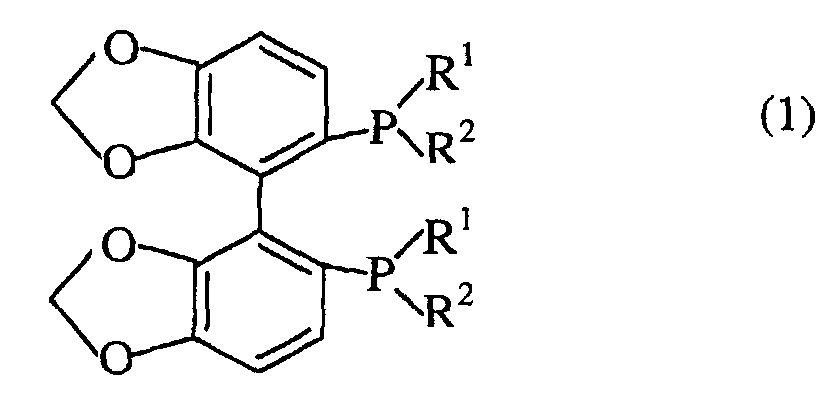
- diphosphine compounds of the present invention is represented by the following formula (1): where R 1 and R 2 represent independently cycloalkyl group, unsubstituted or substituted phenyl group, or five-membered heteroaromatic ring residue.
- the cycloalkyl in the R 1 and R 2 are cyclopentyl group, cyclohexyl group or cycloheptyl group.
- the five-membered heteroaromatic ring in R 1 and R 2 is 2-furyl group, 3-furyl group, 2-benzofuryl group or 3-benzofuryl group.
- substituents in the substituted phenyl are C 1 -C 4 alkyl, C 1 -C 4 alkoxy group, di-(lower alkyl)amino group or halogen atom.
- lower alkyl is alkyl group having 1 to 5 carbon atoms.
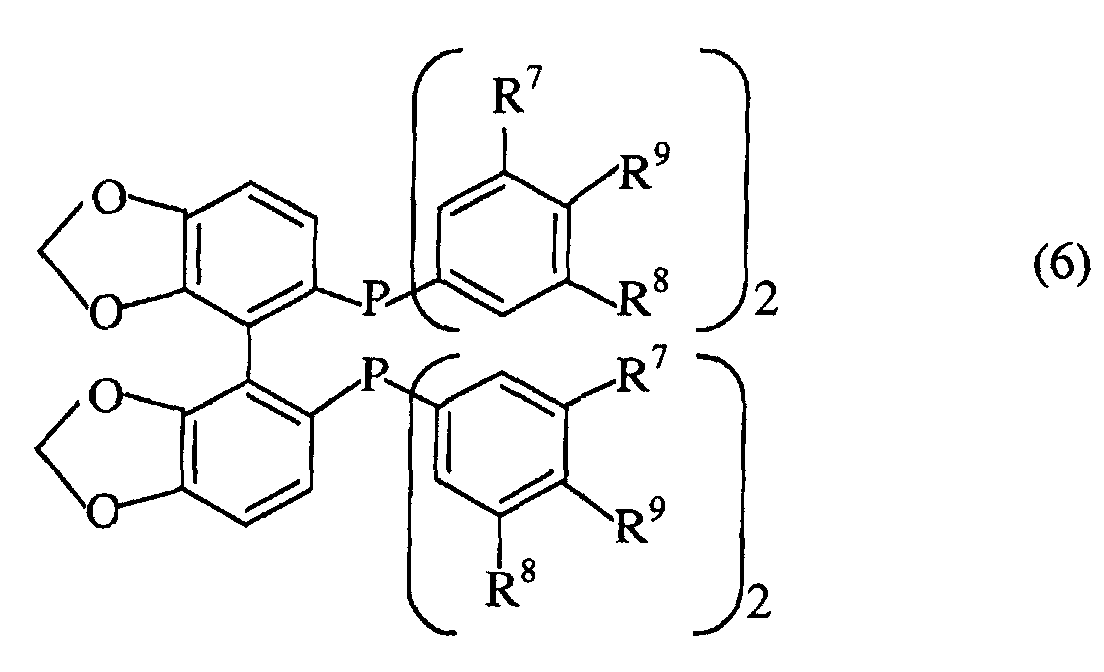
- preferable compound is represented by the formula (5): where R 4 and R 5 represent independently hydrogen atom, C 1 -C 4 alkyl group, C 1 -C 4 alkoxy group; R 6 represents hydrogen, C 1 -C 4 alkyl group, C 1 -C 4 alkoxy group or di(C 1 -C 4 alkyl)-amino group, and more preferable compounds are represented by the formula (6): where R 7 and R 8 are the same or different and represent hydrogen atom, t-butyl group, n-butyl group, n-propyl group, isopropyl group, ethyl group or methyl group; R 9 represents hydrogen atom, t-butoxy group, isopropoxy group, ethoxy group or methoxy group.
- Another compound of the present invention is represented by the following formula (2): where R 1 and R 2 are as defined above.
- the compound of the formula (2) is an intermediate for preparing the compounds of the aforementioned formula (1).
- the present invention includes racemic compounds and optically active compounds of the aforementioned compounds.
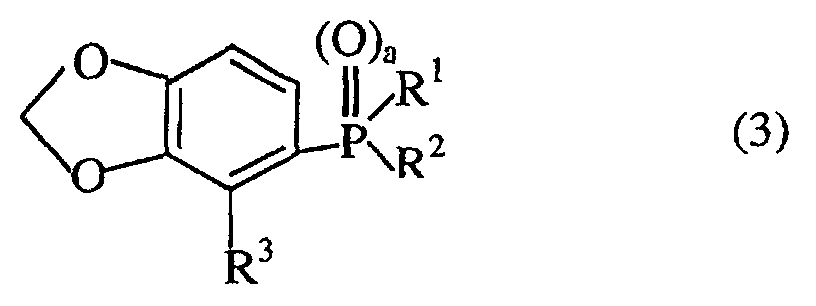
- diphosphine compound of the present invention is represented by the following formula (3): where R 1 and R 2 are the same as defined above; R3 represents hydrogen or a halogen atom; and letter a represents 0 or 1.
- the compound of the formula (3) is an intermediate for preparing the compound of the aforementioned formula (2).
- the invention also relates to a process for the preparation of a compound of a formula (1) said process comprising the steps of :
- This compound (3a) can be reduced by the known method to obtain diphenyl(3,4-methylenedioxyphenyl)-phosphine.
- the racemic phosphine oxide can be resolved with (-)-L-dibenzoyltartaric acid by forming a crystalline equimolar complex. Reduction of the resolved phosphine oxide with trichlorosilane glue (-)-SEGPHOS in good yield.
- (+)-SEGPHOS can be obtained by optical resolution using (+)-D-benzoyltartaric acid.
- the present diphosphine compound having a substituent in phenyl ring can be prepared by using a diarylphosphinyl chloride having a substituent on its phenyl ring in place of the diphenylphosphinyl chloride.
- the compound (1) in particular the optically active compound (1) is useful as a ligand for a transition metal complex catalysed asymmetric reaction.
- the racemic one is also useful as an intermediate for preparing the optically active compounds (1).
- transition metal examples include rhodium, ruthenium, iridium, palladium, nickel.
- the transition metal complex of the invention have the formula (4) : MmLnXpSq where M represents a transition metal selected from rhodium, ruthenium, iridium, palladium and nickel, L represents the diphosphine compound of formula (1), (5) or (6) as above defined and is optically active, and X and S represent as follows :
- the invention also relates to a catalyst comprising a transition metal complex of formula (10) : [MmLnXpSq]Yr where M represents a transition metal selected from rhodium, ruthenium, iridium, palladium and nickel, L represents the diphosphine compound of formula (1), (5) or (6) as above defined and is optically active, and X, S and Y represent as follows :
- transition metal complexes of the present invention can be prepared by the known methods.
- L represents the optically active compounds among the present invention
- cod represents 1, 5-cyclooctadiene
- nbd represents norbornadiene
- Ph represents phenyl group
- Ac represents acetyl group.
- Rhodium complex
- a rhodium complex can be prepared, for example, by reaction of bis(cycloocta-1,5-diene)rhodium (I) tetrafluoroborate with the present SEGPHOS according to a method described in "Experimental Chemistry, 4th edition", volume 18, Organometallic Complexes, pp.339-344, Ed. Chemical Society of Japan, 1991, published by Maruzen.
- rhodium compound examples include the following: [Rh(L)Cl] 2 , [Rh(L)Br] 2 , [Rh(L)I] 2 , [Rh(cod)(L)]BF 4 , [Rh(cod)(L)]BPh 4 , Rh(cod)(L), [Rh(nbd)(L)]BF 4 , [Rh(nbd)(L)]ClO 4 , [Rh(nbd)(L)]PF 6 , [Rh(nbd)(L)]Bph 4
- a ruthenium complex can be prepared by heating [Ru(cod)C 12 ]n and SEGPHOS at reflux with toluene in the presence of triethylamine as described in the literature (T. Ikariya, Y. Ishii, H. Kawano, T. Arai, M. Saburi, S. Yoshikawa, and S. Akutagawa, J. Chem. Soc., Chem. Commun., 922 (1988)).
- the ruthenium complex can be obtained by heating [Ru(p-cymene)I 2 ] 2 and SEGPHOS in methylene chloride and ethanol under stirring according to a method described in the literature (K. Mashima, K. Kusano, T.
- Examples of the ruthenium complex are as follows: Ru(OAc) 2 (L) Ru 2 Cl 4 (L) 2 NEt, [RuCl(benzene)(L)], [RuBr(benzene)(L)]Br, [Rul(benzene)(L)]I, [RuCl(p-cymene)(L)]Cl, [RuBr(p-cymene)(L)]Br, [RuI(p-cymene)(L)]I, [Ru(L)](BF4) 4 , [Ru(L)](ClO 4 ) 2 , (Ru(L)](PF 6 ) 2 ,[Ru(L)](BPh 4 ) 2
- An iridium complex can be prepared by reaction of SEGPHOS with [Ir(cod)(CH 3 CN) 2 ]BF 4 in tetrahydrofuran under stirring according to a method described in the literature (K. Mashima, T. Akutagawa, X. Zhang, T. Taketomi, H. Kumobayashi, S. Akutagawa, J. Organomet., Chem. 1992, 428, 213).
- Examples of the iridium complex are as follows: [Ir(L)Cl] 2 , [Ir(L)Br] 2 , [Ir(L)I] 2 , [Ir(cod)(L)]BF 4 , [Ir(cod)(L)]ClO 4 , [Ir(cod)(L)]PF 6 , [Ir(cod)(L)]BPh 4 , [Ir(nbd)(L)]BF 4 , [Ir(nbd)(L)]Cl 4 [Ir(nbd)(L)]PF 6 , [Ir(nbd)(L)]BPh 4
- a palladium complex can be prepared by reaction of SEGPHOS with ⁇ -allylpalladium chloride according to a method described in the literature (Y, Uozumi and T, Hayashi, J. Am. Chem. Soc., 1991, 113, 9887).
- Examples of the palladium complex are as follows: PdCl 2 (L), (p-allyl)Pd(L), [(Pd(L)]BF 4 , [Pd(L)]ClO 4 , [(Pd(L)]PF 6 , [(Pd(L)]BPh 4
- a nickel complex can be prepared according to a method described in, for example, "Experimental Chemistry, 4th edition” vol. 18, Organometallic complexes, p. 376, Ed. Chemical Society of Japan, 1991, published by Maruzen, or alternatively, can be prepared by dissolving SEGPHOS and nickel chloride with a mixed solvent of isopropanol and methanol, followed by heating under stirring according to a method described in the literature (Y. Uozumi and T, Hayashi, J. Am. Chem. Soc., 1991, 113, 9887).
- nickel complex examples are as follows: NiCl 2 (L), NiBr 2 (L), NiI 2 (L)
- transition metal complexes having this novel optically active diphosphine compound as a ligand are useful as a catalyst for an asymmetric hydrogenation reaction.
- the complex may be used after enhancing the purity thereof or without purification thereof.
- a complex containing ruthenium and SEGPHOS which is an optically active diphosphine compound gives higher enantioselectivity in the asymmetric hydrogenation of 2-oxo-1-propanol than ruthenium complexes having the ligand such as BINAP, p-TolBINAP and the like.
- a complex containing ruthenium and ((5,6),(5',6')-bis(methylendioxy)biphenyl-2,2'-diyl)bis(bis-3,5-dimethylphenyl)phosphine (hereinafter referred to as "DM-SEGPHOS") as a ligand gives the equivalent enantioselectivity to that of ruthenium complexes of BINAP, p-TolBINAP and the like in a reaction for asymmetric hydrogenation of methyl 2-benzamidomethyl-3-oxybutyrate and give higher diastereoselectivity and catalytic activity.
- novel diphosphine compounds of the present invention are useful as, in particular, a ligand for a transition metal complex.
- the transition metal complexes are useful catalyst for asymmetric reaction and are extremely industrially useful.
- Apparatuses used for determining physical properties in respective Examples are as follows:
- a magnesium (12.4 g, 511 mmol) was charged into a four-necked round-bottomed flask, equipped with a thermometer, a condenser and a pressure equalizing dropping funnel, and then which was completely replaced with nitrogen, and 30 ml of anhydrous tetrahydrofuran was added thereto.
- THF tetrahydrofuran
- the resultant solid was recrystallized from a mixed solvent of 45 ml of ethyl acetate and 5 ml of hexane to obtain 18,5 g of the titled compound.
- the mother liquor was concentrated and washed with diisopropyl ether to obtain 12.10 g of the titled compound.
- Trichlorosilane (3.22 g, 23.3 mmol) was added dropwise to 1.50 g (2.34 mmol) of (-)-SEGPHOSO 2 , 3.11 g (25.6 mmol) of dimethylaniline and 25 ml of toluene, followed by stirring at 100 °C for 4 hours.
- the reaction mixture was ice-cooled and 30 ml of 4N aqueous sodium hydroxide solution was added thereto, followed by stirring at room temperature for 30 minutes. After the aqueous layer was separated, the reaction product in the aqueous layer was extracted twice with 15 ml of toluene.
- a magnesium (4.2 g, 171 mmol) of was charged into a four-neck round-bottomed flask equipped with a thermometer, a condenser and a pressure equalizing dropping funnel, and then which was completely replaced with nitrogen, and 10 ml of anhydrous tetrahydrofuran was added thereto.
- Bis((3,5)-dimethylphenyl)((3,4)-methylenedioxyphenyl)phosphine oxide (60.0 g, 158.7 mmol) was dissolved in 330 ml of THF under a nitrogen stream. To this solution was added 250 ml of a solution of lithiumdiisopropylamide in THF (0.7 M) dropwise at - 78 °C over 20 minutes and a temperature was raised to -40 °C.
- Trichlorosilane (187.6 mg, 1.39 mmol) was added dropwise to the mixture of 99.1 mg (0.131 mmol) of (-)-DM-SEGPHOS02, 191.2 mg (1.58 mmol) of dimethylaniline and 5 ml of toluene, followed by stirring 100 °C for 15 hours.
- the reaction mixture was ice-cooled, 10 ml of an 1N aqueous sodium hydroxide solution was added thereto, followed by stirring at room temperature for 30 minutes. After the aqueous layer was separated, the aqueous layer was extracted with ethyl acetate, a combined organic layer was washed with 1N hydrochloric acid, water and an aqueous saturated sodium chloride solution. After drying over anhydrous magnesium sulfate, the solvent was distilled off, and the residue was purified by silica gel column chromatography to obtain 49.1 mg (yield 52%) of the titled compound.
Landscapes
- Chemical & Material Sciences (AREA)
- Organic Chemistry (AREA)
- Health & Medical Sciences (AREA)
- Life Sciences & Earth Sciences (AREA)
- Biochemistry (AREA)
- General Health & Medical Sciences (AREA)
- Molecular Biology (AREA)
- Inorganic Chemistry (AREA)
- Engineering & Computer Science (AREA)
- Materials Engineering (AREA)
- Chemical Kinetics & Catalysis (AREA)
- Organic Low-Molecular-Weight Compounds And Preparation Thereof (AREA)
- Catalysts (AREA)
- Low-Molecular Organic Synthesis Reactions Using Catalysts (AREA)
Claims (10)
- Composé de diphosphine de formule (1) :où R1 et R2 représentent de façon indépendante un groupe cycloalkyle, un groupe phényle substitué ou non substitué ou un résidu de cycle hétéroaromatique à cinq membres.
- Composé de diphosphine selon la revendication 1, dans lequel R1 et R2 sont identiques et représentent un phényle substitué par R4, R5 et R6, ledit composé ayant la formule (5) :où R4 et R5 représentent de façon indépendante un atome d'hydrogène, un groupe alkyle en C1-C4 ou un groupe alcoxy en C1-G4 ; R6 représente un hydrogène, un groupe alkyle en C1-C4, un groupe alcoxy en C1-C4 ou un groupe di-(alkyle en C1-C4)-amino.

- Composé de diphosphine selon la revendication 1 ou 2, dans lequel R1 et R2 sont identiques et représentent un phényle substitué par R7, R8 et R9, ledit composé ayant la formule (6) :où R7 et R8 sont identiques ou différents et représentent un atome d'hydrogène, un groupe t-butyle, un groupe n-butyle, un groupe n-propyle, un groupe isopropyle, un groupe éthyle ou un groupe méthyle ; R9 représente un atome d'hydrogène, un groupe t-butoxy, un groupe isopropoxy, un groupe éthoxy ou un groupe méthoxy.
- Composé de diphosphine de formule (2) :où R1 et R2 représentent de façon indépendante un groupe cycloalkyle, un groupe phényle substitué ou non substitué ou un résidu de cycle hétéroaromatique à cinq membres.

- Composé de phosphine de formule (3) :où R1 et R2 représentent de façon indépendante un groupe cycloalkyle, un groupe phényle substitué ou non substitué ou un résidu de cycle hétéroaromatique à cinq membres ; R3 représente un hydrogène ou un atome d'halogène ; et la lettre "a" représente 0 ou 1.
- Complexe d'un métal de transition choisi parmi un complexe du rhodium, un complexe du ruthénium, un complexe de l'iridium, un complexe du palladium et un complexe du nickel, dans lequel ledit complexe de métal de transition a pour ligand le composé qui est défini dans l'une quelconque des revendications 1 à 3 et qui est optiquement actif.
- Complexe d'un métal de transition de formule (4) :(Ac représente le groupe acétyle).lorsque M = Rh, alors X = Cl, Br, I, m=n=p=2, q=0lorsque M = Ru, alors m=n=1, X = OAc, p=2, q=0
ou X = Cl, S = NEt3, m=n=2, p=4, q=1
ou X = méthylallyle, m=n=1, p=2, q=0lorsque M = Ir, alors X = Cl, Br, I, m=n=p=2, q=0lorsque M = Pd, alors X = Cl, m=n=1, p=2, q=0
ou X = p-allyle, m=n=p=2, p=0lorsque M = Ni, alors X = Cl, Br, I, m=n=1, p=2, q=0 - Catalyseur comprenant un complexe de métal de transition de formule (10) :(cod représente le 1,5-cyclooctadiène, nbd représente le norbornadiène et Ph représente le groupe phényle).lorsque M = Rh, alors X = cod, nbd, Y = BF4, ClO4, PF6, BPh4, m=n=p=r=1, q=0lorsque M = Ru, alors X = Cl, Br, I, S = benzène, p-cymène, Y = Cl, Br, I, m=n=p=q=r=1
ou Y = BF4, ClO4, PF6, BPh4, m=n=1, p=q=0, r=2lorsque M = Ir, alors X = cod, nbd, Y = BF4, ClO4, PF6, BPh4, m=n=r=1, p=1, q=0lorsque M = Pd, alors Y = BF4, ClO4, PF6, BPh4, m=n=r=1, p=q=0 - Catalyseur d'hydrogénation asymétrique comprenant le complexe de métal de transition selon la revendication 6 ou 7.
- Procédé pour préparer un composé ayant la formule (1) selon la revendication 1, comprenant les étapes consistant à :dans laquelle R1 et R2 ont la même signification que celle décrite ci-dessus.a) faire réagir un 3,4-méthylènedioxyhalogénobenzène successivement avec Mg, avec un dérivé correspondant de chlorure de phosphinyle et de façon facultative avec un halogène, dans un solvant approprié, pour obtenir un composé ayant la formule (3) :dans laquelle R1 et R2 représentent de façon indépendante un groupe cycloalkyle, un groupe phényle substitué ou non substitué ou un résidu de cycle hétéroaromatique à cinq membres et R3 représente un hydrogène ou un atome d'halogène ; et où la lettre a représente 1 ;
 b) condenser ledit composé ayant la formule (3) en un composé ayant la formule (2) :dans laquelle R1 et R2 ont la même signification que celle décrite ci-dessus ; et
 c) réduire ledit composé ayant la formule (2), pour obtenir un composé ayant la formule (1):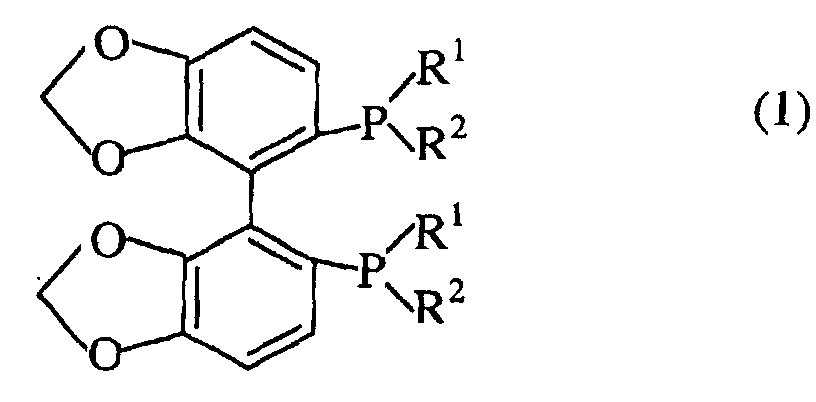
Applications Claiming Priority (3)
| Application Number | Priority Date | Filing Date | Title |
|---|---|---|---|
| JP359818/96 | 1996-12-26 | ||
| JP35981896 | 1996-12-26 | ||
| JP35981896A JP3148136B2 (ja) | 1996-12-26 | 1996-12-26 | 新規なキラルジホスフィン化合物、その製造中間体、該ジホス フィン化合物を配位子とする遷移金属錯体並びに該錯体を含む 不斉水素化触媒 |
Publications (2)
| Publication Number | Publication Date |
|---|---|
| EP0850945A1 EP0850945A1 (fr) | 1998-07-01 |
| EP0850945B1 true EP0850945B1 (fr) | 2002-11-27 |
Family
ID=18466453
Family Applications (1)
| Application Number | Title | Priority Date | Filing Date |
|---|---|---|---|
| EP97403152A Expired - Lifetime EP0850945B1 (fr) | 1996-12-26 | 1997-12-24 | Diphosphine chirale, intermédiaires pour sa préparation, complexes de ladite diphosphine avec des métaux de transition et catalyseur d'hydrogénation asymétrique |
Country Status (4)
| Country | Link |
|---|---|
| US (1) | US5872273A (fr) |
| EP (1) | EP0850945B1 (fr) |
| JP (1) | JP3148136B2 (fr) |
| DE (1) | DE69717406T2 (fr) |
Families Citing this family (33)
| Publication number | Priority date | Publication date | Assignee | Title |
|---|---|---|---|---|
| US6162929A (en) * | 1997-12-23 | 2000-12-19 | Hoffmann-La Roche Inc. | Process for the manufacture of bisphosphine oxide and bisphosphonate compounds |
| JP3549390B2 (ja) * | 1998-03-23 | 2004-08-04 | 高砂香料工業株式会社 | ルテニウム−ホスフィン錯体及びその製造方法 |
| JP3640565B2 (ja) * | 1999-03-31 | 2005-04-20 | 高砂香料工業株式会社 | ルテニウム−光学活性ホスフィン錯体混合物、その製法およびこれを用いた不斉水素化触媒 |
| DE69933904T2 (de) * | 1998-05-08 | 2007-09-06 | Takasago International Corp. | Ruthenium-iodo optisch aktiver Phosphinkomplex |
| DE69908889T2 (de) | 1998-11-19 | 2004-05-06 | Solvias Ag | Chirale Diphenyldiphosphine und d-8 Metall-Komplexe davon |
| FR2790477B1 (fr) * | 1999-03-01 | 2001-05-25 | Rhodia Chimie Sa | Polymere lineaire optiquement actif utilisable comme ligand dans la preparation de complexes metalliques destines a la catalyse asymetrique |
| US6288280B1 (en) * | 1999-07-09 | 2001-09-11 | Hoffmann-La Roche Inc. | Racemization of atropisomeric bis(phosphine oxide) compounds |
| JP3844927B2 (ja) | 2000-01-07 | 2006-11-15 | 高砂香料工業株式会社 | ジホスフィンオキシドおよびジホスホナートの製造方法 |
| JP4601779B2 (ja) * | 2000-07-25 | 2010-12-22 | 高砂香料工業株式会社 | 光学活性アルコールの製造方法 |
| CA2427579C (fr) * | 2000-11-17 | 2009-11-03 | The Penn State Research Foundation | Phosphines et phosphinites chirales substitutees en ortho et leur utilisation dans des reactions catalytiques asymetriques |
| FR2830254B1 (fr) * | 2001-09-28 | 2004-09-17 | Synkem | Nouvelles diphosphines, leurs complexes avec des metaux de transition et leur utilisation en synthese asymetrique |
| ATE438653T1 (de) | 2001-12-07 | 2009-08-15 | Takeda Pharmaceutical | Verfahren zur herstellung von diphosphinverbindungen und zwischenprodukte für das verfahren |
| JP4348126B2 (ja) | 2002-09-06 | 2009-10-21 | 高砂香料工業株式会社 | 光学活性アミノアルコール類の製造方法 |
| CA2521635A1 (fr) * | 2003-04-07 | 2004-10-21 | Solvias Ag | Diphenyldiphosphines substituees par amine |
| EP1528053A1 (fr) * | 2003-10-31 | 2005-05-04 | Lonza Ag | Procédé de préparation de (S)- ou (R)-4-halo-3-hydroxybutyrates |
| DE102004022397A1 (de) * | 2004-05-06 | 2005-12-01 | Consortium für elektrochemische Industrie GmbH | Chirale C2-symmetrische Biphenyle, deren Herstellung sowie Metallkomplexe enthaltend diese Liganden und deren Verwendung als Katalysatoren in chirogenen Synthesen |
| PT1747205E (pt) * | 2004-05-11 | 2012-09-20 | Univ Hong Kong Polytechnic | Composições farmacêuticas |
| JP4490211B2 (ja) * | 2004-08-27 | 2010-06-23 | 高砂香料工業株式会社 | 光学活性3−キヌクリジノール類の製造方法 |
| US20060165580A1 (en) * | 2005-01-26 | 2006-07-27 | The Regents Of The University Of California | Heterogeneous copper catalysts |
| JP4855196B2 (ja) * | 2005-09-22 | 2012-01-18 | 高砂香料工業株式会社 | 置換光学活性ジホスフィン化合物 |
| US7312347B2 (en) | 2005-09-22 | 2007-12-25 | Takasago International Corporation | Substituted optically active disphosphine compound |
| JP2008169201A (ja) | 2006-12-11 | 2008-07-24 | Tokyo Univ Of Agriculture & Technology | 新規光学活性ビアリールリン化合物とその製造方法 |
| WO2008137757A1 (fr) * | 2007-05-04 | 2008-11-13 | Barrx Medical, Inc. | Procédé et appareil pour le traitement de l'obésité par ablation dans l'appareil gastro-intestinal |
| EP2098531A1 (fr) | 2008-03-05 | 2009-09-09 | National University Corporation Tokyo University of Agriculture and Technology | Composé de phosphore axial asymétrique et son procédé de production |
| JP5135264B2 (ja) * | 2009-03-12 | 2013-02-06 | 独立行政法人科学技術振興機構 | ホスホン酸類縁体の製造方法、及び触媒 |
| EP2289897A1 (fr) * | 2009-09-01 | 2011-03-02 | Sanofi-Aventis | Procédé photochimique pour la production d'artémisinine |
| MY155952A (en) * | 2009-09-11 | 2015-12-31 | Sanofi Sa | Process for the production of artemisinin intermediates |
| FR2952638A1 (fr) | 2009-11-17 | 2011-05-20 | Univ Strasbourg | Procede de phosphination catalytique double ou triple de composes di, tri ou tetrahalobiaryles, intermediaires employes, composes obtenus et leurs utilisations |
| JP5825672B2 (ja) | 2011-12-22 | 2015-12-02 | 高砂香料工業株式会社 | 高純度セラミド類の製造方法 |
| CN103087106B (zh) * | 2013-01-31 | 2016-02-03 | 中国科学院上海有机化学研究所 | 含有n-芳基的手性膦氮类化合物、合成方法以及应用 |
| CN103145557B (zh) * | 2013-03-27 | 2015-06-03 | 石家庄手性化学有限公司 | 一种光学纯度的s-4-氯-3-羟基丁酸乙酯的制备方法 |
| CN104909992A (zh) * | 2015-06-03 | 2015-09-16 | 黄山天香科技股份有限公司 | 一种用2s-反-5-甲基-2-(1-甲基乙基)环己酮制备(1r,2s,5r)-2-异丙基-5-甲基环己醇的方法 |
| JP7028889B2 (ja) | 2016-12-20 | 2022-03-02 | ブリストル-マイヤーズ スクイブ カンパニー | テトラヒドロカルバゾールカルボキサミド化合物の製造方法 |
Family Cites Families (5)
| Publication number | Priority date | Publication date | Assignee | Title |
|---|---|---|---|---|
| DE4330730A1 (de) * | 1993-09-10 | 1995-03-16 | Bayer Ag | Neue Bisphosphine für asymmetrische Hydrierkatalysatoren |
| DE4415682A1 (de) * | 1994-05-04 | 1995-11-09 | Hoechst Ag | Palladium Katalysatoren mit sulfonierten Bisphosphinen als Liganden, Verfahren zu ihrer Herstellung und ihre Verwendung für Carbonylierungsreaktionen |
| DE4422672A1 (de) * | 1994-06-30 | 1996-01-04 | Hoechst Ag | Halogenierte Biphenyl-2,2'-diyl-bis-diphenylphosphine, ihre Herstellung und ihre Verwendung |
| IT1270082B (it) * | 1994-07-12 | 1997-04-28 | Univ Degli Studi Milano | Difosfine eteroaromatiche come leganti chirali, complessi tra dette difosfine e metalli di transizione ed impiego di detti complessi come catalizzatori chirali |
| JP3770639B2 (ja) * | 1995-10-31 | 2006-04-26 | 高砂香料工業株式会社 | 光学活性ジホスフィンの製造方法 |
-
1996
- 1996-12-26 JP JP35981896A patent/JP3148136B2/ja not_active Expired - Lifetime
-
1997
- 1997-12-22 US US08/996,405 patent/US5872273A/en not_active Expired - Lifetime
- 1997-12-24 DE DE69717406T patent/DE69717406T2/de not_active Expired - Lifetime
- 1997-12-24 EP EP97403152A patent/EP0850945B1/fr not_active Expired - Lifetime
Also Published As
| Publication number | Publication date |
|---|---|
| EP0850945A1 (fr) | 1998-07-01 |
| DE69717406D1 (de) | 2003-01-09 |
| JPH10182678A (ja) | 1998-07-07 |
| JP3148136B2 (ja) | 2001-03-19 |
| US5872273A (en) | 1999-02-16 |
| DE69717406T2 (de) | 2003-08-14 |
Similar Documents
| Publication | Publication Date | Title |
|---|---|---|
| US5872273A (en) | Chiral diphosphine compound intermediate for preparing the same transition metal complex having the same diphosphine compound as ligand and asymmetric hydrogenation catalyst | |
| US5206399A (en) | 2,2'-bis(diphenylphosphino)-5,5',6,6',7,7',8,8'-octahydro-1,1'-binaphthyl and transition metal complex containing the same as ligand | |
| EP0826691B1 (fr) | Composés diphosphines optiquement actives, procédé de leur préparation, complexes de métal de transition contenant ces composés comme ligand et procédé de préparation de substances optiquement actives par utilisation de ces complexes | |
| CZ293465B6 (cs) | Heteroaromatické difosfiny jako chirální ligandy | |
| JP3770639B2 (ja) | 光学活性ジホスフィンの製造方法 | |
| EP1095946B1 (fr) | Composé diphosphine d'activité optique, composés intermédiaires de préparation, complexe métal de transition le contenant comme ligand et catalysateur pour des hydrogénations asymmétriques contenant le complexe | |
| JP5454756B2 (ja) | ジホスフィン化合物、その遷移金属錯体およびその遷移金属錯体を含む触媒並びにホスフィンオキシド化合物及びジホスフィンオキシド化合物 | |
| EP0732337B1 (fr) | Diphosphines asymmétriques optiquement actives et procédé pour préparer des substances optiquement actives en leur présence | |
| US6624320B2 (en) | Asymmetric phosphine ligand | |
| US6730629B2 (en) | Asymmetric phosphine ligand | |
| US7078568B2 (en) | Phosphine compounds, transition metal complexes with the compounds contained as ligands therein, and asymmetric synthesis catalysts containing the complexes | |
| US5808162A (en) | Chiral unsymmetric diphosphine compound and transition metal complex containing the same as ligand | |
| US20040072680A1 (en) | Chiral phosphorus cyclic compounds for transition metal-catalyzed asymmetric reactions | |
| JP4226847B2 (ja) | ホスフィン−ホスホラン化合物と遷移金属とを含有する遷移金属錯体の存在下、α,β−不飽和アミド誘導体から光学活性アミド類を製造する方法。 | |
| JP4148702B2 (ja) | 新規なジホスフィン化合物、その製造中間体、該化合物を配位子とする遷移金属錯体並びに該錯体を含む不斉水素化触媒 | |
| US6717016B2 (en) | Phosphine compound, transition metal complex containing the same phosphine compound as ligand and asymmetric synthesis catalyst containing the complex | |
| JP4006453B2 (ja) | 光学活性ジホスフィンモノオキシド |
Legal Events
| Date | Code | Title | Description |
|---|---|---|---|
| PUAI | Public reference made under article 153(3) epc to a published international application that has entered the european phase |
Free format text: ORIGINAL CODE: 0009012 |
|
| AK | Designated contracting states |
Kind code of ref document: A1 Designated state(s): CH DE FR GB IT LI NL |
|
| AX | Request for extension of the european patent |
Free format text: AL;LT;LV;MK;RO;SI |
|
| 17P | Request for examination filed |
Effective date: 19981208 |
|
| AKX | Designation fees paid |
Free format text: CH DE FR GB IT LI NL |
|
| RBV | Designated contracting states (corrected) |
Designated state(s): CH DE FR GB IT LI NL |
|
| 17Q | First examination report despatched |
Effective date: 20010608 |
|
| GRAG | Despatch of communication of intention to grant |
Free format text: ORIGINAL CODE: EPIDOS AGRA |
|
| GRAG | Despatch of communication of intention to grant |
Free format text: ORIGINAL CODE: EPIDOS AGRA |
|
| GRAH | Despatch of communication of intention to grant a patent |
Free format text: ORIGINAL CODE: EPIDOS IGRA |
|
| GRAH | Despatch of communication of intention to grant a patent |
Free format text: ORIGINAL CODE: EPIDOS IGRA |
|
| GRAA | (expected) grant |
Free format text: ORIGINAL CODE: 0009210 |
|
| AK | Designated contracting states |
Kind code of ref document: B1 Designated state(s): CH DE FR GB IT LI NL |
|
| REG | Reference to a national code |
Ref country code: GB Ref legal event code: FG4D |
|
| REG | Reference to a national code |
Ref country code: CH Ref legal event code: EP |
|
| REF | Corresponds to: |
Ref document number: 69717406 Country of ref document: DE Date of ref document: 20030109 |
|
| REG | Reference to a national code |
Ref country code: CH Ref legal event code: NV Representative=s name: BOVARD AG PATENTANWAELTE |
|
| ET | Fr: translation filed | ||
| PLBE | No opposition filed within time limit |
Free format text: ORIGINAL CODE: 0009261 |
|
| STAA | Information on the status of an ep patent application or granted ep patent |
Free format text: STATUS: NO OPPOSITION FILED WITHIN TIME LIMIT |
|
| 26N | No opposition filed |
Effective date: 20030828 |
|
| REG | Reference to a national code |
Ref country code: CH Ref legal event code: PFA Owner name: TAKASAGO INTERNATIONAL CORPORATION Free format text: TAKASAGO INTERNATIONAL CORPORATION#19-22, TAKANAWA 3-CHOME MINATO-KU#TOKYO 108 (JP) -TRANSFER TO- TAKASAGO INTERNATIONAL CORPORATION#19-22, TAKANAWA 3-CHOME MINATO-KU#TOKYO 108 (JP) |
|
| REG | Reference to a national code |
Ref country code: FR Ref legal event code: PLFP Year of fee payment: 19 |
|
| REG | Reference to a national code |
Ref country code: FR Ref legal event code: PLFP Year of fee payment: 20 |
|
| PGFP | Annual fee paid to national office [announced via postgrant information from national office to epo] |
Ref country code: CH Payment date: 20161213 Year of fee payment: 20 Ref country code: GB Payment date: 20161221 Year of fee payment: 20 Ref country code: FR Payment date: 20161111 Year of fee payment: 20 Ref country code: DE Payment date: 20161220 Year of fee payment: 20 Ref country code: NL Payment date: 20161110 Year of fee payment: 20 |
|
| PGFP | Annual fee paid to national office [announced via postgrant information from national office to epo] |
Ref country code: IT Payment date: 20161221 Year of fee payment: 20 |
|
| REG | Reference to a national code |
Ref country code: DE Ref legal event code: R071 Ref document number: 69717406 Country of ref document: DE |
|
| REG | Reference to a national code |
Ref country code: NL Ref legal event code: MK Effective date: 20171223 |
|
| REG | Reference to a national code |
Ref country code: CH Ref legal event code: PL |
|
| REG | Reference to a national code |
Ref country code: GB Ref legal event code: PE20 Expiry date: 20171223 |
|
| PG25 | Lapsed in a contracting state [announced via postgrant information from national office to epo] |
Ref country code: GB Free format text: LAPSE BECAUSE OF EXPIRATION OF PROTECTION Effective date: 20171223 |