EP0851005A2 - Agglomerierte Pigmente, Verfahren zu ihrer Herstellung, wässrige Pigmentdispersion und wässrige Tintezusammensetzung - Google Patents
Agglomerierte Pigmente, Verfahren zu ihrer Herstellung, wässrige Pigmentdispersion und wässrige Tintezusammensetzung Download PDFInfo
- Publication number
- EP0851005A2 EP0851005A2 EP97403096A EP97403096A EP0851005A2 EP 0851005 A2 EP0851005 A2 EP 0851005A2 EP 97403096 A EP97403096 A EP 97403096A EP 97403096 A EP97403096 A EP 97403096A EP 0851005 A2 EP0851005 A2 EP 0851005A2
- Authority
- EP
- European Patent Office
- Prior art keywords
- pigment
- agglomerated
- dispersion
- organic pigment
- compound
- Prior art date
- Legal status (The legal status is an assumption and is not a legal conclusion. Google has not performed a legal analysis and makes no representation as to the accuracy of the status listed.)
- Granted
Links
Images
Classifications
-
- C—CHEMISTRY; METALLURGY
- C09—DYES; PAINTS; POLISHES; NATURAL RESINS; ADHESIVES; COMPOSITIONS NOT OTHERWISE PROVIDED FOR; APPLICATIONS OF MATERIALS NOT OTHERWISE PROVIDED FOR
- C09D—COATING COMPOSITIONS, e.g. PAINTS, VARNISHES OR LACQUERS; FILLING PASTES; CHEMICAL PAINT OR INK REMOVERS; INKS; CORRECTING FLUIDS; WOODSTAINS; PASTES OR SOLIDS FOR COLOURING OR PRINTING; USE OF MATERIALS THEREFOR
- C09D11/00—Inks
- C09D11/30—Inkjet printing inks
- C09D11/32—Inkjet printing inks characterised by colouring agents
-
- C—CHEMISTRY; METALLURGY
- C09—DYES; PAINTS; POLISHES; NATURAL RESINS; ADHESIVES; COMPOSITIONS NOT OTHERWISE PROVIDED FOR; APPLICATIONS OF MATERIALS NOT OTHERWISE PROVIDED FOR
- C09B—ORGANIC DYES OR CLOSELY-RELATED COMPOUNDS FOR PRODUCING DYES, e.g. PIGMENTS; MORDANTS; LAKES
- C09B63/00—Lakes
- C09B63/005—Metal lakes of dyes
-
- C—CHEMISTRY; METALLURGY
- C09—DYES; PAINTS; POLISHES; NATURAL RESINS; ADHESIVES; COMPOSITIONS NOT OTHERWISE PROVIDED FOR; APPLICATIONS OF MATERIALS NOT OTHERWISE PROVIDED FOR
- C09B—ORGANIC DYES OR CLOSELY-RELATED COMPOUNDS FOR PRODUCING DYES, e.g. PIGMENTS; MORDANTS; LAKES
- C09B67/00—Influencing the physical, e.g. the dyeing or printing properties of dyestuffs without chemical reactions, e.g. by treating with solvents grinding or grinding assistants, coating of pigments or dyes; Process features in the making of dyestuff preparations; Dyestuff preparations of a special physical nature, e.g. tablets, films
- C09B67/0001—Post-treatment of organic pigments or dyes
- C09B67/0004—Coated particulate pigments or dyes
-
- C—CHEMISTRY; METALLURGY
- C09—DYES; PAINTS; POLISHES; NATURAL RESINS; ADHESIVES; COMPOSITIONS NOT OTHERWISE PROVIDED FOR; APPLICATIONS OF MATERIALS NOT OTHERWISE PROVIDED FOR
- C09B—ORGANIC DYES OR CLOSELY-RELATED COMPOUNDS FOR PRODUCING DYES, e.g. PIGMENTS; MORDANTS; LAKES
- C09B67/00—Influencing the physical, e.g. the dyeing or printing properties of dyestuffs without chemical reactions, e.g. by treating with solvents grinding or grinding assistants, coating of pigments or dyes; Process features in the making of dyestuff preparations; Dyestuff preparations of a special physical nature, e.g. tablets, films
- C09B67/0033—Blends of pigments; Mixtured crystals; Solid solutions
- C09B67/0034—Mixtures of two or more pigments or dyes of the same type
-
- C—CHEMISTRY; METALLURGY
- C09—DYES; PAINTS; POLISHES; NATURAL RESINS; ADHESIVES; COMPOSITIONS NOT OTHERWISE PROVIDED FOR; APPLICATIONS OF MATERIALS NOT OTHERWISE PROVIDED FOR
- C09D—COATING COMPOSITIONS, e.g. PAINTS, VARNISHES OR LACQUERS; FILLING PASTES; CHEMICAL PAINT OR INK REMOVERS; INKS; CORRECTING FLUIDS; WOODSTAINS; PASTES OR SOLIDS FOR COLOURING OR PRINTING; USE OF MATERIALS THEREFOR
- C09D11/00—Inks
- C09D11/16—Writing inks
- C09D11/17—Writing inks characterised by colouring agents
Definitions
- the present invention relates to an agglomerated pigment, a process for producing the same, an aqueous pigment dispersion, and a water-based ink composition.
- Use of the novel agglomerated pigment according to the present invention readily gives an aqueous pigment dispersion in which the pigment is in a satisfactorily dispersed state and which after preparation undergoes little change in viscosity or pigment particle diameter during storage.
- This aqueous pigment dispersion can be advantageously used as a colorant for water-based inks such as ink-jet printer inks, writing utensil inks, etc.
- a generally employed technique for improving the wettability of a pigment by water and thus preventing pigment sedimentation is to add to the pigment one or more dispersants selected from various surfactants, water-soluble resins, and the like and reduce the pigment into finer particles using a dispersing machine such as a sand grinder or a ball mill.
- JP-A-54-10023 discloses a water-based ink composition for writing utensils which comprises a pigment, a dispersant, and an aqueous medium, and in which the dispersant is a polymer having a hydrophilic part and an oleophilic part and the aqueous medium is a nonvolatile hydrophilic organic solvent.
- JP-A-56-147871 is described a recording liquid comprising at least a pigment, a polymeric dispersant, and an aqueous medium containing a nonionic surfactant.
- JP-A-56-155262 is reported a recording liquid and the like which have been improved in stability by employing a combination of a pigment and dye of similar colors.
- these ink compositions have problems such as flocculation of dispersed fine particles and changes in properties, e.g., viscosity.
- the prior art ink compositions thus have insufficient stability and are unsuitable for use in the thin tubes of writing utensils or in the minute nozzles of ink-jet printer heads, in which resolution is being heightened more and more in recent years.
- JP-B-4-23666 (the term "JP-B” as used herein means an "examined Japanese patent publication") is described a water-based pigment ink for drawing and the like which employ a hydrophilized pigment obtained by treating the surface voids of a pigment with an N-alkanolamine and adsorbing a nonionic surfactant onto the treated surface.
- These pigment dispersions containing a dispersant which has modified Chemical properties or containing a pigment which has undergone a surface treatment or the like can have far higher stability than pigment dispersions prepared without using such a technique.
- the techniques described above each was intended mainly to stabilize dispersions of carbon black, which has relatively high polarity and is porous.
- organic pigments are less apt to strongly adsorb dispersants because the particle surfaces thereof generally have low polarity.
- Techniques have been proposed in which a pigment derivative synthesized beforehand by forming parts having an affinity for a dispersant or incorporating polar groups is adsorbed onto the surface of a pigment and the adsorbed pigment derivative molecules are used as adsorption sites for the dispersant. Coating compositions or printing inks which utilize such a pigment derivative are described, e.g., in JP-B-58-28303, JP-A-5-98200, and JP-B-8-3049. However, since these techniques were mainly intended to produce non-aqueous pigment dispersions, it has been difficult to apply these techniques directly to aqueous dispersions.
- the present inventors made intensive studies in order to obtain an aqueous organic-pigment dispersion having satisfactory pigment dispersibility and excellent storage stability. As a result, it has been found that an aqueous organic-pigment dispersion having the desired excellent pigment dispersibility and storage stability is obtained from an agglomerated organic pigment obtained by treating the surface of sulfonated agglomerates of an organic pigment with univalent counter ions to bring the agglomerate surface into a positively charged state.
- the present invention has been achieved based on this finding.
- an object of the present invention is to provide an agglomerated organic pigment for use as a raw material for an aqueous organic-pigment dispersion having excellent pigment dispersibility and storage stability, and to provide a process for producing the agglomerated pigment.
- Another object of the present invention is to provide an aqueous pigment dispersion and a water-based ink composition both obtained from the agglomerated organic pigment.
- the present invention relates to an agglomerated organic pigment which comprises
- the present invention further relates to a process for producing the agglomerated organic pigment described above which comprises the steps of:
- the present invention furthermore relates to an aqueous dispersion and a water-based ink composition both containing fine organic-pigment particles obtained by pulverizing the agglomerated organic pigment described above.
- agglomerated organic pigment as used herein means a solid formed mainly by the agglomeration and aggregation of crystals of an organic pigment compound, and includes fine particles or powder particles having a particle diameter of about 10 nm or larger, granules having a particle diameter of about 1 mm or larger, and agglomerates having a particle diameter of about 1 cm or larger.
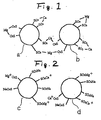
- Fig. 1 is a diagrammatic view illustrating the surface state of pigment agglomerates in which sulfonic groups have been incorporated but which have not undergone a washing treatment with univalent metal ions.
- Fig. 2 is a diagrammatic view illustrating the surface state of pigment agglomerates which have undergone a surface treatment according to the process of the present invention.
- the organic pigment compound contained in the agglomerated organic pigment according to the present invention is not particularly limited.
- the organic pigment compound can be a quinacridone pigment, phthalocyanine pigment, azo pigment, quinophthalone pigment, or isoindolinone pigment.
- the pigment compound is not limited also in hue, and can be a magenta pigment compound, yellow pigment compound, or cyan pigment compound.
- magenta pigment examples include quinacridone pigments such as C.I. Pigment Red 122, 202, and 209 and C.I. Pigment Violet 19. Examples thereof further include C.I. Pigment Red 1, 2, 3, 4, 5, 6, 7, 8, 9, 10, 17, 22, 23, 30, 31, 38, 88, 112, 114, 123, 146, 149, 166, 168, 170, 172, 177, 178, 179, 185, 190, 193, and 219.
- yellow pigment examples include C.I. Pigment Yellow 1 (Fast Yellow G), 2, 3, 5, 6, 10, 12, 13, 14, 15, 16, 17, 24, 55, 74, 81, 83 (Disazo Yellow HR), 95, 97, 98, 100, 101, 104, 108, 117, 120, 138, and 153. Examples thereof further include isoindolinone pigments such as C.I. Pigment Yellow 109 and 110.
- cyan pigment examples include phthalocyanine pigments such as C.I. Pigment Blue 15 (Phthalocyanine Blue R), 15:1, 15:2, 15:3 (Phthalocyanine Blue G), 15:4, 15:6 (Phthalocyanine Blue E), and 16. Examples thereof further include C.I. Pigment Blue 56 and 60, C.I. Pigment Orange 5, 13, 16, 36, 43, and 51, and C.I. Pigment Green 7, 10, and 36.
- any one of the aforementioned pigments may be used alone or a suitable combination of two or more thereof may be used.
- the agglomerated organic pigment according to the present invention can be prepared, for example, by a process comprising:
- sulfonic groups are incorporated into an organic pigment produced generally in an agglomerated state.
- the incorporation of sulfonic groups can be accomplished, for example, by incorporating either a sulfonated organic pigment compound or a sulfonated organic pigment derivative into any of the aforementioned organic pigment compounds.
- the sulfonated organic pigment compound can be easily prepared by treating an organic pigment compound by an ordinary sulfonation reaction (e.g., treatment with fuming sulfuric acid) to thereby incorporate sulfonic groups.
- the sulfonated organic pigment derivative also can be easily prepared by likewise treating an organic pigment derivative by the ordinary sulfonation reaction.
- the sulfonated agglomerates can be produced, for example, as follows.
- An organic pigment compound is mixed with a sulfonated organic pigment compound or sulfonated organic pigment derivative, and the mixture of the two is dissolved in an aqueous solvent having high dissolving power (e.g., sulfuric acid).
- An organic solvent e.g., benzene, toluene, or hexane
- the aqueous phase is removed and the organic solvent in the residual organic phase is volatilized off, whereby the target pigment agglomerates having sulfonic groups incorporated therein can be obtained.
- the mixing of the organic pigment compound with the sulfonated organic pigment compound or sulfonated organic pigment derivative may be conducted either in any stage in the production of the organic pigment compound as agglomerates or after the formation of the organic pigment compound as agglomerates.
- aqueous solution of the sulfonated organic pigment compound or sulfonated organic pigment derivative is added to an aqueous suspension of the pigment compound to thereby deposit the sulfonated organic pigment compound or sulfonated organic pigment derivative on the surface of the pigment compound.
- the organic pigment derivative is not particularly limited as long as it is a compound capable of being stably incorporated in the target organic pigment compound. It is however preferred to use, for example, a compound which is compatible with the target organic pigment compound and has the same basic framework as the target organic pigment compound.
- the target pigment compound is a quinacridone type organic pigment (e.g., a magenta pigment having a quinacridone framework corresponding to C.I. Pigment Red 122, 202, or 209 or C.I.
- the organic pigment derivative can, for example, be a compound represented by general formula (I): wherein R 1 , R 2 , R 3 , and R 4 each independently represents a hydrogen atom, a halogen atom (e.g., chlorine or bromine), or a methyl group; M is a counter metal ion; and n is an integer of 1 or larger (e.g., 1 to 10).
- R 1 , R 2 , R 3 , and R 4 each independently represents a hydrogen atom, a halogen atom (e.g., chlorine or bromine), or a methyl group
- M is a counter metal ion
- n is an integer of 1 or larger (e.g., 1 to 10).
- Especially preferred examples of the compound represented by general formula (I) include a compound wherein R 1 , R 2 , R 3 , and R 4 each is a hydrogen atom, a compound wherein R 1 and R 4 each is a hydrogen atom and R 2 and R 3 each is a methyl group, a compound wherein R 1 and R 4 each is a hydrogen atom and R 2 and R 3 each is a chlorine atom, and a compound wherein R 1 and R 4 each is a chlorine atom and R 2 and R 3 each is a hydrogen atom.
- the organic pigment derivative can, for example, be a compound represented by general formula (II): wherein T is a counter metal ion and m is an integer of 1 or larger (e.g., 1 to 10).
- the compounds respectively represented by general formulae (I) and (II) each consists of block A, which comprises the basic framework characteristic of the organic pigment, and block B, which comprises one or more sulfonic groups incorporated. It is preferred to select a compound in which block A has a chemical structure similar to that of the dispersed substance (pigment compound).
- a sulfonated isoindolinone pigment can be produced by the condensation of 4,5,6,7-tetrachloroisoindoline with a sulfonated aromatic primary diamine because an isoindolinone pigment can be synthesized by the condensation of 4,3,6,7-tetrachloroisoindoline with an aromatic primary diamine.
- the sulfonated organic pigment compound or sulfonated organic pigment derivative generally consists of a part (block A) having a chemical structure similar to that of the dispersed substance (pigment compound) and a part (block B) comprising one or more sulfonic functional groups and serving to solubilize the compound or derivative in dispersion medium (water).
- block A functions to deposit on the pigment compound more tenaciously than ordinary dispersants adsorbed thereonto
- block B undergoes hydrolysis in water and thus functions to shift the surface potential of the pigment particles so that the particle surface is negatively charged and that electrical repulsion among the particles in the dispersion is enhanced.
- the effect of the sulfonated compound or derivative is hence higher than the dispersing/stabilizing function of ordinary dispersants. Furthermore, in the pigment dispersion of the present invention, which will be described later, the fine pigment particles can be made to have even better dispersibility and stability by using a known surfactant in combination therewith.
- the incorporation amount of sulfonic groups is preferably 10x10 -6 equivalents or larger per g of the pigment agglomerates. If the incorporation amount of sulfonic groups is smaller than 10x10 -6 equivalents, the dispersion prepared from the pigment agglomerates may have insufficient storage stability to suffer sedimentation of the dispersed substance. There is no particular upper limit on the incorporation amount of sulfonic groups. However, the amount thereof is preferably not larger than 60x10 -6 equivalents from the standpoint of cost. This is because even when the incorporation amount of sulfonic groups is increased beyond 60x10 -6 equivalents, there are cases where the effect of improving storage stability is not enhanced any more.
- the sulfonated agglomerates obtained by the above-described step of yielding sulfonated agglomerates are treated with a compound containing a univalent inorganic ion.
- the compound containing a univalent inorganic ion include the hydroxides of strong alkalis, e.g., alkali metals (e.g., lithium, sodium, and potassium), and ammonium hydroxide.
- the sulfonated agglomerates are preferably treated with an aqueous sodium hydroxide solution having a concentration of about from 0.1 to 1 N. Specifically, the sulfonated agglomerates are placed in an aqueous solution of a strong alkali and the resultant mixture is shaken with a paint shaker or the like.
- the sulfonated agglomerates contain many sulfonic groups, part of which are thought to be crosslinked with bivalent or higher inorganic counter ions. For example, it is thought that as shown in Fig. 1, sulfonic groups on each agglomerate each has been crosslinked to another sulfonic group on the same agglomerate or to a sulfonic group on another agglomerate with calcium (Ca) or magnesium (Mg) as a bivalent inorganic counter ion.
- Ca calcium
- Mg magnesium
- bivalent or higher inorganic counter ions examples include ions of alkaline earth metals (e.g., barium, calcium, and magnesium), copper, iron, aluminum, nickel, tin, strontium, and zinc.
- alkaline earth metals e.g., barium, calcium, and magnesium
- copper, iron, aluminum, nickel, tin, strontium, and zinc examples include ions of alkaline earth metals (e.g., barium, calcium, and magnesium), copper, iron, aluminum, nickel, tin, strontium, and zinc.
- the treatment with the compound of a univalent inorganic ion is preferably conducted to such a degree that the surface of the counter-ion-replaced agglomerates comes to be positively charged.
- the step of removing inorganic ions is then conducted in which the counter-ion-replaced agglomerates are washed to remove the inorganic ions not bonded to the sulfonic groups.
- the cleaning liquid which can be used is not limited as long as it is an aqueous liquid free from ions to such a degree as not to prevent dissolution of salts therein. It is however preferred to use ion-exchanged water or a mixture of water and ethyl ether (the mixture has the improved ability to infiltrate into agglomerates).
- the aqueous dispersion according to the present invention can be prepared by evenly dispersing the agglomerated pigment described above into water.
- a dispersing technique which itself is conventionally known can be utilized for preparing the dispersion.
- an aqueous vehicle is prepared beforehand which contains a proper dispersant dissolved therein in an amount suitable for the addition amount of the surface-treated agglomerated pigment according to the present invention.
- a proper dispersant dissolved therein is added to the vehicle.
- the surface-treated agglomerated organic pigment is added to the vehicle.
- the agglomerated organic pigment is reduced into fine particles using a known dispersing machine (e.g., a mixing mill such as a bead mill or jet mill).
- a known dispersing machine e.g., a mixing mill such as a bead mill or jet mill.
- the dispersion is preferably subjected to centrifugal treatment with a centrifuge treatment with a filter, or the like to remove the coarse particles.
- the pigment dispersion preferably has a pigment content in the range of from 5 to 70 parts by weight per 100 parts by weight of the pigment dispersion. If the pigment dispersion has a pigment concentration lower than 5 parts by weight, various additive ingredients are limited in their addition amounts by solid content when the additives are added to the dispersion to prepare an ink for ink-jet recording or for writing utensils, since it is necessary to add a large amount of the pigment dispersion. In addition, the dispersing efficiency (the amount of the solid pigment which can be treated in unit time) is reduced. If the dispersion has a pigment concentration higher than 70 parts by weight, the dispersion has an increased viscosity, resulting also in a reduced dispersing efficiency.
- metal ions have come from the dispersing machine or are the metal ions originally contained in the dispersant. It is therefore preferred to take account of the inclusion of metal ions in the dispersing step when pigment agglomerates are washed in the step of removing inorganic ions for preparing the agglomerated pigment.
- the dispersant that can be used in the aqueous dispersion of the present invention is not limited as long as it is capable of maintaining the dispersed state of finely pulverized pigment particles and, if these particles have agglomerated into large secondary particles, it functions to reduce these large particles into primary particles or small secondary particles and to prevent the fine pigment particles from reagglomerating.
- Examples of dispersants having such an effect in the present invention are as follows.
- the sulfonated organic pigment compound or sulfonated organic pigment derivative should be negatively charged through the hydrolysis of block B thereof.
- anionic dispersants are most preferred.
- nonionic dispersants which cause steric-hindrance repulsion.
- anionic dispersants include low-molecular weight dispersants such as salts of higher fatty acids, salts of higher alkyldicarboxylic acids, salts of higher alcohol/sulfuric acid esters, salts of higher alkylsulfonic acids, salts of alkylbenzenesulfonic acids, salts of alkylnaphthalenesulfonic acids, salts of naphthalenesulfonic acid/formalin polycondensates, salts of higher fatty acid/amino acid condensates, salts of dialkyl sulfosuccinates, salts of alkyl sulfosuccinates, salts of naphthenic acids, salts of (alkyl ether)carboxylic acids, acylated peptides, salts of ⁇ -olefinsulfonic acids, N-acylmethyltaurine, alkyl ether sulfates, secondary higher alcohol ethoxysulfates, salt
- Examples thereof further include polymeric disperaante such aa alkali-soluble resin dispersants, e.g., acrylic acid/styrene copolymers, acrylic ester/methacrylic acid copolymers, acrylic acid/methacrylic ester copolymers, and styrene/maleic acid copolymers.
- a neutralizing agent can be used such as ammonia or an alkanolamine (e.g., monoethanolamine, N,N-dimethylethanolamine, diethanolamine, N-butylethanolamine, or triethanolamine).
- nonionic dispersants examples include fluorochemical surfactants, silicone surfactants, polyoxyethylene sorbitan monolaurate, polyoxyethylene sorbitan monostearate, polyoxyethylene alkylphenyl ethers, sorbitan monostearate, acetylene glycol, ethylene oxide adducts of acetylene glycol (acetylene glycol alcohol ethylene oxide), propylethanolamide, polyoxyethylene alkyl ethers, and polyoxyethylene alkylphenyl ethers.
- the incorporation amount of the dispersant is preferably from 0.1 to 200 parts by weight per 100 parts by weight of the pigment in order to further improve the dispersibility of fine pigment particles. If the incorporation amount thereof is smaller than 0.1 part by weight, dispersion stability cannot be ensured. If the incorporation amount thereof exceeds 200 parts by weight and this dispersion is used to prepare an ink for ink-jet printers or writing utensils, the dispersant may increase the viscosity of the ink or adversely influence other properties of the ink.
- a high-boiling, lowly volatile, water-soluble organic solvent can be incorporated into the pigment dispersion of the present invention for the purpose of preventing undesirable drying or freezing.
- the water-soluble organic solvent include polyhydric alcohols such as ethylene glycol, diethylene glycol, propylene glycol, polyethylene glycol, glycerol, and diglycerol.
- the pigment dispersion of the present invention may contain other additives according to need.
- pH regulators such as potassium dihydrogen phosphate and disodium hydrogen phosphate
- additives for mildew proofing, rot proofing, rust prevention, etc. such as benzoic acid, dichlorophene, hexachlorophene, sorbic acid, p-hydroxybenzoic esters, ethylenediaminetetraacetic acid salts, sodium dehydroacetate, 1,2-benzothiazolin-3-one (trade name: Proxel XLII; manufactured by ICI Ltd.), and 3,4-isothiazolin-3-one.
- the ink composition according to the present invention can be prepared from the aqueous pigment dispersion by a known method.
- Fig. 1 is a diagrammatic view illustrating a model surface state of pigment agglomerates which, as stated hereinabove, have undergone the incorporation of sulfonic groups thereinto but have not undergone the washing treatment with univalent metal ions.
- crosslinks have been formed by bivalent metal ions present as counter ions for the sulfonic groups.
- the present inventors have found that a pigment dispersion having significantly improved storage stability is obtained when the content of counter metal ions incorporated into the sulfonic groups of an agglomerated organic pigment is regulated so that the sum of the products of the amount by equivalent of each kind of metal ions incorporated and the reciprocal of the valency of the ions is not smaller than the neutralization equivalent of the sulfonic groups. It has been found that an effective method for accomplishing the' above is to treat organic agglomerates having sulfonic groups incorporated therein with an aqueous solution of the hydroxide of a univalent metal ion and wash the resultant agglomerates with ion-exchanged water before the agglomerates are dispersed into water.
- Fig. 2 is a diagrammatic view illustrating a model surface state of organic agglomerates obtained, according to the process of the present invention, by treating the organic agglomerates having sulfonic groups incorporated therein with the hydroxide of a univalent metal ion and then washing the resultant agglomerates with ion-exchanged water.
- sulfonated agglomerates such as those shown in Fig. 1 are treated with a compound of a univalent inorganic ion compound, each crosslink is cleaved, with one side thereof being replaced with the univalent inorganic ion, and the other side of the crosslink becomes an -SO 3 Mg + or -SO 3 Ca + group.
- the crosslinks between the pigment agglomerates c and d are eliminated or diminished. Therefore, the surface of the counter-ion-replaced agglomerates obtained through the treatment with a compound of a univalent inorganic ion comes into a positively charged state.
- the storage stability of a pigment dispersion is influenced by electrical repulsion or by the force attributable to steric hindrance caused by polymer adsorption.
- the present invention is based on the former, i.e., electrical repulsion. Namely, the degree in which the counter metal ions bonded to sulfonic groups of an agglomerated pigment dissociate to enhance electrical repulsion was taken in account in achieving the present invention.
- the metal ions dissociate through hydrolysis. This dissociation occurs similarly in both the model of Fig. 1 and that of Fig. 2. However, in the case of the agglomerates shown in Fig.
- the sulfonated organic pigment derivative obtained had an average molecular weight of 480 and had one sulfonic group per quinacridone molecule.
- the monosulfonated organic pigment derivative thus obtained (1.44 parts by weight) and C.I. Pigment Red 122 (200 parts by weight) were dissolved in 12 N sulfuric acid solution. Benzene was then added to the aqueous solution to transfer the magenta pigment and the monosulfonated organic pigment derivative to the oily phase. After the sulfuric acid solution was removed, the benzene was evaporated to thereby obtain sulfonated agglomerates of C.I. Pigment Red 122.
- the sulfonated magenta pigment agglomerates obtained were washed with 1 N sodium hydroxide solution several times to remove impurities including benzene. Thereafter, the agglomerates were further washed with ion-exchanged water to obtain a surface-treated agglomerated magenta pigment according to the present invention.
- the surface-treated agglomerated magenta pigment was placed on a platinum dish, and sulfuric acid was added thereto to carbonize and ash the pigment.' The resultant ashed sample was dissolved in dilute hydrochloric acid, and the solution was subjected to elemental analysis with an ICP emission spectrophotometer (SPS-4000, manufactured by Seiko Denshi Kogyo K.K., Japan).
- SPS-4000 ICP emission spectrophotometer
- M is the incorporation amount of metal ions
- Ma is the amount of the metal ions in the surface-treated agglomerated magenta pigment according to the present invention, which had been obtained through alkali washing and washing with ion-exchanged water from the sulfonated agglomerates obtained by incorporating the sulfonated organic pigment derivative into the organic pigment
- Nb is the amount of the metal ions in an agglomerated magenta pigment obtained from agglomerates of the organic pigment not containing the sulfonated organic pigment derivative by washing the agglomerates with an alkali and ion-exchanged water.
- the incorporation amount of univalent metal ions per g of the surface-treated agglomerated magenta pigment prepared in Example 1 (1) above was 10x10 -6 equivalents.
- the incorporation amount of bivalent and higher metal ions was 15x10 -6 equivalents.
- a sample [the surface-treated agglomerated magenta pigment prepared in Example 1 (1) above] was treated by the oxygen flask combustion method, and the combustion gas was absorbed in 0.3% aqueous hydrogen peroxide solution. Thereafter, the solution was analyzed by ion chromatography (2000i, manufactured by Dionex Co.) to determine the amount of sulfate ions (bivalent), which was then converted to the amount of sulfonic groups (univalent).
- the incorporation amount of sulfonic groups per g of the surface-treated agglomerated magenta pigment prepared in Example 1 (1) above was 15x10 -6 equivalents.
- C is the amount of charges per g of the surface-treated agglomerated magenta pigment
- M1 is the incorporation amount by equivalent of univalent metal ions per g of the surface-treated agglomerated pigment
- M2 is the incorporation amount by equivalent of bivalent and higher metal ions per g of the surface-treated agglomerated pigment
- S is the incorporation amount by equivalent of sulfonic groups per g of the surface-treated agglomerated pigment
- the value of 2.5 has been calculated, in the case of Example 1, from the incorporation, amount of bivalent and higher metal ions and the valencies of the metal ions.
- the amount of charges per g of the surface-treated agglomerated magenta pigment prepared in Example 1 (1) is calculated at 1x10 -6 equivalents.
- the agglomerated pigment was found to be in a positively charged state.
- Example 1 (1) Twenty parts by weight of the surface-treated agglomerated magenta pigment obtained in Example 1 (1) above was mixed with 4 parts by weight of an alkali-neutralized styrene/acrylic resin (used as a dispersant; average molecule weight, 7,000; acid value, 200; neutralized with ammonia) and 76 parts by weight of ion-exchanged water. This mixture was treated with a sand grinder (manufactured by Inoue Seisakusho K.K., Japan) for 1 hour to disperse the pigment. The resultant dispersion was centrifuged to remove coarse particles to thereby obtain a magenta pigment dispersion according to the present invention.
- an alkali-neutralized styrene/acrylic resin used as a dispersant; average molecule weight, 7,000; acid value, 200; neutralized with ammonia
- ion-exchanged water 76 parts by weight of ion-exchanged water.
- This mixture was treated with
- Example 1 (5) The magenta pigment dispersion obtained in Example 1 (5) above was analyzed for the content of all metal ions in the same manner as in Example 1 (2) above. As a result, the total amount of univalent metal ions and bivalent and higher metal ions contained per g of the magenta pigment dispersion prepared in Example 1 (5) above was found to be 125x10 -6 equivalents. The total amount of all metal ions incorporated in the agglomerated pigment through the surface treatment as prepared in Example 1 (1) above was determined to be 5x10 -6 equivalents per g of the dispersion from Example 1 (2).
- the amount of metal ions which had come into the dispersion in the dispersion preparation step in Example 1 (5) above was 120x10 -6 equivalents per g of the dispersion.
- the magenta pigment dispersion prepared in Example 1 (5) above contained sulfonic groups in an amount of 3x10 -6 equivalents per g of the dispersion. Therefore, the total amount of all metal ions contained per g of the magenta pigment dispersion was 47.67 times the amount of the sulfonic groups incorporated in the surface-treated agglomerated magenta pigment.
- Example 2 a surface-treated agglomerated magenta pigment was obtained in the same manner as in Example 1 (1), except that 50 parts by weight of C.I. Pigment Red 122 (hereinafter abbreviated as R-122), 5 parts by weight of C.I. Pigment Red 202 (hereinafter abbreviated as R-202), 5 parts by weight of C.I. Pigment Red 209 (hereinafter abbreviated as R-209), and 50 parts by weight of C.I. Pigment Violet 19 (hereinafter abbreviated as V-19) were used together with 0.792 part by weight of the monosulfonated organic pigment derivative produced in Example 1 (1).
- R-122 C.I. Pigment Red 122
- R-202 C.I. Pigment Red 202
- R-209 C.I. Pigment Red 209
- V-19 50 parts by weight of C.I. Pigment Violet 19
- the incorporation amount of univalent metal ions per g of the pigment was 10x10 -6 equivalents, while that of bivalent and higher metal ions was 15x10 -6 equivalents.
- the incorporation amount of sulfonic groups per g of the surface-treated agglomerated pigment was 15x10 -6 equivalents. Therefore, the surface-treated agglomerated pigment was in a positively charged state, with the charge amount being 7x10 -6 equivalents (per g).
- the total amount of univalent metal ions and bivalent and higher metal ions contained per g of the magenta pigment dispersion thus obtained was 322x10 -6 equivalents.
- the total amount of all metal ions incorporated in the agglomerated pigment through the surface treatment as described in Example 2 (1) above was 12x10 -6 equivalents per g of the dispersion. Consequently, the amount of metal ions which had come into the dispersion in the dispersion preparation step was 310x10 -6 equivalents per g of the dispersion.
- the magenta pigment dispersion contained sulfonic groups in an amount of 4.5x10 -6 equivalents per g of the dispersion. Therefore, the total amount of all metal ions contained per g of the magenta pigment dispersion was 71.56 times the amount of the sulfonic groups incorporated in the surface-treated agglomerated magenta pigment.
- Example 3 a surface-treated agglomerated magenta pigment was obtained in the same manner as in Example 1 (1), except that V-19 (200 parts by weight) and 2.88 parts by weight of the monosulfonated organic pigment derivative produced in Example 1 (1) were used.
- the incorporation amount of univalent metal ions per g of the pigment was 15x10 -6 equivalents, while that of bivalent and higher metal ions was 40x10 -6 equivalents.
- the incorporation amount of sulfonic groups per g of the surface-treated agglomerated pigment was 30x10 -6 equivalents. Therefore, the surface-treated agglomerated pigment was in a positively charged state, with the charge amount being 1x10 -6 equivalents (per g).
- Example 3 (1) Forty parts by weight of the surface-treated agglomerated magenta pigment obtained in Example 3 (1) above, 6 parts by weight of an alkali-neutralized styrene/acrylic resin (used as a dispersant; average molecular weight, 7,000; acid value, 200; neutralized with ammonia), 2 parts by weight of sodium propyl sulfosuccinate, and 8 parts by weight of diethylene glycol were mixed with a solution prepared by dissolving 0.01 part by weight of 1,2-benzothiazolin-3-one (Proxel XL-2; Zeneca Co.) in 43.99 parts by weight of ion-exchanged water. This mixture waa subjected to a dispersing step in the same manner as in Example 1 (5) above to prepare a magenta pigment dispersion.
- an alkali-neutralized styrene/acrylic resin used as a dispersant; average molecular weight, 7,000; acid value, 200; neutralized with ammoni
- the total amount of univalent metal ions and bivalent and higher metal ions contained per g of the magenta pigment dispersion thus obtained was 92x10 -6 equivalents.
- the total amount of all metal ions incorporated in the agglomerated pigment through the surface treatment as described in Example 3 (1) above was 22x10 -6 equivalents per g of the dispersion. Consequently, the amount of metal ions which had come into the dispersion in the dispersion preparation step was 70x10 -6 equivalents per g of the dispersion.
- the magenta pigment dispersion contained sulfonic groups in an amount of 8x10 -6 equivalents per g of the dispersion. Therefore, the total amount of all metal ions contained per g of the magenta pigment dispersion was 11.5 times the amount of the sulfonic groups incorporated in the surface-treated agglomerated magenta pigment.
- Example 4 a surface-treated agglomerated magenta pigment was obtained in the same manner as in Example 1 (1), except that R-122 (300 parts by weight) and 2.88 parts by weight of the monosulfonated organic pigment derivative produced in Example 1 (1) were used.
- the incorporation amount of univalent metal ions per g of the pigment was 15x10 -6 equivalents, while that of bivalent and higher metal ions was 30x10 -6 equivalents.
- the incorporation amount of sulfonic groups per g of the surface-treated agglomerated pigment was 20x10 -6 equivalents. Therefore, the surface-treated agglomerated pigment was in a positively charged state, with the charge amount being 12x10 -6 equivalents (per g).
- Example 4 (1) Forty parts by weight of the surface-treated agglomerated magenta pigment obtained in Example 4 (1) above and 8 parts by weight of sodium propyl sulfosuccinate were mixed with 52 parts by weight of ion-exchanged water. This mixture was subjected to a dispersing step in the same manner as in Example 1 (5) above to prepare a magenta pigment dispersion.
- the total amount of univalent metal ions and bivalent and higher metal ions contained per g of the magenta pigment dispersion thus obtained was 258x10 -6 equivalents.
- the total amount of all metal ions incorporated in the agglomerated pigment through the surface treatment as described in Example 4 (1) above was 18x10 -6 equivalents per g of the dispersion. Consequently, the amount of metal ions which had come into the dispersion in the dispersion preparation step was 240x10 -6 equivalents per g of the dispersion.
- the magenta pigment dispersion contained sulfonic groups in an amount of 8x10 -6 equivalents per g of the dispersion. Therefore, the total amount of all metal ions contained per g of the magenta pigment dispersion was 32.25 times the amount of the sulfonic groups incorporated in the surface-treated agglomerated magenta pigment.
- Example 5 a surface-treated agglomerated magenta pigment was obtained in the same manner as in Example 1 (1), except that R-122 (400 parts by weight) and 9.6 parts by weight of the monosulfonated organic pigment derivative produced in Example 1 (1) were used.
- the incorporation amount of univalent metal ions per g of the pigment was 10x10 -6 equivalents, while that. of bivalent and higher metal ions was 120x10 -6 equivalents.
- the incorporation amount of sulfonic groups per g of the surface-treated agglomerated pigment was 50x10 -6 equivalents. Therefore, the surface-treated agglomerated pigment was in a positively charged state, with the charge amount being 8x10 -6 equivalents (per g).
- Example 5 (1) Five parts by weight of the surface-treated agglomerated magenta pigment obtained in Example 5 (1) above was mixed with 1 part by weight of an alkali-neutralized styrene/acrylic resin (used as a dispersant; average molecular weight, 7,000, acid value, 200; neutralized with ammonia) and 94 parts by weight ion-exchanged water. This mixture was subjected to a dispersing step in the same manner as in Example 1 (5) above to prepare a magenta pigment dispersion.
- an alkali-neutralized styrene/acrylic resin used as a dispersant; average molecular weight, 7,000, acid value, 200; neutralized with ammonia
- the total amount of univalent metal ions and bivalent and higher metal ions contained per g of the magenta pigment dispersion thus obtained was 91.5x10 -6 equivalents.
- the total amount of all metal ions incorporated in the agglomerated pigment through the surface treatment as described in Example 5 (1) above was 6.5x10 -6 equivalents per g of the dispersion. Consequently, the amount of metal ions which had come into the dispersion in the dispersion preparation step was 85x10 -6 equivalents per g of the dispersion.
- the magenta pigment dispersion contained sulfonic groups in an amount of 2.5x10 -6 equivalents per g of the dispersion. Therefore, the total amount of all metal ions contained per g of the magenta pigment dispersion was 36.6 times the amount of the sulfonic groups incorporated in the surface-treated agglomerated magenta pigment.
- Example 6 a surface-treated agglomerated magenta pigment was obtained in the same manner as in Example 1 (1), except that R-122 (400 parts by weight) and 9.6 parts by weight of the monosulfonated organic pigment derivative produced in Example 1 (1) were used.
- the incorporation amount of univalent metal ions per g of the pigment was 40x10 -6 equivalents, while that of bivalent and higher metal ions was 70x10 -6 equivalents.
- the incorporation amount of sulfonic groups per g of the surface-treated agglomerated pigment was 50x10 -6 equivalents. Therefore, the surface-treated agglomerated pigment was in a positively charged state, with the charge amount being 28x10 -6 equivalents (per g).
- Example 6 (1) Ten parts by weight of the surface-treated agglomerated magenta pigment obtained in Example 6 (1) above and 2 parts by weight of an alkali-neutralized styrene/acrylic resin (used as a dispersant; average molecular weight, 7,000; acid value, 200; neutralized with ammonia) were mixed with a solution prepared by dissolving 0.01 part by weight of 1,2-benzothiazolin-3-one (Proxel XL-2; Zeneca Co.) in 87.99 parts by weight of ion-exchanged water. This mixture was subjected to a dispersing step in the same manner as in Example 1 (5) above to prepare a magenta pigment dispersion.
- an alkali-neutralized styrene/acrylic resin used as a dispersant; average molecular weight, 7,000; acid value, 200; neutralized with ammonia
- the total amount of univalent metal ions and bivalent and higher metal ions contained per g of the magenta pigment dispersion thus obtained was 36x10 -6 equivalents.
- the total amount of all metal ions incorporated in the agglomerated pigment through the surface treatment as described in Example 6 (1) above was 11x10 -6 equivalents per g of the dispersion. Consequently, the amount of metal ions which had come into the dispersion in the dispersion preparation step was 25x10 -6 equivalents per g of the dispersion.
- the magenta pigment dispersion contained sulfonic groups in an amount of 5x10 -6 equivalents per g of the dispersion. Therefore, the total amount of all metal ions contained per g of the magenta pigment dispersion was 7.2 times the amount of the sulfonic groups incorporated in the surface-treated agglomerated magenta pigment.
- Example 7 a surface-treated agglomerated magenta pigment was obtained in the same manner as in Example 1 (1), except that V-19 (300 parts by weight) and 5.76 parts by weight of the monosulfonated organic pigment derivative produced in Example 1 (1) were used.
- the incorporation amount of univalent metal ions per g of the pigment was 30x10 -6 equivalents while that of bivalent and higher metal ions was 30x10 -6 equivalents
- the incorporation amount of sulfonic groups per g of the surface-treated agglomerated pigment was 40x10 -6 equivalents. Therefore, the surface-treated agglomerated pigment was in a positively charged state, with the charge amount being 12x10 -6 equivalents (per g).
- the total amount of univalent metal ions and bivalent and higher metal ions contained per g of the magenta pigment dispersion thus obtained was 83x10 -6 equivalents.
- the total amount of all metal ions incorporated in the agglomerated pigment through the surface treatment as described in Example 7 (1) above was 36x10 -6 equivalents per g of the dispersion. Consequently, the amount of metal ions which had come into the dispersion in the dispersion preparation step was 47x10 -6 equivalents per g of the dispersion.
- the magenta pigment dispersion contained sulfonic groups in an amount of 24x10 -6 equivalents per g of the dispersion. Therefore, the total amount of all metal ions contained per g of the magenta pigment dispersion was 3.458 times the amount of the sulfonic groups incorporated in the surface-treated agglomerated magenta pigment.
- Example 8 a surface-treated agglomerated magenta pigment was obtained in the same manner as in Example 1 (1), except that R-122 (50 parts by weight), V-19 (50 parts by weight), and 2.16 parts by weight of the monosulfonated organic pigment derivative produced in Example 1 (1) were used.
- the incorporation amount of univalent metal ions per g of the pigment was 15x10 -6 equivalents, while that of bivalent and higher metal ions was 80x10 -6 equivalents.
- the incorporation amount of sulfonic groups per g of the surface-treated agglomerated pigment was 45x10 -6 equivalents. Therefore, the surface-treated agglomerated pigment was in a positively charged state, with the charge amount being 2x10 -6 equivalents (per g).
- the total amount of univalent metal ions and bivalent and higher metal ions contained per g of the magenta pigment dispersion thus obtained was 157.5x10 -6 equivalents.
- the total amount of all metal ions incorporated in the agglomerated pigment through the surface treatment as described in Example 8 (1) above was 47.5x10 -6 equivalents per g of the dispersion. Consequently, the amount of metal ions which had come into the dispersion in the dispersion preparation step was 110x10 -6 equivalente per g of the dispersion.
- the magenta pigment dispersion contained sulfonic groups in an amount of 22.5x10 -6 equivalents per g of the dispersion. Therefore, the total amount of all metal ions contained per g of the magenta pigment dispersion was 7 times the amount of the sulfonic groups incorporated in the surface-treated agglomerated magenta pigment.
- Example 9 a surface-treated agglomerated magenta pigment was obtained in the same manner as in Example 1 (1), except that V-19 (200 parts by weight) and 1.44 parts by weight of the monosulfonated organic pigment derivative produced in Example 1 (1) were used.
- the incorporation amount of univalent metal ions per g of the pigment was 10x10 -6 equivalents, while that of bivalent and higher metal ions was 20x10 -6 equivalents.
- the incorporation amount of sulfonic groups per g of the surface-treated agglomerated pigment was 15x10 -6 equivalents. Therefore, the surface-treated agglomerated pigment was in a positively charged state, with the charge amount being 3x10 -6 equivalents (per g).
- Example 9 (1) Twenty parts by weight of the surface-treated agglomerated magenta pigment obtained in Example 9 (1) above, 4 parts by weight of an alkali-neutralized styrene/acrylic resin (used as a dispersant; average molecular weight, 7,000; acid value, 200; neutralized with ammonia), and 5 parts by weight of diethylene glycol were mixed with 71 parts by weight of ion-exchanged water. This mixture was subjected to a dispersing step in the same manner as in Example 1 (5) above to prepare a magenta pigment dispersion.
- an alkali-neutralized styrene/acrylic resin used as a dispersant; average molecular weight, 7,000; acid value, 200; neutralized with ammonia
- the total amount of univalent metal ions and bivalent and higher metal ions contained per g of the magenta pigment dispersion thus obtained was 51x10 -6 equivalents.
- the total amount of all metal ions incorporated in the agglomerated pigment through the surface treatment as described in Example 9 (1) above was 6x10 -6 equivalents per g of the dispersion. consequently, the amount of metal ions which had come into the dispersion in the dispersion preparation step was 45x10 -6 equivalents per g of the dispersion.
- the magenta pigment dispersion contained sulfonic groups in an amount of 3x10 -6 equivalents per g of the dispersion. Therefore, the total amount of all metal ions contained per g of the magenta pigment dispersion was 17 times the amount of the sulfonic groups incorporated in the surface-treated agglomerated magenta pigment.
- the monosulfonated organic pigment thus obtained (4 parts by weight) and C.I. Pigment Blue 15:3 (200 parts by weight) were dissolved in 12 N sulfuric acid solution. Benzene was then added to the aqueous solution to transfer the phthalocyanine pigment and the monosulfonated phthalocyanine pigment to the oily phase. After the sulfuric acid solution was removed, the benzene was evaporated to thereby obtain sulfonated agglomerates of C.I. Pigment Blue 15:3.
- the sulfonated phthalocyanine pigment agglomerates obtained were washed with 1 N sodium hydroxide solution several times to remove impurities including benzene. Thereafter, the agglomerates were further washed with ion-exchanged water to obtain a surface-treated agglomerated phthalocyanine pigment according to the present invention.
- the incorporation amount of univalent metal ions per g of the pigment was 15x10 -6 equivalents, while that of bivalent and higher metal ions was 30x10 -6 equivalents.
- the incorporation amount of sulfonic groups per g of the surface-treated agglomerated pigment was 25x10 -6 equivalents. Therefore, the surface-treated agglomerated pigment was in a positively charged state, with the charge amount being 2x10 -6 equivalents (per g).
- Example 10 (1) Twenty parts by weight of the surface-treated agglomerated phthalocyanine pigment prepared in Example 10 (1) above was mixed with 4 parts by weight of an alkali-neutralized styrene/acrylic resin (used as a dispersant; average molecular weight, 7,000; acid value, 200; neutralized with ammonia) and 110 parts by weight of ion-exchanged water. This mixture was subjected to a dispersing step in the same manner as in Example 1 (5) above to prepare a phthalocyanine pigment dispersion.
- an alkali-neutralized styrene/acrylic resin used as a dispersant; average molecular weight, 7,000; acid value, 200; neutralized with ammonia
- a surface-treated agglomerated phthalocyanine pigment was obtained in the same manner as in Example 10 (1), except that 80 parts by weight of a phthalocyanine pigment (C.I. Pigment Green 7) and 1 part by weight of a monosulfonated phthalocyanine pigment obtained therefrom [in the same manner as in Example 10 (1) above] were used.
- a phthalocyanine pigment C.I. Pigment Green 7
- a monosulfonated phthalocyanine pigment obtained therefrom in the same manner as in Example 10 (1) above] were used.
- the incorporation amount of univalent metal ions per g of the pigment was 9x10 -6 equivalents, while that of bivalent and higher metal ions was 18x10 -6 equivalents.
- the incorporation amount of sulfonic groups per g of the surface-treated agglomerated pigment was 15x10 -6 equivalents. Therefore, the surface-treated agglomerated pigment was in a positively charged state, with the charge amount being 1x10 -6 equivalents (per g).
- the surface-treated agglomerated phthalocyanine pigment was subjected to a dispersing step in the same manner as in Example 10 (1) above to prepare a phthalocyanine pigment dispersion.
- the monosulfonated organic pigment thus obtained (3 parts by weight) and 140 parts by weight of the isoindolinone pigment (C.I. Pigment Yellow 109) were dissolved in 12 N sulfuric acid solution. Benzene was then added to the aqueous solution to transfer the isoindolinone pigment and the monosulfonated isoindolinone pigment to the oily phase. After the sulfuric acid solution was removed, the benzene was evaporated to thereby obtain sulfonated pigment agglomerates.
- the sulfonated isoindolinone pigment agglomerates obtained were washed with 1 N sodium hydroxide solution several times to remove impurities including benzene. Thereafter, the agglomerates were further washed with ion-exchanged water to obtain a surface-treated agglomerated isoindolinone pigment according to the present invention.
- the incorporation amount of univalent metal ions per g of the pigment was 17x10 -6 equivalents, while that of bivalent and higher metal ions was 28x10 -6 equivalents.
- the incorporation amount of sulfonic groups per g of the surface-treated agglomerated pigment was 25x10 -6 equivalents. Therefore, the surface-treated agglomerated pigment was in a positively charged state, with the charge amount being 3x10 -6 equivalents (per g).
- a surface-treated agglomerated isoindolinone pigment was obtained in the same manner as in Example 12 (1), except that 300 parts by weight of an isoindolinone pigment (C.I. Pigment Yellow 110) and 8 parts by weight of the monosulfonated organic pigment obtained in Example 12 (1) above were used.
- an isoindolinone pigment C.I. Pigment Yellow 110
- 8 parts by weight of the monosulfonated organic pigment obtained in Example 12 (1) above were used.
- the incorporation amount of univalent metal ions per g of the pigment was 20x10 -6 equivalents, while that of bivalent and higher metal ions was 38x10 -6 equivalents.
- the incorporation amount of sulfonic groups per g of the surface-treated agglomerated pigment was 30x10 -6 equivalents. Therefore, the surface-treated agglomerated pigment was in a positively charged state, with the charge amount being 5x10 -6 equivalents (per g).
- Example 13 (1) The surface-treated agglomerated isoindolinone pigment prepared in Example 13 (1) above was subjected to a dispersing step in the same manner as in Example 12 (2) above to prepare an isoindolinone pigment dispersion.
- a surface-treated agglomerated isoindolinone pigment was obtained in the same manner as in Example 12 (1), except that 55 parts by weight of an isoindolinone pigment (C.I. Pigment Yellow 109), 55 parts by weight of another isoindolinone pigment (C.I. Pigment Yellow 110), and 2 parts by weight of the monosulfonated organic pigment obtained in Example 12 (1) above were used.
- the incorporation amount of univalent metal ions per g of the pigment was 13x10 -6 equivalents, while that of bivalent and higher metal ions was 23x10 -6 equivalents.
- the incorporation amount of sulfonic groups per g of the surface-treated agglomerated pigment was 21x10 -6 equivalents. Therefore, the surface-treated agglomerated pigment was in a positively charged state, with the charge amount being 2x10 -6 equivalents (per g).
- Example 14 (1) Twenty parts by weight of the surface-treated agglomerated isoindolinone pigment prepared in Example 14 (1) above was mixed with 4 parts by weight of an alkali-neutralized styrene/acrylic resin (used as a dispersant; average molecular weight, 7,000; acid value, 200; neutralized with ammonia), 4 parts by weight of diethylene glycol, and 106 parts by weight of ion-exchanged water. This mixture was subjected to a dispersing step in the same manner as in Example 1 (5) above to prepare an isoindolinone pigment dispersion.
- an alkali-neutralized styrene/acrylic resin used as a dispersant; average molecular weight, 7,000; acid value, 200; neutralized with ammonia
- An anthraquinone pigment (C.I. Pigment Red 168) was sulfonated in the same manner as in Example 10 (1) above to prepare a monosulfonated anthraquinone pigment.
- a surface-treated agglomerated anthraquinone pigment was obtained in the same manner as in Example 10 (1), except that 160 parts by weight of the anthraquinone pigment (C.I. Pigment Red 168) and 3 parts by weight of the monosulfonated anthraquinone pigment were used.
- the incorporation amount of univalent metal ions per g of the pigment was 16x10 -6 equivalents, while that of bivalent and higher metal ions was 35x10 -6 equivalents.
- the incorporation amount of sulfonic groups per g of the surface-treated agglomerated pigment was 28x10 -6 equivalents. Therefore, the surface-treated agglomerated pigment was in a positively charged state, with the charge amount being 2x10 -6 equivalents (per g).
- a perinone pigment (C.I. Pigment Orange 43) was sulfonated in the same manner as in Example 10 (1) above to prepare a monosulfonated perinone pigment.
- a surface-treated agglomerated perinone pigment was obtained in the same manner as in Example 10 (1), except that 230 parts by weight of the perinone pigment (C.I. Pigment Orange 43) and 5 parts by weight of the monosulfonated perinone pigment were used.
- the incorporation amount or univalent metal ions per g of the pigment was 23x10 -6 equivalents, while that of bivalent and higher metal ions was 45x10 -6 equivalents,
- the incorporation amount of sulfonic groups per g of the surface-treated agglomerated pigment was 35x10 -6 equivalents. Therefore, the surface-treated agglomerated pigment was in a positively charged state, with the charge amount being 6x10 -6 equivalents (per g).
- Example 16 (1) The surface-treated agglomerated perinone pigment prepared in Example 16 (1) above was subjected to a dispersing step in the same manner as in Example 10 (1) above to prepare a perinone pigment dispersion.
- Comparative Example 1 relates to a dispersion prepared from a non-sulfonated agglomerated pigment consisting of magenta pigment agglomerates not containing a sulfonated pigment derivative. This dispersion was prepared by the following method.
- R-122 (20 parts by weight), 4 parts by weight of an alkali-neutralized styrene/acrylic resin (used as a dispersant; average molecular weight, 7,000; acid value, 200; neutralized with ammonia), and 5 parts by weight of diethylene glycol were mixed with a solution prepared by dissolving 0.1 part by weight of dipotassium phosphate and 0.01 part by weight of 1,2-benzothiazolin-3-one (Proxel XL-2; Zeneca Co.) in 70.89 parts by weight of ion-exchanged water.
- This mixture was subjected to a dispersing step in the same manner as in Example 1 (5) above to prepare a dispersion of the non-sulfonated magenta pigment.
- the amount of metal ions contained in the dispersion thus obtained was 70x10 -6 equivalents per g of the dispersion.
- Comparative Example 2 relates to a dispersion of a surface-treated agglomerated magenta pigment in which dispersion the amount by equivalent of metal ions contained per g of the dispersion exceeds 80 times the amount by equivalent of sulfonic groups incorporated in the surface-treated agglomerated magenta pigment contained per g of the dispersion.
- a surface-treated agglomerated magenta pigment was obtained in the same manner as in Example 1 (1), except that R-122 (200 parts by weight) and 1.44 parts by weight of the monosulfonated organic pigment derivative produced in Example 1 (1) were used.
- the incorporation amount of univalent metal ions per g of the pigment was 10X10 -6 equivalents, while that of bivalent and higher metal ions was 15x10 -6 equivalents.
- the incorporation amount of sulfonic groups per g of the surface-treated agglomerated pigment was 15x10 -6 equivalents. Therefore, the surface-treated agglomerated pigment was in a positively charged state, with the charge amount being 1x10 -6 equivalents (per g).
- the total amount of univalent metal ions and bivalent and higher metal ions contained per g of the magenta pigment dispersion thus obtained was 255x10 -6 equivalents.
- the total amount of all metal ions incorporated in the agglomerated pigment through the surface treatment as described in Comparative Example 2 (1) above was 5x10 -6 equivalents per g of the dispersion. Consequently, the amount of metal ions which had come into the dispersion in the dispersion preparation step was 250x10 -6 equivalents per g of the dispersion.
- the magenta pigment dispersion contained sulfonic groups in an amount of 3x10 -6 equivalents per g of the dispersion. Therefore, the total amount of all metal ions contained per g of the magenta pigment dispersion was 85 times the amount of the sulfonic groups incorporated in the surface-treated agglomerated magenta pigment.
- Comparative Example 3 also relates to a dispersion of a surface-treated agglomerated magenta pigment in which dispersion the amount by equivalente of metal ions contained per g of the dispersion exceeds 80 times the amount by equivalent of sulfonic groups incorporated in the surface-treated agglomerated magenta pigment contained per g of the dispersion.
- a surface-treated agglomerated magenta pigment was obtained in the same manner as in Example 1 (1), except that R-122 (200 parts by weight) and 2.88 parts by weight of the monosulfonated organic pigment derivative produced in Example 1 (1) were used.
- the incorporation amount of univalent metal ions per g of the pigment was 15x10 -6 equivalents, while that of bivalent and higher metal ions was 40x10 -6 equivalents.
- the incorporation amount of sulfonic groups per g of the surface-treated agglomerated pigment was 30x10 -6 equivalents. Therefore, the surface-treated agglomerated pigment was in a positively charged state, with the charge amount being 1x10 -6 equivalents (per g).
- the total amount of univalent metal ions and bivalent and higher metal ions contained per g of the magenta pigment dispersion thus obtained was 501x10 -6 equivalents.
- the total amount of all metal ions incorporated in the agglomerated pigment through the surface treatment as described in Comparative Example 3 (1) above was 11x10 -6 equivalents per g of the dispersion. Consequently, the amount of metal ions which had come into the dispersion in the dispersion preparation step was 490x10 -6 equivalents per g of the dispersion.
- the magenta pigment dispersion contained sulfonic groups in an amount of 6x10 -6 equivalents per g of the dispersion. Therefore, the total amount of all metal ions contained per g of the magenta pigment dispersion was 83.5 times the amount of the sulfonic groups incorporated in the surface-treated agglomerated magenta pigment.
- sulfonated agglomerates of a phthalocyanine pigment (C.I. Pigment Blue 15:3) were obtained in the same manner as in Example 10 (1) above. Thereafter, the sulfonated agglomerates, without being subjected to washing with 1 N sodium hydroxide solution and with ion-exchanged water, were used to prepare a phthalocyanine pigment dispersion in the same manner as in Example 10 (2) above.
- sulfonated agglomerates of a phthalocyanine pigment (C.I. Pigment Yellow 110) were obtained in the same manner as in Example. 12 (1) above. Thereafter, the sulfonated agglomerates, without being subjected to washing with 1 N sodium hydroxide solution and with ion-exchanged water, were used to prepare a phthalocyanine pigment dispersion in the same manner as in Example 12 (2) above.
- dispersions according to the present invention prepared in Examples 1 to 16 and the comparative dispersions prepared in Comparative Examples 1 to 5 were examined for viscosity change and particle diameter change for the purpose of evaluating storage stability.
- A (suitable for practical use): 1.05) 0.9-0.95 (excluding 0.95) or 1.05-1.1 (excluding 1.05)
- Each dispersion was allowed to stand under the same conditions as in the viscosity change measurement to examine a change in average particle diameter using a particle size analyzer of the light scattering zeta potential type (ELS-800, manufactured by Otsuka Denshi Co., Ltd., Japan).
- the samples were analyzed after being diluted about from 10,000 to 1,000 times so as to result in an absorbance of about from 0.1 to 0.2.
- the value of [average particle diameter after the standing]/[initial particle diameter] was calculated from found diameter values, and evaluated based on the same criteria as the above.
- the results obtained are shown in Table 1, wherein A and B have the same meanings as the above.
- the pigment dispersions according to the present invention prepared in Examples 1 to 16 were excellent dispersions reduced in viscosity change and pigment particle diameter change.
- the aqueous pigment dispersion prepared using the surface-treated agglomerated pigment according to the present invention can be reduced in viscosity change and pigment particle diameter change during storage, and can hence be stored for a prolonged period of time. Therefore, the pigment dispersion provided by the present invention can be advantageously used as a colorant for preparing inks for ink-jet printers, which are increasingly required to have higher functions in recent years, and for writing utensils.
Landscapes
- Chemical & Material Sciences (AREA)
- Organic Chemistry (AREA)
- Life Sciences & Earth Sciences (AREA)
- Engineering & Computer Science (AREA)
- Materials Engineering (AREA)
- Wood Science & Technology (AREA)
- Chemical Kinetics & Catalysis (AREA)
- Inks, Pencil-Leads, Or Crayons (AREA)
- Pigments, Carbon Blacks, Or Wood Stains (AREA)
Applications Claiming Priority (9)
| Application Number | Priority Date | Filing Date | Title |
|---|---|---|---|
| JP34222696 | 1996-12-20 | ||
| JP34222696 | 1996-12-20 | ||
| JP342226/96 | 1996-12-20 | ||
| JP144058/97 | 1997-06-02 | ||
| JP14405897 | 1997-06-02 | ||
| JP14405897 | 1997-06-02 | ||
| JP33547097A JP3581243B2 (ja) | 1996-12-20 | 1997-12-05 | 顔料塊状体及びその製造方法、顔料水系分散液、並びに水系インク組成物 |
| JP335470/97 | 1997-12-05 | ||
| JP33547097 | 1997-12-05 |
Publications (3)
| Publication Number | Publication Date |
|---|---|
| EP0851005A2 true EP0851005A2 (de) | 1998-07-01 |
| EP0851005A3 EP0851005A3 (de) | 1998-11-25 |
| EP0851005B1 EP0851005B1 (de) | 2001-08-22 |
Family
ID=27318758
Family Applications (1)
| Application Number | Title | Priority Date | Filing Date |
|---|---|---|---|
| EP19970403096 Expired - Lifetime EP0851005B1 (de) | 1996-12-20 | 1997-12-19 | Agglomerierte Pigmente, Verfahren zu ihrer Herstellung, wässrige Pigmentdispersion und wässrige Tintezusammensetzung |
Country Status (4)
| Country | Link |
|---|---|
| US (1) | US6083315A (de) |
| EP (1) | EP0851005B1 (de) |
| JP (1) | JP3581243B2 (de) |
| DE (1) | DE69706273T2 (de) |
Cited By (14)
| Publication number | Priority date | Publication date | Assignee | Title |
|---|---|---|---|---|
| EP1043371A1 (de) * | 1999-03-11 | 2000-10-11 | Sharp Kabushiki Kaisha | Gelbe Aufzeichnungsflüssigkeit, Herstellungsverfahren und Verwendung |
| WO2000075245A1 (en) * | 1999-06-09 | 2000-12-14 | Seiko Epson Corporation | Ink for ink-jet recording and process for producing the same, ink set for ink-jet recording, and ink cartridge |
| EP1146094A3 (de) * | 2000-03-06 | 2002-03-13 | Toyo Ink Manufacturing Co., Ltd. | Pigmentdispersion auf Wasserbasis, ihre Verwendung sowie Verfahren zu deren Herstellung |
| EP1013728A4 (de) * | 1998-07-14 | 2002-08-21 | Seiko Epson Corp | Tintenstrahltinte, tintenstrahl-aufzeichnungsverfahren und aufzeichnungen |
| EP1146090A3 (de) * | 2000-04-10 | 2004-01-28 | Seiko Epson Corporation | Verfahren zur Herstellung einer Pigmentdispersion, die so erhaltene Pigmentdispersion, diese enthaltende Tintenstrahlaufzeichnungstinte sowie diese verwendendes Aufzeichnungsverfahren und Aufzeichnungsmaterial |
| US7001935B2 (en) * | 2001-03-12 | 2006-02-21 | Seiko Epson Corporation | Ink for ink jet printing process and printed matter obtained using the same |
| WO2008016821A3 (en) * | 2006-07-31 | 2008-03-13 | Hewlett Packard Development Co | Inkjet ink composition and method of making the same |
| EP1967558A4 (de) * | 2005-11-16 | 2010-08-25 | Seiko Epson Corp | Magentatintenzusammensetzung, tintenpatrone und davon gebrauch machendes aufzeichnungssystem und aufzeichnungsmaterial |
| EP2316886A1 (de) * | 2009-11-03 | 2011-05-04 | Agfa-Gevaert | Herstellung und Dispersion von oberflächenmodifizierten Farbpigmenten |
| US8016931B2 (en) | 2007-07-19 | 2011-09-13 | Seiko Epson Corporation | Ink set |
| US8038783B2 (en) | 2008-09-10 | 2011-10-18 | Seiko Epson Corporation | Ink set, recording method, and recording apparatus |
| US8092583B2 (en) | 2008-08-25 | 2012-01-10 | Seiko Epson Corporation | Ink set |
| US8277552B2 (en) | 2009-12-04 | 2012-10-02 | Seiko Epson Corporation | Ink set, recording apparatus, and recording method |
| US8277551B2 (en) | 2009-02-23 | 2012-10-02 | Seiko Epson Corporation | Ink set, recording apparatus, and recording method |
Families Citing this family (70)
| Publication number | Priority date | Publication date | Assignee | Title |
|---|---|---|---|---|
| US6852156B2 (en) | 2000-06-05 | 2005-02-08 | E.I. Du Pont De Nemours And Company | Self-dispersing pigment and process of making and use of same |
| US6514330B1 (en) * | 1999-04-06 | 2003-02-04 | Seiko Epson Corporation | Ink composition containing copper complex colorant |
| US6132501A (en) * | 1999-08-10 | 2000-10-17 | Eastman Kodak Company | Co-milled pigments in ink jet ink |
| JP4100594B2 (ja) * | 2000-01-11 | 2008-06-11 | 株式会社リコー | 顔料分散液と該分散液を用いたインクジェット用インク |
| US6599356B2 (en) | 2000-06-28 | 2003-07-29 | Seiko Epson Corporation | Method for manufacturing pigment dispersed liquid, and pigment dispersed liquid, and ink for ink-jet printer recording using said pigment dispersed liquid |
| US6451103B1 (en) | 2000-09-22 | 2002-09-17 | Toyo Ink Mfg. Co., Ltd. | Self-dispersible aqueous pigment dispersion |
| JP2002256201A (ja) * | 2000-12-27 | 2002-09-11 | Dainippon Ink & Chem Inc | 水性顔料分散液及びその製造方法 |
| JP2013010959A (ja) * | 2000-12-27 | 2013-01-17 | Dic Corp | 水性顔料分散液及びその製造方法 |
| JP2002220545A (ja) | 2001-01-26 | 2002-08-09 | Canon Inc | 有機顔料粉体、水性インク、インクカートリッジ、記録ユニットおよびインクジェット記録装置 |
| JP4277490B2 (ja) | 2001-08-27 | 2009-06-10 | セイコーエプソン株式会社 | マイクロカプセル化顔料及びその製造方法、水性分散液、並びに、インクジェット記録用インク |
| JP2007277566A (ja) * | 2002-02-19 | 2007-10-25 | Seiko Epson Corp | インク組成物、インクセット及び記録方法 |
| JP2007314805A (ja) * | 2002-02-19 | 2007-12-06 | Seiko Epson Corp | インク組成物、インクセット及び記録方法 |
| JP2007270154A (ja) * | 2002-02-19 | 2007-10-18 | Seiko Epson Corp | インク組成物、インクセット及び記録方法 |
| US6849682B2 (en) * | 2002-09-30 | 2005-02-01 | Omnova Solutions Inc. | VOC containment coating, methods and articles |
| US20040071953A1 (en) * | 2002-09-30 | 2004-04-15 | Sobieski Robert T. | Ink formulations and methods |
| JP4547885B2 (ja) | 2002-09-30 | 2010-09-22 | セイコーエプソン株式会社 | マイクロカプセル化顔料及びその製造方法、水性分散液、並びに、インクジェット記録用インク |
| US7423076B2 (en) | 2003-10-14 | 2008-09-09 | Seiko Epson Corporation | Microencapsulated pigment, preparation process therefor, aqueous dispersion and ink jet recording ink |
| WO2006043571A1 (ja) | 2004-10-18 | 2006-04-27 | Seiko Epson Corporation | カプセル化物及びその製造方法、並びにインク組成物 |
| JP2006206626A (ja) * | 2005-01-25 | 2006-08-10 | Toray Ind Inc | 水性顔料分散液、およびそれを用いたインク組成物 |
| US7479179B2 (en) * | 2005-08-05 | 2009-01-20 | Eastman Kodak Company | Pigment inks having excellent image and storage properties |
| TW200806757A (en) | 2006-06-02 | 2008-02-01 | Tokai Carbon Kk | Aqueous carbon black pigment and water-based dispersion thereof |
| WO2008055244A2 (en) | 2006-10-31 | 2008-05-08 | Sensient Colors Inc. | Modified pigments and methods for making and using the same |
| JP2008208298A (ja) | 2007-02-28 | 2008-09-11 | Konica Minolta Holdings Inc | インクジェット用インク及びインクジェット記録方法 |
| JP2008221468A (ja) | 2007-03-08 | 2008-09-25 | Konica Minolta Holdings Inc | インクジェット記録方法 |
| JP5098397B2 (ja) | 2007-03-29 | 2012-12-12 | コニカミノルタホールディングス株式会社 | インクジェットインク、及びインクジェット記録方法 |
| CN101730724A (zh) * | 2007-04-24 | 2010-06-09 | 太阳化学公司 | 用于非水性油墨和涂料的颜料 |
| EP3483222A3 (de) | 2007-08-23 | 2019-08-07 | Sensient Colors LLC | Selbstdispergierte pigmente und ihre herstellung und verwendung |
| EP2048539A1 (de) | 2007-09-06 | 2009-04-15 | FUJIFILM Corporation | Verarbeitetes Pigment, pigmentverstreute Zusammensetzung, farbige, lichtempfindliche Zusammensetzung, Farbfilter, Flüssigkristallanzeigeelement und Festbildaufnahmeelement |
| US9442372B2 (en) | 2007-09-26 | 2016-09-13 | Fujifilm Corporation | Pigment dispersion composition, photocurable composition and color filter |
| KR101548196B1 (ko) | 2007-11-01 | 2015-08-28 | 후지필름 가부시키가이샤 | 안료 분산 조성물, 착색 경화성 조성물, 컬러필터 및 그 제조 방법 |
| WO2009060632A1 (ja) | 2007-11-06 | 2009-05-14 | Konica Minolta Ij Technologies, Inc. | 非水系インクジェットインク及びインクジェット記録方法 |
| KR101509278B1 (ko) | 2007-12-27 | 2015-04-06 | 도까이 카본 가부시끼가이샤 | 표면 처리 카본 블랙 수성 분산체와 그 제조 방법 |
| EP2075293B1 (de) | 2007-12-28 | 2014-03-12 | Konica Minolta Holdings, Inc. | Tintenstrahltinte und Tintenstrahlaufzeichnungsverfahren |
| JP5448352B2 (ja) | 2008-03-10 | 2014-03-19 | 富士フイルム株式会社 | 着色硬化性組成物、カラーフィルタ、及び、固体撮像素子 |
| CN101978004B (zh) | 2008-03-17 | 2013-11-06 | 富士胶片株式会社 | 颜料分散组合物、着色感光性组合物、光固化性组合物、滤色器、液晶显示元件及固体摄像元件 |
| JP5659789B2 (ja) | 2008-04-04 | 2015-01-28 | コニカミノルタ株式会社 | 非水系インクジェットインク、非水系インクジェットインクの製造方法及びインクジェット記録方法 |
| US8378002B2 (en) | 2008-07-16 | 2013-02-19 | Fujifilm Corporation | Aqueous ink composition, aqueous ink composition for inkjet recording, and inkjet recording method |
| JP5079653B2 (ja) | 2008-09-29 | 2012-11-21 | 富士フイルム株式会社 | 着色硬化性組成物、カラーフィルタ及びその製造方法、並びに固体撮像素子 |
| JP5127651B2 (ja) | 2008-09-30 | 2013-01-23 | 富士フイルム株式会社 | 着色硬化性組成物、カラーフィルタ及びその製造方法、並びに固体撮像素子 |
| JP2010150314A (ja) * | 2008-12-24 | 2010-07-08 | Hitachi Maxell Ltd | 油性顔料インク組成物 |
| KR101659382B1 (ko) | 2009-02-16 | 2016-09-23 | 후지필름 가부시키가이샤 | 안료 분산 조성물, 착색 경화성 조성물, 컬러필터, 액정 표시 장치, 및 고체 촬상 소자 |
| EP2417202A2 (de) | 2009-04-07 | 2012-02-15 | Sensient Colors LLC | Selbstdispergierende teilchen und verfahren zu ihrer herstellung und verwendung |
| EP2475724A4 (de) * | 2009-09-11 | 2013-12-11 | Hewlett Packard Development Co | Oberflächenmodifizierung von polymerpartikeln |
| KR20110098638A (ko) | 2010-02-26 | 2011-09-01 | 후지필름 가부시키가이샤 | 착색 경화성 조성물, 컬러필터와 그 제조방법, 고체촬상소자 및 액정표시장치 |
| US8152863B2 (en) | 2010-06-01 | 2012-04-10 | Fujifilm Corporation | Pigment dispersion composition, red colored composition, colored curable composition, color filter for a solid state imaging device and method for producing the same, and solid state imaging device |
| JP5680353B2 (ja) | 2010-08-24 | 2015-03-04 | 富士フイルム株式会社 | 水性インク組成物、インクジェット記録方法及びインクジェット印画物 |
| US8449096B2 (en) | 2010-12-06 | 2013-05-28 | Xerox Corporation | Five member ring stabilizers for quinacridone-type pigments in solid ink |
| JP5634888B2 (ja) | 2011-01-12 | 2014-12-03 | 富士フイルム株式会社 | インク組成物、画像形成方法及び印画物 |
| JP5398760B2 (ja) | 2011-02-23 | 2014-01-29 | 富士フイルム株式会社 | インク組成物、画像形成方法及び印画物 |
| JP5611870B2 (ja) | 2011-03-15 | 2014-10-22 | 富士フイルム株式会社 | インク組成物、画像形成方法及び印画物 |
| JP5762172B2 (ja) | 2011-06-24 | 2015-08-12 | 富士フイルム株式会社 | インク組成物、画像形成方法及び印画物 |
| JP5591770B2 (ja) | 2011-08-15 | 2014-09-17 | 富士フイルム株式会社 | インク組成物、画像形成方法、及び印画物 |
| JP5808684B2 (ja) | 2012-02-01 | 2015-11-10 | 富士フイルム株式会社 | 水性インク組成物及び画像形成方法 |
| JP5901335B2 (ja) | 2012-02-13 | 2016-04-06 | 富士フイルム株式会社 | インク組成物、画像形成方法及びそれを用いた印画物。 |
| JP2013163794A (ja) | 2012-02-13 | 2013-08-22 | Fujifilm Corp | インク組成物、及び画像形成方法 |
| EP2644404B1 (de) | 2012-03-28 | 2017-08-16 | FUJIFILM Corporation | Tintenzusammensetzung, bilderzeugungsverfahren und druckartikel |
| JP2014040529A (ja) | 2012-08-22 | 2014-03-06 | Fujifilm Corp | インク組成物、画像形成方法、及び印画物 |
| WO2014030473A1 (ja) | 2012-08-23 | 2014-02-27 | 富士フイルム株式会社 | インク組成物、画像形成方法、印画物、およびグラフト共重合体 |
| JP2014169379A (ja) | 2013-03-04 | 2014-09-18 | Fujifilm Corp | 加飾シートの製造方法、加飾シート、加飾シート成形物、インモールド成形品の製造方法、及び、インモールド成形品 |
| JP5939640B2 (ja) | 2013-03-08 | 2016-06-22 | 富士フイルム株式会社 | 多層構成物、及び、多層構成物の製造方法 |
| JP2014185235A (ja) | 2013-03-22 | 2014-10-02 | Fujifilm Corp | 白色インク組成物、複層形成用インクセット、画像形成方法及び印画物 |
| JP6021707B2 (ja) | 2013-03-26 | 2016-11-09 | 富士フイルム株式会社 | インクジェット記録方法及び印刷物 |
| JP2017021078A (ja) * | 2015-07-07 | 2017-01-26 | 株式会社Dnpファインケミカル | カラーフィルタ用顔料分散液、カラーフィルタ用着色組成物、カラーフィルタ及び表示装置 |
| US10570302B2 (en) * | 2015-08-31 | 2020-02-25 | Sanyo Color Works, Ltd. | Aqueous ink and aqueous dye dispersion for aqueous ink |
| JP2017090930A (ja) * | 2017-02-07 | 2017-05-25 | 株式会社Dnpファインケミカル | カラーフィルタ用顔料分散液、カラーフィルタ用着色組成物、カラーフィルタ及び表示装置 |
| JP6894641B2 (ja) | 2017-12-01 | 2021-06-30 | 山陽色素株式会社 | 顔料組成物 |
| JP7079835B2 (ja) * | 2020-12-10 | 2022-06-02 | 株式会社Dnpファインケミカル | カラーフィルタ用顔料分散液、カラーフィルタ用着色組成物、カラーフィルタ及び表示装置 |
| JPWO2023026894A1 (de) * | 2021-08-23 | 2023-03-02 | ||
| JP7691953B2 (ja) * | 2022-03-14 | 2025-06-12 | 大日精化工業株式会社 | 顔料分散液及びコーティング剤 |
| JP2024118613A (ja) * | 2023-02-21 | 2024-09-02 | 大日精化工業株式会社 | 顔料分散剤、顔料分散液、及びコーティング剤 |
Family Cites Families (17)
| Publication number | Priority date | Publication date | Assignee | Title |
|---|---|---|---|---|
| US2526345A (en) * | 1946-02-23 | 1950-10-17 | Interchem Corp | Phthalocyanine pigment compositions |
| GB1046724A (en) * | 1963-01-02 | 1966-10-26 | Lajos Csonka | Process for preparing surface treated pigments |
| US3386843A (en) * | 1963-10-01 | 1968-06-04 | Du Pont | Quinacridone pigments |
| GB1168523A (en) * | 1967-07-21 | 1969-10-29 | Geigy Uk Ltd | Pigment Treatment |
| JPS5410023A (en) * | 1977-06-22 | 1979-01-25 | Dainichiseika Color Chem | Aqueous ink composition for writing instrument |
| JPS56147871A (en) * | 1980-04-17 | 1981-11-17 | Canon Inc | Recording solution |
| JPS6045669B2 (ja) * | 1980-05-06 | 1985-10-11 | キヤノン株式会社 | 記録液 |
| JPS5785375A (en) * | 1980-11-18 | 1982-05-28 | Ube Ind Ltd | Alkali metallic salt of 5-carboxyorotic acid |
| EP0272649B1 (de) * | 1986-12-23 | 1995-07-19 | Kao Corporation | Kugelförmige, fein verteilte Pigmente und Verfahren zu deren Herstellung |
| DE3831384A1 (de) * | 1988-09-15 | 1990-03-29 | Hoechst Ag | Verfahren zur gezielten beeinflussung des triboelektrischen effektes von azopigmenten |
| US5221334A (en) * | 1990-04-11 | 1993-06-22 | E. I. Du Pont De Nemours And Company | Aqueous pigmented inks for ink jet printers |
| JP2836320B2 (ja) * | 1991-10-04 | 1998-12-14 | 東洋インキ製造株式会社 | 塗料組成物 |
| JPH083049A (ja) * | 1994-04-22 | 1996-01-09 | Senju Pharmaceut Co Ltd | 表皮増殖疾患治療剤 |
| JP2993392B2 (ja) * | 1995-04-14 | 1999-12-20 | 東洋インキ製造株式会社 | 表面処理顔料およびその製造方法 |
| JPH08328303A (ja) * | 1995-05-31 | 1996-12-13 | Sekisui Chem Co Ltd | トナー用樹脂組成物及びトナー |
| US5728204A (en) * | 1996-01-31 | 1998-03-17 | Bayer Corporation | Preparation of phthalocyanine-containing waterborne coating systems |
| JPH09223666A (ja) * | 1996-02-14 | 1997-08-26 | Oki Electric Ind Co Ltd | 単結晶薄膜の成長レートの決定方法 |
-
1997
- 1997-12-05 JP JP33547097A patent/JP3581243B2/ja not_active Expired - Lifetime
- 1997-12-19 EP EP19970403096 patent/EP0851005B1/de not_active Expired - Lifetime
- 1997-12-19 DE DE69706273T patent/DE69706273T2/de not_active Expired - Lifetime
- 1997-12-22 US US08/996,194 patent/US6083315A/en not_active Expired - Lifetime
Cited By (25)
| Publication number | Priority date | Publication date | Assignee | Title |
|---|---|---|---|---|
| EP1013728A4 (de) * | 1998-07-14 | 2002-08-21 | Seiko Epson Corp | Tintenstrahltinte, tintenstrahl-aufzeichnungsverfahren und aufzeichnungen |
| EP1043371A1 (de) * | 1999-03-11 | 2000-10-11 | Sharp Kabushiki Kaisha | Gelbe Aufzeichnungsflüssigkeit, Herstellungsverfahren und Verwendung |
| US6537358B1 (en) | 1999-03-11 | 2003-03-25 | Sharp Kabushiki Kaisha | Yellow recording liquid and producing method thereof and the use thereof |
| US6802893B1 (en) | 1999-06-09 | 2004-10-12 | Seiko Epson Corporation | Ink for ink-jet recording and process for producing the same, ink set for ink-jet recording, and ink cartridge |
| WO2000075245A1 (en) * | 1999-06-09 | 2000-12-14 | Seiko Epson Corporation | Ink for ink-jet recording and process for producing the same, ink set for ink-jet recording, and ink cartridge |
| EP1122286A4 (de) * | 1999-06-09 | 2003-07-30 | Seiko Epson Corp | Tintenstrahltinte, verfahren zur herstellung derselben, tintenstrahl-tintensatz und tintenpatrone |
| US6648954B2 (en) | 2000-03-06 | 2003-11-18 | Toyo Ink Mfg. Co., Ltd. | Water-based pigment dispersion, use thereof and process for the production thereof |
| EP1146094A3 (de) * | 2000-03-06 | 2002-03-13 | Toyo Ink Manufacturing Co., Ltd. | Pigmentdispersion auf Wasserbasis, ihre Verwendung sowie Verfahren zu deren Herstellung |
| EP1146090A3 (de) * | 2000-04-10 | 2004-01-28 | Seiko Epson Corporation | Verfahren zur Herstellung einer Pigmentdispersion, die so erhaltene Pigmentdispersion, diese enthaltende Tintenstrahlaufzeichnungstinte sowie diese verwendendes Aufzeichnungsverfahren und Aufzeichnungsmaterial |
| US6916862B2 (en) | 2000-04-10 | 2005-07-12 | Seiko Epson Corporation | Process for the preparation of pigment dispersion, pigment dispersion obtained by the same, ink jet recording ink comprising the same, and recording method and recorded material using the same |
| US7001935B2 (en) * | 2001-03-12 | 2006-02-21 | Seiko Epson Corporation | Ink for ink jet printing process and printed matter obtained using the same |
| US8016930B2 (en) | 2005-11-16 | 2011-09-13 | Seiko Epson Corporation | Magenta ink composition, ink cartridge, and recording system and recorded matter using the same |
| US8486186B2 (en) | 2005-11-16 | 2013-07-16 | Seiko Epson Corporation | Magenta ink composition, ink cartridge, and recording system and recorded matter using the same |
| EP1967558A4 (de) * | 2005-11-16 | 2010-08-25 | Seiko Epson Corp | Magentatintenzusammensetzung, tintenpatrone und davon gebrauch machendes aufzeichnungssystem und aufzeichnungsmaterial |
| US7479181B2 (en) | 2006-07-31 | 2009-01-20 | Hewlett-Packard Development Company, L.P. | Inkjet ink composition and method of making the same |
| WO2008016821A3 (en) * | 2006-07-31 | 2008-03-13 | Hewlett Packard Development Co | Inkjet ink composition and method of making the same |
| US8016931B2 (en) | 2007-07-19 | 2011-09-13 | Seiko Epson Corporation | Ink set |
| US8092583B2 (en) | 2008-08-25 | 2012-01-10 | Seiko Epson Corporation | Ink set |
| US8172933B2 (en) | 2008-08-25 | 2012-05-08 | Seiko Epson Corporation | Ink set |
| US8038783B2 (en) | 2008-09-10 | 2011-10-18 | Seiko Epson Corporation | Ink set, recording method, and recording apparatus |
| US8277551B2 (en) | 2009-02-23 | 2012-10-02 | Seiko Epson Corporation | Ink set, recording apparatus, and recording method |
| WO2011054654A1 (en) | 2009-11-03 | 2011-05-12 | Agfa-Gevaert | Preparing and dispersing surface-modified colour pigments |
| EP2316886A1 (de) * | 2009-11-03 | 2011-05-04 | Agfa-Gevaert | Herstellung und Dispersion von oberflächenmodifizierten Farbpigmenten |
| US8313576B2 (en) | 2009-11-03 | 2012-11-20 | Agfa-Gevaert N.V. | Preparing and dispersing surface-modified colour pigments |
| US8277552B2 (en) | 2009-12-04 | 2012-10-02 | Seiko Epson Corporation | Ink set, recording apparatus, and recording method |
Also Published As
| Publication number | Publication date |
|---|---|
| EP0851005A3 (de) | 1998-11-25 |
| JPH1149974A (ja) | 1999-02-23 |
| DE69706273T2 (de) | 2002-05-23 |
| DE69706273D1 (de) | 2001-09-27 |
| EP0851005B1 (de) | 2001-08-22 |
| JP3581243B2 (ja) | 2004-10-27 |
| US6083315A (en) | 2000-07-04 |
Similar Documents
| Publication | Publication Date | Title |
|---|---|---|
| EP0851005B1 (de) | Agglomerierte Pigmente, Verfahren zu ihrer Herstellung, wässrige Pigmentdispersion und wässrige Tintezusammensetzung | |
| US6641653B2 (en) | Ink compositions comprising modified colored pigments and methods for preparing the same | |
| US5837045A (en) | Colored pigment and aqueous compositions containing same | |
| US6936097B2 (en) | Modified organic colorants and dispersions, and methods for their preparation | |
| US6451103B1 (en) | Self-dispersible aqueous pigment dispersion | |
| JP3826615B2 (ja) | 水系顔料分散体およびインクジェット用記録液 | |
| US6942724B2 (en) | Modified organic colorants and dispersions, and methods for their preparation | |
| JP2000007936A (ja) | 水性カ―ボンブラック分散液、その製造方法および使用 | |
| JP3975500B2 (ja) | 顔料組成物およびその製造方法 | |
| US7651557B2 (en) | Inkjet inks comprising multi-layer pigments | |
| EP0921163B1 (de) | Pigmentzusammensetzung und damit hergestellte wässrige Pigmentdispersion | |
| TW202200713A (zh) | 鹵化鋅酞菁顏料及其製造方法 | |
| JP4320991B2 (ja) | 水性顔料分散体およびそれを用いたインクジェット記録液 | |
| EP1761609B1 (de) | Wässrige tintenstrahldrucktintenzusammensetzungen mit kammverzweigten copolymeren | |
| JP2002220557A (ja) | プロセス印刷インキセット | |
| JP4659162B2 (ja) | 水系顔料分散体の製造方法 | |
| JP3882358B2 (ja) | 顔料組成物およびそれを使用した水系顔料分散体 | |
| EP1362895A1 (de) | Pigmentzusammensetzung enthaltend ein Phthalocyaninpigment und ein Eisensalz einer Phthalocyaninsulphonsäure | |
| JP2001049158A (ja) | 顔料塊状体及びその製造方法、それを含む顔料分散液並びにそれを用いたインクジェット用記録液 | |
| JP4329315B2 (ja) | 水性顔料分散体用混練物の製造方法 | |
| GB1578859A (en) | Sublimable dye preparations and processes for their production | |
| JP2005015675A (ja) | 吸着処理有機顔料の製造方法 | |
| JP2005015674A (ja) | 吸着処理有機顔料の製造方法 |
Legal Events
| Date | Code | Title | Description |
|---|---|---|---|
| PUAI | Public reference made under article 153(3) epc to a published international application that has entered the european phase |
Free format text: ORIGINAL CODE: 0009012 |
|
| AK | Designated contracting states |
Kind code of ref document: A2 Designated state(s): CH DE FR GB IT LI NL SE |
|
| AX | Request for extension of the european patent |
Free format text: AL;LT;LV;MK;RO;SI |
|
| PUAL | Search report despatched |
Free format text: ORIGINAL CODE: 0009013 |
|
| AK | Designated contracting states |
Kind code of ref document: A3 Designated state(s): AT BE CH DE DK ES FI FR GB GR IE IT LI LU MC NL PT SE |
|
| AX | Request for extension of the european patent |
Free format text: AL;LT;LV;MK;RO;SI |
|
| 17P | Request for examination filed |
Effective date: 19990414 |
|
| AKX | Designation fees paid |
Free format text: CH DE FR GB IT LI NL SE |
|
| 17Q | First examination report despatched |
Effective date: 20000331 |
|
| GRAG | Despatch of communication of intention to grant |
Free format text: ORIGINAL CODE: EPIDOS AGRA |
|
| GRAG | Despatch of communication of intention to grant |
Free format text: ORIGINAL CODE: EPIDOS AGRA |
|
| GRAH | Despatch of communication of intention to grant a patent |
Free format text: ORIGINAL CODE: EPIDOS IGRA |
|
| GRAH | Despatch of communication of intention to grant a patent |
Free format text: ORIGINAL CODE: EPIDOS IGRA |
|
| GRAA | (expected) grant |
Free format text: ORIGINAL CODE: 0009210 |
|
| AK | Designated contracting states |
Kind code of ref document: B1 Designated state(s): CH DE FR GB IT LI NL SE |
|
| REG | Reference to a national code |
Ref country code: CH Ref legal event code: EP |
|
| REF | Corresponds to: |
Ref document number: 69706273 Country of ref document: DE Date of ref document: 20010927 |
|
| REG | Reference to a national code |
Ref country code: CH Ref legal event code: NV Representative=s name: BOVARD AG PATENTANWAELTE |
|
| REG | Reference to a national code |
Ref country code: GB Ref legal event code: IF02 |
|
| ET | Fr: translation filed | ||
| PLBE | No opposition filed within time limit |
Free format text: ORIGINAL CODE: 0009261 |
|
| STAA | Information on the status of an ep patent application or granted ep patent |
Free format text: STATUS: NO OPPOSITION FILED WITHIN TIME LIMIT |
|
| 26N | No opposition filed | ||
| REG | Reference to a national code |
Ref country code: CH Ref legal event code: PUE Owner name: SEIKO EPSON CORPORATION Free format text: SEIKO EPSON CORPORATION#4-1, NISHISHINJUKU 2-CHOME#SHINJUKU-KU TOKYO (JP) $ MIKUNI COLOR LTD.#138-1, KOKUBUNJI, MIKUNINO-CHO#HIMEIJI-SHI, HYOGO-KEN (JP) -TRANSFER TO- SEIKO EPSON CORPORATION#4-1, NISHISHINJUKU 2-CHOME#SHINJUKU-KU TOKYO (JP) Ref country code: GB Ref legal event code: 732E |
|
| NLS | Nl: assignments of ep-patents |
Owner name: SEIKO EPSON CORPORATION |
|
| REG | Reference to a national code |
Ref country code: FR Ref legal event code: TP |
|
| REG | Reference to a national code |
Ref country code: CH Ref legal event code: PFA Owner name: SEIKO EPSON CORPORATION Free format text: SEIKO EPSON CORPORATION#4-1, NISHISHINJUKU 2-CHOME#SHINJUKU-KU TOKYO (JP) -TRANSFER TO- SEIKO EPSON CORPORATION#4-1, NISHISHINJUKU 2-CHOME#SHINJUKU-KU TOKYO (JP) |
|
| REG | Reference to a national code |
Ref country code: FR Ref legal event code: PLFP Year of fee payment: 19 |
|
| PGFP | Annual fee paid to national office [announced via postgrant information from national office to epo] |
Ref country code: GB Payment date: 20151216 Year of fee payment: 19 Ref country code: CH Payment date: 20151211 Year of fee payment: 19 Ref country code: DE Payment date: 20151215 Year of fee payment: 19 |
|
| PGFP | Annual fee paid to national office [announced via postgrant information from national office to epo] |
Ref country code: SE Payment date: 20151211 Year of fee payment: 19 Ref country code: FR Payment date: 20151110 Year of fee payment: 19 Ref country code: NL Payment date: 20151110 Year of fee payment: 19 |
|
| PGFP | Annual fee paid to national office [announced via postgrant information from national office to epo] |
Ref country code: IT Payment date: 20151221 Year of fee payment: 19 |
|
| REG | Reference to a national code |
Ref country code: DE Ref legal event code: R119 Ref document number: 69706273 Country of ref document: DE |
|
| REG | Reference to a national code |
Ref country code: CH Ref legal event code: PL |
|
| REG | Reference to a national code |
Ref country code: SE Ref legal event code: EUG |
|
| REG | Reference to a national code |
Ref country code: NL Ref legal event code: MM Effective date: 20170101 |
|
| GBPC | Gb: european patent ceased through non-payment of renewal fee |
Effective date: 20161219 |
|
| PG25 | Lapsed in a contracting state [announced via postgrant information from national office to epo] |
Ref country code: SE Free format text: LAPSE BECAUSE OF NON-PAYMENT OF DUE FEES Effective date: 20161220 |
|
| PG25 | Lapsed in a contracting state [announced via postgrant information from national office to epo] |
Ref country code: NL Free format text: LAPSE BECAUSE OF NON-PAYMENT OF DUE FEES Effective date: 20170101 |
|
| REG | Reference to a national code |
Ref country code: FR Ref legal event code: ST Effective date: 20170831 |
|
| PG25 | Lapsed in a contracting state [announced via postgrant information from national office to epo] |
Ref country code: IT Free format text: LAPSE BECAUSE OF NON-PAYMENT OF DUE FEES Effective date: 20161219 Ref country code: FR Free format text: LAPSE BECAUSE OF NON-PAYMENT OF DUE FEES Effective date: 20170102 Ref country code: CH Free format text: LAPSE BECAUSE OF NON-PAYMENT OF DUE FEES Effective date: 20161231 Ref country code: LI Free format text: LAPSE BECAUSE OF NON-PAYMENT OF DUE FEES Effective date: 20161231 |
|
| PG25 | Lapsed in a contracting state [announced via postgrant information from national office to epo] |
Ref country code: GB Free format text: LAPSE BECAUSE OF NON-PAYMENT OF DUE FEES Effective date: 20161219 Ref country code: DE Free format text: LAPSE BECAUSE OF NON-PAYMENT OF DUE FEES Effective date: 20170701 |