EP0851374A1 - Méthode de localisaton d'un code appliqué sur un objet - Google Patents
Méthode de localisaton d'un code appliqué sur un objet Download PDFInfo
- Publication number
- EP0851374A1 EP0851374A1 EP96830661A EP96830661A EP0851374A1 EP 0851374 A1 EP0851374 A1 EP 0851374A1 EP 96830661 A EP96830661 A EP 96830661A EP 96830661 A EP96830661 A EP 96830661A EP 0851374 A1 EP0851374 A1 EP 0851374A1
- Authority
- EP
- European Patent Office
- Prior art keywords
- vectors
- subimages
- gradient vector
- gradient
- code
- Prior art date
- Legal status (The legal status is an assumption and is not a legal conclusion. Google has not performed a legal analysis and makes no representation as to the accuracy of the status listed.)
- Granted
Links
Images



Classifications
-
- G—PHYSICS
- G06—COMPUTING OR CALCULATING; COUNTING
- G06K—GRAPHICAL DATA READING; PRESENTATION OF DATA; RECORD CARRIERS; HANDLING RECORD CARRIERS
- G06K7/00—Methods or arrangements for sensing record carriers, e.g. for reading patterns
- G06K7/10—Methods or arrangements for sensing record carriers, e.g. for reading patterns by electromagnetic radiation, e.g. optical sensing; by corpuscular radiation
- G06K7/14—Methods or arrangements for sensing record carriers, e.g. for reading patterns by electromagnetic radiation, e.g. optical sensing; by corpuscular radiation using light without selection of wavelength, e.g. sensing reflected white light
- G06K7/1404—Methods for optical code recognition
- G06K7/146—Methods for optical code recognition the method including quality enhancement steps
- G06K7/1478—Methods for optical code recognition the method including quality enhancement steps adapting the threshold for pixels in a CMOS or CCD pixel sensor for black and white recognition
-
- G—PHYSICS
- G06—COMPUTING OR CALCULATING; COUNTING
- G06K—GRAPHICAL DATA READING; PRESENTATION OF DATA; RECORD CARRIERS; HANDLING RECORD CARRIERS
- G06K7/00—Methods or arrangements for sensing record carriers, e.g. for reading patterns
- G06K7/10—Methods or arrangements for sensing record carriers, e.g. for reading patterns by electromagnetic radiation, e.g. optical sensing; by corpuscular radiation
- G06K7/14—Methods or arrangements for sensing record carriers, e.g. for reading patterns by electromagnetic radiation, e.g. optical sensing; by corpuscular radiation using light without selection of wavelength, e.g. sensing reflected white light
Definitions
- the present invention relates to a method of locating an object-applied optical code.
- the present invention also relates to a device implementing the above method.
- optical sensors in particular, telecameras
- Such systems also provide for reading the code in the selected image portion, but suffer from the drawback of involving complex processing of a large amount of data.
- a method of locating an optical code applied to an object characterized by comprising: an image acquisition step wherein at least one image (I) of an object bearing said code is acquired; a first processing step wherein the acquired image (I) is divided into a number of elementary images (If), each comprising a predetermined number (N) of pixels, and each pixel being assigned a pixel brightness value; a second processing step wherein a brightness gradient vector (G) is calculated for each of said elementary images (If); a first comparing step wherein, from said calculated gradient vectors (G), the vectors of a magnitude above at least one threshold value (Glim) and representing rapid variations in brightness are selected; a transforming step wherein the previously selected gradient vectors are transformed to determine a given path and a given direction, which path and which direction are assigned to all the calculated gradient vectors; a tiling step wherein said acquired image (I) is divided into a number of subimages (Ip), each comprising a number of elementary images (If
- the angle ( ⁇ ) formed by said gradient vector with a cartesian reference system is preferably doubled during said transforming step.
- the angle ( ⁇ ) formed by said gradient vector with a cartesian reference system is preferably multiplied by a factor equal to the number of sides of the geometric figure forming the unit element of the optical code. More specifically, if the optical code is a two-dimensional code, the unit element of which is defined by four sides, said angle ( ⁇ ) is multiplied by a factor of four; if the unit element is defined by six sides, said angle ( ⁇ ) is multiplied by a factor of six.
- the method according to the present invention provides for rapidly and effectively locating the acquired image portion corresponding to the code, so that the code reading algorithm only operates on the portions corresponding to the optical code image, and the amount of information for processing is greatly reduced as compared with that picked up by the telecamera. Moreover, no information is lost due to elision of vectors having the same path but opposite directions.
- a device for locating an optical code applied to an object characterized by comprising: image acquisition means for acquiring at least one image (I) of an object bearing said code; first processing means wherein the acquired image (I) is divided into a number of elementary images (If), each comprising a predetermined number (N) of pixels, and each pixel being assigned a pixel brightness value; second processing means wherein a brightness gradient vector (G) is calculated for each of said elementary images (If); first comparing means wherein, from said calculated gradient vectors (G), the vectors of a magnitude above at least one threshold value (Glim) and representing rapid variations in brightness are selected; transforming means wherein the previously selected gradient vectors are transformed to determine a given path and a given direction, which path and which direction are assigned to all the calculated gradient vectors; tiling means wherein said acquired image (I) is divided into a number of subimages (Ip), each comprising a number of elementary images (If); composing means wherein the previously transformed gradient vector
- the transforming means preferably double the angle ( ⁇ ) formed by said gradient vector with a reference system.
- Said transforming means preferably multiply the angle ( ⁇ ) formed by said gradient vector with a cartesian reference system by a factor equal to the number of sides of the geometric figure forming the unit element of the optical code. More specifically, if the optical code is a two-dimensional code, the unit element of which is defined by four sides, the factor equals four; if the optical code is a two-dimensional code, the unit element of which is defined by six sides, the factor equals six.
- Number 1 in Figure 1 indicates an automatic optical code reading device comprising a reading head 5 facing a conveyor belt 6 and for scanning objects 7 located on conveyor belt 6, traveling in a straight horizontal direction D, and each bearing an optical code on the surface 7a facing reading head 5.
- optical code is intended to mean a set of graphic marks on a label or directly on the object (or any other support), whereby information is coded in the form of a sequence of black and white or variously coloured regions arranged in one or more directions. Examples of optical codes are bar, two-dimensional and colour codes.
- object 7 comprises a bar code BC in the form of a number of straight, parallel, alternating light and dark bars.
- Device 1 comprises an electronic processing and control unit 12 cooperating with reading head 5.
- Device 1 also comprises a sensor 14 located along conveyor belt 6 to determine the height of objects 7 traveling along the belt; a sensor 15 for determining the presence of objects 7 in the vicinity of reading head 5; and a speed sensor 16 for determining the traveling speed of the belt (and hence the conveyed objects) with respect to reading head 5.
- Device 1 also comprises a lighting device 17 for lighting the belt portion scanned by reading head 5.
- reading head 5 comprises a linear (e.g. CCD) telecamera 20 for scanning a line 6a of the belt (either continuously or when enabled by sensors 14, 15 and 16); and a circuit 22 for processing the output signals generated by telecamera 20.
- Circuit 22 comprises a filter 24 connected at the input to the output of telecamera 20; an image memory 26 connected at the input to the output of telecamera 20; and a programmable data processing unit (digital signal processor - DSP) 28 cooperating with filter 24 and memory 26.
- digital signal processor - DSP digital signal processor
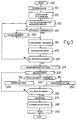
- FIG. 3 shows a block diagram of the operating cycle of processing circuit 22.
- a start block 100 goes on to a block 110, in which the lines 6a scanned by telecamera 20 are composed electronically to form a two-dimensional image (stored in memory 26) of conveyor belt 6 and/or objects 7, and so form a digital image I comprising a matrix of pixels, each characterized by a whole number defining its grey level.
- the acquired digital image I may comprise one or more objects 7 on conveyor belt 6, bearing one or more optical codes.
- Block 110 is followed by a block 120, in which the acquired digital image I is divided into a number of elementary images (windows) If, each comprising a predetermined number N of pixels.
- windows If may comprise four pixels, as shown in Figure 4.
- Block 120 is followed by a block 130, in which a brightness gradient vector G is calculated for each window If of image I.
- Block 130 is followed by a block 140, which compares the magnitude of each calculated gradient vector with a threshold value Glim established at the initialization step. If the value of the gradient vector is below the threshold, block 140 goes on to a block 150, in which the gradient vector, considered nonsignificant by representing only gradual variations in brightness, is cancelled. Conversely (block 190 following block 140), the calculated gradient vector, considered significant by representing sharp variations in brightness, is kept for subsequent processing.
- Block 190 performs a so-called "S-transform" of each previously calculated and selected gradient vector. More specifically, if the optical code is a bar code, angle ⁇ of each gradient vector is doubled ( Figure 5).
- the transformation operator in block 190 is capable of passing from gradient space (defined by magnitude, path and direction) to path space (defined by magnitude and path), so that, when S-transformed, two gradients of the same magnitude and path but opposite directions are mapped in the same path space vector. If the S-transform were not performed, in fact, the mean of two vectors of the same magnitude and path but opposite directions would obviously give a zero result, and the information associated with the gradients would be lost.
- To locate a bar code which comprises a number of black bars alternating with white spaces, both black to white and white to black transitions, i.e. vectors of opposite directions, must be taken into account.
- ID-MATRIX codes comprise square black or white unit elements, and involve identifying changes in brightness from white to black and black to white in four perpendicular directions, i.e. identifying four gradient vectors of the same magnitude and at 90° to one another (i.e. having respective angles ⁇ , ⁇ +90°, ⁇ +180°, ⁇ +270°).
- the S-transform in block 190 multiplies the angles of the four gradient vectors by 4 to generate four gradients, all with the same path 4 ⁇ ; and the four S-transformed vectors are added to give a vector of four times the magnitude of the gradient vectors and path 4 ⁇ .
- Other two-dimensional codes such as "MAXICODES", comprise hexagonal black or white unit elements, and involve identifying changes in brightness from white to black and black to white in six directions to give six gradient vectors of the same magnitude and at 60° to one another (i.e. having respective angles ⁇ , ⁇ +60°, ⁇ +120°, ⁇ +180°, ⁇ +240°, ⁇ +300°).
- the S-transform in block 190 multiplies the angles of the six gradient vectors by 6 to generate six gradients, all with the same path 6 ⁇ ; and the six S-transformed vectors are added to give a vector of six times the magnitude of the gradient vectors and path 6 ⁇ .
- the S-transform multiplies the angles of the gradient vectors by a factor equal to the number of sides of the unit element of which the code is formed. More specifically, the S-transform provides for transforming the previously selected gradients to determine a predetermined path and direction, which are assigned to all the calculated gradient vectors.
- Block 190 is followed by a block 200, in which each gradient vector G transformed in block 190 is approximated to the closest of a set of reference vectors (gradient vector quantization).
- the reference vector set may comprise four first unit vectors perpendicular to one another, and four second vectors perpendicular to one another and forming a 45° angle with the first vectors ( Figure 6).
- Block 200 is followed by a block 210, which determines whether all the windows If defined in block 120 have been examined (and the relative gradient vectors calculated). In the event of a negative response (windows If still being examined), block 210 goes back to block 130 to calculate a further gradient vector. Conversely (windows If all examined), block 210 goes on to block 215.
- Block 215 groups the quantized gradients of image I into a number of subsets (subimages) or tiles Ip, which are formed by dividing the acquired image I into a number of subimages (tiles) Ip, each comprising a number of windows If.
- tiles Ip may comprise a hundred pixels of the original image I, and therefore (in the example shown) twenty-five windows If (each comprising four pixels).
- the next processing step provides for determining which portions of the digitized original image I contain gradient vectors indicating brightness transitions compatible with the type of optical code being located.
- a bar code comprising parallel, side by side black and white bars, involves identifying white to black and black to white brightness changes in two directions to give two gradient vectors of the same path but opposite directions.
- Block 215 is followed by a block 220, which adds the gradient vectors processed in blocks 190, 200 and forming part of a subimage Ip. That is, the S-transformed and quantized gradient vectors of the various windows If are composed to generate a total gradient vector Gs relative to the currently selected tile Ip.
- Block 220 is followed by a block 230, in which the total gradient vector Gs is compared with threshold values. If the total gradient vector Gs exceeds the threshold values, block 230 goes on to block 240. Conversely (total gradient vector Gs below the threshold values), block 230 goes on to block 250.
- the threshold values may be represented by the sides of a square Q ( Figures 7 and 8). In which case, if one end of total gradient vector Gs falls within square Q ( Figure 8), block 230 goes on to block 250. Conversely (end of total gradient vector Gs outside square Q - Figure 7), block 230 goes on to block 240.
- Figures 7 and 8 also show a square Q 2 representing the maximum possible value of total gradient vector Gs.
- the situation determined in block 240 is that in which the value of the total gradient vector in the path space exceeds the threshold, in which case, the tile Ip in question is considered significant by comprising a sufficient number of gradient vectors of significant magnitude and substantially the same path (possible presence of an optical code and, in the example described, of a bar code).
- the selected tile Ip is therefore assigned a first logic value (in particular, a logic "1") indicating tile Ip is to be considered significant.
- the situation determined in block 250 is that in which the value of the total gradient vector in the path space is below the threshold, in which case, the tile in question is considered nonsignificant by comprising an insufficient number of gradients of significant magnitude and substantially the same path.
- the selected tile is therefore assigned a second logic value (in particular, a logic "0") indicating tile Ip is to be considered nonsignificant.
- Blocks 240, 250 are followed by a block 260, which determines whether all the tiles Ip of image I have been examined. In the event of a negative response (image still being examined), block 260 goes back to block 220 to examine a further tile Ip. Conversely (examination of image I completed), block 260 goes on to block 270.
- the output of block 260 is a final binary image Ir ( Figure 9) showing image I divided into a number of contiguous tiles Ip, each of which has a logic value "1" (significant "black” tile) if probably containing optical code images, or a logic value "0" (nonsignificant "white” tile) if probably containing no optical code images.
- the elementary unit by which final image Ir is represented is the same size as tile Ip. That is, tiles Ip constitute the pixels of final image Ir.
- the final image Ir is supplied to the next block 270, which provides for further reducing the amount of information for subsequent processing, in addition to the gradual, drastic reduction already made by the above process up to this point.
- SMOOTHING replaces the binary value of an original tile Ip in final image Ir with that of the majority of adjacent tiles, and provides for limiting the effect of acquisition noise and eliminating any "unclear" portions of the image.
- smoothing provides for eliminating any small-area or narrow clusters (shown by the hatched portions in Figure 10).
- the elementary unit by which final image Ir is represented obviously remains the same size as tile Ip, and noise is reduced at the expense of a loss in clearness of the image.
- the final image Ir clearly shows the possible code portions, but still comprises apparently significant spurious portions (i.e. "black” tiles) not actually corresponding to bar codes and containing a large number of parallel gradients (e.g. portions relative to tables, labels, photographs, etc.).
- the next block 280 provides (in known manner) for automatically recognizing the spurious portions and selecting the portions corresponding to the bar code by means of an automatic pattern recognition process for discriminating between the spurious portions and those corresponding to the bar code.
- the step performed in block 280 provides for recognizing all the groups of significant ("black”) tiles most likely to correspond to a bar code.
- Block 280 therefore rejects some significant tile groups, elects other significant tile groups as corresponding to optical codes, and generates a number of elected significant tile groups, each defining a portion of image I containing a respective optical code.
- the read algorithm (block 290 downstream from block 280) then processes in known manner the portion of image I relative solely to the portions corresponding to the elected tile groups.
- the method described above therefore provides for effectively and rapidly locating the portion corresponding to the optical code in the image picked up by telecamera 20.
- the code reading algorithm (block 290) only processes the portions corresponding to the optical code image, thus greatly reducing the amount of information processed as compared with the amount acquired by the telecamera.
- the S-transform in block 190 prevents information being lost due to the elision of vectors of the same path but opposite directions, thus further enhancing the efficiency of the location method; and, as the method described groups the tiles regardless of the predominant path of the gradients in each tile, tiles with predominantly perpendicular gradients may be placed in the same group.
- the method described above involves the processing of a large amount of data, and, as objects 7 are conveyed on belt 6 at high speed (about 1-3 meters a second), only a very limited amount of time is available in which to locate and subsequently read the code.
- the initial operations corresponding to blocks 130-250 of the present method and characterized by the processing of a large amount of data by means of fairly straightforward algorithms may be performed using electronic circuits (HARDWARE) implementing the operations.
- HARDWARE electronic circuits
- the final operations corresponding to blocks 270-290 of the present method and characterized by the processing of a small amount of data using fairly complex algorithms may be performed by a program (SOFTWARE).
- the gradient calculation in block 130 may be performed by a first circuit (not shown) defining two subtractors and a digital delay line, and generating components GX and GY of gradient vector G.
- the operations in blocks 140, 150, 190 and 200 may be performed by a second circuit (not shown) mainly comprising a memory, receiving components GX and GY, and generating components Sx and Sy of the S-transformed and quantized gradient vector.
- the operations in block 220 may be performed by a third circuit (not shown) comprising a digital filter, adders and delay lines, receiving components Sx and Sy, and generating the x and y components of the total gradient vector.
- the operations in blocks 230, 240 and 250 may be performed by a fourth circuit (not shown) receiving the x and y components of the total gradient vector, and comprising a comparator, a memory and a series of adders.
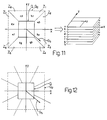
- the total gradient vector Gs may be compared with threshold values and a number of reference paths. That is, the cartesian space in which total gradient vector Gs is located may be divided into a central portion defining the limit values of the threshold vector, and into a number of radial portions outside the central portion and corresponding to respective total gradient vector paths. Each radial portion (and, hence, each total gradient vector path) corresponds to at least one respective binary plane in which the total gradient vector is mapped. More specifically, the orientation of the total gradient vector provides for selecting at least one respective binary plane comprising a number of tiles.
- Each tile is assigned a "1” or “0” according to whether the respective total gradient vector is respectively above or below the threshold, so as to build a number of binary images, each similar to the one in Figure 9, i.e. divided into a number of contiguous tiles Ip of logic "1" (significant “black” tile) or logic "0" (nonsignificant “white” tile).
- the cartesian space in which total gradient vector Gs is located is divided into a central portion (defined by a square Q) defining the minimum threshold vector values, and into eight symmetrical radial portions Z 1 -Z 8 outside square Q and corresponding to respective paths of total gradient vector Gs.
- Each radial portion (and, hence, each total gradient vector path) corresponds to two respective binary planes a-h in which the corresponding tile Ip is assigned a "1", whereas, in all the other planes, the corresponding tile Ip is assigned a "0", so as to build eight binary images, each similar to the one in Figure 9.
- the analysis performed in block 280 is repeated for each of the various binary planes to locate the groups of significant (black) tiles Ip corresponding to optical code images.
- the division into multiple planes, each corresponding to one path provides for improving the selectivity of the location process.
- Figure 12 shows said space divided into a larger number of radial portions than in Figure 11, and more specifically into twelve portions.
- the orientation of the total gradient vector Gs of each tile Ip is determined to locate the plane/s of the portion relative to total gradient vector Gs, and so build a number of binary images.
- N binary plane smoothing may be replaced by a mean total vector operation.
- each total vector Gs generated by block 220 for a tile Ip is replaced by the mean total vector of all the tiles within an adequate neighbourhood of the tile Ip in question (e.g. a neighbourhood of three by three tiles Ip).
- the resulting total vector may then be processed in the same way as previously (blocks 230, 240 and 250), i.e. compared with threshold values to determine the significant tile groups.
- the binary smoothing operation in block 270 may be dispensed with.
Landscapes
- Engineering & Computer Science (AREA)
- Physics & Mathematics (AREA)
- Toxicology (AREA)
- Health & Medical Sciences (AREA)
- Electromagnetism (AREA)
- General Health & Medical Sciences (AREA)
- Artificial Intelligence (AREA)
- Computer Vision & Pattern Recognition (AREA)
- General Physics & Mathematics (AREA)
- Theoretical Computer Science (AREA)
- Quality & Reliability (AREA)
- Image Analysis (AREA)
- Measurement Of Velocity Or Position Using Acoustic Or Ultrasonic Waves (AREA)
- Compression Or Coding Systems Of Tv Signals (AREA)
Priority Applications (4)
| Application Number | Priority Date | Filing Date | Title |
|---|---|---|---|
| EP96830661A EP0851374B1 (fr) | 1996-12-30 | 1996-12-30 | Méthode de localisaton d'un code appliqué sur un objet |
| DE69629930T DE69629930T2 (de) | 1996-12-30 | 1996-12-30 | Verfahren zum Festlegen eines auf einem Objekt angebrachten optischen Codes |
| AT96830661T ATE249650T1 (de) | 1996-12-30 | 1996-12-30 | Verfahren zum lokalisieren eines auf einem objekt aufgebrachten kodes |
| US09/000,797 US6047893A (en) | 1996-12-30 | 1997-12-30 | Method of locating an object-applied optical code |
Applications Claiming Priority (1)
| Application Number | Priority Date | Filing Date | Title |
|---|---|---|---|
| EP96830661A EP0851374B1 (fr) | 1996-12-30 | 1996-12-30 | Méthode de localisaton d'un code appliqué sur un objet |
Publications (2)
| Publication Number | Publication Date |
|---|---|
| EP0851374A1 true EP0851374A1 (fr) | 1998-07-01 |
| EP0851374B1 EP0851374B1 (fr) | 2003-09-10 |
Family
ID=8226101
Family Applications (1)
| Application Number | Title | Priority Date | Filing Date |
|---|---|---|---|
| EP96830661A Expired - Lifetime EP0851374B1 (fr) | 1996-12-30 | 1996-12-30 | Méthode de localisaton d'un code appliqué sur un objet |
Country Status (4)
| Country | Link |
|---|---|
| US (1) | US6047893A (fr) |
| EP (1) | EP0851374B1 (fr) |
| AT (1) | ATE249650T1 (fr) |
| DE (1) | DE69629930T2 (fr) |
Cited By (3)
| Publication number | Priority date | Publication date | Assignee | Title |
|---|---|---|---|---|
| US6775409B1 (en) | 1998-10-23 | 2004-08-10 | Data Logic S.P.A. | Method for locating codes in bidimensional images |
| US10825137B2 (en) | 2019-01-15 | 2020-11-03 | Datalogic IP Tech, S.r.l. | Systems and methods for pre-localization of regions of interest for optical character recognition, and devices therefor |
| US12524637B2 (en) | 2024-06-18 | 2026-01-13 | Datalogic Ip Tech S.R.L. | System and method for symbol detection |
Families Citing this family (26)
| Publication number | Priority date | Publication date | Assignee | Title |
|---|---|---|---|---|
| EP0917080B1 (fr) * | 1997-11-17 | 2001-07-18 | DATALOGIC S.p.A. | Méthode de localisation de régions colorées ou à hautes variations de brillance deans une image |
| DE19840455A1 (de) * | 1998-09-04 | 2000-03-09 | Sick Ag | Verfahren zum Betreiben eines Strichcodelesers |
| US7137711B1 (en) | 2000-03-21 | 2006-11-21 | Leonard Reiffel | Multi-user retro reflector data input |
| CN1190752C (zh) * | 2000-05-03 | 2005-02-23 | 伦纳德·赖费尔 | 双模式数据成像产品 |
| US7034803B1 (en) | 2000-08-18 | 2006-04-25 | Leonard Reiffel | Cursor display privacy product |
| US7161581B2 (en) * | 2000-08-18 | 2007-01-09 | Leonard Reiffel | Annotating imaged data product |
| WO2002049340A1 (fr) * | 2000-12-15 | 2002-06-20 | Leonard Reiffel | Produit d'entree de donnees d'une source de donnees codees muti-usage multi-source multi-imageur |
| AU2002228950A1 (en) * | 2000-12-15 | 2002-06-24 | Leonard Reiffel | Imaged coded data source tracking product |
| EP1350217A4 (fr) * | 2000-12-15 | 2004-12-15 | Leonard Reiffel | Produit transducteur source de donnees codees imagees |
| US20040195327A1 (en) * | 2001-04-19 | 2004-10-07 | Leonard Reiffel | Combined imaging coded data source data acquisition |
| US6729544B2 (en) * | 2001-05-02 | 2004-05-04 | International Business Machines Corporation | Fast barcode search |
| GB2392286B (en) * | 2002-08-19 | 2004-07-07 | Chunghwa Telecom Co Ltd | Personal identification system based on the reading of multiple one-dimensional barcodes scanned from scanned from PDA/cell phone screen |
| SE0301143D0 (sv) * | 2003-04-17 | 2003-04-17 | C Technologies Ab | Sätt och anordning för inläsning av data |
| US20060291797A1 (en) * | 2003-05-27 | 2006-12-28 | Leonard Reiffel | Multi-imager multi-source multi-use coded data source data input product |
| US7376894B2 (en) * | 2004-11-18 | 2008-05-20 | Microsoft Corporation | Vector path merging into gradient elements |
| EP1836646B1 (fr) * | 2004-12-03 | 2012-03-21 | Symbol Technologies, Inc. | Decodage au moyen d'un scanneur de code a barres |
| US7337970B2 (en) * | 2004-12-03 | 2008-03-04 | Symbol Technologies, Inc. | Barcode scanner decoding |
| US20100084470A1 (en) * | 2008-10-03 | 2010-04-08 | Microsoft Corporation | Two-dimensional barcode localization for camera based devices |
| JP5651659B2 (ja) * | 2012-08-31 | 2015-01-14 | 株式会社東芝 | 物体検出システムおよびプログラム |
| ITUB20154043A1 (it) | 2015-09-30 | 2017-03-30 | Datalogic IP Tech Srl | Sistema e metodo di lettura di informazioni codificate |
| JP6837880B2 (ja) * | 2017-03-15 | 2021-03-03 | 株式会社東芝 | 画像処理装置、画像処理システム、画像処理方法、およびプログラム |
| US10346660B2 (en) | 2017-08-25 | 2019-07-09 | Datalogic I.P. Tech S.R.L. | Coded image capture and decoding system |
| US10262436B2 (en) * | 2017-08-25 | 2019-04-16 | Datalogic Ip Tech S.R.L. | System for multiple decode of captured images |
| GB2575333B (en) * | 2018-12-21 | 2020-09-09 | Imagination Tech Ltd | Double-angle gradients |
| US10817693B1 (en) | 2019-07-10 | 2020-10-27 | Datalogic Ip Tech S.R.L. | System for decode of two-dimensional indicia |
| US11003881B2 (en) | 2019-09-11 | 2021-05-11 | Datalogic Ip Tech S.R.L. | System for multiple decode of captured images |
Citations (4)
| Publication number | Priority date | Publication date | Assignee | Title |
|---|---|---|---|---|
| US5268580A (en) * | 1992-09-02 | 1993-12-07 | Ncr Corporation | Bar code enhancement system and method for vision scanners |
| US5296690A (en) * | 1991-03-28 | 1994-03-22 | Omniplanar, Inc. | System for locating and determining the orientation of bar codes in a two-dimensional image |
| US5304787A (en) * | 1993-06-01 | 1994-04-19 | Metamedia Corporation | Locating 2-D bar codes |
| US5504319A (en) * | 1994-02-09 | 1996-04-02 | Symbol Technologies, Inc. | Method and system for bar code acquisition |
Family Cites Families (1)
| Publication number | Priority date | Publication date | Assignee | Title |
|---|---|---|---|---|
| US4874936A (en) * | 1988-04-08 | 1989-10-17 | United Parcel Service Of America, Inc. | Hexagonal, information encoding article, process and system |
-
1996
- 1996-12-30 DE DE69629930T patent/DE69629930T2/de not_active Expired - Lifetime
- 1996-12-30 EP EP96830661A patent/EP0851374B1/fr not_active Expired - Lifetime
- 1996-12-30 AT AT96830661T patent/ATE249650T1/de not_active IP Right Cessation
-
1997
- 1997-12-30 US US09/000,797 patent/US6047893A/en not_active Expired - Lifetime
Patent Citations (4)
| Publication number | Priority date | Publication date | Assignee | Title |
|---|---|---|---|---|
| US5296690A (en) * | 1991-03-28 | 1994-03-22 | Omniplanar, Inc. | System for locating and determining the orientation of bar codes in a two-dimensional image |
| US5268580A (en) * | 1992-09-02 | 1993-12-07 | Ncr Corporation | Bar code enhancement system and method for vision scanners |
| US5304787A (en) * | 1993-06-01 | 1994-04-19 | Metamedia Corporation | Locating 2-D bar codes |
| US5504319A (en) * | 1994-02-09 | 1996-04-02 | Symbol Technologies, Inc. | Method and system for bar code acquisition |
Cited By (3)
| Publication number | Priority date | Publication date | Assignee | Title |
|---|---|---|---|---|
| US6775409B1 (en) | 1998-10-23 | 2004-08-10 | Data Logic S.P.A. | Method for locating codes in bidimensional images |
| US10825137B2 (en) | 2019-01-15 | 2020-11-03 | Datalogic IP Tech, S.r.l. | Systems and methods for pre-localization of regions of interest for optical character recognition, and devices therefor |
| US12524637B2 (en) | 2024-06-18 | 2026-01-13 | Datalogic Ip Tech S.R.L. | System and method for symbol detection |
Also Published As
| Publication number | Publication date |
|---|---|
| EP0851374B1 (fr) | 2003-09-10 |
| DE69629930D1 (de) | 2003-10-16 |
| ATE249650T1 (de) | 2003-09-15 |
| DE69629930T2 (de) | 2004-07-22 |
| US6047893A (en) | 2000-04-11 |
Similar Documents
| Publication | Publication Date | Title |
|---|---|---|
| EP0851374B1 (fr) | Méthode de localisaton d'un code appliqué sur un objet | |
| US4969202A (en) | Image recognition edge detection method and system | |
| US6377698B1 (en) | Method of locating highly variable brightness or color regions in an image | |
| JP2832646B2 (ja) | 2次元cddイメージ中のバーコード・シンボルの精細な方位角を求める方法および装置 | |
| US5081689A (en) | Apparatus and method for extracting edges and lines | |
| JP3910447B2 (ja) | マルチ解像度ラベルロケータ | |
| US5276315A (en) | Method and apparatus for processing low resolution images of degraded bar code symbols | |
| US5420971A (en) | Image edge finder which operates over multiple picture element ranges | |
| US5668898A (en) | Device for detecting the inclination of image | |
| JP3251918B2 (ja) | 光学式文字認識システムにおける2値化方法 | |
| KR20060100376A (ko) | 물체 윤곽 이미지를 분석하기 위한 방법 및 이미지 처리장치, 물체를 검출하기 위한 방법 및 이미지 처리 장치,산업용 비전 장치, 스마트 카메라, 이미지 디스플레이,보안 시스템, 및 컴퓨터 프로그램 제품 | |
| JPH0413748B2 (fr) | ||
| JPH04287290A (ja) | ハフ変換画像処理装置 | |
| JPH0799581A (ja) | 画像処理装置 | |
| JP7062722B2 (ja) | 光学コードのモジュールサイズの特定 | |
| US5438636A (en) | Apparatus for simultaneously convolving multiple digital binary images using a single convolver with a binary mask to determine pixel densities | |
| US6000618A (en) | Method of reading an object-applied bar code | |
| EP0917081A1 (fr) | Méthode de localisation d'un Maxicode | |
| EP0447541B1 (fr) | Systeme et methode de traitement d'images | |
| CA2230197C (fr) | Detection de l'orientation des copeaux | |
| JP2009032202A (ja) | 2次元コード読取装置及びその方法 | |
| JP2000329538A (ja) | 表面検査装置 | |
| CA2208788C (fr) | Procede et appareil pour la convolution simultanee de multiples images binaires numeriques a l'aide d'un seul convolutionneur dote d'un masque binaire pour determiner les densites de pixels | |
| JPH05113315A (ja) | 円形画像データの中心位置検出方法 | |
| JPH09330417A (ja) | 形状計測装置 |
Legal Events
| Date | Code | Title | Description |
|---|---|---|---|
| PUAI | Public reference made under article 153(3) epc to a published international application that has entered the european phase |
Free format text: ORIGINAL CODE: 0009012 |
|
| AK | Designated contracting states |
Kind code of ref document: A1 Designated state(s): AT BE CH DE DK ES FI FR GB GR IE IT LI |
|
| AX | Request for extension of the european patent |
Free format text: AL;LT;LV;RO;SI |
|
| AKX | Designation fees paid | ||
| RBV | Designated contracting states (corrected) | ||
| 17P | Request for examination filed |
Effective date: 19981229 |
|
| RBV | Designated contracting states (corrected) |
Designated state(s): AT BE CH DE DK ES FR GB IT LI NL PT SE |
|
| RAP1 | Party data changed (applicant data changed or rights of an application transferred) |
Owner name: DATALOGIC S.P.A. |
|
| GRAH | Despatch of communication of intention to grant a patent |
Free format text: ORIGINAL CODE: EPIDOS IGRA |
|
| GRAS | Grant fee paid |
Free format text: ORIGINAL CODE: EPIDOSNIGR3 |
|
| GRAA | (expected) grant |
Free format text: ORIGINAL CODE: 0009210 |
|
| AK | Designated contracting states |
Kind code of ref document: B1 Designated state(s): AT BE CH DE DK ES FR GB IT LI NL PT SE |
|
| PG25 | Lapsed in a contracting state [announced via postgrant information from national office to epo] |
Ref country code: NL Free format text: LAPSE BECAUSE OF FAILURE TO SUBMIT A TRANSLATION OF THE DESCRIPTION OR TO PAY THE FEE WITHIN THE PRESCRIBED TIME-LIMIT Effective date: 20030910 Ref country code: LI Free format text: LAPSE BECAUSE OF FAILURE TO SUBMIT A TRANSLATION OF THE DESCRIPTION OR TO PAY THE FEE WITHIN THE PRESCRIBED TIME-LIMIT Effective date: 20030910 Ref country code: CH Free format text: LAPSE BECAUSE OF FAILURE TO SUBMIT A TRANSLATION OF THE DESCRIPTION OR TO PAY THE FEE WITHIN THE PRESCRIBED TIME-LIMIT Effective date: 20030910 Ref country code: BE Free format text: LAPSE BECAUSE OF FAILURE TO SUBMIT A TRANSLATION OF THE DESCRIPTION OR TO PAY THE FEE WITHIN THE PRESCRIBED TIME-LIMIT Effective date: 20030910 Ref country code: AT Free format text: LAPSE BECAUSE OF FAILURE TO SUBMIT A TRANSLATION OF THE DESCRIPTION OR TO PAY THE FEE WITHIN THE PRESCRIBED TIME-LIMIT Effective date: 20030910 |
|
| REG | Reference to a national code |
Ref country code: GB Ref legal event code: FG4D |
|
| REG | Reference to a national code |
Ref country code: CH Ref legal event code: EP |
|
| REF | Corresponds to: |
Ref document number: 69629930 Country of ref document: DE Date of ref document: 20031016 Kind code of ref document: P |
|
| PG25 | Lapsed in a contracting state [announced via postgrant information from national office to epo] |
Ref country code: SE Free format text: LAPSE BECAUSE OF FAILURE TO SUBMIT A TRANSLATION OF THE DESCRIPTION OR TO PAY THE FEE WITHIN THE PRESCRIBED TIME-LIMIT Effective date: 20031210 Ref country code: DK Free format text: LAPSE BECAUSE OF FAILURE TO SUBMIT A TRANSLATION OF THE DESCRIPTION OR TO PAY THE FEE WITHIN THE PRESCRIBED TIME-LIMIT Effective date: 20031210 |
|
| PG25 | Lapsed in a contracting state [announced via postgrant information from national office to epo] |
Ref country code: PT Free format text: LAPSE BECAUSE OF FAILURE TO SUBMIT A TRANSLATION OF THE DESCRIPTION OR TO PAY THE FEE WITHIN THE PRESCRIBED TIME-LIMIT Effective date: 20031215 |
|
| PGFP | Annual fee paid to national office [announced via postgrant information from national office to epo] |
Ref country code: FR Payment date: 20031218 Year of fee payment: 8 |
|
| PG25 | Lapsed in a contracting state [announced via postgrant information from national office to epo] |
Ref country code: ES Free format text: LAPSE BECAUSE OF FAILURE TO SUBMIT A TRANSLATION OF THE DESCRIPTION OR TO PAY THE FEE WITHIN THE PRESCRIBED TIME-LIMIT Effective date: 20031221 |
|
| NLV1 | Nl: lapsed or annulled due to failure to fulfill the requirements of art. 29p and 29m of the patents act | ||
| REG | Reference to a national code |
Ref country code: CH Ref legal event code: PL |
|
| ET | Fr: translation filed | ||
| PLBE | No opposition filed within time limit |
Free format text: ORIGINAL CODE: 0009261 |
|
| STAA | Information on the status of an ep patent application or granted ep patent |
Free format text: STATUS: NO OPPOSITION FILED WITHIN TIME LIMIT |
|
| 26N | No opposition filed |
Effective date: 20040614 |
|
| PG25 | Lapsed in a contracting state [announced via postgrant information from national office to epo] |
Ref country code: FR Free format text: LAPSE BECAUSE OF NON-PAYMENT OF DUE FEES Effective date: 20050831 |
|
| REG | Reference to a national code |
Ref country code: FR Ref legal event code: ST |
|
| PG25 | Lapsed in a contracting state [announced via postgrant information from national office to epo] |
Ref country code: IT Free format text: LAPSE BECAUSE OF NON-PAYMENT OF DUE FEES Effective date: 20051230 |
|
| PGFP | Annual fee paid to national office [announced via postgrant information from national office to epo] |
Ref country code: GB Payment date: 20151221 Year of fee payment: 20 Ref country code: DE Payment date: 20151211 Year of fee payment: 20 |
|
| REG | Reference to a national code |
Ref country code: DE Ref legal event code: R071 Ref document number: 69629930 Country of ref document: DE |
|
| REG | Reference to a national code |
Ref country code: GB Ref legal event code: PE20 Expiry date: 20161229 |
|
| PG25 | Lapsed in a contracting state [announced via postgrant information from national office to epo] |
Ref country code: GB Free format text: LAPSE BECAUSE OF EXPIRATION OF PROTECTION Effective date: 20161229 |