EP0852406B1 - Lithium-Ion-Sekundärbatterie und Verfahren zur Herstellung - Google Patents
Lithium-Ion-Sekundärbatterie und Verfahren zur Herstellung Download PDFInfo
- Publication number
- EP0852406B1 EP0852406B1 EP97121078A EP97121078A EP0852406B1 EP 0852406 B1 EP0852406 B1 EP 0852406B1 EP 97121078 A EP97121078 A EP 97121078A EP 97121078 A EP97121078 A EP 97121078A EP 0852406 B1 EP0852406 B1 EP 0852406B1
- Authority
- EP
- European Patent Office
- Prior art keywords
- polymer
- lithium ion
- ion secondary
- secondary battery
- electrolytic solution
- Prior art date
- Legal status (The legal status is an assumption and is not a legal conclusion. Google has not performed a legal analysis and makes no representation as to the accuracy of the status listed.)
- Expired - Lifetime
Links
Images

Classifications
-
- H—ELECTRICITY
- H01—ELECTRIC ELEMENTS
- H01M—PROCESSES OR MEANS, e.g. BATTERIES, FOR THE DIRECT CONVERSION OF CHEMICAL ENERGY INTO ELECTRICAL ENERGY
- H01M10/00—Secondary cells; Manufacture thereof
- H01M10/05—Accumulators with non-aqueous electrolyte
- H01M10/056—Accumulators with non-aqueous electrolyte characterised by the materials used as electrolytes, e.g. mixed inorganic/organic electrolytes
- H01M10/0564—Accumulators with non-aqueous electrolyte characterised by the materials used as electrolytes, e.g. mixed inorganic/organic electrolytes the electrolyte being constituted of organic materials only
- H01M10/0565—Polymeric materials, e.g. gel-type or solid-type
-
- H—ELECTRICITY
- H01—ELECTRIC ELEMENTS
- H01M—PROCESSES OR MEANS, e.g. BATTERIES, FOR THE DIRECT CONVERSION OF CHEMICAL ENERGY INTO ELECTRICAL ENERGY
- H01M10/00—Secondary cells; Manufacture thereof
- H01M10/05—Accumulators with non-aqueous electrolyte
- H01M10/052—Li-accumulators
- H01M10/0525—Rocking-chair batteries, i.e. batteries with lithium insertion or intercalation in both electrodes; Lithium-ion batteries
-
- H—ELECTRICITY
- H01—ELECTRIC ELEMENTS
- H01M—PROCESSES OR MEANS, e.g. BATTERIES, FOR THE DIRECT CONVERSION OF CHEMICAL ENERGY INTO ELECTRICAL ENERGY
- H01M10/00—Secondary cells; Manufacture thereof
- H01M10/05—Accumulators with non-aqueous electrolyte
- H01M10/058—Construction or manufacture
-
- H—ELECTRICITY
- H01—ELECTRIC ELEMENTS
- H01M—PROCESSES OR MEANS, e.g. BATTERIES, FOR THE DIRECT CONVERSION OF CHEMICAL ENERGY INTO ELECTRICAL ENERGY
- H01M2300/00—Electrolytes
- H01M2300/0085—Immobilising or gelification of electrolyte
-
- H—ELECTRICITY
- H01—ELECTRIC ELEMENTS
- H01M—PROCESSES OR MEANS, e.g. BATTERIES, FOR THE DIRECT CONVERSION OF CHEMICAL ENERGY INTO ELECTRICAL ENERGY
- H01M2300/00—Electrolytes
- H01M2300/0088—Composites
- H01M2300/0094—Composites in the form of layered products, e.g. coatings
-
- H—ELECTRICITY
- H01—ELECTRIC ELEMENTS
- H01M—PROCESSES OR MEANS, e.g. BATTERIES, FOR THE DIRECT CONVERSION OF CHEMICAL ENERGY INTO ELECTRICAL ENERGY
- H01M50/00—Constructional details or processes of manufacture of the non-active parts of electrochemical cells other than fuel cells, e.g. hybrid cells
- H01M50/40—Separators; Membranes; Diaphragms; Spacing elements inside cells
- H01M50/46—Separators, membranes or diaphragms characterised by their combination with electrodes
- H01M50/461—Separators, membranes or diaphragms characterised by their combination with electrodes with adhesive layers between electrodes and separators
-
- H—ELECTRICITY
- H01—ELECTRIC ELEMENTS
- H01M—PROCESSES OR MEANS, e.g. BATTERIES, FOR THE DIRECT CONVERSION OF CHEMICAL ENERGY INTO ELECTRICAL ENERGY
- H01M6/00—Primary cells; Manufacture thereof
- H01M6/40—Printed batteries, e.g. thin film batteries
-
- Y—GENERAL TAGGING OF NEW TECHNOLOGICAL DEVELOPMENTS; GENERAL TAGGING OF CROSS-SECTIONAL TECHNOLOGIES SPANNING OVER SEVERAL SECTIONS OF THE IPC; TECHNICAL SUBJECTS COVERED BY FORMER USPC CROSS-REFERENCE ART COLLECTIONS [XRACs] AND DIGESTS
- Y02—TECHNOLOGIES OR APPLICATIONS FOR MITIGATION OR ADAPTATION AGAINST CLIMATE CHANGE
- Y02E—REDUCTION OF GREENHOUSE GAS [GHG] EMISSIONS, RELATED TO ENERGY GENERATION, TRANSMISSION OR DISTRIBUTION
- Y02E60/00—Enabling technologies; Technologies with a potential or indirect contribution to GHG emissions mitigation
- Y02E60/10—Energy storage using batteries
-
- Y—GENERAL TAGGING OF NEW TECHNOLOGICAL DEVELOPMENTS; GENERAL TAGGING OF CROSS-SECTIONAL TECHNOLOGIES SPANNING OVER SEVERAL SECTIONS OF THE IPC; TECHNICAL SUBJECTS COVERED BY FORMER USPC CROSS-REFERENCE ART COLLECTIONS [XRACs] AND DIGESTS
- Y02—TECHNOLOGIES OR APPLICATIONS FOR MITIGATION OR ADAPTATION AGAINST CLIMATE CHANGE
- Y02P—CLIMATE CHANGE MITIGATION TECHNOLOGIES IN THE PRODUCTION OR PROCESSING OF GOODS
- Y02P70/00—Climate change mitigation technologies in the production process for final industrial or consumer products
- Y02P70/50—Manufacturing or production processes characterised by the final manufactured product
-
- Y—GENERAL TAGGING OF NEW TECHNOLOGICAL DEVELOPMENTS; GENERAL TAGGING OF CROSS-SECTIONAL TECHNOLOGIES SPANNING OVER SEVERAL SECTIONS OF THE IPC; TECHNICAL SUBJECTS COVERED BY FORMER USPC CROSS-REFERENCE ART COLLECTIONS [XRACs] AND DIGESTS
- Y10—TECHNICAL SUBJECTS COVERED BY FORMER USPC
- Y10T—TECHNICAL SUBJECTS COVERED BY FORMER US CLASSIFICATION
- Y10T29/00—Metal working
- Y10T29/49—Method of mechanical manufacture
- Y10T29/49002—Electrical device making
- Y10T29/49108—Electric battery cell making
- Y10T29/49114—Electric battery cell making including adhesively bonding
Definitions
- This invention relates to a lithium ion secondary battery in which positive and negative electrodes face each other by sandwiching a separator which keeps electrolytes, more particularly to a thin lithium ion secondary battery having excellent charge and discharge characteristics.
- Lithium ion battery is a secondary battery which can realize the highest voltage, largest energy density and tolerance for largest load factor resistance among existing batteries and is expected as a most probable candidate which will satisfy the aforementioned requirements.
- the lithium ion secondary battery has a positive electrode, a negative electrode and an ion conducting layer inserted between these positive and negative electrodes.
- a plate-shaped material prepared by mixing powder of a lithium-cobalt oxide or the like active material with a binder resin together with powder of an electron conducting substance and coating the mixture on an aluminum collector is used as the positive electrode
- another plate-shaped material prepared by mixing powder of a carbonaceous active material with a binder resin and coating the mixture on a copper collector is used as the negative electrode.
- a porous film such as of polyethylene, polypropylene or the like filled with a lithium ion-containing non-aqueous solution is used as the ion conducting layer.
- US 5,429,891 is considered as the closest prior art, and discloses a polymeric film useful as an inter-electrode separator or electrolyte member in electrolytic devices, such as rechargeable batteries.
- the film comprises a copolymer, a medium to high-boiling plasticizer and a finely divided inorganic filler.
- the present invention provides a lithium ion secondary battery in accordance with independent claim 1. Further preferred embodiments are given in the dependent claims.
- the present invention has been accomplished with the aim of resolving the aforementioned problems and it contemplate providing a battery structure in which a positive electrode and a negative electrode are closely adhered to an ion conducting layer (to be referred to as separator hereinafter) by an adhesive resin, thereby securing sufficient bonding strength between the electrodes and separator, and ionic conduction resistance between the positive and negative electrodes and the ion conducting layer (to be referred to as separator hereinafter) electrode is simultaneously secured to the same level of conventional batteries which use armor cases.
- separator ion conducting layer
- a first aspect of the lithium ion secondary battery of the present invention is a battery which comprises:
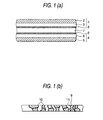
- 1 is a positive electrode
- 2 is a positive electrode collector
- 3 is a positive electrode active material layer
- 4 is a negative electrode
- 5 is a negative electrode collector
- 6 is a negative electrode active material layer
- 7 is a separator
- 8 is an adhesive resin layer
- 9 is an electrolytic solution phase
- 10 is a polymer gel phase
- 11 is a polymer solid phase.
- Fig. 1 (a) and (b) are sectional illustration of principal part showing a practical mode of the lithium ion secondary battery of the present invention, in which Fig. 1 (b) is a partially enlarged view of the adhesive resin layer of Fig. 1 (a) .
- Fig. 1 (a) 1 is a positive electrode which is prepared by forming a positive electrode active material layer 3 on a positive electrode collector 2 made of aluminum foil or the like metal.
- the part 4 is a negative electrode which is prepared by forming a negative electrode active material layer 6 on a negative electrode collector 5 made of copper or the like metal.
- the part 7 is a separator which keeps a lithium ion-containing electrolytic solution, 8 is an adhesive resin layer which bonds the separator 7 to the positive electrode 1, and the separator 7 to the negative electrode 4 , and, as shown in Fig.
- the adhesive resin layer 8 comprises a mixture phase consisting of a polymer solid phase 11, a polymer gel phase 10 that contains an electrolytic solution and an electrolytic solution phase 9 which is kept in micropores formed with the polymer solid phase 11 or the polymer gel phase 10.
- the polymer solid phase 11 of the adhesive resin layer 8 By the polymer solid phase 11 of the adhesive resin layer 8 ,one side of the facing surfaces of the separator 7 are strongly bonded (adhered) to the positive electrode 1, and the other side of the separator 7 also are strongly bonded (adhered) to the negative electrode 4. And large ionic conductance is obtained by the electrolytic solution phase 9, and decrease in the bonding (adhesion) strength caused by compatibilization of the polymer solid phase 11 with the electrolytic solution phase 9 is repressed by the polymer gel phase 10. And the polymer gel phase 10 is also effective in keeping large ionic conductance, thereby the ionic conductance between the separator 7 and the positive electrode 1 and negative electrode 4 can be increased to a markedly high level.
- an adhesive resin which is prepared by dissolving polymer materials having different average molecular weight is used as an adhesive resin.
- an adhesive resin layer 8 which comprises a mixture phase consisting of a polymer solid phase 11 containing a large molecular weight polymer material, a polymer gel phase 10 containing a small molecular weight polymermaterial and an electrolytic solution phase 9 is formed, when an adhesive is prepared by uniformly dissolving a small molecular weight polymer material which swells by an electrolytic solution and a large molecular weight polymer material which does not swell by the electrolytic solution in an appropriate solvent, the positive electrode 1 and the negative electrode 4 are bonded to the separator 7 using the thus prepared adhesive and then the adhesive is thoroughly dried and impregnated with the electrolytic solution at a predetermined temperature.
- the aforementioned polymer materials having different average molecular weight may be the same or different polymer materials.
- the gel phase and solid phase can be formed by this combination even when they large the same average molecular weight, but it is desirable that they large different average molecular weight even in this case.
- the reason for this is that, when the polymer materials are different from each other but large similar molecular weight, the gel state changes periodically due to the formation of so-called "topological entanglement" in the solution system, so that there is a possibility that battery characteristics may also be changed.
- These polymer materials to be used for the formation of the adhesive resin layer 8 must be at least those which are insoluble in the electrolytic solution and do not cause reactions in the lithium ion secondary battery. In addition to this, it is necessary that such materials are capable of forming gel phase and solid phase in the presence of the electrolytic solution, so that materials which satisfy these conditions can be used.
- the same polymer material can form each of the gel phase and solid phase depending on the type of solvent of the electrolytic solution or the temperature history when the lithium ion secondary battery is produced, and, for example, polymethylmethacrylate or the like acrylic ester polymer, polyacrylonitrile, small molecular weight polyvinylidene fluoride or a copolymer thereof with other large molecular weight compound may be used as the polymer material which can form a gel phase. Also, large molecular weight polyvinylidene fluoride, polytetrafluoroethylene or a or a copolymer thereof with other large molecular weight compound may be used as the polymer material which can form a solid phase.
- Examples of the positive electrode active material to be used in the positive electrode active material layer 3 include complex oxides of lithium with cobalt, manganese, nickel and the like transient metals, lithium-containing chalcogen compounds or complex compounds thereof and these complex oxides, chalcogen compounds and complex compounds to which various elements are added. Also, a carbonaceous material or the like material through which lithium ions can go in and out may be used as the negative electrode active material to be used in the negative electrode active material layer 6.
- any metal can be used with the proviso that it is stable in the lithium ion secondary battery, and aluminum is used preferably as the positive electrode collector 2, and copper as the negative electrode collector 5.
- aluminum is used preferably as the positive electrode collector 2, and copper as the negative electrode collector 5.
- shape of the collectors 2 and 5 any of foil, net, expanded metal and the like shapes can be used, of which net, expanded metal or the like shape which has a large surface area is desirable in order to obtain bonding strength with the active material layers 3 and 6 and to facilitate impregnation with the electrolytic solution after their bonding.
- any one of porous membranes, nets, non-woven fabric and the like insulating materials which can be impregnated with the electrolytic solution and can exert sufficient strength may be used, but it is desirable to use a porous membrane made of polypropylene, polyethylene or the like, from the view point of adhesiveness and safety.
- a fluoride resin material it is necessary in some cases to ensure its adhesiveness by a plasma treatment of its surface.
- the electrolytic solution to be used may be prepared by dissolving LiPF 6 , LiClO 4 , LiBF 4 , LiCF 3 SO 3 , LiN(CF 3 SO 2 ) 2 , LiC(CF 3 SO 2 ) 3 , LiN(C 2 F 5 SO 2 ) 2 or the like electrolyte in a single or mixture solvent selected from dimethoxyethane, diethoxyethane, dimethylether, diethylether and the like ether solvents and ethylene carbonate, propylene carbonate and the like ester solvents.
- a single or mixture solvent selected from dimethoxyethane, diethoxyethane, dimethylether, diethylether and the like ether solvents and ethylene carbonate, propylene carbonate and the like ester solvents.
- Fig. 1 The following illustratively describes embodiments of the lithium ion secondary battery of the present invention shown in Fig. 1 .
- a positive electrode active material paste prepared by dispersing 87 parts by weight of LiCoO 2 , 8 parts by weight of graphite powder and 5 parts by weight of polyvinylidene fluoride in N-methylpyrrolidone (to be referred to as NMP hereinafter) was coated to a thickness of 300 ⁇ m by doctor blade method to form a positive electrode active material thin film.
- An aluminum net having a thickness of 30 ⁇ m to be used as a positive electrode collector was put on the film, and the positive electrode active material paste was again coated further thereon to a thickness of 300 ⁇ m by the doctor blade method.
- a negative electrode active material paste prepared by dispersing 95 parts by weight of Meso Phase Microbeads Carbon (manufactured by Osaka Gas) and 5 parts by weight of polyvinylidene fluoride in NMP was coated to a thickness of 300 ⁇ m by doctor blade method to form a negative electrode active material thin film.
- a copper net having a thickness of 20 ⁇ m to be used as a negative electrode collector was put on the film, and the negative electrode active material paste was again coated further thereon to a thickness of 300 ⁇ m by the doctor blade method.
- a mixture consisting of 3.0 parts by weight of poly (methylmethacrylate) having an average molecular weight (Mw) of 350,000 (manufactured by Aldrich), 2.0 parts by weight of polyvinylidene fluoride having an average molecular weight (Mw) of 534,000 (manufactured by Aldrich) and 95 parts by weight of NMP in that compositional ratio was thoroughly stirred until the mixture became uniform solution, thereby preparing a viscous adhesive agent.
- poly (methylmethacrylate) having an average molecular weight (Mw) of 350,000 (manufactured by Aldrich)
- polyvinylidene fluoride having an average molecular weight (Mw) of 534,000 (manufactured by Aldrich)
- NMP average molecular weight
- the adhesive agent prepared in the above step was coated on both sides of a porous polypropylene sheet (trade name Cell Guard #2400, manufactured by Hoechst) to be used as the separator 7. Thereafter, and before the adhesive agent was dried, the positive electrode and the negative electrode were adhered and laminated together in such a manner that they faced each other by sandwiching the separator, thus preparing a battery laminate in which the positive electrode 1, the separator 7 and the negative electrode 4 were bonded.
- the thus laminated battery laminate was allowed to stand for 2 hours in a hot air oven of 60°C to evaporate NMP. By the evaporation of NMP from the adhesive agent, it becomes a porous membrane having continuous holes.
- an electrolytic solution which has been prepared by dissolving 1.0 mol/dm 3 in concentration of LiPF 6 (manufactured by Tokyo Kasei) in a mixture solvent (1:1 in molar ratio) consisting of ethylene carbonate (manufactured by Kanto Chemical) and 1,2-dimethoxyethane (manufactured by Wako Pure Chemical Industries).
- the peel strength between the positive electrode active material layer 3 and the separator 7 and the negative electrode active material layer 6 and the separator 7 was measured (by the measuring method of JIS K6854) to find respective values of 25 to 30 gf/cm and 15 to 20 gf/cm.
- a lithium ion secondary battery was completed by packing the electrolytic solution-injected electrode laminate with an aluminum laminate film and sealing the opening by hot melting treatment.
- adhesive resin layer 8 consist of a polymer solid phase 11 containing a large molecular weight polymer material, a polymer gel phase 10 containing a small molecular weight polymer material and an electrolytic solution phase 9 is formed.
- the injected electrode laminate can be heated at the temperature lower than 50°C for 60 minutes before packing. More preferably the injected electrode laminate can be heated at the temperature lower than 60°C for 3,4 minutes before packing.
- the ratio of polymer gel phase 10 for polymer solid phase 11 is 3:2.
- a lithium ion secondary battery was prepared by repeating the method of Embodiment 1, with only one exception that the preparation method of adhesive agent was changed as follows.
- a mixture consisting of 3.0 parts by weight of poly(acrylonitrile) having an average molecular weight (Mw) of 86,200 (manufactured by Aldrich), 2.0 parts by weight of polyvinylidene fluoride having an average molecular weight (Mw) of 534,000 (manufactured by Aldrich) and 95 parts by weight of NMP in that compositional ratio was thoroughly stirred until the mixture became uniform solution, thereby preparing a viscous adhesive agent.
- a lithium ion secondary battery was prepared by repeating the method of Embodiment 1, with only one exception that the preparation method of adhesive agent was changed as follows.
- a mixture consisting of 2.5 parts by weight of polyvinylidene fluoride having an average molecular weight (Mw) of 180,000 (manufactured by Aldrich), 2.5 parts by weight of polyvinylidene fluoride having an average molecular weight (Mw) of 534,000 (manufactured by Aldrich) and 95 parts by weight of NMP in that compositional ratio was thoroughly stirred until the mixture became uniform solution, thereby preparing a viscous adhesive agent.
- a lithium ion secondary battery was prepared by repeating the method of Embodiment 1, with only one exception that the preparation method of adhesive agent was changed as follows.
- Mw average molecular weight
- Mw average molecular weight
- a lithium ion secondary battery was prepared by repeating the method of Embodiment 1, with only one exception that the preparation method of adhesive agent was changed as follows.
- a mixture consisting of 5.0 parts by weight of polyvinylidene fluoride having an average molecular weight (Mw) of 180,000 (manufactured by Aldrich), 5.0 parts by weight of polyvinylidene fluoride having an average molecular weight (Mw) of 534,000 (manufactured by Aldrich) and 90 parts by weight of NMP in that compositional ratio was thoroughly stirred until the mixture became uniform solution, thereby preparing a viscous adhesive agent.
- Mw average molecular weight
- Mw average molecular weight
- a lithium ion secondary battery was prepared by repeating the method of Embodiment 1, with only one exception that the preparation method of adhesive agent was changed as follows.
- a mixture consisting of 2.5 parts by weight of polyvinylidene fluoride having an average molecular weight (Mw) of 180,000 (manufactured by Aldrich), 2.5 parts by weight of polyvinylidene fluoride having an average molecular weight (Mw) of 534,000 (manufactured by Aldrich) and 90 parts by weight of NMP in that compositional ratio was thoroughly stirred until the mixture became uniform solution, thereby preparing a viscous adhesive agent.
- the adhesive agent prepared in the above step was coated on both sides of a porous polypropylene sheet (trade name Cell Guard #2400, manufactured by Hoechst) to be used as the separator 7. Thereafter, and before the adhesive agent was dried, the positive electrode and the negative electrode were adhered and laminated together in such a manner that they faced each other by sandwiching the separator, thus preparing a electrode laminate.
- the thus electrode laminate was allowed to stand for 2 hours in a hot air oven of 60°C to evaporate NMP. By the evaporation of NMP from the adhesive agent, it becomes a porous membrane having continuous holes.
- an electrolytic solution which has been prepared by dissolving 1.0 mol/dm 3 in concentration of LiPF 6 (manufactured by Tokyo Kasei) in a mixture solvent (1:1 in molar ratio) consisting of ethylene carbonate (manufactured by Kanto Chemical) and diethyl carbonate (manufactured by Wako Pure Chemical Industries).
- a lithium ion secondary battery was prepared by repeating the method of Embodiment 6 except that the preparation method of adhesive agent was changed as follows.
- Mw average molecular weight
- Mw average molecular weight
- a lithium ion secondary battery was prepared by repeating the method of Embodiment 6, except that the preparation method of adhesive agent was changed as follows.
- a mixture consisting of 5.0 parts by weight of polyvinylidene fluoride having an average molecular weight (Mw) of 180,000 (manufactured by Aldrich), 5.0 parts by weight of polyvinylidene fluoride having an average molecular weight (Mw) of 534,000 (manufactured by Aldrich) and 93 parts by weight of NMP in that compositional ratio was thoroughly stirred until the mixture became uniform solution, thereby preparing a viscous adhesive agent.
- Mw average molecular weight
- a lithium ion secondary battery was prepared by repeating the method of Embodiment 1, except that the preparation method of adhesive agent was changed as follows and the injection temperature of the electrolytic solution in producing the battery was changed to 70°C as shown below.
- a mixture consisting of 2.5 parts by weight of polyvinylidene fluoride having an average molecular weight (Mw) of 180,000 (manufactured by Aldrich), 2.5 parts by weight of polyvinylidene fluoride having an average molecular weight (Mw) of 534,000 (manufactured by Aldrich) and 95 parts by weight of NMP in that compositional ratio was thoroughly stirred until the mixture became uniform solution, thereby preparing a viscous adhesive agent.
- the adhesive agent prepared in the above step was coated on both sides of a porous polypropylene sheet (trade name Cell Guard #2400, manufactured by Hoechst) to be used as the separator 7. Thereafter, and before the adhesive agent was dried, the positive electrode and the negative electrode were adhered and laminated together in such a manner that they faced each other by sandwiching the separator, thus preparing a electrode laminate.
- the thus electrode laminate was allowed to stand for 2 hours in a hot air oven of 60°C to evaporate NMP. By the evaporation of NMP from the adhesive agent, it becomes a porous membrane having continuous holes (micropores).
- an electrolytic solution which has been prepared by dissolving 1.0 mol/dm 3 in concentration of LiPF 6 (manufactured by Tokyo Kasei) in a mixture solvent (1:1 in molar ratio) consisting of ethylene carbonate (manufactured by Kanto Chemical) and diethyl carbonate (manufactured by Wako Pure Chemical Industries).
- a lithium ion secondary battery was prepared by repeating the method of Embodiment 1, with only one exception that the preparation method of adhesive agent was changed as follows.
- poly (methylmethacrylate) having an average molecular weight (Mw) of 350,000 manufactured by Aldrich
- NMP average molecular weight
- a lithium ion secondary battery was prepared by repeating the method of Embodiment 1, with only one exception that the preparation method of adhesive agent was changed as follows.
- Mw average molecular weight
- a lithium ion secondary battery was prepared by repeating the method of Embodiment 1, with only one exception that the preparation method of adhesive agent was changed as follows.
- Mw average molecular weight
- a lithium ion secondary battery was prepared by repeating the method of Embodiment 1, with only one exception that the preparation method of adhesive agent was changed as follows.
- Mw average molecular weight
- a lithium ion secondary battery was prepared by repeating the method of Embodiment 1, except that the same adhesive agent of Embodiments 6 and 9 was used and the injection temperature of the electrolytic solution in producing the battery was changed to 100°C as shown below.
- the aforementioned adhesive agent was coated on both sides of a porous polypropylene sheet (trade name Cell Guard #2400, manufactured by Hoechst) to be used as the separator 7. Thereafter, and before the adhesive agent was dried, the positive electrode and the negative electrode were adhered and laminated together in such a manner that they faced each other by sandwiching the separator, thus preparing a electrode laminate.
- the thus electrode laminate was allowed to stand for 2 hours in a hot air oven of 60°C to evaporate NMP. By the evaporation of NMP from the adhesive agent, it becomes a porous membrane having continuous holes.
- an electrolytic solution which has been prepared by dissolving 1.0 mol/dm 3 in concentration of LiPF 6 (manufactured by Tokyo Kasei) in a mixture solvent (1:1 in molar ratio) consisting of ethylene carbonate (manufactured by Kanto Chemical) and diethyl carbonate (manufactured by Wako Pure Chemical Industries).
- the lithium ion secondary batteries of Comparative Examples 1 to 3 showed hardly measurable peel strength values of close to zero. Since each of the adhesive agents used in Comparative Examples 1 to 3 swells by the electrolytic solution and is composed of the electrolytic solution and a polymer gel phase which contains the electrolytic solution, it seemed that the ionic conductivity could be ensured, but the adhesion strength could not be ensured so that it was difficult to measure the cell electrical resistance.
- the lithium ion secondary battery of Comparative Example 4 shows a large peel strength value, but its ionic conductivity is not ensured due to large cell electrical resistance. Since the adhesive agent used in Comparative Example 4 does not swell by the electrolytic solution, its adhesion strength is ensured, but its ionic conductivity becomes small due to inclusion of the electrolytic solution in the solid polymerphase.
- the lithium ion secondary battery of Comparative Example 5 showed a hardly measurable peel strength value of close to zero, so that its cell electrical resistance was not able to measure.
- Comparative Example 5 the same composition of Embodiments 6 and 9 was used as the adhesive agent, but injection temperature of the electrolytic solution was increased to 100°C, so that the polymer which does not swell at low temperature was swollen and, as a consequence, its ionic conductivity was ensured but the adhesive strength was not, similar to the case of Comparative Example 1 to 3.
- Embodiments 1 to 9 In the lithium ion secondary batteries of Embodiments 1 to 9, on the other hand, both of their ionic conductivity and adhesion strength were ensured with a cell electrical resistance of 20 to 30 ⁇ and a peel strength of 8 to 52 gf/cm.
- a mixture phase is formed from an electrolytic solution-containing polymer gel phase and a polymer solid phase, so that the ionic conductivity is ensured by the electrolytic solution-containing polymer gel phase and the adhesion strength is ensured by the polymer solid phase.
- the lithium ion secondary battery of the present invention comprises a positive electrode, a negative electrode, a separator which keeps an electrolytic solution and has facing surfaces and an adhesive resin layer which bonds each of said positive electrode and negative electrode to corresponding facing surface of said separator, and said adhesive resin layer comprises a mixture phase consisting of a polymer gel phase containing an electrolytic solution, a polymer solid phase and an electrolytic solution phase, so that both of the adhesion strength and ionic conductivity between the positive and negative electrodes and the separator can be ensured and a practicable lithium ion secondary battery can be obtained which does not require a strong armor case, can be made into thin and optional shapes and has large charge and discharge efficiency.
- the polymer gel phase and the polymer solid phase can be formed by including the same or different polymer materials in the polymer gel phase and the polymer solid phase, in which average molecular weight of the polymer material included in said polymer gel phase is different from average molecular weight of the polymer material included in said polymer solid phase.
- polymer gel phase and the polymer solid phase contain polyvinylidene fluoride, and average molecular weight of polyvinylidene fluoride contained in said polymer gel phase is different from average molecular weight of polyvinylidene fluoride contained in said polymer solid phase, in terms of ensuring both of the adhesion strength and ionic conductivity between the positive and negative electrodes and the separator.
- both of the adhesion strength and ionic conductivity between the positive and negative electrodes and the separator can be ensured and a practicable lithium ion secondary battery can be obtained which does not require a strong armor case, can be made into thin and optional shapes and has excellent charge and discharge efficiency, by bonding each of the positive electrode and the negative electrode to corresponding facing surface of the separator using an adhesive agent prepared by dissolving a plurality of the polymer materials having different average molecular weight in a solvent, thereby forming an adhesive resin layer between each of said facing surfaces, and subsequently impregnating the adhesive resin layer with an electrolytic solution to make said adhesive resin layer into a mixture phase consisting of a polymer gel phase containing an electrolytic solution, a polymer solid phase and an electrolytic solution phase.
Landscapes
- Chemical & Material Sciences (AREA)
- Engineering & Computer Science (AREA)
- Chemical Kinetics & Catalysis (AREA)
- Electrochemistry (AREA)
- General Chemical & Material Sciences (AREA)
- Manufacturing & Machinery (AREA)
- Physics & Mathematics (AREA)
- Condensed Matter Physics & Semiconductors (AREA)
- Dispersion Chemistry (AREA)
- General Physics & Mathematics (AREA)
- Inorganic Chemistry (AREA)
- Materials Engineering (AREA)
- Secondary Cells (AREA)
- Cell Separators (AREA)
Claims (9)
- Lithium-Ionen-Sekundärbatterie, welche enthält:eine positive Elektrode (1);eine negative Elektrode (4);einen Separator (7), welcher eine elektrolytische Lösung enthält und gegenüberliegende Oberflächen hat;eine Klebeharzschicht (8), welche sowohl die positive Elektrode (1) als auch die negative Elektrode (4) an gegenüberliegende Oberflächen des Separators (7) anbindet;wobei die Klebeharzschicht (8) eine Mischphase enthält, welche enthält:eine elektrolytische Lösung (9),eine Gelphase, welche durch ein erstes Polymer beim Vorliegen von der elektrolytischen Lösung, nach einem Verdampfen eines Lösemittels aus der Kiebeharzschicht, ausgebildet ist,ein zweites Polymer in einer Festphase (11),wobei das erste und das zweite Polymer in der elektrolytischen Lösung unauflöslich sind,wobei das erste und zweite Polymer keine Reaktionen in der Lithium-Ionen-Sekundärbatterie hervorrufen.
- Lithium-Ionen-Sekundärbatterie nach Anspruch 1, bei welcher die Gelphase (10) und die Polymer-Festphase (11) die gleichen Polymermaterialien enthalten, und wobei das mittlere Molekulargewicht von dem Polymermaterial, welches in der Polymer-Gelphase (10) enthalten ist, geringer ist als das mittlere Molekulargewicht von dem Polymermaterial, welches in der Polymer-Festphase (11) enthalten ist.
- Lithium-Ionen-Sekundärbatterie nach Anspruch 1 oder 2, bei welcher die Polymer-Gelphase (10) und die Polymer-Festphase (11) unterschiedliche Polymermaterialien enthalten.
- Lithium-Ionen-Sekundärbatterie nach Anspruch 3, bei welcher sich das mittlere Molekulargewicht von dem Polymermaterial, welches in der Polymer-Gelphase (10) enthalten ist, vom mittleren Molekulargewicht des Polymermaterials unterscheidet, welches in der Polymer-Festphase (11) enthalten ist.
- Lithium-Ionen-Sekundärbatterie nach Anspruch 1 bis 4, bei welcher die Polymer-Gelphase (10) und die Polymer-Festphase (11) ein Polyvinyliden-Fluorid enthalten, und wobei das mittlere Molekulargewicht des Polyvinyliden-Fluorids, welches in der Polymer-Gelphase (10) enthalten ist, geringer als das mittlere Molekulargewicht des Polymervinyliden-Fluorids ist, welches in der Polymer-Festphase (10) enthalten ist.
- Verfahren zum Herstellen einer Lithium-Ionen-Sekundärbatterie, welches die Schritte enthält:Vorbereiten von einer Klebeharzlösung durch Auflösen eines ersten und zweiten Polymermaterials, welche ein unterschiedliches mittleres Molekulargewicht haben, in einem Lösemittel;Anbinden von sowohl einer positiven Elektrode (1) als auch einer negativen Elektrode (4) an entsprechend gegenüberliegende Oberflächen eines Separators (7) durch Anlegen einer Beschichtung der Klebeharzlösung zwischen den Elektroden und den Oberflächen des Separators, undImprägnieren der Klebeharzschicht (8) mit einer elektrolytischen Lösung, nach einem Verdampfen des Lösemittels, um die Klebeharzschicht (8) in eine Mischphase zu bringen, welche enthält:eine Gelphase, welche durch das erste Polymermaterial beim Vorliegen von der elektrolytischen Lösung ausgebildet wird,das zweite Polymermaterial in der Festphase, unddie elektrolytische Lösung (9).
- Verfahren zum Herstellen einer Lithium-Ionen-Sekundärbatterie nach Anspruch 6, bei welchem der Imprägnierschritt ein Zuführen von einer elektrolytischen Lösung an die Klebeharzschicht (8) und ein Erwärmen der Klebeharzschicht (8) enthält, um somit jenes Polymermaterial herzustellen, welches ein geringeres mittleres Molekulargewicht hat, welches die Polymer-Gelphase (10) selektiv ausbildet, und um ein weiteres Polymermaterial herzustellen, welches die Polymer-Festphase (11) ausbildet.
- Verfahren zum Herstellen einer Lithium-Ionen-Sekundärbatterie nach Anspruch 7, bei welchem der Erwärmungsschritt ein Erwärmen bei einer Temperatur innerhalb des Bereiches von Raumtemperatur bis 70°C enthält.
- Verfahren zum Herstellen einer Lithium-Ionen-Sekundärbatterie nach Anspruch 8, bei welchem der Erwärmungsschritt ein Erwärmen bei einer Temperatur innerhalb des Bereiches von Raumtemperatur bis 60°C enthält.
Applications Claiming Priority (3)
| Application Number | Priority Date | Filing Date | Title |
|---|---|---|---|
| JP338240/96 | 1996-12-18 | ||
| JP33824096A JP3225867B2 (ja) | 1996-12-18 | 1996-12-18 | リチウムイオン二次電池及びその製造方法 |
| JP33824096 | 1996-12-18 |
Publications (3)
| Publication Number | Publication Date |
|---|---|
| EP0852406A2 EP0852406A2 (de) | 1998-07-08 |
| EP0852406A3 EP0852406A3 (de) | 2004-08-25 |
| EP0852406B1 true EP0852406B1 (de) | 2011-02-23 |
Family
ID=18316251
Family Applications (1)
| Application Number | Title | Priority Date | Filing Date |
|---|---|---|---|
| EP97121078A Expired - Lifetime EP0852406B1 (de) | 1996-12-18 | 1997-12-01 | Lithium-Ion-Sekundärbatterie und Verfahren zur Herstellung |
Country Status (5)
| Country | Link |
|---|---|
| US (1) | US6051342A (de) |
| EP (1) | EP0852406B1 (de) |
| JP (1) | JP3225867B2 (de) |
| KR (1) | KR100287002B1 (de) |
| DE (1) | DE69740127D1 (de) |
Families Citing this family (55)
| Publication number | Priority date | Publication date | Assignee | Title |
|---|---|---|---|---|
| JP3225864B2 (ja) | 1996-12-04 | 2001-11-05 | 三菱電機株式会社 | リチウムイオン二次電池及びその製造方法 |
| WO1998028812A1 (en) * | 1996-12-20 | 1998-07-02 | Danionics A/S | Lithium secondary battery |
| JP3223824B2 (ja) * | 1996-12-26 | 2001-10-29 | 三菱電機株式会社 | リチウムイオン二次電池 |
| JPH10284131A (ja) | 1997-02-04 | 1998-10-23 | Mitsubishi Electric Corp | リチウムイオン二次電池およびその製造方法 |
| JPH10289732A (ja) * | 1997-02-12 | 1998-10-27 | Mitsubishi Electric Corp | 電池用接着剤及びそれを用いた電池 |
| EP0954042B1 (de) * | 1997-11-19 | 2007-09-05 | Mitsubishi Denki Kabushiki Kaisha | Lithiumionensekundärbatterie und deren herstellung |
| EP1043796A4 (de) | 1997-12-18 | 2003-05-02 | Mitsubishi Electric Corp | Herstellung von lithium-ionen-sekundärbatterien |
| WO1999033136A1 (en) * | 1997-12-22 | 1999-07-01 | Mitsubishi Denki Kabushiki Kaisha | Lithium ion secondary battery and its manufacture |
| JP3426253B2 (ja) * | 1998-01-19 | 2003-07-14 | 三菱電機株式会社 | 電 池 |
| JP4281129B2 (ja) | 1998-10-28 | 2009-06-17 | 三菱電機株式会社 | リチウムイオン二次電池 |
| US6485862B1 (en) * | 1998-12-28 | 2002-11-26 | Mitsubishi Denki Kabushiki Kaisha | Thin battery and method of manufacturing |
| US6589690B1 (en) * | 1999-03-30 | 2003-07-08 | Kabushiki Kaisha Toshiba | Secondary battery |
| US6451484B1 (en) * | 1999-04-21 | 2002-09-17 | Samsung Sdi Co., Ltd. | Lithium secondary battery and manufacturing method thereof |
| WO2000079618A1 (fr) | 1999-06-22 | 2000-12-28 | Mitsubishi Denki Kabushiki Kaisha | Separateur de cellule, cellule, et procede de production dudit separateur |
| US7332218B1 (en) | 1999-07-14 | 2008-02-19 | Eic Laboratories, Inc. | Electrically disbonding materials |
| US6376125B2 (en) | 1999-07-19 | 2002-04-23 | Mitsubishi Denki Kabushiki Kaisha | Lithium ion secondary battery and process for producing the same |
| US6468693B1 (en) | 1999-07-29 | 2002-10-22 | Kabushiki Kaisha Toshiba | Nonaqueous electrolyte secondary battery |
| US6660430B1 (en) | 2000-01-24 | 2003-12-09 | Mitsubishi Denki Kabushiki Kaisha | Package for nonaqueous electrolyte cell and cell comprising the same |
| JP4201459B2 (ja) * | 2000-03-31 | 2008-12-24 | 三洋電機株式会社 | 非水電解質二次電池及びその製造方法 |
| US6482544B1 (en) | 2000-06-30 | 2002-11-19 | Mitsubishi Denki Kabushiki Kaisha | Battery package |
| KR100890715B1 (ko) * | 2000-11-01 | 2009-03-27 | 소니 가부시끼 가이샤 | 전지, 전지의 제조 방법, 용접물의 제조 방법 및 페데스탈 |
| US6547839B2 (en) * | 2001-01-23 | 2003-04-15 | Skc Co., Ltd. | Method of making an electrochemical cell by the application of polysiloxane onto at least one of the cell components |
| CN1186391C (zh) | 2001-04-26 | 2005-01-26 | 三星Sdi株式会社 | 聚合物凝胶电解质及采用该电解质的锂电池 |
| US6835214B2 (en) * | 2001-06-18 | 2004-12-28 | Japan Storage Battery Co., Ltd. | Process for the production of non-aqueous electrolyte battery |
| JP5097322B2 (ja) * | 2001-09-26 | 2012-12-12 | 日東電工株式会社 | 接着性高分子ゲル電解質の製造方法 |
| KR20030065074A (ko) * | 2002-01-29 | 2003-08-06 | 주식회사 뉴턴에너지 | 전기화학셀 및 이의 제조방법 |
| KR100560208B1 (ko) * | 2002-03-12 | 2006-03-10 | 에스케이씨 주식회사 | 상온에서 겔화가능한 겔 고분자 전해질용 조성물 |
| US7318984B2 (en) | 2002-05-17 | 2008-01-15 | Nitto Denko Corporation | Adhesive composition-supporting separator for battery and electrode/separator laminate obtained by using the same |
| JP4549621B2 (ja) | 2002-12-02 | 2010-09-22 | 日東電工株式会社 | 電池用セパレータのための架橋性ポリマー担持多孔質フィルムとそれを用いた電池の製造方法 |
| JP4601323B2 (ja) * | 2004-05-17 | 2010-12-22 | 日東電工株式会社 | 大型リチウムイオン二次電池用の電極素子とその製造方法 |
| JP4526352B2 (ja) | 2004-11-08 | 2010-08-18 | 日東電工株式会社 | 電池用セパレータのための反応性ポリマー担持多孔質フィルムとそれを用いた電池の製造方法 |
| JP4293205B2 (ja) * | 2005-09-09 | 2009-07-08 | ソニー株式会社 | 電池 |
| JP5124178B2 (ja) | 2007-06-15 | 2013-01-23 | 日東電工株式会社 | 電池用セパレータのための架橋性ポリマー担持多孔質フィルムとその利用 |
| JP2009110683A (ja) | 2007-10-26 | 2009-05-21 | Nitto Denko Corp | 電池用セパレータのための反応性ポリマー層担持多孔質フィルムとその利用 |
| US20110105079A1 (en) * | 2007-11-14 | 2011-05-05 | Mark Randall Levea | Liberty phone and liberty phone system |
| JP2009211949A (ja) * | 2008-03-04 | 2009-09-17 | Nissan Motor Co Ltd | 非水電解質二次電池 |
| US9337474B1 (en) * | 2010-05-20 | 2016-05-10 | Halbert P. Fischel | Electrodes for electrochemical cells |
| JP5711026B2 (ja) * | 2011-03-29 | 2015-04-30 | 旭化成イーマテリアルズ株式会社 | リチウムイオン二次電池用及びリチウムイオン二次電池の製造方法 |
| WO2013047856A1 (ja) | 2011-09-26 | 2013-04-04 | 住友化学株式会社 | 二次電池用接着樹脂組成物 |
| CN103828114B (zh) | 2011-09-26 | 2018-03-09 | 住友化学株式会社 | 二次电池用粘合树脂组合物 |
| CN103947009B (zh) | 2011-11-15 | 2016-03-09 | 帝人株式会社 | 非水系二次电池用隔膜及其制造方法以及非水系二次电池 |
| KR101369326B1 (ko) * | 2011-12-27 | 2014-03-04 | 주식회사 엘지화학 | 세퍼레이터의 제조방법 및 이에 따라 제조된 세퍼레이터를 구비한 전기화학소자 |
| EP2629352A1 (de) | 2012-02-17 | 2013-08-21 | Oxis Energy Limited | Verstärkte Metallfolienelektrode |
| US9887406B2 (en) | 2012-03-09 | 2018-02-06 | Teijin Limited | Separator for non-aqueous secondary battery, method for manufacturing the same, and non-aqueous secondary battery |
| WO2014014118A1 (ja) * | 2012-07-18 | 2014-01-23 | 住友化学株式会社 | 接着層、層及び組成物 |
| KR101432915B1 (ko) | 2013-01-04 | 2014-08-22 | 한양대학교 산학협력단 | 개질된 리튬 금속 전극, 그 제조방법 및 이를 이용한 리튬금속전지 |
| JP2014179321A (ja) | 2013-03-13 | 2014-09-25 | Samsung Sdi Co Ltd | セパレータおよびこれを含むリチウム二次電池 |
| EP2784851B1 (de) | 2013-03-25 | 2015-08-19 | Oxis Energy Limited | Verfahren zum Laden einer Lithium-Schwefel-Zelle |
| KR20160100958A (ko) * | 2013-12-17 | 2016-08-24 | 옥시스 에너지 리미티드 | 리튬-황 셀용 전해질 |
| US10811728B2 (en) | 2014-05-30 | 2020-10-20 | Oxis Energy Ltd. | Lithium-sulphur cell |
| CN111613758B (zh) * | 2020-04-21 | 2023-02-21 | 浙江锋锂新能源科技有限公司 | 无聚烯烃基材的隔膜及其制备方法和含有该隔膜的锂电池 |
| CN116261794A (zh) | 2020-11-18 | 2023-06-13 | 株式会社Lg新能源 | 二次电池及其制造方法 |
| JP7735635B2 (ja) | 2021-05-24 | 2025-09-09 | エルジー エナジー ソリューション リミテッド | 単位セルおよびこれを含む電池セル |
| EP4199235B1 (de) | 2021-05-24 | 2025-08-20 | LG Energy Solution, Ltd. | Einheitszelle und batteriezelle damit |
| EP4152455B1 (de) | 2021-09-16 | 2025-12-31 | LG Energy Solution, Ltd. | Elektrodenanordnung zur verwendung in einer batterie, vorrichtung zur herstellung davon und verfahren zur herstellung davon |
Family Cites Families (10)
| Publication number | Priority date | Publication date | Assignee | Title |
|---|---|---|---|---|
| US5540741A (en) * | 1993-03-05 | 1996-07-30 | Bell Communications Research, Inc. | Lithium secondary battery extraction method |
| US5429891A (en) * | 1993-03-05 | 1995-07-04 | Bell Communications Research, Inc. | Crosslinked hybrid electrolyte film and methods of making and using the same |
| US5460904A (en) * | 1993-08-23 | 1995-10-24 | Bell Communications Research, Inc. | Electrolyte activatable lithium-ion rechargeable battery cell |
| US5498489A (en) * | 1995-04-14 | 1996-03-12 | Dasgupta; Sankar | Rechargeable non-aqueous lithium battery having stacked electrochemical cells |
| US5437692A (en) * | 1994-11-02 | 1995-08-01 | Dasgupta; Sankar | Method for forming an electrode-electrolyte assembly |
| TW342537B (en) * | 1995-03-03 | 1998-10-11 | Atochem North America Elf | Polymeric electrode, electrolyte, article of manufacture and composition |
| US5658685A (en) * | 1995-08-24 | 1997-08-19 | Motorola, Inc. | Blended polymer gel electrolytes |
| JP3539570B2 (ja) | 1996-06-13 | 2004-07-07 | 旭化成エレクトロニクス株式会社 | ハイブリッド電解質、該電解質の製造方法、および該電解質を用いた電気化学素子の製造方法 |
| US5741609A (en) * | 1996-07-22 | 1998-04-21 | Motorola, Inc. | Electrochemical cell and method of making same |
| US5849433A (en) * | 1997-03-10 | 1998-12-15 | Motorola, Inc. | Polymer blend electrolyte system and electrochemical cell using same |
-
1996
- 1996-12-18 JP JP33824096A patent/JP3225867B2/ja not_active Expired - Fee Related
-
1997
- 1997-12-01 DE DE69740127T patent/DE69740127D1/de not_active Expired - Lifetime
- 1997-12-01 EP EP97121078A patent/EP0852406B1/de not_active Expired - Lifetime
- 1997-12-15 US US08/991,003 patent/US6051342A/en not_active Expired - Lifetime
- 1997-12-16 KR KR1019970069220A patent/KR100287002B1/ko not_active Expired - Fee Related
Also Published As
| Publication number | Publication date |
|---|---|
| EP0852406A2 (de) | 1998-07-08 |
| DE69740127D1 (de) | 2011-04-07 |
| KR19980064181A (ko) | 1998-10-07 |
| JP3225867B2 (ja) | 2001-11-05 |
| KR100287002B1 (ko) | 2001-04-16 |
| JPH10177865A (ja) | 1998-06-30 |
| US6051342A (en) | 2000-04-18 |
| EP0852406A3 (de) | 2004-08-25 |
Similar Documents
| Publication | Publication Date | Title |
|---|---|---|
| EP0852406B1 (de) | Lithium-Ion-Sekundärbatterie und Verfahren zur Herstellung | |
| EP0851522B1 (de) | Verfahren zur Herstellung einer Lithium-Ion-Batterie | |
| US6322599B1 (en) | Method of fabricating a lithium ion secondary battery | |
| EP0954042B1 (de) | Lithiumionensekundärbatterie und deren herstellung | |
| KR100287004B1 (ko) | 리튬이온 2차전지 및 그 제조방법 | |
| EP1041658B1 (de) | Verfahren zur herstellung einer batterie mit nichtwässrigem gelelektrolyt | |
| US6051343A (en) | Polymeric solid electrolyte and lithium secondary cell using the same | |
| US7615084B2 (en) | Secondary battery, and its production process | |
| US20010016290A1 (en) | Solid state electrolyte cell having at least one electrode impregnated with a solid electrolyte | |
| JPH10275633A (ja) | リチウムイオン二次電池 | |
| US6235066B1 (en) | Manufacture of lithium ion secondary battery | |
| JP2000251944A (ja) | 非水電解液二次電池及び非水電解液二次電池の製造方法 | |
| JP2001210377A (ja) | 高分子電解質組成物、その製造方法及びこれを利用したリチウム二次電池 | |
| US6537705B1 (en) | Lithium ion secondary battery and its manufacture | |
| JP2001084985A (ja) | 二次電池 | |
| US6376125B2 (en) | Lithium ion secondary battery and process for producing the same | |
| CN1214480C (zh) | 锂离子二次电池及其制造方法 | |
| JPH1021963A (ja) | 電池およびその製造方法 | |
| KR100301995B1 (ko) | 리튬이온 2차전지 및 그 제조방법 | |
| JP2003151631A (ja) | リチウムイオンポリマー電池の製造方法、およびそれで得られたリチウムイオンポリマー電池 | |
| JPWO1999033136A1 (ja) | リチウムイオン二次電池及びその製造方法 | |
| JPWO1999048163A1 (ja) | リチウムイオン電池およびその形成法 | |
| JPWO1999034470A1 (ja) | リチウムイオン二次電池の製造方法 |
Legal Events
| Date | Code | Title | Description |
|---|---|---|---|
| PUAI | Public reference made under article 153(3) epc to a published international application that has entered the european phase |
Free format text: ORIGINAL CODE: 0009012 |
|
| AK | Designated contracting states |
Kind code of ref document: A2 Designated state(s): AT BE CH DE DK ES FI FR GB GR IE IT LI LU MC NL PT SE |
|
| AX | Request for extension of the european patent |
Free format text: AL;LT;LV;MK;RO;SI |
|
| PUAL | Search report despatched |
Free format text: ORIGINAL CODE: 0009013 |
|
| AK | Designated contracting states |
Kind code of ref document: A3 Designated state(s): AT BE CH DE DK ES FI FR GB GR IE IT LI LU MC NL PT SE |
|
| AX | Request for extension of the european patent |
Extension state: AL LT LV MK RO SI |
|
| RIC1 | Information provided on ipc code assigned before grant |
Ipc: 7H 01M 2/16 B Ipc: 7H 01M 10/40 B Ipc: 7H 01M 10/04 A |
|
| 17P | Request for examination filed |
Effective date: 20050210 |
|
| AKX | Designation fees paid |
Designated state(s): DE FR GB |
|
| RAP1 | Party data changed (applicant data changed or rights of an application transferred) |
Owner name: MITSUBISHI DENKI KABUSHIKI KAISHA |
|
| GRAP | Despatch of communication of intention to grant a patent |
Free format text: ORIGINAL CODE: EPIDOSNIGR1 |
|
| RIC1 | Information provided on ipc code assigned before grant |
Ipc: H01M 2/16 20060101ALI20100603BHEP Ipc: H01M 10/04 20060101ALI20100603BHEP Ipc: H01M 10/058 20100101ALI20100603BHEP Ipc: H01M 10/0565 20100101ALI20100603BHEP Ipc: H01M 10/0525 20100101AFI20100603BHEP |
|
| GRAS | Grant fee paid |
Free format text: ORIGINAL CODE: EPIDOSNIGR3 |
|
| GRAA | (expected) grant |
Free format text: ORIGINAL CODE: 0009210 |
|
| AK | Designated contracting states |
Kind code of ref document: B1 Designated state(s): DE FR GB |
|
| REG | Reference to a national code |
Ref country code: GB Ref legal event code: FG4D |
|
| REF | Corresponds to: |
Ref document number: 69740127 Country of ref document: DE Date of ref document: 20110407 Kind code of ref document: P |
|
| REG | Reference to a national code |
Ref country code: DE Ref legal event code: R096 Ref document number: 69740127 Country of ref document: DE Effective date: 20110407 |
|
| REG | Reference to a national code |
Ref country code: GB Ref legal event code: S27 Free format text: APPLICATION FILED; APPLICATION TO AMEND SPECIFICATION UNDER SECTION 27 FILED ON 18 MAY 2011. |
|
| REG | Reference to a national code |
Ref country code: GB Ref legal event code: S27 Free format text: APPLICATION OPEN FOR OPPOSITION; PATENTS FORM 15 GIVING THE COMPTROLLER NOTICE OF OPPOSITION TO THE AMENDMENTS. YOU ALSO NEED TO FILE TWO COPIES OF A STATEMENT SETTING OUR FULLY THE FACTS OF YOUR CASE AND THE RELIEF THAT YOU ARE SEEKING.FOR A COPY OF THESE AMENDMENTS, PHONE LITIGATION SECTION (01633 814376) |
|
| REG | Reference to a national code |
Ref country code: GB Ref legal event code: S27 Free format text: SPECIFICATION AMENDED; APPLICATION FOR AMENDMENT UNDER SECTION 27 FILED 18 MAY 2011 ALLOWED ON 3 OCTOBER 2011. |
|
| PLBE | No opposition filed within time limit |
Free format text: ORIGINAL CODE: 0009261 |
|
| STAA | Information on the status of an ep patent application or granted ep patent |
Free format text: STATUS: NO OPPOSITION FILED WITHIN TIME LIMIT |
|
| 26N | No opposition filed |
Effective date: 20111124 |
|
| REG | Reference to a national code |
Ref country code: DE Ref legal event code: R097 Ref document number: 69740127 Country of ref document: DE Effective date: 20111124 |
|
| PGFP | Annual fee paid to national office [announced via postgrant information from national office to epo] |
Ref country code: GB Payment date: 20121128 Year of fee payment: 16 |
|
| PGFP | Annual fee paid to national office [announced via postgrant information from national office to epo] |
Ref country code: FR Payment date: 20130107 Year of fee payment: 16 |
|
| REG | Reference to a national code |
Ref country code: DE Ref legal event code: R084 Ref document number: 69740127 Country of ref document: DE |
|
| REG | Reference to a national code |
Ref country code: GB Ref legal event code: 746 Effective date: 20130513 |
|
| REG | Reference to a national code |
Ref country code: DE Ref legal event code: R084 Ref document number: 69740127 Country of ref document: DE Effective date: 20130503 |
|
| PGFP | Annual fee paid to national office [announced via postgrant information from national office to epo] |
Ref country code: DE Payment date: 20131127 Year of fee payment: 17 |
|
| GBPC | Gb: european patent ceased through non-payment of renewal fee |
Effective date: 20131201 |
|
| REG | Reference to a national code |
Ref country code: FR Ref legal event code: ST Effective date: 20140829 |
|
| PG25 | Lapsed in a contracting state [announced via postgrant information from national office to epo] |
Ref country code: FR Free format text: LAPSE BECAUSE OF NON-PAYMENT OF DUE FEES Effective date: 20131231 Ref country code: GB Free format text: LAPSE BECAUSE OF NON-PAYMENT OF DUE FEES Effective date: 20131201 |
|
| REG | Reference to a national code |
Ref country code: DE Ref legal event code: R119 Ref document number: 69740127 Country of ref document: DE |
|
| PG25 | Lapsed in a contracting state [announced via postgrant information from national office to epo] |
Ref country code: DE Free format text: LAPSE BECAUSE OF NON-PAYMENT OF DUE FEES Effective date: 20150701 |