EP0852967A1 - Catalyseurs céramiques pour le réformage des combustibles fluides et méthode pour les produire - Google Patents
Catalyseurs céramiques pour le réformage des combustibles fluides et méthode pour les produire Download PDFInfo
- Publication number
- EP0852967A1 EP0852967A1 EP97300179A EP97300179A EP0852967A1 EP 0852967 A1 EP0852967 A1 EP 0852967A1 EP 97300179 A EP97300179 A EP 97300179A EP 97300179 A EP97300179 A EP 97300179A EP 0852967 A1 EP0852967 A1 EP 0852967A1
- Authority
- EP
- European Patent Office
- Prior art keywords
- catalyst
- core
- ceramic
- intermediate layer
- alumina
- Prior art date
- Legal status (The legal status is an assumption and is not a legal conclusion. Google has not performed a legal analysis and makes no representation as to the accuracy of the status listed.)
- Granted
Links
- 239000003054 catalyst Substances 0.000 title claims abstract description 118
- 239000000919 ceramic Substances 0.000 title claims abstract description 44
- 238000004519 manufacturing process Methods 0.000 title claims description 8
- 239000000446 fuel Substances 0.000 title abstract description 30
- 238000002407 reforming Methods 0.000 title abstract description 14
- 239000012530 fluid Substances 0.000 title abstract description 10
- PNEYBMLMFCGWSK-UHFFFAOYSA-N aluminium oxide Inorganic materials [O-2].[O-2].[O-2].[Al+3].[Al+3] PNEYBMLMFCGWSK-UHFFFAOYSA-N 0.000 claims abstract description 48
- BPQQTUXANYXVAA-UHFFFAOYSA-N Orthosilicate Chemical compound [O-][Si]([O-])([O-])[O-] BPQQTUXANYXVAA-UHFFFAOYSA-N 0.000 claims abstract description 19
- 238000000576 coating method Methods 0.000 claims abstract description 14
- 239000011248 coating agent Substances 0.000 claims abstract description 12
- 238000010304 firing Methods 0.000 claims abstract description 12
- 239000011224 oxide ceramic Substances 0.000 claims abstract description 11
- 229910052574 oxide ceramic Inorganic materials 0.000 claims abstract description 11
- 229910052723 transition metal Inorganic materials 0.000 claims abstract description 11
- 150000003624 transition metals Chemical class 0.000 claims abstract description 11
- 229910000510 noble metal Inorganic materials 0.000 claims abstract description 9
- 239000000203 mixture Substances 0.000 claims description 39
- 229910052593 corundum Inorganic materials 0.000 claims description 31
- 229910001845 yogo sapphire Inorganic materials 0.000 claims description 31
- NUJOXMJBOLGQSY-UHFFFAOYSA-N manganese dioxide Chemical compound O=[Mn]=O NUJOXMJBOLGQSY-UHFFFAOYSA-N 0.000 claims description 16
- 229910000629 Rh alloy Inorganic materials 0.000 claims description 14
- 238000005245 sintering Methods 0.000 claims description 13
- XHCLAFWTIXFWPH-UHFFFAOYSA-N [O-2].[O-2].[O-2].[O-2].[O-2].[V+5].[V+5] Chemical compound [O-2].[O-2].[O-2].[O-2].[O-2].[V+5].[V+5] XHCLAFWTIXFWPH-UHFFFAOYSA-N 0.000 claims description 11
- 239000011230 binding agent Substances 0.000 claims description 11
- 229910001935 vanadium oxide Inorganic materials 0.000 claims description 11
- 229910017933 Ag—Al2O3 Inorganic materials 0.000 claims description 9
- 229910019606 La0.5Sr0.5CoO3 Inorganic materials 0.000 claims description 8
- 238000000034 method Methods 0.000 claims description 8
- 229910045601 alloy Inorganic materials 0.000 claims description 6
- 239000000956 alloy Substances 0.000 claims description 6
- 239000004088 foaming agent Substances 0.000 claims description 4
- 238000002156 mixing Methods 0.000 claims description 4
- 206010039509 Scab Diseases 0.000 claims description 3
- 239000011345 viscous material Substances 0.000 claims description 3
- 238000010298 pulverizing process Methods 0.000 claims 2
- 239000000463 material Substances 0.000 claims 1
- 239000000126 substance Substances 0.000 abstract description 37
- 239000007789 gas Substances 0.000 abstract description 17
- 238000002485 combustion reaction Methods 0.000 abstract description 12
- 230000007423 decrease Effects 0.000 abstract description 11
- TVMXDCGIABBOFY-UHFFFAOYSA-N octane Chemical compound CCCCCCCC TVMXDCGIABBOFY-UHFFFAOYSA-N 0.000 abstract description 7
- 230000001473 noxious effect Effects 0.000 abstract description 2
- 238000007654 immersion Methods 0.000 description 15
- 239000001301 oxygen Substances 0.000 description 14
- 229910052760 oxygen Inorganic materials 0.000 description 14
- 239000003502 gasoline Substances 0.000 description 13
- UHOVQNZJYSORNB-UHFFFAOYSA-N Benzene Chemical compound C1=CC=CC=C1 UHOVQNZJYSORNB-UHFFFAOYSA-N 0.000 description 12
- QVGXLLKOCUKJST-UHFFFAOYSA-N atomic oxygen Chemical compound [O] QVGXLLKOCUKJST-UHFFFAOYSA-N 0.000 description 10
- 230000003197 catalytic effect Effects 0.000 description 10
- VNWKTOKETHGBQD-UHFFFAOYSA-N methane Chemical compound C VNWKTOKETHGBQD-UHFFFAOYSA-N 0.000 description 10
- 239000000843 powder Substances 0.000 description 8
- 239000007864 aqueous solution Substances 0.000 description 7
- 239000004372 Polyvinyl alcohol Substances 0.000 description 5
- 239000003921 oil Substances 0.000 description 5
- 229920002451 polyvinyl alcohol Polymers 0.000 description 5
- XLYOFNOQVPJJNP-UHFFFAOYSA-N water Substances O XLYOFNOQVPJJNP-UHFFFAOYSA-N 0.000 description 5
- IKHGUXGNUITLKF-UHFFFAOYSA-N Acetaldehyde Chemical compound CC=O IKHGUXGNUITLKF-UHFFFAOYSA-N 0.000 description 4
- VTYYLEPIZMXCLO-UHFFFAOYSA-L Calcium carbonate Chemical compound [Ca+2].[O-]C([O-])=O VTYYLEPIZMXCLO-UHFFFAOYSA-L 0.000 description 4
- OKTJSMMVPCPJKN-UHFFFAOYSA-N Carbon Chemical group [C] OKTJSMMVPCPJKN-UHFFFAOYSA-N 0.000 description 4
- CURLTUGMZLYLDI-UHFFFAOYSA-N Carbon dioxide Chemical compound O=C=O CURLTUGMZLYLDI-UHFFFAOYSA-N 0.000 description 4
- UFHFLCQGNIYNRP-UHFFFAOYSA-N Hydrogen Chemical compound [H][H] UFHFLCQGNIYNRP-UHFFFAOYSA-N 0.000 description 4
- ATUOYWHBWRKTHZ-UHFFFAOYSA-N Propane Chemical compound CCC ATUOYWHBWRKTHZ-UHFFFAOYSA-N 0.000 description 4
- 229910052799 carbon Inorganic materials 0.000 description 4
- 230000003247 decreasing effect Effects 0.000 description 4
- 125000002485 formyl group Chemical class [H]C(*)=O 0.000 description 4
- 239000002828 fuel tank Substances 0.000 description 4
- 239000001257 hydrogen Substances 0.000 description 4
- 229910052739 hydrogen Inorganic materials 0.000 description 4
- 239000007788 liquid Substances 0.000 description 4
- OFBQJSOFQDEBGM-UHFFFAOYSA-N Pentane Chemical compound CCCCC OFBQJSOFQDEBGM-UHFFFAOYSA-N 0.000 description 3
- 239000000567 combustion gas Substances 0.000 description 3
- MWUXSHHQAYIFBG-UHFFFAOYSA-N nitrogen oxide Inorganic materials O=[N] MWUXSHHQAYIFBG-UHFFFAOYSA-N 0.000 description 3
- 230000033116 oxidation-reduction process Effects 0.000 description 3
- 239000011148 porous material Substances 0.000 description 3
- 239000010453 quartz Substances 0.000 description 3
- VYPSYNLAJGMNEJ-UHFFFAOYSA-N silicon dioxide Inorganic materials O=[Si]=O VYPSYNLAJGMNEJ-UHFFFAOYSA-N 0.000 description 3
- JMMZCWZIJXAGKW-UHFFFAOYSA-N 2-methylpent-2-ene Chemical compound CCC=C(C)C JMMZCWZIJXAGKW-UHFFFAOYSA-N 0.000 description 2
- IJGRMHOSHXDMSA-UHFFFAOYSA-N Atomic nitrogen Chemical compound N#N IJGRMHOSHXDMSA-UHFFFAOYSA-N 0.000 description 2
- 230000003213 activating effect Effects 0.000 description 2
- 229910000019 calcium carbonate Inorganic materials 0.000 description 2
- 229910002092 carbon dioxide Inorganic materials 0.000 description 2
- 239000001569 carbon dioxide Substances 0.000 description 2
- 238000000354 decomposition reaction Methods 0.000 description 2
- 230000007812 deficiency Effects 0.000 description 2
- 238000004817 gas chromatography Methods 0.000 description 2
- -1 however Substances 0.000 description 2
- MRELNEQAGSRDBK-UHFFFAOYSA-N lanthanum(3+);oxygen(2-) Chemical compound [O-2].[O-2].[O-2].[La+3].[La+3] MRELNEQAGSRDBK-UHFFFAOYSA-N 0.000 description 2
- 229910052763 palladium Inorganic materials 0.000 description 2
- 229910052697 platinum Inorganic materials 0.000 description 2
- 230000008569 process Effects 0.000 description 2
- 239000001294 propane Substances 0.000 description 2
- 229910052703 rhodium Inorganic materials 0.000 description 2
- UGFAIRIUMAVXCW-UHFFFAOYSA-N Carbon monoxide Chemical compound [O+]#[C-] UGFAIRIUMAVXCW-UHFFFAOYSA-N 0.000 description 1
- 238000004435 EPR spectroscopy Methods 0.000 description 1
- OTMSDBZUPAUEDD-UHFFFAOYSA-N Ethane Chemical compound CC OTMSDBZUPAUEDD-UHFFFAOYSA-N 0.000 description 1
- VGGSQFUCUMXWEO-UHFFFAOYSA-N Ethene Chemical compound C=C VGGSQFUCUMXWEO-UHFFFAOYSA-N 0.000 description 1
- 239000005977 Ethylene Substances 0.000 description 1
- NINIDFKCEFEMDL-UHFFFAOYSA-N Sulfur Chemical compound [S] NINIDFKCEFEMDL-UHFFFAOYSA-N 0.000 description 1
- 239000005864 Sulphur Substances 0.000 description 1
- 238000000862 absorption spectrum Methods 0.000 description 1
- 230000009471 action Effects 0.000 description 1
- 230000004913 activation Effects 0.000 description 1
- 239000000654 additive Substances 0.000 description 1
- HSFWRNGVRCDJHI-UHFFFAOYSA-N alpha-acetylene Natural products C#C HSFWRNGVRCDJHI-UHFFFAOYSA-N 0.000 description 1
- XAGFODPZIPBFFR-UHFFFAOYSA-N aluminium Chemical compound [Al] XAGFODPZIPBFFR-UHFFFAOYSA-N 0.000 description 1
- 230000015572 biosynthetic process Effects 0.000 description 1
- 239000001273 butane Substances 0.000 description 1
- 229910002091 carbon monoxide Inorganic materials 0.000 description 1
- 239000003795 chemical substances by application Substances 0.000 description 1
- 238000004587 chromatography analysis Methods 0.000 description 1
- 229910000428 cobalt oxide Inorganic materials 0.000 description 1
- IVMYJDGYRUAWML-UHFFFAOYSA-N cobalt(ii) oxide Chemical compound [Co]=O IVMYJDGYRUAWML-UHFFFAOYSA-N 0.000 description 1
- 239000000470 constituent Substances 0.000 description 1
- 239000013078 crystal Substances 0.000 description 1
- 230000001627 detrimental effect Effects 0.000 description 1
- 238000004455 differential thermal analysis Methods 0.000 description 1
- 238000001362 electron spin resonance spectrum Methods 0.000 description 1
- 125000002534 ethynyl group Chemical group [H]C#C* 0.000 description 1
- 238000004880 explosion Methods 0.000 description 1
- 238000007710 freezing Methods 0.000 description 1
- 239000000295 fuel oil Substances 0.000 description 1
- 238000005984 hydrogenation reaction Methods 0.000 description 1
- 239000012535 impurity Substances 0.000 description 1
- 239000003350 kerosene Substances 0.000 description 1
- 229910021318 lanthanum strontium oxide Inorganic materials 0.000 description 1
- 238000005259 measurement Methods 0.000 description 1
- 229910052750 molybdenum Inorganic materials 0.000 description 1
- IJDNQMDRQITEOD-UHFFFAOYSA-N n-butane Chemical compound CCCC IJDNQMDRQITEOD-UHFFFAOYSA-N 0.000 description 1
- 239000003345 natural gas Substances 0.000 description 1
- 229910052757 nitrogen Inorganic materials 0.000 description 1
- 125000001997 phenyl group Chemical group [H]C1=C([H])C([H])=C(*)C([H])=C1[H] 0.000 description 1
- 238000005381 potential energy Methods 0.000 description 1
- JTXAHXNXKFGXIT-UHFFFAOYSA-N propane;prop-1-ene Chemical group CCC.CC=C JTXAHXNXKFGXIT-UHFFFAOYSA-N 0.000 description 1
- 238000006479 redox reaction Methods 0.000 description 1
- 230000001172 regenerating effect Effects 0.000 description 1
- 230000008929 regeneration Effects 0.000 description 1
- 238000011069 regeneration method Methods 0.000 description 1
- 229910052709 silver Inorganic materials 0.000 description 1
- 238000001228 spectrum Methods 0.000 description 1
- 238000010183 spectrum analysis Methods 0.000 description 1
- IATRAKWUXMZMIY-UHFFFAOYSA-N strontium oxide Chemical compound [O-2].[Sr+2] IATRAKWUXMZMIY-UHFFFAOYSA-N 0.000 description 1
- 238000005979 thermal decomposition reaction Methods 0.000 description 1
- 238000005303 weighing Methods 0.000 description 1
Images


Classifications
-
- C—CHEMISTRY; METALLURGY
- C10—PETROLEUM, GAS OR COKE INDUSTRIES; TECHNICAL GASES CONTAINING CARBON MONOXIDE; FUELS; LUBRICANTS; PEAT
- C10G—CRACKING HYDROCARBON OILS; PRODUCTION OF LIQUID HYDROCARBON MIXTURES, e.g. BY DESTRUCTIVE HYDROGENATION, OLIGOMERISATION, POLYMERISATION; RECOVERY OF HYDROCARBON OILS FROM OIL-SHALE, OIL-SAND, OR GASES; REFINING MIXTURES MAINLY CONSISTING OF HYDROCARBONS; REFORMING OF NAPHTHA; MINERAL WAXES
- C10G35/00—Reforming naphtha
- C10G35/04—Catalytic reforming
- C10G35/06—Catalytic reforming characterised by the catalyst used
- C10G35/085—Catalytic reforming characterised by the catalyst used containing platinum group metals or compounds thereof
-
- B—PERFORMING OPERATIONS; TRANSPORTING
- B01—PHYSICAL OR CHEMICAL PROCESSES OR APPARATUS IN GENERAL
- B01J—CHEMICAL OR PHYSICAL PROCESSES, e.g. CATALYSIS OR COLLOID CHEMISTRY; THEIR RELEVANT APPARATUS
- B01J23/00—Catalysts comprising metals or metal oxides or hydroxides, not provided for in group B01J21/00
- B01J23/70—Catalysts comprising metals or metal oxides or hydroxides, not provided for in group B01J21/00 of the iron group metals or copper
- B01J23/76—Catalysts comprising metals or metal oxides or hydroxides, not provided for in group B01J21/00 of the iron group metals or copper combined with metals, oxides or hydroxides provided for in groups B01J23/02 - B01J23/36
- B01J23/84—Catalysts comprising metals or metal oxides or hydroxides, not provided for in group B01J21/00 of the iron group metals or copper combined with metals, oxides or hydroxides provided for in groups B01J23/02 - B01J23/36 with arsenic, antimony, bismuth, vanadium, niobium, tantalum, polonium, chromium, molybdenum, tungsten, manganese, technetium or rhenium
- B01J23/889—Manganese, technetium or rhenium
- B01J23/8892—Manganese
-
- B—PERFORMING OPERATIONS; TRANSPORTING
- B01—PHYSICAL OR CHEMICAL PROCESSES OR APPARATUS IN GENERAL
- B01J—CHEMICAL OR PHYSICAL PROCESSES, e.g. CATALYSIS OR COLLOID CHEMISTRY; THEIR RELEVANT APPARATUS
- B01J37/00—Processes, in general, for preparing catalysts; Processes, in general, for activation of catalysts
- B01J37/02—Impregnation, coating or precipitation
- B01J37/0215—Coating
- B01J37/0221—Coating of particles
-
- B—PERFORMING OPERATIONS; TRANSPORTING
- B01—PHYSICAL OR CHEMICAL PROCESSES OR APPARATUS IN GENERAL
- B01J—CHEMICAL OR PHYSICAL PROCESSES, e.g. CATALYSIS OR COLLOID CHEMISTRY; THEIR RELEVANT APPARATUS
- B01J37/00—Processes, in general, for preparing catalysts; Processes, in general, for activation of catalysts
- B01J37/02—Impregnation, coating or precipitation
- B01J37/024—Multiple impregnation or coating
- B01J37/0244—Coatings comprising several layers
-
- C—CHEMISTRY; METALLURGY
- C10—PETROLEUM, GAS OR COKE INDUSTRIES; TECHNICAL GASES CONTAINING CARBON MONOXIDE; FUELS; LUBRICANTS; PEAT
- C10G—CRACKING HYDROCARBON OILS; PRODUCTION OF LIQUID HYDROCARBON MIXTURES, e.g. BY DESTRUCTIVE HYDROGENATION, OLIGOMERISATION, POLYMERISATION; RECOVERY OF HYDROCARBON OILS FROM OIL-SHALE, OIL-SAND, OR GASES; REFINING MIXTURES MAINLY CONSISTING OF HYDROCARBONS; REFORMING OF NAPHTHA; MINERAL WAXES
- C10G35/00—Reforming naphtha
- C10G35/04—Catalytic reforming
- C10G35/06—Catalytic reforming characterised by the catalyst used
-
- B—PERFORMING OPERATIONS; TRANSPORTING
- B01—PHYSICAL OR CHEMICAL PROCESSES OR APPARATUS IN GENERAL
- B01J—CHEMICAL OR PHYSICAL PROCESSES, e.g. CATALYSIS OR COLLOID CHEMISTRY; THEIR RELEVANT APPARATUS
- B01J23/00—Catalysts comprising metals or metal oxides or hydroxides, not provided for in group B01J21/00
- B01J23/70—Catalysts comprising metals or metal oxides or hydroxides, not provided for in group B01J21/00 of the iron group metals or copper
- B01J23/76—Catalysts comprising metals or metal oxides or hydroxides, not provided for in group B01J21/00 of the iron group metals or copper combined with metals, oxides or hydroxides provided for in groups B01J23/02 - B01J23/36
- B01J23/84—Catalysts comprising metals or metal oxides or hydroxides, not provided for in group B01J21/00 of the iron group metals or copper combined with metals, oxides or hydroxides provided for in groups B01J23/02 - B01J23/36 with arsenic, antimony, bismuth, vanadium, niobium, tantalum, polonium, chromium, molybdenum, tungsten, manganese, technetium or rhenium
- B01J23/889—Manganese, technetium or rhenium
- B01J23/8898—Manganese, technetium or rhenium containing also molybdenum
-
- Y—GENERAL TAGGING OF NEW TECHNOLOGICAL DEVELOPMENTS; GENERAL TAGGING OF CROSS-SECTIONAL TECHNOLOGIES SPANNING OVER SEVERAL SECTIONS OF THE IPC; TECHNICAL SUBJECTS COVERED BY FORMER USPC CROSS-REFERENCE ART COLLECTIONS [XRACs] AND DIGESTS
- Y10—TECHNICAL SUBJECTS COVERED BY FORMER USPC
- Y10T—TECHNICAL SUBJECTS COVERED BY FORMER US CLASSIFICATION
- Y10T428/00—Stock material or miscellaneous articles
- Y10T428/12—All metal or with adjacent metals
- Y10T428/12181—Composite powder [e.g., coated, etc.]
-
- Y—GENERAL TAGGING OF NEW TECHNOLOGICAL DEVELOPMENTS; GENERAL TAGGING OF CROSS-SECTIONAL TECHNOLOGIES SPANNING OVER SEVERAL SECTIONS OF THE IPC; TECHNICAL SUBJECTS COVERED BY FORMER USPC CROSS-REFERENCE ART COLLECTIONS [XRACs] AND DIGESTS
- Y10—TECHNICAL SUBJECTS COVERED BY FORMER USPC
- Y10T—TECHNICAL SUBJECTS COVERED BY FORMER US CLASSIFICATION
- Y10T428/00—Stock material or miscellaneous articles
- Y10T428/29—Coated or structually defined flake, particle, cell, strand, strand portion, rod, filament, macroscopic fiber or mass thereof
- Y10T428/2982—Particulate matter [e.g., sphere, flake, etc.]
- Y10T428/2991—Coated
- Y10T428/2993—Silicic or refractory material containing [e.g., tungsten oxide, glass, cement, etc.]
Definitions
- This invention relates to fluid fuel reforming ceramic catalysts that effectively increase combustion efficiency and decrease obnoxious substances in gasoline, light oil and other liquid fuels and natural gas and other gaseous fuels by reforming them.
- Gasoline for example, contains approximately 30 percent of benzene, acetaldehyde and other icombustible and environment polluting substances and approximately 10 percent of octane-number increasing substances, anti-freezing agent and other additives, in addition to approximately 60 percent of combustible substances.
- the incombustible and environment polluting substances are discharged as obnoxious substances in exhaust gases as a result of incomplete combustion. Reforming these incombustible and environment polluting substances into combustible substances will increase the ratio of combustible substances that are conducive to efficient combustion.
- oxygen supply or air supply
- larger quantities of air inevitably contains greater amounts of nitrogen.
- the object of this invention is to provide catalysts that reform incombustible and environment polluting substances contained in fluid fuels to combustible substances and increase combustion efficiency and decrease the content of obnoxious substances in exhaust gases by activating the oxygen in the air dissolved in fuels and methods for manufacturing such catalysts.
- this invention provides:
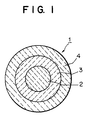
- Fig. 1 is a cross-sectional view schematically illustrating the structure of a ceramic catalyst according to this invention.
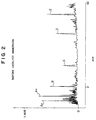
- Fig. 2 is a chromatogram showing the composition of a light oil before a catalyst is immersed.
- Fig. 3 is a chromatogram showing the composition of a light oil after a catalyst is immersed.
- Fig. 4 is an electron spin resonance spectrum showing the formation of oxygen radicals in fuel.
- Fig. 5 graphically shows the relationship between the rotating speed of the automotive engine and the total aldehyde concentration in the exhaust gas.
- Fig. 6 graphically shows the relationship between the running speed of the automobile and the NOx concentration in the exhaust gas.
- Fig. 7 graphically shows the relationship between the composition of the combustion gas in the engine cylinder and the rotating speed.
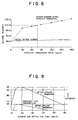
- Fig. 8 graphically shows the relationship between the quantity of catalyst used and the octane number.
- Fig. 9 graphically shows the relationship between the air-fuel ratio and combustion efficiency.
- FIG. 1 is a cross-sectional view schematically illustrating the structure of a fluid fuel reforming ceramic catalyst according to this invention.
- a fluid fuel reforming ceramic catalyst 1 basically has a three-layer structure comprising a core 2 of a complex oxide ceramic of transition metals, an intermediate layer 3 of a silicate ceramic consisting essentially of alumina (i.e., alumina-based) covering the core 2, and an outer layer 4 of a ceramic containing a noble metal alloy covering the intermediate layer 3.
- the outer and intermediate layers 4 and 3 are of porous materials having pores that allow the passage of gases and liquids to and from the outside.
- the core 2 is also porous, though the porosity is greater than in the intermediate and outer layers 3 and 4, and allows the passage of gases and liquids to and from the outside.
- the boundaries between the individual layers are either of a slanted structure in which composition changes gradually or of a stepped structure in which composition changes abruptly. It should be noted that potential energy changes more continuously in the slanted structure than in the stepped structure. This permits electrons to move smoothly at the boundaries, allows oxidation-reduction reaction to proceed smoothly, and thereby enhances the regeneration efficiency of the intermediate and outer layers. Hence, the slanted structure is preferred for the individual boundaries.
- the ceramic catalysts according to this invention are generally substantially spherical in shape. They may also be shaped substantially like columns.
- columnar catalysts cannot maintain a three-layer structure comprising the core and the intermediate and outer layers at both ends thereof where all of them are exposed.
- substantially spherical catalysts maintain a three-layer structure in all directions. Therefore, substantially spherical catalysts are preferable.
- the ceramic catalysts according to this invention can be used with liquid fuels such as gasoline, light and heavy oils, and kerosene and gaseous fuels such as town gas and propane.
- liquid fuels such as gasoline, light and heavy oils, and kerosene and gaseous fuels such as town gas and propane.
- the ceramic catalysts according to this invention are placed directly in fuels. For example, they are immersed in fuel tanks.
- the core consists of a complex oxide ceramic of transition metals having an oxidation-reduction catalytic action that regenerates the outer and intermediate layers when their catalytic activity is lost by being contaminated by trace amount of sulphur, lead and other inorganic substances contained in fuels. Electrons in the substance making up the core move to the intermediate and outer layers and reduce the substances making up the intermediate and outer layers that have been contaminated by catalyst-poisoning impurities. With the contaminated intermediate and outer layers thus detoxicated, their catalytic activities are regenerated.
- a complex oxide ceramic of transition metals containing MnO 2 , NiO, CoO and CuO is preferable for the core.
- the core contains 40 to 70 parts of MnO 2 , 10 to 20 parts each of NiO, CoO and CuO, all by weight. If any of these oxides are absent or present in other ranges than those described above, a perovskite-type crystal structure having pores to store electrons contributing to the oxidation-reduction action may not be formed and, as a consequence, the regenerating function may decrease significantly.
- the catalysts according to this invention may consist essentially of the four oxides mentioned above, or it may contain other substances unless they have detrimental effects on the oxidation-reduction catalytic action.
- the intermediate layer has a function to reform the incombustible and environment polluting substances contained in fuels to combustible substances.
- benzene contained in gasoline is considered to be reformed to methane, propane or other combustible substances, with the benzene ring linkage severed and the hydrogen resulting from the decomposition of water by the catalytic action of the outer layer described later carrying out hydrogenation.
- Acetaldehyde is considered to be decomposed to methane, hydrogen and carbon dioxide by reacting with the hydrogen and oxygen ions resulting from the decomposition of water by the catalytic action of the outer layer.
- the intermediate layer preferably consists of a silicate ceramic consisting essentially of alumina (i.e., alumina-based) and silicate, or, preferably, kaoline and carbon-bearing quartz.
- the intermediate layer consists of 70 to 90 parts of Al 2 O 3 and 10 to 30 parts of silicate or, preferably, 5 to 10 parts of kaoline and 5 to 20 parts of carbon-bearing quarts, all by weight.
- Al 2 O 3 mainly functions as a carrier of silicate having a catalytic action. While a deficiency of Al 2 O 3 leads to a lowering of mechanical strength, an excess decreases the quantity of silicate carried and impairs the catalytic action.
- the outer layer has a function to activate the oxygen in the air contained in fuels and evolve hydrogen and nascent oxygen by decomposing the water contained in the fuel. Therefore, the combustible substances increased by reforming can be burnt without increasing the air supply from the outside.
- the outer layer preferably consists of a ceramic containing noble metal alloys containing a fired mixture of Pt-Pd-Rh alloy and Al 2 O 3 , a Mo-Al 2 O 3 catalyst, a La 0.5 -Sr 0.5 CoO 3 catalyst, and an Al 2 O 3 -carried vanadium oxide catalyst and/or a Ag-Al 2 O 3 catalyst.
- At least either one of the Al 2 O 3 -carried vanadium oxide catalyst and Ag-Al 2 O 3 catalysts is required.
- the outer layer contains 15 to 25 parts each of the fired mixture of Pt-Pd-Rh alloy and Al 2 O 3 , Mo-Al 2 O 3 catalyst, La 0.5 -Sr 0.5 CoO 3 catalyst, Al 2 O 3 -carried vanadium oxide catalyst and/or Ag-Al 2 O 3 catalyst, all by weight.
- the contents of the constituents are outside the ranges described above, the desired ceramic is difficult to form by firing, with a resulting decrease in the quantities of oxygen activated and water decomposed.
- the Pt-Pd-Rh alloy contains approximately 5 to 7:1 to 3:1 to 3 of Pt, Pd and Rh, by weight.
- the Pt-Pd-Rh alloy and Al 2 O 3 are preferably mixed at a ratio of approximately 4 to 5: 5 to 6.
- Al 2 O 3 mainly functions as a carrier of Pt-Pd-Rh alloy having a catalytic action. While a deficiency of Al 2 O 3 leads to a lowering of mechanical strength, an excess decreases the quantity of silicate carried and impairs the catalytic action.
- the fired mixture is prepared by firing a mixture of Pt-Pd-Rh alloy and Al 2 O 3 at a temperature of approximately 850° to 930° C.
- the Mo-Al 2 O 3 catalyst is a catalyst of Mo carried by Al 2 O 3 at a ratio of approximately 1:1.
- the La 0.5 -Sr 0.5 -CoO 3 catalyst is a fired mixture of lanthanum oxide, strontium oxide and cobalt oxide.
- the Al 2 O 3 -carried vanadium oxide catalyst consists of approximately 9:1 of Al 2 O 3 and vanadium oxide.
- the Ag-Al 2 O 3 catalyst is a catalyst of Ag carried by Al 2 O 3 at a ratio of approximately 1 Ag: 9 Al 2 O 3 .
- a method of manufacturing ceramic catalysts according to this invention comprises the steps of firing a core of a complex oxide ceramic of transition metal, coating an intermediate layer of an alumina-based silicate ceramic over the core, and coating an outer layer of a ceramic containing noble metals over the intermediate layer.
- the core catalyst is obtained by forming the pre-fired powder thus obtained into, for example, balls of 1.5 to 2.0 mm in diameter, with the addition of a binder, and sintered at a temperature of approximately 1150° to 1350° C. Sintering is performed in the air.
- a paste of the pre-fired powder thus obtained is prepared by adding a binder and a foaming agent (which makes the sintered product porous by evolving carbon dioxide or other gases during sintering). The paste thus obtained is then coated over the core ball to a thickness of, for example, approximately 1 mm. Then, a catalyst prepared by coating the paste over the core ball is sintered at a temperature of approximately 900° to 1100° C. Sintering is performed in the air.
- the substances making up the core and intermediate layer catalysts melt and diffuse with each other.
- the boundaries between the core and the intermediate layer assumes a slanted structure where composition changes gradually.
- a mixture of powders of a fired mixture of Pt-Pd-Rh alloy and Al 2 O 3 , Mo-Al 2 O 3 catalyst, La 0.5 -Sr 0.5 CoO 3 catalyst, and Al 2 O 3 -carried vanadium oxide catalyst and/or Ag-Al 2 O 3 catalyst in a desired ratio is prepared.
- the mixture is made into a paste by adding a binder and a foaming agent.
- the paste is then coated over the fired catalyst ball consisting of the core and the intermediate layer to a thickness of, for example, approximately 1 mm.
- the ceramic catalyst according to this invention is obtained by firing the coated product at a temperature of approximately 600° to 700° C in a reducing atmosphere.
- the fired mixture of Pt-Pd-Rh alloy and Al 2 O 3 is prepared by mixing a Pt-Pd-Rh alloy and Al 2 O 3 in a desired ratio and firing the mixture at a temperature of approximately 850° to 930° C.
- the substances making up the catalysts of the outer and intermediate melt and diffuse with each other.
- the boundaries between the core and the intermediate layer have a slanted structure where composition changes gradually.
- the intermediate layer catalyst mixed with wax or other viscous substance functioning as a binder is coated over the core catalyst, with the subsequent sintering process omitted.
- the outer layer catalyst mixed with the same viscous substance is coated over the intermediate layer catalyst, with the subsequent sintering process omitted.
- the core may be formed into a substantially spherical shape during sintering, with the coatings applied subsequently to form the intermediate and outer layers forming substantially spherical crusts.
- the finished ceramic catalyst is substantially spherical in its entirety.
- the finished ceramic catalyst is substantially cylindrical in its entirety.
- a paste was prepared by adding 30 ml of a 7 percent by weight aqueous solution of polyvinyl alcohol and 10 ml of a 12 percent by weight aqueous solution of calcium carbonate to the pre-fired powder.
- the paste thus obtained was coated over the ball-shaped core catalyst to a thickness of approximately 1 mm. By sintering the coated ball at 900° C, a catalyst consisting of the core coated with the intermediate layer was obtained.
- a Mo-Al 2 O 3 catalyst consististing of Mo and Al 2 O 3 in a ratio of 1:1
- an Al 2 O 3 -carried vanadium oxide catalyst consististing of Al 2 O 3 and vanadium
- a paste of the mixture was prepared by adding 30 ml of a 7 percent by weight aqueous solution of polyvinyl alcohol and 10 ml of a 12 percent by weight aqueous solution of calcium carbonate. The obtained paste was coated over the fired catalyst ball consisting of the core and intermediate layer to a thickness of approximately 1 mm. A three-layer ceramic catalyst was obtained by firing the coated ball at 670° C in a carbon monoxide atmosphere.
- a 1 and A 2 denote methane-based combustible substances, A 3 ethane-, ethylene-and acetylene-based combustible substances, A 4 propane- and propylene-based combustible substances, B pentane, C butane, D methylpentene, and E benzene.
- incombustible substances such as methylpentene and benzene, decrease and combustible substances increase after immersion of the catalyst according to this invention.
- Fig. 5 shows the results obtained with and without the immersion of the catalyst (averaged over six automobiles). As can be seen in Fig. 5, immersion of the catalyst significantly decreased the total aldehyde concentration irrespective of the engine speed.
- Fig. 6 shows the results obtained with and without the immersion of the catalyst. As can be seen in Fig. 6, immersion of the catalyst significantly (by approximately 29 to 33 percent) decreased the NOx concentration in the exhaust gas irrespective of the running speed.
- the thermal decomposition temperature (ignition point) measured by differential thermal analysis dropped by approximately 7° C from 278° C before the immersion of the catalyst to 271° C after the immersion. This temperature drop is considered to suppress the evolution of NOx.
- FIG. 9 shows the combustion efficiencies before and after the immersion of the catalyst in regular gasoline. The measurements were taken under the conditions where constant fuel consumption was maintained. As can be seen in Fig. 9, the catalyst immersion increased combustion efficiency by approximately 30 percent when the air-fuel ratio was 16.7.
- the ceramic catalysts according to this invention enhance fuel economy and decrease noxious substances in exhaust gases by reforming the incombustible and environment-polluting substances in fuels to combustible substances, activating the oxygen contained in fuels, and evolving nascent oxygen by decomposing the water contained in fuels.
Landscapes
- Chemical & Material Sciences (AREA)
- Engineering & Computer Science (AREA)
- Organic Chemistry (AREA)
- Chemical Kinetics & Catalysis (AREA)
- Oil, Petroleum & Natural Gas (AREA)
- Materials Engineering (AREA)
- General Chemical & Material Sciences (AREA)
- Catalysts (AREA)
- Exhaust Gas Treatment By Means Of Catalyst (AREA)
Priority Applications (6)
| Application Number | Priority Date | Filing Date | Title |
|---|---|---|---|
| JP29187895A JP3286134B2 (ja) | 1995-10-12 | 1995-10-12 | 流体燃料の改質用セラミックス触媒 |
| TW085115407A TW404978B (en) | 1995-10-12 | 1996-12-13 | Fluid fuel reforming ceramic catalysts and their manufacturing methods |
| DE69711836T DE69711836T2 (de) | 1995-10-12 | 1997-01-14 | Keramische Katalysatoren für die Reformierung von flüssigförmigen Brennstoffe und Verfahren für ihre Herstellung |
| ES97300179T ES2174181T3 (es) | 1995-10-12 | 1997-01-14 | Catalizadores ceramicos que reforman combustibles fluidos y metodos para su fabricacion. |
| EP97300179A EP0852967B1 (fr) | 1995-10-12 | 1997-01-14 | Catalyseurs céramiques pour le réformage des combustibles fluides et méthode pour les produire |
| US08/798,493 US5763351A (en) | 1995-10-12 | 1997-02-10 | Fluid fuel reforming ceramic catalysts and their manufacturing methods |
Applications Claiming Priority (3)
| Application Number | Priority Date | Filing Date | Title |
|---|---|---|---|
| JP29187895A JP3286134B2 (ja) | 1995-10-12 | 1995-10-12 | 流体燃料の改質用セラミックス触媒 |
| EP97300179A EP0852967B1 (fr) | 1995-10-12 | 1997-01-14 | Catalyseurs céramiques pour le réformage des combustibles fluides et méthode pour les produire |
| US08/798,493 US5763351A (en) | 1995-10-12 | 1997-02-10 | Fluid fuel reforming ceramic catalysts and their manufacturing methods |
Publications (2)
| Publication Number | Publication Date |
|---|---|
| EP0852967A1 true EP0852967A1 (fr) | 1998-07-15 |
| EP0852967B1 EP0852967B1 (fr) | 2002-04-10 |
Family
ID=27238570
Family Applications (1)
| Application Number | Title | Priority Date | Filing Date |
|---|---|---|---|
| EP97300179A Expired - Lifetime EP0852967B1 (fr) | 1995-10-12 | 1997-01-14 | Catalyseurs céramiques pour le réformage des combustibles fluides et méthode pour les produire |
Country Status (6)
| Country | Link |
|---|---|
| US (1) | US5763351A (fr) |
| EP (1) | EP0852967B1 (fr) |
| JP (1) | JP3286134B2 (fr) |
| DE (1) | DE69711836T2 (fr) |
| ES (1) | ES2174181T3 (fr) |
| TW (1) | TW404978B (fr) |
Cited By (1)
| Publication number | Priority date | Publication date | Assignee | Title |
|---|---|---|---|---|
| FR2870161A1 (fr) * | 2004-05-12 | 2005-11-18 | Air Liquide | Procede d'elaboration de reacteurs membranaires catalytiques ceramiques par co-extrusion |
Families Citing this family (17)
| Publication number | Priority date | Publication date | Assignee | Title |
|---|---|---|---|---|
| DE69708872T2 (de) * | 1996-07-15 | 2002-04-11 | Chevron U.S.A. Inc., San Ramon | Schwefelbeständiger katalysator zur hydrokonversion und wasserstoffbehandlung von wasserstoffbehandlung von schwefelhältigen schmiermittelausgangsstoffen |
| JP3042601B2 (ja) * | 1996-10-31 | 2000-05-15 | ファイラックインターナショナル株式会社 | 流体燃料の改質用セラミックス触媒を用いた内燃機関及 びこれを使用した交通輸送用又は発電用手段 |
| US6177381B1 (en) * | 1998-11-03 | 2001-01-23 | Uop Llc | Layered catalyst composition and processes for preparing and using the composition |
| US6508209B1 (en) | 2000-04-03 | 2003-01-21 | R. Kirk Collier, Jr. | Reformed natural gas for powering an internal combustion engine |
| US6397790B1 (en) | 2000-04-03 | 2002-06-04 | R. Kirk Collier, Jr. | Octane enhanced natural gas for internal combustion engine |
| US6405720B1 (en) | 2000-04-03 | 2002-06-18 | R. Kirk Collier, Jr. | Natural gas powered engine |
| DE10104226A1 (de) * | 2001-01-31 | 2002-08-01 | Basf Ag | Kern/Mantel-Katalysatorformkörper |
| US6739125B1 (en) | 2002-11-13 | 2004-05-25 | Collier Technologies, Inc. | Internal combustion engine with SCR and integrated ammonia production |
| US7585810B2 (en) * | 2004-09-01 | 2009-09-08 | Umicore Ag & Co. Kg | Method for partial oxidation of hydrocarbons, catalyst member therefor and method of manufacture |
| US7546826B2 (en) * | 2006-03-31 | 2009-06-16 | Transonic Combustion, Inc. | Injector-ignition for an internal combustion engine |
| JP5202034B2 (ja) * | 2008-02-27 | 2013-06-05 | 株式会社キャタラー | 排ガス浄化用触媒の製造方法 |
| WO2009139749A1 (fr) * | 2008-05-16 | 2009-11-19 | Utc Power Corporation | Pile à combustible à catalyseur cathodique stabilisé |
| US8304365B2 (en) | 2008-05-16 | 2012-11-06 | Utc Power Corporation | Stabilized platinum catalyst |
| CN102454512A (zh) * | 2010-10-26 | 2012-05-16 | 地天泰科技股份有限公司 | 提升燃油燃烧效率降低排放黑烟废气的方法与制品 |
| EP2939764B1 (fr) * | 2012-12-27 | 2018-09-26 | LG Chem, Ltd. | Procédé de fabrication d'une nanoparticule métallique creuse supportée par un corps de support |
| CN104884194A (zh) * | 2012-12-27 | 2015-09-02 | Lg化学株式会社 | 负载在载体上的中空金属纳米粒子 |
| CN107349954B (zh) * | 2017-07-05 | 2020-10-09 | 江南大学 | 一种合成气直接制备芳香族化合物的多级纳米反应器催化剂及其制备与应用 |
Citations (4)
| Publication number | Priority date | Publication date | Assignee | Title |
|---|---|---|---|---|
| FR2462928A1 (fr) * | 1979-08-08 | 1981-02-20 | Johnson Matthey Co Ltd | Procede d'elimination de l'ozone d'un melange de gaz |
| EP0262962A2 (fr) * | 1986-09-30 | 1988-04-06 | Engelhard Corporation | Catalyseur pour purifier des gaz d'échappement de voiture et son procédé de fabrication |
| EP0443765A1 (fr) * | 1990-02-22 | 1991-08-28 | Engelhard Corporation | Composition catalytique contenant des composants de platine et de rhodium séparés |
| US5182249A (en) * | 1990-10-22 | 1993-01-26 | East China University Of Chemical Technology | Non-precious metal three way catalyst |
Family Cites Families (9)
| Publication number | Priority date | Publication date | Assignee | Title |
|---|---|---|---|---|
| US3145183A (en) * | 1958-12-16 | 1964-08-18 | Norton Co | Catalyst carrying balls |
| NL291717A (fr) * | 1962-04-20 | |||
| GB1405405A (en) * | 1971-06-25 | 1975-09-10 | Johnson Matthey Co Ltd | Platinum group metal catalysts |
| GB1417544A (en) * | 1971-11-22 | 1975-12-10 | Johnson Matthey Co Ltd | Catalysts containing platinum and rhodium |
| US4804796A (en) * | 1984-04-23 | 1989-02-14 | California Institute Of Technology | Catalytic, hollow, refractory spheres, conversions with them |
| SE462143C (sv) * | 1988-03-07 | 1996-02-19 | Heraeus Gmbh W C | Katalysator för bilavgasrening, förfarande för framställning därav samt användning därav |
| US5256616A (en) * | 1989-09-25 | 1993-10-26 | Board Of Regents, The University Of Texas System | Materials and methods for photocatalyzing oxidation of organic compounds on water |
| DE4140900A1 (de) * | 1991-12-12 | 1993-06-17 | Basf Ag | Als carrier fuer die elektrophotographie geeignete teilchen |
| US5424129A (en) * | 1992-11-16 | 1995-06-13 | Xerox Corporation | Composite metal oxide particle processes and toners thereof |
-
1995
- 1995-10-12 JP JP29187895A patent/JP3286134B2/ja not_active Expired - Fee Related
-
1996
- 1996-12-13 TW TW085115407A patent/TW404978B/zh not_active IP Right Cessation
-
1997
- 1997-01-14 EP EP97300179A patent/EP0852967B1/fr not_active Expired - Lifetime
- 1997-01-14 ES ES97300179T patent/ES2174181T3/es not_active Expired - Lifetime
- 1997-01-14 DE DE69711836T patent/DE69711836T2/de not_active Expired - Fee Related
- 1997-02-10 US US08/798,493 patent/US5763351A/en not_active Expired - Fee Related
Patent Citations (4)
| Publication number | Priority date | Publication date | Assignee | Title |
|---|---|---|---|---|
| FR2462928A1 (fr) * | 1979-08-08 | 1981-02-20 | Johnson Matthey Co Ltd | Procede d'elimination de l'ozone d'un melange de gaz |
| EP0262962A2 (fr) * | 1986-09-30 | 1988-04-06 | Engelhard Corporation | Catalyseur pour purifier des gaz d'échappement de voiture et son procédé de fabrication |
| EP0443765A1 (fr) * | 1990-02-22 | 1991-08-28 | Engelhard Corporation | Composition catalytique contenant des composants de platine et de rhodium séparés |
| US5182249A (en) * | 1990-10-22 | 1993-01-26 | East China University Of Chemical Technology | Non-precious metal three way catalyst |
Cited By (2)
| Publication number | Priority date | Publication date | Assignee | Title |
|---|---|---|---|---|
| FR2870161A1 (fr) * | 2004-05-12 | 2005-11-18 | Air Liquide | Procede d'elaboration de reacteurs membranaires catalytiques ceramiques par co-extrusion |
| WO2005113209A1 (fr) * | 2004-05-12 | 2005-12-01 | L'air Liquide Societe Anonyme A Directoire Et Conseil De Surveillance Pour L'etude Et L'exploitation Des Procedes Georges Claude | Procédé d'élaboration de réacteurs membranaires catalytiques céramiques par co-extrusion |
Also Published As
| Publication number | Publication date |
|---|---|
| DE69711836D1 (de) | 2002-05-16 |
| TW404978B (en) | 2000-09-11 |
| JP3286134B2 (ja) | 2002-05-27 |
| JPH09103680A (ja) | 1997-04-22 |
| EP0852967B1 (fr) | 2002-04-10 |
| DE69711836T2 (de) | 2002-09-12 |
| ES2174181T3 (es) | 2002-11-01 |
| US5763351A (en) | 1998-06-09 |
Similar Documents
| Publication | Publication Date | Title |
|---|---|---|
| EP0852967B1 (fr) | Catalyseurs céramiques pour le réformage des combustibles fluides et méthode pour les produire | |
| CA2199066C (fr) | Moteurs a combustion interne a catalyseur ceramique de reformage du combustible liquide et moyens de transport et de production d'energie utilisant ces moteurs | |
| US4367162A (en) | Catalyst for purifying exhaust gases and a method for producing the catalyst | |
| AU606222B2 (en) | Catalytic converter | |
| JP5210306B2 (ja) | 三元触媒 | |
| EP3662987B1 (fr) | Substrat de filtre comprenant un catalyseur à trois voies | |
| JP4833453B2 (ja) | 排ガス浄化触媒およびその製造および使用 | |
| KR970000297B1 (ko) | 로듐을 함유하지 않는 3원 촉매 | |
| US4058485A (en) | Porous metal-alumina composite | |
| US4193793A (en) | Porous metal-alumina composite | |
| US20050137079A1 (en) | Catalyst formulation, exhaust system, and gas treatment device | |
| US4702897A (en) | Lead-tolerant catalyst system and method for treating exhaust gas containing lead compounds | |
| US20040254069A1 (en) | Exhaust gas purifying catalyst and exhaust gas purifying system | |
| US7169734B2 (en) | Exhaust gas purifying catalyst and method of producing same | |
| US20080318769A1 (en) | Catalyst and Method for Manufacturing Catalyst for Use in Exhaust Emission Control | |
| US6050247A (en) | Internal combustion engines, fluid fuel reforming ceramic catalyst and transporting and power-generating means employing them | |
| CA2193146C (fr) | Catalyseurs de reformage de combustibles liquides et procedes de production | |
| JPH1119521A (ja) | 排気ガス浄化用触媒の製造方法、及び排気ガス浄化用触媒を用いた排気ガスフィルター及び排気ガス浄化装置並びに排気ガス浄化システム | |
| JPH06126175A (ja) | 排気ガス中の炭化水素酸化用の複合触媒、その製造法、及びその使用法 | |
| JPH08283751A (ja) | 合成燃料並びに低公害燃料の製造方法及びその製造装置 | |
| KR100306927B1 (ko) | 액체연료의 개질용 세라믹스촉매 및 그 제조방법 | |
| US4977128A (en) | Catalyst for combustion and process for producing same | |
| US6205985B1 (en) | Catalyst for reforming fossil fuel | |
| CN1104956C (zh) | 流体燃料重组陶瓷催化剂及其制造方法 | |
| MXPA96006671A (en) | Ceramic catalysts for reforming combustible fluid and its manufacturing methods |
Legal Events
| Date | Code | Title | Description |
|---|---|---|---|
| PUAI | Public reference made under article 153(3) epc to a published international application that has entered the european phase |
Free format text: ORIGINAL CODE: 0009012 |
|
| AK | Designated contracting states |
Kind code of ref document: A1 Designated state(s): DE ES FR GB |
|
| 17P | Request for examination filed |
Effective date: 19990113 |
|
| AKX | Designation fees paid |
Free format text: DE ES FR GB |
|
| RBV | Designated contracting states (corrected) |
Designated state(s): DE ES FR GB |
|
| 17Q | First examination report despatched |
Effective date: 20000128 |
|
| GRAG | Despatch of communication of intention to grant |
Free format text: ORIGINAL CODE: EPIDOS AGRA |
|
| GRAG | Despatch of communication of intention to grant |
Free format text: ORIGINAL CODE: EPIDOS AGRA |
|
| GRAH | Despatch of communication of intention to grant a patent |
Free format text: ORIGINAL CODE: EPIDOS IGRA |
|
| REG | Reference to a national code |
Ref country code: GB Ref legal event code: IF02 |
|
| GRAH | Despatch of communication of intention to grant a patent |
Free format text: ORIGINAL CODE: EPIDOS IGRA |
|
| GRAA | (expected) grant |
Free format text: ORIGINAL CODE: 0009210 |
|
| AK | Designated contracting states |
Kind code of ref document: B1 Designated state(s): DE ES FR GB |
|
| REF | Corresponds to: |
Ref document number: 69711836 Country of ref document: DE Date of ref document: 20020516 |
|
| ET | Fr: translation filed | ||
| REG | Reference to a national code |
Ref country code: ES Ref legal event code: FG2A Ref document number: 2174181 Country of ref document: ES Kind code of ref document: T3 |
|
| PLBE | No opposition filed within time limit |
Free format text: ORIGINAL CODE: 0009261 |
|
| STAA | Information on the status of an ep patent application or granted ep patent |
Free format text: STATUS: NO OPPOSITION FILED WITHIN TIME LIMIT |
|
| 26N | No opposition filed |
Effective date: 20030113 |
|
| PGFP | Annual fee paid to national office [announced via postgrant information from national office to epo] |
Ref country code: FR Payment date: 20060110 Year of fee payment: 10 |
|
| PGFP | Annual fee paid to national office [announced via postgrant information from national office to epo] |
Ref country code: DE Payment date: 20060112 Year of fee payment: 10 |
|
| PGFP | Annual fee paid to national office [announced via postgrant information from national office to epo] |
Ref country code: ES Payment date: 20060215 Year of fee payment: 10 |
|
| PG25 | Lapsed in a contracting state [announced via postgrant information from national office to epo] |
Ref country code: DE Free format text: LAPSE BECAUSE OF NON-PAYMENT OF DUE FEES Effective date: 20070801 |
|
| GBPC | Gb: european patent ceased through non-payment of renewal fee |
Effective date: 20070114 |
|
| REG | Reference to a national code |
Ref country code: FR Ref legal event code: ST Effective date: 20070930 |
|
| PG25 | Lapsed in a contracting state [announced via postgrant information from national office to epo] |
Ref country code: GB Free format text: LAPSE BECAUSE OF NON-PAYMENT OF DUE FEES Effective date: 20070114 |
|
| REG | Reference to a national code |
Ref country code: ES Ref legal event code: FD2A Effective date: 20070115 |
|
| PG25 | Lapsed in a contracting state [announced via postgrant information from national office to epo] |
Ref country code: FR Free format text: LAPSE BECAUSE OF NON-PAYMENT OF DUE FEES Effective date: 20070131 |
|
| PG25 | Lapsed in a contracting state [announced via postgrant information from national office to epo] |
Ref country code: ES Free format text: LAPSE BECAUSE OF NON-PAYMENT OF DUE FEES Effective date: 20070115 |
|
| PGFP | Annual fee paid to national office [announced via postgrant information from national office to epo] |
Ref country code: GB Payment date: 20060111 Year of fee payment: 10 |