EP0853106A2 - Pigmenthaltige Tintenstrahl-Aufzeichnungsflüssigkeit - Google Patents
Pigmenthaltige Tintenstrahl-Aufzeichnungsflüssigkeit Download PDFInfo
- Publication number
- EP0853106A2 EP0853106A2 EP97310494A EP97310494A EP0853106A2 EP 0853106 A2 EP0853106 A2 EP 0853106A2 EP 97310494 A EP97310494 A EP 97310494A EP 97310494 A EP97310494 A EP 97310494A EP 0853106 A2 EP0853106 A2 EP 0853106A2
- Authority
- EP
- European Patent Office
- Prior art keywords
- ink
- weight
- ink jet
- carbon black
- range
- Prior art date
- Legal status (The legal status is an assumption and is not a legal conclusion. Google has not performed a legal analysis and makes no representation as to the accuracy of the status listed.)
- Granted
Links
Images

Classifications
-
- C—CHEMISTRY; METALLURGY
- C09—DYES; PAINTS; POLISHES; NATURAL RESINS; ADHESIVES; COMPOSITIONS NOT OTHERWISE PROVIDED FOR; APPLICATIONS OF MATERIALS NOT OTHERWISE PROVIDED FOR
- C09D—COATING COMPOSITIONS, e.g. PAINTS, VARNISHES OR LACQUERS; FILLING PASTES; CHEMICAL PAINT OR INK REMOVERS; INKS; CORRECTING FLUIDS; WOODSTAINS; PASTES OR SOLIDS FOR COLOURING OR PRINTING; USE OF MATERIALS THEREFOR
- C09D11/00—Inks
- C09D11/30—Inkjet printing inks
- C09D11/32—Inkjet printing inks characterised by colouring agents
- C09D11/324—Inkjet printing inks characterised by colouring agents containing carbon black
Definitions
- the present invention relates to pigment ink which permits printing with an increased optical density and improved permanence and a recording method which is capable of recording by selecting specific ink drops from a continuous stream of drops and directing them towards the image receiver.
- Continuous ink jet recording has several advantages in that it produces low noise and can obtain a high-resolution recorded image at a high speed by utilizing a highly integrated head.
- Such an ink jet recording method uses as ink a solution obtained by dissolving one of various water-soluble dyes in water or a solvent mixture of water and an organic solvent.
- Current state-of-the-art aqueous ink jet inks utilize water soluble dyes to attain acceptable redissolvability of the dried ink on the orifice plate. This redissolvability is essential for good machine runnability as well as start-up for continuous ink jet printers which do not have a separate printhead cleaning fluid mechanism.
- the water-soluble dye exhibits poor light resistance, when such a water-soluble dye is used, the light resistance of the recorded image frequently becomes a problem.
- the ink is soluble in water, the water resistance of the recorded image also frequently becomes a problem. Namely, when rain, sweat or drinking water is applied to the recorded image, the recorded image is blurred with the ink or even disappears in some cases. With dye based inks, then, there is an issue of redissolvability.
- a water based pigment ink may be able to provide waterfastness as pigments are dispersed rather than dissolved.
- various kinds of aqueous pigment ink for writing utensils have been proposed for resolving the problems with respect to light resistance and water resistance.
- conventional aqueous pigment ink for writing utensils is used in an ink jet printing device of the type in which printing is accomplished by discharging an ink from one or more orifices of a printhead as a stream of ink droplets, however, there is a problem in that the stability of drop stream generation is significantly deteriorated, and printing failure occurs.
- pigment inks For pigment inks, then, redispersion, rather than redissolvability, must be achieved to have good system start-up.
- Use of pigments rather than dyes creates some further complications which are not present with dyes.
- dye based inks provide dry film which has high dried film resistivity.
- Pigment based inks, particularly black inks, on the other hand, provide films which are conductive.
- the print density can be easily increased by increasing the pigment concentration in the ink.
- the density can also be increased by increasing the thickness of the coated ink layer.
- printing very dark images with ink jet printing is very difficult, because the size of the orifice is very small, and the amount of the ink printed is limited.
- an increase in the concentration of the pigment contained in the ink causes the occurrence of undesirable troubles in the formation of stable, straight jets.
- some of the conventional aqueous pigment inks have excellent jet forming properties for a relatively short time, such inks have a problem because the conductivity of dried films of the ink are quite conductive.
- the charge on the catch drops tends to accumulate on the area of dried pigment to the extent that it can deflect the ink stream away from the catcher. In this case, the stream of catch drops can actually reach the print media, causing an improper black streak.
- the ink composition according to the present invention wherein an ink is provided which permits the printing of an image with both superior fastness and high density.
- the ink also has excellent long-term storage stability, which permits printing with high density. Furthermore, although the ink dries on the catcher face, it does not form to a conducting dry film on the printhead electrodes.
- an ink is provided for discharge as a plurality of continuous streams from a plurality of orifices by applying pressure to the ink, and in which selected drops from the plurality of streams are deflected via an electrostatic charging system so that they strike the receiver at a position determined by the image structure provided from a data system.
- the ink comprises an aqueous liquid medium containing acid carbon black having a volatile content within the range of 3.5 to 8% by weight of the total weight of the acid carbon black and a water-soluble resin having a weight average molecular weight within the range of 5,000 to 25,000, wherein the weight ratio of the acid carbon black to the water soluble resin is within the range of 2:1 to 5:1, and the water-soluble resin dissolved in the medium being 2% by weight or less.
- the ink further comprises a dispersed pigment having a maximum particle size less than 1 micron.
- the ink jet ink composition of the present invention comprises an aqueous liquid medium containing acid carbon black having a volatile content within the range of 3.5 to 8% by weight of the total weight of the acid carbon black and a water-soluble resin having a weight average molecular weight within the range of 5,000 to 25,000, wherein the weight ratio of the acid carbon black to the water soluble resin is within the range of 2:1 to 5:1, and the water-soluble resin dissolved in the medium being 2% by weight or less.
- the ink further comprises a dispersed pigment having a maximum particle size less than 1 micron.
- An example of the printing apparatus which are preferable for printing by using the ink of the present invention is an apparatus in which ink is sprayed under pressure from one or more orifices.
- the jets produces by this process are disintegrate into drops by the action of surface tension.
- the disintegration process is made highly uniform by stimulating the jets at the natural breakoff frequency for the jets, as is known in the art.
- the droplets produced are very uniform in size, and spacing. Charging electrodes placed at the breakoff point charge the drops to separate the drops to be printed from drops to be caught and discarded or recirculated.
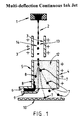
- a drop generator system 1 contains one or more orifices to which ink is supplied under pressure.
- the ink issues from the orifice as a stream 2 which is stimulated by mechanical or electrical means so that the jet breaks up into a highly uniform stream of evenly spaced droplets.
- a charging electrode 3 in close proximity to the jet is charged, as illustrated by the plus signs. Since the ink is conducting and is grounded at the drop generator, an opposite charge is induced on the last drop which is connected to the jet 13. When the drop breaks off from the jet 2 it is insulated from further charging.
- the charge on the charging electrode 3 is properly timed to the breakoff of the drops, different levels of charge can be placed on different drops.
- one level of charge can be placed on drops which are not desired for printing, and a plurality of other levels of charge can be placed on drops which are desired for printing.
- the drops experience a force in the electric field region which is proportional to their charge. Drops having a high level of charge experience a larger force, and experience a large deflection. Drops with a low level of charge experience a smaller force and experience a smaller deflection.
- drops 8 which are not needed for printing the desired image move on a trajectory towards the catcher 9, which may also serve as part of the ground electrode in the electric field structure.
- Drops which impact the catcher 9 are subsequently drawn away from the printhead through a tube 6 by vacuum, gravity, or a combination of the two forces. In this way, a drop stream from the jet 2 is separated into print and catch drops, and the print drops are further segregated into a plurality of trajectories which, in combination print the desired image.
- Fig. 2 there is illustrated a very similar configuration for the binary array continuous ink jet system. Drop generation and charging are done as was described for Fig. 1 except that for binary array printing, only two charge levels are involved.
- drops 8 are typically charged to a given fixed level to cause them to be deflected into the catcher 9.
- Print drops are typically left uncharged. Printing with uncharged drops means that the impact point for the drops on the print receiver is determined by the directionality of the jets.
- the system is called binary because drops are charged to only two levels; charged for catching, or left uncharged for printing.
- a single binary ink jet can only print a single line of spots.
- an array of jets must be used, or the receiver must be moved relative to the printhead.
- the ink according to the present invention not only produces a print having good fastness and high density on plain paper but also enables the straight jets required for binary continuous ink jet illustrated in Fig. 2.
- continuous ink jet systems it often happens that more drops are created per unit time than are needed for printing a completely covered area, such as a black area in a black and white printer.
- a completely covered area such as a black area in a black and white printer.
- any suitable procedure may be used, such as a simplified filtration procedure as summarized.
- a vacuum filtration unit for example, 47 millimeter filter size
- a 47 mm diameter disc filter of appropriate pore size (such as a Versapor 1200 - 1.2 micron pore size or Versapor 3000 - 3 micron pore size) is put at seven inches of mercury.
- 1 liter of deionized water is poured, while the time for the water to pass through the filter is measured. This step is repeated three times to insure times are within a normal variation. Also, the temperature of the water should be recorded.
- a pigment based ink suitable for use in continuous ink jet printers has a filtration ratio greater than or equal to 0.2 through a 1.2 micron filter. Furthermore, for continuous ink jet printing, the ink has a particle size of less than 1 micron, and, in a preferred embodiment, less than 0.3 microns.
- An ink comprising a dispersed pigment and in accordance with the preferred embodiment permits the printing of an image with both superior fastness and high density. Furthermore, such an ink is still capable of enabling the straight jets required for binary continuous ink jet and is tolerant of being refiltered multiple times. Realizing this, the invention is illustrated with the following examples. In the following examples, the particle size and the filtration ratio was measured on various dispersions to determine the compatibility of the dispersions in continuous ink jet printing.
- pigment materials were obtained, to determine suitability for continuous ink jet printing.
- the materials typically are in a readily dispersible solid form or liquid dispersion form.
- a liquid dispersion of at least 1.5% by weight pigment concentration was prepared as per the specified procedures by the manufacturers.
- the resulting samples were evaluated for particle size using a Microtrac Ultra fine Particle size analyzer, and for filtration ratio using the above mentioned procedure. Table I shows results.
- Dispersion Filtration ratio 1.2 micron filter maximum Particle Size (100% below) microns Micrilith Black C-WA (Ciba - Geigy) 0.0 0.81 Hostafine Black T (Hoechst) 0.0 0.81 Disperse Jet Black 1 (BASF) 0.0 0.41 Based on the results, the above tested dispersions were considered unsuitable for use in continuous ink jet printers. One, the maximum particle size, while not necessarily outside a usable range, are greater than preferred. Two, the filtration ratio is zero in all of the above measurements, and that is through a 3 micron filter. Hence, a filtration ratio of ⁇ 0.2 through a 1.2 micron filter would not be possible.
- the present invention proposes an ink comprising an aqueous liquid medium which contains acid carbon black having a volatile content within the range of 3.5 to 8% by weight of the total weight of the carbon black. A volatile content within this range appears to give better dispersibility and, consequently, higher print density.
- the ink further comprises a water-soluble resin having a weight average molecular weight within the range of 5,000 to 25,000. If the weight average molecular weight is greater than about 25,000, the resultant viscosity tends to be undesirably high, and the particle size increases. Conversely, if the weight average molecular weight is less than about 5,000, the necessary steric hindrance is not available, which adversely affects stability.
- the weight ratio of the acid carbon black to the water-soluble resin is within the range of 2:1 to 5:1. If the weight ratio is greater than that range, the ink would contain more carbon and less polymer, and, therefore, insufficient stability; if the weight ratio is less than that range, the ink would contain excessive polymer, making the viscosity of the dispersion go high.
- one suitable pigment dispersion is experimental pigment dispersion Microjet S801, made by Orient Chemical Company. This dispersion was diluted with deionized water so as to reach a pigment concentration of 2% by weight. The resulting dispersion was then evaluated for filtration properties, as per the mentioned procedure, and particle size analysis. The results obtained are as follows: Filtration ratio 1.2 micron filter Maximum Particle size (100% below) microns 0.59 0.20
- the dispersed pigment meets the preferred embodiment of a particle size less than 0.3 microns and a filtration ratio ⁇ 0.2 through a 1.2 micron filter.
- a dispersion being considered for use in a continuous ink jet printer is subjected to an ink circulation test, to determine its tolerance for refiltration and non-conductance of its dried film.
- An ink formulated using a dispersed pigment having a particle size of 0.20 microns and a filtration ratio of 0.59 was circulated through a circulation stand, designed to simulate ink circulation in a printer, for more than 100 hours.
- the shear stability of the ink was checked by comparing physical properties of used ink with the fresh ink. The lack of significant change in ink properties demonstrated that the dispersion based ink was stable. Furthermore, measurement of the pressure drop across the filter did not indicate filter clogging.
- the present invention provides an ink which permits the printing of an image with both superior fastness and high density. Furthermore, the ink has excellent long-term storage stability. This permits printing with high density, yet does not form to a conducting dry film on the printhead electrodes.
- the present invention is useful in the field of ink jet printing, and has the advantage of formulating an ink composition which permits the printing of an image with both superior fastness and high density.
- the present invention provides the further advantage of providing an ink which has excellent long-term storage stability, which permits printing with high density and which discharges when it dries on the catcher face, yet does not form to a conducting dry film on the printhead electrodes.
Landscapes
- Chemical & Material Sciences (AREA)
- Life Sciences & Earth Sciences (AREA)
- Engineering & Computer Science (AREA)
- Materials Engineering (AREA)
- Wood Science & Technology (AREA)
- Organic Chemistry (AREA)
- Inks, Pencil-Leads, Or Crayons (AREA)
- Ink Jet Recording Methods And Recording Media Thereof (AREA)
Applications Claiming Priority (2)
| Application Number | Priority Date | Filing Date | Title |
|---|---|---|---|
| US78165097A | 1997-01-10 | 1997-01-10 | |
| US781650 | 1997-01-10 |
Publications (3)
| Publication Number | Publication Date |
|---|---|
| EP0853106A2 true EP0853106A2 (de) | 1998-07-15 |
| EP0853106A3 EP0853106A3 (de) | 1999-05-06 |
| EP0853106B1 EP0853106B1 (de) | 2001-11-21 |
Family
ID=25123469
Family Applications (1)
| Application Number | Title | Priority Date | Filing Date |
|---|---|---|---|
| EP19970310494 Expired - Lifetime EP0853106B1 (de) | 1997-01-10 | 1997-12-23 | Pigmenthaltige Tintenstrahl-Aufzeichnungsflüssigkeit |
Country Status (4)
| Country | Link |
|---|---|
| EP (1) | EP0853106B1 (de) |
| JP (1) | JPH10306247A (de) |
| CA (1) | CA2226481A1 (de) |
| DE (1) | DE69708451T2 (de) |
Cited By (4)
| Publication number | Priority date | Publication date | Assignee | Title |
|---|---|---|---|---|
| GB2330840A (en) * | 1997-10-30 | 1999-05-05 | Hewlett Packard Co | Ink-jet inks |
| EP1314766A1 (de) * | 2001-11-23 | 2003-05-28 | Sicpa Holding S.A. | Pigmenthaltige Tintenzusammensetzung |
| US6827772B2 (en) | 2002-05-24 | 2004-12-07 | Cabot Corporation | Carbon black and compositions containing same |
| WO2013039941A1 (en) | 2011-09-16 | 2013-03-21 | Eastman Kodak Company | Ink composition for continuous inkjet printer |
Family Cites Families (3)
| Publication number | Priority date | Publication date | Assignee | Title |
|---|---|---|---|---|
| EP0429828B1 (de) * | 1989-10-19 | 1994-03-16 | Canon Kabushiki Kaisha | Tinte und Tintenstrahldruckverfahren, Tintenpatrone, Tintenstrahlerzeugungsvorrichtung und Tintenstrahldruckvorrichtung unter Verwendung derselben |
| JP2691860B2 (ja) * | 1993-12-27 | 1997-12-17 | 株式会社呉竹精昇堂 | 墨汁組成物 |
| DE69602657T2 (de) * | 1995-03-17 | 1999-09-30 | Toyo Ink Mfg. Co., Ltd. | Tintenstrahltinte und Verfahren zu ihrer Herstellung |
-
1997
- 1997-12-23 EP EP19970310494 patent/EP0853106B1/de not_active Expired - Lifetime
- 1997-12-23 DE DE1997608451 patent/DE69708451T2/de not_active Expired - Lifetime
-
1998
- 1998-01-07 CA CA 2226481 patent/CA2226481A1/en not_active Abandoned
- 1998-01-09 JP JP10002914A patent/JPH10306247A/ja active Pending
Cited By (8)
| Publication number | Priority date | Publication date | Assignee | Title |
|---|---|---|---|---|
| GB2330840A (en) * | 1997-10-30 | 1999-05-05 | Hewlett Packard Co | Ink-jet inks |
| US6024786A (en) * | 1997-10-30 | 2000-02-15 | Hewlett-Packard Company | Stable compositions of nano-particulate unmodified pigments and insoluble colorants in aqueous microemulsions, and principle of stability and methods of formation thereof |
| GB2330840B (en) * | 1997-10-30 | 2002-04-03 | Hewlett Packard Co | Stable compositions of nano-particulate un-modified pigments and insoluble colorants in aqueous micromulsions, and principle of stability and methods of forma |
| EP1314766A1 (de) * | 2001-11-23 | 2003-05-28 | Sicpa Holding S.A. | Pigmenthaltige Tintenzusammensetzung |
| WO2003044102A1 (en) * | 2001-11-23 | 2003-05-30 | Sicpa Holding S.A. | Pigmented ink composition |
| US7402614B2 (en) | 2001-11-23 | 2008-07-22 | Sicpa Holding S.A. | Pigmented ink composition |
| US6827772B2 (en) | 2002-05-24 | 2004-12-07 | Cabot Corporation | Carbon black and compositions containing same |
| WO2013039941A1 (en) | 2011-09-16 | 2013-03-21 | Eastman Kodak Company | Ink composition for continuous inkjet printer |
Also Published As
| Publication number | Publication date |
|---|---|
| CA2226481A1 (en) | 1998-07-10 |
| EP0853106A3 (de) | 1999-05-06 |
| DE69708451T2 (de) | 2002-05-02 |
| EP0853106B1 (de) | 2001-11-21 |
| DE69708451D1 (de) | 2002-01-03 |
| JPH10306247A (ja) | 1998-11-17 |
Similar Documents
| Publication | Publication Date | Title |
|---|---|---|
| US6399674B1 (en) | Ink set and ink-jet color recording method using the same | |
| DE3410855C2 (de) | ||
| DE3147592C2 (de) | ||
| CN101429357A (zh) | 喷墨记录用非水系油墨组合物、喷墨记录方法及记录物 | |
| EP3647377B1 (de) | Temperatursensor-tintenzusammensetzung mit metalloxid-nanopartikeln | |
| DE69424894T2 (de) | Tinte, Tintenstrahl-Aufzeichnungsverfahren und Vorrichtung unter Verwendung derselben | |
| EP0853106B1 (de) | Pigmenthaltige Tintenstrahl-Aufzeichnungsflüssigkeit | |
| US6210473B1 (en) | Ink composition and processes thereof | |
| DE69918619T2 (de) | Verfahren zur Verminderung der Kavitation in Impuls-Tintenstrahldruckern | |
| US6203605B1 (en) | Process for improving dried film resistivity of a chemically modified carbon black dispersion | |
| EP0751194A2 (de) | Verfahren zur Herstellung von schwartpigmentierter wässriger Tinte mit hoher Trockenfilmbeständigkeit für Tintenstrahldrucker | |
| JP2005060567A (ja) | インクジェットインク組成物の製造方法およびインクジェットインク組成物 | |
| JP2008055775A (ja) | インクジェット記録装置 | |
| JP4158303B2 (ja) | インクジェット記録用水性顔料インキ | |
| EP0859036B1 (de) | Verfahren zur Verbesserung des Redispergiervermögens von Tintenstrahltinten auf Bais von Pigment | |
| US5676744A (en) | Process for improving dried film resistivity of carbon pigment ink jet inks | |
| DE602004003437T2 (de) | Tintenzusammensetzung und Methode für den Tintenstrahldruck | |
| DE602004009012T2 (de) | Tintenzusammensetzung, Tintenstrahlaufzeichnungsverfahren unter Verwendung derselben und damit aufgezeichnetes Substrat | |
| JPS63137976A (ja) | 記録液 | |
| EP1359200A2 (de) | Verfahren zur Verminderung der Kavitation in Impuls-Tintenstrahldruckern | |
| JPH09302290A (ja) | 連続インクジェットプリンタ用の高抵抗率乾燥フィルムを有する水性顔料黒色インクの製造方法 | |
| US6364463B1 (en) | Electrostatic ink jet recording apparatus | |
| JP2005060568A (ja) | インクジェットインク組成物の製造方法およびインクジェットインク組成物 | |
| JP2017141336A (ja) | インクジェット用油性記録液及びインクジェット記録方法 | |
| JP2001354878A (ja) | 静電式インクジェット用インク及びその製造方法 |
Legal Events
| Date | Code | Title | Description |
|---|---|---|---|
| PUAI | Public reference made under article 153(3) epc to a published international application that has entered the european phase |
Free format text: ORIGINAL CODE: 0009012 |
|
| AK | Designated contracting states |
Kind code of ref document: A2 Designated state(s): DE FR GB |
|
| AX | Request for extension of the european patent |
Free format text: AL;LT;LV;MK;RO;SI |
|
| 17P | Request for examination filed |
Effective date: 19980807 |
|
| PUAL | Search report despatched |
Free format text: ORIGINAL CODE: 0009013 |
|
| AK | Designated contracting states |
Kind code of ref document: A3 Designated state(s): AT BE CH DE DK ES FI FR GB GR IE IT LI LU MC NL PT SE |
|
| AX | Request for extension of the european patent |
Free format text: AL;LT;LV;MK;RO;SI |
|
| AKX | Designation fees paid |
Free format text: DE FR GB |
|
| 17Q | First examination report despatched |
Effective date: 19991209 |
|
| GRAG | Despatch of communication of intention to grant |
Free format text: ORIGINAL CODE: EPIDOS AGRA |
|
| GRAG | Despatch of communication of intention to grant |
Free format text: ORIGINAL CODE: EPIDOS AGRA |
|
| GRAH | Despatch of communication of intention to grant a patent |
Free format text: ORIGINAL CODE: EPIDOS IGRA |
|
| GRAH | Despatch of communication of intention to grant a patent |
Free format text: ORIGINAL CODE: EPIDOS IGRA |
|
| GRAA | (expected) grant |
Free format text: ORIGINAL CODE: 0009210 |
|
| AK | Designated contracting states |
Kind code of ref document: B1 Designated state(s): DE FR GB |
|
| REG | Reference to a national code |
Ref country code: GB Ref legal event code: IF02 |
|
| REF | Corresponds to: |
Ref document number: 69708451 Country of ref document: DE Date of ref document: 20020103 |
|
| ET | Fr: translation filed | ||
| PLBE | No opposition filed within time limit |
Free format text: ORIGINAL CODE: 0009261 |
|
| STAA | Information on the status of an ep patent application or granted ep patent |
Free format text: STATUS: NO OPPOSITION FILED WITHIN TIME LIMIT |
|
| 26N | No opposition filed | ||
| REG | Reference to a national code |
Ref country code: GB Ref legal event code: 732E |
|
| REG | Reference to a national code |
Ref country code: FR Ref legal event code: TP |
|
| PGFP | Annual fee paid to national office [announced via postgrant information from national office to epo] |
Ref country code: GB Payment date: 20121128 Year of fee payment: 16 |
|
| PGFP | Annual fee paid to national office [announced via postgrant information from national office to epo] |
Ref country code: FR Payment date: 20121219 Year of fee payment: 16 |
|
| GBPC | Gb: european patent ceased through non-payment of renewal fee |
Effective date: 20131223 |
|
| REG | Reference to a national code |
Ref country code: FR Ref legal event code: ST Effective date: 20140829 |
|
| PG25 | Lapsed in a contracting state [announced via postgrant information from national office to epo] |
Ref country code: FR Free format text: LAPSE BECAUSE OF NON-PAYMENT OF DUE FEES Effective date: 20131231 Ref country code: GB Free format text: LAPSE BECAUSE OF NON-PAYMENT OF DUE FEES Effective date: 20131223 |
|
| PGFP | Annual fee paid to national office [announced via postgrant information from national office to epo] |
Ref country code: DE Payment date: 20141222 Year of fee payment: 18 |
|
| REG | Reference to a national code |
Ref country code: DE Ref legal event code: R119 Ref document number: 69708451 Country of ref document: DE |
|
| PG25 | Lapsed in a contracting state [announced via postgrant information from national office to epo] |
Ref country code: DE Free format text: LAPSE BECAUSE OF NON-PAYMENT OF DUE FEES Effective date: 20160701 |