EP0853209A2 - Dispositif d'étanchéité sur pièces préfabriquées en béton - Google Patents
Dispositif d'étanchéité sur pièces préfabriquées en béton Download PDFInfo
- Publication number
- EP0853209A2 EP0853209A2 EP98100287A EP98100287A EP0853209A2 EP 0853209 A2 EP0853209 A2 EP 0853209A2 EP 98100287 A EP98100287 A EP 98100287A EP 98100287 A EP98100287 A EP 98100287A EP 0853209 A2 EP0853209 A2 EP 0853209A2
- Authority
- EP
- European Patent Office
- Prior art keywords
- cover
- arrangement according
- precast concrete
- sealing arrangement
- compression body
- Prior art date
- Legal status (The legal status is an assumption and is not a legal conclusion. Google has not performed a legal analysis and makes no representation as to the accuracy of the status listed.)
- Granted
Links
- 239000011178 precast concrete Substances 0.000 title claims abstract description 72
- 238000007789 sealing Methods 0.000 claims abstract description 66
- 230000006835 compression Effects 0.000 claims abstract description 57
- 238000007906 compression Methods 0.000 claims abstract description 57
- 239000013013 elastic material Substances 0.000 claims abstract description 7
- 239000011324 bead Substances 0.000 claims description 39
- 239000000463 material Substances 0.000 claims description 25
- 235000011837 pasties Nutrition 0.000 claims description 24
- 239000004567 concrete Substances 0.000 claims description 21
- 229920001971 elastomer Polymers 0.000 claims description 12
- 230000008961 swelling Effects 0.000 claims description 5
- 239000000853 adhesive Substances 0.000 claims description 4
- 230000001070 adhesive effect Effects 0.000 claims description 4
- 238000003780 insertion Methods 0.000 claims description 4
- 230000037431 insertion Effects 0.000 claims description 4
- 238000004873 anchoring Methods 0.000 claims description 3
- 239000013039 cover film Substances 0.000 claims description 2
- 238000012546 transfer Methods 0.000 claims description 2
- 239000000945 filler Substances 0.000 claims 1
- 239000011346 highly viscous material Substances 0.000 claims 1
- 238000004381 surface treatment Methods 0.000 claims 1
- 239000000314 lubricant Substances 0.000 description 11
- 230000004048 modification Effects 0.000 description 5
- 238000012986 modification Methods 0.000 description 5
- 238000004519 manufacturing process Methods 0.000 description 4
- 230000000873 masking effect Effects 0.000 description 4
- 238000005266 casting Methods 0.000 description 3
- 230000000694 effects Effects 0.000 description 3
- 239000000806 elastomer Substances 0.000 description 3
- 239000008187 granular material Substances 0.000 description 3
- 238000000034 method Methods 0.000 description 3
- 230000008569 process Effects 0.000 description 3
- 239000007779 soft material Substances 0.000 description 3
- VYPSYNLAJGMNEJ-UHFFFAOYSA-N Silicium dioxide Chemical compound O=[Si]=O VYPSYNLAJGMNEJ-UHFFFAOYSA-N 0.000 description 2
- 230000008901 benefit Effects 0.000 description 2
- 239000003795 chemical substances by application Substances 0.000 description 2
- 238000009415 formwork Methods 0.000 description 2
- 230000007704 transition Effects 0.000 description 2
- XLYOFNOQVPJJNP-UHFFFAOYSA-N water Substances O XLYOFNOQVPJJNP-UHFFFAOYSA-N 0.000 description 2
- 239000006004 Quartz sand Substances 0.000 description 1
- 210000001015 abdomen Anatomy 0.000 description 1
- 230000009471 action Effects 0.000 description 1
- 230000004913 activation Effects 0.000 description 1
- 230000009286 beneficial effect Effects 0.000 description 1
- 150000001875 compounds Chemical class 0.000 description 1
- 230000007547 defect Effects 0.000 description 1
- 230000002950 deficient Effects 0.000 description 1
- 238000013461 design Methods 0.000 description 1
- 238000010586 diagram Methods 0.000 description 1
- 238000009826 distribution Methods 0.000 description 1
- 239000013536 elastomeric material Substances 0.000 description 1
- 239000010408 film Substances 0.000 description 1
- 229920002457 flexible plastic Polymers 0.000 description 1
- 230000002706 hydrostatic effect Effects 0.000 description 1
- 230000003116 impacting effect Effects 0.000 description 1
- 229910052500 inorganic mineral Inorganic materials 0.000 description 1
- 239000007788 liquid Substances 0.000 description 1
- 239000011707 mineral Substances 0.000 description 1
- 239000002245 particle Substances 0.000 description 1
- 239000004033 plastic Substances 0.000 description 1
- 229920003023 plastic Polymers 0.000 description 1
- 238000003825 pressing Methods 0.000 description 1
- 238000005096 rolling process Methods 0.000 description 1
- 239000004576 sand Substances 0.000 description 1
- 239000007787 solid Substances 0.000 description 1
- 238000007711 solidification Methods 0.000 description 1
- 230000008023 solidification Effects 0.000 description 1
- 230000003068 static effect Effects 0.000 description 1
- 239000000126 substance Substances 0.000 description 1
- 230000008719 thickening Effects 0.000 description 1
- 238000012549 training Methods 0.000 description 1
- 239000011800 void material Substances 0.000 description 1
- 239000004636 vulcanized rubber Substances 0.000 description 1
- 238000004804 winding Methods 0.000 description 1
Images


Classifications
-
- B—PERFORMING OPERATIONS; TRANSPORTING
- B28—WORKING CEMENT, CLAY, OR STONE
- B28B—SHAPING CLAY OR OTHER CERAMIC COMPOSITIONS; SHAPING SLAG; SHAPING MIXTURES CONTAINING CEMENTITIOUS MATERIAL, e.g. PLASTER
- B28B21/00—Methods or machines specially adapted for the production of tubular articles
- B28B21/56—Methods or machines specially adapted for the production of tubular articles incorporating reinforcements or inserts
- B28B21/563—Gaskets
-
- E—FIXED CONSTRUCTIONS
- E03—WATER SUPPLY; SEWERAGE
- E03F—SEWERS; CESSPOOLS
- E03F3/00—Sewer pipe-line systems
- E03F3/04—Pipes or fittings specially adapted to sewers
-
- F—MECHANICAL ENGINEERING; LIGHTING; HEATING; WEAPONS; BLASTING
- F16—ENGINEERING ELEMENTS AND UNITS; GENERAL MEASURES FOR PRODUCING AND MAINTAINING EFFECTIVE FUNCTIONING OF MACHINES OR INSTALLATIONS; THERMAL INSULATION IN GENERAL
- F16L—PIPES; JOINTS OR FITTINGS FOR PIPES; SUPPORTS FOR PIPES, CABLES OR PROTECTIVE TUBING; MEANS FOR THERMAL INSULATION IN GENERAL
- F16L21/00—Joints with sleeve or socket
- F16L21/02—Joints with sleeve or socket with elastic sealing rings between pipe and sleeve or between pipe and socket, e.g. with rolling or other prefabricated profiled rings
- F16L21/03—Joints with sleeve or socket with elastic sealing rings between pipe and sleeve or between pipe and socket, e.g. with rolling or other prefabricated profiled rings placed in the socket before connection
-
- F—MECHANICAL ENGINEERING; LIGHTING; HEATING; WEAPONS; BLASTING
- F16—ENGINEERING ELEMENTS AND UNITS; GENERAL MEASURES FOR PRODUCING AND MAINTAINING EFFECTIVE FUNCTIONING OF MACHINES OR INSTALLATIONS; THERMAL INSULATION IN GENERAL
- F16L—PIPES; JOINTS OR FITTINGS FOR PIPES; SUPPORTS FOR PIPES, CABLES OR PROTECTIVE TUBING; MEANS FOR THERMAL INSULATION IN GENERAL
- F16L21/00—Joints with sleeve or socket
- F16L21/02—Joints with sleeve or socket with elastic sealing rings between pipe and sleeve or between pipe and socket, e.g. with rolling or other prefabricated profiled rings
- F16L21/035—Joints with sleeve or socket with elastic sealing rings between pipe and sleeve or between pipe and socket, e.g. with rolling or other prefabricated profiled rings placed around the spigot end before connection
Definitions
- the invention relates to a sealing arrangement on precast concrete parts that have a sealing seat and a Have sealing surface.
- Prefabricated concrete parts have tubes that can be plugged into one another a so-called pointed end and a bell socket end. At A pipeline laid between seals these spigot ends and bell socket ends for sealing between the inside and outside of the line.
- the the oldest type of sealing found in practice existed in putting a rolling ring on the tip end and the Push tubes into each other. Later you have so-called Compression seals used and this when casting the Bell sleeve built in. Such seals are relative large area and have to develop large restoring forces, to seal. Therefore, the assembly of the pipes requires great powers.
- the invention is based, measures to specify for elastomer seals, so that assembled Precast concrete parts can also be sealed when attached to them certain formal errors occur.
- the seal has an annular shape Compression body, the cross section of which can be trapezoidal can and with an axial side in one of the Precast concrete is installed.
- the second side of the annular compression body then runs obliquely radially axially, to insert the other precast concrete to be pressed together.
- Ring bead made of cover and possibly pasty mass formed and deformed to unevenness in the concrete and Defective shape of the precast concrete in the sealing area balance.
- the pasty mass is used in a small amount, as it is sufficient as a lubricant.
- the cover becomes relatively thick and from a relative Made of soft material so that it can be assembled of the finished parts to the ring bulge, which in Viewed in the circumferential direction, different cross-section occupies how it corresponds to the gap to be filled.
- the Cover can be made of a soft, rubbery material exist, depending on the diameter of the precast concrete parts is preferably in the range of 5 to 15 mm thick and itself squeezed between the concrete and the compression body.
- a larger amount of pasty mass used by one Coat is wrapped, which can also be perforated. While the pasty mass is effective as a lubricant, it can also Serve sealing purposes by selecting substances that react with air or moisture and gradually become solid will. This way too, gaps are changing between compression body and sealing surface of the Precast concrete filled and sealed.
- a cover for forming the bead in the insertion direction at the front arranged on the annular compression body In the Assembly of the precast elements there is a tendency that the Bead is drawn into the axial branch, and so far if there is no place there, it will enter the radial gap repressed. In doing so, irregularities of this radial Compensated gap, d. H. uneven height of the radial Gap branch in the circumferential direction ("parallelism error") is not noticeable.
- the precast concrete at the transition between radial and axial branch of the gap between the precast concrete parts have a trough-shaped expansion. This will ensures that even with extreme parallelism errors no total squeezing of the bead adjacent to that Compression body can follow.
- Mass to be injected comfortably into the envelope of the bead to put pressure on it from within and to expand it and to seal leaks.
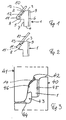
- a annular compression body 1 has the outline shape of a thickened digit 1, i.e. H. is from a trapezoidal and assembled a rectangular part. Accordingly there is an inclined surface 2, radial surfaces 3, 4 and 5 and axial surfaces 6 and 7. Between surfaces 2 and 5 a kind of sealing lip 8 is formed.
- Page 6 of Compression body 1 is covered by a base 9 while on the opposite side 2 a cover 10 is appropriate.
- the cover 10 can be made of an elastomer exist or contain vulcanized rubber, but can also made of soft-flexible plastic, such as PVC or PE.
- the cover 10 is connected to the web via a web 11 Compression body 1 connected.
- the elastomer seal has different shore hardness in parts 1, 9 and 10.
- the compression part 1 is equipped with a Shore hardness in the range of 50, to have sufficiently large restoring forces when assembling the Develop precast concrete parts.
- the pad 9 can be as Layer with a Shore hardness in the range of 40 is formed to be with the developing forces when assembling of the precast concrete elements in roughness and unevenness of the Concrete to be pushed into it.
- the pad 9 is for Cooperation with a sealing seat 45 (Fig. 3 and 6) of the Precast concrete is provided, on which the seal is pushed before the precast concrete is assembled.
- the sealing seat 45 is usually an axially extending one Ring surface on the bell socket of the precast element (in In this case, a sealing ring with a ring axis in the Drawing to the left of the cross section shown in FIG. 3 used), but it also happens that the seal on the Pointed should sit, whereupon the backing layer 9 for the axially extending ring surface of the tip end is formed (in this case, the axis of the annular seal to the right of the cross section of Fig. 6).
- the cover 10 is compared to the previously known Cover skins relatively thick and soft. Depending on the diameter of the precast concrete, the cover 10 has a thickness between 3 and 20 mm, preferably between 5 and 15 mm. The Shore hardness is in the range of 30.
- the Cover 10 therefore does not hold the pressure during assembly the precast concrete parts stood, so that in the highly loaded Areas practically with the annular compression body 1 Parts of its surface 2 on the sealing surface 46 (FIG. 3 and 6) the one shifted relative to the compression body Concrete part.
- the material of the cover 10 will practically in void irregularities of the sealing surface 46 rubbed in when the precast elements are pushed together will.
- Fig. 2 shows a modification to the embodiment of the Fig. 1.
- the cover 10 is extended, i. H. submits for Larger dimension beyond the radial surface 3 than when Fig. 1 is the case.
- To form the bead 14 (Fig. 3) by clumping the cover 10 is therefore more Material available if one of equal thicknesses of the Cover 10 runs out.
- the cover 10 can also be on both sides of the web 11 extend as shown at 15.
- Fig. 3 shows the edge areas of precast concrete 40, 41 when hitting the seal 1.
- the one to be sealed Gap comprises a radial gap branch 42 (which is on the outside, if 41 is the bell socket and 40 is the tip end), an axial gap branch 43 (essentially of the Seal is filled) and another radial Gap branch 44.
- the radial seat becomes 45 Surface area on which the seal is placed before assembly the precast concrete 40, 41 is assembled while the Sealing surface 46 which pulls slightly obliquely Surface with which the inclined surface 2 of the seal should seal and to which a wedge angle of about 5 ° to 10 ° exists.
- Fig. 4 shows a further embodiment of the Invention in which a tubular sheath 20 over the Inclined surface 2 is formed.
- the envelope 20 can on the Inside or outside of the ring-shaped Compression body 1 may be arranged, depending on whether this in a bell socket or on a pointed end.
- the sleeve 20 can be on the annular compression body 1 be extruded, but it is also possible to use a applied masking tape, preferably made of vulcanizable Rubber, in a separate operation on pages 3 and 5 of the compression body 1 in a suitable manner fasten.
- the interior 22 of the shell 20 is pasty Mass 13 filled, which has a consistency as a lubricant having.
- the filling 13 gives way to that narrowing gap when closing the precast concrete parts 40, 41 and forms a bead in front of the compressed Sealing area 8 of the compression body 1, the pasty mass also in the circumferential direction of the socket connection of the precast concrete parts moving and out of roundness Precast concrete parts compensates.
- the perforations 23 should only occur when this occurs Break up the pressure and step out the pasty agent 13 to let. This makes the assembly of precast concrete facilitated. On the other hand, it also becomes the pasty agent within the envelope interior 22 in the direction of the surface 3 displaced because that on the compression body 1 impacting precast concrete element 41 first in the vicinity of Lip 8 hits. Thus, the envelope 20 in the area of Lip 8 flattened and bulged towards surface 3 bulged.
- the bead shape follows the wedge-shaped gap between the sealing surface 46 of the precast concrete part 41 and the surface 2 of the compression body 1 and makes the Variations in the thickness of the gap, if any, as a result Shape errors of the precast concrete occur. With time stiffer pasty mass 13 contributes to the additional Sealing the gap between the precast concrete parts.
- Fig. 5 shows a variant of the embodiment of the Fig. 4.
- the sheath 20 is on the annular Compression body 1 attached so that the tubular Inside of the casing 22, page 3, but only parts of page 2 covered.
- the predetermined breaking point 25 can be provided in the casing 20.
- This Embodiment is intended to seal the radial gap 42 what is achieved as follows:
- the emerging pasty mass acts as a lubricant for the moving over the compression body Sealing surface 46 of the precast concrete part 41.
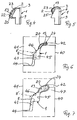
- the displaced pasty mass forms a bead 24 (FIG. 6) in the wedge-shaped gap between the sealing surface 46 of the Precast concrete 41 and the surfaces 2, 3 of Compression body.
- the bead 24 forms an additional one Sealing, especially with precast concrete Formal errors are important.
- the pasty mass changes with time stiffer and closes the wedge-shaped gap like a Graft.
- Fig. 6 shows the assembly of the precast elements with the seal in which the surface 3 is similar to the surface 2 is slanted.
- the imperforate cover 20 is on Transition of areas 2 and 3 and 3 and 6 with the Compression body 1 connected and forms a bead 24 in Insertion direction of the precast concrete part 41 with the Sealing surface 46 in front of the compression body 1.
- sections of the precast concrete elements 40 and 41 are shown, assuming that these are shaft components acts. Part 40 is then pointed end and part 41 bell end, between which the radial gap 42, the axial gap 43 and the further radial gap 44 are formed.
- the axial Surface 45 of the precast concrete part 40 in turn forms the Seal seat on which the compression body 1 is mounted while the opposite surface 46 of the Precast concrete 41 forms the sealing surface on which the Fit the inclined surface 2 of the compression body in a sealing manner should. If this is the case, the sheath 20 also forces itself their content 12 into the radial gap 42, wherein it the flexibility and extensibility of the casing 20 are important, the relatively soft rubber-elastic material such as the Shore hardness 30 exists. If the width of the gap 42 in The circumferential direction of the precast concrete parts is not constant is, the material 13 flows in the circumferential direction and fills the Gap 42 uniformly d. H. the bead 24 is entire Gap 42 is present and seals it (secondary seal).
- FIG. 7 shows a modification in which a trough 47 arranged in the precast concrete part 40 in the area of the gap 42 is.
- the trough 47 is provided for the shell 20 together Record content 13. If there is a leak in the Should show socket connection, you can use additional material Inject into the interior of the shell 20 under pressure and thereby achieve a functioning secondary seal.
- the can also be used to facilitate assembly Cover 20 contain prepared perforations, and the liquid-pasty mass can have lubricant properties have so that filling on the surface 2 of the Compression body can leak and the assembly process is lubricated.
- Fig. 8 shows a special design of the pad 9. It is a shell in the form of a skin 90 with webs 91, 92, 93 for connection to the compression body 1 provided, annular spaces 94, 95 delimited will.
- the rooms 94, 95 are of liquid-pasty mass 13 filled, and the skin 90 points in the region of the annular space 94 breakable perforations 23, which are certain Embodiments are also located in the area of the annular space 95 can.
- the inclined surface 2 of the compression body 1 is with a cover 10 or a cover 20, as shown in the previous exemplary embodiments of FIGS. 1 to 7 have been described.
- the support of the pad 9 on Seal seat 45 also leads to a large one Pressure increase of the liquid pasty located in the annular space 95 Mass 13, so that this after hydrostatic principle in the circumferential direction of the annular space 95 rearranged when the spigot end of the precast concrete Differences in shape compared to the sleeve of the other Should have precast concrete. It can be one uniform pressing of the lip-shaped sealing area 8 can be achieved around the circumference of the seal, which is one secure sealing is very beneficial.
- Fig. 9 shows another modified Embodiment of the seal, especially for Shaft structures is suitable.
- On surfaces 2, 3 and 6 of the compression body 1 are layers of swelling rubber attached, which is a pad 9, a cover 10 and a Form secondary seal 16.
- Swelling rubber is in the Initial condition somewhat brittle, but swells when access is made by Moisture and then ensures a good seal.
- a bead 14 is formed from the material the cover 10 when the sealing surface 46 in the suitable angle to the helix angle of surface 2 selected has been.
- the layer 16 is in the radial gap 42 jammed between the precast concrete parts and then works as a secondary seal.
- layer 16 is about 4 to 10 mm thick, while layers 9 and 10 Are 1 to 2 mm thick.
- Fig. 10 shows a scheme of sheathing a Compression body 1 through a shell 30 around the entire compression body passes around.
- the Compression body 1 is annular, its cross section can have the outline shape of a thickened number 1 or also be round as shown.
- the shell 30 Sections that behave like cover 10 when them with the suitably designed counter surface 46 of the Precast concrete work together and there are sections that behave like the pad 9. This is especially true then, if the shell is made of swelling rubber, which over a Intermediate layer 31 sufficiently firm on the Compression body 1 is attached.
- annular bead 80 as a secondary seal Precast concrete parts.
- the sleeve end 50 has a radially inner surface 52, one axially extending surface 53 and a radial outer surface 54 on.
- the tip end 51 has a radially inner one Surface 55, an axial surface 56 and an outer radial Area 57. If sleeve end 50 and spigot end 51 are pushed into each other, a curved gap is formed 60 out of a radially inner branch 61, an axial Branch 62 and a radially outer branch 63 has.
- a primary seal is used to seal the gap 60 70 provided with a harder section 71 (Shore hardness 50) and a softer section 72 (Shore hardness 30 or less) anchored in the surface 53 of the bell sleeve 50 is by the seal 70 in the manufacture of the Precast concrete poured into the bell socket 50 has been.
- the seal 70 has two to each other inclined sides 73 and 74, the side 73 the Sealing side is and page 74 in the area of the section 72 is very compliant-soft, so maneuvering space for that Spitzende 51 is won.
- the cover 10 consists of a relatively soft, adhesive carrier layer as a pasty mass and one relatively harder material filling or support, namely from fine quartz sand, granules or flocking with plastic or Rubber particles that the winding of the masking tape enable.
- the mode of action is similar to before described.
- the soft, sticky material of the backing layer enables the shift and distribution of the relative too harder material in the blowholes and roughness of the Concrete, so that it is more even and smoothed and the Better sealing effect of the compression body is coming.
- the relatively softer, adhesive material can otherwise solidification occurs over time, what benefits the sealing effect.
- a tape soaked with viscous lubricant can be used which may be dusted with granules.
- a tape soaked with viscous lubricant can be used which may be dusted with granules.
- the Compression body comes with a sufficiently wide Strips of such a masking tape wrapped and with the Lubricant pinned.
- the masking tape can be prepared so that you can can roll up. For easier unwinding, you can interpose a separating film. A fitting piece of the The tape roll is unwound and placed around a seal. In front When installing the concrete pipes, the cover film is removed.
- the front 55 of the tip end 51 has one Trough 58 in which an annular bead 80 is inserted.
- the Ring bead 80 consists of a closed ring tubular casing 81 and a filling 82.
- the casing 81 consists of a rubber-elastic or elastomeric material with a Shore hardness between 30 and 40, while the Filling consists of a cheaper material, for example pasty mass or mineral grain, such as Sand, fine grit or the like.
- FIG. 12 shows a modification of the annular bead 80, whose shell 81 is provided with an anchoring rib 83, around the ring bead at the front end 55 of the tip end 51 or in the bell socket wall 52 in the manufacture of the to anchor the precast element concerned.
- Fig. 13 shows a cross section through the Edge areas of the bell socket and the tip end, similar as in Fig. 11, but with an annular bead 80 which on the radially inner surface 52 of the sleeve end 50 anchored is.
- Parts corresponding to the first embodiment are with corresponding reference numerals and need not to be described further.
- FIG. 14 shows a cross section through the edge region a so-called lower sleeve 100, which the mold for Impression of surfaces 52, 53 and 54 of the bell socket represents. Accordingly, there is a substantially radial extending surface 102, an axially extending surface 103 and another radially extending surface 104. In the surface 102 a trough 105 is attached, which for Recording most of the ring bead 80 is used. In the an obliquely axially extending surface 103 is another Well 106 attached, in which the primary seal 70th is recorded during the casting process.
- the Cover 10 and the inclined surface 73 of the seal 70 on the axial face 56 of the tip end, with the seal 70 is increasingly compressed and the gap branch 62nd seals.
- Ring bead 80 Another advantage of using the Ring bead 80 according to the invention is that a Secondary seal is created that is independent of the Primary seal 70 is effective. This secondary seal also transmits axial forces between the Precast concrete parts, if these are arranged one above the other, as is the case with shaft components.
Landscapes
- Engineering & Computer Science (AREA)
- General Engineering & Computer Science (AREA)
- Mechanical Engineering (AREA)
- Public Health (AREA)
- Manufacturing & Machinery (AREA)
- Health & Medical Sciences (AREA)
- Life Sciences & Earth Sciences (AREA)
- Hydrology & Water Resources (AREA)
- Chemical & Material Sciences (AREA)
- Water Supply & Treatment (AREA)
- Ceramic Engineering (AREA)
- Joints With Sleeves (AREA)
- Building Environments (AREA)
- Moulds, Cores, Or Mandrels (AREA)
- Sealing Material Composition (AREA)
- Gasket Seals (AREA)
- Underground Structures, Protecting, Testing And Restoring Foundations (AREA)
- Joining Of Building Structures In Genera (AREA)
Applications Claiming Priority (6)
| Application Number | Priority Date | Filing Date | Title |
|---|---|---|---|
| DE29700370U | 1997-01-10 | ||
| DE29700370U DE29700370U1 (de) | 1997-01-10 | 1997-01-10 | Elastomerdichtung für Betonfertigteile |
| DE29702419U DE29702419U1 (de) | 1997-02-13 | 1997-02-13 | Elastomerdichtung für Betonfertigteile |
| DE29702419U | 1997-02-13 | ||
| DE29706793U DE29706793U1 (de) | 1997-04-15 | 1997-04-15 | Abdichtanordnung an Betonfertigteilen |
| DE29706793U | 1997-04-15 |
Publications (3)
| Publication Number | Publication Date |
|---|---|
| EP0853209A2 true EP0853209A2 (fr) | 1998-07-15 |
| EP0853209A3 EP0853209A3 (fr) | 2000-08-23 |
| EP0853209B1 EP0853209B1 (fr) | 2003-07-23 |
Family
ID=27219914
Family Applications (1)
| Application Number | Title | Priority Date | Filing Date |
|---|---|---|---|
| EP98100287A Expired - Lifetime EP0853209B1 (fr) | 1997-01-10 | 1998-01-09 | Dispositif d'étanchéité sur pièces préfabriquées en béton |
Country Status (3)
| Country | Link |
|---|---|
| EP (1) | EP0853209B1 (fr) |
| AT (1) | ATE245785T1 (fr) |
| DE (1) | DE59809034D1 (fr) |
Cited By (5)
| Publication number | Priority date | Publication date | Assignee | Title |
|---|---|---|---|---|
| DE10006294A1 (de) * | 2000-02-14 | 2001-08-30 | Macon Verbaugeraete Gmbh | Verfahren zum Aufbringen von Gleitmittel auf eine Rohrdichtung |
| WO2006080872A1 (fr) * | 2005-01-27 | 2006-08-03 | Trelleborg Forsheda Building Ab | Bague d'etancheite |
| EP2634468A1 (fr) | 2012-02-29 | 2013-09-04 | DS Dichtungstechnik GmbH | Bague d'étanchéité et raccord de manchon emboîtable |
| DE10140928B4 (de) * | 2001-05-31 | 2014-08-28 | Georg Prinzing Gmbh & Co. Kg Betonformen- Und Maschinenfabrik | Schachtsystem |
| DE102017122286A1 (de) | 2017-09-26 | 2019-03-28 | M.O.L. Gummiverarbeitung Gmbh & Co. Kg | Dichtring |
Citations (2)
| Publication number | Priority date | Publication date | Assignee | Title |
|---|---|---|---|---|
| EP0011919B1 (fr) | 1978-10-27 | 1982-07-28 | A/S Den Norske Remfabrik | Joint en caoutchouc ou matériau similaire |
| DE3817868A1 (de) | 1987-05-27 | 1988-12-15 | Forsheda Ab | Dichtring |
Family Cites Families (5)
| Publication number | Priority date | Publication date | Assignee | Title |
|---|---|---|---|---|
| SE444358B (sv) * | 1981-04-23 | 1986-04-07 | Finnveden Dev Ltd Ab | Sett for avtetning av spalten mellan tva tetningsytor samt tetningsanordning for genomforande av settet |
| US5143381A (en) * | 1991-05-01 | 1992-09-01 | Pipe Gasket & Supply Co., Inc. | Pipe joint seal |
| DE9212666U1 (de) * | 1992-09-21 | 1993-11-04 | PT-Poly-Tec GmbH Vertrieb und Herstellung von Dichtungssystemen, 63456 Hanau | Abdichtung zwischen zwei ineinandersteckbaren Teilen |
| FR2701527B1 (fr) * | 1993-02-16 | 1995-05-12 | Tuyaux Bonna | Joint d'étanchéité, notamment destiné à établir une étanchéité entre deux tuyaux ou analogues mutuellement emboîtés, et tuyau ou analogue comportant un tel joint. |
| DE4323734A1 (de) * | 1993-07-15 | 1995-01-19 | Prinzing Georg Gmbh Co Kg | Dichtungseinrichtung an aneinanderstoßenden Bauteilen, insbesondere Betonformteilen |
-
1998
- 1998-01-09 AT AT98100287T patent/ATE245785T1/de not_active IP Right Cessation
- 1998-01-09 EP EP98100287A patent/EP0853209B1/fr not_active Expired - Lifetime
- 1998-01-09 DE DE59809034T patent/DE59809034D1/de not_active Expired - Lifetime
Patent Citations (2)
| Publication number | Priority date | Publication date | Assignee | Title |
|---|---|---|---|---|
| EP0011919B1 (fr) | 1978-10-27 | 1982-07-28 | A/S Den Norske Remfabrik | Joint en caoutchouc ou matériau similaire |
| DE3817868A1 (de) | 1987-05-27 | 1988-12-15 | Forsheda Ab | Dichtring |
Cited By (5)
| Publication number | Priority date | Publication date | Assignee | Title |
|---|---|---|---|---|
| DE10006294A1 (de) * | 2000-02-14 | 2001-08-30 | Macon Verbaugeraete Gmbh | Verfahren zum Aufbringen von Gleitmittel auf eine Rohrdichtung |
| DE10140928B4 (de) * | 2001-05-31 | 2014-08-28 | Georg Prinzing Gmbh & Co. Kg Betonformen- Und Maschinenfabrik | Schachtsystem |
| WO2006080872A1 (fr) * | 2005-01-27 | 2006-08-03 | Trelleborg Forsheda Building Ab | Bague d'etancheite |
| EP2634468A1 (fr) | 2012-02-29 | 2013-09-04 | DS Dichtungstechnik GmbH | Bague d'étanchéité et raccord de manchon emboîtable |
| DE102017122286A1 (de) | 2017-09-26 | 2019-03-28 | M.O.L. Gummiverarbeitung Gmbh & Co. Kg | Dichtring |
Also Published As
| Publication number | Publication date |
|---|---|
| EP0853209B1 (fr) | 2003-07-23 |
| DE59809034D1 (de) | 2003-08-28 |
| EP0853209A3 (fr) | 2000-08-23 |
| ATE245785T1 (de) | 2003-08-15 |
Similar Documents
| Publication | Publication Date | Title |
|---|---|---|
| DE4229609C2 (de) | Abdichtung zwischen zwei ineinandersteckbaren Teilen | |
| DE3414180A1 (de) | Dichtungseinrichtung fuer aneinanderstossende, zumindest etwa rohrfoermige bauteile, insbesondere fuer betonformteile | |
| DE20310390U1 (de) | Anschlussdichtung mit Ratschenzähnen | |
| EP0553723B1 (fr) | Joint d'étanchéité pour éléments de construction en contact, notamment éléments en béton | |
| WO1996023958A1 (fr) | Garniture d'etancheite pour segments de galeries de tunnel | |
| EP1165937B1 (fr) | Ensemble etanche | |
| EP0853209B1 (fr) | Dispositif d'étanchéité sur pièces préfabriquées en béton | |
| DE69608969T2 (de) | Auskleidung von pipelines und durchgängen | |
| EP2113702B1 (fr) | Embrayage destiné à la liaison de deux extrémités de tuyaux, doté d'une étanchéité de source secondaire | |
| EP0890772B1 (fr) | Joint d'étancheité avec de cavités | |
| DE102007052559A1 (de) | Elastische Einlage für eine Rohrschelle | |
| DE3521888C2 (fr) | ||
| EP0343677B1 (fr) | Joint d'étanchéité entre deux éléments préfabriqués en béton, insérables l'un dans l'autre | |
| DE1961362U (de) | Abdichtungsband. | |
| DE202018100354U1 (de) | Dichtungsprofil zur Einbettung in ein Formteil aus aushärtbarem Material | |
| CH686383A5 (de) | Verfahren zur Herstellung einer nicht verschiebbaren Dichtungsprofilleiste und nach diesem Verfahren hergestellte Leiste. | |
| DE69324055T2 (de) | Hohles, rohrförmiges Auskleidungselement für Abwasserkanäle und Verfahren zum Auskleiden eines Abwasserkanals | |
| DE2915227C2 (de) | Rohrverbindung | |
| EP0859183B1 (fr) | Anneau d'étanchéité pour anneaux de puits d'accès | |
| DE29702419U1 (de) | Elastomerdichtung für Betonfertigteile | |
| EP0758703A1 (fr) | Joint de bétonnage | |
| EP2282098A2 (fr) | Joint doté d'un élément d'étanchéité coulissant | |
| DE69406816T2 (de) | Rohrvortriebsstrang und entsprechendes Vortriebsrohr | |
| DE2541999A1 (de) | Fugenabdichtung zwischen aneinanderstossenden bauteilen aus mineralischen stoffen mittels eines fugenbandes aus thermoplastischem kunststoff | |
| DE29614582U1 (de) | Druckübertragungsring zum Vortrieb von Abwasserrohren |
Legal Events
| Date | Code | Title | Description |
|---|---|---|---|
| PUAI | Public reference made under article 153(3) epc to a published international application that has entered the european phase |
Free format text: ORIGINAL CODE: 0009012 |
|
| AK | Designated contracting states |
Kind code of ref document: A2 Designated state(s): AT BE CH DE DK ES FR GB IT LI LU NL PT SE |
|
| AX | Request for extension of the european patent |
Free format text: AL;LT;LV;MK;RO;SI |
|
| PUAL | Search report despatched |
Free format text: ORIGINAL CODE: 0009013 |
|
| AK | Designated contracting states |
Kind code of ref document: A3 Designated state(s): AT BE CH DE DK ES FI FR GB GR IE IT LI LU MC NL PT SE |
|
| AX | Request for extension of the european patent |
Free format text: AL;LT;LV;MK;RO;SI |
|
| 17P | Request for examination filed |
Effective date: 20010220 |
|
| AKX | Designation fees paid |
Free format text: AT BE CH DE DK ES FR GB IT LI LU NL PT SE |
|
| GRAH | Despatch of communication of intention to grant a patent |
Free format text: ORIGINAL CODE: EPIDOS IGRA |
|
| GRAH | Despatch of communication of intention to grant a patent |
Free format text: ORIGINAL CODE: EPIDOS IGRA |
|
| GRAA | (expected) grant |
Free format text: ORIGINAL CODE: 0009210 |
|
| AK | Designated contracting states |
Designated state(s): AT BE CH DE DK ES FR GB IT LI LU NL PT SE |
|
| PG25 | Lapsed in a contracting state [announced via postgrant information from national office to epo] |
Ref country code: IT Free format text: LAPSE BECAUSE OF FAILURE TO SUBMIT A TRANSLATION OF THE DESCRIPTION OR TO PAY THE FEE WITHIN THE PRE;WARNING: LAPSES OF ITALIAN PATENTS WITH EFFECTIVE DATE BEFORE 2007 MAY HAVE OCCURRED AT ANY TIME BEFORE 2007. THE CORRECT EFFECTIVE DATE MAY BE DIFFERENT FROM THE ONE RECORDED.SCRIBED TIME-LIMIT Effective date: 20030723 Ref country code: GB Free format text: LAPSE BECAUSE OF FAILURE TO SUBMIT A TRANSLATION OF THE DESCRIPTION OR TO PAY THE FEE WITHIN THE PRESCRIBED TIME-LIMIT Effective date: 20030723 |
|
| REG | Reference to a national code |
Ref country code: GB Ref legal event code: FG4D Free format text: NOT ENGLISH |
|
| REG | Reference to a national code |
Ref country code: CH Ref legal event code: EP |
|
| REF | Corresponds to: |
Ref document number: 59809034 Country of ref document: DE Date of ref document: 20030828 Kind code of ref document: P |
|
| PG25 | Lapsed in a contracting state [announced via postgrant information from national office to epo] |
Ref country code: DK Free format text: LAPSE BECAUSE OF FAILURE TO SUBMIT A TRANSLATION OF THE DESCRIPTION OR TO PAY THE FEE WITHIN THE PRESCRIBED TIME-LIMIT Effective date: 20031023 |
|
| PG25 | Lapsed in a contracting state [announced via postgrant information from national office to epo] |
Ref country code: ES Free format text: LAPSE BECAUSE OF FAILURE TO SUBMIT A TRANSLATION OF THE DESCRIPTION OR TO PAY THE FEE WITHIN THE PRESCRIBED TIME-LIMIT Effective date: 20031103 |
|
| REG | Reference to a national code |
Ref country code: SE Ref legal event code: TRGR |
|
| PG25 | Lapsed in a contracting state [announced via postgrant information from national office to epo] |
Ref country code: PT Free format text: LAPSE BECAUSE OF FAILURE TO SUBMIT A TRANSLATION OF THE DESCRIPTION OR TO PAY THE FEE WITHIN THE PRESCRIBED TIME-LIMIT Effective date: 20031223 |
|
| PG25 | Lapsed in a contracting state [announced via postgrant information from national office to epo] |
Ref country code: LU Free format text: LAPSE BECAUSE OF NON-PAYMENT OF DUE FEES Effective date: 20040109 Ref country code: AT Free format text: LAPSE BECAUSE OF NON-PAYMENT OF DUE FEES Effective date: 20040109 |
|
| GBV | Gb: ep patent (uk) treated as always having been void in accordance with gb section 77(7)/1977 [no translation filed] |
Effective date: 20030723 |
|
| PG25 | Lapsed in a contracting state [announced via postgrant information from national office to epo] |
Ref country code: LI Free format text: LAPSE BECAUSE OF NON-PAYMENT OF DUE FEES Effective date: 20040131 Ref country code: CH Free format text: LAPSE BECAUSE OF NON-PAYMENT OF DUE FEES Effective date: 20040131 |
|
| ET | Fr: translation filed | ||
| PLBE | No opposition filed within time limit |
Free format text: ORIGINAL CODE: 0009261 |
|
| STAA | Information on the status of an ep patent application or granted ep patent |
Free format text: STATUS: NO OPPOSITION FILED WITHIN TIME LIMIT |
|
| 26N | No opposition filed |
Effective date: 20040426 |
|
| REG | Reference to a national code |
Ref country code: CH Ref legal event code: PL |
|
| REG | Reference to a national code |
Ref country code: FR Ref legal event code: PLFP Year of fee payment: 19 |
|
| REG | Reference to a national code |
Ref country code: FR Ref legal event code: PLFP Year of fee payment: 20 |
|
| PGFP | Annual fee paid to national office [announced via postgrant information from national office to epo] |
Ref country code: NL Payment date: 20170124 Year of fee payment: 20 |
|
| PGFP | Annual fee paid to national office [announced via postgrant information from national office to epo] |
Ref country code: FR Payment date: 20170124 Year of fee payment: 20 Ref country code: SE Payment date: 20170125 Year of fee payment: 20 Ref country code: DE Payment date: 20170128 Year of fee payment: 20 |
|
| PGFP | Annual fee paid to national office [announced via postgrant information from national office to epo] |
Ref country code: BE Payment date: 20170124 Year of fee payment: 20 |
|
| REG | Reference to a national code |
Ref country code: DE Ref legal event code: R071 Ref document number: 59809034 Country of ref document: DE |
|
| REG | Reference to a national code |
Ref country code: NL Ref legal event code: MK Effective date: 20180108 |
|
| REG | Reference to a national code |
Ref country code: BE Ref legal event code: MK Effective date: 20180109 |
|
| REG | Reference to a national code |
Ref country code: SE Ref legal event code: EUG |