EP0855176A2 - Bouchon d'oreille détectable - Google Patents
Bouchon d'oreille détectable Download PDFInfo
- Publication number
- EP0855176A2 EP0855176A2 EP97309046A EP97309046A EP0855176A2 EP 0855176 A2 EP0855176 A2 EP 0855176A2 EP 97309046 A EP97309046 A EP 97309046A EP 97309046 A EP97309046 A EP 97309046A EP 0855176 A2 EP0855176 A2 EP 0855176A2
- Authority
- EP
- European Patent Office
- Prior art keywords
- earplug
- insert
- detectable
- fastener
- shaft
- Prior art date
- Legal status (The legal status is an assumption and is not a legal conclusion. Google has not performed a legal analysis and makes no representation as to the accuracy of the status listed.)
- Granted
Links
Images

Classifications
-
- A—HUMAN NECESSITIES
- A61—MEDICAL OR VETERINARY SCIENCE; HYGIENE
- A61F—FILTERS IMPLANTABLE INTO BLOOD VESSELS; PROSTHESES; DEVICES PROVIDING PATENCY TO, OR PREVENTING COLLAPSING OF, TUBULAR STRUCTURES OF THE BODY, e.g. STENTS; ORTHOPAEDIC, NURSING OR CONTRACEPTIVE DEVICES; FOMENTATION; TREATMENT OR PROTECTION OF EYES OR EARS; BANDAGES, DRESSINGS OR ABSORBENT PADS; FIRST-AID KITS
- A61F11/00—Methods or devices for treatment of the ears or hearing sense; Non-electric hearing aids; Methods or devices for enabling ear patients to achieve auditory perception through physiological senses other than hearing sense; Protective devices for the ears, carried on the body or in the hand
- A61F11/06—Protective devices for the ears
- A61F11/08—Protective devices for the ears internal, e.g. earplugs
-
- A—HUMAN NECESSITIES
- A61—MEDICAL OR VETERINARY SCIENCE; HYGIENE
- A61F—FILTERS IMPLANTABLE INTO BLOOD VESSELS; PROSTHESES; DEVICES PROVIDING PATENCY TO, OR PREVENTING COLLAPSING OF, TUBULAR STRUCTURES OF THE BODY, e.g. STENTS; ORTHOPAEDIC, NURSING OR CONTRACEPTIVE DEVICES; FOMENTATION; TREATMENT OR PROTECTION OF EYES OR EARS; BANDAGES, DRESSINGS OR ABSORBENT PADS; FIRST-AID KITS
- A61F11/00—Methods or devices for treatment of the ears or hearing sense; Non-electric hearing aids; Methods or devices for enabling ear patients to achieve auditory perception through physiological senses other than hearing sense; Protective devices for the ears, carried on the body or in the hand
- A61F11/06—Protective devices for the ears
- A61F11/08—Protective devices for the ears internal, e.g. earplugs
- A61F11/12—External mounting means
Definitions
- Earplugs are worn by industrial workers to protect their hearing. However, when worn by workers in the food or pharmaceutical industry, there is danger of product contamination if an earplug should fall into the material being processed.
- Such industries use detectors for metallic and other objects, but such detectors usually cannot detect earplugs molded of foam plastic or other plastic or rubber.
- European patent publication 244,979 and U.S. patent 4,936,411 show a metal object inserted into a deep hole or channel extending along the axis of a solid rubber or other polymer earplug. It can require substantial cost to insert the object and securely lock it in place, especially if the earplug is formed of foam material.
- a metal object or other detectable insert which could be very securely attached to earplugs, especially those of the compressible foam plastic type, and in a manner that enabled attachment at low cost, would be of value.
- a detectable earplug which can be constructed at low cost.
- the earplug includes a molded earplug body having an axis extending in forward and rearward directions and having a forward portion that first enters a persons ear canal and having a rearward portion.
- the earplug also includes a detectable insert that is attached to the body.
- the insert comprises a fastener with a shaft extending through a lateral hole in the body between laterally opposite sides of the body.
- the fastener includes enlargements lying at laterally opposite sides of the body rearward portion.
- the body is preferably formed of a compressible resilient foam, with the body portion lying between the enlargements being compressed therebetween.
- an end portion of the cord can be trapped between the fastener and the earplug body.
- the cord can be wrapped about the shaft and trapped between a first of the enlargements and the body rearward portion that lies between the enlargements.
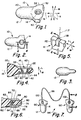
- Fig. 1 is an isometric view of a detectable earplug of one embodiment of the present invention.
- Fig. 2 is a side view of the earplug of Fig. 1, as taken along a lateral direction.
- Fig. 3 is a side view of the earplug of Fig. 2, taken along a longitudinal direction.
- Fig. 4 is an enlarged sectional view taken on line 4-4 of Fig. 2.
- Fig. 5 is a partial isometric view of a detectable earplug constructed in accordance with another embodiment of the invention.
- Fig. 6 is a view taken on line 6-6 of Fig. 5.
- Fig. 7 is an isometric view of a detectable earplug assembly which includes two earplugs and a cord connecting them.
- Fig. 8 is a view taken on line 8-8 of Fig. 7.
- Fig. 9 is a sectional view taken on line 9-9 of Fig. 8, showing only the fastener and cord.
- Fig. 10 is an exploded view showing one manner in which the fastener and cord of Fig. 8 can be assembled.
- Fig. 11 is an isometric view of a detectable earplug of another embodiment of the invention.
- Fig. 12 is a sectional view taken on line 12-12 of Fig. 11.
- Fig. 12A is a sectional view similar to Fig. 12, but with another insert.
- Fig. 1 illustrates a detectable earplug 10 which includes an earplug body 12 and a detectable insert 14 mounted on the body.
- the earplug body has an axis 16 extending in forward and rearward directions F, R.
- the body has a front portion 20 which is the portion that is initially inserted into a person's ear canal to block sound, and has a rearward portion 22, with the particular rearward portion shown being designed to lie outside the entrance to the ear canal.
- the earplug body 12 is generally of the shape shown in U.S. patent D 329,897.
- the body is molded of a soft polymer (modulus of elasticity of less than 50,000psi), that is, a polymer that can be significantly compressed and/or deflected by forces of several ounces typically applied by the walls of the ear canal to an earplug, and has a much lower modulus of elasticity than engineering plastics (whose modulus of elasticity is more than 100,000psi).
- the particular body 12 is formed of resilient plastic foam, such as slow recovery foam which is easily compressed and which takes about one minute to recover to near its original uncompressed shape.
- the earplug has a through hole 30 that extends in a lateral direction L which is perpendicular to the axis 16.
- the insert is in the form of a fastener such as an eyelet, which has a barrel or shaft 32 that projects through the hole 30 and which has flanges or enlargements 34, 36 at laterally opposite sides 40, 42 of the body rearward portion.
- the enlargements 34, 36 are shown as being in the form of washers that completely surround the shaft.
- a region 44 of the body that lies between the enlargements 34, 36, is highly compressed, by more than 20% of its original thickness, and usually by at least about 50% of its original thickness.
- the insert 14 formed by a shaft that passes completely through the earplug rearward portion in a direction perpendicular to the axis of the earplug, enables simple and secure mounting of the insert.
- the earplug body 12 can be molded in the same manner as for nondetectable earplugs, and a through hole is formed in the earplug. Then the eyelet (14) is projected through the hole, the eyelet having a flange or enlargement at only one end. Thereafter, the other end of the eyelet is deformed to form the second enlargement 36, with the deformation proceeding until the region 44 of the body between enlargements is highly compressed.
- the eyelet is a very low cost item, and its installation can be achieved at low cost.
- Applicant prefers to use an earplug body with longitudinally opposite sides 50, 52, which are longitudinally spaced in longitudinal direction M, by more than the longitudinal width of the front portion 20 of the body. This provides side portions that can be easily grasped to withdraw the earplug.
- the longitudinal middle of the body rear portion has a lateral width (in direction L, Fig. 4) which is much less than the longitudinal width of the front portion 20 of the body. The result is to provide a thin but wide rear portion that can be readily grasped, to pull out the earplug.
- Fig. 5 illustrates the earplug body 12 with a different detectable insert 60 attached to the rear portion 22 of the body.
- the insert 60 forms a fastener with a shaft 62 extending in a lateral direction L completely through a hole 64 in the body.
- the fastener formed by the insert includes enlargements 66, 68 lying on lateral opposite sides 70, 72 of the body rearward portion, and with the body including a region 74 that is tightly squeezed between the enlargements.
- the enlargements 66, 68 of the particular insert shown, extend to the rear edge 76 of the body, where they are joined by an insert rear end 80.
- the shaft 62 includes two shaft parts 82, 84 which lock together when the insert is installed on the body.
- Figs. 7-10 illustrate a pair of detectable earplugs 90, 92 of an earplug assembly 94 that includes a cord 96 having opposite end portions or ends 100, 102 that are securely fixed to the earplugs.
- a cord that joins the earplugs, makes it less likely that one of the two earplugs will be dropped.
- Each of the earplugs such as 90 includes an earplug body 12 and a detectable insert 14 which is securely fastened to the body. Applicant uses the insert 14 to securely hold a corresponding end 100 of the cord.
- the cord end 100 is wrapped about the shaft 32 of the insert and is trapped between a compressed region 44 of the earplug body and a flange or enlargement 34 of the insert that presses against the compressed body portion. Applicant prefers that the cord end 100 be wrapped more than 360° about the shaft, and with the cord having overlapping areas 102, 104 that are fastened together, as with adhesive.
- Fig. 10 shows one example of the manner in which the cord end 100 can be installed on the insert. The insert is shown in its initial configuration 14A, wherein one of the enlargements at 36A has not yet been radially outwardly deformed.
- the cord is formed into the loop 110, and the loop is slid over the insert shaft 32 and against the already-formed enlargement 34.
- a hole is formed in the rearward portion of the earplug body, and the insert 14A with the cord loop 110 installed thereon, is pressed through the hole. Then, the initial enlargement area at 36A is deformed radially outwardly (with respect to the shaft axis 112) until the enlargement assumes the shape shown at 36 in Fig. 8.
- the enlargement 34 can be formed with its radially outer edge bent to assure that the cord is not weakened.
- the cord end 100 can be securely coupled to the insert 14 in a number of ways, including wrapping the cord so it extends axially, or in the lateral direction L, between the opposite enlargements, as indicated at 100X. Another way is to thread the cord through a hole in the shaft 32 and to tie a knot or other enlargement at the extreme end of the cord.
- Fig. 8 shows, in phantom lines, a cord at 114 that extends in a loop through the hollow shaft of the eyelet insert 14, with the cord tied to itself at 116.
- Fig. 5 shows, in phantom lines, a cord at 117 that extends in a loop through the insert 60 and with the cord held to itself at 118.
- the hole 30 in the body can be formed by thrusting a sharp-pointed piercing tool through the body or by punching out a piece of material of the body. Applicant prefers to merely pierce the body, with a piercing tool whose cross section is in the shape of a cross.
- Figs. 11 and 12 illustrate another earplug 120 that includes an earplug body 12 of the same construction as in Fig. 1, and a detectable insert 122 and cord end 124.
- the insert is a rivet that is offset from the earplug body axis 126, and that extends primarily perpendicular to the axis through the body.
- the card end 124 lies in a hole 130 that extends along the axis of the body, and is glued in place. This construction can be useful where tooling is already setup to install the cord as shown, and it is desired to add the detectable insert 122 for special applications.
- Fig. 12 shows that the insert includes a shaft 132 with opposite flanges 134, 136. Caps 140, 142 are fastened around the flanges to give a more "finished" look. The caps also add metal for easier detection, and avoid edges on the enlargements 144, 146 formed by the flanges and caps, that can cut into the compressed region 150 of the body and allow the insert to pullout.
- Fig. 12A shows a lower cost alternative, where the insert 150 includes an eyelet 152 and a washer 154. The eyelet is supplied with an enlargement 156 having a flat face 158 that presses against the earplug body 12. The washer 154 has a flat face 160, and is held down by a rolled-over eyelet flange 162 that has a concave lower face 164.
- Applicant prefers to use an insert merely formed of metal (or other conductive material) for detection by reason of its conductivity, or of a magnetic material such as steel which can be detected by its magnetic properties.
- metal or other conductive material
- magnetic material such as steel which can be detected by its magnetic properties.
- the invention provides a detectable earplug which includes a molded earplug body and a detectable insert that is attached to the rear body, where the insert comprises a fastener with a shaft that projects through a hole extending primarily perpendicular to the axis of the earplug and having enlargements extending from the shaft and lying at opposite sides of the body.
- the lateral direction could be the direction M of Fig. 1, wherein a longer insert would be used.
- the body is formed of resilient foam material, the enlargements can compress a region of the body lying between them, to provide a secure and low cost fastening of the insert to the resilient foam body. Where it is desired to attach an end portion of a cord to the earplug, this can be readily accomplished by coupling the cord to the insert.
Landscapes
- Health & Medical Sciences (AREA)
- Life Sciences & Earth Sciences (AREA)
- Biomedical Technology (AREA)
- Animal Behavior & Ethology (AREA)
- Biophysics (AREA)
- Otolaryngology (AREA)
- Psychology (AREA)
- Engineering & Computer Science (AREA)
- Physics & Mathematics (AREA)
- Heart & Thoracic Surgery (AREA)
- Vascular Medicine (AREA)
- Acoustics & Sound (AREA)
- General Health & Medical Sciences (AREA)
- Public Health (AREA)
- Veterinary Medicine (AREA)
- Soundproofing, Sound Blocking, And Sound Damping (AREA)
- Orthopedics, Nursing, And Contraception (AREA)
- Clamps And Clips (AREA)
- Insertion Pins And Rivets (AREA)
Applications Claiming Priority (2)
| Application Number | Priority Date | Filing Date | Title |
|---|---|---|---|
| US785415 | 1985-10-08 | ||
| US08/785,415 US5711313A (en) | 1997-01-23 | 1997-01-23 | Discoverable earplug |
Publications (3)
| Publication Number | Publication Date |
|---|---|
| EP0855176A2 true EP0855176A2 (fr) | 1998-07-29 |
| EP0855176A3 EP0855176A3 (fr) | 1998-11-11 |
| EP0855176B1 EP0855176B1 (fr) | 2004-04-07 |
Family
ID=25135457
Family Applications (1)
| Application Number | Title | Priority Date | Filing Date |
|---|---|---|---|
| EP97309046A Expired - Lifetime EP0855176B1 (fr) | 1997-01-23 | 1997-11-11 | Bouchon d'oreille détectable |
Country Status (4)
| Country | Link |
|---|---|
| US (1) | US5711313A (fr) |
| EP (1) | EP0855176B1 (fr) |
| AU (1) | AU695296B1 (fr) |
| DE (1) | DE69728514T2 (fr) |
Cited By (1)
| Publication number | Priority date | Publication date | Assignee | Title |
|---|---|---|---|---|
| EP1629807A1 (fr) * | 2004-08-25 | 2006-03-01 | Phonak Ag | Bouchon d'oreilleet, son procédé de fabrication et procédé de détection d'un bouchon d'oreilleet |
Families Citing this family (25)
| Publication number | Priority date | Publication date | Assignee | Title |
|---|---|---|---|---|
| US6920956B1 (en) | 1999-01-07 | 2005-07-26 | Cabot Safety Intermediate Corporation | Detectable earplug and method of manufacture thereof |
| FR2842726A1 (fr) * | 2002-07-25 | 2004-01-30 | Serge Schlee | Bouchon d'oreilles antibruit et d'hygiene |
| US8708091B2 (en) | 2002-10-28 | 2014-04-29 | 3M Innovative Properties Company | Corded hearing protective device and method of manufacturing the same |
| DE102005034733B4 (de) * | 2005-07-21 | 2007-10-25 | Drescher, Rüdiger | Lärmprotektor |
| US7984716B2 (en) * | 2007-06-22 | 2011-07-26 | Kimberly-Clark Worldwide Inc. | Self-conforming sound attenuation earplug |
| US8079366B2 (en) * | 2008-04-03 | 2011-12-20 | Collins Timothy R | Magnetic earplug |
| CA128312S (en) * | 2008-04-28 | 2009-08-12 | Philips Electronics Ltd | Headphone |
| US8113207B2 (en) * | 2008-08-22 | 2012-02-14 | Kimberly-Clark Worldwide, Inc. | Self-conforming sound attenuation earplug |
| US8671948B2 (en) * | 2010-09-28 | 2014-03-18 | Moldex-Metric, Inc. | Corded earplugs |
| US8375803B2 (en) * | 2010-10-27 | 2013-02-19 | Chevron U.S.A. Inc. | Testing device for stress corrosion cracking |
| US20120272974A1 (en) * | 2011-04-26 | 2012-11-01 | Moldex-Metric, Inc. | Corded earplug |
| US9451353B2 (en) | 2012-02-08 | 2016-09-20 | Decibullz Llc | Moldable earpiece system |
| USD783003S1 (en) * | 2013-02-07 | 2017-04-04 | Decibullz Llc | Moldable earpiece |
| US9763832B2 (en) * | 2013-04-10 | 2017-09-19 | Howard S. Leight | Pull out earplug |
| USD733676S1 (en) | 2013-11-18 | 2015-07-07 | 3M Innovative Properties Company | Hearing device tether acoustic decoupling section |
| US9445177B2 (en) | 2013-11-18 | 2016-09-13 | 3M Innovative Properties Company | Hearing device tether with acoustic decoupling section |
| EP3435938B1 (fr) | 2016-04-01 | 2021-09-29 | 3M Innovative Properties Company | Dispositif de protection auditive et son procédé de formation |
| US10149038B2 (en) | 2017-01-20 | 2018-12-04 | Decibullz Llc | Earpiece intra-auricular support system |
| US10507599B2 (en) | 2017-04-07 | 2019-12-17 | Decibullz Llc | Moldable earpiece heating case |
| US10728648B2 (en) | 2017-08-23 | 2020-07-28 | Decibullz Llc | Reconfigurable intra-auricular support |
| USD895901S1 (en) | 2017-09-01 | 2020-09-08 | 3M Innovative Properties Company | Hearing protector |
| JP7273798B2 (ja) | 2017-09-01 | 2023-05-15 | スリーエム イノベイティブ プロパティズ カンパニー | 先端キャビティを有する押し嵌め式耳栓 |
| CN111033643B (zh) | 2017-09-01 | 2022-04-29 | 3M创新有限公司 | 用于耳塞的冷拔聚烯烃共聚物绳 |
| EP3730107B1 (fr) * | 2019-04-26 | 2023-06-07 | Moldex/Metric AG & Co. KG | Bouchon d'oreille pour oreilles humaines, système de bouchon d'oreille, bouchon d'oreille à cordon |
| USD925493S1 (en) | 2019-11-25 | 2021-07-20 | Decibullz Llc | Intra-auricular earbud support |
Citations (3)
| Publication number | Priority date | Publication date | Assignee | Title |
|---|---|---|---|---|
| US329897A (en) | 1885-11-10 | Adolph geiss | ||
| EP0244979A1 (fr) | 1986-04-29 | 1987-11-11 | Safer Safety Limited | Tampons auriculaires |
| US4936411A (en) | 1988-08-19 | 1990-06-26 | Cabot Corporation | Detectable earplug |
Family Cites Families (9)
| Publication number | Priority date | Publication date | Assignee | Title |
|---|---|---|---|---|
| US516135A (en) * | 1894-03-06 | Adalbert tpiamm | ||
| US125339A (en) * | 1872-04-02 | Improvement in ear-muffs | ||
| US758680A (en) * | 1903-11-18 | 1904-05-03 | Albert Edward C Otte | Ear-hood. |
| US955276A (en) * | 1909-03-22 | 1910-04-19 | John Lopizich | Ear-plug for bathers. |
| US4253452A (en) * | 1979-05-24 | 1981-03-03 | Specialty Composites Corporation | Ear plug assembly |
| US4807612A (en) * | 1987-11-09 | 1989-02-28 | Industrial Research Products, Inc. | Passive ear protector |
| US5074375A (en) * | 1989-10-18 | 1991-12-24 | Grozil Richard S | Hearing protection system assembly |
| SE502365C2 (sv) * | 1991-04-19 | 1995-10-09 | Bilsom Ab | Detekterbar hörselskyddspropp |
| US5249309A (en) * | 1992-09-17 | 1993-10-05 | Bilsom Ab | Ear defender |
-
1997
- 1997-01-23 US US08/785,415 patent/US5711313A/en not_active Expired - Lifetime
- 1997-11-11 DE DE69728514T patent/DE69728514T2/de not_active Expired - Lifetime
- 1997-11-11 EP EP97309046A patent/EP0855176B1/fr not_active Expired - Lifetime
- 1997-11-17 AU AU45251/97A patent/AU695296B1/en not_active Expired
Patent Citations (3)
| Publication number | Priority date | Publication date | Assignee | Title |
|---|---|---|---|---|
| US329897A (en) | 1885-11-10 | Adolph geiss | ||
| EP0244979A1 (fr) | 1986-04-29 | 1987-11-11 | Safer Safety Limited | Tampons auriculaires |
| US4936411A (en) | 1988-08-19 | 1990-06-26 | Cabot Corporation | Detectable earplug |
Cited By (1)
| Publication number | Priority date | Publication date | Assignee | Title |
|---|---|---|---|---|
| EP1629807A1 (fr) * | 2004-08-25 | 2006-03-01 | Phonak Ag | Bouchon d'oreilleet, son procédé de fabrication et procédé de détection d'un bouchon d'oreilleet |
Also Published As
| Publication number | Publication date |
|---|---|
| EP0855176B1 (fr) | 2004-04-07 |
| DE69728514T2 (de) | 2005-02-24 |
| DE69728514D1 (de) | 2004-05-13 |
| AU695296B1 (en) | 1998-08-13 |
| US5711313A (en) | 1998-01-27 |
| EP0855176A3 (fr) | 1998-11-11 |
Similar Documents
| Publication | Publication Date | Title |
|---|---|---|
| EP0855176B1 (fr) | Bouchon d'oreille détectable | |
| US5727566A (en) | Trackable earplug | |
| US5713707A (en) | U-nut and stand-off fastener | |
| EP0761984A1 (fr) | Dispositif de fixation pour deux pièces fonctionnant par encliquetage | |
| EP0588537B1 (fr) | Mousqueton tournant | |
| EP1258945A3 (fr) | Antenne en forme linéaire | |
| JPH1132815A (ja) | スナップボタンおよびその取付方法 | |
| EP0913083A1 (fr) | Système de verrouillage pour une marque pour animaux | |
| EP0865243A1 (fr) | Extremites tampons pour armature de soutien-gorge | |
| EP1136707A2 (fr) | Elément de montage pour fixer des éléments sur un support pourvu d'une ouverture | |
| WO1990004935A1 (fr) | Disque d'accouplement pour article de bijouterie | |
| EP0786294A1 (fr) | Structure de joint pour des tÔles | |
| EP1557107A1 (fr) | Bouton | |
| US6606764B2 (en) | Beaded chain connector | |
| EP1293952A3 (fr) | Etiquette pour identifier et surveiller des articles | |
| EP1388301B1 (fr) | Boucle | |
| EP0610812B1 (fr) | Agrafe à crochet et à oeillet | |
| KR200183274Y1 (ko) | 합단추 | |
| US4521943A (en) | Fastening for a garment | |
| CN209950511U (zh) | 薄厚布料通用的钮扣用紧固件 | |
| CN109878853A (zh) | 一种防伪扣及防伪包装 | |
| US6719338B2 (en) | Dummy trim with an improved resistance to pull | |
| EP1076327A3 (fr) | Réceptacle de sécurité | |
| JPS5962021A (ja) | 重なり薄板形カ−テン | |
| US5901421A (en) | Pull tab of the zipper head |
Legal Events
| Date | Code | Title | Description |
|---|---|---|---|
| PUAI | Public reference made under article 153(3) epc to a published international application that has entered the european phase |
Free format text: ORIGINAL CODE: 0009012 |
|
| 17P | Request for examination filed |
Effective date: 19971201 |
|
| AK | Designated contracting states |
Kind code of ref document: A2 Designated state(s): DE FR GB |
|
| AX | Request for extension of the european patent |
Free format text: AL;LT;LV;MK;RO;SI |
|
| PUAL | Search report despatched |
Free format text: ORIGINAL CODE: 0009013 |
|
| AK | Designated contracting states |
Kind code of ref document: A3 Designated state(s): AT BE CH DE DK ES FI FR GB GR IE IT LI LU MC NL PT SE |
|
| AX | Request for extension of the european patent |
Free format text: AL;LT;LV;MK;RO;SI |
|
| RHK1 | Main classification (correction) |
Ipc: A61F 11/12 |
|
| AKX | Designation fees paid |
Free format text: DE FR GB |
|
| 17Q | First examination report despatched |
Effective date: 20021120 |
|
| GRAH | Despatch of communication of intention to grant a patent |
Free format text: ORIGINAL CODE: EPIDOS IGRA |
|
| GRAS | Grant fee paid |
Free format text: ORIGINAL CODE: EPIDOSNIGR3 |
|
| GRAA | (expected) grant |
Free format text: ORIGINAL CODE: 0009210 |
|
| AK | Designated contracting states |
Kind code of ref document: B1 Designated state(s): DE FR GB |
|
| REG | Reference to a national code |
Ref country code: GB Ref legal event code: FG4D |
|
| REF | Corresponds to: |
Ref document number: 69728514 Country of ref document: DE Date of ref document: 20040513 Kind code of ref document: P |
|
| ET | Fr: translation filed | ||
| PLBE | No opposition filed within time limit |
Free format text: ORIGINAL CODE: 0009261 |
|
| STAA | Information on the status of an ep patent application or granted ep patent |
Free format text: STATUS: NO OPPOSITION FILED WITHIN TIME LIMIT |
|
| 26N | No opposition filed |
Effective date: 20050110 |
|
| PGFP | Annual fee paid to national office [announced via postgrant information from national office to epo] |
Ref country code: FR Payment date: 20121113 Year of fee payment: 16 Ref country code: DE Payment date: 20121031 Year of fee payment: 16 |
|
| PGFP | Annual fee paid to national office [announced via postgrant information from national office to epo] |
Ref country code: GB Payment date: 20121025 Year of fee payment: 16 |
|
| REG | Reference to a national code |
Ref country code: DE Ref legal event code: R082 Ref document number: 69728514 Country of ref document: DE Representative=s name: PATENTANWAELTE QUERMANN, STURM, WEILNAU, DE |
|
| REG | Reference to a national code |
Ref country code: DE Ref legal event code: R082 Ref document number: 69728514 Country of ref document: DE Representative=s name: PATENTANWAELTE QUERMANN, STURM, WEILNAU, DE |
|
| REG | Reference to a national code |
Ref country code: DE Ref legal event code: R082 Ref document number: 69728514 Country of ref document: DE Representative=s name: QUERMANN STURM WEILNAU PATENTANWAELTE PARTNERS, DE Effective date: 20130516 Ref country code: DE Ref legal event code: R082 Ref document number: 69728514 Country of ref document: DE Representative=s name: QUERMANN STURM WEILNAU PATENTANWAELTE PARTNERS, DE Effective date: 20130802 Ref country code: DE Ref legal event code: R082 Ref document number: 69728514 Country of ref document: DE Representative=s name: PATENTANWAELTE QUERMANN, STURM, WEILNAU, DE Effective date: 20130802 Ref country code: DE Ref legal event code: R082 Ref document number: 69728514 Country of ref document: DE Representative=s name: PATENTANWAELTE QUERMANN, STURM, WEILNAU, DE Effective date: 20130516 Ref country code: DE Ref legal event code: R081 Ref document number: 69728514 Country of ref document: DE Owner name: SPERIAN RESPIRATORY PROTECTION USA, LLC (N.D.G, US Free format text: FORMER OWNER: HOWARD S. LEIGHT AND ASSOCIATES, INC., SAN DIEGO, CALIF., US Effective date: 20130802 Ref country code: DE Ref legal event code: R081 Ref document number: 69728514 Country of ref document: DE Owner name: SPERIAN RESPIRATORY PROTECTION USA, LLC (N.D.G, US Free format text: FORMER OWNER: HOWARD S. LEIGHT AND ASSOCIATES, INC., SAN DIEGO, US Effective date: 20130802 |
|
| REG | Reference to a national code |
Ref country code: GB Ref legal event code: 732E Free format text: REGISTERED BETWEEN 20131212 AND 20131218 |
|
| GBPC | Gb: european patent ceased through non-payment of renewal fee |
Effective date: 20131111 |
|
| REG | Reference to a national code |
Ref country code: FR Ref legal event code: ST Effective date: 20140731 |
|
| PG25 | Lapsed in a contracting state [announced via postgrant information from national office to epo] |
Ref country code: DE Free format text: LAPSE BECAUSE OF NON-PAYMENT OF DUE FEES Effective date: 20140603 |
|
| REG | Reference to a national code |
Ref country code: DE Ref legal event code: R119 Ref document number: 69728514 Country of ref document: DE Effective date: 20140603 |
|
| PG25 | Lapsed in a contracting state [announced via postgrant information from national office to epo] |
Ref country code: GB Free format text: LAPSE BECAUSE OF NON-PAYMENT OF DUE FEES Effective date: 20131111 Ref country code: FR Free format text: LAPSE BECAUSE OF NON-PAYMENT OF DUE FEES Effective date: 20131202 |