EP0855831B1 - Bildwiedergabe mittels mehrzeiliger Fehlerdiffusion mit diagonaler Sequenz für schnellere Wirkung und kleinere integrierte Schaltungen - Google Patents
Bildwiedergabe mittels mehrzeiliger Fehlerdiffusion mit diagonaler Sequenz für schnellere Wirkung und kleinere integrierte Schaltungen Download PDFInfo
- Publication number
- EP0855831B1 EP0855831B1 EP98300616A EP98300616A EP0855831B1 EP 0855831 B1 EP0855831 B1 EP 0855831B1 EP 98300616 A EP98300616 A EP 98300616A EP 98300616 A EP98300616 A EP 98300616A EP 0855831 B1 EP0855831 B1 EP 0855831B1
- Authority
- EP
- European Patent Office
- Prior art keywords
- error
- data
- pixel
- rows
- pixels
- Prior art date
- Legal status (The legal status is an assumption and is not a legal conclusion. Google has not performed a legal analysis and makes no representation as to the accuracy of the status listed.)
- Expired - Lifetime
Links
- 238000009792 diffusion process Methods 0.000 title claims description 107
- 238000012545 processing Methods 0.000 claims description 119
- 238000000034 method Methods 0.000 claims description 78
- 230000015654 memory Effects 0.000 claims description 41
- 238000009826 distribution Methods 0.000 claims description 38
- 239000000872 buffer Substances 0.000 claims description 26
- 238000003860 storage Methods 0.000 claims description 23
- 238000007639 printing Methods 0.000 claims description 19
- 238000013500 data storage Methods 0.000 claims description 12
- 238000007781 pre-processing Methods 0.000 claims description 10
- 230000007787 long-term memory Effects 0.000 claims description 6
- 238000003491 array Methods 0.000 claims description 3
- 238000010276 construction Methods 0.000 claims description 2
- 230000008569 process Effects 0.000 description 36
- 239000003086 colorant Substances 0.000 description 15
- 238000012546 transfer Methods 0.000 description 15
- 230000000694 effects Effects 0.000 description 13
- 230000008901 benefit Effects 0.000 description 11
- 230000006870 function Effects 0.000 description 9
- 238000011144 upstream manufacturing Methods 0.000 description 8
- 238000004458 analytical method Methods 0.000 description 7
- 238000013459 approach Methods 0.000 description 6
- 238000010586 diagram Methods 0.000 description 6
- 230000003252 repetitive effect Effects 0.000 description 6
- 238000012163 sequencing technique Methods 0.000 description 6
- 238000004364 calculation method Methods 0.000 description 5
- 230000006872 improvement Effects 0.000 description 5
- 238000013461 design Methods 0.000 description 4
- 238000007792 addition Methods 0.000 description 3
- 238000006243 chemical reaction Methods 0.000 description 3
- 238000001914 filtration Methods 0.000 description 3
- 238000005457 optimization Methods 0.000 description 3
- 238000000059 patterning Methods 0.000 description 3
- 230000002829 reductive effect Effects 0.000 description 3
- 238000004891 communication Methods 0.000 description 2
- 230000002860 competitive effect Effects 0.000 description 2
- 238000013523 data management Methods 0.000 description 2
- 239000011159 matrix material Substances 0.000 description 2
- 238000012986 modification Methods 0.000 description 2
- 230000004048 modification Effects 0.000 description 2
- 238000012856 packing Methods 0.000 description 2
- 238000002360 preparation method Methods 0.000 description 2
- 230000008707 rearrangement Effects 0.000 description 2
- 239000007787 solid Substances 0.000 description 2
- 238000012360 testing method Methods 0.000 description 2
- 230000000007 visual effect Effects 0.000 description 2
- 241000282887 Suidae Species 0.000 description 1
- 239000000654 additive Substances 0.000 description 1
- 230000000996 additive effect Effects 0.000 description 1
- WYTGDNHDOZPMIW-RCBQFDQVSA-N alstonine Natural products C1=CC2=C3C=CC=CC3=NC2=C2N1C[C@H]1[C@H](C)OC=C(C(=O)OC)[C@H]1C2 WYTGDNHDOZPMIW-RCBQFDQVSA-N 0.000 description 1
- 230000002457 bidirectional effect Effects 0.000 description 1
- 230000005540 biological transmission Effects 0.000 description 1
- 230000008859 change Effects 0.000 description 1
- 150000001875 compounds Chemical class 0.000 description 1
- 238000012937 correction Methods 0.000 description 1
- 230000003247 decreasing effect Effects 0.000 description 1
- 230000001934 delay Effects 0.000 description 1
- 238000011161 development Methods 0.000 description 1
- 238000005516 engineering process Methods 0.000 description 1
- 239000012530 fluid Substances 0.000 description 1
- 239000004615 ingredient Substances 0.000 description 1
- 238000007641 inkjet printing Methods 0.000 description 1
- 238000003780 insertion Methods 0.000 description 1
- 230000037431 insertion Effects 0.000 description 1
- 238000012432 intermediate storage Methods 0.000 description 1
- 230000001788 irregular Effects 0.000 description 1
- 238000007726 management method Methods 0.000 description 1
- 230000007246 mechanism Effects 0.000 description 1
- 230000000116 mitigating effect Effects 0.000 description 1
- 238000013439 planning Methods 0.000 description 1
- 230000002250 progressing effect Effects 0.000 description 1
- 230000000750 progressive effect Effects 0.000 description 1
- 230000000135 prohibitive effect Effects 0.000 description 1
- 230000000644 propagated effect Effects 0.000 description 1
- 230000001902 propagating effect Effects 0.000 description 1
- 230000000717 retained effect Effects 0.000 description 1
- 230000000979 retarding effect Effects 0.000 description 1
- 238000005096 rolling process Methods 0.000 description 1
- 230000006403 short-term memory Effects 0.000 description 1
- 238000006467 substitution reaction Methods 0.000 description 1
- 239000002699 waste material Substances 0.000 description 1
- 230000003936 working memory Effects 0.000 description 1
Images









Classifications
-
- H—ELECTRICITY
- H04—ELECTRIC COMMUNICATION TECHNIQUE
- H04N—PICTORIAL COMMUNICATION, e.g. TELEVISION
- H04N1/00—Scanning, transmission or reproduction of documents or the like, e.g. facsimile transmission; Details thereof
- H04N1/40—Picture signal circuits
- H04N1/405—Halftoning, i.e. converting the picture signal of a continuous-tone original into a corresponding signal showing only two levels
- H04N1/4051—Halftoning, i.e. converting the picture signal of a continuous-tone original into a corresponding signal showing only two levels producing a dispersed dots halftone pattern, the dots having substantially the same size
- H04N1/4052—Halftoning, i.e. converting the picture signal of a continuous-tone original into a corresponding signal showing only two levels producing a dispersed dots halftone pattern, the dots having substantially the same size by error diffusion, i.e. transferring the binarising error to neighbouring dot decisions
Definitions
- This invention relates generally to machines and procedures for printing text or graphics on printing media such as paper, transparency stock, or other glossy media; and more particularly to system and methods for performing certain kinds of rendition procedures known as "error diffusion", in preparation for printing.
- Error diffusion is favoured for handling photograph-like images (e.g. , continuous-tone or near-continuous-tone pictorial images) in thermal-inkjet printing and in printing by other devices which construct images as arrays of dots in pixel rows.
- the invention is used in, and may encompass, an image-related device such as a printer or a copier - or a multipurpose machine that can be used for printing or copying.
- EP-A-0 606 988 discloses a method and apparatus for reducing the speed with which a halftoning method must be performed by performing the halftoning of an output image in parallel by simultaneously error diffusing more than one line of input at a time.
- Known Floyd and Steinberg error diffusion processes are used by first and second error diffusion units which operate on different portions of the input data simultaneously.
- US Patent No. 5,271,070 discloses a plurality of separate conversion circuits, one for each line, in which the plurality of separate conversion circuits can be processed in parallel to obtain an error term for a pixel.
- the invention is a system for error diffusion of image data having pixels in multiple rows. (In other words, it is assumed that the overall image is expressed in terms of multiple pixel rows of data.)
- the system includes calculating circuitry for processing the image data by error-diffusion procedures, to generate printing-decision data.
- the calculating circuitry comprise some means for making the final distribution of error into a pixel at a time when that pixel is the "left pixel".
- a primary direction of processing in accordance with my invention is along a path that is transverse to the row structure of the data, but that is not the sense of a "direction of processing" which is pertinent here; rather, I refer to the direction in which the path itself is successively shifted, as processing continues.
- the apparatus processes a group of the image-data rows together ⁇ as for example by taking such a group of rows into internal memory for processing as discussed below for the second primary facet of the invention ⁇ the final distribution of error into a pixel is preferably made at a time when that pixel is the "next pixel", if that pixel is in the first row of a group of rows that are processed together. (The "next pixel" is to be understood as defined in the foregoing paragraph.)
- sequence-imposing means comprise means for imposing a sequence that is skewed in relation to the order of pixels in the rows. Still further preferably the sequence-imposing means comprise means for imposing a processing sequence that is substantially at forty-five degrees to the rows. I also prefer that the sequence-imposing means comprise means for preprocessing a group of plural rows of the data by introducing a skewed structure to those plural rows of data.
- a system for error diffusion of image data having pixels in multiple rows includes internal registers of an integrated circuit, for acquiring and holding plural rows at a time - that is to say, some group of rows, out of the multiple rows that make up the overall image data.
- the system may also include calculating circuitry, of the same integrated circuit.
- the circuitry is for processing the plural rows of data in the internal registers by error-diffusion procedures, to generate printing-decision data.
- the plural data rows are all processed substantially concurrently.
- the system takes plural rows of image data into its internal registers and works on those rows in a substantially concurrent way, rather than operating on one row at a time.
- the calculating circuitry includes some means for distributing error from each pixel in at least four directions, relative to the rows of data. Again for purposes of breadth and generality I shall refer to these means as the "error-distributing means”.
- the fast internal registers can be used for intermediate results, and DRAM writing and reading operations thereby deferred ⁇ for the time involved in processing a certain number of pixels.
- the time consumed in DRAM transactions can be thereby in effect averaged over that number of pixels, greatly reducing the net effective time per pixel.
- the system includes input-data storage means for receiving and holding an array of multiple rows of data corresponding to a desired image.
- error-diffusion calculating means which include two components:
- the system may include input-data means for holding or generating an array of multiple rows of data corresponding to a desired image.
- input-data means may (but do not necessarily) differ from the above-mentioned input-data storage means which are part of the third main aspect.
- the input-data means here do not necessarily receive and hold, but may instead generate , the image data.
- this example may include, as the input-data means, a scan head which for instance can create an image of an existing document to be copied - or computer which a human operator uses to create image data or modify preexisting data to make an image file.
- the input-data means may be a memory device as discussed for the third aspect of the invention.
- the system may include previous-error memory means for holding error accumulated from previously processed data. Further the system may include error-diffusion calculating means, which include:
- the input-data means are defined more broadly than the data-receiving means, the error-receiving means may not necessarily be present.
- Preferred embodiments of this alternative offer important time efficiencies as to the moving of error information to and from the calculating circuitry.
- the invention also extends to a method for error diffusion and printing of image data on a printing medium.
- the method preferably uses digital electronic components - including an input-data memory, a previous-error memory, and electronic calculating circuitry having internal storage registers.
- the method may also use a printer stage that prints an image by construction from individual marks formed in pixel column-and-row arrays.
- the method preferably includes the steps of receiving, into the input-data means, an array of multiple rows of data corresponding to a desired image; and holding, in the previous-error memory, error accumulated from previously processed rows of data.
- the method also includes the step of transferring, from the input-data means into the internal storage registers, a group of plural rows of the image data at a time.
- the method may include the steps of padding out data in those rows to form a skew block; and transfering, from the previous-error memory into the internal storage registers, accumulated error for pixels that are currently being processed. Also included may be the step of combining the plural rows of data and the accumulated error, by error-diffusion procedures, to generate printing-decision data and new error information.
- This combining step may include distributing error from each pixel in at least four directions within the plural rows of data. Also the method may include the steps of transfering the new error information into the previous-error memory; and storing, in the previous-error memory means, error information accumulated from rows of the data that are currently being processed.
- the method may include the step of applying the printing-decision data to print an error-diffused version of the desired image.
- the ASIC is a custom unit manufactured for HP by its integrated-circuit-board division in Corvallis, Oregon.
- the DRAM is a model KM416C1204AJ-6 available commercially from Samsung, of Seoul, South Korea ⁇ with U. S. representative in Santa Clara, California.
- the DRAM transaction time of 280 nanoseconds per pixel can therefore be taken as ⁇ very roughly ⁇ a third of the processing time per pixel for the whole ASIC.
- my invention does not enable conversion of all the transactions from DRAM to register transactions. DRAM transfers are still required at the top and bottom of each group of ( e. g. four or eight) rows, and only the intermediate transfers or "carries" can be changed over. The overall improvement can be appreciated, qualitatively at least, in terms of an average.
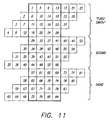
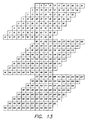
- each swath or group in the diagrams of Figs. 11 through 13 ⁇ discussed in earlier sections of this document ⁇ can be represented graphically this way: and successive swaths:
- this latter drawing convention emphasizes the geometrical relations within the true image data (between the vertical bars), whose integrity is preserved graphically by maintaining the edge bars vertical and one above another.
- error-diffusion relations appear true to form ⁇ particularly in that the pixels into which error distributions are made appear to be adjacent or contiguous.
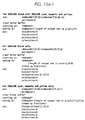
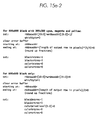
- Figs. 18a-c is more satisfying for a designer who must think in terms of filling the data array in the skew block. That person may have no particular interest in the processes of the error-diffusion block, or in contiguousness of pixels within the image data per se , and will find any representation artificial that fails to represent the overall data array as having vertical edges. These differences of viewpoint are mentioned as they can impede communication about the invention.
- bitpacker or "BitPack” block services more than only the error-diffusion block. It packs any of the supported data formats into sixteen-bit so-called “short words” and performs the DMA operations to place them into an output buffer.
- bitpacker has two independent output-DMA channels ⁇ one dedicated to black data and the other to color. Each channel is fed by a set of sixteen-bit shift registers which pack the incoming data, and each has four shift registers per colorant (four total for black, twelve for color) feeding out to its dedicated DMA.
- bitpacker has (Fig. 20) several control registers to configure resolution and to set up the block to select the valid pixels.
- the control registers can be programed in a multitude of configurations, some of which (Fig. 21) are valid and some of which are not.
- each shift register is dedicated exclusively to a single row of a single channel.
- the data packing for one-, two-, four- or eight-bit modes is accomplished by shifting the most-significant bit(s) from the input into the shift register (Fig. 22). Once a shift register is filled, it is transfered to the black or color DMA for transfer to the DRAM.
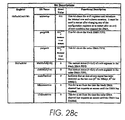
- the several control registers serve to bitmap (Fig. 28) various functional settings and addresses needed in the bitpacker.
Landscapes
- Engineering & Computer Science (AREA)
- Multimedia (AREA)
- Signal Processing (AREA)
- Facsimile Image Signal Circuits (AREA)
- Image Processing (AREA)
Claims (12)
- Ein System zur Fehlerdiffusion von Bilddaten (21), die Pixel (11-15, 111-119) in mehreren Reihen (10) aufweisen, wobei das System folgende Merkmale aufweist:eine Berechnungsschaltungsanordnung (erdif) zum Verarbeiten (Fig. 4, 5) der Bilddaten durch Fehlerdiffusionsprozeduren, um Druckentscheidungsdaten zu erzeugen; undeine Einrichtung zum Auferlegen einer Sequenz (122), die im wesentlichen diagonal bezüglich der Reihen ist, auf das Verarbeiten der Pixel in den Bilddaten.
- Das System gemäß Anspruch 1, bei dem:die Berechnungsschaltungsanordnung eine Einrichtung zum Durchführen der Endverteilung des Fehlers in ein Pixel zu einem Zeitpunkt, zu dem dieses Pixel das vorhergehende Pixel in der Sequenz (122) ist, aufweist; unddie Sequenzauferlegungseinrichtung ferner eine Einrichtung zum Durchführen der Endverteilung des Fehlers in ein Pixel zu einem Zeitpunkt, zu dem dieses Pixel das "nächste Pixel" (116) ist, wenn dieses Pixel in der ersten Reihe einer Gruppe von Reihen (110) ist, die gemeinsam verarbeitet werden, aufweist.
- Das System gemäß Anspruch 1, bei dem:die Sequenzauferlegungseinrichtung eine Einrichtung zum Auferlegen einer Verarbeitungssequenz, die im wesentlichen um 45° schräg verlaufend (122) bezüglich der Reihen ist, aufweist.
- Das System gemäß Anspruch 1, bei dem:die Sequenzauferlegungseinrichtung eine Einrichtung (skew) zum Vorverarbeiten von zumindest Teilen (120, 120', 120'') einer Gruppe mehrerer Reihen (110) der Daten durch Einführen einer schräg verlaufenden Struktur in zumindest Teile mehrerer Reihen von Daten aufweist; unddie Berechnungsschaltungsanordnung (erdif) und die Vorverarbeitungseinrichtung (skew) kooperieren, um den Fehler (Fig. 10) von jedem Pixel in mehrere Richtungen im wesentlichen gemäß Standardregeln zur Floyd-Steinberg-Fehlerdiffusion, nämlich 7/16 für das nächste Pixel, 1/16 für das rechte Pixel, 5/16 für das mittlere Pixel und 3/16 für das linke Pixel, jedoch innerhalb der schräg verlaufenden Datenstruktur, zu verteilen.
- Das System gemäß Anspruch 4, bei dem:die Vorverarbeitungseinrichtung (skew) auch Scheinpixel (2-4, 7, 8, 12, 17, 21, 22, 25-27, usw. in Fig. 11) einsetzt, um Fehlerverteilungen von den Bilddatenpixeln (1, 5, 6, 9-11, 13-16, 18-20, 23, 24, 28, usw. in Fig. 11) zu empfangen; unddie Berechnungsschaltungsanordnung eine Einrichtung (erdif) zum gemeinsamen Verarbeiten der Bilddaten und Scheinpixel durch Fehlerdiffusionsprozeduren (Fig. 5), um Druckentscheidungsdaten zu erzeugen, aufweist; unddie Berechnungsschaltungsanordnung und die Vorverarbeitungseinrichtung kooperieren, um den Fehler von jedem Pixel in vier Richtungen gemäß Standardregeln zur Fehlerdiffusion zu verteilen, jedoch, als ob die Bilddaten und Scheinpixel gemeinsam eine parallelogrammförmige Datenstruktur (1-4-25-28 in Fig. 11) bilden würden, wobei sich die Scheinpixel an beiden Seiten der Datenpixel nach außen erstrecken.
- Das System gemäß Anspruch 1, bei dem:die Sequenzauferlegungseinrichtung eine Einrichtung (skew) zum Vorverarbeiten von zumindest Teilen einer Gruppe (110) mehrerer Reihen der Daten durch Auffüllen zumindest dieser Teile mehrerer Reihen von Daten mit Scheinpixeln (2-4, 7, 8, 12, 17, 21, 22, 25-27, usw. in Fig. 11), um Fehlerverteilungen von den Bilddatenpixeln (1, 5, 6, 9-11, 13-16, 18-20, 23, 24, 28, usw. in Fig. 11) zu empfangen, aufweist; unddie Berechnungsschaltungsanordnung eine Einrichtung (erdif) zur gemeinsamen Verarbeitung der aufgefüllten Daten und Scheinpixel durch Fehlerdiffusionsprozeduren, um Druckentscheidungsdaten zu erzeugen, aufweist.
- Das System gemäß einem der Ansprüche 1 bis 6, bei dem:die Berechnungsschaltungsanordnung eine Einrichtung zum mehrmaligen Wiederholen einer Unterroutine (Fig. 5) für die Querverarbeitungssequenz aufweist, wobei vorzugsweise eine jeweilige Wiederholung der Unterroutine jedem Querarbeitsgang (122) über eine Gruppe (110) der Reihen zugeordnet ist;für das erste Pixel (29, 33, 37, 41, 45, 49, 50, usw. in Fig. 11) an dem Anfang jeder Unterroutinenwiederholung, das in der oberen Reihe einer Gruppe ("zweite" in Fig. 11) der Reihen ist, die Berechnungsschaltungsanordnung den Fehler von einem relativ langfristigen Speicher (Fehlerpuffer) wiedergewinnt;für das letzte Pixel (32, 36, 40, 44, 48, 52, 56) an dem Ende jeder Unterroutinenwiederholung, das in der unteren Reihe einer Gruppe ("zweite") der Reihen ist, die Berechnungsschaltungsanordnung den Fehler in einen relativ langfristigen Speicher (Fehlerpuffer) ablegt; undfür Zwischenpixel (30, 31, 34, 35, 38, 39, 42, 43, 46, 47, 50, 51, 54, 55) zwischen dem ersten und dem letzten Pixel entlang jeder Unterroutinenwiederholung die Berechnungsschaltungsanordnung den Fehler nicht von einem relativ langfristigen Speicher wiedergewinnt oder in diesem ablegt.
- Das System gemäß Anspruch 6, bei dem:die Vorverarbeitungseinrichtung ferner eine Einrichtung (skew) zum internen Auffüllen (Fig. 12, 13) der Daten in zumindest einer Richtung bezüglich der Bildreihen mit zumindest einer Duplizierung von im wesentlichen jedem Pixelwert aufweist; unddie Berechnungsschaltungsanordnung eine Einrichtung zum Ausdrücken der Druckentscheidungsdaten mit einer Auflösung, die den Daten als intern aufgefüllt entspricht, aufweist.
- Das System gemäß einem der Ansprüche 4 bis 8, das ferner folgende Merkmale aufweist:wobei die Datenempfangseinrichtung, die Vorverarbeitungseinrichtung und die Berechnungsschaltungsanordnung Teile einer integrierten Schaltung (Fig. 29 ausschließlich der Puffer) sind, und wobei die Eingangsdatenspeicherungseinrichtung außerhalb der integrierten Schaltung ist.eine Eingangsdatenspeicherungseinrichtung (Puffer R, G, B, L, H, C) zum Empfangen und Halten eines Arrays mehrerer Reihen von Daten, die einem erwunschten Bild entsprechen; undeine Datenempfangseinrichtung, die der Vorverarbeitungseinrichtung (skew) zugeordnet ist, zum Empfangen von zumindest Teilen mehrerer Reihen von Daten zu einem Zeitpunkt zur Verwendung durch die Vorverarbeitungseinrichtung von der Eingangsdatenspeicherungseinrichtung; und
- Das System gemäß Anspruch 1, das ferner folgende Merkmale aufweist:ein verwandtes Gerät (Fig. 30, 31) zur Verwendung beim Drucken eines Bildes, das durch die Bilddaten dargestellt ist; undeine andere Berechnungseinrichtung (Fig. 29 ausschließlich der Puffer, skew und erdif) zum Operieren bei den Bilddaten und zum Steuern des verwandten Geräts; und wobei:die Datenempfangseinrichtung Speichervorrichtungen aufweist, deren effektive Geschwindigkeit relativ schnell ist; unddie Eingangsdatenspeicherungseinrichtung Speichervorrichtungen (Puffer) aufweist, deren effektive Geschwindigkeit relativ niedrig ist, und wobei der Zugriff auf dieselbe gemeinschaftlich mit der anderen Berechnungseinrichtung geteilt wird.
- Das System gemäß Anspruch 1:wobei die Berechnungsschaltungsanordnung ferner eine Fehlerempfangseinrichtung zum Empfangen des akkumulierten Fehlers von der Speichereinrichtung des vorhergehenden Fehlers aufweist.das ferner eine Speichereinrichtung des vorhergehenden Fehlers (Fehlerpuffer) zum Halten des Fehlers, der aus vorher verarbeiteten Daten akkumuliert ist, aufweist;
- Ein Verfahren zur Fehlerdiffusion und zum Drucken von Bilddaten (21) auf ein Druckmedium unter Verwendung digitaler elektronischer Komponenten, die eine Eingangsdatenspeicherungseinrichtung (Puffer R, G, B, L, H, C), einen Speicher für einen vorhergehenden Fehler (Speicherpuffer) und eine elektronische Berechnungsschaltungsanordnung (erdif), die interne Speicherungsregister aufweist, umfassen, und unter Verwendung einer Druckerstufe, die ein Bild durch einen Aufbau aus einzelnen Markierungen druckt, die in Pixel-Spalteund-Reihe-Arrays gebildet sind, wobei das Verfahren folgende Schritte aufweist:Empfangen eines Arrays (21) mehrerer Reihen von Daten, die einem erwünschten Bild entsprechen, in der Eingangsdatenspeicherungseinrichtung;Halten eines Fehlers, der aus vorher verarbeiteten Reihen der Daten akkumuliert ist (Fig. 10), in dem Speicher für den vorhergehenden Fehler;Übertragen eines Satzes (110) von Reihen der Bilddaten zu einem Zeitpunkt von der Eingangsdatenspeicherungseinrichtung in die internen Speicherregister;für jeden Satz von Reihen, Auffüllen von Daten mit Scheinpixeln in die Reihen, um eine diagonale Datenstruktur bezüglich der Reihen (1-4-25-28, 29-32-53-56, 57-60-81-84 in Fig. 11) zu bilden;Übertragen des akkumulierten Fehlers für Pixel, die gegenwärtig verarbeitet werden, von dem Speicher für den vorhergehenden Fehler in die internen Speicherungsregister;Kombinieren des Satzes von Reihen von Daten und des akkumulierten Fehlers durch Fehlerdiffusionsprozeduren (Fig. 5), um Druckentscheidungsdaten und neue Fehlerinformationen zu erzeugen, wobei der Kombinierungsschritt ein Verteilen (Fig. 4) des Fehlers von jedem Pixel in zumindest vier Richtungen in dem Satz von Reihen von Daten aufweist;Übertragen der neuen Fehlerinformationen in den Speicher für den vorhergehenden Fehler (Fehlerpuffer);Speichern von Fehlerinformationen, die von Reihen der Daten akkumuliert sind, die gegenwärtig verarbeitet werden, in dem Speicher für den vorhergehenden Fehler; undAnwenden der Druckentscheidungsdaten, um eine fehlerdiffundierte Version des erwünschten Bildes zu drucken.
Applications Claiming Priority (2)
| Application Number | Priority Date | Filing Date | Title |
|---|---|---|---|
| US789859 | 1997-01-28 | ||
| US08/789,859 US5974228A (en) | 1997-01-28 | 1997-01-28 | Image rendition by plural-row error diffusion, for faster operation and smaller integrated circuits |
Publications (3)
| Publication Number | Publication Date |
|---|---|
| EP0855831A2 EP0855831A2 (de) | 1998-07-29 |
| EP0855831A3 EP0855831A3 (de) | 1999-01-27 |
| EP0855831B1 true EP0855831B1 (de) | 2002-07-17 |
Family
ID=25148876
Family Applications (1)
| Application Number | Title | Priority Date | Filing Date |
|---|---|---|---|
| EP98300616A Expired - Lifetime EP0855831B1 (de) | 1997-01-28 | 1998-01-28 | Bildwiedergabe mittels mehrzeiliger Fehlerdiffusion mit diagonaler Sequenz für schnellere Wirkung und kleinere integrierte Schaltungen |
Country Status (4)
| Country | Link |
|---|---|
| US (1) | US5974228A (de) |
| EP (1) | EP0855831B1 (de) |
| JP (1) | JPH10224627A (de) |
| DE (1) | DE69806520T2 (de) |
Families Citing this family (36)
| Publication number | Priority date | Publication date | Assignee | Title |
|---|---|---|---|---|
| KR100275690B1 (ko) * | 1997-12-29 | 2000-12-15 | 윤종용 | 마스크를 이용한 영상처리장치 |
| US6307978B1 (en) * | 1998-06-03 | 2001-10-23 | Wellesley College | System and method for parallel error diffusion dithering |
| US6154567A (en) * | 1998-07-01 | 2000-11-28 | Cognex Corporation | Pattern similarity metric for image search, registration, and comparison |
| JP3748172B2 (ja) * | 1998-12-09 | 2006-02-22 | 富士通株式会社 | 画像処理装置 |
| US6325487B1 (en) * | 1999-06-30 | 2001-12-04 | Xerox Corporation | Systems and methods for generating high addressability images |
| US6870645B1 (en) | 2000-10-03 | 2005-03-22 | Hewlett-Packard Development Company, L.P. | Plane dependent matrix based halftoning |
| JP3661624B2 (ja) * | 2000-10-06 | 2005-06-15 | セイコーエプソン株式会社 | 画像処理装置 |
| US6967753B2 (en) * | 2001-07-31 | 2005-11-22 | Hewlett-Packard Development Company, L.P. | Plane dependent compression |
| US7355747B2 (en) * | 2002-01-18 | 2008-04-08 | Hewlett-Packard Development Company, L.P. | System for improving the speed of data processing |
| US7233963B2 (en) * | 2002-03-20 | 2007-06-19 | Microsoft Corporation | Systems and methods for diffusing clipping error |
| JP4272843B2 (ja) * | 2002-04-25 | 2009-06-03 | キヤノン株式会社 | 画像処理装置及び画像処理方法 |
| KR100508936B1 (ko) * | 2003-08-12 | 2005-08-17 | 삼성에스디아이 주식회사 | 고속 동작이 가능한 오차 확산 방법 및 그 방법을 이용한플라즈마 디스플레이 패널 구동 장치 |
| US7450270B2 (en) * | 2004-01-16 | 2008-11-11 | Hewlett-Packard Development Company, L.P. | Image data processing methods, hard imaging devices, and articles of manufacture |
| US20060087527A1 (en) * | 2004-10-27 | 2006-04-27 | De Pena Alejandro M | Method for preparing a print mask |
| US7452046B2 (en) * | 2004-10-27 | 2008-11-18 | Hewlett-Packard Development Company, L.P. | Method for preparing a print mask |
| JP2006146672A (ja) | 2004-11-22 | 2006-06-08 | Toshiba Corp | データ処理装置及びデータ処理方法 |
| US7639887B2 (en) | 2004-12-14 | 2009-12-29 | Intel Corporation | Error diffusion-based image processing |
| US7486834B2 (en) * | 2005-01-18 | 2009-02-03 | Lexmark International, Inc. | System and method for dynamically shifting error diffusion data |
| CN1326384C (zh) * | 2005-04-07 | 2007-07-11 | 北京北大方正电子有限公司 | 一种产生调频网点的方法和装置 |
| US7480078B2 (en) * | 2005-04-28 | 2009-01-20 | Xerox Corporation | Method and system for performing multi-pixel parallel error diffusion enabling high-speed diffusion processing without increasing the system clock rate |
| US7440140B2 (en) * | 2005-04-29 | 2008-10-21 | Hewlett-Packard Development Company, L.P. | Sequential color error diffusion with forward and backward exchange of information between color planes |
| JP4501796B2 (ja) * | 2005-06-30 | 2010-07-14 | ブラザー工業株式会社 | 画像処理装置 |
| CN100435548C (zh) * | 2006-09-15 | 2008-11-19 | 北京大学 | 一种能够同时产生多位调频网点的方法及装置 |
| JP4577366B2 (ja) * | 2008-01-28 | 2010-11-10 | セイコーエプソン株式会社 | 複数のラスタを並行して処理する画像処理装置 |
| JP5222797B2 (ja) * | 2009-06-08 | 2013-06-26 | 京セラドキュメントソリューションズ株式会社 | 画像処理装置 |
| KR101328793B1 (ko) * | 2009-11-23 | 2013-11-13 | 엘지디스플레이 주식회사 | 오차 확산 방법과 이를 이용한 액정표시장치 |
| JP5600517B2 (ja) * | 2010-08-18 | 2014-10-01 | キヤノン株式会社 | 情報処理装置、情報処理方法、およびプログラム |
| JP5612965B2 (ja) * | 2010-08-25 | 2014-10-22 | キヤノン株式会社 | 画像処理装置及び画像処理方法 |
| CN103568607B (zh) * | 2012-07-20 | 2017-04-26 | 精工爱普生株式会社 | 印刷系统 |
| US9507321B2 (en) * | 2013-09-17 | 2016-11-29 | City University Of Hong Kong | Converting complex holograms to phase holograms |
| US9541899B2 (en) | 2013-11-11 | 2017-01-10 | City University Of Hong Kong | Fast generation of pure phase digital holograms |
| US9007659B1 (en) * | 2013-12-16 | 2015-04-14 | Xerox Corporation | Re-ordered error diffusion for fast implementation |
| US9823623B2 (en) | 2014-03-27 | 2017-11-21 | City University Of Hong Kong | Conversion of complex holograms to phase holograms |
| JP5714156B2 (ja) * | 2014-04-17 | 2015-05-07 | キヤノン株式会社 | 画像処理装置および画像処理方法 |
| US9773128B2 (en) | 2014-10-16 | 2017-09-26 | City University Of Hong Kong | Holographic encryption of multi-dimensional images |
| US9798290B2 (en) | 2015-09-25 | 2017-10-24 | City University Of Hong Kong | Holographic encryption of multi-dimensional images and decryption of encrypted multi-dimensional images |
Family Cites Families (6)
| Publication number | Priority date | Publication date | Assignee | Title |
|---|---|---|---|---|
| EP0512578B1 (de) * | 1986-12-19 | 1996-11-20 | Matsushita Electric Industrial Co., Ltd. | Gerät zur Verarbeitung von Signalen für die Anzeige von Bildern mit zwei Pegeln |
| US5121447A (en) * | 1989-04-27 | 1992-06-09 | Canon Kabushiki Kaisha | Apparatus for performing gradation processing on image data |
| DE69129818T2 (de) * | 1990-03-27 | 1998-12-10 | Canon K.K., Tokio/Tokyo | Farbbildkommunikationsgerät und Methode |
| US5271070A (en) * | 1992-11-06 | 1993-12-14 | Xerox Corporation | Multi-dimensional error diffusion technique |
| US5553165A (en) * | 1993-01-11 | 1996-09-03 | Canon, Inc. | Parallel error diffusion method and apparatus |
| NL9300684A (nl) * | 1993-04-22 | 1994-11-16 | Oce Nederland Bv | Werkwijze voor het halftonen van gedigitaliseerde grijswaardebeelden en beeldbewerkingsinrichting geschikt voor het uitvoeren van een dergelijke werkwijze. |
-
1997
- 1997-01-28 US US08/789,859 patent/US5974228A/en not_active Expired - Lifetime
-
1998
- 1998-01-23 JP JP10011584A patent/JPH10224627A/ja active Pending
- 1998-01-28 EP EP98300616A patent/EP0855831B1/de not_active Expired - Lifetime
- 1998-01-28 DE DE69806520T patent/DE69806520T2/de not_active Expired - Lifetime
Also Published As
| Publication number | Publication date |
|---|---|
| JPH10224627A (ja) | 1998-08-21 |
| EP0855831A2 (de) | 1998-07-29 |
| US5974228A (en) | 1999-10-26 |
| EP0855831A3 (de) | 1999-01-27 |
| DE69806520T2 (de) | 2002-10-31 |
| DE69806520D1 (de) | 2002-08-22 |
Similar Documents
| Publication | Publication Date | Title |
|---|---|---|
| US5974228A (en) | Image rendition by plural-row error diffusion, for faster operation and smaller integrated circuits | |
| KR960007261B1 (ko) | 주사된 영상 정보를 프린트된 매체 출력으로 변환하는 방법 및 시스템, 주사된 영상 정보를 프린트된 매체 하드카피 출력으로 변환하는 방법 및 시스템, 영상 재생용 순차 디더 방법 및 시스템 | |
| EP0474985B1 (de) | Verfahren und System zum Drucken in eine oder mehrere Farbflächen mit verbesserter Fehlerdiffusionssteuerung | |
| US5931960A (en) | Method and apparatus for handling error diffusion values | |
| US6068361A (en) | Method and apparatus for multiple drop error diffusion in a liquid ink printer | |
| US5627659A (en) | Image processing system capable of selecting from among a plurality of error diffusion matrices | |
| EP1267565B1 (de) | Verfahren für mehrschichtiges Drucken von digitalen Bildern bei Verwendung von reduzierten Farbstoffmengen | |
| JP2009166474A (ja) | 画像処理装置、画像形成装置および画像処理方法 | |
| US8947735B2 (en) | Image processing apparatus and image processing method for performing error diffusion processing for each region of an image | |
| US7889394B2 (en) | Image processing apparatus and method | |
| US6977756B2 (en) | Error diffusion processing device | |
| EP1437678B1 (de) | Kolorimetrisches Verfahren zur Reduktion des Tintenverbrauchs für Drucker | |
| JPH04219073A (ja) | 画像記録装置 | |
| US8098403B2 (en) | Color error diffusion with error signal offset | |
| US20040085553A1 (en) | Multitoning a digital image having at least one group of similar colors channels | |
| US7627188B2 (en) | Error diffusion method and hardware architecture | |
| US7565027B2 (en) | Countdown stamp error diffusion | |
| US6819453B1 (en) | Image processing apparatus | |
| JP4838769B2 (ja) | 画像処理装置および画像処理方法、並びに、インクジェット記録装置 | |
| JPH11221933A (ja) | インクジェット記録方法および装置 | |
| US7480078B2 (en) | Method and system for performing multi-pixel parallel error diffusion enabling high-speed diffusion processing without increasing the system clock rate | |
| US7564589B2 (en) | Color error diffusion with error signal offsets | |
| JP2954317B2 (ja) | 画像処理装置 | |
| Kim et al. | Efficient hardware structure for various binarization algorithms | |
| JPS61107873A (ja) | カラ−中間調画像処理方法 |
Legal Events
| Date | Code | Title | Description |
|---|---|---|---|
| PUAI | Public reference made under article 153(3) epc to a published international application that has entered the european phase |
Free format text: ORIGINAL CODE: 0009012 |
|
| AK | Designated contracting states |
Kind code of ref document: A2 Designated state(s): DE FR GB |
|
| AX | Request for extension of the european patent |
Free format text: AL;LT;LV;MK;RO;SI |
|
| PUAL | Search report despatched |
Free format text: ORIGINAL CODE: 0009013 |
|
| AK | Designated contracting states |
Kind code of ref document: A3 Designated state(s): AT BE CH DE DK ES FI FR GB GR IE IT LI LU MC NL PT SE |
|
| AX | Request for extension of the european patent |
Free format text: AL;LT;LV;MK;RO;SI |
|
| 17P | Request for examination filed |
Effective date: 19990329 |
|
| AKX | Designation fees paid |
Free format text: DE FR GB |
|
| 17Q | First examination report despatched |
Effective date: 20000703 |
|
| RAP1 | Party data changed (applicant data changed or rights of an application transferred) |
Owner name: HEWLETT-PACKARD COMPANY, A DELAWARE CORPORATION |
|
| RTI1 | Title (correction) |
Free format text: IMAGE RENDITION BY PLURAL-ROW ERROR DIFFUSION USING A DIAGONAL SEQUENCE FOR FASTER OPERATION AND SMALLER INTEGRATED CIRCUITS |
|
| RTI1 | Title (correction) |
Free format text: IMAGE RENDITION BY PLURAL-ROW ERROR DIFFUSION USING A DIAGONAL SEQUENCE FOR FASTER OPERATION AND SMALLER INTEGRATED CIRCUITS |
|
| GRAG | Despatch of communication of intention to grant |
Free format text: ORIGINAL CODE: EPIDOS AGRA |
|
| GRAG | Despatch of communication of intention to grant |
Free format text: ORIGINAL CODE: EPIDOS AGRA |
|
| GRAH | Despatch of communication of intention to grant a patent |
Free format text: ORIGINAL CODE: EPIDOS IGRA |
|
| GRAH | Despatch of communication of intention to grant a patent |
Free format text: ORIGINAL CODE: EPIDOS IGRA |
|
| GRAA | (expected) grant |
Free format text: ORIGINAL CODE: 0009210 |
|
| AK | Designated contracting states |
Kind code of ref document: B1 Designated state(s): DE FR GB |
|
| REG | Reference to a national code |
Ref country code: GB Ref legal event code: FG4D |
|
| REF | Corresponds to: |
Ref document number: 69806520 Country of ref document: DE Date of ref document: 20020822 |
|
| ET | Fr: translation filed | ||
| PLBE | No opposition filed within time limit |
Free format text: ORIGINAL CODE: 0009261 |
|
| STAA | Information on the status of an ep patent application or granted ep patent |
Free format text: STATUS: NO OPPOSITION FILED WITHIN TIME LIMIT |
|
| 26N | No opposition filed |
Effective date: 20030422 |
|
| PGFP | Annual fee paid to national office [announced via postgrant information from national office to epo] |
Ref country code: FR Payment date: 20070207 Year of fee payment: 10 |
|
| PGFP | Annual fee paid to national office [announced via postgrant information from national office to epo] |
Ref country code: GB Payment date: 20080129 Year of fee payment: 11 |
|
| REG | Reference to a national code |
Ref country code: FR Ref legal event code: ST Effective date: 20081029 |
|
| PG25 | Lapsed in a contracting state [announced via postgrant information from national office to epo] |
Ref country code: FR Free format text: LAPSE BECAUSE OF NON-PAYMENT OF DUE FEES Effective date: 20080131 |
|
| GBPC | Gb: european patent ceased through non-payment of renewal fee |
Effective date: 20090128 |
|
| PG25 | Lapsed in a contracting state [announced via postgrant information from national office to epo] |
Ref country code: GB Free format text: LAPSE BECAUSE OF NON-PAYMENT OF DUE FEES Effective date: 20090128 |
|
| PGFP | Annual fee paid to national office [announced via postgrant information from national office to epo] |
Ref country code: DE Payment date: 20120127 Year of fee payment: 15 |
|
| PG25 | Lapsed in a contracting state [announced via postgrant information from national office to epo] |
Ref country code: DE Free format text: LAPSE BECAUSE OF NON-PAYMENT OF DUE FEES Effective date: 20130801 |
|
| REG | Reference to a national code |
Ref country code: DE Ref legal event code: R119 Ref document number: 69806520 Country of ref document: DE Effective date: 20130801 |