EP0856482B1 - Automatisierte Einheit zum Ausrichten von ungeordnet zugeführten Gegenständen - Google Patents
Automatisierte Einheit zum Ausrichten von ungeordnet zugeführten Gegenständen Download PDFInfo
- Publication number
- EP0856482B1 EP0856482B1 EP98500026A EP98500026A EP0856482B1 EP 0856482 B1 EP0856482 B1 EP 0856482B1 EP 98500026 A EP98500026 A EP 98500026A EP 98500026 A EP98500026 A EP 98500026A EP 0856482 B1 EP0856482 B1 EP 0856482B1
- Authority
- EP
- European Patent Office
- Prior art keywords
- containers
- compartment
- automatic machine
- planes
- hopper
- Prior art date
- Legal status (The legal status is an assumption and is not a legal conclusion. Google has not performed a legal analysis and makes no representation as to the accuracy of the status listed.)
- Expired - Lifetime
Links
- 230000002093 peripheral effect Effects 0.000 claims description 13
- 238000012546 transfer Methods 0.000 claims description 8
- 230000005294 ferromagnetic effect Effects 0.000 claims description 2
- 238000000034 method Methods 0.000 description 4
- 230000000284 resting effect Effects 0.000 description 3
- 230000005540 biological transmission Effects 0.000 description 2
- 238000007796 conventional method Methods 0.000 description 2
- 238000012800 visualization Methods 0.000 description 2
- 238000001514 detection method Methods 0.000 description 1
- 230000000694 effects Effects 0.000 description 1
- 230000003287 optical effect Effects 0.000 description 1
- 238000012545 processing Methods 0.000 description 1
- 239000007787 solid Substances 0.000 description 1
- 238000003756 stirring Methods 0.000 description 1
Images


Classifications
-
- B—PERFORMING OPERATIONS; TRANSPORTING
- B65—CONVEYING; PACKING; STORING; HANDLING THIN OR FILAMENTARY MATERIAL
- B65G—TRANSPORT OR STORAGE DEVICES, e.g. CONVEYORS FOR LOADING OR TIPPING, SHOP CONVEYOR SYSTEMS OR PNEUMATIC TUBE CONVEYORS
- B65G47/00—Article or material-handling devices associated with conveyors; Methods employing such devices
- B65G47/02—Devices for feeding articles or materials to conveyors
- B65G47/04—Devices for feeding articles or materials to conveyors for feeding articles
- B65G47/12—Devices for feeding articles or materials to conveyors for feeding articles from disorderly-arranged article piles or from loose assemblages of articles
- B65G47/14—Devices for feeding articles or materials to conveyors for feeding articles from disorderly-arranged article piles or from loose assemblages of articles arranging or orientating the articles by mechanical or pneumatic means during feeding
- B65G47/1407—Devices for feeding articles or materials to conveyors for feeding articles from disorderly-arranged article piles or from loose assemblages of articles arranging or orientating the articles by mechanical or pneumatic means during feeding the articles being fed from a container, e.g. a bowl
- B65G47/1442—Devices for feeding articles or materials to conveyors for feeding articles from disorderly-arranged article piles or from loose assemblages of articles arranging or orientating the articles by mechanical or pneumatic means during feeding the articles being fed from a container, e.g. a bowl by means of movement of the bottom or a part of the wall of the container
- B65G47/1457—Rotating movement in the plane of the rotating part
-
- B—PERFORMING OPERATIONS; TRANSPORTING
- B65—CONVEYING; PACKING; STORING; HANDLING THIN OR FILAMENTARY MATERIAL
- B65G—TRANSPORT OR STORAGE DEVICES, e.g. CONVEYORS FOR LOADING OR TIPPING, SHOP CONVEYOR SYSTEMS OR PNEUMATIC TUBE CONVEYORS
- B65G2201/00—Indexing codes relating to handling devices, e.g. conveyors, characterised by the type of product or load being conveyed or handled
- B65G2201/02—Articles
- B65G2201/0235—Containers
- B65G2201/0244—Bottles
Definitions
- the present invention concerns an automated unit for the unscrambling and lined up delivery of articles which is specially applicable to the upright positioning of empty containers or lightweight objects of various configurations and is apt to continuously feed a filling station or the like.
- the unit in question comprises an upperly open hopper which is apt to receive the containers in bulk and has a flat bottom that is a preferably moving member in order to thus shake or stir the containers and has a peripheral edge that is spaced apart from the lateral wall of said hopper and determines a gap through which the containers can pass, comprising a plurality of compartments travelling along a closed circuit below said peripheral edge, and each allowing to receive in a lying position a single container to be oriented, and having an open bottom through which the containers can pass, there being besides a discharge chute associated to each of said compartments and travelling together with them so as to thus receive said containers that are thus oriented as they fall, and for an ulterior transfer of said containers in a lined up arrangement onto an out feed conveyor.
- a unit of this kind is known from the European patent EP-A-0578602, issued to the applicant, wherein a principle is used for the upright positioning of the containers which is known from the US-A-3 295 659 and is based on a circling of the containers arranged in a lying position inside peripheral cavities in such a way that the container body is supported by a stationary annular shelf interposed between the open bottom of said compartments and said discharge chutes, the neck of the container being held by holding members provided next to the bottom of said moving compartments.
- the orientation in an upright position is achieved by means of providing an interruption in said stationary annular shelf supporting the container body, this determining the falling of the container into the corresponding discharge chute with its bottom first since regardless of the position of the container in the compartment its neck or upper filling part is being held by said holding members.
- This orientation system presents nevertheless the drawback that at the beginning of the positioning there is always a critical transfer from a stationary support, i.e. the above-mentioned annular shelf, into a moving part, i.e. the aforesaid discharge chutes, with the risk that during said transfer and due to the light weight of the containers, to the possible irregularities of the latter, etc. jams might possibly occur, with the consequent damage to the containers and undesired shutdowns of the unit.
- a second drawback related to the precited upright positioning technique derives from the limitation imposed by said structure since it needs a specific area where the positioning of the containers has to take place as they fall, this having to occur at a point sufficiently distant from the loading area, which in some units has required to split the falling process in two parts in order to give the containers the time needed for them to reach the bottom of the discharge chutes to thereupon be driven on a stationary flor up to an out feed conveyor; see for example patent US-A-3 650 368 and US-A-4 130 194, this latter comprising peripheral cavities to hold the containers.
- an automated positioning of said supporting element has been provided by means of using means for recognizing the previous position adopted by the containers inside said peripheral cavities, said elements being actuated as dictated by said previous position as per a conventional technique used in the field of the conveying and storing of goods and described, for example, in the publications of prior art: ES-A-8203775, ES-8205702 and EP-A-0242214, for similar applications.
- the present invention seeks to obviate the aforementioned drawbacks, and for such a purpose an upright positioning/orienting system has been provided which has a different conception and consists in employing compartments for example like those of patent EP-A-0 578 602 or even simpler which have been provided with a member for temporarily holding the containers, in such a way that once having the containers been received in said compartments said holding member is tilted at a given point in time in order to thus directly drop the containers into the discharge chutes as per the desired orientation.
- the aforementioned stationary annular shelf has been hence omitted, and the containers are now transferred from a moving element, i.e. the compartment (where they are being temporarily held by the aforesaid holding member), into another moving element, i.e. the discharge chute situated directly below, into which they fall once having been conveniently oriented.
- a detection of the previous position adopted by the containers in the compartments is made use of by means of an optical visualization device (one or more sensors) and auxiliary circuitry for processing the signal which is apt to generate an opportune control output signal as per a conventional technique used in the field of the conveying or storage of goods as previously cited.
- said temporary holding member consist in a flat forming the bottom of the compartment and rotatable at its central part around a cross shaft, said flat being selectively tiltable to either side as a result of a rotation of said shaft in the proper direction as dictated by the previous position of the article in the compartment.
- first rods linked to said shaft and second rods ending in a lever in its turn ending in a roller travelling inside a main guide-path for example a groove
- means having been provided for switching said roller into either of the intermediary guide-path lengths of different course intercalated in said guide-path, this determining the rotation of a corresponding rod in either direction, said rotation being then transmitted through a gearing to the other rod connected to said shaft.
- said temporary holding member can comprise two planes articulated by one end to the opposite edges of the bottom of a compartment.
- the automated unit for the unscrambling and lined up delivery of articles being proposed of special application to empty containers or other lightweight bodies, hereinafter called “containers", of various configurations, comprises the following basic elements:
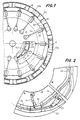
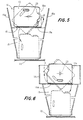
- Figures 5 and 6 illustrate the above-mentioned positioning principle, showing that the upright positioning of a container 12 is achieved, regardless of its previous position in the compartment, by tilting member 18 to either side thus directly dropping said containers from the moving compartment 14 into the corresponding moving discharge chute 15 (elements 14 and 15 are both solid with the set of disks 19, 20 attached to rotary shaft 21 (see Fig. 3) driven by a motor 36 and transmission 37.
- said member 18 for temporarily holding containers 12 consists in a flat 18a forming the bottom of compartment 14 and rotatable at its central part around a cross shaft 23, said flat 18a being selectively tiltable to either side as a result of a rotation of said shaft in the proper direction as dictated by the previous position of container 12 in the compartment.
- compartment 14 are formed by upward extensions 15a, 15b of the flanks of discharge chutes 15, whereas the inner side and bottom of the compartment are respectively formed by the vertical 18b and horizontal 18a flat of an L-shaped plate 18 which at the central part of said vertical flat 18b is connected to said rotary shaft 23, the inner side of the shell, i.e. the extension of wall 10a of hopper 10, delimiting the outer side of said compartment 14.
- each compartment consists of an open-bottom frame 35, and member 18 forming the bottom of the compartment has as well a structure of L-shaped cross-section and through a vertical flange 18b superimposed to one of the inner walls of compartment 14 is attached to said rotary shaft 23 centred with respect to the compartment.
- shaft 23 is connected to a second vertical rod 26 whose lower end is linked to an orthogonal lever 27 ending in a roller 28 that is inserted and guided in a main guide-path 29 which in the exemplified embodiment follows a circular course.
- Means (piston 31 and switch block 30) have been besides provided which are apt to guide said roller 28 into either of the intermediary guide-path lengths 32, 33 of different course intercalated in said main guide-path 29 thus determining a corresponding rotation of said second vertical rod 26 in either direction and hence also the rotation of rod 24 and finally a proportional rotation of shaft 23 attached to said holding flat or member 18.
- said compartments 14 are formed at the periphery of a rotary disk 19 to which brackets 34 are fastened for supporting and guiding said first articulated rods 24 which are connected to shaft 23, said gearings 25 directly connected with said first rods 24 being also fastened to said disk, another rotary disk 20 having been provided at a lower level and carrying guiding elements (for example bearings) for a smooth rotation of said vertical rods 26, this latter disk forming with the former rotary disk 19 a support for discharge chutes 15 ending at the bottom on a stationary annular bottom 22 extending into a central platform 22a on which said main guide-path 29 and intermediary guide-path lengths 32 and 33 are defined.
- intermediary guide-path lengths 32 and 33 impose a reduction of the diameter of main guide-path 29 in the case of the former and an increase of said diameter in the case of the latter, and hence the travel of roller 28 along either of said path lengths 32, 33 as governed by means 31-30 will cause said lever to turn in one or in the opposite direction covering a turning angle of a preset member of degrees, said turning angle being transmitted by gearing 25, this latter increasing an angle covered by said lever 27 and thus transmitting said increased angle to the first articulated rod 24 with an angular width that is large enough to determine a turning motion of member 18 of enough amplitude to drop (see Figs. 5 and 6) container 12 in the properly oriented position into discharge chute 15.
- each compartment receiving articles consists of an open-bottom frame 35 (as the one depictured in Fig. 6), and said member 18 for temporarily holding the articles comprise in this case two planes 41, 42 articulated by one of its edges to opposite ends of the open-bottom frame 35 closing at least in part the passage therethrough, each of said planes 41, 42 being capable to individually pivot and open out while the other remains immobile.
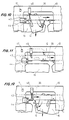
- each of said planes 41, 42 include a corresponding projecting member 41a, 42a having a specific orientation with regard to a detector means 43, 44 (such a proximity detector) which they can face along the travelling of the compartment, said detector being secured to the inner wall (10a) of the hopper 10.
- a detector means 43, 44 such a proximity detector
- the planes 41, 42 in a closing position, laterally protrude from said open bottom in such a way they can receive the thrust of an actuator device 45 (i.e. an electro-pneumatically driven pusher) in order to be open out.
- the retaining means of said planes 41, 42 in a closing position comprises magnet members (which are not visible in the drawings) connected either to said planes 41, 42 or to some parts of the frame 35 which can enter in contact with said planes 41, 42, both of them of ferromagnetic condition.
- return stops 46, 47 have been provided connected to the inner side 10a of the hopper 10 in order to convey to a closing position any one of the planes 41, 42 from its open out position, when the compartment is moving.
- the rear plane 41 considered in the moving direction as the compartment travels, includes an elbowed lever 48 extending its articulation axis, in order to collide with mentioned return stop 46.
Landscapes
- Engineering & Computer Science (AREA)
- Mechanical Engineering (AREA)
- Feeding Of Articles To Conveyors (AREA)
- Filling Or Emptying Of Bunkers, Hoppers, And Tanks (AREA)
- Attitude Control For Articles On Conveyors (AREA)
- Supplying Of Containers To The Packaging Station (AREA)
- Chutes (AREA)
Claims (14)
- Automatisierte Anlage zum Ordnen und Zuführen von Gegenständen in einer Linie, die insbesondere zum senkrechten Aufstellen von leeren Behältern (12) oder Gegenständen geringen Gewichts verschiedener Gestalt geeignet und zum kontinuierlichen Beschicken einer Füllstation oder dgl. einsetzbar ist, mit:dadurch gekennzeichnet, dass die Anlage Mittel (18) zum vorübergehenden Halten der Behälter (12) umfasst, die in das jeweilige Fach (14) eingebracht wurden und durch Betätigung von Antriebsmitteln, die durch ein vom genannten Erkennungsmittel (17) erhaltenen Signal gesteuert werden, selektiv kippbar sind, um auf diese Weise die Behälter (12) in einer geeignet ausgerichteten Stellung in diese Auslaufrutschen (15) fallen zu lassen.einem oben offenen Trichter (10), der das Laden der Behälter (12) in größeren Mengen ermöglicht und einen Boden (11) aufweist, auf dem sich die Behälter regellos ansammeln, wobei dieser Boden (11) eine Außenkante (11a) aufweist, die von einer Innenseitenwand (10a) des Trichters (10) beabstandet ist, wodurch ein Spalt definiert ist, durch den die Behälter (12) passieren können;mehreren benachbarten Fächern (14), die entlang einer geschlossenen Schleife unterhalb dieser Außenkante (11a) des Bodens (11) beweglich sind, wobei jedes dieser Fächer (14) zur losen Aufnahme eines Einzelbehälters (12) in liegender Stellung geeignet ist;einer Abzugsrutsche (15), die unterhalb des jeweiligen Fachs (14) angeordnet ist und zusammen mit letzterem zur Aufnahme der beim Fallen eine bestimmte Stellung einnehmenden Behälter (12) und zum späteren Weiterleiten dieser Behälter (12) in einer Anordnung in einer Linie an ein Abzugsförderband verschiebbar ist; sowieErkennungsmitteln (17) zur Erkennung der von den Behältern (12) in diesen Fächern (14) eingenommenen Lage,
- Automat nach Anspruch 1, dadurch gekennzeichnet, dass das Mittel (18) zum vorübergehenden Halten der Behälter (12) aus einer den Boden des Fachs (14) bildenden Flachplatte (18a) besteht, die selektiv nach beiden Seiten ihres Mittelteils kippbar ist, und zwar aufgrund einer Drehung einer an diese Flachplatte (18a) angeformten Querwelle (23) in der richtigen, von der vorherigen Stellung des Behälters (12) im Fach (14) diktierten, vom Erkennungsmittel (17) angezeigten Richtung.
- Automat nach Anspruch 2, dadurch gekennzeichnet, dass die Endseiten jedes Fachs (14) durch aufwärtige Verlängerungen (15a, 15b) der Flanken der Auslaufrutschen (15) gebildet werden, wohingegen die Innenseite und der Boden des Fachs durch den vertikalen (18b) bzw. horizontalen (18a) Flachabschnitt einer L-förmigen Platte gebildet werden, wobei der Mittelteil des vertikalen Flachabschnitts (18b) mit der Drehwelle (23) und der Innenwand (10a) des Trichters (10) verbunden ist und hierdurch die Außenseite des Fachs (14) begrenzt.
- Automat nach Anspruch 2, dadurch gekennzeichnet, dass jedes Fach aus einem Rahmen mit offenem Boden (35) besteht, wohingegen die Innenseite und der Boden des Fachs durch den vertikalen (18b) bzw. horizontalen Flachabschnitt (18a) einer L-förmigen Platte gebildet werden, wobei der Mittelteil des vertikalen Flachabschnitts (18b) einer der Innenseiten des Fachs (14) überlagert und mit der Drehwelle (23) verbunden ist, die bezüglich des Fachs (14) und der Innenwand (10a) des Trichters (10) zentriert ist und hierdurch die Außenseite des Fachs (14) begrenzt.
- Automat nach Anspruch 2, dadurch gekennzeichnet, dass die Drehwelle (23) über eine erste Gelenkwelle (24) und ein Getriebe (25) mit einer zweiten vertikalen Welle (26) verbunden ist, deren unteres Ende mit einem orthogonalen Hebel (27) verbunden ist, der in einer Rolle (28) endet, die in eine eine geschlossene Schleife bildende Hauptführungsbahn (29) eingesetzt ist und dort geführt wird, und dass Mittel vorgesehen sind, die zum Schalten der Rolle (28) in eine oder die andere der zwei Zwischenführungsbahnlängen (32, 33) mit unterschiedlichem Laufweg geeignet ist, die in diese Hauptführungsbahn (29) eingeschoben sind und dadurch eine entsprechende Drehung der zweiten vertikalen Welle (26) in einer oder der anderen Richtung und somit eine Drehung der Welle (24) und schließlich das Kippen des den Boden des Fachs (14) bildenden Flachabschnitts (18a) um dessen Mittelteil durch Drehung der Welle (23) festlegen.
- Automat nach Anspruch 5, dadurch gekennzeichnet, dass die Fächer (14) an der Peripherie einer ersten Rundscheibe (19) geformt werden, an denen Klammern (34) zum Stützen und Führen der mit der Rundwelle (23) verbundenen ersten Gelenkwellen (24) befestigt sind, wobei das Getriebe (25) direkt mit der ebenfalls an der ersten Scheibe befestigten ersten Gelenkwelle (24) verbunden ist, und eine an die erste Scheibe (19) angeformte zweite Drehscheibe (20), die Führungselemente zum Drehen der vertikalen Wellen (26) trägt, in einer untereren Ebene vorgesehen ist, wobei die letztere Scheibe (20) mit der ersten Scheibe (19) eine Stütze für die Auslaufrutschen (15) bildet, die am Boden an einem stationären ringförmigen Boden (22) endet, der bis zu einer Mittelplattform (22a) verlängert ist, auf der die genannte Hauptführungsbahn (29) und die Zwischenführungsbahnlängen (32, 33) definiert sind.
- Automat nach Anspruch 5, dadurch gekennzeichnet, dass das Getriebe (25) den vom rechtwinkligen Hebel (27) bestrichenen Winkel vergrößert und diese Bewegung auf die erste Gelenkwelle (24) überträgt.
- Automat nach Anspruch 1, dadurch gekennzeichnet, dass der Boden (11) des Trichters (10), auf dem sich die Behälter (12) regellos ansammeln, drehbar ist, um so das Verschieben der Behälter (12) in Richtung einer Randzone dieses Bodens (11a) zu erleichtern.
- Automat nach Anspruch 1, dadurch gekennzeichnet, dass der Boden (11) des Trichters (10) geneigt ist, um so das Verschieben der Behälter in Richtung einer Randzone dieses Bodens (11 a) zu erleichtern.
- Automat nach Anspruch 5, dadurch gekennzeichnet, dass die Hauptführungsbahn (29) ringförmig verläuft und die Zwischenführungsbahnlängen (32, 33) bogenförmige Abschnitte aufweisen, die eine Abnahme der Hauptführungsbahn (29) bzw. deren Zunahme erzwingen.
- Automat nach Anspruch 1, dadurch gekennzeichnet, dass jedes Fach (14) aus einem am Boden offenen Rahmen (35) besteht und das Mittel (18) zum vorübergehenden Halten der Behälter (12) zwei Platten (41, 42) aufweist, die durch eine ihrer Kanten mit gegenüberliegenden Enden dieses offenen Bodens (35) in einer Gelenkverbindung stehen, wodurch der Durchgang zumindest teilweise geschlossen wird, wobei diese Platten (41, 42) jeweils in der Lage sind, sich einzeln zu drehen und zu öffnen, während die andere Platte unbeweglich bleibt.
- Automat nach Anspruch 11, dadurch gekennzeichnet, dass die zwei Platten (41, 42) jeweils ein entsprechendes vorstehendes Glied (41 a, 42a) mit spezifischer Orientierung bezüglich eines Detektionsmittels (43, 44) aufweisen, das an der Innenseitenwand (10a) des Trichters (10) befestigt ist, und dass Mittel zum Halten dieser Platten (41, 42) in einer geschlossenen Stellung vorgesehen sind, wobei diese Platten (41, 42) seitlich von dem offenen Boden so vorstehen, dass sie den Schub eines Stellorgans (45) aufnehmen können, um sich dadurch zu öffnen.
- Automat nach Anspruch 12, dadurch gekennzeichnet, dass das Mittel zum Halten der Gelenkplatten (41, 42) in einer geschlossenen Stellung Magnetelemente aufweist, die entweder mit den Platten oder einem eventuell mit den Platten (41, 42) in Kontakt stehendem Teil des Rahmens (35), die beide ferromagnetisch sind, verbunden sind.
- Automat nach Anspruch 11, dadurch gekennzeichnet, dass Rücklaufsperranschläge (46, 47) vorgesehen sind, die an der Innenseitenwand (10a) des Trichters (10) befestigt sind, um eine oder die andere der geöffneten Klappen (41, 42) in die Schliessstellung zurückzuführen, wenn sich das mit der Rückwand gebildete Fach in der Bewegungsrichtung der Bahn des Fachs bewegt, was dadurch gelingt, dass ein Hebel (48) seinen Drehpunkt verschiebt und dadurch an einen entsprechenden Sperranschlag (46) stößt.
Applications Claiming Priority (4)
| Application Number | Priority Date | Filing Date | Title |
|---|---|---|---|
| ES9700197 | 1997-01-31 | ||
| ES9700197A ES2122926B1 (es) | 1997-01-31 | 1997-01-31 | Maquina automatica para orientacion y alimentacion de articulos. |
| ES9800145 | 1998-01-27 | ||
| ES009800145A ES2150347B1 (es) | 1997-01-31 | 1998-01-27 | Mejoras en el objeto de la patente principal n. 9700197 por : "maquinaautomatica para orientacion y alimentacion de articulos". |
Publications (2)
| Publication Number | Publication Date |
|---|---|
| EP0856482A1 EP0856482A1 (de) | 1998-08-05 |
| EP0856482B1 true EP0856482B1 (de) | 2000-12-06 |
Family
ID=26155031
Family Applications (1)
| Application Number | Title | Priority Date | Filing Date |
|---|---|---|---|
| EP98500026A Expired - Lifetime EP0856482B1 (de) | 1997-01-31 | 1998-01-30 | Automatisierte Einheit zum Ausrichten von ungeordnet zugeführten Gegenständen |
Country Status (11)
| Country | Link |
|---|---|
| US (1) | US6116406A (de) |
| EP (1) | EP0856482B1 (de) |
| JP (1) | JP3926020B2 (de) |
| KR (1) | KR100611926B1 (de) |
| CN (1) | CN1160228C (de) |
| AR (1) | AR011433A1 (de) |
| BR (1) | BR9801198A (de) |
| CA (1) | CA2228329C (de) |
| DE (1) | DE69800416T2 (de) |
| ES (2) | ES2150347B1 (de) |
| TW (1) | TW426627B (de) |
Cited By (1)
| Publication number | Priority date | Publication date | Assignee | Title |
|---|---|---|---|---|
| ES2346387A1 (es) * | 2008-05-16 | 2010-10-14 | Jaime Marti Sala | Maquina para orientar y alinear articulos. |
Families Citing this family (27)
| Publication number | Priority date | Publication date | Assignee | Title |
|---|---|---|---|---|
| ES2150347B1 (es) * | 1997-01-31 | 2001-06-01 | Sala Jaime Marti | Mejoras en el objeto de la patente principal n. 9700197 por : "maquinaautomatica para orientacion y alimentacion de articulos". |
| DE1016601T1 (de) * | 1998-05-21 | 2002-02-07 | Jaime Marti Sala | Bohrmeissel zum beaufschlagen einer formation |
| NO317573B1 (no) * | 1999-07-29 | 2004-11-15 | Repant As | Anordning ved transportinnretning for gjenstander, sa som emballasje i f.eks. glass |
| IT1317139B1 (it) * | 2000-03-08 | 2003-05-27 | Ronchi Mario S R L | Dispositivo per macchine riordinatrici di contenitori dotato di mezziautomatici di orientamento e caduta del contenitore prelevato |
| ITPR20000016A1 (it) | 2000-03-15 | 2001-09-15 | Lino Lanfranchi | Vaschetta di alloggiamento di contenitori provvisti di imboccatura decentrata rispetto ad un asse longitudinale, in particolare in una macch |
| KR100829687B1 (ko) * | 2001-12-21 | 2008-05-16 | 주식회사 포스코 | 리클레이머용 배출슈트 |
| ITPR20030006A1 (it) * | 2003-02-06 | 2004-08-07 | Lanfranchi Srl | Macchina per orientare, raddrizzare ed allineare |
| ES2245163B1 (es) * | 2003-03-04 | 2006-10-01 | Francisco Carrasquer Borda | Sistema de orientacion automatica de envases. |
| ITPR20030101A1 (it) * | 2003-11-13 | 2005-05-14 | Promec Srl | Procedimento ed apparato per orientare e raddrizzare contenitori. |
| CA2455798A1 (en) * | 2004-01-23 | 2005-07-23 | D.I.T. Equipements, Inc. | Apparatus for longitudinally aligning concrete blocks on a conveyor |
| EP2226276A1 (de) * | 2009-03-05 | 2010-09-08 | Bonino S.p.A. | Objektausrichtungsvorrichtung |
| IT1396893B1 (it) * | 2009-11-12 | 2012-12-20 | Lorenzo Forni | Macchina riordinatrice per contenitori e relativo procedimento. |
| EP2404849B1 (de) * | 2010-07-05 | 2013-08-28 | BONINO S.p.A. unico azionista | Objektausrichtungsvorrichtung |
| CN102807061B (zh) * | 2011-05-31 | 2015-06-03 | 苏州琼派瑞特电子科技有限公司 | 一种循环传输装置 |
| JP5672182B2 (ja) * | 2011-07-14 | 2015-02-18 | トヨタ自動車株式会社 | ナット並べ装置 |
| JP5772336B2 (ja) * | 2011-07-20 | 2015-09-02 | トヨタ自動車株式会社 | ワッシャー並べ装置、ワッシャー配置システムおよびワッシャーの配置方法 |
| EP3059188B1 (de) | 2015-02-20 | 2017-04-26 | Jaime Marti Sala | Drehförderer mit Saug- und Steigungsveränderung zum Transport von Behältern |
| ES2645861T3 (es) | 2015-04-10 | 2017-12-11 | Jaime Martí Sala | Aparato para posicionar contenedores |
| CN105600371B (zh) * | 2015-10-30 | 2017-09-15 | 广东溢达纺织有限公司 | 吊粒自动上料输送系统及方法 |
| ITUB20159816A1 (it) * | 2015-12-31 | 2017-07-01 | Erre Enne Soc Cooperativa | Dispositivo di ordinamento e orientamento articoli e metodo |
| IT201600072858A1 (it) * | 2016-07-12 | 2018-01-12 | Lanfranchi Srl | Macchina ordinatrice per contenitori in plastica con dispositivo di orientamento e suo metodo |
| ES2592940B1 (es) * | 2016-08-02 | 2017-09-06 | Joaquim TORRELLA CARDÚS | Posicionador rotativo de envases |
| CN108263699B (zh) * | 2017-12-26 | 2020-11-06 | 张正 | 一种瓶子贴标定位装置 |
| CN108845156A (zh) * | 2018-08-09 | 2018-11-20 | 迈克医疗电子有限公司 | 反应杯上料装置 |
| CN110451231B (zh) * | 2019-08-14 | 2024-06-07 | 联创(新乡)精密电子科技有限公司 | 一种白柄排角机 |
| KR102606511B1 (ko) * | 2021-09-16 | 2023-11-24 | 김기삼 | 파우치 정렬장치 |
| CN115352849A (zh) * | 2022-08-10 | 2022-11-18 | 晋江市聚赢数控科技有限公司 | 一种伞中棒自动化定向输送装置 |
Family Cites Families (15)
| Publication number | Priority date | Publication date | Assignee | Title |
|---|---|---|---|---|
| US3295659A (en) * | 1965-03-02 | 1967-01-03 | Samuel S Aidlin | Hopper-type feeding and orienting device for bottles or the like |
| US3650368A (en) * | 1970-11-30 | 1972-03-21 | Nalbach Eng Co J | Article-orienting apparatus |
| DE2651495C2 (de) * | 1976-11-11 | 1983-03-31 | Rationator-Maschinenbau Gmbh, 6521 Hillesheim | Vorrichtung zum Aufrichten und Aufreihen von Flaschen, Dosen, Formteilen oder dergleichen |
| IT1138105B (it) * | 1981-07-24 | 1986-09-17 | Moss Srl | Dispositivo per trasferire oggetti sagomati da un primo ad un secondo nastro,disponendoli uniformemente orientati su quest'ultimo |
| JPS62243503A (ja) * | 1986-04-15 | 1987-10-24 | ワイケイケイ株式会社 | スライドフアスナ−裏表転換搬送装置 |
| DE3803852A1 (de) * | 1988-02-09 | 1989-08-17 | Hugo Schindel | Vorrichtung zum aufrichten und aufreihen von formteilen |
| US4854442A (en) * | 1988-03-25 | 1989-08-08 | Krooss Robert J | Bottle stand up apparatus |
| US4979607A (en) * | 1989-02-21 | 1990-12-25 | Fogg-Filler Co. | Bottle unscrambler |
| US5421447A (en) * | 1992-04-07 | 1995-06-06 | Omega Design Corp. | High rate transfer wheel for orienting unscrambled containers |
| KR940008380Y1 (ko) * | 1992-04-10 | 1994-12-16 | 임동희 | 용기 정렬기의 훤넬 고정장치 |
| ES2066672B1 (es) * | 1992-07-07 | 1998-01-16 | Sala Jaime Marti | Maquina para posicionar y alinear recipientes diversos. |
| IL106222A (en) * | 1992-07-07 | 1996-08-04 | Sala Jaime Marti | A machine for automatic display and the alignment of its capacity as plastic bottles |
| ES2092941B1 (es) * | 1993-06-15 | 1997-06-16 | Sala Jaime Marti | Maquina automatica para posicionar recipientes verticalmente y entregarlos en hilera. |
| JP3502674B2 (ja) * | 1993-12-24 | 2004-03-02 | Ntn株式会社 | 振動部品供給機における部品表裏整列装置 |
| ES2150347B1 (es) * | 1997-01-31 | 2001-06-01 | Sala Jaime Marti | Mejoras en el objeto de la patente principal n. 9700197 por : "maquinaautomatica para orientacion y alimentacion de articulos". |
-
1998
- 1998-01-27 ES ES009800145A patent/ES2150347B1/es not_active Expired - Fee Related
- 1998-01-30 DE DE69800416T patent/DE69800416T2/de not_active Expired - Fee Related
- 1998-01-30 AR ARP980100412A patent/AR011433A1/es active IP Right Grant
- 1998-01-30 CA CA002228329A patent/CA2228329C/en not_active Expired - Fee Related
- 1998-01-30 EP EP98500026A patent/EP0856482B1/de not_active Expired - Lifetime
- 1998-01-30 ES ES98500026T patent/ES2154490T3/es not_active Expired - Lifetime
- 1998-01-30 JP JP01913398A patent/JP3926020B2/ja not_active Expired - Fee Related
- 1998-01-30 BR BR9801198A patent/BR9801198A/pt not_active IP Right Cessation
- 1998-01-31 KR KR1019980002617A patent/KR100611926B1/ko not_active Expired - Fee Related
- 1998-01-31 CN CNB981041108A patent/CN1160228C/zh not_active Expired - Fee Related
- 1998-02-02 US US09/017,211 patent/US6116406A/en not_active Expired - Lifetime
- 1998-02-12 TW TW087101736A patent/TW426627B/zh not_active IP Right Cessation
Cited By (3)
| Publication number | Priority date | Publication date | Assignee | Title |
|---|---|---|---|---|
| ES2346387A1 (es) * | 2008-05-16 | 2010-10-14 | Jaime Marti Sala | Maquina para orientar y alinear articulos. |
| ES2346387B1 (es) * | 2008-05-16 | 2011-07-22 | Jaime Marti Sala | Maquina para orientar y alinear articulos. |
| DE102009021583B4 (de) * | 2008-05-16 | 2013-02-07 | Jaime Marti Sala | Maschine zum Ausrichten und aufeinanderfolgenden Anordnen von Artikel |
Also Published As
| Publication number | Publication date |
|---|---|
| JP3926020B2 (ja) | 2007-06-06 |
| TW426627B (en) | 2001-03-21 |
| CN1160228C (zh) | 2004-08-04 |
| JPH10279054A (ja) | 1998-10-20 |
| ES2154490T3 (es) | 2001-04-01 |
| DE69800416D1 (de) | 2001-01-11 |
| KR100611926B1 (ko) | 2007-05-14 |
| CA2228329C (en) | 2002-04-23 |
| AR011433A1 (es) | 2000-08-16 |
| CN1192986A (zh) | 1998-09-16 |
| US6116406A (en) | 2000-09-12 |
| DE69800416T2 (de) | 2001-08-23 |
| ES2150347A1 (es) | 2000-11-16 |
| EP0856482A1 (de) | 1998-08-05 |
| BR9801198A (pt) | 1999-06-15 |
| ES2150347B1 (es) | 2001-06-01 |
| CA2228329A1 (en) | 1998-07-31 |
| KR19980070961A (ko) | 1998-10-26 |
Similar Documents
| Publication | Publication Date | Title |
|---|---|---|
| EP0856482B1 (de) | Automatisierte Einheit zum Ausrichten von ungeordnet zugeführten Gegenständen | |
| EP1262429B1 (de) | Anpassbare automatische maschine für die orientierung und ausgerichtete zuführung von leichten hohlartikeln | |
| CA1305940C (en) | An automatic unscrambler for uprightly orientating and feeding of containers | |
| US5839566A (en) | Belt-carried tilt tray sorter | |
| US10384234B2 (en) | Sorting device and method of operating the sorting device | |
| RU2754016C1 (ru) | Транспортирующее устройство с поворотным цилиндром и зажимным ремнем | |
| US5230394A (en) | Device for conveying products, in particular fruit, adapted to sort these products as a function of predetermined selection criteria | |
| WO1998008759A9 (en) | Belt-carried tilt tray sorter | |
| JP6836747B2 (ja) | 搬送仕分け装置 | |
| EP1394082B1 (de) | Vorrichtung zum Übertragen und Ausrichten von Gegenständen, insbesondere von Stangen | |
| SU1519527A3 (ru) | Узел конвейеров | |
| US5388706A (en) | Apparatus for identifying and sorting different types of a class of articles | |
| US4843799A (en) | Automatic direct soft cookie loading apparatus | |
| US3814270A (en) | Device for emptying containers | |
| NL8005601A (nl) | Inrichting voor het door middel van een roterend aandrijforgaaan een voor een langs een cirkelboogvormige baan verder transporteren van een rij cilindervormige voorwerpen. | |
| US20080296127A1 (en) | Article-Positioning Machine | |
| US4343587A (en) | Machine for horizontal transportation of containers | |
| JP3361906B2 (ja) | 搬送コンベア | |
| EP4737364A1 (de) | Behälterkippvorrichtung | |
| US3552540A (en) | Conveyor system for articles | |
| JPH069332Y2 (ja) | 物品供給装置 | |
| SU1578071A1 (ru) | Комплектатор | |
| WO2026092905A1 (en) | A bin tipper | |
| MXPA98000849A (en) | Automatic machine for orientation and alignment of articu | |
| JPS59102728A (ja) | 穀物用タンクへの穀物投入方法 |
Legal Events
| Date | Code | Title | Description |
|---|---|---|---|
| PUAI | Public reference made under article 153(3) epc to a published international application that has entered the european phase |
Free format text: ORIGINAL CODE: 0009012 |
|
| AK | Designated contracting states |
Kind code of ref document: A1 Designated state(s): BE CH DE DK ES FR GB GR IT LI NL PT SE |
|
| AX | Request for extension of the european patent |
Free format text: AL;LT;LV;MK;RO;SI |
|
| 17P | Request for examination filed |
Effective date: 19990202 |
|
| AKX | Designation fees paid |
Free format text: BE CH DE DK ES FR GB GR IT LI NL PT SE |
|
| RBV | Designated contracting states (corrected) |
Designated state(s): BE CH DE DK ES FR GB GR IT LI NL PT SE |
|
| GRAG | Despatch of communication of intention to grant |
Free format text: ORIGINAL CODE: EPIDOS AGRA |
|
| 17Q | First examination report despatched |
Effective date: 19991005 |
|
| GRAG | Despatch of communication of intention to grant |
Free format text: ORIGINAL CODE: EPIDOS AGRA |
|
| GRAH | Despatch of communication of intention to grant a patent |
Free format text: ORIGINAL CODE: EPIDOS IGRA |
|
| GRAH | Despatch of communication of intention to grant a patent |
Free format text: ORIGINAL CODE: EPIDOS IGRA |
|
| GRAA | (expected) grant |
Free format text: ORIGINAL CODE: 0009210 |
|
| AK | Designated contracting states |
Kind code of ref document: B1 Designated state(s): BE CH DE DK ES FR GB GR IT LI NL PT SE |
|
| PG25 | Lapsed in a contracting state [announced via postgrant information from national office to epo] |
Ref country code: SE Free format text: THE PATENT HAS BEEN ANNULLED BY A DECISION OF A NATIONAL AUTHORITY Effective date: 20001206 Ref country code: NL Free format text: LAPSE BECAUSE OF FAILURE TO SUBMIT A TRANSLATION OF THE DESCRIPTION OR TO PAY THE FEE WITHIN THE PRESCRIBED TIME-LIMIT Effective date: 20001206 Ref country code: LI Free format text: LAPSE BECAUSE OF FAILURE TO SUBMIT A TRANSLATION OF THE DESCRIPTION OR TO PAY THE FEE WITHIN THE PRESCRIBED TIME-LIMIT Effective date: 20001206 Ref country code: CH Free format text: LAPSE BECAUSE OF FAILURE TO SUBMIT A TRANSLATION OF THE DESCRIPTION OR TO PAY THE FEE WITHIN THE PRESCRIBED TIME-LIMIT Effective date: 20001206 |
|
| REG | Reference to a national code |
Ref country code: CH Ref legal event code: EP |
|
| REF | Corresponds to: |
Ref document number: 69800416 Country of ref document: DE Date of ref document: 20010111 |
|
| ITF | It: translation for a ep patent filed | ||
| PG25 | Lapsed in a contracting state [announced via postgrant information from national office to epo] |
Ref country code: PT Free format text: LAPSE BECAUSE OF FAILURE TO SUBMIT A TRANSLATION OF THE DESCRIPTION OR TO PAY THE FEE WITHIN THE PRESCRIBED TIME-LIMIT Effective date: 20010306 Ref country code: DK Free format text: LAPSE BECAUSE OF FAILURE TO SUBMIT A TRANSLATION OF THE DESCRIPTION OR TO PAY THE FEE WITHIN THE PRESCRIBED TIME-LIMIT Effective date: 20010306 |
|
| PG25 | Lapsed in a contracting state [announced via postgrant information from national office to epo] |
Ref country code: GR Free format text: LAPSE BECAUSE OF FAILURE TO SUBMIT A TRANSLATION OF THE DESCRIPTION OR TO PAY THE FEE WITHIN THE PRESCRIBED TIME-LIMIT Effective date: 20010309 |
|
| REG | Reference to a national code |
Ref country code: ES Ref legal event code: FG2A Ref document number: 2154490 Country of ref document: ES Kind code of ref document: T3 |
|
| ET | Fr: translation filed | ||
| NLV1 | Nl: lapsed or annulled due to failure to fulfill the requirements of art. 29p and 29m of the patents act | ||
| REG | Reference to a national code |
Ref country code: CH Ref legal event code: PL |
|
| PLBE | No opposition filed within time limit |
Free format text: ORIGINAL CODE: 0009261 |
|
| STAA | Information on the status of an ep patent application or granted ep patent |
Free format text: STATUS: NO OPPOSITION FILED WITHIN TIME LIMIT |
|
| 26N | No opposition filed | ||
| REG | Reference to a national code |
Ref country code: GB Ref legal event code: IF02 |
|
| PGFP | Annual fee paid to national office [announced via postgrant information from national office to epo] |
Ref country code: ES Payment date: 20080118 Year of fee payment: 11 |
|
| PGFP | Annual fee paid to national office [announced via postgrant information from national office to epo] |
Ref country code: IT Payment date: 20080118 Year of fee payment: 11 Ref country code: GB Payment date: 20080125 Year of fee payment: 11 Ref country code: DE Payment date: 20080307 Year of fee payment: 11 |
|
| PGFP | Annual fee paid to national office [announced via postgrant information from national office to epo] |
Ref country code: FR Payment date: 20080130 Year of fee payment: 11 |
|
| PGFP | Annual fee paid to national office [announced via postgrant information from national office to epo] |
Ref country code: BE Payment date: 20080310 Year of fee payment: 11 |
|
| GBPC | Gb: european patent ceased through non-payment of renewal fee |
Effective date: 20090130 |
|
| PG25 | Lapsed in a contracting state [announced via postgrant information from national office to epo] |
Ref country code: DE Free format text: LAPSE BECAUSE OF NON-PAYMENT OF DUE FEES Effective date: 20090801 |
|
| REG | Reference to a national code |
Ref country code: FR Ref legal event code: ST Effective date: 20091030 |
|
| PG25 | Lapsed in a contracting state [announced via postgrant information from national office to epo] |
Ref country code: GB Free format text: LAPSE BECAUSE OF NON-PAYMENT OF DUE FEES Effective date: 20090130 |
|
| PG25 | Lapsed in a contracting state [announced via postgrant information from national office to epo] |
Ref country code: BE Free format text: LAPSE BECAUSE OF NON-PAYMENT OF DUE FEES Effective date: 20090131 |
|
| REG | Reference to a national code |
Ref country code: ES Ref legal event code: FD2A Effective date: 20090131 |
|
| PG25 | Lapsed in a contracting state [announced via postgrant information from national office to epo] |
Ref country code: FR Free format text: LAPSE BECAUSE OF NON-PAYMENT OF DUE FEES Effective date: 20090202 Ref country code: ES Free format text: LAPSE BECAUSE OF NON-PAYMENT OF DUE FEES Effective date: 20090131 |
|
| PG25 | Lapsed in a contracting state [announced via postgrant information from national office to epo] |
Ref country code: IT Free format text: LAPSE BECAUSE OF NON-PAYMENT OF DUE FEES Effective date: 20090130 |