EP0857732A1 - Menschlicher pec-60-aehnliches protein und dafuer kodierende dna - Google Patents
Menschlicher pec-60-aehnliches protein und dafuer kodierende dna Download PDFInfo
- Publication number
- EP0857732A1 EP0857732A1 EP96935398A EP96935398A EP0857732A1 EP 0857732 A1 EP0857732 A1 EP 0857732A1 EP 96935398 A EP96935398 A EP 96935398A EP 96935398 A EP96935398 A EP 96935398A EP 0857732 A1 EP0857732 A1 EP 0857732A1
- Authority
- EP
- European Patent Office
- Prior art keywords
- protein
- cdna
- human
- sequence
- present
- Prior art date
- Legal status (The legal status is an assumption and is not a legal conclusion. Google has not performed a legal analysis and makes no representation as to the accuracy of the status listed.)
- Withdrawn
Links
Images

Classifications
-
- C—CHEMISTRY; METALLURGY
- C07—ORGANIC CHEMISTRY
- C07K—PEPTIDES
- C07K14/00—Peptides having more than 20 amino acids; Gastrins; Somatostatins; Melanotropins; Derivatives thereof
- C07K14/435—Peptides having more than 20 amino acids; Gastrins; Somatostatins; Melanotropins; Derivatives thereof from animals; from humans
- C07K14/575—Hormones
-
- A—HUMAN NECESSITIES
- A61—MEDICAL OR VETERINARY SCIENCE; HYGIENE
- A61P—SPECIFIC THERAPEUTIC ACTIVITY OF CHEMICAL COMPOUNDS OR MEDICINAL PREPARATIONS
- A61P1/00—Drugs for disorders of the alimentary tract or the digestive system
-
- A—HUMAN NECESSITIES
- A61—MEDICAL OR VETERINARY SCIENCE; HYGIENE
- A61P—SPECIFIC THERAPEUTIC ACTIVITY OF CHEMICAL COMPOUNDS OR MEDICINAL PREPARATIONS
- A61P25/00—Drugs for disorders of the nervous system
-
- A—HUMAN NECESSITIES
- A61—MEDICAL OR VETERINARY SCIENCE; HYGIENE
- A61P—SPECIFIC THERAPEUTIC ACTIVITY OF CHEMICAL COMPOUNDS OR MEDICINAL PREPARATIONS
- A61P37/00—Drugs for immunological or allergic disorders
-
- A—HUMAN NECESSITIES
- A61—MEDICAL OR VETERINARY SCIENCE; HYGIENE
- A61K—PREPARATIONS FOR MEDICAL, DENTAL OR TOILETRY PURPOSES
- A61K38/00—Medicinal preparations containing peptides
-
- C—CHEMISTRY; METALLURGY
- C07—ORGANIC CHEMISTRY
- C07K—PEPTIDES
- C07K2319/00—Fusion polypeptide
Definitions
- the present invention relates to a human PEC-60-like protein and a cDNA encoding this protein.
- the protein of the present invention can be used as pharmaceuticals for the treatment and diagnosis of the digestive system diseases, the immune system diseases, and the nervous system diseases, or as an antigen for preparing an antibody against said protein.
- the human cDNA of the present invention can be used as a probe for the gene diagnosis and a gene source for the gene therapy. Furthermore, the cDNA can be used as a gene source for large-scale production of the protein encoded by said cDNA.
- PEC-60 (a peptide consisting of an N-terminal glutamic acid, a C-terminal cysteine, and 60 amino acid residues) was isolated from the pig small intestine as a protein that inhibits the glucose-induced insulin secretion from perfused pancreas [Agerberth, B. et al., Proc. Natl. Acad. Sci. USA 86: 8590-8594 (1989)].
- gastrointestinal hormones are found also in the nervous systems in many cases, whereas recent immunohistological studies have revealed the localization of a putative PEC-60 in the central and peripheral catecholamine nerves [Fuxe, K. et al., Neuroreport 5: 1817-1821 (1994)].
- the peptide plays some roles in the immune system, from the observation of its existence in the peripheral blood monocyte in a high content as well as the excretion in the serum [Metsis, M. et al., J. Biol. Chem., 267: 19829-19832 (1992)].
- the present inventors were successful in cloning of a human cDNA encoding a human PEC-60-like protein, thereby completing the present invention. That is to say, the present invention provides a protein containing the amino acid sequence represented by Sequence No. 1 that is a human PEC-60-like protein. The present invention, also, provides a DNA encoding said protein exemplified as a cDNA containing the base sequence represented by Sequence No. 1.
- the protein of the present invention can be obtained, for example, by a method for isolation from human organs, cell lines, etc, a method for preparation of the peptide by the chemical synthesis on the basis of the amino acid sequence of the present invention, or a method for production with the recombinant DNA technology using the DNA encoding the human PEC-60-like protein of the present invention, wherein the method for obtainment by the recombinant DNA technology is employed preferably.
- an in vitro expression can be achieved by preparation of an RNA by the in vitro transcription from a vector having the cDNA of the present invention, followed by the in vitro translation using this RNA as a template.
- the recombination of the translation domain to a suitable expression vector by the method known in the art leads to the expression of a large amount of the encoded protein by using Escherichia coli , Bacillus subtilis , yeasts, animal cells, and so on.
- the DNA of the present invention includes all DNA encoding said protein. Said DNA can be obtained using the method by chemical synthesis, the method by cDNA cloning, and so on.
- the cDNA of the present invention can be cloned from, for example, a cDNA library of the human cell origin.
- the cDNA is synthesized using as a template a poly(A) + RNA extracted from human cells.
- the human cells may be cells delivered from the human body, for example, by the operation or may be the culture cells.
- a poly(A) + RNA isolated from the human stomach cancer tissue is used in Examples.
- the cDNA can be synthesized by using any method selected from the Okayama-Berg method [Okayama, H. and Berg, P., Mol. Cell. Biol. 2: 161-170 (1982)], the Gubler-Hoffman method [Gubler, U. and Hoffman, J.
- the cloning of the cDNA is performed by the sequencing of a partial base sequence of the cDNA clone selected at random from the cDNA library and the search of the protein data base by the amino acid sequence predicted from the base sequence.
- the identification of the cDNA is carried out by determination of the whole base sequence by the sequencing, the protein expression by the in vitro translation, and the expression by Escherichia coli .
- the cDNA of the present invention is characterized by containing the base sequence represented by Sequence No. 1, as exemplified by that represented by Sequence No. 2 possessing a 398-bp base sequence with a 261-bp open reading frame.
- This open reading frame codes for a protein consisting of 86 amino acid residues and possessed a signal sequence at the N-terminal end.
- the same clone as the cDNA of the present invention can be easily obtained by screening of the human cDNA library by the use of an oligonucleotide probe synthesized on the basis of the cDNA base sequence depicted in Sequence No. 1 or Sequence No. 2.
- any cDNA that is subjected to insertion or deletion of one or plural nucleotides and/or substitution with other nucleotides in Sequence No. 1 or Sequence No. 2 shall come within the scope of the present invention.
- any protein that is produced by these modifications comprising insertion or deletion of one or plural nucleotides and/or substitution with other nucleotides shall come within the scope of the present invention, as far as said protein possesses the activity of the protein having the amino acid sequence represented by Sequence No. 1.
- the cDNA of the present invention includes cDNA fragments (more than 10 bp) containing any partial base sequence of the base sequence represented by Sequence No. 1 or No. 2. Also, DNA fragments consisting of a sense chain and an anti-sense chain shall come within this scope. These DNA fragments can be used as the probes for the gene diagnosis.
- Figure 1 is a figure depicting the structure of the plasmid pHP00839.
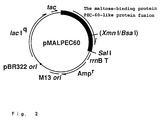
- Figure 2 is a figure depicting the structure of the Escherichia coli expression vector pMALPEC60 of the present invention.
- the present invention is embodied in more detail by the following examples, but this embodiment is not intended to restrict the present invention.
- the basic operations and the enzyme reactions with regard to the DNA recombination are carried out according to the literature [Molecular Cloning. A Laboratory Manual", Cold Spring Harbor Laboratory, 1989]. Unless otherwise stated, restrictive enzymes and a variety of modification enzymes to be used were those available from TAKARA SHUZO. The manufacturer's instructions were used for the buffer compositions as well as for the reaction conditions, in each of the enzyme reactions.
- the cDNA synthesis was carried out according to the literature [Kato, S. et al., Gene 150: 243-250 (1994)].
- RNA was prepared according to the literature [Okayama, H. et al., Methods in Enzymology" Vol. 164. Academic Press, 1987]. This was subjected to oligo(dT)-cellulose column chromatography washed with a 20 mM Tris-hydrochloric acid buffer solution (pH 7.6), 0.5 M NaCl, and 1 mM EDTA to obtain 10 ⁇ g of a poly(A) + RNA according to the literature mentioned above.
- the decapped poly(A) + RNA and 3 nmol of a chimeric DNA-RNA oligonucleotide (5'-dG-dG-dG-dG-dA-dA-dT-dT-dC-dG-dA-G-G-A-3') were dissolved in a solution containing 50 mM Tris-hydrochloric acid buffer (pH 7.5), 0.5 mM ATP, 5 mM MgCl 2 , 10 mM 2-mercaptoethanol, and 25% polyethylene glycol, whereto was added 50 units of T4RNA ligase and a total 30 ⁇ l volume of the resulting mixture was reacted at 20°C for 12 hours. After the reaction mixture was subjected to phenol extraction followed by ethanol precipitation, the pellet was dissolved in water to obtain a chimeric-oligo-capped poly(A) + RNA.
- the pellet was dissolved in a solution containing 50 mM Tris-hydrochloric acid buffer (pH 7.5), 100 mM NaCl, 10 mM MgCl 2 , and 1 mM dithiothreitol. Thereto were added 100 units of EcoRI and a total 20 ⁇ l volume of the resulting mixture was reacted at 37°C for one hour.
- the pellet was dissolved in a solution containing 20 mM Tris-hydrochloric acid buffer solution (pH 7.5), 100 mM KCl, 4 mM MgCl 2 , 10 mM (NH 4 ) 2 SO 4 , and 50 ⁇ g/ml of the bovine serum albumin. Thereto were added 60 units of an Escherichia coli DNA ligase and the resulting mixture was reacted at 16°C for 16 hours.
- the cDNA-synthesis reaction solution was used for transformation of an Escherichia coli DH12S (GIBCO-BRL).
- the transformation was carried out by an electroporation method. A portion of the transformant was sprayed on the 2xYT agar culture medium containing 100 ⁇ g/ml ampicillin and the mixture was incubated at 37°C overnight. A colony formed on the agar medium was picked up at random and inoculated on 2 ml of the 2xYT culture medium containing 100 ⁇ g/ml ampicillin. After incubation at 37°C for 2 hours, the mixture was infected with a helper phage MK13KO7 (Pharmacia) and incubated further at 37°C overnight.
- a helper phage MK13KO7 Pharmacia
- the culture solution was centrifuged to separate the mycelia and the supernatant, wherein a double-stranded DNA was isolated from the mycelia by the alkaline hydrolysis method and a single-stranded plasmid DNA from the supernatant according to the conventional method. After double digestion with EcoRI and NotI, the double-stranded plasmid DNA was subjected to 0.8% agarose gel electrophoresis to determine the size of the cDNA insert.
- the vector pHP00839 having the cDNA of the present invention was used for in vitro translation with a TNT rabbit reticulocyte lysate kit (Promega). In this case, [ 35 S]methionine was added to label the expression product with a radioisotope. Each of the reactions was carried out according to the protocols attached to the kit.
- Two micrograms of the plasmid pHP00839 was reacted at 30°C for 90 minutes in a total 100 ⁇ l volume of the reaction mixture containing 50 ⁇ l of the TNT rabbit reticulocyte lysate, 4 ⁇ l of a buffer solution (attached to the kit), 2 ⁇ l of an amino acid mixture (Met-free), 8 ⁇ l of [ 35 S]methionine (Amersham) (0.37 Mbq/ ⁇ l), 2 ⁇ l of T7RNA polymerase, and 80 U of RNasin.
- oligonucleotide primer PR1 (5'-GCGGTCTCGGGAAAGCTCCCTTTCTCAAG-3') and PR2 (5'-GCGTCGACTCAGCATTTGCCATCTTTCA-3') were synthesized using a DNA synthesizer (Applied Biosystems) according to the attached protocol.
- PCR was carried out using 1 ng of the plasmid pHP00839 as well as 100 pmole each of primer PR1 and primer PR2 to amplify a region encoding a maturation protein consisting of C-terminal 60 amino acid residues. After phenol extraction and ethanol precipitation, the pellet was digested with 20 units of Bsal (New England Biolabs), treated with Klenow enzyme, and then digested with SalI. The reaction product was subjected to 1.5% agarose gel electrophoresis, cutting-off of an about 200-bp DNA fragment from the gel, and purification.
- Plasmid pMALPEC was prepared from the transformant and the objective recombinant was identified by the restriction enzyme cleavage map.
- Figure 2 depicts the structure of the obtained plasmid.
- a suspension of 10 ml of an overnight-incubated liquid of pMALPEC60/JM109 in 500 ml of the Rich culture medium (contains 10 g of triptone, 5 g of yeast extract, 5 g of NaCl, and 2 g of glucose per one liter) was incubated in a shaker at 37°C and isopropylthiogalactoside was added so as to make 1 mM when A 600 reached about 0.5. After further incubation at 37°C for 3 hours, the mycelia collected by centrifugation were suspended in 25 ml of a column buffer for amylose column (10 mM Tris-hydrochloric acid, pH 7.4, 200 mM NaCl, and 1 mM EDTA).
- the present invention provides a human PEC-60-like protein, a DNA encoding said protein, and a human cDNA encoding said protein.
- the protein of the present invention can be used as pharmaceuticals for the treatment and diagnosis of the digestive system diseases, the immune system diseases, and the nervous system diseases or as an antigen for preparing an antibody against said protein.
- Said DNA can be used for the expression of a large amount of said protein.
Landscapes
- Health & Medical Sciences (AREA)
- Chemical & Material Sciences (AREA)
- Organic Chemistry (AREA)
- Life Sciences & Earth Sciences (AREA)
- Medicinal Chemistry (AREA)
- General Health & Medical Sciences (AREA)
- Bioinformatics & Cheminformatics (AREA)
- Engineering & Computer Science (AREA)
- Chemical Kinetics & Catalysis (AREA)
- General Chemical & Material Sciences (AREA)
- Nuclear Medicine, Radiotherapy & Molecular Imaging (AREA)
- Veterinary Medicine (AREA)
- Pharmacology & Pharmacy (AREA)
- Animal Behavior & Ethology (AREA)
- Public Health (AREA)
- Biophysics (AREA)
- Genetics & Genomics (AREA)
- Proteomics, Peptides & Aminoacids (AREA)
- Molecular Biology (AREA)
- Endocrinology (AREA)
- Toxicology (AREA)
- Zoology (AREA)
- Gastroenterology & Hepatology (AREA)
- Biochemistry (AREA)
- Immunology (AREA)
- Biomedical Technology (AREA)
- Neurosurgery (AREA)
- Neurology (AREA)
- Preparation Of Compounds By Using Micro-Organisms (AREA)
- Peptides Or Proteins (AREA)
- Micro-Organisms Or Cultivation Processes Thereof (AREA)
- Saccharide Compounds (AREA)
- Medicines That Contain Protein Lipid Enzymes And Other Medicines (AREA)
Applications Claiming Priority (3)
| Application Number | Priority Date | Filing Date | Title |
|---|---|---|---|
| JP280272/95 | 1995-10-27 | ||
| JP7280272A JPH09124698A (ja) | 1995-10-27 | 1995-10-27 | ヒトpec−60様蛋白質およびそれをコードするdna |
| PCT/JP1996/003061 WO1997015596A1 (en) | 1995-10-27 | 1996-10-22 | Human pec-60-like protein and dna encoding the same |
Publications (2)
| Publication Number | Publication Date |
|---|---|
| EP0857732A1 true EP0857732A1 (de) | 1998-08-12 |
| EP0857732A4 EP0857732A4 (de) | 2001-03-14 |
Family
ID=17622687
Family Applications (1)
| Application Number | Title | Priority Date | Filing Date |
|---|---|---|---|
| EP96935398A Withdrawn EP0857732A4 (de) | 1995-10-27 | 1996-10-22 | Menschlicher pec-60-aehnliches protein und dafuer kodierende dna |
Country Status (4)
| Country | Link |
|---|---|
| US (2) | US6280968B1 (de) |
| EP (1) | EP0857732A4 (de) |
| JP (1) | JPH09124698A (de) |
| WO (1) | WO1997015596A1 (de) |
Families Citing this family (2)
| Publication number | Priority date | Publication date | Assignee | Title |
|---|---|---|---|---|
| US5858710A (en) * | 1996-11-06 | 1999-01-12 | Incyte Pharmaceuticals, Inc. | Tumor-associated kazal inhibitor-like polypeptides and encoding polynucleotides |
| WO2013033629A2 (en) * | 2011-08-31 | 2013-03-07 | Oncocyte Corporation | Methods and compositions for the treatment and diagnosis of colorectal cancer |
Family Cites Families (3)
| Publication number | Priority date | Publication date | Assignee | Title |
|---|---|---|---|---|
| AU8172787A (en) | 1986-10-30 | 1988-05-25 | Synergen Biologicals, Inc. | Human pancreatic secretory trypsin inhibitors produced by recombinant dna methods and processes for the production of same |
| GB2199582A (en) | 1987-01-07 | 1988-07-13 | Bayer Ag | Analogues of pancreatic secretory trypsin inhibitor |
| US5550213A (en) | 1993-12-27 | 1996-08-27 | Rutgers, The State University Of New Jersey | Inhibitors of urokinase plasminogen activator |
-
1995
- 1995-10-27 JP JP7280272A patent/JPH09124698A/ja active Pending
-
1996
- 1996-10-22 US US09/065,019 patent/US6280968B1/en not_active Expired - Lifetime
- 1996-10-22 EP EP96935398A patent/EP0857732A4/de not_active Withdrawn
- 1996-10-22 WO PCT/JP1996/003061 patent/WO1997015596A1/ja not_active Ceased
-
2001
- 2001-08-28 US US09/941,309 patent/US20020106777A1/en not_active Abandoned
Also Published As
| Publication number | Publication date |
|---|---|
| JPH09124698A (ja) | 1997-05-13 |
| US6280968B1 (en) | 2001-08-28 |
| US20020106777A1 (en) | 2002-08-08 |
| EP0857732A4 (de) | 2001-03-14 |
| WO1997015596A1 (en) | 1997-05-01 |
Similar Documents
| Publication | Publication Date | Title |
|---|---|---|
| Zhang et al. | Cloning and sequencing of a copper-containing, topa quinone-containing monoamine oxidase from human placenta | |
| SK171492A3 (en) | Polypeptide, method of its preparation its use and pharmaceutical agent | |
| WO1986007595A1 (en) | Fibroblast growth factor | |
| JPS62190084A (ja) | ミュレル管抑制物質の活性を示すポリペプチドをコードするdna,組換dnaおよび形質転換宿主 | |
| FI108943B (fi) | Menetelmiä seriiniproteaasi-inhibiittorien valmistamiseksi ja menetelmässä käytettävä synteettinen tai eristetty DNA-sekvenssi, yhdistelmävektori sekä bakteeri- tai hiivaisäntäsolu | |
| CA2005358A1 (en) | Somatotropin analogs | |
| JPH07508879A (ja) | アミノペプチダーゼ酵素をコードする組換えdna分子および蠕虫感染に対するワクチンの調製におけるその用途 | |
| NZ311738A (en) | Recombinant protein having bacteriophage endosialidase enzymatic activity | |
| CA2441327A1 (en) | Human arginine-rich protein-related compositions | |
| JPH04504953A (ja) | ヒトリラキシンの単離のための方法および組成物 | |
| US5464774A (en) | Bovine basic fibroblast growth factor | |
| Van Poelje et al. | Cloning, sequencing, expression, and site-directed mutagenesis of the gene from Clostridium perfringens encoding pyruvoyl-dependent histidine decarboxylase | |
| EP0841393A1 (de) | Menschliches galectin-4-ähnliches protein und dafür kodierende dna | |
| JP2001029082A (ja) | カンナビジオール酸シンターゼをコードするdna | |
| US6280968B1 (en) | Human PEC-60-like protein and DNA encoding the same | |
| US6703201B1 (en) | Human PEC-60-like protein and DNA encoding this protein | |
| WO1989005857A1 (en) | A METHOD OF SIMULTANEOUSLY PRODUCING A LARGE NUMBER OF Leu17-VIP-ANALOGS AND NEW Leu17-VIP-ANALOGS | |
| HU197939B (en) | Process for producing deoxyribonucleic acid, or its precursor, determining human growth hormone releasing factor | |
| AU4802490A (en) | Recombinant fish hormone proteins | |
| JPS6034915A (ja) | ポリペプチド | |
| US6277822B1 (en) | Family of peptides known as xenoxins | |
| EP0620278A1 (de) | Menschliche Transaldolase und dafür kodierende DNA | |
| HUT51328A (en) | Process for producing proteins | |
| JPH0937779A (ja) | ユビキチン結合酵素E2およびそれをコードするヒトcDNA | |
| CA2380354A1 (en) | Novel tachykinin peptides, precursor peptides thereof and genes encoding the same |
Legal Events
| Date | Code | Title | Description |
|---|---|---|---|
| PUAI | Public reference made under article 153(3) epc to a published international application that has entered the european phase |
Free format text: ORIGINAL CODE: 0009012 |
|
| 17P | Request for examination filed |
Effective date: 19980423 |
|
| AK | Designated contracting states |
Kind code of ref document: A1 Designated state(s): AT BE CH DE DK ES FI FR GB GR IE IT LI LU MC NL PT SE |
|
| RIN1 | Information on inventor provided before grant (corrected) |
Inventor name: KAMATA, KOUJU Inventor name: SEKINE, SHINGO Inventor name: KIMURA, TOMOKO Inventor name: KATO, SEISHI |
|
| A4 | Supplementary search report drawn up and despatched |
Effective date: 20010125 |
|
| AK | Designated contracting states |
Kind code of ref document: A4 Designated state(s): AT BE CH DE DK ES FI FR GB GR IE IT LI LU MC NL PT SE |
|
| 17Q | First examination report despatched |
Effective date: 20030924 |
|
| STAA | Information on the status of an ep patent application or granted ep patent |
Free format text: STATUS: THE APPLICATION HAS BEEN WITHDRAWN |
|
| 18W | Application withdrawn |
Effective date: 20040416 |