EP0857775A2 - Procédé de carbonisation d'une matière organique contenant de l'eau - Google Patents
Procédé de carbonisation d'une matière organique contenant de l'eau Download PDFInfo
- Publication number
- EP0857775A2 EP0857775A2 EP97107476A EP97107476A EP0857775A2 EP 0857775 A2 EP0857775 A2 EP 0857775A2 EP 97107476 A EP97107476 A EP 97107476A EP 97107476 A EP97107476 A EP 97107476A EP 0857775 A2 EP0857775 A2 EP 0857775A2
- Authority
- EP
- European Patent Office
- Prior art keywords
- moisture
- carbonization
- dewatering
- carbide
- cake
- Prior art date
- Legal status (The legal status is an assumption and is not a legal conclusion. Google has not performed a legal analysis and makes no representation as to the accuracy of the status listed.)
- Withdrawn
Links
Images


Classifications
-
- C—CHEMISTRY; METALLURGY
- C10—PETROLEUM, GAS OR COKE INDUSTRIES; TECHNICAL GASES CONTAINING CARBON MONOXIDE; FUELS; LUBRICANTS; PEAT
- C10B—DESTRUCTIVE DISTILLATION OF CARBONACEOUS MATERIALS FOR PRODUCTION OF GAS, COKE, TAR, OR SIMILAR MATERIALS
- C10B53/00—Destructive distillation, specially adapted for particular solid raw materials or solid raw materials in special form
-
- C—CHEMISTRY; METALLURGY
- C02—TREATMENT OF WATER, WASTE WATER, SEWAGE, OR SLUDGE
- C02F—TREATMENT OF WATER, WASTE WATER, SEWAGE, OR SLUDGE
- C02F11/00—Treatment of sludge; Devices therefor
-
- C—CHEMISTRY; METALLURGY
- C10—PETROLEUM, GAS OR COKE INDUSTRIES; TECHNICAL GASES CONTAINING CARBON MONOXIDE; FUELS; LUBRICANTS; PEAT
- C10B—DESTRUCTIVE DISTILLATION OF CARBONACEOUS MATERIALS FOR PRODUCTION OF GAS, COKE, TAR, OR SIMILAR MATERIALS
- C10B53/00—Destructive distillation, specially adapted for particular solid raw materials or solid raw materials in special form
- C10B53/02—Destructive distillation, specially adapted for particular solid raw materials or solid raw materials in special form of cellulose-containing material
-
- Y—GENERAL TAGGING OF NEW TECHNOLOGICAL DEVELOPMENTS; GENERAL TAGGING OF CROSS-SECTIONAL TECHNOLOGIES SPANNING OVER SEVERAL SECTIONS OF THE IPC; TECHNICAL SUBJECTS COVERED BY FORMER USPC CROSS-REFERENCE ART COLLECTIONS [XRACs] AND DIGESTS
- Y02—TECHNOLOGIES OR APPLICATIONS FOR MITIGATION OR ADAPTATION AGAINST CLIMATE CHANGE
- Y02E—REDUCTION OF GREENHOUSE GAS [GHG] EMISSIONS, RELATED TO ENERGY GENERATION, TRANSMISSION OR DISTRIBUTION
- Y02E50/00—Technologies for the production of fuel of non-fossil origin
- Y02E50/10—Biofuels, e.g. bio-diesel
Definitions
- the present invention relates to a method of continuously producing a carbide from an organic substance containing water.
- the water-containing organic substances such as lees of wine, sprits and beer, or sludge cakes are partly recycled as compost or burned to be buried in the ground, but most of them are thrown away in the sea or ground as they are.
- Production of the compost is very costly because it requires an expensive device for deodorizing a bad smell generated during the fermentation process and, furthermore, it is inefficient because the compost thus produced decreases in volume by only 10% to 20%.
- to burn the organic substances is also very costly and not practical because it needs a great amount of heat to burn off the substances containing more than 90% water. Thus, the above-mentioned substances are mostly thrown away in the sea without being processed at all.
- Another known processing method is carbonization of the organic substances.
- the organic substances are carbonized by an incomplete combustion or by a continuous carbonization under 500°C. But, this method produces a great quantity of an air-polluting and malodorous smoke and therefore requires a device for processing the smoke. Further, the carbide thus produced by the conventional method is of a high volatility and therefore has a limited field of application.
- a method of continuously producing a carbide from the water-containing organic substances An object thereof is to recycle them which have been usually thrown away as wastes.
- Means proposed by the invention for solving the problems comprises: a pressing process for removing water from a material; a moisture adjustment process for further removing water from the dewatered cake; and a carbonization process for carbonizing the moisture-adjusted material, said moisture adjustment process including the step of mixing a carbide formed by said carbonization process.
- the present invention can produce the carbide by carbonizing the organic substances which have been unprocessed and discarded in the sea, thereby preventing the environmental pollution and enabling the recycling of sources.
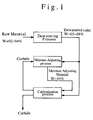
- Fig. 1 is a block diagram illustrating the processes of the invention.
- Fig. 2 is a flow chart showing the whole devices.
- Fig. 3a is a sectional view showing a furnace of a carbonizing device
- Fig. 3b is a view taken along the line b-b thereof.
- Fig. 4 is a graph showing the percentage of yield in contrast with the carbonization temperature.
- Fig. 5 is a graph showing the relationship between the carbonization temperature and the carbonizing period.
- the invention comprises a dewatering process for removing water by a pressing machine from a raw material such as the lees of wine, sprits, beer or the sludge cake; a moisture adjusting process for removing the moisture from the dewatered cake; and a carbonization process for continuously carbonizing the moisture adjusted material.
- the dewatered cake from the dewatering process can be carbonized without the moisture adjustment, but preferably after the moisture adjusting process.
- the raw material discharged from a factory 1 is gathered into a storage tank 2, wherein the average moisture percentage is between 92% and 94%.
- the raw material in the storage tank 2 is sent by a pump to a dewatering device 3, by which the moisture percentage is reduced to between 65% and 68% on average.
- the dewatering device 3 consists of a stirrer 4, and first and second dewatering means, 5 and 6, respectively.
- the stirrer 5 for mixing the material with a coagulant, comprises first and second blenders of a screw-structure.
- the type and amount of the coagulant to be injected differ according to the kind of the material to be processed, therefore the detailed description about the coagulant is omitted herein.
- the first dewatering means 5 employing a belt-press type machine creates a low-pressure dewatering area while the second means 6 creates a high-pressure dewatering area with use of a drum-press type machine.
- the combination of the two means 5 and 6 is not the scope of the invention.
- the dewatering machine of the present invention is as disclosed in Japanese Patent Nos. 2127055, 907864 and 926951.
- the filtrate separated by the dewatering device 3 is sent to a discharged water processing device 7 to be recycled as a water for industrial purpose.
- Dewatered cake coming from the device 3 is gathered into a silo 8, from which the cake is partly sent to a carbonization device 9 and the other part to a moisture adjustment device 10.
- the device 10 is to process the cake prior to the carbonization by adjusting the moisture of the cake to about 45%.
- a carbide produced by the invention is mixed into the cake to dehydrate the moisture in the cake, thereby accelerating the carbonization speed.
- the cake and carbide mixture can be utilized as a fertilizer or a soil conditioner without the carbonization process.
- the moisture adjusted material may be directly sent to a silo 11, but preferably after being granulated, and thereafter to a carbonization device 9.
- the carbonization device 9 has an inner-tapered furnace 90 mounted rotatable.
- the furnace has an inlet 91 at the smaller diameter portion thereof, from which the material is put in the furnace, and an outlet 92 is provided at the larger diameter portion.
- a burner and a blower, not shown, are mounted at the outlet side.
- the moisture adjusted material becomes dry by getting in contact with the inner wall of the rotating furnace 90, and burns by emitting a volatile gas.
- An intermediate combustion atmosphere is formed in which such an amount of air is supplied to cause neither incineration nor incomplete combustion.
- the blower is controlled to blow a minimum amount of air to the most violent combustion section in the atmosphere so as to prevent the incineration of the material.
- the carbide thus produced is taken out of the furnace and instantly cooled under the normal temperature, whereby the volatile matter in the carbide is volatilized completely and a porous carbide of a good quality is produced. Cooling the carbide again makes it into the most stable condition.
- the amount of material to be injected in the furnace 90 is adjusted according to the degree of granulation and the percentage of moisture. Control of the revolution of the furnace and the injected amount of the material is crucial because raising the combustion temperature in the furnace 90 for carbonization at a high temperature enables the continuous production of a porous carbide of a little volatility.
- Exhaust heat emitted at the time of combustion can be recovered for use.
- a heat exchanger for example a water-cooled type, is installed at the bottom of a chimney 93 for discharging the exhaust gas, so as to lower the temperature of said gas and at the same time radiate the heat ,by a radiator, from a cooling water which is as high as about 80°C to 100°C.
- Radiated heat source can be used for preliminary drying of the material to be carbonized. The odor and vapor produced by the preliminary drying are recovered to be fed into the furnace for deodorization and vaporization before they are discharged in the air.
- the carbide produced by the carbonization device 9 is accommodated in a carbide silo 12, where the sorting is made for a final product 13. As described above, a part of the carbide is supplied to the moisture adjusting device. 10.
- Figs. 4 and 5 show the examples of experiment for carbonization process regarding the dewatered sludge cake, the lees of Japanese distilled spirit, i.e. shochu (made from a barley and a potato) and the lees of beer.
- Fig. 4 indicates the yield percentage of carbide against the carbonization temperature
- Fig. 5 indicates the relationship between the carbonization temperature and the carbonization period. As the carbonization temperature rises, the percentage of yield lowers with the lowering degree being more remarkable between 700°C and 900°C rather than 500°C to 700°C.
- the temperature between 700°C and 900°C is not necessarily a factor for shortening the carbonization period.
- the temperature between 500°C and 700°C can yield a large amount of carbide while saving the fuel.
- the percentage of yield shows the ratio, in total dry quantity, of the produced carbide to the material.
- the carbide produced by the invention is applicable in a various fields as a material for a medical mattress, a soil conditioner, a water purifier, an freshness keeping agent for vegetable, a building material, a livestock feed, a compost, a deodorant.
Landscapes
- Chemical & Material Sciences (AREA)
- Engineering & Computer Science (AREA)
- Oil, Petroleum & Natural Gas (AREA)
- Organic Chemistry (AREA)
- Materials Engineering (AREA)
- Hydrology & Water Resources (AREA)
- Life Sciences & Earth Sciences (AREA)
- Environmental & Geological Engineering (AREA)
- Water Supply & Treatment (AREA)
- Processing Of Solid Wastes (AREA)
- Carbon And Carbon Compounds (AREA)
- Coke Industry (AREA)
- Fertilizers (AREA)
Applications Claiming Priority (2)
| Application Number | Priority Date | Filing Date | Title |
|---|---|---|---|
| JP38301/97 | 1997-02-06 | ||
| JP9038301A JPH10219257A (ja) | 1997-02-06 | 1997-02-06 | 水分を含む有機物から炭化物を生成する方法 |
Publications (2)
| Publication Number | Publication Date |
|---|---|
| EP0857775A2 true EP0857775A2 (fr) | 1998-08-12 |
| EP0857775A3 EP0857775A3 (fr) | 1998-11-04 |
Family
ID=12521493
Family Applications (1)
| Application Number | Title | Priority Date | Filing Date |
|---|---|---|---|
| EP97107476A Withdrawn EP0857775A3 (fr) | 1997-02-06 | 1997-05-06 | Procédé de carbonisation d'une matière organique contenant de l'eau |
Country Status (3)
| Country | Link |
|---|---|
| US (1) | US5891413A (fr) |
| EP (1) | EP0857775A3 (fr) |
| JP (1) | JPH10219257A (fr) |
Families Citing this family (1)
| Publication number | Priority date | Publication date | Assignee | Title |
|---|---|---|---|---|
| JP2001019971A (ja) * | 1999-07-09 | 2001-01-23 | Takasago Ind Co Ltd | 高粘度または高水分の有機物の炭化方法 |
Family Cites Families (9)
| Publication number | Priority date | Publication date | Assignee | Title |
|---|---|---|---|---|
| US3480395A (en) * | 1967-12-05 | 1969-11-25 | Carborundum Co | Method of preparing extruded grains of silicon carbide |
| JPS587716B2 (ja) * | 1975-09-11 | 1983-02-10 | 三井金属鉱業株式会社 | デンカイソウ |
| JPS533501A (en) * | 1976-06-27 | 1978-01-13 | Daiichi Kasei | Production of artificial leather |
| US4244287A (en) * | 1979-07-09 | 1981-01-13 | Uop Inc. | Two-stage mechanical dewatering of sewage sludge |
| US4317659A (en) * | 1980-01-24 | 1982-03-02 | Westinghouse Electric Corp. | Production of hydrogen, acetylene and ammonia gases from lithium reaction with hydrocarbon materials |
| US4761893A (en) * | 1986-10-29 | 1988-08-09 | Glorioso John D | Sludge treatment process |
| CH671094A5 (fr) * | 1987-12-02 | 1989-07-31 | Stella Spa | |
| DE9107080U1 (de) * | 1991-06-08 | 1992-10-01 | Südfleisch GmbH, 8000 München | Vorrichtung zur Entsorgung von Biomasse mit hohem Wassergehalt |
| JPH08155495A (ja) * | 1994-12-01 | 1996-06-18 | Mitsuhiro Fujiwara | 製炭方法および製炭装置ならびに製造された炭の利用方法 |
-
1997
- 1997-02-06 JP JP9038301A patent/JPH10219257A/ja not_active Withdrawn
- 1997-05-06 EP EP97107476A patent/EP0857775A3/fr not_active Withdrawn
- 1997-06-25 US US08/882,304 patent/US5891413A/en not_active Expired - Fee Related
Also Published As
| Publication number | Publication date |
|---|---|
| EP0857775A3 (fr) | 1998-11-04 |
| US5891413A (en) | 1999-04-06 |
| JPH10219257A (ja) | 1998-08-18 |
Similar Documents
| Publication | Publication Date | Title |
|---|---|---|
| EP0906248B2 (fr) | Procede de traitement et valorisation energetique optimisee des boues d'epuration urbaine et industrielle | |
| JP3051020B2 (ja) | 有機廃棄物の炭化装置 | |
| EP1734097A1 (fr) | Méthode de traitement de carbonisation continue par système d'auto-combustion par chauffage interne | |
| US4159684A (en) | Method for incinerating waste sludges | |
| US2015050A (en) | Incinerating method and apparatus | |
| JP4247892B2 (ja) | 有機汚泥の処理方法 | |
| EP0857775A2 (fr) | Procédé de carbonisation d'une matière organique contenant de l'eau | |
| JP4288714B2 (ja) | 有機汚泥より肥料を製造する方法 | |
| US5558686A (en) | Method for making a fuel product | |
| JPH1190497A (ja) | 有機性汚泥の処理方法 | |
| JP3417314B2 (ja) | 有機系廃棄物の処理方法 | |
| JP2012224677A (ja) | 湿潤バイオマスの炭化処理システム及び炭化処理方法 | |
| JPH1177095A (ja) | 家畜ふん尿処理システム | |
| JP3774803B2 (ja) | 汚泥の焼却方法 | |
| JP3537123B2 (ja) | 下水汚泥を原料とする固形燃料の製造方法 | |
| JPH06154728A (ja) | 有機廃棄物炭化処理方法 | |
| JP2002303409A (ja) | 鶏糞の熱分解処理方法とその残渣を使用した特殊肥料と土壌改良材 | |
| CN202962406U (zh) | 一种助力脱模窝轴活塞式成型机 | |
| CN102329059A (zh) | 一种污泥制造环保再生能源的方法 | |
| JPS6061099A (ja) | 有機性汚泥の処理方法 | |
| JPH08132007A (ja) | 生ごみ処理方法 | |
| JP2000169130A (ja) | 活性汚泥からの顆粒状有機汚泥炭の製造方法 | |
| JP2968767B2 (ja) | 廃棄物の炭化処理方法 | |
| JP2000053969A (ja) | 炭化装置 | |
| JP2001205243A (ja) | 素炭製造方法及び素炭 |
Legal Events
| Date | Code | Title | Description |
|---|---|---|---|
| PUAI | Public reference made under article 153(3) epc to a published international application that has entered the european phase |
Free format text: ORIGINAL CODE: 0009012 |
|
| AK | Designated contracting states |
Kind code of ref document: A2 Designated state(s): DE FR GB |
|
| AX | Request for extension of the european patent |
Free format text: AL;LT;LV;RO;SI |
|
| PUAL | Search report despatched |
Free format text: ORIGINAL CODE: 0009013 |
|
| AK | Designated contracting states |
Kind code of ref document: A3 Designated state(s): AT BE CH DE DK ES FI FR GB GR IE IT LI LU MC NL PT SE |
|
| AX | Request for extension of the european patent |
Free format text: AL;LT;LV;RO;SI |
|
| 17P | Request for examination filed |
Effective date: 19990407 |
|
| AKX | Designation fees paid |
Free format text: DE FR GB |
|
| 17Q | First examination report despatched |
Effective date: 20010625 |
|
| GRAH | Despatch of communication of intention to grant a patent |
Free format text: ORIGINAL CODE: EPIDOS IGRA |
|
| STAA | Information on the status of an ep patent application or granted ep patent |
Free format text: STATUS: THE APPLICATION IS DEEMED TO BE WITHDRAWN |
|
| 18D | Application deemed to be withdrawn |
Effective date: 20030123 |