EP0862373B1 - Produit stratifie destine a etre utilise dans la fabrication de chaussures - Google Patents
Produit stratifie destine a etre utilise dans la fabrication de chaussures Download PDFInfo
- Publication number
- EP0862373B1 EP0862373B1 EP96934277A EP96934277A EP0862373B1 EP 0862373 B1 EP0862373 B1 EP 0862373B1 EP 96934277 A EP96934277 A EP 96934277A EP 96934277 A EP96934277 A EP 96934277A EP 0862373 B1 EP0862373 B1 EP 0862373B1
- Authority
- EP
- European Patent Office
- Prior art keywords
- fibers
- fibrous mat
- insole
- laminated
- upper layer
- Prior art date
- Legal status (The legal status is an assumption and is not a legal conclusion. Google has not performed a legal analysis and makes no representation as to the accuracy of the status listed.)
- Expired - Lifetime
Links
- 238000004519 manufacturing process Methods 0.000 title claims description 15
- 239000000835 fiber Substances 0.000 claims abstract description 93
- 239000006261 foam material Substances 0.000 claims abstract description 27
- 239000006260 foam Substances 0.000 claims abstract description 19
- 238000010348 incorporation Methods 0.000 claims abstract description 5
- 230000000149 penetrating effect Effects 0.000 claims abstract description 5
- 238000002844 melting Methods 0.000 claims description 28
- 230000008018 melting Effects 0.000 claims description 28
- 238000000034 method Methods 0.000 claims description 21
- -1 polypropylene Polymers 0.000 claims description 14
- 229920005989 resin Polymers 0.000 claims description 13
- 239000011347 resin Substances 0.000 claims description 13
- 229920000728 polyester Polymers 0.000 claims description 10
- 239000004743 Polypropylene Substances 0.000 claims description 9
- 239000004744 fabric Substances 0.000 claims description 9
- 229920001155 polypropylene Polymers 0.000 claims description 9
- 229920002994 synthetic fiber Polymers 0.000 claims description 8
- 238000010438 heat treatment Methods 0.000 claims description 7
- 239000004816 latex Substances 0.000 claims description 7
- 229920000126 latex Polymers 0.000 claims description 7
- 239000000203 mixture Substances 0.000 claims description 7
- 230000002787 reinforcement Effects 0.000 claims description 7
- 241000894006 Bacteria Species 0.000 claims description 6
- 239000004753 textile Substances 0.000 claims description 6
- 239000004677 Nylon Substances 0.000 claims description 5
- 238000000576 coating method Methods 0.000 claims description 5
- 238000001816 cooling Methods 0.000 claims description 5
- 229920001778 nylon Polymers 0.000 claims description 5
- 239000012209 synthetic fiber Substances 0.000 claims description 5
- 229920005992 thermoplastic resin Polymers 0.000 claims description 5
- 229920001187 thermosetting polymer Polymers 0.000 claims description 5
- 239000004698 Polyethylene Substances 0.000 claims description 4
- 239000011248 coating agent Substances 0.000 claims description 4
- 229920000573 polyethylene Polymers 0.000 claims description 4
- 239000004814 polyurethane Substances 0.000 claims description 4
- 229920002635 polyurethane Polymers 0.000 claims description 4
- 229920000642 polymer Polymers 0.000 claims description 3
- VEXZGXHMUGYJMC-UHFFFAOYSA-M Chloride anion Chemical compound [Cl-] VEXZGXHMUGYJMC-UHFFFAOYSA-M 0.000 claims description 2
- 229920001634 Copolyester Polymers 0.000 claims description 2
- 241000233866 Fungi Species 0.000 claims description 2
- 239000004721 Polyphenylene oxide Substances 0.000 claims description 2
- 238000003490 calendering Methods 0.000 claims description 2
- 239000003795 chemical substances by application Substances 0.000 claims description 2
- 229920003020 cross-linked polyethylene Polymers 0.000 claims description 2
- 239000004703 cross-linked polyethylene Substances 0.000 claims description 2
- 229920000570 polyether Polymers 0.000 claims description 2
- 239000000243 solution Substances 0.000 description 8
- PXHVJJICTQNCMI-UHFFFAOYSA-N Nickel Chemical compound [Ni] PXHVJJICTQNCMI-UHFFFAOYSA-N 0.000 description 4
- 239000006185 dispersion Substances 0.000 description 4
- 239000011230 binding agent Substances 0.000 description 3
- OKTJSMMVPCPJKN-UHFFFAOYSA-N Carbon Chemical compound [C] OKTJSMMVPCPJKN-UHFFFAOYSA-N 0.000 description 2
- 229920000297 Rayon Polymers 0.000 description 2
- 239000002174 Styrene-butadiene Substances 0.000 description 2
- MTAZNLWOLGHBHU-UHFFFAOYSA-N butadiene-styrene rubber Chemical compound C=CC=C.C=CC1=CC=CC=C1 MTAZNLWOLGHBHU-UHFFFAOYSA-N 0.000 description 2
- 238000010276 construction Methods 0.000 description 2
- 230000005611 electricity Effects 0.000 description 2
- 230000008020 evaporation Effects 0.000 description 2
- 238000001704 evaporation Methods 0.000 description 2
- 238000005470 impregnation Methods 0.000 description 2
- 229910052759 nickel Inorganic materials 0.000 description 2
- 239000002904 solvent Substances 0.000 description 2
- 230000003068 static effect Effects 0.000 description 2
- 239000011115 styrene butadiene Substances 0.000 description 2
- 229920003048 styrene butadiene rubber Polymers 0.000 description 2
- QTBSBXVTEAMEQO-UHFFFAOYSA-M Acetate Chemical compound CC([O-])=O QTBSBXVTEAMEQO-UHFFFAOYSA-M 0.000 description 1
- 229920002972 Acrylic fiber Polymers 0.000 description 1
- 229920000049 Carbon (fiber) Polymers 0.000 description 1
- RYGMFSIKBFXOCR-UHFFFAOYSA-N Copper Chemical compound [Cu] RYGMFSIKBFXOCR-UHFFFAOYSA-N 0.000 description 1
- 240000000491 Corchorus aestuans Species 0.000 description 1
- 235000011777 Corchorus aestuans Nutrition 0.000 description 1
- 235000010862 Corchorus capsularis Nutrition 0.000 description 1
- WSFSSNUMVMOOMR-UHFFFAOYSA-N Formaldehyde Chemical compound O=C WSFSSNUMVMOOMR-UHFFFAOYSA-N 0.000 description 1
- 229920000877 Melamine resin Polymers 0.000 description 1
- 229920005830 Polyurethane Foam Polymers 0.000 description 1
- 239000004372 Polyvinyl alcohol Substances 0.000 description 1
- NIXOWILDQLNWCW-UHFFFAOYSA-N acrylic acid group Chemical group C(C=C)(=O)O NIXOWILDQLNWCW-UHFFFAOYSA-N 0.000 description 1
- 238000005452 bending Methods 0.000 description 1
- 229910052799 carbon Inorganic materials 0.000 description 1
- 239000004917 carbon fiber Substances 0.000 description 1
- 238000009960 carding Methods 0.000 description 1
- 229910052802 copper Inorganic materials 0.000 description 1
- 239000010949 copper Substances 0.000 description 1
- 230000009977 dual effect Effects 0.000 description 1
- 229920001971 elastomer Polymers 0.000 description 1
- BFMKFCLXZSUVPI-UHFFFAOYSA-N ethyl but-3-enoate Chemical compound CCOC(=O)CC=C BFMKFCLXZSUVPI-UHFFFAOYSA-N 0.000 description 1
- 239000002657 fibrous material Substances 0.000 description 1
- 229960004279 formaldehyde Drugs 0.000 description 1
- 235000019256 formaldehyde Nutrition 0.000 description 1
- 229920001903 high density polyethylene Polymers 0.000 description 1
- 239000004700 high-density polyethylene Substances 0.000 description 1
- 230000006698 induction Effects 0.000 description 1
- 238000001746 injection moulding Methods 0.000 description 1
- 238000010030 laminating Methods 0.000 description 1
- 229920001684 low density polyethylene Polymers 0.000 description 1
- 239000004702 low-density polyethylene Substances 0.000 description 1
- 239000000463 material Substances 0.000 description 1
- JDSHMPZPIAZGSV-UHFFFAOYSA-N melamine Chemical compound NC1=NC(N)=NC(N)=N1 JDSHMPZPIAZGSV-UHFFFAOYSA-N 0.000 description 1
- 239000002184 metal Substances 0.000 description 1
- 229910052751 metal Inorganic materials 0.000 description 1
- 238000002156 mixing Methods 0.000 description 1
- 230000035515 penetration Effects 0.000 description 1
- 230000035699 permeability Effects 0.000 description 1
- 239000011496 polyurethane foam Substances 0.000 description 1
- 229920002451 polyvinyl alcohol Polymers 0.000 description 1
- 239000004800 polyvinyl chloride Substances 0.000 description 1
- 229920000915 polyvinyl chloride Polymers 0.000 description 1
- 230000005855 radiation Effects 0.000 description 1
- 239000002964 rayon Substances 0.000 description 1
- 239000005060 rubber Substances 0.000 description 1
- 230000035939 shock Effects 0.000 description 1
- 229910052709 silver Inorganic materials 0.000 description 1
- 239000004332 silver Substances 0.000 description 1
- 229910001220 stainless steel Inorganic materials 0.000 description 1
- 239000010935 stainless steel Substances 0.000 description 1
- 229920003002 synthetic resin Polymers 0.000 description 1
- 239000000057 synthetic resin Substances 0.000 description 1
- 229920001169 thermoplastic Polymers 0.000 description 1
- 239000004416 thermosoftening plastic Substances 0.000 description 1
- 210000002268 wool Anatomy 0.000 description 1
Images

Classifications
-
- B—PERFORMING OPERATIONS; TRANSPORTING
- B32—LAYERED PRODUCTS
- B32B—LAYERED PRODUCTS, i.e. PRODUCTS BUILT-UP OF STRATA OF FLAT OR NON-FLAT, e.g. CELLULAR OR HONEYCOMB, FORM
- B32B5/00—Layered products characterised by the non- homogeneity or physical structure, i.e. comprising a fibrous, filamentary, particulate or foam layer; Layered products characterised by having a layer differing constitutionally or physically in different parts
- B32B5/22—Layered products characterised by the non- homogeneity or physical structure, i.e. comprising a fibrous, filamentary, particulate or foam layer; Layered products characterised by having a layer differing constitutionally or physically in different parts characterised by the presence of two or more layers which are next to each other and are fibrous, filamentary, formed of particles or foamed
- B32B5/24—Layered products characterised by the non- homogeneity or physical structure, i.e. comprising a fibrous, filamentary, particulate or foam layer; Layered products characterised by having a layer differing constitutionally or physically in different parts characterised by the presence of two or more layers which are next to each other and are fibrous, filamentary, formed of particles or foamed one layer being a fibrous or filamentary layer
- B32B5/245—Layered products characterised by the non- homogeneity or physical structure, i.e. comprising a fibrous, filamentary, particulate or foam layer; Layered products characterised by having a layer differing constitutionally or physically in different parts characterised by the presence of two or more layers which are next to each other and are fibrous, filamentary, formed of particles or foamed one layer being a fibrous or filamentary layer another layer next to it being a foam layer
-
- A—HUMAN NECESSITIES
- A43—FOOTWEAR
- A43B—CHARACTERISTIC FEATURES OF FOOTWEAR; PARTS OF FOOTWEAR
- A43B13/00—Soles; Sole-and-heel integral units
- A43B13/38—Built-in insoles joined to uppers during the manufacturing process, e.g. structural insoles; Insoles glued to shoes during the manufacturing process
-
- A—HUMAN NECESSITIES
- A43—FOOTWEAR
- A43B—CHARACTERISTIC FEATURES OF FOOTWEAR; PARTS OF FOOTWEAR
- A43B17/00—Insoles for insertion, e.g. footbeds or inlays, for attachment to the shoe after the upper has been joined
- A43B17/14—Insoles for insertion, e.g. footbeds or inlays, for attachment to the shoe after the upper has been joined made of sponge, rubber, or plastic materials
-
- B—PERFORMING OPERATIONS; TRANSPORTING
- B32—LAYERED PRODUCTS
- B32B—LAYERED PRODUCTS, i.e. PRODUCTS BUILT-UP OF STRATA OF FLAT OR NON-FLAT, e.g. CELLULAR OR HONEYCOMB, FORM
- B32B27/00—Layered products comprising a layer of synthetic resin
- B32B27/02—Layered products comprising a layer of synthetic resin in the form of fibres or filaments
-
- B—PERFORMING OPERATIONS; TRANSPORTING
- B32—LAYERED PRODUCTS
- B32B—LAYERED PRODUCTS, i.e. PRODUCTS BUILT-UP OF STRATA OF FLAT OR NON-FLAT, e.g. CELLULAR OR HONEYCOMB, FORM
- B32B5/00—Layered products characterised by the non- homogeneity or physical structure, i.e. comprising a fibrous, filamentary, particulate or foam layer; Layered products characterised by having a layer differing constitutionally or physically in different parts
- B32B5/18—Layered products characterised by the non- homogeneity or physical structure, i.e. comprising a fibrous, filamentary, particulate or foam layer; Layered products characterised by having a layer differing constitutionally or physically in different parts characterised by features of a layer of foamed material
-
- B—PERFORMING OPERATIONS; TRANSPORTING
- B32—LAYERED PRODUCTS
- B32B—LAYERED PRODUCTS, i.e. PRODUCTS BUILT-UP OF STRATA OF FLAT OR NON-FLAT, e.g. CELLULAR OR HONEYCOMB, FORM
- B32B5/00—Layered products characterised by the non- homogeneity or physical structure, i.e. comprising a fibrous, filamentary, particulate or foam layer; Layered products characterised by having a layer differing constitutionally or physically in different parts
- B32B5/22—Layered products characterised by the non- homogeneity or physical structure, i.e. comprising a fibrous, filamentary, particulate or foam layer; Layered products characterised by having a layer differing constitutionally or physically in different parts characterised by the presence of two or more layers which are next to each other and are fibrous, filamentary, formed of particles or foamed
-
- B—PERFORMING OPERATIONS; TRANSPORTING
- B32—LAYERED PRODUCTS
- B32B—LAYERED PRODUCTS, i.e. PRODUCTS BUILT-UP OF STRATA OF FLAT OR NON-FLAT, e.g. CELLULAR OR HONEYCOMB, FORM
- B32B5/00—Layered products characterised by the non- homogeneity or physical structure, i.e. comprising a fibrous, filamentary, particulate or foam layer; Layered products characterised by having a layer differing constitutionally or physically in different parts
- B32B5/22—Layered products characterised by the non- homogeneity or physical structure, i.e. comprising a fibrous, filamentary, particulate or foam layer; Layered products characterised by having a layer differing constitutionally or physically in different parts characterised by the presence of two or more layers which are next to each other and are fibrous, filamentary, formed of particles or foamed
- B32B5/24—Layered products characterised by the non- homogeneity or physical structure, i.e. comprising a fibrous, filamentary, particulate or foam layer; Layered products characterised by having a layer differing constitutionally or physically in different parts characterised by the presence of two or more layers which are next to each other and are fibrous, filamentary, formed of particles or foamed one layer being a fibrous or filamentary layer
- B32B5/26—Layered products characterised by the non- homogeneity or physical structure, i.e. comprising a fibrous, filamentary, particulate or foam layer; Layered products characterised by having a layer differing constitutionally or physically in different parts characterised by the presence of two or more layers which are next to each other and are fibrous, filamentary, formed of particles or foamed one layer being a fibrous or filamentary layer another layer next to it also being fibrous or filamentary
-
- B—PERFORMING OPERATIONS; TRANSPORTING
- B32—LAYERED PRODUCTS
- B32B—LAYERED PRODUCTS, i.e. PRODUCTS BUILT-UP OF STRATA OF FLAT OR NON-FLAT, e.g. CELLULAR OR HONEYCOMB, FORM
- B32B2305/00—Condition, form or state of the layers or laminate
- B32B2305/08—Reinforcements
-
- B—PERFORMING OPERATIONS; TRANSPORTING
- B32—LAYERED PRODUCTS
- B32B—LAYERED PRODUCTS, i.e. PRODUCTS BUILT-UP OF STRATA OF FLAT OR NON-FLAT, e.g. CELLULAR OR HONEYCOMB, FORM
- B32B2307/00—Properties of the layers or laminate
- B32B2307/20—Properties of the layers or laminate having particular electrical or magnetic properties, e.g. piezoelectric
- B32B2307/202—Conductive
-
- B—PERFORMING OPERATIONS; TRANSPORTING
- B32—LAYERED PRODUCTS
- B32B—LAYERED PRODUCTS, i.e. PRODUCTS BUILT-UP OF STRATA OF FLAT OR NON-FLAT, e.g. CELLULAR OR HONEYCOMB, FORM
- B32B2307/00—Properties of the layers or laminate
- B32B2307/30—Properties of the layers or laminate having particular thermal properties
- B32B2307/306—Resistant to heat
-
- B—PERFORMING OPERATIONS; TRANSPORTING
- B32—LAYERED PRODUCTS
- B32B—LAYERED PRODUCTS, i.e. PRODUCTS BUILT-UP OF STRATA OF FLAT OR NON-FLAT, e.g. CELLULAR OR HONEYCOMB, FORM
- B32B2307/00—Properties of the layers or laminate
- B32B2307/50—Properties of the layers or laminate having particular mechanical properties
- B32B2307/536—Hardness
-
- B—PERFORMING OPERATIONS; TRANSPORTING
- B32—LAYERED PRODUCTS
- B32B—LAYERED PRODUCTS, i.e. PRODUCTS BUILT-UP OF STRATA OF FLAT OR NON-FLAT, e.g. CELLULAR OR HONEYCOMB, FORM
- B32B2307/00—Properties of the layers or laminate
- B32B2307/70—Other properties
- B32B2307/714—Inert, i.e. inert to chemical degradation, corrosion
- B32B2307/7145—Rot proof, resistant to bacteria, mildew, mould, fungi
-
- B—PERFORMING OPERATIONS; TRANSPORTING
- B32—LAYERED PRODUCTS
- B32B—LAYERED PRODUCTS, i.e. PRODUCTS BUILT-UP OF STRATA OF FLAT OR NON-FLAT, e.g. CELLULAR OR HONEYCOMB, FORM
- B32B2437/00—Clothing
- B32B2437/02—Gloves, shoes
-
- Y—GENERAL TAGGING OF NEW TECHNOLOGICAL DEVELOPMENTS; GENERAL TAGGING OF CROSS-SECTIONAL TECHNOLOGIES SPANNING OVER SEVERAL SECTIONS OF THE IPC; TECHNICAL SUBJECTS COVERED BY FORMER USPC CROSS-REFERENCE ART COLLECTIONS [XRACs] AND DIGESTS
- Y10—TECHNICAL SUBJECTS COVERED BY FORMER USPC
- Y10T—TECHNICAL SUBJECTS COVERED BY FORMER US CLASSIFICATION
- Y10T428/00—Stock material or miscellaneous articles
- Y10T428/23907—Pile or nap type surface or component
- Y10T428/23914—Interlaminar
-
- Y—GENERAL TAGGING OF NEW TECHNOLOGICAL DEVELOPMENTS; GENERAL TAGGING OF CROSS-SECTIONAL TECHNOLOGIES SPANNING OVER SEVERAL SECTIONS OF THE IPC; TECHNICAL SUBJECTS COVERED BY FORMER USPC CROSS-REFERENCE ART COLLECTIONS [XRACs] AND DIGESTS
- Y10—TECHNICAL SUBJECTS COVERED BY FORMER USPC
- Y10T—TECHNICAL SUBJECTS COVERED BY FORMER US CLASSIFICATION
- Y10T428/00—Stock material or miscellaneous articles
- Y10T428/23907—Pile or nap type surface or component
- Y10T428/23979—Particular backing structure or composition
-
- Y—GENERAL TAGGING OF NEW TECHNOLOGICAL DEVELOPMENTS; GENERAL TAGGING OF CROSS-SECTIONAL TECHNOLOGIES SPANNING OVER SEVERAL SECTIONS OF THE IPC; TECHNICAL SUBJECTS COVERED BY FORMER USPC CROSS-REFERENCE ART COLLECTIONS [XRACs] AND DIGESTS
- Y10—TECHNICAL SUBJECTS COVERED BY FORMER USPC
- Y10T—TECHNICAL SUBJECTS COVERED BY FORMER US CLASSIFICATION
- Y10T442/00—Fabric [woven, knitted, or nonwoven textile or cloth, etc.]
- Y10T442/40—Knit fabric [i.e., knit strand or strip material]
- Y10T442/469—Including a foamed layer or component
-
- Y—GENERAL TAGGING OF NEW TECHNOLOGICAL DEVELOPMENTS; GENERAL TAGGING OF CROSS-SECTIONAL TECHNOLOGIES SPANNING OVER SEVERAL SECTIONS OF THE IPC; TECHNICAL SUBJECTS COVERED BY FORMER USPC CROSS-REFERENCE ART COLLECTIONS [XRACs] AND DIGESTS
- Y10—TECHNICAL SUBJECTS COVERED BY FORMER USPC
- Y10T—TECHNICAL SUBJECTS COVERED BY FORMER US CLASSIFICATION
- Y10T442/00—Fabric [woven, knitted, or nonwoven textile or cloth, etc.]
- Y10T442/60—Nonwoven fabric [i.e., nonwoven strand or fiber material]
- Y10T442/647—Including a foamed layer or component
-
- Y—GENERAL TAGGING OF NEW TECHNOLOGICAL DEVELOPMENTS; GENERAL TAGGING OF CROSS-SECTIONAL TECHNOLOGIES SPANNING OVER SEVERAL SECTIONS OF THE IPC; TECHNICAL SUBJECTS COVERED BY FORMER USPC CROSS-REFERENCE ART COLLECTIONS [XRACs] AND DIGESTS
- Y10—TECHNICAL SUBJECTS COVERED BY FORMER USPC
- Y10T—TECHNICAL SUBJECTS COVERED BY FORMER US CLASSIFICATION
- Y10T442/00—Fabric [woven, knitted, or nonwoven textile or cloth, etc.]
- Y10T442/60—Nonwoven fabric [i.e., nonwoven strand or fiber material]
- Y10T442/647—Including a foamed layer or component
- Y10T442/651—Plural fabric layers
-
- Y—GENERAL TAGGING OF NEW TECHNOLOGICAL DEVELOPMENTS; GENERAL TAGGING OF CROSS-SECTIONAL TECHNOLOGIES SPANNING OVER SEVERAL SECTIONS OF THE IPC; TECHNICAL SUBJECTS COVERED BY FORMER USPC CROSS-REFERENCE ART COLLECTIONS [XRACs] AND DIGESTS
- Y10—TECHNICAL SUBJECTS COVERED BY FORMER USPC
- Y10T—TECHNICAL SUBJECTS COVERED BY FORMER US CLASSIFICATION
- Y10T442/00—Fabric [woven, knitted, or nonwoven textile or cloth, etc.]
- Y10T442/60—Nonwoven fabric [i.e., nonwoven strand or fiber material]
- Y10T442/647—Including a foamed layer or component
- Y10T442/652—Nonwoven fabric is coated, impregnated, or autogenously bonded
Definitions
- the present invention relates to a laminated product for use in footwear manufacturing and to a method of manufacturing an insole for a footwear.
- US-A-461 099 discloses a bottom layer made of a fibrous mat between which is interposed an odor-absorbing layer
- US-A-5 433 987 discloses two laminates between which fibers are placed, some of them penetrating the laminates.
- a drawback with those products is that they generally do not provide a good rigidity to the finished product and therefore their use is limited to articles which do not require a good rigidity. As a result, they are not very suitable as an insole for footwear.
- an object of the present invention is to provide a laminated product for use in footwear manufacturing which overcomes this drawback. More particularly, an object of the present invention is to propose a laminated product suitable for use in footwear manufacturing comprising:
- Another object of the present invention is to propose a laminated insole for a footwear comprising:
- the upper layer has an outer surface opposed to the bottom layer, and each of the fibers of the fraction penetrating the foam material emerges from said outer surface and thereby provides a pilosity thereon.
- the stiff portion of the bottom layer is obtained by impregnating an outer surface of the fibrous mat with a member selected from the group consisting of a latex, a solution of thermoplastic resin and a solution of thermosetting resin.
- the fibrous mat may comprise a plurality of constructive fibers having a given melting point and a plurality of binding fibers having a melting point smaller than the melting point of the constructive fibers; and then the stiff portion of the fibrous mat may be obtained by subjecting an outer surface of the fibrous mat to a temperature greater than the melting point of the binding fibers and smaller than the melting point of the constructive fibers.
- a further object is to propose a method of manufacturing a laminated product suitable for use in footwear manufacturing, the method comprising the steps of:
- a laminated product according to the present invention is suitable for use as an insole as well as a slip-in insole in any footwear.
- it takes advantage of the resilient properties of the foam and the stiffness and thermoformability of the fibrous mat and in a preferred version it also takes advantage of the comfort provided by the pilosity covering the upper layer of foam.
- the invention is generally characterized by a laminated product (2) suitable for use as an insole for a footwear. It can also be used as a slip-in insole.
- This product may be used flat and be cut for matching the shape of a foot. It comprises an upper layer made of a resilient foam material (4) and, if it is used as an insole as shown in FIG. 1, it also has an outline (6) shaped for incorporation in a footwear.
- the product (2) further comprises a bottom layer made of a fibrous mat (10) and having a shape conforming with the outline of the upper layer (4).
- the fibrous mat (10) which comprises a multiplicity of fibers (12) is needled to the upper layer (4) so that a fraction of those fibers (12) penetrates the foam material of the upper layer (4) for bonding the bottom layer (10) to the upper layer (4).
- the fibrous mat (10) further comprises a stiff portion (14) for providing stiffness to the product (2).
- the fibrous mat (10) preferably includes a non-woven mat of fibers.
- Each of the fibers (12) of the fraction penetrating the foam material (4) preferably emerges from the outer surface (16) of the upper layer (4) and thereby provides a pilosity (17) thereon which gives a comfortable finish to the product (2).
- the laminated insole (2) may further comprise a reinforcement laminate (9) embedded in the fibrous mat (10).
- the fibrous mat (10) may contain in its structure a reinforcement fabric or laminate (9), bonded together with the fibers during construction of the mat (10).
- the reinforcement fabric or laminate (9) may be a polypropylene scrim fabric with very small openings, or said scrim may be coated on one or both sides with a 1 to 3 mils polypropylene coating.
- Other coatings, scrims or films, selected in the group of polyester, nylon, polyethylene may be used as long as they are able to resist to the temperatures found in the production process of the laminate or during production of the footwear product.
- An additional layer of textile (18) may also be bonded to the upper layer of foam (4).
- the fibers (12) of the bottom layer (10) which are threaded through the upper layer (4) are used for combining this additional layer of textile (18) on the surface of the upper layer (4).
- this additional layer may also be laminated to the surface of the top layer.
- This additional layer (18) may comprise another nonwoven mat, a felt, a knit, a brushed cloth, synthetic fur or any other kind of textile allowing to improve the aesthetic aspect or comfort of the product.
- the version of the invention illustrated in FIGS. 1, 2 and 6 takes advantage of the resilient properties of synthetic foams, the stiffness and the thermoformability of the fibrous mat, as well as the comfort provided by the fibers needled through the foam.
- the fibrous mat (10) comprises a plurality of fibers (12) selected in the group consisting of synthetic fibers such as polyester, polypropylene, nylon, etc., or artificial fibers such as rayon, viscose, etc., natural fibers such as wool, jute, etc., and mixtures thereof.
- the fibrous mat (10) may also comprise fibers with specific functions. For example, if the fibers transferred by the needling process are electrically conductive, the product will dissipate static electricity therefrom.
- the bottom layer (10) may comprise a small amount of electrically conductive fibers, preferably 1% to 20% in weight.
- These fibers have a resistivity lower than 10 -3 ⁇ cm and may be made of stainless steel, copper or synthetic fibers coated with a layer of nickel, silver or any other conductive metal. Carbon fibers, epitropic, or carbon coated fibers or polymeric conductive fibers can be used.
- the fibrous mat (10) may comprise 3 to 6% of a nickel coated acrylic fibre produced for STATEX in Germany under the trademark EX-STAT.
- the bottom layer (10) may also comprise fibers containing agents preventing fungus or bacteria growth. These fibers will prevent any bacteria growth under the foot and are preferably selected from the group consisting of polyester, polypropylene, acetate acrylic and the like. For example, an acetate fibre of 2 dtex manufactured by the company HOECHST under the name MICROSAFE may be suitable.
- these fibers (12) are heat resistant.
- the exact composition of the fibrous mat (10) depends on the process used for stiffening the structure and the expected use of the multilayer product.
- the fibers (12) of the fibrous mat (10) have a size comprised between 0,7 and 25 dtex, more preferably between 1,5 and 10 dtex. Their length is preferably comprised between 25 and 150 mm, and more preferably between 38 and 100 mm.
- the bottom layer (10) is made by a conventional process of carding and then needling the mixture of fibers chosen. Preferably, this bottom layer (10) has a surface density comprised between 70 and 1000 g/m 2 , more preferably between 200 and 800 g/m 2 .
- the resilient foam material of the upper layer (4) may be an opened or closed-cell synthetic foam. It preferably consists of a polymer selected from the group consisting of polyurethane, polyester, polyether, cross-linked polyethylene, polyvinylic chloride, and the like. Such foams are available commercially. For example, an opened-cell polyurethane foam such as the one produced by RODGERS Co. under the trademark PORON may be used.
- the stiff portion (14) of the bottom layer (10) is obtained by impregnating an outer surface (20) of the fibrous mat (10) with a member selected from the group consisting of a latex, a solution of thermoplastic resin and a solution of thermosetting resin. This latex or solution is then dried and cross-linked. This operation gives the stiffness required for an inner sole.
- the fibrous mat (10) is stiffened while keeping a good resiliency for absorbing shocks.
- the resin is selected in the group consisting of acrylic, methylmethacrilate, ethylvinylacetate, polyvinyl alcohol, styrene butadiene resin and styrene butadiene comprising melamine formol.
- the amount of resin required varies between 100 and 350 g/m 2 in the dry state, preferably 150 and 250 g/m 2 .
- the fibrous mat (10) may be stiffened by mixing constructive fibers with binder fibers. More particularly, in this case, the fibrous mat (10) comprises a plurality of constructive fibers having a given melting point and a plurality of binding fibers having a melting point smaller than the melting point of the constructive fibers.
- the stiff portion (14) of the fibrous mat (10) is then obtained by subjecting the outer surface (20) of the fibrous mat (10) to a temperature greater than the melting point of the binding fibers and smaller than the melting point of the constructive fibers.
- the stiffness required is obtained.
- the proportions of the binding fibers in the fibrous mat (10) preferably vary from 10% to 80% by weight, more preferably from 25% to 60%.
- These binding fibers are preferably selected from the group consisting of polyesters or copolyesters having a low softening temperature, high or low density polyethylene, polypropylene or dual fibers of the type sheath core or side by side.
- sheath core fibers the heart has a high melting point while the core comprises a polymer with a low melting point. During the heating, this core will keep the linkage between the fibers.
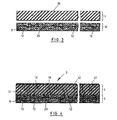
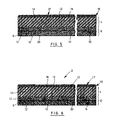
- FIGS. 3 to 6 consecutive steps of a preferred version of a method of manufacturing a laminated product suitable for use in footwear manufacturing are illustrated.
- the method comprises the steps of a), needling a layer made of a fibrous mat (10) comprising a multiplicity of fibers (12) to a layer made of a resilient foam material (4) such that a fraction of said fibers (12) penetrates the foam material (4).
- FIG. 3 shows the fibrous mat (10) and the layer of foam (4) before the needling step
- FIG. 4 shows the same layers after the needling step.
- the fraction of the fibers (12) which are threaded through the foam material (4) may also be used for combining an additional layer of textile (18) as described hereinbefore.
- This additional layer (18) may also be laminated to the product by using conventional laminating methods.
- the method further comprises the step of b), stiffening a portion of the fibrous mat for providing stiffness to the insole, as shown in FIG. 6, and then step c), if the product is going to be used as an insole, of forming an insole having an outline shaped for incorporation in the footwear.
- the fibrous mat (10) and foam material (4) used are preferably as the fibrous mat and foam material described hereinbefore.
- an additional step of calendering may help make denser a fibrous mat (10) reinforced with a reinforcement fabric (9) in order to achieve a Frazier air permeability smaller than 5 cubic feet per minute.
- a laminate is well suited for construction of footwear by injection molding of thermoplastic, rubber, polyurethane, or polyvinylchloride soles directly against the insole described in the invention.
- the method consists in transferring a portion of the fibers (12) contained in the bottom layer (10) through the upper layer (4) by means of needles provided with barbs.
- the amount of transferred fibers (12) may be adjusted by controlling the number of penetrations per square centimeter and controlling the depth of the needle into the foam (4).
- the threaded fibers emerge from the outer surface (16) of the upper layer (4) and therefore these fibers are visible on the surface of the upper layer (4) and are forming a pilosity (17) thereon.
- This pilosity (17) on the surface of the upper layer (4) provides a comfortable finish to the product. It also allows easy dissipation of the perspiration and moisture therefrom. Furthermore, the fibers (12) which are threaded through the upper layer (4) improve the transfer of perspiration and moisture from the foot towards the bottom layer (10) where it could be dissipated. If the fibers (12) brought to the outer surface (16) of the upper layer (4) are electrically conductive fibers or the fibers preventing bacteria growth, these fibers on the surface of the top layer (4) allow either to dissipate static electricity, provide a link between the sole and the foot, or prevent bad odours due to bacteria growth.
- the stiffening of step b) comprises the steps of:
- FIG. 6 shows the laminated product (2) after it has been made stiff by partially coating the fibrous mat (10) with a latex or a solution comprising a synthetic resin.
- the dispersion beforehand transformed into foam is pushed into the non woven mat (10) by means of a scrape or any other process allowing an impregnation at a predetermined depth in the non woven fibrous mat (10).
- the fibrous mat (10) is then subjected to a temperature comprised between 100 to 200°C, preferably between 130 to 180°C for a time sufficient to allow the evaporation of the dispersion solvent and the reticulation of the resin.
- the stiffness obtained is controlled by measuring the bending resistance of the structure.
- the upper layer (4) comprises a foam made of polyurethane which is not deteriorated through this process.
- the fibrous mat (10) is impregnated with a resin in an amount comprised between 100 and 350 g/m 2 of fibrous mat, and more preferably between 150 and 250 g/m 2 .
- the stiffening of step b) may be performed with a process which does not use binders in the form of dispersion.
- the fibrous mat (10) comprises a plurality of constructive fibers having a given melting point and a plurality of binding fibers having a melting point smaller than the melting point of the constructive fibers, and wherein the stiffening of step b) comprises the steps of:
- the fibrous mat (10) may also comprise conductive fibers or fibers preventing bacteria growth.
- This embodiment is stiffened by transferring heat to the fibrous mat (10) preferably by means of a system consisting of two continuous bands. One band is heated to a temperature sufficient for softening the binder fibers. The other band is maintained at room temperature and is kept at a distance which is equal to or slightly inferior to the width of the structure. The structure has to be maintained at the softening temperature for a time long enough for allowing heat to penetrate into the width of the fibrous mat (10) without heating or softening the upper layer (4).
- Other heating techniques may be used for heating the fibrous mat (10). For example, radiation, convection or induction techniques may be used.
- a laminated product (2) according to the present invention may afterwards be thermoformed into a desired shape, as illustrated in FIG. 6.
Landscapes
- Laminated Bodies (AREA)
- Footwear And Its Accessory, Manufacturing Method And Apparatuses (AREA)
Abstract
Claims (27)
- Produit stratifié (2) approprié pour être utilisé dans la fabrication de chaussures, caractérisé en ce qu'il comprend :une couche supérieure constituée d'un matériau en mousse résiliente (4); etune couche de base constituée d'un mat fibreux (10) comprenant :une multiplicité de fibres (12), dont une fraction pénètre dans le matériau en mousse de la couche supérieure (4) afin de fixer la couche de base (10) à la couche supérieure (4); etune partie rigide (14) destinée à conférer une rigidité au produit (2).
- Produit stratifié (2) tel que revendiqué dans la revendication 1, caractérisé en ce que le mat fibreux (10) inclut un mat en non-tissé comprenant une pluralité de fibres choisies dans le groupe constitué des fibres synthétiques, des fibres artificielles, des fibres naturelles, et des mélanges de celles-ci.
- Semelle intérieure stratifiée (2) pour chaussure, caractérisée en ce qu'elle comprend :une couche supérieure constituée d'un matériau en mousse résiliente (4) et dont le profil (6) a été façonné de façon à être incorporé dans la chaussure; etune couche de base constituée d'un mat fibreux (10) et dont la forme s'adapte au profil de la couche supérieure (4), le mat fibreux (10) comprenant :une multiplicité de fibres (12), dont une fraction pénètre dans le matériau en mousse de la couche supérieure (4) afin de fixer la couche de base (10) à la couche supérieure (4); etune partie rigide (14) destinée à conférer une rigidité à la semelle intérieure (2).
- Semelle intérieure stratifiée (2) telle que revendiquée dans la revendication 3, caractérisée en ce que :la couche supérieure (4) a une surface externe (16) opposée à la couche de base (10); etchacune des fibres (12) de la fraction pénétrant dans le matériau en mousse (4) dépasse de ladite surface externe (16) et confère de ce fait une pilosité (17) à celle-ci.
- Semelle intérieure stratifiée (2) telle que revendiquée dans la revendication 4, caractérisée en ce que le mat fibreux (10) comprend un mat en non-tissé comprenant une pluralité de fibres choisies dans le groupe constitué des fibres synthétiques, des fibres artificielles, des fibres naturelles, et des mélanges de celles-ci.
- Semelle intérieure stratifiée (2) telle que revendiquée dans la revendication 5, caractérisée en ce que les fibres synthétiques (12) sont choisies dans le groupe constitué du polyester, du polypropylène, du nylon, et des mélanges de ceux-ci.
- Semelle intérieure stratifiée (2) telle que revendiquée dans la revendication 5, caractérisée en ce qu'elle comprend en outre un stratifié de renfort (9) noyé dans le mat fibreux (10).
- Semelle intérieure stratifiée (2) telle que revendiquée dans la revendication 7, dans laquelle le stratifié de renfort (9) comprend un tissu du type canevas.
- Semelle intérieure stratifiée (2) telle que revendiquée dans la revendication 8, dans laquelle le tissu du type canevas est choisi dans le groupe constitué des tissus du type canevas en polypropylène, en polyester, en nylon, et en polyéthylène.
- Semelle intérieure stratifiée (2) telle que revendiquée dans la revendication 8, dans laquelle le tissu du type canevas est recouvert avec un revêtement de 1 à 3 mils choisi dans le groupe constitué d'un revêtement en polypropylène, en polyester, en nylon, et en polyéthylène.
- Semelle intérieure stratifiée (2) telle que revendiquée dans la revendication 5, caractérisée en ce que le matériau en mousse (4) comprend une mousse synthétique à cellules ouvertes ou fermées.
- Semelle intérieure stratifiée (2) telle que revendiquée dans la revendication 11, caractérisée en ce que la mousse synthétique (4) comprend un polymère choisi dans le groupe constitué du polyuréthane, du polyester, du polyéther, du polyéthylène réticulé, du poly(chlorure de vinyle), et des mélanges de ceux-ci.
- Semelle intérieure stratifiée (2) telle que revendiquée dans la revendication 5, caractérisée en ce que la partie rigide (14) du mat fibreux (10) est obtenue en imprégnant la surface externe (20) du mat fibreux (10) avec un élément choisi dans le groupe constitué d'un latex, d'une solution d'une résine thermoplastique, et d'une solution d'une résine thermodurcissable.
- Semelle intérieure stratifiée (2) telle que revendiquée dans la revendication 5, caractérisée en ce que :le mat fibreux (10) a une surface externe (20) opposée à la couche supérieure (4);le mat fibreux (10) comprend une pluralité de fibres structurelles ayant un point de fusion donné et une pluralité de fibres de liaison ayant un point de fusion inférieur au point de fusion des fibres structurelles; etla partie rigide (14) du mat fibreux (10) est obtenue en soumettant la surface externe (20) du mat fibreux (10) à une température supérieure au point de fusion des fibres de liaisons et inférieure au point de fusion des fibres structurelles.
- Semelle intérieure stratifiée (2) telle que revendiquée dans la revendication 14, caractérisée en ce que le mat fibreux (10) comprend de 10% à 80% de fibres de liaison en poids.
- Semelle intérieure stratifiée (2) telle que revendiquée dans la revendication 13, caractérisée en ce que les fibres de liaison sont choisies dans le groupe constitué des fibres de polyester, de copolyester, de polyéthylène, de polypropylène et les fibres ayant une âme formant manchon.
- Semelle intérieure stratifiée (2) telle que revendiquée dans la revendication 14, caractérisée en ce que le mat fibreux (10) comprend des fibres conductrices électriques.
- Semelle intérieure stratifiée (2) telle que revendiquée dans la revendication 5, caractérisée en ce que les fibres (12) ont une taille comprise entre 0,7 et 25 dtex.
- Semelle intérieure stratifiée (2) telle que revendiquée dans la revendication 18, caractérisée en ce que le mat fibreux (10) a une densité surfacique comprise entre 70 et 1000 g/m2.
- Semelle intérieure stratifiée (2) telle que revendiquée dans la revendication 5, caractérisée en ce que les fibres (12) résistent à la chaleur.
- Semelle intérieure stratifiée (2) telle que revendiquée dans la revendication 5, caractérisée en ce que le mat fibreux (10) comprend des fibres (12) contenant des agents évitant le développement des champignons et des bactéries.
- Semelle intérieure stratifiée (2) telle que revendiquée dans la revendication 5, caractérisée en ce qu'elle comprend également :
une couche supplémentaire de textile (18) fixée à la couche supérieure en mousse (4). - Procédé de fabrication d'un produit stratifié (2) approprié pour être utilisé dans la fabrication de chaussures, comprenant les étapes consistant :a) à coudre une couche constituée d'un mat fibreux (10), comprenant une multiplicité de fibres (12) à une couche constituée d'un matériau en mousse résiliente (4) de façon à ce qu'une fraction desdites fibres pénètre dans le matériau en mousse; etb) à rigidifier une partie (14) du mat fibreux (10) pour conférer une rigidité au produit (2).
- Procédé tel que revendiqué dans la revendication 21, caractérisé en ce que la rigidification de l'étape b), comprend les étapes consistant :à imprégner partiellement le mat fibreux (10) avec un élément choisi dans le groupe constitué d'un latex, d'une résine thermoplastique, et d'une résine thermodurcissable;à chauffer le mat fibreux (10) à une température comprise entre 100°C et 200°C; età refroidir le mat fibreux (10).
- Procédé tel que revendiqué dans la revendication 24, caractérisé en ce que le mat fibreux (10) est imprégné avec une résine dans une quantité comprise entre 100 et 350 g/m2 de mat fibreux.
- Procédé tel que revendiqué dans la revendication 25, caractérisé en ce que le mat fibreux (10) comprend une pluralité de fibres structurelles ayant un point de fusion donné et une pluralité de fibres de liaison ayant un point de fusion inférieur au point de fusion des fibres structurelles, et dans lequel la rigidification de l'étape b) comprend les étapes consistant :à soumettre, pendant un temps donné, une surface externe (20) du mat fibreux (10) à une température supérieure au point de fusion des fibres de liaison et inférieure au point de fusion des fibres structurelles; età refroidir le mat fibreux (10).
- Procédé tel que revendiqué dans la revendication 23, dans lequel le mat fibreux (10) comprend un stratifié de renfort noyé dans le mat fibreux (10) et le procédé comprend une étape supplémentaire c) consistant :
à laminer la semelle intérieure stratifiée pour rendre le mat fibreux (10) plus dense.
Applications Claiming Priority (3)
| Application Number | Priority Date | Filing Date | Title |
|---|---|---|---|
| US752595P | 1995-11-24 | 1995-11-24 | |
| US7525P | 1995-11-24 | ||
| PCT/CA1996/000727 WO1997019608A1 (fr) | 1995-11-24 | 1996-11-01 | Produit stratifie destine a etre utilise dans la fabrication de chaussures |
Publications (2)
| Publication Number | Publication Date |
|---|---|
| EP0862373A1 EP0862373A1 (fr) | 1998-09-09 |
| EP0862373B1 true EP0862373B1 (fr) | 2001-03-07 |
Family
ID=21726714
Family Applications (1)
| Application Number | Title | Priority Date | Filing Date |
|---|---|---|---|
| EP96934277A Expired - Lifetime EP0862373B1 (fr) | 1995-11-24 | 1996-11-01 | Produit stratifie destine a etre utilise dans la fabrication de chaussures |
Country Status (12)
| Country | Link |
|---|---|
| US (1) | US5994245A (fr) |
| EP (1) | EP0862373B1 (fr) |
| JP (1) | JPH11506035A (fr) |
| KR (1) | KR19990071568A (fr) |
| CN (1) | CN1202805A (fr) |
| AU (1) | AU7274496A (fr) |
| CA (1) | CA2235390C (fr) |
| DE (1) | DE69612012T2 (fr) |
| ES (1) | ES2154838T3 (fr) |
| MX (1) | MX9803987A (fr) |
| TW (1) | TW372409U (fr) |
| WO (1) | WO1997019608A1 (fr) |
Cited By (1)
| Publication number | Priority date | Publication date | Assignee | Title |
|---|---|---|---|---|
| DE102004030914A1 (de) * | 2004-06-25 | 2006-01-19 | Trocellen Gmbh | Elektrisch leitfähige Laminate |
Families Citing this family (46)
| Publication number | Priority date | Publication date | Assignee | Title |
|---|---|---|---|---|
| DE19829072A1 (de) * | 1998-06-30 | 2000-01-05 | Walter Braun | Sohlenaufbau für einen Schuh oder eine Einlegesohle |
| US6643956B2 (en) | 1998-07-07 | 2003-11-11 | Earnest P. S. Mawusi | Orthopedic slipper |
| GB9905753D0 (en) * | 1999-03-13 | 1999-05-05 | Texon Uk Ltd | Sheet material for use in the manufacture of shoes, method of making same and shoe insole |
| AU8438301A (en) * | 2000-08-28 | 2002-03-13 | Mani Shankar Almal | Jute/cotton composites for use in the manufacture of footwear components and method of manufacture of such composites |
| JP2004516369A (ja) | 2000-12-27 | 2004-06-03 | ワールド・プロパティーズ・インコーポレイテッド | ポリウレタンフォームとその製造方法 |
| US20040016147A1 (en) * | 2002-07-25 | 2004-01-29 | Cole Alan Bruce | Hygienic footwear, incorporating material or composites containing silver metal |
| KR100464673B1 (ko) * | 2002-09-12 | 2005-01-03 | 이경훈 | 물세탁이 가능한 실내용 슬리퍼 |
| US6962010B2 (en) | 2002-10-02 | 2005-11-08 | Footstar Corporation | Dress shoe with improved heel counter |
| AU2003286953A1 (en) * | 2002-12-21 | 2004-07-14 | Yeun Kwon Seo | Method for making flexible automobile interior material and sheet for the construction and its product made therefrom |
| DE20300097U1 (de) | 2003-01-07 | 2003-05-22 | Pfeifer, Josef, 66954 Pirmasens | Einlegesohle |
| US20080014817A1 (en) * | 2003-03-31 | 2008-01-17 | Xymid, Llc | Abrasion-Resistant Composites with In-Situ Activated Matrix Resin |
| US7022405B2 (en) * | 2003-04-21 | 2006-04-04 | Kaplo Joseph J | Multiplanar EMI shielding gasket and method of making |
| US7008386B2 (en) * | 2003-08-26 | 2006-03-07 | Acor Orthopaedic, Inc. | Foot orthotic |
| US7270644B2 (en) * | 2003-09-05 | 2007-09-18 | Ossur Hf | Ankle-foot orthosis having an orthotic footplate |
| US20050115106A1 (en) * | 2003-12-01 | 2005-06-02 | Schumacher James H. | Shoe insert and method for fitting a shoe |
| DE102004051929A1 (de) * | 2004-10-25 | 2006-04-27 | Trocellen Gmbh | Elektrisch leitfähige Laminate aus Vliesen und einer elastischen Dämmschicht |
| FR2891116B1 (fr) * | 2005-09-29 | 2007-12-14 | Olivier Lefebvre | Semelle pour chaussure |
| US20080068773A1 (en) * | 2006-09-14 | 2008-03-20 | Earth Fx, Inc. | Personal body grounding systems to reduce and prevent inflammation |
| US7752773B2 (en) * | 2006-12-01 | 2010-07-13 | Ariat International, Inc. | Advanced torque stability footbed |
| US7913428B2 (en) * | 2007-07-20 | 2011-03-29 | Ching-Hung Wang | Electromagnetic fitness shoes with a conductor structure |
| US8069587B2 (en) * | 2008-11-20 | 2011-12-06 | 3M Innovative Properties Company | Molded insulated shoe footbed and method of making an insulated footbed |
| US8845939B1 (en) | 2008-11-25 | 2014-09-30 | Remington Products Company | Foam product with an insert and its method of manufacture |
| CN101632501B (zh) * | 2009-05-22 | 2011-03-09 | 吴江市东塔鞋业有限公司 | 一种防护鞋鞋材 |
| WO2011011021A1 (fr) * | 2009-07-23 | 2011-01-27 | Harold Kalde | Semelle intérieure en fibres liantes à deux composants |
| CN101940385A (zh) * | 2010-09-14 | 2011-01-12 | 苏州希尔克纤维制品有限公司 | 防穿刺鞋垫 |
| TWM406368U (en) * | 2011-02-14 | 2011-07-01 | Global Action Inc | Anti-electrostatic insole |
| CN102641019A (zh) * | 2011-02-17 | 2012-08-22 | 佛山星期六鞋业股份有限公司 | 新型按摩鞋中底 |
| USD669275S1 (en) * | 2011-09-28 | 2012-10-23 | Abraham Franco | Lenticular panel |
| USD733408S1 (en) | 2011-09-28 | 2015-07-07 | Abraham Franco | Flip flop upper with lenticular panels |
| CN102771950A (zh) * | 2012-08-10 | 2012-11-14 | 昆山乔锐金属制品有限公司 | 一种复合鞋底 |
| WO2014066548A1 (fr) * | 2012-10-23 | 2014-05-01 | Joint Venture: Titan Industries, Inc.;Carol De Leon, And International Fashion Royalty Inc. | Semelle composite et ensemble fond |
| EP3111794B1 (fr) * | 2014-02-25 | 2022-01-05 | Diatex Co., Ltd. | Semelle de chaussure, semelle intérieure de chaussure, semelle principale de chaussure, et chaussure |
| US10561514B2 (en) | 2015-12-10 | 2020-02-18 | Ossur Iceland Ehf | Orthotic system |
| USD818686S1 (en) | 2017-01-19 | 2018-05-29 | Storelli Sports, Inc. | Insole |
| USD858968S1 (en) | 2017-01-19 | 2019-09-10 | Storelli Sports, Inc. | Insole |
| WO2018144118A1 (fr) * | 2017-02-03 | 2018-08-09 | Nike Innovate C.V. | Matériaux façonnés liés par des fibres, formés sous la forme d'un cuir synthétique |
| US20190366680A1 (en) | 2017-02-03 | 2019-12-05 | Nike, Inc. | Fiber-bound engineered materials formed using continuous scrims |
| CN121647443A (zh) | 2017-02-03 | 2026-03-13 | 耐克创新有限合伙公司 | 使用区域性垫料形成的纤维结合工程化材料 |
| WO2018144120A1 (fr) | 2017-02-03 | 2018-08-09 | Nike Innovate C.V. | Matériaux modifiés liés à des fibres formés à l'aide de canevas de fondation |
| WO2018144124A1 (fr) * | 2017-02-03 | 2018-08-09 | Nike Innovate C.V. | Matériaux modifiés liés à des fibres formés à l'aide de canevas modifiés |
| EP3723534B1 (fr) * | 2017-12-13 | 2022-03-16 | Basf Se | Procédé de fabrication d'une semelle intérieure en mousse de polyuréthane |
| USD903268S1 (en) | 2019-02-06 | 2020-12-01 | S. C. Johnson & Son, Inc. | Insole |
| USD906658S1 (en) | 2019-02-19 | 2021-01-05 | S. C. Johnson & Son, Inc. | Insole |
| IT201900007204A1 (it) * | 2019-05-24 | 2020-11-24 | Trocellen Italia S P A | Membrana composita e suo metodo di realizzazione |
| EP3993661B1 (fr) * | 2019-07-03 | 2024-09-04 | O2 Partners, LLC | Semelles intérieures antistatiques de chaussure en fibres et en mousse, et procédé de fabrication desdites semelles intérieures |
| CN112754105A (zh) * | 2021-01-14 | 2021-05-07 | 尚立刚 | 一种吸汗透气除臭抑菌的中草药黄麻鞋垫及制备方法 |
Family Cites Families (19)
| Publication number | Priority date | Publication date | Assignee | Title |
|---|---|---|---|---|
| US3591882A (en) * | 1969-08-21 | 1971-07-13 | Usm Corp | Chemical manufacture |
| US3766669A (en) * | 1969-08-21 | 1973-10-23 | Usm Corp | Profiled cellular article |
| CA983262A (en) * | 1972-03-25 | 1976-02-10 | Usm Corporation | Insole and method of making same |
| US3906570A (en) * | 1973-03-20 | 1975-09-23 | Usm Corp | Method of making an insole |
| US4062131A (en) * | 1976-09-10 | 1977-12-13 | Scholl, Inc. | Insoles for footwear |
| DE3231971A1 (de) * | 1982-08-27 | 1984-03-15 | Helmut 6780 Pirmasens Schaefer | Brandsohle fuer schuhe und verfahren zur herstellung derselben |
| GB2132554B (en) * | 1982-12-17 | 1986-10-01 | British United Shoe Machinery | Shoe insole and the manufacture thereof |
| US4461099A (en) * | 1983-02-28 | 1984-07-24 | Bailly Richard Louis | Molded odor-absorbing laminate |
| US4515844A (en) * | 1984-03-19 | 1985-05-07 | Nylco Corporation | Delsolite |
| US4642912A (en) * | 1984-05-02 | 1987-02-17 | Scholl, Inc. | Shoe insole |
| US4703533A (en) * | 1985-10-04 | 1987-11-03 | La Crosse Rubber Mills, Inc. | Rubber footwear vulcanizate assembly and its manufacture |
| US4858337A (en) * | 1985-10-04 | 1989-08-22 | La Crosse Footwear, Inc. | Vulcanized rubber footwear product |
| DE3724327A1 (de) * | 1987-07-22 | 1989-02-09 | Lohmann Gmbh & Co Kg | Schuhinnensohle, insbesondere zwischen- oder brandsohle |
| GB8919389D0 (en) * | 1989-08-25 | 1989-10-11 | Emhart Materials Uk | "cushion insole/insock material" |
| US5197208A (en) * | 1991-02-06 | 1993-03-30 | Combe Incorporated | Odor-adsorbent activated charcoal |
| DE4106295A1 (de) * | 1991-02-28 | 1992-09-03 | Schlerf Coronet Werke | Nadelvlies |
| US5433994A (en) * | 1992-12-18 | 1995-07-18 | Mckinney; Betty J. | Superabsorbent structure |
| US5350625A (en) * | 1993-07-09 | 1994-09-27 | E. I. Du Pont De Nemours And Company | Absorbent acrylic spunlaced fabric |
| WO1995033555A1 (fr) * | 1994-06-02 | 1995-12-14 | C.Filipitsch & Co. Keg | Materiau absorbant l'humidite et articles comprenant ce materiau |
-
1996
- 1996-11-01 DE DE69612012T patent/DE69612012T2/de not_active Expired - Fee Related
- 1996-11-01 EP EP96934277A patent/EP0862373B1/fr not_active Expired - Lifetime
- 1996-11-01 CN CN96198542A patent/CN1202805A/zh active Pending
- 1996-11-01 ES ES96934277T patent/ES2154838T3/es not_active Expired - Lifetime
- 1996-11-01 KR KR1019980703843A patent/KR19990071568A/ko not_active Ceased
- 1996-11-01 WO PCT/CA1996/000727 patent/WO1997019608A1/fr not_active Ceased
- 1996-11-01 JP JP9520022A patent/JPH11506035A/ja active Pending
- 1996-11-01 AU AU72744/96A patent/AU7274496A/en not_active Abandoned
- 1996-11-01 US US09/077,204 patent/US5994245A/en not_active Expired - Lifetime
- 1996-11-01 CA CA002235390A patent/CA2235390C/fr not_active Expired - Fee Related
- 1996-11-22 TW TW087215202U patent/TW372409U/zh unknown
-
1998
- 1998-05-20 MX MX9803987A patent/MX9803987A/es unknown
Cited By (1)
| Publication number | Priority date | Publication date | Assignee | Title |
|---|---|---|---|---|
| DE102004030914A1 (de) * | 2004-06-25 | 2006-01-19 | Trocellen Gmbh | Elektrisch leitfähige Laminate |
Also Published As
| Publication number | Publication date |
|---|---|
| DE69612012T2 (de) | 2001-08-23 |
| JPH11506035A (ja) | 1999-06-02 |
| ES2154838T3 (es) | 2001-04-16 |
| WO1997019608A1 (fr) | 1997-06-05 |
| CA2235390C (fr) | 2000-10-17 |
| MX9803987A (es) | 1998-09-30 |
| AU7274496A (en) | 1997-06-19 |
| EP0862373A1 (fr) | 1998-09-09 |
| TW372409U (en) | 1999-10-21 |
| US5994245A (en) | 1999-11-30 |
| KR19990071568A (ko) | 1999-09-27 |
| CN1202805A (zh) | 1998-12-23 |
| DE69612012D1 (de) | 2001-04-12 |
| CA2235390A1 (fr) | 1997-06-05 |
Similar Documents
| Publication | Publication Date | Title |
|---|---|---|
| EP0862373B1 (fr) | Produit stratifie destine a etre utilise dans la fabrication de chaussures | |
| US4594283A (en) | Shoemaking material and production thereof | |
| US8025751B2 (en) | Needlepunched nonwoven with centrally-located binder | |
| US4602442A (en) | Shoe insole and the manufacture thereof | |
| US7497978B2 (en) | Process for abrasion-resistant needle-punched composite | |
| EP0726843B1 (fr) | Materiau composite et structure composite a base d'une structure textile tridimensionnelle | |
| EP0822062B1 (fr) | Plastique renforcé avec un substrat composite | |
| EP3354453B1 (fr) | Tapis acoustique pour véhicules | |
| US5981411A (en) | Thermoformable material | |
| EP0414395A1 (fr) | Matériau de rembourrage pour semelle intérieure | |
| US20190366674A1 (en) | Noise Absorbing Multilayer System for a Vehicle | |
| JP2001232708A (ja) | 内装材および該内装材の製造方法 | |
| CZ2007133A3 (cs) | Vrstvené teleso a zpusob jeho výroby | |
| EP1649771A1 (fr) | Stratifié électroconducteur, notamment semelle intérieure, et son procédé de fabrication | |
| JPH0121991Y2 (fr) | ||
| EP1289755B1 (fr) | Semelle et contreforts en stratifie conducteur | |
| RU2821466C1 (ru) | Способ соединения твердого композитного материала с мягкими материалами с помощью прошивки | |
| GB2110990A (en) | Shoe construction | |
| JPS6226476Y2 (fr) | ||
| JPH01209131A (ja) | 繊維質積層体及びその製造方法 | |
| Arons | Novel Porous Sheet Materials of Potential Suitability for Military Textile Applications | |
| WO1998035574A1 (fr) | Materiau de revetement pour chaussures | |
| JPH0551698B2 (fr) |
Legal Events
| Date | Code | Title | Description |
|---|---|---|---|
| PUAI | Public reference made under article 153(3) epc to a published international application that has entered the european phase |
Free format text: ORIGINAL CODE: 0009012 |
|
| 17P | Request for examination filed |
Effective date: 19980504 |
|
| AK | Designated contracting states |
Kind code of ref document: A1 Designated state(s): DE ES FR GB IT |
|
| 17Q | First examination report despatched |
Effective date: 19990303 |
|
| GRAG | Despatch of communication of intention to grant |
Free format text: ORIGINAL CODE: EPIDOS AGRA |
|
| GRAG | Despatch of communication of intention to grant |
Free format text: ORIGINAL CODE: EPIDOS AGRA |
|
| GRAH | Despatch of communication of intention to grant a patent |
Free format text: ORIGINAL CODE: EPIDOS IGRA |
|
| GRAH | Despatch of communication of intention to grant a patent |
Free format text: ORIGINAL CODE: EPIDOS IGRA |
|
| GRAA | (expected) grant |
Free format text: ORIGINAL CODE: 0009210 |
|
| AK | Designated contracting states |
Kind code of ref document: B1 Designated state(s): DE ES FR GB IT |
|
| ITF | It: translation for a ep patent filed | ||
| REF | Corresponds to: |
Ref document number: 69612012 Country of ref document: DE Date of ref document: 20010412 |
|
| REG | Reference to a national code |
Ref country code: ES Ref legal event code: FG2A Ref document number: 2154838 Country of ref document: ES Kind code of ref document: T3 |
|
| ET | Fr: translation filed | ||
| REG | Reference to a national code |
Ref country code: GB Ref legal event code: IF02 |
|
| PLBE | No opposition filed within time limit |
Free format text: ORIGINAL CODE: 0009261 |
|
| STAA | Information on the status of an ep patent application or granted ep patent |
Free format text: STATUS: NO OPPOSITION FILED WITHIN TIME LIMIT |
|
| 26N | No opposition filed | ||
| PGFP | Annual fee paid to national office [announced via postgrant information from national office to epo] |
Ref country code: DE Payment date: 20021108 Year of fee payment: 7 |
|
| PGFP | Annual fee paid to national office [announced via postgrant information from national office to epo] |
Ref country code: FR Payment date: 20021114 Year of fee payment: 7 |
|
| PGFP | Annual fee paid to national office [announced via postgrant information from national office to epo] |
Ref country code: GB Payment date: 20021119 Year of fee payment: 7 |
|
| PGFP | Annual fee paid to national office [announced via postgrant information from national office to epo] |
Ref country code: ES Payment date: 20021122 Year of fee payment: 7 |
|
| PG25 | Lapsed in a contracting state [announced via postgrant information from national office to epo] |
Ref country code: GB Free format text: LAPSE BECAUSE OF NON-PAYMENT OF DUE FEES Effective date: 20031101 |
|
| PG25 | Lapsed in a contracting state [announced via postgrant information from national office to epo] |
Ref country code: ES Free format text: LAPSE BECAUSE OF NON-PAYMENT OF DUE FEES Effective date: 20031103 |
|
| PG25 | Lapsed in a contracting state [announced via postgrant information from national office to epo] |
Ref country code: DE Free format text: LAPSE BECAUSE OF NON-PAYMENT OF DUE FEES Effective date: 20040602 |
|
| GBPC | Gb: european patent ceased through non-payment of renewal fee |
Effective date: 20031101 |
|
| PG25 | Lapsed in a contracting state [announced via postgrant information from national office to epo] |
Ref country code: FR Free format text: LAPSE BECAUSE OF NON-PAYMENT OF DUE FEES Effective date: 20040730 |
|
| REG | Reference to a national code |
Ref country code: FR Ref legal event code: ST |
|
| PG25 | Lapsed in a contracting state [announced via postgrant information from national office to epo] |
Ref country code: IT Free format text: LAPSE BECAUSE OF NON-PAYMENT OF DUE FEES Effective date: 20051101 |
|
| REG | Reference to a national code |
Ref country code: ES Ref legal event code: FD2A Effective date: 20031103 |