EP0862990A1 - Vorrichtung zur kontinuierlichen Herstellung von auf Holz basierenden Laminaten - Google Patents
Vorrichtung zur kontinuierlichen Herstellung von auf Holz basierenden Laminaten Download PDFInfo
- Publication number
- EP0862990A1 EP0862990A1 EP97830086A EP97830086A EP0862990A1 EP 0862990 A1 EP0862990 A1 EP 0862990A1 EP 97830086 A EP97830086 A EP 97830086A EP 97830086 A EP97830086 A EP 97830086A EP 0862990 A1 EP0862990 A1 EP 0862990A1
- Authority
- EP
- European Patent Office
- Prior art keywords
- agglomerate
- station
- wood
- layer
- compounds
- Prior art date
- Legal status (The legal status is an assumption and is not a legal conclusion. Google has not performed a legal analysis and makes no representation as to the accuracy of the status listed.)
- Granted
Links
- 239000002023 wood Substances 0.000 title claims abstract description 43
- 238000010924 continuous production Methods 0.000 title claims abstract description 5
- 239000000463 material Substances 0.000 claims abstract description 25
- 239000003085 diluting agent Substances 0.000 claims abstract description 23
- 235000013312 flour Nutrition 0.000 claims abstract description 22
- 239000000853 adhesive Substances 0.000 claims abstract description 18
- 230000001070 adhesive effect Effects 0.000 claims abstract description 18
- 238000005520 cutting process Methods 0.000 claims abstract description 12
- 238000010030 laminating Methods 0.000 claims abstract description 12
- 238000001035 drying Methods 0.000 claims abstract description 10
- 235000013339 cereals Nutrition 0.000 claims abstract description 7
- 238000009423 ventilation Methods 0.000 claims abstract description 3
- 150000001875 compounds Chemical class 0.000 claims description 41
- 238000009826 distribution Methods 0.000 claims description 14
- 239000000314 lubricant Substances 0.000 claims description 14
- 239000011347 resin Substances 0.000 claims description 13
- 229920005989 resin Polymers 0.000 claims description 13
- UOCLXMDMGBRAIB-UHFFFAOYSA-N 1,1,1-trichloroethane Chemical compound CC(Cl)(Cl)Cl UOCLXMDMGBRAIB-UHFFFAOYSA-N 0.000 claims description 12
- 241000779819 Syncarpia glomulifera Species 0.000 claims description 12
- 229910052500 inorganic mineral Inorganic materials 0.000 claims description 12
- 239000011707 mineral Substances 0.000 claims description 12
- 239000001739 pinus spp. Substances 0.000 claims description 12
- 239000000454 talc Substances 0.000 claims description 12
- 229910052623 talc Inorganic materials 0.000 claims description 12
- 229940036248 turpentine Drugs 0.000 claims description 12
- 229920002554 vinyl polymer Polymers 0.000 claims description 12
- XOOUIPVCVHRTMJ-UHFFFAOYSA-L zinc stearate Chemical compound [Zn+2].CCCCCCCCCCCCCCCCCC([O-])=O.CCCCCCCCCCCCCCCCCC([O-])=O XOOUIPVCVHRTMJ-UHFFFAOYSA-L 0.000 claims description 12
- 125000000391 vinyl group Chemical group [H]C([*])=C([H])[H] 0.000 claims description 11
- GHPGOEFPKIHBNM-UHFFFAOYSA-N antimony(3+);oxygen(2-) Chemical compound [O-2].[O-2].[O-2].[Sb+3].[Sb+3] GHPGOEFPKIHBNM-UHFFFAOYSA-N 0.000 claims description 10
- 238000003490 calendering Methods 0.000 claims description 10
- 238000004898 kneading Methods 0.000 claims description 10
- 238000004519 manufacturing process Methods 0.000 claims description 7
- 239000004114 Ammonium polyphosphate Substances 0.000 claims description 6
- VTYYLEPIZMXCLO-UHFFFAOYSA-L Calcium carbonate Chemical compound [Ca+2].[O-]C([O-])=O VTYYLEPIZMXCLO-UHFFFAOYSA-L 0.000 claims description 6
- WNROFYMDJYEPJX-UHFFFAOYSA-K aluminium hydroxide Chemical compound [OH-].[OH-].[OH-].[Al+3] WNROFYMDJYEPJX-UHFFFAOYSA-K 0.000 claims description 6
- 235000019826 ammonium polyphosphate Nutrition 0.000 claims description 6
- 229920001276 ammonium polyphosphate Polymers 0.000 claims description 6
- VYPSYNLAJGMNEJ-UHFFFAOYSA-N Silicium dioxide Chemical compound O=[Si]=O VYPSYNLAJGMNEJ-UHFFFAOYSA-N 0.000 claims description 5
- ADCOVFLJGNWWNZ-UHFFFAOYSA-N antimony trioxide Inorganic materials O=[Sb]O[Sb]=O ADCOVFLJGNWWNZ-UHFFFAOYSA-N 0.000 claims description 5
- WHHGLZMJPXIBIX-UHFFFAOYSA-N decabromodiphenyl ether Chemical compound BrC1=C(Br)C(Br)=C(Br)C(Br)=C1OC1=C(Br)C(Br)=C(Br)C(Br)=C1Br WHHGLZMJPXIBIX-UHFFFAOYSA-N 0.000 claims description 5
- 239000007788 liquid Substances 0.000 claims description 5
- 239000012188 paraffin wax Substances 0.000 claims description 5
- 239000000843 powder Substances 0.000 claims description 5
- 239000002904 solvent Substances 0.000 claims description 5
- 239000012815 thermoplastic material Substances 0.000 claims description 5
- 239000004411 aluminium Substances 0.000 claims description 4
- 229910052782 aluminium Inorganic materials 0.000 claims description 4
- XAGFODPZIPBFFR-UHFFFAOYSA-N aluminium Chemical compound [Al] XAGFODPZIPBFFR-UHFFFAOYSA-N 0.000 claims description 4
- 229910021502 aluminium hydroxide Inorganic materials 0.000 claims description 4
- 238000003475 lamination Methods 0.000 claims description 4
- 238000002156 mixing Methods 0.000 claims description 4
- 238000004806 packaging method and process Methods 0.000 claims description 4
- 239000004033 plastic Substances 0.000 claims description 4
- 229920003023 plastic Polymers 0.000 claims description 4
- 238000005303 weighing Methods 0.000 claims description 4
- 229910000019 calcium carbonate Inorganic materials 0.000 claims description 3
- 150000003017 phosphorus Chemical class 0.000 claims description 3
- WKBOTKDWSSQWDR-UHFFFAOYSA-N Bromine atom Chemical compound [Br] WKBOTKDWSSQWDR-UHFFFAOYSA-N 0.000 claims description 2
- ZAMOUSCENKQFHK-UHFFFAOYSA-N Chlorine atom Chemical compound [Cl] ZAMOUSCENKQFHK-UHFFFAOYSA-N 0.000 claims description 2
- 229910052787 antimony Inorganic materials 0.000 claims description 2
- WATWJIUSRGPENY-UHFFFAOYSA-N antimony atom Chemical compound [Sb] WATWJIUSRGPENY-UHFFFAOYSA-N 0.000 claims description 2
- GDTBXPJZTBHREO-UHFFFAOYSA-N bromine Substances BrBr GDTBXPJZTBHREO-UHFFFAOYSA-N 0.000 claims description 2
- 229910052794 bromium Inorganic materials 0.000 claims description 2
- 239000000460 chlorine Substances 0.000 claims description 2
- 229910052801 chlorine Inorganic materials 0.000 claims description 2
- 239000008187 granular material Substances 0.000 claims description 2
- 238000000227 grinding Methods 0.000 claims description 2
- 238000002360 preparation method Methods 0.000 claims description 2
- 230000001681 protective effect Effects 0.000 claims description 2
- 239000007787 solid Substances 0.000 claims description 2
- FYYHWMGAXLPEAU-UHFFFAOYSA-N Magnesium Chemical compound [Mg] FYYHWMGAXLPEAU-UHFFFAOYSA-N 0.000 claims 2
- 239000011777 magnesium Substances 0.000 claims 2
- 229910052749 magnesium Inorganic materials 0.000 claims 2
- 239000000377 silicon dioxide Substances 0.000 claims 2
- BVKZGUZCCUSVTD-UHFFFAOYSA-L Carbonate Chemical compound [O-]C([O-])=O BVKZGUZCCUSVTD-UHFFFAOYSA-L 0.000 claims 1
- PWHULOQIROXLJO-UHFFFAOYSA-N Manganese Chemical compound [Mn] PWHULOQIROXLJO-UHFFFAOYSA-N 0.000 claims 1
- 150000004649 carbonic acid derivatives Chemical class 0.000 claims 1
- 229910052748 manganese Inorganic materials 0.000 claims 1
- 239000011572 manganese Substances 0.000 claims 1
- WPBNNNQJVZRUHP-UHFFFAOYSA-L manganese(2+);methyl n-[[2-(methoxycarbonylcarbamothioylamino)phenyl]carbamothioyl]carbamate;n-[2-(sulfidocarbothioylamino)ethyl]carbamodithioate Chemical compound [Mn+2].[S-]C(=S)NCCNC([S-])=S.COC(=O)NC(=S)NC1=CC=CC=C1NC(=S)NC(=O)OC WPBNNNQJVZRUHP-UHFFFAOYSA-L 0.000 claims 1
- 229920001169 thermoplastic Polymers 0.000 abstract description 2
- 239000004416 thermosoftening plastic Substances 0.000 abstract description 2
- 239000006185 dispersion Substances 0.000 abstract 1
- 239000000047 product Substances 0.000 description 13
- 238000000034 method Methods 0.000 description 10
- 239000000203 mixture Substances 0.000 description 3
- MXRIRQGCELJRSN-UHFFFAOYSA-N O.O.O.[Al] Chemical compound O.O.O.[Al] MXRIRQGCELJRSN-UHFFFAOYSA-N 0.000 description 2
- 238000004026 adhesive bonding Methods 0.000 description 2
- 238000004049 embossing Methods 0.000 description 2
- 238000010422 painting Methods 0.000 description 2
- 241000206761 Bacillariophyta Species 0.000 description 1
- OKTJSMMVPCPJKN-UHFFFAOYSA-N Carbon Chemical group [C] OKTJSMMVPCPJKN-UHFFFAOYSA-N 0.000 description 1
- OAICVXFJPJFONN-UHFFFAOYSA-N Phosphorus Chemical compound [P] OAICVXFJPJFONN-UHFFFAOYSA-N 0.000 description 1
- 230000004075 alteration Effects 0.000 description 1
- QVGXLLKOCUKJST-UHFFFAOYSA-N atomic oxygen Chemical compound [O] QVGXLLKOCUKJST-UHFFFAOYSA-N 0.000 description 1
- 230000015572 biosynthetic process Effects 0.000 description 1
- 239000006227 byproduct Substances 0.000 description 1
- BVKZGUZCCUSVTD-UHFFFAOYSA-N carbonic acid Chemical compound OC(O)=O BVKZGUZCCUSVTD-UHFFFAOYSA-N 0.000 description 1
- 239000003795 chemical substances by application Substances 0.000 description 1
- 238000005336 cracking Methods 0.000 description 1
- 238000000354 decomposition reaction Methods 0.000 description 1
- 238000007865 diluting Methods 0.000 description 1
- 230000008030 elimination Effects 0.000 description 1
- 238000003379 elimination reaction Methods 0.000 description 1
- 239000012467 final product Substances 0.000 description 1
- 239000003517 fume Substances 0.000 description 1
- KBMLJKBBKGNETC-UHFFFAOYSA-N magnesium manganese Chemical compound [Mg].[Mn] KBMLJKBBKGNETC-UHFFFAOYSA-N 0.000 description 1
- 229910052751 metal Inorganic materials 0.000 description 1
- 239000002184 metal Substances 0.000 description 1
- 229910052760 oxygen Inorganic materials 0.000 description 1
- 239000001301 oxygen Substances 0.000 description 1
- 239000002245 particle Substances 0.000 description 1
- GUSFEBGYPWJUSS-UHFFFAOYSA-N pentaazanium;[oxido(phosphonatooxy)phosphoryl] phosphate Chemical compound [NH4+].[NH4+].[NH4+].[NH4+].[NH4+].[O-]P([O-])(=O)OP([O-])(=O)OP([O-])([O-])=O GUSFEBGYPWJUSS-UHFFFAOYSA-N 0.000 description 1
- 229910052698 phosphorus Inorganic materials 0.000 description 1
- 239000011574 phosphorus Substances 0.000 description 1
- 239000011120 plywood Substances 0.000 description 1
- 229920000728 polyester Polymers 0.000 description 1
- 238000011084 recovery Methods 0.000 description 1
- 238000004064 recycling Methods 0.000 description 1
- 230000001105 regulatory effect Effects 0.000 description 1
- 238000010008 shearing Methods 0.000 description 1
- 230000008961 swelling Effects 0.000 description 1
- 231100000331 toxic Toxicity 0.000 description 1
- 230000002588 toxic effect Effects 0.000 description 1
- XLYOFNOQVPJJNP-UHFFFAOYSA-N water Substances O XLYOFNOQVPJJNP-UHFFFAOYSA-N 0.000 description 1
Images


Classifications
-
- B—PERFORMING OPERATIONS; TRANSPORTING
- B27—WORKING OR PRESERVING WOOD OR SIMILAR MATERIAL; NAILING OR STAPLING MACHINES IN GENERAL
- B27N—MANUFACTURE BY DRY PROCESSES OF ARTICLES, WITH OR WITHOUT ORGANIC BINDING AGENTS, MADE FROM PARTICLES OR FIBRES CONSISTING OF WOOD OR OTHER LIGNOCELLULOSIC OR LIKE ORGANIC MATERIAL
- B27N3/00—Manufacture of substantially flat articles, e.g. boards, from particles or fibres
-
- B—PERFORMING OPERATIONS; TRANSPORTING
- B27—WORKING OR PRESERVING WOOD OR SIMILAR MATERIAL; NAILING OR STAPLING MACHINES IN GENERAL
- B27N—MANUFACTURE BY DRY PROCESSES OF ARTICLES, WITH OR WITHOUT ORGANIC BINDING AGENTS, MADE FROM PARTICLES OR FIBRES CONSISTING OF WOOD OR OTHER LIGNOCELLULOSIC OR LIKE ORGANIC MATERIAL
- B27N3/00—Manufacture of substantially flat articles, e.g. boards, from particles or fibres
- B27N3/08—Moulding or pressing
- B27N3/28—Moulding or pressing characterised by using extrusion presses
Definitions
- the present invention relates to an apparatus for the continuous production, starting from a malleable agglomerate, of wood-based laminates for veneering and wainscoting.
- the present invention is an agglomerate constituted essentially by extremely fine wooden particles (wood flour), of an average diameter of about 75 micron and inert components closely linked to each other by aceto-vinyl resins.
- the high wood content as well as the particular production technique, allow to obtain a material that is truly alternative to natural wood.
- the subject laminate can be produced in thicknesses ranging from 0.3 mm and 0.5 mm, depending on the envisioned use.
- the surface of the laminate undergoes an engraving or embossing process, in order to imitate more realistically the grain of the chosen wood; without such embossing, it can be lacquered directly.
- the laminate has characteristics which are wholly similar to a normal wood in regard to gluing and painting, with the advantage of an enormously lower porosity.
- the laminate can be modeled and adapted for gluing on any kind of support.
- the laminate can be heat-moulded, it can be provided for use in the form of rolls, but also in the form of sheets cut to the required size.
- the subject laminate though it is made up to a large extent of wood, is very advantageously fire-proof and thus not flammable.
- the laminate is also water-proof, it cannot be attacked by mildews and it can be stored in a cool, dry place for an indefinite time without being subject to phenomena of dimensional, colour, or other kind of alteration.
- the laminate is also sound-absorbing, and therefore well suited for masonry walls and public places.
- the laminate can be glued to various supports with the use of slow adhesives with pressure drying or with rapid adhesives like Bostic; it can be polished with polyurethane- or polyester-based polishes.
- It can be used for furniture, supported on faesite, plywood, multi-layers and sheet metal; it can be used on suitably prepared masonry walls, it is very well suited to cover frames with any kind of curve or corner, for wainscoting any plane and knickknacks; it remains unchanged over time, i.e. it is not subject to the shrinking, cracking and swelling which are characteristic of normal wood.
- the cost-effectiveness of the laminate with respect to normal veneering stems from the lower cost of the material (though only an expert would be able to recognise the difference), from the possibility of having it in the required size and thickness, without the wastage associated with true veneering; from the lessened a need to prepare the surface for painting.
- cutting station is also provided to finish the laminates in the desired sizes.
- These laminates can be collected both in the form of sheets, and of reeled rolls. In both cases, the laminates are protected by appropriate protective plastic sheaths.
- the apparatus for the continuous production of the subject laminate essentially comprises, in succession, a starting set 1 for preparing the malleable agglomerate, a laminating station 2, fed by the set 1 and able to transform the agglomerate into a thin layer 23 and a cutting station 6, able to reduce the thin layer 23 into laminates 68 of the required size.
- wood flour a very fine wood powder, which can thus be defined as wood flour, with average granule size of about 75 micron and in a percentage ranging from 23% to 30%.
- the wood flour it is necessary to mix an adhesive of thermoplastic material, in order to provide a certain thermoplasticity to the finished product as well; the adhesive is present in a percentage ranging from 10% to 12%.
- the adhesive used is vinyl resin, and in particular the adhesive designated "K115" by MONTEDISON or "MOWILITH 90" by HOECHST.
- inert mineral charges to render the laminate more compact and stronger, in a percentage ranging from 5% to 13%.
- the agglomerate requires a lubricating agent, of the paraffin-based type, in a percentage ranging from 1 to 1.6%.
- diluting agents are necessary, which will volatilise in the course of agglomerate manufacturing, in a percentage ranging from 48% to 58%.
- the agglomerate according to the present invention must be such as not to adhere to any support during the process whereby the laminate is formed with the subject apparatus, the presence of said lubricant contributes to this goal, such lubricant being specifically zinc stearate, but a contribution is also provided by the inert mineral charge of talc, always present in the agglomerate.
- the inert materials of the agglomerate may also be chosen among calcium carbonate (example 4), aluminium-based compounds, such as aluminium hydroxide (example 1), phosphorus-based compounds, such as ammonium polyphosphate (example 2), or silica-, carbonate-, magnesium- and manganese-based compounds, all materials present in the powder derived from diatoms, a particular type of shells (example 2).
- This latter component is particularly interesting, since in the agglomerate it is rather spongy and thus easily absorbs liquids for a successful agglomerate but also lets the liquids and the diluting agents easily volatilise during the drying and laminating process which will be described further on.
- aluminum hydroxide can be found in the product known as "APYRAL” BY VAW AG BOON - (GERMANY); ammonium polyphosphate can be identified with the product "exolit 422" by GREAT LAKES INDIANA - (U.S.A.); diatom powder can be found in the product "CELITE 281" by JOHN MANVILLE (U.S.A.).
- the fire-proof materials pertaining to non-flammable agglomerates in particular, are chosen among bromine-based compounds, such as decabromodiphenyloxide, commercially available for instance as "DER 83" by GREAT LAKES INDIANA (example 2); antimony-based compounds, such as antimony sesquioxide (example 1); phosphorus salts-based compounds, such as ammonium polyphosphate which, as mentioned above, is also an inert charge (example 2); chlorine-based compounds, such as chloroparaffin or chlorinated paraffin, available commercially as "cloroparaffina 70" manufactured by the Italian firm CAFFARO (example 1); aluminium-based compounds such as the said aluminium hydroxide or APYRAL (example 1).
- bromine-based compounds such as decabromodiphenyloxide
- antimony-based compounds such as antimony sesquioxide
- phosphorus salts-based compounds such as ammonium polyphosphate which, as mentioned above, is also
- This last compound is useful above all because it reduces the emission of fumes, without developing aggressive or toxic products, and its endothermic decomposition develops a large quantity of water, diluting atmospheric oxygen, without adding to unburned by-products and carbon residues.
- lubricant i.e. zinc stearate
- this product is a thermoplastic material and therefore contributes to the final plasticity of the laminate.
- diluting agents comprise trichloroethane and turpentine in proportions which may vary approximately from 8:1 to 15:1. While trichloroethane essentially serves as a pure diluting agent, turpentine in practice acts as a solvent. In the course of the laminate formation process, these diluting agents will be eliminated from the final product by means of volatilisation and recovered to be reused in the cycle.
- the starting set 1 comprises a first station 11 for the calibrated distribution of the compounds of the agglomerate which are in the solid and/or powdery state, such as the wood flour, the vinyl resin related to the adhesive, the inert materials, etcetera, while a second calibrated distribution station 12 is destined to the compounds of the agglomerate which are in the liquid state, such as the diluting agents and, for instance, the "DER 83".
- a first station 11 for the calibrated distribution of the compounds of the agglomerate which are in the solid and/or powdery state, such as the wood flour, the vinyl resin related to the adhesive, the inert materials, etcetera
- a second calibrated distribution station 12 is destined to the compounds of the agglomerate which are in the liquid state, such as the diluting agents and, for instance, the "DER 83".
- each calibrated distribution station is fitted, for each compound, with a containment silos 16, associated to its own device 17 for weighing the compound, in order to feed it to the corresponding mixer 13 or 14, in the pre-set, exact quantity, independently from the other compounds, through a distribution way 18 or 18'.
- the mixers 13 and 14 and each weighing device 17 are commanded electrically by a microprocessor circuit 19, in order always to provide the correct doses to the kneading machine 15, regardless of the quantity required.
- a stand-by tank 20 connected to it, able to store and feed material to the lamination distribution 2, replacing the kneading machine 15 during the latter's down time.
- the material formed by the kneading machine 15 or coming from the stand-by tank 20 is transferred to the subsequent laminating station 2 by means of a screw conveyer 151 and 201.
- the lamination station 2 instead comprises, in succession, an extruder 21, which forms an agglomerate layer formed along the horizontal direction, and a calendering station 22, able to determine the definitive thickness of the layer which will constitute the final laminate.
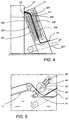
- the calendering station 22 comprises at least a pair of motor-driven roller sets 221, 222, facing each other and oriented downward. One of them and preferably the one next to the extruder 21 (see Figure 4), is fixed, while the other one (222) is movable with respect to the first. In particular it has to create a through-passage section 211 in the agglomerate layer exiting from extruder 21, in order to reduce it to a thin thickness 23, which is the definitive one of the laminate to be obtained.
- the through-passage section shall be adjustable and, for example, the movable roller set can be pivoting, around a hinge 225 coinciding for instance with the axis of the roller at the larger height.
- roller sets are preferably fully encompassed by continuous belts 223 and 224, which of course are movable along the direction of flow of the agglomerate layer.
- the two roller sets shall be moved by chains 226, motor-driven along the direction of rotation of the arrows F1 and F2.
- Downstream of the calendering station 222 is a conveyor belt 227 placed at the output side of the roller sets and able to transfer the thin agglomerate layer towards the subsequent stations.
- the layer exiting the calendering station 22 could, in theory, be transferred directly to the cutting station 6, if the agglomerate layer were to be dried naturally or if waiting periods were possible.
- this apparatus since this apparatus must be designed for a large hourly production, it is evident that, between the calendering station 22 and the cutting station, it is necessary to have additional stations able to accelerate the drying process of the agglomerate layer.
- a forced ventilation station 3 which comprises at least a fan 31 and a hood 32 placed over it to collect volatilisation products and to render the agglomerate layer suitable to be permanently engraved.
- the subsequent engraving station 4 comprises (see Figure 5) at least a first fixed roller 41 and a second rotating and engraved counter-roller 42, whose position with respect to the first roller can be adjusted according to the thickness of the agglomerate layer to be engraved, which passes between the two rollers.
- the adjustable roller is connected for instance with a handwheel 42 which, actuating for instance worm screws 44 which engage the support 45 of the engraved rotating counter-roller, causes it to move away from or towards the fixed roller 41.
- a rapid drying station 5 Downstream of the engraving station 4, there is a rapid drying station 5, to disperse in a short time all the volatile products which were used to constitute an effective initial agglomerate. It comprises a ventilated chamber 51, in which one or more fans 53 send forced air inside the chamber 51, and at least one exit 54 for the volatile products, which, as shall be made clear further on, are all conveyed inside a single collection hood 7, from which the volatile products are collected by a recovery device 8, so they can be re-entered into the cycle, through the starting set 1.
- the cutting station 6 At the output of the drying station 5, through one or more conveyor belts T, the cutting station 6 is reached, which comprises a slitting machine 61 to determine the lateral cuts of the finished laminate, and a vertical shear 62 able instead to determine the transverse cuts of the laminate 68.
- a counter 64 Downstream of the cutting station 6 is a counter 64 for packaging the laminate, cut in overlaid sheets, vertically movable in height, in order to support a pile of laminates, each with its own plastic sheath interposed.
- the packaging counter 65 comprises at least one reel 66 for the collection of the laminate and of the protection sheath 69 and it also comprises at least an additional stand-by reel 67.
- the agglomerate since the process for laminating the subject agglomerate must unfold without any snags, the agglomerate must necessarily be insofar as possible free of adherence to the various supports it encounters during the process. This problem is for the most part solved by the paraffin-based lubricants present in the agglomerate itself and by the talc chosen as an inert mineral charge, but the apparatus itself is also provided with a design feature for this purpose. All conveyors T and the conveyors 52 of the rapid drying station 5 are made up of non-stick and fire-proof meshes. Lastly, it should be noted that the whole laminate forming process is advantageously carried out at ambient temperature, which should be no lower than 18/20°C.
- the whole apparatus including the said microprocessor circuit 19 is run and regulated by a computerised electronic system (100), with synoptic display, which determines the adjustments of all the motor drives and/or regulation devices, such as the intervention time of the drying stations, the distances between the roller sets (221) and (222) etcetera.
- the computerised electronic system (100) runs and regulates the functional phases of the whole apparatus.
Landscapes
- Life Sciences & Earth Sciences (AREA)
- Engineering & Computer Science (AREA)
- Manufacturing & Machinery (AREA)
- Wood Science & Technology (AREA)
- Forests & Forestry (AREA)
- Dry Formation Of Fiberboard And The Like (AREA)
- Chemical And Physical Treatments For Wood And The Like (AREA)
- Veneer Processing And Manufacture Of Plywood (AREA)
- Laminated Bodies (AREA)
- Casting Or Compression Moulding Of Plastics Or The Like (AREA)
Priority Applications (7)
| Application Number | Priority Date | Filing Date | Title |
|---|---|---|---|
| DK97830086T DK0862990T3 (da) | 1997-02-28 | 1997-02-28 | Apparat til kontinuerlig fremstilling af træbaserede laminater |
| SI9730602T SI0862990T1 (en) | 1997-02-28 | 1997-02-28 | Apparatus for the continuous production of wood-based laminates |
| DE69724759T DE69724759T2 (de) | 1997-02-28 | 1997-02-28 | Vorrichtung zur kontinuierlichen Herstellung von auf Holz basierenden Laminaten |
| EP97830086A EP0862990B1 (de) | 1997-02-28 | 1997-02-28 | Vorrichtung zur kontinuierlichen Herstellung von auf Holz basierenden Laminaten |
| ES97830086T ES2206675T3 (es) | 1997-02-28 | 1997-02-28 | Aparato para la produccion continua de laminados a base de madera. |
| PT97830086T PT862990E (pt) | 1997-02-28 | 1997-02-28 | Equipamento para a producao em continuo a partir de um aglomerado maleavel de laminados a base de madeira destinados a forrar e a folhear |
| AT97830086T ATE249335T1 (de) | 1997-02-28 | 1997-02-28 | Vorrichtung zur kontinuierlichen herstellung von auf holz basierenden laminaten |
Applications Claiming Priority (1)
| Application Number | Priority Date | Filing Date | Title |
|---|---|---|---|
| EP97830086A EP0862990B1 (de) | 1997-02-28 | 1997-02-28 | Vorrichtung zur kontinuierlichen Herstellung von auf Holz basierenden Laminaten |
Publications (2)
| Publication Number | Publication Date |
|---|---|
| EP0862990A1 true EP0862990A1 (de) | 1998-09-09 |
| EP0862990B1 EP0862990B1 (de) | 2003-09-10 |
Family
ID=8230579
Family Applications (1)
| Application Number | Title | Priority Date | Filing Date |
|---|---|---|---|
| EP97830086A Expired - Lifetime EP0862990B1 (de) | 1997-02-28 | 1997-02-28 | Vorrichtung zur kontinuierlichen Herstellung von auf Holz basierenden Laminaten |
Country Status (7)
| Country | Link |
|---|---|
| EP (1) | EP0862990B1 (de) |
| AT (1) | ATE249335T1 (de) |
| DE (1) | DE69724759T2 (de) |
| DK (1) | DK0862990T3 (de) |
| ES (1) | ES2206675T3 (de) |
| PT (1) | PT862990E (de) |
| SI (1) | SI0862990T1 (de) |
Cited By (1)
| Publication number | Priority date | Publication date | Assignee | Title |
|---|---|---|---|---|
| WO2002026456A3 (en) * | 2000-09-29 | 2002-05-16 | Steinhoff Mfg Pty Ltd | Method of handling synthetic wood mouldings and article |
Citations (7)
| Publication number | Priority date | Publication date | Assignee | Title |
|---|---|---|---|---|
| GB388387A (en) * | 1930-07-24 | 1933-02-22 | Celluloid Corp | Improvements in the manufacture of moulded articles from cellulose derivatives |
| GB586198A (en) * | 1943-07-10 | 1947-03-11 | Ici Ltd | Production of modified cellulosic materials and articles having improved chemical and physical properties |
| GB880198A (en) * | 1959-06-15 | 1961-10-18 | Charles Lawrence Blake | Plastic containing composition and the process of making the same |
| US4112145A (en) * | 1974-09-09 | 1978-09-05 | S.U.B. Societa Utilizzazione Brevetti S.R.L. | Method of manufacturing a lining layer |
| JPS6042009A (ja) * | 1983-08-19 | 1985-03-06 | Sadao Nishibori | 木質合成板の成形方法 |
| EP0426619A2 (de) * | 1989-10-31 | 1991-05-08 | ICMA SAN GIORGIO S.p.A. | Verfahren zur Herstellung von Platten |
| US5096046A (en) * | 1990-03-14 | 1992-03-17 | Advanced Environmental Recycling Technologies, Inc. | System and process for making synthetic wood products from recycled materials |
-
1997
- 1997-02-28 PT PT97830086T patent/PT862990E/pt unknown
- 1997-02-28 EP EP97830086A patent/EP0862990B1/de not_active Expired - Lifetime
- 1997-02-28 AT AT97830086T patent/ATE249335T1/de not_active IP Right Cessation
- 1997-02-28 SI SI9730602T patent/SI0862990T1/xx unknown
- 1997-02-28 DK DK97830086T patent/DK0862990T3/da active
- 1997-02-28 DE DE69724759T patent/DE69724759T2/de not_active Expired - Fee Related
- 1997-02-28 ES ES97830086T patent/ES2206675T3/es not_active Expired - Lifetime
Patent Citations (7)
| Publication number | Priority date | Publication date | Assignee | Title |
|---|---|---|---|---|
| GB388387A (en) * | 1930-07-24 | 1933-02-22 | Celluloid Corp | Improvements in the manufacture of moulded articles from cellulose derivatives |
| GB586198A (en) * | 1943-07-10 | 1947-03-11 | Ici Ltd | Production of modified cellulosic materials and articles having improved chemical and physical properties |
| GB880198A (en) * | 1959-06-15 | 1961-10-18 | Charles Lawrence Blake | Plastic containing composition and the process of making the same |
| US4112145A (en) * | 1974-09-09 | 1978-09-05 | S.U.B. Societa Utilizzazione Brevetti S.R.L. | Method of manufacturing a lining layer |
| JPS6042009A (ja) * | 1983-08-19 | 1985-03-06 | Sadao Nishibori | 木質合成板の成形方法 |
| EP0426619A2 (de) * | 1989-10-31 | 1991-05-08 | ICMA SAN GIORGIO S.p.A. | Verfahren zur Herstellung von Platten |
| US5096046A (en) * | 1990-03-14 | 1992-03-17 | Advanced Environmental Recycling Technologies, Inc. | System and process for making synthetic wood products from recycled materials |
Non-Patent Citations (1)
| Title |
|---|
| PATENT ABSTRACTS OF JAPAN vol. 009, no. 168 (M - 396) 13 July 1985 (1985-07-13) * |
Cited By (1)
| Publication number | Priority date | Publication date | Assignee | Title |
|---|---|---|---|---|
| WO2002026456A3 (en) * | 2000-09-29 | 2002-05-16 | Steinhoff Mfg Pty Ltd | Method of handling synthetic wood mouldings and article |
Also Published As
| Publication number | Publication date |
|---|---|
| DE69724759D1 (de) | 2003-10-16 |
| SI0862990T1 (en) | 2004-02-29 |
| EP0862990B1 (de) | 2003-09-10 |
| DK0862990T3 (da) | 2004-01-19 |
| ES2206675T3 (es) | 2004-05-16 |
| PT862990E (pt) | 2004-02-27 |
| ATE249335T1 (de) | 2003-09-15 |
| DE69724759T2 (de) | 2004-08-05 |
Similar Documents
| Publication | Publication Date | Title |
|---|---|---|
| JP3658714B2 (ja) | 木質合成板の模様形成方法 | |
| US7923477B2 (en) | Carpet waste composite | |
| US6511757B1 (en) | Compression molding of synthetic wood material | |
| AU665897B2 (en) | Manufacturing process for panels or similar products made ofinsulating material and panel or product obtained by such process | |
| WO2002028617A1 (en) | Structural member and structure containing the same | |
| CN110014710A (zh) | 石塑面板、木质门扇复合结构及其制备方法 | |
| CA2809674A1 (en) | Structural substitutes made from polymer fibers | |
| EP0862990B1 (de) | Vorrichtung zur kontinuierlichen Herstellung von auf Holz basierenden Laminaten | |
| DE4125217A1 (de) | Mehrschichtformkoerper, haftschicht(en) fuer denselben sowie verwendung dieses mehrschichtformkoerpers und verfahren zur wiederverwendung von schichtmaterialien des formkoerpers | |
| EP4247632A1 (de) | Verbundbaustoffe und verfahren zur herstellung | |
| KR20170060776A (ko) | 참숯 가루를 함유한 친환경성 방습 마루 판재 및 그 제조방법 | |
| KR101905304B1 (ko) | 팽창질석보드의 제조방법 | |
| WO2014144193A1 (en) | Structural substitutes made from polymer fibers | |
| CN217196564U (zh) | 一种塑料袋生产用具有干燥下料机构的流延机 | |
| CN206855563U (zh) | 面包切片机 | |
| TW464601B (en) | ABS substrate extrusion process | |
| JPH10100321A (ja) | 合板及び前記合板の製造方法 | |
| EP0988965A3 (de) | Schaumkunststoffzusammensetzung und Verfahren zur Herstellung, aus diesen Zusammensetzungen hergestellte Substrate und Verfahren zur Herstellung, sowie aus diesen Substraten hergestellte Produkte und Verfahren zur Herstellung | |
| CN215241407U (zh) | 一种立式单板刨切机 | |
| KR20220140447A (ko) | 폐우레탄을 이용한 건축재의 제조 방법 및 폐우레탄을 이용하여 제조된 건축재를 포함하는 샌드위치 패널 | |
| JP4540816B2 (ja) | タイル及びその製造方法 | |
| CA2766186A1 (en) | Method for producing sheets from renewable raw materials in an endless process and a sheet of renewable raw materials | |
| WO2013115617A1 (en) | Flooring having pla layer | |
| JP2009067008A (ja) | 耐水性ボード | |
| WO2004014622A2 (en) | Compression molded panels |
Legal Events
| Date | Code | Title | Description |
|---|---|---|---|
| PUAI | Public reference made under article 153(3) epc to a published international application that has entered the european phase |
Free format text: ORIGINAL CODE: 0009012 |
|
| AK | Designated contracting states |
Kind code of ref document: A1 Designated state(s): AT BE CH DE DK ES FI FR GB GR IE IT LI LU MC NL PT SE |
|
| AX | Request for extension of the european patent |
Free format text: AL PAYMENT 980224;LT PAYMENT 980224;LV PAYMENT 980224;RO PAYMENT 980224;SI PAYMENT 980224 |
|
| 17P | Request for examination filed |
Effective date: 19990217 |
|
| AKX | Designation fees paid |
Free format text: AT BE CH DE DK ES FI FR GB GR IE IT LI LU MC NL PT SE |
|
| AXX | Extension fees paid |
Free format text: AL PAYMENT 19980224;LT PAYMENT 19980224;LV PAYMENT 19980224;RO PAYMENT 19980224;SI PAYMENT 19980224 |
|
| RBV | Designated contracting states (corrected) |
Designated state(s): AT BE CH DE DK ES FI FR GB GR IE IT LI LU MC NL PT SE |
|
| 17Q | First examination report despatched |
Effective date: 20011112 |
|
| GRAH | Despatch of communication of intention to grant a patent |
Free format text: ORIGINAL CODE: EPIDOS IGRA |
|
| GRAS | Grant fee paid |
Free format text: ORIGINAL CODE: EPIDOSNIGR3 |
|
| GRAA | (expected) grant |
Free format text: ORIGINAL CODE: 0009210 |
|
| AK | Designated contracting states |
Kind code of ref document: B1 Designated state(s): AT BE CH DE DK ES FI FR GB GR IE IT LI LU MC NL PT SE |
|
| AX | Request for extension of the european patent |
Extension state: AL LT LV RO SI |
|
| REG | Reference to a national code |
Ref country code: GB Ref legal event code: FG4D |
|
| REG | Reference to a national code |
Ref country code: CH Ref legal event code: EP |
|
| REF | Corresponds to: |
Ref document number: 69724759 Country of ref document: DE Date of ref document: 20031016 Kind code of ref document: P |
|
| REG | Reference to a national code |
Ref country code: IE Ref legal event code: FG4D |
|
| REG | Reference to a national code |
Ref country code: CH Ref legal event code: NV Representative=s name: BUGNION S.A. |
|
| REG | Reference to a national code |
Ref country code: SE Ref legal event code: TRGR |
|
| REG | Reference to a national code |
Ref country code: DK Ref legal event code: T3 |
|
| REG | Reference to a national code |
Ref country code: GR Ref legal event code: EP Ref document number: 20030405099 Country of ref document: GR |
|
| PG25 | Lapsed in a contracting state [announced via postgrant information from national office to epo] |
Ref country code: MC Free format text: LAPSE BECAUSE OF NON-PAYMENT OF DUE FEES Effective date: 20040228 Ref country code: LU Free format text: LAPSE BECAUSE OF NON-PAYMENT OF DUE FEES Effective date: 20040228 Ref country code: GB Free format text: LAPSE BECAUSE OF NON-PAYMENT OF DUE FEES Effective date: 20040228 Ref country code: FI Free format text: LAPSE BECAUSE OF NON-PAYMENT OF DUE FEES Effective date: 20040228 Ref country code: BE Free format text: LAPSE BECAUSE OF NON-PAYMENT OF DUE FEES Effective date: 20040228 Ref country code: AT Free format text: LAPSE BECAUSE OF NON-PAYMENT OF DUE FEES Effective date: 20040228 |
|
| PG25 | Lapsed in a contracting state [announced via postgrant information from national office to epo] |
Ref country code: LI Free format text: LAPSE BECAUSE OF NON-PAYMENT OF DUE FEES Effective date: 20040229 Ref country code: CH Free format text: LAPSE BECAUSE OF NON-PAYMENT OF DUE FEES Effective date: 20040229 |
|
| PG25 | Lapsed in a contracting state [announced via postgrant information from national office to epo] |
Ref country code: SE Free format text: LAPSE BECAUSE OF NON-PAYMENT OF DUE FEES Effective date: 20040301 Ref country code: IE Free format text: LAPSE BECAUSE OF NON-PAYMENT OF DUE FEES Effective date: 20040301 Ref country code: ES Free format text: LAPSE BECAUSE OF NON-PAYMENT OF DUE FEES Effective date: 20040301 Ref country code: DK Free format text: LAPSE BECAUSE OF NON-PAYMENT OF DUE FEES Effective date: 20040301 |
|
| REG | Reference to a national code |
Ref country code: ES Ref legal event code: FG2A Ref document number: 2206675 Country of ref document: ES Kind code of ref document: T3 |
|
| ET | Fr: translation filed | ||
| PLBE | No opposition filed within time limit |
Free format text: ORIGINAL CODE: 0009261 |
|
| STAA | Information on the status of an ep patent application or granted ep patent |
Free format text: STATUS: NO OPPOSITION FILED WITHIN TIME LIMIT |
|
| BERE | Be: lapsed |
Owner name: *VALENTI IMPERO Effective date: 20040228 |
|
| 26N | No opposition filed |
Effective date: 20040614 |
|
| PG25 | Lapsed in a contracting state [announced via postgrant information from national office to epo] |
Ref country code: NL Free format text: LAPSE BECAUSE OF NON-PAYMENT OF DUE FEES Effective date: 20040901 Ref country code: DE Free format text: LAPSE BECAUSE OF NON-PAYMENT OF DUE FEES Effective date: 20040901 |
|
| PG25 | Lapsed in a contracting state [announced via postgrant information from national office to epo] |
Ref country code: GR Free format text: LAPSE BECAUSE OF NON-PAYMENT OF DUE FEES Effective date: 20040903 |
|
| REG | Reference to a national code |
Ref country code: DK Ref legal event code: EBP |
|
| REG | Reference to a national code |
Ref country code: CH Ref legal event code: PL |
|
| GBPC | Gb: european patent ceased through non-payment of renewal fee | ||
| LTLA | Lt: lapse of european patent or patent extension |
Effective date: 20040228 |
|
| NLV4 | Nl: lapsed or anulled due to non-payment of the annual fee |
Effective date: 20040901 |
|
| EUG | Se: european patent has lapsed | ||
| PG25 | Lapsed in a contracting state [announced via postgrant information from national office to epo] |
Ref country code: PT Free format text: LAPSE BECAUSE OF NON-PAYMENT OF DUE FEES Effective date: 20041130 |
|
| REG | Reference to a national code |
Ref country code: IE Ref legal event code: MM4A |
|
| REG | Reference to a national code |
Ref country code: SI Ref legal event code: KO00 Effective date: 20041202 |
|
| REG | Reference to a national code |
Ref country code: ES Ref legal event code: FD2A Effective date: 20040301 |
|
| REG | Reference to a national code |
Ref country code: PT Ref legal event code: MM4A Effective date: 20041130 |
|
| REG | Reference to a national code |
Ref country code: FR Ref legal event code: ST Effective date: 20080229 |
|
| PG25 | Lapsed in a contracting state [announced via postgrant information from national office to epo] |
Ref country code: PT Free format text: LAPSE BECAUSE OF NON-PAYMENT OF DUE FEES Effective date: 20040228 |
|
| PG25 | Lapsed in a contracting state [announced via postgrant information from national office to epo] |
Ref country code: FR Free format text: LAPSE BECAUSE OF NON-PAYMENT OF DUE FEES Effective date: 20040229 |
|
| PGFP | Annual fee paid to national office [announced via postgrant information from national office to epo] |
Ref country code: IT Payment date: 20140821 Year of fee payment: 18 |
|
| PG25 | Lapsed in a contracting state [announced via postgrant information from national office to epo] |
Ref country code: IT Free format text: LAPSE BECAUSE OF NON-PAYMENT OF DUE FEES Effective date: 20150228 |