EP0863183B1 - Composition de propylene, procede pour la preparer, composition de polypropylene et articles moules - Google Patents
Composition de propylene, procede pour la preparer, composition de polypropylene et articles moules Download PDFInfo
- Publication number
- EP0863183B1 EP0863183B1 EP96939302A EP96939302A EP0863183B1 EP 0863183 B1 EP0863183 B1 EP 0863183B1 EP 96939302 A EP96939302 A EP 96939302A EP 96939302 A EP96939302 A EP 96939302A EP 0863183 B1 EP0863183 B1 EP 0863183B1
- Authority
- EP
- European Patent Office
- Prior art keywords
- propylene
- composition
- ethylene
- polypropylene composition
- polypropylene
- Prior art date
- Legal status (The legal status is an assumption and is not a legal conclusion. Google has not performed a legal analysis and makes no representation as to the accuracy of the status listed.)
- Expired - Lifetime
Links
Images


Classifications
-
- C—CHEMISTRY; METALLURGY
- C08—ORGANIC MACROMOLECULAR COMPOUNDS; THEIR PREPARATION OR CHEMICAL WORKING-UP; COMPOSITIONS BASED THEREON
- C08J—WORKING-UP; GENERAL PROCESSES OF COMPOUNDING; AFTER-TREATMENT NOT COVERED BY SUBCLASSES C08B, C08C, C08F, C08G or C08H
- C08J5/00—Manufacture of articles or shaped materials containing macromolecular substances
- C08J5/18—Manufacture of films or sheets
-
- C—CHEMISTRY; METALLURGY
- C08—ORGANIC MACROMOLECULAR COMPOUNDS; THEIR PREPARATION OR CHEMICAL WORKING-UP; COMPOSITIONS BASED THEREON
- C08L—COMPOSITIONS OF MACROMOLECULAR COMPOUNDS
- C08L23/00—Compositions of homopolymers or copolymers of unsaturated aliphatic hydrocarbons having only one carbon-to-carbon double bond; Compositions of derivatives of such polymers
- C08L23/02—Compositions of homopolymers or copolymers of unsaturated aliphatic hydrocarbons having only one carbon-to-carbon double bond; Compositions of derivatives of such polymers not modified by chemical after-treatment
- C08L23/10—Homopolymers or copolymers of propene
- C08L23/12—Polypropene
-
- B—PERFORMING OPERATIONS; TRANSPORTING
- B32—LAYERED PRODUCTS
- B32B—LAYERED PRODUCTS, i.e. PRODUCTS BUILT-UP OF STRATA OF FLAT OR NON-FLAT, e.g. CELLULAR OR HONEYCOMB, FORM
- B32B27/00—Layered products comprising a layer of synthetic resin
- B32B27/32—Layered products comprising a layer of synthetic resin comprising polyolefins
-
- C—CHEMISTRY; METALLURGY
- C08—ORGANIC MACROMOLECULAR COMPOUNDS; THEIR PREPARATION OR CHEMICAL WORKING-UP; COMPOSITIONS BASED THEREON
- C08F—MACROMOLECULAR COMPOUNDS OBTAINED BY REACTIONS ONLY INVOLVING CARBON-TO-CARBON UNSATURATED BONDS
- C08F255/00—Macromolecular compounds obtained by polymerising monomers on to polymers of hydrocarbons as defined in group C08F10/00
- C08F255/02—Macromolecular compounds obtained by polymerising monomers on to polymers of hydrocarbons as defined in group C08F10/00 on to polymers of olefins having two or three carbon atoms
-
- C—CHEMISTRY; METALLURGY
- C08—ORGANIC MACROMOLECULAR COMPOUNDS; THEIR PREPARATION OR CHEMICAL WORKING-UP; COMPOSITIONS BASED THEREON
- C08F—MACROMOLECULAR COMPOUNDS OBTAINED BY REACTIONS ONLY INVOLVING CARBON-TO-CARBON UNSATURATED BONDS
- C08F297/00—Macromolecular compounds obtained by successively polymerising different monomer systems using a catalyst of the ionic or coordination type without deactivating the intermediate polymer
- C08F297/06—Macromolecular compounds obtained by successively polymerising different monomer systems using a catalyst of the ionic or coordination type without deactivating the intermediate polymer using a catalyst of the coordination type
- C08F297/08—Macromolecular compounds obtained by successively polymerising different monomer systems using a catalyst of the ionic or coordination type without deactivating the intermediate polymer using a catalyst of the coordination type polymerising mono-olefins
-
- C—CHEMISTRY; METALLURGY
- C08—ORGANIC MACROMOLECULAR COMPOUNDS; THEIR PREPARATION OR CHEMICAL WORKING-UP; COMPOSITIONS BASED THEREON
- C08F—MACROMOLECULAR COMPOUNDS OBTAINED BY REACTIONS ONLY INVOLVING CARBON-TO-CARBON UNSATURATED BONDS
- C08F297/00—Macromolecular compounds obtained by successively polymerising different monomer systems using a catalyst of the ionic or coordination type without deactivating the intermediate polymer
- C08F297/06—Macromolecular compounds obtained by successively polymerising different monomer systems using a catalyst of the ionic or coordination type without deactivating the intermediate polymer using a catalyst of the coordination type
- C08F297/08—Macromolecular compounds obtained by successively polymerising different monomer systems using a catalyst of the ionic or coordination type without deactivating the intermediate polymer using a catalyst of the coordination type polymerising mono-olefins
- C08F297/083—Macromolecular compounds obtained by successively polymerising different monomer systems using a catalyst of the ionic or coordination type without deactivating the intermediate polymer using a catalyst of the coordination type polymerising mono-olefins the monomers being ethylene or propylene
-
- C—CHEMISTRY; METALLURGY
- C08—ORGANIC MACROMOLECULAR COMPOUNDS; THEIR PREPARATION OR CHEMICAL WORKING-UP; COMPOSITIONS BASED THEREON
- C08J—WORKING-UP; GENERAL PROCESSES OF COMPOUNDING; AFTER-TREATMENT NOT COVERED BY SUBCLASSES C08B, C08C, C08F, C08G or C08H
- C08J5/00—Manufacture of articles or shaped materials containing macromolecular substances
-
- C—CHEMISTRY; METALLURGY
- C08—ORGANIC MACROMOLECULAR COMPOUNDS; THEIR PREPARATION OR CHEMICAL WORKING-UP; COMPOSITIONS BASED THEREON
- C08L—COMPOSITIONS OF MACROMOLECULAR COMPOUNDS
- C08L23/00—Compositions of homopolymers or copolymers of unsaturated aliphatic hydrocarbons having only one carbon-to-carbon double bond; Compositions of derivatives of such polymers
- C08L23/02—Compositions of homopolymers or copolymers of unsaturated aliphatic hydrocarbons having only one carbon-to-carbon double bond; Compositions of derivatives of such polymers not modified by chemical after-treatment
- C08L23/10—Homopolymers or copolymers of propene
-
- C—CHEMISTRY; METALLURGY
- C08—ORGANIC MACROMOLECULAR COMPOUNDS; THEIR PREPARATION OR CHEMICAL WORKING-UP; COMPOSITIONS BASED THEREON
- C08L—COMPOSITIONS OF MACROMOLECULAR COMPOUNDS
- C08L51/00—Compositions of graft polymers in which the grafted component is obtained by reactions only involving carbon-to-carbon unsaturated bonds; Compositions of derivatives of such polymers
- C08L51/06—Compositions of graft polymers in which the grafted component is obtained by reactions only involving carbon-to-carbon unsaturated bonds; Compositions of derivatives of such polymers grafted on to homopolymers or copolymers of aliphatic hydrocarbons containing only one carbon-to-carbon double bond
-
- C—CHEMISTRY; METALLURGY
- C08—ORGANIC MACROMOLECULAR COMPOUNDS; THEIR PREPARATION OR CHEMICAL WORKING-UP; COMPOSITIONS BASED THEREON
- C08L—COMPOSITIONS OF MACROMOLECULAR COMPOUNDS
- C08L53/00—Compositions of block copolymers containing at least one sequence of a polymer obtained by reactions only involving carbon-to-carbon unsaturated bonds; Compositions of derivatives of such polymers
-
- C—CHEMISTRY; METALLURGY
- C08—ORGANIC MACROMOLECULAR COMPOUNDS; THEIR PREPARATION OR CHEMICAL WORKING-UP; COMPOSITIONS BASED THEREON
- C08F—MACROMOLECULAR COMPOUNDS OBTAINED BY REACTIONS ONLY INVOLVING CARBON-TO-CARBON UNSATURATED BONDS
- C08F110/00—Homopolymers of unsaturated aliphatic hydrocarbons having only one carbon-to-carbon double bond
- C08F110/04—Monomers containing three or four carbon atoms
- C08F110/06—Propene
-
- C—CHEMISTRY; METALLURGY
- C08—ORGANIC MACROMOLECULAR COMPOUNDS; THEIR PREPARATION OR CHEMICAL WORKING-UP; COMPOSITIONS BASED THEREON
- C08F—MACROMOLECULAR COMPOUNDS OBTAINED BY REACTIONS ONLY INVOLVING CARBON-TO-CARBON UNSATURATED BONDS
- C08F210/00—Copolymers of unsaturated aliphatic hydrocarbons having only one carbon-to-carbon double bond
- C08F210/04—Monomers containing three or four carbon atoms
- C08F210/06—Propene
-
- C—CHEMISTRY; METALLURGY
- C08—ORGANIC MACROMOLECULAR COMPOUNDS; THEIR PREPARATION OR CHEMICAL WORKING-UP; COMPOSITIONS BASED THEREON
- C08J—WORKING-UP; GENERAL PROCESSES OF COMPOUNDING; AFTER-TREATMENT NOT COVERED BY SUBCLASSES C08B, C08C, C08F, C08G or C08H
- C08J2323/00—Characterised by the use of homopolymers or copolymers of unsaturated aliphatic hydrocarbons having only one carbon-to-carbon double bond; Derivatives of such polymers
- C08J2323/02—Characterised by the use of homopolymers or copolymers of unsaturated aliphatic hydrocarbons having only one carbon-to-carbon double bond; Derivatives of such polymers not modified by chemical after treatment
- C08J2323/10—Homopolymers or copolymers of propene
-
- C—CHEMISTRY; METALLURGY
- C08—ORGANIC MACROMOLECULAR COMPOUNDS; THEIR PREPARATION OR CHEMICAL WORKING-UP; COMPOSITIONS BASED THEREON
- C08L—COMPOSITIONS OF MACROMOLECULAR COMPOUNDS
- C08L23/00—Compositions of homopolymers or copolymers of unsaturated aliphatic hydrocarbons having only one carbon-to-carbon double bond; Compositions of derivatives of such polymers
- C08L23/02—Compositions of homopolymers or copolymers of unsaturated aliphatic hydrocarbons having only one carbon-to-carbon double bond; Compositions of derivatives of such polymers not modified by chemical after-treatment
- C08L23/04—Homopolymers or copolymers of ethene
- C08L23/08—Copolymers of ethene
- C08L23/0807—Copolymers of ethene with unsaturated hydrocarbons only containing four or more carbon atoms
- C08L23/0815—Copolymers of ethene with unsaturated hydrocarbons only containing four or more carbon atoms with aliphatic 1-olefins containing one carbon-to-carbon double bond
-
- C—CHEMISTRY; METALLURGY
- C08—ORGANIC MACROMOLECULAR COMPOUNDS; THEIR PREPARATION OR CHEMICAL WORKING-UP; COMPOSITIONS BASED THEREON
- C08L—COMPOSITIONS OF MACROMOLECULAR COMPOUNDS
- C08L23/00—Compositions of homopolymers or copolymers of unsaturated aliphatic hydrocarbons having only one carbon-to-carbon double bond; Compositions of derivatives of such polymers
- C08L23/02—Compositions of homopolymers or copolymers of unsaturated aliphatic hydrocarbons having only one carbon-to-carbon double bond; Compositions of derivatives of such polymers not modified by chemical after-treatment
- C08L23/16—Ethylene-propylene or ethylene-propylene-diene copolymers
Definitions
- This invention relates to propylene compositions, more specifically propylene compositions comprising a propylene homopolymer and a propylene-ethylene copolymer, processes for the production thereof, polypropylene compositions based on said propylene composition and molded articles from those compositions, particularly injection molded articles, extruded sheets, films and blow molded articles.
- Polypropylene resins are relatively cheap and have good properties, and so have a widespread use such as various molded articles, e.g., injection molded articles such as sheets, containers, caps and those having a hinge structure; films; and blow molded articles such as air ducts. Films of polypropylene resins have been extensively employed as packaging materials for foods and fiber products, taking advantage of their mechanical, optical and thermal properties.
- polypropylene compositions each based on propylene homopolymer; random copolymers of propylene and ⁇ -olefins, especially ethylene; and propylene homopolymer/propylene- ⁇ -olefin copolymer.
- propylene homopolymer has high rigidity, good heat resistance, but insufficient flexibility, poor impact resistance, especially low-temperature impact resistance and poor tear strength when it is formed into films.
- Random copolymers of propylene and ⁇ -olefins have good transparency and good flexibility, but poor heat resistance and poor low-temperature impact resistance.
- known propylene compositions comprising a propylene homopolymer and a propylene-ethylene copolymer have good heat resistance and low-temperature impact resistance, they have been extensively employed in a wide variety of industrial fields including automobiles and appliances. However, they are inferior in transparency and gloss to homopolymer, but have high mold shrinkage factor like homopolymer, and also they are inferior in tear strength and flexibility to copolymers. In any case, a phenomenon of whitening is observed in said known compositions when impacting and bending, and their whitening resistance is insufficient.
- the methods to improve their insufficient properties include a method of modifying the properties of homopolymers, copolymers or compositions and a method using additives.
- a general method has been employed wherein the mold shrinkage factor of the composition is improved by filling with inorganic materials, such as talc.
- the method requires a large quantity of inorganic materials such as talc to improve the mold shrinkage factor, which results in an increased weight of the molded article and a remarkably poor appearance.
- a method has been employed wherein an ethylene content in the copolymer of the composition is lowered to improve the transparency and gloss.
- lowering the ethylene content in the copolymer contributes to an improvement in gloss, with the reduction in low-temperature impact resistance and rigidity.
- JP-A-60-28411 discloses a process of producing a high-rigidity ethylene-propylene copolymer, i.e., a propylene composition wherein propylene and ethylene are copolymerized in three consecutive stages with varying the ethylene content.
- the composition obtained by this process has high rigidity, good whitening resistance, good impact resistance and good heat resistance, but more improvements are required in the transparency, gloss, appearance of the molded articles and mold shrinkage factor on molding.
- JP-B-7-30145 discloses a propylene block copolymer, i.e., a propylene composition which comprises a crystalline polypropylene block and an ethylene-propylene random copolymer block, the content of the crystalline polypropylene component being 55-95 wt.%, the ratio of the intrinsic viscosities of both components ([ ⁇ ] EP /[ ⁇ ] PP ) being 0.5-2.0 and a glass transition temperature of the ethylene-propylene random copolymer being -30°C or lower.
- a propylene block copolymer i.e., a propylene composition which comprises a crystalline polypropylene block and an ethylene-propylene random copolymer block, the content of the crystalline polypropylene component being 55-95 wt.%, the ratio of the intrinsic viscosities of both components ([ ⁇ ] EP /[ ⁇ ] PP ) being 0.5-2.0 and a glass transition temperature of the ethylene-propylene random
- This composition has substantially the same range in respect of the content of the ethylene-propylene copolymer and the ratio of the intrinsic viscosity of the propylene homopolymer to that of the copolymer, has good mechanical properties such as impact resistance and rigidity, but more improvements are required in the transparency, gloss and appearance, especially stress-whitening resistance of the molded articles, and the mold shrinkage factor on molding.
- JP-A-6-93061 discloses a melt-kneaded polypropylene block copolymer obtained by polymerizing a monomer based on propylene to form a polymer comprising polypropylene (component A) in an amount of 60-80% by weight to the total polymer amount, and then polymerizing a mixture of ethylene and propylene to form an ethylene-propylene copolymer (component B) having an ethylene content of 20-50% by weight, and melt-kneading the resulting polypropylene block copolymer, wherein the intrinsic viscosity ([ ⁇ B ]) of the ethylene-propylene copolymer is at least 2.0 dl/g and the ratio ([ ⁇ ] B /[ ⁇ ] A ) of the intrinsic viscosity of the component B to the component A is 1.8 or less.
- This composition has substantially the same range in respect of the content of the ethylene-propylene copolymer and the ratio of the intrinsic viscosity of the propylene homopolymer to the copolymer, has good low-temperature impact resistance, good blocking resistance and good appearance, but more improvements are required in mechanical properties such as rigidity and mold shrinkage factor on molding.
- JP-A-6-328640 discloses a multilayered film with a largely improved tear strength wherein a polypropylene resin layer is laminated on both surfaces of a straight chain low-density polyethylene layer.
- a compatibility of the laminating low-density polyethylene with polypropylene resin may be not substantially good, and so fish eye is easy to occur when the film is remelted and reused.
- JP-A-52-126450 discloses a blend of three components comprising an ethylene- ⁇ -olefin copolymer rubber, polypropylene or high-density polyethylene and paraffin or naphthene oil. This blend has good flexibility, but lower heat resistance.
- JP-A-4-282232 discloses a resin tubular body wherein a rigid portion produced from a rigid polyolefin resin and a flexible portion produced from a thermoplastic elastomer are connected in series with each other. This tubular body may be insufficient in the bonding strength between the rigid portion and the flexible portion.
- An object of the invention is to provide a propylene composition suitable for a base resin for a polypropylene composition having various excellent properties of molded articles such as impact resistance, especially low-temperature impact resistance, rigidity, tear strength, heat resistance, transparency, gloss and stress-whitening resistance, etc., and excellent balance of said properties as well as mold shrinkage factor on molding, and also a process for the production of the propylene composition.
- Another object of the invention is to provide a polypropylene composition comprising the propylene composition as a base resin.
- Further object of the invention is to provide a variety of molded articles from the polypropylene composition and a process for the production thereof.
- the present inventors have studied the propylene type compositions to achieve the above-mentioned objects, and found that a propylene composition produced by subjecting propylene alone and then a mixture of propylene and ethylene to a continuous vapor phase polymerization in the presence of a catalyst for a stereoregular olefin polymerization comprising a titanium-containing solid catalyst component of a large particle size, is excellent in respect of impact resistance, especially low-temperature impact resistance, rigidity, transparency, stress-whitening resistance, mold shrinkage factor on molding as well as balance of said properties, when an intrinsic viscosity of the propylene-ethylene copolymer, an intrinsic viscosity ratio of both components and a product of the intrinsic viscosity ratio and the weight ratio of both components are in a certain range.
- the present invention relates to a propylene composition (A) comprising a propylene homopolymer (PP) and a propylene-ethylene copolymer (RC), characterized in that an intrinsic viscosity ([ ⁇ ] RC ) of the propylene-ethylene copolymer is in the range of 1.7 to 2.8 dl/g, the ratio ([ ⁇ ] RC /[ ⁇ ] PP ) of an intrinsic viscosity of the propylene-ethylene copolymer (RC) to an intrinsic viscosity of the propylene homopolymer (PP) is in the range of 0.7 to 1.2 and a product [(W PP /W RC ) x ([ ⁇ ] RC /[ ⁇ ] PP )] of the weight ratio (W PP /W RC ) of the propylene homopolymer (PP) to the propylene-ethylene copolymer (RC) and the intrinsic viscosity ratio ([ ⁇ ] RC /[ ⁇ ] PP )
- the invention also relates to a process for the production of the propylene composition (A), which comprises conducting a first polymerization step wherein propylene is singly polymerized in a vapor phase in the presence of a catalyst for a stereoregular olefin polymerization which comprises a combination of
- the invention further relates to a polypropylene composition (C) which comprises the above-mentioned propylene composition (A) as a main component and an additive to be added, if desired.
- the invention further relates to a molded article (D) from the polypropylene composition, especially an injection molded article, sheets, films and a blow molded article.
- the propylene homopolymer (PP) is a high crystalline, i.e., stereoregular polypropylene having an isotactic pentad (P) of not less than 0.95, preferably not less than 0.955.
- the isotactic pentad (P) of the propylene homopolymer (PP) has an effect on the mechanical properties of the molded articles (D) such as rigidity, heat resistance, etc. Higher pentad value provides higher rigidity and heat resistance.
- the propylene-ethylene copolymer (RC) is an ethylene-propylene random copolymer containing the ethylene polymeric unit of 25 to 55 wt.%, preferably 30 to 55 wt.% on the weight basis of the copolymer (RC).
- the ethylene polymeric unit in the propylene-ethylene copolymer (RC) has an effect on the rigidity, flexibility, impact resistance, especially low-temperature impact resistance, and stress-whitening resistance of the molded articles (D). Higher ethylene polymeric unit provides more improved flexibility and impact resistance. However, excessive unit affects the dispersibility of propylene-ethylene copolymer (RC) in propylene homopolymer (PP), which results in lowering the transparency, gloss and stress-whitening resistance, etc. of the molded articles (D).
- the intrinsic viscosity ([ ⁇ ] RC ) as determined in tetralin at 135°C is in the range of 1.7 to 2.8 dl/g
- the ratio ([ ⁇ ] RC /[ ⁇ ] PP ) of the intrinsic viscosity ([ ⁇ ] RC ) of the copolymer to the intrinsic viscosity ([ ⁇ ] PP ) of propylene homopolymer as determined under the same condition is in the range of 0.7 to 1.2, preferably 0.8 to 1.2.
- the intrinsic viscosity ([ ⁇ ] RC ) of propylene-ethylene copolymer (RC) has an effect on the molding cycle of the polypropylene composition (C), the film-forming property when it is formed into film, and the mechanical properties of molded articles (D) such as rigidity, heat resistance, etc.
- the ratio [[ ⁇ ] RC /[ ⁇ ] PP ] of the intrinsic viscosity of propylene-ethylene copolymer (RC) to propylene homopolymer (PP) affects the dispersibility of propylene-ethylene copolymer (RC) in propylene homopolymer (PP).
- the propylene-ethylene copolymer (RC) contains not less than 80 wt.%, preferably 85 wt.% of a component soluble in xylene at 20°C, on the weight basis of the propylene-ethylene copolymer (RC).
- CXS RC weight % (CXS RC ) of the component soluble in xylene at 20°C in the propylene-ethylene copolymer (RC) cannot be directly measured, it is derived from the weight % (CXS PP ) of the component soluble in xylene at 20°C in the propylene homopolymer (PP), the weight % (CXS WHOLE ) of the component soluble in xylene at 20°C in the whole composition (A) and the weight % (W RC ) of the propylene-ethylene copolymer (RC), in accordance with the following equation.
- CXS RC ⁇ CXS WHOLE - (1 - W RC /100)CXS PP ⁇ /(W RC /100)
- the weight ratio (W PP /W RC ) of propylene homopolymer (PP) to propylene-ethylene copolymer (RC) is such that a product [[ ⁇ ] RC /[ ⁇ ] PP ] x (W PP /W RC ) of said weight ratio (W PP /W RC ) and the intrinsic viscosity ratio [[ ⁇ ] RC /[ ⁇ ] PP ] of both components is in the range of 1.0 to 3.0.
- the product of the weight ratio and the intrinsic viscosity of both components is an index showing the mold shrinkage factor of the polypropylene composition (C).
- Lower product value provides more improved mold shrinkage factor as well as tear strength and weld strength of molded articles (D), but provides a great reduction in heat resistance and rigidity of molded article (D).
- higher product value lowers the stress-whitening resistance and does not provide the desired mold shrinkage factor as well as the improvement effects in tear strength and weld strength.
- the propylene composition (A) comprises 22 to 40 wt.%, preferably 25 to 40 wt.% of propylene-ethylene copolymer (RC), on the weight basis of the composition (A).
- the propylene composition (A) has a narrow dispersing molecular-weight distribution wherein Q value (Mw/Mn) is not more than 5, preferably not more than 4.5. Wider molecular weight distribution lowers the gloss and weld strength of molded articles (D).
- the propylene composition (A) of the present invention satisfying the above-mentioned various properties is suitably used as a base resin in the polypropylene composition (C) for the manufacture of molded articles having excellent mechanical properties such as mold shrinkage factor on molding and film-forming property, as well as transparency, gloss, rigidity, flexibility, impact resistance, especially low-temperature impact resistance, tear strength, weld strength, and excellent balance of the properties.
- the propylene composition (A) of the invention may be produced by any method, if it satisfies the above-mentioned properties.
- the composition can be prepared by mixing propylene homopolymer (PP) and propylene-ethylene copolymer (RC) as produced separately, in a mixing equipment, but it can be suitably prepared by the processes of the present invention.
- the process for the production of the propylene composition (A) according to the present invention is characterized by producing the propylene homopolymer in a vapor phase in a first stage in the presence of a catalyst for a stereoregular olefin polymerization which comprises (a) a titanium-containing solid catalyst component, (b) an organoaluminum compound and (c) an organosilicon compound (first polymerization step) and successively producing the propylene-ethylene copolymer (second polymerization step).
- a catalyst for a stereoregular olefin polymerization which comprises (a) a titanium-containing solid catalyst component, (b) an organoaluminum compound and (c) an organosilicon compound (first polymerization step) and successively producing the propylene-ethylene copolymer (second polymerization step).
- the titanium-containing solid catalyst component can be used any known components, so long as they are titanium compounds supported on an inorganic carrier such as magnesium, silica and aluminum compounds, or an organic carrier such as polystyrene, and those supported on such carriers reacted with an electron donor compound such as ethers and esters, as is necessary.
- an inorganic carrier such as magnesium, silica and aluminum compounds, or an organic carrier such as polystyrene, and those supported on such carriers reacted with an electron donor compound such as ethers and esters, as is necessary.
- the catalyst components (a) can include the titanium-containing solid catalyst components produced by spraying an alcohol solution of a magnesium compound, partially drying a solid component and treating the dry solid component with titanium halides and an electron donor compound (JP-A-3-119003) and the titanium-containing solid catalyst component prepared by dissolving a magnesium compound in tetrahydrofuran/alcohol/ electron donor and treating magnesium precipitated by a TiCl 4 alone or a combination thereof with an electron donor, with titanium halides and electron donor compounds (JP-A-4-103604).
- the titanium-containing solid catalyst component (a) are used those having an average particle size of 25 to 300 ⁇ m, preferably 30 to 150 ⁇ m. If the average particle size of the titanium-containing solid catalyst component is not more than 25 ⁇ m, the flowability of the powder of the propylene composition (A) is remarkably lost, thus resulting in the contamination within the polymerization system by adhesion of the powders to the wall of the polymerization reactor and the agitating element, etc., and further resulting in difficulty in the transfer of the powders discharged from the polymerization reactor, which leads to a great hindrance to a steady operation.
- titanium-containing catalyst component (a) are preferable those having the uniformity of not more than 2.0 in the normal distribution. If the uniformity exceeds 2.0, the powder flowability of the propylene composition (A) get worse, so that the steady operation continuing the first polymerization step and the second polymerization step becomes difficult.
- organoaluminum compound (b) can be used the organoaluminum compounds of the formula AlR 1 m X 3-m wherein R 1 is a hydrocarbyl group of 1-20 carbons, X is a halogen atom and m is a positive number of 3 ⁇ m ⁇ 1.5.
- triethylaluminum is used.
- organoaluminum compounds may be used alone or in admixture with two or more kinds.
- methyltrimethoxysilane ethyltrimethoxysilane, n-propyltrimethoxysilane, phenylmethyldimethoxysilane, t-butyltrimethoxysilane, phenyltriethoxysilane, methylethyldimethoxysilane, methylphenyldiethoxysilane, dimethyldimethoxysilane, dimethyldiethoxysilane, diisopropyldimethoxysilane, diisobutyldimethoxysilane, di-t-butyldimethoxysilane, diphenyldimethoxysilane, trimethylmethoxysilane, cyclohexylmethyldimethoxysilane, trimethylethoxysilane, etc.
- diisobutyldimethoxysilane diisopropyldimethoxysilane, di-t-butyldimethoxysilane, cyclohexylmethyldimethoxysilane and diphenyldimethoxysilane are used.
- organosilicon compounds may be used alone or in admixture with two or more kinds.
- the titanium-containing solid catalyst component (a) is preactivated by reaction with ⁇ -olefins in the presence of an organoaluminum compound (b') and, as is necessary, an organosilane compound (c'), prior to homopolymerization of propylene in the first polymerization step.
- the amount of the organoaluminum compound (b') used is not limited, but the compound (b') is usually used in the range of 0.1 to 40 mols, preferably 0.3 to 20 mols per mol of a titanium atom in the titanium-containing solid catalyst component, and it is reacted at 10-80°C over a period of 10 minutes to 48 hours with ⁇ -olefin in an amount of 0.1 to 100 grams, preferably 0.5 to 50 grams based on 1 g of the titanium-containing solid catalyst component.
- the organosilane compound (c') may be previously used in the range of 0.01 to 10 mols, preferably 0.05 to 5 mols per mole of the organoaluminum compound.
- the organoaluminum compounds (b') used in the preactivation can include the above-illustrated organoaluminum compounds (b) used for the polymerization of propylene.
- the organoaluminum compounds (b') can be used the kinds same as or different from the organoaluminum compound (b) used in the polymerization of propylene.
- triethylaluminum is used.
- the organosilane compound (c') used in the preactivation as is necessary can include the same kinds as the above-recited organosilicon compounds (c).
- the organosilane compounds (c') can be used the kinds same as or different from the organosilicon compound (c) used in the polymerization of propylene.
- diisobutyldimethoxysilane, diisopropyldimethoxysilane, di-t-butyldimethoxysilane, cyclohexylmethyldimethoxysilane and diphenyldimethoxysilane are used.
- ⁇ -olefins used in the preactivation of the titanium-containing solid catalyst component (a) are ethylene, propylene, 1-butene, 1-pentene, 1-hexene, 1-octene, 1-decene, 1-dodecene, 1-tetradecene, 1-hexadecene, 1-octadecene, 1-eicosene, 4-methyl-1-pentene, 3-methyl-1-pentene, etc.
- olefins may be used alone or in admixture with two or more kinds.
- a molecular weight modifier such as hydrogen can be used in combination to modify the molecular weight of the polymer.
- the inert solvents used in the preactivation of the titanium-containing solid catalyst component (a) are those which do not give a remarkable effect on the polymerization reaction, including liquid saturated hydrocarbons such as hexane, heptane, octane, decane, dodecane and liquid paraffin and a silicone oil having a dimethylpolysiloxane structure.
- These inert solvents may be a single solvent or a mixed solvent of two or more kinds.
- the first polymerization step wherein propylene is polymerized in a vapor phase in the presence of the preactivated titanium-containing solid catalyst component (a) to produce a propylene homopolymer (PP) and then the second polymerization step wherein ethylene and propylene are copolymerized to produce a propylene-ethylene copolymer (RC).
- the first polymerization step is not limited to a vapor phase polymerization, and may use a slurry polymerization and a bulk polymerization.
- the subsequent second polymerization step is preferably a vapor phase polymerization.
- the first polymerization step also preferably uses a vapor phase polymerization.
- the propylene-ethylene copolymer (RC) dissolves out in the solution, which results in the difficulty in the continuation of a stable operation.
- the polymerization conditions for the propylene homopolymer (PP) are varied depending on a polymerization process.
- propylene is polymerized at a polymerization temperature of 20 to 120°C, preferably 40 to 100°C and a polymerization pressure of from atmospheric pressure to 9.9 MPa, preferably 0.59 to 5.0 MPa in the presence of a stereoregular catalyst comprising (a) a titanium-containing solid catalyst component which has been preactivated by mixing and agitating prescribed amounts of powders, (b) an organoaluminum component and (c) an organosilicon compound, to produce a propylene homopolymer (A).
- a stereoregular catalyst comprising (a) a titanium-containing solid catalyst component which has been preactivated by mixing and agitating prescribed amounts of powders, (b) an organoaluminum component and (c) an organosilicon compound, to produce a propylene homopolymer (A).
- the ratio, Al/Ti of (b) the organoaluminum compound used to (a) the titanium-containing solid catalyst component used is 1-500 (molar ratio), preferably 10-300.
- the number of mols of (a) the titanium-containing solid catalyst component refers to substantially the number of g atoms of Ti in (a) the titanium-containing solid catalyst component.
- the ratio, b/c of (c) the organosilicon compound used to (b) the organoaluminum component used is 1-10 (molar ratio), preferably 1.5-8.
- a molecular weight modifier such as hydrogen can be used upon polymerization. It is performed so that the intrinsic viscosity of propylene homopolymer (PP) can meet the requirements for the present invention. After the propylene homopolymer (PP) was polymerized, a part of the resultant powders is taken out and used for the measurement of the intrinsic viscosity ([ ⁇ ] PP ), melt flow rate (MFR PP ), amount of a soluble component in xylene at 20 °C, isotactic pentad (P) and polymerization yield per weight of catalyst.
- a molecular weight modifier such as hydrogen can be used upon polymerization. It is performed so that the intrinsic viscosity of propylene homopolymer (PP) can meet the requirements for the present invention. After the propylene homopolymer (PP) was polymerized, a part of the resultant powders is taken out and used for the measurement of the intrinsic viscosity ([ ⁇ ] PP ), melt flow rate (MFR
- the second polymerization step is carried out wherein a mixed monomer of ethylene and propylene is copolymerized at a polymerization temperature of 20 to 120°C, preferably 40 to 100°C and a polymerization pressure of from atmospheric pressure to 9.9 MPa, preferably 0.59 to 5.0 MPa, to produce a propylene-ethylene copolymer (RC).
- the ethylene content in the propylene-ethylene copolymer (RC) is adjusted so as to provide 25 to 55 wt.%, by controlling a gas molar ratio of an ethylene monomer to a propylene monomer in the comonomer gas.
- the weight of the propylene-ethylene copolymer (RC) relative to the weight of the propylene homopolymer (PP) is adjusted so as to provide 22 to 40 wt.%, by controlling the polymerization time and using an agent for regulating the polymerization activity of the catalyst such as carbon monoxide and hydrogen sulfide. Further, the molecular weight of the propylene-ethylene copolymer (RC) is regulated so that the intrinsic viscosity of the propylene-ethylene copolymer (RC) can meet the requirements for the propylene composition (A), by adding a molecular weight modifier such as hydrogen upon the polymerization of the propylene-ethylene copolymer. Hydrogen is fed so that the Q value (Mw/Mn) of the propylene composition (A) can meet the requirements for the propylene composition (A).
- the polymerization system may be any of batch, semi-continuous and continuous systems, but a continuous polymerization is industrially preferable.
- the monomer can be removed from the polymerization system to prepare a particulate polymer.
- the resultant polymer is used for the measurement of the intrinsic viscosity ([ ⁇ ] WHOLE ), amount of the soluble component in xylene at 20°C, Q value (Mw/Mn), ethylene content and polymerization yield per weight of the catalyst.
- the polypropylene composition (C) of the present invention is the composition comprising said propylene composition (A) as a base resin in which a desired additive component is incorporated in compliance with the required properties for the molded article and the molding method.
- the polypropylene composition (C) of the present invention may usually contain, within the range that would not adversely affect the object of the invention, various types of additives commonly employed for polyolefin compositions, such as antioxidants, for example, phenol-, thioether- or phosphorous antioxidants; dispersing agents or neutralizing agents, for example, higher aliphatic acid salts (metal soaps), e.g., calcium stearate; light stabilizers; heavy metal inactivators (copper pollution inhibitors); crystal nucleating agents; lubricants such as stearic acid amides; antistatic agents such as aliphatic acid esters, e.g., glycerol monostearate; anti-fogging agents; flame retardants; auxiliaries for flame retardants; pigments; halogen scavengers; organic or inorganic antibacterial agents; inorganic fillers and anti-blocking agents; for example, talc, mica, clay, wollastonite, zeolite,
- phenolic antioxidants and/or phosphorus antioxidants, and calcium stearate as neutralizing agents (dispersants) are incorporated in the polypropylene composition (C).
- the polypropylene compositions (C) having conventional additives incorporated in the above-mentioned polyolefins can be used as such suitably as a polypropylene composition for injection molding (Ci), a polypropylene composition for sheet forming (Cs) and a polypropylene composition for film forming (Cf).
- Increased rigidity and more improved low-temperature impact resistance of the injection molded articles can be achieved by incorporating in the polypropylene composition (Ci) 0.0001 to 1 part by weight, preferably 0.001 to 0.8 part by weight of an ⁇ -crystal nucleating agent based on 100 parts by weight of the propylene composition (A).
- the ⁇ -crystal nucleating agents can include inorganic compounds such as talc, alum, silica, titanium oxide, calcium oxide, magnesium oxide, carbon black, clay minerals; carboxylic acids excluding aliphatic monocarboxylic acids such as malonic acid, succinic acid, adipic acid, maleic acid, azelaic acid, sebacic acid, dodecanic diacid, citric acid, butanetricarboxylic acid, butanetetracarboxylic acid, naphthenic acid, cyclopentanecarboxylic acid, 1-methylcyclopentanecarboxylic acid, 2-methylcyclopentanecarboxylic acid, cyclopentanecarboxylic acid, cyclohexanecarboxylic acid, 1-methylcyclohexanecarboxylic acid, 4-methylcyclohexanecarboxylic acid, 3,5-dimethylcyclohexanecarboxylic acid, 4-butylcyclohexanecarbox
- talc aluminum hydroxy-bis(4-t-butylbenzoate); 1.3,2.4-dibenzylidenesorbitol, 1.3,2.4-bis(p-methylbenzylidene)sorbitol, 1.3,2.4-bis(p-ethylbenzylidene)sorbitol, 1.3,2.4-bis(2',4'-dimethylbenzylidene)sorbitol, 1.3,2.4-bis(3',4'-dimethylbenzylidene)sorbitol, 1.3-p-chlorobenzylidene-2.4-p-methylbenzylidenesorbitol, 1.3,2.4-bis(p-chlorobenzylidene)sorbitol; mixtures of aliphatic monocarboxylic acid alkali metal salts with cyclic polyvalent metal arylphosphate compounds such as sodium bis(4-t-butylphenyl)phosphate, sodium 2,2'-methylene-bis(
- the ⁇ -crystal nucleating agent may be used alone or in combination with two or more kinds.
- More improved stress-whitening resistance of the injection molded article can be achieved by incorporating a radical generator and/or a crystalline propylene homopolymer (PHP) in the polypropylene composition (Ci).
- PGP crystalline propylene homopolymer
- the crystalline propylene homopolymer (PHP) to be incorporated is the propylene homopolymer having the density of 0.91 to 0.89 g/cm 3 and the melt flow rate ratio (MFR WHOLE /MFR Ph ) of the propylene composition (A) to the crystalline propylene homopolymer (PHP) ranging from 0.5 to 2, preferably 0.8 to 1.2.
- the MFR ratio of the propylene composition (A) to the crystalline propylene homopolymer (Ph) has an influence on the stress-whitening resistance of the molded articles. Even too high or too low ratio provides insufficient stress-whitening resistance.
- the amount of the crystalline propylene homopolymer (PHP) incorporated is 10 to 95% by weight on the resin basis, and the content of the propylene composition (A) is in the range of 5 to 90% by weight on the resin basis from the balance of the rigidity and impact resistance of the molded articles.
- the propylene composition (A) serves as a stress-whitening resistant agent to prevent the whitening of the molded article, and so the composition (C) is suitable for the formation of the molded articles having a folding part such as hinge and cap of a container.
- the radical generator causes the compound to be highly fluidized and remarkably improves the moldability.
- the decomposition temperature is not too low to obtain a uniform composition, and the temperature for obtaining a half-life period of 10 hours is 70°C or higher, preferably 100°C or higher.
- the following organic peroxides are recited: benzoyl peroxide, t-butylperbenzoate, t-butylperacetate, t-butylperoxyisopropylcarbonate, 2,5-di-methyl-2,5-di-(t-benzoylperoxy)hexane, 2,5-di-methyl-2,5-di-(t-benzoylperoxy)hexyne-3,t-butyl-diperadipate, t-butylperoxy-3,5,5-trimethylhexanoate, methyl ethyl ketone peroxide, cyclohexanone peroxide, di-t-butyl peroxide, dicumyl peroxide, 2,5-d
- 2,5-di-methyl-2,5-di-(t-butylperoxy)hexane, 2,5-di-methyl-2,5-di-(t-butylperoxy)hexyne-3 and 1,3-bis-(t-butylperoxyisopropyl)benzene are preferable.
- the radical generators can be used alone or in combination with two or more kinds.
- the polypropylene composition (C) having conventional additives incorporated in the above-mentioned olefin can be used as the polypropylene composition (Cb) for the formation of blow molded articles.
- the polypropylene composition (Cb) can be incorporated with 5 to 20 parts by weight of a plasticizing component based on 100 parts by weight of the propylene composition (A) to provide the molded article with flexibility.
- the plasticizing components (Ps) can include an ethylene homopolymer and ethylene- ⁇ -olefin copolymer which are generally called "low-density polyethylene", having the density of 0.910 to 0.930 g/cm 3 , the crystalline melting point (Tm) of 100 to 115°C and the melt flow rate (MFR: 190 °C; 21.18 N) of 0.1 to 5 g/10 min, preferably 0.1 to 1 g/10 min, and an ethylene-vinyl acetate copolymer having the density of 0.92 to 0.935 g/cm 3 , the crystalline melting point (Tm) of 90 to 108°C, and the melt flow rate (MFR: 190°C; 21.18 N) of 0.1 to 5 g/10 min, preferably 0.1 to 1 g/10 min.
- MFR melt flow rate
- the polypropylene composition (Cb) is suitable for the formation of the blow molded articles having a bellows structure and films.
- Each polypropylene composition of the present invention as mentioned above is mixed with the propylene composition (A) and if desired, each additive component by means of a high speed mixing apparatus such as Henschel mixer (trade name), ribbon blender, tumbler mixer, etc., and then melt kneaded at a temperature of 150 to 300°C, preferably 200 to 250°C to form pellets which are used for the formation of a variety of molded articles.
- a high speed mixing apparatus such as Henschel mixer (trade name), ribbon blender, tumbler mixer, etc.
- the molded articles of the present invention are those produced by using each of the above polypropylene compositions according to various molding methods.
- the molded articles of the first embodiment are injection molded articles. More specifically, these molded articles are those obtained by injection-molding method using pellets of each of the polypropylene compositions into those articles such as sheet-like articles, containers, caps for containers, molded articles with a hinge, and the like.
- polypropylene compositions for injection molding can be used any of the above-mentioned compositions, but it is preferred to use polypropylene compositions (Ci) for injection molding.
- compositions incorporated with an ⁇ -crystal nucleating agent, a radical generator and/or a crystalline propylene homopolymer, etc. can be used.
- the molded articles according to the second embodiment of the present invention are sheets.
- the sheets have a Young's modulus in a longitudinal direction at 23°C of 200 to 450 MPa, preferably 300 to 400 MPa, and a tensile strength at yield in a longitudinal direction at 50°C of not less than 15 MPa, preferably not less than 17 MPa.
- the sheets according to the present invention can be produced by any of the known sheet molding methods, but are preferably produced by extrusion molding or calendering because of their good productivity.
- the sheets are molded by T-die extrusion method using an apparatus equipped with extruder, T-die, polishing roll (cooling roll), guide roll, take-off roll, trimming cutter, masking, cutter for cutting in desired lengths, stacker and the like (T-die sheet molding machine), or using an apparatus (calendering machine) equipped with Banburry mixer, mixing roll, warming roll, extruder, calender roll, trimming cutter, masking, cutter for cutting in desired lengths, winder and the like.
- the polypropylene compositions (C), preferably the polypropylene compositions (Cs) similar to those mentioned for the injection molding are molded by the method for producing the sheets according to the present invention, namely by the T-die method, by extruding at a resin temperature of from 180 to 300 °C and a cooling roll temperature in the range of 5 to 80°C while setting the temperature difference between the resin temperature and the cooling roll temperature not less than 120°C, and at a sheet speed of 0.1 to 100 m/min.
- the polypropylene compositions (Cs) melt sufficiently without thermal deterioration, whereby the melt tension of the sheets will be maintained to provide a good moldability, and the surface of the resulting sheet will not exhibit shark skin pattern to give sheets with an excellent appearance.
- the cooling roll temperature is not less than 5°C, spot patterns are not formed on the sheet surface because moisture condensation does not occur on the cooling roll. If it is not higher than 80°C, the sheets can be sufficiently cooled and will not have a linear pattern when the sheet is unrolled, whereby sheets with a good appearance are provided.
- the sheet is weekly molecular-oriented end a difference in heat shrinkage between the longitudinal direction and transverse direction is small, the sheets having an excellent moldability can be obtained by maintaining the following relation between the resin temperature and the cooling roll temperature: Resin temperature - Cooling roll temperature ⁇ 120°C
- the sheet line speed is not less than 0.1 m/min., sheets with a uniform thickness and a low fraction defective can be obtained with a satisfactory production speed. If it is not more than 100 m/min., the sheets can be sufficiently cooled and linear pattern generation will be prevented upon unrolling, thereby sheets with a good appearance can be obtained.
- the molded products according to the third embodiment of the present invention are films produced by molding the above-mentioned polypropylene composition (C), preferably polypropylene composition (Cf) in which conventional additives for polyolefins are added to the propylene compositions (A).
- the films include unstretched, uniaxially stretched and biaxially oriented films.
- the unstretched films can be produced by the T-die method or inflation method which are usually used for production of polyolefin films, and the uniaxially stretched films or biaxially oriented films can be produced by stretching the thus obtained unstretched films by way of uniaxial stretching with a tentering method, or by successive biaxial orienting or by simultaneous biaxial orienting with a tubular method, respectively.
- These films are excellent in low-temperature impact resistance, thermal resistance and tear resistance due to the use of the polypropylene compositions (C) containing as a base resin the propylene compositions of the present invention.
- Another embodiment of the films according to the present invention is a multi-layered film wherein a functional polymer layer is laminated on one or both of the surface(s) of the above-mentioned films.
- the multi-layered films according to the invention are not specially restricted as long as a polymer layer which can provide a special function is laminated on a film comprising the polypropylene composition (C), but have at least a heat sealing layer.
- heat sealing layer can be suitably used propylene homopolymers having the density of 0.89 to 0.91 g/cm 3 and the crystalline melting point of 165 to 160°C and/or propylene- ⁇ -olefin copolymers having the density of 0.89 to 0.91 g/cm 3 and the crystalline melting point of 159 to 110°C.
- the melt flow rate (230°C; 21.18 N) of the polymers used for the heat sealing layer is 0.1 to 50 g/10 min., preferably 1 to 20 g/10 min. from the viewpoints of moldability on molding of the film and appearance of the resulting films.
- the ⁇ -olefins to be copolymerized with propylene can include ethylene, butene-1, pentene-1, etc.
- the propylene- ⁇ -olefin copolymers can include ethylene-propylene copolymers containing 0.2 to 10% by weight of ethylene component and ethylene-propylene-butene-1-copolymers containing 0.2 to 10% by weight of ethylene component and 0.4 to 5% by weight of butene-1 component.
- the crystalline melting point of the propylene homopolymer is 165 to 160°C in order to give a multi-layered film having excellent gloss, hardness and rigidity.
- the crystalline melting point of the propylene- ⁇ -olefin copolymer is 159 to 110°C, preferably 140 to 110°C, in order to give a multi-layered film having an excellent heat-sealing property.
- propylene homopolymers and propylene- ⁇ -olefin copolymers can be produced by conventional polymerization methods through homopolymerization of propylene or copolymerization of propylene and an ⁇ -olefin using a catalyst formed from a composite containing at least magnesium, titanium and a halogen, an organometal compound of Groups 1 to 3 metals in periodic table and an electron donor.
- the multi-layered films according to the present invention are unstretched, uniaxially stretched or biaxially oriented multi-layered films having a layer of the polypropylene composition and the above-mentioned functional polymer layer.
- the layer configuration of the multi-layered films can include two components-two layers, i.e. functional polymer layer/polypropylene composition layer, and two components-three layers or three components-three layers such as functional polymer layer/polypropylene composition layer/functional polymer layer.
- a multi-layered film consisting of propylene homopolymer layer/polypropylene composition layer/propylene- ⁇ -olefin copolymer layer is preferred in view of thermal resistance and heat-sealing property of the resulting multi-layered film.
- the thickness of the multi-layered film is not specially restricted, but is preferably 10 to 100 ⁇ , more preferably 15 to 70 ⁇ in view of the moldability of the film.
- the thickness of each layer in the multi-layered film is not specially restricted, but the ratio of the thickness of the propylene composition layer to the total thickness of the film is 30 to 90%, preferably 50 to 90%, in view of low-temperature impact resistance, thermal resistance and tear strength of the multi-layered film.
- the methods for production of the multi-layered films can include a multi-layer extrusion molding method, a dry laminating method, an extrusion laminating method and the like.
- the multi-layer extrusion molding methods can include a T-die or inflation method which is usually used for production of polyolefin films.
- the stretching methods include successive biaxial orienting by a tentering method and simultaneous biaxial orienting by a tubular method.
- melt flow rates MFR
- the MFR ratio of the polypropylene composition to the functional polymer is from 0.1 to 10, preferably 0.5 to 2, in view of the moldability of the film and appearance of the film product.
- the multi-layered films according to the present invention can be produced by laminating the functional polymer layer onto a transparent base film such as BOPP film, PET film, nylon film or Eberl film through an adhesive by the methods such as dry lamination.
- a transparent base film such as BOPP film, PET film, nylon film or Eberl film
- the films and multi-layered films accoding to the present invention can be further subjected to surface treatments such as corona discharge treatment, flame treatment, plasma treatment, etc. by using usual industrially-applicable methods for the purpose of providing printability, lamination adaptability and metallizing property.
- the molded articles according to the fourth embodiment of the present invention are blow molded articles made from the above-mentioned polypropylene compositions (C), particularly the compositions (Cb) in which the propylene composition is incorporated with a flexibilizing component.
- the blow molded articles preferably have a bellows structure.
- the blow molded articles accoding to the present invention can be readily produced by a blow molding process wherein pellets of the polypropylene compositions (C) are supplied to an extruder in a blow molding machine and extruded into a hollow cylindrical article.
- a blow molding process wherein pellets of the polypropylene compositions (C) are supplied to an extruder in a blow molding machine and extruded into a hollow cylindrical article.
- blow molded articles accoding to the invention is a composite blow molded article wherein a blow molded part having a bellows structure is joined with a blow molded part from a polyolefin composition (PO) having excellent rigidity and impact resistance.
- PO polyolefin composition
- the polyolefin composition (PO) used for the blow molded part to be joined with the bellows structure is the composition wherein a composition comprising 1 to 20% by weight, preferably 10 to 20% by weight of an ethylene-propylene copolymer containing 25 to 55% by weight, preferably 35 to 55% by weight of ethylene polymerization unit and 99 to 80% by weight of a propylene homopolymer is incorporated with an inorganic filler, such as talc, calcium carbonate or calcium silicate to be added for providing the rigidity in the proportion not impairing the object of the present invention.
- the ratio of the inorganic filler incorporated is preferably not more than 20% by weight on the weight basis of the composition.
- the blow molded articles can be produced using an accumulator type blow molding machine equipped with a set of clamping device, one ram cylinder and at least two extruders, by the process comprising supplying the polypropylene composition (C) of the present invention to one of the extruders and supplying the polyolefin composition (PO) to the other extruder, accumulating a molten composition extruded from one of the extruders in the ram cylinder and then a molten composition extruded from the other extruder in the ram cylinder, extruding from the ram cylinder a parison of the molten polypropylene composition (C) in such a fashion that the parison can be introduced into a mold having a rugged surface (bellows), and blowing pressurized air at 0.5 to 1 MPa into the parison.
- C polypropylene composition
- PO polyolefin composition
- the physical properties of the intermediate products and the final products were measured according to the following methods.
- Titanium-containing solid catalyst component a-1
- spherical carrier having the particle size of 45 to 212 ⁇ m were taken out by sieving.
- the carrier was dried by introducing nitrogen gas at the flow rate of 3 liters/min. at room temperature for 181 hours to give a dry carrier composed of MgCl 2 ⁇ 1.7 EtOH.
- the dry carrier (20 g), titanium tetrachloride (160 ml) and purified 1,2-dichloroethane (240 ml) were blended in a glass flask, and heated to 100°C with stirring. Then di-isobutylphthalate (6.8 ml) was added. After heating the mixture for additional 2 hours at 100°C, a liquid layer was removed by decantation. Again, titanium tetrachloride (160 ml) and purified 1,2-dichloroethane (320 ml) were added and the resulting mixture was maintained at 100°C by heating for one hour.
- titanium-containing solid catalyst component a-1.
- the average particle size of the titanium-containing solid catalyst component: a-1 was 115 ⁇ m, and the analytical values were as follows: Mg; 19.5% by weight, Ti; 1.6% by weight, Cl; 59.0% by weight, di-isobutylphthalate; 4.5% by weight.
- Titanium-containing solid catalyst component a-2
- the carrier (15 g) was suspended in titanium tetrachloride (300 ml) at room temperature, di-isobutylphthalate (2.6 ml) was added, and the resulting suspension was raised to 120°C. After stirring and mixing the suspension at 120°C for two hours, a solid was filtered off and suspended again in titanium tetrachloride (300 ml). After the suspension was stirred and mixed at 130°C for 2 hours, a solid was filtered off and thoroughly washed with purified hexane to give titanium-containing solid catalyst component: a-2.
- the resulting titanium-containing solid catalyst component: a-2 had an average particle size of 72 ⁇ m and the following analytical values: Mg; 21.1% by weight, Ti; 2.4% by weight, Cl; 64.15% by weight, di-isobutylphthalate; 5.3% by weight.
- Titanium-containing solid catalyst component a-3
- the resulting titanium-containing solid catalyst component: a-3 had an average particle size of 18.5 ⁇ m, with the following analytical values: Mg; 17.0% by weight, Ti; 2.3% by weight, Cl; 55.0% by weight, di-isobutylphthalate; 7.5% by weight.
- a 15 liters stainless steel reaction vessel equipped with slant vanes was purged with nitrogen gas, and then charged with a saturated hydrocarbon solvent having a dynamic viscosity of 7.3 centistokes at 40°C (CRYSTOL-52, manufactured by Esso Sekiyu Co., Ltd.)(8.3 liters), triethyl aluminum (525 mmol), di-isopropyl-di-methoxysilane (80 mmol) and the titanium-containing solid catalyst component as prepared above (700 g) at room temperature.
- the mixture was warmed to 40°C and reacted for 7 hours at a propylene partial pressure of 0.15 PMa to pre-activate the catalyst.
- the result of the analysis indicated that 3.0 g of propylene was reacted per 1 g of the titanium-containing solid catalyst component.
- Propylene was continuously fed to maintain the conditions of the reaction temperature at 70°C, the reaction pressure at 2.5 MPa and the stirring speed at 40 rpm, and hydrogen gas was continuously fed through circulation pipe 2 to adjust the molecular weight of the resulting propylene homopolymer and the intrinsic viscosity of the propylene homopolymer was controlled with the hydrogen concentration in the vapor phase within the reactor.
- Reaction heat was removed by evaporation of the starting propylene supplied through piping 3. Unreacted gases discharged from the polymerization reactor was cooled and condensed outside the reaction system via piping 4 and returned to polymerization reactor 1.
- the propylene homopolymer obtained in the polymerization reactor 1 was continuously taken out from said reactor 1 via piping 5 so that the retention level of the polymer occupies 50% volume of the reactor and then introduced into polymerization reactor 10 in the second polymerization step.
- a part of the propylene homopolymer was intermittently taken out from piping 5 to give a sample for measuring the isotactic pentad (P), amount of a soluble component in xylene at 20°C, intrinsic viscosity ([ ⁇ ]pp) and yield of the polymer per unit weight of the catalyst.
- Carbon monoxide was supplied as a polymerization inhibitor to control the polymerized amount of the resulting propylene-ethylene copolymer and hydrogen gas was supplied to control the molecular weight of the resulting propylene-ethylene copolymer, both from piping 7.
- Unreacted gases discharged from the polymerization reactor were cooled and condensed outside the reaction system via piping 8 and returned to the copolymerization step.
- the propylene composition (A) produced in the copolymerization step was taken out from polymerization reactor 10 via piping 9 so that the retention level of the polymer occupies 50% volume of the reactor.
- Production rate of the propylene composition (A) was 8 to 12 kg/hr.
- Monomers were removed from the propylene composition (A) taken from the reactor 10, a part was subjected to the measurement of intrinsic viscosity ([ ⁇ ] WHOLE ), Q value (Mw/Mn), amount of a soluble component in xylene at 20°C, ethylene content of the propylene-ethylene copolymers by infrared spectrum and polymerization ratio of the propylene-ethylene copolymers.
- the flowability of the powder of the propylene composition (A) was evaluated.
- Tables 1 and 2 The reaction conditions and the measured results of the physical properties are shown in Tables 1 and 2.
- Table 1 shows the production conditions and physical properties of the propylene compositions according to the present invention and Table 2 shows those of the comparative propylene compositions.
- each of the powders of the propylene compositions A-1 to A-6 according to the present invention and the comparative compositions cA-1 to cA-7 was incorporated with various additives and mixed at room temperature for 5 to 10 minutes using a high speed stirring mixer (Henschel mixer), and each of the mixtures was pelletized into pellets by an extruding pelletizer with a screw diameter of 40 mm while setting the cylinder temperature at 230°C.
- Tables 3 and 4 show the additive components and the amounts thereof for the injection molding polypropylene compositions Ci-1 to Ci-12 and Ci-13 to Ci-18 of the present invention, and Tables 5 and 6 show those of comparative compositions cCi-1 to cCi-7 and cCi-13.
- Each of the pellets as prepared above was molded into a JIS type test piece and a test piece for measuring physical properties, using an injection molding machine in which the molten resin temperature was set at 230°C and the mold temperature at 50°C.
- test pieces were conditioned in a chamber kept at a humidity of 50% and at room temperature 23°C for 72 hours, and measured for the physical properties according to the following methods:
- Fig. 1 shows the relation between a product of the intrinsic viscosity ratio and the weight ratio of the propylene homopolymer to the propylene-ethylene copolymer and the molding shrinkage
- Fig. 2 the relation between said product and bending modulus.
- each of the powders of the propylene compositions A-1 to A-6 of the present invention and comparative compositions cA-1, -3, -5 and -7 was incorporated with various additives and mixed at room temperature for 5 to 10 minutes using a high speed mixer (Henschel mixer), and each of the mixtures was granulated into pellets by an extruding granulator with a screw diameter of 40 mm while setting the cylinder temperature at 230°C.
- Tables 7 and 8 show the additive components and the amounts added to the polypropylene compositions Cs-1 to Cs-6 of the present invention and the comparative compositions cCs-1 to cCs-4.
- compositions as prepared above were molded into a sheet of 5 mm thick by a sheet molding machine equipped with a T-die and a polishing roll at the cylinder temperature, cooling roll temperature and line speed as shown in Tables 9 and 10.
- the molded sheet was conditioned in a chamber at a humidity of 50% and room temperature 23°C for 72 hours, and measured for the following physical properties. Molding conditions and the measured results of the physical properties are shown in Tables 7 and 8.
- each of the propylene compositions A-7 to 14, -2, -4 and -5 of the present invention and the comparative propylene compositions cA-8 to 14, -5 and -6 was incorporated with various additives and mixed using Henshel mixer (trade name), and the mixture was molten kneaded and granulated into pellets by a single screw extruder (bore diameter: 40 mm ⁇ ) to obtain polypropylene compositions Cf-1 to Cf-12 for film and comparative compositions cCf-1 to cCf-9 for film.
- the polypropylene compositions and the comparative compositions are shown in Tables 9 and 10.
- compositions Cf-1 to Cf-8 and cCf-1 to cCf-7 were extruded using a single-layer extruder (bore diameter: 65 mm ⁇ ) equipped with a T-die at an extruding temperature of 230°C, and rapidly cooled by an air chamber and a cooling roll with a surface temperature of 30°C to obtain an unstretched film of 25 ⁇ m thick.
- compositions Cf-9 to Cf-11 and cCf-8 and -9 were extruded using a single-layer extruder (bore diameter: 40 mm ⁇ ) equipped with a T-die at an extruding temperature of 230°C, and rapidly cooled and solidified by an air knife and a cooling roll with a surface temperature of 30°C to mold an unstretched sheet of 2.0 mm thick. Then the resulting unstretched sheet was biaxially oriented (5.0 times in the extruding direction and 8.0 times in the transverse direction) using a batch type biaxially orienting machine at a stretching temperature of 157°C to obtain a biaxially oriented film of 50 ⁇ m thick.
- compositions Cf-9 to Cf-11 and cCf-8 and -9 were extruded using a single-layer extruder (bore diameter: 40 mm ⁇ ) equipped with a T-die at an extruding temperature of 230°C, and rapidly cooled and solidified by an air knife and a cooling roll with a surface temperature of 60°C to mold an unstretched sheet of 0.25 mm thick. Then the resulting unstretched sheet was uniaxially stretched 5.0 times in the extruding direction using a batch type uniaxially stretching machine at a stretching temperature of 120°C to obtain a uniaxially stretched film of 50 ⁇ m thick.
- an extruder for molding a film of three components-three layers equipped with a multi-layer T-die (including one single screw extruder for intermediate layers having a bore diameter of 65 mm ⁇ , and two single screw extruders for surface layers having a bore diameter of 50 mm ⁇ )
- the polypropylene composition was fed to the single screw extruder for intermediate layers
- the polyolefin composition was fed to the single screw extruders for surface layers, and these compositions were molten at 230°C, subjected to multi-layers (two components-three layers or three components-three layers) co-extrusion, and then cooled and solidified in an air chamber and a cooling roll with a surface temperature of 30°C to obtain an unstretched film of two components-three layers or three components-three layers.
- the layer configuration is shown in Tables 11 and 12.
- the polypropylene composition Cf-12 or cCf-8 was fed to the single screw extruder for intermediate layers, and the polyolefin composition was fed to the single screw extruders for surface layers, and these compositions were molten at 230°C, subjected to multi-layers (two components-three layers) co-extrusion, and then cooled and solidified by an air knife and a cooling roll with a surface temperature of 30°C to obtain an unstretched sheet of two components-three layers of 2.0 mm thick (thickness ratio: 1/18/1).
- the resulting unstretched sheet was biaxially oriented (5.0 times in the extruding direction and 8.0 times in the transverse direction) using a batch type biaxially orienting machine at a stretching temperature of 157°C to obtain a biaxially oriented film of 50 ⁇ m thick.
- the layer configuration is shown in Tables 11 and 12.
- the single layer films and the multi-layered films were evaluated with regard to the following physical properties.
- each of the propylene compositions A-1 and A-2 according to the present invention and the comparative compositions cA-3 was incorporated with various additive components and mixed using Henschel mixer, and the mixture was melt-kneaded and extruded by an extruder set at 250°C to prepatre pellets of the polypropylene compositions Cb-1 to Cb-7 and the comparative compositions cCb-1 to cCb-4.
- the polypropylene compositions and the comparative compositions are shown in Tables 13 and 14.
- the pellets of the polypropylene compositions Cb-1 to Cb-6 or cCb-1 to cCb-3 as prepared above were fed to an extruder of a blow molding machine (SN-50, manufactured by Praco Corporation) and extruded into a parison at 200°C.
- the parison was molded into a cylindrical blow molded article having a bellows structure at the side (60 ⁇ x 300 x 1.6 mm thick, having the bellows structure with 7 pitches, pitch interval 10 mm, channel depth 10 mm, average thickness of the bellows part 0.9 mm provided at the center of the article) by blowing in a mold adjusted at 30°C.
- the upper and bottom parts were cut away from the article to obtain a blow molded article.
- pellets of the polypropylene compositions Cb-1, Cb-2 or Cb-7, or comparative compositions cCb-1, cCb-2 or cCb-4 were fed to one of the two extruders in a blow molding machine, and any one of the polymer compositions shown below was fed to the other extruder. Initially, a parison was extruded from the former (first) extruder at 200°C and then another parison was extruded from the second extruder at 200°C to make a parison in which two parisons of the two compositions were connected.
- the resulting parison was molded into a cylindrical blow molded article having a bellows structure at the side (60 ⁇ x 300 x 1.6 mm thick, having the bellows structure with 7 pitches, pitch interval 10 mm, channel depth 10 mm, average thickness of of the bellows part 0.9 mm provided at the center of the product) by blowing in a mold adjusted at 30°C. During the molding, adjustment was made to locate the parison from the first extruder at the bellows part. The upper and bottom parts were cut away to obtain a blow molded article (composite article).
- blow molded articles as produced above were evaluated for the following properties according to the following evaluation standards.
- the propylene compositions of the present invention are suitably used as a base resin of the polypropylene compositions for producing various molded articles which are excellent in moldability, molding shrinkage, rigidity, flexibility, impact resistance, particularly low-temperature impact resistance, transparency, gloss and stress-whitening resistance, and which are well balanced in these properties.
- molding shrinkage of the articles is approximately 1 and the articles exhibit a high bending modulus (rigidity) when the product ([ ⁇ ] RC /[ ⁇ ] PP ) x (W PP /W RC ) of the intrinsic viscosity ratio and the weight ratio of the propylene homopolymers (PP) to the propylene-ethylene copolymers (RC) is within the range of from 1.0 to 3.0, as shown in Figs. 1 and 2, and the articles also exhibit excellent low-temperature impact resistance, transparency, gloss and stress-whitening resistance as shown in Tables 3 and 5.
- the sheets made from the polypropylene compositions including as a base resin the propylene compositions of the present invention are excellent in punching impact strength, whitening resistance on folding and printability, and are well balanced in tensile strength at yield and Young's modulus depending on their molding methods, as shown in Tables 7 and 8.
- the single-layer films molded from the polypropylene compositions including as a base resin the propylene compositions of the present invention provide unstretched, biaxially oriented and uniaxially stretched films which are excellent in transparency and heat resistance and which are well balanced in mechanical properties such as tear strength, tensile strength at break, tensile elongation at break and low-temperature impact resistance, as shown in Tables 9 and 10.
- the multi-layered films of the polypropylene compositions and the polyolefin compositions have an excellent heat sealing property while maintaining the properties of the above-mentioned single-layer films, as shown in Tables 11 and 12.
- These films are suitable as various packaging films including those for foods.
- the blow molded articles particularly those having a bellows structure, which are molded from the polypropylene compositions comprising as a base resin the propylene compositions of the present invention are excellent in moldability, flexibility, stress-whitening resistance, heat resistance, and weld properties. Particularly when polypropylene compositions Cb-2, -3, -5 and -7 incorporated with a plasiticizing component are used, flexibility is more improved.
- the composite articles where other polymer compositions are bonded have a high bonding strength.
- blow molded articles having a bellows structure and the composites thereof are suitable as air ducts, etc.
- the present invention provides the polypropylene compositions used for molding various molded articles as well as propylene compositions suitable as the base resins thereof, which is of a great significance in the field concerned.
- Fig. 1 shows a curve representing a molding shrinkage relative to the product ([ ⁇ ] RC /[ ⁇ ] PP ) x (W PP /W RC ) of the intrinsic viscosity ratio and the weight ratio of the propylene homopolymers (PP) to the propylene-ethylene copolymers (RC).
- Fig. 2 shows a curve representing a bending modulus relative to the product ([ ⁇ ] RC /[ ⁇ ] PP ) x (W PP /W RC ) of the intrinsic viscosity ratio and the weight ratio of the propylene homopolymers (PP) to the propylene-ethylene copolymers (RC).
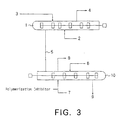
- Fig. 3 is a flow sheet of the continuous polymerization apparatus for the propylene compositions used in the examples.
- 1, 10 polymerization reactor
- 2 piping for hydrogen
- 3 piping for starting propylene
- 4 piping for unreacted gases
- 5 piping for removing polymers
- 6 piping for starting mixed gases.
Landscapes
- Chemical & Material Sciences (AREA)
- Chemical Kinetics & Catalysis (AREA)
- Medicinal Chemistry (AREA)
- Polymers & Plastics (AREA)
- Organic Chemistry (AREA)
- Health & Medical Sciences (AREA)
- Inorganic Chemistry (AREA)
- Engineering & Computer Science (AREA)
- Manufacturing & Machinery (AREA)
- Materials Engineering (AREA)
- Compositions Of Macromolecular Compounds (AREA)
- Manufacture Of Macromolecular Shaped Articles (AREA)
- Processes Of Treating Macromolecular Substances (AREA)
- Addition Polymer Or Copolymer, Post-Treatments, Or Chemical Modifications (AREA)
- Laminated Bodies (AREA)
- Extrusion Moulding Of Plastics Or The Like (AREA)
- Graft Or Block Polymers (AREA)
Claims (29)
- Composition de propylène comprenant un homopolymère de propylène et un copolymère de propylène et d'éthylène, caractérisée en ce que la viscosité intrinsèque ([η]RC) du copolymère de propylène et d'éthylène est dans la plage de 1,7 à 2,8 dl/g, le rapport ([η]RC/[η]PP) de la viscosité intrinsèque du copolymère de propylène et d'éthylène à la viscosité intrinsèque de l'homopolymère de propylène est dans la plage de 0,7 à 1,2 et en ce que le produit [(WPP/WRC) x ([η]RC/[η]PP)] du rapport (WPP/WRC) du % en poids de l'homopolymère de propylène à celui du copolymère de propylène et d'éthylène et du rapport ([η]RC/[η]PP) des viscosités intrinsèques de ceux-ci est dans la plage de 1,0 à 3,0, dans laquelle le copolymère de propylène et d'éthylène contient de 25 à 55 % en poids d'un motif éthylène, par rapport au poids du copolymère de propylène et d'éthylène.
- Composition de propylène selon la revendication 1, dans laquelle l'homopolymère de propylène possède un élément pentavalent isotactique (P) qui n'est pas inférieur à 0,95.
- Composition de propylène selon la revendication 1 ou 2, dans laquelle le copolymère de propylène et d'éthylène contient au moins 80 % en poids d'un composant soluble dans'le xylène à 20°C par rapport au poids du copolymère de propylène et d'éthylène.
- Composition de propylène selon la revendication 1, contenant de 22 à 40 % en poids du copolymère de propylène et d'éthylène, par rapport au poids de la composition de propylène.
- Composition de propylène selon l'une quelconque des revendications 1 à 4, dans laquelle la valeur Q (Mp/Mn) ne dépasse pas 5.
- Procédé de préparation d'une composition de propylène selon la revendication 1, ledit procédé comprenant la réalisation d'une première étape de polymérisation au cours de laquelle le propylène est polymérisé en phase vapeur en présence d'un catalyseur de polymérisation oléfinique stéréorégulière qui comprend une combinaison de :puis la réalisation d'une seconde étape de polymérisation au cours de laquelle de l'éthylène et du propylène sont copolymérisés pour produire de 22 à 40 % en poids d'un copolymère de propylène et d'éthylène où le motif éthylène représente de 25 à 55 % en poids, par rapport au poids total de la composition.(a) un composant catalytique solide contenant du titane, dont la taille de particule moyenne est de 25 à 300 µm,(b) un composé organo-aluminium de formule AlR1 mX3-m, dans laquelle R1 est un groupe hydrocarbyle de 1 à 20 atomes de carbone, X est un atome d'halogène et m un nombre positif obéissant à 3 ≥ m ≥ 1,5, et(c) un composé organo-silicium de formule R2 XR3 YSi(OR4)Z, dans laquelle R2 et R4 représentent un groupe hydrocarbyle, R3 est un groupe hydrocarbyle ou un groupe hydrocarbyle contenant un hétéroatome, X, Y et Z obéissent aux relations 0 ≤ X ≤ 2, 1 ≤ Y < 3, 1 ≤ Z ≤ 3, et X + Y + Z = 4, pour produire de 78 à 60 % en poids d'un homopolymère de propylène, par rapport au poids total de la composition,
- Procédé selon la revendication 6, comprenant en plus une étape de préactivation du catalyseur de polymérisation oléfinique stéréorégulière, avant la première étape de polymérisation.
- Procédé selon la revendication 6, dans lequel (a) le composant catalytique solide contenant du titane possède une homogénéité particulaire qui ne dépasse pas 2,0.
- Procédé selon la revendication 6, dans lequel le rapport molaire (b/c) du composé organo-aluminium (b) au composé organo-silicium (c) est dans la plage de 1 à 10.
- Composition de polypropylène comprenant la composition de propylène de l'une quelconque des revendications 1 à 5 comme résine de base.
- Composition de polypropylène selon la revendication 10, comprenant un antioxydant et un agent neutralisant.
- Composition de polypropylène selon la revendication 11, dans laquelle l'antioxydant est un stabilisant thermique phénolique et/ou un stabilisant thermique phosphorique, et l'agent neutralisant est le stéarate de calcium.
- Composition de polypropylène selon l'une quelconque des revendications 10 à 12, comprenant en outre de 0,0001 à 1 % en poids d'un agent de germination de cristaux α.
- Composition de polypropylène selon la revendication 13, dans laquelle l'agent de germination de cristaux α est de la stéatite, des carboxylates aromatiques de métaux, des composés dibenzylidène sorbitol, des phosphates aromatiques de métaux, le poly(3-méthyl-1-butène), le polyvinylcyclohexane, le polyallyltriméthylsilane, ou un mélange de ceux-ci.
- Composition de polypropylène selon l'une quelconque des revendications 10 à 14, comprenant en outre un générateur de radicaux.
- Composition de polypropylène selon la revendication 15, dans laquelle le générateur de radicaux est un peroxyde organique.
- Composition de polypropylène selon l'une quelconque des revendications 10 à 16, comprenant en outre de 10 à 95 % en poids, par rapport au poids de la résine, d'un homopolymère de propylène dont la densité est de 0,91 à 0,89 g/cm3, le rapport de l'indice de fluidité à l'état fondu de l'homopolymère à celui de la composition de propylène étant dans la plage de 0,5 à 2.
- Composition de polypropylène selon l'une quelconque des revendications 10 à 16, comprenant en outre de 5 à 20 parties en poids d'un composant qui favorise la souplesse, par rapport à 100 parties en poids de la composition de polypropylène.
- Composition de polypropylène selon la revendication 18, dans laquelle le composant qui favorise la souplesse est un homopolymère d'éthylène ou un copolymère d'éthylène et d'α-oléfine dont la densité est de 0,910 à 0,930 g/cm3 et le point de fusion cristalline (Tm) de 100 à 115°C et/ou un copolymère d'éthylène et d'acétate de vinyle dont la densité est de 0,92 à 0,935 g/cm3, le point de fusion cristalline (Tm) de 90 à 108°C et dans lequel le motif acétate de vinyle représente de 1 à 10 % en poids.
- Article moulé à partir de la composition de polypropylène selon l'une quelconque des revendications 10 à 19.
- Procédé de fabrication de l'article moulé selon la revendication 20, ledit procédé comprenant le moulage par injection d'une pastille de la composition de polypropylène selon l'une quelconque des revendications 10 à 19.
- Feuille formée à partir de la composition de polypropylène selon l'une quelconque des revendications 10 à 19.
- Procédé de fabrication de la feuille selon la revendication 22, ledit procédé comprenant l'extrusion en filière en T d'une pastille de la composition de polypropylène selon l'une quelconque des revendications 10 à 19 dans des conditions de température de résine de 180 à 300°C, de température de rouleau refroidisseur de 5 à 80°C, d'écart de température entre la résine et le rouleau refroidisseur d'au moins 120°C et de vitesse d'avancée de ligne de 0,1 à 100 m/min.
- Film formé à partir de la composition de polypropylène selon l'une quelconque des revendications 10 à 19.
- Film multicouches, dans lequel la couche de film selon la revendication 24 comporte une couche de polymère fonctionnel.
- Film multicouches selon la revendication 25, dans lequel la couche de polymère fonctionnel est une couche traitée en utilisant un homopolymère de propylène dont la densité est de 0,89 à 0,91 g/cm3 et le point de fusion cristalline (Tm) de 165 à 160°C et, si on le souhaite, un additif, et/ou une couche de thermocollage traitée en utilisant un copolymère de propylène et d'α-oléfine dont la densité est de 0,89 à 0,91 g/cm3 et le point de fusion cristalline (Tm) de 159 à 110°C et, si on le souhaite, un additif,
- Article moulé par soufflage comprenant la composition de polypropylène selon l'une quelconque des revendications 10 à 19.
- Article moulé par soufflage selon la revendication 27, comportant une structure à soufflet.
- Article moulé par soufflage, dont une partie correspond à un article moulé par soufflage selon la revendication 28, comportant une structure à soufflet, la partie restante correspondant à un article moulé par soufflage à partir d'une composition polyoléfinique comprenant de 1 à 20 % en poids du copolymère d'éthylène et de propylène, contenant de 25 à 55 % en poids de motif éthylène, et de 99 à 80 % en poids d'un homopolymère de propylène et, en plus, un additif souhaité.
Applications Claiming Priority (22)
| Application Number | Priority Date | Filing Date | Title |
|---|---|---|---|
| JP30529295 | 1995-11-24 | ||
| JP305292/95 | 1995-11-24 | ||
| JP30529295 | 1995-11-24 | ||
| JP35639/96 | 1996-01-29 | ||
| JP3563996 | 1996-01-29 | ||
| JP3563996 | 1996-01-29 | ||
| JP10636596 | 1996-04-02 | ||
| JP106365/96 | 1996-04-02 | ||
| JP10636596 | 1996-04-02 | ||
| JP17417896 | 1996-06-13 | ||
| JP174178/96 | 1996-06-13 | ||
| JP17417896 | 1996-06-13 | ||
| JP18114196 | 1996-06-21 | ||
| JP181141/96 | 1996-06-21 | ||
| JP18114196 | 1996-06-21 | ||
| JP209030/96 | 1996-07-18 | ||
| JP209031/96 | 1996-07-18 | ||
| JP20903096 | 1996-07-18 | ||
| JP20903196 | 1996-07-18 | ||
| JP20903196 | 1996-07-18 | ||
| JP20903096 | 1996-07-18 | ||
| PCT/JP1996/003433 WO1997019135A1 (fr) | 1995-11-24 | 1996-11-22 | Composition de propylene, procede pour la preparer, composition de polypropylene et articles moules |
Publications (4)
| Publication Number | Publication Date |
|---|---|
| EP0863183A1 EP0863183A1 (fr) | 1998-09-09 |
| EP0863183A4 EP0863183A4 (fr) | 1999-12-29 |
| EP0863183B1 true EP0863183B1 (fr) | 2002-04-03 |
| EP0863183B2 EP0863183B2 (fr) | 2008-05-28 |
Family
ID=27564401
Family Applications (1)
| Application Number | Title | Priority Date | Filing Date |
|---|---|---|---|
| EP96939302A Expired - Lifetime EP0863183B2 (fr) | 1995-11-24 | 1996-11-22 | Composition de propylene, procede pour la preparer, composition de polypropylene et articles moules |
Country Status (10)
| Country | Link |
|---|---|
| US (1) | US6300415B1 (fr) |
| EP (1) | EP0863183B2 (fr) |
| JP (1) | JP3470337B2 (fr) |
| KR (1) | KR100277378B1 (fr) |
| CN (1) | CN1109715C (fr) |
| AT (1) | ATE215571T1 (fr) |
| AU (1) | AU7638796A (fr) |
| DE (1) | DE69620440T3 (fr) |
| EA (1) | EA199800481A1 (fr) |
| WO (1) | WO1997019135A1 (fr) |
Cited By (1)
| Publication number | Priority date | Publication date | Assignee | Title |
|---|---|---|---|---|
| EP2905309B1 (fr) | 2012-10-03 | 2018-11-14 | Basell Poliolefine Italia S.r.l. | Composition de résine de propylène pour film d'emballage en sachet stérilisable en autoclave |
Families Citing this family (135)
| Publication number | Priority date | Publication date | Assignee | Title |
|---|---|---|---|---|
| EP0457455B2 (fr) † | 1990-05-14 | 2008-07-02 | Union Carbide Chemicals & Plastics Technology Corporation | Compositions de polymères |
| TW400341B (en) † | 1997-05-22 | 2000-08-01 | Chisso Corp | Propyene polymer blends, processes of producing the same, and polypropylene resin compositions |
| AP955A (en) * | 1997-11-12 | 2001-04-06 | Polymer Concrete Industries Pty Limited | A process for manufacturing a tank or container by using a polymer concrete mixture. |
| JP3990805B2 (ja) * | 1997-12-25 | 2007-10-17 | 日本ポリプロ株式会社 | オレフィン系複合樹脂積層シート |
| GB2345290B (en) | 1998-08-18 | 2002-04-17 | Chisso Corp | Polypropylene composition |
| FR2782474B1 (fr) * | 1998-08-19 | 2000-11-17 | Lorraine Laminage | Traverse d'un train arriere de vehicule automobile |
| KR100404499B1 (ko) * | 1998-08-21 | 2003-11-05 | 짓쏘 가부시끼가이샤 | 폴리프로필렌 필름 및 다중층 폴리프로필렌 필름 |
| JP2000072950A (ja) * | 1998-09-02 | 2000-03-07 | Chisso Corp | 高発色性ポリプロピレン系組成物 |
| JP4088373B2 (ja) * | 1998-09-22 | 2008-05-21 | チッソ株式会社 | 自動車サイドモール成形用樹脂組成物及び自動車サイドモール |
| JP2000109639A (ja) * | 1998-10-06 | 2000-04-18 | Japan Polychem Corp | 成形性、成形外観に優れるポリプロピレン系樹脂組成物 |
| JP4344421B2 (ja) * | 1999-04-26 | 2009-10-14 | 住友化学株式会社 | 熱可塑性樹脂組成物及びその射出成形体 |
| US6489019B1 (en) * | 1999-05-19 | 2002-12-03 | Basell Poliolefine Italia S.P.A. | High surface gloss, co-extruded sheets from olefin polymer materials |
| US6306518B1 (en) | 1999-05-19 | 2001-10-23 | Montell Technology Company Bv | High surface gloss, co-extruded sheets from propylene polymer materials |
| JP3808243B2 (ja) * | 1999-07-27 | 2006-08-09 | 三井化学株式会社 | 軟質樹脂組成物 |
| US6362270B1 (en) * | 1999-08-12 | 2002-03-26 | The Dow Chemical Company | Thermoplastic compositions for durable goods applications |
| US6444302B1 (en) * | 1999-09-01 | 2002-09-03 | Exxonmobil Chemical Patents Inc. | Breathable films and method for making |
| JP2001072815A (ja) * | 1999-09-07 | 2001-03-21 | Chisso Corp | プロピレン系樹脂組成物 |
| KR20010028476A (ko) * | 1999-09-21 | 2001-04-06 | 이계안 | 비도료 타입 폴리프로필렌계 수지 조성물 |
| JP2001163999A (ja) * | 1999-10-01 | 2001-06-19 | Chisso Corp | 鮮度保持性フィルム |
| JP2001106845A (ja) * | 1999-10-01 | 2001-04-17 | Chisso Corp | 気体透過性の改良されたフィルム、およびその製造方法 |
| US6355736B1 (en) * | 1999-11-02 | 2002-03-12 | Chisso Corporation | Propylene block copolymer compositions |
| ITFE20000002A1 (it) * | 2000-02-15 | 2001-08-15 | Moplefan Spa | Film multistrato sterilizzabili con radiazioni gamma |
| US20030039826A1 (en) | 2000-03-20 | 2003-02-27 | Sun Edward I. | Conformable and die-cuttable biaxially oriented films and labelstocks |
| JP2002220538A (ja) * | 2000-03-28 | 2002-08-09 | Mazda Motor Corp | 成形用ガラス長繊維強化樹脂材料、該樹脂材料を射出成形してなる射出成形品及び該樹脂材料を用いた成形方法 |
| KR100656829B1 (ko) * | 2000-06-03 | 2006-12-15 | 삼성토탈 주식회사 | 용융 흐름성, 강성 및 저온충격강도가 우수한 고결정성폴리프로필렌 수지조성물 |
| JP2001354814A (ja) | 2000-06-16 | 2001-12-25 | Chisso Corp | プロピレン系樹脂シート |
| US20050234162A1 (en) * | 2000-07-05 | 2005-10-20 | Solvay Polyolefins Europe-Belgium (Societe Anonyme) | Polymeric composition, its use for the manufacture of object and object so obtained |
| JP2002018887A (ja) | 2000-07-12 | 2002-01-22 | Chisso Corp | ポリプロピレン樹脂発泡成形体 |
| JP4629836B2 (ja) * | 2000-07-19 | 2011-02-09 | 古河電気工業株式会社 | 絶縁電線 |
| JP3921951B2 (ja) * | 2001-02-27 | 2007-05-30 | 住友化学株式会社 | ポリプロピレン樹脂組成物およびその製造方法 |
| US6600436B2 (en) * | 2001-03-26 | 2003-07-29 | Semiconductor Energy Laboratory Co., Ltd, | D/A converter having capacitances, tone voltage lines, first switches, second switches and third switches |
| US6562890B2 (en) * | 2001-03-29 | 2003-05-13 | Milliken & Company | Disodium hexahydrophthalate salt compositions and nucleated polymers comprising such compositions |
| JP4910242B2 (ja) | 2001-04-03 | 2012-04-04 | Jnc株式会社 | ポリプロピレン系樹脂組成物及びそれを用いた気体透過性フィルム |
| US6825276B2 (en) * | 2001-04-17 | 2004-11-30 | Pliant Corporation | Nonoriented stiff packaging film with superior tear properties |
| US6541554B2 (en) * | 2001-05-17 | 2003-04-01 | Milliken & Company | Low-shrink polypropylene fibers |
| US6656404B2 (en) * | 2001-05-17 | 2003-12-02 | Milliken & Company | Methods of making low-shrink polypropylene fibers |
| JP4031622B2 (ja) * | 2001-05-30 | 2008-01-09 | バセル ポリオレフィン イタリア エス.アール.エル. | ポリプロピレン系樹脂組成物 |
| US7141300B2 (en) * | 2001-06-27 | 2006-11-28 | Nitto Denko Corporation | Adhesive sheet for dicing |
| EP1458810A4 (fr) | 2001-10-12 | 2005-02-09 | Huntsman Polymers Corp | Polyolefines a module eleve et a ductilite elevee |
| US20030134118A1 (en) * | 2001-12-21 | 2003-07-17 | Morin Brian G. | Low-shrink polypropylene tape fibers |
| US20030134082A1 (en) * | 2001-12-21 | 2003-07-17 | Morin Brian G. | Carpet comprising a low-shrink backing of polypropylene tape fibers |
| US6998081B2 (en) * | 2001-12-21 | 2006-02-14 | Milliken & Company | Method of producing low-shrink polypropylene tape fibers |
| DE10313954B4 (de) * | 2002-03-29 | 2016-12-22 | Sumitomo Chemical Co. Ltd. | Polypropylenharzzusammensetzung und deren Verwendung in einer Folie |
| US6780506B2 (en) * | 2002-04-26 | 2004-08-24 | Sumitomo Chemical Company, Limited | Fiber-reinforced polyolefin resin composite and molded article obtained from the same |
| KR100554059B1 (ko) * | 2002-05-20 | 2006-02-22 | 미쯔이가가꾸가부시끼가이샤 | 실란트용 수지 조성물, 적층체 및 이로부터 얻어지는 용기 |
| KR101186268B1 (ko) | 2002-06-26 | 2012-09-27 | 애버리 데니슨 코포레이션 | 폴리프로필렌/올레핀 탄성체 혼합물을 포함하는 배향된 필름 |
| KR100488858B1 (ko) * | 2002-07-09 | 2005-05-11 | 현대자동차주식회사 | 폴리프로필렌 복합수지 조성물 |
| EP1391482B1 (fr) * | 2002-08-20 | 2009-05-20 | Borealis Technology OY | Composition de polypropylène |
| US6939903B2 (en) * | 2002-10-09 | 2005-09-06 | Crompton Corporation | Natural fiber-filled polyolefin composites |
| US20040084802A1 (en) * | 2002-11-02 | 2004-05-06 | Morin Brian G. | Method of producing low-shrink polypropylene tape fibers comprising high amounts of nucleating agents |
| US6887567B2 (en) * | 2002-11-02 | 2005-05-03 | Milliken & Company | Low-shrink polypropylene tape fibers comprising high amounts of nucleating agents |
| US6863976B2 (en) | 2002-11-16 | 2005-03-08 | Milliken & Company | Polypropylene monofilament and tape fibers exhibiting certain creep-strain characteristics and corresponding crystalline configurations |
| US20040096639A1 (en) * | 2002-11-16 | 2004-05-20 | Morin Brian G. | Uniform production methods for colored and non-colored polypropylene fibers |
| US6759124B2 (en) * | 2002-11-16 | 2004-07-06 | Milliken & Company | Thermoplastic monofilament fibers exhibiting low-shrink, high tenacity, and extremely high modulus levels |
| US7041368B2 (en) * | 2002-11-17 | 2006-05-09 | Milliken & Company | High speed spinning procedures for the manufacture of high denier polypropylene fibers and yarns |
| US20040096621A1 (en) * | 2002-11-17 | 2004-05-20 | Dai Weihua Sonya | High denier textured polypropylene fibers and yarns |
| US20040152815A1 (en) * | 2002-11-17 | 2004-08-05 | Morin Brian G. | High speed spinning procedures for the manufacture of low denier polypropylene fibers and yarns |
| ES2257231T3 (es) * | 2002-12-18 | 2007-05-16 | Borealis Technology Oy | Pelicula plana para termoconformado y procedimiento para su fabricacion. |
| US6780936B1 (en) * | 2003-02-11 | 2004-08-24 | Exxonmobil Chemical Patents Inc. | Diene-modified propylene polymer nucleating agents |
| US7781500B2 (en) | 2003-04-14 | 2010-08-24 | Crompton Corporation | Coupling agents for natural fiber-filled polyolefins |
| EP1510547A1 (fr) * | 2003-08-13 | 2005-03-02 | Borealis Technology OY | Nouvelles compositions de polypropylène à résistance améliorée à la rupture blanche |
| US20050046065A1 (en) * | 2003-08-30 | 2005-03-03 | Cowan Martin E. | Thermoplastic fibers exhibiting durable high color strength characteristics |
| US6849330B1 (en) | 2003-08-30 | 2005-02-01 | Milliken & Company | Thermoplastic fibers exhibiting durable high color strength characteristics |
| US20050048281A1 (en) * | 2003-08-30 | 2005-03-03 | Royer Joseph R. | Thermoplastic fibers exhibiting durable high color strength characteristics |
| DE10348876B4 (de) | 2003-10-21 | 2014-04-03 | Jnc Corporation | Poröse Polyolefinmembran |
| JP2005137972A (ja) * | 2003-11-04 | 2005-06-02 | Chisso Corp | ポリオレフィン樹脂製フィルター |
| US7326751B2 (en) * | 2003-12-01 | 2008-02-05 | Kimberly-Clark Worlwide, Inc. | Method of thermally processing elastomeric compositions and elastomeric compositions with improved processability |
| US20050118435A1 (en) * | 2003-12-01 | 2005-06-02 | Kimberly-Clark Worldwide, Inc. | Films and methods of forming films having polyorganosiloxane enriched surface layers |
| JP4982365B2 (ja) * | 2004-07-30 | 2012-07-25 | サウディ ベーシック インダストリーズ コーポレイション | 高透明性のプロピレンコポリマー組成物 |
| US20090057961A1 (en) * | 2004-08-18 | 2009-03-05 | Basell Poliolefine Italia S.R.L. | Process for producing clear polypropylene based stretch blow molded containers with improved infrared heat-up rates |
| US9187610B2 (en) * | 2004-10-27 | 2015-11-17 | Sumitomo Chemical Company, Limited | Polypropylene resin composition and foamed article produced therefrom |
| ES2269021T5 (es) * | 2005-05-12 | 2012-06-27 | Borealis Technology Oy | Elemento laminar transparente y fácilmente rompible |
| CA2615555C (fr) * | 2005-07-21 | 2014-01-07 | Ciba Specialty Chemicals Holding Inc. | Stabilisation de polyolefines a l'aide de tris-(mono-alkyl)phenyl phosphites liquides |
| SI1788022T1 (sl) * | 2005-11-16 | 2009-04-30 | Borealis Tech Oy | Polipropilenska smola z majhnim krčenjem, visoko udarno trdnostjo, togostjo in odpornostjo na razenje |
| JP2007231136A (ja) | 2006-02-28 | 2007-09-13 | Kyoraku Co Ltd | プロピレン系樹脂組成物ならびにその組成物からなるブロー成形パネルおよびそのブロー成形パネルからなる自動車用デッキボード |
| US20070208110A1 (en) * | 2006-03-03 | 2007-09-06 | Sigworth William D | Coupling agents for natural fiber-filled polyolefins |
| JP2007293289A (ja) * | 2006-03-30 | 2007-11-08 | Chisso Corp | 光反射シート |
| BRPI0711647B1 (pt) | 2006-05-16 | 2018-06-05 | Basf Schweiz Ag | Películas sopradas por mono e múltiplas camadas |
| ES2338910T5 (es) * | 2006-05-26 | 2014-03-28 | Borealis Technology Oy | Composición de poliolefina con resistencia al emblanquecimiento por tensión mejorada |
| US9662867B2 (en) | 2006-06-14 | 2017-05-30 | Avery Dennison Corporation | Conformable and die-cuttable machine direction oriented labelstocks and labels, and process for preparing |
| WO2007149900A2 (fr) | 2006-06-20 | 2007-12-27 | Avery Dennison Corporation | Film polymérique à plusieurs couches destiné à un étiquetage avec adhésif thermofusible et papier pour étiquette et étiquette pour celui-ci |
| KR101400573B1 (ko) | 2006-07-17 | 2014-05-28 | 애브리 데니슨 코포레이션 | 비대칭 다층 중합체 필름 및 라벨원단 및 이로부터의 라벨 |
| US7862671B2 (en) * | 2007-01-11 | 2011-01-04 | Dow Global Technologies Inc. | Welding of a polymeric material and structures formed thereby |
| KR101133359B1 (ko) * | 2007-07-13 | 2012-04-06 | 에스케이종합화학 주식회사 | 유동성, 강성 및 충격강도가 우수한 에틸렌-프로필렌블록공중합체계 폴리프로필렌 수지 조성물 |
| EA019316B1 (ru) * | 2008-06-11 | 2014-02-28 | Люммус Новолен Текнолоджи Гмбх | Высокоактивные катализаторы циглера-натта, способ получения катализаторов и их использование |
| CN102105527A (zh) * | 2008-07-23 | 2011-06-22 | 沙特基础工业公司 | 制备改性聚丙烯组合物的方法 |
| DE102008061746A1 (de) * | 2008-12-12 | 2010-06-24 | Treofan Germany Gmbh & Co. Kg | Einschichtige mikroporöse Folie für Batterien mit Abschaltfunktion |
| DE102008061748A1 (de) * | 2008-12-12 | 2010-06-24 | Treofan Germany Gmbh & Co. Kg | Mehrschichtige mikroporöse Folie für Batterien mit Abschaltfunktion |
| JP5653366B2 (ja) * | 2009-01-23 | 2015-01-14 | エボニック デグサ ゲーエムベーハーEvonik Degussa GmbH | フィルム |
| US8076429B2 (en) | 2009-03-11 | 2011-12-13 | Lummus Novolen Technology Gmbh | Supertransparent high impact strength random block copolymer |
| US8927135B2 (en) * | 2009-06-20 | 2015-01-06 | Treofan Germany Gmbh & Co. Kg | Microporous foil for batteries having shutdown function |
| US8217116B2 (en) * | 2009-07-15 | 2012-07-10 | Braskem America, Inc. | Polypropylene composition for buried structures |
| CN102050990A (zh) * | 2009-10-30 | 2011-05-11 | 中国石油化工股份有限公司 | 用于制备包装用薄膜的聚丙烯树脂组合物及其薄膜 |
| KR101145072B1 (ko) * | 2009-12-17 | 2012-05-11 | 호남석유화학 주식회사 | 과산화물을 이용한 충격강도 및 오렌지필이 개선된 필름용 폴리프로필렌-에틸렌 블록 공중합체 수지 조성물 |
| KR100977665B1 (ko) * | 2009-12-18 | 2010-08-24 | 에스케이에너지 주식회사 | 충격강도, 표면특성 및 유동성이 우수한 에틸렌-프로필렌 블록공중합체계 폴리프로필렌 수지 조성물 |
| EP2338930A1 (fr) * | 2009-12-23 | 2011-06-29 | Borealis AG | Qualité de film soufflé démontrant une rigidité, une transparence et un comportement au traitement supérieurs |
| EP2338931A1 (fr) * | 2009-12-23 | 2011-06-29 | Borealis AG | Qualité soufflée démontrant une rigidité, une transparence et un comportement au traitement supérieurs |
| US8044135B2 (en) * | 2010-02-24 | 2011-10-25 | Braskem America, Inc. | Polypropylene impact copolymer compositions |
| WO2011149886A1 (fr) * | 2010-05-28 | 2011-12-01 | Dow Global Technologies Llc | Film à base de polyoléfine thermoscellable comprenant un copolymère séquencé oléfinique |
| US8178623B2 (en) | 2010-06-10 | 2012-05-15 | Dow Global Technologies Llc | High stiffness high impact propylene impact copolymers field of the invention |
| US9442220B2 (en) * | 2010-08-30 | 2016-09-13 | Samsung Electronics Co., Ltd. | Composition for polarizing film, polarizing film, method of manufacturing the same, and liquid crystal display provided with the polarizing film |
| CN102585351A (zh) * | 2011-01-12 | 2012-07-18 | 中国石油化工股份有限公司 | 耐应力发白抗冲聚丙烯组合物 |
| CN102585350A (zh) * | 2011-01-12 | 2012-07-18 | 中国石油化工股份有限公司 | 耐应力发白抗冲聚丙烯组合物 |
| CN103087402A (zh) * | 2011-10-28 | 2013-05-08 | 中国石油化工股份有限公司 | 一种聚丙烯组合物和其制法及由其制备的拉伸薄膜 |
| DE112012004977T5 (de) | 2011-11-30 | 2014-08-28 | Sumitomo Chemical Company, Limited | Propylenpolymerzusammensetzung und Formgegenstand daraus |
| JP6244084B2 (ja) * | 2012-08-09 | 2017-12-06 | 住友化学株式会社 | 蒸着フィルム用ポリオレフィン系樹脂組成物およびそれからなる蒸着用ポリオレフィンフィルム |
| US9676532B2 (en) | 2012-08-15 | 2017-06-13 | Avery Dennison Corporation | Packaging reclosure label for high alcohol content products |
| EP2733175B1 (fr) * | 2012-11-16 | 2016-08-31 | Borealis AG | Copolymère de propylène aléatoire pour bouteilles avec de bonnes propriétés optiques et une faible teneur en hexane |
| KR101501835B1 (ko) * | 2013-08-13 | 2015-03-12 | 삼성토탈 주식회사 | 내백화성 및 내충격성이 우수한 폴리프로필렌 수지 조성물 |
| US9962851B2 (en) | 2013-12-12 | 2018-05-08 | 3M Innovative Properties Company | Method of making polymeric multilayer films |
| US10696829B2 (en) | 2013-12-20 | 2020-06-30 | Saudi Basic Industries Corporation | Heterophasic propylene copolymer |
| WO2015091151A1 (fr) | 2013-12-20 | 2015-06-25 | Saudi Basic Industries Corporation | Composition de polyoléfine |
| US9505161B2 (en) * | 2014-04-10 | 2016-11-29 | Fina Technology, Inc. | Solid-state stretched HDPE |
| CN105017637B (zh) * | 2014-04-16 | 2017-08-25 | 中国石化扬子石油化工有限公司 | 一种高透明长支链聚丙烯/弹性体组合物及其制备方法 |
| CA2951030C (fr) | 2014-06-02 | 2023-03-28 | Christopher J. Blackwell | Films ayant une resistance a l'abrasion, une clarte et une conformabilite ameliorees |
| CN105330955B (zh) * | 2014-06-30 | 2018-01-23 | 中国石油化工股份有限公司 | 一种抗冲聚丙烯的制备方法 |
| KR20170026500A (ko) * | 2014-07-03 | 2017-03-08 | 다우 글로벌 테크놀로지스 엘엘씨 | 조성물, 이로부터 제조된 사출 성형 물품 및 사출 성형 물품을 제조하기 위한 방법 |
| CN104231435A (zh) * | 2014-09-24 | 2014-12-24 | 苏州冰心文化用品有限公司 | 一种文具用聚丙烯材料及其制备方法 |
| US10882292B2 (en) * | 2015-07-06 | 2021-01-05 | Zephyros, Inc. | Heat bonding of low energy surface substrates |
| US20180230254A1 (en) * | 2015-08-11 | 2018-08-16 | Sumitomo Chemical Company, Limited | Ethylene-alpha-olefin copolymer rubber, rubber composition, and method for producing ethylene-alpha-olefin copolymer rubber |
| CN105111338B (zh) * | 2015-09-23 | 2018-05-25 | 神华集团有限责任公司 | 丙烯聚合物及其制备方法 |
| EP3362504B1 (fr) | 2015-10-16 | 2020-12-02 | Borealis AG | Films à orientation biaxiale fabriqués à partir de compositions de polymère de propylène |
| EP3397663B1 (fr) | 2015-12-30 | 2022-10-19 | Braskem America, Inc. | Composition polymère transparente et résistante aux chocs et article fabriqué |
| EP3420027B1 (fr) | 2016-02-22 | 2019-10-23 | SABIC Global Technologies B.V. | Composition comprenant un copolymère de propylène hétérophasique |
| JP6743463B2 (ja) * | 2016-04-12 | 2020-08-19 | 住友化学株式会社 | ポリオレフィンの製造方法 |
| RU2697706C9 (ru) * | 2016-04-14 | 2020-02-28 | Базелл Полиолефин Италия С.Р.Л. | Пропилен-полимерные композиции |
| CN107629332B (zh) * | 2016-07-18 | 2022-07-05 | Sabic环球技术有限责任公司 | 聚烯烃组合物 |
| BR112019006015B1 (pt) * | 2016-10-14 | 2023-04-04 | Basell Poliolefine Italia S.R.L. | Composição de polímero de propileno nucleado e filme compreendendo a mesma |
| WO2018081630A1 (fr) * | 2016-10-28 | 2018-05-03 | Fina Technology, Inc. | Utilisation d'agents pour réduire la cristallinité dans le polypropylène pour des applications bopp |
| BR112019026185A2 (pt) * | 2017-06-30 | 2020-06-30 | Borealis Ag | composição de polipropileno com aparência de superfície excelente |
| JP7114361B2 (ja) * | 2018-06-19 | 2022-08-08 | サンアロマー株式会社 | ポリプロピレン組成物および成形品 |
| EP4206276A4 (fr) * | 2020-08-27 | 2024-10-16 | China Petroleum & Chemical Corporation | Composition de polypropylène, son procédé de préparation et article fabriqué à partir de celle-ci |
| JP7547953B2 (ja) * | 2020-11-19 | 2024-09-10 | Toppanホールディングス株式会社 | ポリプロピレン系樹脂組成物、ポリプロピレン系無延伸フィルム、包装材、および包装体 |
| JP2022095294A (ja) * | 2020-12-16 | 2022-06-28 | サンアロマー株式会社 | 射出成形用ポリプロピレン系樹脂組成物及び射出成形体 |
| JP7645108B2 (ja) * | 2021-03-18 | 2025-03-13 | 株式会社プライムポリマー | ポリプロピレン系樹脂組成物および成形体 |
Family Cites Families (34)
| Publication number | Priority date | Publication date | Assignee | Title |
|---|---|---|---|---|
| JPS52126450A (en) | 1976-04-16 | 1977-10-24 | Sumitomo Chem Co Ltd | Thermoplastic elastomer compound |
| JPS5439453A (en) | 1977-09-05 | 1979-03-26 | Hitachi Ltd | Polypropylene resin composition |
| JPS6028411A (ja) | 1983-07-26 | 1985-02-13 | Chisso Corp | 高剛性エチレン・プロピレン共重合体の製造方法 |
| JPH0730145B2 (ja) † | 1986-10-30 | 1995-04-05 | 出光石油化学株式会社 | プロピレンブロック共重合体 |
| JPH07100751B2 (ja) * | 1987-11-11 | 1995-11-01 | 出光石油化学株式会社 | プロピレン重合体組成物 |
| JPH01272612A (ja) | 1988-04-25 | 1989-10-31 | Idemitsu Petrochem Co Ltd | プロピレン共重合体組成物の製造方法 |
| IT1230133B (it) * | 1989-04-28 | 1991-10-14 | Himont Inc | Composizioni polipropileniche plasto-elastiche |
| IT1231768B (it) * | 1989-08-02 | 1991-12-21 | Himont Inc | Composizioni polipropileniche adatte alla modifica di bitumi. |
| JP2879347B2 (ja) * | 1989-10-02 | 1999-04-05 | チッソ株式会社 | オレフィン重合用触媒の製法 |
| IT1240417B (it) † | 1990-02-28 | 1993-12-15 | Himont Inc | Procedimento per la produzione di film e corpi laminari polipropilenici e prodotti cosi' ottenuti |
| US5362782A (en) * | 1990-05-14 | 1994-11-08 | Shell Oil Company | Polymer compositions |
| EP0457455B2 (fr) | 1990-05-14 | 2008-07-02 | Union Carbide Chemicals & Plastics Technology Corporation | Compositions de polymères |
| IT1243188B (it) | 1990-08-01 | 1994-05-24 | Himont Inc | Composizioni poliolefiniche elastoplastiche |
| JP2935878B2 (ja) | 1990-08-22 | 1999-08-16 | チッソ株式会社 | オレフィン重合用触媒成分 |
| JPH04282232A (ja) | 1991-03-12 | 1992-10-07 | Toyoda Gosei Co Ltd | 樹脂製管状体 |
| JP3076619B2 (ja) † | 1991-05-14 | 2000-08-14 | 三井化学株式会社 | ブロック共重合体の製造方法 |
| JP3198549B2 (ja) | 1991-08-23 | 2001-08-13 | 岩崎電気株式会社 | 送風機構を備えたメタルハライドランプ装置 |
| CA2105834A1 (fr) * | 1992-09-16 | 1994-03-17 | Hajime Sadatoshi | Copolymere avec sequence de polypropylene et pellicule a base de ce copolymere |
| JPH0693061A (ja) * | 1992-09-16 | 1994-04-05 | Sumitomo Chem Co Ltd | ポリプロピレンブロック共重合体及びそのフィルム |
| JP2998448B2 (ja) | 1992-09-16 | 2000-01-11 | 住友化学工業株式会社 | ポリプロピレンブロック共重合体及びそのフィルム |
| JP3163787B2 (ja) | 1992-10-09 | 2001-05-08 | 住友化学工業株式会社 | 改質ポリプロピレンブロック共重合体 |
| JPH06145268A (ja) | 1992-11-06 | 1994-05-24 | Sumitomo Chem Co Ltd | 改質ポリプロピレンブロック共重合体 |
| JP3119003B2 (ja) | 1992-12-21 | 2000-12-18 | 石川島播磨重工業株式会社 | 流動床式廃棄物焼却炉の給塵装置 |
| JP3308040B2 (ja) | 1993-04-30 | 2002-07-29 | 東燃化学株式会社 | ポリオレフィン成形体 |
| JP3217897B2 (ja) | 1993-05-18 | 2001-10-15 | 大倉工業株式会社 | 自動車用表面保護フィルムに使用する基材フィルム |
| JP2729346B2 (ja) | 1993-07-08 | 1998-03-18 | 第一工業製薬株式会社 | トリス(トリブロモフェノキシ)−s−トリアジンの製造方法 |
| JP3145836B2 (ja) | 1993-07-14 | 2001-03-12 | シャープ株式会社 | 光結合素子及びそれに用いられる光伝導体の製造方法 |
| JP3205439B2 (ja) | 1993-08-04 | 2001-09-04 | 日立建機株式会社 | 作業機の運転室 |
| JPH07100751A (ja) | 1993-10-04 | 1995-04-18 | Matsushita Electric Ind Co Ltd | 非球面金型研磨方法 |
| JP3312801B2 (ja) | 1993-12-21 | 2002-08-12 | 出光石油化学株式会社 | プロピレンエチレン共重合体及びその製造方法 |
| US5409992A (en) * | 1994-02-28 | 1995-04-25 | Himont Incorporated | Calenderable blends containing broad molecular weight distribution propylene polymer material |
| JP3385733B2 (ja) | 1994-07-11 | 2003-03-10 | チッソ株式会社 | プロピレン系ブロック共重合体組成物 |
| JP3355819B2 (ja) | 1994-09-28 | 2002-12-09 | チッソ株式会社 | プロピレン・エチレンブロック共重合体の製造方法 |
| EP0792914B1 (fr) * | 1995-09-14 | 2002-08-14 | Mitsui Chemicals, Inc. | Composition de polyolefine et article moule a partir de ladite composition |
-
1996
- 1996-11-22 EP EP96939302A patent/EP0863183B2/fr not_active Expired - Lifetime
- 1996-11-22 KR KR1019980703853A patent/KR100277378B1/ko not_active Expired - Fee Related
- 1996-11-22 US US09/068,949 patent/US6300415B1/en not_active Expired - Lifetime
- 1996-11-22 AT AT96939302T patent/ATE215571T1/de not_active IP Right Cessation
- 1996-11-22 CN CN96199321A patent/CN1109715C/zh not_active Expired - Lifetime
- 1996-11-22 JP JP51960097A patent/JP3470337B2/ja not_active Expired - Fee Related
- 1996-11-22 EA EA199800481A patent/EA199800481A1/ru unknown
- 1996-11-22 WO PCT/JP1996/003433 patent/WO1997019135A1/fr not_active Ceased
- 1996-11-22 DE DE69620440T patent/DE69620440T3/de not_active Expired - Lifetime
- 1996-11-22 AU AU76387/96A patent/AU7638796A/en not_active Abandoned
Cited By (1)
| Publication number | Priority date | Publication date | Assignee | Title |
|---|---|---|---|---|
| EP2905309B1 (fr) | 2012-10-03 | 2018-11-14 | Basell Poliolefine Italia S.r.l. | Composition de résine de propylène pour film d'emballage en sachet stérilisable en autoclave |
Also Published As
| Publication number | Publication date |
|---|---|
| JP3470337B2 (ja) | 2003-11-25 |
| EP0863183A4 (fr) | 1999-12-29 |
| KR100277378B1 (ko) | 2001-01-15 |
| DE69620440D1 (de) | 2002-05-08 |
| AU7638796A (en) | 1997-06-11 |
| EP0863183B2 (fr) | 2008-05-28 |
| KR19990071578A (ko) | 1999-09-27 |
| DE69620440T3 (de) | 2010-05-20 |
| ATE215571T1 (de) | 2002-04-15 |
| WO1997019135A1 (fr) | 1997-05-29 |
| US6300415B1 (en) | 2001-10-09 |
| EP0863183A1 (fr) | 1998-09-09 |
| CN1109715C (zh) | 2003-05-28 |
| DE69620440T2 (de) | 2002-08-29 |
| EA199800481A1 (ru) | 1998-12-24 |
| CN1205726A (zh) | 1999-01-20 |
Similar Documents
| Publication | Publication Date | Title |
|---|---|---|
| EP0863183B1 (fr) | Composition de propylene, procede pour la preparer, composition de polypropylene et articles moules | |
| JPWO1997019135A1 (ja) | プロピレン系組成物およびその製造方法ならびにポリプロピレン系組成物および成型品 | |
| US6511755B1 (en) | Polypropylene film and multilayered polypropylene film | |
| JP3270056B2 (ja) | 樹脂成形体 | |
| EP1899415B1 (fr) | Polymeres de propylene presentant une large distribution de masses moleculaires | |
| JP3190380B2 (ja) | オレフィンポリマーフィルム | |
| EP2173471B1 (fr) | Procédé de production de terpolymères de propylène | |
| EP0885926B2 (fr) | Mélange de polymères de propylène, procédé pour leur préparation et composition de polymères | |
| EP1849827B1 (fr) | Composition de polymeres du propylene et film oriente fabrique a partir de celle-ci | |
| EP3625055B1 (fr) | Composition de copolymère aléatoire de propylène à faible température d'initiation d'étanchéité | |
| DE10217841B4 (de) | Verfahren zur Herstellung einer Ethylenpolymer-Zusammensetzung, Teilchen aus Ethylenpolymer-Zusammensetzung und aus den Teilchen der Ethylenpolymer-Zusammensetzung erhaltene Folie | |
| JP3852326B2 (ja) | プロピレン系組成物およびその製造方法ならびにポリプロピレン系組成物および成型品 | |
| JP5206395B2 (ja) | ポリプロピレン系共重合体、およびそれからなるフィルム | |
| JP4310832B2 (ja) | プロピレン系樹脂シートおよびそれを用いた成形体 | |
| EP2492309A1 (fr) | Composition de polyoléfine hétérophasique disposant d'une aptitude à l'écoulement et d'une résistance à l'impact améliorées | |
| JP3800181B2 (ja) | プロピレン系組成物およびその製造方法ならびにポリプロピレン系組成物および成型品 | |
| CN107428872A (zh) | 基于丙烯的三元共聚物 | |
| JP4759235B2 (ja) | ポリプロピレン系積層フィルム | |
| JP2004322413A (ja) | 空冷インフレーション成形多層フィルム | |
| JP2004322415A (ja) | 空冷インフレーション成形多層フィルム | |
| JPH08325414A (ja) | 安定化されたポリオレフィン組成物 | |
| JPH10231369A (ja) | ポリプロピレン延伸フィルム | |
| JP4244428B2 (ja) | 多層プラスチックシート | |
| JP4798593B2 (ja) | ポリプロピレン樹脂組成物および二軸延伸フィルム | |
| WO2024083610A1 (fr) | Composition de polypropylène ayant de bonnes propriétés d'étanchéité |
Legal Events
| Date | Code | Title | Description |
|---|---|---|---|
| PUAI | Public reference made under article 153(3) epc to a published international application that has entered the european phase |
Free format text: ORIGINAL CODE: 0009012 |
|
| 17P | Request for examination filed |
Effective date: 19980514 |
|
| AK | Designated contracting states |
Kind code of ref document: A1 Designated state(s): AT BE CH DE DK ES FI FR GB GR IE IT LI LU MC NL PT SE |
|
| RIN1 | Information on inventor provided before grant (corrected) |
Inventor name: SUGIMOTO, MASATAKA C/O CHISSO PETROCHEMICAL CORP. Inventor name: ISHII, HIROHISA Inventor name: YAMAMOTO, TOSHIKI Inventor name: KIMURA, KAZUHIRO Inventor name: WAKATA, MAYUMI Inventor name: KIMURA, MASAMI Inventor name: NAKASHIMA, TAKANORI Inventor name: OKAYAMA, CHIKASHI |
|
| A4 | Supplementary search report drawn up and despatched |
Effective date: 19991117 |
|
| AK | Designated contracting states |
Kind code of ref document: A4 Designated state(s): AT BE CH DE DK ES FI FR GB GR IE IT LI LU MC NL PT SE |
|
| RIC1 | Information provided on ipc code assigned before grant |
Free format text: 7C 08F 297/08 A, 7C 08L 23/10 B, 7C 08J 5/18 B, 7C 08F 210/00 B, 7B 29K 23:00 Z |
|
| 17Q | First examination report despatched |
Effective date: 20001115 |
|
| GRAG | Despatch of communication of intention to grant |
Free format text: ORIGINAL CODE: EPIDOS AGRA |
|
| GRAG | Despatch of communication of intention to grant |
Free format text: ORIGINAL CODE: EPIDOS AGRA |
|
| GRAH | Despatch of communication of intention to grant a patent |
Free format text: ORIGINAL CODE: EPIDOS IGRA |
|
| GRAH | Despatch of communication of intention to grant a patent |
Free format text: ORIGINAL CODE: EPIDOS IGRA |
|
| REG | Reference to a national code |
Ref country code: GB Ref legal event code: IF02 |
|
| GRAA | (expected) grant |
Free format text: ORIGINAL CODE: 0009210 |
|
| AK | Designated contracting states |
Kind code of ref document: B1 Designated state(s): AT BE CH DE DK ES FI FR GB GR IE IT LI LU MC NL PT SE |
|
| PG25 | Lapsed in a contracting state [announced via postgrant information from national office to epo] |
Ref country code: NL Free format text: LAPSE BECAUSE OF FAILURE TO SUBMIT A TRANSLATION OF THE DESCRIPTION OR TO PAY THE FEE WITHIN THE PRESCRIBED TIME-LIMIT Effective date: 20020403 Ref country code: LI Free format text: LAPSE BECAUSE OF FAILURE TO SUBMIT A TRANSLATION OF THE DESCRIPTION OR TO PAY THE FEE WITHIN THE PRESCRIBED TIME-LIMIT Effective date: 20020403 Ref country code: IT Free format text: LAPSE BECAUSE OF FAILURE TO SUBMIT A TRANSLATION OF THE DESCRIPTION OR TO PAY THE FEE WITHIN THE PRESCRIBED TIME-LIMIT;WARNING: LAPSES OF ITALIAN PATENTS WITH EFFECTIVE DATE BEFORE 2007 MAY HAVE OCCURRED AT ANY TIME BEFORE 2007. THE CORRECT EFFECTIVE DATE MAY BE DIFFERENT FROM THE ONE RECORDED. Effective date: 20020403 Ref country code: GR Free format text: LAPSE BECAUSE OF FAILURE TO SUBMIT A TRANSLATION OF THE DESCRIPTION OR TO PAY THE FEE WITHIN THE PRESCRIBED TIME-LIMIT Effective date: 20020403 Ref country code: FR Free format text: LAPSE BECAUSE OF FAILURE TO SUBMIT A TRANSLATION OF THE DESCRIPTION OR TO PAY THE FEE WITHIN THE PRESCRIBED TIME-LIMIT Effective date: 20020403 Ref country code: FI Free format text: LAPSE BECAUSE OF FAILURE TO SUBMIT A TRANSLATION OF THE DESCRIPTION OR TO PAY THE FEE WITHIN THE PRESCRIBED TIME-LIMIT Effective date: 20020403 Ref country code: CH Free format text: LAPSE BECAUSE OF FAILURE TO SUBMIT A TRANSLATION OF THE DESCRIPTION OR TO PAY THE FEE WITHIN THE PRESCRIBED TIME-LIMIT Effective date: 20020403 Ref country code: AT Free format text: LAPSE BECAUSE OF FAILURE TO SUBMIT A TRANSLATION OF THE DESCRIPTION OR TO PAY THE FEE WITHIN THE PRESCRIBED TIME-LIMIT Effective date: 20020403 |
|
| REF | Corresponds to: |
Ref document number: 215571 Country of ref document: AT Date of ref document: 20020415 Kind code of ref document: T |
|
| REG | Reference to a national code |
Ref country code: CH Ref legal event code: EP |
|
| REF | Corresponds to: |
Ref document number: 69620440 Country of ref document: DE Date of ref document: 20020508 |
|
| REG | Reference to a national code |
Ref country code: IE Ref legal event code: FG4D |
|
| PG25 | Lapsed in a contracting state [announced via postgrant information from national office to epo] |
Ref country code: SE Free format text: LAPSE BECAUSE OF FAILURE TO SUBMIT A TRANSLATION OF THE DESCRIPTION OR TO PAY THE FEE WITHIN THE PRESCRIBED TIME-LIMIT Effective date: 20020703 Ref country code: PT Free format text: LAPSE BECAUSE OF FAILURE TO SUBMIT A TRANSLATION OF THE DESCRIPTION OR TO PAY THE FEE WITHIN THE PRESCRIBED TIME-LIMIT Effective date: 20020703 Ref country code: DK Free format text: LAPSE BECAUSE OF FAILURE TO SUBMIT A TRANSLATION OF THE DESCRIPTION OR TO PAY THE FEE WITHIN THE PRESCRIBED TIME-LIMIT Effective date: 20020703 |
|
| NLV1 | Nl: lapsed or annulled due to failure to fulfill the requirements of art. 29p and 29m of the patents act | ||
| REG | Reference to a national code |
Ref country code: CH Ref legal event code: PL |
|
| PG25 | Lapsed in a contracting state [announced via postgrant information from national office to epo] |
Ref country code: ES Free format text: LAPSE BECAUSE OF FAILURE TO SUBMIT A TRANSLATION OF THE DESCRIPTION OR TO PAY THE FEE WITHIN THE PRESCRIBED TIME-LIMIT Effective date: 20021030 |
|
| PG25 | Lapsed in a contracting state [announced via postgrant information from national office to epo] |
Ref country code: LU Free format text: LAPSE BECAUSE OF NON-PAYMENT OF DUE FEES Effective date: 20021122 Ref country code: IE Free format text: LAPSE BECAUSE OF NON-PAYMENT OF DUE FEES Effective date: 20021122 Ref country code: GB Free format text: LAPSE BECAUSE OF NON-PAYMENT OF DUE FEES Effective date: 20021122 |
|
| EN | Fr: translation not filed | ||
| PLBQ | Unpublished change to opponent data |
Free format text: ORIGINAL CODE: EPIDOS OPPO |
|
| PLBI | Opposition filed |
Free format text: ORIGINAL CODE: 0009260 |
|
| PLBQ | Unpublished change to opponent data |
Free format text: ORIGINAL CODE: EPIDOS OPPO |
|
| PLBF | Reply of patent proprietor to notice(s) of opposition |
Free format text: ORIGINAL CODE: EPIDOS OBSO |
|
| 26 | Opposition filed |
Opponent name: BASELL POLIOLEFINE ITALIA S.P.A. Effective date: 20030103 |
|
| PG25 | Lapsed in a contracting state [announced via postgrant information from national office to epo] |
Ref country code: MC Free format text: LAPSE BECAUSE OF NON-PAYMENT OF DUE FEES Effective date: 20030601 |
|
| PLBF | Reply of patent proprietor to notice(s) of opposition |
Free format text: ORIGINAL CODE: EPIDOS OBSO |
|
| GBPC | Gb: european patent ceased through non-payment of renewal fee | ||
| PLBB | Reply of patent proprietor to notice(s) of opposition received |
Free format text: ORIGINAL CODE: EPIDOSNOBS3 |
|
| REG | Reference to a national code |
Ref country code: IE Ref legal event code: MM4A |
|
| PLAY | Examination report in opposition despatched + time limit |
Free format text: ORIGINAL CODE: EPIDOSNORE2 |
|
| PLAY | Examination report in opposition despatched + time limit |
Free format text: ORIGINAL CODE: EPIDOSNORE2 |
|
| PLAY | Examination report in opposition despatched + time limit |
Free format text: ORIGINAL CODE: EPIDOSNORE2 |
|
| PLBC | Reply to examination report in opposition received |
Free format text: ORIGINAL CODE: EPIDOSNORE3 |
|
| PLAY | Examination report in opposition despatched + time limit |
Free format text: ORIGINAL CODE: EPIDOSNORE2 |
|
| PGFP | Annual fee paid to national office [announced via postgrant information from national office to epo] |
Ref country code: BE Payment date: 20050215 Year of fee payment: 9 |
|
| PLAY | Examination report in opposition despatched + time limit |
Free format text: ORIGINAL CODE: EPIDOSNORE2 |
|
| PLBC | Reply to examination report in opposition received |
Free format text: ORIGINAL CODE: EPIDOSNORE3 |
|
| PG25 | Lapsed in a contracting state [announced via postgrant information from national office to epo] |
Ref country code: BE Free format text: LAPSE BECAUSE OF NON-PAYMENT OF DUE FEES Effective date: 20051130 |
|
| PLAB | Opposition data, opponent's data or that of the opponent's representative modified |
Free format text: ORIGINAL CODE: 0009299OPPO |
|
| R26 | Opposition filed (corrected) |
Opponent name: BASELL POLIOLEFINE ITALIA S.P.A. Effective date: 20030103 |
|
| APBP | Date of receipt of notice of appeal recorded |
Free format text: ORIGINAL CODE: EPIDOSNNOA2O |
|
| APAH | Appeal reference modified |
Free format text: ORIGINAL CODE: EPIDOSCREFNO |
|
| PLAB | Opposition data, opponent's data or that of the opponent's representative modified |
Free format text: ORIGINAL CODE: 0009299OPPO |
|
| R26 | Opposition filed (corrected) |
Opponent name: BASELL POLIOLEFINE ITALIA S.P.A. Effective date: 20030103 |
|
| PLAB | Opposition data, opponent's data or that of the opponent's representative modified |
Free format text: ORIGINAL CODE: 0009299OPPO |
|
| APBU | Appeal procedure closed |
Free format text: ORIGINAL CODE: EPIDOSNNOA9O |
|
| R26 | Opposition filed (corrected) |
Opponent name: BASELL POLIOLEFINE ITALIA S.R.L. Effective date: 20030103 |
|
| BERE | Be: lapsed |
Owner name: *CHISSO CORP. Effective date: 20051130 |
|
| PUAH | Patent maintained in amended form |
Free format text: ORIGINAL CODE: 0009272 |
|
| STAA | Information on the status of an ep patent application or granted ep patent |
Free format text: STATUS: PATENT MAINTAINED AS AMENDED |
|
| 27A | Patent maintained in amended form |
Effective date: 20080528 |
|
| AK | Designated contracting states |
Kind code of ref document: B2 Designated state(s): AT BE CH DE DK ES FI FR GB GR IE IT LI LU MC NL PT SE |
|
| REG | Reference to a national code |
Ref country code: ES Ref legal event code: FD2A Effective date: 20021123 |
|
| PG25 | Lapsed in a contracting state [announced via postgrant information from national office to epo] |
Ref country code: ES Free format text: LAPSE BECAUSE OF FAILURE TO SUBMIT A TRANSLATION OF THE DESCRIPTION OR TO PAY THE FEE WITHIN THE PRESCRIBED TIME-LIMIT Effective date: 20021123 |
|
| PG25 | Lapsed in a contracting state [announced via postgrant information from national office to epo] |
Ref country code: DE Free format text: LAPSE BECAUSE OF FAILURE TO SUBMIT A TRANSLATION OF THE DESCRIPTION OR TO PAY THE FEE WITHIN THE PRESCRIBED TIME-LIMIT Effective date: 20080829 |
|
| REG | Reference to a national code |
Ref country code: DE Ref legal event code: 8570 |
|
| PGRI | Patent reinstated in contracting state [announced from national office to epo] |
Ref country code: DE Effective date: 20090713 |
|
| REG | Reference to a national code |
Ref country code: DE Ref legal event code: 8570 |
|
| REG | Reference to a national code |
Ref country code: DE Ref legal event code: R082 Ref document number: 69620440 Country of ref document: DE Representative=s name: GILLE HRABAL STRUCK NEIDLEIN PROP ROOS, DE |
|
| REG | Reference to a national code |
Ref country code: DE Ref legal event code: R082 Ref document number: 69620440 Country of ref document: DE Representative=s name: GILLE HRABAL, DE Effective date: 20120117 Ref country code: DE Ref legal event code: R081 Ref document number: 69620440 Country of ref document: DE Owner name: JNC CORPORATION, JP Free format text: FORMER OWNER: CHISSO CORP., OSAKA, JP Effective date: 20120117 |
|
| PGFP | Annual fee paid to national office [announced via postgrant information from national office to epo] |
Ref country code: DE Payment date: 20151118 Year of fee payment: 20 |
|
| REG | Reference to a national code |
Ref country code: DE Ref legal event code: R071 Ref document number: 69620440 Country of ref document: DE |