EP0864640A2 - Eingekapselter kristalliner Calciumcarbonat builder für Waschmittel - Google Patents
Eingekapselter kristalliner Calciumcarbonat builder für Waschmittel Download PDFInfo
- Publication number
- EP0864640A2 EP0864640A2 EP98200738A EP98200738A EP0864640A2 EP 0864640 A2 EP0864640 A2 EP 0864640A2 EP 98200738 A EP98200738 A EP 98200738A EP 98200738 A EP98200738 A EP 98200738A EP 0864640 A2 EP0864640 A2 EP 0864640A2
- Authority
- EP
- European Patent Office
- Prior art keywords
- detergent composition
- calcium carbonate
- crystalline calcium
- composition according
- builder
- Prior art date
- Legal status (The legal status is an assumption and is not a legal conclusion. Google has not performed a legal analysis and makes no representation as to the accuracy of the status listed.)
- Ceased
Links
Images


Classifications
-
- C—CHEMISTRY; METALLURGY
- C11—ANIMAL OR VEGETABLE OILS, FATS, FATTY SUBSTANCES OR WAXES; FATTY ACIDS THEREFROM; DETERGENTS; CANDLES
- C11D—DETERGENT COMPOSITIONS; USE OF SINGLE SUBSTANCES AS DETERGENTS; SOAP OR SOAP-MAKING; RESIN SOAPS; RECOVERY OF GLYCEROL
- C11D17/00—Detergent materials or soaps characterised by their shape or physical properties
- C11D17/0039—Coated compositions or coated components in the compositions, (micro)capsules
-
- C—CHEMISTRY; METALLURGY
- C11—ANIMAL OR VEGETABLE OILS, FATS, FATTY SUBSTANCES OR WAXES; FATTY ACIDS THEREFROM; DETERGENTS; CANDLES
- C11D—DETERGENT COMPOSITIONS; USE OF SINGLE SUBSTANCES AS DETERGENTS; SOAP OR SOAP-MAKING; RESIN SOAPS; RECOVERY OF GLYCEROL
- C11D3/00—Other compounding ingredients of detergent compositions covered in group C11D1/00
- C11D3/02—Inorganic compounds ; Elemental compounds
- C11D3/12—Water-insoluble compounds
- C11D3/1233—Carbonates, e.g. calcite or dolomite
-
- C—CHEMISTRY; METALLURGY
- C11—ANIMAL OR VEGETABLE OILS, FATS, FATTY SUBSTANCES OR WAXES; FATTY ACIDS THEREFROM; DETERGENTS; CANDLES
- C11D—DETERGENT COMPOSITIONS; USE OF SINGLE SUBSTANCES AS DETERGENTS; SOAP OR SOAP-MAKING; RESIN SOAPS; RECOVERY OF GLYCEROL
- C11D3/00—Other compounding ingredients of detergent compositions covered in group C11D1/00
- C11D3/16—Organic compounds
- C11D3/20—Organic compounds containing oxygen
- C11D3/22—Carbohydrates or derivatives thereof
Definitions
- formulators of cleaning compositions to include in addition to a cleaning active material, a builder to remove hardness cations (e.g. calcium cations and magnesium cations) from washing solution which would otherwise reduce the efficiency of the cleaning active material (e.g. surfactant) and render certain souls more difficult to remove.
- a builder to remove hardness cations (e.g. calcium cations and magnesium cations) from washing solution which would otherwise reduce the efficiency of the cleaning active material (e.g. surfactant) and render certain souls more difficult to remove.
- laundry detergent compositions typically contain an anionic surfactant and a builder to reduce the effects of hardness cations in wash solutions.
- the builder sequesters or "ties up" the hardness cations so as to prevent them from hindering the cleaning action of the anionic surfactant in the detergent composition.
- water-soluble phosphate materials have been used extensively as detergency builders. However for a variety of reasons, including eutrophication of surface waters allegedly caused by phosphates, there has been a desire to use other builder materials in many geographic areas.
- Other known builders include water-soluble builder salts, such as sodium carbonate, which can form precipitates with the hardness cations found in washing solutions.
- water-soluble builder salts such as sodium carbonate
- calcite typically has to be produced in a very small particle size in order to have a larger surface area which is harder to poison. This, however, renders the very small calcite particle dusty and difficult to handle.
- the required particle sizes are so small (at least having 15 m 2 /g or more of surface area) that manufacturing of such calcite particles is extremely expensive.
- production of such small calcite particles may require a controlled "growing" process which is extremely expensive.
- Another problem associated with the use of calcite as a "seed crystal" for the poisons and precipitates in washing solutions is the difficulty experienced in adequately dispersing the calcite in the washing solution so that it does not deposit on fabrics or articles which have been subjected to cleaning operations. Such deposits or residues are extremely undesirable for most any cleaning operation, especially in fabric laundering and tableware cleaning situations.
- the present invention which provides a detergent builder in the form of a crystalline calcium carbonate that is enrobed with an encapsulating material, such as a carbohydrate.
- the crystalline calcium carbonate e.g. calcite
- the crystalline calcium carbonate can have a substantially rhombohedral crystal structure with ⁇ 1,0,-1,1 ⁇ crystallographic indices.
- the crystalline calcium carbonate of the present invention is extremely inexpensive because it can be readily formed of or from inexpensive naturally occurring calcite and it performs well even when used at large median particle sizes.
- a detergent composition comprises: (a) from about 0.1% to about 80% by weight of a crystalline calcium carbonate, said crystalline calcium carbonate being substantially enrobed with an encapsulating material and having a surface area less than about 10 m 2 /g; (b) at least about 1% by weight of a detersive surfactant; and (c) the balance adjunct detergent ingredients.
- a detergent composition having especially preferred features.
- This detergent composition comprises: (a) from about 0.1% to about 80% by weight of crystalline calcium carbonate, the crystalline calcium carbonate being substantially enrobed with an encapsulating material and having a rhombohedral crystalline structure with ⁇ 1,0,-1,1 ⁇ crystallographic indices, wherein the crystalline calcium carbonate has a surface area of from about 0.01 m 2 /g to about 4 m 2 /g; (b) at least about 1% by weight of a detersive surfactant; and (c) from about 2% to about 80% by weight of sodium carbonate.
- the sodium carbonate and the crystalline calcium carbonate are in a weight ratio of about 1:1 to about 5:1.
- This detergent composition is substantially free of phosphates.
- the invention also provides a method for laundering soiled fabrics comprising the steps of contacting the soiled fabrics with an aqueous solution containing an effective amount of a detergent composition as described herein. Also, provided is a method for cleaning surfaces comprising the steps of contacting the surfaces with an aqueous solution containing an effective amount of a detergent composition as described herein.
- the detergent composition of the invention can be used in a variety of applications including but not limited to fabric laundering, fabric or surface bleaching, automatic or hand dishwashing, hard surface cleaning and any other application which requires the use of a builder material to remove water hardness.
- the phrase "effective amount” means that the level of the builder material in the composition is sufficient to sequester an adequate amount of hardness in the washing solution such that the detersive surfactant is not overly inhibited.
- the word “crystalline” means a mixture or material having a regularly repeating internal arrangement (i.e., “lattice") of its atoms and external plane faces.
- the phase “substantially having a rhombohedral crystalline structure” means a crystal having the form of a parallelogram and no right angles (e.g., as depicted in Fig. 1).
- crystallographic indices refers to a specific set of crystal planes on a hexagonal coordinate system which defines a selected crystalline structure (also referenced as the "Miller indices” for a hexagonal coordinate system).
- crystalline calcium carbonate refers to the chemical entity, calcium carbonate, in crystalline form, of which the most common form is referenced as "calcite”. Also see standard texts on all of these subjects, such as Blackburn et al, Principles of Mineralogy , 2nd Ed., pp. 21-51 (1994) and Klein et al, Manual of Mineralogy , p. 405 et seq (1977).
- the crystalline calcium carbonate used in the detergent composition of the present invention can take a variety of forms, including but not limited to, calcite, aragonite, vaterite and mixtures thereof.
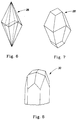
- the variety of forms of calcite are depicted in Figs. 1-8.
- the most preferred crystalline calcium carbonate has a substantially rhombohedral crystalline structure 10 as depicted in Fig. 1.
- This crystalline calcium carbonate is defined by ⁇ 1,0,-1,1 ⁇ crystallographic or Miller indices. It has been surprisingly found that by judiciously selecting a crystalline calcium carbonate of such a crystalline configuration, superior builder performance (i.e., removal of water hardness) can be achieved when used in typical detergent compositions for laundering soiled clothes.
- the median particle size of this crystalline calcium carbonate as detailed hereinafter is not required to be in the very small range (e.g., less than about 2 microns with a surface areas at least about 15 m 2 /g).
- Figs 2-8 define crystal structures of crystalline calcium carbonate or calcite which do not substantially have a rhombohedral crystalline structure with ⁇ 1,0,-1,1 ⁇ crystallographic indices, although they are suitable for use in the present invention as well.
- FIG. 6 depicts a crystalline calcium carbonate structure 26 having ⁇ 2,1,-3,1 ⁇ crystallographic indices
- Fig. 7 illustrates a scalenohedral calcite crystal structure 28 with ⁇ 2,1,-3,1 ⁇ and small faces with the preferred ⁇ 1,0,-1,1, ⁇ crystallographic indices
- Fig. 8 illustrates a top partial perspective view of yet another calcium carbonate crystalline structure 30 which has ⁇ 0,1,-1,2 ⁇ , ⁇ 2,1,-3,1 ⁇ and ⁇ 1,0,-1,0 ⁇ crystallographic indices.
- Figs. 3, 4, 5 and 7 depict the most common calcite crystals formed in nature. Furthermore, it is believed that the calcite crystal structures of Figs. 2-8 do not perform as well as the Fig. 1 structure because the Figs. 2-8 structures have a high population of calcium atoms at their respective crystal planes (i.e., outer surfaces), thereby resulting in poor performance relative to water hardness cation sequestration. To the contrary, as mentioned previously, the calcite crystal depicted in Fig.
- the "crystalline" nature of the builder material can be detected by X-ray Diffraction techniques known by those skilled in the art.
- X-ray diffraction patterns are commonly collected using Cu K alpha radiation on an automated powder diffractometer with a nickel filter and a scintillation counter to quantify the diffracted X-ray intensity.
- the X-ray diffraction diagrams are typically recorded as a pattern of lattice spacings and relative X-ray intensities.
- X-ray diffraction diagrams of corresponding preferred builder materials include, but are not limited to, the following numbers: 5-0586 and 17-0763.
- the crystalline calcium carbonate builder preferably has selected surface area for optimal performance. More specifically, the crystalline calcium carbonate has a surface area of less than about 10 m 2 /g Other more preferable surface area ranges for use herein include from about 0.01 m 2 /g to about 12 m 2 /g, even more preferably from about 0.1 m 2 /g to about 10 m 2 /g, yet more preferably from about 0.2 m 2 /g to about 5 m 2 /g, and most preferably from about 0.2 m 2 /g to about 4 m 2 /g.
- suitable surface area ranges also include from about 0.1 m 2 /g to about 4 m 2 /g and from about 0.01 m 2 /g to about 4 m 2 /g.
- the surface areas can be measured by standard techniques including by nitrogen adsorption using the standard Bruauer, Emmet & Teller (BET) method.
- BET Bruauer, Emmet & Teller
- a suitable machine for this method is a Carlo Erba Sorpty 1750 instrument operated according to the manufacturer's instructions.
- the crystalline calcium carbonate builder used in the detergent composition herein also unexpectedly has improved builder performance in that it has a high calcium ion exchange capacity.
- the builder material has a calcium ion exchange capacity, on an anhydrous basis, of at least about 100 mg equivalent of calcium carbonate hardness/gram, more preferably at least about 200 mg, and even more preferably at least about 300 mg, and most preferably from at least about 400 mg, equivalent of calcium carbonate hardness per gram of builder.
- the builder unexpectedly has an improved calcium ion exchange rate.
- the builder material has a calcium carbonate hardness exchange rate of at least about 5 ppm, more preferably from about 10 ppm to about 150 ppm, and most preferably from about 20 ppm to about 100 ppm, CaCO 3 /minute per 200 ppm of the builder material.
- a wide variety of test methods can be used to measure the aforementioned properties including the procedure exemplified hereinafter and the procedure disclosed in Corkill et al, U.S. Patent No. 4,605,509 (issued August 12, 1986), the disclosure of which is incorporated herein by reference.
- the detergent composition is substantially free of potassium salts, or if they are present, are included at very low levels.
- the potassium salts are included at levels of about 0.01% to about 5%, preferably at about 0.01% to about 2% by weight of the detergent composition.
- sodium sulfate and sodium carbonate are included in the detergent composition, they are preferably in a weight ratio of about 1:50 to about 2:1, more preferably from about 1:40 to about 1:1, most preferably from about 1:20 to about 1:1 of sodium sulfate to sodium carbonate. While not intending to be bound by theory, it is believed that excessive amounts of sulfate relative to carbonate may interfere with the builder performance of the crystalline calcium carbonate.
- sodium carbonate is included in the detergent composition, it is included preferably in a weight ratio of about 1:1 to about 20:1, more preferably from about 1:1 to about 10:1, most preferably from about 1:1 to about 5:1 of sodium carbonate to crystalline calcium carbonate builder.
- sodium carbonate is present in the detergent composition in an amount of from about 2% to about 80%, more preferably from about 5% to about 70%, and most preferably from about 10% to about 50% by weight of the detergent composition.
- the crystalline calcium carbonate in accordance with the invention can be made in a variety of ways so long as the resulting crystal substantially has a rhombohedral crystalline structure with ⁇ 1,0,-1,1 ⁇ crystallographic indices.
- the starting ingredient is crystalline calcium carbonate which does not have the aforementioned crystal structure.
- naturally occurring calcite such as the one depicted in Fig. 5 can be mined or commercially purchased and subjected to the process described hereinafter.
- milling means crushing, grinding or otherwise affecting the physical structure of the crystalline calcium carbonate.
- the process first involves feeding starting crystalline calcium carbonate into an apparatus having an internal chamber and air nozzles directed into the chamber.
- An Alpine Fluid Bed Jet Mill Model 100 AFG Fluid Bed Jet Mill commercially available from Hosokawa Micron - Alpine, Germany.
- Other suitable apparatus are commercially available from Hosokawa Micron - Alpine, Germany are sold under the trade names Table Top Roller Mill, Aeroplex, Ecoplex and Turboplex.
- the starting crystalline calcium carbonate is milled in such apparatus by inputting and grinding with air at a pressure from about 1 bar to about 50 bar, more preferably from about 1.5 bar to about 10 bar, and most preferably from about 2.5 bar to about 5 bar.
- the starting crystalline calcium carbonate is converted to a rhombohedral crystalline structure with ⁇ 1,0,-1,1 ⁇ crystallographic indices, thereby forming the detergent builder.
- This selected milling process step in which the starting ingredient (e.g., calcite) is milled involves crushing and/or grinding the starting crystalline calcium carbonate such that it is cleaved to form the aforementioned crystalline calcite structure (Fig. 1). While not intending to be bound by theory, it is believed that the ⁇ 1,0,-1,1 ⁇ crystallographic indices define "low stress" planes of larger naturally occurring calcite along which cleavage can occur if milled with selected process parameters.
- encapsulating materials for use in the present invention are said encapsulating material is selected from starches, polysaccharides, oligosaccharides, disaccharides, monosaccharidesalginate esters, carrageenan, agar-agar, pectic acid, chitosan, chitin, cellulose acetate cellulose acetate phthalate, carboxymethylcellulase, borates, polyethylene glycols, polyvinyl alcohol and mixtures thereof.
- the sugars such as polysaccharides, oligosaccharides, disaccharides, and monosaccharides are the most preferred.
- sucrose most preferred
- glucose fructose
- maltose maltose
- lactose lactose
- cellobiose cellobiose.
- the weight ratio of the encapsulating material to crystalline calcium carbonate described herein is from about 4:1 to about 1:99, preferably from about 2:1 to about 1:80, more preferably from about 1:1 to about 1:70, and most preferably from about 1:2 to about 1:60.
- Glass transition temperature is a well known and readily determined property for glassy materials. This transition is described as being equivalent to the liquification, upon heating through the Tg region, of a material in the glassy state to one in the liquid state. It is not a phase transition such as melting, vaporization, or sublimation. See William P. Brennan, "'What is a Tg?' A review of the scanning calorimetry of the glass transition", Thermal Analysis Application Study #7 , Perkin-Elmer Corporation, March 1973 for further details. Measurement of Tg is readily obtained by using a Differential Scanning Calorimeter.
- the Tg of the hydroxylic compounds is obtained for the anhydrous compound not containing any plasticizer (which will impact the measured Tg value of the hydroxylic compound).
- Glass transition temperature is also described in detail in P. Peyser, "Glass Transition Temperatures of Polymers", Polymer Handbook, Third Edition , J. Brandrup and E. H. Immergut (Wiley-Interscience; 1989), pp. VI/209 - VI/277.
- At least one of the hydroxylic compounds useful in the present invention detergent compositions can have an anhydrous, nonplasticized Tg of at least 0 °C.
- Other suitable Tg include at least about 20 °C, preferably at least about 40 °C, more preferably at least 60 °C, and most preferably at least about 100 °C. It is also preferred that these compounds be low temperature processable, preferably within the range of from about 40 °C to about 200 °C, and more preferably within the range of from about 60 °C to about 160 °C.
- Preferred such hydroxylic compounds include sucrose, glucose, lactose, and maltodextrin.
- the "hygroscopicity value" means the level of moisture uptake by the detergent compositions, as measured by the percent increase in weight of the composition under the following test method.
- the hygroscopicity value required for the present invention detergent compositions is determined by placing 2 grams of particles (approximately 500 micron size particles; not having any moisture barrier coating) in an open container petri dish under conditions of 90 °F and 80% relative humidity for a period of 4 weeks. The percent increase in weight of the particles at the end of this time is the particles hygroscopicity value as used herein.
- Preferred detergent particles have hygroscopicity value of less than about 50%, more preferably less than about 10%.
- the detergent compositions of the present invention typically comprise from about 10% to about 95% of the carbohydrate material, preferably from about 20% to about 90%, and more preferably from about 20% to about 75%.
- the detergent compositions of the invention can contain all manner of organic, water-soluble detergent compounds, inasmuch as the builder material are compatible with all such materials.
- at least one suitable adjunct detergent ingredient is preferably included in the detergent composition.
- the adjunct detergent ingredient is preferably selected from the group consisting of auxiliary builders, enzymes, bleaching agents, bleach activators, suds suppressers, soil release agents, brighteners, perfumes, hydrotropes, dyes, pigments, polymeric dispersing agents, pH controlling agents, chelants, processing aids, crystallization aids, and mixtures thereof.
- the following list of detergent ingredients and mixtures thereof which can be used in the compositions herein is representative of the detergent ingredients, but is not intended to be limiting.
- the detergent compositions herein comprise at least about 1%, preferably, from about 1% to about 55%, and most preferably from about 10 to 40%, by weight, of a detersive surfactant selected from the group consisting of anionic surfactants, nonionic surfactants, cationic surfactants, zwitterionic surfactants and mixtures.
- a detersive surfactant selected from the group consisting of anionic surfactants, nonionic surfactants, cationic surfactants, zwitterionic surfactants and mixtures.
- Nonlimiting examples of surfactants useful herein include the conventional C 11 -C 18 alkyl benzene sulfonates ("LAS") and primary, branched-chain and random C 10 -C 20 alkyl sulfates (“AS”), the C 10 -C 18 secondary (2,3) alkyl sulfates of the formula CH 3 (CH 2 ) x (CHOSO 3 - M + ) CH 3 and CH 3 (CH 2 ) y (CHOSO 3 - M + ) CH 2 CH 3 where x and (y + 1) are integers of at least about 7, preferably at least about 9, and M is a water-solubilizing cation, especially sodium, unsaturated sulfates such as oleyl sulfate, the C 10 -C 18 alkyl alkoxy sulfates ("AE x S", especially EO 1-7 ethoxy sulfates), C 10 -C 18 alkyl alkoxy carboxylates (especially the EO 1-5 e
- the conventional nonionic and amphoteric surfactants such as the C 12 -C 18 alkyl ethoxylates ("AE") including the so-called narrow peaked alkyl ethoxylates and C 6 -C 12 alkyl phenol alkoxylates (especially ethoxylates and mixed ethoxy/propoxy), C 12 -C 18 betaines and sulfobetaines ("sultaines"), C 10 -C 18 amine oxides, and the like, can also be included in the overall compositions.
- the C 10 -C 18 N-alkyl polyhydroxy fatty acid amides can also be used. Typical examples include the C 12 -C 18 N-methylglucamides. See WO 9,206,154.
- sugar-derived surfactants include the N-alkoxy polyhydroxy fatty acid amides, such as C 10 -C 18 N-(3-methoxypropyl) glucamide.
- the N-propyl through N-hexyl C 12 -C 18 glucamides can be used for low sudsing.
- C 10 -C 20 conventional soaps may also be used. If high sudsing is desired, the branched-chain C 10 -C 16 soaps may be used. Mixtures of anionic and nonionic surfactants are especially useful. Other conventional useful surfactants are listed in standard texts.
- LAS alkyl benzene sulfonates
- sugar based surfactants are less preferred, although they may be included in the compositions herein, in that they may interfere or otherwise act as a poison with respect to the builder material.
- Preferred adjunct builders include aluminosilicate ion exchange materials and sodium carbonate.
- the aluminosilicate ion exchange materials used herein as a detergent builder preferably have both a high calcium ion exchange capacity and a high exchange rate. Without intending to be limited by theory, it is believed that such high calcium ion exchange rate and capacity are a function of several interrelated factors which derive from the method by which the aluminosilicate ion exchange material is produced.
- the aluminosilicate ion exchange materials used herein are preferably produced in accordance with Corkill et al, U.S. Patent No. 4,605,509 (Procter & Gamble), the disclosure of which is incorporated herein by reference.
- the aluminosilicate ion exchange material is in "sodium" form since the potassium and hydrogen forms of the instant aluminosilicate do not exhibit the as high of an exchange rate and capacity as provided by the sodium form.
- the aluminosilicate ion exchange material preferably is in over dried form so as to facilitate production of crisp detergent agglomerates as described herein.
- the aluminosilicate ion exchange materials used herein preferably have particle size diameters which optimize their effectiveness as detergent builders.
- particle size diameter represents the average particle size diameter of a given aluminosilicate ion exchange material as determined by conventional analytical techniques, such as microscopic determination and scanning electron microscope (SEM).
- the preferred particle size diameter of the aluminosilicate is from about 0.1 micron to about 10 microns, more preferably from about 0.5 microns to about 9 microns. Most preferably, the particle size diameter is from about 1 microns to about 8 microns.
- the aluminosilicate ion exchange material has the formula Na z [(AlO 2 ) z .(SiO 2 ) y ]xH 2 O wherein z and y are integers of at least 6, the molar ratio of z to y is from about 1 to about 5 and x is from about 10 to about 264. More preferably, the aluminosilicate has the formula Na 12 [(AlO 2 ) 12 .(SiO 2 ) 12 ]xH 2 O wherein x is from about 20 to about 30, preferably about 27.
- These preferred aluminosilicates are available commercially, for example under designations Zeolite A, Zeolite B and Zeolite X.
- Naturally-occurring or synthetically derived aluminosilicate ion exchange materials suitable for use herein can be made as described in Krummel et al, U.S. Patent No. 3,985,669, the disclosure of which is incorporated herein by reference.
- the aluminosilicates used herein are further characterized by their ion exchange capacity which is at least about 200 mg equivalent of CaCO 3 hardness/gram, calculated on an anhydrous basis, and which is preferably in a range from about 300 to 352 mg equivalent of CaCO 3 hardness/gram. Additionally, the instant aluminosilicate ion exchange materials are still further characterized by their calcium ion exchange rate which is at least about 2 grains Ca ++ /gallon/minute/-gram/gallon, and more preferably in a range from about 2 grains Ca ++ /gallon/minute/-gram/gallon to about 6 grains Ca ++ /gallon/minute/-gram/gallon .
- the detergent compositions can include additional detergent ingredients and/or, any number of additional ingredients can be incorporated in the detergent composition during subsequent steps of the present process.
- adjunct ingredients include other detergency builders, bleaches, bleach activators, suds boosters or suds suppressers, anti-tarnish and anticorrosion agents, soil suspending agents, soil release agents, germicides, pH adjusting agents, non-builder alkalinity sources, chelating agents, smectite clays, enzymes, enzyme-stabilizing agents and perfumes. See U.S. Patent 3,936,537, issued February 3, 1976 to Baskerville, Jr. et al., incorporated herein by reference.
- minor mounts of other builders can be generally selected from the various water-soluble, alkali metal, ammonium or substituted ammonium phosphates, polyphosphates, phosphonates, polyphosphonates, carbonates, borates, polyhydroxy sulfonates, polyacetates, carboxylates, and polycarboxylates.
- alkali metal especially sodium, salts of the above.
- those preferred for low level use herein are the phosphates, carbonates, C 10-18 fatty acids, polycarboxylates, and mixtures thereof.
- Still others include sodium tripolyphosphate, tetrasodium pyrophosphate, citrate, tartrate mono- and di-succinates, and mixtures thereof (see below).
- crystalline layered sodium silicates exhibit a clearly increased calcium and magnesium ion exchange capacity.
- the layered sodium silicates prefer magnesium ions over calcium ions, a feature necessary to insure that substantially all of the "hardness" is removed from the wash water.
- These crystalline layered sodium silicates are generally more expensive than soluble silicates as well as other builders. Accordingly, in order to provide an economically feasible laundry detergent, the proportion of crystalline layered sodium silicates used must be determined judiciously.
- the crystalline layered sodium silicates suitable for use herein preferably have the formula NaMSi x O 2x+1 .yH 2 O wherein M is sodium or hydrogen, x is from about 1.9 to about 4 and y is from about 0 to about 20. More preferably, the crystalline layered sodium silicate has the formula NaMSi 2 O 5 .yH 2 O wherein M is sodium or hydrogen, and y is from about 0 to about 20.
- low levels of inorganic phosphate builders may be used which include sodium and potassium tripolyphosphate, pyrophosphate, polymeric metaphosphate having a degree of polymerization of from about 6 to 21, and orthophosphates.
- polyphosphonate builders are the sodium and potassium salts of ethylene diphosphonic acid, the sodium and potassium salts of ethane 1-hydroxy-1, 1-diphosphonic acid and the sodium and potassium salts of ethane, 1,1,2-triphosphonic acid.
- Other phosphorus builder compounds are disclosed in U.S. Patents 3,159,581; 3,213,030; 3,422,021; 3,422,137; 3,400,176 and 3,400,148, all of which are incorporated herein by reference.
- nonphosphorus, inorganic builders are tetraborate decahydrate and silicates having a weight ratio of SiO 2 to alkali metal oxide of from about 0.5 to about 4.0, preferably from about 1.0 to about 2.4.
- Water-soluble, nonphosphorus organic builders useful herein include the various alkali metal, ammonium and substituted ammonium polyacetates, carboxylates, polycarboxylates and polyhydroxy sulfonates.
- polyacetate and polycarboxylate builders are the sodium, potassium, lithium, ammonium and substituted ammonium salts of ethylene diamine tetraacetic acid, nitrilotriacetic acid, oxydisuccinic acid, mellitic acid, benzene polycarboxylic acids, and citric acid.
- polycarboxylates are the polyacetal carboxylates described in U.S. Patent 4,144,226, issued March 13, 1979 to Crutchfield et al, and U.S. Patent 4,246,495, issued March 27, 1979 to Crutchfield et al, both of which are incorporated herein by reference.
- These polyacetal carboxylates can be prepared by bringing together under polymerization conditions an ester of glyoxylic acid and a polymerization initiator. The resulting polyacetal carboxylate ester is then attached to chemically stable end groups to stabilize the polyacetal carboxylate against rapid depolymerization in alkaline solution, converted to the corresponding salt, and added to a detergent composition.
- Still other polycarboxylate builders are the ether carboxylate builder compositions comprising a combination of tartrate monosuccinate and tartrate disuccinate described in U.S. Patent 4,663,071, Bush et al., issued May 5, 1987, the disclosure of which is incorporated herein by reference.
- Bleaching agents and activators are described in U.S. Patent 4,412,934, Chung et al., issued November 1, 1983, and in U.S. Patent 4,483,781, Hartman, issued November 20, 1984, both of which are incorporated herein by reference.
- Chelating agents are also described in U.S. Patent 4,663,071, Bush et al., from Column 17, line 54 through Column 18, line 68, incorporated herein by reference.
- Suds modifiers are also optional ingredients and are described in U.S. Patents 3,933,672, issued January 20, 1976 to Bartoletta et al., and 4,136,045, issued January 23, 1979 to Gault et al., both incorporated herein by reference.
- Suitable smectite clays for use herein are described in U.S. Patent 4,762,645, Tucker et al, issued August 9, 1988, Column 6, line 3 through Column 7, line 24, incorporated herein by reference.
- Suitable additional detergency builders for use herein are enumerated in the Baskerville patent, Column 13, line 54 through Column 16, line 16, and in U.S. Patent 4,663,071, Bush et al, issued May 5, 1987, both incorporated herein by reference.
- the following illustrates a step-by-step procedure for determing the amount of calcium sequestration and the rate thereof for the crystalline calcium carbonate builder used in the compositions described herein.
- This example illustrates one of the many methods available to produce a detergent composition in accordance with the invention.
- a powdered sucrose having a particle size of 300 microns with a moisture content of less than 5% is mixed together at a ratio of 1:1 with calcite commercially available from Quincy Carbonates, Inc.
- a portion of this mixture, about 0.2-0.3 grams, of this mixture is then placed in the tablet die.
- the die was fashioned from three parts, which could be completely disassembled.
- the anvils, face diameter of 1.4 cm, have highly polished faces.
- the third part provides for alignment of the two anvils and containment of the sample.
- the top anvil is then placed into position and the entire assembly is placed between the platen of a hydraulic press capable of delivering 24,000 pounds of applied load.
- the base granule is prepared by a conventional spray drying process in which the starting ingredients are formed into a slurry and passed though a spray drying tower having a countercurrent stream of hot air (200-300°C) resulting in the formation of porous granules.
- the admixed agglomerates are formed from two feed streams of various starting detergent ingredients which are continuously fed, at a rate of 1400 kg/hr, into a Lödige CB-30 mixer/densifier, one of which comprises a surfactant paste containing surfactant and water and the other stream containing starting dry detergent material containing aluminosilicate and sodium carbonate.
- the rotational speed of the shaft in the Lödige CB-30 mixer/densifier is about 1400 rpm and the mean residence time is about 1-10 seconds.
- the contents from the Lödige CB-30 mixer/densifier are continuously fed into a Lödige KM-600 mixer/densifier for further agglomeration during which the mean residence time is about 6 minutes.
- the resulting detergent agglomerates are then fed to a fluid bed dryer and to a fluid bed cooler before being admixed with the spray dried granules.
- the remaining adjunct detergent ingredients are sprayed on or dry added to the blend of agglomerates and granules.
Landscapes
- Chemical & Material Sciences (AREA)
- Life Sciences & Earth Sciences (AREA)
- Engineering & Computer Science (AREA)
- Chemical Kinetics & Catalysis (AREA)
- Oil, Petroleum & Natural Gas (AREA)
- Wood Science & Technology (AREA)
- Organic Chemistry (AREA)
- Health & Medical Sciences (AREA)
- Inorganic Chemistry (AREA)
- Molecular Biology (AREA)
- Emergency Medicine (AREA)
- Detergent Compositions (AREA)
Applications Claiming Priority (2)
| Application Number | Priority Date | Filing Date | Title |
|---|---|---|---|
| US4042697P | 1997-03-11 | 1997-03-11 | |
| US40426P | 1997-03-11 |
Publications (2)
| Publication Number | Publication Date |
|---|---|
| EP0864640A2 true EP0864640A2 (de) | 1998-09-16 |
| EP0864640A3 EP0864640A3 (de) | 1998-11-18 |
Family
ID=21910926
Family Applications (1)
| Application Number | Title | Priority Date | Filing Date |
|---|---|---|---|
| EP98200738A Ceased EP0864640A3 (de) | 1997-03-11 | 1998-03-09 | Eingekapselter kristalliner Calciumcarbonat builder für Waschmittel |
Country Status (3)
| Country | Link |
|---|---|
| US (1) | US6114289A (de) |
| EP (1) | EP0864640A3 (de) |
| CA (1) | CA2231646C (de) |
Cited By (1)
| Publication number | Priority date | Publication date | Assignee | Title |
|---|---|---|---|---|
| WO2002064725A1 (en) * | 2001-02-12 | 2002-08-22 | The Procter & Gamble Company | Delivery system having encapsulated porous carrier loaded with additives |
Families Citing this family (7)
| Publication number | Priority date | Publication date | Assignee | Title |
|---|---|---|---|---|
| GB9825033D0 (en) * | 1998-11-13 | 1999-01-13 | Nycomed Pharma As | Process |
| US6492320B2 (en) * | 1999-09-24 | 2002-12-10 | Rohm And Hass Company | Multifunctional, granulated pellet aid and process |
| DE10118979A1 (de) * | 2001-04-18 | 2002-11-14 | Markus Miller | Verfahren zur Herstellung leichtlöslicher Agglomerate aus einem insbesondere schwerlöslichen Schüttgut |
| US20050148488A1 (en) * | 2002-05-15 | 2005-07-07 | Maren Jekel | Detergent tablets with active phase |
| JP4424605B2 (ja) * | 2004-12-09 | 2010-03-03 | 花王株式会社 | 洗浄剤 |
| DE102006054436A1 (de) * | 2006-11-16 | 2008-05-21 | Henkel Kgaa | Feste, textil- und/oder hautpflegende Zusammensetzung |
| FI128521B (en) * | 2013-06-20 | 2020-07-15 | Fp Pigments Oy | Composition of precipitated calcium carbonate, method of producing the same and the uses thereof |
Family Cites Families (31)
| Publication number | Priority date | Publication date | Assignee | Title |
|---|---|---|---|---|
| GB1437950A (en) * | 1972-08-22 | 1976-06-03 | Unilever Ltd | Detergent compositions |
| US4171291A (en) * | 1972-09-06 | 1979-10-16 | Lever Brothers Company | Process for preparing alkane sulfonate detergent compositions |
| US4076653A (en) * | 1973-08-08 | 1978-02-28 | Lever Brothers Company | Detergent compositions |
| GB1481685A (en) * | 1973-08-15 | 1977-08-03 | Unilever Ltd | Detergent ingredient |
| GB1481516A (en) * | 1973-08-15 | 1977-08-03 | Unilever Ltd | Detergent compositions |
| GB1485371A (en) * | 1973-10-01 | 1977-09-08 | Unilever Ltd | Detergent compositions |
| GB1504878A (en) * | 1974-05-30 | 1978-03-22 | Unilever Ltd | Production of detergent compositions |
| US3954649A (en) * | 1974-09-16 | 1976-05-04 | Lever Brothers Company | Detergent compositions containing coated particulate calcium sulfate dihydrate |
| US3997692A (en) * | 1974-09-16 | 1976-12-14 | Lever Brothers Company | Process of coating calcium sulfate dihydrate detergent filler particles |
| US4049586A (en) * | 1974-09-27 | 1977-09-20 | The Procter & Gamble Company | Builder system and detergent product |
| US3981686A (en) * | 1974-10-24 | 1976-09-21 | Intermountain Research And Development Corporation | Clarifier process for producing sodium carbonate |
| US3932316A (en) * | 1974-11-13 | 1976-01-13 | The Procter & Gamble Company | Free flowing detergent compositions containing benzoate salts |
| GB1583081A (en) * | 1977-05-18 | 1981-01-21 | Unilever Ltd | Production of detergent compositions |
| US4162994A (en) * | 1977-11-10 | 1979-07-31 | Lever Brothers Company | Powdered detergent compositions containing a calcium salt of an anionic surfactant |
| US4352678A (en) * | 1978-10-02 | 1982-10-05 | Lever Brothers Company | Thickened abrasive bleaching compositions |
| MX151028A (es) * | 1978-11-17 | 1984-09-11 | Unilever Nv | Mejoras en bolsa insoluble pero permeable al agua que tiene una capa protectora dispersable o soluble en agua,que contiene una composicion detergente en particulas |
| US4407722A (en) * | 1981-06-18 | 1983-10-04 | Lever Brothers Company | Fabric washing process and detergent composition for use therein |
| US4473485A (en) * | 1982-11-05 | 1984-09-25 | Lever Brothers Company | Free-flowing detergent powders |
| GB8311002D0 (en) * | 1983-04-22 | 1983-05-25 | Unilever Plc | Detergent compositions |
| GB2174712B (en) * | 1985-05-10 | 1988-10-19 | Unilever Plc | Detergent granules |
| CA1297376C (en) * | 1985-11-01 | 1992-03-17 | David Philip Jones | Detergent compositions, components therefor, and processes for theirpreparation |
| GB8626691D0 (en) * | 1986-11-07 | 1986-12-10 | Unilever Plc | Detergent composition |
| US4828620A (en) * | 1987-08-27 | 1989-05-09 | Southwest Research Institute | Calcination of calcium carbonate and blend therefor |
| GB9112384D0 (en) * | 1991-06-10 | 1991-07-31 | Unilever Plc | Detergent compositions |
| US5219541A (en) * | 1991-07-23 | 1993-06-15 | Tenneco Minerals Company | Sodium hydroxide production with a calcium carbonate seed crystal |
| GB9209366D0 (en) * | 1992-04-30 | 1992-06-17 | Unilever Plc | Builder and bleach system |
| US5733865A (en) * | 1995-05-31 | 1998-03-31 | The Procter & Gamble Company | Processes for making a crystalline builder having improved performance |
| US5707959A (en) * | 1995-05-31 | 1998-01-13 | The Procter & Gamble Company | Processes for making a granular detergent composition containing a crystalline builder |
| US5731279A (en) * | 1995-05-31 | 1998-03-24 | The Procter & Gamble Company | Cleaning compositions containing a crystalline builder material having improved performance |
| US5658867A (en) * | 1995-05-31 | 1997-08-19 | The Procter & Gamble Company | Cleaning compositions containing a crystalline builder material in selected particle size ranges for improved performance |
| US5665691A (en) * | 1995-10-04 | 1997-09-09 | The Procter & Gamble Company | Process for making a low density detergent composition by agglomeration with a hydrated salt |
-
1998
- 1998-03-02 US US09/033,444 patent/US6114289A/en not_active Expired - Fee Related
- 1998-03-09 EP EP98200738A patent/EP0864640A3/de not_active Ceased
- 1998-03-10 CA CA002231646A patent/CA2231646C/en not_active Expired - Fee Related
Cited By (1)
| Publication number | Priority date | Publication date | Assignee | Title |
|---|---|---|---|---|
| WO2002064725A1 (en) * | 2001-02-12 | 2002-08-22 | The Procter & Gamble Company | Delivery system having encapsulated porous carrier loaded with additives |
Also Published As
| Publication number | Publication date |
|---|---|
| CA2231646A1 (en) | 1998-09-11 |
| CA2231646C (en) | 2003-08-05 |
| EP0864640A3 (de) | 1998-11-18 |
| US6114289A (en) | 2000-09-05 |
Similar Documents
| Publication | Publication Date | Title |
|---|---|---|
| US6130194A (en) | Crystalline calcium carbonate builder enrobed with a hydrotrope for use in detergent compositions | |
| EP0858500B1 (de) | Verfahren zur herstellung eines waschmittels mit niedrigen schüttgewichtmittels agglomeration mit einem anorganischen doppelsalz | |
| JP2533053B2 (ja) | 珪酸塩及び無機化合物を基剤とするビルダ― | |
| US4908159A (en) | Detergent granules containing simple sugars and a seed crystal for calcium carbonate | |
| EP0828816B1 (de) | Verfahren zur herstellung einer granulierten waschmittelzusammensetzung die ein kristallines builder-material enthält | |
| JP2002517371A (ja) | コーティングされた過炭酸ナトリウム粒子、その調製法、洗剤組成物におけるその使用及びそれを含む洗剤組成物 | |
| CA2245933C (en) | Process for making a low density detergent composition by agglomeration with an inorganic double salt | |
| US6114289A (en) | Encapsulated crystalline calcium carbonate builder for use in detergent compositions | |
| CZ94298A3 (cs) | Způsob přípravy detergentních prostředků s nízkou sypnou hmotností aglomerací s hydratovanou solí | |
| JPH07504696A (ja) | 顆粒状洗剤組成物 | |
| PT660873E (pt) | Composicoes detergentes granulares de densidade elevada | |
| US6100232A (en) | Process for making a granular detergent composition containing a selected crystalline calcium carbonate builder | |
| WO1998040457A1 (en) | Builder mixture containing crystalline calcium carbonate builder for use in detergent compositions | |
| MXPA02004213A (es) | Composiciones detergentes y metodo de limpieza. | |
| EP0828811B1 (de) | Verfahren zur herstellung von einem kristallinen builder-material mit verbesserter leistung | |
| JP3008266B2 (ja) | 結晶性アルカリ金属ケイ酸塩顆粒の製造方法及び衣料用の高嵩密度粒状洗剤組成物 | |
| EP1159390B1 (de) | Verfahren zur herstellung umhüllter tensidteilchen | |
| JPS63264700A (ja) | 水溶性陽イオン界面活性剤で表面処理された中間相を形成する多量の陰イオン界面活性剤を含有する粒状洗剤 | |
| KR960001012B1 (ko) | 칼슘 침전물용 스캐빈져로서의 무정질 실리코알루미늄산염의 용도 | |
| WO1998040456A1 (en) | A process for making a selected crystalline calcium carbonate builder for use in detergent compositions | |
| MXPA02004212A (es) | Composiciones detergentes. | |
| WO1997033966A1 (en) | Compaction/crushing process for making a crystalline builder material | |
| WO1998040455A1 (en) | A selected crystalline calcium carbonate builder for use in detergent compositions | |
| WO1994028099A1 (en) | Coating clay agglomerates with finely divided particulate material | |
| MXPA02004214A (es) | Composiciones detergentes. |
Legal Events
| Date | Code | Title | Description |
|---|---|---|---|
| PUAI | Public reference made under article 153(3) epc to a published international application that has entered the european phase |
Free format text: ORIGINAL CODE: 0009012 |
|
| AK | Designated contracting states |
Kind code of ref document: A2 Designated state(s): AT BE CH DE DK ES FI FR GB GR IE IT LI LU NL PT SE |
|
| AX | Request for extension of the european patent |
Free format text: AL;LT;LV;MK;RO;SI |
|
| PUAL | Search report despatched |
Free format text: ORIGINAL CODE: 0009013 |
|
| AK | Designated contracting states |
Kind code of ref document: A3 Designated state(s): AT BE CH DE DK ES FI FR GB GR IE IT LI LU MC NL PT SE |
|
| AX | Request for extension of the european patent |
Free format text: AL;LT;LV;MK;RO;SI |
|
| AKX | Designation fees paid |
Free format text: AT BE CH DE DK ES FI FR GB GR IE IT LI LU NL PT SE |
|
| 17P | Request for examination filed |
Effective date: 19990524 |
|
| RAP1 | Party data changed (applicant data changed or rights of an application transferred) |
Owner name: THE UNIVERSITY OF NORTH CAROLINA AT CHAPEL HILL |
|
| 17Q | First examination report despatched |
Effective date: 20030124 |
|
| STAA | Information on the status of an ep patent application or granted ep patent |
Free format text: STATUS: THE APPLICATION HAS BEEN REFUSED |
|
| 18R | Application refused |
Effective date: 20041216 |