EP0864878B1 - Isolierung der Vibrationen und Reduzierung des Lärms von Kryokühlern in der Bilderzeugung durch magnetische Resonanz - Google Patents
Isolierung der Vibrationen und Reduzierung des Lärms von Kryokühlern in der Bilderzeugung durch magnetische Resonanz Download PDFInfo
- Publication number
- EP0864878B1 EP0864878B1 EP98301776A EP98301776A EP0864878B1 EP 0864878 B1 EP0864878 B1 EP 0864878B1 EP 98301776 A EP98301776 A EP 98301776A EP 98301776 A EP98301776 A EP 98301776A EP 0864878 B1 EP0864878 B1 EP 0864878B1
- Authority
- EP
- European Patent Office
- Prior art keywords
- cryocooler
- mri
- axis
- magnet assembly
- superconducting magnet
- Prior art date
- Legal status (The legal status is an assumption and is not a legal conclusion. Google has not performed a legal analysis and makes no representation as to the accuracy of the status listed.)
- Expired - Lifetime
Links
- 238000002955 isolation Methods 0.000 title claims description 30
- 238000002595 magnetic resonance imaging Methods 0.000 title description 21
- 230000033001 locomotion Effects 0.000 claims description 22
- 229910001220 stainless steel Inorganic materials 0.000 claims description 6
- 239000010935 stainless steel Substances 0.000 claims description 6
- 230000000694 effects Effects 0.000 claims description 5
- 229910001369 Brass Inorganic materials 0.000 claims description 2
- 239000010951 brass Substances 0.000 claims description 2
- 230000003247 decreasing effect Effects 0.000 claims description 2
- 239000000463 material Substances 0.000 claims 1
- 239000007789 gas Substances 0.000 description 5
- 239000001307 helium Substances 0.000 description 5
- 229910052734 helium Inorganic materials 0.000 description 5
- SWQJXJOGLNCZEY-UHFFFAOYSA-N helium atom Chemical compound [He] SWQJXJOGLNCZEY-UHFFFAOYSA-N 0.000 description 5
- 230000005534 acoustic noise Effects 0.000 description 3
- 229910052782 aluminium Inorganic materials 0.000 description 3
- XAGFODPZIPBFFR-UHFFFAOYSA-N aluminium Chemical compound [Al] XAGFODPZIPBFFR-UHFFFAOYSA-N 0.000 description 3
- 238000009434 installation Methods 0.000 description 3
- 239000007788 liquid Substances 0.000 description 3
- 238000013016 damping Methods 0.000 description 2
- 230000006866 deterioration Effects 0.000 description 2
- RYGMFSIKBFXOCR-UHFFFAOYSA-N Copper Chemical compound [Cu] RYGMFSIKBFXOCR-UHFFFAOYSA-N 0.000 description 1
- 241000270295 Serpentes Species 0.000 description 1
- 230000002745 absorbent Effects 0.000 description 1
- 239000002250 absorbent Substances 0.000 description 1
- 239000006096 absorbing agent Substances 0.000 description 1
- 238000005452 bending Methods 0.000 description 1
- 230000005540 biological transmission Effects 0.000 description 1
- 238000009835 boiling Methods 0.000 description 1
- 238000001816 cooling Methods 0.000 description 1
- 238000006073 displacement reaction Methods 0.000 description 1
- 230000005284 excitation Effects 0.000 description 1
- 238000003780 insertion Methods 0.000 description 1
- 230000037431 insertion Effects 0.000 description 1
- 230000003993 interaction Effects 0.000 description 1
- 229910052751 metal Inorganic materials 0.000 description 1
- 239000002184 metal Substances 0.000 description 1
- 229920003023 plastic Polymers 0.000 description 1
- 229920001084 poly(chloroprene) Polymers 0.000 description 1
- 238000005086 pumping Methods 0.000 description 1
- 230000000717 retained effect Effects 0.000 description 1
- 230000035939 shock Effects 0.000 description 1
- 230000003068 static effect Effects 0.000 description 1
- 239000000758 substrate Substances 0.000 description 1
- 230000007704 transition Effects 0.000 description 1
Images


Classifications
-
- F—MECHANICAL ENGINEERING; LIGHTING; HEATING; WEAPONS; BLASTING
- F25—REFRIGERATION OR COOLING; COMBINED HEATING AND REFRIGERATION SYSTEMS; HEAT PUMP SYSTEMS; MANUFACTURE OR STORAGE OF ICE; LIQUEFACTION SOLIDIFICATION OF GASES
- F25D—REFRIGERATORS; COLD ROOMS; ICE-BOXES; COOLING OR FREEZING APPARATUS NOT OTHERWISE PROVIDED FOR
- F25D19/00—Arrangement or mounting of refrigeration units with respect to devices or objects to be refrigerated, e.g. infrared detectors
- F25D19/006—Thermal coupling structure or interface
-
- G—PHYSICS
- G01—MEASURING; TESTING
- G01R—MEASURING ELECTRIC VARIABLES; MEASURING MAGNETIC VARIABLES
- G01R33/00—Arrangements or instruments for measuring magnetic variables
- G01R33/20—Arrangements or instruments for measuring magnetic variables involving magnetic resonance
- G01R33/28—Details of apparatus provided for in groups G01R33/44 - G01R33/64
- G01R33/38—Systems for generation, homogenisation or stabilisation of the main or gradient magnetic field
- G01R33/381—Systems for generation, homogenisation or stabilisation of the main or gradient magnetic field using electromagnets
- G01R33/3815—Systems for generation, homogenisation or stabilisation of the main or gradient magnetic field using electromagnets with superconducting coils, e.g. power supply therefor
-
- H—ELECTRICITY
- H01—ELECTRIC ELEMENTS
- H01F—MAGNETS; INDUCTANCES; TRANSFORMERS; SELECTION OF MATERIALS FOR THEIR MAGNETIC PROPERTIES
- H01F6/00—Superconducting magnets; Superconducting coils
- H01F6/04—Cooling
-
- Y—GENERAL TAGGING OF NEW TECHNOLOGICAL DEVELOPMENTS; GENERAL TAGGING OF CROSS-SECTIONAL TECHNOLOGIES SPANNING OVER SEVERAL SECTIONS OF THE IPC; TECHNICAL SUBJECTS COVERED BY FORMER USPC CROSS-REFERENCE ART COLLECTIONS [XRACs] AND DIGESTS
- Y10—TECHNICAL SUBJECTS COVERED BY FORMER USPC
- Y10S—TECHNICAL SUBJECTS COVERED BY FORMER USPC CROSS-REFERENCE ART COLLECTIONS [XRACs] AND DIGESTS
- Y10S505/00—Superconductor technology: apparatus, material, process
- Y10S505/825—Apparatus per se, device per se, or process of making or operating same
- Y10S505/888—Refrigeration
- Y10S505/892—Magnetic device cooling
Definitions
- This invention relates to the use of cryocoolers in superconducting magnets for magnetic resonance imaging (hereinafter "MRI"), and more particularly to noise reduction, and vibration isolation, of the cryocooler to improve the quality of the images provided by MRI operation.
- MRI magnetic resonance imaging
- a magnet coil can be made superconducting by placing it in an extremely cold environment, such as by enclosing it in a cryostat or pressure vessel containing liquid helium or other cryogen.
- the extreme cold reduces the resistance of the magnet coil to negligible levels, such that when a power source is initially connected to the coil (for a period, for example, of 100 minutes) to introduce a current flow through the coil, the current will continue to flow through the coil due to the negligible coil resistance even after power is removed, thereby maintaining a strong magnetic field.
- Superconducting magnets find wide application, for example, in the field of MRI.
- the pressure vessel which is contained within a vacuum vessel, is surrounded by a plurality of intermediate concentric heat shields.
- Each successive heat shield is at a slightly higher temperature than the cryogen in order to thermally isolate the pressure vessel from ambient temperatures on the outside of the vacuum vessel, which may be in the order of some 300° K higher than the cryogen temperature.
- the thermal shields are maintained at their cold temperatures by a cryogenic refrigerator which typically is contained within a stainless steel cold head sleeve cylinder with thermal connections between the cold head and the thermal shields.
- the thermal connection between the cold head and the thermal shields must be thermally conductive and efficient, and operate in the presence of vibration generated by the movement of the piston and gas within the cryogenic refrigerator or cryocooler and the resultant movement of the cold head relative to the heat shields and relative to the superconducting magnet.
- Cryocoolers have been found to provide two major problems, acoustic noise and vibration.
- the noise has proven to be nuisance and distraction to MRI operators and patients because of its disturbing frequency and the vibration has resulted in deterioration in the MRI image quality.
- An additional problem is minimizing noise and vibration without deterioration in the cryocooler performance. See, for example, US-A-5,129,232.
- isolation means are provided in an MRI superconducting magnet to minimize the vibration effects of the cryocooler.
- the isolation means include a flexible bellows between the cryocooler and the superconducting magnet plus vibration damping means.
- the vibration isolation means also includes a mass which is attached to the cryocooler with rods which extend parallel to the axis of the cryocooler with the mass being positioned at a distance from the cryocooler. The dimensions of the rods are selected to lower the stiffness of the vibration in directions other than the axial direction while providing high stiffness in the axial direction.
- the flexible isolating means includes a bellows interposed between the cryocooler and the vessel enclosing the superconducting magnet and a plurality of elastomeric blocks to dampen motion of the cryocooler.
- Thermal braids of copper wire thermally connect yet isolate the thermal shields of the MRI from the vibration effects of the cryocooler.
- cryocooler 12 is mounted on superconducting magnet 10 and is a powered by drive motor 13 to provide cooling to components within the superconducting magnet.
- Cryocooler 12 is inserted into a cavity or vacuum sleeve 14 within vacuum vessel 18 of superconducting magnet 10 and secured in place enabling the selective insertion of the cryocooler into the sleeve, or the removal of the cryocooler for service or replacement, without disturbing the vacuum within the vacuum vessel or the superconducting operation of superconducting magnet 10.
- Cryocooler 12 is bolted to vacuum vessel 18 through suitable mounting means which include member 7, bolts 2, aluminum isolator brackets 31 sized for stiffness, and associated flanges such as cryocooler flange 8, transition flange 9 and stainless steel sleeve 11.
- Stiffness as used herein is resistance to a static load wherein stiffness is proportional to the force applied divided by the amount of deflection. Accordingly, the lower the deflection, the higher the stiffness.
- means are provided to isolate superconducting magnet 10 from the vibration generated by the reciprocating piston and gas motion of cryocooler 12 and to minimize the bothersome noise generated by the cryocooler.
- Principal elements of the isolating means each of which are described in more detail below, cooperate to provide the desired vibration attenuation and noise minimization include thermal braids 22, bellows 28, elastomeric blocks 30 and mass 36 (shown in FIG. 2).
- Bellows 28 provide vibration isolation between vacuum vessel 18 and cryocooler 12. Bellows 28 provide increased absorbent resiliency or softness in the direction of axis 5 of cryocooler 12 which is also the axis of the motion of the gas piston (not shown) within the cryocooler and hence the direction of movement of the gas piston which creates the mechanical disturbance or vibration of concern. Bellows 28 consists of 2-6 convolutions and is fabricated of 300 series stainless steel having a wall thickness of 127-508 ⁇ m (5-20 mils), an inside diameter of 127-203 mm (5-8 inches) and an outside diameter of 152-229 mm (6-9 inches). The embodiment shown in FIG. 1 includes three convolutions of substantially sinusoidal shape, although other shapes are suitable.
- bellows 28 does not provide adequate support for cryocooler 12 which has a typical weight of approximately 13.6 kg (30 pounds), and which with the added sleeve and mounting hardware can be as much as 27.2 kg (60 pounds).
- Bellows 28 is too soft or flimsy to support such significant weight which would tend to cause cryocooler 12 to tip and rotate about the bellows transverse to axis 5.
- 3 to 12 elastomeric cylindrical blocks 30 are spaced concentrically around axis 5 and interposed between flanges 8, 9 and 11 together with associated mounting bracket 31 and member or mounting means 7 on vacuum vessel 18 on the other side.
- Elastomeric blocks 30 have a diameter of 12.7-50.8 mm (1/2-2 inches) and are selected to provide the desired stiffness and damping (resistance to velocity) to assist in the vibration isolation. They are equally spaced around axis 5. Elastomeric blocks 30 include metal studs embedded therein on each end to facilitate securing them to the cryocooler assembly. Elastomeric blocks 30 support and prevent the rotation of cryocooler 12 and cryocooler sleeve 14 within vacuum vessel 18. Port 4 is a path for pumping out or evacuating sleeve 14 or for access to the vacuum vessel for instrumentation. Elastomeric blocks 30 are neoprene such as those sold by Barry Controls, Brighten, Massachusetts, under their model designation A34-141. Bellows 28 and elastomeric blocks 30 provide vibration isolation without additional vibration paths and result in improved MRI image quality.
- the inertia mounting or mass arrangement shown in FIG. 2 is added to the vibration isolation combination including thermal braids 22, elastomeric blocks 30 and bellows 28.
- the one embodiment of mass 36 comprises 3 square 305 mm (12 inch) brass 19 mm (3/4 inch) thick plates totaling 45.36 kg (100 pounds) which is suspended about axis 5 and spaced from cryocooler 12 and its drive motor 13 by three rods 34. Alternate mass embodiments are possible.
- Rods 34 are 18SST stainless steel 6.35 to 19 mm (1/4 to 3/4 inches) in diameter. A diameter of 7.94 mm (5/16") was used in one embodiment.
- the three rods 34 extend parallel to axis 5 of cryocooler 12 and are concentric thereto, being equally spaced from each other about axis 5 by approximately 120 degrees.
- Rods 34 are secured at their inner ends to mounting plate 31 by suitable fastener such as nuts 35.
- the outer ends of rods 34 are similarly threaded and nuts 38 secure plates 36 to the rods which pass through appropriately spaced apertures 37 in the plates. Plates 36 are secured to base 44 of superconducting magnet 10 which supports the superconducting magnet on substrate or floor 46 by frame assembly 40 which snakes around vacuum vessel 18 and includes aluminum yoke 43, upper vertical support 42, upper angle portion 39 and vertical lower portion 41.
- Rods 34 are concentric about axis 5 to avoid twisting and provide softness or flexibility in directions other than the axial direction.
- the rods are not compressible and are stiff in the axial direction. As a result, they provide stiff inertial resistance in the axial direction, while providing soft vibration isolation in the lateral directions.
- Frame 40 supports the weight of plates 36 in the vertical direction. As a result, frame 40 supports the weight such that its inertia only affects the vibration of cryocooler 12 in the axial direction.
- U-shaped yoke 43 Interposed between frame 40 and plates 36 is U-shaped yoke 43 which surrounds the lower portion of the plates and is connected to the plates by pivots 45.
- Pivots 45 are a pair of 19 mm (3/4 inch) bolts.
- Yoke 43 provides a support interface between the pivots and frame 40.
- Pivots 45 enable the adjustment of plates 36 by nuts 38 to provide the optimum positioning and inertia properties of the plates on the vibration isolation system.
- the bottom of vibration isolation frame 40 is connected to base 44 of superconducting magnet 10 through pivot 49 which is a 50.8 mm (2 inch) pipe rotatable about axle 48 secured to member 18.
- Frame 40 is fabricated of 25.4 to 50.8 mm (1 to 2 inch) thick aluminum channel members sized for the desired stiffness.
- Mobile MRI equipment is utilized for movement over roads for sequential use at a plurality of hospitals or diagnostic centers.
- the present invention provides flexibility to compensate for the mobile environment and to avoid bellows fatique which might otherwise result from the bumps and shocks encountered in repeated travel over roadways.
- Stiffness elements are added along the lateral axes to resist dynamic loads without deforming the bellows or buckling under road conditions.
- the stiffness is obtained by adding flexures between mounting bracket 31 and vacuum vessel 18.
- the flexures are sized to resist lateral motion of bellows 28 without adding stiffness along axis 5.
- a motion limiter is provided to limit axial movement of bellows 28 during transportation.
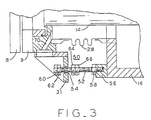
- the axial motion limiter is shown in FIG. 3.
- axial motion limiter 50 includes a threaded 6.35 to 12.7 mm (1/4 to 1/2 inch) diameter stud 52 extending through aperture 54 in isolation bracket 31 on one end and retained in block 56 secured to vacuum vessel 18 on the other end by threads in the block and lock nut 58.
- Nut pairs 60, 62 and 64, 66 threaded on stud 52 on opposite sides of isolation bracket or stop plate 31 are positioned by rotation to define the limits of axial travel of bellows 28 secured between vacuum sleeve 16 on one end and isolation bracket 31 (through the intermediary of member 70) on the other end.
- the distance between nut pairs 60, 62 and 64, 66 defines the amount of motion allowed by axial motion limiter 50 in the direction parallel to axis 5 of cryocooler 12 (see FIG. 1).
- Other mechanical stops as well as impact absorbers could be used in place of the nut pairs.
- FIG. 2 also includes bellows flexures 57 drawn in enlarged form to better illustrate its structure.
- flexure sheet 52 is stainless steel sheet, approximately 102-203 mm (4-8 inches) long, 12.7-50.8 mm (1/2-2 inches) wide and 0.51-2.29 mm (20-90 mils) thick.
- Stiffness element 67 is a pair of plastic members approximately 25.4-76.2 mm (1-3 inches) long, 12.7-50.8 mm (1/2-2 inches) wide and 1.59-6.35 mm (1/16-1/4 inch) thick sandwiching flexure sheet 52 in the central region thereof.
- Flexure sheet 52 is secured to mounting bracket 31 at end 54 and to end member 62 at the remote end.
- End member 62 is secured through threaded rod 64 to bracket 59 by nuts 58 and 61 which are positioned on threaded rod 64 on either side of bracket 59 enabling selective application of controlled tension to flexure sheet 52.
- Bellows flexures 57 provides stiffness along its excitation axis parallel to axis 5 of cryocooler 12 of approximately 11.79 kg per cm (66 pounds per inch), and approximately 17.860 kg per cm (100,000 pounds per inch) along each lateral axis.
- the buckling load is approximately 45.4 kg (100 pounds) along each lateral axis or 5 G's for a 27.2 kg (60 pound) load of cryocooler 12 and associate weight, far above anything to be encountered in transporting superconducting magnet 10.
- the bending load on flexure movement of cryocooler 12 is also adequate.
- bellows flexures 57 is adequate to prevent bellows fatigue under a mobile environment, including a mobile MRI installation which is repeatedly moved between a plurality of locations. Bellows flexures 57 is not disconnected during fixed MRI operation at any particular location even though its presence may not be required during such periods of time.
Landscapes
- Physics & Mathematics (AREA)
- Engineering & Computer Science (AREA)
- Electromagnetism (AREA)
- Condensed Matter Physics & Semiconductors (AREA)
- General Physics & Mathematics (AREA)
- Chemical & Material Sciences (AREA)
- Combustion & Propulsion (AREA)
- Mechanical Engineering (AREA)
- Thermal Sciences (AREA)
- General Engineering & Computer Science (AREA)
- Magnetic Resonance Imaging Apparatus (AREA)
Claims (10)
- Supraleitende Magneteinrichtung für MRI, mit
einem supraleitenden Magnet (10) und einem mechanischen Kryo-Kühler (12), der eine Achse (5) umschließt und auf dem supraleitenden Magneten in Wärme austauschender Zuordnung zu diesem angeordnet ist;- mit einer Isolationseinrichtung (28, 30) zur Minimierung von Vibrationswirkungen des Kryo-Kühlers (12), wobei die Isolationseinrichtung (28, 30) Isolationsmittel (28) aufweist, die zwischen dem Kryokühler und dem supraleitenden Magneten (10) angeordnet sind;- einem Gewicht (36), das längs der Achse (5) des Kryo-Kühlers (12) in einem Abstand von dem von dem supraleitenden Magneten (10) entfernten Ende des Kryo-Kühlers (12) derart angeordnet ist, dass der Kryo-Kühler (12) zwischen dem Gewicht (36) und dem Magneten (10) positioniert ist;- und einer Anzahl sich im Wesentlichen parallel zu der Achse (5) erstreckender, axialer Trägerelemente (34) zur Abstützung des Gewichtes (36);- wobei die Größe der Vibrationen des Kryo-Kühlers (12) in der axialen Richtung verringert wird. - MRI-Magneteinrichtung nach Anspruch 1, bei der ein Trägerelement (34) sich rechtwinklig zu der Achse (5) erstreckt um das Gewicht (36) in dieser rechtwinkligen Richtung abzustützen.
- MRI-Magneteinrichtung nach Anspruch 2, bei der die axialen Trägerelemente (34) Stäbe sind, deren Abmessungen so gewählt sind, dass die Steifigkeit der Vibrationsisolationsmittel (28, 30) in anderen Richtungen als der Axialrichtung verringert ist, während die Steifigkeit in der Axialrichtung vergrößert ist.
- MRI-Magneteinrichtung nach Anspruch 3, bei der der supraleitende Magnet (10) ein ihn einschließendes Gefäß (18) aufweist und die Isolationsmittel (28, 30) einem Balg (28) aufweisen, der zwischen dem Kryo-Kühler (12) und dem umschließenden Gefäß (18) angeordnet ist.
- MRI-Magneteinrichtung nach Anspruch 4, bei der die Isolationsmittel (28, 30) außerdem wenigstens ein elastomeres Element (30) aufweisen, das zwischen dem Kryo-Kühler und dem supraleitenden Magnet (10) angeordnet ist.
- MRI-Magneteinrichtung nach Anspruch 3, bei der das Material und die Abmessungen der Isolationsmittel (28, 30) einschließlich des Gewichtes (36) derart gewählt sind, dass die Isolationsfrequenz des Kryo-Kühlers (12) unter die erste Resonanzfrequenz des umschließenden Gefäßes (18) abgesenkt ist.
- MRI-Magneteinrichtung nach Anspruch 6, bei der das Gewicht (36) Messingplatten (36) aufweist, die mittels Edelstahl-Stäben (34) befestigt sind.
- MRI-Magneteinrichtung nach Anspruch 4, bei der eine einstellbare Bewegungsbegrenzungseinrichtung (50) vorgesehen ist um die Bewegungen des Balges (28) in der Richtung der Kryo-Kühlerachse (5) zu begrenzen.
- MRI-Magneteinrichtung nach Anspruch 4, bei der wenigstens ein seitliches Steifigkeitsmittel (31) dazu vorgesehen ist, Bewegung des Balges (28) in anderen Richtungen als in jener in der Kryo-Kühlerachse (5) zu begrenzen.
- MRI-Magneteinrichtung nach Anspruch 9, bei der die seitlichen Steifigkeitsmittel elastische Biegemittel (57) aufweisen, die zwischen dem Kryo-Kühler (12) und dem umschließenden Gefäß (18) angeordnet sind.
Applications Claiming Priority (2)
| Application Number | Priority Date | Filing Date | Title |
|---|---|---|---|
| US08/814,909 US5864273A (en) | 1997-03-12 | 1997-03-12 | Cryocooler vibration isolation and noise reduction in magnetic resonance imaging |
| US814909 | 1997-03-12 |
Publications (2)
| Publication Number | Publication Date |
|---|---|
| EP0864878A1 EP0864878A1 (de) | 1998-09-16 |
| EP0864878B1 true EP0864878B1 (de) | 2006-01-11 |
Family
ID=25216324
Family Applications (1)
| Application Number | Title | Priority Date | Filing Date |
|---|---|---|---|
| EP98301776A Expired - Lifetime EP0864878B1 (de) | 1997-03-12 | 1998-03-11 | Isolierung der Vibrationen und Reduzierung des Lärms von Kryokühlern in der Bilderzeugung durch magnetische Resonanz |
Country Status (3)
| Country | Link |
|---|---|
| US (1) | US5864273A (de) |
| EP (1) | EP0864878B1 (de) |
| JP (1) | JPH1116719A (de) |
Families Citing this family (18)
| Publication number | Priority date | Publication date | Assignee | Title |
|---|---|---|---|---|
| US20060106500A1 (en) * | 1995-08-07 | 2006-05-18 | Quality Research, Development & Consulting, Inc. | Vibration control by confinement of vibration energy |
| US6032552A (en) | 1995-08-07 | 2000-03-07 | Quality Research Development & Consulting, Inc. | Vibration control by confinement of vibration energy |
| US6116389A (en) * | 1995-08-07 | 2000-09-12 | Quality Research, Development & Consulting, Inc. | Apparatus and method for confinement and damping of vibration energy |
| US6636136B1 (en) * | 2000-12-14 | 2003-10-21 | Ge Medical Systems Global Technology Company, Llc | Mechanical stabilizer-tuned damper for high field open magnet |
| US6667676B2 (en) | 2001-09-12 | 2003-12-23 | Hitachi, Ltd. | Superconducting magnet and magnetic resonance imaging apparatus using the same |
| US6664876B2 (en) | 2001-09-12 | 2003-12-16 | Hitachi, Ltd. | Superconducting magnet and magnetic resonance imaging apparatus using the same |
| US6923009B2 (en) * | 2003-07-03 | 2005-08-02 | Ge Medical Systems Global Technology, Llc | Pre-cooler for reducing cryogen consumption |
| US7348777B2 (en) * | 2004-04-05 | 2008-03-25 | General Electric Company | Thermal shield to coldhead sleeve thermal contact |
| GB0408425D0 (en) * | 2004-04-15 | 2004-05-19 | Oxford Instr Superconductivity | Cooling apparatus |
| IL161900A (en) * | 2004-05-09 | 2011-01-31 | Rami Ben Maimon | Vibration reliever for vacuum pump |
| GB0428406D0 (en) * | 2004-12-24 | 2005-02-02 | Oxford Instr Superconductivity | Cryostat assembly |
| GB2449652B (en) * | 2007-05-30 | 2009-06-10 | Siemens Magnet Technology Ltd | Suspension rod tensioning arrangements |
| DE102011006164B8 (de) | 2011-03-25 | 2013-04-18 | Bruker Biospin Ag | Kompakter kryogener NMR-Sensor mit integriertem, aktivem Kühlaggregat |
| US10416691B2 (en) | 2014-08-15 | 2019-09-17 | Raytheon Company | Adaptive phase control of cryocooler active vibration cancellation |
| DE102016206435B4 (de) * | 2016-04-15 | 2018-05-17 | Bruker Biospin Ag | Kühlvorrichtung, umfassend einen Kryostaten und einen Kaltkopf, mit verbesserter Entkopplung zu einem Kühlsystem und zugehöriqe NMR-Messanordnung |
| CN112933645B (zh) * | 2021-01-13 | 2022-05-20 | 山东赛尔化工科技发展有限公司 | 一种分馏塔再沸器 |
| CN119212196B (zh) * | 2024-08-13 | 2025-04-01 | 中国科学院近代物理研究所 | 一种用于超导加速模组的复式绝热波纹管及超导加速模组 |
| CN119943522B (zh) * | 2025-01-23 | 2025-11-04 | 中国科学院近代物理研究所 | 用于超导磁体低温恒温器的假温孔管冷缩补偿方法 |
Family Cites Families (6)
| Publication number | Priority date | Publication date | Assignee | Title |
|---|---|---|---|---|
| US4959964A (en) * | 1988-09-16 | 1990-10-02 | Hitachi, Ltd. | Cryostat with refrigerator containing superconductive magnet |
| US4986078A (en) * | 1989-08-17 | 1991-01-22 | General Electric Company | Refrigerated MR magnet support system |
| US5129232A (en) * | 1991-06-03 | 1992-07-14 | General Electric Company | Vibration isolation of superconducting magnets |
| US5317879A (en) * | 1992-10-28 | 1994-06-07 | General Electric Company | Flexible thermal connection system between a cryogenic refrigerator and an mri superconducting magnet |
| US5522226A (en) * | 1995-09-12 | 1996-06-04 | General Electric Company | Positive retraction mechanism for cryogenic thermal joints |
| US5613367A (en) * | 1995-12-28 | 1997-03-25 | General Electric Company | Cryogen recondensing superconducting magnet |
-
1997
- 1997-03-12 US US08/814,909 patent/US5864273A/en not_active Expired - Fee Related
-
1998
- 1998-03-11 EP EP98301776A patent/EP0864878B1/de not_active Expired - Lifetime
- 1998-03-12 JP JP10061434A patent/JPH1116719A/ja not_active Withdrawn
Also Published As
| Publication number | Publication date |
|---|---|
| EP0864878A1 (de) | 1998-09-16 |
| JPH1116719A (ja) | 1999-01-22 |
| US5864273A (en) | 1999-01-26 |
Similar Documents
| Publication | Publication Date | Title |
|---|---|---|
| EP0864878B1 (de) | Isolierung der Vibrationen und Reduzierung des Lärms von Kryokühlern in der Bilderzeugung durch magnetische Resonanz | |
| US6246308B1 (en) | Superconductive magnet including a cryocooler coldhead | |
| US6043653A (en) | Magnetic resonance imaging system having mechanically decoupled field generators to reduce ambient acoustic noise | |
| US5345177A (en) | Magnetic resonance imaging apparatus having vibration damping means on gradient coil | |
| US5793210A (en) | Low noise MRI scanner | |
| EP0019426B1 (de) | Anordnung zur Vibrationsisolation in einem Apparat mit einem Vakuumsystem | |
| CN100464700C (zh) | 高强度磁场开式磁共振成像隔磁系统及方法 | |
| JP2005024184A (ja) | 極低温冷却装置 | |
| JP2012143566A (ja) | 超伝導電磁石システム用導電性シールド | |
| JPH1116719A5 (de) | ||
| US6201462B1 (en) | Open superconductive magnet having a cryocooler coldhead | |
| JP3901217B2 (ja) | 振動隔離低温装置 | |
| WO2006054187A1 (en) | Magnetic resonance system with reduced noise | |
| EP0467558B1 (de) | Kryostat und Bilderzeugungsapparat mittels magnetischer Kernresonanz mit einem Kryostat | |
| US5103647A (en) | Dynamically balanced Gifford-McMahon refrigerator cold head | |
| EP1530058A2 (de) | Supraleitendes Gerät der bildgebenden magnetischen Resonanz mit verringerten Schwingungen | |
| EP0642641B1 (de) | Kryostatzusammenbau | |
| JP2009052881A (ja) | 極低温冷却装置 | |
| JP2007000254A (ja) | Mri用超電導電磁石装置 | |
| JPH1187131A (ja) | 磁場振動抑制型ヘリウムフリ−超電導磁石装置 | |
| JP3856086B2 (ja) | 磁気共鳴イメージング装置 | |
| JP4700999B2 (ja) | 磁気共鳴イメージング装置 | |
| JPH0614913B2 (ja) | 核磁気共鳴装置 | |
| EP0111032B1 (de) | Schwingungsdämpfungsvorrichtung | |
| JPH05133432A (ja) | 除振装置及びその使用方法 |
Legal Events
| Date | Code | Title | Description |
|---|---|---|---|
| PUAI | Public reference made under article 153(3) epc to a published international application that has entered the european phase |
Free format text: ORIGINAL CODE: 0009012 |
|
| AK | Designated contracting states |
Kind code of ref document: A1 Designated state(s): FR GB NL |
|
| AX | Request for extension of the european patent |
Free format text: AL;LT;LV;MK;RO;SI |
|
| 17P | Request for examination filed |
Effective date: 19990316 |
|
| AKX | Designation fees paid |
Free format text: FR GB NL |
|
| RBV | Designated contracting states (corrected) |
Designated state(s): FR GB NL |
|
| REG | Reference to a national code |
Ref country code: DE Ref legal event code: 8566 |
|
| 17Q | First examination report despatched |
Effective date: 20021121 |
|
| GRAP | Despatch of communication of intention to grant a patent |
Free format text: ORIGINAL CODE: EPIDOSNIGR1 |
|
| GRAS | Grant fee paid |
Free format text: ORIGINAL CODE: EPIDOSNIGR3 |
|
| GRAA | (expected) grant |
Free format text: ORIGINAL CODE: 0009210 |
|
| AK | Designated contracting states |
Kind code of ref document: B1 Designated state(s): FR GB NL |
|
| PGFP | Annual fee paid to national office [announced via postgrant information from national office to epo] |
Ref country code: NL Payment date: 20060216 Year of fee payment: 9 |
|
| PGFP | Annual fee paid to national office [announced via postgrant information from national office to epo] |
Ref country code: FR Payment date: 20060317 Year of fee payment: 9 |
|
| PLBE | No opposition filed within time limit |
Free format text: ORIGINAL CODE: 0009261 |
|
| STAA | Information on the status of an ep patent application or granted ep patent |
Free format text: STATUS: NO OPPOSITION FILED WITHIN TIME LIMIT |
|
| 26N | No opposition filed |
Effective date: 20061012 |
|
| EN | Fr: translation not filed | ||
| GBPC | Gb: european patent ceased through non-payment of renewal fee |
Effective date: 20070311 |
|
| NLV4 | Nl: lapsed or anulled due to non-payment of the annual fee |
Effective date: 20071001 |
|
| PG25 | Lapsed in a contracting state [announced via postgrant information from national office to epo] |
Ref country code: NL Free format text: LAPSE BECAUSE OF NON-PAYMENT OF DUE FEES Effective date: 20071001 |
|
| PG25 | Lapsed in a contracting state [announced via postgrant information from national office to epo] |
Ref country code: GB Free format text: LAPSE BECAUSE OF NON-PAYMENT OF DUE FEES Effective date: 20070311 Ref country code: FR Free format text: LAPSE BECAUSE OF FAILURE TO SUBMIT A TRANSLATION OF THE DESCRIPTION OR TO PAY THE FEE WITHIN THE PRESCRIBED TIME-LIMIT Effective date: 20070302 |
|
| PGFP | Annual fee paid to national office [announced via postgrant information from national office to epo] |
Ref country code: GB Payment date: 20060329 Year of fee payment: 9 |